Lawiswis ng Salita ni P. Nicanor F. Lalog II, Ika-03 ng Disyembre 2020
Larawan kuha ng may-akda, oras ng pagninilay sa kapilya ng mga teologo, ICMAS, Oktubre 2020.
O Diyos na mahabagin
Ako sana’y Iyong dinggin
Sabi mo ikaw ay darating
Bakit parang ako’y
Iyong iniwan, nakabinbin?
Katulad ng mang-aawit
araw gabi ako tumatangis
ninanamnam mga salita mong matamis
sa paglipas pumapait dahil
sa mga butil ng luhang walang tigil.
Kay dilim ng aking paningin
sana mga ito ay pangitain
sa isang panaginip
na ibig ko nang magising
sana ikaw Panginoon aking kapiling.
Larawan kuha ng may-akda, takip-silim sa Silang, Cavite noong 20 Setyembre 2020.
Ano pa nga ba dapat kong gawin
upang huwag maging mainipin
sinasarili mga daing at hinaing
sa Iyo lamang sinasabi
waring ako'y napakagaling.
Pumarito ka na, Panginoon
iyong madaliin; punitin yaring tabing
ako’y iyong dukwangin
at sagipin mula sa mga ngipin
at pangil pinalalala nitong Covid-19!
Kung minsan mas mainam pa rin
pananahimik at pakikinig
sa panaghoy at alalahanin
ng sino mang mayroong tiisin
dahil maging ang Panginoon, nananahimik din.
Larawan kuha ng may-akda, takip-silim sa likod ng parokya, Hulyo 2020.
Sana aming mapagtantong totoo
sa gitna ng lahat ng ito
narito ka Panginoong Jesu-Kristo
naunang dumating, upang lahat
ay tiisin at batahin para sa amin.
Kung tutuusin lila ang kulay
nitong Adbiento upang ilahad
pag-aagawan ng liwanag at kadiliman
tanda ng Iyong pagdating,
nagkukubli ng tahimik doon sa sulok na madilim.
Itulot po Ninyo, Panginoon
na huwag kaming mainipin
manatiling gising at matiyagang manalangin
mamunga ng mabubuting gawain
upang sa pagtingin, ikaw masilayan namin!
Larawan kuha ng may-akda, tabernakulo ng parokya, Panahon ng Adbiento 2020.
The Lord Is My Chef Breakfast Recipe for the Soul by Fr. Nicanor F. Lalog II
Wednesday, Dedication of the Basilicas of Sts. Peter and Paul, 18 November 2020
Acts of the Apostles 28:11-16, 30-31     >><)))*>  +  <*(((><<     Matthew 14:22-33
Photo from wp-media.patheos.com
Today, O Lord, we celebrate anew the Dedication of your two other Major Basilicas in Rome, St. Peter’s and St. Paul’s. Last week, we celebrated the dedication of the Cathedral of Rome, the St. John Lateran and in August, the St. Mary Major.
All these major basilicas remind us of the spiritual nature of the Church signified by these beautiful buildings of stones as community of believers following you, dear Jesus.
Since the beginning, we have always been sailing in rough, stormy seas as you have seen your apostles that night in their boat “being tossed about by the waves, for the wind was against it” (Mt. 14:24).
As I prayed today on that scene with the recent fierce winds of typhoon Ulysses still so vivid to me, I felt like Peter – so fearful with winds like in the gospel today when you bid him come to you by walking on water too. “But when he saw how strong the wind was he became frightened” and began to sink in water, crying out to you, “Lord, save me!”(Mt. 14:30).
When the strong winds and heavy rains by typhoonUlysses ravaged our region last week, it was also nighttime, so dark, so cold, and we felt so fearful like Peter. Some people took shelter in our church and hopefully have given them some sense of security in you, Lord.
As I reflected on the many things that have frightened me from the winds, I have realized some beautiful things too about you that reassure me of your perfect love that casts out all fears.
Photo by author, Sea of Galilee, May 2019.
Two things I have found so fearful with the winds, Lord.
First was the howling sound of the winds.
It was scary especially when you are very silent, Lord, because I felt so alone.
No wonder the Apostles thought you were a ghost when they saw you walking on water!
Inside and outside the Church today are so many voices like harsh winds that add to our many confusions that isolate us from you and from one another, making us so afraid that sometimes lead us to doubt your presence and love.
Please give us the courage to grow deeper in your silence, befriending it more when you are most silent so we may heighten our sensitivity of your presence and overcome our fears.
Second thing so frightening with the winds, O Lord, is its relentless force that refuses to stop that it seems to pummel everything on its path.
Sometimes in life, forces around us can be felt so strongly that frighten us but without really hitting us at all!
Yes, it is so scary but unfounded! Sometimes, it is more in our minds than in the winds actually because we are afraid of being bruised and hurt, of being knocked down especially when we do not know where the blows are coming from.
Remind us, Lord, how often our fears are imaginary.
Teach us not to resist the strong winds, to be calm, to hold on, and if ever we are swept away, to await you for you are definitely coming even if you have to walk on water to save us! Amen.
The Lord Is My Chef Breakfast Recipe for the Soul by Fr. Nicanor F. Lalog II
First Friday, Week XXII, Year II in Ordinary Time, 04 September 2020
1 Corintians 4:1-5 /// Luke 5:1-11
Photo by author, Lent in our parish 2020.
Dearest Jesus Christ:
Your words today through St. Paul are very edifying but also demanding, even scary and frightening.
But, I would rather have it that way than get them into my head.
Brothers and sisters: Thus should one regard us: as servants of Christ and stewards of the mysteries of God. Now it is of course required of stewards that they be found trustworthy.
1 Corinthians 4:1-2
Yes, it is an honor to be chosen as your servant, Lord, and a steward of the mysteries of God.
It is so pleasant to the ears and so flattering to one’s self to be a steward of the mysteries of God, of his wisdom – of Jesus Christ crucified.
Keep me lowly and humble, Lord. Remind me always that everything is about you and never about me. Keep me faithful to you and your call that whatever others may say about me, let me be concerned solely with your words and with your judgment. At the same time, keep me silent too, never to brag of my mission and most of all, never to judge others for that resides in God alone.
Keep my mind and my heart open to you always, Lord, so I may always be like a fresh wineskin to be poured on with new wine to mature and grow spiritually in you. Amen.
Maybe you have been asked so many times with the question, which do you prefer to hear first, the good news or the bad news? Usually we say it all depends to our mood and temperament or to the gravity of the situation. Sometimes, we ask for the bad news first so we can suffer earlier and enjoy the good news later. Or, we ask for the good news first to soften the impact of the bad news.
Our gospel this Sunday is still set in the pagan city of Caesarea Philippi and we heard Jesus giving his disciples – including us – with a strong dosage of “bad news” after hearing last week the good news that he is “the Christ, the Son of the living God.”
Jesus began to show his disciples that he must go to Jerusalem and suffer greatly from the elders, the chief priests, and the scribes, and be killed and on the third day be raised. Then Peter took Jesus aside and began to rebuke him, “God forbid, Lord! No such thing shall ever happen to you.” He turned and said to Peter, “Get behind me, Satan! You are obstacle to me. You are thinking not as God does, but as human beings do.” Then Jesus said to his disciples, “Whoever wishes to come after me must deny himself, take up his cross, and follow me. For whoever wishes to save his life will lose it, but whoever loses his life for my sake will find it.”
Matthew 16:21-25
Our gospel today seems to be a very big, bad news for everyone, with things getting worst before getting any better which the Lord had promised to be only in the end that nobody knows when!
See how Jesus started by saying he would “suffer greatly at the hands of elders, the chief priests, and the scribes and be killed and on the third day be raised again.” Not only that: he now calls Peter as “Satan” from being the Rock last Sunday after giving the right answer as to who he is.
Like Peter, we would probably say the same thing to Jesus why make suffering and death central to life that is meant to enjoy?
Like Peter, the Lord is inviting us today to focus more on the good news than on the bad news of suffering and death which for him – the Paschal mystery we call – is actually the best of good news!
Photo by author, altar flowers in our parish, January 2020.
Jesus Christ’s pasch is the best of good news!
What we have heard as “bad news” from the Lord is his first prediction of his coming pasch or Passion, Death and Resurrection. He would be announcing this prediction of his pasch two more times as they near Jerusalem.
From the He brew word pesach that means to pass over, it connotes suffering and death into new life. It came from the Exodus experience of the Chosen People from Egypt into the Promised Land during the time of Moses, taking its fullest meaning in Jesus Christ, the Son of God who became human like us in everything except sin, “passing over” from eternity to temporal, from Passion and Death to Resurrection.
Authentic discipleship does not require us to seek suffering; no, God is not sadistic as some people with twisted minds would say. However, being faithful to Jesus, witnessing his gospel values bring enough of these sufferings and deaths but on a different level and meaning. We realize that life is a daily exodus, a passing over from darkness into light, from ignorance into wisdom, from sickness into health, from death into new life.
Like the prophet Jeremiah in the first reading, we discover that the more we follow God, the more sufferings we encounter in life but at the same time, we cannot let go of him because his attraction is so powerful! There is something so deep within, so profound and fulfilling in us we realize that living in the ways of God, in the gospel values of Christ can we truly find lasting joy and peace – even if we have to die in our very selves in the process.
You duped me, O Lord, and I let myself be duped; you were too strong for me, and you triumphed. all the day I am an object of laughter; everyone mocks me… But then it becomes like fire burning in my heart, imprisoned in my bones; I grow weary holding it in, I cannot endure it.
Jeremiah 20:7, 9
Photo by author, Gaudete Sunday in our parish, December 2019.
Thinking in God’s ways
Today Jesus is assuring us that there is no such thing as “good news, bad news” with him. The good news/bad news question is really a non-question to disciples of Christ because whatever suffering and death we embrace in him is a sharing in his very life.
Hence, Jesus Christ’s good news is in fact the bestest news we can ever have. Always.
The key is to think as God does, not as human beings do as Jesus pointed out to Peter.
Three things I wish to share with you about thinking in God’s ways:
First is to accept and embrace pains and sufferings not for their own sake but as a way to cleanse our selves to greater glory. As we have said, God is not a sadist; we need to be cleansed like every thing in order to bring out the best in us like diamonds or any precious stone or any material.
Polishing and honing always mean “subtractions” with so many shaving and cutting of the rough edges to bring out the beauty and sharpness of a thing.
Man’s ways has always been to avoid every pain and suffering. No wonder, the most prescribed medicine worldwide is said to be the pain killer. But, experience has taught us this is not true and cannot be the norm of life. Like every gym enthusiast would tell you, “no pain, no gain”. Pain and suffering is part of life and the good news is, Christ has made it holy for us.
Second is to be silent in order to be able to listen to every sound and thus, heighten our sensitivities not only with our true selves but also with God and with others. In this age of social media and instant communications, silent has become a rare commodity. It is always easier to speak even without thinking much than be silent. That is the way of the world: speak out loud, make noises, and let everyone hear you — until they get tired of you.
Photo by author, our parish ceiling at sunset, 25 August 2020.
Third is the most precious in God’s ways of thinking — the way of hiddenness. This is God’s most evident way of making himself felt, experienced, and yes, seen by being hidden and invisible.
Last Thursday we celebrated the memorial of St. Monica, the mother of St. Augustine who narrated the story of how she got sick at Ostia in Italy with his brother hurrying to get back home to Tagaste in Africa so that when she dies, she would be buried there. St. Monica “reproached him with a glance because he had entertained such earthly thoughts”; then, she looked at St. Augustine and told him to bury her anywhere, asking one thing only from him: that he remembers her always in his celebration of the Holy Mass.
So many times, we are so concerned with our popularity that whatever we do has to be made known to everyone to see specially by those so-called “followers” with their “likes” that even up to death, some would spend a fortune for lavish funerals and even mauseleoum.
That’s the way of the world of everybody making a statement, of being known as present, always seen. In the movie “The Devil’s Advocate”, Al Pacino played the role of satan who said it so well at the end after tempting Keanu Reeves, “vanity…vanity is my most favorite sin.”
See the life of Jesus Christ: more than half was spend in hiddenness and silence. He worked only for three years characterized by so many instances of silence and hiddenness too and yet, his impact continues to this day and hereafter.
Beginning with last Sunday after asking us who do we say he is, Jesus is inviting us to follow him in his Passion and Death to be one in his Resurrection. This is also the call by St. Paul in the second reading:
I urge you, brothers and sisters, by the mercies of God, to offer your bodies as a living sacrifice, holy and pleasing to God, your spiritual worship. Do not conform yourselves to this age but be transformed by the renewal of your mind, that you may discern what is the will of God, what is good and pleasing and perfect.
Romans 12:1-2
Jesus is not asking too much from us, no need for any fanfares on our part; simply come to him with our true self, no matter how sinful and incomplete we are. Remember, all is good news with him and you never lose in him. Amen.
A blessed week to everyone!
Photo by author, parish ceiling at sunset, 25 August 2020.
The Lord Is My Chef Breakfast Recipe for the Soul by Fr. Nicanor F. Lalog II
Monday, Feast of St. Bartholomew, Apostle, 24 August 2020
Revelation 21:9-14 >><}}}*> |+| >><}}}*> |+| >><}}}*> John 1:45-51
Photo by author, Subic, 2018.
Glory and praise to you, Lord Jesus, the “Word who became flesh and dwelt among us” to reveal the Father’s immense love for us all. He was not contented in just telling the prophets of Old Testament how he loved us that He came and lived with us in you, Lord Jesus!
And that is why we also rejoice on this Feast of St. Bartholomew, a.k.a. Nathanael, who was introduced to you by another Apostle you have called earlier:
Philip found Nathanael and told him, “We have found the one about whom Moses wrote in the law, and also the prophets, Jesus, son of Joseph, from Nazareth.” But Nathanael said to him, “Can anything good come from Nazareth?” Philip said to him, “Come and see.” Jesus saw Nathanael coming toward him and said of him, “Here is a true child of Israel. There is no duplicity in him.” Nathanael said to him, “How did you know me?” Jesus answered and said to him, “Before Philip called you, I saw you under the fig tree.” Nathanael answered him, “Rabbi, you are the Son of God; you are the King of Israel.”
John 1:45-49
O dear Jesus, like St. Peter in the gospel yesterday and now St. Bartholomew, you are telling us anew to never be contented with mere words, with the “what” of who you really are, that we must always “come and see you” in order to experience your very person and truly know you.
I really wonder O Lord what your words meant that before Philip called Nathanael-Batholomew, you have seen him under the fig tree; however, I am so convinced that in your words, Nathanael-Bartholomew must have felt something deep inside him that he threw himself totally to you as your Apostle.
Most of all, teach me to remain simple and hidden in you, Jesus that like St. Bartholomew, despite the scarcity of stories and information about him except this little anecdote from the fourth Gospel, he remained faithful to you until his death by flaying reportedly in India.
May we imitate St. Bartholomew who had shown us that more than words, what matters is our oneness in you, Jesus, without any need for us doing sensational deeds, earning thousands of “likes” and “followers” in social media because only you, Lord, remains extraordinary above all. Amen.
The Lord Is My Chef Sunday Recipe for the Soul by Fr. Nicanor F. Lalog II
Week XX, Cycle A in Ordinary Time, 16 August 2020
Isaiah 56:1, 6-7 >><}}}*> Romans 11:13-15, 29-32 >><}}}*> Matthew 15:21-28
Twilight at our parish by Ms. Ria De Vera, 12 August 2020.
For the third Sunday in a row, Jesus reveals a very wonderful side of him who goes out of his way to meet us and comfort us in the most difficult situations and places we are into. It is something we need so much in these days of Moderate Enhanced Community Quarantine (MECQ) seen right away in the opening of today’s gospel.
At that time, Jesus withdrew to the region of Tyre and Sidon. And behold, a Canaanite woman of that district came and called out, “Have pity on me, Lord, Son of David! My daughter is tormented by a demon.” But Jesus did not say a word in answer to her.
Matthew 15:21-23
Jesus goes out of his way to meet everyone
Israel is a very small country but always leaves a big impact on everyone who goes on a pilgrimage there. There is that sense of awe in every sacred site that until now continues to “speak” and evoke among pilgrims the presence and holiness of God and his saints.
Like what we have mentioned last Sunday, the proxemics or the non verbal communication of the places Jesus have visited convey to us deeper meanings than just mere sites. And that is more true during the time of Christ like the setting of this Sunday’s gospel, the region of Tyre and Sidon.
Now part of Lebanon found south of its capital city Beirut that was devastated by powerful explosions two weeks ago, Tyre and Sidon were gentile or pagan cities during the time of Jesus with a considerable Jewish population.
His going there shows us his fidelity to his mission of “searching for the lost sheep of the house of Israel” that partly explains to us why he never bothered to give the slightest hint of recognition to the Canaanite woman who had sought his help for her daughter “tormented by a demon”.
Photo by author, the Holy Land, May 2019.
And despite the lack of any explanation again by St. Matthew on the attitude by Jesus “snubbing” the pagan woman, we can safely assume that Christ surely knew that by going to Tyre and Sidon, gentiles would seek his healing as news of his fame had spread beyond Galilee at that time.
Here we find the great love and concern of Jesus for everyone, specially the rejected and marginalized in the society.
His “withdrawing to the region of Tyre and Sidon” was in itself a revelation of his universal love, a love without borders reaching out to those lost and feeling alone in life, those rejected, those discriminated for their color and beliefs, status and gender, sickness and diseases like AIDS and lately, COVID-19!
Inclusive Jesus, exclusive human
At the beginning of chapter 11 of St. Paul’s Letter to the Romans from which our second reading is taken today, the great Apostle starts by asking “has God rejected his people?” St. Paul emphatically said “no”, explaining at length the plan of God in Jesus Christ to save all peoples not just the Jews, beautifully telling us,
For the gifts and the call of God are (permanent and) irrevocable.
Romans 11:29
St. Paul’s reflections on God being “inclusive” as against our being so “exclusive” in sending us Jesus Christ to bring us all together as one sheds us some light on that extraordinary incident in the region of Tyre and Sidon involving the Canaanite woman.
Again, I invite you my dear reader to reflect on the many layers of meaning found in this episode so special like the feeding of more than five thousand people the other Sunday and Jesus walking on water last week.
First, notice the silence of Jesus. Keep in mind when the Lord is silent, it does not mean he is out or does not care at all to our needs and pleas. When there is silence – specially a deafening one – the problem is never with God but with us people.
And, true enough! See how the disciples asked Jesus to “Send her away, for she keeps calling out after us” (Mt.15:23) — exactly the way we deal sometimes with those begging our help and attention, seeing them as a nuisance to be sent away? What a shame!
From Google.
Now, we go to the climax of this episode with the woman coming to Jesus, “paying him homage” for the healing of her daughter tormented by a demon. It was a scene similar with St. John’s wedding at Cana where the Blessed Mother also approached Jesus with a request when wine ran out during the feast.
In both episodes we find Jesus being a snub – suplado, as we say.
Most of all, in both scenes we find the remarkable faith in Jesus by his Mother at Cana believing he can do something to spare the newly wed couple of embarrassment from running out of wine while this Canaanite woman felt so sure only Jesus can cure her daughter.
See how she addressed Jesus like his disciples with not just “Lord” but also with the title “Son of David” to indicate her faith in him as the Messiah.
And it did not stop there as she engaged Jesus into a dialogue — indicating intimacy and trust, depth and communion that we refer in Filipino as “matalik na ugnayan” or “matalik na usapan”.
Sometimes in life, Jesus seems to have that longing for some “lambing” from us that he tries to be “pakipot” or hard to get in order to be intimate with us. Please take these Filipino traits positively to get what I mean from this unique scene of Jesus and the Canaanite woman in Tyre and Sidon.
Jesus said in reply, “It is not right to take the food of the children and throw it to the dogs.” She said, “Please, Lord, for even the dogs eat the scraps that fall from the table of their masters.” Then Jesus said to her in reply, “O woman, great is your faith! Let it be done for you as you wish.” And the woman’s daughter was healed from that hour.
Matthew 15:26-28
Photo by author, Church of All Nations beside the Garden of Gethsemane in the Holy Land, May 2019.
Brothers and sisters all in one God as Father
St. Matthew recorded this episode not to scandalize and shock us with those words coming from the Lord, referring to the Canaanite woman as one of the “dogs” that was the term used to designate pagans at that time.
For St. Matthew who was writing for Christians of Jewish origins, the episode was a reminder that the people of Israel were indeed the “children” of God to whom the coming Messiah and salvation – like bread or food – were first promised. St. Paul spent a great deal of explaining of this in his letter specially to the Romans .
Rigthly then, theirs was the “food” not right to be thrown to the “dogs” but, that fact does not exclude the “dogs” from partaking later from the leftover food of the children, as if telling Jesus, today we satisfy ourselves with crumbs, tomorrow we shall have bread!
The Canaanite woman clearly knew where to place herself before the Lord, proving to him her deep faith and amazing knowledge of God’s goodness and plans for everyone. For that, she was highly praised by Jesus for her faith. The only other person also praised by Jesus in having a tremendous faith in him was the centurion – another pagan – who begged the Lord for the remote healing of his servant.
Last Sunday afternoon I read the story of how a nurse was driven out of her boarding house after she tested positive for COVID-19 virus. The poor lady had nowhere to go to spend the night after being denied of any assistance by barangay officials, even by her own family in Batangas! Good enough, somebody reported her to the Philippine National Red Cross that sent an ambulance to take care of the nurse who was found crying by herself at the gutter of a street in Pasay City.
What a very sad and tragic reality happening among us these days of the pandemic.
Where is our love and concern for everyone, especially the weak and the sick, those in our own versions of Tyre and Sidon where no one would dare to go except Jesus, perhaps like the dorms and residences of our medical frontliners who are so tired and sick physically, emotionally, and spiritually during this pandemic?
In these past three weeks we have reflected how Jesus lovingly joined us, staying with us in the wilderness, in the storms of the dark sea, even at the pagan territories where nobody would ever want to go.
This Sunday, Jesus is inviting us to break all barriers and borders between us that separate us from each other. Let us animate our community with Christ’s love and mercy for us all amid our many differences so that slowly we fulfill Isaiah’s prophecy in the first reading that someday the house of the Lord shall be called “a house of prayer for all peoples” (Is.56:7). Amen.
A blessed and safe new week to you! And please do not forget to pray ten Hail Mary’s every 12-noon for national healing and end of the pandemic until September 15, 2020.
The Lord Is My Chef Breakfast Recipe for the Soul by Fr. Nicanor F. Lalog II
Monday, Week XVIII, Year II in Ordinary Time, 03 August 2020
Jeremiah 28:1-17 >>><)))*> >><)))*> ><)))*> Matthew 14:22-36
Photo by Mr. Raffy Tima of GMA-7 News before a storm in Batanes, 2018.
God our Father, we come to you again fervently asking for your guidance and protection as the threats of COVID-19 infections are getting closer to home. More and more are getting sick and we could feel them so strongly for they are no longer statistics we read and see in news but persons we know very well in our home and community.
Thank you very much that finally, our government leaders have listened to the calls of medical experts to go on at least two weeks of quarantine to reassess our response to the pandemic.
In this quarantine period, we pray that we learn to value again silence and hiddenness that we have taken for granted in our 24-hour world of media and noise.
So many times, we have taken for granted things that are not seen, that are invisible and hidden, that we ourselves also hide in evil and sin, convincing ourselves nobody would know or “see” it.
And so, we try deceiving others with our false claims of knowledge and competencies like Hananiah and other false prophets among us who give false hopes to people who are eventually misled from you and from one another.
To the prophet Hananiah the prophet Jeremiah said: Hear this, Hananiah! The Lord has not sent you, and you have raised false confidence in this people. For this, says the Lord, I will dispatch you from the face of the earth; this very year you shall die, because you have preached rebellion against the Lord.
Jeremiah 28:15-16
In this time of modified enhanced community quarantine again, teach us O Lord Jesus to deepen our faith in you so that we may remain focused on you alone in moments of storms when it is so difficult to recognize you, when it is easier to “see” and “believe” the powers of the unseen winds like Simon Peter in today’s gospel.
Let us befriend your holy silence and stillness again, sweet Jesus, because in you, the most significant are always the most hidden too. Amen.
The Lord Is My Chef Sunday Recipe for the Soul by Fr. Nicanor F. Lalog II
XIIIth Sunday in Ordinary Time, Year A, 28 June 2020
2 Kings 4:8-11, 14-16 >><)))*>Romans 6:3-4, 8-11 >><)))*> Matthew 10:37-42
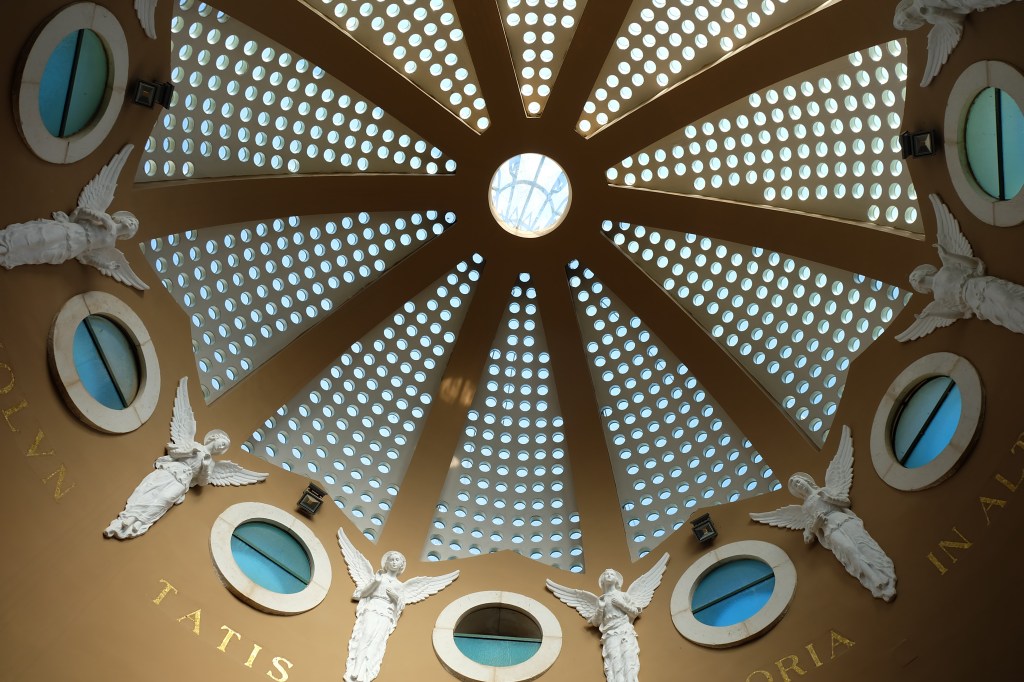
Photo by author, Dome of the Chapel of Nativity at Shepherd’s Field, Bethlehem, the Holy Land, May 2019.
Jesus continues his lessons to us his disciples being sent to look for the “lost sheep of Israel”, to be not afraid for he is with us in this journey and mission. But, it is not enough that we have Jesus on our side and be present among us: we have to allow Jesus to take possession of us completely!
From having no fear because Jesus is here, Christ now deepens his presence by inviting us to be possessed by him, to be in communion with him.
Jesus said to his disciples: “Whoever loves father and mother more than me is not worthy of me, and whoever loves son or daughter more than me is not worthy of me; and whoever does not take up his cross and follow after me is not worthy of me. Whoever finds his life will lose it, and whoever loses his life for my sake will find it.”
Matthew 10:37-39
Photo by author, processional Cross at the altar, 2019.
The Mystery of the Cross
Discipleship in Jesus Christ is more than a total allegiance to him who is neither a demanding nor exacting Lord and Master for he does not arbitrarily impose himself upon us.
Nothing like that of subservience but something more lofty because it is wrapped in a mystery — a mystery of love freely given and shared to us by God even if we do not deserve it all. Remember the mystery of the Blessed Trinity four Sundays ago (June 07)?
Ever since, God has never imposed himself upon us, that we should love him back in return for he does not really need our love. He gave us the gift of freedom so that we may love him freely for he never imposes on us.
And here lies the beauty of discipleship, of this relationship we have with God that is based solely on love expressed to us in the most personal manner by giving us his Son Jesus Christ who suffered and died on the Cross but rose again on Easter. This we were reminded by the Solemnities of the Body and Blood of Jesus and of his Sacred Heart last June 14 and 19 respectively.
Now you see my dear readers the clearer picture of our liturgical celebrations expressing our concrete experiences of being loved by God in Jesus Christ most especially during times of trials and sufferings like in this COVID-19 pandemic.
It is Christ who made the initiative to be one with us in our pains and sufferings; God did not remove our crosses in life but made them holy in his Son Jesus Christ so that every time we go through life’s many difficulties, we share in the Lord’s Passion, Death, and Resurrection.
That is why, we are invited to take and carry our cross every day for it is through the Cross we are saved. It is not enough to simply believe in the person of Jesus but we need to accept and embrace his Cross because it is through which he had won our salvation by dying on it and rising again.
This is easier said than done. It is so difficult to love Jesus more than our loved ones like family and friends. And it is most difficult to love the Lord more than our selves, when we have to let go of our plans and agenda.
Letting go and letting God in itself is already crucifying — but that is when this mystery of Christ’s love and of his Cross deepens further when we lose ourselves in him!
Celebrating Mass without te congregation during the ECQ, March-April 2020.
Possessed by Christ
To be possessed by Jesus is to receive God and his gift of salvation through the mystery of Christ and his Cross. Like our Christian life, proclaiming the gospel carries with it the sign of the Cross of Christ.
We are not asked to reenact or reproduce his Crucifixion nor is Jesus asking us to be suicidal or go against our natural aspirations and dreams.
To be possessed by Jesus means we continue to take care of ourselves without neglecting the needs of others.
To be possessed by Jesus means being generous to others in the same manner Jesus has always been generous to us.
To be possessed by Jesus means to realize that every act of self-giving is really an act of receiving!
Photo by author, Malagos Park, Davao City, 2018.
That is the paradox of the Cross, of discipleship in Christ: “Whoever finds his life will lose it, and whoever loses his life for my sake will find it” (Mt.10:40).
And that is also where the mystery of Christ’s love deepens because whatever we give is not really ours but Christ’s.
Every time we give love, it is the love of Jesus.
When we are kind and generous with others, it is the kindness and generosity of Jesus we give and share.
When we are patient and understanding to others, it is still the patience and understanding of Jesus in us.
Even if we give and share material things like money, food, clothing… whatever good we share and give are all from Jesus not from us.
And the more we give, the more we receive!
Have you noticed especially during this pandemic how the generous among us are now more blessed?
Wonder no more because you have allowed yourself to be possessed by Jesus Christ!
This is what the woman at Shumen had realized after welcoming the Prophet Elisha into her home in our first reading. She even gave him a room to stay every time he comes for his mission while the Lord provided all her needs, even rewarded her with a son as promised by Elisha.
When we allow Jesus to take over us, when we enter into communion in him and with him in his very life, we become more free to love, we strengthen our relationships with others, we wander less and worry less in life; most of all, we feel lightened in our burdens with the presence of Jesus giving us fullness of life in him.
This is the grace I hope we have seen from this quarantine period, especially those two months of lockdown when were freed from our usual grind and busyness with more time to be silent and still, to pray and reflect on our relationships with God and with others. It was a difficult and very trying period that had given in return a lot of opportunities to others.
Photo by author, Marcos Highway, 2019.
Dead to sin, alive to God
Brothers and sisters: We know that Christ, raised from the dead, dies no more; death no longer has power over him. As to his death, he died to sin once and for all; as to his life, he lives for God. Consequently, you too must think of yourselves as dead to sin and living for God in Christ Jesus.
Romans 6:9-11
It has been four months since houses of worship were ordered closed to help stop the spread of the corona virus. Somehow, the lockdown had made us realize the importance of receiving the Sacraments especially the Holy Eucharist.
But, sacraments are not everything for we have the bigger roles of putting into practice its reality of being the saving presence of Jesus Christ.
Now that lowly life is beginning to go back to its usual grind especially the traffic, soon we might forget again the more important things in life like God and our relationships in our family and friends that it is hoped we have rediscovered during the quarantine period.
That is why I strongly feel the government must now allow Churches to open so the people may experience again God in the sacraments and in our rites and rituals lest they get busy again with so many things only to miss finding anew the meaning of our lives found in silence and stillness before the Cross of Christ.
It is my hope that in this quarantine period, may we find through the Cross of Jesus that when we learn to submit and surrender to him, that is when we truly become free; and, when we lose and give away our lives to him, that is when we gain fullness of life in him. Amen.
A blessed week and a more abundant July to everyone!
The Lord Is My Chef Breakfast Recipe for the Soul by Fr. Nicanor F. Lalog II
Thursday, Week XIX in Ordinary Time, Year II, 04 June 2020
2 Timothy 2:8-15 ><)))*> ><)))*> ><)))*> Mark 12:28-34
Photo by Mr. Raffy Tima of GMA-7 News, 02 June 2020
Remind people of these things and charge them before God to stop disputing about words. This serves no useful purpose since it harms those who listen.
2 Timothy 2:14
Dear God:
For today I just wanted to be silent before you in prayer.
But, you spoke a lot in that silence. Or, did I?
You know very well, Lord, how we have been silent since the start of this quarantine period due to COVID-19 pandemic. We bore everything in silence as much as possible, giving our government officials and lawmakers a chance to redeem themselves.
After all, we are in this mess because of their refusal to listen what others have been saying for the safety of the country, speaking of diplomacy and friendships among the originators of COVID-19, not knowing two of them have been infected with corona while here visiting. One eventually became the first fatality of COVID-19 outside China.
Photo by author, our altar decor with a snake on first week of Lent, 2020.
Those in government have always been doing all the talking that has always been non-sense and rubbish. They thought that the more words they used, the more things get clearer.
That is the problem, Lord: those in government like many of us your people are not aware that your silence always precedes your speaking; that your words are full of power, full of life, the fullness of meaning because every word comes from silence.
We humans, especially our elected officials, are all speaking out of noise and void, not from silence which is fullness.
We keep on talking in the hope and belief that the more we talk, the more our words become meaningful.
Lately, it is the opposite that is happening: the more our government officials speak, the more their words become empty while their tongues get sharper like swords, inflicting more pain and causing more shame.
They speak of lies after lies after lies hoping they become true if repeatedly said but the more they are lost.
They speak so tough, complete with warning against violators of quarantine rules but they are the ones who fall into their own pit, becoming like dogs eating what they have spit.
They speak of opening shops and offices, but they are closed to the plight of the commuters.
Worst and most unkind of all, they speak shamelessly of blaming the people for all their woes in this time of pandemic quarantine while they were busy silencing us the people, closing ABS-CBN and just this week, surreptitiously passing the anti-terror bill that silences all critics of this administration mired in profanities, lies, and insincerity.
They make so many laws, using so many words, and yet not a single word proved to be good like the scribe who asked Jesus:
“Which is the first of all the commandments?”
Mark 12:28
Photo by Mr. Raffy Tima of GMA-7 News, commuters at start of lockdown, March 2020.
Lord God of power and might, you are the only we have always count on for our protection and salvation.
You know what is in our hearts and you know very well what we are willing to do if you just say so.
For the sake of peace in our country, let our leaders eat their words or at least, keep their mouths shut to stop all their shows and start to listen, accept and love.
The Lord Is My Chef Recipe for the Solemnity of Palm Sunday of the Lord’s Passion, 05 April 2020
Isaiah 50:4-7 >>+<< Philippians 2:6-11 >>+<< Matthew 26:14-27:66
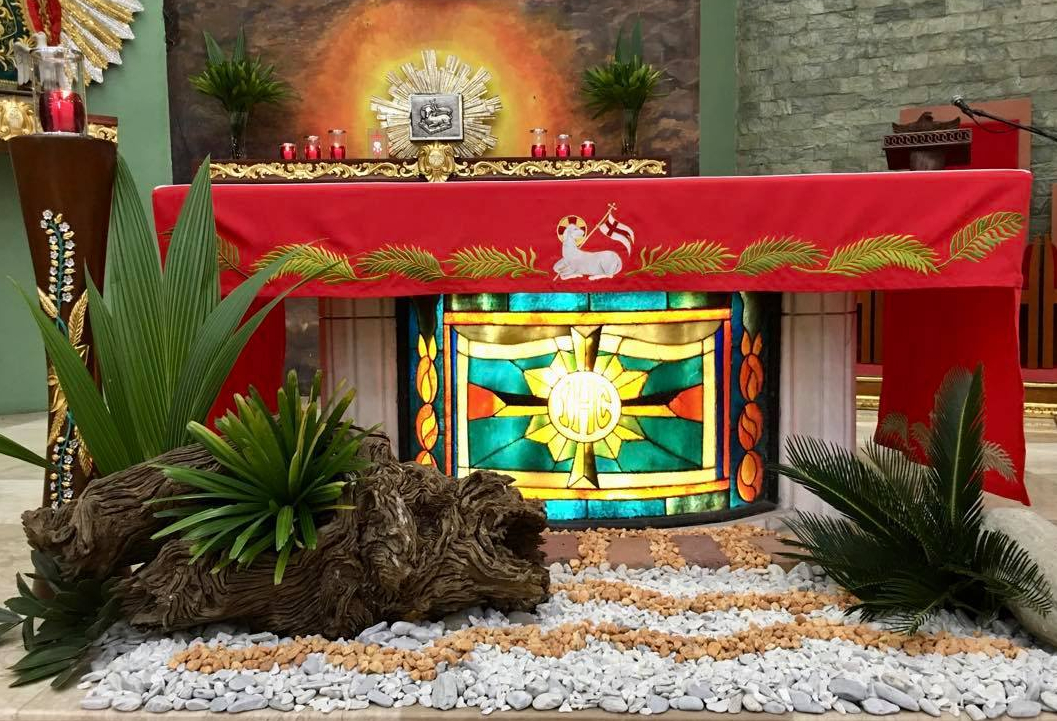
Photo by author, altar of Parokya ni San Juan Apostol at Ebanghelista, Bagbaguin, Sta. Maria, Bulacan, Palm Sunday 2020.
“Hosanna!” is the song of the day and despite the ongoing lockdown now entering its penultimate week, we have every reason to praise God this Solemnity of Palm Sunday in the Lord’s Passion.
Let us continue to sing “hosanna” even if our churches are closed due to threats of COVID-19 because even with all the difficulties arising from this enhanced community quarantine, it also gives us much needed time and space to reflect on the meaning of our Holy Week celebrations.
Let us make this Holy Week holy indeed so we may discover God anew in our sacred celebrations and right in our very hearts in this time of the corona pandemic.
The “ascent” to Jerusalem
Photo by author, ancient city of Jerusalem from the Church of Dominus Flevit (The Lord Wept) where Jesus came from towards the holy city via the eastern gate as prophesied in the Old Testament, May 2019.
Geographically speaking, to go to Jerusalem is to go up, to ascend to higher level as it rises to 754 meters above sea level (2,474 feet) compared with Galilee from where Jesus spent his three years of ministry which is just 209 meters (686 feet) above sea level.
Jesus Christ’s “trip to Jerusalem” was both literally and figuratively speaking an “ascent” in all aspects: he went up to Jerusalem to offer himself on the Cross to replace temple worship so people can finally worship in “truth and spirit” as he had told the Samaritan woman at Jacob’s well three Sundays ago.
More than the outward sign of ascending Jerusalem is the inner sign of Christ’s ascent in his outpouring of love for the Father and us.
That is the beautiful imagery of his triumphant entrance to Jerusalem which will reach its climax on Good Friday capped by the glorious Easter.
Every day, Jesus invites us to welcome him and most of all to join him in his ascent to Jerusalem, to the Father by forgetting one’s self, taking our crosses, and following the Lord in giving of self in love.
Now is the perfect time to sing “hosanna” – to welcome and follow Jesus in our inner ascent when everything and everyone is “down” due to COVID-19. The only way to rise again from this misery of the corona pandemic is to ascent in Jesus, with Jesus, and through Jesus.
For so long, we have been following the upward path of “social mobility” measured in income and material things without considering the emotional and spiritual imbalances that result in these worldly pursuits. In our rat race for higher productivity, more money and less costs, we have become distant from persons especially family. Now, we have to practice social distance not only to stop spread of virus but most of all, to realize anew that above all is always the human person.
And the best route to encounter each person is in Jesus Christ who leads us from Jerusalem to the Cross and into Easter; hence, the liturgies this Holy Week are the oldest and simplest we have in the Church so that we can truly sing “hosanna” and focus only to Jesus ever present to us.
Death and Love
Photo by author, parish altar, Lent 2019.
Now playing at Netflix is the fourth part of its hit series “Money Heist”. I had the chance to watch its first episode that opened with a scene of the professor escaping police in the forest with a narration by “Tokyo” trying to control the situation in the bank they have taken over. She said, “His (the professor) heart held two words that should not be together: love and death.”
Perfect sound bite for Palm Sunday of the Lord’s Passion – “two words that should not be together: love and death” when in fact, its opposite is the exact reality! For love to be very true, it must be willing to suffer and die as the Lord Jesus Christ had shown us more than 2000 years ago.
Love and death are always together! That is why we have a Holy Week leading to Easter!
It is a basic reality we have always tried to negate and escape that have only left us more empty and lost within. The undeniable sign of love is when we are able to love somebody more than our very self – and that includes willing to die for the beloved!
We can never ascend, never arise for as long as we have too much of self, like the characters opposite our Lord Jesus Christ this Holy Week.
One of the Twelve, who was called Judas Iscariot, went to the chief priests, and said, “What are you willing to give me if I hand him over to you?” They paid him thirty pieces of silver, and from that time on he looked for an opportunity to hand him over.
Matthew 26:14-16
Selflessness and silence of Jesus, Selfishness of man
Palm Sunday in our parish 2020.
One distinct characteristic of Jesus throughout his life that is most especially clear from Palm Sunday to Good Friday is his selflessness and silence in the face of too much pressure and suffering.
Rather than being a sign of weakness, it is Jesus Christ’s shining moment of mastery and control as we have noted last Sunday when he cried in meeting Martha and Mary at the tomb of Lazarus who had been dead for four days.
This becomes more evident starting this Sunday reaching its highest point on Good Friday to be capped by his glorious Resurrection on Easter.
See how during his entrance and ascent into Jerusalem, Jesus was silent. Because he knew what was going to happen! He was even looking forward into it.
His entrance into Jerusalem to assert his being the Christ by offering himself on the Cross is the culmination of what St. Luke had noted in his account early on at Caesarea Philippi that “when the days of his going up to heaven was nearing completion, Jesus resolutely journeyed to Jerusalem.”
Despite the dangers and the certainty of death, Jesus did not balk nor even thought of backing out. He resolutely went into his death because of his immense love for us and the Father. He never cracked under pressure!
Even during his trials first before the Sanhedrin and before Pontius Pilate, there was the mastery and surety of Jesus very evident in his silence. He was totally composed, wholly entrusting himself in total obedience to the Father in heaven.
How about us these days of lockdown in the face of the growing threats of COVID-19?
What a shame that our officials and their families finally revealed their true colors as the modern Judas Iscariots seeking VIP treatment for COVID-19 testing! So afraid of dying because love they have none whatsoever for the country and the people but for themselves alone.
From a Facebook post of my friend .
Like Judas, they think only of themselves, keeping their loot of more than 30 pieces of silver, looking for the opportune time to betray us again, totally quiet in the comfort of their homes when thousands are facing hunger and uncertainties.
They are the modern Pontius Pilates who mumble in public, who could not make a definitive stand on anything at all, more at home in accusing and blaming others for the confusions and lack of order, always washing their hands, without guts to humbly accept lack of foresight despite the grave dangers that did not happen overnight.
Most of all, look inside ourselves too for those moments we think more of “what we can have” than “what we can give or do” in these trying times? Do we hoard and panic buy? Do we cower in fear by hiding it with our anger and demands for assistance and relief goods?
Above is a nice guide I found on my friend’s Facebook, indicating three zones to show where are in the midst of COVID-19 pandemic. It can be very useful too in indicating where we can meet Jesus in ascending and entering Jerusalem to fulfill his mission and our mission too.
Entering Jerusalem, entering Jesus
My daily Mass attendees since the lockdown.
When the Luzon lockdown started last March 18, I cried on my first Mass: it was simply unbelievable – until now – for me celebrating Mass without people because a Mass always presupposes people and community to celebrate Christ’s presence!
But now, everybody is gone.
Except me. And the birds who keep constant company for me.
Every morning after pealing our bell as I celebrate Mass alone, I bow before the giant crucifix looming above our altar and look on the metal engraving of the Lamb of God on the cover of our Tabernacle where the Blessed Sacrament of Jesus is kept.
This week as I looked more often onto the lamb during prayer periods, I felt it to be looking at me too. That’s when I realized how the lamb perfectly signifies Jesus Christ entering Jerusalem, the “Suffering Servant” of God prophesied by Isaiah in the first reading today. But what struck me most is the song’s latter part not included in our first reading, referring to Jesus Christ:
Though he was harshly treated, he submitted and opened not his mouth; Like a lamb led to the slaughter or a sheep before the shearers, he was silent and opened not his mouth.
Isaiah 53:7
That lamb is indeed Jesus Christ, coming to us day in, day out in the Holy Eucharist we priests continue to celebrate even if our churches are closed. Every day especially in the Mass, Jesus invites us to ascend with him to the Father, little by little with our selfless acts of charity and kindness to others.
Looking into that lamb of our Tabernacle, I see the eyes of Jesu telling me how much he loves me, how much he has forgiven me from my sins despite his knowing me through and through.
And that is Jesus Christ: always silent, gazing with his eyes full of love, full of knowledge about us and what’s going to happen next, inviting us to join him, to come with him to ascend to our higher selves especially in this time of crisis. All despite his knowing our sins because he sees us too with eyes full of mercy!
These my dear readers are more enough reasons to sing “hosanna” today despite the many difficulties and uncertainties around us because Jesus is with us and will never leave us especially when we reach the cross. Amen.












 lordmychef.com