The Lord Is My Chef Breakfast Recipe for the Soul by Fr. Nicanor F. Lalog II
Thursday, Week XIX in Ordinary Time, Year II, 04 June 2020
2 Timothy 2:8-15 ><)))*> ><)))*> ><)))*> Mark 12:28-34
Photo by Mr. Raffy Tima of GMA-7 News, 02 June 2020
Remind people of these things and charge them before God to stop disputing about words. This serves no useful purpose since it harms those who listen.
2 Timothy 2:14
Dear God:
For today I just wanted to be silent before you in prayer.
But, you spoke a lot in that silence. Or, did I?
You know very well, Lord, how we have been silent since the start of this quarantine period due to COVID-19 pandemic. We bore everything in silence as much as possible, giving our government officials and lawmakers a chance to redeem themselves.
After all, we are in this mess because of their refusal to listen what others have been saying for the safety of the country, speaking of diplomacy and friendships among the originators of COVID-19, not knowing two of them have been infected with corona while here visiting. One eventually became the first fatality of COVID-19 outside China.
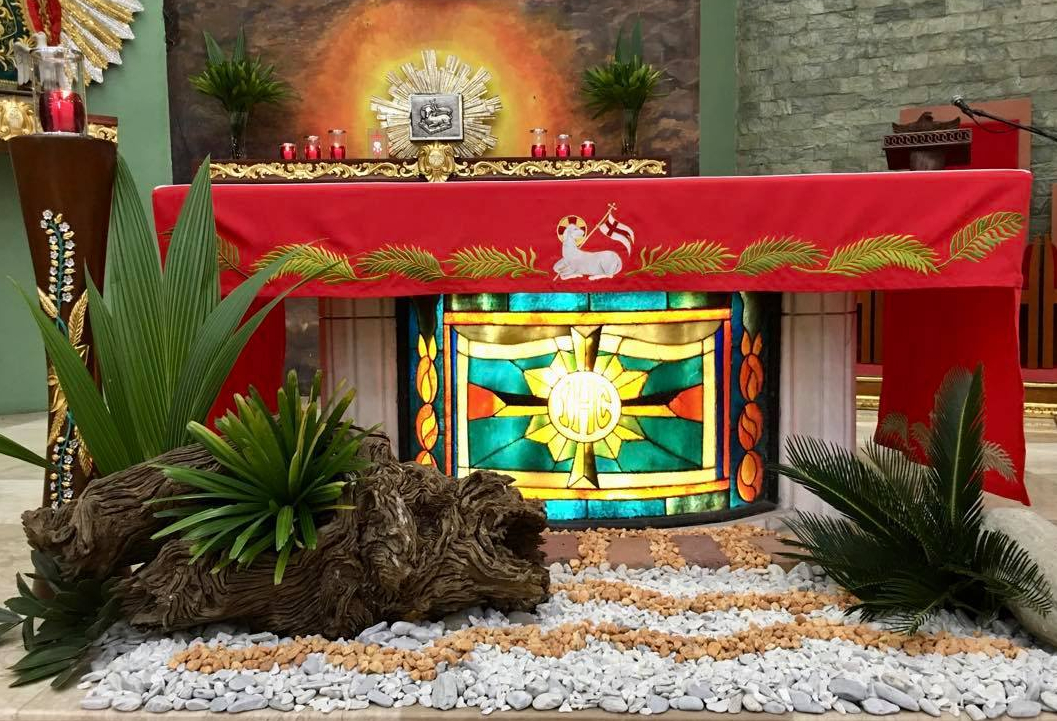
Photo by author, our altar decor with a snake on first week of Lent, 2020.
Those in government have always been doing all the talking that has always been non-sense and rubbish. They thought that the more words they used, the more things get clearer.
That is the problem, Lord: those in government like many of us your people are not aware that your silence always precedes your speaking; that your words are full of power, full of life, the fullness of meaning because every word comes from silence.
We humans, especially our elected officials, are all speaking out of noise and void, not from silence which is fullness.
We keep on talking in the hope and belief that the more we talk, the more our words become meaningful.
Lately, it is the opposite that is happening: the more our government officials speak, the more their words become empty while their tongues get sharper like swords, inflicting more pain and causing more shame.
They speak of lies after lies after lies hoping they become true if repeatedly said but the more they are lost.
They speak so tough, complete with warning against violators of quarantine rules but they are the ones who fall into their own pit, becoming like dogs eating what they have spit.
They speak of opening shops and offices, but they are closed to the plight of the commuters.
Worst and most unkind of all, they speak shamelessly of blaming the people for all their woes in this time of pandemic quarantine while they were busy silencing us the people, closing ABS-CBN and just this week, surreptitiously passing the anti-terror bill that silences all critics of this administration mired in profanities, lies, and insincerity.
They make so many laws, using so many words, and yet not a single word proved to be good like the scribe who asked Jesus:
“Which is the first of all the commandments?”
Mark 12:28
Photo by Mr. Raffy Tima of GMA-7 News, commuters at start of lockdown, March 2020.
Lord God of power and might, you are the only we have always count on for our protection and salvation.
You know what is in our hearts and you know very well what we are willing to do if you just say so.
For the sake of peace in our country, let our leaders eat their words or at least, keep their mouths shut to stop all their shows and start to listen, accept and love.
The Lord Is My Chef Recipe for the Solemnity of Palm Sunday of the Lord’s Passion, 05 April 2020
Isaiah 50:4-7 >>+<< Philippians 2:6-11 >>+<< Matthew 26:14-27:66
Photo by author, altar of Parokya ni San Juan Apostol at Ebanghelista, Bagbaguin, Sta. Maria, Bulacan, Palm Sunday 2020.
“Hosanna!” is the song of the day and despite the ongoing lockdown now entering its penultimate week, we have every reason to praise God this Solemnity of Palm Sunday in the Lord’s Passion.
Let us continue to sing “hosanna” even if our churches are closed due to threats of COVID-19 because even with all the difficulties arising from this enhanced community quarantine, it also gives us much needed time and space to reflect on the meaning of our Holy Week celebrations.
Let us make this Holy Week holy indeed so we may discover God anew in our sacred celebrations and right in our very hearts in this time of the corona pandemic.
The “ascent” to Jerusalem
Photo by author, ancient city of Jerusalem from the Church of Dominus Flevit (The Lord Wept) where Jesus came from towards the holy city via the eastern gate as prophesied in the Old Testament, May 2019.
Geographically speaking, to go to Jerusalem is to go up, to ascend to higher level as it rises to 754 meters above sea level (2,474 feet) compared with Galilee from where Jesus spent his three years of ministry which is just 209 meters (686 feet) above sea level.
Jesus Christ’s “trip to Jerusalem” was both literally and figuratively speaking an “ascent” in all aspects: he went up to Jerusalem to offer himself on the Cross to replace temple worship so people can finally worship in “truth and spirit” as he had told the Samaritan woman at Jacob’s well three Sundays ago.
More than the outward sign of ascending Jerusalem is the inner sign of Christ’s ascent in his outpouring of love for the Father and us.
That is the beautiful imagery of his triumphant entrance to Jerusalem which will reach its climax on Good Friday capped by the glorious Easter.
Every day, Jesus invites us to welcome him and most of all to join him in his ascent to Jerusalem, to the Father by forgetting one’s self, taking our crosses, and following the Lord in giving of self in love.
Now is the perfect time to sing “hosanna” – to welcome and follow Jesus in our inner ascent when everything and everyone is “down” due to COVID-19. The only way to rise again from this misery of the corona pandemic is to ascent in Jesus, with Jesus, and through Jesus.
For so long, we have been following the upward path of “social mobility” measured in income and material things without considering the emotional and spiritual imbalances that result in these worldly pursuits. In our rat race for higher productivity, more money and less costs, we have become distant from persons especially family. Now, we have to practice social distance not only to stop spread of virus but most of all, to realize anew that above all is always the human person.
And the best route to encounter each person is in Jesus Christ who leads us from Jerusalem to the Cross and into Easter; hence, the liturgies this Holy Week are the oldest and simplest we have in the Church so that we can truly sing “hosanna” and focus only to Jesus ever present to us.
Death and Love
Photo by author, parish altar, Lent 2019.
Now playing at Netflix is the fourth part of its hit series “Money Heist”. I had the chance to watch its first episode that opened with a scene of the professor escaping police in the forest with a narration by “Tokyo” trying to control the situation in the bank they have taken over. She said, “His (the professor) heart held two words that should not be together: love and death.”
Perfect sound bite for Palm Sunday of the Lord’s Passion – “two words that should not be together: love and death” when in fact, its opposite is the exact reality! For love to be very true, it must be willing to suffer and die as the Lord Jesus Christ had shown us more than 2000 years ago.
Love and death are always together! That is why we have a Holy Week leading to Easter!
It is a basic reality we have always tried to negate and escape that have only left us more empty and lost within. The undeniable sign of love is when we are able to love somebody more than our very self – and that includes willing to die for the beloved!
We can never ascend, never arise for as long as we have too much of self, like the characters opposite our Lord Jesus Christ this Holy Week.
One of the Twelve, who was called Judas Iscariot, went to the chief priests, and said, “What are you willing to give me if I hand him over to you?” They paid him thirty pieces of silver, and from that time on he looked for an opportunity to hand him over.
Matthew 26:14-16
Selflessness and silence of Jesus, Selfishness of man
Palm Sunday in our parish 2020.
One distinct characteristic of Jesus throughout his life that is most especially clear from Palm Sunday to Good Friday is his selflessness and silence in the face of too much pressure and suffering.
Rather than being a sign of weakness, it is Jesus Christ’s shining moment of mastery and control as we have noted last Sunday when he cried in meeting Martha and Mary at the tomb of Lazarus who had been dead for four days.
This becomes more evident starting this Sunday reaching its highest point on Good Friday to be capped by his glorious Resurrection on Easter.
See how during his entrance and ascent into Jerusalem, Jesus was silent. Because he knew what was going to happen! He was even looking forward into it.
His entrance into Jerusalem to assert his being the Christ by offering himself on the Cross is the culmination of what St. Luke had noted in his account early on at Caesarea Philippi that “when the days of his going up to heaven was nearing completion, Jesus resolutely journeyed to Jerusalem.”
Despite the dangers and the certainty of death, Jesus did not balk nor even thought of backing out. He resolutely went into his death because of his immense love for us and the Father. He never cracked under pressure!
Even during his trials first before the Sanhedrin and before Pontius Pilate, there was the mastery and surety of Jesus very evident in his silence. He was totally composed, wholly entrusting himself in total obedience to the Father in heaven.
How about us these days of lockdown in the face of the growing threats of COVID-19?
What a shame that our officials and their families finally revealed their true colors as the modern Judas Iscariots seeking VIP treatment for COVID-19 testing! So afraid of dying because love they have none whatsoever for the country and the people but for themselves alone.
From a Facebook post of my friend .
Like Judas, they think only of themselves, keeping their loot of more than 30 pieces of silver, looking for the opportune time to betray us again, totally quiet in the comfort of their homes when thousands are facing hunger and uncertainties.
They are the modern Pontius Pilates who mumble in public, who could not make a definitive stand on anything at all, more at home in accusing and blaming others for the confusions and lack of order, always washing their hands, without guts to humbly accept lack of foresight despite the grave dangers that did not happen overnight.
Most of all, look inside ourselves too for those moments we think more of “what we can have” than “what we can give or do” in these trying times? Do we hoard and panic buy? Do we cower in fear by hiding it with our anger and demands for assistance and relief goods?
Above is a nice guide I found on my friend’s Facebook, indicating three zones to show where are in the midst of COVID-19 pandemic. It can be very useful too in indicating where we can meet Jesus in ascending and entering Jerusalem to fulfill his mission and our mission too.
Entering Jerusalem, entering Jesus
My daily Mass attendees since the lockdown.
When the Luzon lockdown started last March 18, I cried on my first Mass: it was simply unbelievable – until now – for me celebrating Mass without people because a Mass always presupposes people and community to celebrate Christ’s presence!
But now, everybody is gone.
Except me. And the birds who keep constant company for me.
Every morning after pealing our bell as I celebrate Mass alone, I bow before the giant crucifix looming above our altar and look on the metal engraving of the Lamb of God on the cover of our Tabernacle where the Blessed Sacrament of Jesus is kept.
This week as I looked more often onto the lamb during prayer periods, I felt it to be looking at me too. That’s when I realized how the lamb perfectly signifies Jesus Christ entering Jerusalem, the “Suffering Servant” of God prophesied by Isaiah in the first reading today. But what struck me most is the song’s latter part not included in our first reading, referring to Jesus Christ:
Though he was harshly treated, he submitted and opened not his mouth; Like a lamb led to the slaughter or a sheep before the shearers, he was silent and opened not his mouth.
Isaiah 53:7
That lamb is indeed Jesus Christ, coming to us day in, day out in the Holy Eucharist we priests continue to celebrate even if our churches are closed. Every day especially in the Mass, Jesus invites us to ascend with him to the Father, little by little with our selfless acts of charity and kindness to others.
Looking into that lamb of our Tabernacle, I see the eyes of Jesu telling me how much he loves me, how much he has forgiven me from my sins despite his knowing me through and through.
And that is Jesus Christ: always silent, gazing with his eyes full of love, full of knowledge about us and what’s going to happen next, inviting us to join him, to come with him to ascend to our higher selves especially in this time of crisis. All despite his knowing our sins because he sees us too with eyes full of mercy!
These my dear readers are more enough reasons to sing “hosanna” today despite the many difficulties and uncertainties around us because Jesus is with us and will never leave us especially when we reach the cross. Amen.
Photo from catholicworldreport.com, “The Beheading of St. John the Baptist” (1869) by Pierre Puvis de Chevannes.
Your gospel today, O Lord, is so appropriate and timely: while we were busy, albeit foolishly discussing the novel coronavirus in every fora, a technical committee in the House of Representatives has approved three measures seeking to legalize divorce in the country.
We do not know what have really happened but it is so sad that no one among the Catholic and Christian lawmakers there made a solid stand against these measures like St. John the Baptist who was imprisoned on account of his objection to Herod’s taking of his brother’s wife Herodias.
So many times, Lord, we are so afraid and worried of what others might say against us when we make a stand for what is right and just, for what is proper and decent, for what is right and good, for what is your will.
Worst, O Lord, many of us are like Herodias who have prostituted our very selves in the service of the worldly allures of sex, fame, and wealth, choosing to be silent with all the many immoralities going on in government, in the society, and even in the church!
Give us the same courage, Lord, you have given your precursor St. John the Baptist to be prophets in this modern age, to be a voice in the wilderness, making a stand for what is holy, true, and just.
Like David, may we always seek your ways, ask for your grace to do your will against the giants and monsters of this world who ram into us every modern thought and idea that disregard the sanctity of life, the value of every person, as well as the sanctity of marriage.
Let us not be silent anymore with the growing impunity of many in their arrogant display of authority, throwing their weight around us with their cuss words and fallacious arguments that dignify their truncated egos and pride for the sake of progress and modernity. Amen.
1 Samuel 1:9-20 ><)))*> ><)))*> ><)))*> Mark 1:21-28
Inside our church from the altar table. Photo by author, November 2019.
Hanna replied to Eli, “Think kindly of your maidservant,” and she left..
1 Samuel 1:18
While praying over your words, O Lord, of that scene at the temple when Eli mistook Hannah to being drunk while praying intensely to you for a child, it reminded me of Taal Volcano’s restive behavior, of her spewing ashes and causing tremors.
But despite all these, Taal remains lovely and magnificent.
Sometimes, Lord, that is what exactly we need in life: to think kindly of others always.
The people were astonished at his teaching, for he taught them as one having authority and not as the scribes. All were amazed and asked one another, “What is this? A new teaching with authority. He commands even the unclean spirits and they obey him.”
Mark 1:22, 27
Purify our thoughts, Lord, to always think kindly of others.
To always have that disposition for silence and being non-judgmental with others to always listen to them and be open to their thoughts and feelings as well.
Like you, Lord Jesus Christ, enable us to share in the power of your words, to speak with authority by entering into that daily union with you in silence and prayers.
May we learn also from the gentle Taal: to be still and silent, to speak only when necessary so that everyone listens intently to her inner rumblings when she finally “speaks”.
We continue to pray for those severely affected by Taal’s eruptions, most especially that they may remain kind with people and nature alike in this trying moments of a major calamity.
We pray for businessmen to have a heart, to think kindly of those affected by Taal’s eruptions and stop jacking up prices of much needed goods. Amen.
Quiet Storm by Fr. Nicanor F. Lalog II, 27 December 2019
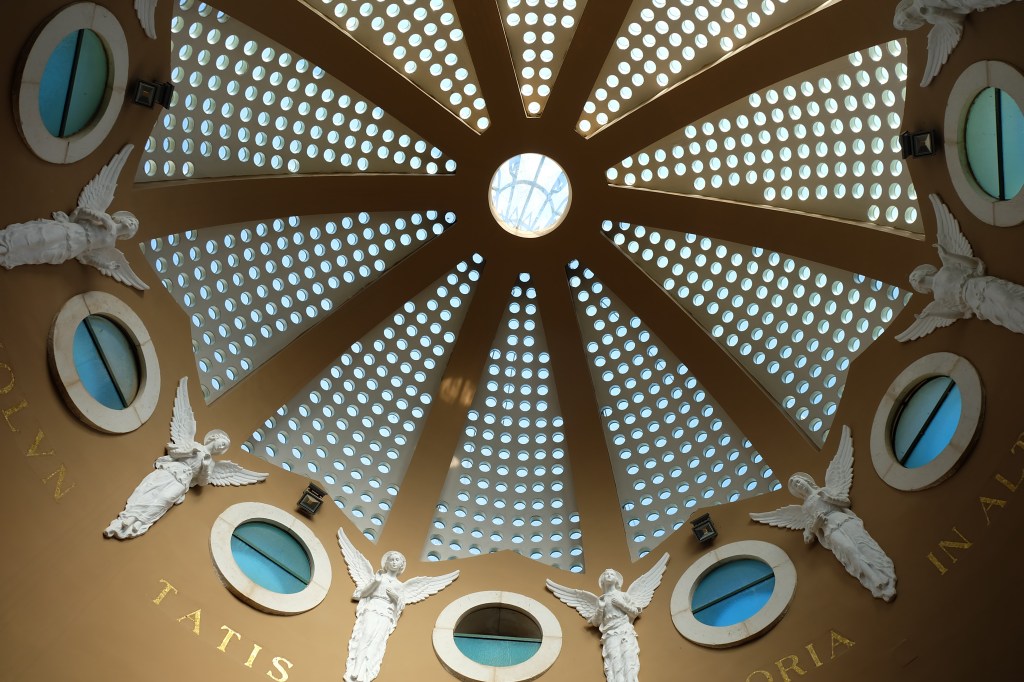
Dome of the chapel at Shepherd’s Field near Bethlehem where the angels appeared to some shepherds to announce the birth of Jesus Christ more than 2000 years ago.
By this time, many of you must have opened the gifts you have received this Christmas. Some are happy, some are not – even disappointed – while there are others who simply do not care at all with the gifts they have received.
But gifts are not everything. What really matters most are the persons and the love and thoughts that come with every gift we have received this blessed season.
Below are some spiritual gifts I feel we need to be thankful too!
The “little door” that leads into the Church of Nativity in Bethlehem that has come to mean the need to bow low and be humble in order to meet Jesus Christ not only inside but also in our daily life. Photo by author, May 2019.
The gift of hope. Hope is not thinking positively that things can get better like the weather. Hope is having a firm belief that even if things get worst, there is God who always loves us, who takes care of us. People with hope always look forward in the future whether here or in eternal life. They are also the most loving people around, the most understanding and most forgiving. They always strive, work hard to make things better for them and for others. Those without hope are the most evil: they will kill and destroy everything and everyone because they have nothing to look forward to in this life or hereafter. The kind of life we live always indicates the kind of hope we have. Or do not have.
The gift of desert. Sometimes, life becomes a desert for us, when we are desolate and so barren with everything dry and even lifeless. But it is during our desert moments in life when we not only meet our true selves but most of all, that is when we meet God. It is in this meeting with God in our desert we experience healing from all our hurts and disappointments in life. We need to withdraw once in a while to our desert to silently pray in order to hear God’s voice anew in our inner selves. In our mass mediated world today when we are bombarded with wants and needs to be rich and famous, the more we end up empty and lost. But when we dare stay in our desert and try to listen in silence, the more we are attuned with life’s realities, the more we are enriched and deepened in our lives.
The gift of intimacy. From our desert experiences of barrenness and desolation, of silence and prayer, and a lot of reflections and introspections come the great gift of intimacy with God and with others. We come to realize who our true friends are when our chips are down, when we are alone and badly bruised and beaten in life. How ironic that when we are so filled with material things, that is when life for us becomes superficial and shallow. But whenever we go through many desert storms, that is when we come to realize the most important in life – the persons who have touched us for better or for worse, the persons who make us experience to be loved and to love.
An oasis at the Dead Sea desert. Photo by author, May 2017.
We shall continue with our other lists of spiritual gifts this Christmas tomorrow.
How about you, what are the spiritual gifts you wish to share with us that may also help us deepen our Christmas celebrations this 2019?
The Lord Is My Chef Simbang Gabi Recipe, 19 December 2019
Judges 13:2-7, 24-25 ><)))*> ><)))*> ><)))*> Luke 1:15-25
The Walls of Jerusalem, May 2019. Photo by the author.
From St. Matthew, we now move to the Christmas story by St. Luke that starts in the temple of Jerusalem. And surprisingly, not precisely with Jesus or his parents.
In the days of Herod, King of Judea, there was a priest named Zechariah of the priestly division of Abijah; his wife was from the daughters of Aaron, and her name was Elizabeth. Both were righteous in the eyes of God, observing all the commandments and ordinances of the Lord blamelessly. But they had no child, because Elizabeth was barren and both were advanced in years. Once when he was serving as priest in his division’s turn before God, according to the practice of the priestly service, he was chosen by lot to enter the sanctuary of the Lord to burn incense. Then, when the whole assembly of the people was praying outside at the hour of the incense offering, the angel of the Lord appeared to him, standing at the right of the altar of incense.
Luke 1:5-11
We know what happened, of how Zechariah doubted the good news announced to him about the birth of his son John the Baptizer.
Many times in our lives, especially in this age of too much communications in the social media where everything is exposed, we hardly notice the best and nicest things in life happening in silence, mostly in hiddenness.
And the saddest part of this present reality is that it is God whom we miss in this “overexposures” we have in social media because he always comes to us hidden in the most ordinary and simple things in life.
Yesterday St. Joseph taught us the need to value silence and stillness in the Lord as an important lesson in facing life’s many adversarial situations.
Today we hear Zechariah forcibly silenced to experience the Lord’s power and grace, his very presence in fact.
An inside section of the remaining Walls of Jerusalem. Photo by author, May 2019.
God’s presence hidden in our time and space
Advent is the season that reminds us that God comes to us always hidden in our very time and space. Unless we know how to be silent and simple, we shall never experience the Divine presence that has covered the whole world ever since.
Of the four evangelists, St. Luke is the only one who claims to have “investigated everything accurately” about the life and teachings of Jesus Christ (Lk.1:3). That is why he has the most stories and details about Christmas.
For St. Luke, Christmas begins with the coming of St. John the Baptizer, Jesus Christ’s precursor. In a very unique manner, he tells us how God’s presence came through a husband and wife yearning so much to have a child of their own, Zechariah and Elizabeth, both belonging to the upper crust of the Jewish society having descended from the priestly families.
In fact, Zechariah was a priest who was so blessed that Day of Atonement known as the Yom Kippur of the Jews that happens around September 18-24. (That is how we come to celebrate Christmas on December 25: Elizabeth conceived John in September, giving birth to him in June 24; tomorrow, we shall hear in the Annunciation to Mary that Elizabeth was six months pregnant which falls on March 24. Simple math, we arrive at December 25 as Christ’s birthdate.)
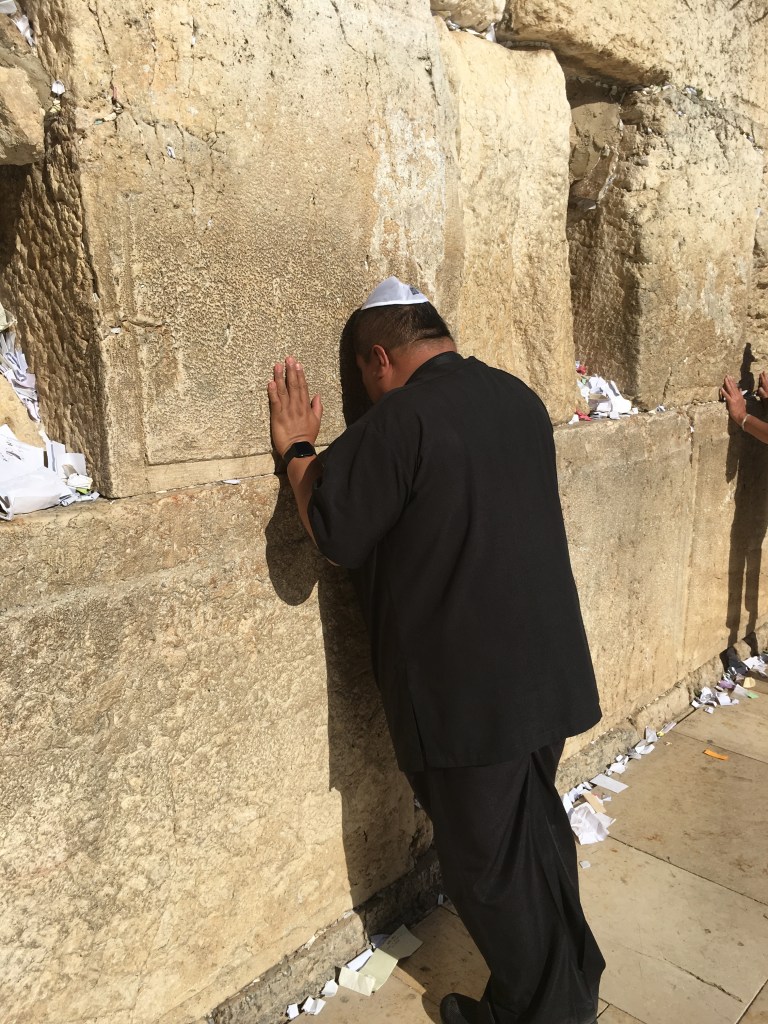
Praying at the Wall, May 2019.
During the Yom Kippur, priests drew lots on who would incense the Holy of Holies where the “Ark of the Covenant” was kept containing the stone tablets of God’s commandments given to Moses. It was the closest thing they have as signs of God’s presence among them. Hence, until now they venerate and pray at the “wailing Wall” of Jerusalem because that is supposed to be the only remaining structure of their temple destroyed in 70 AD closest to that part of the Holy of Holies.
It was so rare at that time to be assigned to incense the Holy of Holies because there were so many priests drawing lots and only one would be chosen for the rite that happens about twice daily for the whole week. It was a tremendous blessing indeed to be chosen to incense the Holy of Holies.
Here we find St. Luke setting the stage of his Christmas story to remind us all that God comes right into our time and space, in our history, in our here and now.
See his descriptions:
It happened in a specific time during during “the days of Herod, King of Judea”, when Zechariah was “chosen by lot to enter the sanctuary of the Lord to burn incense” while people were outside praying and waiting.
It happened in a specific place, the temple of Jerusalem.
Most of all, it happened to real people, “Zechariah of the priestly division of Abijah; his wife Elizabeth was from the daughters of Aaron.”
A view from the Walls of Jerusalem of the Jewish section; dome is the Moslem section, Mount of Olives at the background. Photo by author, May 2017.
The Presence of God, the Absence of Man
When we are deeply hurt and disappointed, we are usually less rational. Worst, although we try to keep our faith alive, that is also when we doubt God, refusing to recognize his presence among us, and even right in us.
In this story of the annunciation of the birth of John the Baptizer, we find God giving Zechariah the tremendous grace to approach his Divine presence by having the rare opportunity to incense the Holy of Holies.
Most of all, at their most important feast when priests gather in the temple to pray for the people and for their personal intentions, God sent Zechariah the angel Gabriel to personally tell him his and Elizabeth’s prayers have been heard and granted!
But what happened? Zechariah doubted, even questioned God!
“How shall I know this? For I am an old man, and my wife is advanced in years.”
Luke 1:18
That’s the problem with us: God is always present but we are always absent that we never meet him. And every time he comes to visit us, we are so busy with so many other things.
If we cannot see and experience God in the most ordinary things and events in our lives, nothing would be enough to convince us of his love and mercy, of his presence and power.
That is why Zechariah was silenced by the angel, who, by the way, is already the presence of God yet Zechariah doubted.
This remaining week before Christmas, let us try to have some silence, or better, let us create a space for silence and solitude to experience God’s loving presence among us, in us.
It is only in silence where we can truly learn how to trust and be intimate with God and with our loved ones because it is only in silence where we can dare to open our selves to God and to others.
Let “the spirit of the Lord stir” you like Samson in the first reading (Jgs.13:25) this Christmas by creating silent moments with Jesus. Amen.
Photo by Mr. Jim Marpa at Panglao, Bohol, September 2019.
Which is more difficult to confront, the fact of dying or that of suffering through a serious sickness? I have been thinking these for the past couple of days following my recent visitations of sick parishioners.
Today I visited a parishioner sick for the past three months with a lung disease. She’s 76 years old.
Right upon seeing me, Lola Milagros cried, telling me to ask God to take her because she’s so tired of suffering and waiting for death.
I just let her cry, holding her hands, as I listened to her pouring out of her aches and pains.
After that, I whispered to her the words of St. Teresa de Avila whose feast we are also celebrating today:
Nada te turbe… Solo Dios basta! (Let nothing disturb you… only God suffices!)
St. Teresa De Avila
So beautiful to hear and yes, easier said than done.
Can anybody with a serious ailment be not disturbed?
Been asking myself the same questions too. It is difficult not to be disturbed when one is sick. Aside from the costs of treatment are the enormous pains and sufferings one has to go through with the medical procedures and its many effects to the patient, who eventually would die.
It is a reality getting closer to home with me and I must confess, I am disturbed. Worried. And afraid.
The other week I visited another sick parishioner named Charlie, a former cook paralysed waist down due to a spine injury. He is only in his early 50’s.
What struck me when I saw him were the ropes tied to his both feet. I could not figure out how he could be restless when he is paralysed that his feet have to be tied?
He explained, “Father, I pity my wife when I have to wake her up every night just to move my legs. So, I improvised these ropes tied to my feet so I can just pull them with my hands in case I have to change positions even at night.”
Oh God! What a great love of a man to his wife!
Charlie loves his wife so much that he does not want her to be disturbed with his ailment and condition.
When there is love, we are not disturbed. And the only true love that can make us undisturbed is the love of Jesus Christ, the only perfect love we can have and find.
Whenever we think of Christ we should recall the love that led him to bestow on us so many graces and favors, and also the great love God showed in giving us in Christ a pledge of his love; for love calls for love in return. Let us strive to keep this always before our eyes and to rouse ourselves to love him. For if at some time the Lord should grant us the grace of impressing his love on our hearts, all will become easy for us and we shall accomplish great things quickly and without effort.
St. Teresa de Avila
“Love calls for love in return.”
So beautiful words by St. Teresa de Avila.
We can only truly feel that personal love of Jesus if we are also personally in love with him.
We are disturbed with so many things in life when there is not enough love in our hearts, when we have not felt loved enough by others too.
Without love, we would always be disturbed.
I told Lola Milagros this morning to thank God for the gift of tears because they are prayers coming straight from her heart. That God knows very well all her pains and sufferings. Most of all, I told her tears are clear signs of love in her heart.
Later on my way home, Lola Milagros’ daughter was also teary-eyed as she told me she was so glad to see her mother cried. According to her, Lola Milagros is a very tough woman of the “old school” who tried to bear everything and even hide what’s inside her so as not to disturb them. She always wanted them to be assured all’s fine.
Lola Milagros and Charlie do not want to disturb their respective family because they love them. It is love that moves the sick not to disturb others and it is also love that enables us to assure them not to be disturbed.
The challenge therefore is not to reflect on whether to die instantly or slowly but to always love truly!
Sacred Heart Novitiate (Novaliches), 2017.
Human love is always imperfect. Only God can love us perfectly. This he did exactly to us when he sent us Jesus Christ who died on the Cross for us.
To love truly is be personally one in Jesus Christ. When we were still seminarians, Fr. Memeng used to tell us in our class “Priestly Spirituality” that “if we can really cultivate a deep prayer life, we can also experience Jesus Christ in the most personal way.” It is the experience of St. Teresa de Avila and all the other saints.
Nothing can disturb us in this life when our love is borne out of a personal relationship with Jesus in prayer.
Prayer life is more than reciting prayers by following a schedule. Prayer life is a relationship, a communing with God, of being our true selves before him, seeing ourselves as he sees us. And because of this assurance of his love despite our many sins and flaws, that is when we are not disturbed because God loves us no matter what.
When we are not disturbed, then we become silent. Presence is more than enough to share and experience God’s love. St. Paul said “love is not pompous” because true love is always silent, more on deeds than on words.
One thing amusing with death is that it always comes in silence, when we least expect it. Whether we die instantly or slowly, it always happens in silence. And that is also why many are disturbed of dying.
But, if we love patiently our self, others and God, nothing can ever disturb us because when we love, we are already in God. That is when we realize too the wisdom and truth of St. Teresa’s contemporary who claimed that
A soul that walks in love is neither tired nor gets tired.
San Juan dela Cruz
From Google.
Let us love, love, and love until the end onto eternity.
We Filipinos have an expression that best captures the faith of Easter experience, something very close with the universal expression “aha!”. It is what I call as the “a basta!” experience.
From the Spanish word “basta” which means “enough” like what St. Teresa of Avila said in her poem, “Solo Dios basta” (Only God is enough/suffices), our “a basta!” expression is often used to insist on something to be accepted as true. Its closest English equivalent is “that’s it” to show that the issue at hand is settled because I have confessed it so.
On this octave of Easter which means eternity (because there are only seven days in a week but if you count the days since Easter, this Sunday is the eighth, an octave), the beloved disciple reminds us that Jesus said other things not recorded in his book; and most likely, he had had other appearances too not recorded simply because they are impossible to do. According to John, these were all written so we may all believe Jesus is the Christ and have eternal life in him. Moreover, there is no need for him to go into so many details about the appearances of Jesus after his Resurrection because what really matters most is the intensity of his presence. It is from that intensity of his presence we derive that “a basta!” experience of him. To be open to accept such intense moments of Christ’s presence leads us to deeper faith in him and eventually, to a relationship with him and in a community.
Thomas meets the Risen Jesus. From Google.
Now a week later his disciples were again inside and Thomas was with them. Jesus came, although the doors were locked, and stood in their midst and said, “Peace be with you.” Then he said to Thomas, “Put your finger here and see my hands, and bring your hand and put it into my side, and do not be unbelieving, but believe.” Thomas answered and said to him, “My Lord and my God!”
John 20:26-
“Do not be unbelieving, but believe.”
Last Sunday we have reflected how the Easter stories are always set in darkness like in the early morning, at sunset, and in the evening: the joy of Easter always comes bursting in the darkness of our lives, when we are down and suffering, sick or feeling lost, and fearful. It is during those dark moments of our lives when Jesus silently comes to us even in locked doors and windows. Problem is the moment Jesus comes to us, that is when we doubt him like Thomas! We could not believe Jesus is really alive though deep inside us, we do believe if only there could be be something within us that could give that final big push for us to say “a basta!”.
A week after his first appearance to his disciples at night, Jesus appeared anew today despite locked doors, darkness, and shadows of doubts within Thomas. When Jesus told him to “do not be unbelieving, but believe” , the Lord was not reproaching him but actually exhorting him to believe. And that is likewise addressed to us today: believe!
To believe is first to accept the gift of faith from God who opens himself to us, inviting us to a relationship with him. To believe in God is to meet him who always comes to meet us, to be with us. To believe in God is most of all to enter into a relationship with him so that that more we believe, the more we “see” him, the more we experience him. Most of the time we learn and get so many proofs of the existence of Jesus Christ in our prayers, studies, and experiences. Through time, we also grow in our personal conviction and acknowledgment of the Risen Lord, surpassing all proofs and logic until eventually even if we can enumerate our many reasons for believing, in the end, we admit that not even one of them is the very reason for our faith in Jesus Christ. And that is when we give that burst of “a basta!” – – – Jesus is alive! Then we learn to confess like Thomas, “My Lord and my God.”
From Google.
The Resurrection of Jesus is both historical and beyond history that made so much impact in human life, affecting us in the most personal manner. Sometimes we really wonder like the Apostle Jude Thaddeus who asked the Lord during the Last Supper why he would only manifest to them and not to everyone (Jn.14:22) so as to cast out all doubts and set the record straight that there is God indeed. When we examine our life journey, we find there is really no need for Jesus to appear at all for everyone to believe his existence, that he had risen from the dead, that there is God.
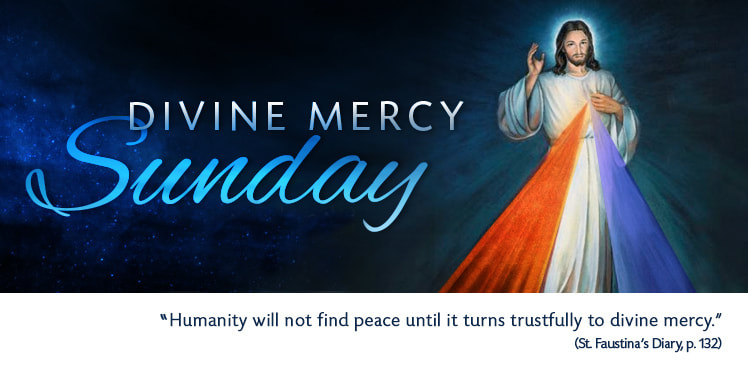
The Easter stories show us how God works silently in our midst, always slowly and surely, gradually through history and in our personal life. It is not really his appearances that matter but the intensity of his presence felt only in silence when we learn to trust more and believe more. How wonderful that on this eight day of Easter we also celebrate Divine Mercy Sunday that invites us to trust more than ever Jesus Christ our salvation. May we entrust ourselves to Jesus anew like Thomas, touching his wounds, confessing “My Lord and my God” or “Jesus, King of Mercy, I trust in You.” Amen.
Photo by Dra. Mai Dela Pena in Athens, Greece, April 2017.
Hello…! Today is the last Sunday of Lent. It is hoped that by this time since Ash Wednesday, we have slowly acquired a contemplative spirit of prayerful silence. It is something very essential not only during these 40 days and in the coming Holy Week. It is only in silence can we truly find balance in life as we discover what is valuable and what is worthless, things that last and things that pass. Silence teaches us to slow down, to be more discerning, and more trusting. It is in silence where we learn to pray deeply, to enter into communion with God to allow Him to suffuse us with His love and grace, mercy and forgiveness to be transformed into a better person.
From Google.
In today’s gospel only found in St. John’s account, we find the remarkable silence of Jesus Christ among the crowd demanding his opinion on whether the woman caught committing adultery should be stoned to death or not as per the Law given by Moses. Jesus chose to be silent so we may realize that issues of sin and evil are best resolved in a contemplative spirit where we find the value of every person.
“Condemn the sin, not the sinner.” History has shown us that where there is severity in measures against evil, we find only more deaths and burials happening but never peace and justice. In Christ Jesus, we have found and experienced God’s mercy so abounding and closest to us sinners if we are truly sorry and ready to change. It is in silence where we discover our sinfulness that leads us to conversion which leads us to more silence which is the contemplative spirit.
Photo by Mr. Raffy Tima of GMA7-News, Natonin, Mountain Province after landslides, Nov. 2018.
In the spirit of this Sunday gospel about the woman caught committing adultery, I invite you to listen anew to Paul Simon’s classic “The Sound of Silence” first released in 1964 with his friend Art Garfunkel. It was a commercial flop upon its release but, “silently” the following year when some radio stations started playing it in Florida and Boston areas when it gained followers, forcing Columbia records to rerelease the song in 1965.
Hello darkness, my old friend
I've come to talk with you again
Because a vision softly creeping
Left its seeds while I was sleeping
And the vision that was planted in my brain
Still remains
Within the sound of silence

In restless dreams I walked alone
Narrow streets of cobblestone
'Neath the halo of a street lamp
I turned my collar to the cold and damp
When my eyes were stabbed by the flash of a neon light
That split the night
And touched the sound of silence
From Bing.com.
 And in the naked light I saw
Ten thousand people, maybe more
People talking without speaking
People hearing without listening
People writing songs that voices never share
No one dared
Disturb the sound of silence
"Fools" said I, "You do not know
Silence like a cancer grows
Hear my words that I might teach you
Take my arms that I might reach you"
But my words like silent raindrops fell
And echoed in the wells of silence
Sunset at Fatima Shrine, Portugal by Arch. Philip Santiago, October 2018.
And the people bowed and prayed
To the neon god they made
And the sign flashed out its warning
In the words that it was forming
And the sign said, "The words of the prophets
Are written on the subway walls
And tenement halls"
And whispered in the sounds of silence
40 Shades of Lent, 5th Sunday-C, 07 April 2019
Isaiah 43:16-21///Philippians 3:8-14///John 8:1-11
From Google.
Sunrise at Lake of Galilee. Photo by author April 2017.
Today is the last Sunday of Lent. It is hoped that by this time since Ash Wednesday, we have slowly acquired or even regained our contemplative spirit of prayerful silence. It is something very essential not only during these 40 days and in the coming Holy Week. It is only in silent prayers can we truly find balance in life as we discover what is valuable and what is worthless, things that last and things that pass. Prayerful silence teaches us to slow down, to be more discerning, and more trusting. The contemplative spirit thus leads us to grow deeper in our faith, hope and love in God. It is in the contemplative spirit where God works best in us.
We find this invitation to a contemplative spirit in our beautiful gospel today of a woman caught committing adultery whom Jesus refused to condemn. Unlike the previous four weeks when we heard all gospels taken from Luke, this Sunday’s story is from John that perfectly fits last week’s parable of the prodigal son to show us God’s immense love and mercy for us sinners. Every conversion, every contrition of sins presupposes silence. Recall how the lost son last Sunday realized his sinfulness while silently tending swine in a far away land.
From Google.
Jesus went to the Mount of Olives. But early in the morning he arrived again in the temple area, and all the people started coming to him, and he sat down and taught them. Then the scribes and the Pharisees brought a woman who had been caught in adultery and made her stand in the middle. They said to him, “Teacher, this woman was caught in the very act of committing adultery. Now in the law, Moses commanded us to stone such women. So what do you say?” They said this to test him, so that they could have some charge to bring against him. Jesus bent down and began to write on the ground with his finger.
John 8:1-6
From Google.
We have seen how Jesus foiled other insidious plots against him through tricky questions but this one involving a woman caught committing adultery shows us a fine image of him as the Christ. His silence, his bending down and his writing on the ground are moving moments that touch our hearts and make us wonder all the more, who is this man?
More than addressing a question that concerns the many dilemmas we face in life, this episode shows us that it is something that directly concerns Jesus Christ himself, his being our Savior. Notice at the start of the story where Jesus is presented always going to the Mount of Olives to pray, to be one with the Father. This episode happened after he had entered Jerusalem on Palm Sunday, showing us how Jesus became more intense in praying, in being one with the Father when his final days were approaching. That is the contemplative spirit.
Now feel the atmosphere of those tense moments when people brought the woman caught committing adultery to Jesus: everybody was saying something, emotions were running high, just like us in our own time with social media around us. We live in so much noises where everybody and everything is talking that we fail to listen to our very selves, to others and most especially to God always silent. See how Jesus was so cool – or “chillax” as young people would say. It was an astonishing reaction to the situation. Only a person with deep contemplative spirit like Jesus can be so composed and silent in a tense situation like that. It is always easier to react and say something than be silent to weigh everything. Too often in the world today, words are so empty that they have to be shouted all around and repeated so often in the hope they become true, exactly what every election candidate is doing!
From Bing.com.
Jesus chose to be silent so we may realize that issues of sin and evil are best resolved in a contemplative spirit where we find the value of every person that we condemn the sin not the sinner. History has shown time and again how wars and violence or any other harsh methods like death penalty have proven ineffective in correcting any injustice or wrongdoing and preventing crimes. Where there is severity in measures against evil, we find only more deaths and burials happening but never peace and justice.
Now more than ever in Jesus Christ, we have found and experienced God’s mercy so abounding and closest to us sinners if we are truly sorry and ready to change. Like the woman caught committing adultery or the prodigal son last Sunday, we have to reach out to Christ to be forgiven from our sins. He assures us of never being condemned, of deleting our past sins and assuring us with a bright future to receive his promises if we “go and sin no more.”
We have to stress that Jesus does not approve sins. Never. He recognized the sinfulness of the woman when he told her “go and sin no more.” Likewise, Jesus never asked us to stop fighting sins. When he dared the people of whoever has no sin be the first to cast the stone, Jesus never meant us to be silent with the evil and wrongdoings happening around us. This encounter between Jesus and the woman committing adultery invites us to examine first, our own attitudes toward others guilty of serious sins. And secondly, to examine our own reactions when our misery meets with God’s mercy especially in the sacrament of penance or reconciliation.
Do we choose to be harsh like the crowd or be gentle like Christ?
How sad that even with our very selves we are so unforgiving, so severe that we hardly move on in life. Only in a contemplative spirit can we truly experience God’s liberating mercy and forgiveness within us and with others. The contemplative spirit enables us to trust God that no matter how sinful we are, his love and mercy are more powerful, able to transform us all into better persons, even saints! This is the promise of God in the first reading that he would do something greater than what he had done in liberating his people from Egypt – that he would send our Savior not only to forgive our many sins but even to share in his glory as saints.
Assumption Sabbath Baguio, January 2019.
St. Paul in the second reading could speak of “considering everything as a loss in knowing Christ Jesus” because of the contemplative spirit he acquired after his conversion. His letters all reveal to us St. Paul’s contemplative spirit and intimacy with Jesus Christ that flowed out into his daily life, reaching its summit in his martyrdom.
As the season of Lent comes to a close on this fifth Sunday, we are reminded of the path of conversion we have followed these past four weeks under St. Luke’s guidance. Conversion leads to contemplation, a daily communion with God in prayerful silence and allow him to suffuse us with his love. Its fruits are seen in our daily lives. It is the work of God, not us. It is God who renews us in silence into a new creation. We simply have to remain in Christ and strive always “to go and sin no more”. Amen.