Lord My Chef Daily Recipe for Soul by Fr. Nicanor F. Lalog II
Tuesday, Twenty-Fifth Week in Ordinary Time, Year II, 22 September 2026
Proverbs 21:1-6, 10-13     ><))))*> + ><))))*> + ><))))*>     Luke 8:19-21
I pray for all
those suffering today,
Lord Jesus;
for those hoping to see
you, to talk to you even for a while
like your mother and brothers
in the gospel;
why did you not go out to see
them right away?
I felt sad.
And disappointed.
The mother of Jesus and his brothers came to him but were unable to join him because of the crowd. He was told, “Your mother and your brothers are standing outside annd they wish to see you.” He said to them in reply, “My mother and my brothers are those who hear the word of G0d and act on it” (Luke 8:19-21).
Luke never bothered
to tell us what they wanted
from you, Lord;
but your reply got me praying
more deeply and these
I realized:
you love us so much
Jesus,
your words always in us,
in our hearts
but many times we do not listen;
Mary and your brothers know
that so well
and they never protested;
in fact,
they affirmed your words
by remaining silent,
trusting you as always;
most of all,
your reply teaches us
your disciples
to widen,
to enlarge
the bounds of our family:
if we choose to listen
and act on the Word of God,
we must at the same time
become a member of the
family of Jesus.
Teach us to be like
that king in the first reading
willing to bow
his will and desires to
God despite his power
and authority;
give me a listening heart,
a will so pliant to your ways
so that I may welcome those
trying to get close to you
Jesus because they hurt;
many times our pains
are so pronounced because
we have no room
for those seeking you,
Jesus.
Amen.
Lord My Chef Daily Recipe by Fr. Nicanor F. Lalog II
Wednesday, Twenty-first Week in Ordinary Time, Year II, 26 August 2026
2 Thessalonians 3:6-10, 16-18     <*((((>< + ><))))*>     Matthew 23:27-32
Cleanse me inside,
Lord Jesus,
cleanse me thoroughly
for I am indeed like
"whitewashed tombs that
appear beautiful outside,
but inside are full of dead
men's bones and every kind
of filth"; you know so well
how I fake good deeds
and virtues, my humility
with a hook that is self-
serving, most of all,
my being silent in many occasions
because I am so timid,
so afraid to make a stand
for what is right,
what is good,
and what is just.
Jesus said, “Woe to you, scribes and Pharisees, you hypocrites. You are like whitewashed tombs, which appear beautiful on the outside, but inside are full of dead men’s bones and every kind of filth. Even so, on the outside you appear righteous, but inside you are filled with hypocrisy and evildoing (Matthew 23:27-28).
Create a clean heart in me,
Lord Jesus:
I am so disordered within,
anger and resentments,
bitterness and pains
from past experiences
and persons still affecting me
negatively;
create a clean heart in me,
Lord Jesus:
still with doubts about
my worth and abilities,
so many skeletons,
so many dead
like tombstones,
buried for so long,
repeatedly whitewashed
outside
to hide all
hypocrisies
and evil.

Cleanse me,
Jesus,
wash me thoroughly,
take away my stony heart,
create a clean heart in me,
radiant with your love
and mercy
and presence.
Amen.
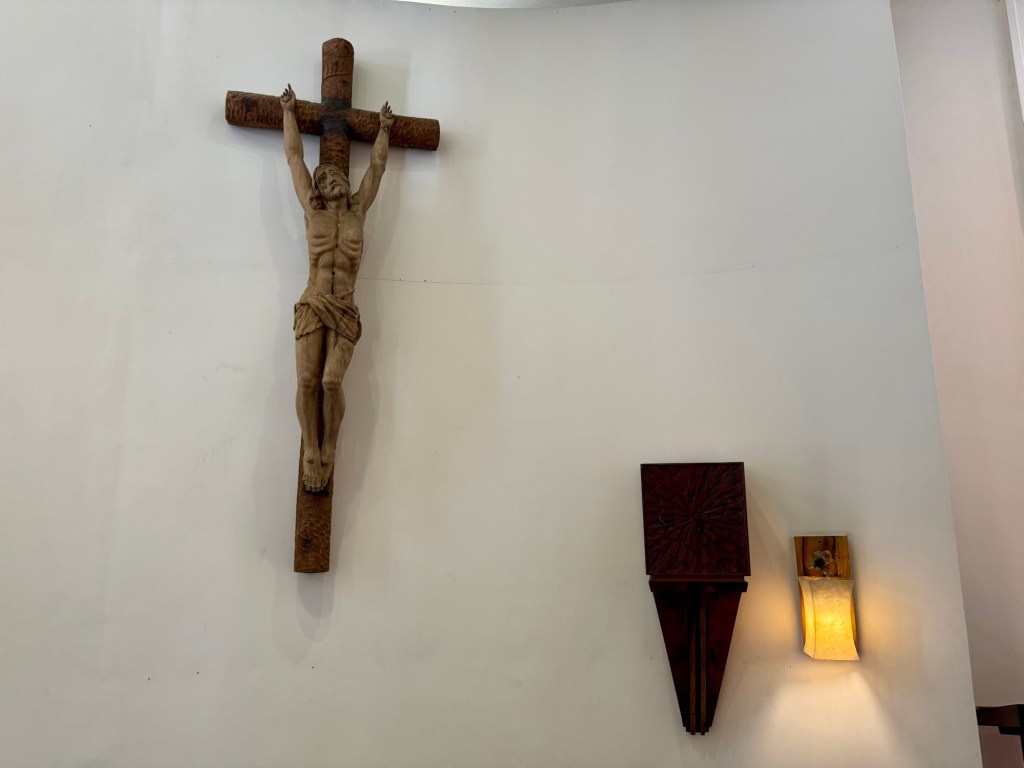
Photo by author, St. Paul Spiritual & Renewal Center, Bgy. Tanyawak, Alfonso, Cavite, 19 August 2026.
Lord My Chef Daily Recipe for Soul by Fr. Nicanor F. Lalog II
Tuesday, Memorial of St. John Mary Vianney, Patron of Priests, 04 August 2026
Jeremiah 30:1-2, 12-15, 18-22     <*{{{{>< + ><}}}}*>     Matthew 15:1-2, 10-14
Salamuch everyone for all your greetings since Sunday to us your priests. And this is my only response to your prayerful wishes: Salamuch also for enriching my priestly life and ministry!
It is so nice and heart-warming for me as a priest how our Patron, St. John Mary Vianney is now so widely-known among so many people these days that somehow changed their minds and hearts to understand us priests better, to love and support, most especially to pray always for us. Thanks largely to the efforts of Pope Benedict XVI who set the Year of Priests from June 19, 2009 to June 19, 2010 in celebration that year of Vianney’s 150th death anniversary with the theme “Faithfulness of Christ, faithfulness of priests.”
St. John said it perfectly during his long years of lovingly serving not only the more than 200 people of his parish in Ars but also the more than 20,000 people who annually came to him for confession and spiritual direction, “The priesthood is the love of the heart of Jesus.”
And what is the heart of Jesus?
A heart burning with love, a heart totally surrendered to God through others.
Easier said than done by us your priests these days.
Detail of a painting of the Sacred Heart of Jesus at Visitation Monastery, Marclaz, France from godongphoto / Shutterstock.
While you deluge us with your greetings and prayers, may I also take this opportunity on our feast day as priests that you forgive us your priests for those moments we have been cold and even ruthless especially in our words to you.
Both of us, priests and laypeople are wounded by each other.
Both of us identify so well with the words of God through his Prophet Jeremiah in today’s first reading:
Thus says the Lord, the God of Israel: Incurable is your wound, grievous your bruise; There is none to plead your cause, no remedy for your running sore, no healing for you. All your lovers have forgotten you, they do not seek you. I struck you as an enemy would strike, punished your cruelly; Why cry out over your wound? Your pain is without relief. Because of your guilt, your numerous sins, I have done this to you (Jeremiah 30:12-15).
Photo by a friend in Washington. 28 July 2026.
I am so touched by God’s words today, so appropriate for our celebration: incurable wound, grievous bruise. That is because I have experienced it too many times.
But, I must confess that it is most painful for me as a priest when I have hurt people especially with my words. Many times I have lost my cool; it is one of my many struggles in life. One thing I have realized as a priest that indeed it is most difficult in life to be silent; we always have something to say. Mema tayo palagi.
Believe me, as a priest, even if I have hurt just one person, it lingers with me my whole life. The sharp looks and everything, of how they were scared, I beg God for forgiveness daily as I wonder where are they now. Maniwala kayo, iniinda naming pari yung malaman naming maski isa sa inyo may sama ng loob o tampo sa amin.
Many times we priests speak so harsh, or “brutally frank”.
It is easy to claim what we say is true like Jesus in the gospel today when he told the Pharisees that “It is not what enters one’s mouth that defiles the man; but what comes out of the mouth is what defiles one” (Mt. 15:11); the disciples then told Jesus how the Pharisees took offense with his declaration but he simply dismissed them.
It is easy to claim that “truth hurts” especially when we priests speak of the truth like Jesus Christ. Ganun lang ba yun?
From Facebook by Suzie Bell, 02 August 2026.
Last Sunday I shared in Facebook a post about by a certain Suzie Bell who rightfully asked, “Why has the pulpit become a place to persecute people?”
Sadly and tragically very true. It is a big no no, a mortal sin especially with our venerable mentor and professor in homiletics, the late Msgr. Sabino Vengco Jr. who insisted on us to never use the ambo in attacking or shaming people because precisely they have no way of defending themselves. Most of all, the pulpit is primarily for the word of God – words that heal, words that encourage, words that express love and kindness, words that forgive, words that liberate.
With the widespread popularity of priest vloggers, many times I feel so afraid that there are so many occasions that some of our preaching are libelous. Not just scandalous.
Worst of all, the abuse at the pulpit becomes most tragic and shameful of all when priests become entertainers, when priests become rage baiters forda views, forda following!
Writer and artist Lourd De Veyra told me sometime ago how he had noticed that churches have come to look more like a videoke bar with priests just singing or acting no longer preaching. E ano pa nga ba?
Same is very true when priests become political commentators at the pulpit. We can always be political without being partisan.
Unknown to us priests, when these happen, the deeper the cut and the wounds we inflict on the people because we deny them Jesus Christ.
Me culpa, me culpa, mea maxima culpa!
Forgive us your priests for causing you pains and wounds. Priesthood is victimhood in Christ. It is part of our “job-description” to be hurt with incurable wound, grievous bruise as God told Jeremiah. Hindi na bale kami masaktan kasi iyon ang buhay namin, ang magpasan at ipako sa krus. Huwag mga tao ang aming masaktan at mailayo kay Kristo.
Priesthood as lived out by St. John Mary Vianney is more of the Caller than the call, of becoming, of imitating Christ because priesthood is Jesus. Help us to be like Jesus, always Jesus, only Jesus. Again, to you dear people of God, salamuch for enriching my priestly life and ministry. Amen.
I have not been to France nor do I know French but while searching for images of St. John Marie Vianney, I found this from the French website, https://www.notrehistoireavecmarie.com/; it is perhaps the depiction of the new pastor speaking to the young Antoine whom he asked for directions to Ars.
Lord My Chef Daily Recipe for Soul by Fr. Nicanor F. Lalog II
Tuesday in the Eighteenth Week of Ordinary Time, Year II
Memorial of St. John Mary Vianney, Priest, 04 August 2026
Jeremiah 30:1-2, 12-15, 18-22     <*{{{{>< + ><}}}}*>     Matthew 15:1-2, 10-14
Photo by a friend in Washington. 28 July 2026.
Your words today,
O Lord sound harsh
but I do not mind at all
because you speak as an
honest friend who truly loves
and cares for me;
you speak the truth always
that hurts us because every
mess we are into this life is
a result of our own making,
of our pride and sinfulness
like Israel and Judah
conquered and banished
from their own country
by the Assyrians and the Babylonians:
Thus says the Lord, the God of Israel: Incurable is your wound, grievous your bruise; There is none to plead your cause, no remedy for your running sore, no healing for you. All your lovers have forgotten you, they do not seek you. I struck you as an enemy would strike, punished your cruelly; Why cry out over your wound? Your pain is without relief. Because of your guilt, your numerous sins, I have done this to you (Jeremiah 30:12-15).
Today we also celebrate the feast
of our Patron Saint,
John mary Vianney,
your most holy priest
who bore so much pains
and sufferings not because
of his sins but by the sins of many
around him; we your priests,
O God, have sinned a lot
against you, O God,
through your people,
the flock you have entrusted
to us: we have hurt them so bad
their wounds are incurable,
their bruise so grievous with some
leaving the Church;
forgive us, Lord for being too
far from the heart of your Son
Jesus, the Good Shepherd;
cleanse our hearts and make us
realize priesthood is victimhood
like Jesus; let us bear the wounds
inflicted to us by the sheep rather
than us wounding them.
Deep within your harsh
words today, Lord,
we feel your deep desire
to heal us,
to free us,
and to renew us;
cleanse our hearts,
Lord, your priests,
purify us to bear all pains
for your people,
to be truly prophetic
so that your people may
realize you are in their midst
and eventually be like you
in Christ Jesus.
Amen.
Lord My Chef Daily Recipe for the Soul by Fr. Nicanor F. Lalog II
Friday in the Twelfth Week of Ordinary Time, Year II, 26 June 2026
2 Kings 25:1-12     ><]]]]'> + ><]]]]'> + ><]]]]'>     Matthew 8:1-4
Photo by author, St. Anthony De Padua Chapel, D’Alta Tagaytay, Tagaytay City, 02 June 2026.
Glory and praise to you,
merciful God and Father
for this wonderful last Friday
of June 2026 as you present us
with two images of human sufferings:
in the first reading is the final siege
of Jerusalem with the capture of its king
Zedekiah who rebelled against his
Babylonian masters and conquerors
and the leper who approached Jesus Christ
to do homage, begging for his healing.
Many times,
we are like Zedekiah who
willingly submit ourselves to the
forces of evil and eventually end up
miserably in their hands:
"Then king was therefore arrested
and brought to Riblah to the king of
Babylon, who pronounced sentence on him.
He had Zedekiah's sons slain before
his eyes. Then he blinded Zedekiah,
bound him with fetters,
and had him brought to Babylon"
(2 Kings 25:6-7).
You never punish us your people,
Lord; all our misfortunes and
miseries are brought about by our
or others sinfulness; hence,
keep us faithful to you,
to return to you while still early
before we could not get out
and be stuck in a difficult situation
like Zedekiah.
Teach us to be humble
like that leper who approached
Jesus after coming down from a mountain:
"Lord, if you wish, you can make me clean."
Jesus stretched out his hand,
touched him, and said,
"I do will it. Be made clean."
His leprosy was cleansed
immediately (Matthew 8:2-4).
To whom shall we go,
Lord Jesus but to you alone;
let us suffer in you,
with you on the cross
for you not only have the words
of life but because you too
have gone through our sufferings
and felt its pains that you will nothing for us
but healing and cleansing,
absolution and freedom.

In a special way,
dear Jesus,
we pray for those
undergoing medical procedures
this weekend,
healing for those seriously ill
and easing of pains for those
in severe diseases and sickness.
Amen.
Photo by author, St. Michael Retreat House, Antipolo City, 16 June 2026.
40 Shades of Lent by Fr. Nicanor F. Lalog II
Fifth Sunday in Lent, Cycle A, 22 March 2026
Ezekiel 37:12-14  +++  Romans 8:8-11  +++  John 11:1-45
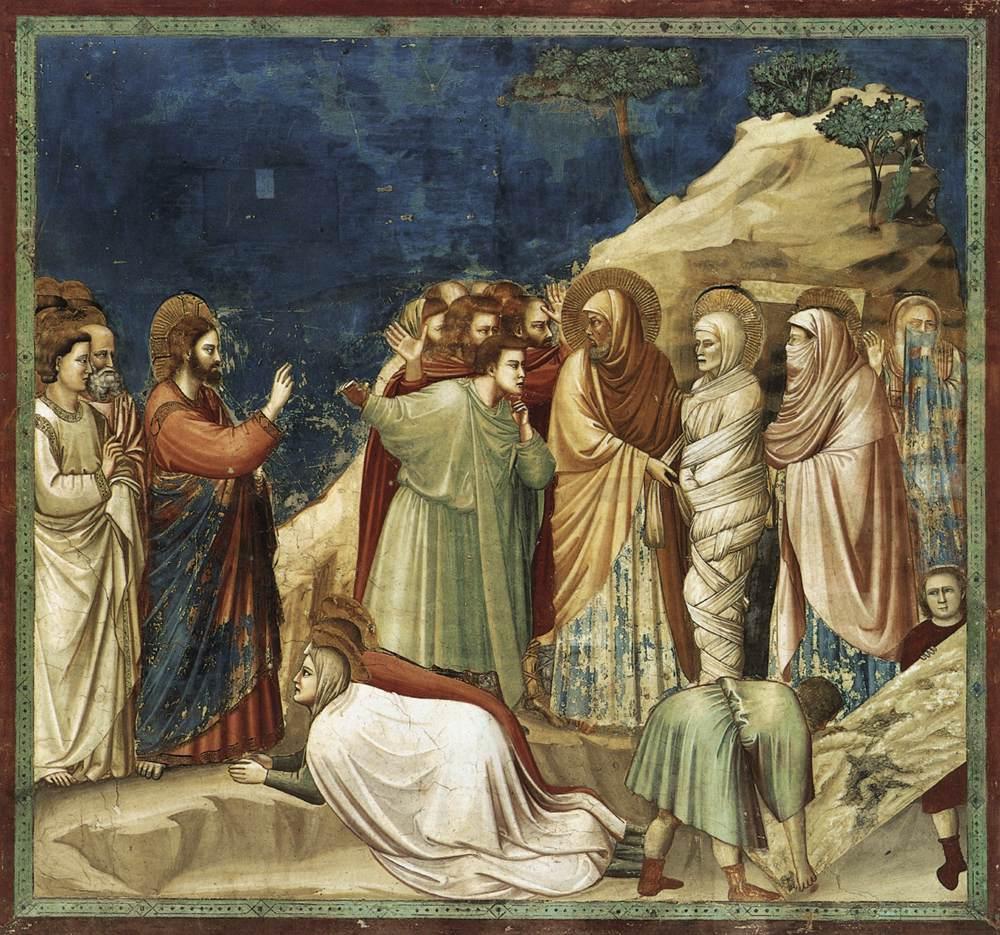
“The Raising of Lazarus” by Italian painter and architect Giotto di Bondone (1266-1337), fresco inside the Scrovegni Chapel in Padua, Italy via commons.wikimedia.org.
We now come to the final Sunday of our Lenten journey into Easter with John still as our guide telling us Jesus Christ’s raising to life of his friend Lazarus who had been dead for four days.
The raising of Lazarus is a prelude for the greatest sign of all by Jesus as the Christ – his Resurrection at Easter after his Passion and Death on good Friday. Though very long, it is a lovely story that speaks of Jesus Christ’s deep friendship with us by being most present in our most painful suffering of all which is death of a loved one as well as our many “deaths” in life.
And like in every true friendship, Jesus invites us like the sisters of Lazarus, Martha and Mary, to believe in him.
When Martha heard that Jesus was coming, she went to meet him; but Mary sat at home. Martha said to Jesus, “Lord, if you had been here, my brother would have not died. But even now I know that whatever you ask of God, God will give you.” Jesus said to her, “Your brother will rise.” Martha said to him, “I know he will rise, in the resurrection on the last day.” Jesus told her, “I am the resurrection and the life, whoever believes in me, even if he dies, will live, and everyone who lives and believes in me will never die. Do you believe this?” She said to him, “Yes, Lord. I have come to believe that you are the Messiah, the Son of God, the one who is coming into the world” (John 11:20-27).
When Mary came to where Jesus was and saw him, she fell at his feet and said to him, “Lord, if you had been here, my brother would not have died.” When Jesus saw her weeping and the Jews who had come with her weeping, he became perturbed and deeply troubled… (John 11:32-33).
Jesus said, “Take away the stone.” Martha, the dead man’s sister, said to him, “Lord, by now there will be a stench; he has been dead for four days.” Jesus said to her, “Did I not tell you that if you believe you will see the glory of God?” (John 11:39-40)
“The Raising of Lazarus”, 1311 painting by Duccio de Buoninsegna from commons.wikimedia.org
“Lord, if you had been here, my brother would not have died.” We are all like Martha and Mary who believed in Jesus Christ. Both expressed to Jesus their faith in him, of believing in him and his powers.
To believe is the starting point of every relationship. With God and with others.
It usually begins in our mind, in our intellect. We believe because we know and have learned their names and backgrounds, their likes and dislikes, and a host of others things. We can truly be friends with others even by believing only with our intellect that is why we understand their predicament and situations, the way they react. Almost everything, we know and have known that we are still the best of friends. Including with God.
Martha exemplified that kind of believing.
Martha is good. If she is the same “Martha, Martha” mentioned by Luke whom Jesus visited, she was well meaning like most of us.
She believed in Jesus. In God. In the scriptures when she told Jesus she knew Lazarus would rise along with all the dead in the resurrection on the last day.
Jesus never argued because it was good. Same with us.
Our friends do not argue nor break away from us with our kind of believing. After all it is reasonable and sane. But, believing from the mind, from the intellect is not enough. For a more intimate and engaging relationship in friendship, believing has to deepen and take root in our heart.
Believing leads to love.
Whatever kind of love, it starts in believing.
We love because we believe as we have claimed last Sunday.
But, believing and loving do not stop there.
How deeply, how truly we believe indicate how deeply, how truly we love.
Photo by author, Sacred Heart Novitiate, Novaliches, QC, 20 March 2026.
Without any intentions of comparing and pitting the two sisters against each other on who is better, John presents to us where believing leads us.
Like Martha, Mary expressed how she believed in Jesus and his powers by telling him “Lord, if you had been here, my brother would not have died.”But it was not merely coming from her mind, from her head, from what she knew of Jesus but more of how she felt with Jesus.
Notice at the start of this long story (verse 2) how John described Mary as the one who anointed Jesus – six days after this raising of Lazarus – with perfumed oil and dried his feet with her hair as expression of her faith and love for the Lord on his burial. Getting some help from Luke’s account again, we find Mary’s level of believing as deeper and matured when she chose to seat at the Lord’s feet to listen to his teachings when he came to visit them.
Mary came to Jesus with her total self – unashamed to weep in front of the Lord. She spoke no words, showed no clues of her “theology” like Martha’s faith seeking understanding by studying the scriptures.
It was Mary’s heart that spoke to Jesus that he was “perturbed” twice and “deeply troubled” seeing her. Even the Jews with her felt the Lord so moved by her that led us to the final scene of this beautiful story.
Feel the revelations at the cave where Lazarus was buried:
When Jesus asked the stone removed from the cave, Martha stepped in. And it was reasonable of her. We do it so often in various occasions like in funerals and deathbeds.
That was when Jesus reminded her, “Did I not tell you that if you believe you will see the glory of God?”
Everybody fell dead silent.
Jesus then prayed aloud briefly to the Father, shouting for Lazarus to come out – alive, still covered with cloth. End of scene.
What’s next?
You tell me. Tell me how much you believe Jesus, how much you love Jesus. And how much you love like Jesus especially when everything, everyone is dead, dead silent, dead still for many reasons.
Photo by author, Sacred Heart Novitiate, Novaliches, QC, 20 March 2026.
How much do we believe in Jesus, the resurrection and life?
Think of our many deaths in life. Not only in losing a beloved but our very own deaths – when we were buried and dead to sin and failures, disappointments and losses like the Israelites thrown into exile that Ezekiel the Prophet described in the first reading. What a beautiful imagery of God raising us to life, opening our graves of sins and failures, weaknesses and darkness, breathing into us his spirit, now better. Or maybe still struggling in life.
Believing in Jesus is believing like Martha and Mary most especially, unashamedly pouring out our pains and griefs to Jesus, baring our battered hearts and souls to him because we have felt, we have experienced his very passion and death in our own life, with those we love and serve.
In these trying times, Jesus invites us to believe more than ever in him by believing also with those severely affected by the hard times like the jeepney drivers and minimum wage earners. Let us try to live in spirit as St. Paul reminds us in the second reading by feeling their struggles, their fears, their sufferings so that they may not cry, “Lord, if you were here our families would have not gone hungry, would have not died” because we his disciples were here for them.
That is believing in Jesus the resurrection and life – being present with those suffering and dying. Solidarity.
Jesus is not asking us to think nor understand their pains and miseries. He is asking us to feel within us their pains and miseries so that like Mary we can bring Jesus to them and raise them to new life. Let us pray:
Lord Jesus Christ,
before all these pains and
sufferings came to me,
you were there first
to suffer and die for me
on the Cross.
Let me love you more
by loving others
especially those also
in pain and suffering.
Amen.
Lord My Chef Daily Recipe for the Soul by Fr. Nicanor F. Lalog II
Monday, Solemnity of the Immaculate Conception, 08 December 2025
Genesis 3:9-15, 20 ><}}}}*> Ephesians 1:3-6, 11-12 ><}}}}*> Luke 1:26-38
“Cestello Annunciation” by Botticelli painted in 1490; from en.wikipedia.org.
We praise and thank God today on this Solemnity of the Immaculate Conception of Mary that formally kicked off the process of the fulfillment of his promised salvation in Jesus born by the Virgin Mother.
According to our official Church teaching called dogma, Mary was conceived by her mother St. Anne without any stain of original sin through the merits of Jesus Christ our Savior. Mary has to be pure and clean because she would bear the Son of God who is perfect and spotless.
God chose Mary to be the Mother of Jesus not because of her having any special traits but purely out of God’s goodness “who has blessed us in Christ with every spiritual blessing in the heavens” (Eph.1:3).
Hence, this feast reminds us too to imitate the Blessed Virgin in saying “yes” to God’s invitation to cooperate in his wonderful plans of bringing Jesus into this world so darkened by sin that has left us broken and fragmented from each other. Rejoice, therefore, because everyday, God sends us his angel to greet us with “Hail, full of grace! The Lord is with you” (Lk.1:26), inviting us into an intimacy with him like Mary.
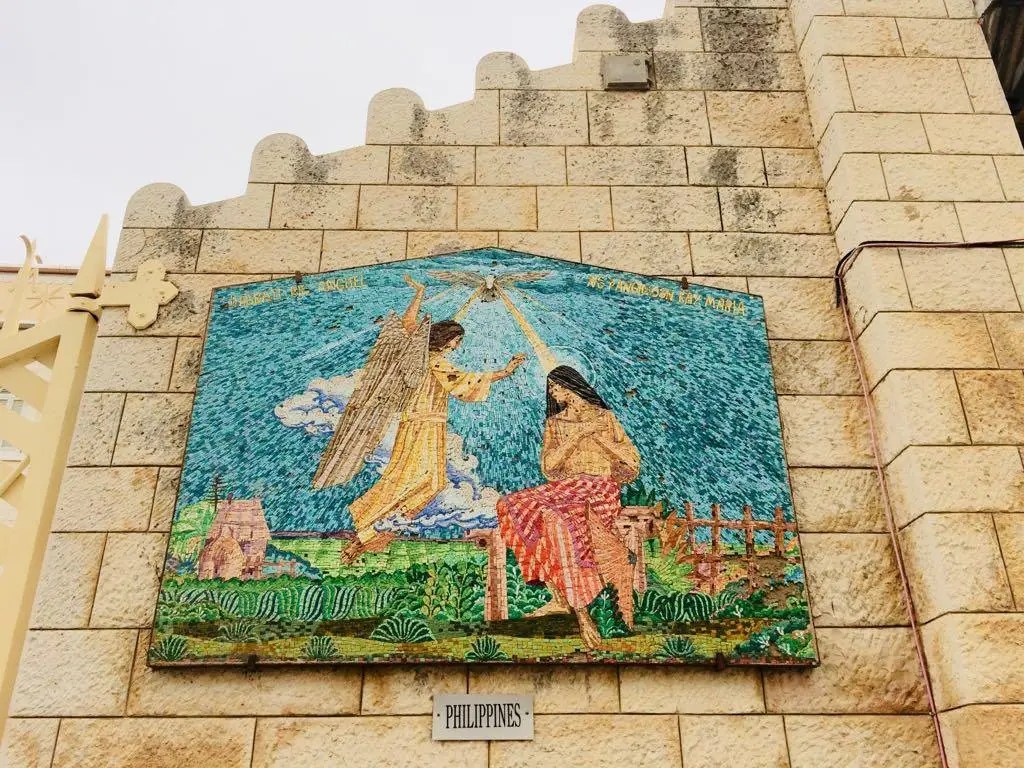
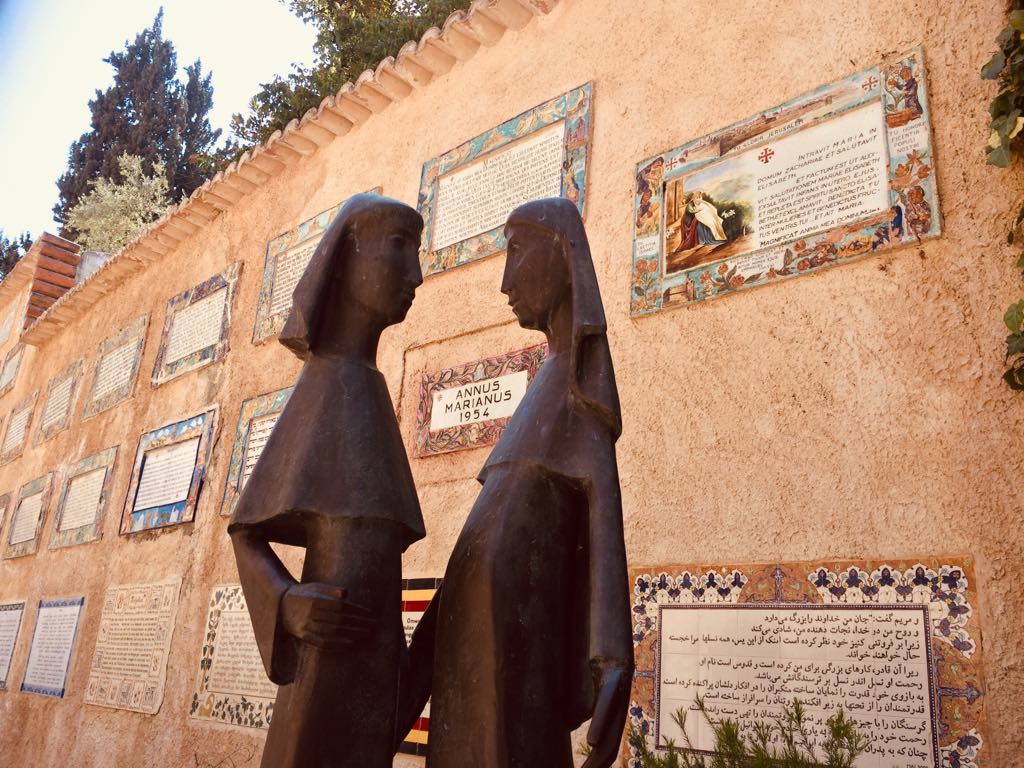
Photo by author, left side of the facade of the Basilica of the Annunciation in Nazareth, Holy Land, May 2019.
Intimacy is more than being close with another; it is an expression of love that is willing to sacrifice, to suffer and get hurt for the sake of the beloved.
God was the first to express his intimacy with us not just by expressing his immense love for us in words by the prophets in the Old Testament but by sending us his Son Jesus Christ who became human like us in everything except sin. Actually, God does not need to become human like us to save us but he chose to be one of us because he loves us so much. As an expression of his intimacy and solidarity with us, Jesus suffered and died on the Cross while going through every pain and hurt we go through in life like grief and sadness in losing a friend, betrayal by a friend, abandonment by friends, no to mention being terrified, going hungry and thirsty. Jesus became like us so that we may become like God – intimately loving him through others.
Actually, God does not need us but he chose to love us, to be with us, to be intimate with us because he loves us so much. God remains God even without us. When we do not pray, when we do not go to Mass on Sundays, when we are bad and not good, God is still God. It is us humans who are lessened when we turn away from from God.
That’s the intimacy of God with us.
How about us, are we willing to be intimate with God in Jesus Christ?
Sadly, many people “create” and “force” intimacy which is a grace, a gift of God freely given to everyone. Like friendship, we cannot force intimacy into someone not meant to be. And like friendship too, intimacy begins in Christ, blooms in Christ.
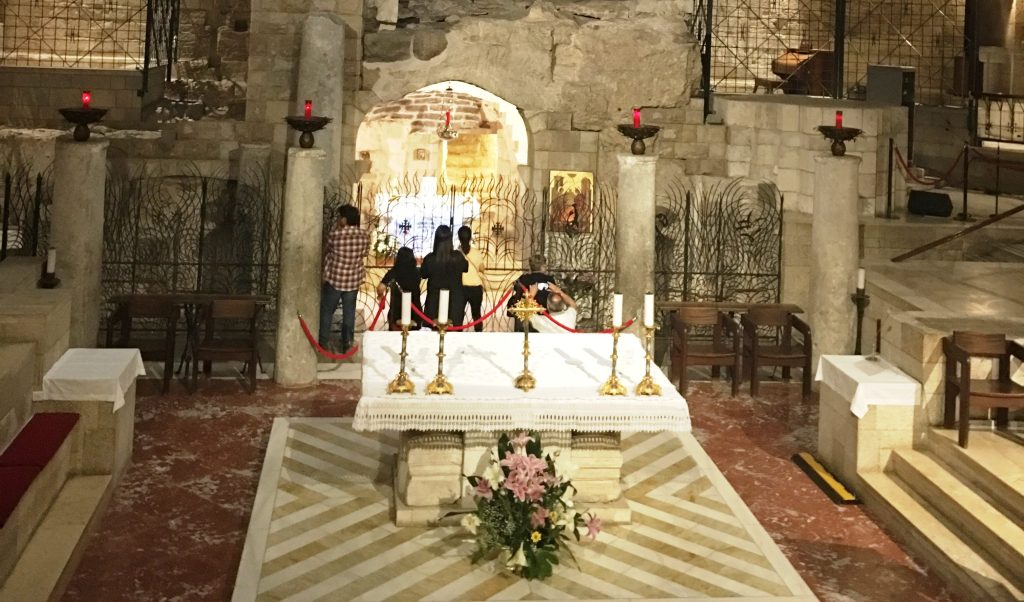
Photo by author, chapel beneath the Basilica of the Annunciation in Nazareth; see those pilgrims praying behind iron grills at the back of the sanctuary which is the site where the Angel announced to Mary the birth of Jesus Christ.
Underneath the Basilica of the Annunciation in Nazareth is a chapel near the very site where the angel is believed to have appeared to Mary to announce the coming of the Savior. At the back of the sanctuary of this chapel is that holy site of the Annunciation enclosed by iron grills with an altar table at the center with the declaration in Latin, Verbum Caro Hic Factum Est (The Word became flesh here).
Mary’s intimacy with God began long before the Annunciation to her by the Angel cultivated in her prayer life. Every time I pray this scene of the Annunciation, I always imagine Mary deeply absorbed in prayer. Most likely, she must be praying about her coming wedding to Joseph. Luke and Matthew were both consistent about their status as being “betrothed to each other” when God announced through the Angel the birth of the Christ.
Photo by author, close up of the Annunciation site beneath the Basilica of the Annunciation in Nazareth; written on the altar table that says in Latin, “The Word became flesh here.”
Imagine the excitement and joy of two faithful Jews getting married soon when suddenly the Angel appeared to them on separate occasions and diverse situations to announce God’s plan of sending his own Son Jesus Christ for the salvation of the world?
It must have been most painful to both Mary and Joseph but as being truly faithful and loving of God, they both agreed to the Divine plan! And that is the great sign of their immense love for God – eventually for each other. Moreover, in saying yes to God, both Mary and Joseph showed the kind of intimacy they have with the Divine.
Let us focus on the intimacy of Mary with God on this Solemnity of the Immaculate Conception found in our gospel account of the Annunciation.
Photo by Rev. Fr. Gerry Pascual of Iba, Zambales at Santuario di Greccio, Rieti, Italy in 2019.
Then the angel said to her, “Do not be afraid, Mary, for you ahve found favor with God. Behold, you will conceive in your womb and bear a son, and you shall name him Jesus (Luke 1:30-31).
Notice that in many scenes and prayers about the Blessed Virgin Mary, we find the prominence of her “womb” like here in the Annunciation and when Elizabeth praised her during her Visitation as “blessed is the fruit of your womb” (Lk.1:42).
In Hebrew, the word for womb is “racham, rachamin” which is their word too for “mercy” because for them, God’s mercy comes from his innermost being. Hence, whenever the Jews speak of mercy of God, they point their fingers downward into the womb or uterus and moves it upward to the heart to indicate the flow of mercy of God from his innermost being expressed in love which is he’s very being and core.
This is the reason the Church Fathers translated mercy into “misericordia” from the Latin verb to move or to stir – “misereor” – and word for heart “cor” that literally means “to move or to stir one’s heart”. It is more than a feeling like compassion; mercy is deeper as it encompasses one’s being leading to intimacy that is a communion or oneness with others which is also intimacy.
Photo by author, Church of the Visitation, Ein-Karem, Israel, May 2017.
Where there is love, there is always intimacy with the lover willing to bear all pains and hurts for the beloved. And vice versa. Like Jesus. Then Mary who was willing to sacrifice her wedding and marriage to Joseph by being the Mother of the Son of God.
But why? Because we have experienced too that true joy comes only when there is giving of self, when there is willingness to let go and suffer. At the Last Supper, Jesus described joy as like a mother in the pangs of childbirth when she goes through a lot of pains and worries and fears almost like dying but once the baby is delivered, joy happens because she had brought forth a new life into the world.
True joy is having the firm belief that no matter what happens even in the worst scenarios, God would never leave nor forsake us. Joy happens when we find new life, new directions because there is another person willing to remain with us, assuring us we are never alone. That again is intimacy when you feel not alone especially in the most trying times.
Without intimacy with God and another person, there can be no true joy because no one would dare to take risks in this life like mothers. This is what modern women are missing when they see childbearing more as a chore or a burden or a suffering they can always avoid than self-giving borne out of love which happens in the context of an intimacy. No wonder too that sex has been so trivialized, reduced to an activity and act instead of as a gift of self because there is no more responsibility and intimacy. We cannot have lasting and meaningful relationships without intimacy.
Photo by author, 2021.
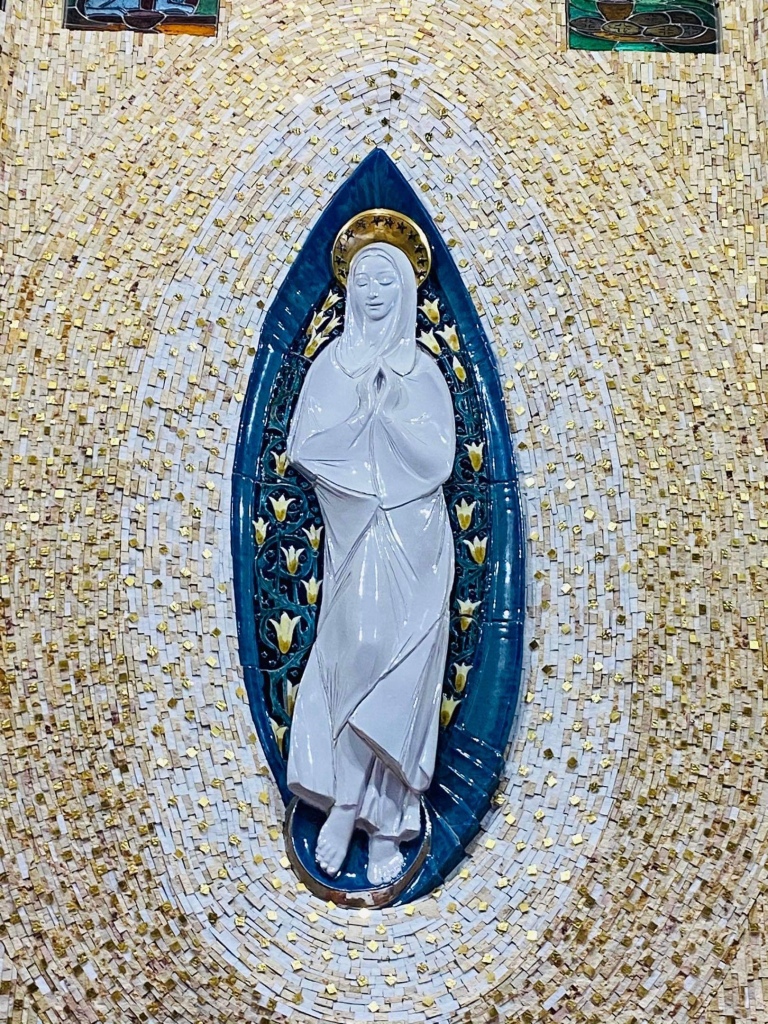
On this Solemnity of the Immaculate Conception, we are reminded of God’s mercy and intimacy with us, of his loving relationship with us that continues in Christ Jesus with Mary.
Let us nurture this beautiful relationship with God that flows and bears fruit in our relationships with one another.
Like Mary, may we finally say yes to God into an intimate relationship with him through our selflessness. Like Mary, we are blessed and full of grace. The joy awaiting far outweighs the pains and sufferings we shall go through in our gift of self in our relationships. Have no fear for Jesus had suffered first before us so that we can love and be intimate like him. Amen. Have a blessed week.
Lord My Chef Daily Recipe by Fr. Nicanor F. Lalog II
Red Wednesday, 26 November 2025
Daniel 5:1-6, 13-14, 16-17, 23-28   <*{{{>< + ><}}}*>   Luke 21:12-19
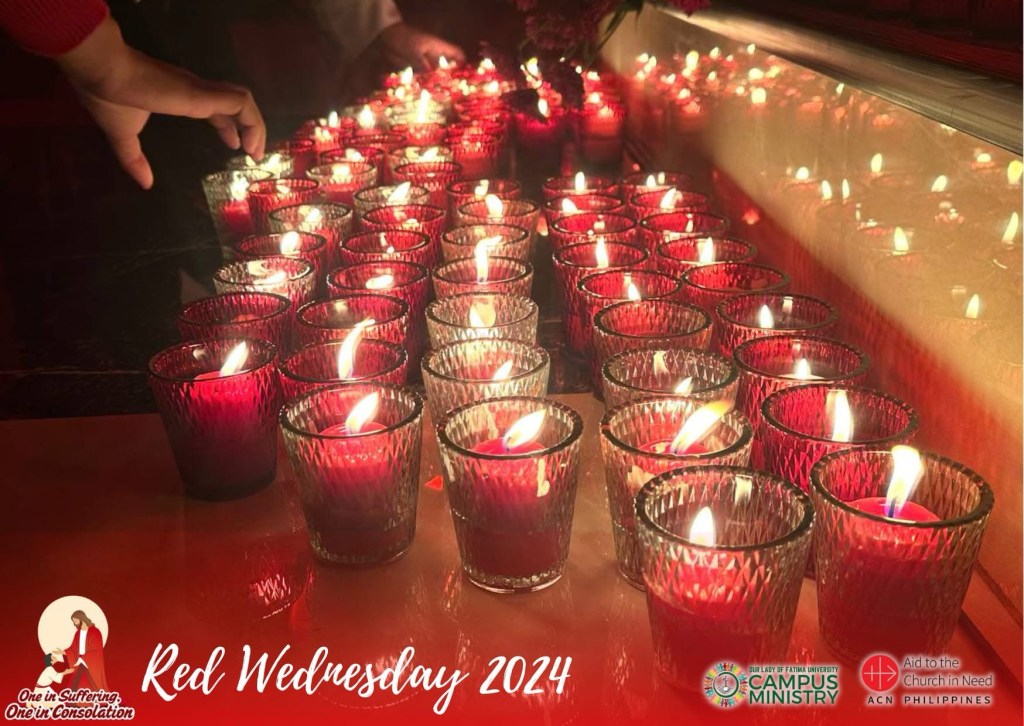
Photo from Fatima Tribune, 27 November 2024.
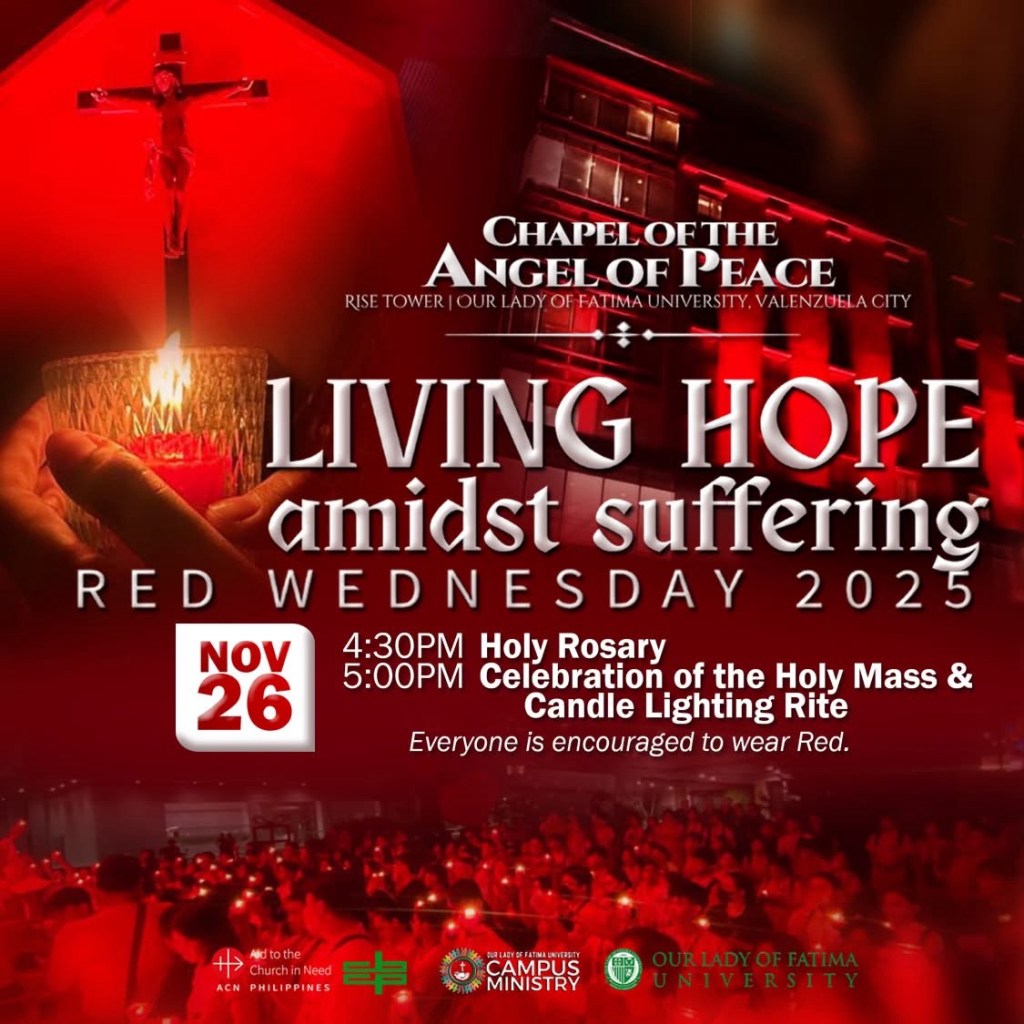
It’s the Wednesday after Christ the King when our churches and other religious buildings are lit in red to mark Red Wednesday, the annual campaign for persecuted Christians worldwide.
Started in 2016 by the Aid for Church in Need (ACN), it has been an annual Church celebration with other Christian groups and sects participating to heighten awareness of the continuing persecution of Christians in various parts of the world – exactly what Jesus had predicted to his disciples more than 2000 years ago.
Jesus said to the crowd: “They will seize and persecute you, they will hand you over to the synagogues and to prisons, and they will have you led before kings and governors because of my name. It will lead to your giving testimony… By your perseverance you will secure your lives” (Luke 21:12-13, 19).
Photo from Fatima Tribune, 27 November 2024.
For us in the Philippines that is majority a Christian nation, Red Wednesday is an opportune time to reflect about our “giving testimony” to Jesus Christ: how “bloody red” is our being a Christian?
Unlike in other countries in Africa or our neighbors in Asia where Christians are persecuted and harassed, we in the Philippines do not go through such sufferings and challenges. Think of any kind of opposition to the Christian faith we have encountered even in the last 100 years. None. The most serious threats ever made against our faith seem to be mere “peer pressures” of being teased as “conservative” in going to Mass and Confession frequently, or upholding the virtue of virginity. Perhaps, the most serious dilemma most of us Christians have ever had in our faith is whether or not we shall pray or at least make the Sign of the Cross when dining in a restaurant or fast food chain. In Europe and the States, chapels and churches are vandalized and burned but here in the country, those who have committed sacrileges in the past three years were “crucified” in social media with one being sued in court.
We do not wish that we also undergo similar religious persecutions like the other Christians abroad whom we pray for today on this Red Wednesday and send with our financial support as concrete actions of our solidarity with them.
In line with this year’s theme of “Living Hope Amidst Suffering” in conjunction with the Jubilee Year celebration “Pilgrims of Hope”, Red Wednesday invites us to simply witness the gospel of Jesus by standing on what is true and good especially these days our country is so deep into the ghost project scandals on flood control.
Giving testimony to Jesus Christ is letting our zeal for him burn anew within us by not bending into the ways of the world that promote a “culture of death” like abortion and contraceptives, or to the many forms of wokism that overextend personal rights contrary to God’s original plan and design like divorce, same sex marriage, and gender manipulation.
Photo by Ms. Kei Abad, Kawaguchiko Lake (Fujisan), 23 November 2025.
Witnessing Christ is being honest and just in a country of such impunity where graft and corruption is a family endeavor, a norm in public service.
Giving testimony to Christ in this time of social media where trending and viral are the new standards is to remain simple and modest even if it is looked down upon, being fair and just even if everyone chooses to disregard them while being concrete in our acts of mercy and charity for the weak and marginalized.
Red Wednesday is reigniting our hope in God which is an expression of our firm faith in him. Religious persecutions happen and abound anywhere God is negated and denied or when a particular group of people insist on their own perception of God.
We Christians are pilgrims of hope because we do believe in the one True and Only God in Heaven who was revealed to us by his own Son Jesus Christ made present up to this day until the end of time by the Holy Spirit. Hope is primarily having faith in God.
In this sense it is true that anyonbe who does not nknow God, even though he may entertain all kinds of hopes, is ultimately without hope, without the great hope that sustains the whole of life (cf. Eph. 2:12). Man’s great, true hope which holds firm in spite of all disappointments can only be God – God who has loved us and who continues to love us “to the end,” until all “is accomplished” (cf. Jn.13:1 and 19:30). (Pope Benedict XVI, Spe Salvi #27)
Hope is not optimism nor positive thinking, believing things will get better. On the contrary, true hope is actually accepting that things and situations could get worst as Jesus mentioned in his predictions of the coming upheavals and persecutions. Hope is putting all our trust in God that no matter what happens in the end when things get worst like death, there is Jesus Christ loving us, comforting us, and saving us.
That’s the kind of faith and hope Daniel expressed in our first reading despite the threats of sure death when he spoke of the God of Israel as the only true God, not the many idols and false gods of the Babylonians. Most of all, because of his fervent hope in God who would raise him up in the end, Daniel delivered his interpretation of the king’s dream of how his days were numbered as the Medians and Persians were soon to conquer them that eventually happened.
Photo by Ms. Kei Abad, Kawaguchiko Lake (Fujisan), 23 November 2025.
Many times in life, all we can have is hope in God especially when pains and sufferings become unbearable, when these get worst without any signs of getting any better.
That is why Red Wednesday’s theme this year is so appropriate, “living hope amidst suffering”.
Hope makes life more worthy and lofty because our sights are not only fixed on this world but even beyond as Jesus assured us in today’s gospel, “By your perseverance you will secure your lives” (Lk.21:19).
And there lies the beauty of hope – it is the most surprising of all virtues as the French poet, essayist and writer Charles Peguy wrote in 1911 in his long masterpiece called “The Portal of the Mystery of Hope.” In this poem, Peguy presents God as the speaker himself, reflecting about the virtue of hope in relation with the other two theological virtues of faith and love. It is so lovely because it is so true especially when I encountered it during my trying months of second year in theology in the seminary.
The faith that I love best, says God, is hope...
Faith itself does not surprise me...

Love, says God, that does not surprise me...

But Hope, says God, that is what surprises me.
I, myself, find it surprising
that my children see what happens and believe things will improve.
That is the most surprising, the most marvelous gift.
And it surprises me, myself, that my gift has such incredible strength
since it first flowed in creation as it always will.
Faith sees what is.
Hope sees what will be.
Love loves what is.
Hope loves what has not yet been
and what will be in the future and in eternity.
For those suffering, those in pain especially because of faith in Jesus Christ: keep believing, keep hoping and be ready to be surprised by God. Reignite that zeal in Christ and his gospel. Amen.A blessed Red Wednesday to you.
Photo by Ms. Kei Abad, Kawaguchiko Lake (Fujisan), 23 November 2025.
Lord My Chef Sunday Recipe for the Soul, 23 November 2025
Solemnity of Christ the King, Cycle C
2 Samuel 5:1-3 ><}}}}*> Colossians 1:12-20 ><}}}}*> Luke 23:35-43
I was teasing our campus ministry head for communication last Tuesday after he had presented to me this announcement for our Christ the King celebration today. “Para namang malnourished si Jesus diyan,” I told Darwin as he scratched his head laughing during our meeting.
But, that evening after praying our gospel, I changed my mind the following Wednesday and told Darwin to go ahead with his original artwork because I have realized that the face of Christ the King is also the face of us suffering.
Photo by author, Holy Monday, 2025.
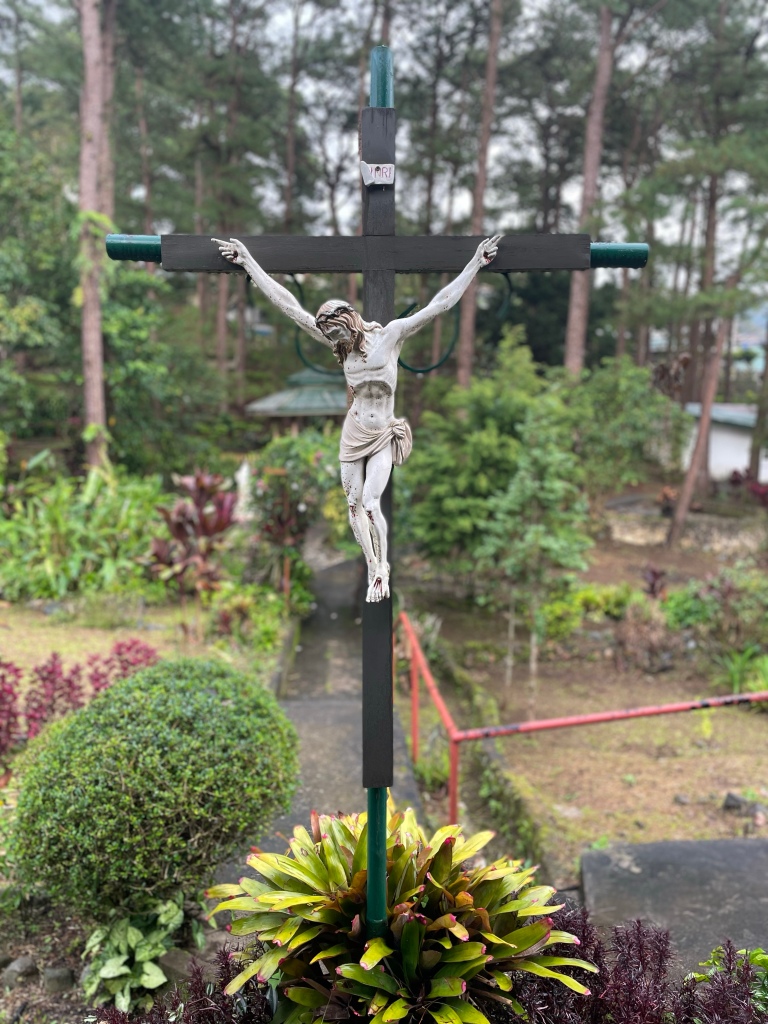
Are you not surprised that on this final Sunday of the liturgical year, we are not presented with an image of a victorious Jesus like that Cristo Rey found in every Catholic home but the gospel scene of Jesus suffering in excruciating pain there on the Cross on Good Friday?
Above him there was an inscription that read, “This is the King of the Jews.” Now one of the criminals hanging there reviled Jesus, saying, “Are you not the Christ? Save yourself and us.” The other, however, rebuking him, said in reply, “Have you no fear of God, for you are subject to the same condemnation? And indeed, we have been condemned justly, for the sentence we received corresponds to our crimes, but this man has done nothing criminal.” Then he said, “Jesus, remember me when you come into your kingdom.” He replied to him, “Amen, I say to you, today you will be with me in Paradise” (Luke 23:38-43).
Photo by author, Chapel of St. Francis Xavier, Sacred Heart Novitiate, Quezon City, 2024.
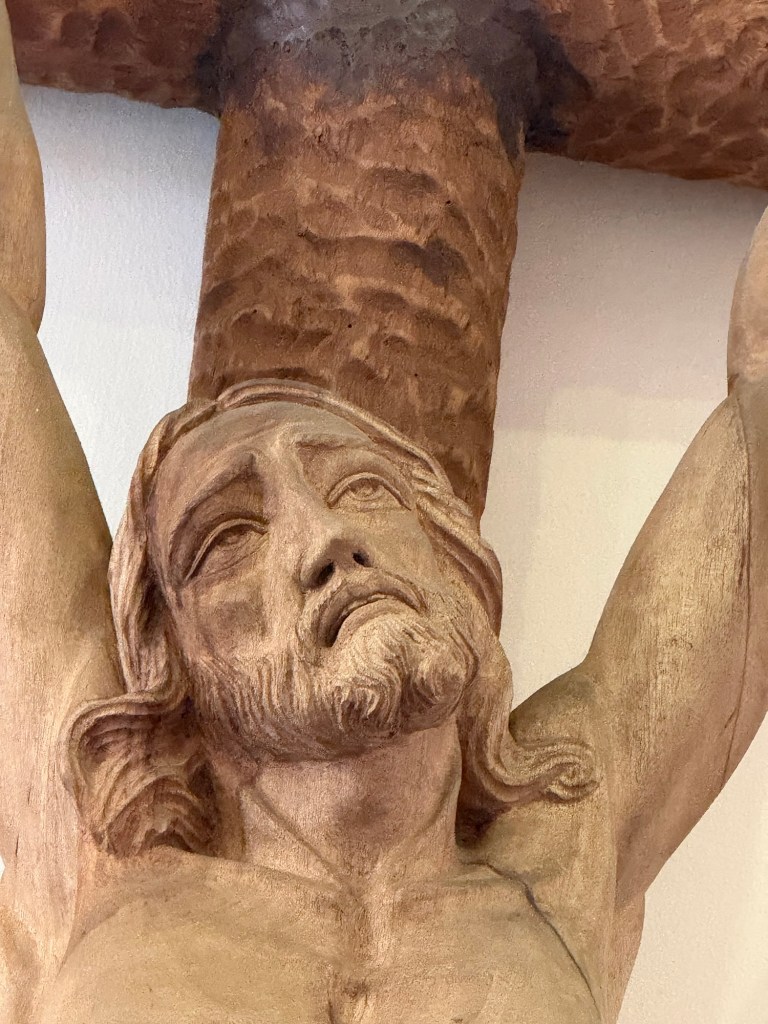
On this Solemnity of Christ the King, St. Luke invites us for the last time we hear his gospel this year to look at the face and into the eyes of Jesus crucified.
What do you see and feel in him?
Ever wondered what the rulers and soldiers saw on the face of Jesus crucified that they sneered and jeered him from below? They were so filled with pride in finally putting into shame and silence Jesus who had always spoken the truth and exposed their lies and hypocrisies.
What do we see when people are put on the spot and shamed like Jesus crucified or like the woman caught committing adultery Jesus forgave and saved from being stoned by the angry crowd? So sad that in this age of social media, public trials and condemnation have become a hobby for many without even checking the accusations are true or not.
Let us move closer to Jesus on the Cross like those two thieves hanging at each of his side: what do you see and feel about him?
Why did the other thief join those below in deriding and insulting Jesus crucified? Now one of the criminals hanging there reviled Jesus, saying, “Are you not the Christ? Save yourself and us” (Lk.23:39).
Have you ever found yourself in the ER or waiting for your turn at the doctor’s clinic with other patients also in pain and suffering? How do you see the other patients and sick people like you? Is there in your mind any tinge of suspicion why or how they got sick? The best and the worst in us come out in such times when we are so down beside another suffering brother or sister.
Or, do we choose the path of humility and sincerity of Dimas, the good thief? What did he see in Jesus there on the Cross? The other, however, rebuking him, said in reply, “Have you no fear of God, for you are subject to the same condemnation? And indeed, we have been condemned justly, for the sentence we received corresponds to our crimes, but this man has done nothing criminal” (Lk.23:40-41).
Most likely, Dimas must have heard a lot about the teachings and healings by Jesus but he felt something so unique and liberating, so personal during those dark moments of excruciating pains when he finally recognized Christ his Savior, the only true King that is why he asked to be remembered in his kingdom!
Finally, somebody greater than him there beside him, saying nothing to judge nor condemn him nor irritate him like his fellow criminal at the other side. In recognizing Jesus, Dimas also found himself as truly human, weak and finite who can only be whole and complete – saved and redeemed – in Christ who chose to be there on the Cross with him exactly as St. Paul had written in our second reading.
He is before all thing, and in him all things hold together. He is the beginning, the firstborn from the dead, that in all things he himself might be preeminent. For in him all the fullness was pleased to dwell, and through him reconcile all things for him, making peace by the blood of his cross through him, whether those on earth or those in heaven (Colossians 1:17, 18-20).
Photo by author, St. Scholastica Spirituality Center, Baguio City, August 2023.
Here we find the beauty of the Cross, of how God so perfect without any need to suffer and experience pain yet chose to go through it to express his solidarity and love for us humans.
It is on the cross when we are most able to identify and be one in Jesus Christ. That is why it is also on the Cross that we enter heaven with Jesus amid suffering and death. Jesus said today you shall be with me in Paradise – not later when we die or after three days at Easter. How lovely that Jesus never promised heaven when he was strong and freely moving around but when he was there on the cross, nailed and dying.
Jesus Christ is the King of the Universe not because of his powers and might but primarily of his being one of us in sufferings and death. It was the very feeling the tribes of Israel were telling David when they came to him in Hebron to reaffirm their allegiance to him as their king, “Here we are, your bone and your flesh” (2 Sm. 5:1).
The people we admire most are not always the best nor most powerful nor talented because often we envy them. On the other hand, we are more drawn with those down and burdened because we see in them our own brokenness, too, that it is part of life and of being human. That is why we easily empathize with those grieving or sad than with those happy or rejoicing.
Our humanity reaches its highest point and beauty when broken and weak as we realize our mortality and similarity with others in suffering needing for a Savior. We are most inhuman whenever we enjoy inflicting or causing pains on others or when rejoicing in their agonies. To proclaim Christ is the King of the Universe is to always see him in our sufferings and among those suffering too like us. Amen. A blessed week ahead of you!
Lord My Chef Daily Recipe for the Soul, 27 October 2025
Monday in the Thirtieth Week of Ordinary Time, Year I
Romans 8:12-17     <*{{{{><  +  ><}}}}*>     Luke 13:10-17
Jesus was teaching in a synagogue on the sabbath. And a woman was there who for eighteen years had been crippled by a spirit; she was bent over, completely incapable of standing erect. When Jesus saw her, he called to her and said, “Woman, you are set free of your infirmity.” He laid his hands on her, and she at once stood up straight and glorified God (Luke 13:10-13).
What a lovely story
for this Monday, Jesus,
when many of us
got the blues so to speak:
many of us are like
that woman at the synagogue
"bent over",
"bowed down"
and for the longest time
have seen only the dirty,
hard ground below;
the reasons are varied, Lord:
many of us are bowed down
due to sins and evil,
pains and hurts and trauma
some from people we trusted
and loved, mistakes and missed
opportunities, and so many others
that have enslaved and crippled
us for so long like
that woman you
have healed;
you know so well
how much we have wanted
to break free from these long years
of bowed down posture so that
we may rise and straighten up our lives
to look up to you in the sky,
to feel the warmth of the sun,
savor the beauty of creation.
On this Monday,
let us take to heart
the words of St. Paul
that we are not debtors
to the flesh... that we received
a spirit of adoption to cry
"Abba, Father!"
(Romans 8:12,15).
For those living
"bowed down" in pain
and shame, arouse them,
Jesus with the warmth of the
Holy Spirit, to rejoice
in our new life in you.
Amen.