Lord My Chef Daily Recipe for Soul by Fr. Nicanor F. Lalog II Wednesday, Twenty-Fourth Week in Ordinary Time, 16 September 2026 Memorial of Sts. Cornelius, Pope, and Cyprian, Bishop, Martyrs 1 Corinthians 12:31-13:13 <*((((>< + ><))))*> Luke 7:31-35
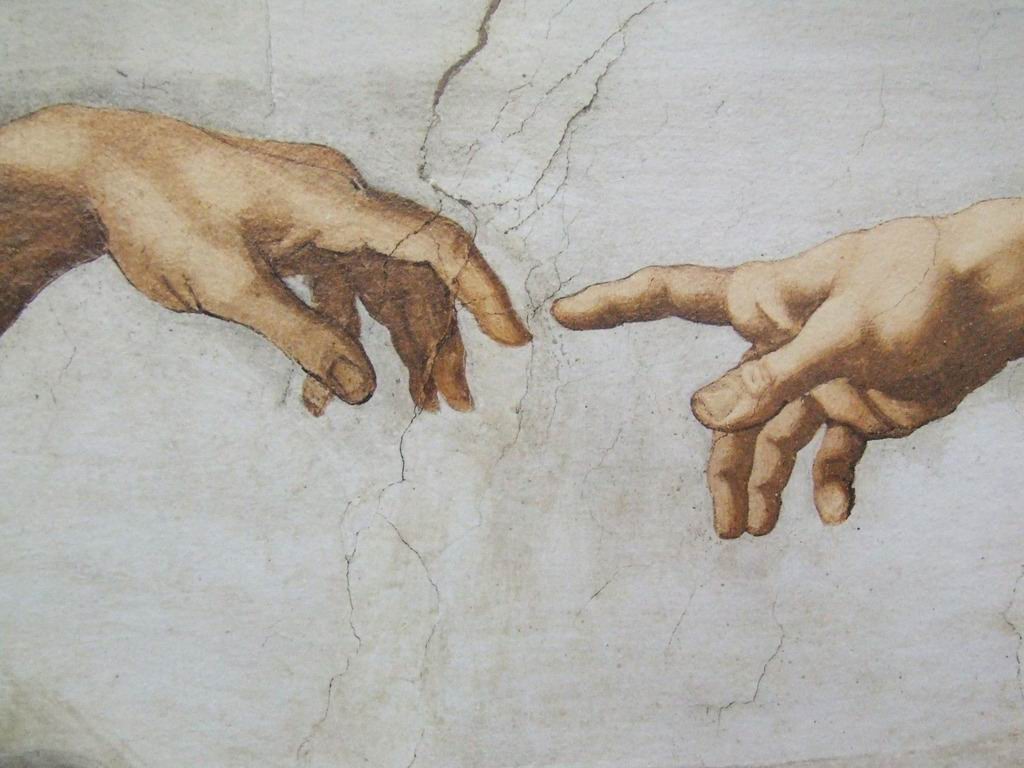
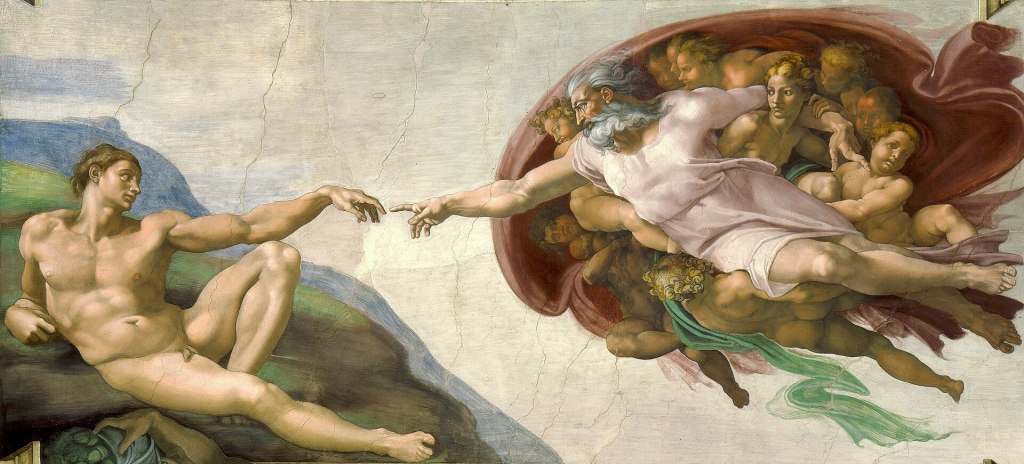
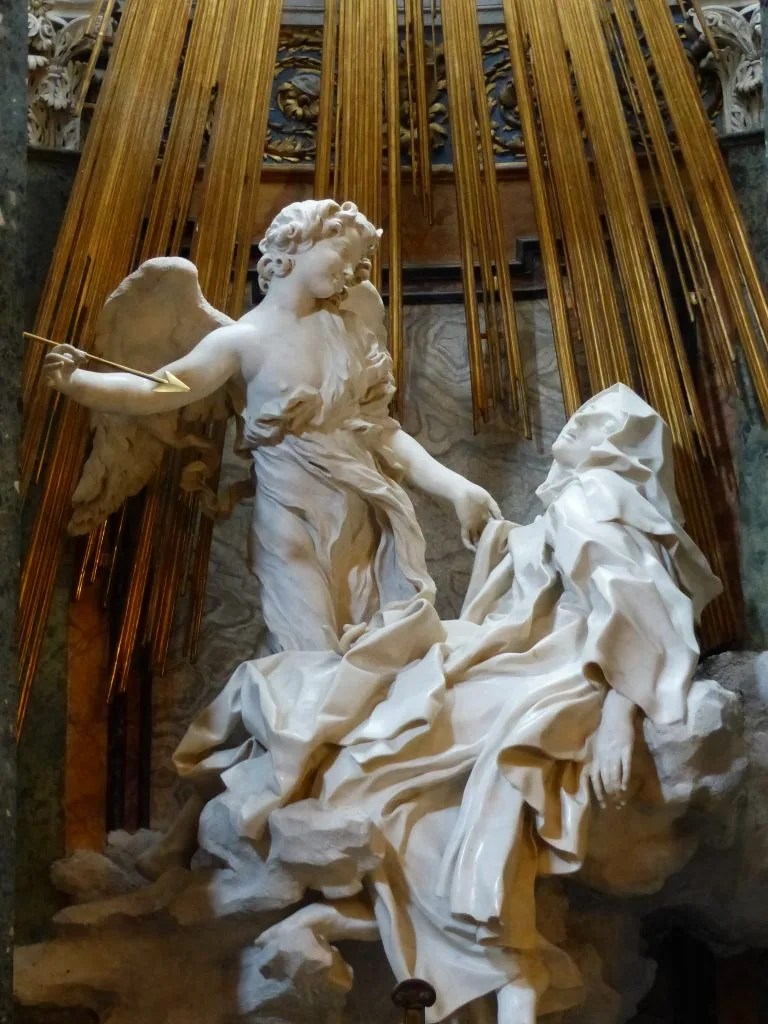
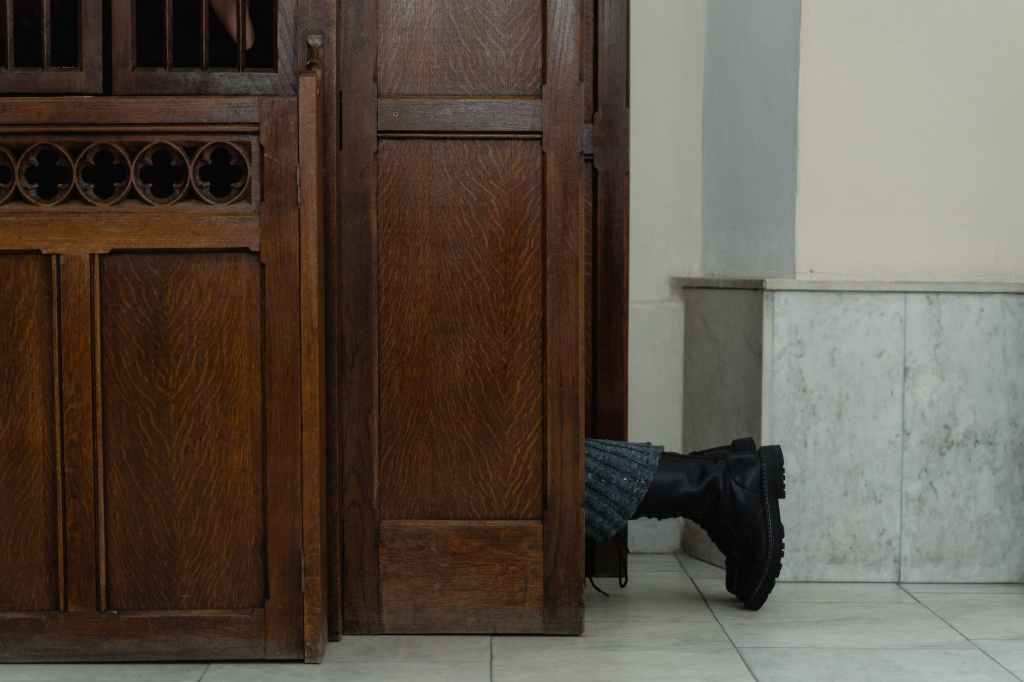
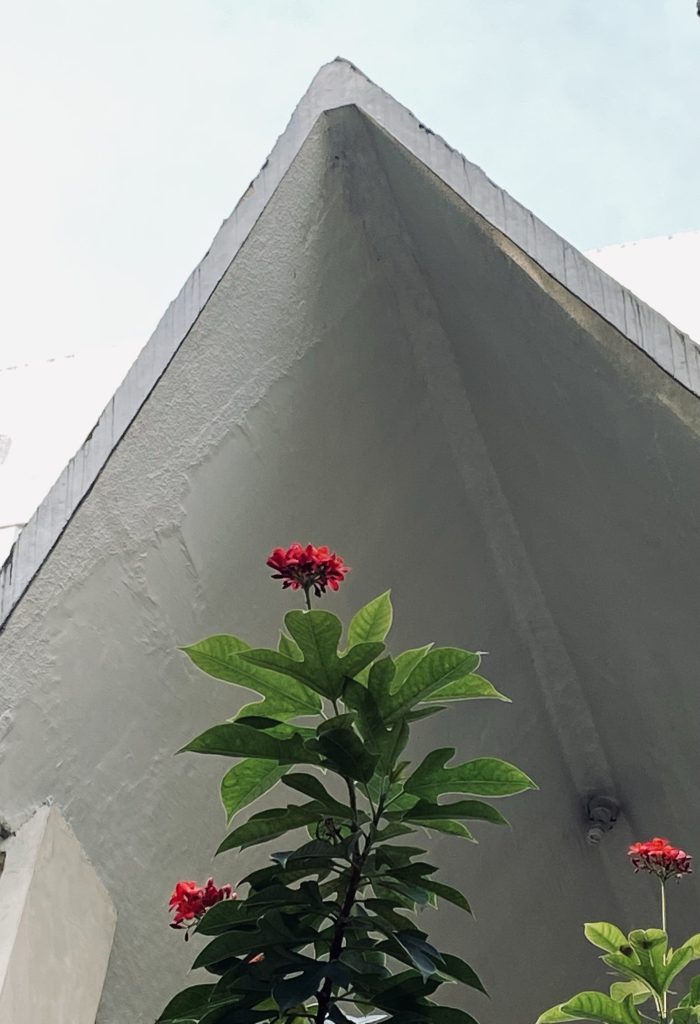
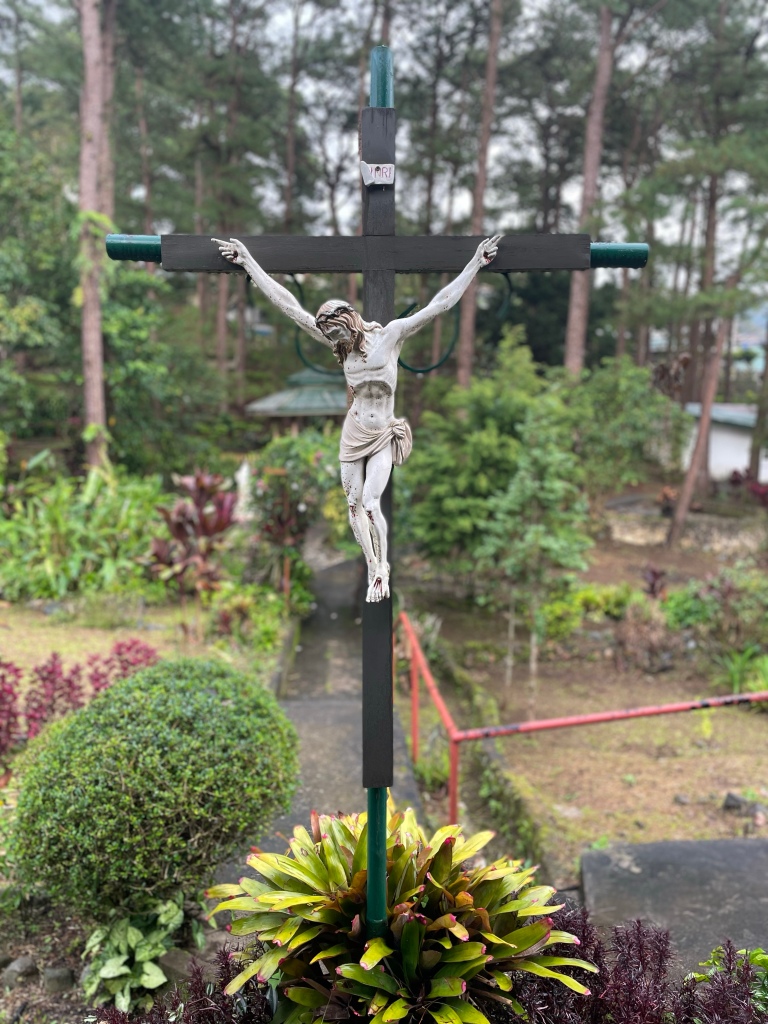
Photo by a friend in Seabrook, Washington, 06 September 2026.
Love never fails. In other translations, love never ends.
How lovely, Lord Jesus; and so challenging because many times I think of at least an end to "loving" like when Peter asked you last Sunday "how many times must I forgive my brother who sins to me... is it seven times?"
When you said it is "seventy times seven" - that is clearly what love that never fails.
As I pray to you, I realized every age, every generation in history always thinks itself as the worst, almost hopeless like during this time in our lives not only in the world but in our own country: everything is chaos and disordered, injustice and corruption are the norms followed ironically in this predominantly Christian nation where money not only talks but even shouts.
But, here we are still Jesus: alive and kicking, fighting and surviving, eagerly awaiting our new dawn of salvation in you, Jesus; grant me patience and perseverance to keep loving especially when it seems to be no longer feasible and even not doable; like Sts. Cornelius and Cyprian during their time, it was not persecution per se that was the problem but divisions among early Christians especially in the refusal of some in forgiving and readmitting apostates to to the faith; dear Jesus, teach us to be flexible, more loving than legalistic like your former Pope St. Cornelius and his friend St. Cyprian the bishop who both insisted those who denied their faith while facing persecution may be forgiven and be readmitted; it was clearly choosing to be more loving than to be legalistic.
Teach me, Jesus, to learn to read the signs of the times and most specially your divine will in dealing with the many complicated issues we now face in our being Christians. May in everything we let love prevail for wherever there is love, you are always there, Lord because that is when we have communion and oneness in you. Amen.
Lord My Chef Sunday Recipe for the Soul by Fr. Nicanor F. Lalog II Solemnity of the Most Holy Body & Blood of Christ-A, 07 May 2026 Deuteronomy 8:2-3, 3:14-16 ><}}}*> 1Corinthians 10:16-17 ><}}}*> John6:51-58
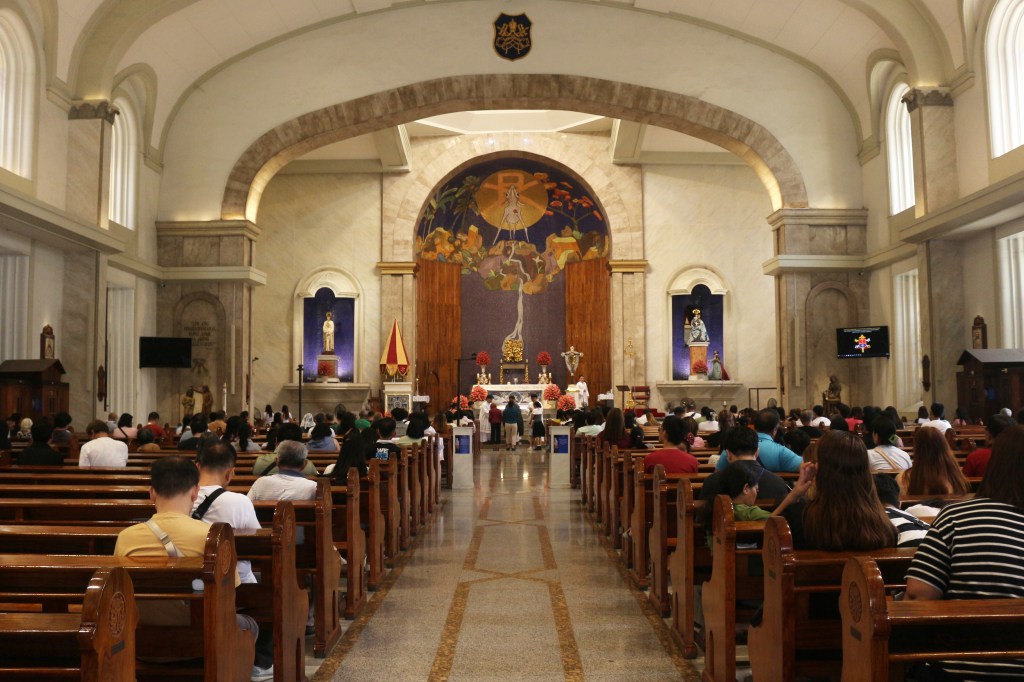
Photo from wikimedia.org of the nave with the classic altar of the Sta. Cruz Church in Manila.
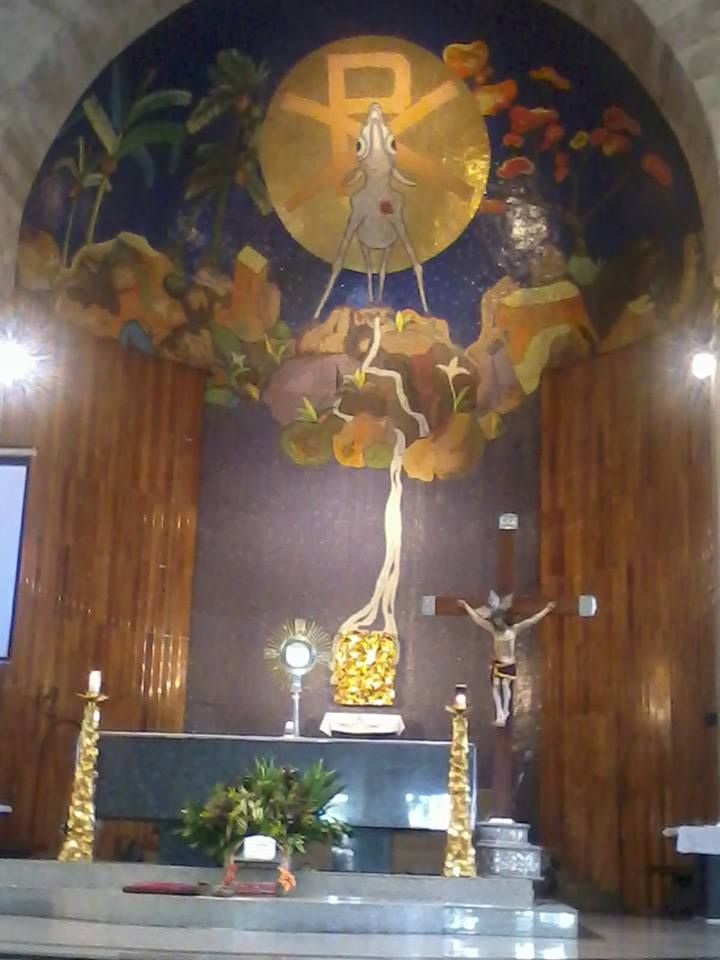
Of the many churches I have been to, the Sta. Cruz Church in Manila remains my favorite. Since childhood, I have always loved its beautiful apse of Byzantine glass mosaic of a sacrificial lamb symbolizing Jesus Christ whose blood flows like a river to the tabernacle amid a setting of mango, banana and fire trees.
Photo from Pinterest.com.
The mosaic gives that feeling of the divine presence that may be a contributing factor too in keeping the solemnity of the many successive Masses celebrated there daily.
After leaving the high school seminary in 1982 while in college at UST, I still went to Sta. Cruz church by taking the Love Bus to Escolta after which I would walk across the street to my dad’s barber for a haircut then lunch at Panciteria Ramon Lee. It remained my refuge whenever I found myself deep into sins and troubles, with problems and difficulties, feeling lost and empty especially later in life while working.
It had played a significant role in my vocation story and that is why I remembered it while reflecting this Sunday’s gospel on the Solemnity of the body and Blood of Christ.
More than a gift offered to us individually in the Eucharist, Jesus intends his Body and Blood “for the life of the world” like that sacrificial lamb depicted at the apse of the Sta. Cruz church.
Jesus said to the Jewish crowds: “I am the living bread that came down from heaven; whoever eats this bread will live forever; and the bread that I will give is my flesh for the life of the world” (John 6:51).
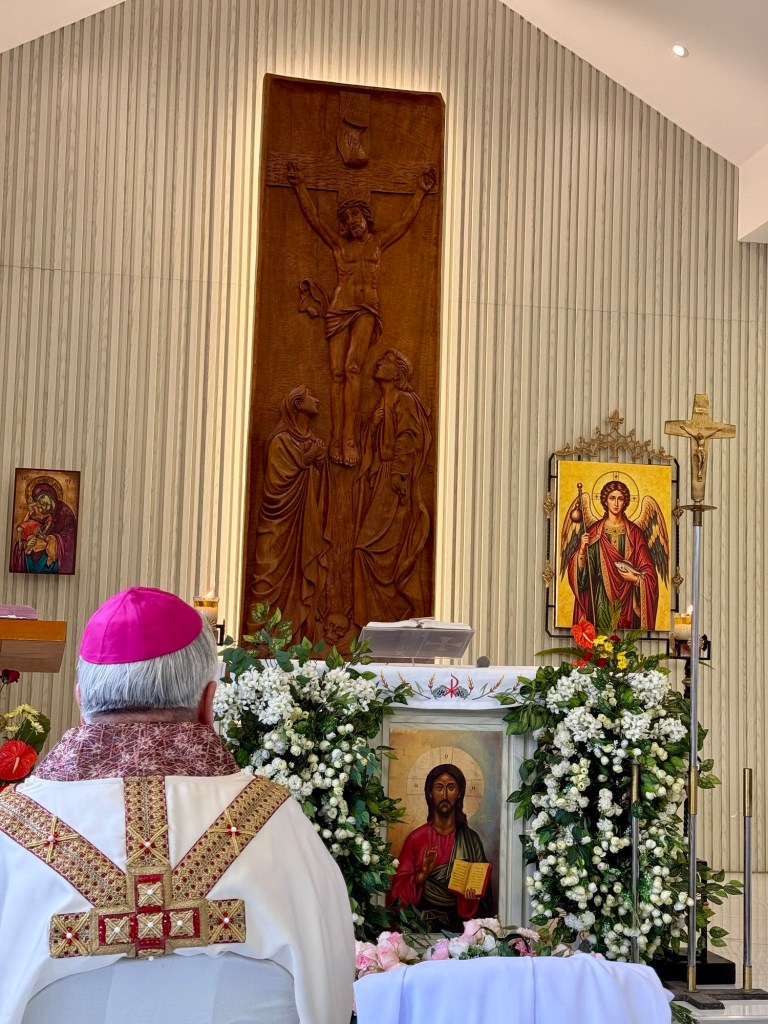
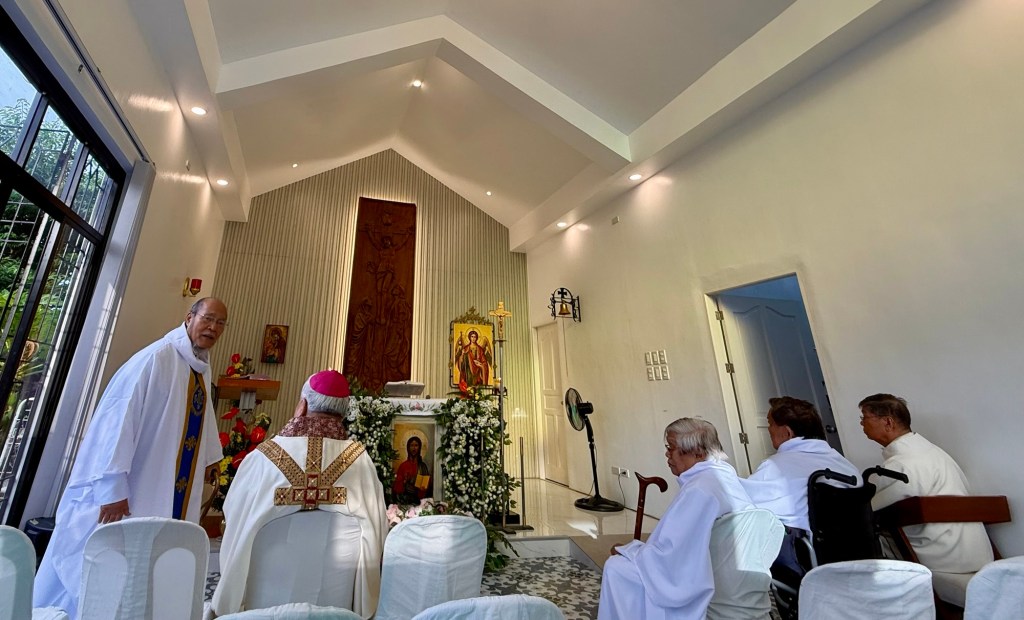
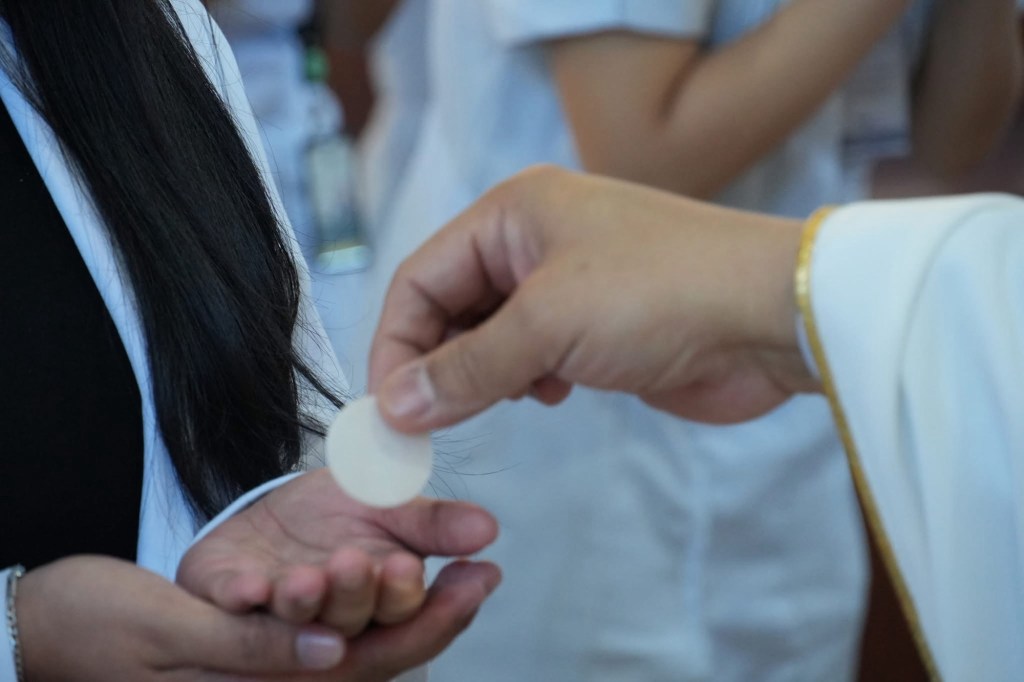
Photo by author, Chapel of St. Anthony De Padua, Alta D’Tagaytay Hotel, 02 June 2026.
On this Solemnity of the Body and Blood of Christ, we are invited to reflect on the meaning of the Holy Eucharist in our lives where the mystery of God in Three Persons, the Blessed Trinity we celebrated last week is revealed and becomes most real.
Faith in God is faith in the Incarnation of Jesus Christ present to us in the Eucharist under the signs of bread and wine. But, what does it mean really for us especially in the light of today’s gospel where Jesus said “and the bread that I will give is my flesh for the life of the world.” How can our individual life contribute in giving the life of the world, Jesus Christ himself?
In his encyclical letter Ecclesia de Eucharistia issued in 2003, St. John Paul II beautifully expressed that if Jesus can transform the bread and wine into his Body and Blood in every Eucharistic celebration, then he can transform us into better persons too.
So true! That is why the bestest time to pray is right after receiving Holy Communion because that is when Jesus Christ, Body and Blood, is present in our own body – speak to him in your most natural way. If you want, complain to him. Magsumbong ka rin sa kanya. Pour your heart out to Jesus who is Body and Blood inside you.
However, make sure too that you listen intently to him. When we listen to Jesus, we then enter into a relationship with him as we make him part of our lives as we too become part of his very life. That is when we are filled with his life which we in turn share with others and thus, give life to the world.
In the first reading we heard Moses calling us to “remember” not only those forty years in the wilderness by the Israelites but our own journey in the many desert of this life.
The word “remember” is from the root word “member” which means “part” plus the prefix “re” meaning again; to re + member a person and an incident is to make them a part of the present moment again which is the very commandment of Jesus at the Last Supper, “do this is remembrance of me.”
Now look: every week we go through our many exodus like in the first reading. We remember them especially at the start of every week because life is a daily exodus, of coming out from sickness into health, of darkness into light, of slavery into freedom, of sin into grace, of death into life. Yes, our many desert experiences in life were painful but they were all moments of grace too because that is when we realized that we do not live by bread alone, by material things alone – that we need God.
Hence, the first step for us experience this life of Christ as life for the world is to go back to the church, go back to the Holy Mass. These online Masses must be stopped. COVID pandemic is long gone.
The Mass presupposes actual presence because Christ is truly present with us in every celebration. We must learn anew to desire Jesus more in the Eucharist especially on Sundays.
In the Mass, we re-member Jesus in our lives after a week of busy activities and work; as we make Jesus a part of our lives anew, we see also ourselves needing much needed rest and comfort too in Jesus! Inasmuch as we re-member Jesus into our lives, it is actually us being re-membered into Christ who is also our food and drink to nourish us in this daily exodus in life.
Notice how in verse 14 Moses reiterated his call to the people to “remember” but this time what he told them including us today is “do not forget the Lord”: every Mass as our exodus is a way of casting off the temptation to live one’s life without God.
When we come to celebrate the Mass, especially when we are well disposed and prepared, we realize that we are always poor before God who alone can satisfy all our longings and needs.
To forget this is the sure path to catastrophe as many of us would attest.
With God, life; without God, no life.
This we find so clear with the Corinthians during the time of St. Paul that is why he addressed them in the interrogative tone:
Brothers and sisters: The cup of blessing that we bless, is it not a participation in the blood of Christ? The bread that we break, is it not a participation in the body of Christ? Because the loaf of bread is one, we, though many, are one body, for we all partake of the one loaf (1 Corinthians 10:16-17).
The Corinthians at that time were already well aware of how the Eucharist make the Church whose head is Jesus Christ. Hence, the need for a communion or “participation” which is the word used in our translation. St. Paul was reminding them of what they knew in faith, that is, a Holy Communion in Christ which they must put into practice. This communion among the Corinthians would be put into risk when quarrels and divisions plagued their community later that prompted St. Paul to write them a second letter.
As part of the Mass, the Communion is when we receive the Body and Blood of Christ; but, in a deeper sense, Communion is unity in charity. It is Jesus Christ becoming human like us in everything except sin so that we can become holy and divine like him. This mysterious exchange of ourselves with Jesus, in Jesus, and through Jesus happens in the Eucharist where we are nourished and filled with the life of Christ whenever we receive the Holy Communion. May we share this life we have gained in Christ with others by witnessing his Gospel to give life to this sick and dying world – like that sacrificial lamb at the apse of my favorite church in Sta. Cruz. Amen.Have a blessed week ahead.
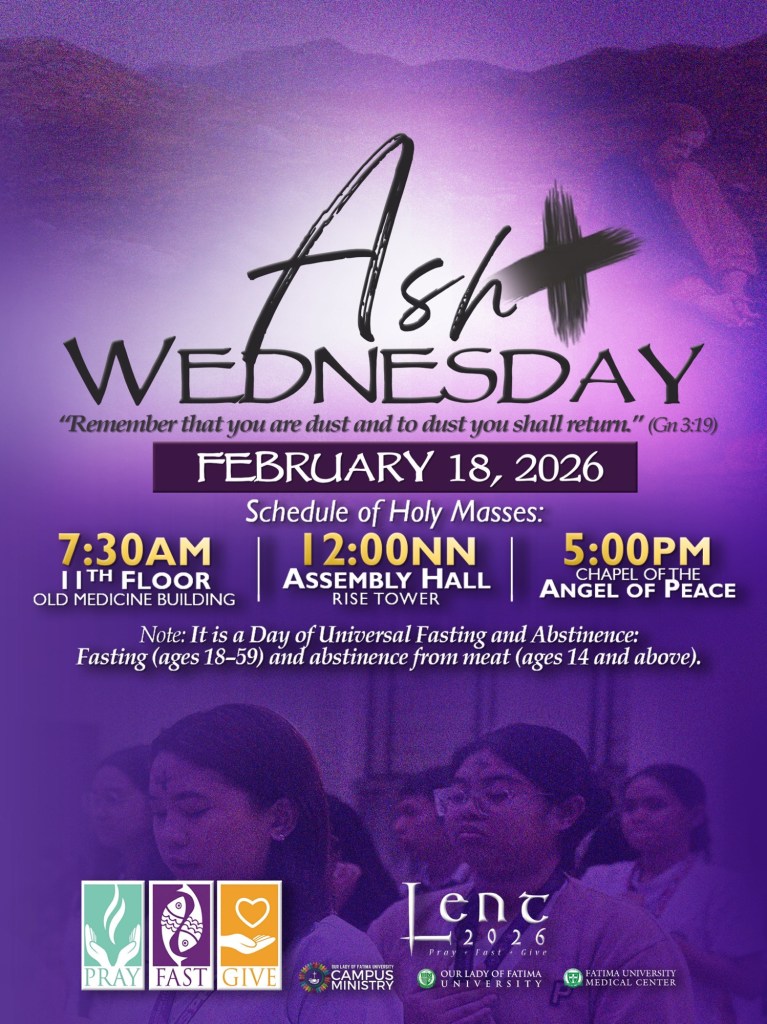
40 Shades of Lent by Fr. Nicanor F. Lalog II Ash Wednesday, 18 February 2026 Joel 2:12-18 +++ 2 Corinthians 5:20-6:2 +++ Matthew 6:1-6, 16-18
Thank you,
merciful Father
for personally calling us
to return to you this Lent
as we mark its start with
Ash Wednesday;
thank you, Father
in sending us your Son
Jesus Christ our Lord
to lead us back to you,
reminding us of your
abiding presence despite
our turning away from you;
thank you for his Vicar,
Pope Leo XIV in guiding us
in this Lenten journey into
our inner selves,
into our hearts
to find you,
to rest in you,
and to remain in you.
“Even now, says the Lord, return to me with your whole heart, with fasting, and weeping, and mourning; rend your hearts, not your garments, and return to the Lord, your God” (Joel 2:12-13).
Rend my heart, dear Jesus, that I may start listening anew to your words, in listening to your silence to lead me into conversion; rend my heart, O Lord, that I may always listen to you in my brothers and sisters' pleas for help amid their many pains and suffering because I have been numb to them, unmindful of their presence; rend my heart, Jesus so you may be my core not easily swayed by that little gadget the cellphone that had become the modern baal of our time we unconsciously follow and obey instead of you, Lord.
Rend my heart, dear Jesus, that I may truly fast by emptying myself of my pride and sins so that you may fill me with your humility, justice, and love; rend my heart, O Lord, that I may "hunger" more for your values and "thirst" for your love and mercy by "disarming our language, avoiding harsh words and rash judgment, refraining from slander"; render my heart, Jesus, so I may fast my tongue, "striving to measure our words, cultivate kindness and respect so that words of hatred may give way to words of hope and peace."
Rend my heart, dearest Jesus, so that my listening and fasting may lead into the common good, into a communion of your disciples attentive to God and to the least among us; rend my heart, Lord Jesus Christ not only to cleanse my conscience but also to enhance the quality of my relationships and dialogue with each other in the power of the Holy Spirit.
Rend my heart, Lord Jesus Christ to help me find my way back to the Father in you, through you, and with you. Amen.
*Prayer based on Pope Leo XIV's first Lenten Message, https://press.vatican.va/content/salastampa/en/bollettino/pubblico/2026/02/13
40 Shades of Lent by Fr. Nicanor F. Lalog II Ash Wednesday, 18 February 2026 Joel 2:12-18 +++ 2 Corinthians 5:20-6:2 +++ Matthew 6:1-6, 16-18
Lent is often portrayed as a journey of 40 days towards Easter starting today, Ash Wednesday. But deeper than a journey in time, it is a journey into the Father that starts in our hearts, deep within each one of us.
It is the season when we are invited to take time to look inside our hearts to see our true selves as sinful in order to meet God dwelling right inside us. The Prophet Joel in the first reading sets this tone of inner journey of conversion perfectly when he voiced out God’s call, speaking to us personally especially in this modern age:
“Even now, says the Lord, return to me with your whole heart, with fasting, and weeping, and mourning; rend your hearts, not your garments, and return to the Lord, your God” (Joel 2:12-13).
Photo by author, Buendia Ave., Makati City, 09 February 2026.
Very often, we are concerned about our external appearance, of how we look to other people but God sees what is in our hearts, of what is really inside us. And the path inside us is to cleanse ourselves thoroughly of the dirt and smudges of sin; hence, the imposition of ashes on our forehead.
Ash has long been a cleansing agent. Long before these modern kitchen stoves and gadgets of today, we used firewood for cooking that blackened the bottom of cooking wares. There were no Scotch Brite nor dishwasher at that time so we would mix ashes and cleanser soap then with steel wool and eskoba, we scrubbed them on the dirty kaldero and kawali until they were sparklingly beautiful again.
It is the very imagery of that cleaning of darkened pots with ash and soap the priest conveys to us when he says “Repent and believe in the gospel” while putting those ashes on our foreheads.
To repent is more than being sorry and admitting our sins but also a firm resolve to change our sinful ways, to be converted by following Jesus Christ in his Cross, by being more loving like him. In his first Lenten Message, Pope Leo XIV reminds us that “Every path to conversion begins by allowing the word of God to touch our hearts and welcoming it with a docile spirit.” He proposes three specific ways in doing this: listening, fasting and together.
Listening. The Holy Father reminds us so beautifully that “The willingness to listen is the first way we demonstrate our desire to enter into a relationship with someone.”
So true! But, so sad, too is the fact whom do we listen more these days? We live in a mass-mediated culture with so many young people practically living in the social media, taking and believing everything they read and see on their screen as the “gospel” truth that have only misled so many of us into various forms of miseries like emptiness, alienation from self and others, and even deaths.
Pope Leo explains that “Our God is one who seeks to involve us. Even today he shares with us who is in his heart. Because of this, listening to the word in the liturgy teaches us to listen to the truth of reality… In order to foster this inner openness to listening, we must allow God to listen as he does.” This is precisely the call of Jesus to us in the gospel when he repeatedly spoke of “God seeing you in secret” – God is always listening to us but do we listen to him?
In order to truly listen to God, first we must learn his language which is silence. See how the word “silent” is a palindrome of “listen” which is the reason why we have two ears so that we may listen more than speak. Remember also the shape of our ears – when placed together they form a heart because listening is not letting the words pass through the other ear nor keep in one’s head to understand but meant to bring down into our hearts so we can be more loving and kind, leading to oneness and bonding with the other persons.
Here we can adopt the suggestions of the CBCP that we fast this Lent on social media: no more cellphones before sleep and after waking up; limit social media and streaming time; observe device-free meals and gatherings; replace screen time with prayer and making time to be with others personally.
Photo by author, Sacred Heart Novitiate, Novaliches, QC, March 2025.
Fasting. According to Pope Leo, “fasting is a concrete way to prepare ourselves to receive the word of God.” He explains that “because it involves the body, fasting makes it easier to recognize what we ‘hunger’ for and what we deem necessary for our sustenance. Moreover, it helps us identify and order our ‘appetites,’ keeping our hunger and thirst for justice alive and freeing us from complacency.”
Again, let us use our Filipino language in understanding fasting and abstinence as well. Fasting is linked with abstaining from food. For us Filipinos, the most common practice of fasting and abstinence is avoiding meat like no meat on Fridays; meat in Filipino is laman. Therefore, when we say “no meat” it literally means walang laman which means empty in Filipino. It is when we are empty of ourselves that we become filled with God and his word, eventually of others especially the sick and suffering.
In a very interesting way, Pope Leo XIV invites us beginning this Lent to fast with our “tongue”: “Let us begin by disarming our language, avoiding harsh words and rash judgment, refraining from slander and speaking ill of those who are not present and cannot defend themselves. Instead, let us strive to measure our words and cultivate kindness and respect in our families, among our friends, at work, in social media, in political debates, in the media and in Christian communities. In this way, words of hatred will give way to words of hope and peace.”
Together. Finally, the Holy Father sums up that listening and fasting must both lead to the common good, the unity of peoples because “conversion refers not only to one’s conscience, but also to the quality of our relationships and dialogue. It means allowing ourselves to be challenged by reality and recognizing what truly guides our desires” not only as a community but especially in our “thirst for justice and reconciliation”.
Again, our Filipino word for listening says it all: pakikinig leads to pagniniig or intimacy which is oneness, communion, and bonding. True conversion leads to communion that begins with reconciliation as St. Paul called on us today in the second reading, “We implore you on behalf of Christ, be reconciled to God. Behold, now is a very acceptable time; behold, now is the day of salvation (1Cor. 5:20,6:2).”
As we receive the ash on our foreheads today, let us have moments of silence to listen to God’s voice we have stifled in our hearts, let us fast from talking and scrolling, and together we help each other to truly journey inside our true selves to meet God this Lent. To meet God is to die into one’s self, one’s sins, one’s selfishness as well dying literally speaking which the old formula of imposition of ash solemnly declares, “Remember that you are dust, and to dust you shall return.”
Let’s face it: it is the reality of death that we have often tried to deny and escape in life that have kept our hearts consumed with all these distractions in modern life that have led us into sins and meaninglessness. Let us start anew today in Christ Jesus to find ourselves and God within our hearts. Amen. A blessed Ash Wednesday to you!
Lord My Chef Sunday Recipe for the Soul by Fr. Nicanor F. Lalog II Sixth Sunday in Ordinary Time, Cycle A, 15 February 2026 Sirach 15:15-20 ><}}}}*> 1 Corinthians 2:6-10 ><}}}}*> Matthew 5:17-37
Photo by author, Benguet, July 2023.
It is a day after Valentine’s, also the final Sunday before we take a long break from Ordinary Time to start the 40 days of Lent this Ash Wednesday leading us to Easter that lasts until the month of May. It is so lovely and timely that we hear Jesus teaching us this Sunday to examine our hearts always so that we can live our faith in him daily, of remaining blessed in his beatitudes.
We are still at the sermon on the mount with Jesus giving us a series of general teachings illustrated in some concrete examples. However, keep in mind these are not new teachings as Jesus himself clarified he had come not to abolish but to fulfill the laws. In the light of the Beatitudes he taught us the other Sunday, Jesus is now directing us to look deeper into our hearts, to make it whole again in him and stay blessed unlike the scribes and the Pharisees.
Jesus said to his disciples: “I tell you, unless your righteousness surpasses that of the scribes and Pharisees, you will not enter into the kingdom of heaven” (Matthew 5:20).
Photo by author, Jerusalem, May 2017.
This is not the first time we have heard the word “righteousness” in Matthew who used it to describe Joseph in his Christmas story as “a righteous man” (Mt.1:19).
Being righteous for the Jews is being holy which is obeying and living by the laws and commandments of God. Unfortunately, they got centered with the letters of the laws as insisted by their scribes and Pharisees. When Jesus came, they have forgotten God himself as well as the value of the human person and life itself for which the laws were meant to be. Matthew rectified this at the start of his gospel with the story of the annunciation of Christ’s birth to Joseph who obeyed God’s command expressed in his love for Mary whom he took as his wife then pregnant with the Savior he named as “Jesus”.
Righteousness or holiness is not being sinless but being filled with God, living our faith in Christ by witnessing his gospel. From the Greek word holos that means “whole” not broken, holiness in a sense is what we call as integrity.
Holiness, righteousness, and integrity all begin in the heart that we find expressed in the sixth Beatitude taught by Jesus two Sundays ago, “Blessed are the clean of heart, for they will see God” (Mt.5:8).
A clean heart is a loving heart. We can only see God and the other persons with a loving heart. The human intellect cannot know most especially God as St. Paul tells us in the second reading.
In the same manner, we know the other person not with the intellect but always with the heart as the Little Prince said, “What is essential is invisible to the eye; it is only with the heart that one can truly see” while Marvin Gaye expressed it so beautifully in his 1971 hit “What’s Going On” with the lines “we have to put some lovin’ here today” so we can understand each other.
Indeed, the heart is the very center or core of every person because everything flows from the heart. And this is what Jesus himself underscores in his three admonitions against anger, lust, and falsehoods this Sunday. In all three teachings, we find how love is severely damaged when we quarrel against each other, when we take everyone as things and objects to be used, and when we lack the sincerity in our words.
Photo by author, September 2021.
“You have heard that it was said to your ancestors, You shall not kill; whoever kills will be liable to judgment. But I say to you, whoever is angry with his brother will be liable to judgment, and whoever says to his brother ‘Raqa,’ will be answerable to the Sanhedrin, and whoever says, ‘You fool,’ will be liable to fiery Gehenna”(Mt.5:21-22).
First thing we notice in these three teachings is its construction where Jesus first mentioned what was said by the ancestors in the phrase “You have heard” immediately followed by his own take, “But, I say to you.”
Again, Jesus is not contradicting the laws given by Moses and elaborated by their elders; Jesus was actually expressing its fullness in him found in love that begins in the heart which St. Paul reiterated in his letters that love is the perfection of the laws and commandments of God.
Whenever we quarrel in words or in deeds, we not only break our ties with each other as brothers and sisters but even with God we call “our Father”. Remember, love of God is love of one another. And the sad part of this reality is our being cut off from God even if we don’t admit it. And even if we know we have nothing against anyone, we surely feel the break-up in our selves due to the lack of love and charity, most of all, of peace. That is why Jesus added that when in our worship we realize a brother or sister has anything against us, we must first reconcile with him or her. That is why before the Holy Communion, we give the greeting of peace with one another who represents the person we are at odds with. The responsibility becomes more pronounced if the person is in the same assembly we are in if we really want to have a meaningful and holy communion.
“You have heard that it was said, You shall not commit adultery. But I say to you, everyone who looks at a woman with lust has already committed adultery with her in his heart” (Mt.5:27-28).
Here we go again with the issues of marital infidelity as well as of divorce: at the very core of this is the equality of every person, of every man and woman as being created in the image and likeness of God with same equal dignity. Jesus reminds us today that there is no difference between man and woman when it comes to marriage because the same duties of fidelity bind each partner. Most of all, Jesus has consistently taught how we must go beyond the Laws when it comes to marriage because every spouse is an image of himself, of his saving grace. Hence, we must reject every temptation and inappropriate words and actions that may destroy unity and love of couples and even in our other relationships as family and friends.
Photo by author, Makati City, 09 February 2026.
“Again you have heard that it was said to your ancestors, Do not take a false oath, but make good to the Lord all that you vow. But I say to you, do not swear at all. Let your ‘Yes’ mean ‘Yes,’ and your ‘No’ mean ‘No.” Anything more is from the evil one” (Mt.5:33-34).
This last admonition is perhaps most needed these days when we are bombarded with too much fake news as well as our own words are empty. Shakespeare said it so well in Hamlet, “words, words, words” wherein we think and believe that the more we increase our words, the more it becomes true and meaningful.
Of course, it it totally untrue as Jesus reminded us today to be truthful always. In Genesis, we are told in the story of creation how God shared only this power of words, of language with humans alone. Our ability to speak is a sharing in God’s power that demands responsibilities (Spiderman). Hence in the first reading, Ben Sirach reminds us to be responsible in choosing good than evil like in choosing between “fire and water”, “life and death”. Ben Sirach’s short reminders are very timely in this age of social media where “influencers” choose for us not only the candidates to elect but even the food to eat and clothes to wear. Being free is to decide, to choose knowingly what is good.
This Sunday, Jesus invites us to look into our hearts, to cleanse it of evil and sins so that he may dwell and reign completely in our hearts so we can have integrity and remain blessed and holy in him. Amen. Have a blessed week ahead, everyone!
Lord My Chef Daily Recipe for the Soul by Fr. Nicanor F. Lalog II Tuesday, Third Week in Ordinary Time, Year II, 27 January 2026 2 Samuel 6:12-15, 17-19 <*{{{{>< +++ ><}}}}*> Mark 3:31-35
Photo by author, Sacred Heart Novitiate, Novaliches, QC, August 2017.
Your words today are very interesting, God our loving Father: both the first reading and the gospel show us a setting of people gathered, inside and outside a circle of crowd; but, what makes it so interesting is the fact that more than the location of being "inside" and "outside" in any setting especially in gathering and in coming to you, what truly matters most is our action, of what are we doing because many times, we may be "inside" without doing your will while be "outside" doing your will.
The mother of Jesus and his brothers arrived. Standing outside they sent word to Jesus and called him. A crowd seated around him told him, “Your mother and your brothers and your sisters are outside for you.” But he said to them in reply, “Who are my mother and my brothers?” And looking around at those seated in the circle he said, “Here are my mother and my brothers. For whoever does the will of God is my brother and sister and mother” (Mark 3:31-35).
Thank you dear Jesus for coming to us, bringing us closer to you, to God our Father, and most especially with everyone; how sad at times when we are seated right in your circle yet too far from you and others because we are away from your will, from your very self, from your works; it does not really matter wherever we are seated but where we stand in you and with you in doing the will of God.
Teach us to imitate King David who rejoiced triumphantly in the arrival of the Ark of the Covenant where he was closest to God's presence not because of the Ark but most because of his care for the people around to whom "he distributed to each man and each woman in the entire multitude of Israel, a loaf of bread, a cut of roast meat, and a raising cake" (2Samuel 6:19).
Let us come to you, in you, and through you, dear Jesus in holy communion welcoming everyone with our loving service so that no one may feel far and outside from you and one another. Amen.
Lord My Chef Daily Recipe for the Soul by Fr. Nicanor F. Lalog II Monday, Second Week in Ordinary Time, Year II, 19 January 2026 1 Samuel 15:16-23 <*((((>< + ><))))*> Mark 2:18-22
It is still too early, Lord Jesus Christ but every moment is always a "happy hour" in you as you speak of new wine into fresh wineskins:
Likewise, no one pours new wine into old wineskins. Otherwise, the wine will burst the skins, and both the wine and the skins are wuined. Rather, new wine in poured into fresh wineskins” (Mark 2:22).
Teach me, Jesus to have a "new mind in Christ" (1 Cor. 2:16), to truly fast my mind and my heart by emptying myself of so many things like beliefs and suppositions that prevent me from welcoming you into myself; turn me into a fresh wineskin, Lord by discarding my old self that has become my comfort zone of complacency and mediocrity; teach me obedience, Jesus that I may truly appreciate and realize the true meaning of our many traditions like fasting and prayer that lead to glorifying you and union in you; forgive me on many occasions of acting and believing like King Saul of justifying disobedience, insisting on my own understanding and seeing of things.
Many times, indeed, we "burst" because we never have you in us, Jesus, for we are so filled with our old selves. Amen.
Lord My Chef Sunday Recipe for the Soul, 23 November 2025 Solemnity of Christ the King, Cycle C 2 Samuel 5:1-3 ><}}}}*> Colossians 1:12-20 ><}}}}*> Luke 23:35-43
I was teasing our campus ministry head for communication last Tuesday after he had presented to me this announcement for our Christ the King celebration today. “Para namang malnourished si Jesus diyan,” I told Darwin as he scratched his head laughing during our meeting.
But, that evening after praying our gospel, I changed my mind the following Wednesday and told Darwin to go ahead with his original artwork because I have realized that the face of Christ the King is also the face of us suffering.
Photo by author, Holy Monday, 2025.
Are you not surprised that on this final Sunday of the liturgical year, we are not presented with an image of a victorious Jesus like that Cristo Rey found in every Catholic home but the gospel scene of Jesus suffering in excruciating pain there on the Cross on Good Friday?
Above him there was an inscription that read, “This is the King of the Jews.” Now one of the criminals hanging there reviled Jesus, saying, “Are you not the Christ? Save yourself and us.” The other, however, rebuking him, said in reply, “Have you no fear of God, for you are subject to the same condemnation? And indeed, we have been condemned justly, for the sentence we received corresponds to our crimes, but this man has done nothing criminal.” Then he said, “Jesus, remember me when you come into your kingdom.” He replied to him, “Amen, I say to you, today you will be with me in Paradise” (Luke 23:38-43).
Photo by author, Chapel of St. Francis Xavier, Sacred Heart Novitiate, Quezon City, 2024.
On this Solemnity of Christ the King, St. Luke invites us for the last time we hear his gospel this year to look at the face and into the eyes of Jesus crucified.
What do you see and feel in him?
Ever wondered what the rulers and soldiers saw on the face of Jesus crucified that they sneered and jeered him from below? They were so filled with pride in finally putting into shame and silence Jesus who had always spoken the truth and exposed their lies and hypocrisies.
What do we see when people are put on the spot and shamed like Jesus crucified or like the woman caught committing adultery Jesus forgave and saved from being stoned by the angry crowd? So sad that in this age of social media, public trials and condemnation have become a hobby for many without even checking the accusations are true or not.
Let us move closer to Jesus on the Cross like those two thieves hanging at each of his side: what do you see and feel about him?
Why did the other thief join those below in deriding and insulting Jesus crucified? Now one of the criminals hanging there reviled Jesus, saying, “Are you not the Christ? Save yourself and us” (Lk.23:39).
Have you ever found yourself in the ER or waiting for your turn at the doctor’s clinic with other patients also in pain and suffering? How do you see the other patients and sick people like you? Is there in your mind any tinge of suspicion why or how they got sick? The best and the worst in us come out in such times when we are so down beside another suffering brother or sister.
Or, do we choose the path of humility and sincerity of Dimas, the good thief? What did he see in Jesus there on the Cross? The other, however, rebuking him, said in reply, “Have you no fear of God, for you are subject to the same condemnation? And indeed, we have been condemned justly, for the sentence we received corresponds to our crimes, but this man has done nothing criminal” (Lk.23:40-41).
Most likely, Dimas must have heard a lot about the teachings and healings by Jesus but he felt something so unique and liberating, so personal during those dark moments of excruciating pains when he finally recognized Christ his Savior, the only true King that is why he asked to be remembered in his kingdom!
Finally, somebody greater than him there beside him, saying nothing to judge nor condemn him nor irritate him like his fellow criminal at the other side. In recognizing Jesus, Dimas also found himself as truly human, weak and finite who can only be whole and complete – saved and redeemed – in Christ who chose to be there on the Cross with him exactly as St. Paul had written in our second reading.
He is before all thing, and in him all things hold together. He is the beginning, the firstborn from the dead, that in all things he himself might be preeminent. For in him all the fullness was pleased to dwell, and through him reconcile all things for him, making peace by the blood of his cross through him, whether those on earth or those in heaven (Colossians 1:17, 18-20).
Photo by author, St. Scholastica Spirituality Center, Baguio City, August 2023.
Here we find the beauty of the Cross, of how God so perfect without any need to suffer and experience pain yet chose to go through it to express his solidarity and love for us humans.
It is on the cross when we are most able to identify and be one in Jesus Christ. That is why it is also on the Cross that we enter heaven with Jesus amid suffering and death. Jesus said today you shall be with me in Paradise – not later when we die or after three days at Easter. How lovely that Jesus never promised heaven when he was strong and freely moving around but when he was there on the cross, nailed and dying.
Jesus Christ is the King of the Universe not because of his powers and might but primarily of his being one of us in sufferings and death. It was the very feeling the tribes of Israel were telling David when they came to him in Hebron to reaffirm their allegiance to him as their king, “Here we are, your bone and your flesh” (2 Sm. 5:1).
The people we admire most are not always the best nor most powerful nor talented because often we envy them. On the other hand, we are more drawn with those down and burdened because we see in them our own brokenness, too, that it is part of life and of being human. That is why we easily empathize with those grieving or sad than with those happy or rejoicing.
Our humanity reaches its highest point and beauty when broken and weak as we realize our mortality and similarity with others in suffering needing for a Savior. We are most inhuman whenever we enjoy inflicting or causing pains on others or when rejoicing in their agonies. To proclaim Christ is the King of the Universe is to always see him in our sufferings and among those suffering too like us. Amen. A blessed week ahead of you!
Lord My Chef Daily Recipe for the Soul, 17 October 2025 Friday, Memorial of St. Ignatius of Antioch, Bishop & Martyr Romans 4:1-8 <*{{{{>< + ><}}}}*> Luke 12:1-7
Your words, O Lord Jesus this Friday are so lovely, so comforting especially in this time when many fear ageing, suffering, and death.
I tell you, my friends, do not be afraid of those who kill the body but after that can do no more. I shall show you whom to fear. Be afraid of the one who after killing has the power to cast into Gehenna; yes, I tell you, be afraid of that one (Luke 12:4-5).
How I wish I could hug you, Jesus, lean on you while relishing your calling us "my friends" not to be afraid of those who kill the body; more than trusting you, let me live in you, Jesus like Abraham as explained by St. Paul in the first reading who deeply trusted God in everything; deepen my consciousness as a senior citizen that life does not end in the grave because the soul persists even after death; thank you also for the gift of hair though it had thinned and turned gray, now sparse and perhaps easier for the Father to count and remember but most of all as signs of his love and care for me; let me not be afraid, Jesus, for I am worth more than the sparrows.
St. Ignatius of Antioch whose feast we celebrate today, pray for us modern people so afraid of pain and suffering and death: pray for us to be like you - to accept death, even pursue death which is our rebirth to new life. Amen.
Fr. Nicanor F. Lalog II Our Lady of Fatima University Valenzuela City (lordmychef@gmail.com)
Lord My Chef Daily Recipe for the Soul, 15 October 2025 Wednesday, Memorial of St. Teresa of Avila, Virgin & Doctor of Church Romans 2:1-11 <*{{{{>< + ><}}}}*> Luke 11:42-46
Photo by author, Mt. Arayat viewed from Angeles City, Pampanga, May 2022.
Your words, O Lord Jesus are sobering... and so liberating.
You, O man, are without excuse, every one of you who passes judgment. For by the standard by which you judge another you condemn yourself, since you, the judge, do the very same things… Or do you hold his priceless kindness, forbearance, and patience in low esteem, unaware that the kindness of God would lead you to repentance? (Romans 2:1, 4)
How lovely are your words through St. Paul today, Jesus: "You, O man, are without excuse, everyone of you"... whoever you are. And that's all of us!
What a beautiful reminder in this time that when it comes to God's judgment, not one of us is any better than the other; indeed, there is no partiality in you, O Lord, because you are so kind to give each one of us to have that chance to change for the best, to be able to enter into a communion in you in prayer.
On this Memorial of St. Teresa of Avila, teach us to strive in prayers, to learn her ways of discipline and humility, of openness and trust in you so that we may enter into your very heart O Lord where only you would suffice. Amen.
St. Teresa of Avila, Pray for us!
Fr. Nicanor F. Lalog II Our Lady of Fatima University Valenzuela City (lordmychef@gmail.com)