The Lord Is My Chef Breakfast Recipe for the Soul by Fr. Nicanor F. Lalog II
Wednesday, Feast of St. Mary Magdalene, 22 July 2020
2 Corinthians 5:14-17 >><}}}*> >><}}}*> >><}}}*> John 20:1-2, 11-18
Painting by Giotto of the Risen Lord Jesus Christ appearing to St. Mary Magdalene from commons.wikimedia.org.
Dearest Lord Jesus Christ:
Today as I prayed on the feast of your beloved Saint Mary Magdalene, my sights were focused on your beautiful exchange of names on that Easter morning at your tomb.
It is so lovely and so deep, and very personal for all of us whom you love so much despite our many sins like St. Mary Magdalene.
When she had said this, she turned around and saw Jesus there, but did not know it was Jesus. Jesus said to her, “Woman, why are you weeping? Whom are you looking for?” She thought it was the gardener and said to him, “Sir, if you carried him away, tell me where you laid him, and I will take him.” Jesus said to her, “Mary!” She turned and said to him in Hebrew, “Rabbouni,” which means Teacher.
John 20:14-16
You called her by her name, “Mary” and she called you by your title “Rabbouni” – what a beautiful scene of two people loving each other so deeply, so truly! You – humbly and lovingly accepting the sinner, and she – submitting herself to you as disciple.
You have expelled seven demons from her, you have known her so well even her darkest secrets and sins, and despite all these knowledge, Lord Jesus, the more you have loved her that you called her by the sweetest word she could ever hear in her life, “Mary”.
The same with us, sweet Jesus: every day you call us by our names, each one of us as a person, an individual, a somebody not just a someone. You love us so much in spite and despite of everything. We are not just a number or a statistic to you but a person with whom you relate personally.
From Google.
Help us to realize this specially when darkness surrounds us, when self-doubts and mistrust abound in us without realizing your deep trust in us, in our ability to rise again in you and follow you.
Teach me to trust you more and love you more like St. Mary Magdalene, to give and offer my self to you totally as yours, calling you “Rabbouni” or Teacher and Master.
Let me give up whatever I still keep to myself, whatever I refuse to surrender so that I may enjoy the intimacy you offer me as a friend, a beloved, and a family in the Father.
What a joy indeed to be like St. Mary Magdalene, fully known and fully loved by you, dear Jesus.
May I learn to know and love others too like you so I may proclaim you to them. Amen.
The Lord Is My Chef Breakfast Recipe for the Soul by Fr. Nicanor F. Lalog II
Wednesday, Week XIV, Year II in Ordinary Time, 08 July 2020
Hosea 10:1-3, 7-8, 12 <*(((><< >><)))*> Matthew 10:1-7
Photo by Dr. Mai B. Dela Peña, statues of the Twelve Apostles on the facade of the Church of our Lady of Montserrat in Spain, 2019.
How beautiful are your words today, dearest God our Father. You never fail to surprise me with your deep personal involvement with us all that you can capture exactly what is inside us without any doubt at all.
After praising Israel’s great achievements that have brought them material prosperity, you remain impartial and fair in pronouncing your judgement:
Israel is a luxuriant vine whose fruit matches its growth. The more abundant his fruit, the more altars he built. The more productive his land, the more sacred pillars he set up. Their heart is false, and now they pay for their guilt. God shall break down their altars and destroy destroy their sacred pillars.
Hosea 10:1-2
Indeed, only you can read our hearts, our inmost beings.
How many times have we been deceived by outward appearances like material prosperity in life, thinking these are the crowing glory of one’s great efforts in balancing prayer and work only to be rejected by God for their hard headedness and pride?
A heart that is false is also a heart that has turned away from you, O God; sometimes, these are not evident right away because a heart can always fake outside what is inside.
A heart that takes pride in its grand designs and visions is a heart that is false. Most of all, a heart that refuses to look into the pains and hurts of others, their shortcomings and sins, is a heart that is false because it denies humanity, its being a human flesh tormented by love amidst pains and sufferings. A heart that is false is a heart that refuses to see other hearts with many hurts because it believes more with its self than with God’s love and mercy.
A heart that is false is a heart that has refused to grow and outgrow its previously held convictions and beliefs, more intent in looking at its own heart than into Christ’s meek and humble heart, eventually betraying Jesus and loved ones.
Incline our hearts into the Father’s loving heart, dear Jesus, and give us a heart that is both true and humble, accepting our many limitations, full of hope in becoming a better person in you like your Apostles who started out like us all with imperfect hearts. Amen.
The Lord Is My Chef Breakfast Recipe for the Soul by Fr. Nicanor F. Lalog II
Tuesday, Week XI, Year II in Ordinary Time, 16 June 2020
1 Kings 21:17-29 <*(((>< <*(((>< ><)))*> ><)))*> Matthew 5:43-48
Photo from Google.
O God our heavenly Father, we come to you today begging for your mercy, for more enlightenment, for prudence and for self-control amid all the things going on in our land and elsewhere abroad while still under threats with this COVID-19 pandemic.
Every day we are beginning to see how ugly sin can be, often expressed in so many forms of injustice to one another; its ugliness can be seen in the “punishments” King Ahab shall suffer following the death of Naboth whose vineyard he had so desired to own.
Ahab said to Elijah, “Have you found me out, my enemy?” “Yes,” he answered. “Because you have given yourself up to doing evil in the Lord’s sight, I am bringing evil upon you: I will destroy you and will cut off every male in Ahab’s line, whether slave or freeman, in Israel. When one of Ahab’s line dies in the city, dogs will devour him; when one of them dies in the field, the birds of the sky will devour him.”
1 Kings 21:20-21, 24
Help us to turn away from sins, Lord, and cleanse our hearts and our hands of our many sins of dishonesty and insincerity, of lies and injustices, of pride and power tripping.
All these things happening to us today are largely due to our past sins that until now we refuse to admit and confess to you.
Give us the grace of honesty within, of confronting our true selves and admit our guilt, confess our sins to you to start anew like King Ahab towards the end that moved you, merciful God, to let go of your wrath in him.
May we find the wisdom and the immense beauty and power of your love as preached by Jesus to us in the gospel today.
Inspire us to be perfect, to be holy today just like you, our Father, is holy, perfect, and beautiful.
Holiness is not being sinless, Lord; fill us with your Self, O God so we may be strong enough to ward off sins and evil and be truly a reflection of your image and likeness in Christ Jesus. Amen.
The Lord Is My Chef Sunday Recipe for the Soul by Fr. Nicanor F. Lalog II
Solemnity of the Most Holy Trinity, Cycle A, 07 June 2020
Exodus 34:4-6, 8-9 ><)))*> 2 Corinthians 13:11-13 ><)))*> John 3:16-18
Our empty church at the height of the lockdown in March-April 2020.
Two young ladies attended our 4:00 PM Mass last Sunday. Just before the Lamb of God, the other lady collapsed and fell on the floor. Thank God she suffered no injury; later after the Mass I checked on her to see if she was sick or maybe hungry that caused her to collapse.
She said she could find no other reason for feeling dizzy and later collapsing except that they have walked two kilometers from their home under the intense heat of the sun that afternoon to celebrate Mass in the parish. She added that sometimes they also ran so as not to be late.
Then, they told me something that really touched me and broke my heart: “sawa na po kami magsimba sa Facebook Live kaya po kami nagpunta sa Parokya para magsimba” (we are fed up joining Facebook Live Masses that we decided to celebrate Mass at the parish).
As I prayed this week, reflecting on this Solemnity of the Holy Trinity, that story from my two parishioners kept on echoing in my head because that is the reality of God in the Holy Trinity: a God who loves because he keeps on giving, without taking anything in return.
The reality of God in the Holy Trinity
Beginning this Sunday as we resumed Ordinary Time in the liturgy, we are celebrating three solemnities successively: Trinity today, Body and Blood of Christ or Corpus Christi next Sunday and Friday after that, the Most Sacred Heart of Jesus.
In a sense, these three solemnities remind us that God is with us always; hence, on this Sunday as we celebrate his being God in three Persons, he is also telling us to “get real” with him especially in this age of virtual realities and media manipulations.
Getting real with God is like my two parishioners who walked two kilometers under the sun just to celebrate Mass in the parish because they were fed up with online Masses that cannot capture entirely the experience of God in an actual Mass.
Photo by Ezra Acayan/Getty Images, Baclaran Church, 09 February 2020.
When we come to think of it, God does not need to prove himself to us. He simply shows us himself. That is why those two parishioners were willing to sacrifice walking two kilometers because they must have received something, must have experienced something from this God who is so personal, relating and so real that they wanted to experience him personally in the actual Mass.
The same must be true with us all who miss going to actual Masses, who continue to pray at home.
Why do we pray, why do we praise God, why do we ask him for mercy and forgiveness for our sins, why do we ask him for so many things, and the list can go on with one essential question: why do we come to God?
Is it not because he comes first to us? He makes himself known to us by giving himself to us, showering us with many blessings both material and spiritual, surprising us with so many wonderful things and sights like sunset and nature that we praise him? Most of all, he is so kind and loving that we feel sorry when we are mean with others, when we choose to do wrong, when we are not that good like him?
God so loved the world that he gave his only Son, so that everyone who believes in him might not perish but might have eternal life.
John 3:16
That is the essence of God, a personal and relating God who gives everything because he loves us. Only God can adequately “speak” of him to show us he exists in ways so marvelous we cannot even dissect yet jump into conclusion right away that “it is the Lord!” like Peter in Lake Tiberias.
When we speak of a Trinity, of Persons, we speak of relationships that presuppose giving and loving. That is God in himself that he poured out this love in him by first creating everything (Father), then giving us his Son to save us after we have turned away from him, and to ensure that we never get lost again and find our way back to him, gave us the Holy Spirit as Advocate and Counselor.
Here we find God is more than a concept or an abstract and structure in our minds that we have construed or created. He has always been there. He has no need of proving himself to us, unlike us who always have to prove ourselves with others.
God is the giver and the gift himself because he is perfect and complete unlike us who can only give gifts and things as representations of our very selves.
And there lies more the mystery of the Holy Trinity — in his being both the gift and the giver, God remains perfect and one even if he keeps on giving and giving without taking anything for himself, a mystery he shares with us by asking us to be like him in giving so we would remain full like him.
Photo by Mr. Jim Marpa at Carigara, Leyte, 2019.
Something’s got to give
This mystery of the Trinity, of a relationship of persons that only gives yet never depleted or exhausted reveals to us what we must can and must always do as created image of the loving God.
Time and time again we have proven in history and in ourselves that it is only in giving when we truly receive, when we are truly human, truly loving.
This pandemic is telling us in no uncertain ways that our lifestyle of having and gaining has led us to more wanting and more wasting, more destruction and more separation.
God is telling us in the midst of this pandemic that we get real — learn to give and forgive, to let go and let God!
We are all linked together as one, a community of beloved, saved and forgiven though imperfect and sinful. On Mount Sinai Moses saw for himself this God giving everything despite his people being so stubborn, that he asked God to accompany them in their journey.
Since then God has always accompanied us in our journey in life though we always turn away from him, wandering off in the wilderness, following other paths that we end up more lost, more tired.
What are we willing to give up in this life to experience fullness in God and with others?
Getting real is giving up ourselves so we may be filled by God so we may experience life’s fullness in him and in our relationships with others and even with nature. Amen.
Our closed church but open hearts willing to give, willing to sacrifice will enable us to go through this crisis, more complete, more fulfilled.
The Lord Is My Chef Sunday Recipe, Solemnity of the Pentecost-A, 31 May 2020
Acts of the Apostles 2:1-11 <*(((>< 1 Corinthians 12:3-7, 12-13 ><)))*> John 20:19-23
Pope Francis praying at an empty St. Peter’s Square 27 March 2020. Photo from cruxnow.com.
As I prayed over the readings this coming Pentecost Sunday, my thoughts kept going back to those powerful images when Pope Francis prayed at an empty St. Peter’s Square at the Vatican last March 27 when COVID-19 was ravaging the whole Italy with so many deaths.
Now more than ever, the Church badly needs the Pentecost – a new Pentecost that will heal and rebirth the world so wounded and altered by the corona pandemic this year 2020.
On the evening of that first day of the week, when the doors were locked, where the disciples were, for fear of the Jews, Jesus came and stood in their midst and said to them, “Peace be with you.” When he had said this, he showed them his hands and his side. The disciples rejoiced when they saw the Lord.
John 20:19-20
Modern rendition of the Pentecost. From Google.
Holy Spirit, breath of life and cause of unity
The Pentecost is not just an event remembered in the past but a reality that happens daily when the Holy Spirit comes and is received by those attuned with its life and mission which is to bring peace through unity and healing.
Promised by Jesus Christ to his followers as their Advocate and Counsellor, the Holy Spirit descended on them during the feast of Pentecost in Jerusalem when Jews from all parts of the world gathered to remember the 50 days after their Passover in Egypt at the time of Moses.
It was the perfect setting for the Christian Pentecost – this time 50 days after Easter – to celebrate the new unity of mankind in Jesus he established on Holy Thursday evening at his Last Supper. Inasmuch as the Jews went home at that time to be one with their fellow believers in Jerusalem, on that day from the holy city comes forth the new solidarity of peoples in Jesus led by his followers gathered that day in the Upper Room.
Hence, the tradition of considering Pentecost Sunday as the birthday of the Church, too.
Though we have heard two different versions of its coming, what matters most is the Person of the Holy Spirit as the breath of life and the cause of unity among the followers of Christ.
In the first reading, Luke gives us an artistic presentation of the coming of the Holy Spirit showing the unity of the peoples: first of the followers of Jesus and later with the Jews gathered in Jerusalem on that day for their feast of Pentecost. Whereas the apostles were at first presented as timid and lacking in understanding, the Holy Spirit emboldened them on that day to go out and proclaim the gospel of Jesus Christ. Led by Peter, they were filled with life and wisdom and courage, converting thousands of people on Pentecost day despite their speaking in different languages, exactly the opposite at the Tower of Babel in the Old Testament.
In the gospel, John gives us the theological grounding of Pentecost when we find Jesus appearing to his disciples hiding from the Jews on the evening of Easter at the Upper Room where he breathed on them the Holy Spirit that filled them with joy upon seeing him risen and alive.
The scene was reminiscent of the many stories in the Old Testament of the “breath of God” giving life to the first human beings in the story of creation, the “breathing on” by Elijah on the nostrils of the widow’s dead son back to life (1Kgs.17:21), and the promise of God to Ezekiel to restore to life the many dry bones in their graves in the time to come (Ezek. 37:1-14).
These stories now take on deeper meanings in Jesus Christ its fulfillment. And not only were the disciples breathed on with new life in Christ but also the whole creation was renewed in the coming of the Holy Spirit that we pray, “Come Holy Spirit, fill the hearts of your faithful and you shall renew the face of the earth”.
Perennial Pentecost for peace and healing
Pentecost is an event that continues to happen daily especially when we are gathered as the body of believers of Jesus Christ tasked to realize its fulfillment. This coming of the Holy Spirit is not a one-shot deal that happened only in the past in Jerusalem more than 2000 years ago — it is something we as followers of the Risen Lord must always wait and make happen every day so as to continually bring life and renewal to this world especially at this time of the corona pandemic.
In giving us the Holy Spirit, Jesus not only renewed our lives as his disciples united in him but also conferred his own power without restrictions to accomplish our mission.
Jesus said to them again, “Peace be with you. As the Father has sent me, so I send you.” And when he had said this, he breathed on them and said to them, “Receive the Holy Spirit. Whose sins you forgive are forgiven them, and whose sins you retain are retained.”
John 20:21-23
The Chair of St. Peter at St. Peter’s Basilica in Rome with the stained glass of the Holy Spirit above. Photo from dreamstime.com.
At the Vatican inside the great St. Peter’s Basilica is a beautiful stained glass of the Holy Spirit in the form of a dove rising above as background to the Chair of St. Peter ( Feast is February 22) at the sanctuary area.
Pope Emeritus Benedict XVI described this beautiful work of art:
“It seems to me that a deep analysis of the essence of the Church lies hidden here, is contained here… It unites the Church with creation as a whole. It signifies through the dove of the Holy Spirit that God is the actual source of all light. But it tells us something else: the Church herself is in essence, so to speak, a window, a place of contact between the other-worldly mystery of God and our world, the place where the world is permeable to the radiance of his light… The Church is the place of encounter where God meets us and we find God. It is her task to open up the world closing in on itself, to give it the light without which it would be unlivable.”
Images of Hope, pp.29-31
Here we find part of our mission in collaboration with the Holy Spirit is the the healing of the world that can be achieved only through peace. See how Jesus had to repeat twice his gift of peace to his disciples because it is his greatest gift to us following his Resurrection.
Life thrives and blooms most where there is peace, where there are disciples of the Lord willing to work for it with love and patience.
But the peace from Jesus Christ always has a price that we must be willing to pay to achieve it.
See that after his first greeting of peace, Jesus showed his wounds — he was the first to pay the price for peace with his own life.
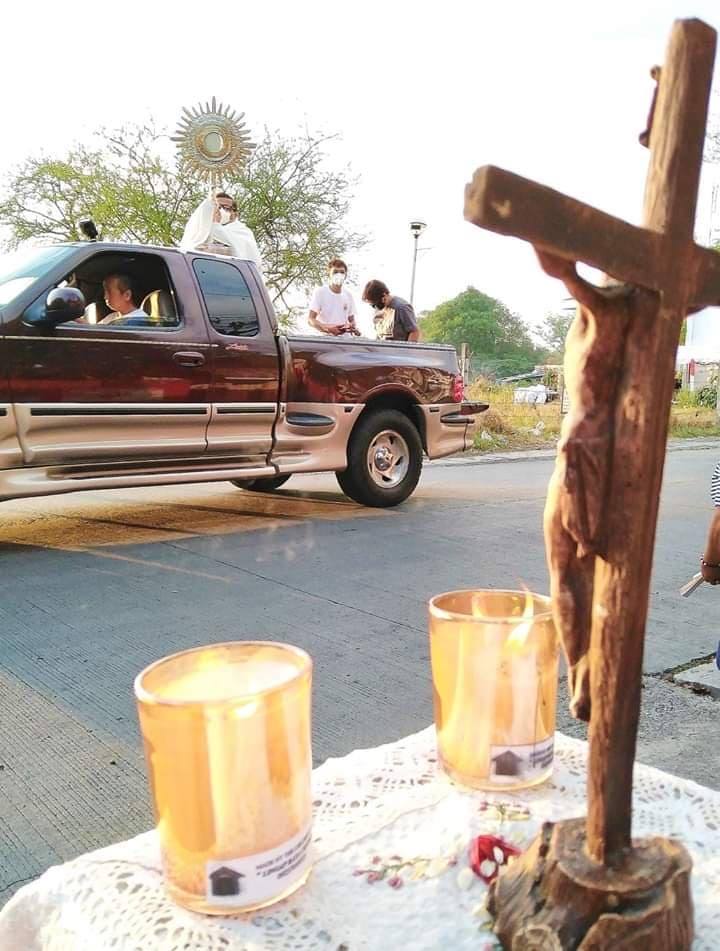
Bringing around our Parish the Blessed Sacrament during the lockdown, March-May 2020.
This is the meaning of the many sacrifices and sufferings we all have to go through in this quarantine period expected to continue until 2021: if we want to get out of this pandemic, aside from the need for a vaccine and medication, we all need to change our ways to make sure this will not happen again.
It is always easy to join so many advocacies and rallies calling for every kind of change in the society and the world but nothing had ever happened because whenever we come home, we do not change our own ways of living! Sayang (what a waste) were all the inspiration and energies of the Holy Spirit for our many causes that have not taken roots right in our hearts.
All the apostles of the Lord paid the price of peace with their own lives that led to the healing not only of individuals and families but even of nations and the world.
The second time Jesus offered his gift of peace, he breathed the Holy Spirit on his apostles and commissioned them to forgive all sins.
Peace is the fruit of love according to Vatican II.
As such, peace from the Holy Spirit leads to healing when there is dialogue, prayer and repentance, that lead to justice, love, and forgiveness. Peace and healing need hard work that is why they are fruits. They never come on a silver platter.
On Monday, most of the quarantine levels in the country are downgraded because it is hoped we have somehow controlled the spread of COVID-19.
As we eagerly await more freedom and mobility in this time of pandemic, what have we achieved during these three months of quarantine, said to be the longest in the world?
Have we resolved our family differences? Have we rediscovered our family members, getting more close than ever, more kind, more understanding?
How sad that all we can share as our quarantine stories are all about food and other pursuits we have undertaken forgetting the unity and life of our family and community.
How sad when we in the Church have all been preoccupied with the new communication media but failed at all to make any impact or dent in the lives of our faithful because we have not shared Jesus Christ at all, when all our “live streaming” and vlogs are powered by likes and followers, not by the Holy Spirit.
Pope Francis blessing the people last March 27 in an empty St. Peter’s Square during the height of COVID-19 in Italy that became the new epicenter of pandemic next to China. Photo from Vatican Media Office.
Jesus never takes back his gift of peace, his gift of healing, his gift of the Holy Spirit. He promised to never leave us orphans. Let us not leave the Holy Spirit behind and stop believing in our selves.
That’s the way we have been in the world and even in the Church.
That is why – to a large extent – we have this corona pandemic.
Tonight is “Spy Wednesday” – the night traitors and betrayers are put on the spotlight because it was on this night after Palm Sunday when Judas Iscariot struck a deal with the chief priests to hand them over Jesus for 30 pieces of silver (Mt. 26:14-16).
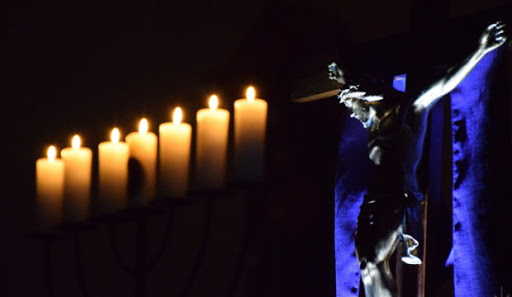
The “Tenebrae” is celebrated in some churches when candles are gradually extinguished with the beating of drums and sounding of matraca to evoke silence and some fear among people as they leave in total darkness to signal the temporary victory of evil in the world for tomorrow we enter the Paschal Triduum of Holy Thursday, Good Friday and Easter Vigil of the Lord.
From Google.
Darkness generally evokes evil and sin, uncertainties and sufferings. But, at the same time, darkness preludes light!
That is why Jesus Christ was born during the darkest night of the year to bring us light of salvation.
Beginning tonight, especially tomorrow at his agony in the garden, we shall see Christ entering through darkness reaching its climax on Friday when he dies on the cross with the whole earth covered in darkness, rising on Easter in all his glory and majesty.
Our present situation in an extended Luzon-wide lockdown offers us this unique experience of darkness within and without where we can learn some important lessons from the Lord’s dark hours beginning tomorrow evening of his Last Supper.
St. John gives us a glimpse into how we must deal with life’s darkness that plagues us almost daily with his unique story of the Lord’s washing of his disciples’ feet on the night he was betrayed.
Before the feast of Passover, Jesus knew that his hour had come to pass from this world to the Father. He loved his own in the world and he loved them to the end. The devil had already induced Judas, son of Simon the Iscariot, to hand him over. So, during supper… he rose from supper and took off his outer garments. He took a towel and tied it around his waist. Then he poured water into a basin and began to wash the disciples’ feet and dry them with the towel around his waist. He came to Simon Peter…
John 13:1-2, 4-6
Photo from aleteia.org.
It is very interesting to reflect how Judas Iscariot and Simon Peter dealt with their own inner darkness on that night of Holy Thursday when Jesus was arrested.
Though Judas Iscariot and Simon Peter are poles apart in their personalities, they both give us some traits that are so characteristic also of our very selves when we are in darkness. In the end, we shall see how Jesus turned the darkness of Holy Thursday into becoming the very light of Easter.
Getting lost in darkness like Judas Iscariot
Right after explaining the meaning of his washing of their feet and exhorting them to do the same to one another, Jesus begins to speak of Judas Iscariot as his betrayer.
When he had said this, Jesus was deeply troubled and testified, “Amen, amen, I say to you, one of you will betray me …It is the one to whom I hand the morsel after I had dipped it.” So he dipped the morsel and handed it to Judas, son of Simon the Iscariot. After he took the morsel, Satan entered him… and left at once. And it was night.
John 13:21, 26-27, 30
Photo from desiringgod.org
The scene is very dramatic.
Imagine the darkness outside the streets of Jerusalem in the stillness of the night and the darkness inside the Upper Room where they were staying.
More darker than that was the darkness among the Apostles not understanding what Jesus was saying about his betrayer because they thought when Judas left, he was being told to buy more wine or give money to the poor!
Most of all, imagine the darkness within Judas.
To betray means to hand over to suffering someone dear to you.
That’s one darkness we always have within, of betraying Jesus, betraying our loved ones because we have found somebody else to love more than them. Satan had taken over Judas. The same thing happens to us when we sin, when we love someone more than those who truly love us or those we have vowed to love always.
And the darkest darkness of all is after handing over our loved ones, after dumping them for something or somebody else, we realize deep within the beautiful light of truth and love imprinted in our hearts by our betrayed loved ones – then doubt it too!
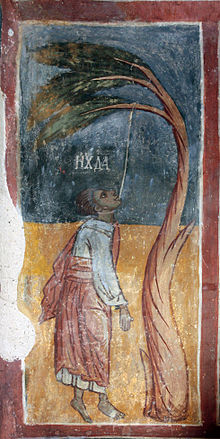
The flickering light of truth and love within is short lived that we immediately extinguish it, plunging us into total darkness of destruction like Judas when he hanged himself.
See how Judas went back to the chief priests because “he had sinned”, giving them back the 30 pieces of silver to regain Jesus.
Here we find the glow of Jesus, of his teachings and friendship within Judas still etched in his heart — the light of truth and love flickering within.
Any person along with their kindness and goodness like Jesus, our family and true friends can never be removed from one’s heart and person. They will always be there, sometimes spurting out in our unguarded moments because they are very true.
That is the darkest darkness of Judas – and of some of us – who think we can never be forgiven by God, that we are doomed, that there is no more hope and any chance at all.
See how the evangelist said it: “Judas left at once. And it was night.”
And that is getting lost in darkness permanently, eaten up by darkness within us because we refuse to believe in the reality of a loving and forgiving God who had come to plunge into the darkness of death to be one with us so we can be one in him. What a loss.
Groping in the dark into the light like Peter
Photo by author, Church of Gallicantu, Jerusalem where the cock crowed after Peter denied Jesus the third time, May 2017.
Of the Twelve, it is perhaps with Simon Peter we always find ourselves identified with: the eager beaver, almost a “bolero” type who is so good in speaking but many times cannot walk his talk.
“Master, are you going to wash my feet?” Jesus answered and said to him, “What I am doing, you do not understand now, but you will understand later.” Peter said to him, “You will never wash my feet.”
John 13:6-8
Here is Peter so typical of us: always assuming of knowing what is right, which is best, as if we have a monopoly of the light when in fact we are in darkness.
See how during the trial of Jesus before the priests, Peter denied him thrice, declaring he never knew Jesus while outside in the dark, completely in contrast with Jesus brilliantly answering every question and false accusation against him inside among his accusers!
Many times in our lives, it is so easy for us to speak on everything when we are in our comfort zones, safe and secured in our lives and career. But when left or thrown out into the harsh realities of life, we grope in the darkness of ignorance and incompetence, trials and difficulties.
How often we are like Peter refusing Jesus to wash our feet because we could not accept the Lord being so humble to do that simply because he is the Lord and Master who must never bow low before anyone.
And that is one darkness we refuse to let go now shaken and shattered by the pandemic lockdown! The people we used to look down upon are mostly now in the frontlines providing us with all the comforts we enjoy in this crisis like electricity, internet, security, food, and other basic services.
Bronze statue of the call of Peter by Jesus. Photo by author, May 2017.
We have always thought of the world, of peoples in hierarchy, in certain status where there are clear delineations and levels of importance, totally forgetting the lessons of Jesus of being like a child, of service and humility: “whoever wants to be great must be the least and servant of all.”
According to Matthew and Luke, Peter realized his sins – the darkness within him – of denying Jesus thrice after the cock crowed that he left the scene weeping bitterly, feeling so sorry. Eventually after Easter, Peter would meet Jesus again on the shores of the Lake of Tiberias, asking him thrice, “do you love me?”
Peter realized how dark his world has always been but in that instance when he declared his love that is so limited and weak did he finally see the light of Christ in his love and mercy!
Unlike Judas, Peter moved out of darkness and finally saw the light in the Risen Lord right in the very place where everything started when he was called to be a fisher of men, in his humanity as he was called by his original name, “Simon, son of Jonah, do you love me?”.
Human love is always imperfect and Jesus knows this perfectly well!
The best way to step out of darkness within us is to be like Simon — simply be your imperfect self, accepting one’s sins and weakness for that is when we can truly love Jesus who is the only one who can love us perfectly.
Overcoming darkness in, Jesus, with Jesus, through Jesus
Though the fourth gospel and the synoptic gospels of Matthew, Mark, and Luke differ in providing us with the transition from the Upper Room of the Last Supper into the agony in the garden, the four evangelists provide us with one clear message at how Jesus faced darkness: with prayer, of being one in the Father.
Even on the cross of widespread darkness, Jesus spoke only to pray to the Father.
Then Jesus came with them to a place called Gethsemane, and he said to his disciples, “Sit here while I go over there and pray.” He took along Peter and the two sons of Zebedee, and began to feel sorrow and distress.
Matthew 26:36-37
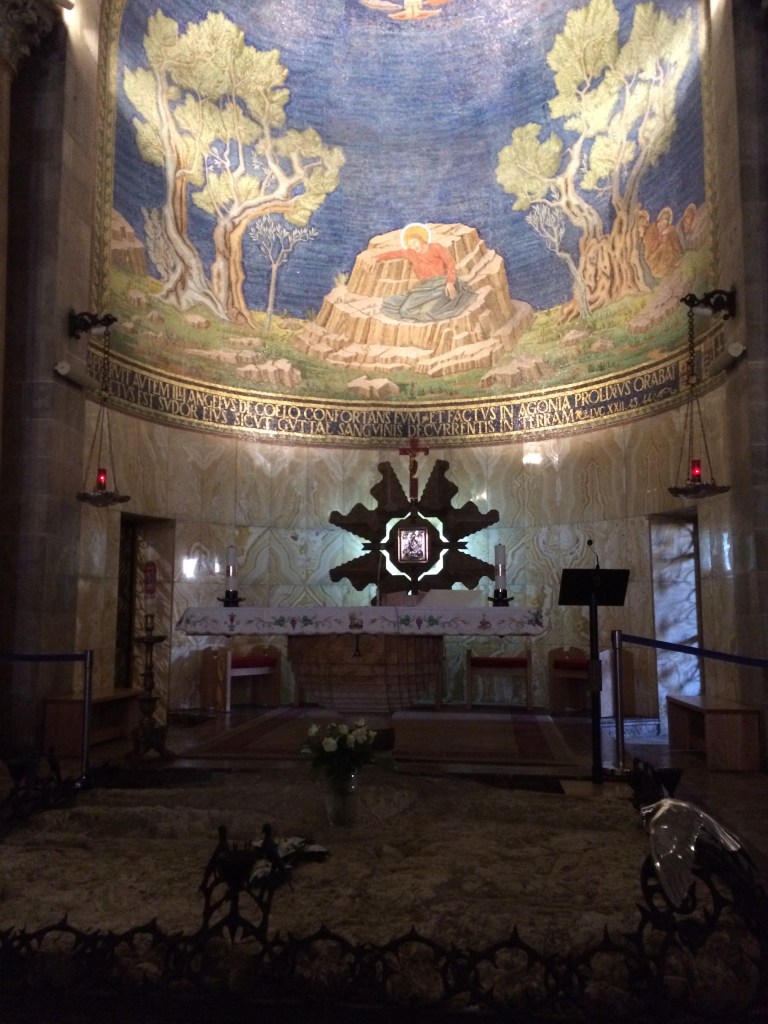
Photo by author, altar of the Church of All Nations beside the Garden of Gethsemane, May 2017. The church is always dimly lit to keep the sense of darkness during the Agony in the Garden of Jesus.
Before, darkness for man was seen more as a curse falling under the realm of evil and sin; but, with the coming of Jesus, darkness became a blessing, a prelude to the coming of light.
We have mentioned at the start of our reflection that Jesus was born during the darkest night of the year to show us he that is the light of the world, who had come to enlighten us in this widespread darkness, within us and outside us.
As the light of the world, Jesus was no stranger to darkness which he conquered and tamed in many instances like when they were caught in a storm at sea and in fact, when walked on water to join his disciples caught in another storm.
But most of all, Jesus had befriended darkness and made it a prelude to light.
How? By always praying during darkness. By prayer, it is more than reciting some prayers common during his time as a Jew but as a form of submission to the will of the Father. Jesus befriended darkness by setting aside, forgetting his very self to let the Father’s will be done.
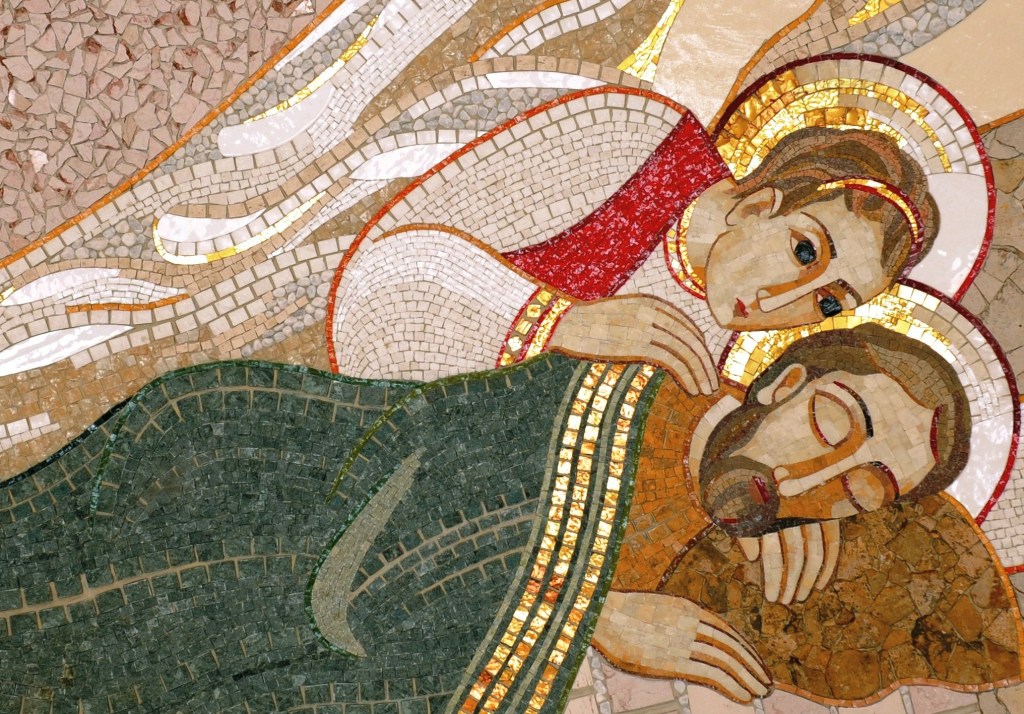
Bass relief of agony in the garden on the wall of the Church of All Nations at Gethsemane. Photo by author, May 2019.
This he showed so well in two instances, first on Mount Tabor where he transfigured and second in Gethsemane before his arrest.
In both events, Jesus showed us the path to overcoming darkness is always through prayers, of being one in the Father.
It is in darkness when God is most closest to us because it is then when we get a glimpse of himself, of his love and mercy, of his own sufferings and pains, and of his glory.
This is something the three privileged disciples – Simon Peter, James and his brother John – did not realize while being with Jesus at both instances until after Easter. We are those three who always fall asleep, who could not keep with praying in Jesus, with Jesus, and through Jesus.
It was in the darkness of the night when Jesus spent most of his prayer periods, communing with the Father up in a mountain or a deserted place.
On Mount Tabor, Jesus showed his coming glory while in Gethsemane he showed his coming suffering and death. But whether in Gethsemane or on Mount Tabor, it is always Jesus we meet inviting us to share in his oneness with the Father, in his power in the Holy Spirit to overcome every darkness in life.
And the good news is he had already won for us!
Photo by Mr. Raffy Tima of GMA-7 News of Mt. Samat with the Memorial Cross across the Manila Bay following clear skies resulting from the lockdown imposed since March 17, 2020.
In these extended darker days of quarantine period, let us come to the Lord closer in prayer to. experience more of his Passion and Death, more of his darkness so we may see his coming glory when everything is finally cleared in this corona pandemic.
Prayer does not necessarily change things but primarily changes the person first. And that is when prayer changes everything when we become like Jesus in praying.
Jesus is asking us to leave everything behind, to forget one’s self anew to rediscover him in this darkness when we get out of our comfort zones to see the many sufferings he continues to endure with our brothers and sisters with lesser things in this life, with those in total darkness, with those groping in the dark.
Now more than ever, we have realized the beauty of poverty and simplicity, of persons than things.
And most especially of darkness itself becoming light for us in this tunnel.
May Jesus enlighten us and vanish all darkness in us so that soon, we shall celebrate together the joy of his coming again in this world darkened by sin. Amen.
Daniel 13:1-9, 15-17, 19-30, 33-62 ><)))*> + <*(((>< John 8:1-11
“Ecce Homo” by Murillo from fineartamerica.com.
Our loving Father, today I pray in a very special way for all people who have been maligned, especially for those whose reputation have been destroyed in public by false accusations, those put to shame in our family and community by harsh words.
Like those two women in our readings today, Susana in the Book of Daniel and the woman caught in adultery in John’s gospel, these people unjustly accused in public or “in their face” are surely suffering so much in the loneliness of their homes, of their room in this period of lockdown.
Most especially, Lord, I pray for those languishing in jail especially those for crimes they did not commit.
But Susan cried aloud: “O eternal God, you know what is hidden and are aware of all things before they come to be; you know that they have testified falsely against me. Here I am about to die, though I have done none of the things with which these wicked men have charged me.” The Lord heard her prayer.
Daniel 13:42-44
Comfort, O God, those crying for justice.
Give them patience and perseverance, trust and confidence in Jesus Christ your Son who have come “to proclaim liberty to captives” (Lk.4:18b).
Grant them a healing of memories.
Most especially, I pray O God, that Jesus may touch them today with the same gentleness and love, mercy and forgiveness without any condemnation except to go and “sin no more” (Jn.8:11). Amen.
Photo by author, Parokya ni San Juan Apostol at Ebanghelista, Bagbaguin, Santa Maria, Bulacan, Lent 2020.
Once again, our loving Father, I take the computer as my point of comparison for my prayer reflection on this second Friday of Lent.
Thank you in giving us this blessed season of Lent when we are able to “debug” our “internal hard drive” – the heart – to be cleansed of bugs and virus as well as unnecessary materials that slow us down to be holy and perfect like you.
Your words are very reassuring of how you want us to be “fixed” always, to be in good condition, filled with life and holiness.
Thus says the Lord God: “Do I indeed derive any pleasure from the death of a wicked?” says the Lord God. “Do I not rather rejoice when he turns from his evil way that he may live? Hear now, house of Israel: Is it my way that is unfair, or rather, are not your ways unfair? When someone virtuous man turns away from virtue to commit iniquity, and dies, it is because of the iniqity he committed that he must die. But if the wicked, trning from the wickedness he has committed, does what is right and just, he shall preserve his life; since he has turned away from all the sins that he committed, he shall surely live, he shall not die.”
Ezekiel 18:23, 25-28
Educate our hearts, O Lord.
Help us “surpass the righteousness of the scribes and the Pharisees” in Jesus Christ who have come to perfect the laws in himself, in love.
May your purifying love, sweet Jesus, cleanse us of our sins, delete our painful memories that continue to hold us back, preventing us to move forward and forgive others and especially our very selves.
Make us rejoice, O Lord, in your immense love and share it with others so that we may grow more in holiness in you. Amen.
Lawiswis ng Salita ni P. Nicanor F. Lalog II, Ika-17 ng Setyembre 2019
Relasyon at ugnayan
hindi emosyon at damdamin
ang sabi natin na pangunahin turo sa atin
ng talinhaga ng alibughang anak.
Kay gandang larawan ng Diyos
ang nakintal sa ating puso't isipan
nang ilahad ng mahabaging ama sa dalawang anak niya
na sila ay iisang pamilya, binibigkis ng buhay na mula sa kanya.
Ano mang kasalanan ay mapapatawad
maging kamatayan ay malalampasan
nitong habag at awa ng Diyos na ibinuhos
kay Kristo Hesus para sa ating mga alibughang anak niya.
Ganyan ang habag at awa ng Diyos bilang Ama
na dumadaloy din mula sa kanyang pagiging ina
nang mawika niya, "hindi kita malilimutan kailanman
katulad ng isang ina sa kanyang anak na mula sa kanyang sinapupunan."
Para sa kanilang kaisipan,
ang habag at awa ay "hesed" ---
damdaming napaka-lalim gaya ng pag-ibig
nagpapahiwatig ng maka-amang katapatan at pananalig.
Nagmumula ito sa sinapupunan o "raham" ---
yaong matris ng kababaihan na siyang kanlungan
ng simula ng buhay, lundo ng katuwaan pagsapit ng kagampan
kapag napawi mga agam-agam, pagsilang ng bagong buhay.
Kapag umiiral habag at awa sa ating buhay
doon tayo buong-buo sa pagkatao
nagiging ganap at banal tulad ng Diyos
puno ng buhay at pagmamahal.
Kaya't kapag mga patayan ay naglipana
at pagkitil sa buhay ang nakikitang paraan
upang lunasan maraming kasalanan at kasamaan
nasisira ating kapatiran, di maglalaon, tayo ang mababaon.




















 lordmychef.com