Ikaw ba ang binubuhat o nagbubuhat?

Lawiswis ng Salita ni P. Nicanor F. Lalog II, Ika-2 ng Hulyo 2026
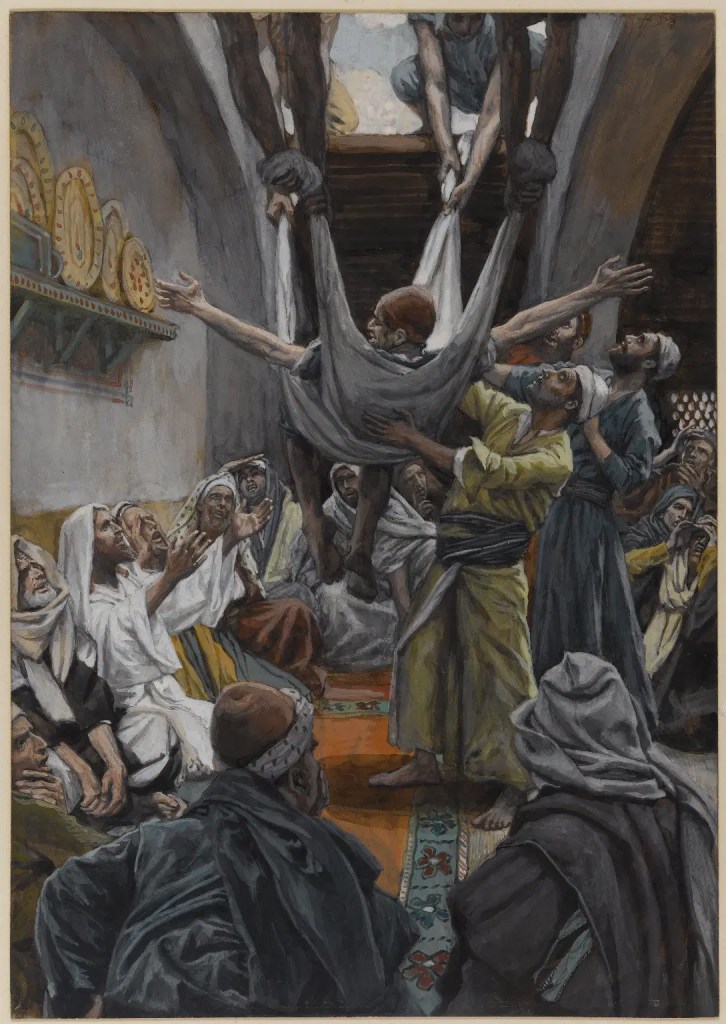
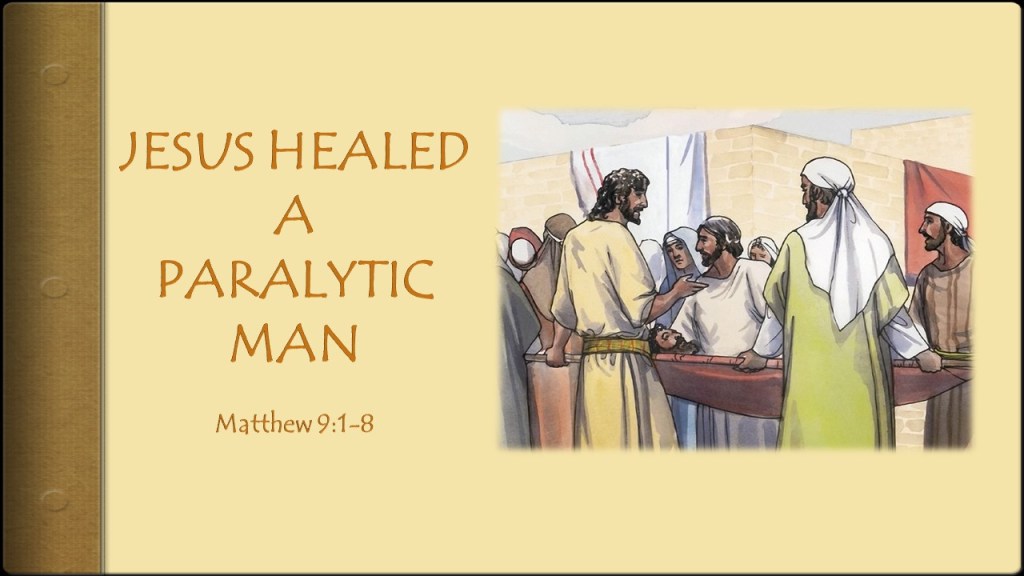
Painting ni James Tissot, “The Palsied ManLet Down through the Roof” mula sa brooklynmuseum.org.
Marami na akong napakinggang
kuwento
kahawig nitong nasa ebanghelyo
isang paralitikong nakaratay
sa kanyang higaan
buhat-buhat ng apat na kaibigan;
nakamamangha sinabi at ginawa
ni Jesus sa paralitiko
lakasan kanyang loob
at pinatatawad na
kanyang mga kasalanan.
Pagmasdan paanong nadama
at natanto ni Jesus bigat na dala-dala
ng paralitikong nakaratay
sa kanyang higaan buhat naman
ng mga kaibigan.
Tayo ang paralitikong pinatawad
at pinagaling; nakaratay sa banig,
paralisado,
hindi makagalaw,
nakabilanggo sa maraming
takot at pangamba
bunsod ng mga nakaraang
pagkakasala at pagkakamali;
hindi makausad
hindi makahakbang pasulong
sa buhay,
nananatili sa kahapon at
madilim na nakaraan
kaya hindi mabanaagan
liwanag sa kapaligiran
sariling kagagawan
kanyang pagkaparalisa na
sadyang napakabigat kaya
kapatawaran sa kanyang kasalanan
iginawad at binitiwan ni Jesus.
Kay gandang pagmasdan
eksena at larawan
kung paanong binakbak ng
kanyang mga kaibigan bubong
ng bahay upang paralitiko
ay maihugos sa tapat ng kinaroonan
ni Jesus: isang paghahayag ng
katotohanan sa ating mga
naparalisa sa hindi mapatawad na kasalanan,
hindi malampasang kabiguan at
kamalian o kasawian sa nakaraan
kinakailangang magpakababa
tanggapin kamalian at kasalanan
upang maranasan kapatawaran
at kapanatilihan ni Jesus na ating
Tagapagligtas.
(Tingnan Mt.9:1-8; Mk.2:1-12; at Lk.5:17-26)
Illustration from parentandchildbiblereading.com.
Sa kabilang dako naman,
akin din napakinggan
maraming kuwento at hinaing
ng mga katulad nitong
apat na kaibigan
na bumubuhat sa higaan
ng paralitiko:

Katulad nilang apat,
tayo man ay mayroong binubuhat
 na paralitiko,
isang pasanin
alagain
at intindihin
 kung inyong mamarapatin
at ipagpapaumanhin
ngunit iyon ang masaklap na
katotohanang dapat nating tanggapin
at lunukin;
Diyos ay nagagalak
tiyak nagpapasalamat
sa mga kaibigan
kapatid at kaanak
buhat-buhat paralitikong
nakaratay sa banig
manhid
at walang pakialam
sa pasanin ng mga
nagmamahal sa kanya;
nagagalit,
naiinis,
hindi lang minsan
nakaisip na sumuko
at lisanin,
bitiwan buhat na paralitiko
ngunit pinili pa rin
tiisin
at manatili
sa pasanin
dahil na rin sa busilak
ng kanilang loobin.
“The Paralytic of Capernaum Lowered from the Roof”, a 5th/6th century Mosaic at Sant’ Apollinare Nuovo, Ravenna, Italy; from christian.art.
Kung ikaw ang binubuhat
na paralitiko,
gumising sa katotohanan
ikaw ay minamahal
at pinahahalagahan
huwag na hintayin
pamilya at kaibigan
ikaw ay tuluyang iwanan!

Kung ikaw ang nagbubuhat
sa paralitiko,
pagsumakitan mo na kanyang kalagayan
mahirap gisingin nagtutulug-tulugan;
iyong pagmamalasakit
at pagmamahal hindi man
kilalanin at suklian
sa buhay na ito,
hahantong pa rin ito
sa iyong kapakanan
at kabutihan
dahil si Jesus palaging
kapiling at kasama natin
pinagagaan ating mga pasanin.

“Lumapit kayo sa akin,
kayong lahat na napapagal
at nabibigatan sa inyong pasanin,
at kayo’y pagpapahingahin ko.
Pasanin ninyo aking pamatok,
at mag-aral kayo sa akin;
ako’y maamo at mababang-loob,
at makasusumpong kayo ng kapahingahan
para sa inyong kaluluwa.
Sapagkat maginhawang dalhin ang
aking pamatok,
at magaan ang pasaning ibibigay ko
sa inyo.”
(Mt.11:28-30)
Larawan kuha ng may-akda, St. Michael Retreat House, Antipolo City, 16 Hunyo 2026.

The burdens we carry.

Lord My Chef Daily Recipe by Fr. Nicanor F. Lalog II
Thursday in the Thirteenth Week of Ordinary Time, Year II, 02 July 2026
Amos 7:10-17 ><]]]]'> + ><]]]]'> + ><]]]]'> Matthew 9:1-8
Illustration from parentandchildbiblereading.com.
Dearest Lord Jesus,
today I pray for the many among us
carrying so much weight on their
shoulders,
those depressed,
those feeling unforgiven
or worthless -
heal them, Lord.

Make them realize there is
always a chance to change for
the better in you.

Clear their minds
and hearts of doubts
and mistrust on others
especially those who genuinely
love and care for them but
they feel are against them.

Like that paralytic,
relieve those still carrying 
the burden of past mistakes and sin
that have paralyzed them,
trapped them that they could
not move on with life.

May they have the courage 
to stand up
and walk free.

How amazing,
dear Jesus,
that you noticed the man lying 
on the mat was the one burdened with
past sins; so lovely to realize how
nothing escapes you, Jesus:
the friends of the paralytic 
were the ones carrying,
exerting effort to bring the paralytic
yet you knew for sure it was
actually the paralytic burdened
not his friends.

Likewise,
we pray for the countless
family and friends of those paralytics
overburdened with sin and worries
who patiently carry them;
shower them with blessings in
their perseverance in putting up with
a loved one like that paralytic -
unappreciative of other's care and 
concern for them
so that one day,
they may look at their message
of love and understanding
and not see them as enemies.
Amen.

Photo by author, Cabo de Roca, Pundaquit, San Antonio, Zambales, 15 June 2025.

Lent is mercy of God

40 Shades of Lent by Fr. Nicanor F. Lalog II
Monday in the Second Week of Lent, 02 March 2026
Daniel 9:4-10 + + + Luke 6:36-38
Photo by Juan Pablo Serrano on Pexels.com
Your words today,
O Lord Jesus
are short but give
much to reflect on:
"Be merciful...
stop judging...
stop condemning...
Forgive...
Give."
Jesus,
teach me to be
"shamefaced"
like Daniel in the first
reading: it is not enough
that I realize my sinfulness,
of my wickedness in refusing
to love, in turning away from you,
in disregarding your words
over and over and still -
be forgiven and loved.

Jesus said to his disciples: “Be merciful, just as your Father is merciful” (Luke 6:36).

So often in life,
I forget the Father's
mercy that I have totally
been oblivious to being
merciful; thank you Jesus
in giving this comparison today,
of being merciful as the Father
is merciful.
What a shame
of how often I look up
to myself as so good,
so righteous
against others
that I judge
and condemn them;
teach me to be like
you, Lord: merciful,
non-judgmental,
forgiving;
most of all,
teach me to give
freely like you, Lord;
remind me always
to remember your
mercy on me
to realize that
more than an ideal,
mercy is about
how it feels
in my own life.
Lord Jesus Christ,
you have given me with
so much love and mercy,
kindness and forgiveness
of sins but I have refused
to be merciful with others;
have mercy on me, Lord
and let me be merciful
like the Father.
Amen.

Advent is conversion in the desert

Lord My Chef Sunday Recipe for the Soul by Fr. Nicanor F. Lalog II
Second Sunday in Advent-A, 07 December 2025
Isaiah 11:1-10 ><}}}}*> Romans 15:4-9 ><}}}}*> Matthew 3:1-12
Photo by author, The Deesis Mosaic in the Hagia Sophia, Istanbul, Turkiye, 01 November 2025.

A few weeks before the Holy Father visited Turkiye recently, we were also in Istanbul and had the great chance of visiting the magnificent Hagia Sophia. And we wonder why Pope Leo XIV skipped the more historical and popular Hagia Sophia to visit instead the Blue Mosque just across.

The Hagia Sophia or “Holy Wisdom” was the largest church in the Eastern Roman Empire when Istanbul was called Constantinople until the Ottoman Turks conquered the city and converted the church into a mosque. More than a hundred years ago when Turkiye became a republic, the government made Hagia Sophia a museum until recently when it was reverted into a mosque again.

My initial feeling when I got inside Hagia Sophia was deep sadness. “Malaking panghihinayang” as in “sayang na sayang” in Filipino because it used to be ours but due to the Great Schism of 1054 when the Eastern Roman Church broke away from Rome, it fell into the hands of the Moslems who made it into a mosque, altering or hiding the many great works of art there that date back to the Byzantine era 1200 to 1400 years ago.

Photo by author, The Deesis Mosaic in the Hagia Sophia, Istanbul, Turkiye, 01 November 2025.

One of its many treasures you might be familiar found in history books and magazines is the “Deesis Mosaic” of Jesus flanked to his left by his Mother Mary and John the Baptist to his right.

From the Greek word “deesis” that means supplication or intercession, the mosaic features Mary and John beseeching Jesus to forgive mankind at his Second Coming. Though the three images have been badly deteriorated due to the elements passing through the window beside it, its beauty remains intact, especially the evocative faces of Mary, Jesus and John.

Seeing it personally, one could feel the pagsusumamo of John the Baptist and Mother Mary expressed in the softness of their face in earnestly asking Jesus to forgive mankind on the day of judgment. And it seems to be working so well as you could feel too the tender compassion of Jesus Christ’s look as he raised his right hand in a blessing position while holding with his other hand a thick book that is perhaps a Bible.

Detail of John the Baptist from the Deesis Mosaic in his abbreviated Greek name Ionnes Prodromos; photo by author, Istanbul, 01 November 2025.

The Deesis Mosaic is very Advent in character because it is about God’s mercy and forgiveness in Christ Jesus at his Second Coming at the end of time.

Here we find how early on in the ancient Church they have been preoccupied in this first aspect of Advent, the Second Coming of Christ at the end of time and of Advent’s essence – our conversion from sins. At the forefront of that call is the Lord’s Precursor, John the Baptist, that is why every second and third Sundays of Advent we hear in the gospel his ministry at Jordan.

John the Baptist appeared, preaching in the desert of Judea and saying, “Repent, for the kingdom of heaven is at hand!” It was of him that the prophet Isaiah had spoken when he said: A voice crying out in the desert, Prepare the way of the Lord, make straight his paths. … At that time Jerusalem, all Judea, and the whole region aroun d the Jordan were going out to him and were being baptized by him in the Jordan River as they acknowledged their sins (Matthew 3:1-3, 5-6).

John the Baptist remains relevant in preparing for the Lord’s coming, whether at the end of time or in preparation for our Christmas celebration. Like him, we are all called to be an Advent person, vigilantly preparing ourselves for Christ’s coming at the end of time that happens in every here and now, right in our own desert in this modern time.

Yes, we are like John the Baptist living in our own desert, a world we describe as a global village wired and connected by the internet yet so apart from each other. Instead of bringing us closer with one another, all these modern inventions have actually grown us more detached from one another like when eating in a fast food. It is so alienating especially for us seniors to be placing our orders on those tall electronic boards programmed for us to order more food and drinks not healthy at all.

Or, take those TNVS or Transport Network Vehicle Services like Grab. We no longer travel in the real sense as we just move to destinations with that desert feeling when inside a Grab car with the driver too far from us passengers in front, following instructions from apps while we at the back sit silently scrolling our phones or pounding a laptop. See also how driving has become going in the wilderness with the horrendous traffic where humans turn into monsters in road rage while machines and CCTVs monitor who’s violating traffic rules and who gets through the RFID.

Photo by author, Basic Education Department Chapel, Our Lady of Fatima University, Valenzuela City, December 2023.

This Second Sunday in Advent, John the Baptist invites us to be aware of the desert we are living into where we have become less personal, less human as we move away from God that we have lost our sense of sin, acting more on impulses without much thinking its effects and consequences.

We think more of ourselves than of God and others, overextending our rights insisting on our ways that actually destroy lives through abortions and gender manipulations. We no longer speak of what is true and good by simply following trends and what is convenient. No more feelings, no more compassion. No more others. No more God nor heaven and eternity.

“St. John the Baptist Preaching in the Wilderness” by German painter Anton Raphael Mengs (1728-1779) from commons.wikimedia.org.

We do not have to dress on camel’s hair nor eat locusts and wild honey like John but simply make a space within us for God and for others.

We would be gravely wrong to think John was only speaking to the people of his time especially to the Pharisees and Sadducees; Matthew wrote his gospel account at that time to nourish the faith of early Christians facing persecutions and many challenges in life like in our own time when it is so tempting to follow the evil ways of the world.

John continues to warn us today of the sure return of the Christ when everyone shall face judgment which is not something to be feared like a sword of Damocles hanging above our heads ready to strike us anytime. It is a call and a demand for concrete actions of conversion, of leaving our sinful ways to follow Christ’s path of holiness.

“Even now the ax lies at the root of the trees. Therefore every tree that does not bear good fruit will be cut down and thrown into the fire. I am baptizing you with water, for repentance, but the one who is coming after me is mightier than I. I am not worthy to carry his sandals. He will baptize you with the Holy Spirit and fire” (Matthew 3:10-11).

Advent assures us of Christ’s Second Coming when he shall purify and renew us to fulfill Isaiah’s prophecy in the first reading when “the wolf shall be a guest of the lamb, the leopard shall lie down with the kid… the calf and young lion shall browse together, with a little child to guide them… the cow and bear shall be neighbors, together their young shall rest, the lion shall eat hay like the ox… the baby shall play by the cobra’s den, and the child lay his hand on the adder’s lair”(Isaiah 11:6-8).

“Peaceable Kingdom”, a painting based on Is.11:1-10 by American Edward Hicks, a Quaker pastor (1780-1849) from wikimedia.org.

As we have reflected last Sunday, every coming of Jesus is a day of judgment but not a catastrophe. It becomes a disaster for those unprepared, living in sin. But for those like John the Baptist, striving to live the gospel amid the desert of this world, Christ’s coming is salvation and peace for Jesus is full of love and compassion and tenderness for his people.

Life is so difficult these days especially when we see our great disparities with the corrupt who simply steal our money and those we call “lumalaban ng patas sa buhay”. Imagine how in our country the world is like a desert, so hostile with the weak and the poor who have to wrestle with 500 pesos – if ever they have – to stretch it for a noche buena on Christmas Eve.

St. Paul reminds us in the second reading that in times like these, we look up to God and his Sacred Words, to keep hoping, trusting and believing in Christ’s coming already happening especially in the Sunday Eucharist. Let us gather together as one community, encouraging each other in Christ like John in Jordan while awaiting the Lord’s coming, rejoicing like the psalmist today who sang, “Justice shall flourish in his time, and fullness of peace forever” (Ps. 72:7). Amen. A blessed Second Week in Advent everyone!

Bringing the good news

Lord My Chef Daily Recipe for the Soul, 19 September 2025
Friday, St. Januarius, Bishop and Martyr
1 Timothy 6:2-12 <*[[[[>< + ><]]]]*> Luke 8:1-3
Photo by Thiago Matos on Pexels.com
Lord Jesus Christ,
teach me to imitate you
in bringing the good news
by inspiring others
to follow you.

Jesus journeyed from one town and village to another, preaching and proclaiming the good news of the Kingdom of God. Accompanying him were the Twelve and some women who had been cured of evil spirits and infirmities, Mary, called Magdalene, from whom seven demons had gone out, Joanna, the wife of Herod’s steward Chuza, Susanna, and many others who nprovided for them out of their resources (Luke 8:1-3).

So, why do I follow you,
Jesus?
What inspires me
in your bringing
the good news
of God's Kingdom?
Here are some, Lord:
I follow you, Jesus
because in you I feel
loved and welcomed
despite who I am
like the Twelve Apostles
who were of most diverse
backgrounds and personalities
yet, were united in you;
I follow you, Jesus
because in you there
is warmth and lightness,
of forgiveness and healing
like those women
who followed you after
being freed from evil possessions
and healed of many sickness;
I follow you, Jesus
because you inspire me
to leave everything behind
as I find everything in you
like those women
who provided for you
from their resources.
Teach me Jesus
to proclaim
to bring
to share
your gospel
of God's Kingdom
to others
by finding life
in you.
Amen
Our Lady of Fatima University, Valenzuela City, June 2025.
Fr. Nicanor F. Lalog II
Our Lady of Fatima University
Valenzuela City
(lordmychef@gmail.com)

Discipleship is loving more

Lord My Chef Daily Recipe for the Soul, 18 September 2025
Thursday in the Twenty-Fourth Week of Ordinary Time, Year I
1 Timothy 4:12-16 <'[[[[>< + ><]]]]'> Luke 7:36-50
Photo by author, Manila Club, BGC, June 2025.
Your words today 
surprised me again,
Lord Jesus:
so many times I find
myself like Simon the Pharisee,
always welcoming you
into my home,
into my life,
into my meal
and many times too
like him,
I am shocked,
becoming judgmental
at times like the others
when a sinner comes
like that sinful woman
who gatecrashed
to get near you,
Lord.

When the Pharisee who had invited him saw this he said to himself, “If this man were a prophet, he would know who and what sort of woman this is who is touching him, that she is a sinner.” Jesus said to him in reply, “Simon, I have something to say to you.” “Tell me, teacher,” he said. “Two people were in debt to a certain creditor; one owed five hudnred days’ wages and the other owed fifty. Since they were unable to repay the debt, he forgave it for both. Which of them will love him more?” Simon said in reply, “The one I suppose, whose larger debt was forgive.” He said to him, “You have judged rightly” (Luke 7:39-43).

Forgive me, 
Jesus,
when I fail to see
my own sinfulness,
my past where I came from
before being with you
as a disciple:
I, too, am a sinner
like that woman who
broke all protocols
and conventions
just to get close to you,
to touch you
and be restored by you
in your mercy and forgiveness;
let me heed Paul's call to Timothy
to be "absorbed"
in your love
because
discipleship is more
than knowing you
and following you
but most of all,
loving you most
especially among
the unloveable
for we were once
like them.

Like that sinful woman,
let me go in peace today
by rejoicing
in your infinite mercy
for us all,
not just me.
Amen.
Photo by author, Manila Club, BGC, June 2025.
Fr. Nicanor F. Lalog II
Our Lady of Fatima University
Valenzuela City
(lordmychef@gmail.com)

Seeing Jesus Christ

Lord My Chef Daily Recipe for the Soul, 22 July 2025
Tuesday, Feast of St. Mary Magdalene, Sixteenth Week in Ordinary Time
Song of Songs 3:1-4 ><}}}*> + ><}}}*> + ><}}}*> John 20:1-2, 11-18
“Martha and Mary Magdalene” painting by Caravaggio (1598). The painting shows Martha of Bethany and Mary Magdalene long considered to have been sisters. Martha is in the act of converting Mary from her life of pleasure to the life of virtue in Christ. Martha, her face shadowed, leans forward, passionately arguing with Mary, who twirls an orange blossom between her fingers as she holds a mirror, symbolising the vanity she is about to give up. The power of the image lies in Mary’s face, caught at the moment when conversion begins (from en.wikipedia.org).
Thank you dear Jesus
in giving us a chance to revisit
your Resurrection with this Feast
of St. Mary Magdalene,
the Apostle to the Apostles;
she whom you love so much
by forgiving her sins and later
called her by name on that
Easter morning reminds us of
your lavish mercy and love
for each of us; how lovely that
in that crucial moment of darkness
as she grieved your death
with your body missing,
she suddenly burst into deep joy
filled with life
upon seeing you!

Mary Magdalene went and announced to the disciples, “I have seen the Lord,” and what he told her (John 20:18).

“The Appearance of Christ to Mary Magdalene” painting by Alexander Ivanov (1834-1836) at the Russian Museum, St. Petersburg, Russia from commons.wikimedia.org.
"I have seen the Lord."
I have seen you,
Jesus when I stop
clinging to my sinful past,
when I stop doubting
your mercy and forgiveness,
wondering how I could move
the huge and heavy stone of my
weaknesses and failures,
addictions and vices
that make me mistake
you into somebody else
like the gardener
because I am so preoccupied
with many things in life.

Teach me, Jesus
to stop clinging to you,
"touching" you and having you
according to my own view
and perception not as
who you really are
so that I may meet you
to personally experience you
right here inside my heart
like St. Mary Magdalene
that Easter.

The Bride says: The watchmen came upon me as they made their rounds of the city. Have you seen him whom my heart loves? I have hardly left them when I found him whom my heart loves (Song of Songs 3:1, 3-4).

"I have seen the Lord."
I have seen you,
Jesus when I love truly
like the Bride in the first reading
when I seek you in persons
not in wealth and power,
in silence not in the noise
and cacophony of vanity and fame;
let me see you Jesus
by being still,
patiently
waiting
and listening
for your coming
and calling of my name
to proclaim You are risen
to others who believe in You,
also searching You,
waiting for You.
Amen.

Fr. Nicanor F. Lalog II
Our Lady of Fatima University
Valenzuela City
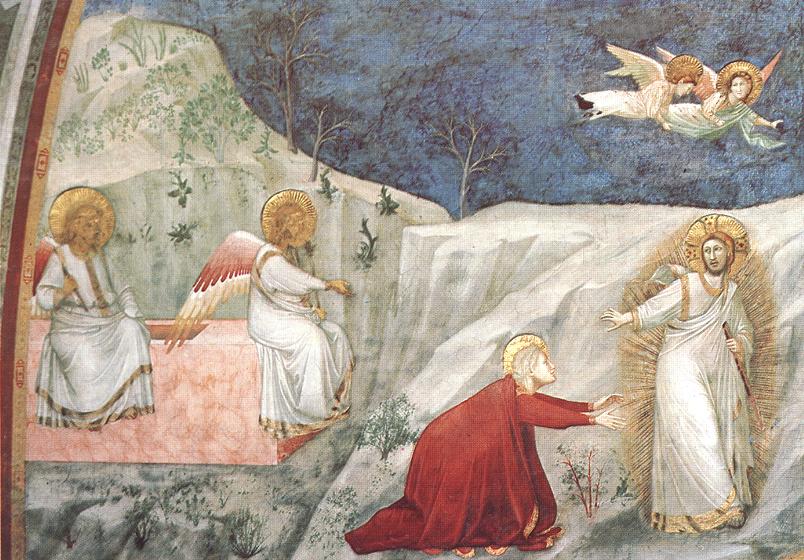
Painting by Giotto of the Risen Lord Jesus Christ appearing to St. Mary Magdalene from commons.wikimedia.org.

Lent is encountering Jesus

40 Shades of Lent by Fr. Nicanor F. Lalog II
Fifth Sunday in Lent, Cycle C, 06 April 2025
Isaiah 43:16-21 + Philippians 3:8-14 + John 8:1-11
Photo by author, Sacred Heart Novitiate Main Chapel, 17 March 2025.

Our gospel on this last Sunday in Lent is so similar in its beauty and simplicity -and drama – with last week’s parable of the prodigal son. In fact, some believe the style of the woman caught in adultery is very much like Luke but, let’s leave that to the experts.

On this beautiful Sunday, it is John’s turn to invite us to enter into the scene of his story set at the temple area shortly before the arrest of Jesus Christ.

Jesus went to the Mount of Olives. But early in the morning he arrived again in the temple area, and all the people started coming to him, and he sat down and taught them. Then the scribes and the Pharisees brought a woman who had been caught in adultery and made her stand in the middle (John 8:1-3).

Photo by author, Sacred Heart Novitiate, 17 March 2025.

Try entering the scene. See the woman who most likely almost naked draped only in a piece of cloth as proof of her committing adultery. The Pharisees and the scribes were ganging up on her to Jesus whom they wanted to test, “Teacher, this woman was caught in the very act of committing adultery. Now in the law, Moses commanded us to stone such women. So what do you say?”

Imagine being there, standing close to Jesus and the woman. How would you feel? Would you be able to look at the woman straight on her face? Nah… seems not good. Perhaps, glance only as you feel also her pain and shame. But, can you look straight at the angry mob? Probably for a while with much fears and trepidation along with a deep anger within you cannot express.

Most likely, it is only at Jesus you can look intently and longer because he is not looking at you. Tensions were rising and Jesus simply bent down, writing something on the ground with his finger while the Pharisees and scribes raised up their attacks against him and the lowly woman standing listlessly, so embarrassed, so ashamed. Even in tears.

Recall those moments when we too were caught in the midst of an undeniable transgression like her or, simply being a witness, someone caught in between of another person without any way out of his/her predicament. It must be so dark. So scary. And shameful.

Then, the unexpected happened: But when they continued asking him, he (Jesus) straightened up and said to them, “Let the one among you who is without sin be the first to throw a stone at her.” Again he bent down and wrote on the ground. and in response, they went away one by one, beginning with the elders. So he was left alone with the woman before him (John 8:7-9).

Photo by author, Sacred Heart Novitiate Main Chapel, 17 March 2025.

Many times, we encounter Jesus in our most vulnerable situation when we let go of our guards so to speak.

It is one of the great ironies in life: when we are most vulnerable and weakest, that is when we are also most truest to our self. And that is when we truly grow and mature in life.

That is when we feel peace and joy and freedom within when we are left alone with Jesus still looking down, writing with his finger on the ground to give us more space literally and figuratively speaking. It is not that Jesus wants to shame us or whatever but simply wants us to be true as he has always been true to us, full of love and mercy. Most of all, with all of Christ’s humility in bending, that is when we finally admit the need for a Savior, the need to be converted in him.

We encounter Jesus when we disarm ourselves of our false securities and pretenses, masks and camouflages that all cover our sins. It is when we come face-to-face with our sinful self when we eventually meet Jesus face-to-face too because that is when we surrender in silence like the woman caught in adultery and the mob to some degree because all the charges against us are true.

See also that it is only the fourth gospel that Jesus is portrayed “bending” low – first here before the woman caught committing adultery and secondly at the washing of the feet of his Apostles at their Last Supper. How lovely is that sight to behold, dear friends! Imagine God bending before us, giving us like the sinful woman and the mob that space for us to confront our true self, to realize and accept the whole realities we are all interconnected in love.

Only the woman remained – like the eleven Apostles at the Last Supper – because she was the only one willing to change, probably sorrowful and contrite for her sins. Contrary to our fears, Jesus has only love and mercy, kindness and forgiveness to anyone contrite and sorrowful of one’s sin that so unlike with the people’s wrath and anger, judgment and condemnation. St. Augustine perfectly described that moment in today’s gospel, Relicti sunt duo; misera et miserecordia (Two were left; misery and mercy).

Then Jesus straightened up and said to her, “Woman, where are they? Has no one condemned you?” She replied, “No one, sir.” Then Jesus said, “Neither do I condemn you. Go, and from now on do not sin anymore” (John 8:10-11).

Stations of the Cross, Fatima University & Medical Center, Valenzuela City, 28 March 2025.

We are now on the final Sunday of Lent. Next week will be the Palm Sunday of the Lord’s Passion that ushers in the Holy Week leading to the Sacred Triduum of Holy Thursday Evening, Good Friday and Easter Vigil and on to the Mother of all Feasts, Easter.

As we get closer to the holiest week of the year, our liturgy invites us to intensify our Lenten practices to be “conformed to Christ’s death” as St. Paul urged us in the second reading which opened with these beautiful confession:

“Brothers and sisters: I consider everything as a loss because of the supreme good of knowing Christ Jesus as my Lord. For his sake I have accepted the loss of all things and I consider them so much rubbish, that I may gain Christ” (Philippians 3:8).

The pillars of Lent – prayer, fasting and alms-giving – aim to empty us of our very selves, of our pride and sins that all prevent us from encountering Jesus Christ always coming to us full of love and mercy. On this final stretch of Lent, are we ready to let go of ourselves and to let God?

Today, Jesus assures us of his love and forgiveness for our sins. The first reading tells us of God asking us to forget the events of the past. Just come home to him. And never leave him like the woman caught committing adultery. Amen. Have blessed week ahead.

Stations of the Cross, College of Maritime Engineering, Our Lady of FatIma University, 28 March 2025.

Forgiving & listening

The Lord Is My Chef Daily Recipe for the Soul by Fr. Nicanor F. Lalog II
Wednesday, Third Week in Ordinary Time, Year I, 29 January 2025
Hebrews 10:11-18 ><]]]]'> + ><]]]]'> ><]]]]'> Mark 4:1-20
From Facebook, 11 March 2024.

Where there is forgiveness of these, there is no longer offering for sin (Hebrews 10:18).

How lovely and reassuring
are these words from the author
of the Letter to the Hebrews today,
Lord Jesus Christ;
thank you for coming
to save us from our sins,
for forgiving our sins,
for teaching us to forgive others
most especially by being more
loving.
Thank you, Jesus,
for being the Sower,
always coming out to
scatter seeds of love and mercy
to us; open our ears, Lord,
that we may ought to hear
you: forgive us for being hard
and harsh in our ways and words,
forgive us for being easily
pricked and agitated,
forgive us for not listening
at all to you, Jesus.
Let me open myself to you,
Jesus, by opening myself too
with others to listen to their
points of view in order
to understand them,
not to judge them;
open myself to your healing
words so I may also soothe
others pains and hurts
than add salt to their injuries.
Lastly, let me do your will
Jesus by always listening
and forgiving.
Amen.

Entering God’s rest

The Lord Is My Chef Daily Recipe for the Soul by Fr. Nicanor F. Lalog II
Thursday, Memorial of St. Anthony, Abbot, 17 January 2025
Hebrews 4:1-5, 11 ><]]]]'> + ><]]]]'> + ><]]]]'> Mark 2:1-12
Photo by author, sunset in Atok, Benguet, 27 January 2025.
God our Father,
let us enter into your rest,
let us go back to you in Jesus Christ
and enter your rest like in Paradise
before the Fall;
spare us of your wrath like with
the Israelites in Meribah and Massah
when they challenged and provoked you
and thus be prevented from entering
your rest, the Promised Land.

Let us be on guard while the promise of entering into his rest remains, that none of you seem to have failed. For in fact we have received the Good News just as our ancestors did. But the word that they heard did not profit them, for they were not united in faith with those who listened. Therefore, let us strive to enter into that rest, so that no one may fall after the same example of disobedience (Hebrews 4:1-2, 11).

With Christ's coming,
you have opened anew heaven
to us, enabling us to enter your rest
like what happened in the
opening of the roof above him
to lower a paralytic;
in Jesus,
that rest you have after creating
everything in Genesis
has become a reality
with his gift of forgiveness
and reconciliation
to everyone as experienced by
the paralytic in today's gospel;
O dearest Lord Jesus,
help me to rise again
by picking up the pieces of my life
made whole in you again
filled with your breath,
filled with your life,
soundly at rest
in your love
and mercy.
Amen.
Photo by author, sunset in Atok, Benguet, 27 January 2025.