Presence and Love of Christ

The Lord Is My Chef Sunday Recipe for the Soul by Fr. Nicanor F. Lalog II
Week XXIII, Cycle A in Ordinary Time, 06 September 2020
Ezekiel 33:7-9 /// Romans 13:8-10 /// Matthew 18:15-20
Photo by Mr. Gelo N. Carpio, January 2020.

For the next three Sundays beginning today, our liturgy directs our gaze to the nature of the Church as the mystical Body of Jesus Christ. For today we hear from Matthew how we as a church or a community of believers are signs of the presence and love of Jesus Christ.

Recall how two weeks ago at Caesarea Philippi Jesus called Simon as “Peter” (“Rock”) to head his “church”, giving him the keys to the kingdom of heaven that whatever he binds on earth shall be bound in heaven and whatever he looses on earth shall be loosed in heaven (Mt.16:17-19).

Matthew is the only evangelist so particular in using the term “church” that he devoted chapter 18 of his gospel on its nature, collecting and giving some of the Lord’s teachings about community life to his own group of disciples or early church.

And off he went to start with the most important part of community life:

Jesus said to his disciples: “If your brother sins against you, go and tell him his fault between you and him alone. If he listens to you, you have won over your brother. If he does not listen, take one or two others along with you… If he refuses to listen to them, tell the church. If he refuses to listen even to the church, then treat him as you would a Gentile or a tax collector… Again, amen, I say to you, if two of you agree on earth about anything for which they are to pray, it shall be granted them by my heavenly Father. For where two or three are gathered together in my name, there am I in the midst of them.”

Matthew 18:15-16, 17, 19-20
Photo by author, dome of the Malolos Cathedral, 2019.

Presence of Jesus in the love and unity of community

In a very short teaching taking a step by step method, Jesus tells us today how our mutual love shall always take precedence above all in our community life as his disciples and sign of presence.

Though we do not find in our gospel this Sunday the word “love”, it is clearly the Lord’s lesson for today: it is mutual love for one another that must guide everyone specially in the delicate matter of fraternal correction when one is going wayward in his/her path of life.

This explains why Jesus spelled out step by step how we correct others primarily because we love, not because we are better than them or that we have such authority or task and duty. Paul beautifully says it in our second reading:

Brothers and sisters: Owe nothing to anyone, except to love one another; for the one who loves another has fulfilled the law. Love does no evil to the neighbor; hence, love is the fulfillment of the law.

Romans 13:8, 10

But of course, we need to clarify that all these lessons of love from the Lord and Paul are based on the love of Jesus Christ who clearly mandated us during his last supper how we must love:

I give you a new commandment: love one another. As I have loved you, so you should love one another. This is how all will know that you are my disciples, if you have love for one another.

John 13:34-35

What makes this loving one another a “new commandment” is loving like Jesus Christ, unlike the pagans in ancient times that are still imitated to this day even by many among us who are also Christians. So often we find specially in media how love is portrayed as mere feelings like physical attraction that always leads up to sex, devoid of any sanctity and inner beauty at all.

St. Augustine called it “disordered love” when we become self-centered and selfish, directing our love solely to attaining what pleases us that we use persons and love things like money.

Love is not just a feeling but a decision, a choice we make and affirm every day specially when times are very rough and tough for us like when we are not loved in return.

Most of all, love is when we find somebody else we can love more than ourselves (Thomas Merton). This is the kind of love that Jesus and Paul as well as all the other saints speak of: the self-sacrificing love Christ showed us when he offered himself on the cross for the forgiveness of our sins.
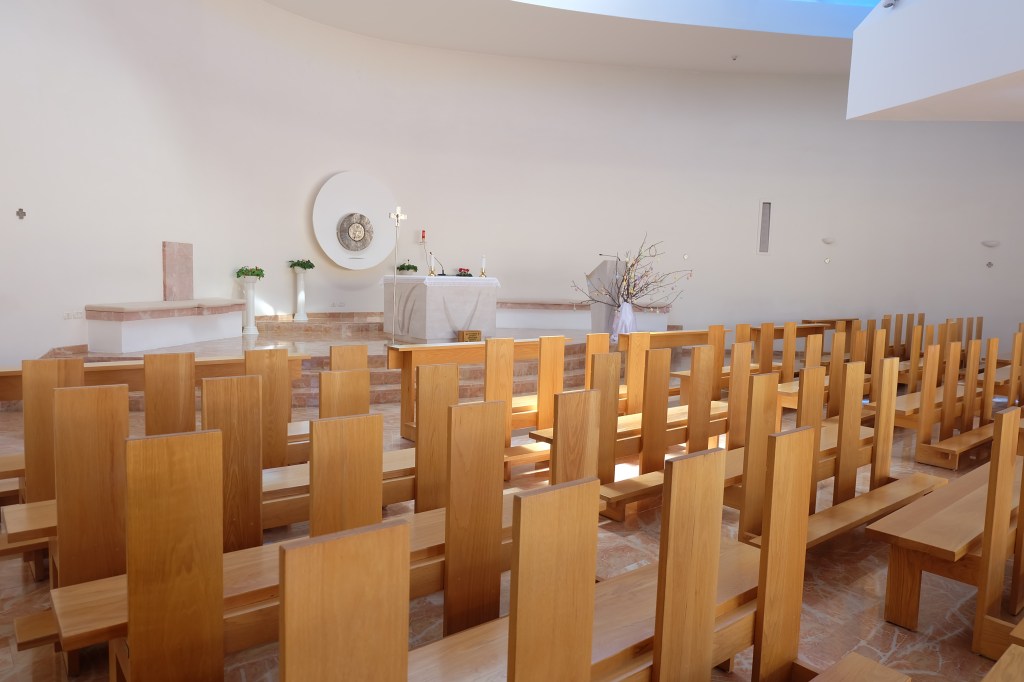
Photo by author, Chapel of the Monastery of the Sisters of Perpetual Adoration of the Blessed Sacrament at the Milk Grotto in Bethlehem where the Holy Family hid before fleeing to Egypt to escape Herod’s order to massacre the Holy Innocents, May 2019.

Love of Jesus builds, not destroys

Applying the law of love to our community is the most severe test of our being disciples of Jesus when we are challenged to be sincere in our love by hating what is evil and holding on to what is good like blessing those who persecute us, foregoing vengeance against those who have wronged us along with other expressions of mutual love in our community that Paul tells us in Romans 12:9-21.

In teaching us mutual love for one another in a step by step manner, it may seem to be a duty that one must follow in the church. It may even sound as contradictory that Jesus seems to be commanding us to strictly follow his law of command because no law can ever impose love.

However, when we try to reflect the ending of his teachings today – “For where two or three are gathered together in my name, there am I in the midst of them” – we find Jesus not ordering us to love but asking us our love because he loves us. He comes to us, grants our prayers because he loves us; therefore, when we love, when we gather as his disciples, we become his presence. And that is when our prayers are most effective because Jesus is in our midst!

Jesus and his love always build people and community; without him and his love, all we have is destruction and divisions. Hence, love is the only debt we owe to anyone. Love as a debt and “duty” is never paid back because the more we love, the more we have love, the more we are indebted to Jesus. It is the only debt that is never burdensome; in fact, the opposite happens when we refuse to love – we are burdened, life becomes heavy and so difficult.

This is what Ezekiel is telling us in the first reading: we are a “watchman”, a brother’s keeper of everyone. St. Pope Gregory the Great wrote a beautiful homily on being a watchman:

Note that a man whom the Lord sends forth as a preacher is called a watchman. A watchman always stands on a height so that he can see from afar what is coming. Anyone appointed to be a watchman for the people must stand on a height for all his life to help them by his foresight.

Office of Readings, Memorial of St. Pope Gregory the Great, 03 September
Photo by author, sunset inside our parish, 25 August 2020.

In the Church, those designated as watchman of the flock of Jesus is the Bishop or episkopos in Greek that means watcher or overseer. It is the bishop’s duty to always be above others in the loving service of the Church that sometimes out of love for Christ, he has to discipline those going astray as instructed in our gospel today, “If he refuses to listen even to the church, then treat him as you would a Gentile or a tax collector”, that is, excommunication or suspensions and other measures not meant to punish but to convert and correct the sinner.

Next Sunday, Matthew deepens our lesson on mutual love when he presents us the teachings of Jesus on how often we must forgive our brother or sister who repeatedly sins against us.

See my dear reader, how after presenting to us who is Jesus Christ last month, in how much he loves us and seeks us, these following Sundays we are challenged by the Lord to be like him – loving and merciful – to truly keep our relationship with him.

It is the first Sunday of September, the -ber months that tell us Christmas is around the corner. But, it seems we are still in a long haul in this pandemic. Having a vaccine will not totally eradicate COVID-19 nor guarantee us this won’t happen again in the future because the disease that is truly plaguing us until now is our refusal to love and live as brothers and sisters in Christ. Let us give it a try. Slowly. Jesus is not rushing us. All he is asking us is be open to his words expressed earlier in our responsorial psalm: “If today you hear his voice, harden not your hearts.”

Have a heart and have a blessed, lovely week, everyone!

The hiddenness of God

Quiet Storm by Fr. Nicanor F. Lalog II, 04 September 2020
Photo by author, sunset at the Lake of Galilee (Tiberias) in Israel, May 2017.

August has always been a “ghost month” for me since elementary school. Long before I have heard these stories and words of caution against many things in the month of August, I have always dreaded this month when days are grindingly slow.

Specially this year 2020 when the whole month of August felt like the season of Lent when everything was dry and empty, even literally speaking in our churches when the five Sundays of August were like five Good Fridays.

But, for the first time in many years during this pandemic, amid the dryness and emptiness of August 2020, I felt and “found” God anew in his most unique and wonderful characteristic — his hiddenness.

Hiddenness is different from being invisible that simply means “not visible”.

Hiddenness is something both simple and complicated but beautiful and wonderful when we find God in his hiddenness.

Hiddenness of God means more than not being seen per se; it is that feeling with certainty that he is present but, just hiding somewhere. In fact, if God were not hidden, we would have not found him at all!

And the more God is hidden, the more we are able to see him and experience him!

Photo by author, April 2020.

Remember when we were kids and could not find the things that our mother had asked us to get from somewhere in the sala or kitchen or her tocador? She would threaten us with the classic line my generation have all heard and memorized, “Pag hindi mo nakita yan, makikita mo sa akin!”

It is one of our funniest memories of childhood! I am sorry for my English-speaking readers but there is no appropriate translation for this because it is very cultural and even spiritual in nature. Literally translated, it says that if you do not find what you are looking for, you would find it with me. Crazy and insane, is it not?!

I told you, hiddenness of God is both simple and complex but whenever we remember those “sweet, maternal threats”, we laugh and shrug off the experience as we were dead serious then searching for whatever thing mom had asked us because deep in us we knew too well, it must be somewhere there. Sabi kasi ni Inay! (Mom said so!)

That is how it is with God too! We know for sure he is around, he is present. But in hiding because that is how loving God is, like moms and some lovers with surprises for us his beloved.

The Prophet Jeremiah experienced it so well when he wrote:

You duped me, O Lord, and I let myself be duped; you were too strong for me, and you triumphed. All the day I am an object of laughter, everyone mocks me. Whenever I speak, I must cry out, violence and outrage is my message; the word of the Lord has brought me derision and reproach all the day. I say to myself, I will not mention him, I will speak in his name no more. But then it becomes like fire burning in my heart, imprisoned in my bones; I grow weary holding itin, I cannot endure it.

Jeremiah 20:7-9

No one can understand this without having experienced such intense kind of love of God or of another person that even if we are pained, we just cannot walk away or leave. More so with God, the most intense lover of all!

At the very center of Jeremiah’s torment is the invincible power of attraction of God. This is also the reason human love – whether for another a friend or a spouse, for the Church or any institution – must always be based on the love of Christ who told us to “love one another as I have loved you.” If our love remains in the human level, it can never go deeper or higher making it so sublime, so true, so pure.

That is how God is in his hiddenness who is like a lover who never stops looking for us, calling us, luring us, even seducing us to come to him, search him and once found, we may dwell in his great love; hence, even if we do not “see” him, we keep on following him as we also find him in his hiddenness!

Hiddenness of God, mystery and gift of Easter

This hiddenness of God is both the gift and mystery of Jesus Christ’s Resurrection. It is a gift because in his hiddenness, God has become closest to us more than ever while at the same time, a mystery because it is in his very hiddenness that we truly find and discover God.

Remember the two disciples going home to Emmaus on Easter afternoon who was accompanied by Jesus while traveling? They did not recognize him but as they talked, their “hearts were burning” as he explained the Scriptures. Then joining them at their meal at sundown upon reaching Emmaus, Jesus took the bread, blessed it and broke it — and the disciples’ eyes were opened, recognizing him as the Lord who immediately disappeared! The two then rushed back to Jerusalem to announce to the other disciples that Jesus had indeed risen.

That is the beauty of hiddenness, its giftedness and mystery that we find God even our beloved who had died or not physically present with us but deep within, we are certain of their presence as being so true and so real.

Hiddenness is a deeper level of relationship coming from one’s heart and soul not dependent on physical presence. This is the reason why upon appearing to Mary Magdalene on Easter morning, Jesus asked her not to touch him because from then on, knowing and relating with the Lord need not be physical and corporeal as he used to relate with them before his Death and Resurrection.

All these we must have experienced like when after a friend or a relative had died, that is when we felt growing closer with the person than when he/she was still alive and physically present with us. Or, when we were feeling low and down, we experienced sometimes so amazed at how we have felt the presence even the scent of our deceased loved ones comforting us, assuring us that all would be better.

This quarantine period invites us to experience and discover God anew in his hiddenness through prayers and silence so we can reflect on the many lessons this pandemic is teaching us today. In the darkness and emptiness of this pandemic are grace-filled moments with God hidden in our poverty and sadness, sickness and even deaths around us.

Photo by author, Christmas 2018.

Some people have already asked me about what or how would our Simbang Gabi and Christmas celebrations be. They are sad and worried that it must be a very bleak Christmas for everyone with so many out of work.

But, despite this gloom, I tell them that Christmas 2020 would be one – if not the most meaningful Christmas we shall ever have despite forecasts that there would be less of everything, materially speaking.

So often in life, when we have so much material things, that is when we fail to find and experience God.

Recall that in Bethlehem more that 2000 years ago when Jesus Christ was born, God came to us hidden in a stable, on a manger in the darkness of the night.

And do not forget, too, that Christmas is not a date but an event, the very person of Jesus Christ, the all-powerful God who came to us hidden in a child, who upon becoming an adult, was crucified and died. These are sad and down moments for us but for God, it is his hiddenness, his presence. Let us go and find him again for he continues to come to us in hiddenness. Amen.

Our foolish pride

The Lord Is My Chef Breakfast Recipe for the Soul by Fr. Nicanor F. Lalog II
Thursday, Memorial of St. Gregory the Great, Pope and Doctor of the Church, 03 September 2020
1 Corinthians 3:18-23 >><)))*> | >><)))*> | >><)))*> | >><)))*> Luke 5:1-11
One of the best ads during the lockdown last summer from Smart.

What a wonderful lesson we have today from St. Paul about your wisdom, O God our Father that is found in the scandal of the Cross of your Son Jesus Christ!

Brothers and sisters: Let no one deceive himself. If anyone among you considers himself wise in this stage, let him become a fool so as to become wise. For the wisdom of this world is foolishness in the eyes of God, for it is written: God catches the wise in their own ruses, and again: The Lord knows the thoughts of the wise, that they are vain.

1 Corinthians 3:18-20

This we have realized at the start of this pandemic when everything in the world stopped and forever changed because of microscopic COVID-19 virus, affecting even the most advanced countries of the world.

Most of all, everybody – rich and poor alike – suffered greatly from this virus, teaching us to value persons more when people we took for granted for so long have become our “saviors” during this prolonged quarantine periods like vendors and delivery personnel, our househelpers, and others we used to look down upon who continued to serve us with food and other needs.

Not to be forgotten too are the members of neglected sectors of our society, specially those in the medical and healthcare system and the agriculture who showed us the importance of human and natural resources over imports and technology as well as entertainment.

What a great lesson about wisdom of God and foolishness of man in this modern time!

One thing very clear, O Lord, that to be a fool for you is first of all to let go of our foolish pride and be humble before you and others.

It is the only way we can let you do your work of changing us and the world when we learn to let go of our foolish pride like St. Peter in today’s gospel when he as an experienced fisherman heeded your command to cast his nets into the deep even though you are the carpenter’s son.

When we review the lives of all saints, they are all men and women of exceptional humility before you, Lord; like St. Gregory the Great who focused more on you that he was able to reform our liturgy, set up schools and monasteries, sent missionaries to England, and instill holiness among the clergy in his “Pastoral Instructions.”

Help us to believe more in you than in ourselves so that you may do your work in us and through us. May we value your Cross, Lord Jesus, considered as foolish in this sophisticated age yet has continued to prove that it is the only path to our transformation as persons and nations. Amen.

Photo by author, XVth Station of the Cross, the Resurrection, Mount St. Paul, La Trinidad, Benguet, February 2020.

Basta may panlasa at pang-amoy, ayos na!

Lawiswis ng Salita ni P. Nicanor F. Lalog II, Ika-21 ng Agosto 2020
Larawan kuha ni G. Jim Marpa, 2019.
Ngayong panahon ng COVID-19
sumagi sa akin mga turo ng dalawang pari
na napakalapit at mabuti sa akin:
Una ay si Padre Nanding 
malimit sabihin sa akin
"Pinakamasarap makasama
tao na mayroong panlasa";
"iyong iba," aniya, 
"pakanin mo ng buong baka,
hindi pa rin masaya!"
Ikalawang paring butihin
ay si Padre Johann 
madalas ako paalalahanan
"Biyaya ng Diyos ang ganang kumain
dahil ibig sabihin
wala kang sakit na dapat intindihin
di tulad ng ibang hindi makakain."
Nakatutuwang isipin at malayin
kung paanong noong panahon natin
mga mumunting butil ng pagkain
pinahahalagahan upang huwag sayangin;
ngayon naman ating alalahanin
itong ating panlasa at ganang kumain
mga biyayang hindi napapansin;
magdildil ka man ng asin o 
maalat man o maasim ulam na inihain
huwag nang punahin o laitin 
sapagkat iyong nalalasap pa rin
ang pagkain at walang COVID-19!
Sa hapag ng pagkain
mga samahan at ugnayan natin
nabubuo, tumatatag at tumitibay
kaya sa ating buhay
masarap kasabay
sa paglalakbay
mayroong panlasa
at maganang kumain,
basta huwag lang sasairin
at uubusin ang sinaing 
baka iba hindi na makakain
dahil ikaw pala ay sakim!
Photo by Pixabay on Pexels.com
Ito naman ang habilin na galing sa akin:
basta nakaka-amoy ng masarap na lutuin
maski hindi sa iyo ang pagkain
matuwa ka na rin, wala ka pang COVID-19;
gayun din naman, 
iyo nang kalimutan hindi man kagandahan 
 ilong na ngayon ay natatakpan
makaamoy man ng alimuong
makalanghap man ng masansang
at masamang hangin ay mabuti pa rin:
nakakahinga ka ng malalim
wala kang COVID-19!
Larawan kuha ni G. Jim Marpa, 2019.

Aral ng COVID-19, VII: katahimikan higit na kailangan

Lawiswis ng Salita ni P. Nicanor F. Lalog II, Ika-18 ng Agosto 2020
Larawan kuha ni G. Jim Marpa, 2018.
Noong aking kabataan
aking natutunan sa mga harutan
naming magpipinsan at magkakaibigan
habang nakapila sa poso na iniigiban 
ang baldeng walang lamang
ang siyang pinaka-maingay.
Ngayon sa aking katandaan
higit kong naunawaan yaring katotohanan
habang nagninilay sa gitna ng lockdown
na siya ngang tunay mga taong maiingay
karamihan sanga-sanga kanilang mga dila
pinagsasasabi'y walang katotohanan o kabuluhan.
Hindi nila batid sa pag-iisip nilang makitid
katahimikan ay hindi kawalan kungdi kapunuan 
pinakikinggan bawat pintig, dinarama maski ang kalma
tinitimbang ano mang katotohanan at kabuluhan 
upang pagkaabalahan, pag-usapan
kung hindi man ay kalimutan at isantabi na lamang.
Larawan kuha ng may-akda, talon sa Taiwan, Enero 2019.
Sa pakikipag-talastasan ng Diyos
masdan lagi itong pinangungnahan ng katahimikan:
sa Matandang Tipan matatagpuan 
bago likhain ng Diyos ang sanlibutan,
walang ano man kungdi dilim at katahimikan
saka lamang Siya nagsalita upang lahat ay malikha;
doon sa Bagong Tipan ganito rin ang napagnilayan
ni San Juan bago si Hesus ay isinilang:
aniya, sa pasimula naroon na ang Salita
kasama ng Salita ang Diyos
 sa Kanya nalikha ang lahat
at naging tao ang Salita
 tinawag na Kristo
humango sa makasalanang tao.
Hindi natin kailanman mauunawaan
mga salita ng Diyos na makapangyarihan
kung hindi tayo handang manahimik
 upang sa Kanya ay makinig;
noong si Hesus ay isinilang
 tatlumpung taon ang binilang
bago Siya napakinggan
pagkaraang binyagan sa Jordan
 maliban nang Siya ay matagpuan
 sa templo nakikipagtalastasan
 noong Kanyang kamusmusan;
gayun pa man sa Kanyang pangangaral
madalas Siya ay manahimik at magdasal
kaya lahat namamangha sa kanyang salita pati gawa.
Saanman mayroong katahimikan
pagtitiwala tiyak matatagpuan;
at kung saan man walang katahimikan
bukod sa maingay, walang kaayusan.
Magandang pagkakataon ngayong lockdown
pagsikapan, huwag katakautan ang katahimikan
dahil dito nalalantad, nakakatagpo ang katotohanan
na palagi nating tinatakasan, iniiwasan
kung kaya ang kalayaan hindi nating makamtan;
sa katahimikan lahat pinakikinggan -
sariling kalooban, kapwa at Diyos maging kalikasan
tungo sa pagmamahalan, kaisahan, at kaganapan ng buhay.
Larawan kuha ni Bb. Ria De Vera, bukang liwayway sa aming parokya, Abril 2020.

Love without borders

The Lord Is My Chef Sunday Recipe for the Soul by Fr. Nicanor F. Lalog II
Week XX, Cycle A in Ordinary Time, 16 August 2020
Isaiah 56:1, 6-7 >><}}}*> Romans 11:13-15, 29-32 >><}}}*> Matthew 15:21-28
Twilight at our parish by Ms. Ria De Vera, 12 August 2020.

For the third Sunday in a row, Jesus reveals a very wonderful side of him who goes out of his way to meet us and comfort us in the most difficult situations and places we are into. It is something we need so much in these days of Moderate Enhanced Community Quarantine (MECQ) seen right away in the opening of today’s gospel.

At that time, Jesus withdrew to the region of Tyre and Sidon. And behold, a Canaanite woman of that district came and called out, “Have pity on me, Lord, Son of David! My daughter is tormented by a demon.” But Jesus did not say a word in answer to her.

Matthew 15:21-23

Jesus goes out of his way to meet everyone

Israel is a very small country but always leaves a big impact on everyone who goes on a pilgrimage there. There is that sense of awe in every sacred site that until now continues to “speak” and evoke among pilgrims the presence and holiness of God and his saints.

Like what we have mentioned last Sunday, the proxemics or the non verbal communication of the places Jesus have visited convey to us deeper meanings than just mere sites. And that is more true during the time of Christ like the setting of this Sunday’s gospel, the region of Tyre and Sidon.

Now part of Lebanon found south of its capital city Beirut that was devastated by powerful explosions two weeks ago, Tyre and Sidon were gentile or pagan cities during the time of Jesus with a considerable Jewish population.

His going there shows us his fidelity to his mission of “searching for the lost sheep of the house of Israel” that partly explains to us why he never bothered to give the slightest hint of recognition to the Canaanite woman who had sought his help for her daughter “tormented by a demon”.

Photo by author, the Holy Land, May 2019.

And despite the lack of any explanation again by St. Matthew on the attitude by Jesus “snubbing” the pagan woman, we can safely assume that Christ surely knew that by going to Tyre and Sidon, gentiles would seek his healing as news of his fame had spread beyond Galilee at that time.

Here we find the great love and concern of Jesus for everyone, specially the rejected and marginalized in the society.

His “withdrawing to the region of Tyre and Sidon” was in itself a revelation of his universal love, a love without borders reaching out to those lost and feeling alone in life, those rejected, those discriminated for their color and beliefs, status and gender, sickness and diseases like AIDS and lately, COVID-19!

Inclusive Jesus, exclusive human

At the beginning of chapter 11 of St. Paul’s Letter to the Romans from which our second reading is taken today, the great Apostle starts by asking “has God rejected his people?” St. Paul emphatically said “no”, explaining at length the plan of God in Jesus Christ to save all peoples not just the Jews, beautifully telling us,

For the gifts and the call of God are (permanent and) irrevocable.

Romans 11:29

St. Paul’s reflections on God being “inclusive” as against our being so “exclusive” in sending us Jesus Christ to bring us all together as one sheds us some light on that extraordinary incident in the region of Tyre and Sidon involving the Canaanite woman.

Again, I invite you my dear reader to reflect on the many layers of meaning found in this episode so special like the feeding of more than five thousand people the other Sunday and Jesus walking on water last week.

First, notice the silence of Jesus. Keep in mind when the Lord is silent, it does not mean he is out or does not care at all to our needs and pleas. When there is silence – specially a deafening one – the problem is never with God but with us people.

And, true enough! See how the disciples asked Jesus to “Send her away, for she keeps calling out after us” (Mt.15:23) — exactly the way we deal sometimes with those begging our help and attention, seeing them as a nuisance to be sent away? What a shame!

From Google.

Now, we go to the climax of this episode with the woman coming to Jesus, “paying him homage” for the healing of her daughter tormented by a demon. It was a scene similar with St. John’s wedding at Cana where the Blessed Mother also approached Jesus with a request when wine ran out during the feast.

In both episodes we find Jesus being a snub – suplado, as we say.

Most of all, in both scenes we find the remarkable faith in Jesus by his Mother at Cana believing he can do something to spare the newly wed couple of embarrassment from running out of wine while this Canaanite woman felt so sure only Jesus can cure her daughter.

See how she addressed Jesus like his disciples with not just “Lord” but also with the title “Son of David” to indicate her faith in him as the Messiah.

And it did not stop there as she engaged Jesus into a dialogue — indicating intimacy and trust, depth and communion that we refer in Filipino as “matalik na ugnayan” or “matalik na usapan”.

Sometimes in life, Jesus seems to have that longing for some “lambing” from us that he tries to be “pakipot” or hard to get in order to be intimate with us. Please take these Filipino traits positively to get what I mean from this unique scene of Jesus and the Canaanite woman in Tyre and Sidon.

Jesus said in reply, “It is not right to take the food of the children and throw it to the dogs.” She said, “Please, Lord, for even the dogs eat the scraps that fall from the table of their masters.” Then Jesus said to her in reply, “O woman, great is your faith! Let it be done for you as you wish.” And the woman’s daughter was healed from that hour.

Matthew 15:26-28
Photo by author, Church of All Nations beside the Garden of Gethsemane in the Holy Land, May 2019.

Brothers and sisters all in one God as Father

St. Matthew recorded this episode not to scandalize and shock us with those words coming from the Lord, referring to the Canaanite woman as one of the “dogs” that was the term used to designate pagans at that time.

For St. Matthew who was writing for Christians of Jewish origins, the episode was a reminder that the people of Israel were indeed the “children” of God to whom the coming Messiah and salvation – like bread or food – were first promised. St. Paul spent a great deal of explaining of this in his letter specially to the Romans .

Rigthly then, theirs was the “food” not right to be thrown to the “dogs” but, that fact does not exclude the “dogs” from partaking later from the leftover food of the children, as if telling Jesus, today we satisfy ourselves with crumbs, tomorrow we shall have bread!

The Canaanite woman clearly knew where to place herself before the Lord, proving to him her deep faith and amazing knowledge of God’s goodness and plans for everyone. For that, she was highly praised by Jesus for her faith. The only other person also praised by Jesus in having a tremendous faith in him was the centurion – another pagan – who begged the Lord for the remote healing of his servant.

Last Sunday afternoon I read the story of how a nurse was driven out of her boarding house after she tested positive for COVID-19 virus. The poor lady had nowhere to go to spend the night after being denied of any assistance by barangay officials, even by her own family in Batangas! Good enough, somebody reported her to the Philippine National Red Cross that sent an ambulance to take care of the nurse who was found crying by herself at the gutter of a street in Pasay City.

What a very sad and tragic reality happening among us these days of the pandemic.

Where is our love and concern for everyone, especially the weak and the sick, those in our own versions of Tyre and Sidon where no one would dare to go except Jesus, perhaps like the dorms and residences of our medical frontliners who are so tired and sick physically, emotionally, and spiritually during this pandemic?

In these past three weeks we have reflected how Jesus lovingly joined us, staying with us in the wilderness, in the storms of the dark sea, even at the pagan territories where nobody would ever want to go.

This Sunday, Jesus is inviting us to break all barriers and borders between us that separate us from each other. Let us animate our community with Christ’s love and mercy for us all amid our many differences so that slowly we fulfill Isaiah’s prophecy in the first reading that someday the house of the Lord shall be called “a house of prayer for all peoples” (Is.56:7). Amen.

A blessed and safe new week to you! And please do not forget to pray ten Hail Mary’s every 12-noon for national healing and end of the pandemic until September 15, 2020.

Quarantine to heaven

The Lord Is My Chef Breakfast Recipe for the Soul by Fr. Nicanor F. Lalog II
Saturday, Solemnity of the Assumption of Mary, 15 August 2020
Revelation 11:19; 12:1-6, 10 >><}}}*> 1 Corinthians 15:20-27 >><}}}*> Luke 1:39-56
Photo by author, the Assumption Sabbath Place in Baguio City, 2018.

God our merciful Father, on this Solemnity of the Assumption of the Blessed Virgin Mary, we start the praying of ten Hail Mary’s daily at noon until the 15th of next month for collective “healing” and the end of COVID-19 pandemic.

Through the Blessed Mother of your Son our Lord Jesus Christ, we pray for firm faith, vibrant hope, and unceasing love for you and for others as we go into the sixth month of our quarantine to help stop the spread of the corona virus.

But it seems, until now, O God, many of us still do not get the full meaning of this quarantine period with most of us pinning our hopes for a magic cure that would come to end these sufferings and resume our previous way of life.

Help us see, O God, the process of quarantine, of purification you want us to go through not as a punishment but as a lesson to learn and remember that will prevent us from all the excesses that have burdened us down lately, preventing us to rise like the Virgin Mary.

On this great feast of Mary’s Assumption into heaven, teach us how we may all rise up to your presence, win over COVID-19 not just with a vaccine or physical remedy and cure to the disease but on how we must change our ways of life, our attitudes and dispositions.

How wonderful, O God, to hear the story anew of Mary and Elizabeth who trusted you so much in the coming of our Savior as they both emerged from their own kind of “quarantine” period in this gospel scene of the Visitation.

May we realize like Elizabeth during this quarantine period that true blessedness is in believing “what was spoken by the Lord would be fulfilled” (Lk.1:45), that we entrust all our hopes in you, O God, not to mere humans who make a lot of promises only to be broken. May we open ourselves like Elizabeth who went into seclusion upon conceiving St. John the Baptist that you always come in the simplest yet wondrous ways of life. Keep within us that sense of wonder and awe, Lord.

“The Assumption of the Virgin” by Italian Renaissance painter Titian completed in 1518 for the main altar of Frari church in Venice. Photo from wikidata.org.

Teach us like Mary to always proclaim your greatness as we rejoice in Jesus our Savior in our very lives of humility and simplicity, obedience and surrender to your will. May our lives be a song of praise to your wondrous deeds, O Lord, like Mary that is centered and focused on you.

Cleanse us of our sins, especially of greed and conceit that have led to this pandemic.

How sad that until now, we still don’t get it.

May this crisis remind us that we are all in a temporary journey here on earth – like in a quarantine – that our final resting place and destination in the end of everything is in you, O God, like Mary whom you gifted with the Assumption of her body and soul into heaven ahead of us all.

May we all strive for the same gift. Amen.

Aral ng COVID 19, VI: disiplina ang gamot sa sakit natin

Lawiswis ng Salita ni P. Nicanor F. Lalog II, Ika-11 ng Agosto 2020
Larawan kuha ni Bb. Anne Ramos, Abril 2020
Habang tumatagal itong quarantine 
lalong ipinakikita hindi COVID-19
ang kalaban natin kungdi ating sarili din;
matagal nang sakit na hindi kayang gamutin
nakaugat nang malalim sa katauhan natin
kawalan ng disiplina kay hirap sugpuin.
Sa gitna ng kawalan ng maaasahan
sa pamahalaang abala sa kapalaluan
ayaw pakinggan mga paraan ng nakakaalam
disiplina nating mga mamamayan
ang pinaka-mabisang sanggalang
laban sa virus na galing sa Wuhan.
Tingnan, pag-aralan, at tularan
pamamaraan ng mga bansa kung saan
paglaganap ng COVID-19 ay nalabanan
laging matatagpuan dalawang bagay magkasabay:
mahusay at magaling na pamahalaan
disiplinadong mga mamamayan.
Masunurin ang turing sa taong may disiplina
na nagmula sa wikang Griyego na discipulos,
taga-sunod o alagad; sa wikang Latin, 
dalawang kataga ang pinagsama
"ob audire" na ibig sabihin "makinig na maigi"
kaya sa Inggles "obedient" ang isang masunurin.

Ang taong may disiplina
 masunurin sa tuwina
laging nakikinig sa mga sasabihin
upang kanyang tuparin 
mga ipinagbibilin
 ano mang atas na kanyang gawain.
Kung ating lilimihin lalim
ng kahulugan ng disiplina
ito rin ang siyang dahilan
upang ating matutuhan
kahalagahan ng pagtitiyaga
at paghihintay na atin nang tinalikuran.
Pagkaraan ng mahigit limang buwan
lahat na lamang sa atin ay dinaraan 
sa paspasan, pag-aagawan, at pagdarayaan
kaya hanggang ngayon wala tayong patunguhan;
kung bawat mamamayan mayroong disiplina
baka sakali tinablan ng kahihiyan mga kinauukulan
wala na silang dahilan sa kanilang kapabayaan 
dahil sila unang nagkulang sa disiplinang kinakailangan
hindi nila tayo maaring sisihin 
nagkulang sa pagsugpo sa COVID-19.
Larawan kuha ni Bb. Anne Ramos, Marso 2020.

Meeting Jesus

The Lord Is My Chef Sunday Recipe for the Soul by Fr. Nicanor F. Lalog II
Week XIX, Cycle A in Ordinary Time, 09 August 2020
1 Kings 19:9, 11-13 >><}}}*> Romans 9:1-5 >><}}}*> Matthew 14:22-33
Photo by Mr. Raffy Tima of GMA-7 News, Batanes, 2018.

I have always loved the sea and lately my thoughts have always been about the beach as I miss it so much after COVID-19 had robbed us of our summer vacation.

In ancient time, the sea evoked fear because it was largely unknown that even in the bible, it is the symbol of evil and its powers over man. That is why our gospel today is very significant when Jesus walked on water to show God’s greater power over evil and sin.

And like our gospel last week, our story today tells us a lot more about Jesus walking on water in the midst of a storm to reveal himself and most of all, his desire to meet us his disciples.

Place and location as non-verbal communication of one’s presence

Every meeting and encounter presupposes locations or places, a locus; but, everything is “levelled up” or elevated in Jesus in whom things do not remain in the physical level.

Proxemics is the non-verbal communication that refers to places and location, its nearness and orientation. How we arrange our furnitures, designate the rooms and sections in our homes, offices, schools and every building we stay and gather communicate and reveal who we are.

For example, Catholic homes are easily identified in having a grotto at the garden, an altar of the Sacred Heart or any saint at the sala, and the Last Supper painting in the dining hall.

But for Jesus, a place or a location is more than the physical site because in him, proxemics takes on a deeper dimension and higher meaning when we meet him in situations and places. That is why after feeding the more than five thousand people last week, he ordered the Twelve to cross the Sea of Galilee (which is actually a lake) ahead of him while he dismissed the crowds.

After doing so, he went up on the mountain by himself to pray. When it was evening he was there alone. Meanwhile the boat, already a few miles offshore, was being tossed about by the waves, for the wind was against it. during the fourth watch of the night, he came toward them, walking on the sea. When the disciples saw him walking on the sea they were terrified. “It is a ghost,” they said, and they cried out in fear. At once Jesus spoke to them, “Take courage, it is I; do not be afraid.”

Matthew 14:23-27
Photo by author, Sea of Galilee at Capernaum where Jesus used to preach, May 2019.

Crossing to Jesus, crossing with Jesus

I love that scene very much, of Jesus getting his disciples into the boat to precede him to the other side of the lake while he dismissed the crowds. Again, St. Matthew never bothered to tell us why Jesus sent the Twelve ahead of him as he stayed behind, dismissing the crowds and later praying alone at night atop the mountain.

Let us now reflect the proxemics or non-verbal communication of our gospel scene this Sunday.

We need to cross to the other side to meet Jesus.

To meet Jesus Christ, we always have to “cross to the other side” by leaving our “comfort zones”.

More than going to the other side of the lake physically, we have to move over to unchartered areas of life, be bold and daring to try new things, new situations in order to mature and find fulfillment by meeting Jesus Christ.

And sometimes, we really have to literally cross the sea or get to the other side of the country or the world to find our self and meet Christ.

Fifteen years ago I went on vacation to Toronto for some soul-searching as I went through a burn-out. While serving at St. Clement Parish, I met many Filipinos serving as lectors, choir members, catechists and volunteers.

Graph shared by sugarindustryfoundationinc.org.ph.

They would always confess to me with both a sense of pride and little shame that they never went to Mass regularly when in the Philippines and now in Canada, they were amazed at how God had brought them there to be involved in parish activities and be closer to Jesus than ever!

As I listened to their stories, I realized the many sacrifices and hardships they have to endure in that vast and cold country with no one to turn to except God. If given the chance, many of them admitted they would return to the Philippines for there is no place like home!

Though I have found so many things I have been searching for in my initial three months of stay there on top of other opportunities given me, I still felt empty. That raging storm within continued. As I prayed and reflected guided by an old, Polish priest who claimed to have been the student of St. John Paul II, I saw myself more, eventually leading me to God anew who refreshed my vocation that I finally decided to go back home after six months of my supposed to be one year leave.

Sometimes in life, we need to get away from our comfort zone, cross to the other side, especially when life becomes so artificial. Jesus invites us to go ahead and cross to the other side of the lake or sea to experience life at its “raw” so we can feel again our souls within and desire him anew until we finally meet him wherever we may be in the world.

It is when we are at the other side of the sea in the midst of a storm when Jesus comes, immediately answering our cries for help – At once Jesus spoke to them, “Take courage; it is I” – because when we are reduced to emptiness and nothingness, then our faith kickstarts again. Faith, like love, is always an encounter with God.

Try going to the other side, leave your comfort zone to meet Jesus and finally have meaning and direction in life!

Silence is the presence of God.

In the first reading we have heard that beautiful story of Elijah meeting God at the mouth of a cave — not in the strong and heavy wind nor earthquake nor fire like Moses before him.

After the fire, there was a tiny whispering sound. When he heard this, Elijah hid his face in his cloak and went and stood at the entrance of the cave.

1 Kings 19:12-13

Silence is the place of the presence of God because silence is his language too. Wherever there is silence, we can surely find and meet God there.

That is why Jesus wants us to cross to the other side, to be silent and listen to him.

Photo by author, crossing the Lake of Galilee, May 2019.

In his silence, God teaches us that except for sin, he never considers everything as being finished; everything is a “work-in-progress” even if he seems to be silent that some think he must be absent or even dead.

The world thrives in noise, loud talks, and screams with each voice trying to dominate another resulting in cacophony of sounds. Shakespeare’s Hamlet said it well when he told Polonius what he was reading were “Words, words, words” — nonsense!

Some people like those in power think that the more words they say, the more meaningful their thoughts and ideas become. Worst, they thought that using foul and filthy language make them so natural and credible, not realizing the more they look stupid with their crazy thoughts and ideas not even clowns and comedians would ever attempt to imitate.

But when our words come from deep silence, they come with power and meaning, touching everyone’s heart and inner core.

That is when silence becomes fullness, not emptiness or mere lack of noise and sound.

Like when our medical frontliners and medical experts spoke with one voice last week airing their thoughts about the pandemic — we were all moved and reawakened to realize how we have been going about with our lives almost forgetting them these past five months!

What a tragedy at how our officials in government and Congress reacted negatively, feeling hurt deep inside with the painful truth of how they have been irresponsible from the beginning. Sapul!

Pico Iyer wrote in a TIME magazine essay 30 years ago that “silence is the domain of trust”.

True. The most trustful people are the most silent; those who speak a lot trust no one and most likely, cannot be trusted too.

Jesus invites us to cross to the other side to be silent and learn to trust him. It is only then when we can meet him. In silence.

Photo by Mr. Raffy Tima of GMA-7 News, Manila Bay with Mt. Samat’s Cross at the background, April 2020.

Jesus meets us in darkness.

Jesus asks us to cross to the other side of the lake or sea like his disciples in order to meet us in darkness. This is a paradox because Jesus is the light of the world.

But, note the most notable moments in his life happened in darkness: he was born on the darkest night of the year, he died when darkness covered the whole city of Jerusalem, and he rose from the dead when it was still dark on the first day of the week.

Jesus had overcome darkness! So, what happened to Peter in this episode after being called by Jesus to walk on water too?

Jesus said, “Come.” Peter got out of the boat and began to walk on the water toward Jesus. But when he saw how strong the wind was he became frightened; and, beginning to sink, he cried out, “Lord, save me!”

Matthew 14:29-30

Imagine how everything was going so well with Peter doing another crossing while crossing the lake! But when he saw how strong the wind was he became frightened; and, beginning to sink, he cried out, “Lord, save me!”

Jesus calls us into the dark so that we only look for him and upon finding him, focus on him alone. Peter saw the strong wind, not the stronger and powerful Jesus walking on water, that fear overtook him.

That’s the whole point of St. Paul in our second reading today: he was telling the Romans how some people in Israel trusted more in their physical descent from Abraham than in God’s promise of salvation fulfilled in Jesus they have refused to see and recognize as the Christ (Rom.9:1-5).

When in the dark, be silent and still for Jesus is near! Keep your sights at him, not on anything else. Problem in darkness is not God but us who follow other lights or have become delusional.

Photo by Mr. Jim Marpa, 2019.

That is the tragedy we are into as a nation while crossing to the other side of the sea of pandemic in just one boat when our officials see only themselves as always being right. Worst, they all want to be on the stage with all the lights on them as they speak and sing in cacophony like psychopaths.

All the more we must hold on tight, trust and focus in Jesus who is “now here”, not “nowhere” for he will never allow us to perish.

Let us trust Jesus overcoming all these evil, leading us to the shore. Amen.

A blessed rainy Sunday to you and your loved ones!

Praying for discipline

The Lord Is My Chef Breakfast Recipe for the Soul by Fr. Nicanor F. Lalog II
Saturday, Memorial of St. Dominic De Guzman, Priest, 08 August 2020
Habakkuk 1:12-2:4 >><)))*> || + || >><)))*> || + || >><)))*> Matthew 17:14-20
Photo by Ms. Jo Villafuerte, Atok, Benguet, 2019.

As we close this very dismal week of soaring number of COVID-19 patients and plunging economy now officially in recession, we pray to you God our Father for the grace of discipline, of being your follower in the truest sense of the word.

Give us discipline… and discipline us, O God, to set our lives and our country back in order.

We have no one to turn to at this stage: our leaders are blaming us, blaming everyone except themselves for all the mess our country is into.

Like your prophet Habakkuk in the first reading, we also wonder at your silence over all these people leading us in government who seem to be more like clowns in a circus.

Too poor are your eyes to look upon evil, and the sight of misery you cannot endure. Why, then, do you gaze on the faithless in silence while the wicked man devours one more just than himself? You have made man like the fish of the sea, like creeping things without ruler.

Habakkuk 1:13-14

Thank you, O God, in sending us saints who are models of discipline in prayer and virtues like St. Dominic De Guzman whose Memorial we celebrate today.

St. Dominic by Fra Angelico from Google.com.

Before he could be the “hound of the Lord” (Domini canes) bringing onto the world that torch of light plunged into darkness, St. Dominic first nurtured in himself that unique discipline of waiting for you in prayers.

And after founding the Order of Preachers, he was so well-disciplined in life centered only in Jesus Christ our Lord and Savior:

Dominic possessed such great integrity and was so strongly motivated by divine love, that without a doubt he proved to be a bearer of honor and grace. He was a man of great equanimity, except when moved to compassion and mercy… Wherever he went he showed himself in word and deed to be a man of the Gospel. During the day no one was more community-minded or pleasant toward his brothers and associates. During the night hours no one was more persistent in every kind of vigil and supplication.

From the Office of Readings on the Memorial of St. Dominic

So often, we ask or – complain to you – Lord Jesus like your disciples in the gospel today why we cannot imitate and do your works? And you readily said, it is because of our “little faith” (Mt.17:20).

Very true, Lord, because after gifting us with faith, we have failed to deepen and nurture it in prayer achieved in a life of discipline that makes us patient in waiting for you.

Then the Lord answered me and said: For the vision still has its time, presses on to fulfillment, and will not disappoint; if it delays, wait for it, it will surely come, it will not be late. The rash man has no integrity; but the just man, because of his faith, shall live.

Habakkuk 2:3-4

Please Lord Jesus, help us discipline our selves in this most trying crisis we have ever faced in recent history, that instead of fighting, we may truly follow your ways. Amen.

St. Dominic De Guzman, pray for us! Amen.

Photo by author, Dominican Hills, Baguio City, January 2019.