Lawiswis ng Salita ni P. Nicanor F. Lalog II, Ika-15 ng Hulyo 2020
Sa gitna nitong mga balita
sa garapal at walang kahihiyang
ginawa ng pitumpung mambabatas
na nagkait ng prangkisa sa Kapamilya
aking naalala sa Banal na Bibliya
kuwento ni San Lucas na ebanghelista
nang ang Panginoong Hesus humirang noon
pitumpung alagad o pitumput-dalawa
na sinugo Niya ng dala-dalawa
sa bawat pook at bayan na patutunguhan Niya.
Sinabi Niya sa kanila
"Sagana ang aanihin, ngunit kakaunti
ang mga manggagawa... Humayo kayo!
Sinusugo ko kayong parang mga kordero
sa gitna ng mga asong-gubat.
Huwag na kayong magdala ng lukbutan,
supot, o panyapak.  Huwag na kayong titigil
sa daan upang makipagbatian kaninuman.
Pagpasok ninyo sa alinmang bahay,
batiin ninyo ng kapayapaan;
Manatili kayo sa inyong tinutuluyan,
huwag kayong magpalipat-lipat ng bahay.
Pagalingin ang mga may karamdaman
sa bawat bayan na inyong pupuntahan
mga taumbayan ay sabihang nalalapit na
ang paghahari ng Diyos sa tanan."
Inyong tingnan sa Banal na Kasulatan
ito ay malalaman, matatagpuan sa Lucas 10:1-12
kahanga-hangang misyon ng pitumpung alagad
ng ating Panginoon noong unang panahon
hatid sa tao pag-asa at pag-ahon;
inyong tingnan ngayon mga pahayagan
pakinggan mga balita ng labis na kasamaan
kawalan ng kahihiyan ni pakundangan
nitong pitumpung nilalang
turing sa sarili at mga kasamahan "kagalang-galang"?
Sila ma'y pinahayo, sinugo
ng pinapanginoon nilang Poncio Pilato
asal nila masahol pa sa asong-gubat
kaayusan at kapayapaan tinapakan
at niyurakan ng kanilang kapalaluan;
sa bawat halalan pangako paglilingkuran
nasasakupan agad namang tinatalikuran
palipat-lipat ng kakampihan kung saan makikinabang
sa sama-samang pagsamsam sa kaban ng bayan;
kunwari'y mabuti ang kalooban
kaban-kabang bigas pinamimigay
milyung-milyong kapalit naman ang dinudugas;
kunwari'y malasakit para sa may-sakit
pakilala sa lahat ay kuya na tila kapamilya
pati turo ng Diyos sinasalaula
manang mana sa kanyang ama.
Sa pagsusugo ni Hesus sa pitumpung alagad Niya
binigay din Kanyang babala
Araw ng Paghuhukom malapit na;
kaya sana itong pitumpung kongresista
pati na kanilang mga kasama
mabatid ang usapin ay hindi lang prangkisa
kungdi kanilang pagmamalabis;
huwag ninyong punuin ang salop
dahil ang Diyos Siyang kakalos
at baka sapitin ninyo ay kalunus-lunos.
The Lord Is My Chef Breakfast Recipe for the Soul by Fr. Nicanor F. Lalog II
Thursday, Week XIV, Year II in Ordinary Time, 09 July 2020
Hosea 11:1-4, 8-9 >><}}}*> >><}}}*> >><}}}*> Matthew 10:7-15
Photo by Mr. Jim Marpa, 2019 in Carigara, Leyte.
This is the fourth straight day, O God when you have come to me in the most touching and personal manner through your prophet Hosea. It is so comforting to dwell on the tenderness of your love for me but at the same time so embarrassing too at what I have given back to you.
Thus says the Lord: When Israel was a child I loved him, out of Egypt I called my son. The more I called them, the farther they were from me, sacrificing to the Baals and burning incense to idols. Yet it was I who thought Ephraim to walk, who took them in my arms. I drew them with human cords, with bands of love; I fostered them like one who raises an infant to his cheeks. Yet, though I stooped to feed my child, they did not know I was their healer.
Hosea 11:1-7
These expressions are so true and so lovely, O God! I could feel your personal closeness to me as my Father, feeling all your love and concern for me, teaching me how to walk, taking me into your arms. And most especially that part of being fostered and raised like an infant to a father’s cheeks.
That’s how close you have been to me in many instances but sadly, it is true that the more you called me to stay closer to you, the more I drifted apart from you in sin and evil.
Forgive me, dearest God our Father, in taking you for granted in the same manner we I disregard the love and affection of those closest to me.
And that is where I feel most your personal love for me — when despite my sinfulness and turning away from you, you prefer not to give vent to your “blazing anger” to me because you are God, not human.
In fact, when your Son Jesus Christ came, his first order to his disciples was to cure the sick among us, raise the dead, cleanse lepers and exorcise those possessed by evil spirits. You only have our good always in your mind that we always fail to see or even refuse to accept and believe.
Today, Lord, we ask you for the grace to bask in your goodness and grace! Amen.
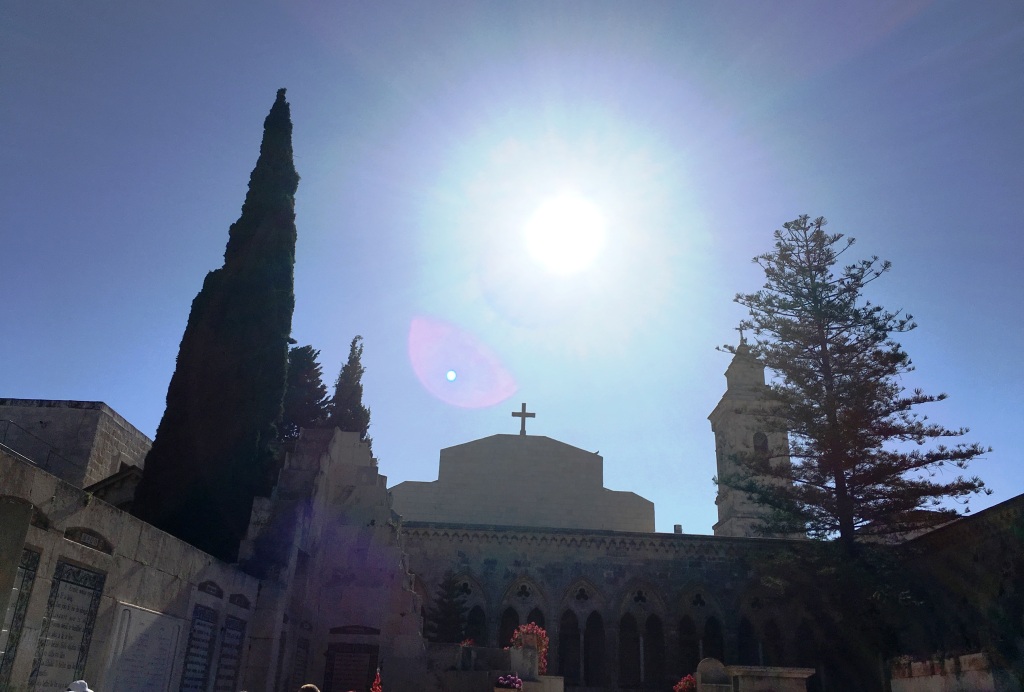
Photo by author, Church of the Our Father outside Jerusalem where Jesus taught his disciples the Lord’s Prayer.
The Lord Is My Chef Breakfast Recipe for the Soul by Fr. Nicanor F. Lalog II
Friday, Feast of St. Thomas, Apostle, 03 July 2020
Ephesians 2:19-22 >><)))*> <*(((><< >><)))*> <*(((><< John 20:24-29
Thank you very much, dearest Jesus, in founding your church upon your Apostles who were all like us: full of flaws and weaknesses, faults and failures, sins and imperfections.
Every time we celebrate their feasts, you remind us of your call to be near you like the Apostles despite our sins and inadequacies, to be sorry and make amends to return to you to be built into a dwelling of the Holy Spirit.
Brothers and sisters: You are no longer strangers and sojourners, but you are fellow citizens with the holy ones and members of the household of God, built upon the foundation of the Apostles and prophets, with Christ Jesus himself as the capstone. Through him the whole structure is held together and grows into a temple sacred in the Lord; in him you are also being built together into a dwelling place of God in the Spirit.
Ephesians 2:19-22
Help us, Lord Jesus, to be like St. Thomas your Apostle who came but doubted, returned and saw you a week later and believed, declaring “My Lord and my God” upon seeing you.
But what did St. Thomas really see that he believed?
Then he said to Thomas, “Put your finger here and see my hands, and bring your hand and out it into my side, and do not be unbelieving, but believe.” Thomas answered and said to him, “My Lord and my God!”
John 20:27
Through St. Thomas, you have blessed us and helped us, dear Jesus to believe in you not in seeing your face but more in seeing and feeling your wounds.
How wonderful, O Lord!
It is not your face but your wounds that enable us to recognize you and believe in you.
We will never see your face in this lifetime, Lord, but every day in our trials and sufferings, in our pains and hurts, in our wounds and woundedness, in our brokenness — there you are most present in us and among us.
Heighten our awareness of your presence, to accept pains and sufferings for your love and mercy so we may deepen our faith in you, following you always in your path of the Cross.
Like St. Thomas, may we follow you closely at your Cross, offering ourselves like you to be broken and shared so that in our wounds and woundedness, others may find healing, most especially you, sweet Jesus. Amen.
Lawiswis ng Salita ni P. Nicanor F. Lalog II, Ika-16 ng Hunyo 2020
Larawan kuha ng may-akda sa Pulilan, Bulacan, Enero 2020.
Minsan aking napanaginipan
matalik kong kaibigan
aming binalikan
mga bukid aming nilakaran
noong aming kabataan;
nagtungo rin kami sa simbahan
doon sa kabayanan
at umistambay pagkaraan
para magkuwentuhan sa Krus na Daan.
Hiniling ko sa kanya
ako'y isama sa kanyang bahay-pahingahan
doon sa bukid ngunit tinanggihan
pinauwi at binilinan tulungan
maraming nangangailangan
lalo na aming mga kaibigan.
Sa aking pagtayo at paghayo
siyang gising ko naman
at natanto
matagal nang yumao
kaibigan ko.
Larawan kuha ng may-akda sa Assumption Sabbath, Baguio City, Enero 2018.
Maliwanag sa akin
kahulugan ng napanaginipan
dahil kung minsan
ako ay nahihirapan at nabibigatan
sa mga pasan-pasan
at tila naman walang ibang maasahan
bukod sa wala ring pakialam
kaya di maiwasan mag-asam
na mawala na lamang
at sumakabilang buhay.
Ngunit hindi iyon ang solusyon
hindi rin kalooban ng Panginoon
na mayroong nilalayon
dapat nating bigyan ng tuon;
mga hirap at pagod
konsumisyon at ilusyon
bahagi ng ating misyon
bigay at dinadalisay ng Panginoon
kaya't magtiyaga, Siya ay ating abangan
at tiyak matatagpuan, Kanyang tutulungan.
“Screenshot” ng palad ng isang mag-aaral sa Dr. Yanga’s Colleges Inc. na nagsulat ng mga aral napakinggan niya kay G. Michael Yanga, Pangulo ng naturang paaralan, 2019.
Madalas tayo ang nagtatanong
sa Panginoon ng direksiyon
ngunit paano kung Siya mismo
sa atin naman ang magtanong
sa kalagitnaan ng ating misyon
"Bakit ka narito?" gaya noong
paghintayin Niya si Elias sa yungib ng Horeb
matapos Siyang mangusap
sa banayad na tinig ng hangin;
kay sarap namnamin at damhin
dahil tuwing tayo tatanungin
nitong Panginoon natin,
ibig sabihin Siya ay ating kapiling!
Ano man iyong gampanin
ngayong quarantine ay pagyamanin
palaging unahin na ang Diyos ay hintayin
dahil tiyak na Siya ay darating
hanggang matapos itong COVID-19
pangako Niyang kaligtasan at kaganapan
Kanyang tutuparin!
The Lord Is My Chef Sunday Music by Fr. Nick F. Lalog II, 14 June 2020
Photo by author, sculpture of Jesus Christ as a homeless man sleeping on a bench at the entrance to the ancient town of Capernaum in Galilee where he grew up. May 2019.
Nice to be back, my dear readers and followers!
We have been unable to post our Sunday music since March due to demands of the ministry during this quarantine period of COVID-19 pandemic. Hoping you are all doing well, getting by each day with music.
Our featured music this Sunday should have been last week when we celebrated the Solemnity of the Holy Trinity as it talks about “l-o-v-e”, the love of God expressed in their community of Persons as the Father, the Son and the Holy Spirit.
But, any talk about love always presupposes “presence” because any one who truly loves is always present to the one he/she loves.
That is why we find Same in Any Language from the motion picture “Elizabethtown” (2005) still appropriate this Sunday of the Solemnity of the Most Holy Body and Blood of Jesus Christ which is an invitation to us all to be present with everyone like God who is always present among us especially in our life’s dark moments.
Written and directed by Cameron Crowe, “Elizabethtown” is a romance-comedy starring Orlando Bloom and Kirsten Dunst. Though it did not measure up to Crowe’s “Almost Famous” released in year 2000, “Elizabethtown” is still a good film despite the negative reviews by most critics.
It is a story about love found in the most strange yet ordinary situation when Orlando was at his lowest point in life after losing his job as a shoe designer that turned out to be a big market flop. As he contemplated suicide, his father died and had to fly to Elizabethtown for the cremation.
It was on that flight he met and befriended the stewardess Kristen whose presence – and love – helped him overcome his darkness in life.
And that is what the song tells us, that love is the same in any language.
Anywhere there is somebody willing to listen or lend a hand, be present to anyone in need, that is love.
Sometime ago I met a Navajo
In a parking lot in Tokyo
He said everything wordlessly
Wonderlust in my eyes, he did see
Oh yea
Oh oh yea
Those postcards I sent to Birmingham
All the way from those windows of Amsterdam
I copped a gram from Dappersan
Just to fall at her man in another jam
Oh yea
Oh oh yea
Its the same in any language
A brother is a brother if there's one thing I know
Its the same in any language
Wherever you go
Oooo yea
It is the same in every language when Jesus said, “I am the living bread that came down from heaven” (John 6:51) because he gives himself as food and drink to nourish us in this life full of pains and sufferings. Jesus came and gave himself to us because of love, to give life to us. And that is what he is also asking of us, especially in this time of corona virus pandemic to share his love with others.
It’s the same in any language, even when put into music….
The Lord Is My Chef Sunday Recipe for the Soul by Fr. Nicanor F. Lalog II
Solemnity of the Most Holy Body and Blood of Jesus Christ, Cycle A, 14 June 2020
Deuteronomy 8:2-3, 14-16 )))+((( 1 Corinthians 10:16-17 )))+((( John 6:51-58
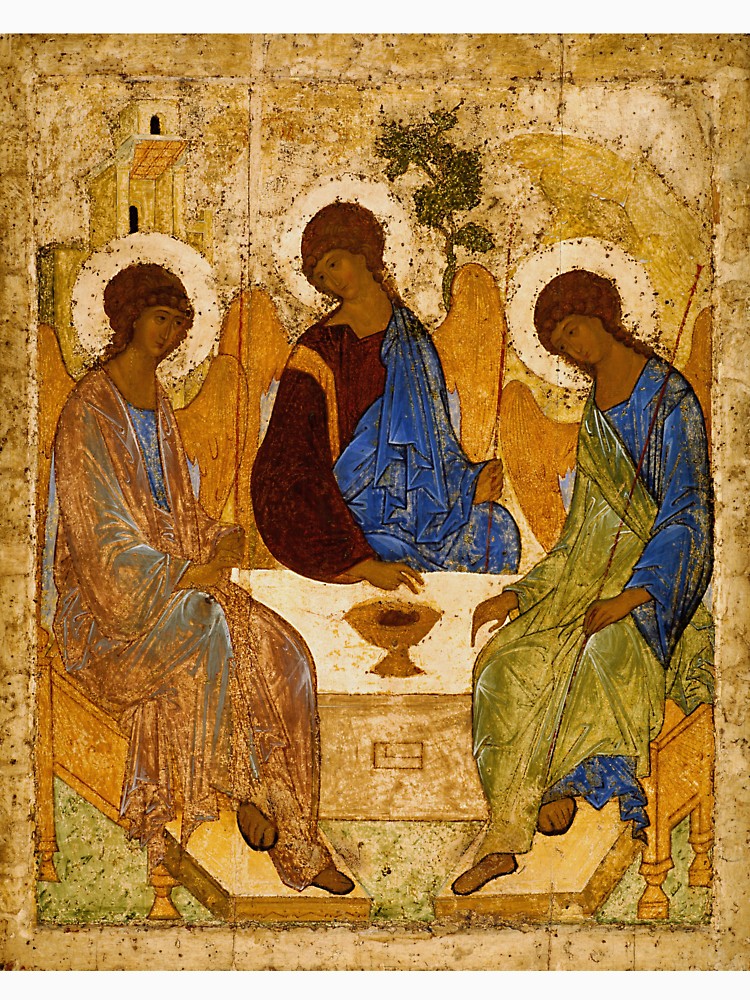
An icon of the Holy Trinity by Russian painter Anton Rublev. Photo from wikipedia.
Above is the beautiful 15th century icon of the Blessed Trinity by Russian painter Anton Rublev. It was based on the Genesis story of God (chapter 18) visiting Abraham at Mamre like angels sharing a meal while in deep conversations, indicating their relationships.
The icon masterfully portrays God as a Trinity of Persons relating with one another in love symbolized by the Eucharistic meal they share.
Most interesting like in most icons is how in this painting the viewer gets involved with the dialogue of the Trinity, thus, becoming the fourth person in the icon present with the Father, the Son and the Holy Spirit like Abraham at Mamre!
I am presenting this icon to you my dear readers and followers to show you the amazing flow of our liturgy these two Sundays as we resumed Ordinary Time on the Monday after Pentecost last month: From the highest truth in our teachings of One God in Three Persons last Sunday, today we have this Solemnity of the Most Holy Body and Blood of Christ to remind us and experience anew that this God we worship and adore is present among us, relating with us in the most personal manner.
Change in name, change of emphasis
Originally known as Corpus Christi or Body of Christ, today’s solemnity was renamed following Vatican II’s reform of the liturgy to give more emphasis on the celebration of the Holy Eucharist that the Preface used before the Consecration is that of Holy Thursday.
Holy Hour in our Parish, Sacred Heart Novena 2020
In the old tradition, focus was more on the Blessed Sacrament – of Jesus Christ reserved in the tabernacle and presented to the faithful for adoration as the Body of Christ, that is, Corpus Christi.
However, when Vatican II changed its name into the “Solemnity of the Most Holy Body and Blood of Jesus Christ”, there was something deeper than the change of name.
The new name challenges us to see the deeper reality of the Holy Eucharist: more than spending time praying before the Blessed Sacrament – though it is good – we are demanded as followers of Jesus Christ to be present like him with others.
Without disregarding the importance of the Blessed Sacrament that have seen a renewed interest among people in this time of corona while churches are closed, Vatican II’s shift in emphasis dares to challenge us disciples of Christ to emulate him in allowing ourselves to be broken for others, to be poured out, offered and shared especially in this time of crisis.
It is in our being broken like the Body of Christ, and poured out like his Blood do we really live the paschal mystery.
Jesus said to the Jewish crowds: “I am the living bread that came down from heaven; whoever eats this bread will live forever; and the bread that I will give is my flesh for the life of the world.” The Jews quarreled among themselves, saying, “How can this man give us his flesh to eat?” Jesus said to them, “Amen, amen, I say to you, unless you eat the flesh of the Son of Man and drink his blood, you do not have life within you.”
Our gospel today is not from the Last Supper as we might expect; instead, it is taken from the “Bread of Life discourse” found only in St. John’s gospel which took place after Jesus had fed more than 5000 people in the wilderness from just five loaves of bread and two pieces of fish.
It was a very decisive moment in the ministry of Jesus as far as St. John was concerned; in fact, he refused to call the feeding of 5000 as a “miracle” but as a “sign” that Jesus is the Christ, the awaited Messiah.
Here, we have Jesus speaking clearly, no matter how difficult it may be for his listeners and even for us.
And we wonder, why he spoke that way?
Even today in the Holy Mass, considering the mixed crowd we have in every celebration, the priest is obliged to speak clearly and distinctly the words of Christ at the Last Supper similar to his bread of life discourse, “Take this, all of you and eat it. This is my Body which will be given up for you.”
Jesus always speaks the truth, he always tells us what is true and he never misleads us.
Unlike us when we say something and mean another thing. We always have to speak in ways that has to be deciphered because we really do not mean what we say. Or we are afraid of saying something else because we prefer to please people than stand by what is true.
But not the Lord! From that day until now, Jesus says the same thing and means always the same, that he is always with us, in us, and among us.
And he has proven then and now, time and time again most especially in our personal lives, that indeed Jesus was sent down from heaven as the “living bread” because he is the “life of the world”.
More than the bread from heaven called manna sent by God to the Israelites during their journey in the wilderness into the Promised Land (first reading), Jesus is the bread who sustains us in our new “exodus” and journey into the Father’s house, into fulfillment.
Photo by Mr. Raffy Tima of GMA-7 News of the plight of stranded people opting to wait at an underpass nearest the airport in their desire to get home
Life an Exodus with Jesus leading us
This pandemic and life under quarantine is an exodus in itself calling us to go back to God, to rely solely in him for he alone can save us. That is why he gave us his only Son, Jesus Christ who in turn gave himself totally, Body and Blood to sustain us in this journey or exodus.
Every exodus is always painful but filled with grace because God is most present with us.
That is why we join Masses on television or the internet while others dare to go to churches for the actual celebration of Mass to receive Holy Communion.
We are convinced that Jesus is sustaining us, nourishing us, raising us, helping us, inspiring us in this time of crisis.
And that is why the more we need to pray and even celebrate the Mass because the more we need Jesus Christ as food and drink in this difficult journey.
We can all feel the stress and pressures of the difficulties and uncertainties of this time. Making things worst than the financial and physical sufferings we all go through are the psychological burdens we silently bear that unfortunately others do not seem to think of or even realize.
Mang Dodong who was held for 30 days for not having a quarantine pass while buying fish in Navotas. Photo from GMA News TV.
How sad when others think only of themselves of getting tired, of being hurt, of being misunderstood that they do not care at all with the feelings and well being of those around them like our callous politicians and officials in government and the police.
Sometimes, watching the news can be so depressing when we see all the troubles and sufferings our brothers and sisters have to go through like those stranded in Metro Manila, those separated from their loved ones, those subjected to discrimination because of the COVID-19, those living alone, those who have lost family members and friends, those who have lost many opportunities in life.
But at the same time, the more we are challenged by these sufferings of our people to be like Jesus, to be the living bread, to share with them Jesus who is our very life.
Let us heed the call of St. Paul in the second reading to be one with our brothers and sisters in Jesus Christ in their brokenness, in their sufferings by being present to them in love and kindness, in being more understanding.
We are the Body and Blood of Jesus Christ, his very presence in this world that continues to disregard him, that until now tries to live without him.
May we not fall into that temptation and sin that is largely the reason behind this pandemic: modern man has forgotten that no matter what is our situation in life, we remain poor before God who alone can fulfill our deepest desires and longings.
Despite the many difficulties we face especially with the continued closure of houses of worship, let us continue to work and find creative means in sharing Jesus Christ with others, in coming to him and receiving him in the Holy Communion.
Only Jesus can help us through this pandemic.
In fact, he was the first to die on the Cross by giving us his Body and Blood so that we may live and share his gift of life with others.
A blessed week ahead of you!
Photo by our parish choir member Gelo Nicolas Carpio, our Church at sunset last Sunday.
The Lord Is My Chef Breakfast Recipe for the Soul by Fr. Nicanor F. Lalog II
Friday, Week X in Ordinary Time, Year II, 12 June 2020
1 Kings 19:9, 11-16 ><)))*> ><)))*> ><)))*> ><)))*> Matthew 5:27-32
Photo by author, sunrise at Camp John Hay, Baguio City, November 2018.
At the mountain of the God, Horeb, Elijah came to a cave, where he took shelter… After the fire, there was a tiny whispering sound. When he heard this, Elijah hid his face in his cloak and went and stood at the entrance of the cave. A voice said to him, “Elijah, why are you here?” He replied, “I have been most zealous for the Lord , the God of hosts. But the children of Israel have forsaken your covenant, torn down your altars, and put your prophets to the sword. I alone am left, and they seek to take my life.”
1 Kings 19:9, 12b-14
The rainy season has started, Lord, and we have covered almost half of the year, making it through more than two months of quarantine period and here we are, before you… tired and exhausted, a bit lost, and frankly, your question to Elijah echoes within, stirring our inmost being.
Why are you here?
It is both a mystery and a gift why we are here.
Some of us have lost family and friends these past six months, some to the dreaded disease of COVID-19. Many of us have lost money and time due to the pandemic. This early, 2020 is practically gone for many of us.
Many of us are just awaiting for you, to your tiny voice to tell us what is next.
That is why we are here, Lord.
Like Elijah, we await your coming.
Unlike before when we await dates and occasions, now, we await you, O God for you alone are sure and guaranteed in coming.
Photo from NCCA.
On this day, Lord, we also celebrate our Independence Day that has become more of a festivity than a reality. Forgive us for wasting, for throwing away our country to undeserving people who have all been puppets of foreign powers with same personal interests.
Yet, one reason why we are here is also because we believe we can change our country for the best.
Help us, O God, by cleansing our hearts, purifying our desires and motivations so that we may be more faithful to you.
Quiet Storm by Fr. Nicanor F. Lalog II, 11 June 2020
Painting by Raphael (1515) of St. Paul preaching at Areopagus in Athens, Greece. From wikipedia.
With houses of worship still closed despite the opening of most business establishments, here is the final installment of reflection in our series on how the life and teachings of St. Paul may help us in our ministry during this time of COVID-19 amid a perceived government “persecution” of the Catholic Church.
There is no doubt that like during his time, St. Paul would be using modern means of communication to preach the Gospel of Jesus Christ especially in this most trying time of our history, using the internet as the new “Areopagus” with social media in particular.
Then Paul stood up at the Areopagus and said: “You Athenians, I see that in every respect you are very religious. For as I walked around looking carefully at your shrines, I even discovered an altar inscribed, ‘To An Unknown God.’ What therefore you unknowingly worship, I proclaim to you. The God who made the world and all that is in it…”
Acts of the Apostles 17:22-24
Social Communication
Perhaps before we go into our reflection, it is imperative especially for bishops and priests to be reminded anew of some important terms in communications; this is more than about names or nomenclature because for as long these terms of communications are not clear with us, all our evangelization efforts would be askewed as it is now showing with an explosion of online Masses and other religious celebrations.
First priority is to stop using the words “mass media” and even “social media” in our church communications because these are very limited in scope and context.
It is important to note that in the 2000-year history of the Church, it was only in Vatican II that we have issued a conciliar document on communication wherein the Fathers also introduced the term social communication as a new name for communications in the Church.
How sad that there are still bishops and priests using the terms “mass media” or “media” and lately “social media” when more than 50 years ago the Church through the inspiration of the Holy Spirit coined social communication to refer to “the communication of and in human society including all the ways and means used in this process” (Fr. Franz-Josef Eilers, svd, 2009 BISCOM-FABC, Bangkok).
Social communication is a very prophetic term because it is theological and rooted in God who is communication himself, sharing with us his power to communicate so we may also communicate with him and with others. Most of all, God continues to communicate with us and from that lies our task as a Church to communicate him to the world.
This is the reason why we have to keep on using this term “social communication” in our Church communications to keep us Christocentric, meaning, every communication in the Church and by the Church has Jesus as Message.
And that is essentially the kind of communication process followed by St. Paul the Apostle. In fact, reviewing his letters and the various accounts about him would show us that early, this great apostle has been into social communication, specifically “pastoral communication” that is an emerging field in Church communications whose realities have long been espoused by St. Paul himself.
Pastoral Communication
Pastoral communication is anchored on Jesus Christ, the “Good Shepherd” who sets himself as the norm and standard of our Church communications.
Jesus said, “I am the good shepherd. A good shepherd lays down his life for the sheep… I am the good shepherd, and I know mine and mine know me, just as the Father knows me and I know the Father; and I will lay down my life for the sheep.”
St. Paul has always been very clear with this in all his communications that towards the end of his life, he had beautifully written his disciple this wonderful piece:
Beloved: I charge you in the presence of God and of Christ Jesus, who will judge the living and the dead, and by his appearing and his kingly power: proclaim the word; per persistent whether it is convenient or inconvenient… For I am already being poured out like a libation, and the time of my departure is at hand. I have competed well; I have finished the race; I have kept the faith.”
2 Timothy 4:1-2, 6-7
Communicating Jesus Christ is always about self-sacrifice, about giving of one’s self like our Lord and Master. In whatever form of communication we use, it is always a call to “enflesh” the Word. In short, communication is spirituality that indicates the kind of relationship we have with God. How we reflect that relationship with God in words and in deeds, in our clothings and everything is communication.
Like St. Paul, he was able to offer himself wholly to God as reflected in his writings and preaching because he was more concerned with the needs of the flock and not with his own needs.
And this is where I sadly feel our bishops sorely absent and silent except for just two, Lingayen-Dagupan’s Archbishop Soc Villegas and Manila’s Apostolic Administrator Bishop Broderick Pabillo.
Where are the other bishops?
Business establishments are almost all opening, even dine-in restaurants and yet, until now for no valid reason, the government continues to ban religious mass gatherings except for maximum of ten persons in areas under GCQ.
When are the bishops and priests going to speak out against this and open the churches so people may be spiritually nourished?
What an auspicious time for the clergy and hierarchy to speak against this continued closure of churches as we are on the eve of our 500th year of Christianization when under serious persecution. Has the Church grown timid in the face of an unfriendly government?
Worst are some priests who seem to follow more the secular world in their digital presence but empty of Jesus Christ, concerned only with popularity measured in number of likes and shares as well as followers.
Many of us have become more of personalities than as priests and ministers, unconsciously trying to be more popular than the Lord himself that we no longer have sacrifice of the Mass but a variety show, complete with sound effects and digital characters, some wit dance numbers and raffles!
When God is displaced, then our love is misplaced, then, we lose all communications too.
Communication is more than the expression of ideas and the indication of emotion. At its most profound level it is the giving of self in love. Christ’s communication was, in fact, spirit and life. In the institution of the Holy Eucharist, Christ gave us the most perfect and most intimate form of communion between God and man possible in this life, and, out of this, the deepest possible unity between men. Further, Christ communicated to us His life-giving Spirit, who brings all men together in unity. The Church is Christ’s Mystical Body, the hidden completion of Christ Glorified who “fills the whole creation”. As a result we move, within the Church and with the help of the word and the sacraments, towards the hope of that last unity where “God will be all in all”.
Communio et Progressio # 11
From Google.
Problem with online Masses and religion
Every communication presupposes presence. That is essentially the meaning of God’s “I AM” in the burning bush to Moses and the “I AM” declarations by Jesus in the New Testament, especially in the fourth gospel where we find him saying “I am the good shepherd”.
Even St. Paul in his letters always began with his standard salutations like “I, Paul…” to indicate his very presence among his “parishioners”.
However, in the digital media, presence is not so essential and can even be faked both ways, either by being “taped” or “replayed” by viewers.
And there lies the great danger of online Masses and other celebrations: whether we like or not, online religious celebrations give the impressions on people that God is a “consummable”, a product or a show that can be had when most convenient to us like video on demand or the streamed shows of Netflix.
That is why we have to open churches soon to stop these online Masses except for those in the Cathedrals and in existence long before COVID-19 that cater to the needs of the sick and elderly in their homes.
Pope Francis has always been clear with this, stressing that these online Masses and religious celebrations are very temporary due to the extraordinary situation brought about by the pandemic.
From Pinterest/Aleteia.
Imagine the problem at Corinth that reached St. Paul’s attention, prompting him to write them another letter to reprimand them but at the same time to encourage them to mend their ways. It was a problem of abusing the Eucharist when St. Paul was no longer with them.
It is the same thing happening in many of our online Masses that have become variety shows to impress viewers. Long before we got into this lockdown, many priests have crossed the boundaries without knowing they have made fools of themselves as they rely more on “likes”, on being viral or trending, dishing out shallow reflections covered with cute song numbers, litany of greetings on air, and so many other inanities that Jesus is lost in the process.
Unfortunately, many laypeople are now also having their own digital preaching or evangelization with their own “productions” taking their cue from their showbiz pastors.
If St. Paul were with us today, he would surely write again to express his dismay at the people seeking more of entertainment than having Jesus Christ.
“But I am afraid that, as the serpent deceived Eve by his cunning, your thoughts may be corrupted from a sincere and pure commitment to Christ. For I think that I am not in any way inferior to these “superapostles”. Even if I am untrained in speaking, I am not so in knowledge; in every way we have made this plain to you in all things.
2 Corinthians 11:3, 5-6
Church communication is Jesus Christ and his Cross as St. Paul reminds us in his writings (1Cor.15:1-3); it is never about techniques or gadgets.
Though we need to be present online, the cutting edge of real communication remains in pastoral communication that means being present with others who need us most including those without internet access, witnessing to the values of Jesus in relating with people, bringing people together into a communion and helping them find answers in their search for meaning and directions in life, in making the right choices and in living their convictions and faith.
What we are speaking of are real people, persons and lives that matter so much, more precious than goods and commodities.
Let us not fall into the trappings of this “media revolution” that made one futurologist describe our contemporary society as
Technologically Intoxicated Zone defined by the complicated and often paradoxical relationship between technology and our search for meaning.
John Naisbitt
According to Naisbitt and other experts, while people prefer quick fixes online of everything, from religion to nutrition, while at the same time fearing and worshipping technology that had blurred the distinction of what is real and fake, the more they live their lives distanced and distracted — something we are already seeing even before the coming of social distancing!
To communicate in the Church at this time is to imitate St. Paul: be present for and with the people wherein we help them find their way to God by being their companions and “co-journeyers” in life, witnessing to them the Cross of Jesus Christ with our very lives as an offering and sacrifice, not as a commodity or a show to be “liked” on Facebook and Instagram.
And, lest we forget, it is God whom people must follow and worship, not us.
So be imitators of God, as beloved children, and live in love, as Christ loved us and handed himself over for us as a sacrificial offering to God for a fragrant aroma.
Ephesians 5:1-2
Pope Francis praying before an empty St. Peter’s Square last March 27, 2020 at the height of COVID-19 in Italy.
The Lord Is My Chef Sunday Recipe for the Soul by Fr. Nicanor F. Lalog II
Solemnity of the Most Holy Trinity, Cycle A, 07 June 2020
Exodus 34:4-6, 8-9 ><)))*> 2 Corinthians 13:11-13 ><)))*> John 3:16-18
Our empty church at the height of the lockdown in March-April 2020.
Two young ladies attended our 4:00 PM Mass last Sunday. Just before the Lamb of God, the other lady collapsed and fell on the floor. Thank God she suffered no injury; later after the Mass I checked on her to see if she was sick or maybe hungry that caused her to collapse.
She said she could find no other reason for feeling dizzy and later collapsing except that they have walked two kilometers from their home under the intense heat of the sun that afternoon to celebrate Mass in the parish. She added that sometimes they also ran so as not to be late.
Then, they told me something that really touched me and broke my heart: “sawa na po kami magsimba sa Facebook Live kaya po kami nagpunta sa Parokya para magsimba” (we are fed up joining Facebook Live Masses that we decided to celebrate Mass at the parish).
As I prayed this week, reflecting on this Solemnity of the Holy Trinity, that story from my two parishioners kept on echoing in my head because that is the reality of God in the Holy Trinity: a God who loves because he keeps on giving, without taking anything in return.
The reality of God in the Holy Trinity
Beginning this Sunday as we resumed Ordinary Time in the liturgy, we are celebrating three solemnities successively: Trinity today, Body and Blood of Christ or Corpus Christi next Sunday and Friday after that, the Most Sacred Heart of Jesus.
In a sense, these three solemnities remind us that God is with us always; hence, on this Sunday as we celebrate his being God in three Persons, he is also telling us to “get real” with him especially in this age of virtual realities and media manipulations.
Getting real with God is like my two parishioners who walked two kilometers under the sun just to celebrate Mass in the parish because they were fed up with online Masses that cannot capture entirely the experience of God in an actual Mass.
Photo by Ezra Acayan/Getty Images, Baclaran Church, 09 February 2020.
When we come to think of it, God does not need to prove himself to us. He simply shows us himself. That is why those two parishioners were willing to sacrifice walking two kilometers because they must have received something, must have experienced something from this God who is so personal, relating and so real that they wanted to experience him personally in the actual Mass.
The same must be true with us all who miss going to actual Masses, who continue to pray at home.
Why do we pray, why do we praise God, why do we ask him for mercy and forgiveness for our sins, why do we ask him for so many things, and the list can go on with one essential question: why do we come to God?
Is it not because he comes first to us? He makes himself known to us by giving himself to us, showering us with many blessings both material and spiritual, surprising us with so many wonderful things and sights like sunset and nature that we praise him? Most of all, he is so kind and loving that we feel sorry when we are mean with others, when we choose to do wrong, when we are not that good like him?
God so loved the world that he gave his only Son, so that everyone who believes in him might not perish but might have eternal life.
John 3:16
That is the essence of God, a personal and relating God who gives everything because he loves us. Only God can adequately “speak” of him to show us he exists in ways so marvelous we cannot even dissect yet jump into conclusion right away that “it is the Lord!” like Peter in Lake Tiberias.
When we speak of a Trinity, of Persons, we speak of relationships that presuppose giving and loving. That is God in himself that he poured out this love in him by first creating everything (Father), then giving us his Son to save us after we have turned away from him, and to ensure that we never get lost again and find our way back to him, gave us the Holy Spirit as Advocate and Counselor.
Here we find God is more than a concept or an abstract and structure in our minds that we have construed or created. He has always been there. He has no need of proving himself to us, unlike us who always have to prove ourselves with others.
God is the giver and the gift himself because he is perfect and complete unlike us who can only give gifts and things as representations of our very selves.
And there lies more the mystery of the Holy Trinity — in his being both the gift and the giver, God remains perfect and one even if he keeps on giving and giving without taking anything for himself, a mystery he shares with us by asking us to be like him in giving so we would remain full like him.
Photo by Mr. Jim Marpa at Carigara, Leyte, 2019.
Something’s got to give
This mystery of the Trinity, of a relationship of persons that only gives yet never depleted or exhausted reveals to us what we must can and must always do as created image of the loving God.
Time and time again we have proven in history and in ourselves that it is only in giving when we truly receive, when we are truly human, truly loving.
This pandemic is telling us in no uncertain ways that our lifestyle of having and gaining has led us to more wanting and more wasting, more destruction and more separation.
God is telling us in the midst of this pandemic that we get real — learn to give and forgive, to let go and let God!
We are all linked together as one, a community of beloved, saved and forgiven though imperfect and sinful. On Mount Sinai Moses saw for himself this God giving everything despite his people being so stubborn, that he asked God to accompany them in their journey.
Since then God has always accompanied us in our journey in life though we always turn away from him, wandering off in the wilderness, following other paths that we end up more lost, more tired.
What are we willing to give up in this life to experience fullness in God and with others?
Getting real is giving up ourselves so we may be filled by God so we may experience life’s fullness in him and in our relationships with others and even with nature. Amen.
Our closed church but open hearts willing to give, willing to sacrifice will enable us to go through this crisis, more complete, more fulfilled.
The Lord Is My Chef Sunday Recipe, Easter Week VI-A, 17 May 2020
Acts of the Apostle 8:5-8, 14-17 ><)))*> 1 Peter 3:15-18 ><)))*> John 14:15-21
Nuns bringing relief goods to a remote village. Photo from Facebook.
We are about to end two great seasons in our liturgy and still, here we are in our enhanced community quarantine due to COVID-19. Prospects remain dim as experts say the corona virus may never be totally eradicated despite the discovery of vaccines and medicines later this year.
It is in this background we find our readings this Sunday so reassuring, reminding us of how so often in history that tragic or painful events in the lives of individuals and societies have led to happy endings.
In our first reading, we have seen how the persecution of the Church at Jerusalem so tragic but at the same time also helped spread Christianity so fast led by the Holy Spirit promised by Jesus Christ before he was betrayed and arrested on that Holy Thursday evening.
All this is possible if we believe in Jesus, if we love Jesus.
Jesus said to his disciples: “If you love me, you will keep my commandments. And I will ask the Father, and he will give you another Advocate to be with you always, the Spirit of truth, which the world cannot accept, because it neither sees nor knows it. But you know it, because it remains with you, and will be in you. I will not leave you orphans; I will come to you.”
John 14:15-18
Photo by author, flowers at Church of Gallicantu near Jerusalem, May 2019.
Intimacy with Jesus Christ in the Holy Spirit
For the first time, Jesus promised during their Last Supper the sending of the Holy Spirit when he fulfills his mission.
In most translations, the Holy Spirit is referred to as Advocate although some prefer the transliteration Paraclete from its original Greek Parakletos to truly capture its full meaning or context.
Only St. John used the word Parakletos to denote the Holy Spirit. In its Hellenistic context, Parakletos had come to be known as Advocate like a lawyer or a friend who speaks on behalf of the “accused” like Jesus in a hostile world (Jn.16:7-11).
However, St. John also used parakletos in different contexts like in our gospel today.
See how before introducing to us the sending of the Holy Spirit, Jesus speaks more of a grand instruction – in fact, a reality, a truth in the life of his every disciple: “If you love me, you will keep my commandments” (Jn.14:15).
Without specifying any commandments to keep, Jesus further explained that “Whoever has my commandments and observes them is the one who loves me” (Jn.14:21). He would be speaking of this like a refrain four more times later to stress that loving Jesus is keeping his commandments.
It is a very difficult task to fulfill and most often, more difficult to understand or interpret especially when we are in real life-situations like loving an arrogant president or loving officials who break the rules of quarantine!
This is so because Jesus himself is the law, the commandments which is his very person; therefore, to love him is to be like him and that is always keeping his commandments of love.
And that is why Jesus made sure to inscribe this lesson and reality into his disciples’ memory and hearts during their last supper by promising the Holy Spirit he called as Parakletos who would be acting as his Advocate, Counsellor, and Comforter when he returns to the Father.
It is the Holy Spirit who leads us now into an intimacy with Christ that we are able to love Jesus, love like Jesus, and love in Jesus. This is the same Holy Spirit who binds the Three Persons of the Trinity in love who also makes us one with God and with others.
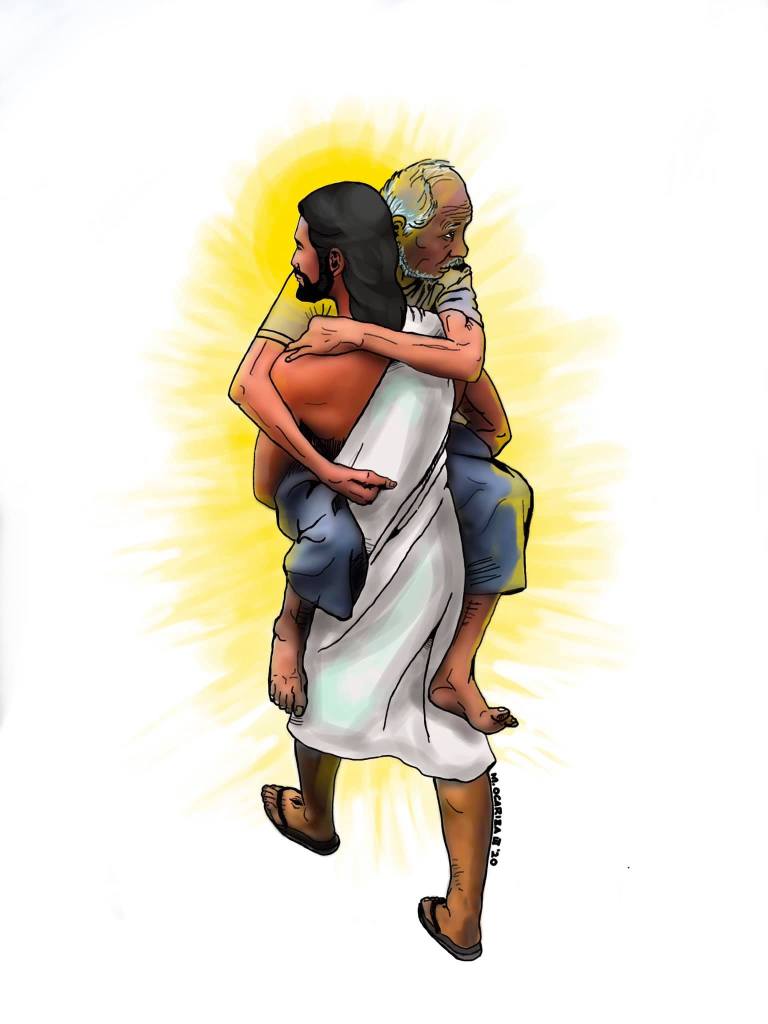
Photo from Facebook post by Ms. Marivic Tribiana, 17 April 2020 fire in Tondo area.
Making Jesus present in our love
We make Jesus most present when we love because when we love, everything changes for the best, even the most difficult and worst situations in life.
Albert Camus rightly said when he wrote in his 1947 novel The Plague now being reread due to the corona virus, that “A loveless world is a dead world.”
Without love, we would have gone extinct by now.
Because of love, every tragedy, every suffering and problem we go through leads to happy ending primarily because we discover something, someone beyond far more important than any situation or plight we may be into.
Artwork by Fr. Marc Ocariza upon seeing the FB post by Ms. Marivic Tribiana above on the eve of Divine Mercy Sunday 2020.
Most of all, love has a distinctive characteristic that moves the lover to become like the beloved. This is the reason why we who love strive harder, persevere and forge into every obstacle and fight until we are one with our beloved!
And who is ultimately our very love?
God.
The God revealed to us by Jesus Christ his Son who became human like us to be one with us in everything including death except sin so that we become like him – divine – in his Resurrection.
Jesus Christ whom we “sanctify as Lord in our hearts” (1Pt.3:15) is the one we imitate and follow, the one we see and, most of all, the only one we (must) share when we love, when we serve especially in this time of the corona pandemic.
Sometimes, it is still difficult to believe how these pandemic and quarantine are happening to us when all of a sudden here comes typhoon Ambo that wreaked a path of destruction in the Visayas and Bicolandia the other day, making us wonder what is happening in the world right now?
Making things worst that have stressed us all so much is our government at all levels lacking preparations, with some officials into alleged corruptions while the enforcers of the laws are the ones breaking all the rules of quarantine!
We just keep on hoping things would get better by starting right at our own end.
Sometimes it can be funny although painful when some people forget us or take us for granted, thinking we are fine or doing great without any hint of the sufferings within.
But the grace is always there because Jesus is within each one of us who believes in him and tries hard to keep his commandments.
“In a little while the world will no longer see me, but you will see me, because I live and you will live. On that day you will realize that I am in my Father and you are in me and I in you.”
John 14:19-20
We just have to do our part, to keep on believing in Jesus, loving Jesus, and most of all, keeping his commandments because Jesus is the “explanation to anyone who asks us for a reason for our hope” (1Pt.3:15).
This does not mean the world is lacking the Lord’s presence.
He has not left us indeed and sooner or later, we shall see how he, the God of history, will direct everything according to his greater plan for us.
Today’s gospel reminds us of his assurance to be with us always in the Holy Spirit.
It is now our turn to pick up the pieces and make him more felt, especially in comforting those affected severely by the many storms that hit us in this time of the corona virus.
Have a blessed Sunday and stay safe! Amen.
Photo from CBCPNews of the debris left by Typhoon Ambo in Arteche, Eastern Samar, 14 May 2020.

















 lordmychef.com