Lawiswis ng Salita ni P. Nicanor F. Lalog IIPaggunita sa Pagpapakasakit ni San Juan Bautista, Ika-29 ng Agosto 2020
Ama naming mahabagin,
ngayong ginugunita namin
pagpapakasakit ni San Juan Bautista,
Inyo sanang dinggin aming panalangin
para sa maraming kapatid namin na ginigipit, iniipit;
ang iba sa kanila ay nakapiit
marami ang lugmok sa pait at sakit na sinapit
mula sa mga makabagong Herodes at Herodias
na prinsipyo at pagkatao, ipinagpalit sa ginto.
Inyong patatagin paninindigan sa katotohanan
katulad ni San Juan Bautista
upang ipagpatuloy pakikipaglaban
nasaid man ang kabuhayan
at tanging pinanghahawakan
dangal ng katauhan.
Ikaw lamang Panginoon
ang nakaaalam ng higit na mainam
kami ay Iyong turuan at tulungan
katulad ni San Juan loob mo ay masundan
kami ma'y maging palatandaan
ng Iyong kapanatilihan sa gitna ng mga
pag-uusig at kahirapan.
Amen.
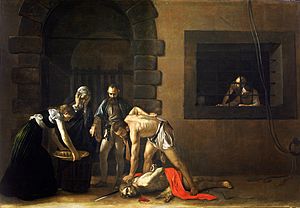
*Mga larawan sa itaas: una ang painting ni Caravaggio ng pagpupugot sa ulo ni Juan Bautista mula sa wikimedia.org; biktima ng tokhang mula sa Philippine Daily Inquirer; umiiyak na empleyado ng ABS-CBN mula sa Reuters.org; at mga locally stranded individuals sa ilalim ng flyover malapit sa NAIA kuha ni G. Raffy Tima ng GMA-7 News.
Praise and glory to you, O Lord, and thank you very much for the gift of vocation to the priesthood.
Thank you very much for a wonderful patron Saint for us all whose feast we are celebrating today, St. John Baptiste Marie Vianney, the Curé of Ars in France.
How wonderful that we celebrate his feast this year on the first day of our return to Modified Enhanced Community Quarantine (MECQ) when public Masses are suspended in our province and other places due to the alarming spread of COVID-19 virus.
Yes, it is wonderful. Beautiful.
At first during last summer’s lockdown when we celebrated Mass without people, I felt sad; but today, I feel happy because I am totally yours, Lord Jesus. Somehow, this pandemic is teaching us priests most specially that life is a constant return to quarantine, to be alone with you always, dear Jesus!
Most specially, to remind us priests that the Holy Mass is never a show, never about us but always YOU, Jesus.
Like the prophet Jeremiah in the first reading, every priest like St. John Vianney is a reminder to the people that in life, there are always pains and sufferings. And most of the time, it is because of our sins and wrong choices in life, of turning away from God.
However, these sufferings like our pandemic and St. John’s French Revolution are all temporary.
Like Jeremiah, we priests are most of all reminders of God’s permanent love and mercy to everyone as exemplified by St. John in his life and ministry of hearing confessions for long hours each day!
Thus says the Lord: See! I will restore the tents of Jacob, his dwellings I will pity; city shall be rebuilt upon the hill, and palace restored as it was. From them will resound songs of praise, the laughter of happy men. I will make them not few, but many; they will not be tiny, for I will glorify them.
Jeremiah 30:18-19
As I reviewed anew the life of your humble and holy pastor St. John Vianney, I realized how our present situation is similar with his time: a period of sufferings after the French Revolution when priests were looked down upon, even maligned and hunted.
Yet, St. John persevered in his vocation, reminding us “The priesthood is the love of the heart of Jesus.”
May we your priests be reminders of your love and mercy, courage and faith in the face of adversaries like when you boldly spoke against the Pharisees and scribes, reminding your disciples…
Let them alone; they are blind guides of the blind. If a blind man leads a blind man, both will fall into the pit.
Matthew 15:14
St. John Baptiste Marie Vianney, pray for us your brother priests! Amen.
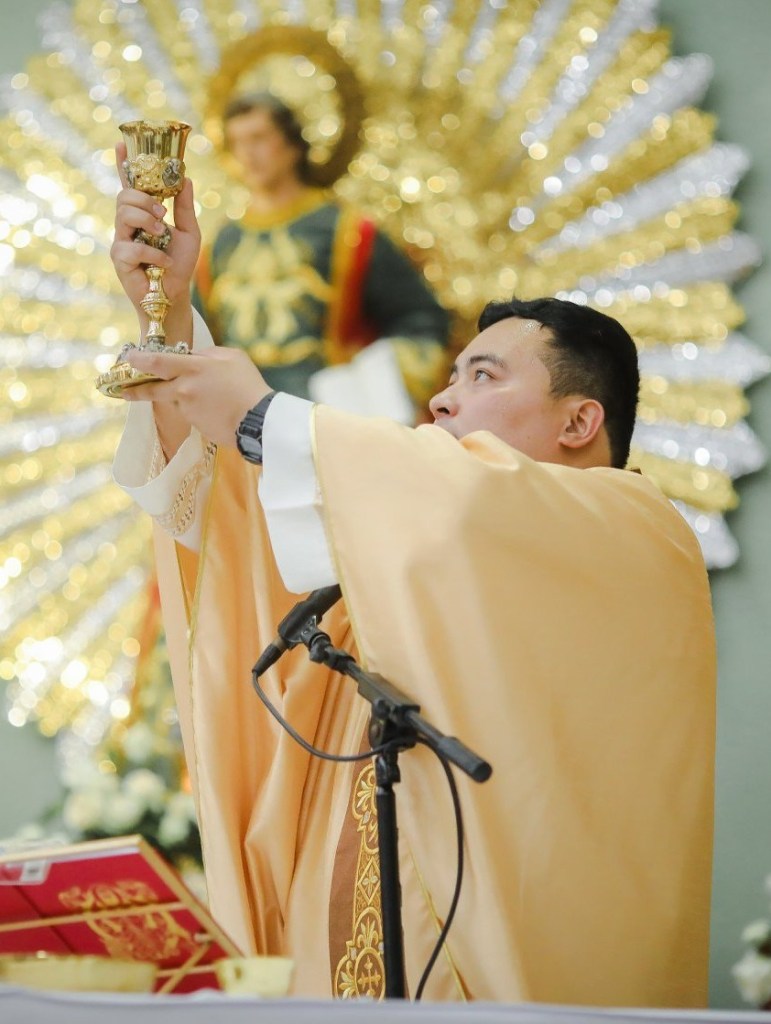
Photo from Primera Missa Solemne by Fr. RA Valmadrid, December 2019.
The Lord Is My Chef Sunday Recipe for the Soul by Fr. Nicanor F. Lalog II
Week XVIII, Cycle A in Ordinary Time, 02 August 2020
Isaiah 55:1-3 >><}}}*> Romans 8:35, 37-39 >><}}}*> Matthew 14:13-21
Remember our reflection last Sunday? Of how parables teach us that “less is always more” because to have the kingdom of God – Jesus Christ himself – we have to learn to appreciate the little things in life?
Beginning this Sunday until August 16, our gospels will start telling us who is Jesus Christ by showing us his powers and abilities that are exactly opposite the way we see and understand them. This new series of stories are so relevant to us in this time of pandemic, giving us wonderful insights into God’s ways of responding to our human situations.
St. Matthew now leads us with Jesus to the wilderness after teaching us in parables to experience his power in transforming us like the five loaves and two fish to feed more than five thousand people.
Multi-layered story of the multiplication of bread
All four evangelists have recorded this story of Jesus Christ’s multiplication of the loaves of bread with their particular focus and stress, showing us that it truly happened and was a major event in the Lord’s ministry.
Very unique with St. Matthew’s version of this miracle story – which has not one but two! – is his economy of words in narrating it like a straight news as if it were a developing story or a “breaking news” unfolding before us, calling us to follow its updates and details due to its multi-layered meanings.
When Jesus heard of John the Baptist, he withdrew in a boat to a deserted place by himself. The crowds heard of this and followed him on foot from their towns. When he disembarked and saw the vast crowd, his heart was moved with pity for them, and he cured their sick. When it was evening, the disciples approached him and said, “This is a deserted place and it is already late; dismiss the crowds so they can go to the villages and buy food for themselves.” Jesus said to them, “There is no need for them to go away; give them some food yourselves.” But they said to him, “Five loaves and two fish are all we have here.” Then he said, “Bring them here to me,” and he ordered the crowds to sit down on the grass. Taking the five loaves and the two fish, and looking up to heaven, he said the blessing, broke the loaves, and gave them to the disciples, who in turn gave them to the crowds. They all ate and were satisfied, and they picked up the fragments left over — twelve wicker baskets full. Those who ate were about five thousand men, not counting women and children.
Matthew 14:13-21
Photo from iStock/Studio-Annika.
The consolation of Jesus.
Our situation in this time of the corona pandemic is so similar with that of Jesus. With the increasing number of COVID-19 cases, it has finally hit us hard, so close to home with news of those we know getting infected and worst, dying from this disease.
Like Jesus upon hearing the death of John the Baptist, we are all saddened that we wish to withdraw away from everyone.
We want to mourn but there are more people in need of our presence and help in this time of pandemic like the countless medical frontliners and health workers who must be so tired – even sick, physically and emotionally – by now with the growing number of COVID-19 patients and yet have chosen to remain in their posts.
And there are still the other casualties of this pandemic like those who have lost their jobs, those evicted from their rented apartments, those stranded and separated from their loved ones, those begging for food, and those afflicted with other sickness going through dialysis and physical therapy.
Jesus knows so well the “wilderness” we are all going through and he is right here with us, one with us in our sufferings, in our fears and anxieties, and in our exhaustion.
To be one with us is consolation, from the Latin “con” or with + “solare” or alone, to be one with somebody feeling alone.
Jesus did not remove our pains and sufferings, even our death; he joined us to be one with us in these that he can call us to “Come to me, all you who labor and are burdened, and I will give your rest. Take my yoke upon you… For my yoke is easy and my burden light” (Mt.11:28-30, 14th Sunday, 05 Jul 2020).
Compassion of Jesus.
Still with Christ’s reaction of being “moved with pity” at the sight of the crowds who have followed him to the wilderness, we find something more deeper with his being one with us, in consoling us that he had forgotten all about himself, his tired body that he went on to heal the sick among them.
To be moved with pity is more than a feeling of the senses but a response of his total person.
You respond for help, you reply to a call.
Ever wondered why we have the “responsorial psalm” after the first reading in the Mass? Because those words from the Psalms express our total assent and commitment to God, involving our total self like body, mind, heart and soul.
Photo by Dra. Mai B. Dela Peña, Carmel Monastery, Israel, 2016.
God cannot suffer because he is perfect.
That is why he became human like us in Jesus Christ to be one with our suffering and death so that we would one with him in his glorious Resurrection.
In the wilderness, Jesus stayed with the people, not allowing them to leave as suggested by the Twelve because he was moved with pity with the crowd because he wanted to suffer with them.
That is compassion, literally means to “suffer with” from cum + patior. Here in the wilderness, Jesus showed his compassion for the people which will reach its highest point in giving himself on the Cross on Good Friday.
Have we “responded” to God’s call to serve, to a call of duty, and to a plea for help from the poor? Have we truly given ourselves to somebody without ever thinking our own comfort or rewards? Or, are we running away from his Cross?
What a shame in this time of pandemic there are some among us who rejoice at the losses of others like the Twelve who wanted the crowd to be sent home because they were afraid of responsibilities, of taking care of the suffering people.
Consolation and compassion are the two most needed from each of us in this time of crisis.
Our scarcity mentality, the God of plenty.
We now come to the miracle of the feeding of five thousand. According to the late Fr. Henri Nouwen, this story is an example of our “scarcity mentality” when we think of not having enough, of finding what we have as too little, always looking for more; hence, our tendency to hoard everything.
The Twelve were thinking more of themselves, afraid they could go hungry with the five loaves of bread and two fish they have. They were so afraid of difficulties ahead of them in their situation where to find and how to feed those great number of people.
They were focused on what was lacking than on what they have, and who was with them, Jesus Christ! They were hungry for food in the stomach than for food to the soul unlike the crowds who have followed Jesus.
Worst of all, the Twelve got “mad” upon seeing the crowds who have followed them to the wilderness when in fact, it was Jesus who needed most to rest to mourn John’s death!
But through all these, Jesus patiently bore the people’s woes and the Twelve’s selfishness to teach them all in a very nice way something so essential in our response to every human suffering and extreme situation: opening and entrusting our selves totally to God.
And that was actually the greatest miracle that happened that day.
In doing it, Jesus simply asked the Twelve what they have, never asking how much they have or its condition. Just whatever they have to give everything to Jesus like those five loaves and two fish that he took, and while looking up to heaven, blessed and broke the loaves, and gave them to the Twelve to distribute to the crowd.
And everyone was satisfied with a lot of left overs too!
Matthew nor any of the other Evangelists ever explained how it happened because it does not really matter at all. What is most important is what are we willing to give up to Jesus so he can transform us into better persons.
That is what we continue to do this day in every celebration of the Holy Eucharist- whatever we have, even not the best or the worst and littlest we have, when given to Jesus becomes holy and multiplied!
The power of God is immense, without doubt. But, in this miracle of the feeding of five thousand, Jesus is showing us that his power is not meant to satisfy our material or bodily needs but our deepest desires that lead to our fulfillment in him as prophesied by Isaiah in the first reading.
Why spend your money for what is not bread; your wages for what fails to satisfy? Heed me, and you shall eat well, you shall delight in rich fare. Come to me heedfully, listen, that you may have life.
Isaiah 55:2-3
Amid the pandemic worsened by our government officials’ inanities, irresponsibilities, and sheer lack of compassion with us in this wilderness, the Lord assures us today that he is with us for “nothing can separate us from the love of Christ” (Second Reading) if we are willing to give him all that we have.
It is our spiritual transformation first that leads us to our material blessings. We can all have it if we are willing to give everything to Jesus and believe in him always. What do you have for miracles to happen?
A blessed August ahead for you!Amen.
Photo by Dra. Mai B. Dela Peña, Carmel, Israel, 2016.
The Lord Is My Chef Breakfast Recipe for the Soul by Fr. Nicanor F. Lalog II
Thursday, Memorial of St. Peter Chrysologus, Bishop and Doctor of the Church, 30 July 2020
Jeremiah 18:1-6 ><)))*> >><)))*> >>><)))*> Matthew 13:47-53
Photo by author, Third Sunday of Lent, 15 March 2020.
How amazing O God on this day as we celebrate the Memorial of St. Peter Chrysologus who spoke eloquently of the Incarnation of your Son in one of his homilies, your Prophet Jeremiah today also spoke something of our being clay in the potter’s hand.
He who made man without generation from pure clay made man again and was born from a pure body. The hand that assumed clay to make our flesh deigned to assume a body for our salvation. That the Creator is in his creature and God is in the flesh brings dignity to man without dishonor to him who made him.
Why then, man, are you so worthless in your own eyes and yet so precious to God? Why render yourself such dishonor when you are honored by him? Why do you ask how you were created and do not seek to know why you were made?
St. Peter Chrysologus in his sermon on the sacrament of Christ’s incarnation, Office of Readings
Thank you, dear God, for this enlightenment from St. Peter Chrysologus also known as the “man of golden speech” for reminding us the great honor of being created by you… from worthless clay!
Help us to reflect more on why you have created us than ask how we were created, and transformed like in the potter’s hand.
Then the word of the Lord came to me: Can I not do to you, house of Israel, as this potter has done? says the Lord. Indeed, like clay in the hand of the potter, so are you in my hand, house of Israel.
Jeremiah 18:5-6
Teach us, sweet Jesus, to be pliant and docile to the Father who continues to form us like clay in the potter’s hand — that no matter how painful life can sometimes be, even difficult, may we also see and appreciate the Father’s wonderful plans for our transformation in the future.
Help us to go through the pains of growing up and maturity so that when judgment day comes, may we all turn out to be good fish to be collected than bad ones that are thrown according to your parable of the net. Amen.
The Lord Is My Chef Sunday Music by Fr. Nick F. Lalog II, 05 July 2020
At that time Jesus exclaimed: “Come to me, all you who labor and are burdened, and I will give you rest. Take my yoke upon you and learn from me, for I am meek and humble of heart; and you will find rest for your selves. For my yoke is easy, and my burden is light.”
Matthew 11:28-30
If there is anything we all wish this first Sunday of July 2020, it must be rest from all the worries and burdens in this time of the corona. We all want something that would be lighter in this second half of the heaviest year we have ever had in decades or even a generation.
Being light does not mean being worry-free, no problems nor sufferings. Dr. M. Scott Peck insists in his book Road Less Travelled that “life is difficult” – the sooner we realize and accept this, the better for us (see our homily, https://lordmychef.com/2020/07/04/we-are-disciples-of-a-meek-and-humble-lord/).
Being light is having a companion to share with our burdens and woes in life because having these all by ourselves is so difficult and impossible. Most of the time, our problems need not be solved at all but simply be accepted and shared with someone who loves us, cares for us, and believes in us.
Jesus Christ is that only companion par excellence we can have for he is meek and humble of heart.
Van Morrison’s lovely ballad Someone Like You released in 1987 captures this essential desire among us all to seek and forge many relationships.
I've been searching a long time
Someone exactly like you
I've been traveling all around the world
Waiting for you to come through

Someone like you makes it all worth while
Someone like you keeps me satisfied
Someone exactly like you
Though the song has become a staple in many weddings and in many romantic movies covered by various artists, Someone Like You sounds more like a spiritual song longing for God through our loved ones for he is always faithful and loving to us despite our many weaknesses and sins.
I've been doin' some soul searching
To find out where you're at
I've been up and down the highway
In all kinds of foreign lands

Someone like you makes it all worth while
Someone like you keeps me satisfied
Someone…
May Van Morrison’s song bring you closer to God through your loved ones as we continue to hurdle the many obstacles and trials ahead in this time of COVID-19.
The Lord Is My Chef Sunday Recipe for the Soul by Fr. Nicanor F. Lalog II
XIVth Sunday in Ordinary Time, Cycle A, 05 July 2020
Zechariah 9:9-10 >><)))*> Romans 8:9, 11-13 >><)))*> Matthew 11:25-30
From Google.
We now come to the conclusion of our series of teachings of Jesus about discipleship that began two Sundays ago when he asked us not to be afraid and to be “possessed” or overtaken by him to fulfill our mission of proclaiming his good news of salvation.
And so, we now ask, “Why should we follow Jesus and be his disciples, forgetting our very selves and still carry our cross? Have we not suffered enough especially in this pandemic?”
His answer: because unlike other lord and master, Jesus is the only one who is meek and humble of heart, full of compassion to everyone!
He is the only one truly with us in our pains and cries because before all these trials have come to us, Jesus was there first to suffer and die for us on the Cross so we can share in the grace and peace of his Resurrection, calling us with these comforting words….
“Come to me, all you who labor and are burdened, and I will give you rest. Take my yoke upon you and learn from me, for I am meek and humble of heart; and you will find rest for your selves. For my yoke is easy, and my burden is light.”
Matthew 11:28-30
Our desire for everything “lite” and easy
If there is anything that we all want at this time is a rest, a break from the heavy burdens 2020 has brought upon us all as individuals and as a nation, not only in the country but the whole world.
We all want things to be “light” and easy like before COVID-19.
The world has long been offering us everything that is “light” (also spelled as “lite”), claiming it to be the key to a healthy and fulfilling life that many products are labelled as lite — from cooking oil to mayonnaise, cheese and ice cream, soda and even brandy, beer, and cigarettes!
But they are all lies!
We still get fat and even sickly with those lite products because being light does not necessarily mean removing or taking away things that are heavy and “toxic” or difficult. Being light does not mean free from responsibilities and duties, or not having a cross and sufferings in life.
Life is difficult as M. Scott Peck insists in The Road Less Travelled, telling us that the sooner we accept this reality, the better we are in life.
It is the truth Jesus Christ has long been telling us, so timely to be reminded again this first Sunday of the second half of 2020 as we continue to hurdle more difficulties ahead in fighting COVID-19 as well as in dealing with a hosts of other problems it had created in the many aspects of our lives.
Today, the Lord is telling us that to be light in life, we have to come to him, be his disciple by taking his yoke and learning from him.
We all know from experience that anything becomes light, especially a burden and a problem, when shared with someone who loves us, someone who cares for us, someone who believes in us. Many times, our problems and burdens need not be solved at all; they simply have to be shared with any one willing to accompany us.
Being light in life is having a companion to share with our burdens and woes because having these all by ourselves is indeed so difficult and impossible. That is the literal meaning of the Latin origin of the word companion – cum panis – someone you break bread with in a journey.
Jesus Christ is that only companion par excellence we can have for he is meek and humble of heart
Photo by Ezra Acayan of Getty Images, Baclaran Church, February 2020.
The gentle mastery of Jesus Christ
In the past two Sundays, Jesus spoke about ourselves and our dispositions to become his disciples. This Sunday, he speaks about himself as our Lord and Master, describing himself as “meek and humble of heart”.
Earlier at the start of his preaching in his Sermon on the Mount, Jesus spoke of true blessedness in the Beatitudes that actually gave us an image of himself as the Blessed One. Each beatitude speaks of Jesus Christ being poor in spirit, being meek, being merciful, being clean of heart, being a peacemaker, and being persecuted.
See that the third beatitude is how he also described himself today in the gospel, “Blessed are the meek for they shall inherit the land” (Mt. 5:5).
Very interesting is the fact that in his Sermon on the Mount when he preached the Beatitudes, Jesus was presenting himself to the people as the “new Moses” who gave them the Ten Commandments of God at Mount Sinai. As the most towering figure among the Jews, Moses is also described as “very meek, more than all men that were on the face of the earth” (Numbers 12:3)!
Meekness of Jesus: focusing more on persons than letters of the law
In calling us to come to him to take his yoke and learn from him for he is meek and humble of heart, Jesus is telling us that indeed, he is the new Moses in whom pure goodness is found. And even more surpassing than Moses because Jesus himself is the Law and its fulfillment. Unlike in Moses wherein the people focused more on the letters of the laws, Jesus our Lord insists more on the person, always reminding us that “Sabbath was created for man, not man for sabbath.”
But the most beautiful key in understanding the meekness of Jesus is found in our first reading which we also hear proclaimed on Palm Sunday:
Thus says the Lord: Rejoice heartily, O daughter Zion, shout for joy, O daughter Jerusalem! See, your king shall come to you; a just savior is he, meek, and riding on an ass, on a colt, the foal of an ass. He shall banish the chariot from Ephraim, and the horse from Jerusalem.
Zechariah 9:9-10a
Photo from Google of an ass considered as the dumbest creature on earth.
Unlike the proud masters and rulers of the world, Jesus our Lord and King entered Jerusalem riding on an ass in fulfillment of this part of the Old Testament.
Here we find Jesus as the exact opposite of the kings and rulers of the world whose kingship does not depend on political and military might, no exercise of brute force and power characterized by the chariots and horses of his time.
Meekness of Jesus: oneness with us his people
In this beautiful imagery of Jesus riding an ass considered as the dumbest creature on earth we find Christ’s inmost being of humility and meekness before God and men. No display of arrogance and shameless feelings of entitlements like our officials in the government and military. Most of all, Jesus riding on an ass illustrates his oneness with us all because the ass is the means of transportation of the poor, of the common tao.
Here is the meekness and humility of Jesus Christ — his being one with us in our brokenness and poverty, pains and hurts. You can really experience him especially in this time of the corona when everything seems to be getting worst than better, when everybody is trying to make ends meet amid the economic crisis with Jesus never abandoning us in our darkest moments of uncertainties, fears, hunger, and sadness.
At the rate things are going, we have nobody else to turn to at this time but Jesus our Lord. We have to muster all our faith in him, deepen ourselves in prayer because we cannot rely on our officials who cannot even get a clear data on COVID-19 infections nor even a sound plan in addressing this pandemic despite the longest days of lockdown in the world and loans from abroad.
And we all feel so hopeless, disgruntled and so disgusted especially with the public officials and those from congress and the police who are oblivious to our sufferings and hardships in this time of the corona as they shamelessly flaunt their privileges and exception to the rules.
How can we heal as one when in the first place they are not one with us?
Discipleship in Christ is life in the Holy Spirit
Despite all the irresponsibilities and inanities of the government, we choose to be like our Lord and Master Jesus Christ in bearing all pains and hardships in his holy name, always hoping that this experience can lead us to more meaningful lives as citizens of the republic.
We choose the path of non-violence despite the government’s militaristic response to the crisis aggravated by the legislative’s dangerous foray into more draconian measures to silence critics of the administration.
It is so tempting to fight back and forget all about meekness and humility but that is not the way of Jesus Christ.
In the second reading, St. Paul reminds us of the fundamental choice that lies before every disciple of the Lord: to live in solidarity with Christ empowered by his Spirit, or to live in solidarity with the old humanity enslaved to sin.
May we choose Jesus because he alone is meek and humble of heart, in him alone can we find rest because his yoke is easy and his burden light. Amen.
The Lord Is My Chef Breakfast Recipe for the Soul by Fr. Nicanor F. Lalog II
Friday, Feast of St. Thomas, Apostle, 03 July 2020
Ephesians 2:19-22 >><)))*> <*(((><< >><)))*> <*(((><< John 20:24-29
Thank you very much, dearest Jesus, in founding your church upon your Apostles who were all like us: full of flaws and weaknesses, faults and failures, sins and imperfections.
Every time we celebrate their feasts, you remind us of your call to be near you like the Apostles despite our sins and inadequacies, to be sorry and make amends to return to you to be built into a dwelling of the Holy Spirit.
Brothers and sisters: You are no longer strangers and sojourners, but you are fellow citizens with the holy ones and members of the household of God, built upon the foundation of the Apostles and prophets, with Christ Jesus himself as the capstone. Through him the whole structure is held together and grows into a temple sacred in the Lord; in him you are also being built together into a dwelling place of God in the Spirit.
Ephesians 2:19-22
Help us, Lord Jesus, to be like St. Thomas your Apostle who came but doubted, returned and saw you a week later and believed, declaring “My Lord and my God” upon seeing you.
But what did St. Thomas really see that he believed?
Then he said to Thomas, “Put your finger here and see my hands, and bring your hand and out it into my side, and do not be unbelieving, but believe.” Thomas answered and said to him, “My Lord and my God!”
John 20:27
Through St. Thomas, you have blessed us and helped us, dear Jesus to believe in you not in seeing your face but more in seeing and feeling your wounds.
How wonderful, O Lord!
It is not your face but your wounds that enable us to recognize you and believe in you.
We will never see your face in this lifetime, Lord, but every day in our trials and sufferings, in our pains and hurts, in our wounds and woundedness, in our brokenness — there you are most present in us and among us.
Heighten our awareness of your presence, to accept pains and sufferings for your love and mercy so we may deepen our faith in you, following you always in your path of the Cross.
Like St. Thomas, may we follow you closely at your Cross, offering ourselves like you to be broken and shared so that in our wounds and woundedness, others may find healing, most especially you, sweet Jesus. Amen.
The Lord Is My Chef Breakfast Recipe for the Soul, Friday, Easter Week-VI, 22 May 2020
Acts of the Apostles 18:9-18 <*(((>< + 0 + ><)))*> John 16:20-23
Photo by Ms. Ria De Vera, Sunrise along Halili Ave. in front of our Parish, 21 May 2020.
Your words today, dear Jesus, are very mysterious, so difficult to understand but so delightful to dwell on, or chew — as St. Ignatius of Loyola reminded us in his “Spiritual Exercises”.
There are many tensions present in your words today, Lord.
And that is where I have found you — in the many tensions that come into our lives!
So often, we find the word “tensions” so negative as they lead to wars and troubles of all sorts. But in deeper reflection, tensions are like frictions that without them, we can never experience life at its fullest.
The beauty of every sunrise and sunset is due to the tensions between light and darkness.
Tensions often occur between good things, never between good and evil. Tensions help us purify our intentions, clarify our priorities because tensions lead us to deeper discernment of your plans and will for us.
In the first reading, there was the tension among St. Paul and the Jews about your good news of salvation. The division resulted into more conversions and baptisms that made Corinth so dear to St. Paul.
Photo by author, altar of our Parish at sunrise, 2019.
But what is most beautiful about tensions is found in the gospel, of how joy is borne out of pain and sufferings like a woman in the pangs of childbirth:
Jesus said to his disciples: “Amen, amen, I say to you, you will weep and mourn, while the world rejoices; you will grieve, but your grief will become joy. When a woman is in labor, she is in anguish because her hour has arrived; but when she had given birth to a child, she no longer remembers the pain because of her joy that a child has been born into the world. so you also are now in anguish. But I will see you again, and your hearts will rejoice, and no one will take your joy away from you.”
John 16:20-22
Lord Jesus Christ, there are so many tensions in our lives these days since the start of quarantine period due to the pandemic.
Help us first identify the tensions in our lives these days.
Some of these tensions are between the need for us to pray more and immerse ourselves with those in need; the tension of going out to help and staying indoor to plan for our actions.
Send us your Holy Spirit, Jesus, to enlighten our minds and our hearts so we may identify the tensions we encounter that lead to life and joy in you. Amen.
The Lord Is My Chef Breakfast Recipe for the Soul, Thursday, Easter Week VI, 21 May 2020
Acts of the Apostles 18:1-8 ><)))*> ><)))*> ><)))*> John 16:16-20
Photo from yourteenmag.com.
Thank you dear Jesus in speaking to us today in our readings about rejection we all detest due to its deep and painful hurts that affect us even for a lifetime.
In the first reading, St. Paul was successively rejected in his preaching about your Good News of salvation while in the gospel, you remind us of our coming rejection by the world that had first rejected you.
Indeed, you were the first to be rejected and that is why you can speak so well of its nature; but, at the same time, you encourage us to be strong because when we are rejected, that is when we are led into joy.
You know how sad and even tragic is the feeling of being rejected by others, of being turned down, of being driven out, and worst, of being crucified simply because others refuse to accept us for so many reasons, from our skin color to our hairstyle to our religious beliefs and everything.
That is the saddest part of rejection: when we are rejected for reasons we have no control of, for being who we are.
But, you also teach us today, Jesus, that the worst part of rejection is “self-rejection” — when we ourselves affirm our rejection by others!
That happens when we stop pursuing our dreams and fulfilling our mission, when we stop living and give in to the rejection of others, when we go into self-pity that we are worthless, that we are nothing, that we are useless.
Like yesterday when the Athenians scoffed and rejected St. Paul’s teachings of your resurrection, they could not accept that there is always a chance in life in you, that we are all your beloved, forgiven and saved.
Give us the drive and determination of St. Paul to never lose sight of our mission in life despite many rejections by others. Keep us strong and persevering despite the many rejections we go through in life.
“Amen, amen, I say to you, you will weep and mourn, while the world rejoices; you will grieve, but your grief will become joy.”
John 16:20
Most of all, let us always be filled with the grace and power of the Holy Spirit to keep in mind we are your Father’s beloved children, saved and forgiven in you Jesus Christ from our many sins and shameful past, ensured of a better tomorrow because you always believe in us, you always trust us, and you always give us each morning as a new chance to make up for our losses and mistakes yesterday. Amen.
The Lord Is My Chef Breakfast Recipe for the Soul, Tuesday, Easter Week-V, 12 May 2020
Acts of the Apostles 14:19-28 ><)))*> +++0+++ <*(((>< John 14:27-31
Photo by author, a bass relief of the Agony in the Garden by Jesus at the Church of All Nations beside Gethsemane near Jerusalem, May 2017.
Lord Jesus Christ, I pray for more faith and trust in you today to experience your peace within so we can truly appreciate the beauty and meaning of life.
Jesus said to his disciples: “Peace I leave with you; my peace I give to you. Not as the world gives do I give it to you. Do not let your hearts be troubled or afraid. You heard me tell you, ‘I am going away and I will come back to you.’ If you loved me, you would rejoice that I am going to the Father; for the Father is greater than I.”
John 14:27-28
So many sufferings, so many uncertainties in life but indeed, Lord, you have never left us.
It is so difficult to rejoice – even absurd – when “you are not with us because you are with the Father”.
I could just imagine the increased fears and anxieties your apostles must have felt when you told them to not let their hearts be troubled or afraid when you were to be betrayed and arrested, and eventually suffered and died.
I always wonder, Lord, why during this quarantine period, as I reviewed my life, there are so many painful memories coming back to me that I thought I have transcended or even outgrown, and hoped forgotten and deleted in my memory bank. Worst, the longer the time had lapsed, the more painful these memories become, like death and other losses in life.
but, no word can ever be enough to express and explain how in these painful past you have stayed in us, now coming back to remind us you will always be with us. And that is when we finally feel your peace within.
Your peace is not found outside us but within us – right in our hearts where we allow you to dwell, to reign in us amid all our trials and sufferings that we continue to forge on in this life, to keep the struggle alive.
Grant us the courage and wisdom you have given Paul and Barnabas who, despite the physical harm and emotional distresses they went through, they never wavered in their mission of proclaiming your Gospel because they have you in their hearts.
Please, Lord Jesus, reign in my heart and fill me with your humility, justice, and love. Amen.
Photo by author, garden beside St. Anne’s Catholic Church in Jerusalem, May 2017.