One of the best ads during the lockdown last summer from Smart.
What a wonderful lesson we have today from St. Paul about your wisdom, O God our Father that is found in the scandal of the Cross of your Son Jesus Christ!
Brothers and sisters: Let no one deceive himself. If anyone among you considers himself wise in this stage, let him become a fool so as to become wise. For the wisdom of this world is foolishness in the eyes of God, for it is written: God catches the wise in their own ruses, and again: The Lord knows the thoughts of the wise, that they are vain.
1 Corinthians 3:18-20
This we have realized at the start of this pandemic when everything in the world stopped and forever changed because of microscopic COVID-19 virus, affecting even the most advanced countries of the world.
Most of all, everybody – rich and poor alike – suffered greatly from this virus, teaching us to value persons more when people we took for granted for so long have become our “saviors” during this prolonged quarantine periods like vendors and delivery personnel, our househelpers, and others we used to look down upon who continued to serve us with food and other needs.
Not to be forgotten too are the members of neglected sectors of our society, specially those in the medical and healthcare system and the agriculture who showed us the importance of human and natural resources over imports and technology as well as entertainment.
What a great lesson about wisdom of God and foolishness of man in this modern time!
One thing very clear, O Lord, that to be a fool for you is first of all to let go of our foolish pride and be humble before you and others.
It is the only way we can let you do your work of changing us and the world when we learn to let go of our foolish pride like St. Peter in today’s gospel when he as an experienced fisherman heeded your command to cast his nets into the deep even though you are the carpenter’s son.
When we review the lives of all saints, they are all men and women of exceptional humility before you, Lord; like St. Gregory the Great who focused more on you that he was able to reform our liturgy, set up schools and monasteries, sent missionaries to England, and instill holiness among the clergy in his “Pastoral Instructions.”
Help us to believe more in you than in ourselves so that you may do your work in us and through us. May we value your Cross, Lord Jesus, considered as foolish in this sophisticated age yet has continued to prove that it is the only path to our transformation as persons and nations. Amen.
Photo by author, XVth Station of the Cross, the Resurrection, Mount St. Paul, La Trinidad, Benguet, February 2020.
“The Beheading of St. John the Baptist” by Pierre Puvis de Chavannes (1869) from WikiArt.org.
Immediately after our Mass for the Passion of John the Baptist this morning, Lord, I am leaving for the celebration of funeral Mass for a very kind woman I have known since high school seminary, Dra. Nenita San Diego who succumbed to COVID-19 three weeks ago.
Yesterday after praying the Holy Rosary, another parishioner passed away, more than a month after I have visited her on her birthday to anoint her with oil for the sick and receive the Holy Viaticum. I was told it was a peaceful death, so true to her name which is “Puring”, from “Purita” for “pure”.
I am not complaining, Lord, but, what is with death – with “Christian death” – that we “celebrate” it, be it for the martyrdom of saints or the demise of ordinary mortals like us?
Thank you for the experience, Lord.
In this time of pandemic when death comes easily almost daily, we are not only reminded of our mortality but most of all, our eternity and victory in Jesus Christ, making every death an image of hope in you.
John the Baptist stood and died speaking for what is true because he had hope in Jesus Christ, the truth, the way and the life.
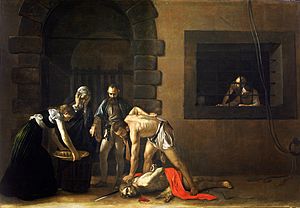
Caravaggio’s painting of the beheading of John the Baptist. From wikimedia.org.
So many people like him are suffering today, refusing to give in to the pressures and whims of modern Herods among us because they believe in you that they stand for what is true.
O good Jesus, we pray for those suffering for truth and for life like John the Baptist in this time of pandemic; bless them and keep them always for they remind us like your precursor that you have come, that you are among us.
Keep our hopes vibrant and alive in you and to a more just tomorrow, Lord, so that we may persevere in speaking your words of truth no matter what others would say. Amen.
Lawiswis ng Salita ni P. Nicanor F. Lalog IIPaggunita sa Pagpapakasakit ni San Juan Bautista, Ika-29 ng Agosto 2020
Ama naming mahabagin,
ngayong ginugunita namin
pagpapakasakit ni San Juan Bautista,
Inyo sanang dinggin aming panalangin
para sa maraming kapatid namin na ginigipit, iniipit;
ang iba sa kanila ay nakapiit
marami ang lugmok sa pait at sakit na sinapit
mula sa mga makabagong Herodes at Herodias
na prinsipyo at pagkatao, ipinagpalit sa ginto.
Inyong patatagin paninindigan sa katotohanan
katulad ni San Juan Bautista
upang ipagpatuloy pakikipaglaban
nasaid man ang kabuhayan
at tanging pinanghahawakan
dangal ng katauhan.
Ikaw lamang Panginoon
ang nakaaalam ng higit na mainam
kami ay Iyong turuan at tulungan
katulad ni San Juan loob mo ay masundan
kami ma'y maging palatandaan
ng Iyong kapanatilihan sa gitna ng mga
pag-uusig at kahirapan.
Amen.
*Mga larawan sa itaas: una ang painting ni Caravaggio ng pagpupugot sa ulo ni Juan Bautista mula sa wikimedia.org; biktima ng tokhang mula sa Philippine Daily Inquirer; umiiyak na empleyado ng ABS-CBN mula sa Reuters.org; at mga locally stranded individuals sa ilalim ng flyover malapit sa NAIA kuha ni G. Raffy Tima ng GMA-7 News.
The Lord Is My Chef Breakfast Recipe for the Soul by Fr. Nicanor F. Lalog II
Monday, Feast of St. Bartholomew, Apostle, 24 August 2020
Revelation 21:9-14 >><}}}*> |+| >><}}}*> |+| >><}}}*> John 1:45-51
Photo by author, Subic, 2018.
Glory and praise to you, Lord Jesus, the “Word who became flesh and dwelt among us” to reveal the Father’s immense love for us all. He was not contented in just telling the prophets of Old Testament how he loved us that He came and lived with us in you, Lord Jesus!
And that is why we also rejoice on this Feast of St. Bartholomew, a.k.a. Nathanael, who was introduced to you by another Apostle you have called earlier:
Philip found Nathanael and told him, “We have found the one about whom Moses wrote in the law, and also the prophets, Jesus, son of Joseph, from Nazareth.” But Nathanael said to him, “Can anything good come from Nazareth?” Philip said to him, “Come and see.” Jesus saw Nathanael coming toward him and said of him, “Here is a true child of Israel. There is no duplicity in him.” Nathanael said to him, “How did you know me?” Jesus answered and said to him, “Before Philip called you, I saw you under the fig tree.” Nathanael answered him, “Rabbi, you are the Son of God; you are the King of Israel.”
John 1:45-49
O dear Jesus, like St. Peter in the gospel yesterday and now St. Bartholomew, you are telling us anew to never be contented with mere words, with the “what” of who you really are, that we must always “come and see you” in order to experience your very person and truly know you.
I really wonder O Lord what your words meant that before Philip called Nathanael-Batholomew, you have seen him under the fig tree; however, I am so convinced that in your words, Nathanael-Bartholomew must have felt something deep inside him that he threw himself totally to you as your Apostle.
Most of all, teach me to remain simple and hidden in you, Jesus that like St. Bartholomew, despite the scarcity of stories and information about him except this little anecdote from the fourth Gospel, he remained faithful to you until his death by flaying reportedly in India.
May we imitate St. Bartholomew who had shown us that more than words, what matters is our oneness in you, Jesus, without any need for us doing sensational deeds, earning thousands of “likes” and “followers” in social media because only you, Lord, remains extraordinary above all. Amen.
Almighty God and Father, on this Memorial of the Queenship of Mary our Blessed Mother, we join her in that most beautiful song of praise to you, “My soul proclaims the greatness of the Lord, my spirit rejoices in God my savior” (Lk.1:47).
Remind us always, O Lord, specially in this time when we exaggerate everything that unlike the royalties of the world, Mary is our Queen not because of power and wealth nor of fame and popularity but precisely due to her humility and weakness before you.
In this time when we are so fond of “triumphalism”, when we overdo even our devotions and prayers to praise and glorify you, remind us O Lord it is not your way as shown to us by the Blessed Mother Mary.
Let us keep in our minds and hearts that Mary, along with all the saints, are venerated because of their obedience to you, fulfilling your will at all times, making you present among us in our weaknesses and helplessness.
We pray for more simplicity and humility, above all, sincerity in our devotions to Mary and the saints that lead to more authentic faith in you alone who is our God Most Holy.
Like Mary our Queen, may we always say “yes” to you O God our “King of kings”. Amen.
The Lord Is My Chef Breakfast Recipe for the Soul by Fr. Nicanor F. Lalog II
Wednesday, Memorials of St. John Eudes & St. Ezechiel Moreno, Priests, 19 August 2020
Ezekiel 34:1-11 >><)))*> ||| >><)))*> ||| >><)))*> Matthew 20:1-16
Photo by author, Pulilan, Bulacan, February 2020.
As we go through more difficulties and sufferings during this time of pandemic, your words today dear God speak so well of what we need most – a true shepherd who will care for the lost and injured sheep.
Yes, you have fulfilled, O God, your promise a long time ago to Ezekiel that you yourself will come by sending us your Son Jesus Christ to look after and tend your sheep after the shepherds of Israel have miserably failed in their duties and responsibilities.
Unfortunately, there are still so many shepherds today in government even in Church who continue to pasture themselves!
Woe to the shepherds of Israel who has been pasturing themselves! Should not shepherds, rather, pasture sheep? You have fed off their milk, worn their wool, and slaughtered the fatlings, but the sheep you have not pastured. You did not strengthen the weak nor heal the sick nor bind up the injured. You did not bring back the strayed nor seek the lost, but you lorded it over them harshly and brutally. As I live, says the Lord God, because my sheep have been given over to pillage, and because my sheep have become food for every wild beast, for lack of a shepherd; I swear I am coming against these shepherds.
Ezekiel 34:2-4, 8, 10
Teach us, O Lord, through the examples of two great shepherds of souls whose feast we celebrate today: St. John Eudes who was one of the early pioneers in propagating devotion to your most Sacred Heart and St. Ezechiel Moreno who served for 15 years in the Philippines and later in South America where innumerable cancer cures were attributed to him.
St. John Eudes and St. Ezechiel Moreno showed in their lives of faithful and loving apostolate for the poor that shepherding is always a gift, never to be counted or equated nor even be seen in terms of wages and pay like in the gospel.
Remind us sweet Jesus in the midst of this pandemic when we are called to be good shepherds like you, may we always see your call and mission to us as gifts freely given not as tasks or work to be compensated by material things because you believe in us.
May we always go the extra mile in answering your call, O Lord, which is in itself a tremendous gift we must cherish for we are not even worthy at all to receive. Amen.
The Lord Is My Chef Breakfast Recipe for the Soul by Fr. Nicanor F. Lalog II
Tuesday, Week XX, Year II in Ordinary Time, 18 August 2020
Ezekiel 28:1-10 <*(((><< || + || >><)))*> Matthew 19:23-30
Photo by author, Petra in Jordan, May 2019.
Then Peter said to Jesus in reply, “We have given up everything and followed you. What will there be for us?” Jesus said to them, “Amen, I say to you that you who have followed me… And everyone who has given up houses or brothers or sisters or father or mother or children or lands for the sake of my name will receive a hundred times more, and will inherit eternal life.”
Matthew 19:27-28, 29
“We have given up everything and followed you, Lord. What will there be for us?”
Oh! how often we tell this to you, Lord Jesus, as if we have given so much for the sake of your kingdom.
Sometimes, it is not really a question we ask but a reminder to you of our “goodness” and “benevolence” with others, of how good we have been when in fact whatever we give and share are all from you.
Forgive us, O Lord, when most specially in the midst of pains and sufferings, we ask you “What will there be for us?” in order to remind you of our rewards, or entitlement as if you forget them or that there is such a thing at all with you.
Photo by author, 2019.
We are sorry Lord in counting the costs and most of all, in demanding so many in return.
“What will there be for us?” is often the question we ask when we doubt your generosity and fidelity to your promises to us.
Like Ezekiel in the first reading, remind us O Lord to keep in mind not to be “haughty of heart”, that “we are not god despite our many achievements brought about by our intelligence or beauty” (Ezekiel 28:1-7).
Dearest Jesus, you have given us with so much and we have given so little; teach us to give more of ourselves, more of our time, more of our treasures, and most of all, more of you to others. Amen.
The Lord Is My Chef Sunday Recipe for the Soul by Fr. Nicanor F. Lalog II
Week XX, Cycle A in Ordinary Time, 16 August 2020
Isaiah 56:1, 6-7 >><}}}*> Romans 11:13-15, 29-32 >><}}}*> Matthew 15:21-28
Twilight at our parish by Ms. Ria De Vera, 12 August 2020.
For the third Sunday in a row, Jesus reveals a very wonderful side of him who goes out of his way to meet us and comfort us in the most difficult situations and places we are into. It is something we need so much in these days of Moderate Enhanced Community Quarantine (MECQ) seen right away in the opening of today’s gospel.
At that time, Jesus withdrew to the region of Tyre and Sidon. And behold, a Canaanite woman of that district came and called out, “Have pity on me, Lord, Son of David! My daughter is tormented by a demon.” But Jesus did not say a word in answer to her.
Matthew 15:21-23
Jesus goes out of his way to meet everyone
Israel is a very small country but always leaves a big impact on everyone who goes on a pilgrimage there. There is that sense of awe in every sacred site that until now continues to “speak” and evoke among pilgrims the presence and holiness of God and his saints.
Like what we have mentioned last Sunday, the proxemics or the non verbal communication of the places Jesus have visited convey to us deeper meanings than just mere sites. And that is more true during the time of Christ like the setting of this Sunday’s gospel, the region of Tyre and Sidon.
Now part of Lebanon found south of its capital city Beirut that was devastated by powerful explosions two weeks ago, Tyre and Sidon were gentile or pagan cities during the time of Jesus with a considerable Jewish population.
His going there shows us his fidelity to his mission of “searching for the lost sheep of the house of Israel” that partly explains to us why he never bothered to give the slightest hint of recognition to the Canaanite woman who had sought his help for her daughter “tormented by a demon”.
Photo by author, the Holy Land, May 2019.
And despite the lack of any explanation again by St. Matthew on the attitude by Jesus “snubbing” the pagan woman, we can safely assume that Christ surely knew that by going to Tyre and Sidon, gentiles would seek his healing as news of his fame had spread beyond Galilee at that time.
Here we find the great love and concern of Jesus for everyone, specially the rejected and marginalized in the society.
His “withdrawing to the region of Tyre and Sidon” was in itself a revelation of his universal love, a love without borders reaching out to those lost and feeling alone in life, those rejected, those discriminated for their color and beliefs, status and gender, sickness and diseases like AIDS and lately, COVID-19!
Inclusive Jesus, exclusive human
At the beginning of chapter 11 of St. Paul’s Letter to the Romans from which our second reading is taken today, the great Apostle starts by asking “has God rejected his people?” St. Paul emphatically said “no”, explaining at length the plan of God in Jesus Christ to save all peoples not just the Jews, beautifully telling us,
For the gifts and the call of God are (permanent and) irrevocable.
Romans 11:29
St. Paul’s reflections on God being “inclusive” as against our being so “exclusive” in sending us Jesus Christ to bring us all together as one sheds us some light on that extraordinary incident in the region of Tyre and Sidon involving the Canaanite woman.
Again, I invite you my dear reader to reflect on the many layers of meaning found in this episode so special like the feeding of more than five thousand people the other Sunday and Jesus walking on water last week.
First, notice the silence of Jesus. Keep in mind when the Lord is silent, it does not mean he is out or does not care at all to our needs and pleas. When there is silence – specially a deafening one – the problem is never with God but with us people.
And, true enough! See how the disciples asked Jesus to “Send her away, for she keeps calling out after us” (Mt.15:23) — exactly the way we deal sometimes with those begging our help and attention, seeing them as a nuisance to be sent away? What a shame!
From Google.
Now, we go to the climax of this episode with the woman coming to Jesus, “paying him homage” for the healing of her daughter tormented by a demon. It was a scene similar with St. John’s wedding at Cana where the Blessed Mother also approached Jesus with a request when wine ran out during the feast.
In both episodes we find Jesus being a snub – suplado, as we say.
Most of all, in both scenes we find the remarkable faith in Jesus by his Mother at Cana believing he can do something to spare the newly wed couple of embarrassment from running out of wine while this Canaanite woman felt so sure only Jesus can cure her daughter.
See how she addressed Jesus like his disciples with not just “Lord” but also with the title “Son of David” to indicate her faith in him as the Messiah.
And it did not stop there as she engaged Jesus into a dialogue — indicating intimacy and trust, depth and communion that we refer in Filipino as “matalik na ugnayan” or “matalik na usapan”.
Sometimes in life, Jesus seems to have that longing for some “lambing” from us that he tries to be “pakipot” or hard to get in order to be intimate with us. Please take these Filipino traits positively to get what I mean from this unique scene of Jesus and the Canaanite woman in Tyre and Sidon.
Jesus said in reply, “It is not right to take the food of the children and throw it to the dogs.” She said, “Please, Lord, for even the dogs eat the scraps that fall from the table of their masters.” Then Jesus said to her in reply, “O woman, great is your faith! Let it be done for you as you wish.” And the woman’s daughter was healed from that hour.
Matthew 15:26-28
Photo by author, Church of All Nations beside the Garden of Gethsemane in the Holy Land, May 2019.
Brothers and sisters all in one God as Father
St. Matthew recorded this episode not to scandalize and shock us with those words coming from the Lord, referring to the Canaanite woman as one of the “dogs” that was the term used to designate pagans at that time.
For St. Matthew who was writing for Christians of Jewish origins, the episode was a reminder that the people of Israel were indeed the “children” of God to whom the coming Messiah and salvation – like bread or food – were first promised. St. Paul spent a great deal of explaining of this in his letter specially to the Romans .
Rigthly then, theirs was the “food” not right to be thrown to the “dogs” but, that fact does not exclude the “dogs” from partaking later from the leftover food of the children, as if telling Jesus, today we satisfy ourselves with crumbs, tomorrow we shall have bread!
The Canaanite woman clearly knew where to place herself before the Lord, proving to him her deep faith and amazing knowledge of God’s goodness and plans for everyone. For that, she was highly praised by Jesus for her faith. The only other person also praised by Jesus in having a tremendous faith in him was the centurion – another pagan – who begged the Lord for the remote healing of his servant.
Last Sunday afternoon I read the story of how a nurse was driven out of her boarding house after she tested positive for COVID-19 virus. The poor lady had nowhere to go to spend the night after being denied of any assistance by barangay officials, even by her own family in Batangas! Good enough, somebody reported her to the Philippine National Red Cross that sent an ambulance to take care of the nurse who was found crying by herself at the gutter of a street in Pasay City.
What a very sad and tragic reality happening among us these days of the pandemic.
Where is our love and concern for everyone, especially the weak and the sick, those in our own versions of Tyre and Sidon where no one would dare to go except Jesus, perhaps like the dorms and residences of our medical frontliners who are so tired and sick physically, emotionally, and spiritually during this pandemic?
In these past three weeks we have reflected how Jesus lovingly joined us, staying with us in the wilderness, in the storms of the dark sea, even at the pagan territories where nobody would ever want to go.
This Sunday, Jesus is inviting us to break all barriers and borders between us that separate us from each other. Let us animate our community with Christ’s love and mercy for us all amid our many differences so that slowly we fulfill Isaiah’s prophecy in the first reading that someday the house of the Lord shall be called “a house of prayer for all peoples” (Is.56:7). Amen.
A blessed and safe new week to you! And please do not forget to pray ten Hail Mary’s every 12-noon for national healing and end of the pandemic until September 15, 2020.
The Lord Is My Chef Breakfast Recipe for the Soul by Fr. Nicanor F. Lalog II
Monday, Memorial of St. Lawrence, Martyr and Deacon, 10 August 2020
2 Corinthians 9:6-10 >><}}}*> // + \\ <*{{{><< John 12:24-26
Photo by Mr. Jim Marpa, 2019.
Dearest Lord Jesus, teach me to be generous and cheerful too, because sometimes our generosity is filled with sadness or bitterness as it is comes from having excess of anything that we have. Worst, it is only when we are forced to become generous by others or due to circumstances.
True generosity is always borne out of joy when our only reason in giving and sharing is due to our faith in you — that no matter what happens to us, you will never abandon us, Lord, providing whatever we need in this life.
Moreover, God is able to make every grace abundant for you, so that in all things, always having all you need, you may have an abundance for every good work.
2 Corinthians 9:8
Most of all, generosity with cheerfulness is always a choice, a decision freely made in imitation of you, Jesus Christ like St. Lawrence your deacon. Those who give or share anything with a heavy heart, if given the choice, would rather keep whatever they have to remain like a grain of wheat without dying.
Like St. Lawrence, teach us generosity that is naturally human and divine, that like him while being roasted alive, he had the sense of humor to ask his persecutors to turn him so that his grilling may be perfect and even. Amen.
“Martyrdom of St. Lawrence, Deacon” by Hipolito de Rioja (16th c.); from commons.wikimedia.org
The Lord Is My Chef Sunday Recipe for the Soul by Fr. Nicanor F. Lalog II
Week XIX, Cycle A in Ordinary Time, 09 August 2020
1 Kings 19:9, 11-13 >><}}}*> Romans 9:1-5 >><}}}*> Matthew 14:22-33
Photo by Mr. Raffy Tima of GMA-7 News, Batanes, 2018.
I have always loved the sea and lately my thoughts have always been about the beach as I miss it so much after COVID-19 had robbed us of our summer vacation.
In ancient time, the sea evoked fear because it was largely unknown that even in the bible, it is the symbol of evil and its powers over man. That is why our gospel today is very significant when Jesus walked on water to show God’s greater power over evil and sin.
And like our gospel last week, our story today tells us a lot more about Jesus walking on water in the midst of a storm to reveal himself and most of all, his desire to meet us his disciples.
Place and location as non-verbal communication of one’s presence
Every meeting and encounter presupposes locations or places, a locus; but, everything is “levelled up” or elevated in Jesus in whom things do not remain in the physical level.
Proxemics is the non-verbal communication that refers to places and location, its nearness and orientation. How we arrange our furnitures, designate the rooms and sections in our homes, offices, schools and every building we stay and gather communicate and reveal who we are.
For example, Catholic homes are easily identified in having a grotto at the garden, an altar of the Sacred Heart or any saint at the sala, and the Last Supper painting in the dining hall.
But for Jesus, a place or a location is more than the physical site because in him, proxemics takes on a deeper dimension and higher meaning when we meet him in situations and places. That is why after feeding the more than five thousand people last week, he ordered the Twelve to cross the Sea of Galilee (which is actually a lake) ahead of him while he dismissed the crowds.
After doing so, he went up on the mountain by himself to pray. When it was evening he was there alone. Meanwhile the boat, already a few miles offshore, was being tossed about by the waves, for the wind was against it. during the fourth watch of the night, he came toward them, walking on the sea. When the disciples saw him walking on the sea they were terrified. “It is a ghost,” they said, and they cried out in fear. At once Jesus spoke to them, “Take courage, it is I; do not be afraid.”
Matthew 14:23-27
Photo by author, Sea of Galilee at Capernaum where Jesus used to preach, May 2019.
Crossing to Jesus, crossing with Jesus
I love that scene very much, of Jesus getting his disciples into the boat to precede him to the other side of the lake while he dismissed the crowds. Again, St. Matthew never bothered to tell us why Jesus sent the Twelve ahead of him as he stayed behind, dismissing the crowds and later praying alone at night atop the mountain.
Let us now reflect the proxemics or non-verbal communication of our gospel scene this Sunday.
We need to cross to the other side to meet Jesus.
To meet Jesus Christ, we always have to “cross to the other side” by leaving our “comfort zones”.
More than going to the other side of the lake physically, we have to move over to unchartered areas of life, be bold and daring to try new things, new situations in order to mature and find fulfillment by meeting Jesus Christ.
And sometimes, we really have to literally cross the sea or get to the other side of the country or the world to find our self and meet Christ.
Fifteen years ago I went on vacation to Toronto for some soul-searching as I went through a burn-out. While serving at St. Clement Parish, I met many Filipinos serving as lectors, choir members, catechists and volunteers.
Graph shared by sugarindustryfoundationinc.org.ph.
They would always confess to me with both a sense of pride and little shame that they never went to Mass regularly when in the Philippines and now in Canada, they were amazed at how God had brought them there to be involved in parish activities and be closer to Jesus than ever!
As I listened to their stories, I realized the many sacrifices and hardships they have to endure in that vast and cold country with no one to turn to except God. If given the chance, many of them admitted they would return to the Philippines for there is no place like home!
Though I have found so many things I have been searching for in my initial three months of stay there on top of other opportunities given me, I still felt empty. That raging storm within continued. As I prayed and reflected guided by an old, Polish priest who claimed to have been the student of St. John Paul II, I saw myself more, eventually leading me to God anew who refreshed my vocation that I finally decided to go back home after six months of my supposed to be one year leave.
Sometimes in life, we need to get away from our comfort zone, cross to the other side, especially when life becomes so artificial. Jesus invites us to go ahead and cross to the other side of the lake or sea to experience life at its “raw” so we can feel again our souls within and desire him anew until we finally meet him wherever we may be in the world.
It is when we are at the other side of the sea in the midst of a storm when Jesus comes, immediately answering our cries for help – At once Jesus spoke to them, “Take courage; it is I” – because when we are reduced to emptiness and nothingness, then our faith kickstarts again. Faith, like love, is always an encounter with God.
Try going to the other side, leave your comfort zone to meet Jesus and finally have meaning and direction in life!
Silence is the presence of God.
In the first reading we have heard that beautiful story of Elijah meeting God at the mouth of a cave — not in the strong and heavy wind nor earthquake nor fire like Moses before him.
After the fire, there was a tiny whispering sound. When he heard this, Elijah hid his face in his cloak and went and stood at the entrance of the cave.
1 Kings 19:12-13
Silence is the place of the presence of God because silence is his language too. Wherever there is silence, we can surely find and meet God there.
That is why Jesus wants us to cross to the other side, to be silent and listen to him.
Photo by author, crossing the Lake of Galilee, May 2019.
In his silence, God teaches us that except for sin, he never considers everything as being finished; everything is a “work-in-progress” even if he seems to be silent that some think he must be absent or even dead.
The world thrives in noise, loud talks, and screams with each voice trying to dominate another resulting in cacophony of sounds. Shakespeare’s Hamlet said it well when he told Polonius what he was reading were “Words, words, words” — nonsense!
Some people like those in power think that the more words they say, the more meaningful their thoughts and ideas become. Worst, they thought that using foul and filthy language make them so natural and credible, not realizing the more they look stupid with their crazy thoughts and ideas not even clowns and comedians would ever attempt to imitate.
But when our words come from deep silence, they come with power and meaning, touching everyone’s heart and inner core.
That is when silence becomes fullness, not emptiness or mere lack of noise and sound.
Like when our medical frontliners and medical experts spoke with one voice last week airing their thoughts about the pandemic — we were all moved and reawakened to realize how we have been going about with our lives almost forgetting them these past five months!
What a tragedy at how our officials in government and Congress reacted negatively, feeling hurt deep inside with the painful truth of how they have been irresponsible from the beginning. Sapul!
Pico Iyer wrote in a TIME magazine essay 30 years ago that “silence is the domain of trust”.
True. The most trustful people are the most silent; those who speak a lot trust no one and most likely, cannot be trusted too.
Jesus invites us to cross to the other side to be silent and learn to trust him. It is only then when we can meet him. In silence.
Photo by Mr. Raffy Tima of GMA-7 News, Manila Bay with Mt. Samat’s Cross at the background, April 2020.
Jesus meets us in darkness.
Jesus asks us to cross to the other side of the lake or sea like his disciples in order to meet us in darkness. This is a paradox because Jesus is the light of the world.
But, note the most notable moments in his life happened in darkness: he was born on the darkest night of the year, he died when darkness covered the whole city of Jerusalem, and he rose from the dead when it was still dark on the first day of the week.
Jesus had overcome darkness! So, what happened to Peter in this episode after being called by Jesus to walk on water too?
Jesus said, “Come.” Peter got out of the boat and began to walk on the water toward Jesus. But when he saw how strong the wind was he became frightened; and, beginning to sink, he cried out, “Lord, save me!”
Matthew 14:29-30
Imagine how everything was going so well with Peter doing another crossing while crossing the lake! But when he saw how strong the wind was he became frightened; and, beginning to sink, he cried out, “Lord, save me!”
Jesus calls us into the dark so that we only look for him and upon finding him, focus on him alone. Peter saw the strong wind, not the stronger and powerful Jesus walking on water, that fear overtook him.
That’s the whole point of St. Paul in our second reading today: he was telling the Romans how some people in Israel trusted more in their physical descent from Abraham than in God’s promise of salvation fulfilled in Jesus they have refused to see and recognize as the Christ (Rom.9:1-5).
When in the dark, be silent and still for Jesus is near! Keep your sights at him, not on anything else. Problem in darkness is not God but us who follow other lights or have become delusional.
Photo by Mr. Jim Marpa, 2019.
That is the tragedy we are into as a nation while crossing to the other side of the sea of pandemic in just one boat when our officials see only themselves as always being right. Worst, they all want to be on the stage with all the lights on them as they speak and sing in cacophony like psychopaths.
All the more we must hold on tight, trust and focus in Jesus who is “now here”, not “nowhere” for he will never allow us to perish.
Let us trust Jesus overcoming all these evil, leading us to the shore. Amen.
A blessed rainy Sunday to you and your loved ones!