The Lord Is My Chef Breakfast Recipe for the Soul by Fr. Nicanor F. Lalog II
Monday, Week XXVIII, Year II in Ordinary Time, 12 October 2020
Galatians 4:22-24, 26-27, 31-5:1     ||| +++ |||     Luke 11:29-32
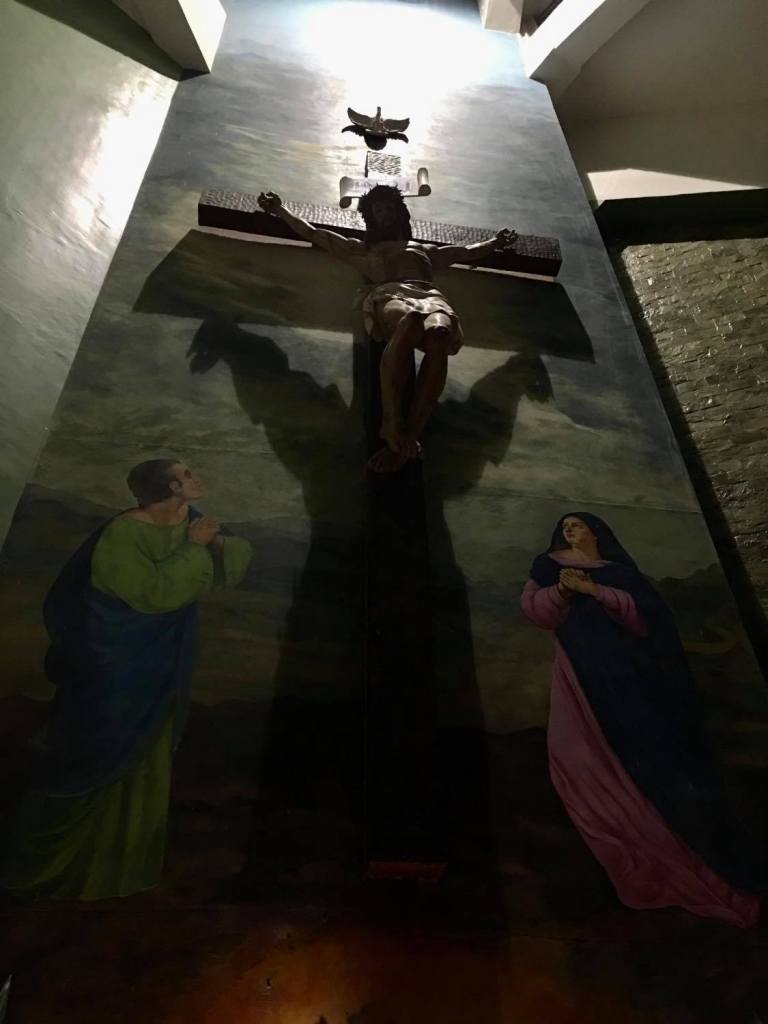
Cross of Christ atop the church of our Lady of Lourdes in France. Photo by Arch. Philip Santiago, September 2018.
Today O God our Father I thank you for the gift of faith we have always taken for granted. Faith is not just for believing in you, God; faith is for believing what is true! Without faith, life would be a drab and even senseless for there is nothing we can ever hold as reliable and true.
Without faith is like living without friction with everything sliding, slipping, escaping our grasps. There is nothing we would ever believe in. Most of all, without faith we can never read and understand any kind of signs, especially your saving work in Jesus Christ.
While still more people gathered in the crowd, Jesus said to them, “This generation is an evil generation; it seeks a sign, but no sign will be given it, except the sign of Jonah. Just as Jonah became a sign to the Ninevites, so will the Son of Man be to this generation.
Luke 11:29-30
We live in a world of so many signs and symbols but it is only through your gift of faith that they all become meaningful and useful.
Teach us, Lord, to deepen our faith so we can read your signs better like St. Paul in the first reading whose deep faith in you enabled him to interpret the meaning of the signs of Abraham’s two sons, Ishmael by Hagar and Isaac by Sarah.
May we love and care more for your gift of faith to us, Lord, because it is through our faith that we know and discover, follow and hold on to your plans for us. Amen.
The Lord Is My Chef Breakfast Recipe for the Soul by Fr. Nicanor F. Lalog II
Saturday, Week XXVII, Year II in Ordinary Time, 10 October 2020
Galatians 3:22-29     ||+||   >><)))*>   ||+||     Luke 11:27-28
Photo by author, 2019.
Glory and praise, O God, our Father for another week that had passed and another new one to start! Thank you so much for everything we have received this week: the beautiful things that have blessed us wondrously and the sad things that have also blessed us with lessons in life.
Thank you for the gifts of faith and conviction, faith and being realistic, faith and consistency.
And so, I pray today for the gifts of faith and freedom for a truly faithful person is always one who is also truly free!
Brothers and sisters: Scripture confined all things under the power of sin, that through faith in Jesus Christ the promise might be given to those who believe. Before faith came, we were held in custody under law, confined for the faith that was to be revealed. Consequently, the law was our disciplinarian for Christ, that we might be justified by faith. But now that faith has come, we are no longer under a disciplinarian.
Galatians 3:22-25
You know how so many times, Lord, when we feel imprisoned and chained by our broken and toxic relationships, sickness and handicaps, painful memories, failures and other past sins.
Let us realize and be convinced that you have come to set us free from all of these, that we are now free to love, free to be ourselves, free to grow, free and faithful in you.
Show us the path how we can break the many barriers that continue to imprison us and prevent us from maturing in faith and freedom in you like gender, color, language, social status and even religion.
Help us imitate you, Jesus, who boldly claimed before everyone that true blessedness is not found in affinities or blood ties but in freely receiving and observing the word of God. Amen.
The Lord Is My Chef Breakfast Recipe for the Soul by Fr. Nicanor F. Lalog II
Friday, Week XXVII, Year II in Ordinary Time, 09 October 2020
Galatians 3:7-14     <*(((><<   +   >><)))*>     Luke 11:15-26
Photo by author, 2019.
Glory and praise to you, O God our Father through your Son Jesus Christ! Today we are celebrating the Memorial of some great men who faithfully and consistently served you and your people with their lives of witnessing to your gospel as members of the clergy: St. John Leonardi who founded in 1570’s the forerunner of Propaganda Fide now headed by Cardinal Luis Antonio Tagle; St. Denis, first bishop of Paris who suffered martyrdom with his priest and deacon in 258; St. Louis Bertrand who came to be known as the “Apostle to the Americas” during the 16th century; and beatified recently by Pope emeritus Benedict XVI, Blessed John Henry Cardinal Newman considered as one of the great Christian intellectuals of the 19th century.
They were all great men of deep faith. And most of all, consistent in heeding your call, doing your work.
And that is why, today O Lord I pray for the gift of being consistent in my faith.
A believer without consistency in his faith and actions is not faithful at all. A truly faithful servant is always consistent especially when the chips are down, we are confronted of either for you, Lord, or against you.
Sometimes we try “moving the lines”, convincing ourselves that we are not crossing the line of morals and morality like when we are bent on accommodating others and ourselves in some occasions to justify personal preferences like tinkering with the formula of the Sacraments as well as those pertaining to intrinsically sinful and immoral.
Like St. Paul in his letter to the Galatians today, clear our minds and our hearts of all kinds of inconsistencies in our faith, set us straight onto your paths, Lord and let us see your own consistency, your works in the past that are fulfilled in the present.
Unlike those people accusing you of driving evil spirits in the name of Beelzebul, may we be consistent in relying only in you and your powers despite our many setbacks and failures in life when you never failed to bless us and work things out for our own good. Amen.
The Lord Is My Chef Breakfast Recipe for the Soul by Fr. Nicanor F. Lalog II
Monday, Week XXVII, Year II in Ordinary Time, 05 October 2020
Galatians 1:6-12     >><)))*>   |+|   <*(((><<     Luke 10:25-37
From America Magazine via Google.
God our loving Father, I praise and thank you for the gift of faith in you that have greatly helped me finding fulfillment in you. As I grow and continue in this journey in faith, I have realized too that it is not enough to just believe in you but also be convinced in this faith in you.
Like during the time of St. Paul especially among the Galatians, until now many of us are easily swayed by so many other beliefs that are misleading. claiming to be a part of the faith we received from you through Jesus Christ.
Teach us to be like St. Paul in his firmness and conviction in his faith no matter what modern thoughts claim to be a part of the gospel of Jesus Christ that try to accommodate certain thoughts and lifestyles, like masquerading as being “politically correct”.
Now I want you to know, brothers and sisters, that the Gospel preached by me is not of human origin. For I did not receive it from a human being, nor was I taught it, but it came through a revelation of Jesus Christ.
Galatians 1:11-12
If we can have St. Paul’s kind of conviction in faith, maybe we can be more authentic Christians or believers of God like the good Samaritan unlike the priest and Levite who just passed by the victim to robbers on the road to Jericho.
Forgive us Lord when our faith and lives do not match because so often our faith have no roots within us, we are not personally convinced in believing and following you. Amen.
The Lord Is My Chef Sunday Recipe for the Soul by Fr. Nicanor F. Lalog II
Week XXVII-A in Ordinary Time, 04 October 2020
Isaiah 5:1-7     ||+||     Philippians     ||+||     Matthew 21:33-43
Photo by Mr. Jim Marpa, 2018.
To all the plantitos and plantitas: happy feast day this Sunday, the fourth of October which is also the feast of St. Francis of Assisi, patron of those in the green movements.
Part of the grace of this pandemic is the new awareness and interests of many among us for all kinds of plants borne out of the prolonged quarantine periods these past seven months. I remember growing up in our barrio where fences were all plants like santan, San Francisco and gumamelas whose flowers we used to mix with Tide to play bubbles. Who would have thought that after several decades those plants we used to take for granted like the gabi varieties and others along with cactus found almost everywhere would cost a fortune today?
But what I really miss and hope the plantitos and plantitas will be able to revive and bring back are the fruit trees every home used to have even in vacant lots like guava, santol, atis, aratiles, mabolo, achesa, duhat, kamias and of course, mango. Whenever me and my cousin would trek to the mini forest at the back of our compound called “duluhan” near a swampland to shoot birds and everything with our slingshots (tirador), we always had some fruits to munch in our little adventures.
And part of that adventure was to “shake” until we break branches of trees to get fruits and local beetles called salagubang (on mango trees).
Shaking of tree. Exactly the same thing that Jesus did today in his next parable addressed to the chief priests and elders of the people who would soon have him arrested, tried, and crucified: after telling them parable of the wicked tenants who killed the servants and the son of the owner, Jesus shook and shocked his listeners who later realized the parable was about them!
“What will the owner of the vineyard do to those tenants when he comes?” They answered him, “He will put those wretched men to a wretched death and lease his vineyard to other tenants who will give him the produce at the proper times.” Jesus said to them, “Did you never read in the Scriptures: ‘The stone that the builders rejected has become the cornerstone; by the Lord has this been done, and it is wonderful in our eyes?’ Therefore, I say to you, the kingdom of God will be taken away from you and given to a people that will produce its fruit.”
Matthew 21:40-43
We are the vineyard of the Lord
From Google.
Jesus had already entered Jerusalem and was teaching at the temple area. Among his audience were the chief priests and elders of the people trying to gather evidences against him for his arrest and execution. Unknown to them, Jesus knew what was in their hearts.
Last Sunday the parable was directed to them so they may realize how wrong they have been in regarding them so highly above the publicans and prostitutes who repented for their sins and went to receive the baptism by John the Baptist.
Today, Jesus “shook them” with this second parable taken from a well known song and lament of a beloved to his vineyard by the Prophet Isaiah which we have heard at the first reading.
Vineyards are very common in Israel as in the rest of the Mediterranean and Europe where grapes and wine symbolize life. Hence, the vine is always considered as a highly prized plant that biblical authors have taken as the image of the people whom God cultivates and from whom he expects beautiful fruits.
In the first reading, we find God lamenting why after investing his vineyard with the best of everything, the grapes it produced were so bad that it had to be burned. It was a very strong warning against Israel who have gone wayward in its ways of living that aside from worshipping idols, they also killed the prophets sent by God.
Notice the transition by Jesus using the same imagery from the Old Testament of the vineyard as the people of God but this time bearing fruits at harvest time. By that time, the chief priests and the elders of the people felt they were better than their ancestors who had the prophets killed. In fact, they felt proud that they have been faithful to God, and therefore, fruitful — thinking they were a far cry from Isaiah’s lament. Unknown to them, Jesus could read their hearts, how they were all planning to kill him like the son in the parable so they can have the vineyard, the people and lord it over them!
Everything fell into right places at the end of the parable when Jesus asked them:
“What will the owner of the vineyard do to those tenants when he comes?” They answered him, “He will put those wretched men to a wretched death and lease his vineyard to other tenants who will give him the produce at the proper times.”
Matthew 21:40-41
Try to imagine the scene with Jesus face-to-face with the chief priests and elders of the people – and with us – discussing the present time, not the past.
Here is Jesus Christ shaking us all to find whatever fruits we have, telling us that this parable is about me and you (see v. 45), asking us, why are you trying to remove me from the people? Why are you easing me out, creating all these cults around yourselves like celebrities, getting the people’s money and approval for your own sake?
Sometimes we need to be shaken – even shocked – to bring out our fruits
Photo by author at Silang, Cavite, 22 September 2020.
See again my dear Reader the beauty of the Lord’s parables wherein he invites us to be involved with it to see how we felt with certain situations like in the merciless debtor and early workers at the vineyard; today, Jesus is asking us our opinion on what the vineyard owner must do against the wicked tenants.
He knows what to do and wants us to realize that we could be those tenants too because like the chief priests and elders, we easily see the sins and shortcomings of others, the fruitlessness of others without realizing our own darkness within, even our sinister plans to dominate.
See how the chief priests and elders of the people called the tenants “wretched men” deserving “wretched death”, not realizing that the more we talk of other people, the more we actually talk of ourselves!
Every parable by Jesus is always set in the present moment with sights set to the future, to eternal life.
Sometimes, God has to shaken us, even shock us so we may bring out and give him his share of harvest of fruits like our faith, hope and love that will build the community in him, not take people away from him. Problem with us is like with those tenants and the chief priests and elders: “masyado tayong bumibilib sa ating sarili”, that is, we believe too much on ourselves that unconsciously we feel like God, forgetting we are mere stewards or tenants of his vineyard.
St. Paul reminds us in the second reading that we strive to imitate Jesus, be like Jesus so that people may find in us a model in following Jesus. Very clear with St. Paul: nobody is replacing Jesus Christ whom we must all imitate.
This time of the pandemic is a time of harvesting, of showing others our fruits like love and kindness so we may lead more people to God, not to ourselves or anyone else trying to lord over us.
The Lord Is My Chef Breakfast Recipe for the Soul by Fr. Nicanor F. Lalog II
Thursday, Memorial of St. Therese of the Child Jesus, 01 October 2020
Job 19:21-27     >><)))*>  +  >><)))*>  +  >><)))*>     Luke 10:1-12
Photo by author, white roses at our altar, 2019.
On this Memorial of the most loved saints of today, St. Therese of the Child Jesus, I pray O God parents who have lost a child, those diagnosed with serious illness, and those heavily weighed on with simultaneous trials and problems in family.
It is so refreshing on this first day of October that we celebrate the life and holiness lived in total simplicity by St. Therese, a modern Job in our time after she had undergo many hardships and trials at a very young age as a contemplative nun.
I pray dear God for those feeling almost crushed by so much tribulations in life, those about to give up, losing hope and meaning or those who could no longer find their sense of mission amid the heavy or enormous weights on their shoulders.
But as for me, I know that my Vindicator lives, and that he will at last stand forth upon the dust; whom I myself shall see: my own eyes, not another’s, shall behold him, and from my flesh I shall see God; my inmost being is consumed with longing.
Job 19:25-27
Most of all, dear God, as we go through so many difficulties in life during this pandemic, may we be more loving not only in words but in deeds, even the most simplest deeds like St. Therese:
Photo by author, 01 October 2019.
Love appeared to me to be the hinge for my vocation… O Jesus, my love, at last I have found my calling: my call is love. In the heart of the Church, my mother, I will be love, and thus I will be all things, as my desire finds its direction.
St. Therese of the Child Jesus, Office of Readings, 01 October, Volume IV
May we break all walls that divide us as brothers and sisters in Jesus Christ your Son, almighty Father.
Most of all, heeding your Son’s call, we pray to you O God our harvest-master to send us with more laborers for your abundant harvest (Lk.10:1-2) of people hungry and thirsty for you and meaning in life. Send us workers in your field whose hearts are filled with love and fervor in doing the mission of evangelization wherever they may be like St. Therese, who, despite her being a cloistered in a monastery, had become patroness of the missions in prayers and in her little ways for God.
Indeed, when there is enough love in one’s heart, there is always so much to give and share with everyone hungry and thirsty for love. Amen.
The Lord Is My Chef Breakfast Recipe for the Soul by Fr. Nicanor F. Lalog II
Wednesday, Memorial of St. Jerome, Priest/Doctor of the Church, 30 September 2020
Job 9:1-12, 14-16  >><)))*>  +  >><)))*>  +  >><)))*>   Luke 9:57-62
Photo by author, city of Jerusalem from Dominus Flevit Chapel, May 2017.
God our Father, sometimes I feel our situation today is very much like during the time of Job when sickness and destruction are all around us with the threats of death no longer lurking out in the dark but most present and getting nearer to us even at daylight.
And that is why lately, I have felt very much like Job too that I want to engage you in a conversation to ask you why all these things happening to me and those special to me. I am so afraid, God, of getting sick that I chill inside when I hear those dear to me going through surgery, chemotherapy, and dialysis.
I feel like asking you why these things going on, why them getting sick instead of just praying for them but, every time these things cross my mind, I just feel like Job:
Job answered his friends and said: I know well that it is so; but how can a man be justified before God? He does great things past finding out, marvelous things beyond reckoning. Should he come near me, I see him not; should he pass by, I am not aware of him; should he seize me forcibly, who can say him nay? Who can say to him “What are you doing?” How much less shall I give him any answer, or choose out arguments against him! Even though I were right, I could not answer him, but should rather beg for what was due me. If I appealed to him and he answered my call, I could not believe that he would hearken to my words.
Job 9:1, 10-12, 14-16
I wonder, Lord, if my faith and trust in you have deepened during this pandemic or, have I just become passive with how things are going on, getting used to the new situations, blankly hoping things will soon get better.
Have I really learned to trust you more than ever, surrendering everything into your hands like Job as I have realized too your immeasurable greatness, your being God beyond my limited knowledge and understanding that you make me wonder and be awed with your transcendence?
Yes, Lord, deep inside me amid all these fears and questions is the conviction you can never be doubted, that all I need is to completely trust you and strive to be good. Thank you for that grace as I continue to pray for healing of those dearest to me.
Let me grow closer to you as your disciple, forgetting everything about myself, surrendering myself to you in complete trust unlike those called by Jesus to follow him in the gospel today filled with many alibis and excuses.
May I have the devotion and discipline of St. Jerome whose memorial we celebrate today in finding you, loving you, and following you in the Sacred Scriptures as well as in the people we serve.
Like St. Jerome, may I have the courage to contemplate like Job on things beyond this world and life like death and eternity without bargaining or haggling with you except to trust in you completely. Amen.
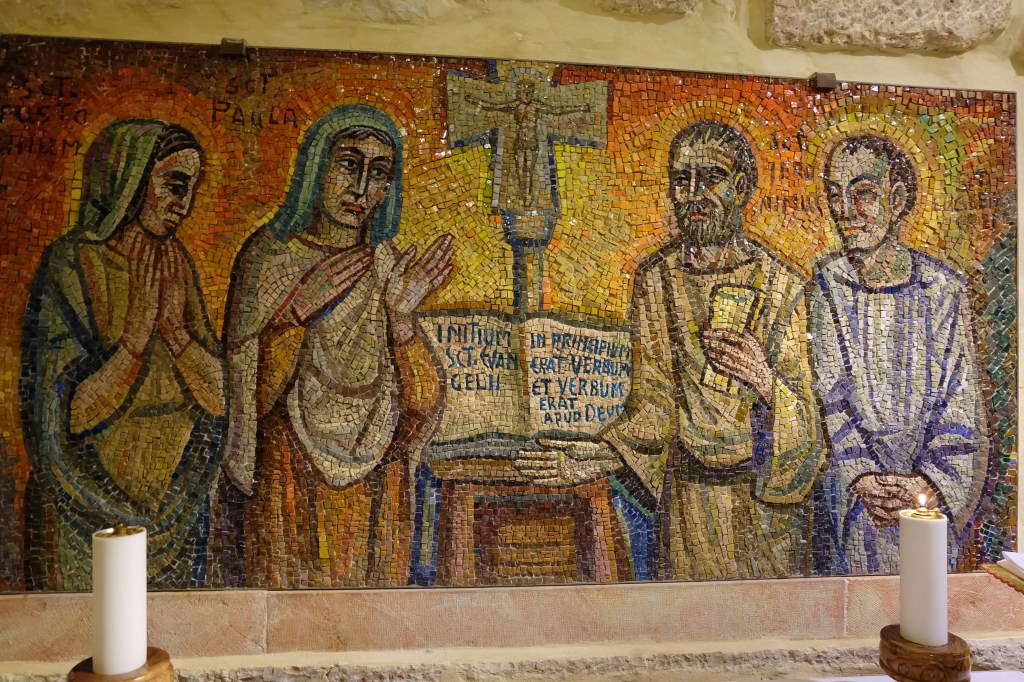
Photo by author, mosaic on the wall of the Chapel of St. Jerome in a cave underneath the Church of the Nativity in Bethlehem where he had lived for 34 years until his death in 420 devoting himself in prayers and studies of the Sacred Scriptures while directing some women like “Paula” towards holiness (May 2017).
The Lord Is My Chef Sunday Recipe for the Soul by Fr. Nicanor F. Lalog II
Week XXV-A, Ordinary Time, 20 September 2020
Isaiah 55:6-9   >><)))*>   Philippians 1:20-24, 27   >><)))*>   Matthew 20:1-16
Photo by the author on the way to Petra in Jordan, May 2019.
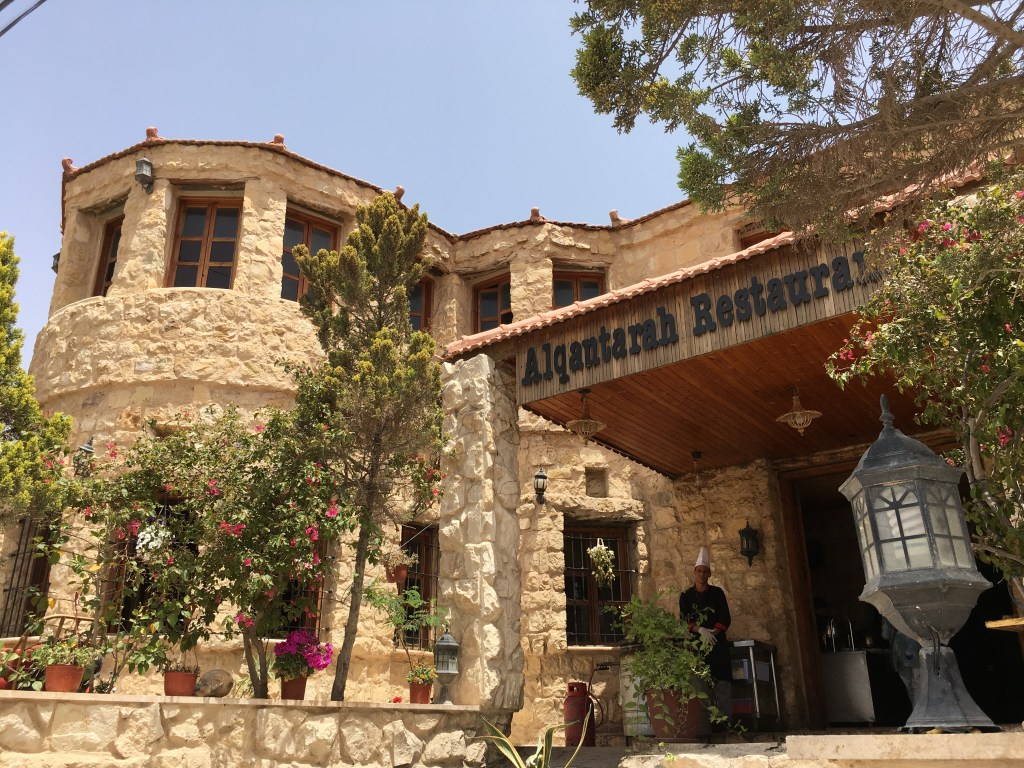
There was something amusing I realized while praying this Sunday’s gospel of how in our time we no longer hear or use the word “generous” anymore — except when the topic is about food like in the expression “generous servings”!
We all love and enjoy “generous servings” of food and drinks whether in restaurants or at home or at parties because it means something more than what we pay for or come for. And that is the essence of generosity: the giving of more than what is required and just. It is love in the real sense like the prayer for generosity by St. Ignatius of Loyola.
Dearest Lord:
Teach me to be generous.
Teach me to serve you as you deserve,
To give and not to count the cost,
To fight and not heed the wounds,
To toil and not seek for rest,
To labor and ask not for reward, except
To know that I am doing your will.  Amen.
Photo by Mr. Jim Marpa, 2019.
Generosity bonds every community in Christ
Sorry if I have to start our reflection through the stomach because today is our “Pistang Pasasalamat” (Thanksgiving) in the Parish…
Going back to our reflection, my dear reader, recall how in the past two weeks we have heard Jesus teaching us important lessons how our relationships must be based on mutual love through fraternal correction and forgiving of those who have sinned against us.
This Sunday through another parable, Jesus teaches us the importance of generosity as a wonderful expression of love we forget most in our relationships and dealing with others.
Generosity is the glue that keeps our ties stronger and keeps us filled with joy because it is thinking more of the other person than of self. It is love at its finest – charming and elegant as in suave – but so disarming and revealing when overlooked as we shall see in this parable.
Jesus told his disciples this parable: “The kingdom of heaven is like a landowner who went out at dawn to hire laborers for is vineyard. After agreeing with them for the usual daily wage, he sent them into his vineyard. Going out about nine o’clock, he saw others standing idle in the marketplace, and he said to them, ‘You too go into my vineyard, and I will give you what is just.’ So they went off. And he went out again around noon, and around three o’clock, and did likewise. Going out about five o’clock, he found others standing around, and said to them… You too go into my vineyard.’ When it was evening the owner of the vineyard said to his foreman, ‘Summon the laborers and give them their pay, beginning with the last and ending with the first.’ When those who had started about five o’clock came, each received the usual daily wage. So when the the first came, they thought that they would receive more, but each of them also got the usual wage. And on receiving it they grumbled against the landowner, saying, ‘These last ones worked only one hour, and you have made them equal to us, who bore the day’s burden and the heat.’ He said to one of them i reply, ‘My friend, I am not cheating you. Did you not agree with me for the usual daily wage? Take what is yours and go. What if I wish to give this last one the same as you? Or am I not free to do as I wish my own money? Are you envious because I am generous?'”
Matthew 20:1-15
Notice how Jesus again elicited our feelings to drive home his lesson today about love as basis of our relationships. Last week we totally agreed with the king in punishing the merciless servant whose debt he had forgiven but was unmerciful to a fellow servant and debtor.
This Sunday, with whom did we take sides with? Be honest. Did you side with the workers hired in the morning and worked all day only to receive a pay exactly the same with those who worked only for an hour? Did we also feel treated unfairly like them?
But, why are we reacting the same way as those workers who toiled under the sun? What is our complaint? Are we envious because the owner is generous?
Recall our reflections last month about the parable as a simple story conveying deeper truths about life and our selves. From the French parabolein -along the way – Jesus is inviting us to read anew this parable we have heard so many times in the past so we may enter into a dialogue with him to purify and cleanse us to get its whole picture. And hopefully, become generous too.
Nuns bringing goods to the poor during the height of the Luzon-wide lockdown last summer.
Human justice, Divine kindness
The parable is not about social justice and just wages: it is about the immense love of God for us all. Jesus said it at the start, “The kingdom of heaven is like a landowner…” – it is a parable about God and his kingdom.
See the great love of the landowner who went out five times during the day, even at late afternoon so people may have a job to earn some money for the day. We have to keep in mind that the workers were hired because the owner is kind. Period.
The owner is like the good shepherd Jesus described as who would leave the rest of his flock to search for one missing sheep.
How many times have we acted like those early workers, complaining to God when we feel “shortchanged” for our work and efforts, or being better and more good perhaps than others?
It happens so many times when we question him even in the Church and specially in the society and government when we cannot understand how God who is supposed to be just and fair is allowing all injustices and evil to happen like during this time of COVID-19.
The first reading reminds us that to think that way as if we know everything is dangerous because we could be very wrong and mistaken after all. God sees and knows everything that in the end amid all the twists and turns in history and in our personal lives, it is always his will that prevails which proves best for us and mankind. In times like these, we need to have faith in God and trust him more through prayers and reflections.
Seek the Lord while he may be found, call him while he is near… As high as the heavens are above the earth, so high are my ways above your ways and my thoughts above your thoughts.
Isaiah 55:6, 9
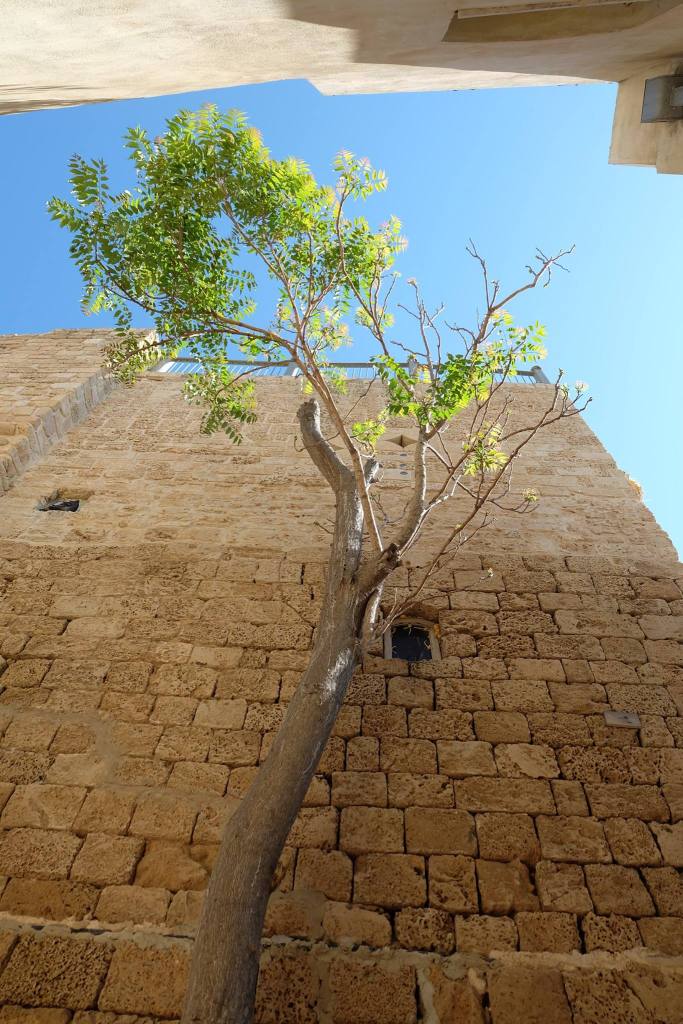
Photo by author, Jaffa in Israel, May 2017.
We keep on saying that one immediate fruit of having a prayer life is the heightening of our sensitivities when we see more of God in others than more of ourselves. The problem with those workers hired earlier in the day that instead of thanking God for his kindness in hiring them, they even wanted more in their pay than what they have agreed upon — so selfish and feeling so entitled like some among us!!!
God as the landowner is teaching us not only to be thankful for the blessings we have received from him but also to rejoice when others aside from us are also blessed. As everyone would say these days, “sana all” are blessed, not only a selected few.
Again we find here a similar situation in the parable of the prodigal son where the father told the elder one that “everything I have is yours” (Lk.15:31) when he refused to come home to celebrate the return of his younger brother, citing how he had obeyed the father all his life without being given a young goat to feast with his friends.
Like that loving father of the prodigal son, God is reminding us this Sunday in this parable to rejoice that others have been blessed, instead of grumbling and complaining, demanding for more than what we have, forgetting everything is out of God’s goodness, never because of our merits.
Looking inside our hearts
My dear friends, this time of the pandemic invites us to be generous by looking deep into our hearts, of seeing God more and others than just our self. At this time when life is so difficult and death is so closest to home with everyone, the best thing we can do is to thank God for his gift of life to us each day and to deepen our faith in him.
Lately I have been praying to God to grant me St. Paul’s clarity of mind and purity of heart as we find ourselves in his similar situation of being imprisoned: him for the gospel, us due to COVID-19.
See the faith of St. Paul in God that even in prison with his death approaching each day, he continues to rejoice and experience peace within because he had realized that the success of the gospel is not on human efforts but in Jesus whom we cannot box in our little worlds and beliefs, rites and rituals. In fact, he was so confident that even with his death, the more the gospel would spread.
Photo by Dra. Mylene A. Santos at Katmon Harbor Nature Sanctuary, Infanta, Quezon, March 2020.
Brothers and sisters: Christ will be magnified in my body, whether by life or by death… conduct yourselves in a way worthy of the gospel of Christ.
Philippians 1:20, 27
Last Sunday, Jesus taught us to forgive from the heart, that is, to see one another as a brother and sister in God our Father who forgives us without limits for our many sins.
Today, Jesus is asking us to give from the heart – to be generous – not for anything else but because we are brothers and sisters in God our Father who blesses us without limits despite our sinfulness.
Generosity comes from the heart when in that heart is Jesus whom we find dwelling, giving us peace and joy no matter how much suffering we go through because him alone suffices that we are willing to let go of everything.
Share a generous serving of God’s blessings today to someone in need. Amen.
Lawiswis ng Salita ni P. Nicanor F. Lalog II
Martes, Kapistahan ng Mater Dolorosa, 15 Setyembre 2020
1 Corinto 12:12-14, 27-31  || + ||  Juan 19:25-27
Larawan kuha ng may-akda, Abril 2020.
O Birheng Maria, aming Ina!
Ngayong aming ipinagdiriwang
iyong kapistahan bilang Mater Dolorosa
kinabukasan pagkaraan ng kapistahan
ng Pagtatampok ng Banal na Krus ni Hesus,
nabubuo ang napakagandang larawan
ng malalim at matalik ninyong ugnayan,
 kaisahan bilang mag-ina sa liwanag ng Banal na Krus;
tunay nga ikaw Birheng Maria ang una at dakilang alagad Niya
sinamahan Siya hanggang pagdurusa at kamatayan
kaya naman ikaw ay naging Ina nitong Santa Iglesya
nang kami ay naging katawan Niya.
Aming dalangin sa gitna nitong COVID-19
paratingin aming mga daing at hinaing
masintahing Ina sa Panginoon natin:
patatagin aming pananampalataya
paalabin aming pagmamahal at paglilingkod
iwaksi kami sa sakit at iba pang kapahamakan
upang balang araw sa pagbubukang liwayway
mapawi rin aming mga dalamhati
katulad mo'y magningning ang ngiti sa aming mga labi
mula kay Kristong muling nabuhay
sa pandemya kami'y pinagtagumpay.
Amen.
Larawan ng “Mater Dolorosa” ng pintor na si Carlo Dolci mula sa Wikimedia Commons.
The Lord Is My Chef Breakfast Recipe for the Soul by Fr. Nicanor F. Lalog II
Friday, Week XXIII, Year II in Ordinary Time, 11 September 2020
1 Corinthians 9:16-19, 22-27   <*(((><<   |+|   >><)))*>   Luke 6:39-42
NEW YORK – SEPTEMBER 11, 2001. Photo by Robert Giroux/Getty Images.
Today, we remember, O Lord, 9/11 – more than the date but the people who have perished, those injured, those who risked their lives for others, and countless others whose lives were forever changed by the terror attacks of that day.
Your servant St. Pope John Paul II lamented at that time how year 2001 – the start of the new century – was marked by that unimaginable attack on human life and freedom.
Nineteen years after, we still remember those vivid moments caught on television that stunned us in disbelief. Most of all, we can still feel the pain and fear 9/11 had stirred in us even if we were thousands of miles away from ground zero.
May this occasion remind us too, Lord Jesus, of our task of great efforts that lie ahead to proclaim your gospel of salvation amidst these troubled times.
All the more that we feel the importance of proclaiming the gospel in this time of the pandemic, 19 years after 9/11 as we go through many crises and calamities of biblical proportions. How sad that until now, we have refused to examine our true selves so we can see clearly the path we are taking.
Jesus told his disciples a parable: “Can a blind person guide a blind person? Will not both fall into a pit? Why do you notice the splinter in your brother’s eye, but do not perceive the wooden beam in your own?”
Luke 6:39, 41
Until now, wars and attacks on life continue everywhere around the world because right inside our hearts, Lord, we have refused to forget ourselves, think more of others so that we can be like St. Paul to “become all things to all” (omnia omnibus) like a slave foregoing our own good and comforts for the sake of more people.
Teach us to discipline ourselves, Lord, for all these crises we are facing today begin inside us.
thus I do not run aimlessly; I do not fight as if I were shadowboxing. No, I drive my body and train it, for fear that, after having preached to others, I myself should be disqualified.
1 Corinthians 9:26-27
To remember anyone and anything in the past, Lord, is to always change to make them better. Let it begin in me by first remembering your dying on the Cross for me. Amen.
The wildfires created a natural Instagram filter across California. Photo: MediaNews Group/The Mercury News via Getty Images; 10 September 2020.