The Lord Is My Chef Breakfast Recipe for the Soul by Fr. Nicanor F. Lalog II
Wednesday, Week XIV, Year II in Ordinary Time, 08 July 2020
Hosea 10:1-3, 7-8, 12 <*(((><< >><)))*> Matthew 10:1-7
Photo by Dr. Mai B. Dela Peña, statues of the Twelve Apostles on the facade of the Church of our Lady of Montserrat in Spain, 2019.
How beautiful are your words today, dearest God our Father. You never fail to surprise me with your deep personal involvement with us all that you can capture exactly what is inside us without any doubt at all.
After praising Israel’s great achievements that have brought them material prosperity, you remain impartial and fair in pronouncing your judgement:
Israel is a luxuriant vine whose fruit matches its growth. The more abundant his fruit, the more altars he built. The more productive his land, the more sacred pillars he set up. Their heart is false, and now they pay for their guilt. God shall break down their altars and destroy destroy their sacred pillars.
Hosea 10:1-2
Indeed, only you can read our hearts, our inmost beings.
How many times have we been deceived by outward appearances like material prosperity in life, thinking these are the crowing glory of one’s great efforts in balancing prayer and work only to be rejected by God for their hard headedness and pride?
A heart that is false is also a heart that has turned away from you, O God; sometimes, these are not evident right away because a heart can always fake outside what is inside.
A heart that takes pride in its grand designs and visions is a heart that is false. Most of all, a heart that refuses to look into the pains and hurts of others, their shortcomings and sins, is a heart that is false because it denies humanity, its being a human flesh tormented by love amidst pains and sufferings. A heart that is false is a heart that refuses to see other hearts with many hurts because it believes more with its self than with God’s love and mercy.
A heart that is false is a heart that has refused to grow and outgrow its previously held convictions and beliefs, more intent in looking at its own heart than into Christ’s meek and humble heart, eventually betraying Jesus and loved ones.
Incline our hearts into the Father’s loving heart, dear Jesus, and give us a heart that is both true and humble, accepting our many limitations, full of hope in becoming a better person in you like your Apostles who started out like us all with imperfect hearts. Amen.
The Lord Is My Chef Sunday Recipe, Easter Week VI-A, 17 May 2020
Acts of the Apostle 8:5-8, 14-17 ><)))*> 1 Peter 3:15-18 ><)))*> John 14:15-21
Nuns bringing relief goods to a remote village. Photo from Facebook.
We are about to end two great seasons in our liturgy and still, here we are in our enhanced community quarantine due to COVID-19. Prospects remain dim as experts say the corona virus may never be totally eradicated despite the discovery of vaccines and medicines later this year.
It is in this background we find our readings this Sunday so reassuring, reminding us of how so often in history that tragic or painful events in the lives of individuals and societies have led to happy endings.
In our first reading, we have seen how the persecution of the Church at Jerusalem so tragic but at the same time also helped spread Christianity so fast led by the Holy Spirit promised by Jesus Christ before he was betrayed and arrested on that Holy Thursday evening.
All this is possible if we believe in Jesus, if we love Jesus.
Jesus said to his disciples: “If you love me, you will keep my commandments. And I will ask the Father, and he will give you another Advocate to be with you always, the Spirit of truth, which the world cannot accept, because it neither sees nor knows it. But you know it, because it remains with you, and will be in you. I will not leave you orphans; I will come to you.”
John 14:15-18
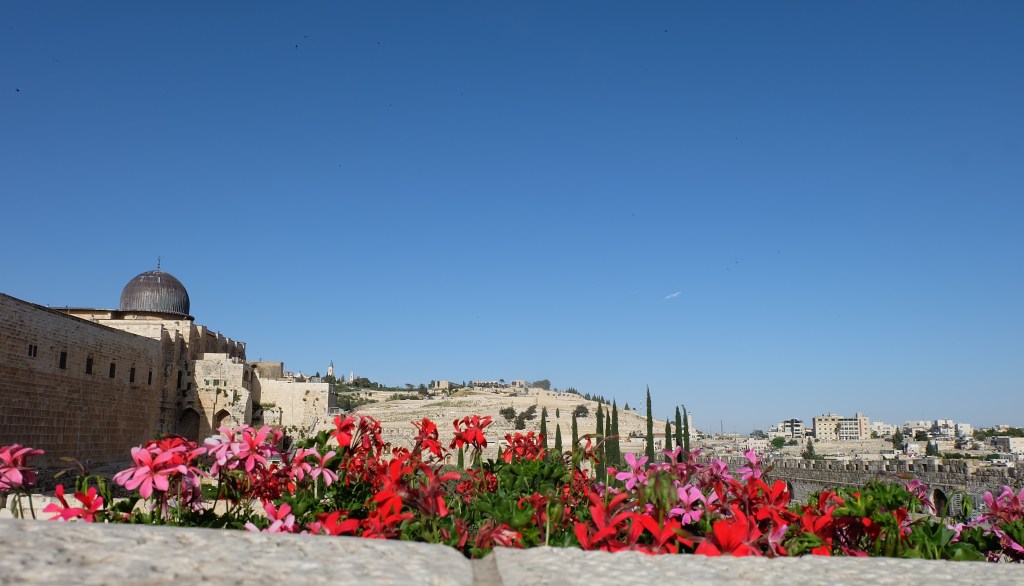
Photo by author, flowers at Church of Gallicantu near Jerusalem, May 2019.
Intimacy with Jesus Christ in the Holy Spirit
For the first time, Jesus promised during their Last Supper the sending of the Holy Spirit when he fulfills his mission.
In most translations, the Holy Spirit is referred to as Advocate although some prefer the transliteration Paraclete from its original Greek Parakletos to truly capture its full meaning or context.
Only St. John used the word Parakletos to denote the Holy Spirit. In its Hellenistic context, Parakletos had come to be known as Advocate like a lawyer or a friend who speaks on behalf of the “accused” like Jesus in a hostile world (Jn.16:7-11).
However, St. John also used parakletos in different contexts like in our gospel today.
See how before introducing to us the sending of the Holy Spirit, Jesus speaks more of a grand instruction – in fact, a reality, a truth in the life of his every disciple: “If you love me, you will keep my commandments” (Jn.14:15).
Without specifying any commandments to keep, Jesus further explained that “Whoever has my commandments and observes them is the one who loves me” (Jn.14:21). He would be speaking of this like a refrain four more times later to stress that loving Jesus is keeping his commandments.
It is a very difficult task to fulfill and most often, more difficult to understand or interpret especially when we are in real life-situations like loving an arrogant president or loving officials who break the rules of quarantine!
This is so because Jesus himself is the law, the commandments which is his very person; therefore, to love him is to be like him and that is always keeping his commandments of love.
And that is why Jesus made sure to inscribe this lesson and reality into his disciples’ memory and hearts during their last supper by promising the Holy Spirit he called as Parakletos who would be acting as his Advocate, Counsellor, and Comforter when he returns to the Father.
It is the Holy Spirit who leads us now into an intimacy with Christ that we are able to love Jesus, love like Jesus, and love in Jesus. This is the same Holy Spirit who binds the Three Persons of the Trinity in love who also makes us one with God and with others.
Photo from Facebook post by Ms. Marivic Tribiana, 17 April 2020 fire in Tondo area.
Making Jesus present in our love
We make Jesus most present when we love because when we love, everything changes for the best, even the most difficult and worst situations in life.
Albert Camus rightly said when he wrote in his 1947 novel The Plague now being reread due to the corona virus, that “A loveless world is a dead world.”
Without love, we would have gone extinct by now.
Because of love, every tragedy, every suffering and problem we go through leads to happy ending primarily because we discover something, someone beyond far more important than any situation or plight we may be into.
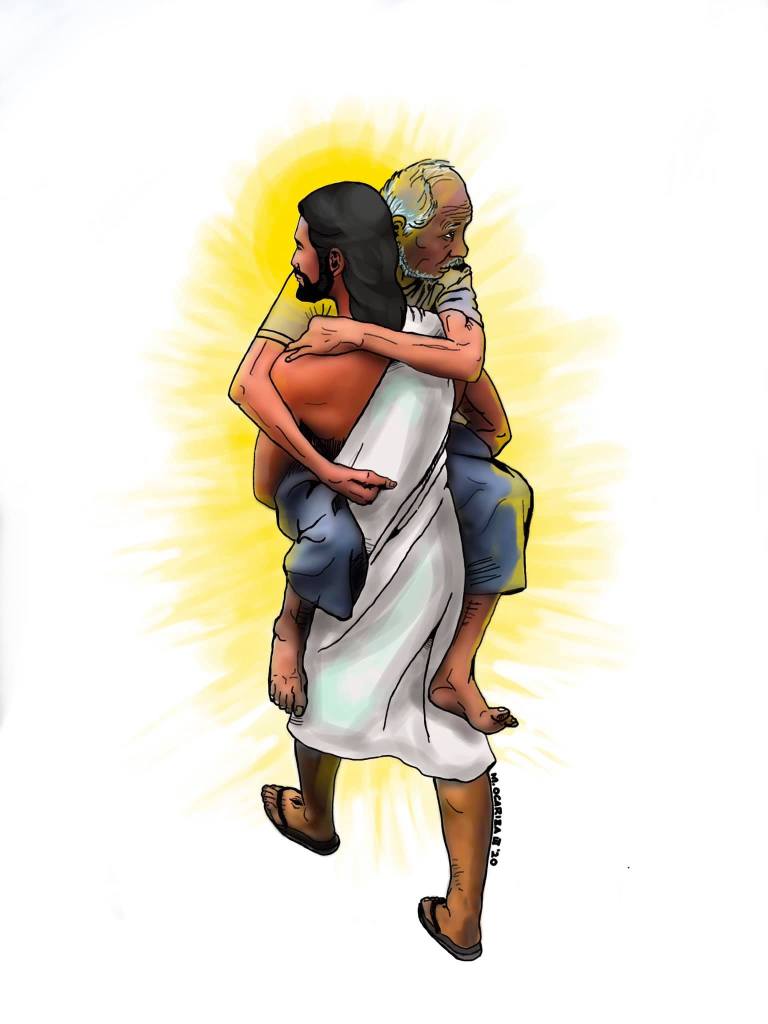
Artwork by Fr. Marc Ocariza upon seeing the FB post by Ms. Marivic Tribiana above on the eve of Divine Mercy Sunday 2020.
Most of all, love has a distinctive characteristic that moves the lover to become like the beloved. This is the reason why we who love strive harder, persevere and forge into every obstacle and fight until we are one with our beloved!
And who is ultimately our very love?
God.
The God revealed to us by Jesus Christ his Son who became human like us to be one with us in everything including death except sin so that we become like him – divine – in his Resurrection.
Jesus Christ whom we “sanctify as Lord in our hearts” (1Pt.3:15) is the one we imitate and follow, the one we see and, most of all, the only one we (must) share when we love, when we serve especially in this time of the corona pandemic.
Sometimes, it is still difficult to believe how these pandemic and quarantine are happening to us when all of a sudden here comes typhoon Ambo that wreaked a path of destruction in the Visayas and Bicolandia the other day, making us wonder what is happening in the world right now?
Making things worst that have stressed us all so much is our government at all levels lacking preparations, with some officials into alleged corruptions while the enforcers of the laws are the ones breaking all the rules of quarantine!
We just keep on hoping things would get better by starting right at our own end.
Sometimes it can be funny although painful when some people forget us or take us for granted, thinking we are fine or doing great without any hint of the sufferings within.
But the grace is always there because Jesus is within each one of us who believes in him and tries hard to keep his commandments.
“In a little while the world will no longer see me, but you will see me, because I live and you will live. On that day you will realize that I am in my Father and you are in me and I in you.”
John 14:19-20
We just have to do our part, to keep on believing in Jesus, loving Jesus, and most of all, keeping his commandments because Jesus is the “explanation to anyone who asks us for a reason for our hope” (1Pt.3:15).
This does not mean the world is lacking the Lord’s presence.
He has not left us indeed and sooner or later, we shall see how he, the God of history, will direct everything according to his greater plan for us.
Today’s gospel reminds us of his assurance to be with us always in the Holy Spirit.
It is now our turn to pick up the pieces and make him more felt, especially in comforting those affected severely by the many storms that hit us in this time of the corona virus.
Have a blessed Sunday and stay safe! Amen.
Photo from CBCPNews of the debris left by Typhoon Ambo in Arteche, Eastern Samar, 14 May 2020.
Quiet Storm by Fr. Nicanor F. Lalog II, 03 May 2020
Photo by author, Parokya ni San Juan Apostol at Ebanghelista, Bagbaguin, Santa Maria, Bulacan. April 2020.
Against the advice of good friends, I went out to distribute Holy Communion in the streets to some parishioners who have participated in our Sunday Mass early this morning at Facebook Live.
I know the risks involved despite our best efforts in having all the precautionary measures but, what convinced me to go on with it is a beautiful Psalm so appropriate during this quarantine period.
As the deer longs for streams of water, so my soul longs for you, O God.
My being thirsts for God, the living God. When can I go and see the face of God?
And when our quarantine period was extended for the second time before the end of Holy Week last month, I began praying again Psalm 42 every night for that is when I truly long for God so much, most of the time lamenting to him our situation, my condition of being alone in my rectory.
This is the first time I felt like this, so different from those so-called “desolation” or “dryness” because I could feel God present in my prayers but… he is not “fresh”.
Like the deer longing for streams of water, my soul longs for God too.
Not just like the water we buy from a filling station but exactly what the deer yearns for — fresh water that is refreshingly cool not only on your face but deep into your body when sipped amid the burbling sounds of the spring, babbling through rocks and branches of trees with the loamy aroma of earth adding a dash of freshness in you.
Admittedly, sometimes I wonder if I still know how to pray or if I still pray at all!
I can feel God present but he is like someone stacked there in my mind, in my memory, in my ideas shaped by my years of learning and praying.
What I am longing for is a God so alive, so true not only in me but also in another person.
And that is when I realized, most likely, my parishioners must be longing for God too in the same way — the God we all come to meet and celebrate with every Sunday in our little parish, among the people present who are so alive, so vibrant, so true, so touching.
Our empty church since March due to COVID-19.
Psalm 42 is believed to have been sang by David when he was prevented from coming to the tent of God either during the reign of King Saul who plotted to kill him or during the revolt of his own son Absalom when he was already the king of Israel.
Like David or the psalmist, I miss celebrating Mass with my parishioners.
And maybe it is safe to assume that two or three of my parishioners are also feeling the same way with me and David, saying these to the Lord:
My tears have been my food day and night, as they ask daily, “Where is your God?”
Those times I recall as I pour out my soul,
When I went in procession with the crowd, I went with them to the house of God,
Amid loud cries of thanksgiving, with the multitude keeping festival.
Psalm 42:4-5
If there is one very essential thing this pandemic has brought back to us in our very busy lives, it is most certainly God. And if ever this is one thing people need most in this time of corona virus, it is spiritual guidance and nourishment from God through his priests.
Of course, people can pray and talk to God straight as the Pope had reminded us before Holy Week.
But, human as we are, we always experience God and his love, his kindness, his mercy, his presence among other people who guide us and join us in our spiritual journey. They are special people like friends or relatives or pastors with whom they can be themselves, let off some steam, get some rays of light of hope and encouragement.
And that this is why I try to keep in touch with my parishioners in various ways in this time of corona: even I myself can feel so low and dark despite my prayers and very condition of living right here in the house of God who can still feel alone and desolate, even depressed.
If I – a priest – go through all these uncertainties and doubts this in this time of quarantine, how much more are the people, the beloved sheep of Jesus the Good Shepherd?
Why are you downcast, my soul; why do you groan within me?
Wait for God, whom I shall praise again, my savior and my God.
Psalm 42:6
Photo by Ms. Ria De Vera, 10 April 2020.
After our Mass this morning when we set out to distribute the Holy Communion, there was a little drizzle. It did not last long that I just wore a hat and left my umbrella in the rectory.
There were about 30 people who waited for us to receive Holy Communion, most of them along the main highway that stretched to about 2 kilometers. Some families gathered with a little altar at their front gate while a waited a couple waited in a gas station along our route.
In less than 20 minutes, we have completed our mission and as we headed back to the parish, the rains fell again, this time stronger than before.
My driver commented, “The weather cooperated with us, Father”1
I just nodded my head to him inside his tricycle but deep inside me, I felt joy because God answered my prayer, my lamentations for he was crying too, – for me and his people.
May this lamentation be an answer to your lamentations during this pandemic of COVID-19.
Continue with your lamentations to God our Father for this very act of crying out to him is the working of the Holy Spirit he had sent us through our Lord Christ Jesus. Amen.
Tonight is “Spy Wednesday” – the night traitors and betrayers are put on the spotlight because it was on this night after Palm Sunday when Judas Iscariot struck a deal with the chief priests to hand them over Jesus for 30 pieces of silver (Mt. 26:14-16).
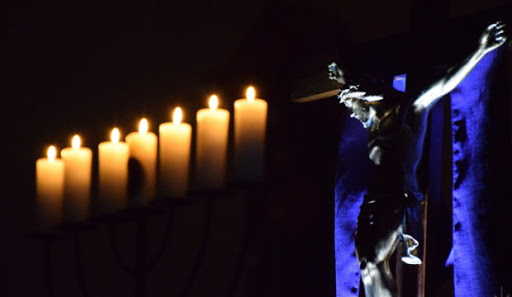
The “Tenebrae” is celebrated in some churches when candles are gradually extinguished with the beating of drums and sounding of matraca to evoke silence and some fear among people as they leave in total darkness to signal the temporary victory of evil in the world for tomorrow we enter the Paschal Triduum of Holy Thursday, Good Friday and Easter Vigil of the Lord.
From Google.
Darkness generally evokes evil and sin, uncertainties and sufferings. But, at the same time, darkness preludes light!
That is why Jesus Christ was born during the darkest night of the year to bring us light of salvation.
Beginning tonight, especially tomorrow at his agony in the garden, we shall see Christ entering through darkness reaching its climax on Friday when he dies on the cross with the whole earth covered in darkness, rising on Easter in all his glory and majesty.
Our present situation in an extended Luzon-wide lockdown offers us this unique experience of darkness within and without where we can learn some important lessons from the Lord’s dark hours beginning tomorrow evening of his Last Supper.
St. John gives us a glimpse into how we must deal with life’s darkness that plagues us almost daily with his unique story of the Lord’s washing of his disciples’ feet on the night he was betrayed.
Before the feast of Passover, Jesus knew that his hour had come to pass from this world to the Father. He loved his own in the world and he loved them to the end. The devil had already induced Judas, son of Simon the Iscariot, to hand him over. So, during supper… he rose from supper and took off his outer garments. He took a towel and tied it around his waist. Then he poured water into a basin and began to wash the disciples’ feet and dry them with the towel around his waist. He came to Simon Peter…
John 13:1-2, 4-6
Photo from aleteia.org.
It is very interesting to reflect how Judas Iscariot and Simon Peter dealt with their own inner darkness on that night of Holy Thursday when Jesus was arrested.
Though Judas Iscariot and Simon Peter are poles apart in their personalities, they both give us some traits that are so characteristic also of our very selves when we are in darkness. In the end, we shall see how Jesus turned the darkness of Holy Thursday into becoming the very light of Easter.
Getting lost in darkness like Judas Iscariot
Right after explaining the meaning of his washing of their feet and exhorting them to do the same to one another, Jesus begins to speak of Judas Iscariot as his betrayer.
When he had said this, Jesus was deeply troubled and testified, “Amen, amen, I say to you, one of you will betray me …It is the one to whom I hand the morsel after I had dipped it.” So he dipped the morsel and handed it to Judas, son of Simon the Iscariot. After he took the morsel, Satan entered him… and left at once. And it was night.
John 13:21, 26-27, 30
Photo from desiringgod.org
The scene is very dramatic.
Imagine the darkness outside the streets of Jerusalem in the stillness of the night and the darkness inside the Upper Room where they were staying.
More darker than that was the darkness among the Apostles not understanding what Jesus was saying about his betrayer because they thought when Judas left, he was being told to buy more wine or give money to the poor!
Most of all, imagine the darkness within Judas.
To betray means to hand over to suffering someone dear to you.
That’s one darkness we always have within, of betraying Jesus, betraying our loved ones because we have found somebody else to love more than them. Satan had taken over Judas. The same thing happens to us when we sin, when we love someone more than those who truly love us or those we have vowed to love always.
And the darkest darkness of all is after handing over our loved ones, after dumping them for something or somebody else, we realize deep within the beautiful light of truth and love imprinted in our hearts by our betrayed loved ones – then doubt it too!
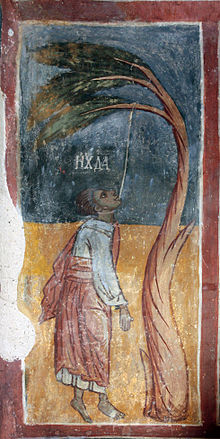
The flickering light of truth and love within is short lived that we immediately extinguish it, plunging us into total darkness of destruction like Judas when he hanged himself.
See how Judas went back to the chief priests because “he had sinned”, giving them back the 30 pieces of silver to regain Jesus.
Here we find the glow of Jesus, of his teachings and friendship within Judas still etched in his heart — the light of truth and love flickering within.
Any person along with their kindness and goodness like Jesus, our family and true friends can never be removed from one’s heart and person. They will always be there, sometimes spurting out in our unguarded moments because they are very true.
That is the darkest darkness of Judas – and of some of us – who think we can never be forgiven by God, that we are doomed, that there is no more hope and any chance at all.
See how the evangelist said it: “Judas left at once. And it was night.”
And that is getting lost in darkness permanently, eaten up by darkness within us because we refuse to believe in the reality of a loving and forgiving God who had come to plunge into the darkness of death to be one with us so we can be one in him. What a loss.
Groping in the dark into the light like Peter
Photo by author, Church of Gallicantu, Jerusalem where the cock crowed after Peter denied Jesus the third time, May 2017.
Of the Twelve, it is perhaps with Simon Peter we always find ourselves identified with: the eager beaver, almost a “bolero” type who is so good in speaking but many times cannot walk his talk.
“Master, are you going to wash my feet?” Jesus answered and said to him, “What I am doing, you do not understand now, but you will understand later.” Peter said to him, “You will never wash my feet.”
John 13:6-8
Here is Peter so typical of us: always assuming of knowing what is right, which is best, as if we have a monopoly of the light when in fact we are in darkness.
See how during the trial of Jesus before the priests, Peter denied him thrice, declaring he never knew Jesus while outside in the dark, completely in contrast with Jesus brilliantly answering every question and false accusation against him inside among his accusers!
Many times in our lives, it is so easy for us to speak on everything when we are in our comfort zones, safe and secured in our lives and career. But when left or thrown out into the harsh realities of life, we grope in the darkness of ignorance and incompetence, trials and difficulties.
How often we are like Peter refusing Jesus to wash our feet because we could not accept the Lord being so humble to do that simply because he is the Lord and Master who must never bow low before anyone.
And that is one darkness we refuse to let go now shaken and shattered by the pandemic lockdown! The people we used to look down upon are mostly now in the frontlines providing us with all the comforts we enjoy in this crisis like electricity, internet, security, food, and other basic services.
Bronze statue of the call of Peter by Jesus. Photo by author, May 2017.
We have always thought of the world, of peoples in hierarchy, in certain status where there are clear delineations and levels of importance, totally forgetting the lessons of Jesus of being like a child, of service and humility: “whoever wants to be great must be the least and servant of all.”
According to Matthew and Luke, Peter realized his sins – the darkness within him – of denying Jesus thrice after the cock crowed that he left the scene weeping bitterly, feeling so sorry. Eventually after Easter, Peter would meet Jesus again on the shores of the Lake of Tiberias, asking him thrice, “do you love me?”
Peter realized how dark his world has always been but in that instance when he declared his love that is so limited and weak did he finally see the light of Christ in his love and mercy!
Unlike Judas, Peter moved out of darkness and finally saw the light in the Risen Lord right in the very place where everything started when he was called to be a fisher of men, in his humanity as he was called by his original name, “Simon, son of Jonah, do you love me?”.
Human love is always imperfect and Jesus knows this perfectly well!
The best way to step out of darkness within us is to be like Simon — simply be your imperfect self, accepting one’s sins and weakness for that is when we can truly love Jesus who is the only one who can love us perfectly.
Overcoming darkness in, Jesus, with Jesus, through Jesus
Though the fourth gospel and the synoptic gospels of Matthew, Mark, and Luke differ in providing us with the transition from the Upper Room of the Last Supper into the agony in the garden, the four evangelists provide us with one clear message at how Jesus faced darkness: with prayer, of being one in the Father.
Even on the cross of widespread darkness, Jesus spoke only to pray to the Father.
Then Jesus came with them to a place called Gethsemane, and he said to his disciples, “Sit here while I go over there and pray.” He took along Peter and the two sons of Zebedee, and began to feel sorrow and distress.
Matthew 26:36-37
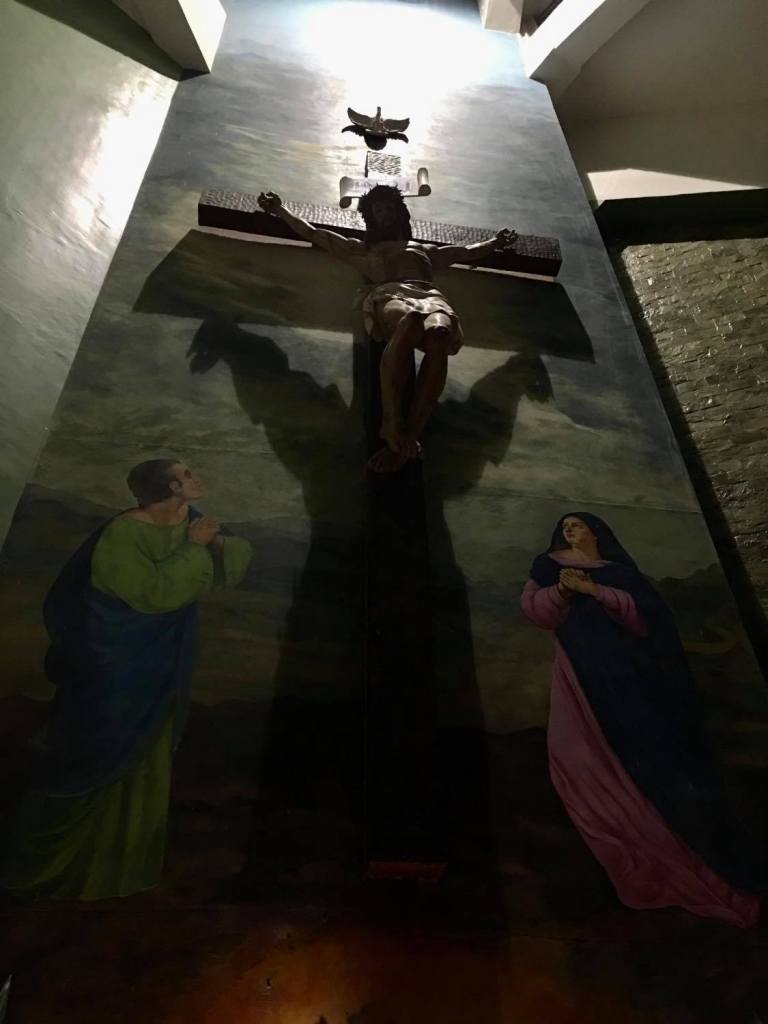
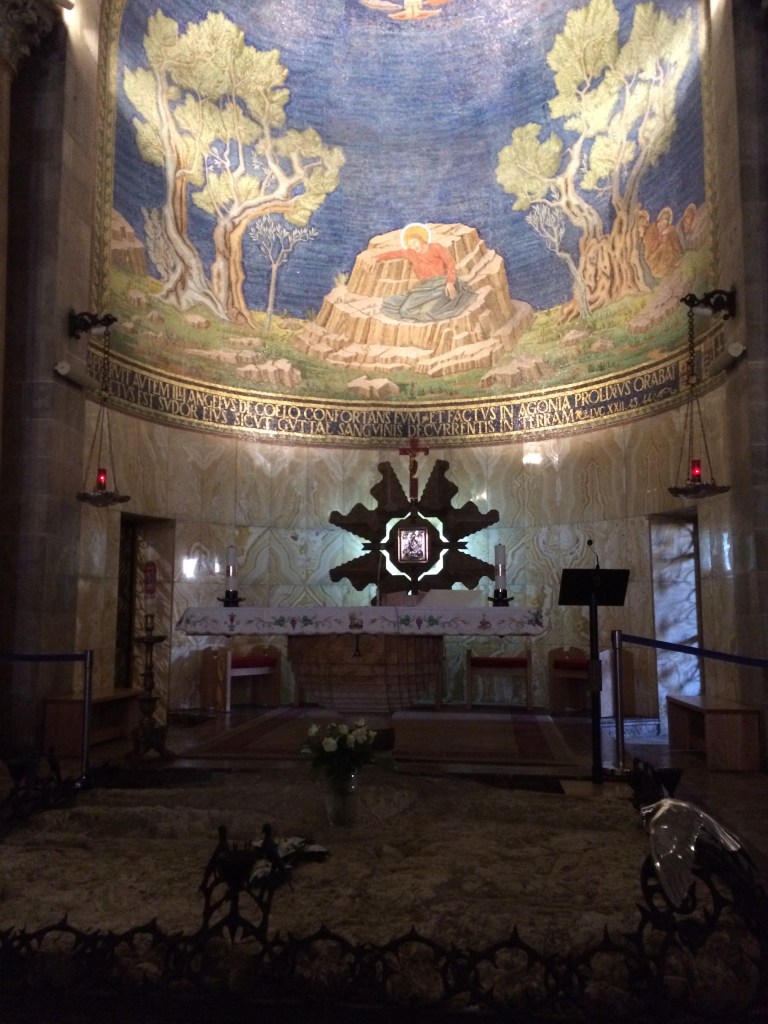
Photo by author, altar of the Church of All Nations beside the Garden of Gethsemane, May 2017. The church is always dimly lit to keep the sense of darkness during the Agony in the Garden of Jesus.
Before, darkness for man was seen more as a curse falling under the realm of evil and sin; but, with the coming of Jesus, darkness became a blessing, a prelude to the coming of light.
We have mentioned at the start of our reflection that Jesus was born during the darkest night of the year to show us he that is the light of the world, who had come to enlighten us in this widespread darkness, within us and outside us.
As the light of the world, Jesus was no stranger to darkness which he conquered and tamed in many instances like when they were caught in a storm at sea and in fact, when walked on water to join his disciples caught in another storm.
But most of all, Jesus had befriended darkness and made it a prelude to light.
How? By always praying during darkness. By prayer, it is more than reciting some prayers common during his time as a Jew but as a form of submission to the will of the Father. Jesus befriended darkness by setting aside, forgetting his very self to let the Father’s will be done.
Bass relief of agony in the garden on the wall of the Church of All Nations at Gethsemane. Photo by author, May 2019.
This he showed so well in two instances, first on Mount Tabor where he transfigured and second in Gethsemane before his arrest.
In both events, Jesus showed us the path to overcoming darkness is always through prayers, of being one in the Father.
It is in darkness when God is most closest to us because it is then when we get a glimpse of himself, of his love and mercy, of his own sufferings and pains, and of his glory.
This is something the three privileged disciples – Simon Peter, James and his brother John – did not realize while being with Jesus at both instances until after Easter. We are those three who always fall asleep, who could not keep with praying in Jesus, with Jesus, and through Jesus.
It was in the darkness of the night when Jesus spent most of his prayer periods, communing with the Father up in a mountain or a deserted place.
On Mount Tabor, Jesus showed his coming glory while in Gethsemane he showed his coming suffering and death. But whether in Gethsemane or on Mount Tabor, it is always Jesus we meet inviting us to share in his oneness with the Father, in his power in the Holy Spirit to overcome every darkness in life.
And the good news is he had already won for us!
Photo by Mr. Raffy Tima of GMA-7 News of Mt. Samat with the Memorial Cross across the Manila Bay following clear skies resulting from the lockdown imposed since March 17, 2020.
In these extended darker days of quarantine period, let us come to the Lord closer in prayer to. experience more of his Passion and Death, more of his darkness so we may see his coming glory when everything is finally cleared in this corona pandemic.
Prayer does not necessarily change things but primarily changes the person first. And that is when prayer changes everything when we become like Jesus in praying.
Jesus is asking us to leave everything behind, to forget one’s self anew to rediscover him in this darkness when we get out of our comfort zones to see the many sufferings he continues to endure with our brothers and sisters with lesser things in this life, with those in total darkness, with those groping in the dark.
Now more than ever, we have realized the beauty of poverty and simplicity, of persons than things.
And most especially of darkness itself becoming light for us in this tunnel.
May Jesus enlighten us and vanish all darkness in us so that soon, we shall celebrate together the joy of his coming again in this world darkened by sin. Amen.
Lawiswis ng Salita ni P. Nicanor F. Lalog, Parokya ni San Juan Apostol at Ebanghelista, Bagbaguin, Santa Maria, Bulacan
Martes, Ika-5 Linggo ng Kuwaresma, 31 Marso 2020
Bilang 21:4-9 ><)))*> +++ <*(((>< Juan 8:21-30
Ang eskultura ng ginawang ahas na tanso ni Moises sa tikin sa lugar kung saan mismo nangyari na ngayon nasa pangangalaga ng mga Paring Franciscano sa Jordan. Larawan kuha ng may-akda, Mayo 2019.
Batay sa salaysay ng aklat ng buhay
nainip mga Israelita sa paglalakbay sa ilang
nang sila ay dumaing, nagreklamo
kay Moises ng ganito:
"Kami ba'y inialis mo sa Egipto
upang patayin na ilang na ito?
Wala kaming makain ni mainom!
Sawa na kami sa walang kwentang pagkaing ito."
Bakit nga ba hindi na naubos
ating mga reklamo
lalo na kapag mayroong krisis
walang mintis yaring mga bibig
walang hanggang daing
tila hindi aabutin, napakamainipin
nakakasakit na ng damdamin
pati Diyos sinusubok, hinahamon natin?
Kung inyong mapapansin
yung talagang walang makain
hindi na makuhang dumaing
tanging isipin saan hahanapin
kanilang isasaing, lakas ay iipunin
sa pagbabaka-sakaling dinggin
dalanging tulong dumating
kanilang hahatiin at titipirin.
Ang masakit na kapansin-pansin
ngayong panahon ng COVID-19
marami sa mga daing ng daing
sa Facebook pinararating!
Akala mo walang makain
bakit nasa harapan ng computer screen?
Katulad nilang nagmamagaling
ibang natulungan may reklamo pa rin!
Magandang pagkakataon
kaloob nitong COVID-19 sa ating panahon
mabuksan puso at kalooban sa katotohanan
"Hindi lamang sa tinapay nabubuhay ang tao"
na kung uunahin natin si Kristo
makikilala natin bawat kapwa tao
ka-patid at ka-putol na dapat bahaginan
ano man mayroon ako.
Madalas sa maraming reklamo
puso ay sinarahan, pinanlalabuan ang isipan
bibig ang laging binubuksan, hindi mawalan ng laman
pinababayaan kaluluwa at kalooban
tiyan lamang nilalagyan
kaya walang kahulugan ni katuturan
ano mang karanasan hindi mapagyaman
kaunting hirap at tiisin, puro daing at hinaing.
Lawiswis ng Salita ni P. Nicanor F. Lalog II, Ika-23 ng Marso 2020
Larawan kuha ni Bb. Ria De Vera, Parokya ni San Juan Apostol at Ebanghelista, Bagbaguin, Santa Maria, Bulacan (22 Marso 2020).
Kahapon aking ipinagdiwang
ika-limamput-limang taon
ng kapanganakan sa
gitna nitong lockdown.
Wala akong inaasahang pagdiriwang
o ano mang kasiyahan maski walang lockdown
dahil hindi ko naman nakagisnan
mga gayong handaan sa aking kaarawan.
Mula kabataan lagi akong nagka-countdown
kinagabihan ng bisperas ng aking kaarawan
at saka mananalangin, magpapasalamat
sa Poong Maykapal sa buhay niyang kaloob.
Subalit aaminin ko rin
napakalungkot sa akin
na dahil sa COVID-19
walang nakapiling sa misa at pananalangin.
Larawan kuha ni Bb. Ria De Vera, Parokya ni San Juan Apostol at Ebanghelista, Bagbaguin, Santa Maria, Bulacan (22 Marso 2020).
Matapos Banal na Oras namin
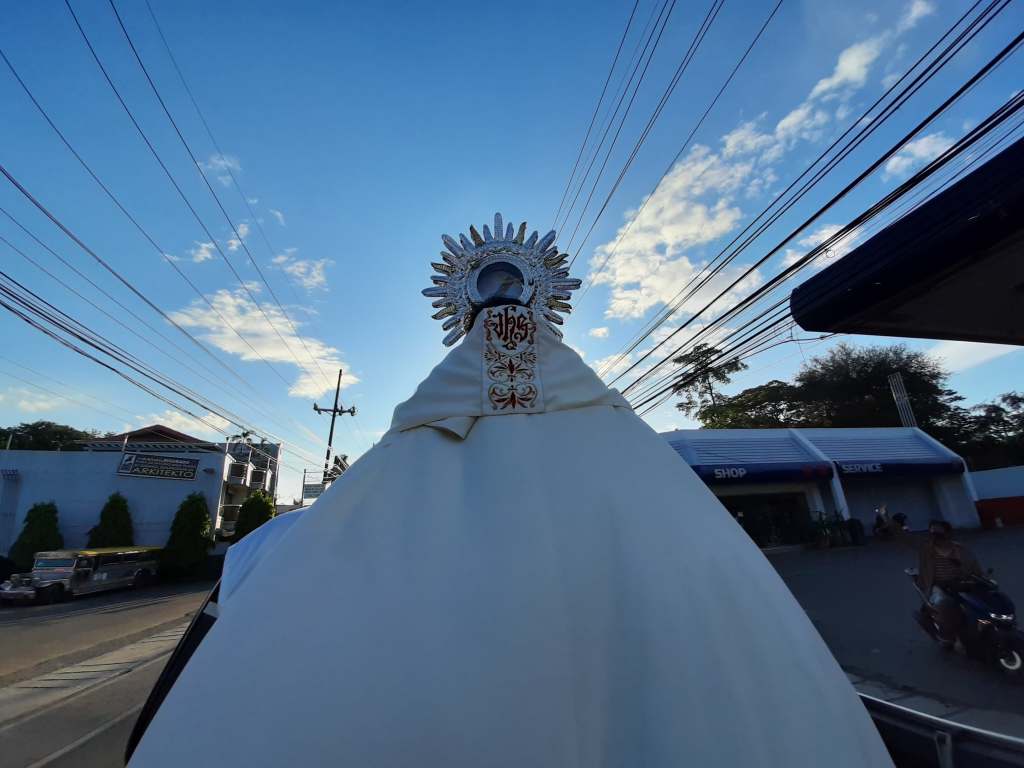
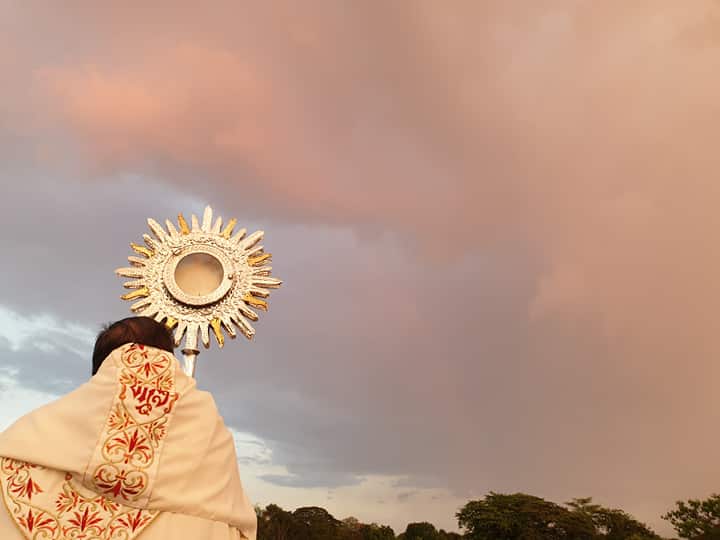
Banal na Sakramento inilibot sa parokya namin
noon ko nadama lambing at pagmamahal
ng Panginoon Hesus tumawag sa akin.
Habang tangan kanyang sisidlan
aking binubulong mga panalangin
sa kawan kanyang pinagkatiwala sa akin
nawa maligtas sa sakit sanhi nitong COVID-19.
Pagkagaling Purok ng Fatima
ibig ko sanang maglakad sa Balutan
ngunit biglang pumatak mga ulan
anong ganda ng aking nasilayan!
Mahiwagang bahag-hari
tumambad sa aming harapan
busilak ng magagandang kulay
naghatid ng aliw at katuwaan.
Larawan kuha ni Bb. Anne Ramos, Parokya ni San Juan Apostol at Ebanghelista, Bagbaguin, Santa Maria, Bulacan (22 Marso 2020).
Sa aking pagyuko,
bumukal sa aking puso
kakaibang katuwaan naramdaman
sadyang napaka hirap ilarawan.
Alam ninyo yung karanasan
minsan-minsan wala tayong alinlangan
sa isang iglap ating nalalaman katotohanan
ngunit kulang, walang sasapat na salita man lamang?
Tila baga sa aki'y nawika
waring nagpapaalala Panginoong Maylikha
tipan kanyang iniwan pagkaraan
ng delubyo at ulan:
Higit pa sa makulay na bahag-hari sa kalangitan
kahawig na larawan iniwan, katiyakang hindi tayo pababayaan
ating mamamasdan sa simbahan at tahanan
Krus pinagpakuan ni Hesus, sa atin nagtawid sa kaligtasan!
Parokya ni San Juan Apostol at Ebanghelista, 2019.
Soon afterward Jesus journeyed to a city called Nain, and his disciples and a large crowd accompanied him. As he drew near to the gate of the city, a man who had died was being carried out, the only son of his mother, and she was a widow. A large crowd from the city was with her. When the Lord saw her, he was moved with pity for her and said to her, “Do not weep.” He stepped forward and touched the coffin; at this the bearers halted, and he said, “Young man, I tell you, arise!” The dead man sat up and began to speak, and Jesus gave him to his mother. Fear seized them all, and they glorified God, exclaiming, “A great prophet has arisen in our midst,” and “God has visited his people.”
Luke 7:11-16
Today, we are like at the city of Nain. Traffic is so heavy outside as many of us – family and friends, former classmates, colleagues at work from all over and neighbors – gather to pray and pay our last respects for Archie.
Celebrating a funeral Mass for a young person is always difficult for me. Like Jesus, I feel so sad for their parents. Normally, it is the children who bury their parents. It must be so painful for parents burying a son or a daughter. That is why in our gospel, Jesus was “moved with pity” with the widow of Nain.
But today, amid the pains and sorrows with the sudden death of Archie last week at a very young age, we actually celebrate life in Jesus Christ.
Photo by author of the hills of Galilee from the Walls of Jerusalem, May 2017.
Jesus comes to visit us always
Like in that scene at Nain, we remember and celebrate the life of Archie who had come to visit us even for a short time.
I love that part of the gospel where the people at Nain exclaimed at how “God has visited his people” when Jesus raised the dead young man.
Jesus continues to visit us everyday through one another like Archie.
Despite his many sins and imperfections, Archie made us experience Jesus Christ’s love and friendship, warmth and kindness, especially to his two sons, family, and friends.
Surely, Jesus must have visited Archie, too, during those dark moments of his life.
And the good news is, Archie visited Jesus so often especially these last two years when he started to pick up the pieces of his life.
Last time I saw Archie was last November when he came to celebrate Mass in our Parish. And I have heard how he had sought spiritual guidance from Fr. Carl, driving that far to Paco every month as he renewed his relationship with Christ, trying to follow anew the Lord he had served since elementary as a sacristan and later as a seminarian in our high school seminary.
It is Jesus who first finds us always
Photo by author at Mt. St. Paul Spirituality Center, Baguio, 04 February 2020.
We all know Archie’s tocayo is one of ancient Greece’s great scientist and inventor, Archimedes.
It is said that he discovered the principle of buoyancy – the “Archimedes’ principle” – while taking a bath.
When Archimedes sat onto his bathtub, he observed that “when a body is submerged in a fluid, it experiences an apparent loss in weight that is equal to the weight of fluid displaced by the immersed body.”
Archimedes was so ecstatic with his accidental discovery that he jumped naked from his bathtub out to the streets, shouting “eureka!” or “I have found” the solution to a problem he was trying to solve at that time.
Archimedes had not only enriched the field of mathematics and sciences with his discoveries but also the English language with the word “eureka” or “eureka moment”: when somebody discovers something very significant in business and economics, the sciences especially medicine, and practically in every field and subject.
Most especially in life.
Photo by author, Mt. St. Paul Spirituality Center, Baguio, 04 February 2020.
Archie had the same eureka moment in life: he had found Jesus Christ again that he went back to Mass and Confessions.
He had found meaning in life again after losing hope and directions.
Most of all, Archie had found love again.
Like his namesake of ancient Greece, Archie is now exclaiming “eureka” ecstatically into heaven – naked – with nothing but the love and mercy of Jesus Christ who first found him and brought him back to life a few years ago.
Today as we bring the remains of Archie into his final resting place, we thank God who never stops looking for us, finding us so that we can find him again and finally rest in him.
Today it is Jesus who is most ecstatic of all because he is the first to have found Archie and that is why, he had called him back to him, never to get lost again.
But the souls of the just are in the hand of God, and no torment shall touch them. They seemed, in the view of the foolish, to be dead; and their passing away was thought an affliction and their going forth from us, utter destruction. But they are in peace. In the time of their visitation they shall shine.
Quiet Storm by Fr. Nick F. Lalog II, 03 February 2020
Detail of the Presentation painting by Italian artist Andrea Mantegna (1431-1506) with Mary handing the Child Jesus to Simeon at the temple of Jerusalem (man at the middle Mary’s husband, Joseph).
As we come to close today’s Feast of the Presentation of the Lord, I wish to share with you a Quiet Storm brewing within me which I call “the Nunc Dimittis experience”.
Nunc dimittis is the Latin opening line of Simeon’s Canticle that says “Now you dismiss” when he was filled with joy by the Holy Spirit upon meeting our Lord and Savior on his presentation at the temple.
According to St. Luke’s account, God had promised Simeon that “he would not see death before he had seen the Christ of the Lord” (Lk. 2:26). Hence, the overflowing joy of Simeon when he finally met the Child Jesus at the temple 40 days after Christmas!
Part of St. Luke’s artistry in his Christmas story is to put songs on the lips of some of its important characters to express their profound joys in their unique experiences of the coming of Christ.
The Nunc Dimittis is the fourth canticle in the Lucan Christmas story: first is Mary’s Magnificat when she visited her cousin Elizabeth who was six months pregnant with St. John the Baptizer; second is the Benedictus by Zechariah when he regained his speech after naming his son John; and third is the Gloria sang by the angels when Christ was born in Bethlehem.
Of these four canticles recorded by St. Luke, Simeon’s Nunc Dimittis sounds the highest level of all, the fulfillment of time within each one of us when we personally recognize and meet Jesus the Christ our Savior like Simeon.
And so often, when we are overjoyed in experiencing Jesus Christ, that is also when we feel like saying “now I am ready to go, ready to die” exactly like Simeon because we have met the Lord.
That is why I call it “the Nunc Dimittis experience”: real joy can only come from that experience and intimacy with Jesus Christ, when we feel so close with him. It does not really matter whether we experience him here in this life or hereafter. What matters most is we feel so close with him, as if embracing him, here and now.
This may be a religious experience like after listening to a homily that really touched us, or after a good confession, or while attending a wonderful retreat or recollection. It may also happen when we feel so loved and accepted, when we are vindicated, or when assured of support and trust and confidence while going through difficult trials in life.
Our Nunc dimittis experience always comes at the end of each day, when we feel despite our failures and shortcomings, we are in God’s loving presence.
Simeon’s Canticle, our Night Prayer
Since the early sixth century during the time of St. Benedict, the “Nunc Dimittis” has been sung in the monks’ night prayer or “compline” from the Latin completorium or completion of the working day. Eventually, it was adopted into the Liturgy of the Hours or the prayers of the Church usually recited by priests and religious. (St. John Paul II had suggested in his encyclical Novo Millennio Innuete after the Great Jubilee of 2000 that the lay faithful also pray the Liturgy of the Hours.)
After the praying of the psalms and meditation of the Sacred Scriptures, there is a Responsory that declares, “Into your hands, Lord, I commend my spirit.” Like Jesus before he died on the Cross, we offer to God our very selves. This is takes on a beautiful dimension especially if we have done a good examination of conscience at the start of the compline, before the psalms and readings.
Then, we recite the antiphon that introduces the Nunc dimittis: “Protect us, Lord, as we stay awake; watch over us as we sleep, that awake, we may keep watch with Christ, and asleep, rest in his peace.”
The antiphon in itself is already a prayer!
It is after the antiphon that we chant or recite Simeon’s Canticle:
Lord, now you let your servant go in peace; your word has been fulfilled: my own eyes have seen the salvation which you have prepared in the sight of every people: a light to reveal you to the nations and the glory of your people Israel.
From the Compline of the Breviary
The antiphon is repeated and immediately followed by the Closing Prayer.
The cross atop our parish church at night with the moon above taken with my iPhone camera, 02 February 2020.
Capping the compline is the blessing at the end that says: “May the all-powerful Lord grant us a restful night and a peaceful death. Amen.”
Usually, a hymn to Mary is sung, then all the lights are turned off and the great silence (magnum silencium) begins until the morning prayers or lauds (Latin for praise).
See how our night prayer or the compline is oriented towards meeting God, or to put it bluntly, towards death.
Yes, it is always easy to say we are ready to die. It is a lot whole different when we are already face to face with death itself.
But, when we come to think of it, we realize that indeed, in death, “there is nothing to fear but fear itself”.
When we die, everything happens so fast. We may not even feel anything at all. And unknown to us, every night when we go to sleep, we rehearse our death, so to speak!
And what a tremendous joy to keep in mind how every night, the Lord fills us with joy and faith within us even if we often forget him. Every night when we sleep, it is automatic within us to entrust everything to God “unconsciously” without even thinking we may never wake up!
It is a “Nunc Dimittis” experience too because most of us go to bed filled with joy, full of hope the following morning would be a better day than today. And that is Jesus still coming to us at the end of the day to assure us of his love and concern, never bothering us at all of this tremendous grace gratuitously given to us.
Next time you sleep, remember how blessed you are to have come to the end of another day, blessed and loved.
Pray, and start experiencing Jesus more from the beginning to the end of each day and forevermore. Amen.
1 John 5:5-13 ><)))*> ><)))*> ><)))*> Luke 5:12-16
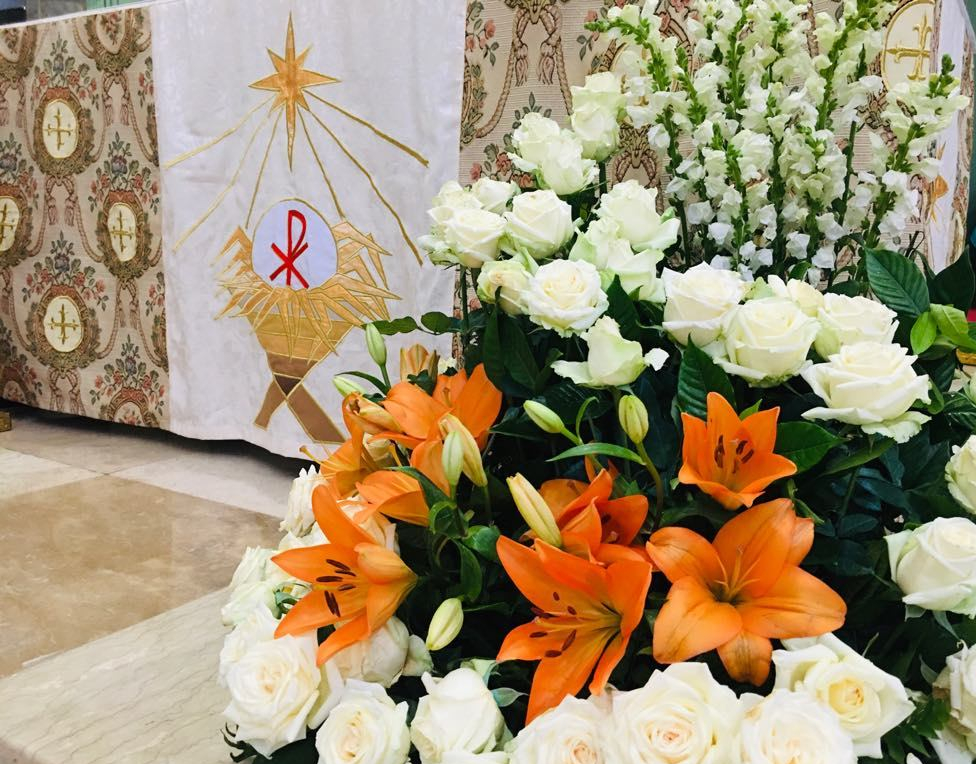
Flowers at our Altar, Epiphany Sunday 2020. Photo by author.
Dearest Jesus Christ:
Today we pray for those losing hope in life, for those about to give up living because they are saddled with so many problems and sufferings.
And most especially with sins and guilt feelings as carryover of the troublesome 2019.
We pray for those who cannot move on with their lives due to so many heartaches and losses and wrongs last year that they see themselves so dirty like the leper in the gospel today, refusing to aspire to become better, refusing to dream again of good things in you.
It happened that there was a man full of leprosy in one of the towns where Jesus was; and when he saw Jesus, he fell prostrate, pleaded with him, and said, “Lord, if you wish, you can make me clean.”
Luke 5:12
“Lord, if you wish, you can make me clean…
Forgive us Lord when sometimes we seem so hopeless.
“Kung ibig ninyo… kung ano po ang gusto ninyo… bahala na po kayo.”
Flowers at our Altar, Epiphany 2020. Photo by author.
Help us remember St. John’s reminder in the first reading that you, O sweet Jesus, is our life because you are the only one to whom “there are three who testify, the Spirit, the water, and the Blood”(1 Jn. 5:7-8) that refer respectively to your divine nature, human nature, and death on the cross.
You are the only one, Lord Jesus, who has overcome death because you are indeed Life itself!
Thank you very much for always willing the best for us and may we reclaim your wonderful gift of life to us daily. Amen.
Quiet Storm by Fr. Nicanor F. Lalog II, 27 December 2019
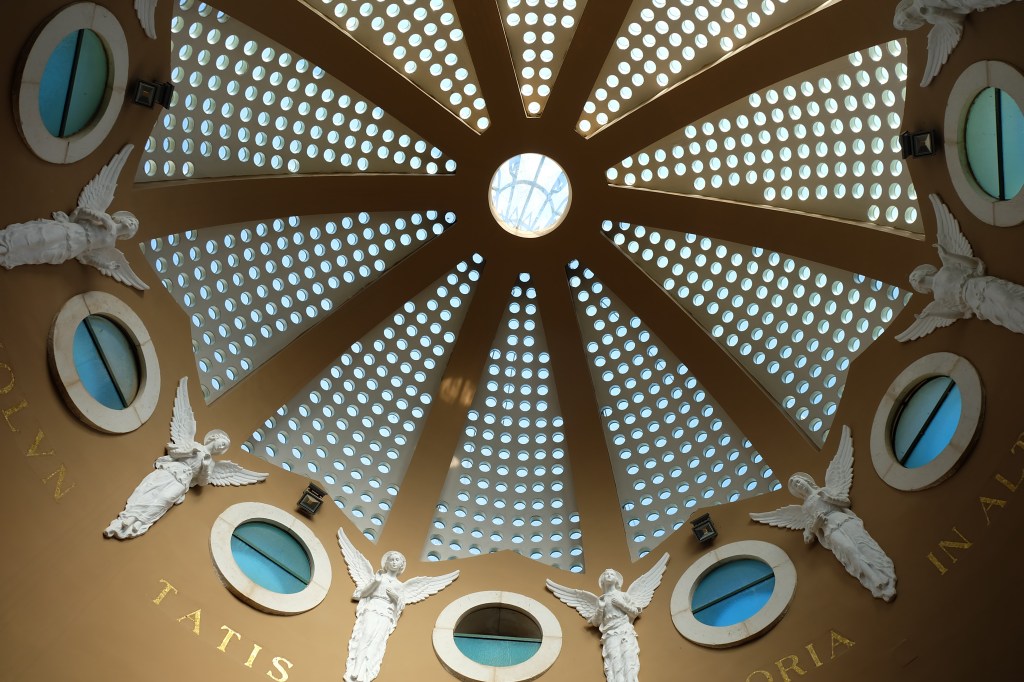
Dome of the chapel at Shepherd’s Field near Bethlehem where the angels appeared to some shepherds to announce the birth of Jesus Christ more than 2000 years ago.
By this time, many of you must have opened the gifts you have received this Christmas. Some are happy, some are not – even disappointed – while there are others who simply do not care at all with the gifts they have received.
But gifts are not everything. What really matters most are the persons and the love and thoughts that come with every gift we have received this blessed season.
Below are some spiritual gifts I feel we need to be thankful too!
The “little door” that leads into the Church of Nativity in Bethlehem that has come to mean the need to bow low and be humble in order to meet Jesus Christ not only inside but also in our daily life. Photo by author, May 2019.
The gift of hope. Hope is not thinking positively that things can get better like the weather. Hope is having a firm belief that even if things get worst, there is God who always loves us, who takes care of us. People with hope always look forward in the future whether here or in eternal life. They are also the most loving people around, the most understanding and most forgiving. They always strive, work hard to make things better for them and for others. Those without hope are the most evil: they will kill and destroy everything and everyone because they have nothing to look forward to in this life or hereafter. The kind of life we live always indicates the kind of hope we have. Or do not have.
The gift of desert. Sometimes, life becomes a desert for us, when we are desolate and so barren with everything dry and even lifeless. But it is during our desert moments in life when we not only meet our true selves but most of all, that is when we meet God. It is in this meeting with God in our desert we experience healing from all our hurts and disappointments in life. We need to withdraw once in a while to our desert to silently pray in order to hear God’s voice anew in our inner selves. In our mass mediated world today when we are bombarded with wants and needs to be rich and famous, the more we end up empty and lost. But when we dare stay in our desert and try to listen in silence, the more we are attuned with life’s realities, the more we are enriched and deepened in our lives.
The gift of intimacy. From our desert experiences of barrenness and desolation, of silence and prayer, and a lot of reflections and introspections come the great gift of intimacy with God and with others. We come to realize who our true friends are when our chips are down, when we are alone and badly bruised and beaten in life. How ironic that when we are so filled with material things, that is when life for us becomes superficial and shallow. But whenever we go through many desert storms, that is when we come to realize the most important in life – the persons who have touched us for better or for worse, the persons who make us experience to be loved and to love.
An oasis at the Dead Sea desert. Photo by author, May 2017.
We shall continue with our other lists of spiritual gifts this Christmas tomorrow.
How about you, what are the spiritual gifts you wish to share with us that may also help us deepen our Christmas celebrations this 2019?























 lordmychef.com