Forgiving from the heart

The Lord Is My Chef Sunday Recipe for the Soul by Fr. Nicanor F. Lalog II
Week XXIV, Cycle A in Ordinary Time, 13 September 2020
Sirach 27:30-28:7     >><)))*>   Romans 14:7-9   >><)))*>   Matthew 18:21-35
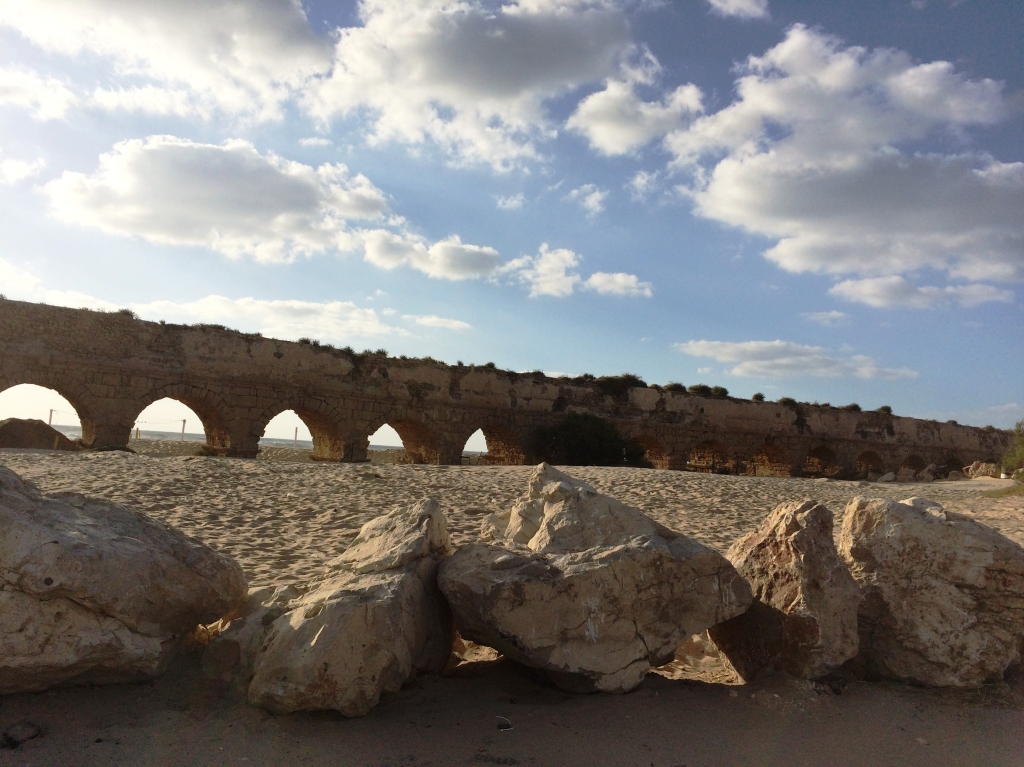
Photo by author, dusk in our parish, July 2020.

This Sunday we go deeper into the lessons gathered by Matthew from Jesus regarding love as the basis of our relationships. Last week we were told how mutual love is the sole reason why we correct brothers and sisters going stray in life.

But, more sensitive and delicate, not to mention most difficult than fraternal correction is the question of forgiving.

How many times should we forgive?

Peter approached Jesus and asked him, “Lord, if my brother sins against me, how often must I forgive? As many as seven times?” Jesus answered, “I say to you, not seven times but seventy-seven times. That is why the kingdom of heaven may be likened to a kind who decided to settle accounts wit his servants. When he began the accounting, a debtor was brought before hm who owed him a huge amount. Since he had no way of paying it back, his master ordered him to be sold, along with his wife, his children, and all is property, in payment of the debt. At that, the servant fell down, did him homage, and said, ‘Be patient with me, and I will pay you back in full.’ Moved with compassion the master of that servant let him go and forgave him the loan.

Matthew 18:21-27

Forgiving is always difficult because it is from God, calling us to be one with him, one in him, and be like him as that saying perfectly summed up, “To err is human, to forgive is divine.” It is beyond human abilities, reserved only for God until he became human like us in Jesus Christ who made us share in his greatest expression of love which is forgiveness. Hence, every time we forgive, we also become like God, divine and holy that unfortunately, we refuse and even hate!

Yes, it is very difficult because like love, forgiving is the nature of God. In fact, any kind of love is best expressed when it is forgiving. The good news is that we now share in this great love of God in forgiving others like him as we shall see in today’s parable, keeping in mind also that it was the Risen Lord’s commission to his disciples when he appeared to them on that Easter evening (John 20:22-23).

Photo by author, Baguio Cathedral, January 2018.

Forgiving like God our Father

The beauty of forgiving is that it is always a grace from God freely given to us. It is doable in Jesus Christ. The problem is when we refuse to let God work in us, when we refuse to level up our relationships to that of brothers and sisters in Jesus Christ.

There is always that pride in us exhibited by Peter at the start of the gospel today when he asked Jesus how many times he must forgive his brother. Must it be seven times?

Of course, seven being a “perfect number” does not specify a numerical figure of times to forgive except that it gives enough room to let go of a sinner or an offender. However, it still connotes some form of “counting” or taking tabs at how many times must one forgive, implying a limit.

But Jesus pushed it further when he told Peter to forgive “not seven times but seventy-seven times” — that is, twice the perfect number he had cited!

The Lord is telling Peter, and us today, to forget all about keeping tabs, of counting how many times you must forgive because God forgives us without limits which his parable tells us.

The king or master in the parable is God, so wealthy that he could lend sums exceeding the normal level of what one can borrow. Most surprising is like God, the master lent so much amount beyond the debtor’s ability to pay!

That is how rich our God is — so rich in love and mercy, giving us with so much even beyond our ability to pay him back in return. Exactly what we have in the responsorial psalm: “The Lord is kind and merciful; slow to anger and rich in compassion.”

And when that servant prostrated before his master, then the more we see in that religious gesture the deeper meaning of the parable: the rich mercy of God forgiving us for our debts even after we have lost everything like that debtor with nothing enough to pay his loans, not even his wife and children.

See the contrast of the king moved with compassion echoing the same attitude of Jesus so often like in the wilderness where he fed more than 5000 people and that servant so lost with nothing else left but still forgiven.

The parable could have stopped there but Jesus went on to continue what happened next to teach us the deeper truth of forgiving, which is imitating God our Father because we are brothers and sisters in him.

From Google.

When this servant had left, he found one of his fellow servants who owed him a much smaller amount. He seized him and started to choke him, demanding, ‘Pay back what you owe.’ Falling to his knees, his fellow servant begged him… but he refused. Instead, he had the fellow servant put in prison until he paid back the debt. Now when his fellow servants saw what had happened, they were deeply disturbed, and went to their master and reported the whole affair. His master summoned him and said to him, ‘You wicked servant! I forgave you your entire debt because you begged me to. should you not have had pity on your fellow servant, as I had pity on you?’ Then in anger is master handed him over to the torturers until he should pay back the whole debt. So will my heavenly Father do to you, unless each of you forgives his brother from his heart.”

Matthew 18:28-35

Forgiving from the heart

After hearing the second part of the parable, we all felt like the master, angry and indignant with that merciless servant whose action was very shameless and scandalous. But, more than being like the king who properly judged the conduct of that merciless servant, Jesus is also inviting us to probe deeper into our hearts the realities why we felt like the king in the parable?

How many times have we felt so angry and frustrated during this pandemic period at the many occasions when we heard news of injustices and abuse of powers against the little ones like Mang Dodong or the Marawi verteran shot to death in Quezon City? Of those punished in violating the protocols when its chief implementor got away free after attending a mañanita party?

The list goes on specially in our country where laws favor the abusive rich and powerful, those with connections while ordinary citizens with lesser violations, even without any crimes at all suffer the same fate as the servant with lesser debts.

Photo by author, “patak-dugo”, 2019.

We all feel so angry and very sad because more than the injustices and lack of mercies committed by those in powers, they have forgotten we are brothers and sisters in one God our Father. Parang sila lang ang anak ng Diyos…

We feel like the king in the parable because we felt left out, disregarded, and disrespected despite our kindness and mercy with others.

Forgiving from the heart means to forgive others not because we are fellow servants but most of all as brothers and sisters of a loving and merciful Father who forgives us always from our unpayable debts of sin and evil against each other.

This is the very thing St. Paul is telling us in the second reading, that “None of us lives for oneself, and no one dies for oneself” (Rom.14:7). Sometimes we need to be in control of our lives but the truth is, when we try to live St. Paul’s message that our lives belong to one another in Christ, the more we become truly free and happy.

It is the same reminder from Ben Sirach in the first reading telling us how we must avoid anger and resentment specially revenge because it is contrary to our faith in God. Most of all, we also know so well that we need the mercy of God in forgiving our countless sins.

The example of St. John Paul II about forgiving like God

I know what I am telling you are easier said than done. And I confess that I also find it so hard to forgive people who have wronged me, specially those I have loved and helped. Allow me to end this reflection with this beautiful bit of history that happened in our lifetime.

We were in high school seminary when Mehmet Agca shot and almost killed St. John Paul II at St. Peter’s Square on May 13, 1981. We were shocked, so sad for him and very angry with Agca. But, two years later after Christmas in 1983, we were more shocked in disbelief while at the same time in tears with joy when news came out that St. John Paul II came to visit Agca in his cell to forgive him!

It was a major news that landed on TIME magazine the following year with the cover story so relevant with our gospel today:

From Pinterest.

Those who do not forgive are those who are least capable of changing the circumstances of their lives…

Not to forgive is to be imprisoned by the past, by old grievances that do not permit life to proceed with new business.

Not to forgive is to yield oneself to another’s control. If one does not forgive, then one is controlled by the other’s initiatives and is locked into a sequence of act and response, of outrage and revenge, tit for tat, escalating always. The present is endlessly overwhelmed and devoured by the past. Forgiveness frees the forgiver. It extracts the forgiver from someone else’s nightmare. “Unless there is a breach with the evil past,” says Donald Shriver, “all we get is this stuttering repetition of evil.”

Lance Morrow, TIME Magazine, 19 January 1984

As I searched for photos of the assassination attempt on him by Agca, I came across this photo below of their meeting with an accompanying report that made me admire and love St. “JP2” more than ever.

It said that while recuperating in the hospital, St. JP2 learned from the news how people hated Agca, prompting him to ask everyone to “pray for my brother (Agca)… whom I have sincerely forgiven.” That is how holy is this great Pope of our time! Long before visiting Agca in 1983, St. JP2 had already forgiven him, calling him a “brother” despite the evil and sin done to him.

What a great Amen!

Have a blessed and wonderful week ahead, brothers and sisters in Christ!

From https://rarehistoricalphotos.com/pope-john-paul-mehmet-agca-1983/.

Mary in the hiddenness of God

Quiet Storm by Fr. Nicanor F. Lalog II, 10 September 2020
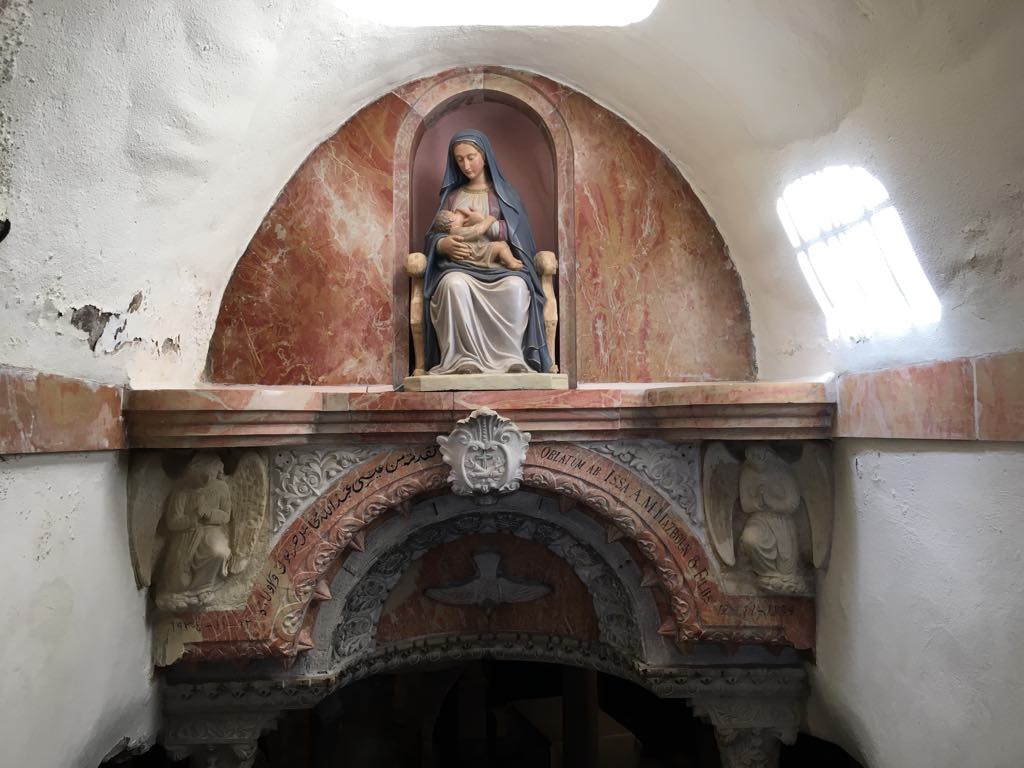
Chapel of the Milk Grotto in Bethlehem where the Holy Family hid before fleeing to Egypt to escape Herod’s murder of innocent babies. According to tradition, a drop of milk from the Virgin Mary fell on the floor of the cave that turned color of the stones to white.

We have just celebrated the Feast of the Birth of the Blessed Virgin Mary, the most perfect example of one who had experienced God’s hiddenness in her life, teaching us with some important lessons in rediscovering and keeping God’s hiddenness specially in this age of social media when everything is shown and has to be seen.

We have mentioned in our previous blog that hiddenness is different from being invisible that simply means “not visible”; hiddenness is more than not being seen per se but that feeling with certainty that God is present though hiding because he wants to surprise us. If God were not hidden, we would have not found him at all. And the more God is hidden, the more we are able to see him and experience him too as seen in the life of Mary (https://lordmychef.com/2020/09/04/the-hiddenness-of-god/).

The hiddenness of Mary.

Simplicity and humility of Mary as venue for the perfect setting of God’s coming in Jesus Christ. Consider her origins: her town of Nazareth in the province of Galilee was definitely outside the more popular city of Jerusalem that was the place to be at that time. Most of all, it is the only town in the New Testament never mentioned in the Old Testament nor by the prophets for lack of any significance in the coming of the Messiah.

Nazareth was largely unknown with some hint of notoriety as expressed by Nathanael (aka, Apostle Bartholomew) when he expressed disbelief to Philip who told him they have found the Christ, Jesus of Nazareth, by saying “Can anything good come from Nazareth?” (John 1:46)

Photo by author of chapel at the grotto believed where Mary received the good news of bearing Jesus Christ in her womb underneath the Basilica of the Annunciation at Nazareth, Israel (2019).

But that is how God works in his hiddenness, coming to us in the most ordinary places and circumstances, even least expected like Mary who was definitely not “in” if we go by today’s popular standard of “who’s in and who’s out?”

In fact, she was so “outside” the circle of influence of their time with her being promdi as we say these days, without any illustrious lineage to be proud of like her spouse Joseph who was from the royal Davidic line or her cousin Elizabeth from the priestly branch of Aaron, the brother of Moses whose husband, Zechariah belonged to another priestly clan in Israel.

Yet, God chose Mary to be the Mother of Jesus Christ because of her hiddenness expressed in her simplicity and humility. It is a far cry from our extreme “Marianism” when we almost worship Mary forgetting Jesus Christ her Son and our Savior! Worst still is the growing trend of “triumphalism” in many parishes racing for the so-called “episcopal” and “canonical” coronation of their various images of the Virgin Mary that come in all kinds of names and titles that has come to look more of a fad than authentic Marian devotion.

Without any intentions of denigrating the role and stature of the Blessed Virgin Mary in our faith as well as her proper place in the life of the Church defined by Vatican II’s Lumen Gentium, I dare ask the following questions:

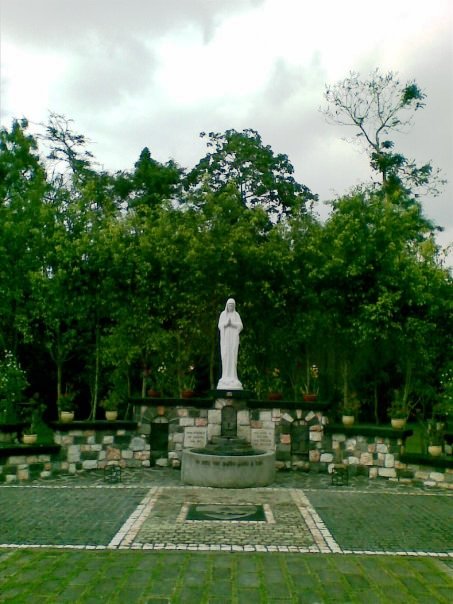
Photo by author, a replica of Our Lady of the Poor of Banneux, Belgium at Girlstown, Cavite (2009).

Is her coronation in heaven as Queen of heaven and earth not enough?

Why the need for these lavish spectacles for the coronation of the most simplest and humblest woman to have lived on earth?

It is a clear case of triumphalism – that exaggeration or overdoing our worship and rituals – especially if the Marian image is less than 200 years old without widespread devotions like the ones at Sto. Domingo (Quezon City) and Manaoag (Pangasinan).

I do not think the Blessed Mother would favor this considering her simplicity and solidarity with the poor and marginalized peoples seen in her many apparitions.

See the quaint and charming simplicity of Mary at Fatima in Portugal (1917) and lately at Banneux in Liege, Belgium (1933) where she identified herself as “Lady of the Poor”.

Note how the Virgin Mary reads “the signs of the times” in her apparitions and appearances when during the 1500’s at the height of European royalties and expeditions, she was always portrayed as victorious in regal clothes; but since Fatima in the 20th century as the world sank into the excesses of Industrial Revolution and affluence, Mary appeared simple, always in solidarity with the poor and suffering.

It is a cue we are sorely missing and sad to say, instead of renewing the world as St. Paul had asked us, we have allowed ourselves with the Mother of God to be transformed into the ways of the world by immersing in its showbiz frenzies, focusing on the material aspects like expensive clothes and jewelries.

Second example of Mary’s hiddenness is her oneness with Jesus Christ. She was never on her own, always seen in Jesus, with Jesus her Son and Lord. She believed in him so much, making him the focus at the wedding feast at Cana as well as at the foot of the Cross where she expressed in the most strongest terms her solidarity with the Savior of the world.

This has always been insisted by the Church since Vatican II regarding our devotions to Mary that must always be in relation with Jesus and his mission — never on her own.

Photo by author, 2019.

In all her apparitions, the Blessed Mother has always been consistent with her messages of conversion and return to God through her Son Jesus Christ, the frequent reception of the Sacraments of the Eucharist and Confession or Reconciliation.

Mary’s Christocentricity is best seen in her oneness with him in pains and sufferings like in the Pieta and the Mater Dolorosa where Jesus is the one standing out, not her. Nor anybody else.

When Mary, or anybody else for that matter goes on one’s own, Jesus is no longer hidden but removed from the scene. Then his Cross disappears and all that is seen is Mary in all her “beauty and glory” that are empty, very secular because these attributes come precisely from her communion in Jesus!

Perhaps, this pandemic is teaching us today to review our Marian devotions and processions that have become more of a show and a spectacle for Instagram than for deepening of our faith.

I pray that the Cofradia that holds the annual December 8 processions at Intramuros would take a rest this year until 2022 to discern their noble efforts before that have degenerated to pomp and pageantry among “devotees” specially camareros and camareras trying to outshine and outclass each other with some participation at the sidelights of their pastors and sacristans.

Keeping the hiddenness of God while we remain hidden in contemplation.

Of all the qualities of Mary we all must imitate to help people rediscover God’s hiddenness is her being hidden in prayer and contemplation.

St. John Paul II noted in Rosarium Virginis Mariae when he launched the Luminous Mysteries in 2002 that although the scriptures are silent about where was Mary during the other significant moments of the life of Jesus, especially at the institution of the Holy Eucharist, it was most likely that Mary was also present deep in prayer.

This we find clearly at the Pentecost when the Holy Spirit descended upon the apostles and the Blessed Virgin Mary while they were praying at the Upper Room in Jerusalem (Acts 1:13-14).

Modern rendition of the Pentecost with Mary among the other disciples of Jesus. From Google.

Pope emeritus Benedict XVI shares with us his profound insight in his second Jesus of Nazareth book series (Birth of Jesus) how after the annunciation of the the birth of Christ to Mary, the angel left her totally without ever coming back to warn or instruct her unlike with Joseph. After saying “Yes” to the plan of God to be the Mother of Jesus, Mary immersed herself deep in prayers and contemplation, becoming hidden herself in God.

Since then, she never doubted Jesus her Son as the Christ, nurturing her faith with prayers beautifully expressed by St. Luke in saying how “Mary treasured things in her heart” when facing difficult situations like during his birth and his finding at the temple. It is not surprising that in the contemplation by St. Ignatius of Loyola, the Risen Lord must have first appeared to his Mother upon rising from the dead because she was the first to believe totally in him (which became the basis of our tradition of the Salubong).

Mary has always been present in the hiddenness of Christ from his coming in the darkness of the night on a manger in Bethlehem, to his hidden years in Nazareth, to his ministry when he would always retreat to a deserted place to pray, to his Crucifixion and death and burial on Good Friday and finally, in the darkness of Easter.

In this age of social media where everyone and everything has to be seen and shown with nothing hidden anymore even without qualms and shame at all, part of our mission and ministry as priests and religious is to lead people back to God’s hiddenness like the Virgin Mary so they may realize anew that the best things in this life are not always seen.

To fulfill this is for us first of all to imitate God like Mary — be hidden!

How unfortunate that instead of leading the people back to God’s hiddenness, we priests and religious have in fact joined the secular world, imitating the “influencers” like bloggers and vloggers that instead of focusing on God who is hidden, we are concerned with our selves and all the “porma” for the sake of number of “likes” and “followers” we have in our posts.

The more we try so hard to make God visible in our ministry by imitating the styles and gimicks of some media personalities that make our liturgy look like a variety show complete with song and dance numbers with our altars heavily decorated like a studio set with giant tarpaulins like in EDSA, that is when we remove God totally – not only his hiddenness – from the scene and inverse proportionately, the more we priests and pastors become more popular than the Lord himself.

“The Assumption of the Virgin” by Italian Renaissance painter Titian completed in 1518 for the main altar of Frari church in Venice. Photo from wikidata.org.

And that is how cults begin, with or without Jesus. It is very sad, even tragic and ironic because we have removed God himself – even Mary! – by unconsciously making ourselves the center of attention like pop icons and idols.

Mary had shown us the most perfect example of discipleship which is more of Jesus, less of self.

Can we not post without using our own pictures – no matter how profound our thoughts are – so the people may see the hiddenness of God in a photo of a lovely flower or a magnificent sunset? Unless you are a bishop or the Pope himself, having your photo published specially in the news is part of the information process about the person in focus. It is totally different in Church communications which is all about God and his message of love, not us.

The quarantine period invites us in the Church to appreciate and share this wonderful hiddenness of God by first becoming incognito, unknown and hidden from others, preferring to be at the background or “behind the camera” as we follow God in his hiddenness until we go to that great beyond of totally hidden from everybody except God.

Do not worry. We have Mary in every step along the way. Amen.

Presence and Love of Christ

The Lord Is My Chef Sunday Recipe for the Soul by Fr. Nicanor F. Lalog II
Week XXIII, Cycle A in Ordinary Time, 06 September 2020
Ezekiel 33:7-9 /// Romans 13:8-10 /// Matthew 18:15-20
Photo by Mr. Gelo N. Carpio, January 2020.

For the next three Sundays beginning today, our liturgy directs our gaze to the nature of the Church as the mystical Body of Jesus Christ. For today we hear from Matthew how we as a church or a community of believers are signs of the presence and love of Jesus Christ.

Recall how two weeks ago at Caesarea Philippi Jesus called Simon as “Peter” (“Rock”) to head his “church”, giving him the keys to the kingdom of heaven that whatever he binds on earth shall be bound in heaven and whatever he looses on earth shall be loosed in heaven (Mt.16:17-19).

Matthew is the only evangelist so particular in using the term “church” that he devoted chapter 18 of his gospel on its nature, collecting and giving some of the Lord’s teachings about community life to his own group of disciples or early church.

And off he went to start with the most important part of community life:

Jesus said to his disciples: “If your brother sins against you, go and tell him his fault between you and him alone. If he listens to you, you have won over your brother. If he does not listen, take one or two others along with you… If he refuses to listen to them, tell the church. If he refuses to listen even to the church, then treat him as you would a Gentile or a tax collector… Again, amen, I say to you, if two of you agree on earth about anything for which they are to pray, it shall be granted them by my heavenly Father. For where two or three are gathered together in my name, there am I in the midst of them.”

Matthew 18:15-16, 17, 19-20
Photo by author, dome of the Malolos Cathedral, 2019.

Presence of Jesus in the love and unity of community

In a very short teaching taking a step by step method, Jesus tells us today how our mutual love shall always take precedence above all in our community life as his disciples and sign of presence.

Though we do not find in our gospel this Sunday the word “love”, it is clearly the Lord’s lesson for today: it is mutual love for one another that must guide everyone specially in the delicate matter of fraternal correction when one is going wayward in his/her path of life.

This explains why Jesus spelled out step by step how we correct others primarily because we love, not because we are better than them or that we have such authority or task and duty. Paul beautifully says it in our second reading:

Brothers and sisters: Owe nothing to anyone, except to love one another; for the one who loves another has fulfilled the law. Love does no evil to the neighbor; hence, love is the fulfillment of the law.

Romans 13:8, 10

But of course, we need to clarify that all these lessons of love from the Lord and Paul are based on the love of Jesus Christ who clearly mandated us during his last supper how we must love:

I give you a new commandment: love one another. As I have loved you, so you should love one another. This is how all will know that you are my disciples, if you have love for one another.

John 13:34-35

What makes this loving one another a “new commandment” is loving like Jesus Christ, unlike the pagans in ancient times that are still imitated to this day even by many among us who are also Christians. So often we find specially in media how love is portrayed as mere feelings like physical attraction that always leads up to sex, devoid of any sanctity and inner beauty at all.

St. Augustine called it “disordered love” when we become self-centered and selfish, directing our love solely to attaining what pleases us that we use persons and love things like money.

Love is not just a feeling but a decision, a choice we make and affirm every day specially when times are very rough and tough for us like when we are not loved in return.

Most of all, love is when we find somebody else we can love more than ourselves (Thomas Merton). This is the kind of love that Jesus and Paul as well as all the other saints speak of: the self-sacrificing love Christ showed us when he offered himself on the cross for the forgiveness of our sins.

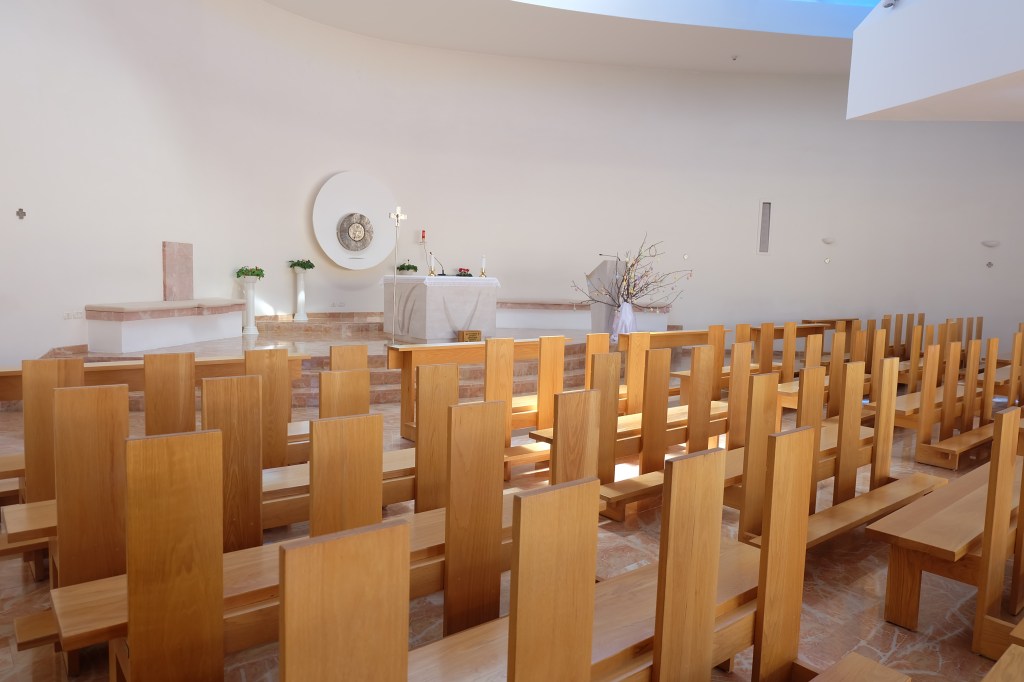
Photo by author, Chapel of the Monastery of the Sisters of Perpetual Adoration of the Blessed Sacrament at the Milk Grotto in Bethlehem where the Holy Family hid before fleeing to Egypt to escape Herod’s order to massacre the Holy Innocents, May 2019.

Love of Jesus builds, not destroys

Applying the law of love to our community is the most severe test of our being disciples of Jesus when we are challenged to be sincere in our love by hating what is evil and holding on to what is good like blessing those who persecute us, foregoing vengeance against those who have wronged us along with other expressions of mutual love in our community that Paul tells us in Romans 12:9-21.

In teaching us mutual love for one another in a step by step manner, it may seem to be a duty that one must follow in the church. It may even sound as contradictory that Jesus seems to be commanding us to strictly follow his law of command because no law can ever impose love.

However, when we try to reflect the ending of his teachings today – “For where two or three are gathered together in my name, there am I in the midst of them” – we find Jesus not ordering us to love but asking us our love because he loves us. He comes to us, grants our prayers because he loves us; therefore, when we love, when we gather as his disciples, we become his presence. And that is when our prayers are most effective because Jesus is in our midst!

Jesus and his love always build people and community; without him and his love, all we have is destruction and divisions. Hence, love is the only debt we owe to anyone. Love as a debt and “duty” is never paid back because the more we love, the more we have love, the more we are indebted to Jesus. It is the only debt that is never burdensome; in fact, the opposite happens when we refuse to love – we are burdened, life becomes heavy and so difficult.

This is what Ezekiel is telling us in the first reading: we are a “watchman”, a brother’s keeper of everyone. St. Pope Gregory the Great wrote a beautiful homily on being a watchman:

Note that a man whom the Lord sends forth as a preacher is called a watchman. A watchman always stands on a height so that he can see from afar what is coming. Anyone appointed to be a watchman for the people must stand on a height for all his life to help them by his foresight.

Office of Readings, Memorial of St. Pope Gregory the Great, 03 September
Photo by author, sunset inside our parish, 25 August 2020.

In the Church, those designated as watchman of the flock of Jesus is the Bishop or episkopos in Greek that means watcher or overseer. It is the bishop’s duty to always be above others in the loving service of the Church that sometimes out of love for Christ, he has to discipline those going astray as instructed in our gospel today, “If he refuses to listen even to the church, then treat him as you would a Gentile or a tax collector”, that is, excommunication or suspensions and other measures not meant to punish but to convert and correct the sinner.

Next Sunday, Matthew deepens our lesson on mutual love when he presents us the teachings of Jesus on how often we must forgive our brother or sister who repeatedly sins against us.

See my dear reader, how after presenting to us who is Jesus Christ last month, in how much he loves us and seeks us, these following Sundays we are challenged by the Lord to be like him – loving and merciful – to truly keep our relationship with him.

It is the first Sunday of September, the -ber months that tell us Christmas is around the corner. But, it seems we are still in a long haul in this pandemic. Having a vaccine will not totally eradicate COVID-19 nor guarantee us this won’t happen again in the future because the disease that is truly plaguing us until now is our refusal to love and live as brothers and sisters in Christ. Let us give it a try. Slowly. Jesus is not rushing us. All he is asking us is be open to his words expressed earlier in our responsorial psalm: “If today you hear his voice, harden not your hearts.”

Have a heart and have a blessed, lovely week, everyone!

The hiddenness of God

Quiet Storm by Fr. Nicanor F. Lalog II, 04 September 2020
Photo by author, sunset at the Lake of Galilee (Tiberias) in Israel, May 2017.

August has always been a “ghost month” for me since elementary school. Long before I have heard these stories and words of caution against many things in the month of August, I have always dreaded this month when days are grindingly slow.

Specially this year 2020 when the whole month of August felt like the season of Lent when everything was dry and empty, even literally speaking in our churches when the five Sundays of August were like five Good Fridays.

But, for the first time in many years during this pandemic, amid the dryness and emptiness of August 2020, I felt and “found” God anew in his most unique and wonderful characteristic — his hiddenness.

Hiddenness is different from being invisible that simply means “not visible”.

Hiddenness is something both simple and complicated but beautiful and wonderful when we find God in his hiddenness.

Hiddenness of God means more than not being seen per se; it is that feeling with certainty that he is present but, just hiding somewhere. In fact, if God were not hidden, we would have not found him at all!

And the more God is hidden, the more we are able to see him and experience him!

Photo by author, April 2020.

Remember when we were kids and could not find the things that our mother had asked us to get from somewhere in the sala or kitchen or her tocador? She would threaten us with the classic line my generation have all heard and memorized, “Pag hindi mo nakita yan, makikita mo sa akin!”

It is one of our funniest memories of childhood! I am sorry for my English-speaking readers but there is no appropriate translation for this because it is very cultural and even spiritual in nature. Literally translated, it says that if you do not find what you are looking for, you would find it with me. Crazy and insane, is it not?!

I told you, hiddenness of God is both simple and complex but whenever we remember those “sweet, maternal threats”, we laugh and shrug off the experience as we were dead serious then searching for whatever thing mom had asked us because deep in us we knew too well, it must be somewhere there. Sabi kasi ni Inay! (Mom said so!)

That is how it is with God too! We know for sure he is around, he is present. But in hiding because that is how loving God is, like moms and some lovers with surprises for us his beloved.

The Prophet Jeremiah experienced it so well when he wrote:

You duped me, O Lord, and I let myself be duped; you were too strong for me, and you triumphed. All the day I am an object of laughter, everyone mocks me. Whenever I speak, I must cry out, violence and outrage is my message; the word of the Lord has brought me derision and reproach all the day. I say to myself, I will not mention him, I will speak in his name no more. But then it becomes like fire burning in my heart, imprisoned in my bones; I grow weary holding itin, I cannot endure it.

Jeremiah 20:7-9

No one can understand this without having experienced such intense kind of love of God or of another person that even if we are pained, we just cannot walk away or leave. More so with God, the most intense lover of all!

At the very center of Jeremiah’s torment is the invincible power of attraction of God. This is also the reason human love – whether for another a friend or a spouse, for the Church or any institution – must always be based on the love of Christ who told us to “love one another as I have loved you.” If our love remains in the human level, it can never go deeper or higher making it so sublime, so true, so pure.

That is how God is in his hiddenness who is like a lover who never stops looking for us, calling us, luring us, even seducing us to come to him, search him and once found, we may dwell in his great love; hence, even if we do not “see” him, we keep on following him as we also find him in his hiddenness!

Hiddenness of God, mystery and gift of Easter

This hiddenness of God is both the gift and mystery of Jesus Christ’s Resurrection. It is a gift because in his hiddenness, God has become closest to us more than ever while at the same time, a mystery because it is in his very hiddenness that we truly find and discover God.

Remember the two disciples going home to Emmaus on Easter afternoon who was accompanied by Jesus while traveling? They did not recognize him but as they talked, their “hearts were burning” as he explained the Scriptures. Then joining them at their meal at sundown upon reaching Emmaus, Jesus took the bread, blessed it and broke it — and the disciples’ eyes were opened, recognizing him as the Lord who immediately disappeared! The two then rushed back to Jerusalem to announce to the other disciples that Jesus had indeed risen.

That is the beauty of hiddenness, its giftedness and mystery that we find God even our beloved who had died or not physically present with us but deep within, we are certain of their presence as being so true and so real.

Hiddenness is a deeper level of relationship coming from one’s heart and soul not dependent on physical presence. This is the reason why upon appearing to Mary Magdalene on Easter morning, Jesus asked her not to touch him because from then on, knowing and relating with the Lord need not be physical and corporeal as he used to relate with them before his Death and Resurrection.

All these we must have experienced like when after a friend or a relative had died, that is when we felt growing closer with the person than when he/she was still alive and physically present with us. Or, when we were feeling low and down, we experienced sometimes so amazed at how we have felt the presence even the scent of our deceased loved ones comforting us, assuring us that all would be better.

This quarantine period invites us to experience and discover God anew in his hiddenness through prayers and silence so we can reflect on the many lessons this pandemic is teaching us today. In the darkness and emptiness of this pandemic are grace-filled moments with God hidden in our poverty and sadness, sickness and even deaths around us.

Photo by author, Christmas 2018.

Some people have already asked me about what or how would our Simbang Gabi and Christmas celebrations be. They are sad and worried that it must be a very bleak Christmas for everyone with so many out of work.

But, despite this gloom, I tell them that Christmas 2020 would be one – if not the most meaningful Christmas we shall ever have despite forecasts that there would be less of everything, materially speaking.

So often in life, when we have so much material things, that is when we fail to find and experience God.

Recall that in Bethlehem more that 2000 years ago when Jesus Christ was born, God came to us hidden in a stable, on a manger in the darkness of the night.

And do not forget, too, that Christmas is not a date but an event, the very person of Jesus Christ, the all-powerful God who came to us hidden in a child, who upon becoming an adult, was crucified and died. These are sad and down moments for us but for God, it is his hiddenness, his presence. Let us go and find him again for he continues to come to us in hiddenness. Amen.

Being servants and stewards of Christ

The Lord Is My Chef Breakfast Recipe for the Soul by Fr. Nicanor F. Lalog II
First Friday, Week XXII, Year II in Ordinary Time, 04 September 2020
1 Corintians 4:1-5 /// Luke 5:1-11
Photo by author, Lent in our parish 2020.

Dearest Jesus Christ:

Your words today through St. Paul are very edifying but also demanding, even scary and frightening.

But, I would rather have it that way than get them into my head.

Brothers and sisters: Thus should one regard us: as servants of Christ and stewards of the mysteries of God. Now it is of course required of stewards that they be found trustworthy.

1 Corinthians 4:1-2

Yes, it is an honor to be chosen as your servant, Lord, and a steward of the mysteries of God.

It is so pleasant to the ears and so flattering to one’s self to be a steward of the mysteries of God, of his wisdom – of Jesus Christ crucified.

Keep me lowly and humble, Lord. Remind me always that everything is about you and never about me. Keep me faithful to you and your call that whatever others may say about me, let me be concerned solely with your words and with your judgment. At the same time, keep me silent too, never to brag of my mission and most of all, never to judge others for that resides in God alone.

Keep my mind and my heart open to you always, Lord, so I may always be like a fresh wineskin to be poured on with new wine to mature and grow spiritually in you. Amen.

Our foolish pride

The Lord Is My Chef Breakfast Recipe for the Soul by Fr. Nicanor F. Lalog II
Thursday, Memorial of St. Gregory the Great, Pope and Doctor of the Church, 03 September 2020
1 Corinthians 3:18-23 >><)))*> | >><)))*> | >><)))*> | >><)))*> Luke 5:1-11
One of the best ads during the lockdown last summer from Smart.

What a wonderful lesson we have today from St. Paul about your wisdom, O God our Father that is found in the scandal of the Cross of your Son Jesus Christ!

Brothers and sisters: Let no one deceive himself. If anyone among you considers himself wise in this stage, let him become a fool so as to become wise. For the wisdom of this world is foolishness in the eyes of God, for it is written: God catches the wise in their own ruses, and again: The Lord knows the thoughts of the wise, that they are vain.

1 Corinthians 3:18-20

This we have realized at the start of this pandemic when everything in the world stopped and forever changed because of microscopic COVID-19 virus, affecting even the most advanced countries of the world.

Most of all, everybody – rich and poor alike – suffered greatly from this virus, teaching us to value persons more when people we took for granted for so long have become our “saviors” during this prolonged quarantine periods like vendors and delivery personnel, our househelpers, and others we used to look down upon who continued to serve us with food and other needs.

Not to be forgotten too are the members of neglected sectors of our society, specially those in the medical and healthcare system and the agriculture who showed us the importance of human and natural resources over imports and technology as well as entertainment.

What a great lesson about wisdom of God and foolishness of man in this modern time!

One thing very clear, O Lord, that to be a fool for you is first of all to let go of our foolish pride and be humble before you and others.

It is the only way we can let you do your work of changing us and the world when we learn to let go of our foolish pride like St. Peter in today’s gospel when he as an experienced fisherman heeded your command to cast his nets into the deep even though you are the carpenter’s son.

When we review the lives of all saints, they are all men and women of exceptional humility before you, Lord; like St. Gregory the Great who focused more on you that he was able to reform our liturgy, set up schools and monasteries, sent missionaries to England, and instill holiness among the clergy in his “Pastoral Instructions.”

Help us to believe more in you than in ourselves so that you may do your work in us and through us. May we value your Cross, Lord Jesus, considered as foolish in this sophisticated age yet has continued to prove that it is the only path to our transformation as persons and nations. Amen.

Photo by author, XVth Station of the Cross, the Resurrection, Mount St. Paul, La Trinidad, Benguet, February 2020.

Maturity in Christ

The Lord Is My Chef Breakfast Recipe for the Soul by Fr. Nicanor F. Lalog II
Wednesday, Week XXII, Year II in Ordinary Time, 02 September 2020
1 Corinthians 3:1-9 <*(((><< || + || >><)))*> Luke 4:38-44
Van Gogh’s “The Sower” from wikimediacommons.org.

Thank you very much, Lord Jesus Christ for the words by St. Paul today that remind us of something hidden among us, something we take for granted that prevents us from maturing fully in you as disciples which is our tendency towards factionalism.

While there is jealousy and rivalry among you, are you not of the flesh, and walking according to the manner of man? Whenever someone says, “I belong to Paul,” and another, I belong to Apollos,” are you not merely men? What is Apollos, after all, and what is Paul? Ministers through whom you became believers, just as the Lord assigned each one. I planted, Apollos watered, but God caused the growth. For we are God’s co-workers; you are God’s field, God’s building.

1 Corinthians 3:3-6, 9

So many times, we remain “infants” in our spirituality as we continue to see more of ourselves and of other persons than YOU, O Lord, in our mission and ministry. Instead of being united as one, we move towards being on our own, towards factions so we can choose whom to follow among us.

There are times we forget we are your stewards, that we are all co-workers in your field that we try to “own” everything, specially people and God himself. We idolize people, setting you aside from the whole picture.

We cannot let go of our labels and tags for each other, forgetting the more essential name of being Christians, of just belonging to YOU alone.

Lord Jesus Christ, forgive us also when we try so hard to always “keep you” or “box” you like the people of Capernaum who tried to prevent you from leaving their town for selfish interests like healing of the sick.

Let us grow deeper in your mind, Lord Jesus Christ by reaching out to more people to proclaim your good news of salvation meant for everyone. Amen.

When good news/bad news do not matter at all

The Lord Is My Chef Sunday Recipe for the Soul by Fr. Nicanor F. Lalog II
Week XXII, Cycle A in Ordinary Time, 30 August 2020
Jeremiah 20:7-9 >><}}}*>| + | >><}}}*> Romans 12:1-2 >><}}}*>| + | >><}}}*> Matthew 16:21-27
Photo by author, Caesarea Philippi, May 2019

Maybe you have been asked so many times with the question, which do you prefer to hear first, the good news or the bad news? Usually we say it all depends to our mood and temperament or to the gravity of the situation. Sometimes, we ask for the bad news first so we can suffer earlier and enjoy the good news later. Or, we ask for the good news first to soften the impact of the bad news.

Our gospel this Sunday is still set in the pagan city of Caesarea Philippi and we heard Jesus giving his disciples – including us – with a strong dosage of “bad news” after hearing last week the good news that he is “the Christ, the Son of the living God.”

Jesus began to show his disciples that he must go to Jerusalem and suffer greatly from the elders, the chief priests, and the scribes, and be killed and on the third day be raised. Then Peter took Jesus aside and began to rebuke him, “God forbid, Lord! No such thing shall ever happen to you.” He turned and said to Peter, “Get behind me, Satan! You are obstacle to me. You are thinking not as God does, but as human beings do.” Then Jesus said to his disciples, “Whoever wishes to come after me must deny himself, take up his cross, and follow me. For whoever wishes to save his life will lose it, but whoever loses his life for my sake will find it.”

Matthew 16:21-25

Our gospel today seems to be a very big, bad news for everyone, with things getting worst before getting any better which the Lord had promised to be only in the end that nobody knows when!

See how Jesus started by saying he would “suffer greatly at the hands of elders, the chief priests, and the scribes and be killed and on the third day be raised again.” Not only that: he now calls Peter as “Satan” from being the Rock last Sunday after giving the right answer as to who he is.

Like Peter, we would probably say the same thing to Jesus why make suffering and death central to life that is meant to enjoy?

Like Peter, the Lord is inviting us today to focus more on the good news than on the bad news of suffering and death which for him – the Paschal mystery we call – is actually the best of good news!

Photo by author, altar flowers in our parish, January 2020.

Jesus Christ’s pasch is the best of good news!

What we have heard as “bad news” from the Lord is his first prediction of his coming pasch or Passion, Death and Resurrection. He would be announcing this prediction of his pasch two more times as they near Jerusalem.

From the He brew word pesach that means to pass over, it connotes suffering and death into new life. It came from the Exodus experience of the Chosen People from Egypt into the Promised Land during the time of Moses, taking its fullest meaning in Jesus Christ, the Son of God who became human like us in everything except sin, “passing over” from eternity to temporal, from Passion and Death to Resurrection.

Authentic discipleship does not require us to seek suffering; no, God is not sadistic as some people with twisted minds would say. However, being faithful to Jesus, witnessing his gospel values bring enough of these sufferings and deaths but on a different level and meaning. We realize that life is a daily exodus, a passing over from darkness into light, from ignorance into wisdom, from sickness into health, from death into new life.

Like the prophet Jeremiah in the first reading, we discover that the more we follow God, the more sufferings we encounter in life but at the same time, we cannot let go of him because his attraction is so powerful! There is something so deep within, so profound and fulfilling in us we realize that living in the ways of God, in the gospel values of Christ can we truly find lasting joy and peace – even if we have to die in our very selves in the process.

You duped me, O Lord, and I let myself be duped; you were too strong for me, and you triumphed. all the day I am an object of laughter; everyone mocks me… But then it becomes like fire burning in my heart, imprisoned in my bones; I grow weary holding it in, I cannot endure it.

Jeremiah 20:7, 9
Photo by author, Gaudete Sunday in our parish, December 2019.

Thinking in God’s ways

Today Jesus is assuring us that there is no such thing as “good news, bad news” with him. The good news/bad news question is really a non-question to disciples of Christ because whatever suffering and death we embrace in him is a sharing in his very life.

Hence, Jesus Christ’s good news is in fact the bestest news we can ever have. Always.

The key is to think as God does, not as human beings do as Jesus pointed out to Peter.

Three things I wish to share with you about thinking in God’s ways:

First is to accept and embrace pains and sufferings not for their own sake but as a way to cleanse our selves to greater glory. As we have said, God is not a sadist; we need to be cleansed like every thing in order to bring out the best in us like diamonds or any precious stone or any material.

Polishing and honing always mean “subtractions” with so many shaving and cutting of the rough edges to bring out the beauty and sharpness of a thing.

Man’s ways has always been to avoid every pain and suffering. No wonder, the most prescribed medicine worldwide is said to be the pain killer. But, experience has taught us this is not true and cannot be the norm of life. Like every gym enthusiast would tell you, “no pain, no gain”. Pain and suffering is part of life and the good news is, Christ has made it holy for us.

Second is to be silent in order to be able to listen to every sound and thus, heighten our sensitivities not only with our true selves but also with God and with others. In this age of social media and instant communications, silent has become a rare commodity. It is always easier to speak even without thinking much than be silent. That is the way of the world: speak out loud, make noises, and let everyone hear you — until they get tired of you.

Photo by author, our parish ceiling at sunset, 25 August 2020.

Third is the most precious in God’s ways of thinking — the way of hiddenness. This is God’s most evident way of making himself felt, experienced, and yes, seen by being hidden and invisible.

Last Thursday we celebrated the memorial of St. Monica, the mother of St. Augustine who narrated the story of how she got sick at Ostia in Italy with his brother hurrying to get back home to Tagaste in Africa so that when she dies, she would be buried there. St. Monica “reproached him with a glance because he had entertained such earthly thoughts”; then, she looked at St. Augustine and told him to bury her anywhere, asking one thing only from him: that he remembers her always in his celebration of the Holy Mass.

So many times, we are so concerned with our popularity that whatever we do has to be made known to everyone to see specially by those so-called “followers” with their “likes” that even up to death, some would spend a fortune for lavish funerals and even mauseleoum.

That’s the way of the world of everybody making a statement, of being known as present, always seen. In the movie “The Devil’s Advocate”, Al Pacino played the role of satan who said it so well at the end after tempting Keanu Reeves, “vanity…vanity is my most favorite sin.”

See the life of Jesus Christ: more than half was spend in hiddenness and silence. He worked only for three years characterized by so many instances of silence and hiddenness too and yet, his impact continues to this day and hereafter.

Beginning with last Sunday after asking us who do we say he is, Jesus is inviting us to follow him in his Passion and Death to be one in his Resurrection. This is also the call by St. Paul in the second reading:

I urge you, brothers and sisters, by the mercies of God, to offer your bodies as a living sacrifice, holy and pleasing to God, your spiritual worship. Do not conform yourselves to this age but be transformed by the renewal of your mind, that you may discern what is the will of God, what is good and pleasing and perfect.

Romans 12:1-2

Jesus is not asking too much from us, no need for any fanfares on our part; simply come to him with our true self, no matter how sinful and incomplete we are. Remember, all is good news with him and you never lose in him. Amen.

A blessed week to everyone!

Photo by author, parish ceiling at sunset, 25 August 2020.

More than words

The Lord Is My Chef Breakfast Recipe for the Soul by Fr. Nicanor F. Lalog II
Monday, Feast of St. Bartholomew, Apostle, 24 August 2020
Revelation 21:9-14 >><}}}*> |+| >><}}}*> |+| >><}}}*> John 1:45-51
Photo by author, Subic, 2018.

Glory and praise to you, Lord Jesus, the “Word who became flesh and dwelt among us” to reveal the Father’s immense love for us all. He was not contented in just telling the prophets of Old Testament how he loved us that He came and lived with us in you, Lord Jesus!

And that is why we also rejoice on this Feast of St. Bartholomew, a.k.a. Nathanael, who was introduced to you by another Apostle you have called earlier:

Philip found Nathanael and told him, “We have found the one about whom Moses wrote in the law, and also the prophets, Jesus, son of Joseph, from Nazareth.” But Nathanael said to him, “Can anything good come from Nazareth?” Philip said to him, “Come and see.” Jesus saw Nathanael coming toward him and said of him, “Here is a true child of Israel. There is no duplicity in him.” Nathanael said to him, “How did you know me?” Jesus answered and said to him, “Before Philip called you, I saw you under the fig tree.” Nathanael answered him, “Rabbi, you are the Son of God; you are the King of Israel.”

John 1:45-49

O dear Jesus, like St. Peter in the gospel yesterday and now St. Bartholomew, you are telling us anew to never be contented with mere words, with the “what” of who you really are, that we must always “come and see you” in order to experience your very person and truly know you.

I really wonder O Lord what your words meant that before Philip called Nathanael-Batholomew, you have seen him under the fig tree; however, I am so convinced that in your words, Nathanael-Bartholomew must have felt something deep inside him that he threw himself totally to you as your Apostle.

Most of all, teach me to remain simple and hidden in you, Jesus that like St. Bartholomew, despite the scarcity of stories and information about him except this little anecdote from the fourth Gospel, he remained faithful to you until his death by flaying reportedly in India.

May we imitate St. Bartholomew who had shown us that more than words, what matters is our oneness in you, Jesus, without any need for us doing sensational deeds, earning thousands of “likes” and “followers” in social media because only you, Lord, remains extraordinary above all. Amen.

It is not “what” we say who Jesus is but “how” we say who he is.

The Lord Is My Chef Sunday Recipe for the Soul by Fr. Nicanor F. Lalog II
Week XXI, Cycle A in Ordinary Time, 23 August 2020
Isaiah 22:19-23 | >><}}}*> | Romans 11:33-36 | >><}}}*> | Matthew 16:13-20
Photo by author at Caesarea, Israel, May 2019.

After showing us some glimpses of the person of the Lord these past three weeks, St. Matthew now leads us into the middle of his gospel where Jesus takes a U-turn in his ministry by revealing himself to the Twelve as he heads back to Jerusalem to fulfill his mission.

Jesus went into the region of Caesarea Philippi, he asked his disciples, “Who do people say that the Son of Man is?” They replied, “Some say John the Baptist, others Elijah, still others Jeremiah or one of the prophets.” He said to them, “But who do you say that I am?” Simon Peter said in reply, “You are the Christ, the Son of the living God.” Jesus said to him in reply, “Blessed are you, Simon son of Jonah. For flesh and blood has not revealed this to you, but my heavenly Father.” Then he strictly ordered the disciples to tell no one that he was the Christ.

Matthew 16:13-17, 20

St. Matthew told us last Sunday how Jesus withdrew to the region of Tyre and Sidon where he had healed the daughter of a Canaanite woman tormented by a demon. From there, they headed north to Caesarea Philippi, a pagan major city at that time.

It was a perfect setting for our gospel this Sunday – just like our present milieu that challenges us not only to be identified as a Christian but also to make a stand for Jesus as his true disciple at a time when faith and morals are disregarded, economics takes precedence over spirituality.

Who do people say I am: “what” I know of Jesus

The two questions posed by Jesus to his disciples while at Caesarea Phillip – and to us today – may sound very similar and even simple but are actually distinctly different and even worlds apart from each other.

Photo by Mr. Jim Marpa, 2019.

His first question “Who do people say that the Son of Man is?” is straightforward, seems to demand not much critical thinking and introspection. A plain question with a plain answer like the usual news we hear and read called “straight reporting” in journalism that tells us the essential “who, what, where, and when” of the story.

So many times, we face this question without even being asked at all!

Through our words and actions we reveal “who do you say the Son of Man is?” in how we pray, what we pray for, the things we post on social media, especially those electronic chain letters that if you say “Amen” you will get money. And so many other things when we try to show everyone we know Jesus without really thinking and reflecting well. No wonder, people get so many wrong impressions about who Jesus is: “some say he is John the Baptist, others Elijah, still others Jeremiah” or one of those prophets of wealth and health who make life easier!

Telling who Jesus Christ from “what” we know and believe can always be dangerous and misleading because it is all in our heads that could often be wrong. Telling who Jesus Christ from “what” we know and believe cannot be so reliable because it is always mechanical, by the book, not actual and most of all, not real.

It is always easy to speak highly of Jesus from “what” we know and believe like those many preachers with fire and brimstone or modern apostles, a.k.a. vloggers complete with their “shock” preaching and antics and gimmicks who end up more popular with thousands of followers and likes. And wealthy, too! Jesus Christ? Forgotten and stuck in Facebook, the bible, and tabernacle.

But who do you say I am: “how” I know Jesus

On the other hand, the Lord’s second question is direct and personal, probing our heart and soul, asking not just for answer from our lips but from our total self: “But who do you say that I am?”

See the words of the Lord after Simon had answered he is the Christ, the Son of the living God:

Jesus said to him in reply, “Blessed are you, Simon son of Jonah. For flesh and blood has not revealed this to you, but my heavenly Father.”

Matthew 16:17

More than a play of words, here we find a deeper dimension of saying who Jesus Christ is: not just telling the what but most of all, the how that reveals more than what we know in our minds but how we have experienced Jesus, of how we have been living in him!

Photo by author, house at Jaffa (Jopa), Israel where Peter met some gentiles according to Book of Acts, May 2017.

For us to say who is Jesus Christ is always a how because it is a story of our relationship with him, it is a how we have grown deeper, how we have journeyed in him and with him.

It is the ability to see beyond structures and persons, excesses and sins, faults and misgivings because despite shortcomings, it is how we see Jesus as the foundation of our lives and of our Church.

See the ways of other religious sects, their pastors and members who spend so much time bashing us Catholics, insisting on the what of Jesus and the bible, never the how they live.

No wonder, they can raise their hands in prayers and still clap their hands while the President in maligning us Catholic priests and bishops in their gatherings.

To speak of who is Jesus is more than to tell what we know about him but how we have known him, how we have been since knowing him!

Anyone who can say who Jesus is from his how is always blessed like Simon because our answer is always the fruit of our life in Christ. We all become like Simon, another Peter or Rock whose very life and existence rests on Jesus our Lord. Despite our weaknesses and sinfulness, we are still blessed and entrusted with the keys of heaven because we have allowed Jesus to be our foundation of life. There is a process, a history always. Hence, it is a telling of the how.

In the first reading, we find God dismissing the master of the palace named Shebna to be replaced by Eliakim due to his infidelity. That is the meaning of the whole prophecy by Isaiah, of how the Lord will someday entrust his people to a trustworthy steward, someone who does not only know what God is but one who has truly known and experienced God.

Saying who God is, always a revelation from him

It is interesting that in the Jewish thought, to know another person is not knowing the what but of having a relationship or some degree of intimacy. Again, it speaks of the how we have been saying.

St. Paul shows us in the most beautiful manner in his many writings this saying of who Jesus is with his how, his very personal experience of the Lord in his life that has continued and deepened until his death. See the beautiful hymn he had composed for our second reading today:

Oh, the depth of the riches and wisdom and knowledge of God! How inscrutable are his judgments and how unsearchable his ways! For from him and through him and for him are all things. To him be glory forever. Amen.

Romans 11:33, 36

Like St. Peter, we find here St. Paul so blessed despite his sins and sinfulness, of how he had experienced Christ not just a name or a man like any what he had known in his mind.

No one can ever write such great poetry with profound thoughts without any deep relationship with God. Whatever we know of God is always a revelation from him, too. When we speak of who God is, it is always borne out of how we have been relating with him our Lord which is called “spirituality”; it is deeper than religiosity or being religious that is always at the level of the head and more of our ego than of the reality of God.

Sometimes, we do not even have to speak and say who Jesus Christ is.

We simply have to live out that relationship we have in him and people would know who Jesus is. No need for elaborate and spectacular showmanships we have in our many rites and rituals, even in our liturgies now so maligned with our triumphalism.

Lest we forget, Jesus saved the world by suffering and dying on the Cross, not with activities and debates which would be his topic next Sunday. God bless everyone!

Photo by Angelo Carpio, January 2020