The Lord Is My Chef Breakfast Recipe for the Soul by Fr. Nicanor F. Lalog II
Wednesday, Week XIV, Year I in Ordinary Time, 07 July 2021
Genesis 41:55-57; 42:5-7, 17-24   ><)))*>+><)))*>  Matthew 10:1-7
It is only now have I realized,
Lord, how far we have been travelling
in this life
and how often have we
truly asked you for directions;
so often in life
off we go where our desires
and plans lead us
deciding on our own
charting our own maps,
asking directions from everybody,
even non-persons like Google and Waze
and still get lost
for we never asked you directions
nor followed your direction.
When hunger came to be felt
throughout the land of Egypt
and the people cried to Pharaoh for bread,
Pharaoh directed all the Egyptians to
go to Joseph and do whatever he told them.(Genesis 41:55)
Jesus sent out these Twelve
after instructing them thus,
"Do not go into pagan territory or
enter a Samaritan town.
Go rather to the lost sheep of the house of Israel."(Matthew 10:5-6)
Go where, O God?
Go to persons, go to people.
Go to those with integrity and faith in you
like Joseph your servant sold to Egypt
by his own brothers.
Go to those lost and hurting,
to those who were one with us
but left us because we have hurt them
or taken them for granted
or have abandoned them.
Let us go, dear God,
where you desire us to bring you
to share you.
And find YOU.
 Amen.
The Lord Is My Chef Breakfast Recipe for the Soul by Fr. Nicanor F. Lalog II
Tuesday in the XIVth Week, Year I in Ordinary Time, 06 July 2021
Genesis 32:23-33   > + <   Matthew 9:32-38
Photo by author, Agony at the Garden of Gethsemane, the Holy Land, 2019.
Your words, O Lord
of Jacob wrestling with you
or, your angel (?)
reminds me of Jesus Christ's
own agony in the garden.
And for me, it is one of sweetest
scenes in the whole bible,
the finest example of an animated
and engaging relationship
with you, dear God our Father.
Jacob was left there alone.
Then some man wrestled
with him until the break of dawn.
When the man saw that
he could not prevail over him,
he struck Jacob's hip at its socket,
so that the hip socket was wrenched
as they wrestled.  Then the man said,
"You shall no longer be spoken of as Jacob,
but as Israel, because you have contended
with divine and human beings
and have prevailed."
(Genesis 32:25-26, 29)
Loving Father,
forgive us when we "box" you
as being stern and stiff like the police
waiting for our slightest mistakes
and violations; surprise us, dear God
with your intimacy, closely engaging
wrestling and contending with you
to bring out the best in us
 and still see your very best plans
that cleanse and purify us of our intentions.
Grant us the grace of intimacy
that is most surprising
when we have to wrestle
with you like Jacob and be "Israel"
so that your might and your truth
will always prevail
unlike the Pharisees who were afraid
to get closer to Christ and be purified
that they vilified and later crucified
to hide in their weaknesses and sins.
Grant us courage and strength
dear God in engaging with you
realizing our limits
humbly surrendering to your will
like Jacob at Peniel;
let us be not like those Pharisees
who refused to contend
by insisting their contempt for Jesus
thinking they can prevail on him
only to reveal their evil within.
Amen.
The Lord Is My Chef Breakfast Recipe for the Soul by Fr. Nicanor F. Lalog II
Monday, Week XIV, Year I in Ordinary Time, 05 July 2021
Genesis 28:10-22   ><)))'>+><)))'>+><)))'>   Matthew 9:18-26
Photo by Dr. Mylene A. Santos, MD, at Quezon Province, 2020.
When Jacob awoke from his sleep,
he exclaimed,
"Truly, the Lord is in this spot,
although I did not know it!"
In solemn wonder he cried out:
"How awesome is this shrine!
This is nothing else but an abode of God,
and that is the gateway to heaven!"
(Genesis 28:16-17)
Surprise us, O Lord, today
like Jacob after his dream.
Gift us with the sense of
wonder and awe,
open ourselves to realize
and experience your presence;
teach our hearts and minds
to be observant and sensitive
of your coming in Jesus Christ
who is filled with life and joy
from whom flows healing
and fullness of life.
We pray, dear God
for the gift of faith
so we may be surprised again
with the usual things in life
like the tassel of the cloak of Jesus;
help us imitate that
hemorrhaging woman
so convinced of
Christ's extraordinary powers
present in the most ordinary
happening daily if we believe
then we can see clearly your majesty!
Amen.
The Lord Is My Chef Sunday Music by Fr. Nick F. Lalog II, 04 July 2021
Photo by author, Pater Noster Church, Jerusalem, Israel, 2019.
Love presupposes faith. It is not enough to know the person in order to love him/her; you have to believe the person too. To love and to believe both call us to be one with the other, to become the part of the other person, of the beloved.
This is most especially true with Jesus who was amazed at the lack of faith in him of his folks at Nazareth though they knew him as the “carpenter son of Mary” (https://lordmychef.com/2021/07/03/surprising-jesus/).
That is why we have chosen for this lazy Sunday the 1980 hit by Ambrosia composed by their lead singer David Pack, Biggest Part of Me. It is a love song sometimes sung in weddings because of its expression of love and faith with the beloved, of what is essentially the life of married couples of being a part of each other.
Faith is essential in any relationship most especially when failures and rejections happen, when things we hope for do not push through like when Jesus was rejected in Nazareth.
In the seventh stanza of Biggest Part of Me we find the importance of faith, of believing essential in love and any relationship.
More than an easy feelin'
She brings joy to me
How can I tell you what it means to me
Flow like a lazy river
For an eternity
I finally found someone who believes in me
And I'll never leave
(Now I've found all I need)

Need your lovin' here beside me
(To guide me) Keep it close enough to guide me
(Inside of me) From the fears that are inside of me
You're the biggest part of me

Got a feelin' that forever
(Together) We are gonna stay together
(Forever) From now until forever
You're the biggest part or me
You're the life that breathes in me
You're the biggest part of me

You changed my life
You made it bright
And I'll be a savior to you
For the rest of my life
Oh, oh the biggest part of me
There are only two instances in the bible that Jesus was amazed: first in Nazareth which is the gospel we heard today when he was amazed for their lack of faith in him. The second was in Capernaum when he was amazed with the faith of a Roman centurion who asked him to heal his servant remotely, saying, “Lord, I am not worthy to have you enter under my roof; but only say the word and my servant shall be healed” (Mt. 8:8). Jesus praised the pagan officer for his great faith.
It is when we believe, when we have faith in Jesus and with our beloved that great things begin to happen in our lives because that is when we make them the “biggest part” of our selves.
Have a blessed Sunday!
*We have no intentions of infringing into the copy rights of this song and video except to share its beauty and joy with others.
The Lord Is My Chef Sunday Recipe for the Soul by Fr. Nicanor F. Lalog II
Fourteenth Sunday in Ordinary time, Cycle B, 04 July 2021
Ezekiel 2:2-5 ><}}}'> 2Corinthians 12:7-10 ><}}}'> Mark6:1-6
Photo by author, Sacred Heart Center for Spirituality, Novaliches, 2015.
There are only two instances in the gospels that say Jesus was surprised or amazed: first is in his hometown of Nazareth as we have heard today when “He was amazed at their lack of faith” (Mk.6:6) and the second is in Capernaum when a Roman centurion asked him to heal his sick servant. When Jesus obliged to come with him to heal the servant, the Roman officer declared, “Lord, I am not worthy to have you enter under my roof; only say the word and my servant shall be healed. When Jesus heard this, he was amazed and said to those following him, “Amen, I say to you, in no one in Israel have I found such faith” (Mt.8:8, 10).
What surprises Jesus most is our faith in him. Or, its lack like the people of Nazareth.
Last Sunday, he dared us to examine our faith in him when he brought back to life the dead daughter of Jairus. On their way, Jairus was told his daughter had died, that there was no need to bother Jesus anymore; that’s when Jesus said, “Do not be afraid; just have faith” (Mk.5:36). Reaching his home, there was commotion on the dead child but later, everybody was “utterly astounded”(Mk.5:42) after Jesus brought her back to life.
Today, St. Mark deepens our reflection on the need to have faith in Jesus by telling us a surprisingly sad episode in the Lord’s life and ministry of being rejected right in his native Nazareth:
When the sabbath came he began to teach in the synagogue, and many who heard him were astonished. They said, “Where did this man get all this? What kind of wisdom has been given him? What mighty deeds are wrought by his hands! Is he not the carpenter, the son of Mary, and the brother of James and Joses and Judas and Simon? And are not his sisters here with us?” And they took offense at him. so he was not able to perform any mighty deed there, apart from curing a few sick people by laying his hands on them. He was amazed at their lack of faith.
Mark 6:2-3, 5-6
Photo by author, Nazareth, Israel, 2019.
The need for faith
For the past three weeks, St. Mark has slowly introduced to us that Jesus is the Christ, the awaited Messiah or Savior through his teachings and miracles like healing the sick, pacifying a violent storm at sea in the darkness of the night, and bringing back to life the dead child of Jairus.
However, it is not enough to “know” who Jesus is.
Knowing Jesus – or anyone – will not matter at all unless we believe in him and enter into a relationship with him lest we end up like his folks who “knew” him as the carpenter and son of Mary, wondering where he got all his wisdom and power.
And worst, “they took offense at him”. As we would say in Filipino, “pinersonal nila si Jesus.”
But, that is what faith is – something very personal because it is a relationship. No relationship can mature and grow unless there is faith. The deeper and stronger the faith, the most wonderful is the relationship because despite all the troubles and sufferings that may come, the ties remain because of faith.
That is why it St. Mark is telling us today the rejection of Jesus at Nazareth, of how even the Son of God experienced failures and rejections, calling us for a deeper and firmer faith in him who alone is our Lord and Savior. Aside from sickness and deaths in our lives, there are many other pains and heartaches, disappointments and failures and losses in our lives that if we do not have faith, we can never make it through with Jesus.
Yes, Jesus is with us in this journey of life in the many seas to cross while in darkness amid violent storms; but, we have to believe in him first before he can make his moves in our favor like in Nazareth where he “was not able to perform any mighty deed there, apart from curing a few sick people by laying his hands on them” due to their lack of faith in him.
Photo by author, altar in my room at the Fatima National Shrine, Valenzuela City, February 2021.
Surprising Jesus with our faith
Too often in our lives, we have boxed God as being stiff and stern, a disciplinarian watching us for our sins and mistakes. Wrong! God sent us his Son Jesus Christ so we may experience his tender mercy and love, his personal relationship with each of us.
Unlike most of us, Jesus is a touch person, so sensitively human, not numb, always feeling us in our gestures and looks and words like that Roman centurion at Capernaum, that sick woman in the crowd last Sunday, the widow of Nain and the sisters Mary and Martha. They all moved and touched Jesus with their grief and sufferings, and most especially with their faith and joy and confidence in him.
Most beautiful in these stories of Jesus being surprised and moved by humans are the more surprising kindness and blessings he bestowed on them – like in our own experiences! Notice that when we were so surprised by God with his blessings, that is when we have also surprised him with our faith.
Jesus is surprised with our faith when we continue to listen and speak his words of justice and truth. In this age of faith in a mass mediated-culture, we find the voice of God drowned in the cacophony of many sounds competing for everyone’s attention where the ones that prevail are those appealing to the senses that are both easy and pleasurable. Through media manipulations, what was unacceptable was first made to be tolerable until it has become acceptable like promiscuity and “safe-sex”, divorce and same sex marriage, birth controls and abortions. Any discussion of God and religion, ethics and morality and values are dismissed as limiting and narrow-mindedness or worst, as being old-fashioned and conservative. In modern man’s effort to be “fair” and “all-encompassing”, the human person has been reduced to technicalities and legalese, replacing life with lifestyles.
Hard of face and obstinate of heart are they to whom I am sending you. But you shall say to them: Thus says the Lord God! And whether they heed or resist – for they are a rebellious house – shall know that a prophet has been among them.
Ezekiel 2:4-5
Jesus shows us today in his unhappy homecoming to Nazareth that even if people refuse to listen, we continue with our prophetic role of proclaiming his good news of salvation “in season, out of season”.
Even if nobody listens, even if we do not win converts or followers, we are prophets of God like Ezekiel, the voice of God, of his justice and truth amid a rebellious and wayward generation. Like John the Baptist, we are the voice in the wilderness preparing the coming of the Lord by speaking the truth, calling people to repentance and conversion.
Though God speaks in silence, our being silent in the midst of evil worsens the sinful situation as we shut doors among humanity leaving no room at all for Jesus to come and work his wonders among us. Be the voice of Jesus, be his opening, and be ready for great surprises happening soon!
Jesus is surprised with our faith when we remain standing with him at his Cross, bearing all pains and wounds with him. In this age of affluence and convenience characterized with everything instant in a click of a button, modern life has become sedentary to our own detriment. As we prefer to be seated more than standing, we have become so passive, avoiding every form of pain and suffering that make pain relievers as the most prescribed and widely used medication these days.
See how we quarrel over our places of “seat” everywhere – at home and school, office and community and parish, public and private transport – as they connote powers without realizing that what matters most in life is where we stand because that is when we are defined as a person for our faith and values in life, when we most surprise Jesus as he surprises us most with his strength like what St. Paul had realized:
Therefore, I am content with weaknesses, insults, hardships, persecutions, and constraints, for the sake of Christ; for when I am weak, then I am strong.
2 Corinthians 12:10
Great things begin to happen in us, in our lives when we are out standing for Jesus, with Jesus because that is when we are truly one in him as he passed over our miseries and sins to rise again with him and in him in his Resurrection.
Jesus is surprised with our faith when we are filled with joy and love in him despite everything. To love and be joyful like Jesus calls for a deep faith in him, to be kind and merciful even when others are rude and unforgiving. Notice how these days it takes a lot of guts to be good. And we are so amazed with them!
On the other hand, notice when we hear news of a band of people who are inconsiderate, corrupt, unkind, selfish, and proud: are you not surprised they are filled with anger and hate and negativities?
During the persecution of the early Church, Christians were easily spotted and rounded because they were amazingly loving and caring with the marginalized like the poor, the sick, the widows, the old, and the orphans. Pagans were most surprised that the more they persecuted the Christians, the more they grew in number! It is one of history’s most surprising facts but, that is how God moves, so unusual in the most surprising ways.
Have you been surprised by Jesus lately?
Try surprising him with your great faith in him and you will be surprised greatly by him!
Have a blessed Sunday!Amen.
Photo by author, flowers at the Pater Noster Church outside Jerusalem in Israel, 2019.
Quiet Storm by Fr. Nicanor F. Lalog II, 02 July 2021
Genesis 23:1-4, 19-24:1-8, 62-67   ><}}}'> + <'{{{>< Matthew 9:9-13
Congratulations, my dear Senior High School graduates of Our Lady of Fatima University Batch 2021. Yes, you hold the distinction of belonging to the first graduates of the pandemic who persevered, who were not daunted by COVID-19 that continues to plague us after more than a year of altering our lives.
Take pride in belonging to this batch because you have just proven you are the right people in the right time at the right place called by God to witness his truth and mercy, our university motto, “Veritas et Misericordia”.
Too often we pray God would send us the right person to become our friends and colleagues at work or project, or simply our co-journeyer in this life – perhaps lovers – without realizing we are in fact the right person being called and sent first by God in the right place, at the right time.
This was the experience of Matthew in our gospel today:
As Jesus passed by, he saw a man named Matthew sitting at the customs post. He said to him, “Follow me.” And he got up and followed him.
Matthew 9:9
“Calling of St. Matthew” painting by Caravaggio from en.wikipedia.org.
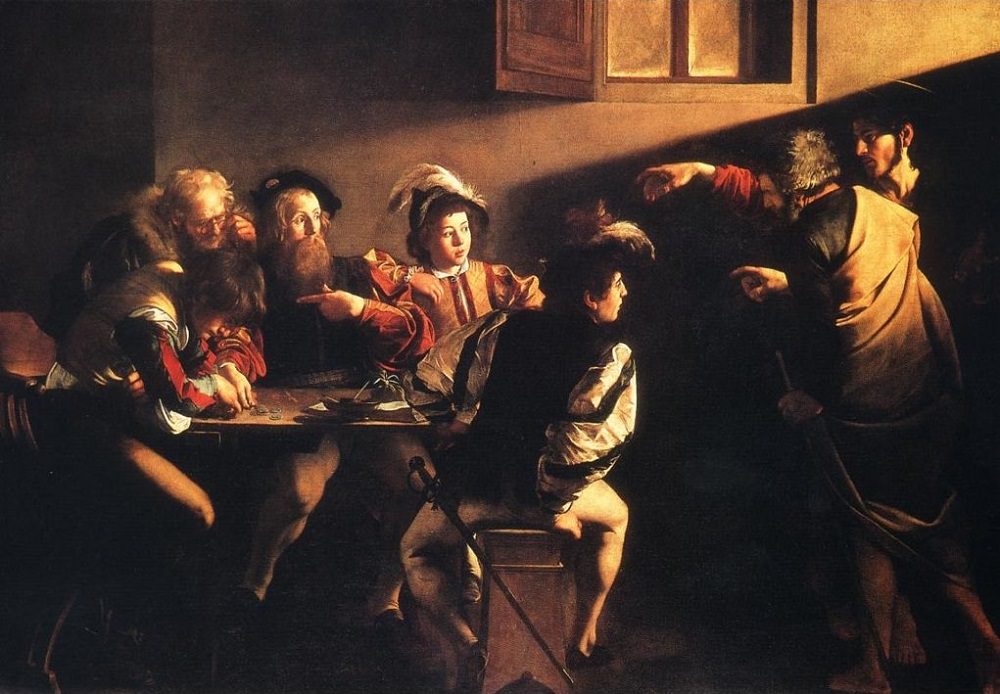
Let me tell you a beautiful story about the call of St. Matthew as depicted in a painting by the renowned artist named Caravaggio during the 1600’s in a chapel in Rome. It is one of the favorite paintings of Pope Francis who claims he used to see it while a student in Rome and later as the Cardinal of Buenos Aires whenever he would go to the Vatican.
Caravaggio’s painting is very unique and amusing especially in the way he would play with lights and darkness like in that other famous painting of the meeting of the Risen Lord and doubting Thomas eight days after Easter. This contrast of light and darkness is very evident in painting the call of Matthew by Jesus.
Very interesting is the kind of clothes the characters wear in this painting: notice how Caravaggio portrayed Matthew, the bearded man with a beret and his companions at the table wearing the expensive clothes of the Middle Ages while Jesus and Simon Peter are in their traditional garments and – barefooted! The room looks like a tavern of Caravaggio’s time than a customs house as narrated by Matthew during the time of the Lord in Galilee.
All of this because Caravaggio was fond of incorporating biblical scenes into his milieu to show the relevance of Christ in their time.
And that is also the reason why I share this painting with you: aside from being the gospel on this first Friday of the month, I find its story so relevant with you Senior High School students and graduates.
When you look at the painting, it is like a video happening in split seconds,
very much like that photo taken in the live mode of an iPhone
with the picture moving a little,
wondering if Matthew would stand and leave to follow Jesus.
When you look at the painting, it is like a video happening in split seconds,
very much like that photo taken in the live mode of an iPhone
with the picture moving a little,
wondering if Matthew would stand and leave to follow Jesus.
From en.wikipedia.org.
See Matthew and company seated at the dark side of the room with Jesus standing near the window partially washed by lights specifically his face and hand with finger pointed towards Matthew whose face is clearly lighted, evidently hesitant, asking Jesus if he were referring to him or to the one slumped on the table. Notice the bright face of Matthew and his index finger pointing to the man beside him, his thumb to himself as if asking “is it I, Lord?” or “who, me?” while his other hand is holding a coin on the table.
So beautiful as it evokes the hesitancy of Matthew and certainty of Jesus!
That is how we have felt this first year of COVID-19, the Academic Year 2020-2021, your batch: there is our hesitancy and uncertainty, fears and anxieties in life, of going back to school or not, of where to get money or laptop or reliable internet service while deep inside us, we felt the Lord so certain in his plans for us, in his love and mercy, that we can “rise to the top” here at Fatima University!
We are the ones always doubting, asking Jesus if he were talking or calling us because we cannot let go of that “coin” Matthew is holding on in the painting symbolizing the materials things and persons on whom we put our trust instead of having faith in God alone.
Doubt no more, my dear graduates of the COVID-19 batch of 2020-2021! You are the right person in the right place – Our Lady of Fatima University – at the right time, Academic Year 2020-2021 on the first year of COVID-19 pandemic.
Jesus is telling you today as he fills you with his light
of truth and mercy in finishing Senior High School in our beloved University
that you are indeed the right people called in the right place at the right time.
Will you "rise to the top" to pursue further studies
to achieve your dreams in this time of the pandemic?
Jesus is telling you today as he fills you with his light of truth and mercy in finishing Senior High School in our beloved University that you are indeed the right people called in the right place at the right time. Will you rise to the top, pursue further studies to achieve your dreams in this time of the pandemic?
Come and follow Jesus, make your dreams come true here with us in Our Lady of Fatima University for we do not stop seeking ways in dealing with the pandemic with our innovative classes and curriculum. We are the first university approved by the government to conduct limited face-to-face classes in our medical courses.
Like Abraham in the first reading from Genesis, trust God that he will send you his messenger, that he will send you people who will be teaching and preparing you for the post-pandemic period while journeying with you, learning with you in this time of the COVID-19.
Amid the darkness of our time like Caravaggio’s painting, do not fail to see the light brightening the scene, getting intense on the face of Matthew and people around him with Jesus looking intently on you, making sure you do not get sick, that you rise and follow him in pursuing your dream.
Don’t worry, my dear graduates, your Rebekah or your Isaac will surely come along the way but at the moment, Jesus wants you to finish your studies first.
Study hard, work harder, and pray hardest! See you in August!
The Lord Is My Chef Breakfast Recipe for the Soul by Fr. Nicanor F. Lalog II
First Friday of the Month, Week XIII, Year I in Ordinary Time, 02 July 2021
Genesis 23:1-4, 19-24:1-8, 62-67   ><)))'> + <'(((><   Matthew 9:9-13
“Calling of St. Matthew” painting by Caravaggio from en.wikipedia.org.
God our loving Father in heaven,
open our eyes to see and recognize
the right persons you send us
to be our friends and colleagues,
co-workers and co-journeyers in life.
Let us not forget that first of all,
the right person we first meet from you
is our very selves!
Thank you for believing in us.
Thank you for creating us.
Thank you in sharing with us your
truth and beauty, your image
and likeness that is very good.
As Jesus passed by,
he saw a man named Matthew
sitting at the customs post.
He said to him,
"Follow me."
And he got up and followed him.
(Matthew 9:9)
Let this scene be a constant reminder to us
of your mercy and love, dear God
that no matter how bad is the perception
of others on us, you still see the best in us.
Give us the grace to be attentive
to Jesus Christ passing by, calling us
even while we are in the darkness of our sin
indulging in luxuries and comfort,
power and fame of a sick world.
Like Matthew, let Jesus our light
make us rise to follow him
leave the damp and dark world of sin
and see again the light within
of your glow and majesty.
"Never take my son back there
for any reason," Abraham told his servant.
"the Lord, the God of heaven,
will send his messenger before you,
and you will obtain a wife for my son there."
A long time later, Isaac went to live
in the region of the Negeb.
One day toward evening
he went out in the field,
and as he looked around,
he noticed that camels were
approaching.  Rebekah, too,
was looking about, and when she
saw him, she alighted from her camel...
Then Isaac took Rebekah into his tent;
he married her, and thus she became
his wife.  In his love for her
Isaac found solace after the death
of his mother Sarah.
(Genesis 24:6, 7, 62-64, 67)
What a beautiful love story
that looked like in the movie, sweet Lord
where you surely send us the right persons
at the right time
for the right reason
because of love.
We pray for those waiting for their
right persons, whether in love or profession,
or for any reason you and they alone know,
grant them the faith of Abraham
and the enlightenment of Matthew.
Amen.
The Lord Is My Chef Breakfast Recipe for the Soul by Fr. Nicanor F. Lalog II
Wednesday, Memorial of the First Martyrs of Rome, 30 June 2021
Genesis 21:5, 8-20   ><)))*>  +  <*(((><   Matthew 8:28-34
First Martyrs of Rome, from Pinterest.com.
You touched my heart so much,
God our loving Father
as your words spoke today
of people being sent away:
Sarah noticed the son
whom Hagar the Egyptian
had borne to Abraham
playing with her son Isaac;
so she demanded of Abraham:
"Drive that slave and her son!
No son of of that slave is going to share
the inheritance with my son Isaac!"
(Genesis 21:9-10)
Abraham was greatly distressed
and so am I, Lord, when I remember
and think of those many people
driven away, sent home or so far away
due to anger and jealousy,
hatred and modern forms of slavery
as well as sometimes for reasons of
inefficiency and deficiencies.
Have mercy on us, O Lord
when we find it so easy
to drive people away
without realizing
for every person sent home
or driven away
with nowhere to go
not only a job or education is lost
but most of all,
we deprive them of life and future.
And that is why we thank you O God,
in taking care of Hagar and Ishmael
after they were sent away
like those many others in our own time
sent away without the basic necessities
and worse victims of human trafficking;
We beg you, dear Father,
like Jesus in the gospel
may he set us free from the evils that
bound us today when we see more
the value of things and money
than of every person.
May the first martyrs of Rome
pray for us to be firm in standing
for the value of every person.
Amen.
The Lord Is My Chef Breakfast Recipe for the Soul by Fr. Nicanor F. Lalog II
Monday, Memorial of St. Irenaeus, Bishop and Martyr, 28 June 2021
Genesis 18:16-33   ><)))*>  +  <*(((><   Matthew 8:18-22
Photo by Ms. Ria De Vera at Lalakhan, Santa Maria, Bulacan, 02 June 2021.
You are sometimes
so funny and amusing, dear God
when you act like our daddy
as if like dilly dallying
on whether to tell us something
he is planning
knowing so well
he is the father and the master
that we his children must obey
and abide by his will and order.
How nice of you, O Lord
to act so decent, so good
full of kindness and consideration
to make us feel important
with what you have in mind
of our role and part in your divine plan
because when you act like one of us
that is when you also want us
to act like you, to think like you
to be holy like you.
The Lord reflected,
"Shall I hide from Abraham
what I am about to do
(to Sodom and Gomorrah),
now that he is to become a great
and populous nation,
and all nations of the earth
are to find blessing in him?
Indeed, I have singled him out
that he may direct his children
and his household after him
to keep the way of the Lord
by doing what is right and just,
so that the Lord may carry into effect
for Abraham the promises he made about him."
(Genesis 18:17-19)
But more than acting
and thinking like you, O God,
is for us to love like you
that is why sometimes
Jesus sounds too harsh and
difficult to follow, challenging us
to let go of our own desires
and usual ways of living
in order to love you completely
and selflessly.
Jesus answered him,
"Foxes have dens, birds have nests,
but the Son of Man has nowhere
to rest his head."
Another of his disciples said to him,
"Lord, let me go first and bury my father."
But Jesus answered him,
"Follow me,
and let the dead bury their dead."
(Matthew 8:20-22)
We pray, O Lord,
for our leaders in the Church
and in government
to be more committed
in serving your people
than in serving their own interests;
enlighten them of your ways, Lord,
of your kindness and mercy
dispensing justice swiftly
where there is outcry against sin.  Amen.
The Lord Is My Chef Sunday Music by Fr. Nick F. Lalog II, 27 June 2021
Photo by Dr. Mai B. Dela Peña, M.D. at Athens, Greece 2016.
Chaka Khan’s Through the Fire is one of the songs that have intrigued me for some time not because I love it. In fact, it is one of my least liked song of all time. I have never liked it – until now – though I have always admired Ms. Khan as a musician, especially as a percussionist (I Feel for You is my favorite).
My interest for this song began about 12 years ago when I asked help from a millennial to make me a playlist in my new laptop wherein she included more than one – maybe three copies of Through the Fire.
I felt the young lady was making fun of me but I never had the chance to ask her why she was so fond of the song.
Years later as I interacted with young people in schools and parishes, I found that so many of them who belonged to a different generation in fact love this song very much! It was only this week when I finally found the answer: it is a most unique romantic song about a true love being found by a woman who was so willing to put it to test, hence, through the fire.
Love is like faith that has to be tested, that must be passed “through the fire” to make it more firm and deeply rooted in Christ. And like love, faith dares us to let go of everything for it to truly grow and mature.
Through the fire
To the limit, to the wall
For a chance to be with you
I'd gladly risk it all
Through the fire
Through whatever, come what may
For a chance at loving you
I'd take it all the way
Right down to the wire
Even through the fire
Composed by David Foster in 1984, he claimed in an interview that Through the Fire is the only song he had written with just one particular singer in his mind, Ms. Chaka Khan. And it proved to be so good as it earned numerous awards aside from staying on top of the charts for several weeks.
The melody is very comely, so perfect with Ms. Khan’s sweet voice that is unusually formal and laid-back in this particular piece.
In our gospel today where Jesus brought back to life the dead daughter of the synagogue official name Jairus, we are challenged to examine our faith in God especially in these trying times of sickness and death due to the pandemic (https://lordmychef.com/2021/06/26/arise-be-whole-again-in-christ/).
How far are we willing to go, to risk all through the fire in following Jesus in the midst of the many trials and sufferings COVID-19 had brought to us not only with our health and well-being but also with our means of livelihood.
May we keep and deepen our faith in Christ as we go through the fire for it is only in him can we arise and be whole again in the face of many sickness and deaths of this time.
Have a blessed week ahead!
*We have no intentions of infringing the copyrights of this beautiful music except to share its pure joy and listening pleasures.