The Lord Is My Chef Breakfast Recipe for the Soul
First Friday, Memorial of St. Agatha, 05 February 2021
Hebrews 13:1-8     >><)))*>   +++  <*(((><<     Mark 6:14-29
Photo by author, Silang, Cavite, September 2020.
Your words today are very disturbing, Lord Jesus. So many times I find myself like Herod perplexed at listening to your words, praying your words, analyzing and learning your words for they are so delightful to the feelings but so disturbing when I am in a state of sin.
Forgive us, dear Jesus, in making into a cliche that beautiful prayer we once in a while utter to you, “Disturb us, O Lord.” So often we hear and read this beautiful prayer without really meaning it so well like Herod in today’s gospel.
Herod feared John, knowing him to be a righteous and holy man, and kept him in custody. When he heard him speak he was very much perplexed, yet he liked to listen to him. Herodias had an opportunity one day when Herod, on his birthday, gave a banquet for his courtiers, his military officers, and the leading men of Galilee…
The girl hurried back to the king’s presence and made her request, “I want you to give me at once on a platter the head of John the Baptist.” The king was deeply distressed, but because of his oaths and the guests he did not wish to break his word to her. So he promptly dispatched an executioner with orders to bring back his head. He went off and beheaded him in the prison.
Mark 6:20-21, 25-27
Disturb us, O Lord?
So nice to read, so good to say but never easy to totally feel and live out its real meaning!
There is no doubt at how your words disturb us, dear Jesus, bothering our conscience, making us feel uncomfortable specially when we are deeply into sin and evil; but then, we would reason out with our usual alibis and justifications that eventually we find a way out of your teachings like Herod in taking the wife of his brother Philip.
Ironically, and yes, tragically, when our words are put to test by somebody else’s words, we feel more distressed like Herod when asked for the head of John after making a pledge to his daughter to ask for anything. Shamefully, that is when we are pushed to edge to finally make a decision on something so wrong simply because we felt challenged and dared to assert our position and power. We act instinctively without much thinking if we are just being taken for a ride, of being manipulated like Herod.
Beheading of John the Baptist from wikipediacommons.org.
O Lord, you know us so well. Too often in life, we would rather bear the daily hurts no matter how painful for as long as we look good among others than suffer big time in confronting and accepting our true selves before you for fear it could badly wound us, exposing our true selves and other vulnerabilities as a person like Herod. Yes, we would rather save face than save souls.
Give us the grace and courage, Lord Jesus Christ, to face up and dare ourselves to rise to your challenge of purifying ourselves into better persons like John the Baptist who truly played his role as your precursor with his prophetic preaching.
Like St. Agatha your holy virgin and martyr, may we persevere in our sufferings, not disturbed at all at what others may say except in how we may witness your Gospel of love and mercy for you are always “the same yesterday, today and forever” (Hebrews 13:8). Amen.
A mosaic of St. Agatha of Sicily whose breasts were cut off by her torturers hoping she would renounce her faith in Christ. She remained faithful to Jesus who sent St. Peter to appear to her in a vision to console her and thus became the patron saint for those with breast cancer. She eventually died a martyr while in prison as a result of the repeated cruelties inflicted to her around year 251. Photo from aleteia.org.
The Lord Is My Chef Breakfast Recipe for the Soul, 03 February 2021
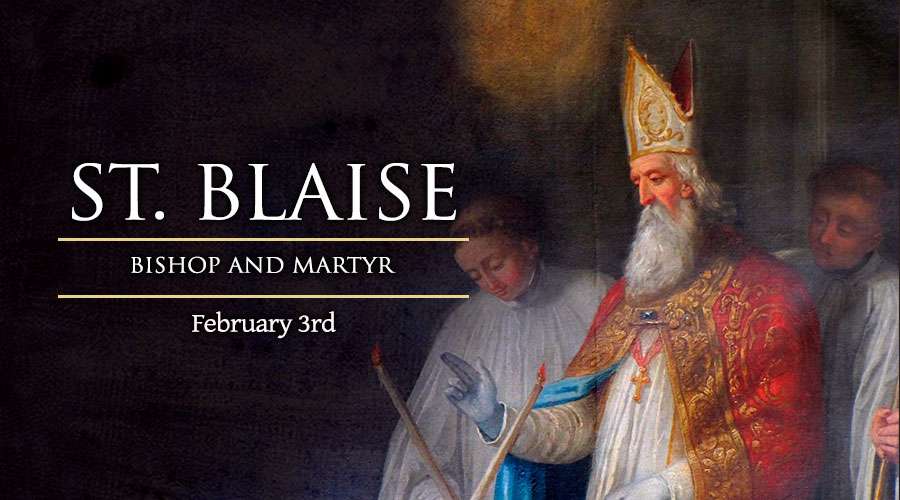
Wednesday, Memorial of St. Blaise, Bishop and Martyr
Hebrews 12:4-7, 11-15     <*(((><<   +++   >><)))*>     Mark 6:1-6
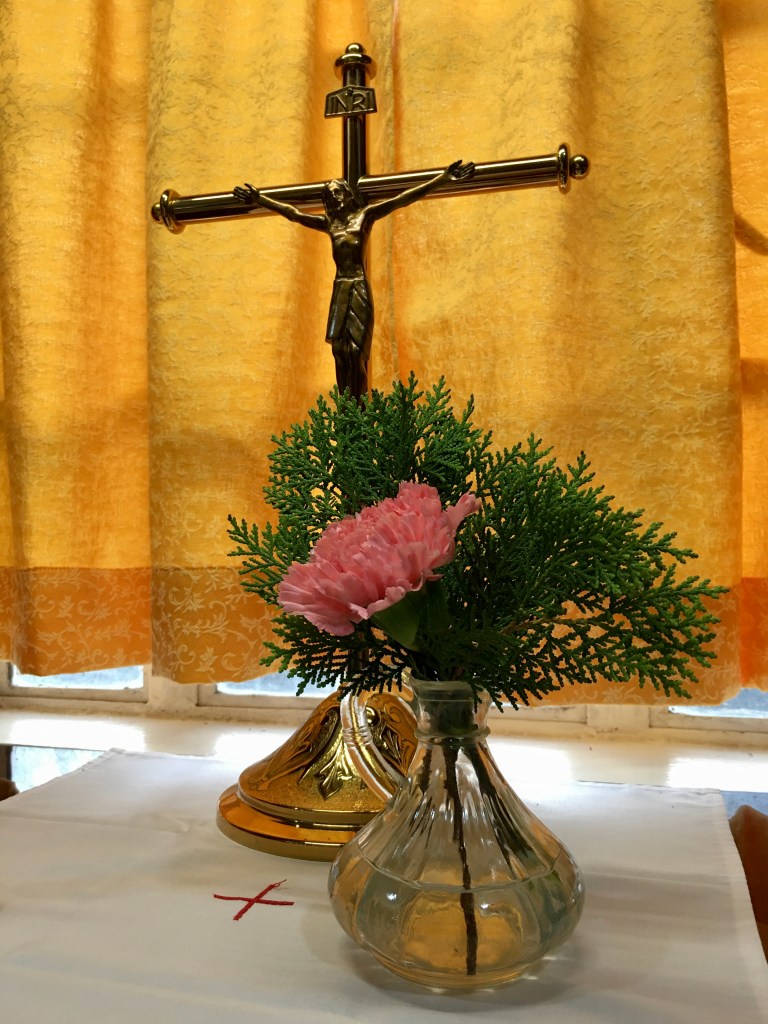
Photo by author, sacristy table, December 2020.
O God our Father, thank you for enlightening us today about the sufferings we are going through especially at this time of the pandemic. Forgive us for those times we have doubted you and your love for us when we go through many sufferings, forgetting that these are a part of our lives you have allowed to happen so we may grow and mature.
Forgive us when at the slightest sign of pain and sufferings, we balk at taking the path of the Cross of Jesus Christ, choosing to commit sin than being faithful to you.
Help us realize that when we suffer, the more you are nearer to us truly as a Father who lets his children go through trials and hardships to make him better and stronger in the future.
Endure your trials as “discipline”; God treats you as sons. For what son is there whom his father does not discipline? At the time, all discipline seems a cause not for joy but for pain, yet later it brings the peaceful fruit of righteousness to those who are trained by it. So strengthen your drooping hands and your weak knees. Make straight paths for your feet, that what is lame may not be dislocated but healed.
Hebrews 12:7, 11-13
We pray, O Lord, for those going through so much sufferings today especially those undergoing chemotherapy, dialysis, and physical therapy; those who have lost loved ones, who have lost their jobs.
Most specially, we pray for those suffering from rejection like Jesus when he came home to his native place and people took offense at him after hearing him spoke at the synagogue and healed so many sick people in other places.
It is one of the most painful sufferings anyone can go through, of being rejected by family and relatives, co-workers and colleagues, friends and neighbors.
Like St. Blaise, may we bear all pains and sufferings in life so we may strengthen the weak among us and offer healing to those who are sick and afflicted.
Most of all, like St. Blaise, as we accept the pains and sufferings coming our way, may we strive hard to never be the source of pains and sufferings to others. Amen.
The Lord Is My Chef Sunday Recipe for the Soul by Fr. Nicanor F. Lalog II
Week XXXIII-A in Ordinary Time, 15 November 2020
Proverbs 31:10-13, 19-20, 30-31 >><)))*> 1Thessalonians 5:1-6 >><)))*> Matthew 25:14-30
From inquirer.net
It is my fervent hope and prayer that by this time, everybody is feeling better after those harrowing experience of winds and rains by typhoon Ulysses that have induced flash floods and left a path of destruction and deaths in Central Luzon and Metro Manila this week.
Indeed, it was like tropical storm Ondoy happening again after eleven years when everybody was caught by surprise by the floods and severe aftermath of dirt and trash left behind with no electricity nor water supply available in many parts of the affected areas.
As a result, many of us have again reflected on the one topic we have always avoided in life – death and things of the end like parousia or Second Coming of Christ, end of the world, and judgement day that have preoccupied the early Christians. St. Paul’s reminder to them in today’s second reading is so timely and relevant even for us today to be vigilant for Christ’s coming.
But you, brothers and sisters, are not in darkness, for that day to overtake you like a thief. For all of you are children of the light and children of the day. We are not of the night or of darkness. Therefore, let us not sleep as the rest do, but let us stay alert and sober.
1Thessalonians 5:4-6
Vigilance is faith in Christ.
Jesus gives us another parable today to illustrate his Second Coming and judgement; but unlike last week, today is more picturesque, touching our innermost core, challenging us to be “wiser” in daring to gain eternal life by working harder in this life.
Jesus told his disciples this parable: “A man going on a journey called in his servants and entrusted his possessions to them. To one he gave five talents; to another, two; to a third, one — to each according to his ability. Then he went away. Immediately the one who received five talents went and traded with them, and made another five. Likewise, the one who received two made another two. But the man who received one went off and dug a hole in the ground and buried his master’s money.”
Matthew 25:14-18
Photo by author, Chapel of the ICMAS Theologate, 05 October 2020.
Vigilance is more than being prepared and ready for any eventuality. It is active waiting by taking risks to ensure a more safe and sound situation when emergencies strike. This is the reason why investors are always surveyed how much risks they are willing to take with their investments: the bigger the risks, the higher the returns are. But, can we take the risks?
The same is true with everything if we wish to have a better future. We have to take risks like working harder, sacrificing more in order to save money and have better homes, to keep our body physically fit and healthy, and burning the night lamp to finish our studies and achieve our goals in life. In this all we find the need to maximize what we have – no one can claim as having nothing at all or “walang-wala” as we would always claim in Tagalog.
Jesus clarifies this today in his parable, telling us that each servant was given with talents “according to his ability”. We are all blessed by God! It is not a question of how much we have received but what have we done to what we are given with.
Of course, not everyone can have all in life but each one has his/her many talents as well as weaknesses. Focus more on what we have than what we do not have. Keep in mind that nobody is perfect, that everybody is going through some struggles in life.
Being vigilant, being “children of light” means striving for the best, choosing what is the best which is part of being holy, an expression of our faith in God. Whenever we dare to take risks like casting our nets into the deep like Simon Peter, we express our deep faith in God as we hope and trust in him.
Photo by Dr. Mylene A. Santos, MD, 30 October 2020.
We are made by the choices we make.
When I was still teaching in our diocesan schools, I used to tell my students to “study hard, work harder and pray hardest”, reminding them that their being good and successful lawyers, doctors, engineers or any professional starts not in the future but today, in the here and now.
Make the right choices in life by truly working on them not just at the spur of the moment or simply based on what others say. Most of all, pray first to discern God’s will for our decisions so we may choose what is best for us according to him.
God wants only the best for us — he made us share in his Life and gave us his only Son Jesus Christ to have its fullness in him here and in eternity. Unlike wealth managers who help people invest for their future, only Jesus assures us with sure, high yields in our “investments” in life by being good and holy.
A lot often, we decide and take risks based on the people we are with like when we have friends or superiors who are good and trustworthy. In the first reading we have heard how a faithful wife uses all her talents in serving her family as she is moved by the fidelity and love of her husband. The same is true if we have good and inspiring friends and employers who move us to be our very best. And most true of all with God who moves us to be our very best to lovingly serve him in others.
Here we find Jesus in his parable as the master who went on a long journey who risked all for us and continues to believe in us, giving us all the grace we need in this life to be fruitful in him.
All we have to do is just be faithful to him to whatever task and mission he has given us. It does not matter how big or small that may be; all he wants is for us to remain faithful to him, of not wasting that talent that must be put into good use not only for us but for others too.
If we are faithful to Jesus, anytime he returns to call us back to eternity, we can be sure of “sharing in his (master’s) joy” of Eternal Life! And if we are not faithful, then….
Photo by Dr. Mylene A. Santos, MD, 07 November 2020.
Today as we praise and thank God for the gift of life with the sun shining anew, let us ask ourselves following the recent calamities happening: what have I done with the many gifts and blessing God has given me? with the tasks, big and small, he has entrusted me?
Remember, it is not how big or how little talents we have received but how we have made it grow that matters. Our lives are the gift of God to us, what we do with our lives, that is our gift to him!
Have a blessed Sunday! Please pray and help our brothers and sisters in Cagayan and Rizal provinces severely affected by typhoon Ulysses. Lastly, kindly say a prayer for me and my six other classmates as we celebrate today (15 November 1997) our 23rd anniversary of ordination as Deacons. Amen.
The Lord Is My Chef Sunday Recipe for the Soul by Fr. Nicanor F. Lalog II
Week XXIV, Cycle A in Ordinary Time, 13 September 2020
Sirach 27:30-28:7     >><)))*>   Romans 14:7-9   >><)))*>   Matthew 18:21-35
Photo by author, dusk in our parish, July 2020.
This Sunday we go deeper into the lessons gathered by Matthew from Jesus regarding love as the basis of our relationships. Last week we were told how mutual love is the sole reason why we correct brothers and sisters going stray in life.
But, more sensitive and delicate, not to mention most difficult than fraternal correction is the question of forgiving.
How many times should we forgive?
Peter approached Jesus and asked him, “Lord, if my brother sins against me, how often must I forgive? As many as seven times?” Jesus answered, “I say to you, not seven times but seventy-seven times. That is why the kingdom of heaven may be likened to a kind who decided to settle accounts wit his servants. When he began the accounting, a debtor was brought before hm who owed him a huge amount. Since he had no way of paying it back, his master ordered him to be sold, along with his wife, his children, and all is property, in payment of the debt. At that, the servant fell down, did him homage, and said, ‘Be patient with me, and I will pay you back in full.’ Moved with compassion the master of that servant let him go and forgave him the loan.
Matthew 18:21-27
Forgiving is always difficult because it is from God, calling us to be one with him, one in him, and be like him as that saying perfectly summed up, “To err is human, to forgive is divine.” It is beyond human abilities, reserved only for God until he became human like us in Jesus Christ who made us share in his greatest expression of love which is forgiveness. Hence, every time we forgive, we also become like God, divine and holy that unfortunately, we refuse and even hate!
Yes, it is very difficult because like love, forgiving is the nature of God. In fact, any kind of love is best expressed when it is forgiving. The good news is that we now share in this great love of God in forgiving others like him as we shall see in today’s parable, keeping in mind also that it was the Risen Lord’s commission to his disciples when he appeared to them on that Easter evening (John 20:22-23).
Photo by author, Baguio Cathedral, January 2018.
Forgiving like God our Father
The beauty of forgiving is that it is always a grace from God freely given to us. It is doable in Jesus Christ. The problem is when we refuse to let God work in us, when we refuse to level up our relationships to that of brothers and sisters in Jesus Christ.
There is always that pride in us exhibited by Peter at the start of the gospel today when he asked Jesus how many times he must forgive his brother. Must it be seven times?
Of course, seven being a “perfect number” does not specify a numerical figure of times to forgive except that it gives enough room to let go of a sinner or an offender. However, it still connotes some form of “counting” or taking tabs at how many times must one forgive, implying a limit.
But Jesus pushed it further when he told Peter to forgive “not seven times but seventy-seven times” — that is, twice the perfect number he had cited!
The Lord is telling Peter, and us today, to forget all about keeping tabs, of counting how many times you must forgive because God forgives us without limits which his parable tells us.
The king or master in the parable is God, so wealthy that he could lend sums exceeding the normal level of what one can borrow. Most surprising is like God, the master lent so much amount beyond the debtor’s ability to pay!
That is how rich our God is — so rich in love and mercy, giving us with so much even beyond our ability to pay him back in return. Exactly what we have in the responsorial psalm: “The Lord is kind and merciful; slow to anger and rich in compassion.”
And when that servant prostrated before his master, then the more we see in that religious gesture the deeper meaning of the parable: the rich mercy of God forgiving us for our debts even after we have lost everything like that debtor with nothing enough to pay his loans, not even his wife and children.
See the contrast of the king moved with compassion echoing the same attitude of Jesus so often like in the wilderness where he fed more than 5000 people and that servant so lost with nothing else left but still forgiven.
The parable could have stopped there but Jesus went on to continue what happened next to teach us the deeper truth of forgiving, which is imitating God our Father because we are brothers and sisters in him.
From Google.
When this servant had left, he found one of his fellow servants who owed him a much smaller amount. He seized him and started to choke him, demanding, ‘Pay back what you owe.’ Falling to his knees, his fellow servant begged him… but he refused. Instead, he had the fellow servant put in prison until he paid back the debt. Now when his fellow servants saw what had happened, they were deeply disturbed, and went to their master and reported the whole affair. His master summoned him and said to him, ‘You wicked servant! I forgave you your entire debt because you begged me to. should you not have had pity on your fellow servant, as I had pity on you?’ Then in anger is master handed him over to the torturers until he should pay back the whole debt. So will my heavenly Father do to you, unless each of you forgives his brother from his heart.”
Matthew 18:28-35
Forgiving from the heart
After hearing the second part of the parable, we all felt like the master, angry and indignant with that merciless servant whose action was very shameless and scandalous. But, more than being like the king who properly judged the conduct of that merciless servant, Jesus is also inviting us to probe deeper into our hearts the realities why we felt like the king in the parable?
How many times have we felt so angry and frustrated during this pandemic period at the many occasions when we heard news of injustices and abuse of powers against the little ones like Mang Dodong or the Marawi verteran shot to death in Quezon City? Of those punished in violating the protocols when its chief implementor got away free after attending a mañanita party?
The list goes on specially in our country where laws favor the abusive rich and powerful, those with connections while ordinary citizens with lesser violations, even without any crimes at all suffer the same fate as the servant with lesser debts.
Photo by author, “patak-dugo”, 2019.
We all feel so angry and very sad because more than the injustices and lack of mercies committed by those in powers, they have forgotten we are brothers and sisters in one God our Father. Parang sila lang ang anak ng Diyos…
We feel like the king in the parable because we felt left out, disregarded, and disrespected despite our kindness and mercy with others.
Forgiving from the heart means to forgive others not because we are fellow servants but most of all as brothers and sisters of a loving and merciful Father who forgives us always from our unpayable debts of sin and evil against each other.
This is the very thing St. Paul is telling us in the second reading, that “None of us lives for oneself, and no one dies for oneself” (Rom.14:7). Sometimes we need to be in control of our lives but the truth is, when we try to live St. Paul’s message that our lives belong to one another in Christ, the more we become truly free and happy.
It is the same reminder from Ben Sirach in the first reading telling us how we must avoid anger and resentment specially revenge because it is contrary to our faith in God. Most of all, we also know so well that we need the mercy of God in forgiving our countless sins.
The example of St. John Paul II about forgiving like God
I know what I am telling you are easier said than done. And I confess that I also find it so hard to forgive people who have wronged me, specially those I have loved and helped. Allow me to end this reflection with this beautiful bit of history that happened in our lifetime.
We were in high school seminary when Mehmet Agca shot and almost killed St. John Paul II at St. Peter’s Square on May 13, 1981. We were shocked, so sad for him and very angry with Agca. But, two years later after Christmas in 1983, we were more shocked in disbelief while at the same time in tears with joy when news came out that St. John Paul II came to visit Agca in his cell to forgive him!
It was a major news that landed on TIME magazine the following year with the cover story so relevant with our gospel today:
From Pinterest.
Those who do not forgive are those who are least capable of changing the circumstances of their lives…
Not to forgive is to be imprisoned by the past, by old grievances that do not permit life to proceed with new business.
Not to forgive is to yield oneself to another’s control. If one does not forgive, then one is controlled by the other’s initiatives and is locked into a sequence of act and response, of outrage and revenge, tit for tat, escalating always. The present is endlessly overwhelmed and devoured by the past. Forgiveness frees the forgiver. It extracts the forgiver from someone else’s nightmare. “Unless there is a breach with the evil past,” says Donald Shriver, “all we get is this stuttering repetition of evil.”
Lance Morrow, TIME Magazine, 19 January 1984
As I searched for photos of the assassination attempt on him by Agca, I came across this photo below of their meeting with an accompanying report that made me admire and love St. “JP2” more than ever.
It said that while recuperating in the hospital, St. JP2 learned from the news how people hated Agca, prompting him to ask everyone to “pray for my brother (Agca)… whom I have sincerely forgiven.” That is how holy is this great Pope of our time! Long before visiting Agca in 1983, St. JP2 had already forgiven him, calling him a “brother” despite the evil and sin done to him.
What a great Amen!
Have a blessed and wonderful week ahead, brothers and sisters in Christ!
The Lord Is My Chef Breakfast Recipe for the Soul by Fr. Nicanor F. Lalog IIMonday, Week XXIII, Year II, 07 September 20201 Corinthians 5:1-8 /// Luke 6:6-11
Photo by Mr. Chester Ocampo, 2019.
Forgive us, loving and merciful Father, for the many times we have chosen to be silent in the face of ongoing evil around us, when we unknowingly conspire in silence against you, against life, against justice.
Both our readings today speak about this deafening silence among us in many situations when we are so afraid to speak for what is good and true.
On a certain sabbath Jesus went into the synagogue and taught, and there was a man there whose right hand was withered. The scribes and the Pharisees watched him closely to see if he would cure on the sabbath so that they might discover a reason to accuse him. But he realized their intentions and said to the man with the withered hand, “Come up and stand before us.” And he rose and stood there. Then Jesus said to them, “I ask you, is it lawful to do good on the sabbath rather than to do evil, to save life rather than to destroy it?”
Luke 6:6-9
Worst than our silence in standing for life and dignity of persons is our “unwitting support” for evil and sin so as not to disturb our family and community.
Brothers and sisters: It is widely reported that there is immorality among you, and immorality of a kind not found even among pagans — a man living with is father’s wife. And you are inflated with pride. Should you not rather have been sorrowful? The one who did this deed should be expelled from your midst.
1 Corinthians 5:1-2
How true is the saying that “the only thing necessary for evil to triumph is for good men and women to do nothing” (attributed to both Edmund Burke and John F. Kennedy).
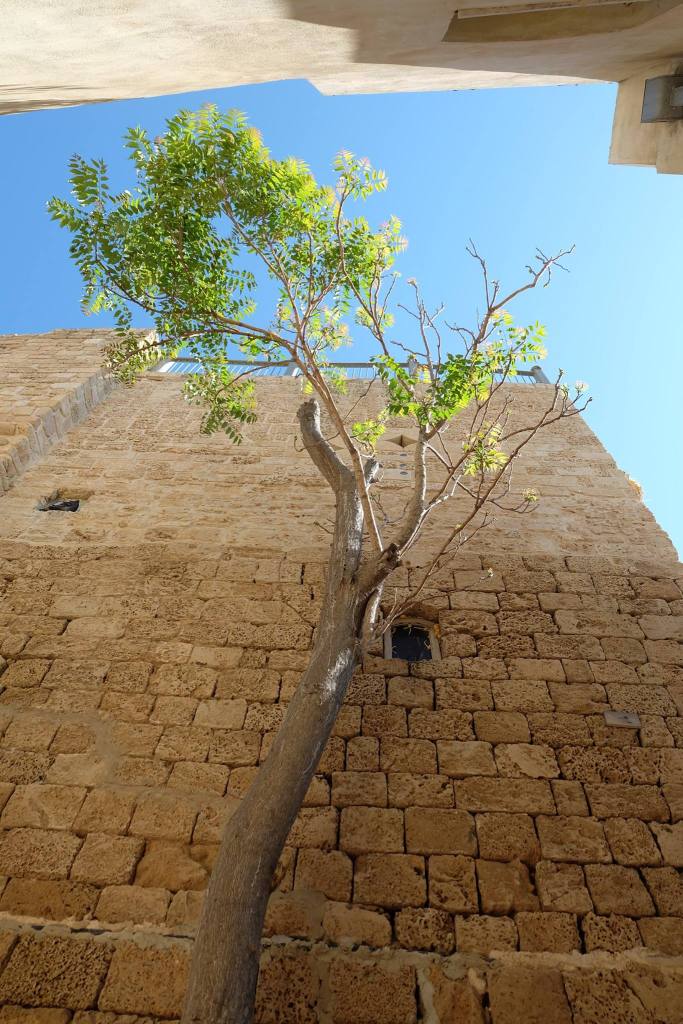
Photo by author, Jaffa, Israel, May 2017.
Forgive us, Lord Jesus.
Strengthen us inside, make our will and our hearts strong to stand for your Gospel specially when friends and families are the ones doing what is wrong and sinful.
Strengthen our firm resolve to be consistent in living our new life in you, Jesus, that is free from what others would say about us and free to be our true selves freed from sin, free to love and be faithful to you and for others.
Enlighten our minds and our hearts with your Holy Spirit on the actions we must take and words we must say to win them back to you.
Most of all, purify our intentions that we do this out of love for you and our beloved going astray. Amen.
The Lord Is My Chef Sunday Recipe for the Soul by Fr. Nicanor F. Lalog II
Week XX, Cycle A in Ordinary Time, 16 August 2020
Isaiah 56:1, 6-7 >><}}}*> Romans 11:13-15, 29-32 >><}}}*> Matthew 15:21-28
Twilight at our parish by Ms. Ria De Vera, 12 August 2020.
For the third Sunday in a row, Jesus reveals a very wonderful side of him who goes out of his way to meet us and comfort us in the most difficult situations and places we are into. It is something we need so much in these days of Moderate Enhanced Community Quarantine (MECQ) seen right away in the opening of today’s gospel.
At that time, Jesus withdrew to the region of Tyre and Sidon. And behold, a Canaanite woman of that district came and called out, “Have pity on me, Lord, Son of David! My daughter is tormented by a demon.” But Jesus did not say a word in answer to her.
Matthew 15:21-23
Jesus goes out of his way to meet everyone
Israel is a very small country but always leaves a big impact on everyone who goes on a pilgrimage there. There is that sense of awe in every sacred site that until now continues to “speak” and evoke among pilgrims the presence and holiness of God and his saints.
Like what we have mentioned last Sunday, the proxemics or the non verbal communication of the places Jesus have visited convey to us deeper meanings than just mere sites. And that is more true during the time of Christ like the setting of this Sunday’s gospel, the region of Tyre and Sidon.
Now part of Lebanon found south of its capital city Beirut that was devastated by powerful explosions two weeks ago, Tyre and Sidon were gentile or pagan cities during the time of Jesus with a considerable Jewish population.
His going there shows us his fidelity to his mission of “searching for the lost sheep of the house of Israel” that partly explains to us why he never bothered to give the slightest hint of recognition to the Canaanite woman who had sought his help for her daughter “tormented by a demon”.
Photo by author, the Holy Land, May 2019.
And despite the lack of any explanation again by St. Matthew on the attitude by Jesus “snubbing” the pagan woman, we can safely assume that Christ surely knew that by going to Tyre and Sidon, gentiles would seek his healing as news of his fame had spread beyond Galilee at that time.
Here we find the great love and concern of Jesus for everyone, specially the rejected and marginalized in the society.
His “withdrawing to the region of Tyre and Sidon” was in itself a revelation of his universal love, a love without borders reaching out to those lost and feeling alone in life, those rejected, those discriminated for their color and beliefs, status and gender, sickness and diseases like AIDS and lately, COVID-19!
Inclusive Jesus, exclusive human
At the beginning of chapter 11 of St. Paul’s Letter to the Romans from which our second reading is taken today, the great Apostle starts by asking “has God rejected his people?” St. Paul emphatically said “no”, explaining at length the plan of God in Jesus Christ to save all peoples not just the Jews, beautifully telling us,
For the gifts and the call of God are (permanent and) irrevocable.
Romans 11:29
St. Paul’s reflections on God being “inclusive” as against our being so “exclusive” in sending us Jesus Christ to bring us all together as one sheds us some light on that extraordinary incident in the region of Tyre and Sidon involving the Canaanite woman.
Again, I invite you my dear reader to reflect on the many layers of meaning found in this episode so special like the feeding of more than five thousand people the other Sunday and Jesus walking on water last week.
First, notice the silence of Jesus. Keep in mind when the Lord is silent, it does not mean he is out or does not care at all to our needs and pleas. When there is silence – specially a deafening one – the problem is never with God but with us people.
And, true enough! See how the disciples asked Jesus to “Send her away, for she keeps calling out after us” (Mt.15:23) — exactly the way we deal sometimes with those begging our help and attention, seeing them as a nuisance to be sent away? What a shame!
From Google.
Now, we go to the climax of this episode with the woman coming to Jesus, “paying him homage” for the healing of her daughter tormented by a demon. It was a scene similar with St. John’s wedding at Cana where the Blessed Mother also approached Jesus with a request when wine ran out during the feast.
In both episodes we find Jesus being a snub – suplado, as we say.
Most of all, in both scenes we find the remarkable faith in Jesus by his Mother at Cana believing he can do something to spare the newly wed couple of embarrassment from running out of wine while this Canaanite woman felt so sure only Jesus can cure her daughter.
See how she addressed Jesus like his disciples with not just “Lord” but also with the title “Son of David” to indicate her faith in him as the Messiah.
And it did not stop there as she engaged Jesus into a dialogue — indicating intimacy and trust, depth and communion that we refer in Filipino as “matalik na ugnayan” or “matalik na usapan”.
Sometimes in life, Jesus seems to have that longing for some “lambing” from us that he tries to be “pakipot” or hard to get in order to be intimate with us. Please take these Filipino traits positively to get what I mean from this unique scene of Jesus and the Canaanite woman in Tyre and Sidon.
Jesus said in reply, “It is not right to take the food of the children and throw it to the dogs.” She said, “Please, Lord, for even the dogs eat the scraps that fall from the table of their masters.” Then Jesus said to her in reply, “O woman, great is your faith! Let it be done for you as you wish.” And the woman’s daughter was healed from that hour.
Matthew 15:26-28
Photo by author, Church of All Nations beside the Garden of Gethsemane in the Holy Land, May 2019.
Brothers and sisters all in one God as Father
St. Matthew recorded this episode not to scandalize and shock us with those words coming from the Lord, referring to the Canaanite woman as one of the “dogs” that was the term used to designate pagans at that time.
For St. Matthew who was writing for Christians of Jewish origins, the episode was a reminder that the people of Israel were indeed the “children” of God to whom the coming Messiah and salvation – like bread or food – were first promised. St. Paul spent a great deal of explaining of this in his letter specially to the Romans .
Rigthly then, theirs was the “food” not right to be thrown to the “dogs” but, that fact does not exclude the “dogs” from partaking later from the leftover food of the children, as if telling Jesus, today we satisfy ourselves with crumbs, tomorrow we shall have bread!
The Canaanite woman clearly knew where to place herself before the Lord, proving to him her deep faith and amazing knowledge of God’s goodness and plans for everyone. For that, she was highly praised by Jesus for her faith. The only other person also praised by Jesus in having a tremendous faith in him was the centurion – another pagan – who begged the Lord for the remote healing of his servant.
Last Sunday afternoon I read the story of how a nurse was driven out of her boarding house after she tested positive for COVID-19 virus. The poor lady had nowhere to go to spend the night after being denied of any assistance by barangay officials, even by her own family in Batangas! Good enough, somebody reported her to the Philippine National Red Cross that sent an ambulance to take care of the nurse who was found crying by herself at the gutter of a street in Pasay City.
What a very sad and tragic reality happening among us these days of the pandemic.
Where is our love and concern for everyone, especially the weak and the sick, those in our own versions of Tyre and Sidon where no one would dare to go except Jesus, perhaps like the dorms and residences of our medical frontliners who are so tired and sick physically, emotionally, and spiritually during this pandemic?
In these past three weeks we have reflected how Jesus lovingly joined us, staying with us in the wilderness, in the storms of the dark sea, even at the pagan territories where nobody would ever want to go.
This Sunday, Jesus is inviting us to break all barriers and borders between us that separate us from each other. Let us animate our community with Christ’s love and mercy for us all amid our many differences so that slowly we fulfill Isaiah’s prophecy in the first reading that someday the house of the Lord shall be called “a house of prayer for all peoples” (Is.56:7). Amen.
A blessed and safe new week to you! And please do not forget to pray ten Hail Mary’s every 12-noon for national healing and end of the pandemic until September 15, 2020.
The Lord Is My Chef Sunday Recipe for the Soul by Fr. Nicanor F. Lalog II
Week XIX, Cycle A in Ordinary Time, 09 August 2020
1 Kings 19:9, 11-13 >><}}}*> Romans 9:1-5 >><}}}*> Matthew 14:22-33
Photo by Mr. Raffy Tima of GMA-7 News, Batanes, 2018.
I have always loved the sea and lately my thoughts have always been about the beach as I miss it so much after COVID-19 had robbed us of our summer vacation.
In ancient time, the sea evoked fear because it was largely unknown that even in the bible, it is the symbol of evil and its powers over man. That is why our gospel today is very significant when Jesus walked on water to show God’s greater power over evil and sin.
And like our gospel last week, our story today tells us a lot more about Jesus walking on water in the midst of a storm to reveal himself and most of all, his desire to meet us his disciples.
Place and location as non-verbal communication of one’s presence
Every meeting and encounter presupposes locations or places, a locus; but, everything is “levelled up” or elevated in Jesus in whom things do not remain in the physical level.
Proxemics is the non-verbal communication that refers to places and location, its nearness and orientation. How we arrange our furnitures, designate the rooms and sections in our homes, offices, schools and every building we stay and gather communicate and reveal who we are.
For example, Catholic homes are easily identified in having a grotto at the garden, an altar of the Sacred Heart or any saint at the sala, and the Last Supper painting in the dining hall.
But for Jesus, a place or a location is more than the physical site because in him, proxemics takes on a deeper dimension and higher meaning when we meet him in situations and places. That is why after feeding the more than five thousand people last week, he ordered the Twelve to cross the Sea of Galilee (which is actually a lake) ahead of him while he dismissed the crowds.
After doing so, he went up on the mountain by himself to pray. When it was evening he was there alone. Meanwhile the boat, already a few miles offshore, was being tossed about by the waves, for the wind was against it. during the fourth watch of the night, he came toward them, walking on the sea. When the disciples saw him walking on the sea they were terrified. “It is a ghost,” they said, and they cried out in fear. At once Jesus spoke to them, “Take courage, it is I; do not be afraid.”
Matthew 14:23-27
Photo by author, Sea of Galilee at Capernaum where Jesus used to preach, May 2019.
Crossing to Jesus, crossing with Jesus
I love that scene very much, of Jesus getting his disciples into the boat to precede him to the other side of the lake while he dismissed the crowds. Again, St. Matthew never bothered to tell us why Jesus sent the Twelve ahead of him as he stayed behind, dismissing the crowds and later praying alone at night atop the mountain.
Let us now reflect the proxemics or non-verbal communication of our gospel scene this Sunday.
We need to cross to the other side to meet Jesus.
To meet Jesus Christ, we always have to “cross to the other side” by leaving our “comfort zones”.
More than going to the other side of the lake physically, we have to move over to unchartered areas of life, be bold and daring to try new things, new situations in order to mature and find fulfillment by meeting Jesus Christ.
And sometimes, we really have to literally cross the sea or get to the other side of the country or the world to find our self and meet Christ.
Fifteen years ago I went on vacation to Toronto for some soul-searching as I went through a burn-out. While serving at St. Clement Parish, I met many Filipinos serving as lectors, choir members, catechists and volunteers.
Graph shared by sugarindustryfoundationinc.org.ph.
They would always confess to me with both a sense of pride and little shame that they never went to Mass regularly when in the Philippines and now in Canada, they were amazed at how God had brought them there to be involved in parish activities and be closer to Jesus than ever!
As I listened to their stories, I realized the many sacrifices and hardships they have to endure in that vast and cold country with no one to turn to except God. If given the chance, many of them admitted they would return to the Philippines for there is no place like home!
Though I have found so many things I have been searching for in my initial three months of stay there on top of other opportunities given me, I still felt empty. That raging storm within continued. As I prayed and reflected guided by an old, Polish priest who claimed to have been the student of St. John Paul II, I saw myself more, eventually leading me to God anew who refreshed my vocation that I finally decided to go back home after six months of my supposed to be one year leave.
Sometimes in life, we need to get away from our comfort zone, cross to the other side, especially when life becomes so artificial. Jesus invites us to go ahead and cross to the other side of the lake or sea to experience life at its “raw” so we can feel again our souls within and desire him anew until we finally meet him wherever we may be in the world.
It is when we are at the other side of the sea in the midst of a storm when Jesus comes, immediately answering our cries for help – At once Jesus spoke to them, “Take courage; it is I” – because when we are reduced to emptiness and nothingness, then our faith kickstarts again. Faith, like love, is always an encounter with God.
Try going to the other side, leave your comfort zone to meet Jesus and finally have meaning and direction in life!
Silence is the presence of God.
In the first reading we have heard that beautiful story of Elijah meeting God at the mouth of a cave — not in the strong and heavy wind nor earthquake nor fire like Moses before him.
After the fire, there was a tiny whispering sound. When he heard this, Elijah hid his face in his cloak and went and stood at the entrance of the cave.
1 Kings 19:12-13
Silence is the place of the presence of God because silence is his language too. Wherever there is silence, we can surely find and meet God there.
That is why Jesus wants us to cross to the other side, to be silent and listen to him.
Photo by author, crossing the Lake of Galilee, May 2019.
In his silence, God teaches us that except for sin, he never considers everything as being finished; everything is a “work-in-progress” even if he seems to be silent that some think he must be absent or even dead.
The world thrives in noise, loud talks, and screams with each voice trying to dominate another resulting in cacophony of sounds. Shakespeare’s Hamlet said it well when he told Polonius what he was reading were “Words, words, words” — nonsense!
Some people like those in power think that the more words they say, the more meaningful their thoughts and ideas become. Worst, they thought that using foul and filthy language make them so natural and credible, not realizing the more they look stupid with their crazy thoughts and ideas not even clowns and comedians would ever attempt to imitate.
But when our words come from deep silence, they come with power and meaning, touching everyone’s heart and inner core.
That is when silence becomes fullness, not emptiness or mere lack of noise and sound.
Like when our medical frontliners and medical experts spoke with one voice last week airing their thoughts about the pandemic — we were all moved and reawakened to realize how we have been going about with our lives almost forgetting them these past five months!
What a tragedy at how our officials in government and Congress reacted negatively, feeling hurt deep inside with the painful truth of how they have been irresponsible from the beginning. Sapul!
Pico Iyer wrote in a TIME magazine essay 30 years ago that “silence is the domain of trust”.
True. The most trustful people are the most silent; those who speak a lot trust no one and most likely, cannot be trusted too.
Jesus invites us to cross to the other side to be silent and learn to trust him. It is only then when we can meet him. In silence.
Photo by Mr. Raffy Tima of GMA-7 News, Manila Bay with Mt. Samat’s Cross at the background, April 2020.
Jesus meets us in darkness.
Jesus asks us to cross to the other side of the lake or sea like his disciples in order to meet us in darkness. This is a paradox because Jesus is the light of the world.
But, note the most notable moments in his life happened in darkness: he was born on the darkest night of the year, he died when darkness covered the whole city of Jerusalem, and he rose from the dead when it was still dark on the first day of the week.
Jesus had overcome darkness! So, what happened to Peter in this episode after being called by Jesus to walk on water too?
Jesus said, “Come.” Peter got out of the boat and began to walk on the water toward Jesus. But when he saw how strong the wind was he became frightened; and, beginning to sink, he cried out, “Lord, save me!”
Matthew 14:29-30
Imagine how everything was going so well with Peter doing another crossing while crossing the lake! But when he saw how strong the wind was he became frightened; and, beginning to sink, he cried out, “Lord, save me!”
Jesus calls us into the dark so that we only look for him and upon finding him, focus on him alone. Peter saw the strong wind, not the stronger and powerful Jesus walking on water, that fear overtook him.
That’s the whole point of St. Paul in our second reading today: he was telling the Romans how some people in Israel trusted more in their physical descent from Abraham than in God’s promise of salvation fulfilled in Jesus they have refused to see and recognize as the Christ (Rom.9:1-5).
When in the dark, be silent and still for Jesus is near! Keep your sights at him, not on anything else. Problem in darkness is not God but us who follow other lights or have become delusional.
Photo by Mr. Jim Marpa, 2019.
That is the tragedy we are into as a nation while crossing to the other side of the sea of pandemic in just one boat when our officials see only themselves as always being right. Worst, they all want to be on the stage with all the lights on them as they speak and sing in cacophony like psychopaths.
All the more we must hold on tight, trust and focus in Jesus who is “now here”, not “nowhere” for he will never allow us to perish.
Let us trust Jesus overcoming all these evil, leading us to the shore. Amen.
A blessed rainy Sunday to you and your loved ones!
The Lord Is My Chef Sunday Recipe for the Soul by Fr. Nicanor F. Lalog II
Week XVII, Cycle A in Ordinary Time, 26 July 2020
1 Kings 3:5,7-12 >><}}}*> Romans 8:28-30 >><}}}*> Matthew 13:44-52
Photo by author, 2020.
The other Sunday during our Mass, I saw a man wearing a black t-shirt with these signs:
– = +
Of course, it means “Less is more” because a minus (-) is equal (=) to an addition or a plus (+)!
That is also the meaning of the Cross of Jesus Christ wherein it is in giving that we receive, in dying that we live, in losing that we gain more of everything because the cross is a plus sign.
This Sunday, that is essentially the lesson Jesus is telling us on this final installment of his parables wherein we have to lose everything in order to have him, the kingdom of God.
See how the three parables present us with one situation: to get the treasure in a field, its finder has to bury it again, sell all he has to buy the field where he had found the treasure; a trader searching for fine pearls sells everything he has to acquire a pearl of great price he had found; and lastly, not all fish caught in a net thrown in the sea are good to be sold with bad ones that must be thrown.
These parables are reminding us today of the need to exercise our freedom properly by making wise choices in life. Freedom is not the ability to do whatever we want but the ability to choose always what is good.
In every situation in life, we always have to make a choice; it is never true that we have no choice left to make. Choosing not to make a choice is actually choosing what is wrong, what is bad, and what is not good for us and for others.
We are always made by the choices we make in life. And that is why the parables are teaching us to choose wisely like King Solomon in the first reading.
Photo by author, February 2020.
Choosing wisely
The Lord appeared to Solomon in a dream at night. God said, “Ask something of me and I will give it to you.” Solomon answered: “O Lord, my God, you have made me, your servant, king to succeed my father David; but I am a mere youth, not knowing at all how to act. Give your servant, therefore, an understanding heart to judge your people and to distinguish right from wrong.” The Lord was pleased that Solomon made this request. So God said to him: “Because you have asked for this — not for a long life for yourself, nor for riches, nor for the life of your enemies, but for understanding so that you may know what is right — I do as you requested. I give you a heart so wise and understanding that there has never been anyone like you up to now, and after you there will come no one to equal you.”
1 Kings 3:5,7,9, 11-12
Here we go back again to that basic reality of a parable which is a simple story of every day life filled with profound meanings. It is something we take for granted because it is so ordinary like the seed forgetting its great potentials in the future.
Many times in life we get distracted like today when we have a plethora of products and services available that we cannot focus on what is really essential and important. Our decisions are clouded even erratic because we are so distracted with the wide array of choices to make, from food to eat to clothes to wear, movies or series to watch on Netflix or cable TV as well as music to listen from thousands of titles in our playlists.
And in our distraction, many times we miss our priorities in life, especially God and our loved ones.
Then, we end up sad and miserable, way too far from what God had envisioned for us since the beginning which is to live in joy in him.
For those he foreknew he also predestined to be conformed to the image of his Son, so that he might be the firstborn among many brothers and sisters. And those he predestined he also called; and those he called he also justified; and those he justified he also glorified.
Romans 8:29-30
St. Paul is reminding and assuring us in these short passages we heard from his letter today that God called us to be saved and glorified in Jesus Christ not by chance but by purpose. He willed it, he wanted it so because he loves us so much, assuring us all of future glory in him in eternity.
The key to experiencing that joy from God is to always abide in him like King Solomon of choosing what is good, letting go of everything that will separate us from him like sin and evil. For God’s plan and grace to operate and materialize, we need to cooperate with him like being a good soil that produces fruitful wheat.
Photo by Mr. Jim Marpa, 2018.
Our Christian life of joy
Like the Twelve inside the house listening to Jesus explained and narrated more parables, the Lord is also asking us today the same question:
“Do you understand all these things?”
Matthew 13:51
To “understand all these things” is not about human intelligence like being smart or brilliant but of holy wisdom or spiritual intelligence characterized by humility and simplicity before God and others.
To “understand all these things” and be like “every scribe… or the head of a household who brings from his storeroom both the new and the old” (Mt.13:52) is to be one in Jesus Christ, a person learned in the ways of God, who knows how to prioritize things, always making things relevant in the present even if it is an old lesson.
To be truly joyful in life is to just have Jesus, only Jesus and always Jesus.
It is easier said than done but we must try even little by little, slowly by learning more to give of our very selves to others.
It is difficult to imitate the main characters in the parables today – the finder of treasure, the pearl merchant, and the fisherman – when we always think of having more than having what is most valuable and important.
Have we noticed during this pandemic that whenever we would count or take tabs of everything we share, we feel sad and even grouchy because we feel we have lost a lot? And if we get too much in return, we cannot rejoice because we somehow feel guilty?
True joy comes when we are able to be generous, of giving without counting the costs, without thinking of what would be left for me because my only concern is what else can I give the other persons so that my joy can be complete when I see them like me – happy, contented, and peaceful with a simple smile or delighted by a hot bowl of soup or a hearty breakfast.
And that’s that greatest parable of Jesus of all that we need to understand and embrace: the less we have of created things, the more we have of the Creator, of himself who is the kingdom of God.
Then, that is heaven.
A blessed Sunday to everyone!
Photo by Dr. Mylene A. Santos at Infanta, Quezon, July 2020.
The Lord Is My Chef Sunday Recipe for the Soul by Fr. Nicanor F. Lalog II
XIVth Sunday in Ordinary Time, Cycle A, 05 July 2020
Zechariah 9:9-10 >><)))*> Romans 8:9, 11-13 >><)))*> Matthew 11:25-30
From Google.
We now come to the conclusion of our series of teachings of Jesus about discipleship that began two Sundays ago when he asked us not to be afraid and to be “possessed” or overtaken by him to fulfill our mission of proclaiming his good news of salvation.
And so, we now ask, “Why should we follow Jesus and be his disciples, forgetting our very selves and still carry our cross? Have we not suffered enough especially in this pandemic?”
His answer: because unlike other lord and master, Jesus is the only one who is meek and humble of heart, full of compassion to everyone!
He is the only one truly with us in our pains and cries because before all these trials have come to us, Jesus was there first to suffer and die for us on the Cross so we can share in the grace and peace of his Resurrection, calling us with these comforting words….
“Come to me, all you who labor and are burdened, and I will give you rest. Take my yoke upon you and learn from me, for I am meek and humble of heart; and you will find rest for your selves. For my yoke is easy, and my burden is light.”
Matthew 11:28-30
Our desire for everything “lite” and easy
If there is anything that we all want at this time is a rest, a break from the heavy burdens 2020 has brought upon us all as individuals and as a nation, not only in the country but the whole world.
We all want things to be “light” and easy like before COVID-19.
The world has long been offering us everything that is “light” (also spelled as “lite”), claiming it to be the key to a healthy and fulfilling life that many products are labelled as lite — from cooking oil to mayonnaise, cheese and ice cream, soda and even brandy, beer, and cigarettes!
But they are all lies!
We still get fat and even sickly with those lite products because being light does not necessarily mean removing or taking away things that are heavy and “toxic” or difficult. Being light does not mean free from responsibilities and duties, or not having a cross and sufferings in life.
Life is difficult as M. Scott Peck insists in The Road Less Travelled, telling us that the sooner we accept this reality, the better we are in life.
It is the truth Jesus Christ has long been telling us, so timely to be reminded again this first Sunday of the second half of 2020 as we continue to hurdle more difficulties ahead in fighting COVID-19 as well as in dealing with a hosts of other problems it had created in the many aspects of our lives.
Today, the Lord is telling us that to be light in life, we have to come to him, be his disciple by taking his yoke and learning from him.
We all know from experience that anything becomes light, especially a burden and a problem, when shared with someone who loves us, someone who cares for us, someone who believes in us. Many times, our problems and burdens need not be solved at all; they simply have to be shared with any one willing to accompany us.
Being light in life is having a companion to share with our burdens and woes because having these all by ourselves is indeed so difficult and impossible. That is the literal meaning of the Latin origin of the word companion – cum panis – someone you break bread with in a journey.
Jesus Christ is that only companion par excellence we can have for he is meek and humble of heart
Photo by Ezra Acayan of Getty Images, Baclaran Church, February 2020.
The gentle mastery of Jesus Christ
In the past two Sundays, Jesus spoke about ourselves and our dispositions to become his disciples. This Sunday, he speaks about himself as our Lord and Master, describing himself as “meek and humble of heart”.
Earlier at the start of his preaching in his Sermon on the Mount, Jesus spoke of true blessedness in the Beatitudes that actually gave us an image of himself as the Blessed One. Each beatitude speaks of Jesus Christ being poor in spirit, being meek, being merciful, being clean of heart, being a peacemaker, and being persecuted.
See that the third beatitude is how he also described himself today in the gospel, “Blessed are the meek for they shall inherit the land” (Mt. 5:5).
Very interesting is the fact that in his Sermon on the Mount when he preached the Beatitudes, Jesus was presenting himself to the people as the “new Moses” who gave them the Ten Commandments of God at Mount Sinai. As the most towering figure among the Jews, Moses is also described as “very meek, more than all men that were on the face of the earth” (Numbers 12:3)!
Meekness of Jesus: focusing more on persons than letters of the law
In calling us to come to him to take his yoke and learn from him for he is meek and humble of heart, Jesus is telling us that indeed, he is the new Moses in whom pure goodness is found. And even more surpassing than Moses because Jesus himself is the Law and its fulfillment. Unlike in Moses wherein the people focused more on the letters of the laws, Jesus our Lord insists more on the person, always reminding us that “Sabbath was created for man, not man for sabbath.”
But the most beautiful key in understanding the meekness of Jesus is found in our first reading which we also hear proclaimed on Palm Sunday:
Thus says the Lord: Rejoice heartily, O daughter Zion, shout for joy, O daughter Jerusalem! See, your king shall come to you; a just savior is he, meek, and riding on an ass, on a colt, the foal of an ass. He shall banish the chariot from Ephraim, and the horse from Jerusalem.
Zechariah 9:9-10a
Photo from Google of an ass considered as the dumbest creature on earth.
Unlike the proud masters and rulers of the world, Jesus our Lord and King entered Jerusalem riding on an ass in fulfillment of this part of the Old Testament.
Here we find Jesus as the exact opposite of the kings and rulers of the world whose kingship does not depend on political and military might, no exercise of brute force and power characterized by the chariots and horses of his time.
Meekness of Jesus: oneness with us his people
In this beautiful imagery of Jesus riding an ass considered as the dumbest creature on earth we find Christ’s inmost being of humility and meekness before God and men. No display of arrogance and shameless feelings of entitlements like our officials in the government and military. Most of all, Jesus riding on an ass illustrates his oneness with us all because the ass is the means of transportation of the poor, of the common tao.
Here is the meekness and humility of Jesus Christ — his being one with us in our brokenness and poverty, pains and hurts. You can really experience him especially in this time of the corona when everything seems to be getting worst than better, when everybody is trying to make ends meet amid the economic crisis with Jesus never abandoning us in our darkest moments of uncertainties, fears, hunger, and sadness.
At the rate things are going, we have nobody else to turn to at this time but Jesus our Lord. We have to muster all our faith in him, deepen ourselves in prayer because we cannot rely on our officials who cannot even get a clear data on COVID-19 infections nor even a sound plan in addressing this pandemic despite the longest days of lockdown in the world and loans from abroad.
And we all feel so hopeless, disgruntled and so disgusted especially with the public officials and those from congress and the police who are oblivious to our sufferings and hardships in this time of the corona as they shamelessly flaunt their privileges and exception to the rules.
How can we heal as one when in the first place they are not one with us?
Discipleship in Christ is life in the Holy Spirit
Despite all the irresponsibilities and inanities of the government, we choose to be like our Lord and Master Jesus Christ in bearing all pains and hardships in his holy name, always hoping that this experience can lead us to more meaningful lives as citizens of the republic.
We choose the path of non-violence despite the government’s militaristic response to the crisis aggravated by the legislative’s dangerous foray into more draconian measures to silence critics of the administration.
It is so tempting to fight back and forget all about meekness and humility but that is not the way of Jesus Christ.
In the second reading, St. Paul reminds us of the fundamental choice that lies before every disciple of the Lord: to live in solidarity with Christ empowered by his Spirit, or to live in solidarity with the old humanity enslaved to sin.
May we choose Jesus because he alone is meek and humble of heart, in him alone can we find rest because his yoke is easy and his burden light. Amen.
The Lord Is My Chef Sunday Recipe for the Soul by Fr. Nicanor F. Lalog II
XIIIth Sunday in Ordinary Time, Year A, 28 June 2020
2 Kings 4:8-11, 14-16 >><)))*>Romans 6:3-4, 8-11 >><)))*> Matthew 10:37-42
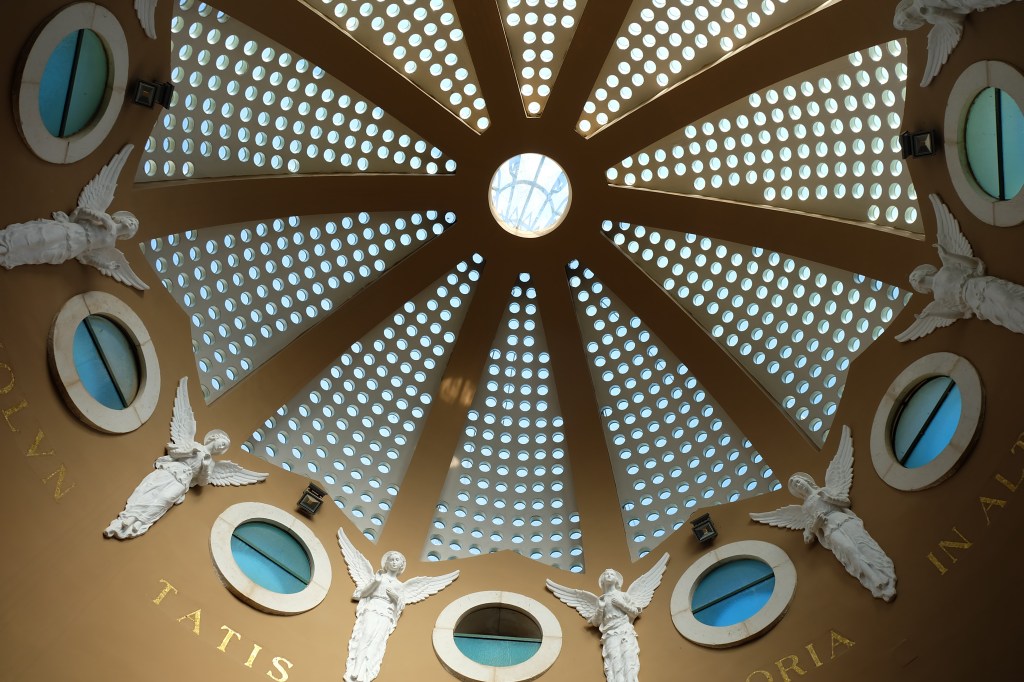
Photo by author, Dome of the Chapel of Nativity at Shepherd’s Field, Bethlehem, the Holy Land, May 2019.
Jesus continues his lessons to us his disciples being sent to look for the “lost sheep of Israel”, to be not afraid for he is with us in this journey and mission. But, it is not enough that we have Jesus on our side and be present among us: we have to allow Jesus to take possession of us completely!
From having no fear because Jesus is here, Christ now deepens his presence by inviting us to be possessed by him, to be in communion with him.
Jesus said to his disciples: “Whoever loves father and mother more than me is not worthy of me, and whoever loves son or daughter more than me is not worthy of me; and whoever does not take up his cross and follow after me is not worthy of me. Whoever finds his life will lose it, and whoever loses his life for my sake will find it.”
Matthew 10:37-39
Photo by author, processional Cross at the altar, 2019.
The Mystery of the Cross
Discipleship in Jesus Christ is more than a total allegiance to him who is neither a demanding nor exacting Lord and Master for he does not arbitrarily impose himself upon us.
Nothing like that of subservience but something more lofty because it is wrapped in a mystery — a mystery of love freely given and shared to us by God even if we do not deserve it all. Remember the mystery of the Blessed Trinity four Sundays ago (June 07)?
Ever since, God has never imposed himself upon us, that we should love him back in return for he does not really need our love. He gave us the gift of freedom so that we may love him freely for he never imposes on us.
And here lies the beauty of discipleship, of this relationship we have with God that is based solely on love expressed to us in the most personal manner by giving us his Son Jesus Christ who suffered and died on the Cross but rose again on Easter. This we were reminded by the Solemnities of the Body and Blood of Jesus and of his Sacred Heart last June 14 and 19 respectively.
Now you see my dear readers the clearer picture of our liturgical celebrations expressing our concrete experiences of being loved by God in Jesus Christ most especially during times of trials and sufferings like in this COVID-19 pandemic.
It is Christ who made the initiative to be one with us in our pains and sufferings; God did not remove our crosses in life but made them holy in his Son Jesus Christ so that every time we go through life’s many difficulties, we share in the Lord’s Passion, Death, and Resurrection.
That is why, we are invited to take and carry our cross every day for it is through the Cross we are saved. It is not enough to simply believe in the person of Jesus but we need to accept and embrace his Cross because it is through which he had won our salvation by dying on it and rising again.
This is easier said than done. It is so difficult to love Jesus more than our loved ones like family and friends. And it is most difficult to love the Lord more than our selves, when we have to let go of our plans and agenda.
Letting go and letting God in itself is already crucifying — but that is when this mystery of Christ’s love and of his Cross deepens further when we lose ourselves in him!
Celebrating Mass without te congregation during the ECQ, March-April 2020.
Possessed by Christ
To be possessed by Jesus is to receive God and his gift of salvation through the mystery of Christ and his Cross. Like our Christian life, proclaiming the gospel carries with it the sign of the Cross of Christ.
We are not asked to reenact or reproduce his Crucifixion nor is Jesus asking us to be suicidal or go against our natural aspirations and dreams.
To be possessed by Jesus means we continue to take care of ourselves without neglecting the needs of others.
To be possessed by Jesus means being generous to others in the same manner Jesus has always been generous to us.
To be possessed by Jesus means to realize that every act of self-giving is really an act of receiving!
Photo by author, Malagos Park, Davao City, 2018.
That is the paradox of the Cross, of discipleship in Christ: “Whoever finds his life will lose it, and whoever loses his life for my sake will find it” (Mt.10:40).
And that is also where the mystery of Christ’s love deepens because whatever we give is not really ours but Christ’s.
Every time we give love, it is the love of Jesus.
When we are kind and generous with others, it is the kindness and generosity of Jesus we give and share.
When we are patient and understanding to others, it is still the patience and understanding of Jesus in us.
Even if we give and share material things like money, food, clothing… whatever good we share and give are all from Jesus not from us.
And the more we give, the more we receive!
Have you noticed especially during this pandemic how the generous among us are now more blessed?
Wonder no more because you have allowed yourself to be possessed by Jesus Christ!
This is what the woman at Shumen had realized after welcoming the Prophet Elisha into her home in our first reading. She even gave him a room to stay every time he comes for his mission while the Lord provided all her needs, even rewarded her with a son as promised by Elisha.
When we allow Jesus to take over us, when we enter into communion in him and with him in his very life, we become more free to love, we strengthen our relationships with others, we wander less and worry less in life; most of all, we feel lightened in our burdens with the presence of Jesus giving us fullness of life in him.
This is the grace I hope we have seen from this quarantine period, especially those two months of lockdown when were freed from our usual grind and busyness with more time to be silent and still, to pray and reflect on our relationships with God and with others. It was a difficult and very trying period that had given in return a lot of opportunities to others.
Photo by author, Marcos Highway, 2019.
Dead to sin, alive to God
Brothers and sisters: We know that Christ, raised from the dead, dies no more; death no longer has power over him. As to his death, he died to sin once and for all; as to his life, he lives for God. Consequently, you too must think of yourselves as dead to sin and living for God in Christ Jesus.
Romans 6:9-11
It has been four months since houses of worship were ordered closed to help stop the spread of the corona virus. Somehow, the lockdown had made us realize the importance of receiving the Sacraments especially the Holy Eucharist.
But, sacraments are not everything for we have the bigger roles of putting into practice its reality of being the saving presence of Jesus Christ.
Now that lowly life is beginning to go back to its usual grind especially the traffic, soon we might forget again the more important things in life like God and our relationships in our family and friends that it is hoped we have rediscovered during the quarantine period.
That is why I strongly feel the government must now allow Churches to open so the people may experience again God in the sacraments and in our rites and rituals lest they get busy again with so many things only to miss finding anew the meaning of our lives found in silence and stillness before the Cross of Christ.
It is my hope that in this quarantine period, may we find through the Cross of Jesus that when we learn to submit and surrender to him, that is when we truly become free; and, when we lose and give away our lives to him, that is when we gain fullness of life in him. Amen.
A blessed week and a more abundant July to everyone!


















 lordmychef.com