The Lord Is My Chef Breakfast Recipe for the Soul by Fr. Nicanor F. Lalog II
Wednesday, Feast of St. Mary Magdalene, 22 July 2020
2 Corinthians 5:14-17 >><}}}*> >><}}}*> >><}}}*> John 20:1-2, 11-18
Painting by Giotto of the Risen Lord Jesus Christ appearing to St. Mary Magdalene from commons.wikimedia.org.
Dearest Lord Jesus Christ:
Today as I prayed on the feast of your beloved Saint Mary Magdalene, my sights were focused on your beautiful exchange of names on that Easter morning at your tomb.
It is so lovely and so deep, and very personal for all of us whom you love so much despite our many sins like St. Mary Magdalene.
When she had said this, she turned around and saw Jesus there, but did not know it was Jesus. Jesus said to her, “Woman, why are you weeping? Whom are you looking for?” She thought it was the gardener and said to him, “Sir, if you carried him away, tell me where you laid him, and I will take him.” Jesus said to her, “Mary!” She turned and said to him in Hebrew, “Rabbouni,” which means Teacher.
John 20:14-16
You called her by her name, “Mary” and she called you by your title “Rabbouni” – what a beautiful scene of two people loving each other so deeply, so truly! You – humbly and lovingly accepting the sinner, and she – submitting herself to you as disciple.
You have expelled seven demons from her, you have known her so well even her darkest secrets and sins, and despite all these knowledge, Lord Jesus, the more you have loved her that you called her by the sweetest word she could ever hear in her life, “Mary”.
The same with us, sweet Jesus: every day you call us by our names, each one of us as a person, an individual, a somebody not just a someone. You love us so much in spite and despite of everything. We are not just a number or a statistic to you but a person with whom you relate personally.
From Google.
Help us to realize this specially when darkness surrounds us, when self-doubts and mistrust abound in us without realizing your deep trust in us, in our ability to rise again in you and follow you.
Teach me to trust you more and love you more like St. Mary Magdalene, to give and offer my self to you totally as yours, calling you “Rabbouni” or Teacher and Master.
Let me give up whatever I still keep to myself, whatever I refuse to surrender so that I may enjoy the intimacy you offer me as a friend, a beloved, and a family in the Father.
What a joy indeed to be like St. Mary Magdalene, fully known and fully loved by you, dear Jesus.
May I learn to know and love others too like you so I may proclaim you to them. Amen.
The Lord Is My Chef Breakfast Recipe for the Soul by Fr. Nicanor F. Lalog II
Friday, Week XV, Year II in Ordinary Time, 17 July 2020
Isaiah 38:1-6, 21-22, 7-8 >><)))*> >><)))*> >><)))*> Matthew 12:1-8
Photo by Mr. Raffy Tima of GMA-7 News at the start of COVID-19 lockdown, March 2020.
Our loving and merciful Father, every time I hear the siren of an ambulance or stories of people I know getting sick, I grapple with words in praying for them and those who take care of them.
I could not find the words what to pray for them except to beg for your mercy that whomever inside a rushing ambulance or my parishioner or friend or relative may get well soon, may be healed totally in their mind, body and soul.
There are just too much sickness and death going on these days, Lord, and the truth is, deep inside me you know very well my own prayer even if it does not pass through my lips – spare me of any sickness at least during this pandemic.
Thank you for your loving mercy, Father, that have sustained me since March, especially when I feel low and sad, even depressed thinking if I would ever survive this COVID-19 pandemic.
Your words today are very consoling and reassuring: you are more than willing to heal us of our sickness, Lord.
Like your servant King Hezekiah, I turn to you merciful Father on behalf of those stricken with COVID-19 and other illnesses in this time of the corona to give them a chance to recover their health to serve you and their families too.
I pray also for their loved ones looking after them to keep them faithful and filled with hope hurdling this sickness.
Then Hezekiah turned his face to the wall and prayed to the Lord: “O Lord, remember how faithfully and wholeheartedly I conducted myself in your presence, doing what was pleasing to you!” And Hezekiah wept bitterly. Then the word of the Lord came to Isaiah: “Go, tell Hezekiah: thus says the Lord, the God of your Father David: I have heard your prayer and seen your tears. I will heal you…”
Isaiah 38:2-5
Unlike Hezekiah who must have been so extraordinary before you, we are not asking any signs from you. Just heal us, strengthen our medical frontliners and caregivers. Most of all, spare us of any sickness in this time of the pandemic.
Father, we beg you in this most trying time of our history as a nation, that we may be filled with your mercy so that we in turn may share this same mercy to those living in the margins, that we may be more compassionate and kind to people so hard-pressed with life these days.
Yes, indeed, your Son’s reminder to the Pharisees are also meant for us today when we are so concerned with laws than with persons:
Jesus said to them: “If you knew what this meant, I desire mercy, not sacrifice, you would not have condemned these innocent men. For the Son of Man is Lord of the sabbath.”
Lawiswis Ng Salita ni P. Nicanor F. Lalog II, Ika-20 ng Abril 2020
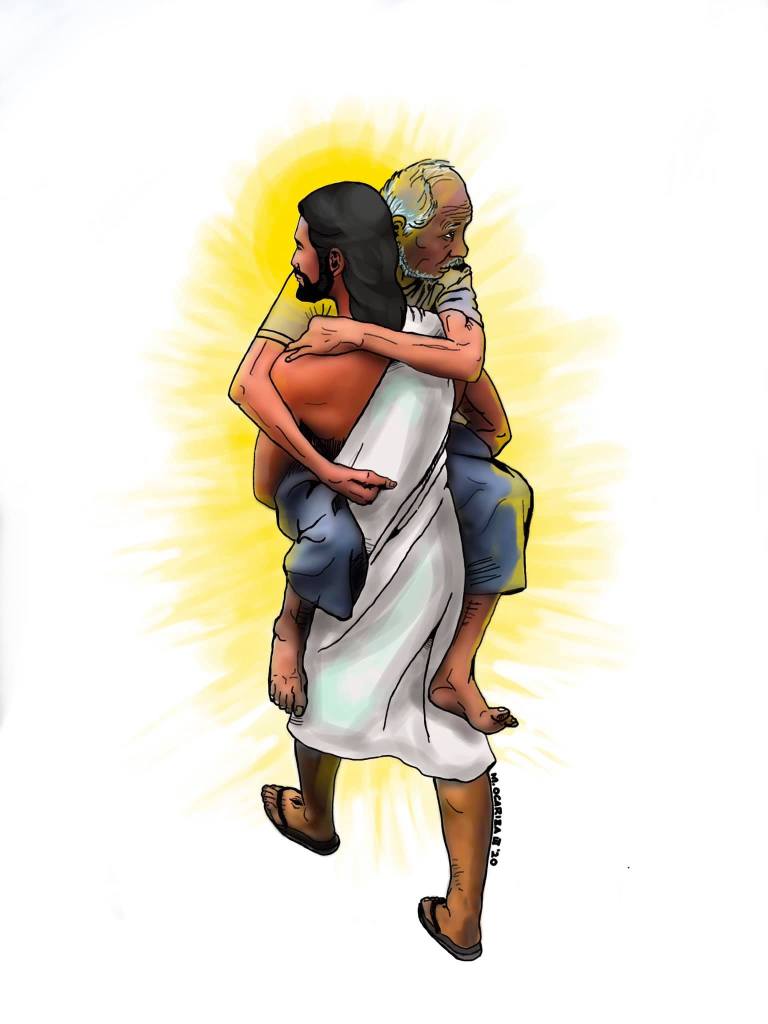
Nakita lamang kita
kamakalawa sa balita
ng social media
karga-karga isang matanda
habang lumilikas mga nasunugan
sa gitna nitong lockdown
doon sa inyong tirahan
kung tawagi'y "Happyland"
sa Tondo na napakaraming tao.
Hindi ko sukat akalain
sa sumunod na pagtingin
naiba at nabago ang lahat sa akin
sa larawan ng naturang balita pa rin
matapos ito ay guhitan at kulayan
dahil kinabukasan ay kapistahan
ng Divine Mercy
at ikaw pala iyan, Jesus
aming Panginoon at Diyos.
Sa gitna ng naglalagablab na apoy
nag-aalab mong pag-ibig Panginoon
ang umantig sa pananalig
ng Iyong dibuhista at pari
Marc Ocariza kaagad nagpinta
gamit bagong teknolohiya
upang ipakita kakaiba niyang nadama
na sadyang tamang tama naman pala
upang itanghal iyong Mabathalang Awa talaga.
"Panginoon ko at Diyos ko!"
ang panalanging akin ding nasambit
katulad ni Tomas na apostol mo
nang muli Kang magpakita sa kanila;
tunay nga pala
mapapalad ang mga nananalig
kahit hindi ka nakikita
dahil hindi itong aming mga mata
ang ginagamit kungdi aming pagsampalataya.
Nawa ikaw ang aming makita
mahabaging Jesus
sa gitna ng dilim nitong COVID-19
Iyong Dakilang Awa aming maipadama
sa pamamagitan ng paglimot sa aming sarili
 at pagpapasan ng krus upang Ikaw ay masundan
tangi Mong kalooban ang bigyang katuparan
upang Ikaw ay maranasan at masaksihan
ng kapwa naming nahihirapan.
Turuan mo kami, maawaing Jesus
na muling magtiwala sa iyo
kumapit ng mahigpit
hindi lamang kapag nagigipit
at huwag nang ipinipilit
aming mga naiisip at mga panaginip
na kailanma'y hindi nakahagip
sa ginawa Mong pagsagip at malasakit
upang kami ngayo'y mapuno ng Iyong kariktan at kabutihan! *
*Maraming salamat kay Marivic Tribiana (hindi ko kakilala) na nagpost sa kanyang Facebook ng unang larawan ni kuya pasan-pasan lolo niya sa kainitan ng sunog sa Happyland noong Abril 18, 2020.
At higit ding pasasalamat ko kay P. Marc Ocariza sa pagmumulat sa aking mga mata ng kanyang pagninilay at obra gamit ang Digital Art Timelapse na kanyang tinaguriang “Nag-aalab na Pag-ibig”.
Ang lahat ng ito ay para sa higit na ikadadakila ng Diyos na nagbigay sa atin ng Kanyang Anak “hindi upang tayo ay mapahamak kungdi maligtas” lalo ngayong panahon ng pandemiya ng COVDI-19.
At sa inyo, maraming salamat po sa pagsubaybay sa Lawiswis ng Salita.
The Lord Is My Chef Recipe in the Octave of Easter, also Divine Mercy Sunday, 19 April 2020
Acts 2:42-47 ><)))*> 0 <*(((>< 1 Peter 1:3-9 ><)))*> 0 <*(((>< John 20:19-31
Carrying around our parish the Blessed Sacrament every Sunday afternoon since lockdown began.
I have almost forgotten – and it is only now amid this extended lockdown – that I have realized the first Easter happened in darkness! We are in the same situation with the Apostles when Jesus rose from the dead.
What we need is to “quarantine” ourselves more, our heart and soul within to see and recognize our Risen Lord among us like during that first Easter.
On the evening of that first day of the week, when the doors were locked, where the disciples were for fear of the Jews, Jesus came and stood in their midst and said to them, “Peace be with you.” When he had said this, he showed them his hands and his side. The disciples rejoiced when they saw the Lord. Jesus said to them again, “Peace be with you. As the Father has sent me, so I send you.” And when he had said this, he breathed on them and said to them, “Receive the Holy Spirit. Whose sins you forgive are forgiven them, and whose sins you retain are retained.”
John 20:19-23
Stained glass at the back of our parish church depicting the appearance of the Risen Jesus with Thomas, aka, Didymus. Photo by author, 02 April 2020.
Jesus always comes in darkness to bring light of peace
In our reflection last Holy Wednesday, we have mentioned how Jesus was born during the darkest night of the year to bring us that light of hope and salvation. The same is true with Easter when he resurrected in the darkest part of the day just before dawn.
Jesus indeed is the light that bursts and pierces through the darkest darkness of the world and of our very lives, our sinfulness. This is the reason we also celebrate this Sunday the Feast of the Divine Mercy of God in Jesus Christ.
Through his Passion, Death and Resurrection, Jesus is the only one who can penetrate through whatever blockages and imprisonment we have or we are into like sin and evil, pains and hurts in the past that filled us with so much guilt.
In his Divine Mercy, Jesus had come to give us our life back complete with the gift of freedom that we have all lost to sin and evil.
And that is why on Easter, Jesus gave us his greatest gift of all which is peace or shalom in Hebrew that means wholeness or holiness. To be whole literally is to have a good relationship with one’s self, with others, and with God.
Vatican II asserts in its Pastoral Constitution on the Church in the Modern World:
Peace is more than the absence of war: it cannot be reduced to the maintenance of a balance of power between opposing force not does it arise out of despotic dominion, but it is appropriately called “the effect of righteousness” (Is.32:17). It is the fruit of that right ordering of things…
Gaudium et Spes, no. 78
Righteousness in the bible means justice that is also equivalent to holiness which is, to be filled with God, not necessarily to be sinless. That is why after greeting them with peace the second time, Jesus breathed on them the Holy Spirit, an imagery that reminds us of the story of creation when God breathed on the first humans to have life.
At Easter, we were breathed on again by the Risen Lord to renew our lives, to fill us again with God and be closest to him in our breath and thus enabling us to be free again from sin and evil, free for God and for others.
What a joy to read these days due to lockdowns worldwide that the Sierra Madres and Mt. Samat can be seen again from the metropolis or the Himalayas from India after 30 years due to clearer skies with less pollution. Or, the lions in Africa’s wildlife parks lazily sleeping without being disturbed by humans.
These are proofs that there is life indeed amid the darkness of this pandemic when Jesus restores life and balance, making everything new and alive again!
From Mr. Raffy Tima of GMA-7 News
From Esquire Philippines
From malaymail.com
From BBC news
Peace and mercy, unity and mission
At his Supper before his arrest, Jesus prayed to God our Father that we may all be one – ut unum sint – like him and Father (John 17:21) are one. This would be partly fulfilled on Easter and eventually at the coming of the Holy Spirit at Pentecost when the Church is eventually launched.
It is in our faith that we enter into communion with the Father in Jesus Christ and with one another as a community, as a church.
That is why it was a beautiful imagery of Thomas eventually joining them the following Sunday not because he lacked faith; he had faith that is why he came to see and experience Jesus. And that faith bloomed upon encountering Jesus again that according to tradition, Thomas preached the good news to India where he died a martyr by being skinned alive.
We have always said in our previous reflections that whenever and wherever there is faith, there is always union and unity with God and others.
Eventually, from every unity and community, there is always mission.
In our first reading today we have heard how the early Christians were one in their faith, always praying, that is, celebrating the Eucharist from which flowed out their mission.
All who believed were together and had all things in common; they would sell their property and possessions and divide them among all according to each one’s need.
Acts 2:44-45
Easter in our Parish amid COVID-19.
In his entire life, we have seen that Jesus had always been clear in his being sent, that the words he had spoken and things he had done were not all his but from and by the Father.
Watch closely John’s narration of after the Lord’s Resurrection:
On the evening of that first day of the week, when the doors were locked, where the disciples were for fear of the Jews, Jesus came and stood in their midst and said to them, “Peace be with you.” When he had said this, he showed them his hands and his side. The disciples rejoiced when they saw the Lord. Jesus said to them again, “Peace be with you. As the Father has sent me, so I send you.”
John 20:19-21
After giving them the gift of peace and filling them with his breath of life to signify they have been forgiven for their sins and failures when they left him on Good Friday, Jesus is now drawing them into his great mission: As the Father has sent me, so I send you.
This is the defining and definitive characteristic of the Church, of any community of disciples in every age, most especially in this time of the corona virus pandemic.
Our mission continues in the darkness of COVID-19
Churches may be closed, public Masses are banned but the mission of proclaiming in words and in deeds the good news of the Risen Lord continues very loud and clear.
Detractors would always malign us, would spend for trolls just to ask “where is the Church in this time of crisis” but the people know best that we have never been remiss nor even flinched a single second whenever disasters strike anywhere in the world.
In the darkest moments of history in the past up to the present, the Church as a community of disciples of Jesus has always shine so brightly in Christ standing up for the poor and oppressed, the marginalized and forgotten, the sick and the hungry, those suffering in the most far-flung areas with its extensive networks of parishes and BEC’s.
This is also the reason why people always malign us in the Church about what we are doing amid the poverty and sufferings of the world: we work in silence because we are merely being sent by Jesus Christ. Like him our Lord and Master, whatever we say and do are not ours but the One who sent us, the Father in heaven.
We merely represent Jesus Christ who represents the Father and guided by the Holy Spirit, together we forge onto the darkness of this pandemic despite the many sufferings we go through, “tested by fire so that we may prove to be for the praise, glory, and honor of revealing Jesus Christ” (cf. 1 Peter 1:6-7).
This is who we are, disciples of Jesus sent to proclaim his love and mercy especially in the midst of all darkness.
This Sunday amid the darkness and threats of COVID-19, let us join the psalmist in his song, “Give thank to the Lord for he is good, his love is everlasting” (Responsorial Psalm , Ocatve of Easter).
A blessed week to everyone. Stay safe but keep working for the Lord! Amen.
Easter Vigil in our Parish, 12 April 2020.
Photos in the collage clockwise: Malolos Diocese Social Action Center, Inc. with Caritas Manila spearheading relief operations in Bulacan; Sisters from the Daughters of St. Anne walking through fields and mountains to reach out to our poorest of the poor; trays of thousands of eggs to be given away to fisherfolks in Binuangan, Obando by Fr. Ramon Garcia III; last two photos, beneficiaries of the 10-m Php worth of Gift Certificates given throughout Bulacan before Holy Week that included everyone even those from other faith and beliefs.
Tonight is “Spy Wednesday” – the night traitors and betrayers are put on the spotlight because it was on this night after Palm Sunday when Judas Iscariot struck a deal with the chief priests to hand them over Jesus for 30 pieces of silver (Mt. 26:14-16).
The “Tenebrae” is celebrated in some churches when candles are gradually extinguished with the beating of drums and sounding of matraca to evoke silence and some fear among people as they leave in total darkness to signal the temporary victory of evil in the world for tomorrow we enter the Paschal Triduum of Holy Thursday, Good Friday and Easter Vigil of the Lord.
From Google.
Darkness generally evokes evil and sin, uncertainties and sufferings. But, at the same time, darkness preludes light!
That is why Jesus Christ was born during the darkest night of the year to bring us light of salvation.
Beginning tonight, especially tomorrow at his agony in the garden, we shall see Christ entering through darkness reaching its climax on Friday when he dies on the cross with the whole earth covered in darkness, rising on Easter in all his glory and majesty.
Our present situation in an extended Luzon-wide lockdown offers us this unique experience of darkness within and without where we can learn some important lessons from the Lord’s dark hours beginning tomorrow evening of his Last Supper.
St. John gives us a glimpse into how we must deal with life’s darkness that plagues us almost daily with his unique story of the Lord’s washing of his disciples’ feet on the night he was betrayed.
Before the feast of Passover, Jesus knew that his hour had come to pass from this world to the Father. He loved his own in the world and he loved them to the end. The devil had already induced Judas, son of Simon the Iscariot, to hand him over. So, during supper… he rose from supper and took off his outer garments. He took a towel and tied it around his waist. Then he poured water into a basin and began to wash the disciples’ feet and dry them with the towel around his waist. He came to Simon Peter…
John 13:1-2, 4-6
Photo from aleteia.org.
It is very interesting to reflect how Judas Iscariot and Simon Peter dealt with their own inner darkness on that night of Holy Thursday when Jesus was arrested.
Though Judas Iscariot and Simon Peter are poles apart in their personalities, they both give us some traits that are so characteristic also of our very selves when we are in darkness. In the end, we shall see how Jesus turned the darkness of Holy Thursday into becoming the very light of Easter.
Getting lost in darkness like Judas Iscariot
Right after explaining the meaning of his washing of their feet and exhorting them to do the same to one another, Jesus begins to speak of Judas Iscariot as his betrayer.
When he had said this, Jesus was deeply troubled and testified, “Amen, amen, I say to you, one of you will betray me …It is the one to whom I hand the morsel after I had dipped it.” So he dipped the morsel and handed it to Judas, son of Simon the Iscariot. After he took the morsel, Satan entered him… and left at once. And it was night.
John 13:21, 26-27, 30
Photo from desiringgod.org
The scene is very dramatic.
Imagine the darkness outside the streets of Jerusalem in the stillness of the night and the darkness inside the Upper Room where they were staying.
More darker than that was the darkness among the Apostles not understanding what Jesus was saying about his betrayer because they thought when Judas left, he was being told to buy more wine or give money to the poor!
Most of all, imagine the darkness within Judas.
To betray means to hand over to suffering someone dear to you.
That’s one darkness we always have within, of betraying Jesus, betraying our loved ones because we have found somebody else to love more than them. Satan had taken over Judas. The same thing happens to us when we sin, when we love someone more than those who truly love us or those we have vowed to love always.
And the darkest darkness of all is after handing over our loved ones, after dumping them for something or somebody else, we realize deep within the beautiful light of truth and love imprinted in our hearts by our betrayed loved ones – then doubt it too!
The flickering light of truth and love within is short lived that we immediately extinguish it, plunging us into total darkness of destruction like Judas when he hanged himself.
See how Judas went back to the chief priests because “he had sinned”, giving them back the 30 pieces of silver to regain Jesus.
Here we find the glow of Jesus, of his teachings and friendship within Judas still etched in his heart — the light of truth and love flickering within.
Any person along with their kindness and goodness like Jesus, our family and true friends can never be removed from one’s heart and person. They will always be there, sometimes spurting out in our unguarded moments because they are very true.
That is the darkest darkness of Judas – and of some of us – who think we can never be forgiven by God, that we are doomed, that there is no more hope and any chance at all.
See how the evangelist said it: “Judas left at once. And it was night.”
And that is getting lost in darkness permanently, eaten up by darkness within us because we refuse to believe in the reality of a loving and forgiving God who had come to plunge into the darkness of death to be one with us so we can be one in him. What a loss.
Groping in the dark into the light like Peter
Photo by author, Church of Gallicantu, Jerusalem where the cock crowed after Peter denied Jesus the third time, May 2017.
Of the Twelve, it is perhaps with Simon Peter we always find ourselves identified with: the eager beaver, almost a “bolero” type who is so good in speaking but many times cannot walk his talk.
“Master, are you going to wash my feet?” Jesus answered and said to him, “What I am doing, you do not understand now, but you will understand later.” Peter said to him, “You will never wash my feet.”
John 13:6-8
Here is Peter so typical of us: always assuming of knowing what is right, which is best, as if we have a monopoly of the light when in fact we are in darkness.
See how during the trial of Jesus before the priests, Peter denied him thrice, declaring he never knew Jesus while outside in the dark, completely in contrast with Jesus brilliantly answering every question and false accusation against him inside among his accusers!
Many times in our lives, it is so easy for us to speak on everything when we are in our comfort zones, safe and secured in our lives and career. But when left or thrown out into the harsh realities of life, we grope in the darkness of ignorance and incompetence, trials and difficulties.
How often we are like Peter refusing Jesus to wash our feet because we could not accept the Lord being so humble to do that simply because he is the Lord and Master who must never bow low before anyone.
And that is one darkness we refuse to let go now shaken and shattered by the pandemic lockdown! The people we used to look down upon are mostly now in the frontlines providing us with all the comforts we enjoy in this crisis like electricity, internet, security, food, and other basic services.
Bronze statue of the call of Peter by Jesus. Photo by author, May 2017.
We have always thought of the world, of peoples in hierarchy, in certain status where there are clear delineations and levels of importance, totally forgetting the lessons of Jesus of being like a child, of service and humility: “whoever wants to be great must be the least and servant of all.”
According to Matthew and Luke, Peter realized his sins – the darkness within him – of denying Jesus thrice after the cock crowed that he left the scene weeping bitterly, feeling so sorry. Eventually after Easter, Peter would meet Jesus again on the shores of the Lake of Tiberias, asking him thrice, “do you love me?”
Peter realized how dark his world has always been but in that instance when he declared his love that is so limited and weak did he finally see the light of Christ in his love and mercy!
Unlike Judas, Peter moved out of darkness and finally saw the light in the Risen Lord right in the very place where everything started when he was called to be a fisher of men, in his humanity as he was called by his original name, “Simon, son of Jonah, do you love me?”.
Human love is always imperfect and Jesus knows this perfectly well!
The best way to step out of darkness within us is to be like Simon — simply be your imperfect self, accepting one’s sins and weakness for that is when we can truly love Jesus who is the only one who can love us perfectly.
Overcoming darkness in, Jesus, with Jesus, through Jesus
Though the fourth gospel and the synoptic gospels of Matthew, Mark, and Luke differ in providing us with the transition from the Upper Room of the Last Supper into the agony in the garden, the four evangelists provide us with one clear message at how Jesus faced darkness: with prayer, of being one in the Father.
Even on the cross of widespread darkness, Jesus spoke only to pray to the Father.
Then Jesus came with them to a place called Gethsemane, and he said to his disciples, “Sit here while I go over there and pray.” He took along Peter and the two sons of Zebedee, and began to feel sorrow and distress.
Matthew 26:36-37
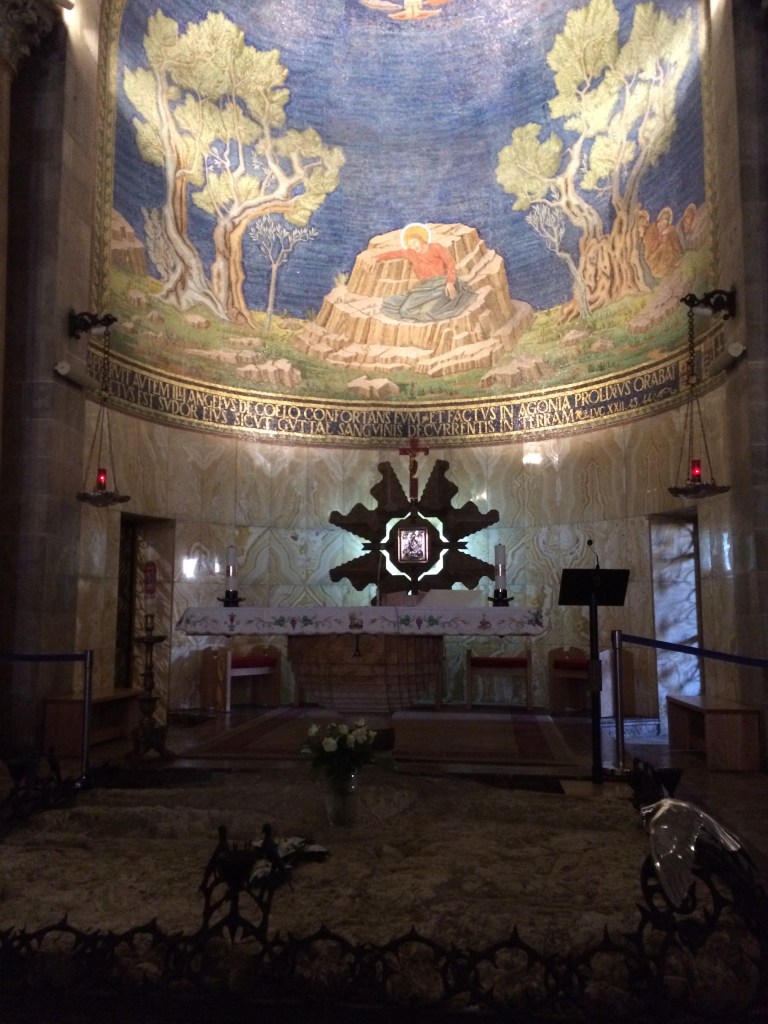
Photo by author, altar of the Church of All Nations beside the Garden of Gethsemane, May 2017. The church is always dimly lit to keep the sense of darkness during the Agony in the Garden of Jesus.
Before, darkness for man was seen more as a curse falling under the realm of evil and sin; but, with the coming of Jesus, darkness became a blessing, a prelude to the coming of light.
We have mentioned at the start of our reflection that Jesus was born during the darkest night of the year to show us he that is the light of the world, who had come to enlighten us in this widespread darkness, within us and outside us.
As the light of the world, Jesus was no stranger to darkness which he conquered and tamed in many instances like when they were caught in a storm at sea and in fact, when walked on water to join his disciples caught in another storm.
But most of all, Jesus had befriended darkness and made it a prelude to light.
How? By always praying during darkness. By prayer, it is more than reciting some prayers common during his time as a Jew but as a form of submission to the will of the Father. Jesus befriended darkness by setting aside, forgetting his very self to let the Father’s will be done.
Bass relief of agony in the garden on the wall of the Church of All Nations at Gethsemane. Photo by author, May 2019.
This he showed so well in two instances, first on Mount Tabor where he transfigured and second in Gethsemane before his arrest.
In both events, Jesus showed us the path to overcoming darkness is always through prayers, of being one in the Father.
It is in darkness when God is most closest to us because it is then when we get a glimpse of himself, of his love and mercy, of his own sufferings and pains, and of his glory.
This is something the three privileged disciples – Simon Peter, James and his brother John – did not realize while being with Jesus at both instances until after Easter. We are those three who always fall asleep, who could not keep with praying in Jesus, with Jesus, and through Jesus.
It was in the darkness of the night when Jesus spent most of his prayer periods, communing with the Father up in a mountain or a deserted place.
On Mount Tabor, Jesus showed his coming glory while in Gethsemane he showed his coming suffering and death. But whether in Gethsemane or on Mount Tabor, it is always Jesus we meet inviting us to share in his oneness with the Father, in his power in the Holy Spirit to overcome every darkness in life.
And the good news is he had already won for us!
Photo by Mr. Raffy Tima of GMA-7 News of Mt. Samat with the Memorial Cross across the Manila Bay following clear skies resulting from the lockdown imposed since March 17, 2020.
In these extended darker days of quarantine period, let us come to the Lord closer in prayer to. experience more of his Passion and Death, more of his darkness so we may see his coming glory when everything is finally cleared in this corona pandemic.
Prayer does not necessarily change things but primarily changes the person first. And that is when prayer changes everything when we become like Jesus in praying.
Jesus is asking us to leave everything behind, to forget one’s self anew to rediscover him in this darkness when we get out of our comfort zones to see the many sufferings he continues to endure with our brothers and sisters with lesser things in this life, with those in total darkness, with those groping in the dark.
Now more than ever, we have realized the beauty of poverty and simplicity, of persons than things.
And most especially of darkness itself becoming light for us in this tunnel.
May Jesus enlighten us and vanish all darkness in us so that soon, we shall celebrate together the joy of his coming again in this world darkened by sin. Amen.
Lawiswis ng Salita ni P. Nicanor F. Lalog II, Ika-17 ng Setyembre 2019
Relasyon at ugnayan
hindi emosyon at damdamin
ang sabi natin na pangunahin turo sa atin
ng talinhaga ng alibughang anak.
Kay gandang larawan ng Diyos
ang nakintal sa ating puso't isipan
nang ilahad ng mahabaging ama sa dalawang anak niya
na sila ay iisang pamilya, binibigkis ng buhay na mula sa kanya.
Ano mang kasalanan ay mapapatawad
maging kamatayan ay malalampasan
nitong habag at awa ng Diyos na ibinuhos
kay Kristo Hesus para sa ating mga alibughang anak niya.
Ganyan ang habag at awa ng Diyos bilang Ama
na dumadaloy din mula sa kanyang pagiging ina
nang mawika niya, "hindi kita malilimutan kailanman
katulad ng isang ina sa kanyang anak na mula sa kanyang sinapupunan."
Para sa kanilang kaisipan,
ang habag at awa ay "hesed" ---
damdaming napaka-lalim gaya ng pag-ibig
nagpapahiwatig ng maka-amang katapatan at pananalig.
Nagmumula ito sa sinapupunan o "raham" ---
yaong matris ng kababaihan na siyang kanlungan
ng simula ng buhay, lundo ng katuwaan pagsapit ng kagampan
kapag napawi mga agam-agam, pagsilang ng bagong buhay.
Kapag umiiral habag at awa sa ating buhay
doon tayo buong-buo sa pagkatao
nagiging ganap at banal tulad ng Diyos
puno ng buhay at pagmamahal.
Kaya't kapag mga patayan ay naglipana
at pagkitil sa buhay ang nakikitang paraan
upang lunasan maraming kasalanan at kasamaan
nasisira ating kapatiran, di maglalaon, tayo ang mababaon.
The Lord Is My Chef Sunday Recipe, Week XXIV-C, 15 September 2019
Exodus 32:7-11, 13-14 ><)))*> 1Timothy 1:12-17 ><)))*> Luke 15:1-32
Camp John Hay, Baguio City, 23 August 2019.
Today we conclude the series of “table talks” by Jesus with three parables narrated while dining; but, unlike the other Sunday when he was with prominent people, this time we find the Lord among the notorious ones of his time.
Tax collectors and sinners were all drawing near to listen to Jesus, but the Pharisees and scribes began to complain, saying, “This man welcomes sinners and eats with them.”
Luke 15:1-2
It is the perfect setting where Jesus bared what we may call as “the wildness and wideness” of God’s love and mercy for everyone, especially the lost and rejected. This explains why Luke 15:1-32 is the “heart” of the third gospel also known as the Gospel of Divine Mercy. So, please bear with me reflecting today’s long but lovely gospel.
The first two parables are about things – a sheep and a coin – that were lost and later found. There is nothing extraordinary about losing things that we also experience today. But, in narrating these parables, Jesus ended both with a saying to explain their meanings and significance to introduce the third parable of the lost son.
“I tell you, in just the same way there will be more joy in heaven over one sinner who repents than over ninety-nine righteous people who have no need of repentance.”
“In just the same way, I tell you, there will be rejoicing among the angels of God over one sinner who repents.”
Luke 15: 7, 10
Photo by Ms. Jo Villafuerte, Atok, Benguet, 01 September 2019.
For the past two Sundays, we have been reflecting about the importance of our personhood, of how God comes first to our very persons, of the need for us to be true and humble because God meets us right in our weaknesses and sinfulness. Jesus warned us the other Sunday that “for everyone who exalts himself will be humbled, but the one who humbles himself will be exalted” (Lk.14:11). As they say, bloom wherever you are planted for God’s grace is more than enough for each one of us!
Such is God’s love us that Jesus demands total faith in him that “if anyone comes to me without hating his father and mother, wife and children, brothers and sisters, and even his own life, he cannot be my disciple” (Lk.14: 26). In our lives as his disciples, there would be countless times when no explanations, no reasons are enough why we choose to love and forgive, to be kind and understanding except the very person of Jesus Christ. That is what we call as communion, oneness with the Lord, of always preferring Jesus above anyone and anything!
This is the very reason why the Pharisees and scribes were complaining against him: the tax collectors and sinners were turning to Jesus and not to the Laws they represent! And that continues to happen in our time when some people insist more on religion and vocation, roles and rituals, totally forgetting and even disregarding the very person of God who calls us to himself in Christ!
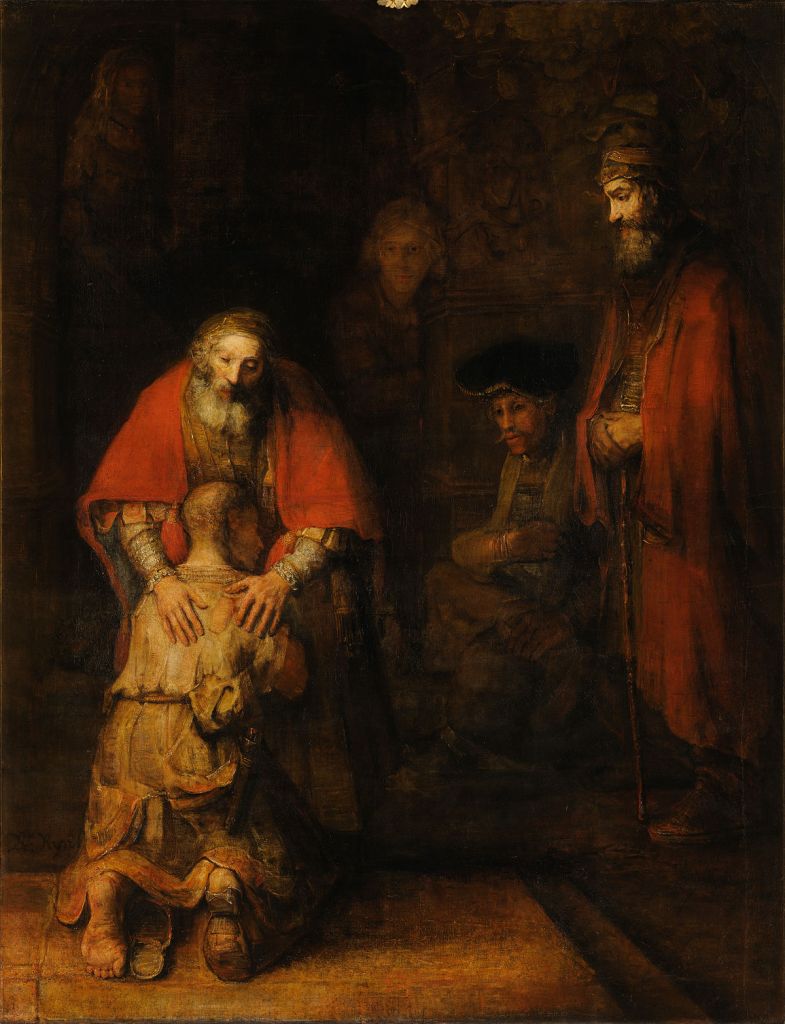
The Return of the Prodigal Son by Rembrandt (c.1661-1669). From Google.
Then he said, “A man had two sons, and the younger son said to his father, ‘Father, give me the share of your estate that should come to me.’ So the father divided the property between them. After a few days, the younger son collected all his belongings and set off to a distant country where he squandered his inheritance on a life of dissipation.”
Luke 15:11-13
Feel the solemnity of Jesus in introducing this parable, shifting from lost sheep and lost coin to lost son, from things to persons because the elder son is also lost. It is the father who eventually restored the lost personhood of the two sons when he lavished them with his love and mercy towards the end of the story. And that is why this parable is so lovely as it reminds us of how unconsciously we are “dumping” our own personhood despite our bloated egos. Slowly we are becoming robots or worst, even zombies without feelings and personal relations with others and with one’s self.
Just like the two sons in our parable who both define sonship in terms of servile obligations that is utilitarian and contractual in relationships, not as a family.
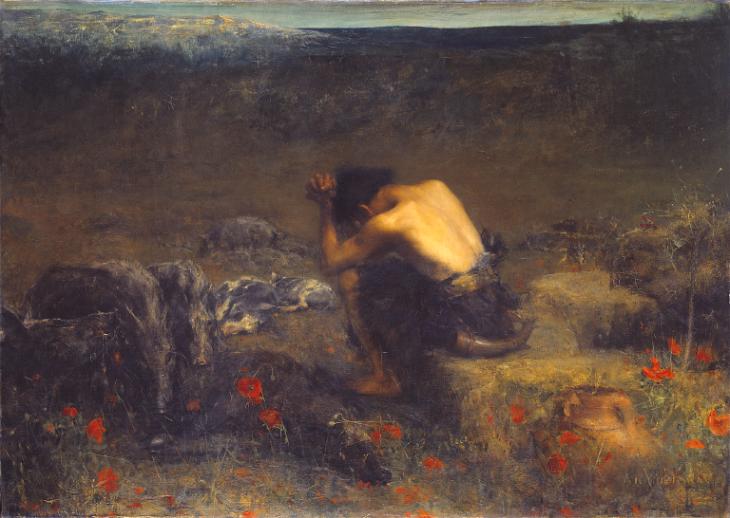
The Prodigal Son by John Macallan Swan, 1888. From Google.
Coming to his senses he thought, ‘How many of my father’s hired workers have more than enough food to eat, but here I am, dying from hunger. I shall get up and go to my father and I shall say to him, “Father, I have sinned against heaven and against you. I no longer deserve to be called your son; treat me as you would treat one of your hired workers.”
He (elder son) said to his father in reply, “Look, all these years I served you and not once did I disobey your orders; yet you never gave me even a young goat to feast on with my friends. But when your son returns who swallowed up your property with prostitutes, for him you slaughtered the fattened calf.”
Luke 15:17-19, 29-30
The prodigal son remembered his father when he was starving, thinking more of the food he could have if he returns home as a servant, not as a son. See how in the midst of sin, he never thought of his father as his parent, of himself as a son. He was convinced that the path to reconciliation with his father was becoming a hired worker, forgetting the very fact he is the youngest son.
The same is true with the elder son who refused to join the celebration when his brother had returned home, feeling so bad that his long years of service to his father deserve him a reward. In a sense, he is worst than the prodigal son: no father, no brother – just himself alone!
Both sons have a slanted view of their father, a very truncated one that is self-isolating, very constricting like the Pharisees and scribes who have forgotten their being persons, of being interrelated with one another in God. Very much like us today that slowly as the ties that bind us as family and friends are slowly being severed by so many things, we also start to lose many of our values like “malasakit” or concern for one another.
The father redefined their – and ours, too – relationships as family that lead to joy and celebration.
He (father) said to him, “My son, you are here with me always; everything I have is yours. But now we must celebrate and rejoice, because your brother was dead and has come to life again; he was lost and has been found.”
Luke 15:31-32
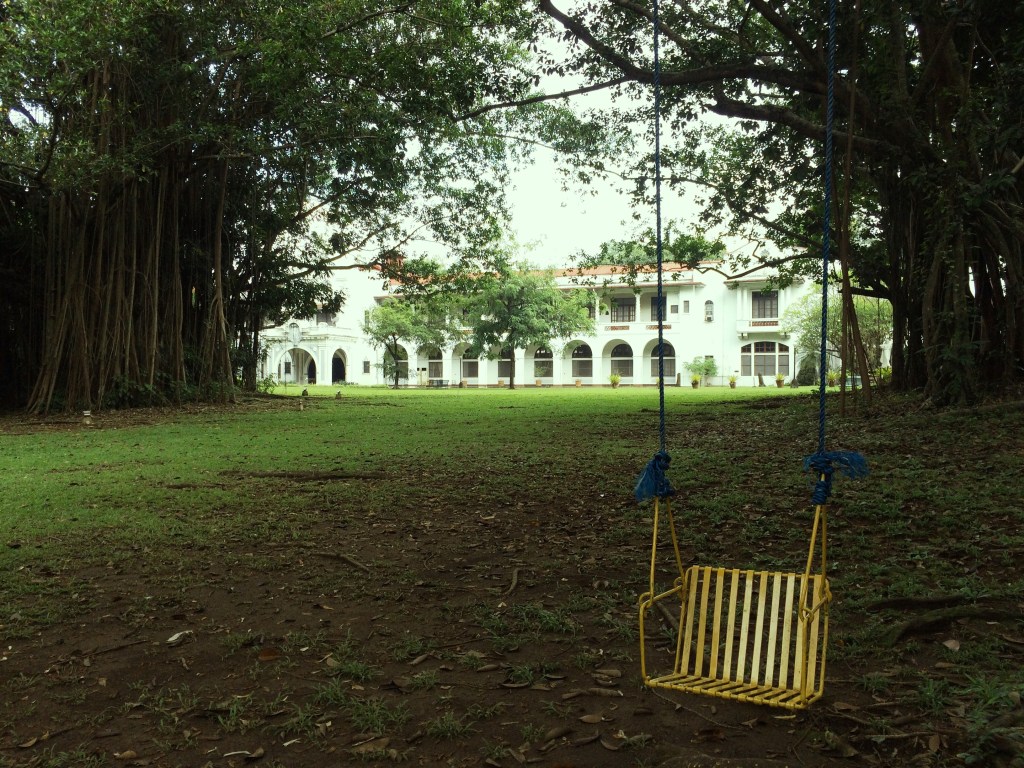
Santorini. Photo by Dra. Mai Dela Pena, 2016.
Today, Jesus reminds us, and assures us too that no matter what happens with us, we will always be his brothers and sisters, beloved and forgiven children of the Father.
We call and relate with God as Father because as his children, he is our giver and keeper of life.
And should this life get lost, God as our Father, can also be so “prodigal” to “wastefully” love us and bring back this life to us for we are more valuable than anything else in this universe. That’s how wild and wide is his love and mercy. Amen.
1 Timothy 1: 1-2, 12-14 ><}}}*> ><}}}*> ><}}}*> Luke 6:39-42
From Google.
Thanks be to you, O God our loving Father for this merciful day of Friday. Today, the whole Church praises you with that beautiful Psalm 51, “The Miserere Nobis”.
Have mercy on me, God, in your kindness. In your compassion blot out my offense. O wash me more and more from my guilt and cleanse me from my sin.
My offenses truly I know them; my sin in always before me. Against you, you alone, have I sinned; what is evil in your sight I have done… O see, in guilt I was born, a sinner was I conceived.
From the Breviary
Like St. Paul in today’s first reading, give us the grace of having that “sense of sinfulness” within us, Lord.
So many times, we deny the presence of sin in our lives as we keep on justifying our actions, always having that feeling of uprightness, of never erring. Worst, we have become blind guides you have mentioned, O Lord, in the gospel today.
Give us the grace of a deep sense of sinfulness within us, Jesus, so that like St. Paul and all the other saints who were all sinners before, including Dimas the thief who died with you on the Cross on that Good Friday, we may also have that sense of the Father’s rich mercy.
Garden of Gethsemane, May 2019.
Let us not be blinded by our self-righteousness that make us deny the presence of sin in us that ultimately deny ourselves of your mercy. May we realise that only those who have been forgiven can understand what it means to receive the Father’s mercy. Amen.
The Lord Is My Chef Sunday Recipe for the Soul, Wk. XV-C, 14 July 2019
Deuteronomy 30:10-14 >< )))*> Colossians 1:15-20 >< )))*> Luke 10:25-37
From America Magazine via Google.
After teaching us about discipleship these past two Sundays, Jesus shifts his lessons to things “we must do” following a series of questions he encountered from people when he “resolutely determined to journey to Jerusalem” (Lk.9:51).
There was a scholar of the law who stood up to test Jesus and said, “Teacher, what must I do to inherit eternal life?” Jesus said to him, “What is written in the law? How do you read it?” He said in reply, You shall love the Lord, your God, with all your heart, with all your being, with all your strength, and with all your mind, and your neighbor as yourself. He replied to him, “You have answered correctly; do this and you will live.” But because he wished to justify himself, he said to Jesus, “And who is my neighbor?” Jesus replied, “A man fell victim to robbers as he went down from Jerusalem to Jericho.”
Luke 10:25-30
And thus Jesus answered the scholar of the law with the beautiful parable of the Good Samaritan that can only be found in St. Luke’s gospel. It has so endeared the world that hospitals and charities including laws and awards everywhere use the “Good Samaritan” title in recognition of the parable’s conviction that we are all neighbors.
Problem is, we have become so familiar with this parable that sometimes we think it teaches us nothing new. Like the Laws or the Ten Commandments, it has degenerated into becoming letters like a code imposed from the outside we simply follow. Moses tells us in the first reading how the Laws are “something very near to you, already in your mouths and in your hearts; you only have to carry it out” (Dt.30:14). Loving God and loving others is an interior and life principle innate within each of us.
This Sunday, Jesus is inviting us to set aside our thoughts about his parable of the Good Samaritan in order to see it in a deeper and personal perspective.
For most Christians especially Catholics, we always reach that stage in our lives when deep within us there is a longing for something deeper, for something more than what we have been used to. It is a very positive sign of spiritual growth. Like the scholar, we are no longer contented with the usual things we do like praying, Sunday Masses, and keeping the laws. At first we may not be able to verbalize or even identify what are the stirrings within us until we realize it is something more than this life we are having.
Like the scholar, we ask Jesus, “Teacher, what must I do to inherit eternal life?” (Lk.10:25). But, instead of probing deeper into our hearts, we tend to look outside for answers like the scholar asking, “who is my neighbor?”.
From Google.
Twenty years ago, the sci-fi series “The X-Files” was a hit worldwide with its tagline “the truth is out there” to refer to all kinds of conspiracy theories and paranormal activities by the US government. Of the same genre today is the Netflix series “Stranger Things” that also points us to something “out there” for answers to many mysteries happening to us.
The answer is never out there – it has always been inside us! Always.
From Google.
How strange that we keep on asking “who is my neighbor?”, searching for a theoretical definition of a neighbor we always think as somebody outside us. What we must be asking is, “am I a neighbor to others?”
Observe how Jesus narrated the parable where both the priest and the Levite “saw the victim and passed by the opposite side. But a Samaritan traveler who came upon him was moved with compassion at the sight. He approached the victim, poured oil and wine over his wounds and bandaged them. Then he lifted him up on his own animal, took him to an inn, and cared for him” (Lk.10:32-34).
That’s the strangest thing of all! Two Temple officials simply “saw” the victim and passed by while a Samaritan “saw” also but was moved with compassion. To be moved with compassion in Latin is misericordia, a “stirring or disturbing of the heart” which translates into mercy.
Here we find the Samaritan looking deep inside him that he saw in him the plight of the victim that he was moved with mercy to help him. And that is to be a neighbor, to treat somebody with mercy that transcends any color or creed or nationality. See the question of Jesus at the end of his parable, “Which of these three, in your opinion, was neighbor to the robbers’ victim?” The scholar answered, “The one who treated him with mercy” (Lk.10:36-37).
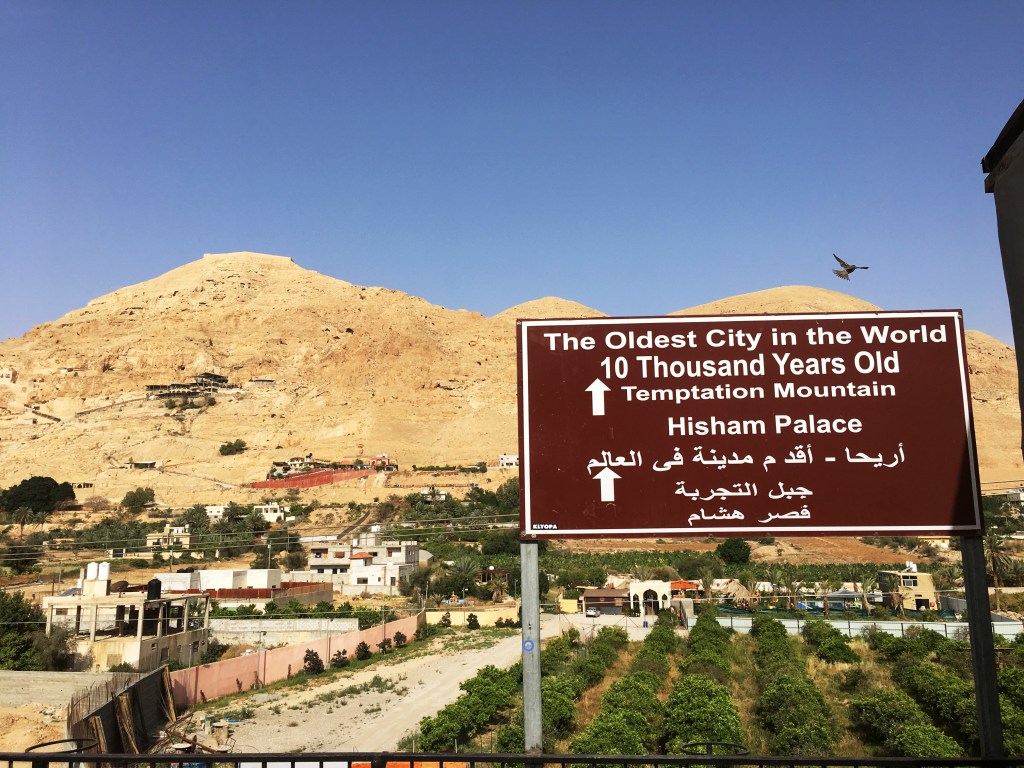
City of Jericho, the setting of the parable of the Good Samaritan. Photo by author, 06 May 2019.
My neighbor is the one with whom I identify with, with whom I am drawn near because of the mercy that moved me within to help in his or her sufferings. A neighbor is one who feels his or her own humanity that he or she is always moved with compassion with those who are in suffering and pain.
And the more we reflect on this parable, the more we see Jesus Christ is in fact the Good Samaritan himself. He is “the image of the invisible God, in him all things hold together” (Col. 1:15,17). It was Jesus who went down the road, becoming human like us in everything except sin, picking us up from our sinfulness and miseries, healing us of our wounds, and restoring us to life “through the blood of his cross” (Col. 1:20).
Let us heed his command this Sunday to “Go and do likewise” (Lk.10:37) as the Good Samaritan. Be a blessed neighbor to everyone! Amen.
We Filipinos have an expression that best captures the faith of Easter experience, something very close with the universal expression “aha!”. It is what I call as the “a basta!” experience.
From the Spanish word “basta” which means “enough” like what St. Teresa of Avila said in her poem, “Solo Dios basta” (Only God is enough/suffices), our “a basta!” expression is often used to insist on something to be accepted as true. Its closest English equivalent is “that’s it” to show that the issue at hand is settled because I have confessed it so.
On this octave of Easter which means eternity (because there are only seven days in a week but if you count the days since Easter, this Sunday is the eighth, an octave), the beloved disciple reminds us that Jesus said other things not recorded in his book; and most likely, he had had other appearances too not recorded simply because they are impossible to do. According to John, these were all written so we may all believe Jesus is the Christ and have eternal life in him. Moreover, there is no need for him to go into so many details about the appearances of Jesus after his Resurrection because what really matters most is the intensity of his presence. It is from that intensity of his presence we derive that “a basta!” experience of him. To be open to accept such intense moments of Christ’s presence leads us to deeper faith in him and eventually, to a relationship with him and in a community.
Thomas meets the Risen Jesus. From Google.
Now a week later his disciples were again inside and Thomas was with them. Jesus came, although the doors were locked, and stood in their midst and said, “Peace be with you.” Then he said to Thomas, “Put your finger here and see my hands, and bring your hand and put it into my side, and do not be unbelieving, but believe.” Thomas answered and said to him, “My Lord and my God!”
John 20:26-
“Do not be unbelieving, but believe.”
Last Sunday we have reflected how the Easter stories are always set in darkness like in the early morning, at sunset, and in the evening: the joy of Easter always comes bursting in the darkness of our lives, when we are down and suffering, sick or feeling lost, and fearful. It is during those dark moments of our lives when Jesus silently comes to us even in locked doors and windows. Problem is the moment Jesus comes to us, that is when we doubt him like Thomas! We could not believe Jesus is really alive though deep inside us, we do believe if only there could be be something within us that could give that final big push for us to say “a basta!”.
A week after his first appearance to his disciples at night, Jesus appeared anew today despite locked doors, darkness, and shadows of doubts within Thomas. When Jesus told him to “do not be unbelieving, but believe” , the Lord was not reproaching him but actually exhorting him to believe. And that is likewise addressed to us today: believe!
To believe is first to accept the gift of faith from God who opens himself to us, inviting us to a relationship with him. To believe in God is to meet him who always comes to meet us, to be with us. To believe in God is most of all to enter into a relationship with him so that that more we believe, the more we “see” him, the more we experience him. Most of the time we learn and get so many proofs of the existence of Jesus Christ in our prayers, studies, and experiences. Through time, we also grow in our personal conviction and acknowledgment of the Risen Lord, surpassing all proofs and logic until eventually even if we can enumerate our many reasons for believing, in the end, we admit that not even one of them is the very reason for our faith in Jesus Christ. And that is when we give that burst of “a basta!” – – – Jesus is alive! Then we learn to confess like Thomas, “My Lord and my God.”
From Google.
The Resurrection of Jesus is both historical and beyond history that made so much impact in human life, affecting us in the most personal manner. Sometimes we really wonder like the Apostle Jude Thaddeus who asked the Lord during the Last Supper why he would only manifest to them and not to everyone (Jn.14:22) so as to cast out all doubts and set the record straight that there is God indeed. When we examine our life journey, we find there is really no need for Jesus to appear at all for everyone to believe his existence, that he had risen from the dead, that there is God.
The Easter stories show us how God works silently in our midst, always slowly and surely, gradually through history and in our personal life. It is not really his appearances that matter but the intensity of his presence felt only in silence when we learn to trust more and believe more. How wonderful that on this eight day of Easter we also celebrate Divine Mercy Sunday that invites us to trust more than ever Jesus Christ our salvation. May we entrust ourselves to Jesus anew like Thomas, touching his wounds, confessing “My Lord and my God” or “Jesus, King of Mercy, I trust in You.” Amen.























 lordmychef.com