Lord My Chef Daily Recipe for Soul by Fr. Nicanor F. Lalog II
Monday, Twenty-Second Week in Ordinary Time, Year II, 31 August 2026
1 Corinthians 2:1-5     <*((((><  +  ><))))*>    Luke 4:16-30
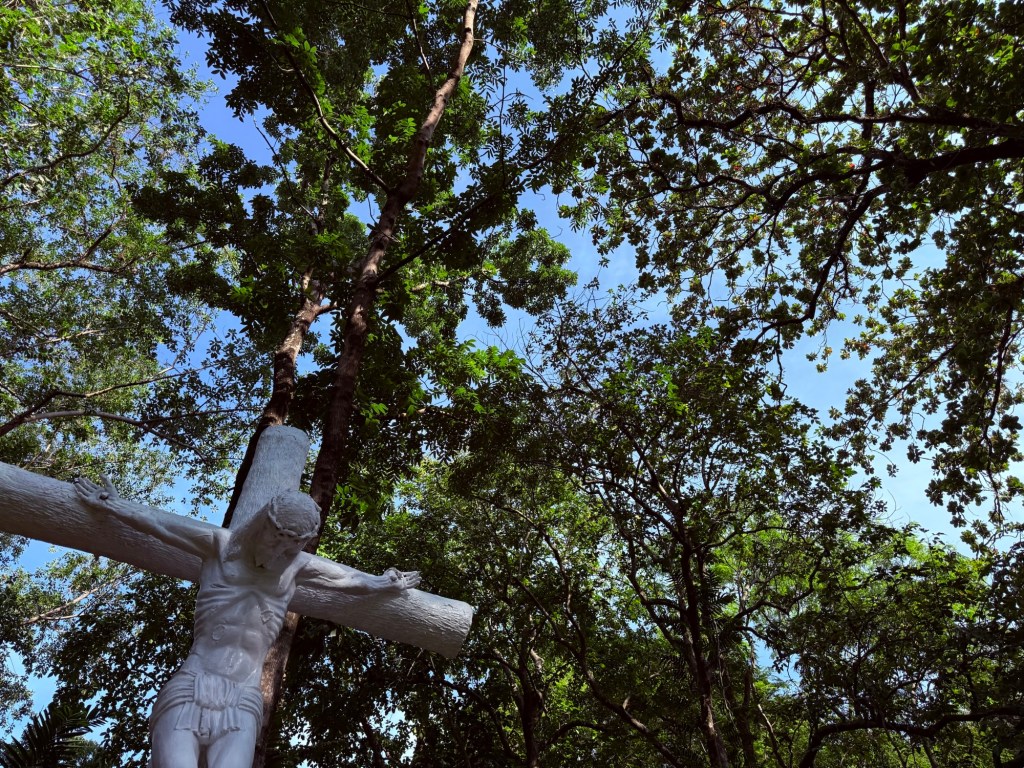
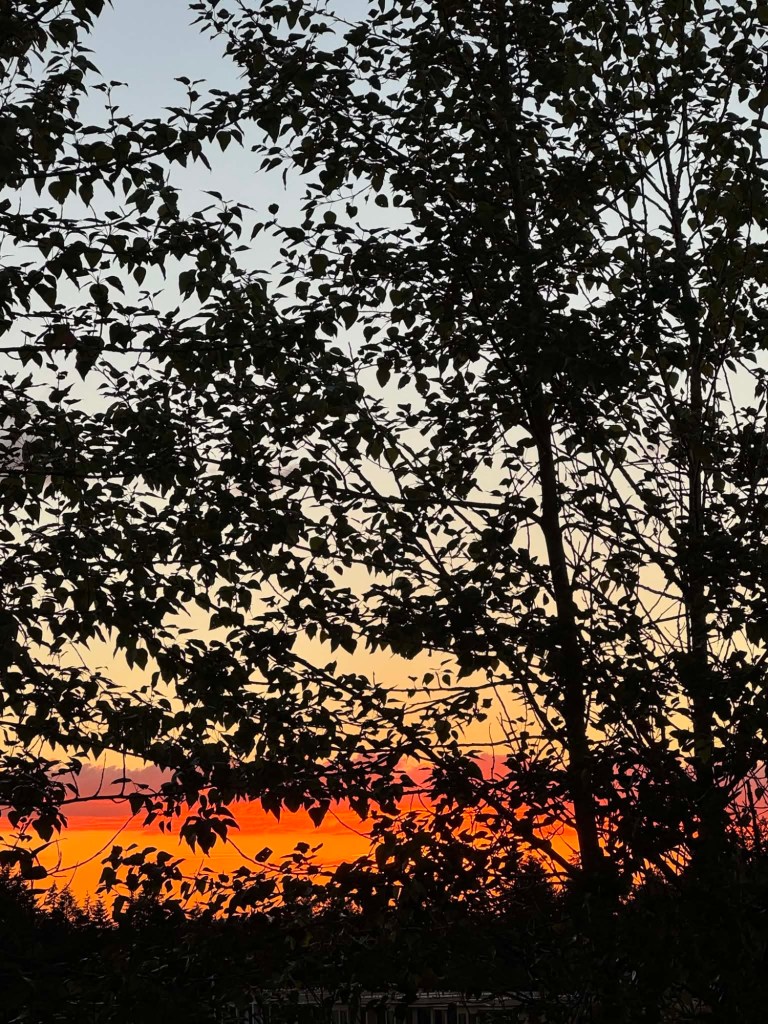
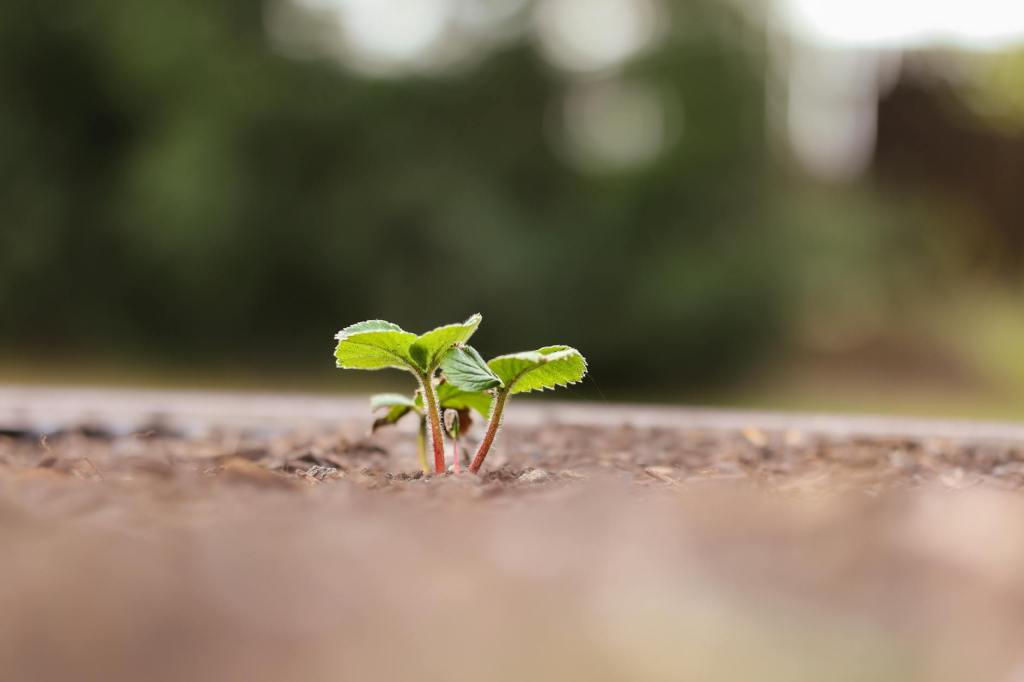
Photo by author, St. Paul Spiritual & Renewal Center, Bgy. Tanyawak, Alfonso, Cavite, 19 August 2026.
Teach me Lord
to "know nothing except
Jesus Christ crucified" like St. Paul,
not just "looked intently at you"
like your folks in Nazareth
when you preached in your synagogue;
it is not enough to just look
intently at you,
imitating you and your manners
and style but not your life,
your self-sacrifice on the Cross;
what a shame in this age of social media
we speak and preach about you
merely to chase clout for ourselves
using sublimity of words
or persuasive words of wisdom
used by demagogues and
influencers for followers
and shameful profits.
Help us realize,
Jesus, that our faith
rests on the power of God
best shown in your Crucifixion,
not in our personality
nor eloquence in speech
nor being savvy with new
technologies that blind us from
the realities of life
like love and sacrifice,
kindness and patience,
justice and truth.
Amen.
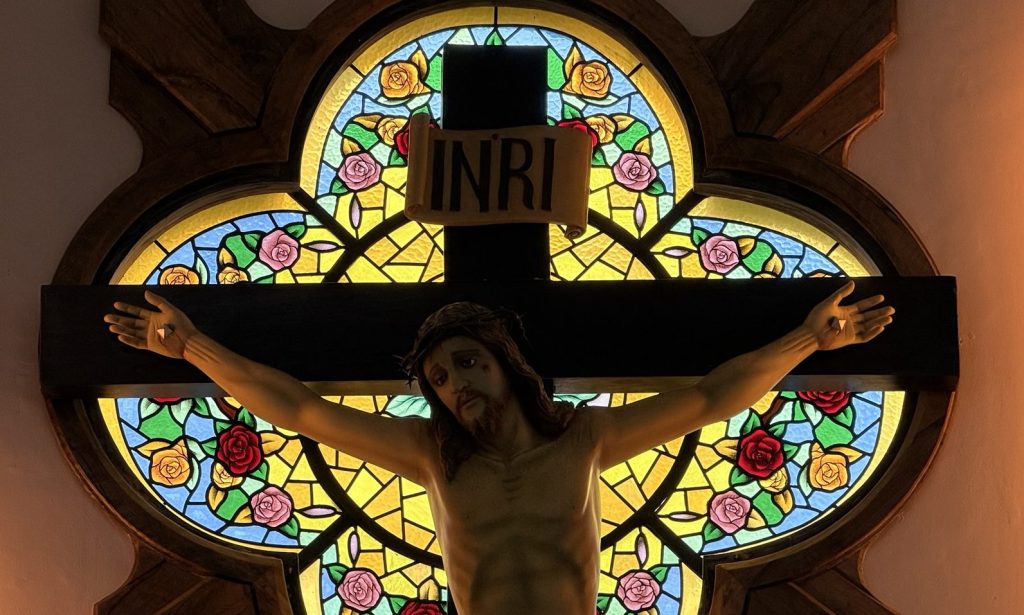
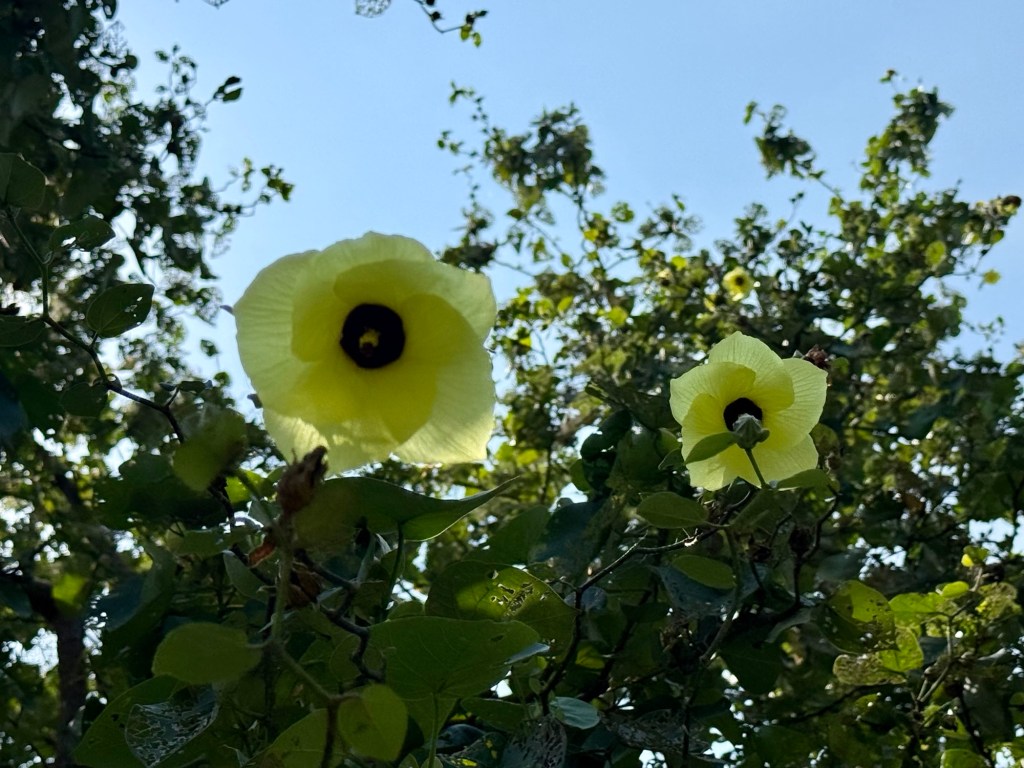
Photo by author, St. Michael Retreat House, Antipolo City, 16 June 2026.
Lord My Chef Sunday Recipe for Soul by Fr. Nicanor F. Lalog II
Eighteenth Sunday in Ordinary Time, Cycle A, 02 August 2026
Isaiah 55:1-3 ><}}}}*> Romans 8:35, 37-39 ><}}}}*> Matthew 14:13-21
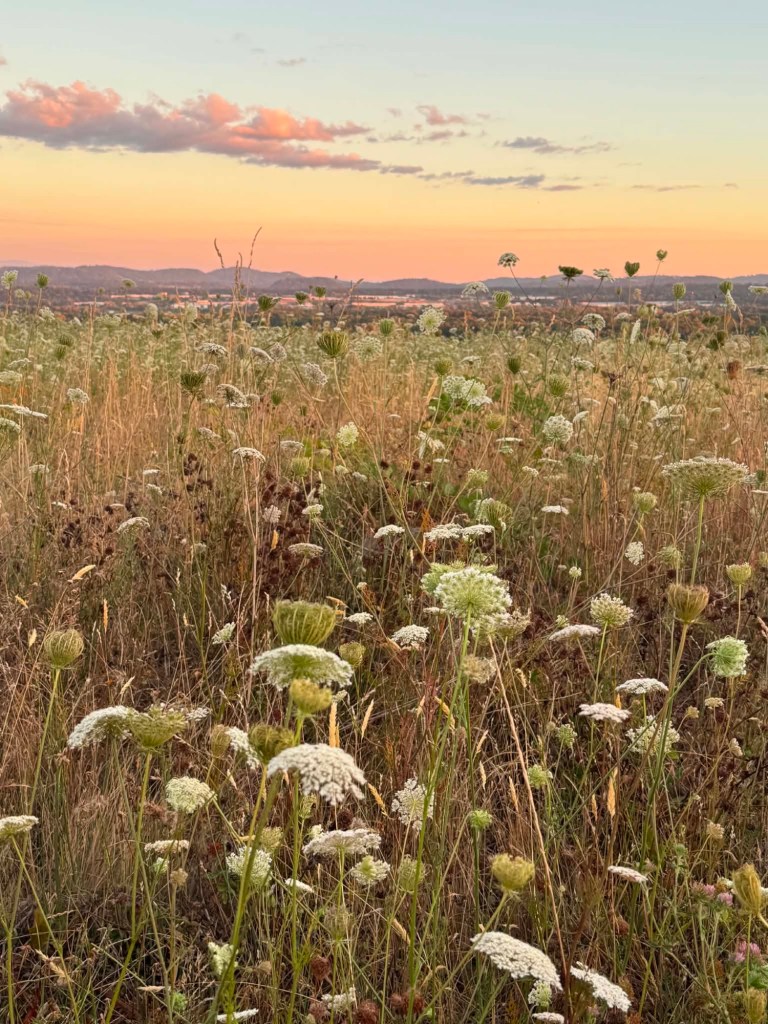
Photo by author, Anvaya Cove Resort, Morong, Bataan 21 July 2026.
Salamuch July, hello August! Though this eighth month of the year is named after the Roman emperor Augustus, August actually came from the Latin word augustus meaning venerable; used as an adjective, it describes something as majestic and grand like when we say “august halls” or “august chambers” of power and justice.
So, please stop demonizing August as “ghost month” which is a pagan belief. For us Christians who affirmed last Sunday to Jesus that we have “understood” very well his parables, Matthew challenges us this August not only how well we have understood the parables on the kingdom of heaven but most especially how much do we know and love and trust Jesus the Christ.
Photo by a friend living in Washington state, 28 July 2026.
From the shores of Galilee, Matthew now brings us to the wilderness with Jesus where he fed more than five thousand people from a few loaves of bread and pieces of fish.
When he disembarked and saw the vast crowd, his heart was moved with pity for them, and he cured their sick. When it was evening, the disciples approached him and said, “This is a deserted place and it is already late; dismiss the crowds so that they can go to the villages and buy food for themselves.” Jesus said to them, “There is no need for them to go away; give them some food yourselves.” But they said to him, “Five loaves and two fish are all we have here.” Then he said, “Bring them here to me,” and he ordered the crowds to sit down on the grass. Taking the five loaves and the two fish, and looking up to heaven, he said the blessing, broke the loaves, and gave them to the disciples, who in turn gave them to the crowds. They all ate and were satisfied, and they picked up the fragments left over – twelve wicker baskets full (Matthew 14:15-20).
See again that distinctive detail Matthew shares with us when Jesus saw the crowds who have followed him and his disciples to the other side of the lake: his heart was moved with pity for them, and he cured their sick. That is how great is the love of Jesus for each of us. He is always moved with pity which is more than a feeling but of actually doing something, even a miracle for us like in this scene in the wilderness.
Life is a wilderness. So vast and uncertain. But, lovely and beautiful. Not really august but grand and majestic, so difficult to explain, often ambiguous, largely mysterious. Even captivating. That is why it is always good to be alive even if life is difficult.
Last Thursday I officiated at the funeral Mass of another best friend from our minor (high school) seminary. In fact, Jonas was my classmate way back in second grade who partly inspired me to become a priest. He is my second best friend after Gil also from the seminary whom I have accompanied spiritually in life and at their deathbeds. Before going to his funeral at prayer in my room, I asked God if I would still have friends alive to attend my own funeral?
The mystery deepened after we have laid Jonas to his final resting place when a few hours later his mother-in-law – the mother of his widow – died too! Imagine the devastation to my friend’s wife who has not rested yet after taking care of him for a month in the hospital then her mother died too? And to their only child just starting her career as a medical doctor?
Photo by a friend living in Washington state, 28 July 2026.
Many times Jesus teases us.
Or seduces us as the Prophet Jeremiah insisted on how God lured him to following him despite the many hurts and pains he had to go through but could not turn away from him because he had grown to loving him so much too.
Like the people who followed Jesus to the wilderness, we gather every Sunday to listen to his words and share in his Body and Blood because we have felt so empty in life that only him could fulfill us.
But, that is so easy to claim as we can readily profess our faith in God, in Jesus Christ but it is different when it is borne out of a wilderness experience like the disciples.
How many times have we felt like them thinking more of our selves than others when in a difficult situation, telling Jesus to send the people home because it was getting late and dark; most of all, so that they could get food for themselves?
It was easy for the crowd to just come to Jesus and think only of themselves but not with the disciples – like our parents, our kuya or ate, our superiors, or those people we look up to with responsibilities over us. That is why be kind with those in positions too. So easy to accuse them of their shortcomings and worst, to spread gossips when we do not realize the enormous weight they carry on their shoulders.
The equation becomes different and heaviest when Jesus tells us to “give them some food yourselves”. It is scary because at that moment Jesus asks us too of “what do you have” which we already knew beforehand as too little. Not enough. Just five loaves of bread and three pieces of fish.
Recall those moments you knew so well your limits, you capacity. And that’s when you start regretting why you have accepted the position or why have you volunteered at all or perhaps why become a priest or why got married?
Photo by author, Anvaya Cove Resort, Morong, Bataan 21 July 2026.
Life is a wilderness that looks so lovely with its sunrise and sunsets but in between, it is so difficult. Because it is in the wilderness of this life when we truly come face to face with the harsh realities of our insecurities and inadequacies, scarcity and emptiness.
But Jesus shows us today that wilderness too becomes our grace-filled moment when he asks us to bring to him whatever little we have. It is the crucial point, turning point when we have to choose between turning to Jesus and trusting his instructions or retreating to our selves, to what we have or believing more to what the world offers.
Let us choose to radically believe in Jesus by surrendering to him whatever we have.
Photo by Mr. Nicko Timbol, OLFU Campus Ministry, 25 October 2025.
This is actually an extension of his question last Sunday, “Do you understand all these things?”
As we have reflected last week, to understand in Filipino is “maunawaan” from the root word “una” which is to be first. To understand the parables of the kingdom of heaven is to entrust ourselves to Jesus completely, to surrender even the little that we have, including our fears and insecurities.
That is why in the first reading God tells us through Isaiah to “come to him” to eat the true bread and drink true water fulfilled in Jesus Christ his Son. To understand all these things is to be convinced that in this life, only God suffices. He alone in Jesus Christ can fulfill our deepest desires and longings like peace and joy, love and hope, all the real reasons for living. Not things. Or even persons and relationships that do not last, often manipulative because not rooted in Christ.
This Sunday, let us not be ashamed of the little that we have, the worst that we have. For as long as we have Jesus, there is nothing that we cannot accomplish nor be fulfilled. St. Paul said so well in the second reading, nothing – not even death – can separate us from the love of God in Christ Jesus our Lord (Rom. 8:39). Amen. Have a blessed august month fulfilled in Christ!
Lord My Chef Sunday Recipe for Soul by Fr. Nicanor F. Lalog II
Fifteenth Sunday in Ordinary Time, Cycle A, 12 July 2026
Isaiah 55:10-11 ><}}}}*> Romans 8:18-23 ><}}}}*> Matthew 13:1-23
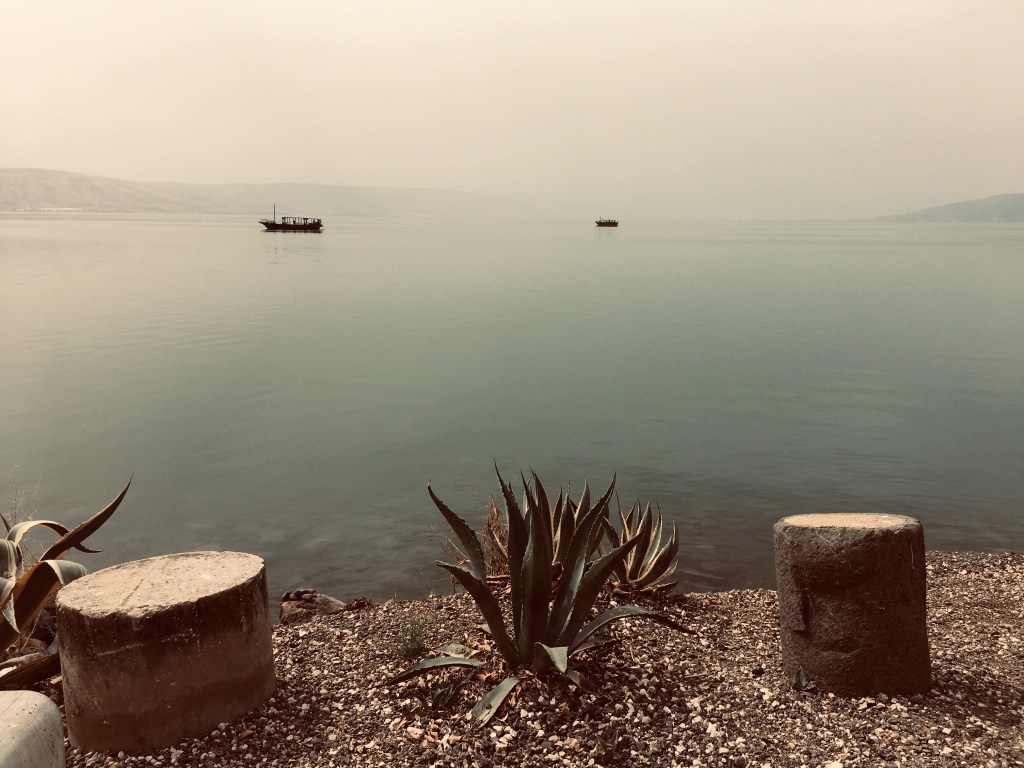
Photo by author, Lake of Galilee, the Holy Land, May 2019.
Matthew’s opening lines in today’s gospel present us a beautiful image of God’s abundance we often take for granted just like the parables of Jesus that remind us of our interconnectedness as brothers and sisters.
On that day, Jesus went out of the house and sat down by the sea. Such large crowds gathered around him that he got into a boat and sat down, and the whole crowd stood along the shore. And he spoke to them at length in parable, saying: “A sower went out to sow” (Matthew 13:1-3).
For the next three Sundays beginning today, all our gospel readings are taken from this 13th chapter of Matthew known as the “Discourse in Parables” that forms one whole unit of the Lord’s teachings in parables.
From the French word parabolein or “along the way”, a parable is a simple story often taken from ordinary things and events in life that offers valuable lessons about life; but, because it is a story taken from ordinary things and events, a parable is often taken for granted.
Many times we only realize later that the most profound realities in life are those found in most ordinary like God who comes to us daily in simplest ordinary things and people and events we take for granted or even refuse to recognize.
Our Filipino word for parable which is talinghaga captures this very well. From the phrase natatalinghiwaga that means “tied mystery”: tali is a rope or a tie that binds things together like mystery or hiwaga. Hence, we have talinghaga for parable that indicate how a mystery is tied with the ordinary and simple things and persons and events.
That is the purpose of Jesus in teaching us in parables: that we may learn to find the hidden truths and mysteries of life in the most ordinary things. His teaching in parables is a continuation as well as a deepening of his call to us last Sunday to “come to him and learn from him” so that we may find rest and fulfillment in him.
Photo by author, Lake of Galilee, the Holy Land, May 2019.
What I find amazing in our gospel scene this Sunday is how Jesus was by the shore of the Lake of Galilee yet, his parable is about the sower.
Why not narrate something about the life of fishermen or fish vendors?
Photo by author, Lake of Galilee, the Holy Land, May 2017.
Again, let us situate ourselves in Matthew’s opening line, “On that day, Jesus went out of the house and sat down by the sea.”
Imagine the scene, it was early morning, the sun had just risen, and people were starting to go about their usual lives when they heard Jesus teaching while seated on a boat perhaps owned by Peter. More than the parable of the sower itself, Matthew is showing us in this scene the very parable of our life that the whole world is God’s.
Every pilgrim to the Holy Land can attest to this unique beauty of the Lake of Galilee that is so lovely, so peaceful and yes, divine. It tells us of God’s superabundance in all of his creation, interconnecting us as brothers and sisters in him our Father.
This is the same parable and truth of life that God had spoken through the Prophet Isaiah in the first reading:
Thus says the Lord: Just as from the heavens the rain and snow come own and do not return there until they have watered the earth, making it fertile and fruitful, giving seed to the one who sows and bread to the one who eats, so shall my word be that goes forth from my mouth; my word shall not return to me void, but shall do my will, achieving the end for which I sent it (Isaiah 55:10-11).
Nothing happens by accident in life; God knows everything. And the good news is, he gives everything that is good like the sower. Not just the seeds but the bread we eat, the water we drink, even the very breath we breathe.
Moreover, there is the connectedness of everything in God’s superabundance like that of the rain and snow making the earth fertile and fruitful, giving seed to the sower so that there would be bread for everyone, even clothes to wear.
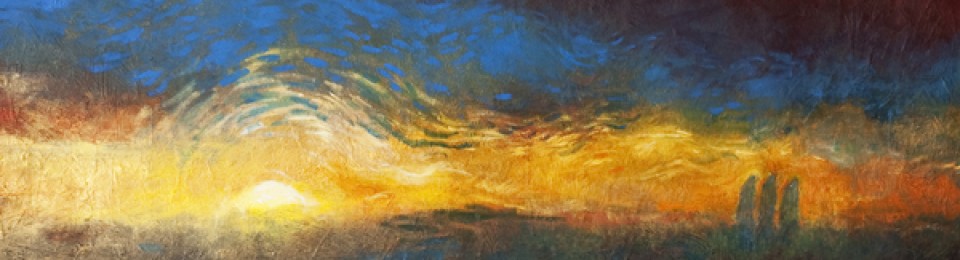
Painting by Van Gogh, “The Sower on Sunset” from wikipedia.org.
God is the Sower always coming to us, tending us, sowing us with seeds that are absolutely good. It does not really matter what kind of soil receives the seed that even the pathway becomes a conduit in feeding the birds of the air!
The seed is definitely good because God is good. In all instances where the seed had fallen, we find God the Sower himself moving in each step of our life. Observe how in this image of the sower moving from his home to his field, it shows us also the journey of the word and the purpose of God in our life. There is no problem with the seed that is so fecund and definitely efficacious as God had told Isaiah that “my word shall not return to me void, but shall do my will, achieving the end for which I sent it.”
If ever the word is not fruitful, it is due to our poor disposition as listeners or recipients. That is why St. Paul reminds us in the second reading of how we must responsibly be true to our call and role as disciples of Christ. It is a process we have to be patient but must be consistent. What we are working for is not just for this time or for one’s self or society or country: we have to see the whole reality of life from here to eternity in Christ’s work of salvation is for all. We are all interconnected so that whatever good we do will always bear fruit, “some a hundred or sixty or thirtyfold.”
Photo by author, St. Michael Retreat House, Antipolo City, 16 June 2026.
This Sunday, in this beautiful scene by the Lake of Galilee, or right there on your comfortable seat or wherever you are, Jesus is asking, “where do I see myself in this wide picture and chain of events?” What have I done with the “word”, the “seed” Jesus had sown in me?
In this age of relativism worsened by social media that have blurred reality with algorithms manipulating the way we see and understand truth and reality, the more we have become empty and alienated from one’s self and one another despite the abundance of material things.
How sad that despite the worldwide connections we now have, the more we have been detached from each other, even from one’s self and ultimately from God so that indeed, many of us “look but do not see and hear but do not listen or understand” (v.13) because we have taken life in the ordinary things for granted. We live in Facebook or social media where everything has to be spectacular, even “imeldific” or at least, enhanced if not AI-generated. This Sunday, let’s get real. Enough with fakes and AI’s. Amen. Have a blessed, fruitful week ahead everyone!
Lord My Chef Sunday Recipe for the Soul by Fr. Nicanor F. Lalog II
Third Sunday of Easter, Cycle A, 19 April 2026
Acts 2:14, 22-23   ><}}}*> 1Peter 1:17-21   ><}}}*>   Luke 24:13-35
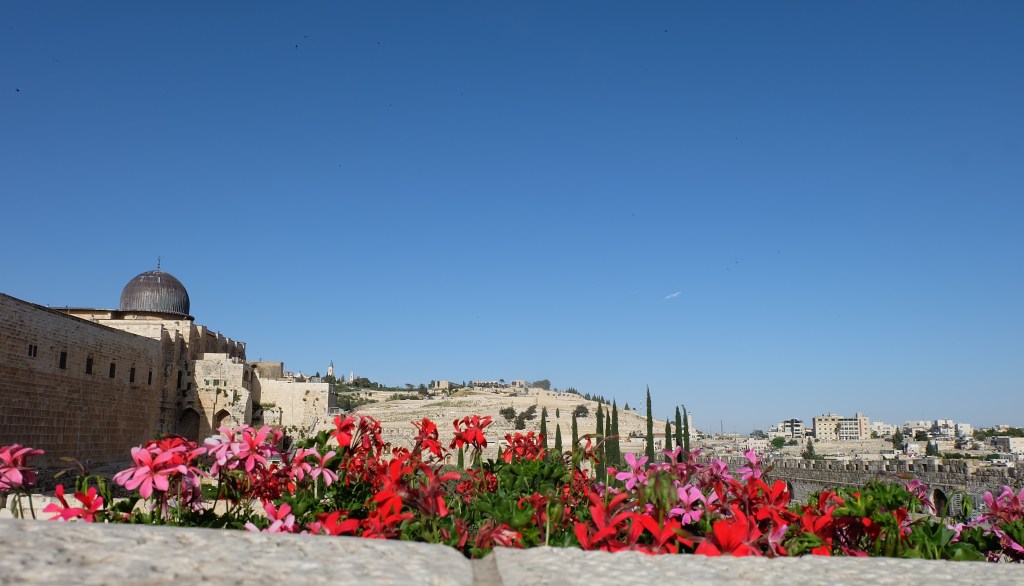
Photo by author, view from Jerusalem Temple, May 2019.
We heard last Sunday Jesus Christ’s coming to his disciples on the evening of Easter and a second time eight days later when Thomas was present, reminding us how Easter is a story of coming and believing, of believing and coming.
This Sunday we find an opposite movement and direction in the two disciples leaving Jerusalem in disbelief at the death and resurrection of Jesus Christ.
That very day, the first day of the week, two of Jesus’ disciples were going to a village seven miles from Jerusalem called Emmaus, and they were conversing about all things that had occurred. And it happened that while they were conversing a debating, Jesus himself drew near and walked with them, but their eyes were prevented from recognizing him (Luke 24:13-16).
“The Road to Emmaus” painting by Ronald Raab, CSC, from ronaldraab.com.
Easter is also about leaving in disbelief. Not necessarily because of not believin like Thomas last Sunday.
Cleopas and the other disciple were leaving Jerusalem in disbelief which our Filipino language adequately express in “hindi makapaniwala” and “matay ko mang isipin” that both indicate a strong sense of belief with a dash of doubt because the story, the event, or the very person involved is beyond comprehension.
Or, bigger than reality like Jesus Christ and his very mystery of love for us.
Many times, we could not believe how good and loving God can be to us, so personal, so real and true but how can it be he “allows” bad things to happen to us or in the world.
Like the two disciples going home to Emmaus, we walk away from God to distance from him and everything and everyone to find our selves and see the real picture of what is going on when times are rough for us.
Those are the times we silently tell ourselves “this could not be happening” especially when it is so difficult, so unbelievable simply because – we believe. Hence, our usual litany of striving to be good, of serving the poor and needy, of going to Mass every Sunday, of always praying…
Look back in our many experiences in life when we could have died or have lost more or could have been a total wreck. Amazingly, despite our being in the opposite direction in life, consciously or unconsciously, that is when we feel more blessed. That’s when we are able to declare with conviction, “hindi ako pinabayaan ng Diyos, napaka-buti ng Diyos, and binigay niya pa rin ang lahat”. This is what the first reading reminds us of Peter’s speech before the Jews at Pentecost, at how God never left us, sending us Jesus Christ as fulfillment of his promise to Abraham and David.
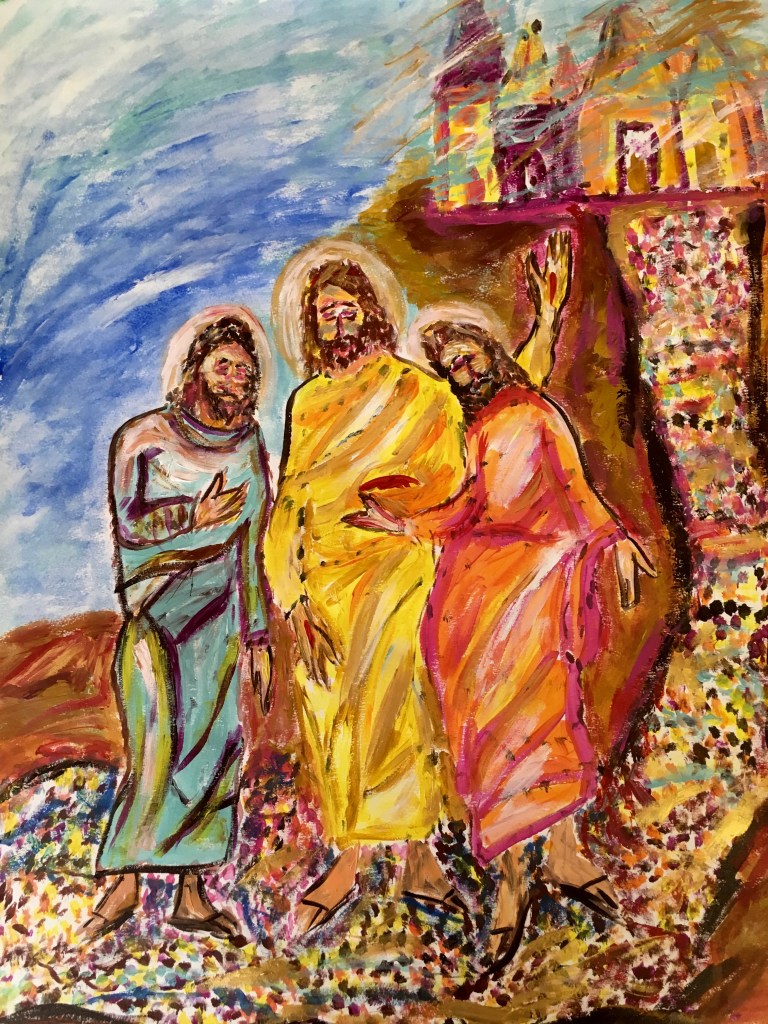
Modern painting of the road to Emmaus from the internet.
Like in the road to Emmaus, Jesus journeys with us in the opposite direction only to bring us back to Jerusalem filled with joy by reminding us how everything that happens in our lives, Jesus had gone through the same sufferings too as foreshadowed and explained in the Sacred Scriptures.
Here we are reminded of the importance of personal prayer which is more than the mere recitation of prayers but having a relationship in God who never leaves nor abandons us.
Most of all, here we are reminded too of how the Sunday Eucharist opens ourselves to Christ’s reality and loving presence among us as experienced by the two disciples after Jesus had broken bread with them. It is called a Holy Communion because in that “breaking of bread”, we share in our common experiences of suffering and death. That we are not alone. Most of all, that we too like others rise to new life in Jesus Christ who suffered, died, and rose to life first for us.
It can happen that our eyes too are prevented from recognizing Jesus like Cleopas and companion on the road to Emmaus because of our many fixations in life like that blessings can only be in positive things like good health, security like steady income, a rising career or a profitable business and endeavor.
But, experience has taught us so many times that blessings are not only found in good things but even in bad or negative ones like sickness, failures, losses and death. And when we look back, they were not really that bad at all because it was in our failures and losses, sickness and deaths when we realized and learned most in life.
Notice how Luke succinctly narrated the breaking of bread in the home of Cleopas in Emmaus, it was so swift unlike the building up of drama along the road to Emmaus. It was so simple because that’s how things happen in life too – so quick that the simplest things and gestures, even so bad can suddenly become so loaded with meanings that we realize God’s loving presence in us.
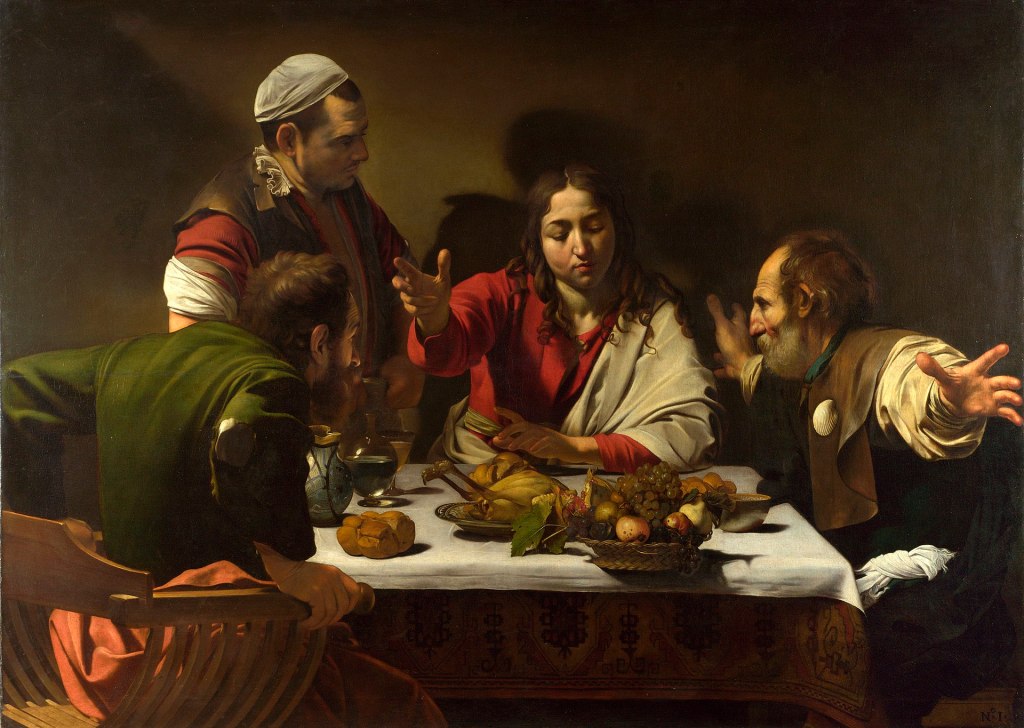
“Supper at Emmaus” by renowned painter Caravaggio. See the emotion depicted by Caravaggio with his trademark of masterful play of light and shadows. At the center is the Risen Lord blessing the bread that caught the two disciples who are seated in disbelief, one outstretching his arms and the others pushing back in his chair. The third character in the painting is the innkeeper unaware of the significance of the gesture of Jesus. It was at this instance that the two disciples recognized Christ as the travelling man with them to Emmaus.
During the COVID pandemic, on the first Sunday of lockdown when there was no public Mass, I started a motorized procession of the Blessed Sacrament in my former parish by mounting our big monstrance on the roof of a parishioner’s truck. I announced the route of our procession during our online Mass that Sunday and people waited.
What an amazing sight of the people’s deep faith in God as they knelt and bowed before the Blessed Sacrament whether on the main highway or the inside streets. Some were crying while everyone was deep in prayer.
There lies the great mystery of Easter: Jesus need not appear to us in person because as he vanishes in the Blessed Sacrament, that is when we recognize him!
In the most simple gestures of the Mass under the most simple signs of bread and wine, Jesus vanishes from our outward view and through this vanishing our interior or inner recognition opens up that we “see” him in the many instances he had touched us especially in our “heart-breaking” experiences in the past, our Emmaus road.
Photo by Ms. Anne Ramos, 22 March 2020, Bagbaguin, Sta. Maria, Bulacan.
We know with certainty that “it is the Lord” – Dominus est – present in every breaking of bread because part of the Easter mystery tells us deep within that it is only in his vanishing that he truly becomes recognizable to us. That is why we have to stop all those “theatrics” in our liturgy as noted by many netizens this past Holy Week and Easter. Unknown to many priests and their alalays, the more we have gimmicks in the Mass or even in our sacred spaces, the more we “displace” and remove Christ.
After an hour every Sunday, we leave the Mass and go back to our usual way of life, facing life’s many challenges. Peter reminds us in the second reading to hold on to that “faith and hope in God” who gave us Jesus Christ, “the spotless unblemished lamb.”
Let us not forget this mystery of Easter that, the more Jesus vanishes, the more we recognize him because Jesus is more than enough than anybody or anything else especially when we in our Emmaus experience. Let us pray like Cleopas and companion “Stay with us, Lord” so we may show him in our witnessing especially when we could not find him in others. Amen.
From Facebook, 21 April 2021: “There is an urgency to announce the Joy, the joy of the Risen Lord.”
Quiet Storm by Fr. Nicanor F. Lalog II, 15 January 2026
Photo by Ar. Philip Santiago, Basilica of the Annunciation, Israel, October 2025.
Two priests and a former nun personally known to me died in our diocese last Sunday. It was also the birthdate of the late Bishop Cirilo Almario, Jr. whom I had remembered in my two early morning Masses on that Sunday, January 11, 2026.
In those two Masses too I mentioned in my homily the retreat I facilitated first week of January with my friends about “ageing gracefully” – my own realizations since joining their ranks as senior citizens last March.
Let me elaborate those two points I have shared with them and in my homily last Sunday.
From forbes.com.
First, let us embrace our being old. Stop saying “when we get old”, pagtanda natin because we are already old. Period. Matanda na tayo.
We cannot reverse our ageing process and it is useless to have all these cosmetic manipulations like dyeing our hair black or stretching our sagging skin and removing those wrinkles.
Embrace old age. It is beautiful and wonderful because it is so good. Our Filipino word for “old” says it all – matanda – which ironically so many women hate to hear as they stress that kalabaw lang ang tumatanda. That is not true.
Our word matanda is from the root word tanda which means “sign” that is why an old person is rightly called matanda because he/she is a sign of God’s goodness, a sign of God’s mercy and love, a sign of God’s beauty and majesty.
Moreover, a matanda is a sign of wisdom and grace that is why when we were young boys, we wanted to be old by putting our dad’s eyeglasses or taste his cigarettes and beer while girls put on their mom’s make up and high heeled shoes. How funny that when we are already old, we resist to accept the fact that we strive to look young again, sometimes ending up as nagmumurang kamatis.
Photo by Mr. Jim Marpa, 2019.
Technically speaking, “old” is actually harsh. Old is something about a past phase that has ran its course like being outdated. Luma in Filipino that connotes stale, passe, lacking relevance and sadly, useless. Just for display purposes. As a person, that is the one we refer to as walang pinagkatandaan. Or huklubang matanda.
To be more specific, the better English term referring to ageing gracefully is ancient that exudes with a sense of timeliness, of being perpetually relevant like the ancient ruins in Rome, Athens, and Jerusalem. Actually, some biblical experts have wanted to rename the “Old Testament” as “Ancient Testament” following this line of thinking.
Photo by author, Ephesus, Turkiye, November 2025.
Things and even persons can rightly be referred to as ancient because of their beauty still intact that inspires us and makes us wonder about life itself. They are not just old sites nor old persons that remind us of the past long gone but ancient because still lovely, “still full of sap and green” as the psalmist extolled the seniors of his time.
Persons who age gracefully like ancient sites stir our inner selves with deeper beauty and realities of life that eyes cannot see. That is perhaps the reason these days many senior men and women are so “in” and considered as attractive.
It is the same wisdom realized by St. Augustine when he wrote about God, “Late have I loved you, O Beauty ever ancient, ever new, late have I loved you. You were within me, but I was outside, and it was there that I searched for you.”
Being ancient -whether as a person or a thing – is something of the inside we must turn to not outside like our skin and physical body. From that inside realization and acceptance of being senior or elderly we experience the grace of ageing because we experience God still present in us, in fact loving us more as he makes as a sign or tanda of his loving presence.
Ageing gracefully is a modern virtue we need to cultivate in this age of instants that glorify youthfulness equated with usefulness. That is why when Pope Benedict XVI resigned from the Papacy in 2013, the more I have come to love and admire him. In his resignation, he taught us the importance of embracing and lovingly accepting our old age when we can no longer adequately perform our many tasks in office even in life itself. It was not a failure nor a surrender in the negative sense but more of a deep courage and trust in God that we accept our being weak and ready to come to him soon.
Photo by author, Pundaquit, San Antonio, Zambales, May 2025.
This brings me to my second realization since turning sigisty years old last year: corollary to embracing old age is accepting death. That is why, as seniors, let us stop saying and thinking of our coming death because we are already dying. Huwag na nating isipin yung “kapag namatay ako” dahil namamatay na nga tayo.
Being senior is doing away with those bucket lists, of thinking about things to do, places to visit before we die. We are already dying and hence, whatever you can do, do it now. There could be no more tomorrow. All we have is the present moment. Anything could happen to us, for better and for worse.
Ageing gracefully is coming to terms with life which leads us to coming to terms with death. Yes, this is easier said than done, but slowly, I am learning and loving it!
Photo by author, Bucharest, Romania, November 2025.
One of the reasons that made me decide to become a priest in the early 1990’s was the conviction that I have felt so deeply God’s love for me as a person in the many experiences I have gone through in life. I felt at that time that by becoming a priest, I could convince more people about the truth and existence of this loving God we have.
I still hold on to that but a year after turning sigisty, becoming sigisty-one in March 22, another fascinating realization I have had is how wonderful this life is. Now that I am old, the more I can boldly claim with conviction that it is good to be alive. Masarap pa rin ang mabuhay! Maganda ang buhay maski mahirap!
Accepting and embracing our ageing, our getting weak, our failing memory are all kinds of dying. And in that midst that we actually live fullest and meaningfully. I don’t know if I can write any further because I ain’t dead yet but… just in case, it was worth the trip. Amen. May you have a fruitful and fulfilling weekend ahead.
Quiet Storm by Fr. Nicanor F. Lalog II, 11 September 2025
Photo by author, Sacred Heart Novitiate, Novaliches, QC, 2023.
Of course, there is no need for us to impress Jesus Christ for he loves us so immensely beyond measure. However, I have realized this week in my prayers that the Lord is most impressed with us when we are in our weakest.
It has been recurring in my prayers several times with the latest in this Wednesday’s gospel, “Raising his eyes toward his disciples Jesus said: ‘Blessed are you who are poor, for the Kingdom of God is yours’” (Luke 6:20).
I just love that scene of Jesus looking up to his disciples, looking up to us because normally we humans are the ones who look up to God his Father where he is seated to his right in heaven. When we pray, we sometimes raise our hands reaching up to God.
There is something so beautiful and wonderful when the Sacred Scriptures tell us of Jesus looking up to us. What an honor and a privilege! Because that happens when we are weakest, most flawed, and dirty with sin.
Imagine being there at that scene of the sermon on the plain and Jesus had to raise his eyes toward his disciples: he must have been at a lower position than them. This scene will have its fullness in the washing of the disciples’ feet after their Last Supper on Holy Thursday.
We who could no longer bow that low to clean and wash our feet as well as trim our toenails know this so well. Imagine all the dirt and flaws Jesus must have seen in the disciples’ feet that evening. Not a word was heard from Jesus. He teased no one nor complained of the dirt and unsightly things he must have seen too. Jesus simply bore everything because he loved them so much.
Photo from Our Lady of Fatima University website, June 2025.
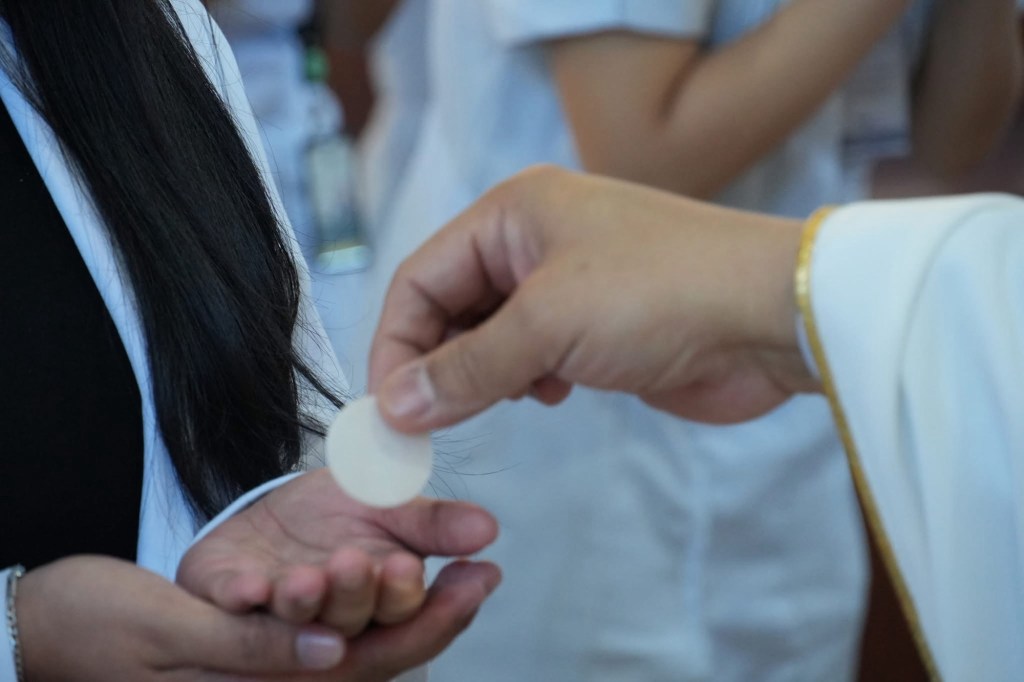
Jesus continues to look up to us every time we receive him in our hands during the Holy Communion. That is why I always tell the people especially our students to be very solemn during that occasion when the Son of God most powerful, all-knowing in his simplest form and sign as a thin wafer, enters us body and blood. It is the most perfect time to pray to Jesus, to tell him everything and most of all, to listen to him because that is when he is right inside our body, when he is down inside us, we above him.
Jesus does not need our triumphs and “goodness” because they all came from him actually. What he does not have is what we have a lot- the negative things like sins, hurts and bitterness, anger and resentment festering deep inside us for a long time. Those are the thing Jesus want from us, the very things he is most “impressed” with us that we are able to live with those burdens for so long. But, he is most impressed with us in the truest sense when we are able to surrender these to him because that’s when we are blessed and filled in him.
Raising his eyes toward his disciples Jesus said: “Blessed are you who are poor, for the Kingdom of God is yours. Blessed are you who are now hungry, for you will be satisfied. Blessed are you who are now weeping, for you will laugh. Blessed are you when people hate you, and when they exclude and insult you, and denounce your name as evil on account of the Son of Man” (Luke 6:20-22).
Photo by author, Sacred Heart Novitiate, Novaliches, QC, 2023.
In this age of affluence brought about by technological advances, being poor and hungry, being maligned and weeping are things to be avoided at all costs. With people so fascinated with money and wealth, fame and power, being poor and hungry for God, weeping and being maligned for what is true and good and just are not impressive at all, even foolish.
But, look at the effect of those shameless social media posts by “nepo babies” of their crass lifestyle sustained by ill-gotten wealth at the expense of the poor – they have all been bashed relentlessly in the country leading to more evidence of corruption among government officials and law-makers while in Indonesia and Nepal, these same practices have sparked social unrest and upheavals recently!
For so long, many have wished to be rich and wealthy, to have all the money to buy good food and drinks, build mansions filled with expensive cars and adorn themselves with signature clothes and jewelries in the belief they can impress others. Maybe with their fellows with the same benighted souls but more often, they only bred jealousies and envies that led to vicious circles of corruption and crimes in the name of having more money.
In truth, no one is impressed with material things because people who feel good only with possessions are actually the most pitiable ones for they could not see their own value as a person. To be able to see one’s value as a person despite one’s sins and weaknesses is the beginning of being truly human.
Recall the Lord’s parable of the Pharisee and the publican praying at the temple: the publican who stayed at the back beating his chest so contrite for his sins went home blessed according to Jesus than the Pharisee who boasted of his own righteousness. “Magpakatotoo ka!” screamed a soda commercial not too long ago but still echoes so true these days.
Jesus is not impressed with what we have done nor achieved but with what we have become – that amid all the beatings and pains of life with all of our shortcomings and sins, we forge on with life, persevering in faith, filled with hope that Christ is our salvation. What impresses Jesus Christ most in us is what we lack because that is when he can be closest to us, one in us. See yourself the way Jesus sees you – as a person, loved and cared for. Regardless of what. Let me end this with a prayer wrapped in a song which I have always loved because it sounds like Jesus speaking to me, so impressed with me despite of everything.
Quiet Storm by Fr. Nicanor F. Lalog II, 18 August 2025
Photo by author, pilgrims awaiting their turn inside the Ascension site of Jesus outside Jerusalem, May 2019.
It has been a month since I have taken a break from my daily walking following that fall in our garage when I hurt my left knee that still aches to this day. But as I rested my onehod (twohod if both knees), I have realized in prayers that there are just two important steps we have to take for a fuller life instead of those 10,000 steps daily.
The first is to always step back one or two steps backwards and stop to make a space for God and for others in our life. Though life is a constant moving forward, it is essential that once in a while we step back and stop to see everything in ourselves and around us. Let God direct you because life is more of adjusting to the many shiftings and transitions that happen every day (https://lordmychef.com/2025/08/11/god-in-our-many-transitions/). Stepping back is being flexible in life.
Since turning 18, we have all been taking charge of our lives, each of us demanding a driver’s license, but, as we approach the age of 60, our interest in driving wane that we prefer more to be a passenger than being on the steering wheel. I have semi-retired from driving last year as I leave my car behind six days a week to take ride-hailing and ride-sharing services. Aside from reasons of convenience, taking a Grab car makes me more productive and most of all, relaxed in getting to my destinations and back home.
When life is so confusing, so dark and you feel so lost, step back and stop. Many times in life what really happens is that we unconsciously eject God from our lives as we go on with our responsibilities and projects even apostolates and ministry thinking we are doing the work of God. The moment things go wrong, when failures and problems happen, we then question God where he is or why did he allow bad things to happen with us. Truth is, God never left us, has always been with us but we never recognized him because we were so busy. Hence, the need to step back and stop to meet him. Finally.
Moses went up from the plains of Moab to Mount Nebo, the headland of Pisgah which faces Jericho, and the Lord showed him all the land… The Lord then said to him, “This is the land which I swore to Abraham, Isaac, and Jacob that I would give to your descendants, I have let you feast your eyes upon it, but you shall not cross over.” So there, in the land of Moab, Moses, the servant of the Lord, died as the Lord had said (Deuteronomy 34:1, 4).
See how Moses was portrayed in the first readings last week, slowly stepping back from the daily scene among the Israelites in the wilderness as he passed leadership to Joshua his successor. It is perhaps the earliest account in the Bible of the virtue of “ageing gracefully” in the Lord by Moses.
It is a virtue so needed these days in modern time that Pope Benedict XVI taught us in 2013 when he resigned, taking that bold step backward to stop from his active duties to spend the rest of his life in prayers. That move proved beyond doubts the true humility and holiness of Pope Benedict XVI who peacefully died right at the transition of the year on December 31, 2022.
Not only successions proceed smoothly when we learn to step back and stop as seen in Moses and Pope Benedict. Stepping back to stop and allow God to do his work among us strengthen and make better our human relationships often strained by those into sin and evil. See these as the steps proposed by Jesus in his instructions when one commits sin:
Jesus said to his disciples: “If your brother sins against you, go and tell him his fault between you and him alone… If he does not listen, take one or two others along with you, so that every fact may be established on the testimony of two or three witnesses. If he refuses to listen to them, tell the Church. If he refuses to listen even to the Church, then treat him as you would a Gentile or a tax collector” (Matthew 18:15,16-17).
Relationships are shattered when we “overstep” on family and friends into sinful situations where stepping backward is the more prudent choice to take. Stepping backward allows us to learn more the situation and avoid making rash judgments against anyone that often starts, then gets aggravated in social media. Stepping back is not just being circumspect at all but simply trying to be more fair and accurate where social media is filled with inaccurate and totally false reports or fake news.
Photo by Dra. Mylene A. Santos, MD, 2023.
The second important step that literally brings us closer to God and others is taking that first bold step into water. Yes. Stepping on water is the other special step we need to learn and make for a fuller life in God.
Recall whenever you go swimming at the pool or the beach. There is always that someone in the family or among friends or even our very self so timid or wary of the cold water who would ask that stupid question, is the water cold?
Of course – you will never know how cold the water in the pool or the sea until you take that plunge! It may sound simple but, many times we are afraid to take the first step forward into any body of water or even the shower due to the chills that quickly follow. But we also know very well from experience the great feelings that come after every plunge into water!
The spiritual value of making this crucial step forward into water is found in the first reading last Thursday at the crossing of the Jordan River by the Israelites into the Promised Land under Joshua. Leading them were the priests carrying the ark of the covenant who took the first steps on the banks of Jordan River that caused it to part and enabled the people to cross into the other side, reminiscent of the crossing of the Red Sea during their exodus from Egypt with Moses (https://lordmychef.com/2025/08/14/praying-to-step-forward-in-christ/).
Photo by Mr. Jim Marpa, 2019.
The people struck their tents to cross the Jordan, with the priests carrying the ark of the covenant ahead of them. No sooner had these priestly bearers of the ark waded into the waters at the edge of the Jordan…than the waters flowing from upstream halted, backing up in a solid mass for every great distance indeed… while those flowing downstream toward the Salt Sea of the Arabah disappeared entirely. Thus the people crossed over opposite Jericho (Joshua 3:14-15, 16).
Water is life but it also evokes death at the same time. Too much water can drown and kill us that is why we are afraid to take the first step forward into the river or the sea. We fear, we doubt even mistrust God, others and our self in taking the first step forward into water without realizing how that step could be the only thing left for us to move on in life. Stepping into water and allowing our feet to get wet in order to cross a stream or a river is one of the boldest moves we can make in life because that could be the very moment when God is actually making a way for us when our usual routes are impassable.
That is why I tried linking that first reading with the story of the saint of that day, St. Maximilian Kolbe (August 14) who “stepped forward” to their prison guards to take the place of a married man to be executed as a punishment following the escape of a prisoner at Auschwitz. Like the priests of Joshua, St. Maximilian carried the ark of the covenant – Jesus Christ – inside the gas chambers that ignited the flames of courage and faith in God to other prisoners at that time.
Photo by Mr. Jim Marpa, 2019.
These days, we need more men and women of faith, hope and love in God willing to step forward into waters that can be dark and murky, even lethal with unknown substances like the modern miseries of human trafficking, substance abuse, sex slavery, extreme poverty and other systematic inhuman conditions that now afflict mankind. Taking that bold step into water carrying Christ across the river is enabling the others to pass through from death to life, from grief to joy, and from hopelessness to love.
Pray for us your priests in the Diocese of Malolos as we go on retreat today until Thursday that we may truly step backwards and stop these days to let God take charge of our lives and ministry anew. Most of all, that we may have the grace of fervor and courage to carry and follow Jesus in crossing the many rivers and streams of life when the usual routes are impassable due to sickness and other miseries. Amen. Have a fulfilling week ahead.
Lord My Chef Daily Recipe for the Soul, 21 July 2025
Monday in the Sixteenth Week of Ordinary Time, Year I
Exodus 14:5-18     <*((((>< + ><))))*>     Matthew 12:38-42
Photo by author, Cabo da Roca, Pundaquit, San Antonio, Zambales, 15 May 2025.
It is a rainy,
gloomy Monday,
God our Father;
like your people who have
left Egypt led by Moses,
suddenly we are again facing
life's realities of work and
struggles,
of health and sickness,
of challenges and problems
bigger than us.
Pharaoh was already near when the children of Israel looked up and saw that the Egyptians were on the march in pursuit of them. In great fright they cried out to the Lord. And they complained to Moses, “Were there no burial places in Egypt that you had to bring us out here to die in the desert? Why did you do this to us? Why did you bring us out of Egypt? Did we not tell you this in Egypt, when we said, ‘Leave us alone. Let us serve the Egyptians? Far better for us to be the slaves of Egyptians than to die in the desert.'” But Moses answered, “Fear not! Stand your ground, and you will see the victory the Lord will win for you today… The Lord himself will fight for you; you have only to keep still” (Exodus 14:10-14).
Keep me still, Lord;
let me stand my ground
in you before my adversaries -
primarily my self when I doubt
you, when I lose hope,
when I am disillusioned,
when I am afraid,
when I complain a lot
when the realities of life
start to kick in
making me realize of your invitation
and calls for me to welcome you
into my life,
to believe you,
to trust you.
O dear Jesus,
many times in the wilderness
of this life I waste precious
time and efforts like the Pharisees
asking you for signs
when each day,
each waking from sleep
is like me being a Jonah
coming out alive
from the belly of the whale;
help me live
your paschal mystery,
Jesus,
one day at a time.
Amen.

Fr. Nicanor F. Lalog II
Our Lady of Fatima University
Valenzuela City













 lordmychef.com