Lord My Chef Daily Recipe for Soul by Fr. Nicanor F. Lalog II
Thursday in the Seventeenth Week of Ordinary Time, Year II, 30 July 2026
Memorial of St. Peter Chrysologus, Bishop & Doctor of the Church
Jeremiah 18:1-6     <*((((><  +  ><))))*>     Matthew 13:47-53
Help me deepen my
relationship with you,
God our loving Father
by making me more sensitive
to your touch,
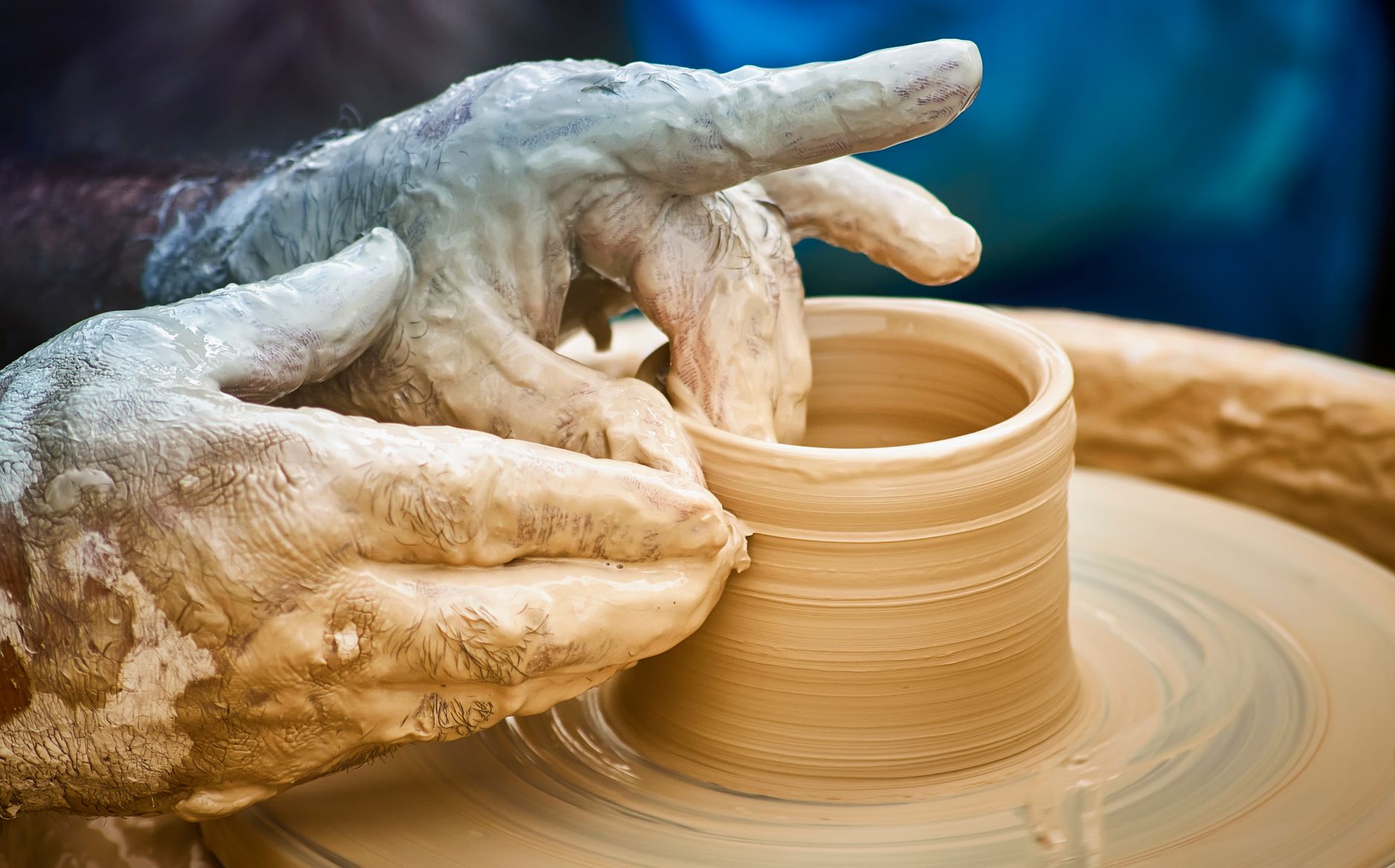
to your creative hands
always forming me to a better
self, a better person,
a new creation in Jesus Christ
daily; let me be still and pliant
like the clay, O Lord,
trusting you always.

Sometimes,
your hands have to
smash me,
destroy me
whenever like a clay
I turn out badly;
most of the time,
those hands of yours Father
exert the perfect pressure
with the most delicate touch
to keep perfecting me like
a clay, transforming me into
a beautiful work of art
so unbelievable
considering my origin
of a simple lump of clay.
Oh, Lord,
how easy it is like
your disciples to answer you
"Yes, we understand all these
things" without really realizing
the ongoing process of
your hands shaping me
like the clay.
One thing very clear
with me, O God,
is that whether I am
smashed into a lump of clay
anew or delicately turned into
a beautiful pottery,
these are both the works of
your loving and creative hands;
grant me the grace of patience
to this tedious process of
"trial and error" molding me
like a clay pot;
keep me "malleable" to the powers
of your hands that sometimes
are harsh,
but often gentle
and soft;
and lastly,
make my heart
"pliable",
to bend without breaking
when the goings get so
tough in bringing out
the best in me
for your greater glory.
Amen.
Quiet Storm by Fr. Nicanor F. Lalog II, 15 January 2026
Photo by Ar. Philip Santiago, Basilica of the Annunciation, Israel, October 2025.
Two priests and a former nun personally known to me died in our diocese last Sunday. It was also the birthdate of the late Bishop Cirilo Almario, Jr. whom I had remembered in my two early morning Masses on that Sunday, January 11, 2026.
In those two Masses too I mentioned in my homily the retreat I facilitated first week of January with my friends about “ageing gracefully” – my own realizations since joining their ranks as senior citizens last March.
Let me elaborate those two points I have shared with them and in my homily last Sunday.
From forbes.com.
First, let us embrace our being old. Stop saying “when we get old”, pagtanda natin because we are already old. Period. Matanda na tayo.
We cannot reverse our ageing process and it is useless to have all these cosmetic manipulations like dyeing our hair black or stretching our sagging skin and removing those wrinkles.
Embrace old age. It is beautiful and wonderful because it is so good. Our Filipino word for “old” says it all – matanda – which ironically so many women hate to hear as they stress that kalabaw lang ang tumatanda. That is not true.
Our word matanda is from the root word tanda which means “sign” that is why an old person is rightly called matanda because he/she is a sign of God’s goodness, a sign of God’s mercy and love, a sign of God’s beauty and majesty.
Moreover, a matanda is a sign of wisdom and grace that is why when we were young boys, we wanted to be old by putting our dad’s eyeglasses or taste his cigarettes and beer while girls put on their mom’s make up and high heeled shoes. How funny that when we are already old, we resist to accept the fact that we strive to look young again, sometimes ending up as nagmumurang kamatis.
Photo by Mr. Jim Marpa, 2019.
Technically speaking, “old” is actually harsh. Old is something about a past phase that has ran its course like being outdated. Luma in Filipino that connotes stale, passe, lacking relevance and sadly, useless. Just for display purposes. As a person, that is the one we refer to as walang pinagkatandaan. Or huklubang matanda.
To be more specific, the better English term referring to ageing gracefully is ancient that exudes with a sense of timeliness, of being perpetually relevant like the ancient ruins in Rome, Athens, and Jerusalem. Actually, some biblical experts have wanted to rename the “Old Testament” as “Ancient Testament” following this line of thinking.
Photo by author, Ephesus, Turkiye, November 2025.
Things and even persons can rightly be referred to as ancient because of their beauty still intact that inspires us and makes us wonder about life itself. They are not just old sites nor old persons that remind us of the past long gone but ancient because still lovely, “still full of sap and green” as the psalmist extolled the seniors of his time.
Persons who age gracefully like ancient sites stir our inner selves with deeper beauty and realities of life that eyes cannot see. That is perhaps the reason these days many senior men and women are so “in” and considered as attractive.
It is the same wisdom realized by St. Augustine when he wrote about God, “Late have I loved you, O Beauty ever ancient, ever new, late have I loved you. You were within me, but I was outside, and it was there that I searched for you.”
Being ancient -whether as a person or a thing – is something of the inside we must turn to not outside like our skin and physical body. From that inside realization and acceptance of being senior or elderly we experience the grace of ageing because we experience God still present in us, in fact loving us more as he makes as a sign or tanda of his loving presence.
Ageing gracefully is a modern virtue we need to cultivate in this age of instants that glorify youthfulness equated with usefulness. That is why when Pope Benedict XVI resigned from the Papacy in 2013, the more I have come to love and admire him. In his resignation, he taught us the importance of embracing and lovingly accepting our old age when we can no longer adequately perform our many tasks in office even in life itself. It was not a failure nor a surrender in the negative sense but more of a deep courage and trust in God that we accept our being weak and ready to come to him soon.
Photo by author, Pundaquit, San Antonio, Zambales, May 2025.
This brings me to my second realization since turning sigisty years old last year: corollary to embracing old age is accepting death. That is why, as seniors, let us stop saying and thinking of our coming death because we are already dying. Huwag na nating isipin yung “kapag namatay ako” dahil namamatay na nga tayo.
Being senior is doing away with those bucket lists, of thinking about things to do, places to visit before we die. We are already dying and hence, whatever you can do, do it now. There could be no more tomorrow. All we have is the present moment. Anything could happen to us, for better and for worse.
Ageing gracefully is coming to terms with life which leads us to coming to terms with death. Yes, this is easier said than done, but slowly, I am learning and loving it!
Photo by author, Bucharest, Romania, November 2025.
One of the reasons that made me decide to become a priest in the early 1990’s was the conviction that I have felt so deeply God’s love for me as a person in the many experiences I have gone through in life. I felt at that time that by becoming a priest, I could convince more people about the truth and existence of this loving God we have.
I still hold on to that but a year after turning sigisty, becoming sigisty-one in March 22, another fascinating realization I have had is how wonderful this life is. Now that I am old, the more I can boldly claim with conviction that it is good to be alive. Masarap pa rin ang mabuhay! Maganda ang buhay maski mahirap!
Accepting and embracing our ageing, our getting weak, our failing memory are all kinds of dying. And in that midst that we actually live fullest and meaningfully. I don’t know if I can write any further because I ain’t dead yet but… just in case, it was worth the trip. Amen. May you have a fruitful and fulfilling weekend ahead.
Quiet Storm by Fr. Nicanor F. Lalog II, 21 August 2025
Photo by author, St. Joseph Chapel, St. Paul Center for Renewal, Alfonso, Cavite, 20 August 2025.
As we ended our annual clergy retreat today when we remembered in the Mass a saint, Pope Pius X and a hero, Benigno “Ninoy” S. Aquino Jr. , I wish to reflect on the word “remember”, a very lovely word worth remembering always.
From the prefix “RE” that connotes repetition as in again and the root “MEMBER” that means a part, to remember literally is to make someone or something a part again. What and who we remember are those gone and away from us, a history in the past. More than mere recalling of a person, event or thing, remembering is making those absent present.
Though the philosopher Martin Heidegger rightly claimed that we humans are “beings of forgetfulness,” God actually programmed us for remembering: from infancy to childhood, our parents drilled into us to remember our name and address, the names of people around us, of things, and everything as we grew. That is why the expression “kalimutan mo na yun” is the most useless piece of advice anyone can give. It is impossible to forget, whether it is so good or so bad. What we need is to harness the power of remembering, to continue learning from the past whether good or bad because whatever is remembered for all its worth is always the best teacher anyone can have.
Remembering is a power because it is a grace, a gift from God himself. When we remember, we not only time travel to the past but make it present in order to perfect us. The past cannot be changed anymore as insisted by Japanese writer Toshikazu Kawaguchi in his series of novels Before the Coffee Gets Cold.
Remembering changes the person, not the past. It is in remembering the bitter lessons of the past we learn most in life because that is when we experience healing and fulfillment. Hence, remembering is at the very core of George Santayana’s warning that whoever does not learn from history is condemned to repeat it. Remembering enables us to move on in life by finding our ways and ultimately our very selves anew especially when lost and confused.
Of God’s many gifts to us, remembering is the most unique because it is never lost at all. People who refuse to remember are the most difficult to deal with like politicians, crooks and low-lifers. And the more corrupt and evil people are, the more they are forgetful, remembering or knowing nothing at all!
God meant us to keep this gift of remembering to be always reasonable and just, or simply good and sane because it keeps us in touch with reality, making us grow and mature in his love. Actually, it is remembering that continues to operate among us despite our faltering memory or even with those afflicted with Alzheimer’s and dementia because remembering is more than keeping information and details like names of people but most of all of God’s interventions through persons and events in our lives individually and collectively that significantly made us experience joy and gladness so crucial for our growth and maturity, eventually in the achievement of our goals.
Photo by author.
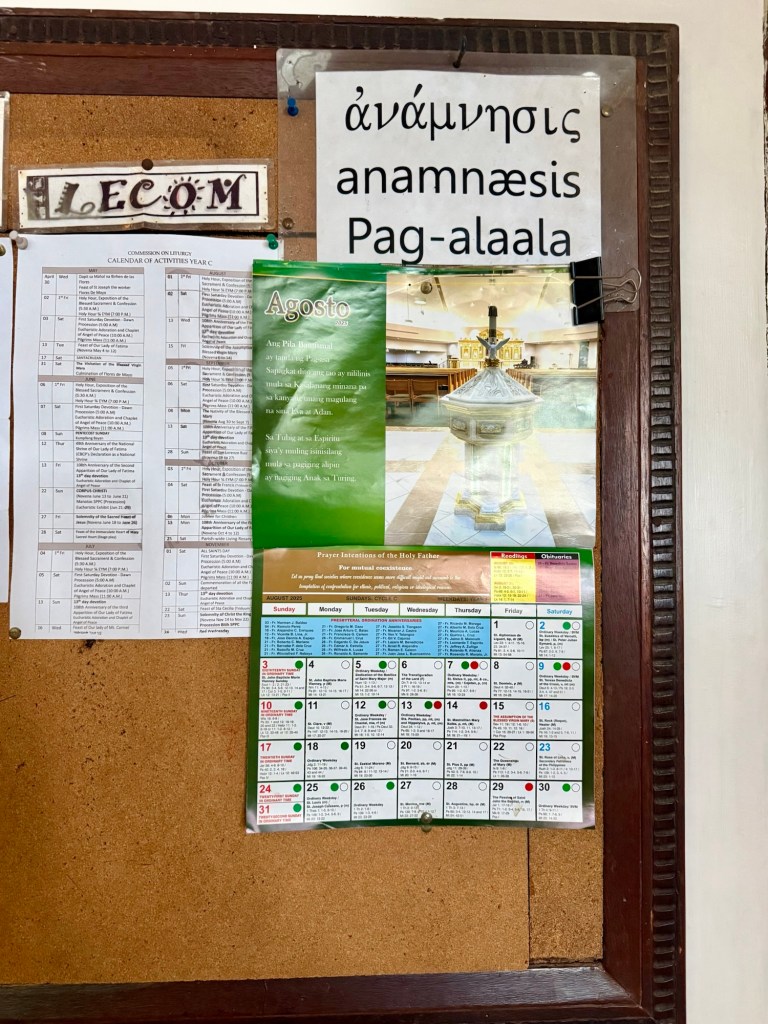
On the bulletin board of our sacristy at the National Shrine of Our Lady of Fatima in Valenzuela City is a laminated piece of bond paper with the Greek word “anamnesis” written in Greek.
It was personally printed and posted on Holy Thursday 2010 by the former rector and parish priest of the Fatima Shrine Msgr. Bart Santos now the Bishop of Iba, Zambales. I remember that so well because that was the first time I was assigned as an attached priest at the Fatima Shrine in June 2010 to June 2011 under Bishop Bart.
According to Bishop Bart who used to teach Sacred Scriptures in the seminary, he wanted to instill in all their servers of the Mass the value and meaning of the Eucharist as an anamnesis or remembering. I was so glad upon my return in February 2021 at the Fatima Shrine again as an attached priest while working full-time as chaplain at the Our Lady of Fatima University and the Fatima University Medical Center that the sign of Bishop Bart was still there – until now! I just hope the people here realize and still remember that word anamnesis as Bishop Bart had explained to them during the Holy Thursday Mass ten years ago.
Photo by author.
When everything seems dark in life with family and friends betraying us, when people we have helped turn against us, denying having known us, try remembering Jesus went through all these first at his Last Supper.
When you feel lost for directions in life, when you are into a burnout, when nothing seems to be working in your favor that you can’t find sparks of inspiration and zeal anymore, remember that first day when you embarked on this journey in life. Remember the people, the places and the things that bring you gladness and joy in pursuing your passion or fulfilling your mission. Most of all, remember when God called you to whatever mission he sent you.
Remembering is a form of stepping back to stop, to create a space and let God work in us as we have reflected last Monday (https://lordmychef.com/2025/08/18/steps-to-god/). This is what we need most in our selves and in our country as a people: the virtue of remembering, of making present the movements of God in our history. Ninoy Aquino did the supreme sacrifice of coming home in August 21, 1983 because he remembered the country he most loved; he remembered his call and mission to serve; he remembered the ideals and mission fought for by our heroes like Jose Rizal and Andres Bonifacio.
It is in remembering we remain anchored to our call and mission in life, both individually and communally. Without remembering, we cannot progress because we lack reference points of what we have covered, of where we are. That is why even the angels at Easter had to remind Mary Magdalene and companions, “He is not here; he has risen! Remember how he told you while he was still with you in Galilee…” (Lk.24:6). Most of all, let us remember always the words of Jesus at his Ascension so we may keep on pursuing our mission in him, “And remember that I am with you always until the end of time” (Matt. 28:20). May God bless you always!
Quiet Storm by Fr. Nicanor F. Lalog II, 18 August 2025
Photo by author, pilgrims awaiting their turn inside the Ascension site of Jesus outside Jerusalem, May 2019.
It has been a month since I have taken a break from my daily walking following that fall in our garage when I hurt my left knee that still aches to this day. But as I rested my onehod (twohod if both knees), I have realized in prayers that there are just two important steps we have to take for a fuller life instead of those 10,000 steps daily.
The first is to always step back one or two steps backwards and stop to make a space for God and for others in our life. Though life is a constant moving forward, it is essential that once in a while we step back and stop to see everything in ourselves and around us. Let God direct you because life is more of adjusting to the many shiftings and transitions that happen every day (https://lordmychef.com/2025/08/11/god-in-our-many-transitions/). Stepping back is being flexible in life.
Since turning 18, we have all been taking charge of our lives, each of us demanding a driver’s license, but, as we approach the age of 60, our interest in driving wane that we prefer more to be a passenger than being on the steering wheel. I have semi-retired from driving last year as I leave my car behind six days a week to take ride-hailing and ride-sharing services. Aside from reasons of convenience, taking a Grab car makes me more productive and most of all, relaxed in getting to my destinations and back home.
When life is so confusing, so dark and you feel so lost, step back and stop. Many times in life what really happens is that we unconsciously eject God from our lives as we go on with our responsibilities and projects even apostolates and ministry thinking we are doing the work of God. The moment things go wrong, when failures and problems happen, we then question God where he is or why did he allow bad things to happen with us. Truth is, God never left us, has always been with us but we never recognized him because we were so busy. Hence, the need to step back and stop to meet him. Finally.
Moses went up from the plains of Moab to Mount Nebo, the headland of Pisgah which faces Jericho, and the Lord showed him all the land… The Lord then said to him, “This is the land which I swore to Abraham, Isaac, and Jacob that I would give to your descendants, I have let you feast your eyes upon it, but you shall not cross over.” So there, in the land of Moab, Moses, the servant of the Lord, died as the Lord had said (Deuteronomy 34:1, 4).
See how Moses was portrayed in the first readings last week, slowly stepping back from the daily scene among the Israelites in the wilderness as he passed leadership to Joshua his successor. It is perhaps the earliest account in the Bible of the virtue of “ageing gracefully” in the Lord by Moses.
It is a virtue so needed these days in modern time that Pope Benedict XVI taught us in 2013 when he resigned, taking that bold step backward to stop from his active duties to spend the rest of his life in prayers. That move proved beyond doubts the true humility and holiness of Pope Benedict XVI who peacefully died right at the transition of the year on December 31, 2022.
Not only successions proceed smoothly when we learn to step back and stop as seen in Moses and Pope Benedict. Stepping back to stop and allow God to do his work among us strengthen and make better our human relationships often strained by those into sin and evil. See these as the steps proposed by Jesus in his instructions when one commits sin:
Jesus said to his disciples: “If your brother sins against you, go and tell him his fault between you and him alone… If he does not listen, take one or two others along with you, so that every fact may be established on the testimony of two or three witnesses. If he refuses to listen to them, tell the Church. If he refuses to listen even to the Church, then treat him as you would a Gentile or a tax collector” (Matthew 18:15,16-17).
Relationships are shattered when we “overstep” on family and friends into sinful situations where stepping backward is the more prudent choice to take. Stepping backward allows us to learn more the situation and avoid making rash judgments against anyone that often starts, then gets aggravated in social media. Stepping back is not just being circumspect at all but simply trying to be more fair and accurate where social media is filled with inaccurate and totally false reports or fake news.
Photo by Dra. Mylene A. Santos, MD, 2023.
The second important step that literally brings us closer to God and others is taking that first bold step into water. Yes. Stepping on water is the other special step we need to learn and make for a fuller life in God.
Recall whenever you go swimming at the pool or the beach. There is always that someone in the family or among friends or even our very self so timid or wary of the cold water who would ask that stupid question, is the water cold?
Of course – you will never know how cold the water in the pool or the sea until you take that plunge! It may sound simple but, many times we are afraid to take the first step forward into any body of water or even the shower due to the chills that quickly follow. But we also know very well from experience the great feelings that come after every plunge into water!
The spiritual value of making this crucial step forward into water is found in the first reading last Thursday at the crossing of the Jordan River by the Israelites into the Promised Land under Joshua. Leading them were the priests carrying the ark of the covenant who took the first steps on the banks of Jordan River that caused it to part and enabled the people to cross into the other side, reminiscent of the crossing of the Red Sea during their exodus from Egypt with Moses (https://lordmychef.com/2025/08/14/praying-to-step-forward-in-christ/).
Photo by Mr. Jim Marpa, 2019.
The people struck their tents to cross the Jordan, with the priests carrying the ark of the covenant ahead of them. No sooner had these priestly bearers of the ark waded into the waters at the edge of the Jordan…than the waters flowing from upstream halted, backing up in a solid mass for every great distance indeed… while those flowing downstream toward the Salt Sea of the Arabah disappeared entirely. Thus the people crossed over opposite Jericho (Joshua 3:14-15, 16).
Water is life but it also evokes death at the same time. Too much water can drown and kill us that is why we are afraid to take the first step forward into the river or the sea. We fear, we doubt even mistrust God, others and our self in taking the first step forward into water without realizing how that step could be the only thing left for us to move on in life. Stepping into water and allowing our feet to get wet in order to cross a stream or a river is one of the boldest moves we can make in life because that could be the very moment when God is actually making a way for us when our usual routes are impassable.
That is why I tried linking that first reading with the story of the saint of that day, St. Maximilian Kolbe (August 14) who “stepped forward” to their prison guards to take the place of a married man to be executed as a punishment following the escape of a prisoner at Auschwitz. Like the priests of Joshua, St. Maximilian carried the ark of the covenant – Jesus Christ – inside the gas chambers that ignited the flames of courage and faith in God to other prisoners at that time.
Photo by Mr. Jim Marpa, 2019.
These days, we need more men and women of faith, hope and love in God willing to step forward into waters that can be dark and murky, even lethal with unknown substances like the modern miseries of human trafficking, substance abuse, sex slavery, extreme poverty and other systematic inhuman conditions that now afflict mankind. Taking that bold step into water carrying Christ across the river is enabling the others to pass through from death to life, from grief to joy, and from hopelessness to love.
Pray for us your priests in the Diocese of Malolos as we go on retreat today until Thursday that we may truly step backwards and stop these days to let God take charge of our lives and ministry anew. Most of all, that we may have the grace of fervor and courage to carry and follow Jesus in crossing the many rivers and streams of life when the usual routes are impassable due to sickness and other miseries. Amen. Have a fulfilling week ahead.
Lord My Chef Daily Recipe for the Soul, 12 August 2025
Tuesday in the Nineteenth Week of Ordinary Time, Year I
Deuteronomy 31:1-8     <*((((>< + ><))))*>     Matthew 18:1-5, 10, 12-14
Photo by author, the Grotto in Baguio City, February 2019.
How I love your words today,
Lord Jesus Christ;
we all remain little children
after all; though like the Twelve
we often debate on "who is the
greatest", in the end, we remain
that little child you called
and placed in their midst.

Yes, Jesus,
we remain like children -
weak and fearful
especially in old age
when we prefer to remain
in our "comfort zones" yet,
like Moses in Jordan,
time catches on us when we
have to go - whether for good
or not - with our many transitions
in life.
Then Moses summoned Joshua and in the presence of all Israel said to him, “Be brave and steadfast… It is the Lord who marches before you; he will be with you and will never fail or forsake you. So do not fear or be dismayed” (Deuteronomy 31:7, 8).
Lord Jesus,
as I age and get old and weak,
the more I doubt,
the more I am afraid than ever;
indeed,
we all remain
 like little children
before you;
fill me with more courage
to step forward in you
when my sight grows dim,
my muscles ache
 and joints weaken
in life's journey;
teach me to trust more
the younger generation as they
take charge from us in this life;
let me be more silent
and deeply aware of your presence
in life's many transitions
that continue to happen
as we advance in age;
deepen our faith and hope
in you, Lord
for you march ahead of us,
never forsaking us,
nor failed us.
Amen.

Fr. Nicanor F. Lalog II
Our Lady of Fatima University
Valenzuela City
(lordmychef@gmail.com)
Photo by author, Tam-Awan Village in Baguio City, February 2019.
Lord My Chef Daily Recipe for the Soul, 11 July 2025
Friday, Memorial of St. Benedict, Abbot, Fourteenth Week in Ordinary Time
Genesis 46:1-7, 28-30   <*{{{>< + ><}}}*>   Matthew 10:16-23
For those still moving places,
changing careers,
pursuing new love, hobbies
and interests;
for those in their senior years
embarking on new journeys
in life,
for those who have finally
decided to leave their
"comfort zones" to dare
live life authentically,
let us learn from
Jacob, aka, Israel:
Israel set out with all that was his. When he arrived at Beer-sheba, he offered sacrifices to the God of his father Isaac. There God, speaking to Israel in a vision by night, called, “Jacob! Jacob!” He answered, “Here I am.” Then he said: “I am God, the God of your father. Do not be afraid to go down to Egypt, for there I will make you a great nation. Not only will I go down with you; I will also bring you back here, after Joseph has closed your eyes.” (Genesis 46:1-4)
Photo by author, Egypt, May 2019.
Thank you, dear God
our loving Father in calling us
and sending us still to missions
despite our age
and unworthiness;
just be patient with us.
Accompany us in this
new journey we take in life;
be our companion.
Thank you, dear God
our loving Father in believing
in us,
in trusting us
after all these years of
hiding and running away from you;
keep us faithful
to your call and direction.
Thank you, dear God
most of all for Jesus,
in sending him to us
who commissioned us to be
like "sheep in the midst of wolves";
enlighten our minds
and our hearts
with your Holy Spirit
so we may be "shrewd as serpents
and simple as doves"
(Matthew 10:16)
in this world that values
youth and technology,
forgetting persons to be loved
and cared
and cherished
like you.
Like St. Benedict who in his
old age continued to follow you
in new directions in his life
and ministry,
give us the courage
to do the same
for your greater glory.
Amen.

St. Benedict,
Pray for us.

Fr. Nicanor F. Lalog II
Our Lady of Fatima University
Valenzuela City
VATICAN CITY, VATICAN – MAY 08: Faithful in St. Peter’s Square participate in the first blessing of Pope Leo XIV immediately after the white smoke on May 08, 2025 in Vatican City, Vatican. White smoke was seen over the Vatican early this evening as the Conclave of Cardinals took just two days to elect Cardinal Robert Francis Prevost, who will be known as Pope Leo (Leone) XIV, as the 267th Supreme Pontiff after the death of Pope Francis on Easter Monday. (Photo by Ivan Romano/Getty Images)