Lord My Chef Daily Recipe by Fr. Nicanor F. Lalog II
Wednesday, Twenty-first Week in Ordinary Time, Year II, 26 August 2026
2 Thessalonians 3:6-10, 16-18     <*((((>< + ><))))*>     Matthew 23:27-32
Cleanse me inside,
Lord Jesus,
cleanse me thoroughly
for I am indeed like
"whitewashed tombs that
appear beautiful outside,
but inside are full of dead
men's bones and every kind
of filth"; you know so well
how I fake good deeds
and virtues, my humility
with a hook that is self-
serving, most of all,
my being silent in many occasions
because I am so timid,
so afraid to make a stand
for what is right,
what is good,
and what is just.
Jesus said, “Woe to you, scribes and Pharisees, you hypocrites. You are like whitewashed tombs, which appear beautiful on the outside, but inside are full of dead men’s bones and every kind of filth. Even so, on the outside you appear righteous, but inside you are filled with hypocrisy and evildoing (Matthew 23:27-28).
Create a clean heart in me,
Lord Jesus:
I am so disordered within,
anger and resentments,
bitterness and pains
from past experiences
and persons still affecting me
negatively;
create a clean heart in me,
Lord Jesus:
still with doubts about
my worth and abilities,
so many skeletons,
so many dead
like tombstones,
buried for so long,
repeatedly whitewashed
outside
to hide all
hypocrisies
and evil.

Cleanse me,
Jesus,
wash me thoroughly,
take away my stony heart,
create a clean heart in me,
radiant with your love
and mercy
and presence.
Amen.
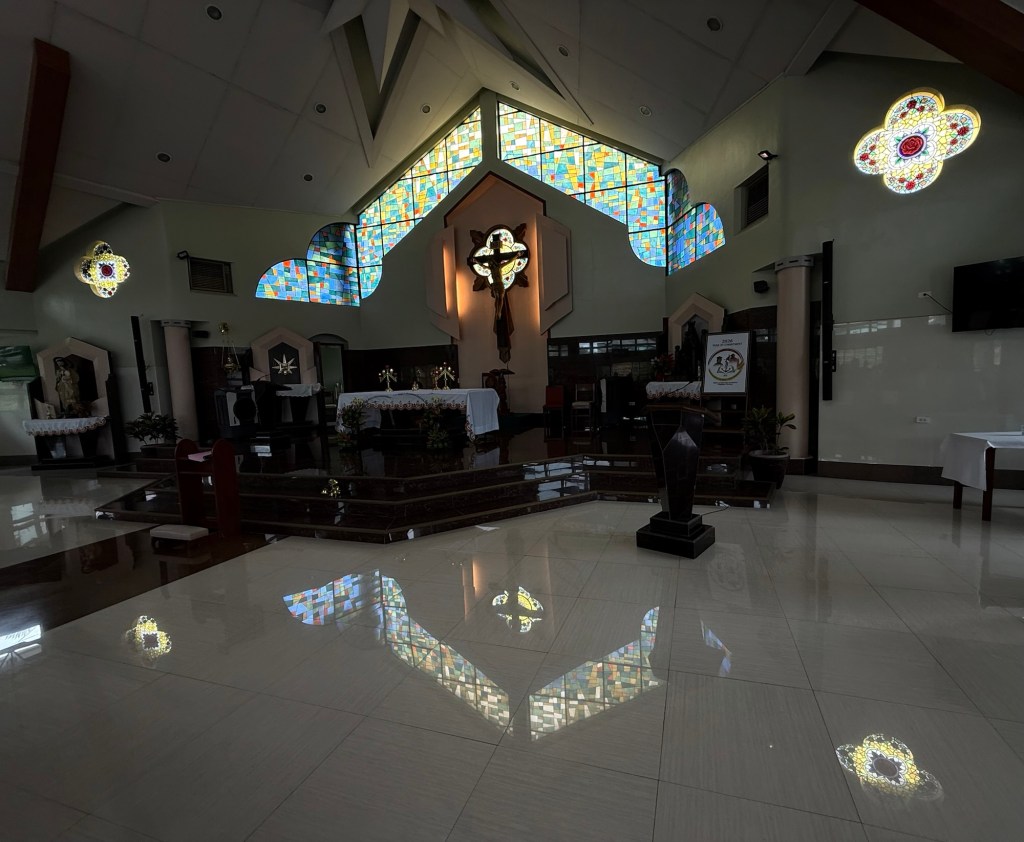
Photo by author, St. Paul Spiritual & Renewal Center, Bgy. Tanyawak, Alfonso, Cavite, 19 August 2026.
Lord My Chef Daily Recipe for Soul by Fr. Nicanor F. Lalog II
Monday, Twenty-first Week In Ordinary Time, Year II
Feast of St. Bartholomew, Apostle of the Lord
Revelation 21:9-14     <*{{{{><  +  ><}}}}*>     John 1:45-51
St. Bartholomew depicted by Michelangelo at the Sistine Chapel holding in one hand a large knife said to have been used in skinning him alive with his own skin held by his other hand. Photo from Pinterest.
Thank you,
God our loving Father
for this Monday;
though still gloomy
with forecast of more rains
like the past weeks,
we rejoice in celebrating
the Feast of St. Bartholomew,
one of the amazing Apostles
of Your Son Jesus Christ;
he died a martyr after being
skinned alive and crucified
upside down like St. Peter;
it must have been his most
glorious achievement because
after skinning him alive,
his torturers must have seen
and realized his faith was not
that skin-deep:
layers upon layers of skin
they must have found only
Jesus deeply ingrained
in his very person!
How lovely of St. Bartholomew
known earlier as Nathanael
his baring of his true self,
that first layer of our person
we often hide when he asked Philip
if anyone good could come
from Nazareth;
truly as Jesus had said,
there was no guile in him,
so unlike us with so many masks
and pretensions layered on our
person.
Philip found Nathanael and told him, “We have found the one about whom Moses wrote in the law, and also the prophets, Jesus, son of Joseph, from Nazareth.” But Nathanael said to him, “Can anything good come from Nazareth?” Philip said to him, “Come and see.” Jesus saw Nathanael coming toward him and said of him, “Here is a true child of Israel. There is no duplicity in him.” (John 1:45-47)
Photo by author, St. Paul Spiritual & Renewal Center, Bgy. Tanyawak, Alfonso, Cavite, 19 August 2026.
Everywhere in this life
there are layers of everything:
layers of clothing,
layers of skin,
layers of meaning,
and layers of faith
and knowledge of
Jesus Christ
who asked us yesterday
"who do you say
that I am?"

Teach me,
Jesus to remove that
first layer of covering
myself with masks
pretending to be somebody
else as good;
let me bare my true self
before you, free and faithful
in telling you what I feel,
what I think
like St. Bartholomew
because you see
everything beneath
our many layers of covering.
Nathanael said to him, “How do you know me?” Jesus answered and said to him, “Before Philip called you, I saw you under the fig tree.” Nathanael answered him, “Rabbi, you are the Son of God; you are the king of Israel.” (John 1:48-49)
Photo by author, St. Paul Spiritual & Renewal Center, Bgy. Tanyawak, Alfonso, Cavite, 19 August 2026.
Most of lovely of all,
dear Jesus is how you "see"
us even from afar,
especially whenever we are
"under the fig tree";
you know very well our
desire to see you too,
to find you and to dwell in you;
unless we are able to remove
our layers of duplicity
and guile,
we shall never see
your promise
"you will see the heaven opened
and the angels of God ascending
and descending on the Son of Man"
(John 1:51);
thank you,
dear Jesus
for your loving gaze upon us
despite our many sins
and brokenness;
help me to look at you too,
to see you like St. Bartholomew
as "truly the Son of God,
the King of Israel."
Amen.
Photo by author, St. Paul Spiritual & Renewal Center, Bgy. Tanyawak, Alfonso, Cavite, 19 August 2026.
Lord My Chef Sunday Recipe for Soul by Fr. Nicanor F. Lalog II
Fifteenth Sunday in Ordinary Time, Cycle A, 12 July 2026
Isaiah 55:10-11 ><}}}}*> Romans 8:18-23 ><}}}}*> Matthew 13:1-23
Photo by author, Lake of Galilee, the Holy Land, May 2019.
Matthew’s opening lines in today’s gospel present us a beautiful image of God’s abundance we often take for granted just like the parables of Jesus that remind us of our interconnectedness as brothers and sisters.
On that day, Jesus went out of the house and sat down by the sea. Such large crowds gathered around him that he got into a boat and sat down, and the whole crowd stood along the shore. And he spoke to them at length in parable, saying: “A sower went out to sow” (Matthew 13:1-3).
For the next three Sundays beginning today, all our gospel readings are taken from this 13th chapter of Matthew known as the “Discourse in Parables” that forms one whole unit of the Lord’s teachings in parables.
From the French word parabolein or “along the way”, a parable is a simple story often taken from ordinary things and events in life that offers valuable lessons about life; but, because it is a story taken from ordinary things and events, a parable is often taken for granted.
Many times we only realize later that the most profound realities in life are those found in most ordinary like God who comes to us daily in simplest ordinary things and people and events we take for granted or even refuse to recognize.
Our Filipino word for parable which is talinghaga captures this very well. From the phrase natatalinghiwaga that means “tied mystery”: tali is a rope or a tie that binds things together like mystery or hiwaga. Hence, we have talinghaga for parable that indicate how a mystery is tied with the ordinary and simple things and persons and events.
That is the purpose of Jesus in teaching us in parables: that we may learn to find the hidden truths and mysteries of life in the most ordinary things. His teaching in parables is a continuation as well as a deepening of his call to us last Sunday to “come to him and learn from him” so that we may find rest and fulfillment in him.
Photo by author, Lake of Galilee, the Holy Land, May 2019.
What I find amazing in our gospel scene this Sunday is how Jesus was by the shore of the Lake of Galilee yet, his parable is about the sower.
Why not narrate something about the life of fishermen or fish vendors?
Photo by author, Lake of Galilee, the Holy Land, May 2017.
Again, let us situate ourselves in Matthew’s opening line, “On that day, Jesus went out of the house and sat down by the sea.”
Imagine the scene, it was early morning, the sun had just risen, and people were starting to go about their usual lives when they heard Jesus teaching while seated on a boat perhaps owned by Peter. More than the parable of the sower itself, Matthew is showing us in this scene the very parable of our life that the whole world is God’s.
Every pilgrim to the Holy Land can attest to this unique beauty of the Lake of Galilee that is so lovely, so peaceful and yes, divine. It tells us of God’s superabundance in all of his creation, interconnecting us as brothers and sisters in him our Father.
This is the same parable and truth of life that God had spoken through the Prophet Isaiah in the first reading:
Thus says the Lord: Just as from the heavens the rain and snow come own and do not return there until they have watered the earth, making it fertile and fruitful, giving seed to the one who sows and bread to the one who eats, so shall my word be that goes forth from my mouth; my word shall not return to me void, but shall do my will, achieving the end for which I sent it (Isaiah 55:10-11).
Nothing happens by accident in life; God knows everything. And the good news is, he gives everything that is good like the sower. Not just the seeds but the bread we eat, the water we drink, even the very breath we breathe.
Moreover, there is the connectedness of everything in God’s superabundance like that of the rain and snow making the earth fertile and fruitful, giving seed to the sower so that there would be bread for everyone, even clothes to wear.
Painting by Van Gogh, “The Sower on Sunset” from wikipedia.org.
God is the Sower always coming to us, tending us, sowing us with seeds that are absolutely good. It does not really matter what kind of soil receives the seed that even the pathway becomes a conduit in feeding the birds of the air!
The seed is definitely good because God is good. In all instances where the seed had fallen, we find God the Sower himself moving in each step of our life. Observe how in this image of the sower moving from his home to his field, it shows us also the journey of the word and the purpose of God in our life. There is no problem with the seed that is so fecund and definitely efficacious as God had told Isaiah that “my word shall not return to me void, but shall do my will, achieving the end for which I sent it.”
If ever the word is not fruitful, it is due to our poor disposition as listeners or recipients. That is why St. Paul reminds us in the second reading of how we must responsibly be true to our call and role as disciples of Christ. It is a process we have to be patient but must be consistent. What we are working for is not just for this time or for one’s self or society or country: we have to see the whole reality of life from here to eternity in Christ’s work of salvation is for all. We are all interconnected so that whatever good we do will always bear fruit, “some a hundred or sixty or thirtyfold.”
Photo by author, St. Michael Retreat House, Antipolo City, 16 June 2026.
This Sunday, in this beautiful scene by the Lake of Galilee, or right there on your comfortable seat or wherever you are, Jesus is asking, “where do I see myself in this wide picture and chain of events?” What have I done with the “word”, the “seed” Jesus had sown in me?
In this age of relativism worsened by social media that have blurred reality with algorithms manipulating the way we see and understand truth and reality, the more we have become empty and alienated from one’s self and one another despite the abundance of material things.
How sad that despite the worldwide connections we now have, the more we have been detached from each other, even from one’s self and ultimately from God so that indeed, many of us “look but do not see and hear but do not listen or understand” (v.13) because we have taken life in the ordinary things for granted. We live in Facebook or social media where everything has to be spectacular, even “imeldific” or at least, enhanced if not AI-generated. This Sunday, let’s get real. Enough with fakes and AI’s. Amen. Have a blessed, fruitful week ahead everyone!
Lord My Chef Daily Recipe for the Soul, 25 August 2025
Monday, Twenty-first Week in Ordinary Time, Year I
1 Thessalonians 1:1-5, 8-10     <*((((>< + ><))))*>     Matthew 23:13-22
Photo from The Fatima Tribune, Red Wednesday at the Chapel of Angel of Peace, Our Lady of Fatima University, Valenzuela City, 27 November 2024.
Today I wonder,
God our Father,
what if Paul your Apostle
or Jesus Christ your Son
were to visit our church today,
what would they find out?
Would Paul be proud of us
like the Thessalonians of
his time?
We give thanks to God always for all of you, remembering you in our prayers, unceasingly calling to mind your work of faith and labor of love and endurance of hope of our Lord Jesus Christ, before our God and Father, knowing, brothers and sisters loved by God, how you were chosen… In every place your faith in God has gone forth, so that we have no need to say anything (1Thessalonians 1:2-4, 8).
Oh how I envy the Thessalonians
that Paul along with
Silvanus and Timothy
were so proud of their "faith
and labor of love
and endurance in hope";
most of all,
of their "conviction"
that he had no need
 to say anything,
as in, "walang masabi".
So beautiful!
How I wish Paul could say
the same things today to our
parish, to our community of
believers with their vibrant
faith, hope and love.
What  I dread, O Father
is when Jesus comes
and begins speaking
the same way to us
his priests and bishops:
Jesus said to the crowds and to his disciples: “Woe to you, scribes and Pharisees, you hypocrites. You lock the Kingdom of heaven before men. You do not enter yourselves, nor do you allow entrance to those trying to enter (Matthew 23:13).
Shame on us, Lord Jesus,
your priests and bishops!
If you were here today,
you would surely say the same
things to us: many of us
your priests do not pray at all
that many have forgotten to
pray properly and celebrate
liturgy meaningfully;
many would rather go on
vacation and recreation than
celebrate Mass and sacraments
for your people;
yes, Lord Jesus,
"woe to us" your servants
for many of us have no plans
of going to heaven at all with the
kind of Eucharist we celebrate
that people have lost faith
in you and your church.
Forgive us, Jesus,
your priests for being
blind fools,
following the limelight
of the world than your path
of the Cross;
lead us back to you, Jesus,
so that your flock may be
enlivened again in their
faith, hope and love
like the Thessalonians
of your great Apostle Paul.
Amen.

Fr. Nicanor F. Lalog II
Our Lady of Fatima University
Valenzuela City
(lordmychef@gmail.com)
Photo from The Fatima Tribune, Red Wednesday at the Chapel of Angel of Peace, Our Lady of Fatima University, Valenzuela City, 27 November 2024.
The Lord Is My Chef Daily Recipe for the Soul by Fr. Nicanor F. Lalog II
Wednesday in the Twenty-seventh Week of Ordinary Time, Year II, 09 October 2024
Galatians 2:1-2, 7-14     ><]]]]'>  +  <'[[[[><     Luke 11:1-4
Photo by author, Sacred Heart Novitiate, Novaliches, QC, 2017.
And when Cephas came to Antioch, I opposed him to his face because he clearly was wrong… (Galatians 2:11).
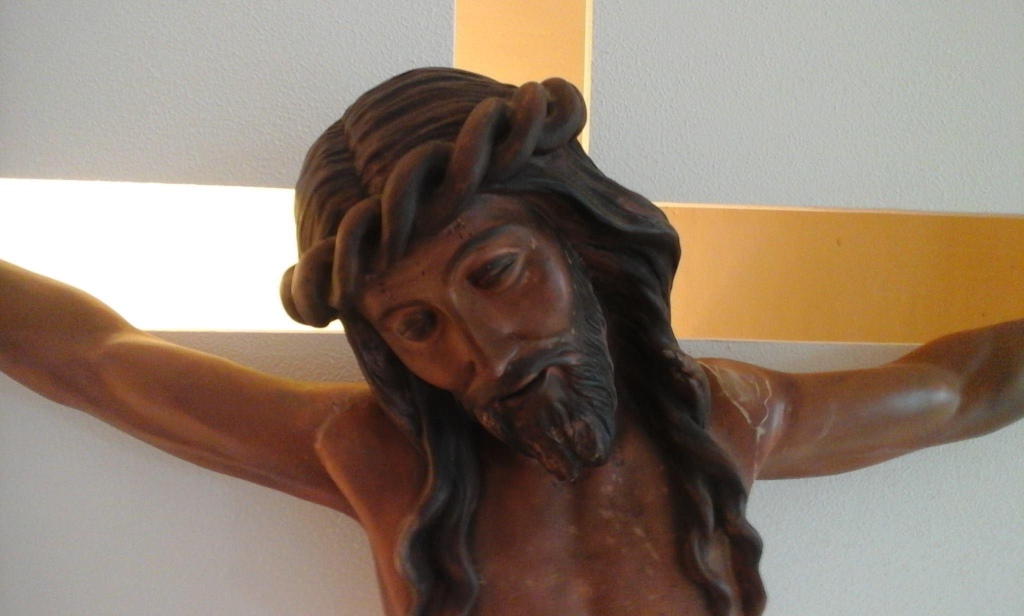
For so long, I have always wondered how You look like, Lord Jesus, of what or how your face looks like really; your face deeply in pain on the Cross has always been the face I have known when thinking of You; how I wished I could see your face moved with pity with that widow of Nain or how your face looked full of love to the rich young man whose face fell after You asked him to sell his belongings, share them to the poor and follow you.
St. Paul's account of
"opposing Cephas to his face"
invites me today
to see face
in a more deeper sense than
something physical;
as I immersed into the scene,
I could sense and picture
the courage and sincerity
on St. Paul's face in telling
St. Peter into his face
his double standards
in dealing with early Christians,
that is, of having two faces:
one with Jewish converts
and another with Gentile converts!
The lithography of Sts. Peter and Paul in Missale Romanum by unknown artist with initials F.M.S (19. cent.) printed by Typis Friderici Pustet. (Renáta Sedmáková | us.fotolia.com)
How sad,
dear Jesus,
that until now,
we your disciples
are like St. Peter before:
many of us are not only double-faced
but even multiple-faced with
one another, never our true selves
at all!
Worst, many of us can't even
show our true face as we put on masks
that literally in Greek are called
hypokritein --- hypocrites!
Teach us, Lord Jesus,
how to pray,
that is,
to be single-faced in our prayers:
to face up before our Father
as His children
forgiving each other's debts,
living as brothers and sisters;
teach us, Lord Jesus,
to face up our prayers,
of living out what we pray
not with many faces
nor with masks on our face;
teach us, Lord Jesus,
to face You more often
in prayers to transform our face
into your face that is truly
an image and likeness
of God,
radiating with your loving presence.
Amen.
Photo by author, CAS Chapel, Our Lady of Fatima University, August 2023.
The Lord Is My Chef Sunday Recipe for the Soul by Fr. Nicanor F. Lalog II
Twenty-Second Sunday in Ordinary Time, Cycle B, 01 September 2024
Deuteronomy 4:1-2, 6-8 ><}}}*> James 1;17-18, 21-22, 27 ><}}}*> Mark 7:1-8, 14-15, 21-23
Photo by author, Sacred Heart Novitiate, Novaliches, QC, 20 March 2024.
After five Sundays of journeying with John, we now return to Mark’s Gospel and shall continue to read it through the 33rd Sunday before we cap the current liturgical calendar with the Solemnity of Christ the King on November 24, 2024.
Oh yes! It’s beginning to feel like Christmas but the liturgy cautions us this Sunday through Mark that there are still many things we have to fix and cleanse in our hearts in the remaining stretch of the year, particularly our motivations in doing things. After dwelling on the “bread of life discourse” from John for five Sundays that gave us time to examine our faith, Mark brings us now to the other side of the lake in Gennesaret to listen to a discussion about the Jewish customs and traditions of ritual cleansing and washing in chapter seven.
When the Pharisees with some scribes who had come from Jerusalem gathered around Jesus, they observed that some of his disciples ate their meals with unclean, that is, unwashed, hands. For the Pharisees and, in fact, all Jews, do not eat without carefully washing their hands, keeping the tradition of the elders. So the Pharisees and scribes questioned him, “Why do your disciples not follow tradition of the elders but instead eat a meal with unclean hands?” He responded, “Well did Isaiah prophesy about you hypocrites, as it is written: This people honors me with their lips, but their hearts are far from me; in vain do they worship me, teaching as doctrines human precepts. You disregard God’s commandment but cling to human tradition” (Mark 7:1-3, 5-8).
Photo by author, St. Scholastica Spirituality Center, Tagaytay City, 20 August 2024.
It is easy to see in this scene how Mark must have tried to explain the many Jewish rituals and traditions that was a source of clashes among Jewish and pagan converts to Christianity in the early Church like circumcision and of eating of meat offered to gods. These were finally resolved in the Council of Jerusalem in year 50 when the Apostles acted upon instructions by the Holy Spirit “not to place on the pagan converts any burden beyond these necessities” (Acts 15:28).
However, it is unfair and a misreading to limit ourselves to this as a lesson in history because the practices criticized in this scene continue among us when we focus on the externalities of any ritual and tradition while missing their more essential and deeper meanings. Worst of all is the strong temptation among us to believe that by our actions and good deeds, like the Pharisees and scribes of that time, we make ourselves worthy of God or of anyone!
That is why Christ’s teaching in this Sunday gospel on the hypocrisy of the Pharisees and scribes of that time refers also for us today.
From Facebook, 29 August 2024.
From the halls of Congress to our own homes, classrooms and offices, pulpits and parish halls, we find many of us acting like the Pharisees and scribes who have come from Jerusalem to test and intimidate Jesus through people around us and under us by flexing their muscles in insisting strict adherence to their rituals and traditions that were passed on from Moses we have heard in the first reading. Observe how the Pharisees and scribes capitalized on these as “tradition of the elders” without really going into its very core and essence because they have forgotten or were totally unaware of Moses’ reminder that faithful observance of the Law and its tradition and rituals is a form of witnessing to God before all the peoples.
Observe them carefully, for thus you will give evidence of your wisdom and intelligence to the nations, who will hear of all these statues and say, “This great nation is truly wise and intelligent people. For what great nation is there that has gods so close to it as the Lord our God, it is to whenever we call upon him? Or what great nation has statutes and decrees that are as just as this whole law which I am setting before you today?” (Deuteronomy 4:6-8)
Photo by author, St. Scholastica Spirituality Center, Tagaytay City, 20 August 2024.
Every adherence and compliance to the Laws, to its accompanying rites and rituals must come from the heart, a result of the conversion of heart, of purification of one’s heart, especially the celebration of the liturgy we refer to as “the summit and font of our Christian life”. Every Mass celebration is an outflowing of what is in our hearts, beginning with the priest as celebrant.
But, what is the reality we have? As we concluded last Sunday Jesus Christ’s “bread of life discourse”, we realized the “shocking truths” of so many Catholics who have totally stopped coming to Sunday Masses, of some priests not giving the proper respect in prayerfully celebrating the Eucharist and the other Sacraments, and of most faithfuls just simply coming without seriously taking part in the Mass. That is why this gospel scene applies to us this time too as Jesus asks us, do we understand the things we are doing in the Church? What is in our hearts in doing these?
He summoned the crowd again and said to them, “Hear me, all of you, and understand. Nothing that enters one from outside can defile that person; but the things that come out from within are what defile. “From within people, from their hearts, come evil thoughts, unchastity, theft, murder, adultery, greed, malice, deceit, licentiousness, envy, blasphemy, arrogance, folly. All these evils come from within and they defile” (Mark 7:14-15, 21-23).
Photo by author, St. Scholastica Spirituality Center, Tagaytay City, 20 August 2024.
This Sunday, Jesus is inviting us to a new perspective at looking at things, not just from what is clean and not clean, or simply what is good and evil, what is traditional and modern; Jesus wants us to examine our motivations, of what is in our hearts in doing things, anything and everything.
Ultimately, it is a question of who is in our heart, Jesus or somebody else or another thing?
It is reality versus hypocrisy. Reality is the truth and meaning that things, events, persons, most of all, of our very selves have before God and for God. It is in this reality that we must scrutinize to strip ourselves naked of the hidden hypocrisies, the many masks and alibis we use to justify our selves.
Photo by author, 13 August 2024.
I have something to confess to you, my dear followers: I have been sick these past three weeks with different ailments. All my lab tests were good. Doctors find nothing wrong with my body with everything normal.
Last Tuesday I saw my longtime doctor for my scheduled check-up. As I explained everything to her, I broke down in tears as I admitted the fact I am in denial stage of my mom’s passing last May. I have repressed my griefs, trying to fill in the void within me with workloads as if I am still young that finally, it manifested in my body. That same Tuesday evening, I dreamt of my mom: she looked younger and healthier without signs of stroke but she wore a black dress and looked to have cried. I hugged her tightly in my dream, we cried together as I said sorry to her, promising that I would finally come home even if it hurts me to see her room empty.
Two days after that, we celebrated John the Baptist’s passion with a reading from Mark telling us of the “grudge” Herodias had on him that led to his beheading. Many times, grudges and other negative things that Jesus cited in today’s gospel not only cover us but actually destroy us, eating us up in the process. The festering negativities in our hearts cannot be hidden, eventually erupting like blisters, not only hurting others around us but most especially us.
In the Mass, Jesus knows very well we are not worthy with our hypocrisies to receive Him but only say the word, we are healed. And blessed to cleanse ourselves. Let us pray:
God our loving Father,
"all good giving and every perfect gift
is from You with whom there is no
alteration or shadow caused by change";
empty our hearts of pride and evil
to welcome Jesus your Word
who became flesh to dwell inside us
so that we may be "doers of the word
not just hearers" (James 1:17, 22)
by being more loving to others
without any strings attached.
Amen.