The Lord Is My Chef Breakfast Recipe for the Soul by Fr. Nicanor F. Lalog II
Monday, Feast of the Exaltation of the Cross, 14 September 2020
Number 21:4-9   >><)))*>   Philippians 2:6-11   >><)))*>   John 3:13-17
Photo by author, Lent 2019.
Thank you very much, God our loving Father, for this Feast of the Exaltation of the Cross of your Son Jesus Christ. Please increase our patience lest we complain like your people at the desert to Moses.
With their patience worn out by the journey, the people complained against God and Moses, “Why have you brought us up from Egypt to die in this desert, where there is no food or water? We are disgusted with this wretched food!
Numbers 21:4-5
You know, dear God, how we feel right now after seven months of journey in the pandemic: we are tired and exhausted, wearied and anxious, most of all, afraid of how things can go worst specially with the incompetence of our government officials.
Please, grant us patience to continue with the journey but allow us too to complain from our hearts, to cry out our pains and fears to you because it is only you who can help us in our situation. Most of all, let us complain from our hearts as an expression of faith and hope in you, Lord.
We are convinced of your love and presence but sometimes we are overwhelmed by the sufferings and difficulties on this period of the pandemic that we think more of ourselves, of our well-being that we forget you are our companion in the journey.
We fail and even refuse to see you in this journey as we complain from our minds, when we are filled with pride, believing in our ourselves that we question you, when we dare you, when we think of ways of manipulating you in our favor.
Open our eyes to see again on this feast and celebrate how you have transformed the worst signs of death and torture in history to be the doorway to life and healing like snakes becoming medicines to snake bites and the cross becoming the sign of love.
Open our minds that instead of complaining of the death of Jesus Christ, we celebrate his resurrection and glory in heaven. Instead of dwelling on pain and suffering, we focus more on healing and salvation.
May we keep in our minds that taking the form of a slave, of carrying our crosses leads to your exaltation, our loving and merciful Father. Amen.
Photo by author of Brazen Serpent Monument on Mt. Nebo inside the Franciscan Monastery in Jordan, May 2019.
The Lord Is My Chef Breakfast Recipe for the Soul by Fr. Nicanor F. Lalog II
First Friday, Week XXII, Year II in Ordinary Time, 04 September 2020
1 Corintians 4:1-5 /// Luke 5:1-11
Photo by author, Lent in our parish 2020.
Dearest Jesus Christ:
Your words today through St. Paul are very edifying but also demanding, even scary and frightening.
But, I would rather have it that way than get them into my head.
Brothers and sisters: Thus should one regard us: as servants of Christ and stewards of the mysteries of God. Now it is of course required of stewards that they be found trustworthy.
1 Corinthians 4:1-2
Yes, it is an honor to be chosen as your servant, Lord, and a steward of the mysteries of God.
It is so pleasant to the ears and so flattering to one’s self to be a steward of the mysteries of God, of his wisdom – of Jesus Christ crucified.
Keep me lowly and humble, Lord. Remind me always that everything is about you and never about me. Keep me faithful to you and your call that whatever others may say about me, let me be concerned solely with your words and with your judgment. At the same time, keep me silent too, never to brag of my mission and most of all, never to judge others for that resides in God alone.
Keep my mind and my heart open to you always, Lord, so I may always be like a fresh wineskin to be poured on with new wine to mature and grow spiritually in you. Amen.
Maybe you have been asked so many times with the question, which do you prefer to hear first, the good news or the bad news? Usually we say it all depends to our mood and temperament or to the gravity of the situation. Sometimes, we ask for the bad news first so we can suffer earlier and enjoy the good news later. Or, we ask for the good news first to soften the impact of the bad news.
Our gospel this Sunday is still set in the pagan city of Caesarea Philippi and we heard Jesus giving his disciples – including us – with a strong dosage of “bad news” after hearing last week the good news that he is “the Christ, the Son of the living God.”
Jesus began to show his disciples that he must go to Jerusalem and suffer greatly from the elders, the chief priests, and the scribes, and be killed and on the third day be raised. Then Peter took Jesus aside and began to rebuke him, “God forbid, Lord! No such thing shall ever happen to you.” He turned and said to Peter, “Get behind me, Satan! You are obstacle to me. You are thinking not as God does, but as human beings do.” Then Jesus said to his disciples, “Whoever wishes to come after me must deny himself, take up his cross, and follow me. For whoever wishes to save his life will lose it, but whoever loses his life for my sake will find it.”
Matthew 16:21-25
Our gospel today seems to be a very big, bad news for everyone, with things getting worst before getting any better which the Lord had promised to be only in the end that nobody knows when!
See how Jesus started by saying he would “suffer greatly at the hands of elders, the chief priests, and the scribes and be killed and on the third day be raised again.” Not only that: he now calls Peter as “Satan” from being the Rock last Sunday after giving the right answer as to who he is.
Like Peter, we would probably say the same thing to Jesus why make suffering and death central to life that is meant to enjoy?
Like Peter, the Lord is inviting us today to focus more on the good news than on the bad news of suffering and death which for him – the Paschal mystery we call – is actually the best of good news!
Photo by author, altar flowers in our parish, January 2020.
Jesus Christ’s pasch is the best of good news!
What we have heard as “bad news” from the Lord is his first prediction of his coming pasch or Passion, Death and Resurrection. He would be announcing this prediction of his pasch two more times as they near Jerusalem.
From the He brew word pesach that means to pass over, it connotes suffering and death into new life. It came from the Exodus experience of the Chosen People from Egypt into the Promised Land during the time of Moses, taking its fullest meaning in Jesus Christ, the Son of God who became human like us in everything except sin, “passing over” from eternity to temporal, from Passion and Death to Resurrection.
Authentic discipleship does not require us to seek suffering; no, God is not sadistic as some people with twisted minds would say. However, being faithful to Jesus, witnessing his gospel values bring enough of these sufferings and deaths but on a different level and meaning. We realize that life is a daily exodus, a passing over from darkness into light, from ignorance into wisdom, from sickness into health, from death into new life.
Like the prophet Jeremiah in the first reading, we discover that the more we follow God, the more sufferings we encounter in life but at the same time, we cannot let go of him because his attraction is so powerful! There is something so deep within, so profound and fulfilling in us we realize that living in the ways of God, in the gospel values of Christ can we truly find lasting joy and peace – even if we have to die in our very selves in the process.
You duped me, O Lord, and I let myself be duped; you were too strong for me, and you triumphed. all the day I am an object of laughter; everyone mocks me… But then it becomes like fire burning in my heart, imprisoned in my bones; I grow weary holding it in, I cannot endure it.
Jeremiah 20:7, 9
Photo by author, Gaudete Sunday in our parish, December 2019.
Thinking in God’s ways
Today Jesus is assuring us that there is no such thing as “good news, bad news” with him. The good news/bad news question is really a non-question to disciples of Christ because whatever suffering and death we embrace in him is a sharing in his very life.
Hence, Jesus Christ’s good news is in fact the bestest news we can ever have. Always.
The key is to think as God does, not as human beings do as Jesus pointed out to Peter.
Three things I wish to share with you about thinking in God’s ways:
First is to accept and embrace pains and sufferings not for their own sake but as a way to cleanse our selves to greater glory. As we have said, God is not a sadist; we need to be cleansed like every thing in order to bring out the best in us like diamonds or any precious stone or any material.
Polishing and honing always mean “subtractions” with so many shaving and cutting of the rough edges to bring out the beauty and sharpness of a thing.
Man’s ways has always been to avoid every pain and suffering. No wonder, the most prescribed medicine worldwide is said to be the pain killer. But, experience has taught us this is not true and cannot be the norm of life. Like every gym enthusiast would tell you, “no pain, no gain”. Pain and suffering is part of life and the good news is, Christ has made it holy for us.
Second is to be silent in order to be able to listen to every sound and thus, heighten our sensitivities not only with our true selves but also with God and with others. In this age of social media and instant communications, silent has become a rare commodity. It is always easier to speak even without thinking much than be silent. That is the way of the world: speak out loud, make noises, and let everyone hear you — until they get tired of you.
Photo by author, our parish ceiling at sunset, 25 August 2020.
Third is the most precious in God’s ways of thinking — the way of hiddenness. This is God’s most evident way of making himself felt, experienced, and yes, seen by being hidden and invisible.
Last Thursday we celebrated the memorial of St. Monica, the mother of St. Augustine who narrated the story of how she got sick at Ostia in Italy with his brother hurrying to get back home to Tagaste in Africa so that when she dies, she would be buried there. St. Monica “reproached him with a glance because he had entertained such earthly thoughts”; then, she looked at St. Augustine and told him to bury her anywhere, asking one thing only from him: that he remembers her always in his celebration of the Holy Mass.
So many times, we are so concerned with our popularity that whatever we do has to be made known to everyone to see specially by those so-called “followers” with their “likes” that even up to death, some would spend a fortune for lavish funerals and even mauseleoum.
That’s the way of the world of everybody making a statement, of being known as present, always seen. In the movie “The Devil’s Advocate”, Al Pacino played the role of satan who said it so well at the end after tempting Keanu Reeves, “vanity…vanity is my most favorite sin.”
See the life of Jesus Christ: more than half was spend in hiddenness and silence. He worked only for three years characterized by so many instances of silence and hiddenness too and yet, his impact continues to this day and hereafter.
Beginning with last Sunday after asking us who do we say he is, Jesus is inviting us to follow him in his Passion and Death to be one in his Resurrection. This is also the call by St. Paul in the second reading:
I urge you, brothers and sisters, by the mercies of God, to offer your bodies as a living sacrifice, holy and pleasing to God, your spiritual worship. Do not conform yourselves to this age but be transformed by the renewal of your mind, that you may discern what is the will of God, what is good and pleasing and perfect.
Romans 12:1-2
Jesus is not asking too much from us, no need for any fanfares on our part; simply come to him with our true self, no matter how sinful and incomplete we are. Remember, all is good news with him and you never lose in him. Amen.
A blessed week to everyone!
Photo by author, parish ceiling at sunset, 25 August 2020.
“The Beheading of St. John the Baptist” by Pierre Puvis de Chavannes (1869) from WikiArt.org.
Immediately after our Mass for the Passion of John the Baptist this morning, Lord, I am leaving for the celebration of funeral Mass for a very kind woman I have known since high school seminary, Dra. Nenita San Diego who succumbed to COVID-19 three weeks ago.
Yesterday after praying the Holy Rosary, another parishioner passed away, more than a month after I have visited her on her birthday to anoint her with oil for the sick and receive the Holy Viaticum. I was told it was a peaceful death, so true to her name which is “Puring”, from “Purita” for “pure”.
I am not complaining, Lord, but, what is with death – with “Christian death” – that we “celebrate” it, be it for the martyrdom of saints or the demise of ordinary mortals like us?
Thank you for the experience, Lord.
In this time of pandemic when death comes easily almost daily, we are not only reminded of our mortality but most of all, our eternity and victory in Jesus Christ, making every death an image of hope in you.
John the Baptist stood and died speaking for what is true because he had hope in Jesus Christ, the truth, the way and the life.
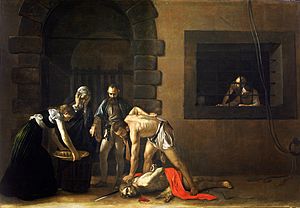
Caravaggio’s painting of the beheading of John the Baptist. From wikimedia.org.
So many people like him are suffering today, refusing to give in to the pressures and whims of modern Herods among us because they believe in you that they stand for what is true.
O good Jesus, we pray for those suffering for truth and for life like John the Baptist in this time of pandemic; bless them and keep them always for they remind us like your precursor that you have come, that you are among us.
Keep our hopes vibrant and alive in you and to a more just tomorrow, Lord, so that we may persevere in speaking your words of truth no matter what others would say. Amen.
The Lord Is My Chef Breakfast Recipe for the Soul by Fr. Nicanor F. Lalog II
Monday, Feast of St. Bartholomew, Apostle, 24 August 2020
Revelation 21:9-14 >><}}}*> |+| >><}}}*> |+| >><}}}*> John 1:45-51
Photo by author, Subic, 2018.
Glory and praise to you, Lord Jesus, the “Word who became flesh and dwelt among us” to reveal the Father’s immense love for us all. He was not contented in just telling the prophets of Old Testament how he loved us that He came and lived with us in you, Lord Jesus!
And that is why we also rejoice on this Feast of St. Bartholomew, a.k.a. Nathanael, who was introduced to you by another Apostle you have called earlier:
Philip found Nathanael and told him, “We have found the one about whom Moses wrote in the law, and also the prophets, Jesus, son of Joseph, from Nazareth.” But Nathanael said to him, “Can anything good come from Nazareth?” Philip said to him, “Come and see.” Jesus saw Nathanael coming toward him and said of him, “Here is a true child of Israel. There is no duplicity in him.” Nathanael said to him, “How did you know me?” Jesus answered and said to him, “Before Philip called you, I saw you under the fig tree.” Nathanael answered him, “Rabbi, you are the Son of God; you are the King of Israel.”
John 1:45-49
O dear Jesus, like St. Peter in the gospel yesterday and now St. Bartholomew, you are telling us anew to never be contented with mere words, with the “what” of who you really are, that we must always “come and see you” in order to experience your very person and truly know you.
I really wonder O Lord what your words meant that before Philip called Nathanael-Batholomew, you have seen him under the fig tree; however, I am so convinced that in your words, Nathanael-Bartholomew must have felt something deep inside him that he threw himself totally to you as your Apostle.
Most of all, teach me to remain simple and hidden in you, Jesus that like St. Bartholomew, despite the scarcity of stories and information about him except this little anecdote from the fourth Gospel, he remained faithful to you until his death by flaying reportedly in India.
May we imitate St. Bartholomew who had shown us that more than words, what matters is our oneness in you, Jesus, without any need for us doing sensational deeds, earning thousands of “likes” and “followers” in social media because only you, Lord, remains extraordinary above all. Amen.
The Lord Is My Chef Sunday Recipe for the Soul by Fr. Nicanor F. Lalog II
Week XIX, Cycle A in Ordinary Time, 09 August 2020
1 Kings 19:9, 11-13 >><}}}*> Romans 9:1-5 >><}}}*> Matthew 14:22-33
Photo by Mr. Raffy Tima of GMA-7 News, Batanes, 2018.
I have always loved the sea and lately my thoughts have always been about the beach as I miss it so much after COVID-19 had robbed us of our summer vacation.
In ancient time, the sea evoked fear because it was largely unknown that even in the bible, it is the symbol of evil and its powers over man. That is why our gospel today is very significant when Jesus walked on water to show God’s greater power over evil and sin.
And like our gospel last week, our story today tells us a lot more about Jesus walking on water in the midst of a storm to reveal himself and most of all, his desire to meet us his disciples.
Place and location as non-verbal communication of one’s presence
Every meeting and encounter presupposes locations or places, a locus; but, everything is “levelled up” or elevated in Jesus in whom things do not remain in the physical level.
Proxemics is the non-verbal communication that refers to places and location, its nearness and orientation. How we arrange our furnitures, designate the rooms and sections in our homes, offices, schools and every building we stay and gather communicate and reveal who we are.
For example, Catholic homes are easily identified in having a grotto at the garden, an altar of the Sacred Heart or any saint at the sala, and the Last Supper painting in the dining hall.
But for Jesus, a place or a location is more than the physical site because in him, proxemics takes on a deeper dimension and higher meaning when we meet him in situations and places. That is why after feeding the more than five thousand people last week, he ordered the Twelve to cross the Sea of Galilee (which is actually a lake) ahead of him while he dismissed the crowds.
After doing so, he went up on the mountain by himself to pray. When it was evening he was there alone. Meanwhile the boat, already a few miles offshore, was being tossed about by the waves, for the wind was against it. during the fourth watch of the night, he came toward them, walking on the sea. When the disciples saw him walking on the sea they were terrified. “It is a ghost,” they said, and they cried out in fear. At once Jesus spoke to them, “Take courage, it is I; do not be afraid.”
Matthew 14:23-27
Photo by author, Sea of Galilee at Capernaum where Jesus used to preach, May 2019.
Crossing to Jesus, crossing with Jesus
I love that scene very much, of Jesus getting his disciples into the boat to precede him to the other side of the lake while he dismissed the crowds. Again, St. Matthew never bothered to tell us why Jesus sent the Twelve ahead of him as he stayed behind, dismissing the crowds and later praying alone at night atop the mountain.
Let us now reflect the proxemics or non-verbal communication of our gospel scene this Sunday.
We need to cross to the other side to meet Jesus.
To meet Jesus Christ, we always have to “cross to the other side” by leaving our “comfort zones”.
More than going to the other side of the lake physically, we have to move over to unchartered areas of life, be bold and daring to try new things, new situations in order to mature and find fulfillment by meeting Jesus Christ.
And sometimes, we really have to literally cross the sea or get to the other side of the country or the world to find our self and meet Christ.
Fifteen years ago I went on vacation to Toronto for some soul-searching as I went through a burn-out. While serving at St. Clement Parish, I met many Filipinos serving as lectors, choir members, catechists and volunteers.
Graph shared by sugarindustryfoundationinc.org.ph.
They would always confess to me with both a sense of pride and little shame that they never went to Mass regularly when in the Philippines and now in Canada, they were amazed at how God had brought them there to be involved in parish activities and be closer to Jesus than ever!
As I listened to their stories, I realized the many sacrifices and hardships they have to endure in that vast and cold country with no one to turn to except God. If given the chance, many of them admitted they would return to the Philippines for there is no place like home!
Though I have found so many things I have been searching for in my initial three months of stay there on top of other opportunities given me, I still felt empty. That raging storm within continued. As I prayed and reflected guided by an old, Polish priest who claimed to have been the student of St. John Paul II, I saw myself more, eventually leading me to God anew who refreshed my vocation that I finally decided to go back home after six months of my supposed to be one year leave.
Sometimes in life, we need to get away from our comfort zone, cross to the other side, especially when life becomes so artificial. Jesus invites us to go ahead and cross to the other side of the lake or sea to experience life at its “raw” so we can feel again our souls within and desire him anew until we finally meet him wherever we may be in the world.
It is when we are at the other side of the sea in the midst of a storm when Jesus comes, immediately answering our cries for help – At once Jesus spoke to them, “Take courage; it is I” – because when we are reduced to emptiness and nothingness, then our faith kickstarts again. Faith, like love, is always an encounter with God.
Try going to the other side, leave your comfort zone to meet Jesus and finally have meaning and direction in life!
Silence is the presence of God.
In the first reading we have heard that beautiful story of Elijah meeting God at the mouth of a cave — not in the strong and heavy wind nor earthquake nor fire like Moses before him.
After the fire, there was a tiny whispering sound. When he heard this, Elijah hid his face in his cloak and went and stood at the entrance of the cave.
1 Kings 19:12-13
Silence is the place of the presence of God because silence is his language too. Wherever there is silence, we can surely find and meet God there.
That is why Jesus wants us to cross to the other side, to be silent and listen to him.
Photo by author, crossing the Lake of Galilee, May 2019.
In his silence, God teaches us that except for sin, he never considers everything as being finished; everything is a “work-in-progress” even if he seems to be silent that some think he must be absent or even dead.
The world thrives in noise, loud talks, and screams with each voice trying to dominate another resulting in cacophony of sounds. Shakespeare’s Hamlet said it well when he told Polonius what he was reading were “Words, words, words” — nonsense!
Some people like those in power think that the more words they say, the more meaningful their thoughts and ideas become. Worst, they thought that using foul and filthy language make them so natural and credible, not realizing the more they look stupid with their crazy thoughts and ideas not even clowns and comedians would ever attempt to imitate.
But when our words come from deep silence, they come with power and meaning, touching everyone’s heart and inner core.
That is when silence becomes fullness, not emptiness or mere lack of noise and sound.
Like when our medical frontliners and medical experts spoke with one voice last week airing their thoughts about the pandemic — we were all moved and reawakened to realize how we have been going about with our lives almost forgetting them these past five months!
What a tragedy at how our officials in government and Congress reacted negatively, feeling hurt deep inside with the painful truth of how they have been irresponsible from the beginning. Sapul!
Pico Iyer wrote in a TIME magazine essay 30 years ago that “silence is the domain of trust”.
True. The most trustful people are the most silent; those who speak a lot trust no one and most likely, cannot be trusted too.
Jesus invites us to cross to the other side to be silent and learn to trust him. It is only then when we can meet him. In silence.
Photo by Mr. Raffy Tima of GMA-7 News, Manila Bay with Mt. Samat’s Cross at the background, April 2020.
Jesus meets us in darkness.
Jesus asks us to cross to the other side of the lake or sea like his disciples in order to meet us in darkness. This is a paradox because Jesus is the light of the world.
But, note the most notable moments in his life happened in darkness: he was born on the darkest night of the year, he died when darkness covered the whole city of Jerusalem, and he rose from the dead when it was still dark on the first day of the week.
Jesus had overcome darkness! So, what happened to Peter in this episode after being called by Jesus to walk on water too?
Jesus said, “Come.” Peter got out of the boat and began to walk on the water toward Jesus. But when he saw how strong the wind was he became frightened; and, beginning to sink, he cried out, “Lord, save me!”
Matthew 14:29-30
Imagine how everything was going so well with Peter doing another crossing while crossing the lake! But when he saw how strong the wind was he became frightened; and, beginning to sink, he cried out, “Lord, save me!”
Jesus calls us into the dark so that we only look for him and upon finding him, focus on him alone. Peter saw the strong wind, not the stronger and powerful Jesus walking on water, that fear overtook him.
That’s the whole point of St. Paul in our second reading today: he was telling the Romans how some people in Israel trusted more in their physical descent from Abraham than in God’s promise of salvation fulfilled in Jesus they have refused to see and recognize as the Christ (Rom.9:1-5).
When in the dark, be silent and still for Jesus is near! Keep your sights at him, not on anything else. Problem in darkness is not God but us who follow other lights or have become delusional.
Photo by Mr. Jim Marpa, 2019.
That is the tragedy we are into as a nation while crossing to the other side of the sea of pandemic in just one boat when our officials see only themselves as always being right. Worst, they all want to be on the stage with all the lights on them as they speak and sing in cacophony like psychopaths.
All the more we must hold on tight, trust and focus in Jesus who is “now here”, not “nowhere” for he will never allow us to perish.
Let us trust Jesus overcoming all these evil, leading us to the shore. Amen.
A blessed rainy Sunday to you and your loved ones!
The Lord Is My Chef Breakfast Recipe for the Soul by Fr. Nicanor F. Lalog II
Wednesday, Memorial of the Dedication of St. Mary Major in Rome, 05 August 2020
Jeremiah 31:1-7 <*(((><< | + | >><)))*> Matthew 15:21-28
Photo by Arch. Philip Santiago, St. Mary Major in Rome, 2018.
O God our almighty Father, in all eternity you have planned what is best for each of us and we thank you so much for that for your great wisdom matched with your immense love for us.
Unfortunately, we always run away from you, discarding your plans for our own personal plans that most often do not work because these are based on what we want, what we like and not of what is really best for us.
Help us to seek your plans for us, Lord, by remaining in you, trusting you because you know what is best for us being our Maker.
Open our selves to you to redeem us from our disgrace and infirmities by seeking your plans in rebuilding our lives like your so-called “remnants of Israel” in the first reading – the few who have remained faithful to you despite the turning away from you of majority of Israelites who chose to worship false gods in the time of Jeremiah.
And ironically, to be like that Canaanite woman at the region of Tyre and Sidon – though a pagan – who remained faithful to you waiting for the Christ to come by holding on to your plans, hoping in your plans, and finally realizing your plans of healing and salvation in Jesus!
Grant us the perseverance and love to seek, believe in your plans for us like the Blessed Virgin Mary as we celebrate today the Memorial of the Dedication of St. Mary Major in Rome, one of our four Major Churches and first Marian shrine in the whole Christendom.
How lovely it is, O God, that you literally laid out your plans for this Basilica when the Virgin Mary appeared in a dream to a faithful Christian couple as well as Pope Liberius in the year 358 to build a church in her honor on the site where snow would fall on the night of August 4-5.
And you did make snow to fall on that night, forcing Pope Liberius to trace the outlines of the church on the snow where the first basilica was built!
But, it was only the beginning of the unfolding of your plans: the Basilica of St. Mary Major was completed a century later after the Council of Ephesus in 431 where Mary was declared the Mother of God, thus clarifying all doubts on the divinity of your Son Jesus Christ who had come to save us.
May we pause for some moments of silence today to pray and seek your plans for us specially in this time of the pandemic. We pray harder for our leaders in government for humility and honesty in seeking you, O God, to draw a specific plan that is clear and workable to contain the spread of the COVID-19 virus.
This we ask in Jesus Christ’s name, in the power of the Holy Spirit with Mary our Mother. Amen.
Photo by author of a pilgrim writing a petition to the Blessed Mother in a Marian shrine in Madaba, Jordan, 2019.
The Lord Is My Chef Breakfast Recipe for the Soul by fr. Nicanor F. Lalog II
Monday, Week XVII, Year II in Ordinary Time, 27 July 2020
Jeremiah 13:1-11 >><)))*> >>><)))*> >><)))*> Matthew 13:31-35
Photo from Google.
What a great way to start our last week of work and studies in July with your sense of humor, O God! Your words are so witty and funny but with a strong punch. Hard-hitting, so biting. And so revealing.
For, as close as the loincloth clings to a man’s loins, so I had made the whole house of Israel and the whole house of Judah cling to me, says the Lord; to be my people, my renown, my praise, my beauty. But they did not listen.
Jeremiah 13:11
You really got me, Lord.
What can I say?
Our underwear, that is, the loincloth of Jeremiah’s time, is our most intimate clothing, always in contact with our very selves, in that part of our body that we always guard and keep to ourselves.
But, what happens when we “dirty” ourselves with sins, when we put on all those filth in ourselves, we also feel the same way inside, no matter how clean and crisp our clothes are but when deep down our loincloth – underwear – is rotted and good for nothing?
We can always hide it from others and they will never know the kind of underwear we have but we cannot deceive ourselves of how dirty we are with sins and evil.
And so far from you, O God.
Forgive us when you are supposed to be the closest to us, the one we are always in contact with but we have totally disregarded because of our many sins, when we thought we can always have our own ways without you, denying the fact it simply cannot be for indeed, you have made us to be that closest to you.
Forgive us in your Son and our Lord Jesus Christ. Renew us inside, cleanse us and refresh us to be in close contact with you again, O God.
Help us to remain good and clean inside like the little mustard seed so we may grow to have leafy branches for birds to come and dwell in us.
In your mercy, cleanse us of our sins and be our yeast to mix with us again to leaven into a dough to make your kingdom come here on earth. Amen.
The Lord Is My Chef Breakfast Recipe for the Soul by Fr. Nicanor F. Lalog II
Thursday, Memorial of Our Lady of Mount Carmel, 16 July 2020
Isaiah 26:7-9, 11, 16-19 >><)))*> + <*(((><< Matthew 11:28-30
Photo by author, Our Lady of Mt. Carmel of the Holy Family, Guiguinto, Bulacan, 08 December 2019.
Your words today, O God our Father, are very comforting and consoling, so reassuring of your love and mercy for us sinners, giving us new life in you as we celebrate the memorial of Our Lady of Mount Carmel.
Like the Israelites living in exile because of their own making when they turned away from you in sins worshiping false gods, we also admit our sinfulness and failures in standing up for what is true and just, in being faithful to you.
Help us to rise again, heavenly Father, breathe into us your life-giving Spirit specially at this time we feel so down and crushed not only by COVID-19 pandemic but by public officials concerned only with their well-being and whims forgetting the people they are supposed to serve.
We conceived and writhed in pain, giving birth to wind. Salvation we have not achieved for the earth, the inhabitants of the world cannot bring it forth. But your dead shall live, their corpses shall rise; awake and sing, you who lie in the dust. For your dew is a dew of light, and the land of shades gives birth.
Isaiah 26:18-19
If there is anything we would want to have these days, it is rest, O Lord.
A lightening of our load and burdens.
But why another yoke, Jesus?
Forgive us Jesus when we feel negative with yoke because they always portray to us images of slavery and oppression. Open our eyes, Lord, as we come closer to you to take your yoke because you not only help us carry our burdens but most of all, your yoke gives us direction in our path back to the Father.
May your Blessed Mother of Mount Carmel help us to hold on to God in this hour of darkness in our lives as individuals and as a nation. Amen.
Photo by author, Our Lady of Mount Carmel of the Holy Family, Guiguinto, Bulacan, November 2019.
The Lord Is My Chef Breakfast Recipe for the Soul by Fr. Nicanor F. Lalog II
Friday, Week XIV, Year II in Ordinary Time, 10 July 2020
Hosea 14:2-10 <*{{{><< <*{{{><< + >><}}}*> >><}}}*> Matthew 10:16-23
Photo by author, Wailing Wall of Jerusalem, May 2019.
Your words today, dear God, hit us hard, very hard especially after we have gravely sinned against you when we have “collapsed through our guilt” (Hosea 14:2). Indeed, without you on our side, everything ends.
And the sad part of this reality is we refuse to listen to you. We have grown so accustomed to our sinful ways, believing more to our selves that we can get away with everything. How foolish, indeed, O Lord that we would not stop until everything collapses and crumbles before us. We have been so drunk with the fleeting pleasures of the world, thinking they are the “real things” we badly need.
Open our eyes, our minds, and our hearts to your love and mercy, Father.
Teach us to be wise to understand your ways and your teachings, your offer of redemption to start anew because with you, everything continues despite some setbacks sometimes.
Let him who is wise understand these things; let him who is prudent know them. Straight are the paths of the Lord, in them the just walk, but sinners stumble in them.
Hosea 14:10
Let us take into our hearts the assurance given us by your Son Jesus Christ not to worry about what to speak or say when persecuted because it is the Holy Spirit who shall be speaking for us, fighting our battles.
Most of all, teach us how to be “shrewd as serpents and simple as doves” (Mt. 10:16) especially in this world and time where sin and lies are glorified and seemingly to be having the “upperhand” in everything, whether in our personal lives or life as a community and a nation.
May we see beyond this world where our lives and stories live on, continuing in you through eternity. Amen.








 lordmychef.com