Desiring God

The Lord Is My Chef Sunday Recipe for the Soul by Fr. Nicanor F. Lalog II
Seventeenth Sunday in Ordinary Time, Cycle B, 28 July 2024
2 Kings 4:42-44 ><}}}}*> Ephesians 4:1-6 ><}}}}*> John 6:1-15
Residents wade through knee to waist-deep flood along P. Florentino Street in Quezon City on July 24, 2024. Photo by Maria Tan, ABS-CBN News

There is a new kind of storm sweeping us these days, more disastrous and silently wreaking havoc among us especially in our relationships with one another. It is a kind of storm borne out materialism that had given rise to other thoughts that have left us more lost and empty in life.

Photo from sunstar.com.ph, 22 July 2024.

More powerful than typhoon Carina was that storm in Cebu when a celebrity had a waiter stand in front of him simply for addressing him a “sir”, not as “mam” as he claimed to be a “beautiful” transwoman. The storm swept the whole social media on Monday with negative reactions and memes even from LGBTQ members. Many women rose to speak against this insistence by some in introducing wokism in the country for the sake of inclusivity which is nothing else but an exaggeration of one’s self and of the truncated truth they know.

*As I wrote this Saturday morning, there came the news of how the Paris Olympics made a mockery of the Lord’s Supper with a drag show in its opening ceremony. What a shame on France!

Photo from rappler.com.

Right after the devastation by the habagat, many were shocked to find Sen. Gil Puyat Avenue in Makati changed into “Sen. Gil Tulog” for an advertising stunt. Again, it flooded social media with criticisms that reached the Mayor of Makati who ordered the signages removed with the city official who approved it reprimanded.

Here we find two recent storms indicating how eroded our value system has become. Both are symptoms of our sick society that have allowed these to creep into our social consciousness on the pretext of inclusivity and creativity along with other western idiotic thoughts displayed in the opening of the Paris Olympics. The incidents show how some people have become so conceited without any sense of respect at all to God and to others, whether alive or deceased, as well as lack of sense of history.

Photo by author, Parish of the National Shrine of Our Lady of Fatima, Valenzuela City, 24 July 2024.

Sorry for the long introduction. I only wish to invite you my dear friends to stop for a while and honestly ask ourselves this question: what are we pursuing in life these days? 

Beginning today until the next four Sundays of August, all our Gospel accounts will be from John’s sixth chapter that opens with the story of the feeding of more than five thousand people. It is the continuation of last Sunday’s gospel scene when Mark narrated how Jesus invited the Twelve to a “deserted place to be by themselves” only to be followed by a vast crowd of people “like sheep without a shepherd.”  

Jesus went across the Sea of Galilee. A large crowd followed him, because they saw the signs he was performing on the sick. Jesus went up on the mountain, and there he sat down with his disciples. The Jewish feast of Passover was near (John 6:1-4).

The beloved disciple’s account of the event is so rich with many signs that point us closer to Jesus Christ.

Keep in mind that the miracles of Jesus in the fourth gospel are called “signs” because they were not just extraordinary things done like some form of magic; for John, the miracles of Jesus were signs that point and reveal superior realities of the highest order, of God Himself in Christ. This is difficult to understand unless our pursuits are clearly on God and not something else.

Photo by author, Fatima Avenue, Valenzuela City, 25 July 2024.

In his brief introduction of the scene, John tells us that if we really want to find and experience liberation from all the problems besetting us as individuals and as a nation, we must first pursue God, not our self-interests and well-being. See how John declared the great number of people pursued Jesus due to the “the signs he was performing on the sick” that they must have found hope and life in Him amid their many sufferings.

How sad many people today spend and waste time in social media and other material things forgetting the persons around them. In the pursuit for money and fame, persons are made into objects to be possessed; perhaps this is the reason of the growing number of many kamotes and pabebes in our time – the objectification of people, when persons are degraded into mere objects. It is an utter lack of respect for others which only shows too the lack of self-respect among many of us because we have lost our rootedness in God.

Do we still have that desire for God which leads us to higher ideals like virtues and qualities that make us more human and humane?

Photo By: FlickrBrett Streutker from catholic365.com.

Pursuing God is not just celebrating the Sunday Mass or praying often but applying these holy activities into our daily lives to experience and find Him working in us and through us in our daily life. As we have reflected last Sunday, the more we get closer to God, the closer we must get with others too!

Many times we are like Philip and Andrew, two of the closest Apostles of Jesus that even if we go to Mass every Sunday or even daily, we never meet Christ at all because we are so absorbed with ourselves and the world. Philip and Andrew saw only saw the huge problem before them, they saw what they lacked – bread – but never found Jesus Christ Himself as the answer to their problem despite their having witnessed His many healings and raising to life of the dead daughter of Jairus.

When Jesus raised his eyes and saw that a large crowd was coming to him, he said to Philip, “Where can we buy enough food for them to eat?” He said this to test him, because he himself knew what he was going to do. Philip answered him, “Two hundred days’ wages worth of food would not be enough for each of them to have a little.”  One of his disciples, Andrew, the brother of Simon Peter, said to him, “There is a boy here who has five barley loaves and two fish; but what good are these for so many (John6:5-9)?”

I love that small detail by John that “Jesus knew what he was going to do”, of how the Lord was merely testing them in asking where to buy bread. 

From psephizo.com

It does not really matter how Jesus multiplied the loaves of bread. What was very clear was the presence of Jesus, the Son of God who can do anything!

It was His person that was most important in this scene set when “The Jewish feast of Passover was near” which would later explain to us the meaning of the Last Supper and Good Friday. It is the very person of Jesus Christ who matters always in life. Recall our most trying moments in life when we have given up hopes but suddenly something happened and everything was reversed that we are still here, very much alive. Until now we are clueless how it all happened except that deep within our hearts, it is only Jesus whom we find as the answer and reason for everything.

In the first reading we heard how Elisha the prophet was given with twenty barley loaves of bread he gave to feed one hundred people that had plenty of leftovers.

Photo by Onnye on Pexels.com

Again, we are not told how Elisha multiplied the loaves of bread but one thing was very clear: the barley loaves were given by the man from Baal-shalisha as an offering to God through Elisha. The man clearly desired and pursued God that he baked those bread from “the first fruits, and fresh grain in the ear” of his bountiful harvest (2 Kgs.4:42). It was a thanksgiving offering for God that made wonders not only for him but for everyone. If we could just do the same in desiring God first of all!

Remember what Jesus told the devil during His first temptation in the wilderness, “One does not live by bread alone, but by every word that comes forth from the mouth of God” (Mt.4:4).

There in the deserted place, miracle happened because everyone desired God first by listening to the teachings of Jesus. When Jesus saw them opening to God’s words, He then fed them with bread and fish. This week, let us pursue God more sincerely by foregoing our usual pursuits for comfort and easy life so that Jesus may multiply whatever we have. Let us pray:

God our loving Father
who is over all and through all
and in all (Ephesians 4:6):
empty us of our pride
that make us pursue worldly
things like wealth, fame, and power;
let us desire You alone
in Jesus Christ so that we may
find You again in our hearts
and on the face of one another
we meet in this world that has become
so empty, hostile and unkind.
Amen.
Photo by author, view of Jerusalem from the Church of Dominus Flevit, May 2017.

God saves

40 Shades of Lent by Fr. Nicanor F. Lalog II
Palm Sunday of the Lord's Passion, 02 April 2023
Isaiah 50:4-7 > + < Philippians 2:6-11 > + < Matthew 27:11-54
Photo by author, Palm Sunday of the Lord’s Passion 2019, Parokya ni San Juan Apostol at Ebanghelista, Bagbaguin, Sta. Maria, Bulacan.

We now enter the holiest week of the year, the height of our Lenten preparations for Easter. What we have today are two ancient celebrations merged by Vatican II in 1963: the blessing of palms practiced in Jerusalem as early as the fourth century and the papal tradition of proclaiming the very long gospel of the Lord’s Passion in Rome about year 500. Hence, the title “Palm Sunday of the Lord’s Passion”.

And it is a beautiful innovation in our liturgy showing us so many truths in our lives like we begin Holy Week with the triumphal entry of Jesus to Jerusalem, leading to the Holy Triduum of Passion and Death on Maundy Thursday and Good Friday into the bursting joy and glory on Easter.

That for me is life itself.

We come into this world in triumph like Jesus with everybody rejoicing with our birth until we grow up, going through a lot of pains and sufferings with little deaths right in the hands of those supposed to love us but always, there is the joy of maturity, of fulfillment in Christ with many Easter moments of triumphs and consolations. Today’s celebrations remind us that while there will always be the disappointing manifestations of sin and evil in life, overall, there is always the immense and immeasurable love of God expressed in Jesus Christ dying on the Cross.

“Ecce Homo” painting by Vicente Juan Masip (1507-1579) from masterapollon.com

Our gospel is very long even in its shorter version. Let us focus on the Lord’s silence from his arrest to His crucifixion.

The Lord God has given me a well-trained tongue, that I might know how to speak to the weary a word that will rouse them. I gave my back to those who beat me, my cheeks to those who plucked my beard; my face I did not shield from buffets and spitting. The Lord God is my help, therefore, I am not disgraced; I have set my face like flint, knowing that I shall not be put to shame.

Isaiah 50:4, 6-7

Jesus is the fulfillment of the so-called Suffering Servant of God in the Book of Isaiah. What is striking is how he claims to have been given with a well-trained tongue but He rarely spoke when tried and crucified, choosing to be silent in the midst of great sufferings. What a great display of love for us!

In a world drowning in a cacophony of sounds and noise with everyone and everything speaking like elevators and cellphones, the more God is silent, waiting for us to stop and listen to Him in Jesus Christ who speaks within us. From Pilate to the soldiers to the Pharisees and priests with their rabid packs of demagogues who ceaselessly mocked Jesus even while slowly dying on the Cross, Jesus remained silent.

Because He loves us.

Because He waits for us to stop and listen.

Because life is more true and fulfilling in silence, not in sounds and noise.

Last Monday we celebrated the Feast of St. Joseph where we heard in the gospel how an angel told him to take Mary as wife with the specific task of naming her child “JESUS” which means “God saves”. See how God gave that specific mission to the most silent man in the Bible, St. Joseph who must have taught Jesus the value of silence!

That is how God saved us in Jesus by remaining silent even on the Cross. If ever He spoke, it was mostly to pray the psalms. In Jesus, God saves us in silence while we are in the din of noises of sin. Oh how we speak a lot these days against God, still putting Him on trial, blaming Him for all the problems and woes we have in our lives and in the world.

Photo by author, August 2020.

Like Pilate and the crowd with their religious leaders, we say a lot about God that are often not true but He never argued nor debated with us just like then because Jesus loves us, because His name means “God saves” and that was exactly the meaning of His silence.

How could be God so demanding as many would claim with His many words of instructions and commandments of things to do and not to do plus warnings against sin just to obey Him when He has always been silent?

Today we are reminded how we talk too much and accomplish so little, even nothing, while Jesus is silent because His name means “God saves”, witnessing it in fact in silent sufferings that was a scandal for many at that time.

Moreover, Jesus showed us today in His sufferings how silence is ultimately the expression of trust in God. When we are able to slow down and be silent in the face of many trials, that is a clear indication of our deep faith and trust in God. People who trust are the most silent because simply wait for their deliverance or salvation. Like Jesus Christ.

Christ Jesus, though he was in the form of God, did not regard equality with God something to be grasped. Rather, he emptied himself, taking the form of a slave, coming in human likeness; and found human in appearance, he humbled himself, becoming obedient to death, even death on a cross.

Philippians 2:6-8
Photo by author, Betania-Tagaytay City, 2018.

More scandalous than the silence of Jesus Christ during His trial was His crucifixion, the supreme expression of His name’s meaning, “God saves”. See how since the fall of Adam and Eve, sin has always been an attempt by humans in becoming like God. There has always been that conscious or unconscious feeling of competition with God whom many see as controlling, manipulative and even power-hungry.

But right there on the Cross, Jesus showed us that indeed, in His very Person how God saves by utterly being weak and powerless.

God saves us in Jesus through the path of powerlessness and weakness, docility and humility, of simplicity before men and before His Father.

That is why even at His triumphal entrance to Jerusalem, He rode a lowly donkey never been used by anyone, a fulfillment of many Old Testament allusions and prophecies that “your king comes to you, meek and riding on an ass, and on a colt, the foal of a beast of burden (donkey)” (Mt. 21:5; Zech. 9:9). His triumphal entry into Jerusalem was the fulfillment of the words of God to his prophets, showing us that indeed, everything Jesus did and said were in accordance with the Father’s will, never on His own.

Photo by author, 2018.

Because His name Jesus means, “God saves”.

What is most beautiful in the reading earlier at the blessing of palms was how Matthew described the Lord’s triumphal entry into Jerusalem – exactly just like the coming of the wise men from the East!

And when he entered Jerusalem the whole city was shaken…

Matthew 21:10

Imagine how a very large crowd welcomed Jesus, spreading their cloaks on the road where He passed, chanting “Hosanna to the Son of David” (Mt.21:9).

Like when Jesus was born and Magis from the East came to Jerusalem inquiring about the newborn king of Israel, they were also shaken! And the irony then at His birth and at His triumphal entry, the learned have refused to recognize Him despite their having all the knowledge and writings available to them.

Is it not the same thing continues to happen to us in our lives, when despite all the kindness and mercy of God, we refuse to recognize His Son’s coming Jesu Christ including the salvation He had gained for us? Where have all the people gone on Sundays? Does God still matter to us? Do we not care at all whenever Jesus comes to us most especially in the Eucharist during the Sunday Mass?

Both the rites of the blessing of palms with the procession and the Mass on this Palm Sunday of the Lord’s Passion are not merely a recalling of a past event, but a making present, a re-membering of Jesus our King triumphantly coming daily – still in silence – to us in the simplicity of bread and wine to become His Body and Blood for us to offer and share in order to experience Him, our Resurrection and Life because His name means “God saves”.

In the Eucharist, Jesus comes to us as “God saves us”, fulfilling us, blessing us.

This Holy Week, especially at the Holy Triduum of Holy Thursday, Good Friday and Easter Vigil, we are reminded of our task to witness to everyone the meaning of the name of Jesus, “God saves” by being present to Him in the Eucharist. Inside the church. With our family. Not in the beach nor a resort unmindful of history’s greatest moment when God saved us from sins by dying on the Cross. Amen. Please, have a meaningful Holy Week to experience the joy of Easter!

Seeing Jesus

The Lord Is My Chef Daily Recipe for the Soul by Fr. Nicanor F. Lalog II
Wednesday, Memorial of St. Lawrence, Deacon & Martyr, 10 August 2022
2 Corinthians 9:6-10   ><}}}*> + ><}}}*> + ><}}}*>   John 12:24-26
Photo by Onnye on Pexels.com
God our loving Father,
just this Monday I have prayed,
telling you how I sometimes wished
to find you in strange visions like
your prophet Ezekiel; today, as we
celebrate the Memorial of your
great Saint, Lawrence, the gospel
speaks so well of finding you
when some Greeks approached Philip,
asking him to help them see Jesus
while in Jerusalem:

Jesus said to his disciples: “Amen, amen, I say to you, unless a grain of wheat falls to the ground and dies, it remains just a grain of wheat; but if it dies, it produces much fruit.”

John 12:24
Lord Jesus, so much have changed
in this world in terms of freely worshipping you
 unlike during the early centuries of Christianity
 when your followers shed blood witnessing you;
today, there are no more lions to devour us
nor executioners to crucify or decapitate us
or roast us on gridiron like St. Lawrence;
but your call for martyrdom remains.
Give us the courage to "let go and let God"
in our lives which is to become fruitful
like the grain of wheat to see you
by allowing you dear Jesus to make us become
 everything you want us to be, that is,
a bread produced by grains of wheat
grounded and disintegrated to become
food for others.

“Whoever loves his life loses it, and whoever hates his life in this world will preserve it for eternal life.”

John 12:25
Help us realize, dear Jesus,
that to see you means to think more
of eternal life than of this present life
that is passing; that we own nothing at all
in this world, not even our very lives;
like St. Lawrence who faithfully served
 the poor and disadvantaged the world refuses
to recognize until now as your presence
and "life" because "life" has always been
seen in glitz and glamor revolving around one's self
as the center of everything;
help us realize that we cannot find meaning of life
in ourselves, by being self-centered;
it is in finding you in others, in valuing them too
 that we find life and its meaning!

“Whoever serves me must follow me, and where I am, there also will my servant be. The Father will honor whoever serves me.”

John 12:26
Finally, finding you dear Jesus
and the Father is entering into your very person,
getting into a communion that "it is no longer I 
who live but you, O Christ, lives in me"
(Gal.2:20);
let me welcome you, Jesus into myself,
let me embrace you and your Cross,
join you in your Passion and Death to be 
one in you more than ever in your Resurrection.

Pray for us, most blessed
St. Lawrence that like you,
we may generously offer our lives
to God and inspire others
to experience and see Jesus Christ
present in this world so blinded
by vanities and fantasies.
Amen.
“Martyrdom of St. Lawrence, Deacon” by Hipolito de Rioja (16th c.) from commons.wikimedia.org

Holiness is companionship in Christ

Quiet Storm by Fr. Nicanor F. Lalog II
Holy Thursday, 14 April 2022
Exodus 12:1-8, 11-14  +  1 Corinthians 11:23-26  +  John13:1-15
Photo from inquirer.net, 20 August 2021.

A blessed Holy Thursday everyone.  Tonight we begin the most holiest days of the year, the Holy Triduum of the Lord’s Passion, Death, and Resurrection known as the pasch of the Lord. From the Hebrew word pesach, a pasch is a passing over, the journey of the Hebrew people from Egypt into the promised land of God.

A journey does not necessarily involve physical distance as it can be something within one’s self like an inner journey to God dwelling within us. Journey is a process that leads us to growth and maturity from the many difficulties and trials we experience as we travel in life.

And whatever journey we take outside or within ourselves, we always need a companion to travel with. From the Latin words cum panis that literally mean “someone you break bread with”, a companion is someone who helps us in our journey, a friend who shares life with us, guiding us, protecting us. Like the bread we break and share, a companion sustains and nourishes us in our journey.

That is exactly the companionship of Jesus which is holiness. Having Jesus as our companion in life’s journey is to have him as our daily Bread who fills us with God in every celebration of the Holy Eucharist. I used to tell our students in elementary school that every Mass is a journey into heaven, a dress rehearsal of our entrance into heaven when we have a foretaste of eternal life we all hope for until Christ comes again. That is why last Tuesday we said the first test of our fidelity in found in our celebration of the Sunday Eucharist.

We are all travellers and journeyers on earth; our true home is in heaven with God our Father.  We are merely passing over this planet temporarily.  That is why we always say life is a daily lent, a daily passing over.

By celebrating the Lord’s Supper that Thursday evening with his disciples who represented all peoples of all time, Jesus established for us the everlasting memorial of his loving presence as our companion and our very Bread and Wine in the journey back to the Father that is often dark and difficult.

What he did that Thursday evening foreshadowed what he would do on Good Friday when he did his greatest act of love for us by dying on the Cross. What is most beautiful meaning we can find here is the importance of communion, of oneness as a community, as a family that are expressions of our companionship in Jesus. Every journey becomes wonderful when done in the context of a community, with true companions beginning in our very family.

At the very core of every companionship, of every community is LOVE. To become bread for someone in a journey is to become LOVE – like Jesus Christ at the last supper.

Love can never be defined for it has no limits; love can only be described like how Jesus described to us in his actions on that night of his supper, his kind of love we all must emulate:

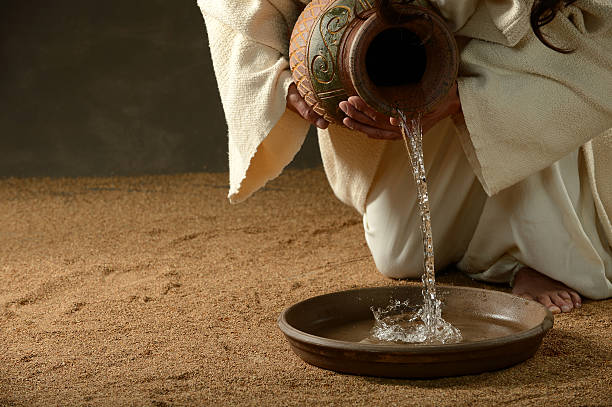
So, during supper, fully aware that the Father had put everything into his power and that he had come from God and was returning to God, he rose from supper and took off his outer garments. He took a towel and tied it around his waist. Then he poured water into a basin and began to wash the disciples’ feet and dry them with the towel around his waist.

John 13:3-5
Photo from GettyImages/iStockPhotos.

During the time of Christ, restaurants were stops not only for meals but for rest that consisted of soaking their feet on a basin of water. It was therapeutic that gave travelers enough strength to travel far again as there were no other modes of transportation at that time and not everybody could afford an animal to ride on. Any hiker and mountaineer can attest that after so much trekking, one thing you would always hope for is a stream or tiny brook with cool, crisp, running water to dip your feet and rest!

This Holy Thursday, let us be a companion in Jesus Christ with others, beginning with our family members. Do not get tired of being broken and shared like bread, of loving and caring when the journey becomes so tiring like in this time of pandemic that seems to be still far from over.

“Do you realize what I have done for you? You call me ‘teacher’ and ‘master,’ and rightly so, for indeed I am. If I, therefore, the master and teacher, have washed your feet, you ought to wash one another’s feet. I have given you a model to follow, so that as I have done for you, you should also do.”

John 13:12-15

Lord Jesus Christ,
may we never get tired 
walking in love 
as a companion and 
bread to one another like you 
by giving rest to others 
already tired and about to give up. 
Let us all be together in welcoming Easter! 
Amen.

Photo by Pixabay on Pexels.com

“Casio” by Jungle (2018)

The Lord Is My Chef Sunday Music by Fr. Nick F. Lalog II, 01 August2021
Photo by Ray Piedra on Pexels.com

It is another rainy, heightened season of quarantine measures here in Metro Manila this Sunday with all religious gatherings being banned again while other business establishments especially like the spa are allowed with limited access by the public.

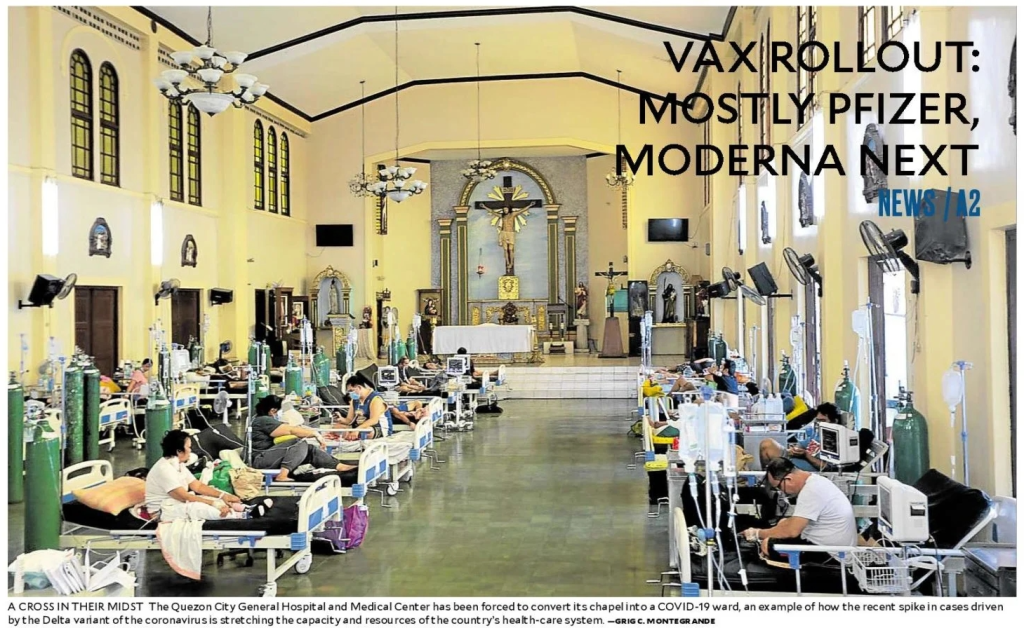
It is a crazy set up. While we believe there has to be some health protocols needed to control the spread of COVID-19, we find it so baffling since last year when religious gatherings continue to be at the bottom list of essentials in this predominantly Christian country.

And the more crazy is how every time our public Masses are restricted, the more people troop to churches to pray and worship!

That is why we have chosen the British neo soul band Jungle with their 2018 “Casio” for our featured music this Sunday that speaks of heartbreak and dysfunctional relationship. It is aptly called Casio because it speaks of a relationship so utilitarian like a Casio watch wherein the woman is just using the guy for her own advantage like the people who have followed Jesus to Capernaum in today’s gospel in order to have food again like last week (https://lordmychef.com/2021/07/31/beyond-when-and-what/).

Casio, playing on my heart just like a Casio
Breaking it apart so you can let it go
Wait another year that's not original, or cynical
Alright, let's go now

When all your dreams are gone
And you're still holding on
You waited far too long
Don't say
I know, you know it's over

We discovered this electronic band last year at the height of the pandemic and since then have been hooked with their funky sound that is characteristically British – intelligent and no non-sense. You have to see the music video for Casio we find so groovy and savvy, perfect for a quarantine Sunday with family.

In an interview at San Francisco’s KEXP, Jungle members explained how in their latest album For Ever (2018) they explored themes – “to shake off their shallow self-doubt” by making “more vulnerable songs” that gave “new directions where they were going in the soul.”

The band is clean cut like most Brits and hip, they really rock so well with their depth and simplicity – exactly what Jesus is asking in today’s gospel so we would desire things of higher levels that “lead to eternal life than food that perishes”.

*We have intentions of copyright infringements to the following music video except to share its good vibes and wonderful music and message.

Beyond “when” and “what”

The Lord Is My Chef Sunday Recipe for the Soul by Fr. Nicanor F. Lalog II
Sunday XVIII-B in Ordinary Time, 01 August 2021
Exodus 16:2-4, 12-15 ><}}}}'> Ephesians 4:17, 20-24 ><}}}}'> John 6:24-35
Photo by author, Church of Dominus Flevit overlooking Jerusalem, 2017.

Last Sunday we reflected the “where” of Jesus in asking Philip, “Where can we buy enough food” for the crowd who have followed them to a deserted place. We said that “where” of Jesus referred not to any place or location but to himself as the only one who can give “enough food” for everyone.

Today I invite you, my dear readers to join me reflecting on the “when” and “what” of the people who have followed Jesus to the other side of the lake, looking for him to have more food after that miraculous feeding last week. This time, the people are the ones asking Jesus with when and what that reveal their pride before God.

When the crowd saw that neither Jesus nor his disciples were there, they themselves got into boats and came to Capernaum looking for Jesus. And when they found him across the sea they said to him, “Rabbi, when did you get here?” Jesus answered them and said, “Amen, amen, I say to you, you are looking for me not because you saw signs but because you ate the loaves and were filled. Do not work for food that perishes but for the food that endures for eternal life, which the Son of Man will give you. For on him the Father, God, has set his seal.”

John 6:24-35
Photo by author, Capernaum’s shore at Lake Tiberias, 2017.

From a deserted place to Capernaum

To fully appreciate today’s gospel account by John, let us get its whole picture with a little help from Mark who started the story of Jesus and the Twelve crossing the lake to a deserted place to rest the other week. With his usual dash of humor, Mark told us how the people arrived to the place ahead of Jesus who was moved with pity at seeing the crowd “for they were like sheep without a shepherd that he taught them with many things.”

John continued the story last Sunday telling us how Jesus fed the people to their satisfaction with so many leftovers out of just five loaves of bread and two fish. The people were astonished that they tried to get Jesus to make him a king but he “withdrew again to the mountain alone.”

This Sunday, John continued his story telling us how the crowd finally found Jesus at Capernaum with his disciples.

How did he get there?

Photo by author, Lake of Tiberias (aka, Galilee), 2020.

According to Mark 6:45ff., after feeding the people, Jesus told the Twelve to proceed ahead of him to the other side of the lake that evening while he dismissed the crowd. Later that evening while Jesus was praying on the mountain, he saw his disciples’ boat being tossed by big waves due to strong winds. He followed them at the “fourth watch of the night” (about 3AM) by walking on water that terrified the Twelve who thought they have seen a ghost.

Upon identifying himself as the Lord, Peter asked to let him come to him by walking on water too; Peter sank when he doubted due to the strong winds until Jesus saved him and joined them on the boat going to Capernaum.

Mark’s story of Jesus walking on water after the miraculous feeding provides us the context for the people’s question to him today in John’s continuation of the story last week, “Rabbi, when did you get here?” (Jn.6:25): it was very difficult, almost impossible for anyone to have crossed the lake at night due to giant waves caused by strong winds. (Any pilgrim to the Holy Land can attest to this fact even today.)

And that was the main issue here: the people refused to see the deeper meanings behind the two events when Jesus fed them and the almost impossible crossing of the lake that night.

That is why Jesus did not answer their question by bluntly addressing their suspicious motive, “Amen, amen, I say to you, you are looking for me not because you saw signs but because you ate the loaves and were filled. Do not work for food that perishes but for the food that endures for eternal life, which the Son of Man will give you. For on him the Father, God, has set his seal.”

Ironically, while their asking of “when did you get here” implicitly acknowledged the Lord’s miraculous crossing of the lake, they still refused to accept it by downplaying everything like addressing Jesus as “Rabbi” when in fact, they were not interested with him but merely with the food he had given them!


Their question of "when" 
was not really about his time of arrival there 
but more of an inquiry on the person of Jesus....

Their question of when was not really about his time of arrival there but more of an inquiry on the person of Jesus as they wondered how could he made it across the lake that night. They have failed to recognize the deeper meaning of the sign Jesus did in feeding them with enough food which Jesus explained anew.

And the stage is now set for Jesus to reveal himself, of who he really is which his disciples were also asking and contending among themselves all these weeks and months of being with the Lord.

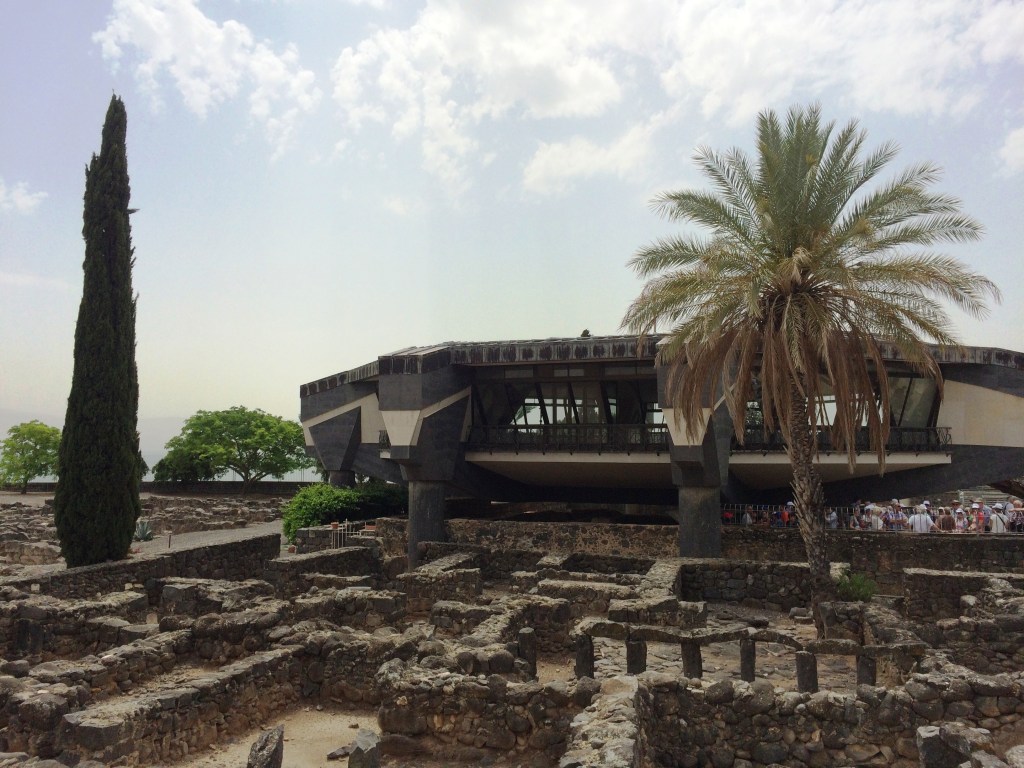
Photo by author(2017), ruins at Capernaum with a church built over the house where Jesus was believed to have stayed.

The need for us to be open to Jesus, our bread of life

Many times in life, our words and attitudes betray us of our inner motives, of our selfish interests to get near some people, to meet and know them not for who they are but for what we can have from them – even with God!

Remember Andrew last Sunday who did not bother to ask the boy’s name who gave the five loaves of bread and two fish from which Jesus performed his miracle? “There is a boy here with five barley loaves and two fish” – no name, just a “there” because the did not matter at all to Andrew except his food.

But there is something deeper being revealed in this attitude of forgetting the other person and being focused on material things: that is our pride, of believing only in ourselves, of playing God!

So they said to him, “What can we do to accomplish the works of God?” Jesus answered and said to them, “This is the work of God, that you believe in the one he sent.” So they said to him, “What sign can you do, that we may see and believe in you? What can you do? Our ancestors ate manna in the desert, as it is written: He gave them bread from heaven to eat.”

John 6:28-31

See how the crowd ignored Christ’s promise of giving food that endures for eternal life by following up their question with What can we do to accomplish the works of God?” – another veiled question like their when, insisting on their own achievements and abilities, on what they can.

Worst is how in a twist highlighting pride in themselves as they dared to question Jesus again with What sign can you do, that we may see and believe in you?“!!! Helloooooo….!

Photo by author at the ruins of the synagogue of Capernaum where Jesus preached his bread of life discourse, 2017.

They have gone so blinded with their pride that suddenly the miraculous feeding they have personally witnessed plus the unimaginable crossing of the lake at night remained lacking, not enough for them to believe in the powers of Jesus that they still asked for another sign.

Their “what” had become a demand from them, an insistence on Jesus the Son of God to give them signs from heaven even if they ironically preferred without them knowing how they were stuck at the lowest level of looking at things.

They have closed their eyes to seeing beyond the ordinary things happening to them since Jesus came teaching and healing. And now after feeding them, they demanded Jesus to follow them instead of them following the Lord.

Is it not the same thing happens with us when we keep on demanding God for proofs of his love and mercy, demanding so many other things from him above while we refuse to rise above ourselves, to “level up” in our lives?

This is the call by St. Paul in the second reading, that we must “be renewed in the spirit of your minds, and put on the new self, created in God’s way in righteousness and holiness of truth” (Eph. 4:23-24).


Once again, we are placed on highest level of quarantine due to a surge in COVID-19 cases with threats from the new Delta variant. Unless we learn to see this pandemic on a higher plane or level that calls for spiritual renewal among us, it will persist to disrupt and destroy lives among us.

It is more than a virus infecting us but an attitude deep within us when we have lost respect for one another and with nature. Pope Francis had long ago sounded this alarm in 2015 with his encyclical Laudato Si calling for each of us to change our lifestyle, each of us contributing for the betterment of the world because it is easiest to join advocacies but difficult to change our ways of life by having less.

With all these pandemic and climate changes going on around us, the signs are getting clearer for us to shift our perspectives, to see things on a higher plane like what Jesus had began at Capernaum declaring himself, “I am the bread of life; whoever comes to me will never hunger; and whoever believes in me will never thirst” (Jn.6:35).

Our misunderstandings with others and in life will persist unless we remove the veils and masks that cover so many insincerities of our questions in search of the many answers to the problems we face.

Like the people who have followed Jesus to Capernaum that day who were stuck in the desert experiences of Moses (first reading) that they could not see Jesus himself as the new bread from heaven; in fact, Jesus had to correct them that it was not Moses who gave the manna but God the Father in heaven who now gives Jesus to nourish us in our journey to eternal life.

Let us empty our selves of our pride to let Jesus fill us today with his words and his Body and Blood so we may realize next week the meaning and sweetness of himself as the Bread of life. A blessed week to you. Stay safe and keep praying. Amen.

Photo by author, April 2020.

Listening attentively, selectively

The Lord Is My Chef Breakfast Recipe for the Soul by Fr. Nicanor F. Lalog II
Wednesday, Week XVI, Year I in Ordinary Time, 21 July 2021
Exodus 16:1-5, 9-15   ><]]]]'>  +  <'[[[[><   Matthew 13:1-9
Photo by Mr. Jim Marpa, 2018.
Every day God, 
we pray to you
"Our Father in heaven
hallowed be thy name...
Give us each day
our daily bread"
without realizing the daily bread 
you give us that truly nourishes us:
your words of truth and of life
that became flesh in Jesus Christ.
On that day, Jesus went out of the house
and sat down by the sea.
Such large crowds gathered around him
that he got into a boat and sat down,
and the whole crowd stood along the shore.
And he spoke to them at length in parables.
(Matthew 13:1-3)
Thank you very much, dear God
for listening to our prayers,
in giving us the food we need
to nourish our bodies
and your words that sustain us
especially in these trying times.
May we hunger more
for this daily bread from heaven,
listening attentively,
fulfilling your words as you willed them so.
Then the Lord said to Moses,
"I will now rain down bread 
from heaven for you.
Each day the people are to go out
and gather their daily portion;
thus will I test them,
to see whether they follow
my instructions or not."
(Exodus 16:4)
But most of all, O God
teach us to be like you: to be more
selective in our listening,
to be more circumspect with what
to hear and process wherein 
we listen more on essential things 
that matter most than on trivial
and mundane words that are
divisive, preventing our growth
and maturity in our relationships.
If you would listen and act
on everything we say, especially 
our grumblings and complaints, 
no one among us would still be alive;
but you are kind and understanding,
unlike us who listen more on petty
than essential things said by others.
May we be like the good soil
that is open to listen and nurture
words that build and give life.  Amen.

Companionship in Christ

The Lord Is My Chef Easter Triduum Recipe by Fr. Nicanor F. Lalog II
Maundy Thursday, 01 April 2021
Exodus 12:1-8, 11-14 ><)))*> 1Corinthians 11:23-26 ><)))*> John 13:1-25
Photo by d0n mil0 on Pexels.com
"A journey of a thousand miles
begins with a single step."
- Lao Tzu

We often hear and use this wise saying that is also most applicable to our celebration of the Holy Triduum of the Lord’s Passion, Death and Resurrection also known as the “Sacred Paschal Triduum”.

From the Hebrew word pesach, a pasch is a passing over. It is a journey which is a long trip taken over long period of time to different places. A journey does not necessarily involve physical distance as it can be something within one’s self like an inner journey to God dwelling within us. Hence, a journey is also a process that leads us to growth and maturity from the many difficulties and trials we experience as we travel, entailing a lot of sacrifices from us.

And whatever journey we take outside or within our selves, we always need a companion to travel with. From the Latin words cum panis that literally mean “someone you break bread with”, a companion is someone who helps us in our journey, a friend who shares life with us, guiding us, protecting us. Like the bread we break and share, a companion sustains and nourishes us in our journey.

Let us keep these three words of journey, companion, and bread in reflecting our celebration tonight of the Lord’s Supper that begins the Sacred Triduum.

We are all pilgrims on a journey to heaven

More than 40 days ago on Ash Wednesday, we said Lent is a daily journey to Easter where we find our very selves, others, and God who is our ultimate origin and end. It is a journey that reaches its summit in the Holy Eucharist where we make present the pasch or passover of Jesus Christ

Every Mass is a journey into heaven, a dress rehearsal of our entrance into heaven when we have a foretaste of eternal life we all hope for until Christ comes again. It is the Passover of the New Testament, a perfection of the Jewish Passover when God’s chosen people led by Moses went into exodus from Egypt into the Promised Land.

This “heavenly” journey had its ancient roots among nomadic Semites who used to celebrate a feast on the first full moon of spring as they prepared to lead their flocks to summer pastures. They ate a roasted lamb from the flock with unleavened bread and bitter herbs. It was an important event of migration filled with many dangers for those nomads who marked their tent-pegs with the blood of the lamb to keep their journey safe.

Eventually this found place in the Jewish Passover which we heard in our first reading when God told his chosen people to begin their journey of exodus from Egypt “on the tenth of their first month” that happens on the second full moon of the spring equinox.

Notice that it happens at night that is coincidentally the usual start of every journey we usually make!

Before their Exodus, each family was told to roast an unblemished lamb to be eaten with unleavened bread and bitter herbs “with your loins girt, sandals on your feet and your staff in hand, you shall eat like those who are in flight. It is the passover of the Lord” (Ex.12:11). It has to be done in a hurry, as in a flight, a journey.

And to keep them safe in their journey, God instructed them to paint their door posts with the blood of the slaughtered lamb so that when his angel comes at night to strike death of every first born male child and animal, their homes would be “passed over” and be saved from death that night.


We are all travelers and journeyers on earth;
our true home is in heaven with God our Father.  
We are merely "passing over" this planet temporarily.

Photo by author, Egypt, 2019.

Jesus our companion and family in the journey

The Jewish Passover or Exodus became the actual event of God’s covenant with Israel as his people on a journey to their Promised Land. Unfortunately, they would break this covenant with God so many times that it would take them 40 years of wandering in the desert before finally got into the Promised Land.

And their stubbornness continued when they would always turn away from God with sins that led to the division of their nation until its conquest by foreign powers that led them anew into another exile. God would restore them as a nation but, again, they would turn away from him until the Romans ruled over them when Jesus came to perfect God’s covenant.

In perfecting and fulfilling the Jewish Passover, Jesus became the new and everlasting Lamb, perfect without any blemish, offering himself to God for the forgiveness of our sins and our liberation from all forms of evil especially sickness and death. It is no longer the blood of the lamb that we now offer but Jesus Christ’s Body and Blood which he established in the Sacrament of the Eucharist “on the night before he was betrayed” on Holy Thursday.

By celebrating the Lord’s Supper that Thursday evening with his disciples who represented all peoples of all time, Jesus established for us the everlasting memorial of his loving presence as our companion and our very Bread and Wine in the journey back to the Father always filled with darkness and sufferings.

What he did that Thursday evening foreshadowed what he would do on Good Friday when he did his greatest act of love for us by dying on the Cross at about 3PM, the same time when the lambs were being slaughtered in the temple for the coming passover feast.

Brothers and sisters: I received from the Lord what I also handed on to you, that the Lord Jesus, on the night he was handed over, took bread, and, after he had given thanks, broke it and said, “This is my body that is for you. Do this in remembrance of me.” In the same way also the cup, after supper, saying, “This cup is the new covenant in my blood. ?Do this in remembrance of me.”

1 Corinthians 11:23-25

Here we find again the darkness of the night as the beginning of our journey back to God perfected by Jesus Christ as our companion and very bread of life to sustain and nourish us.

What is most beautiful meaning we can find here is the importance of communion, of oneness as a community, as a family.

In the Old Testament, God instructed his people to take the passover meal together as a family; at the Lord’s supper, Jesus celebrated it with his “friends”, the Twelve Apostles. Even Judas Iscariot was present at the start but had to leave in the “darkness of the night” when he broke off from the unity of Jesus.

Perhaps, one reason why we are again together this Holy Thursday not in churches but in our homes, with our family so we may be one again in Jesus Christ in prayers and celebrating Mass on-line.

Therefore, do not be a Judas Iscariot! Go back to your family, to your loved ones – your most faithful and truest companions in this journey of life. You’ll never get to heaven, as Dionne Warwick sang, if you break somebody’s heart, when you refuse to love by turning your back from those who love you.


Holy Thursday reminds us in the Eucharist  
that no one is saved alone. 
Every journey becomes wonderful
when done in the context of a community, 
with true companions beginning in our very family.

Photo from wikipediacommons.org of Christ’s washing of feet of Apostles at Montreale Cathedral in Palermo, Italy

The commandment of love

Completing the picture of our celebration tonight with the key concepts of journey, companion and bread is LOVE, the very essence of everything in this life, the reason why we are in a journey in the first place since the Exodus up to this time.

At the very core of every companionship, of every community is LOVE.

To become bread for someone in a journey is to become LOVE.

Jesus Christ as the bread broken, as the cup of wine shared is essentially LOVE.

Love can never be defined but merely described.

And on the night before he was betrayed, Jesus described to us in his actions a very beautiful expression of his love we all must imitate:

So, during supper, fully aware that the Father had put everything into his power and that he had come from God and was returning to God, he rose from supper and took off his outer garments. He took a towel and tied it around his waist. Then he poured water into a basin and began to wash the disciples’ feet and dry them with the towel around his waist.

John 13:3-5

When Jesus washed his disciples’ feet, he showed us one beautiful aspect of LOVE which is tenderness.

Yes, I have been speaking about tenderness lately as something we badly need these days of the pandemic. Tenderness is an expression of love when we realize amid our own suffering the sufferings of others too. To be tender and loving amidst many sufferings is to offer rest to fellow journeyers like what Jesus did on that Holy Thursday evening.

Again, we find here something prevalent during that time which is the concept of “restaurants” where travelers used to stop during their journey not only to eat but to rest that meant soaking their feet on a basin of water. It was therapeutic that gave travelers enough strength to travel far again.

Remember there were no other modes of transportation at that time and not everybody could afford an animal to ride on. Any hiker and mountaineer can attest that after so much trekking, one thing you would always hope for is a stream or tiny brook with cool, crisp, running water to dip your feet and rest!

Photo by Mr. Raffy Tima of GMA-7 News, April 2020.

Everybody is tired of this journey in the pandemic, almost exhausted.

What a shame especially when local officials like that one who refused food delivery because she considered the lowly lugaw as non essential. Lest we forget, Jesus chose one of the most lowly food, the unleavened bread, as the sign of his loving presence among us until the end of time when he comes again.

Indeed, this could be the holiest Holy Week of our lives in this most unholy time of history as it gives us great opportunities to love.

Just be tender with those around you!

Never get tired of loving, of understanding, of caring as everyone is already tired with this journey of ours in the pandemic that seems to be still far from over.

“Do you realize what I have done for you? You call me ‘teacher’ and ‘master’, and rightly so, for indeed I am. If I, therefore, the master and teacher, have washed your feet, you ought to wash one another’s feet. I have given you a model to follow, so that as I have done for you, you should also do.”

John 13:12-15

One of the most moving images of the pandemic for me lately is the one taken by our parishioner on the first day of the ECQ last March 22 when our Parochial Vicar, Fr. Howard John celebrated Mass without a congregation. He said, “the table of the Lord is full, but the pews are empty.”

And that is what we will continue to do in this pandemic. Even without the people, we shall continue to journey in Christ by still celebrating the Mass to give us all nourishment and sustenance and rest in this prolonged journey in the pandemic.

May we never get tired walking in love as a companion and bread to one another in Christ and like Christ by giving rest to others already tired and about to give up. Let us all be together in welcoming Easter! Amen.


El anda que en amor ni cansa ni se cansa.
(The soul that walks in love neither tires others nor grows tired.)
Saint John of the Cross 

Photo by Ms. Kysia Cruz, National Shrine of Our Lady of Fatima, Valenzuela City.

Human situation, Divine response: multiplying our blessings

The Lord Is My Chef Sunday Recipe for the Soul by Fr. Nicanor F. Lalog II
Week XVIII, Cycle A in Ordinary Time, 02 August 2020
Isaiah 55:1-3 >><}}}*> Romans 8:35, 37-39 >><}}}*> Matthew 14:13-21

Remember our reflection last Sunday? Of how parables teach us that “less is always more” because to have the kingdom of God – Jesus Christ himself – we have to learn to appreciate the little things in life?

Beginning this Sunday until August 16, our gospels will start telling us who is Jesus Christ by showing us his powers and abilities that are exactly opposite the way we see and understand them. This new series of stories are so relevant to us in this time of pandemic, giving us wonderful insights into God’s ways of responding to our human situations.

St. Matthew now leads us with Jesus to the wilderness after teaching us in parables to experience his power in transforming us like the five loaves and two fish to feed more than five thousand people.

Multi-layered story of the multiplication of bread

All four evangelists have recorded this story of Jesus Christ’s multiplication of the loaves of bread with their particular focus and stress, showing us that it truly happened and was a major event in the Lord’s ministry.

Very unique with St. Matthew’s version of this miracle story – which has not one but two! – is his economy of words in narrating it like a straight news as if it were a developing story or a “breaking news” unfolding before us, calling us to follow its updates and details due to its multi-layered meanings.

When Jesus heard of John the Baptist, he withdrew in a boat to a deserted place by himself. The crowds heard of this and followed him on foot from their towns. When he disembarked and saw the vast crowd, his heart was moved with pity for them, and he cured their sick. When it was evening, the disciples approached him and said, “This is a deserted place and it is already late; dismiss the crowds so they can go to the villages and buy food for themselves.” Jesus said to them, “There is no need for them to go away; give them some food yourselves.” But they said to him, “Five loaves and two fish are all we have here.” Then he said, “Bring them here to me,” and he ordered the crowds to sit down on the grass. Taking the five loaves and the two fish, and looking up to heaven, he said the blessing, broke the loaves, and gave them to the disciples, who in turn gave them to the crowds. They all ate and were satisfied, and they picked up the fragments left over — twelve wicker baskets full. Those who ate were about five thousand men, not counting women and children.

Matthew 14:13-21
Photo from iStock/Studio-Annika.

The consolation of Jesus.

Our situation in this time of the corona pandemic is so similar with that of Jesus. With the increasing number of COVID-19 cases, it has finally hit us hard, so close to home with news of those we know getting infected and worst, dying from this disease.

Like Jesus upon hearing the death of John the Baptist, we are all saddened that we wish to withdraw away from everyone.

We want to mourn but there are more people in need of our presence and help in this time of pandemic like the countless medical frontliners and health workers who must be so tired – even sick, physically and emotionally – by now with the growing number of COVID-19 patients and yet have chosen to remain in their posts.

And there are still the other casualties of this pandemic like those who have lost their jobs, those evicted from their rented apartments, those stranded and separated from their loved ones, those begging for food, and those afflicted with other sickness going through dialysis and physical therapy.

Jesus knows so well the “wilderness” we are all going through and he is right here with us, one with us in our sufferings, in our fears and anxieties, and in our exhaustion.

To be one with us is consolation, from the Latin “con” or with + “solare” or alone, to be one with somebody feeling alone.

Jesus did not remove our pains and sufferings, even our death; he joined us to be one with us in these that he can call us to “Come to me, all you who labor and are burdened, and I will give your rest. Take my yoke upon you… For my yoke is easy and my burden light” (Mt.11:28-30, 14th Sunday, 05 Jul 2020).

Compassion of Jesus.

Still with Christ’s reaction of being “moved with pity” at the sight of the crowds who have followed him to the wilderness, we find something more deeper with his being one with us, in consoling us that he had forgotten all about himself, his tired body that he went on to heal the sick among them.

To be moved with pity is more than a feeling of the senses but a response of his total person.

You respond for help, you reply to a call.

Ever wondered why we have the “responsorial psalm” after the first reading in the Mass? Because those words from the Psalms express our total assent and commitment to God, involving our total self like body, mind, heart and soul.

Photo by Dra. Mai B. Dela Peña, Carmel Monastery, Israel, 2016.

God cannot suffer because he is perfect.

That is why he became human like us in Jesus Christ to be one with our suffering and death so that we would one with him in his glorious Resurrection.

In the wilderness, Jesus stayed with the people, not allowing them to leave as suggested by the Twelve because he was moved with pity with the crowd because he wanted to suffer with them.

That is compassion, literally means to “suffer with” from cum + patior. Here in the wilderness, Jesus showed his compassion for the people which will reach its highest point in giving himself on the Cross on Good Friday.

Have we “responded” to God’s call to serve, to a call of duty, and to a plea for help from the poor? Have we truly given ourselves to somebody without ever thinking our own comfort or rewards? Or, are we running away from his Cross?

What a shame in this time of pandemic there are some among us who rejoice at the losses of others like the Twelve who wanted the crowd to be sent home because they were afraid of responsibilities, of taking care of the suffering people.

Consolation and compassion are the two most needed from each of us in this time of crisis.

Our scarcity mentality, the God of plenty.

We now come to the miracle of the feeding of five thousand. According to the late Fr. Henri Nouwen, this story is an example of our “scarcity mentality” when we think of not having enough, of finding what we have as too little, always looking for more; hence, our tendency to hoard everything.

The Twelve were thinking more of themselves, afraid they could go hungry with the five loaves of bread and two fish they have. They were so afraid of difficulties ahead of them in their situation where to find and how to feed those great number of people.

They were focused on what was lacking than on what they have, and who was with them, Jesus Christ! They were hungry for food in the stomach than for food to the soul unlike the crowds who have followed Jesus.

Worst of all, the Twelve got “mad” upon seeing the crowds who have followed them to the wilderness when in fact, it was Jesus who needed most to rest to mourn John’s death!

But through all these, Jesus patiently bore the people’s woes and the Twelve’s selfishness to teach them all in a very nice way something so essential in our response to every human suffering and extreme situation: opening and entrusting our selves totally to God.

And that was actually the greatest miracle that happened that day.

Photo by Pixabay on Pexels.com

In doing it, Jesus simply asked the Twelve what they have, never asking how much they have or its condition. Just whatever they have to give everything to Jesus like those five loaves and two fish that he took, and while looking up to heaven, blessed and broke the loaves, and gave them to the Twelve to distribute to the crowd.

And everyone was satisfied with a lot of left overs too!

Matthew nor any of the other Evangelists ever explained how it happened because it does not really matter at all. What is most important is what are we willing to give up to Jesus so he can transform us into better persons.

That is what we continue to do this day in every celebration of the Holy Eucharist- whatever we have, even not the best or the worst and littlest we have, when given to Jesus becomes holy and multiplied!

The power of God is immense, without doubt. But, in this miracle of the feeding of five thousand, Jesus is showing us that his power is not meant to satisfy our material or bodily needs but our deepest desires that lead to our fulfillment in him as prophesied by Isaiah in the first reading.

Why spend your money for what is not bread; your wages for what fails to satisfy? Heed me, and you shall eat well, you shall delight in rich fare. Come to me heedfully, listen, that you may have life.

Isaiah 55:2-3

Amid the pandemic worsened by our government officials’ inanities, irresponsibilities, and sheer lack of compassion with us in this wilderness, the Lord assures us today that he is with us for “nothing can separate us from the love of Christ” (Second Reading) if we are willing to give him all that we have.

It is our spiritual transformation first that leads us to our material blessings. We can all have it if we are willing to give everything to Jesus and believe in him always. What do you have for miracles to happen?

A blessed August ahead for you! Amen.

Photo by Dra. Mai B. Dela Peña, Carmel, Israel, 2016.