The Lord Is My Chef Daily Recipe for the Soul by Fr. Nicanor F. Lalog II
Wednesday, Commemoration of All the Faithful Departed, 02 November 2022
Wisdom 3:1-9 ><}}}}*> Romans 6:3-4, 8-9 ><}}}}*> John 6:37-40
Praise and thanksgiving
to you our loving God and Father
for the grace of life
for the grace of death
for the grace of judgment:
in the end, your love prevails.
Our hope lies in your judgement,
O God and Father because it is
both justice and grace:
justice because you render fairly
to everyone what is due including
everything we have done but
it is also grace because you know
our weaknesses, our sinfulness:
"The souls of the just are in the hands of God,
and no torment shall touch them.
They seemed, in the view of the foolish,
to be dead; and their passing away was thought
an affliction and their going forth from us,
utter destruction.  But they are in peace.
For if before men, indeed, they be punished,
yet it is their hope of immortality;
chastised a little, they shall be greatly blessed,
because God tried them and found them
worthy of himself" (Wisdom 3:1-5).
Thank you, dear Father in sending us your Son
Jesus Christ who had closely linked
your justice and grace in his Passion,
Death and Resurrection we now share
in the hope of being with you in heaven;
as we remember today our faithful departed,
including those who have been forgotten,
we not only hope for ourselves but also
hope for others because we have realized
all the more these November 1 and 2
that no man is an island:
we are all linked together in Jesus,
no one lives alone
no one sins alone
no one is saved alone!
On this All Souls' Day
we express to you not only
our own hope for salvation
but also our hope for other's salvation:
remember those who have died ahead of us,
purify them in the love of Christ
who assured us that "I came down from heaven
not to do my own will but the will
of the one who sent me.  And this is
the will of the one who sent me,
that I should not lose anything
of what he gave me, but that I should
raise it on the last day.
For this is the will of my Father,
that everyone who sees the Son
and believes in him may have
eternal life, and I shall raise him
on the last day" (John 6:38-40).
O most holy Virgin Mary,
our Mother who is the "Star of the Sea"
in this journey of life,
lead us safely to Jesus in eternity
especially at the hour of our death.
Amen.
Photo credits:  Top photo by Dr. Mylene A. Santos, MD in Portugal, October 2022.
Last photo by author, 2019.
The Lord Is My Chef Daily Recipe for the Soul by Fr. Nicanor F. Lalog II
Tuesday, Memorial of St. Vincent de Paul, Priest, 27 September 2022
Job 3:1-3, 11-17, 20-23   ><000'> + ><000'> + ><000'>   Luke 9:51-56
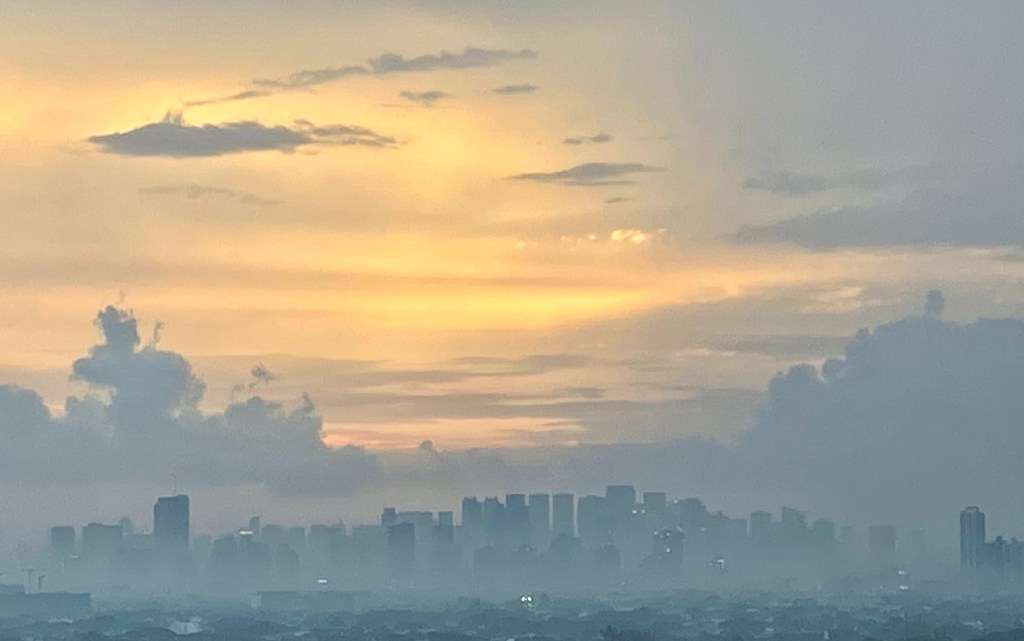
Photo by author, Makati skyline from Antipolo, August 2022.
Thank you again,
dear God our loving Father
in keeping us safe from the
powerful super typhoon that
hit us Sunday evening;
most of all, thank you in giving
us that faith within us like Job
when we go through storms in
life, sometimes so violent and
devastating like the real ones.
Bless us, O God, to be like Job:
to have that grace of crying out
our hearts, of venting out our pains
and even anger when like him,
we curse the day but never you:
Job opened his mouth and cursed his day. Job spoke out and said: Perish the day on which I was born, the night when they said, “The child is a boy!” Why did I not perish at birth, come forth from the womb and expire?
Job 3:1-2, 3
Help us realize, dear Father,
these little "deaths" we go through
daily in life like sickness and loss of
loved ones are the realities of life
itself that prepare us for our eternal
union in you that would surely come
on our Death with a big D;
we are indeed "being-towards-death"
beginning on the day of our birth when
we have to cry out loud and kick hard
to be alive!
It is through our pains and sufferings
that we become truly human,
when we feel with others in
empathy and sympathy,
when we stay with others
in consolation,
when we strive to be like
Jesus in raising up others
by being "resolutely determined
to journey to Jerusalem" (Lk.9:51)
to face death that have inspired saints
like your servant Vincent de Paul
who worked so hard for the sick,
the abandoned, and the poor,
inspiring other saints in the
process!
We pray for everyone
going through darkness,
battered by storms in life
to keep their faith,
that it is okay to cry and
complain because it is really
difficult; most of all,
remind us, Jesus, that
without pains and
sufferings in this world,
then this life would be
so dull, even meaningless
because that is when we
are totally by ourselves,
utterly selfish because we can
only find life's meaning in others,
never in our selves.
Amen.
The Lord Is My Chef Sunday Recipe for the Soul by Fr. Nicanor F. Lalog II
Twenty-Sixth Sunday in Ordinary Time, Cycle C, 25 September 2022
Amos 6:1, 4-7 ><000'> 1 Timothy 6:11-16 ><000'> Luke 16:19-31
Photo by author, Pangasinan, 19 April 2022.
It's amazing how you can speak right to my heart
Without saying a word you can light up the dark
Try as I may I could never explain what I hear when you don't say a thing

The smile on your face lets me know that you need me
There's a truth in your eyes saying you'll never leave me
The touch of your hand says you'll catch me if ever I fall
You say it best when you say nothing at all
Yes, my dear friends, I am so in love these days; the Lord is doing a lot of things in my heart and soul in my ministry that songs automatically play within me like a jukebox every time I pray and meditate. The other day was Five for Fighting’s 100 Years; this Sunday it is When You Say Nothing At All by Paul Overstreet and Don Schlitz first recorded by Keith Whitley in 1988 but became popular with Alison Krauss in 1995 that finally became a worldwide hit with Roan Keating’s version used as soundtrack of the 1999 Julia Robert-starrer Notting Hill.
The lyrics are so lovely, so true while the melody is so cool that is so uplifting and even spiritual as the song tells us a lot of the love of God for us expressed in his Son Jesus Christ who does everything, saying nothing at all, just loving us, understanding us, forgiving us. Most of the time, with us saying nothing at all too because he knows everything.
The more I listen to this song, the more I feel it speaking also of the parable of the Rich Man and Lazarus, of how we truly regard each other as a person, as a brother and sister, as disciples of Jesus when we say nothing at all, when our actions speak loudly or, silently of our love for each other.
Jesus said to the Pharisees: “There was a rich man who dressed in purple garments and fine linen and dined sumptuously each day. And lying at his door was a poor man named Lazarus, covered with sores, who would gladly have eaten his fill of the scraps that fell from the rich man’s table. Dogs even used to come and lick his sores.”
Luke 16:19-21
Photo from bloomberg.com of a homeless man in New York City during a fashion week in summer 2019.
Rich Man, Poor Man
Today’s parable is uniquely found only in Luke’s gospel like last Sunday that stresses Christ’s lesson on the wise use of money in the service of God through one another; but, the parable adds an important dimension in how this wise use of money will have a bearing in our judgment before God upon death. Hence, the gravity of the message expressed in great simplicity with beautiful layers of meaning.
First of all, the rich man has no name while the beggar was named Lazarus that means “God has rescued” or El ‘azar in Hebrew. The scene is still from the previous Sundays when the Pharisees and scribes complained why Jesus welcomed tax collectors and sinners. Jesus took it as an occasion to teach through parables the value of everyone before God, including the lost, the sick, the poor, and the sinful. They are the Lazarus who are given with a name because they are special in the eyes of God who rescues them all.
Then follows the juxtaposition of Lazarus
 lying at the door of the rich man's home
 - a very powerful image that punches us hard
 right in our face, of how numb we have become
 with each other!
On the other hand, the rich man had no name not because he was less important but because he stands for each one of us blessed and loved by God. Notice that Jesus did not say whether the rich man and Lazarus were good or bad because their character would be revealed later as the parable unfolds.
See how Jesus presented the outer appearances of the two: the rich man was dressed in colorful and fine clothes, eating sumptuous food while Lazarus was somewhat naked, covered with sores in his whole body that dogs would lick as he filled himself with scraps falling from the rich man’s table.
Then follows the juxtaposition of Lazarus lying at the door of the rich man’s home – a very powerful image that punches us hard right in our face, of how numb we have become with each other!
Photo by Mr. Raffy Tima of GMA-7 News, stranded local residents at the airport, June 2020.
Here we find a valuable lesson from this pandemic courtesy of the face mask that finally opened our eyes, including our minds and hearts to look again onto each one’s face, to recognize each person. Before the virus came, we just did not care with everyone we met as we were so cold that we would not even look at each others face, snubbing even those close to us.
There are still other Lazarus around us, living among us, not begging at all from us like this one in the parable who would not say anything at all but silently suffer in pain, hungry and thirsty for recognition and love like parents forgotten and neglected by their grownup children, wives cheated by their spouse, children left alone and misunderstood by their parents, our classmates and colleagues so maligned in the nasty talks going around us and in the social media, the poor and lowly workers exploited by their employers, or just anyone often criticized and judged but never appreciated.
Try thinking of the other Lazarus around us we never bothered to talk to nor even smiled at because we have been preoccupied with our many other worldly pursuits in life. Let us examine ourselves while amid the comforts and luxuries of life may have rightly earned with decent hard work that but may have caused us to have forgotten the “feel” of being human, of being sick and weak that we have forgotten or been totally unaware of those around us.
Death and the urgent call to conversion
See how the parable gets interesting when both characters died and a reversal of situation in the afterlife occurred. The rich man was buried, immediately going down to hell to suffer while Lazarus was carried – not buried – by angels to Abraham in heaven to be comforted. In the two conversations that followed between the rich man and Abraham, we find at the core the primary importance of daily conversion of everyone.
When Abraham told the rich man of the great chasm dividing them that Lazarus could do nothing to alleviate his torment, Jesus is warning us of the exact situation when we die which is eternity, without end. Therefore, while we are still alive, let us be aware and conscious of others too, not just of ourselves. That is essentially conversion, defocusing from our selves to see those around us more.
Remember how the dishonest steward in the parable last week who made friends with the debtors of his master to ensure his good fate after being fired? That finds its application in this Sunday’s parable wherein the rich man should have been like that dishonest steward in befriending Lazarus so he could have made it too in heaven! That is why I love so much that part of the parable of the juxtaposition of Lazarus at the gate of the rich man.
How did the rich man miss and did not see Lazarus right there at his face, hungry and with sores?
From Facebook, 2020.
Let us not be “complacent” as the Prophet Amos warned in the first reading of not being aware of the excesses and sacrilege going on during that time (Am.6:1). It could be happening right now with us when we choose to be silent and uninvolved, even blind and deaf to the suffering people around us because we are like the fool rich man who grew rich for himself instead of “growing rich in what matters to God” (Lk.12:13-21, August 1, 18th Sunday)!
In the second conversation with Abraham by the rich man, we find the pressing need for conversion more urgent, of heeding the calls of the scriptures, of the prophets and of Jesus Christ himself we hear in the gospel proclaimed daily. See also how the rich man had not really changed amid his torments, requesting that Lazarus be sent to warn his brothers living the same way he had lived in order to avoid hell. Imagine while in the afterlife, the rich man was still thinking of those he had left behind on earth!
So ridiculous was his request and yet, we too must be careful because so often, we have such illusion that a clear and irrefutable sign from heaven like what the Pharisees and scribes insisted from Jesus could lead everyone to conversion. It is an illusion because as Jesus had been telling since then, we need to have faith first to see and acknowledge him for us to be converted. It is the same faith that we need to heed St. Paul’s call in the second reading to “Lay hold of eternal life” (1 Tim. 6:12). It is faith that is vibrant and so alive that enables us to recognize our true wealth is God found among one another with us.
When we have faith, whether we are rich or poor, we always see everyone as a brother and sister in Christ. When we have faith, whether we are rich or poor, we are able to love truly because we also believe. And that is when we do not say anything at all because we just keep on doing what is good to everyone, especially the Lazarus among us.
This Sunday, Jesus reminds us of God’s immense love for each one of us, a love we have to share with everyone especially if we have so much unlike others.
Let us reflect our lives these past days and weeks when we felt like Lazarus unrecognized at all, even forgotten amid our being right in the middle of life and everyone. It must be painful and sad. Jesus knows it so well; hold on to him our Savior who is always doing something for us always, especially when he says nothing at all. Amen.
Have a blessed week ahead! God bless you more!
Photo from inquirer.net, Ms. Patricia Non of the Maginhawa Community Pantry, 2021.
I'm 15 for a moment
Caught in between ten and 20
And I'm just dreaming
Counting the ways to where you are

I'm 22 for a moment
And she feels better than ever
And we're on fire
Making our way back from Mars
The piano, the voice and the lyrics were unmistakably Five for Fighting when I heard it played again after a very long time at the 40th day of the death of a young college student in our parish recently.
It was only then when I truly appreciated this 2003 hit “100 Years” after realizing its deeper implications about life and death leading to eternity. Besides, there were some interesting things about the song and the deceased young man who was also a talented pianist like Five for Fighting himself – Vladimir John Ondasik III. Most of all, the deceased young man I have celebrated Mass for was aged 22 like the character depicted in the song 100 Years.
Celebrating Mass at the funeral of a child, whether an infant or a grown-up is the most difficult one for me. Normally, we children bury our parents but, it is so different when children die ahead of their parents and even grandparents. As a priest, I could feel the pain of the grieving parents in losing their son or daughter even if I totally do not know them at all. Yet, it is a grace of the priesthood that while we are emotionally affected by grieving parents we hardly know that we are likewise uplifted in identifying with Jesus who had brought back to life a dead young man at Nain after being moved with pity for the man’s widowed mother (Lk.7:11-15).
Photo by author, Pangasinan, April 2022.
Notice that Jesus brought back to life the dead young man because of pity for his mother, not because he pitied the dead son. God tells us in the Old Testament that he is saddened with the death of even just one of us but the event at Nain shows us how the eyes of the Lord are always with those left behind especially mothers because they are indeed the most pitiable in losing a child who would always be a part of them. Moreover, life is most difficult for those left behind who have to continue to bear all pains and sufferings while their departed loved ones rest in peace in eternity. And here lies the call of Jesus for us all to help those grieving to rise again and move on with life after the death of a beloved, especially of a child.
We shall talk about this later and let us just remain a little more with the reality of death.
Although 100 Years is a soft-rock ballad about a love relationship, it is very philosophical, in fact a Martin Heidegger, in calling for “authentic living” because we are all “being-towards-death”. While the song is generally a “feel good” piece, it reminds us of that reality we refuse to accept that coming to terms with death is coming to terms with life. It is when we are faced with the “existential” possibility of death that we begin to see the beauty of life and the joy of living.
15, there's still time for you
Time to buy and time to lose yourself within a morning star
15, I'm alright with you
15, there's never a wish better than this
When you've only got a hundred years to live

Half time goes by, suddenly you're wise
Another blink of an eye, 67 is gone
The sun is getting high
We're moving on
Truly, as the song tells us, our life is precious – whether you are 15 or 22 or 33 or 45 or 67 or 99 – because it could all be gone in a moment or a blink! Like Heidegger, Five for Fighting is calling us in his song to cherish each one’s presence with more love and kindness, care and understanding, with a lot of mercy and forgiveness because we live only for a period of time like 100 Years.
St. Paul also spoke of this constant awareness of death, of how “the world in its present form is passing away” (1 Cor. 7:31) that we should live authentically as Christians. This pandemic has taught us in the most strongest terms this truth, not only with actually dying but also of being prevented from spending precious moments with our dead’s remains! May we not forget this pandemic’s lesson of living in the present moment as if it is also your final moment in life, of cherishing each other always because true riches are found only in God through one another as Jesus reminded us in last Sunday’s gospel (Lk.16:11).
Photo by Ms. Jo Villafuerte, Atok, Benguet, September 2019.
To live is to love. What we need are more people, more children, more friends to celebrate life with. Like God, friends and family do not perish; they live on even if we do not see them because they just move on to higher level of existence. Unlike money and wealth, power and fame, and other material things that perish and become obsolete after a year.
Our weekday readings these past week teemed with so many beautiful nuggets of wisdom about people and relationships learned at the heels of death: the centurion who sent for Jesus for the healing of his slave who “was valuable to him” (Lk.7:2) on Monday; praying for those who grieve like that widowed mother in Nain (Lk.7:13) on Tuesday; and last Wednesday at the Feast of the Exaltation of the Cross we were reminded of our transformation through life’s sufferings or little deaths in life; and, finally on Thursday at the memorial of Our Lady of Sorrows, of how we are invited to imitate Mary who remained at the foot of the Cross on Good Friday with her dying Son Jesus Christ. Here we find how death has become a blessing when seen in the light of Jesus and his Cross as witnessed by the Blessed Mother and preached by St. Paul.
This positive aspect of death as a blessing is wonderfully portrayed in the music video of 100 Years set in an isolated place in soft shades of dark blue and green, with some hues of grey evoking a deep sense of peace and tranquility minus the morbidity. Laid-back and relaxed, perhaps. Of course, Five for Fighting’s trademark piano makes the music video so lovely, so appealing, giving a joyful note on death’s certainty leading to eternity.
I'm 99 for a moment
And dying for just another moment
And I'm just dreaming
Counting the ways to where you are

15, there's still time for you
22, I feel her too
33, you're on your way
Every day's a new day
At the start of the music video of 100 Years, we find a younger man playing the piano before Five for Fighting appears singing. That shifting of the younger and older Ondasik would happen about six times maybe interspersed with other characters coming to play the piano too until in the end he leaves to walk toward a big tree to meet his older self. Or God maybe.
Photo by Mr. Jay Javier, “Acacias”, UP Diliman, QC, April 2022.
That big tree seems to convey something like paradise, a gateway to eternity where time is totally held in completeness with everything at the present moment shown by Five for Fighting’s repeated returns to climb the big tree to look at his younger self kissing his first girlfriend until toward the end, he fell from the tree as if he had died only to be seen singing while playing the piano again. It was reminiscent of one of the final scenes in the 1990 movie Flatliners with Kiefer Sutherland trying to amend his childhood sin and crime in pushing to death his playmate from a similar big tree; Sutherland was eventually forgiven when during an induced “flatline” he was able to go back to his past to apologize to his dead playmate with a reversal of role, of him as an adult in the present moment falling from the big tree.
It was after that scene of falling from the big tree when Five for Fighting had awakened singing and playing the piano again when he finally stood to walk back to the big tree to meet his older self, or maybe God — something like Easter.
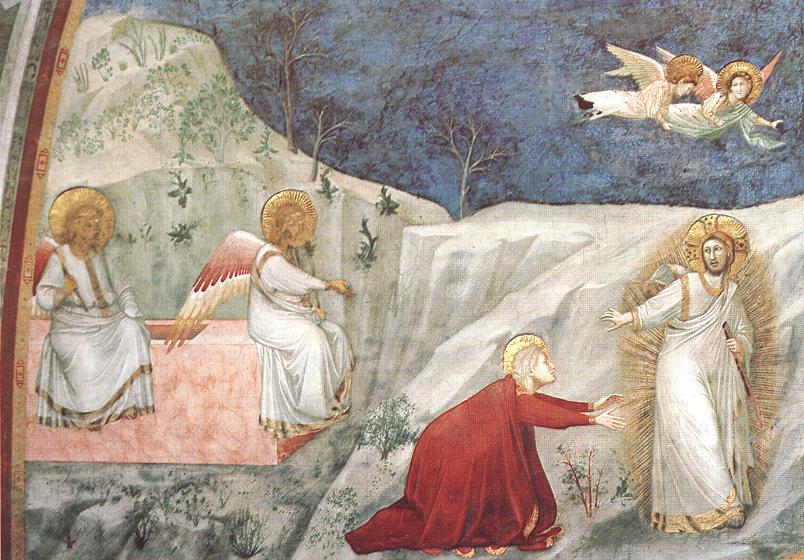
On the first day of the week, Mary of Magdalene came to the tomb early in the morning, while it was still dark, and saw the stone removed from the tomb. Mary stayed outside the tomb weeping. And as she wept, she bent over into the tomb and saw two angels in white sitting there, one at the head and one at the feet where the Body of Jesus had been. And they said to her, “Woman, why are you weeping?” She said to them, “They have taken by Lord, and I don’t know where they laid him.” When she had said this, she turned around and saw Jesus there, but did not know it was Jesus.
John 20: 1, 11-14
“Noli me tangere” (touch me not) fresco in the Lower Basilica of St. Francis Assisi Church in Italy painted by Giotto de Bondone in the 13th century from commons.wikimedia.org.
Like on that Easter morning, there will always be the darkness of death but only for a moment if we keep our eyes and our hearts open to Jesus who had risen. Many times we are like Mary Magdalene grieving and weeping that we fail to see the light of Jesus and of our deceased staying with us right in the darkness of grief and death that envelop us. And like Mary, we keep on insisting in relating with them in our old, physical level, forgetting the fact they have risen with Jesus to new life, to new realm of existence.
Jesus said to her, “Mary!” She turned and said to him in Hebrew, “Rabbouni,” which means Teacher. Jesus said to her, “Stop holding on to me, for I have not yet ascended to the Father. But go to my brothers and tell them, ‘I am going to my Father and your Father, to my God and your God.’” Mary of Magdalene went and announced to the disciples, “I have seen the Lord,” and then reported what he told her.
John 20:16-18
“Stop holding on to me” or “noli me tangere – touch me not” are the words also meant for us today who continue to cling and hold to our departed loved ones like Mary Magdalene, still hoping to hug and kiss them again, to touch and tell them how much we loved them or perhaps say sorry for our sins and lapses when they were still around. It is time to level up in our relationships with them as Five for Fighting reminds us in the last stanza that “every day is a new day”.
It does not really matter if we, or they our departed, are just 15 or 22 or 33 or 45 or 67 or 99 — what is most important is we value each moment of our lives here and now where in the present we meet them once or twice if we are living fully and not blinded by our grief and wishful thinking. Have faith in God. Someday, we shall all be together. For the moment, here is Five for Fighting with his100 Years. May the Lord console you and raise you up to move forward again in life. Amen.
*We have no intentions of infringing into the copyrights of this music and its uploader except to share its beauty and listening pleasure.
The Lord Is My Chef Daily Recipe for the Soul by Fr. Nicanor F. Lalog II
Tuesday, Memorial of St. John Chrysostom, Bishop and Doctor of Church, 13 September 2022
1 Corinthians 12:12-14, 27-31   ><]]]]'> + ><]]]]'> + ><]]]]'>   Luke 7:11-17
Yesterday, O Lord,
your words reminded us of
those people we value in life,
those nearest to us;
today, you remind us of those
people grieving especially
parents who have lost
a child.
Jesus journeyed to a city called Nain, and his disciples and a large crowd accompanied him. As he drew near to the gate of the city, a man who had died was being carried out, the only son of his mother, and she was a widow. A large crowd from the city was with her. When the Lord saw her, he was moved with pity for her and said to her, “Do not weep.” He stepped forward and touched the coffin; at this the bearers halted, and he said, “Young man, I tell you, arise!” The dead man sat up and began to speak, and Jesus gave him to his mother.
Luke 7:11-15
Indeed, dearest Jesus,
it is the sight of parents
crying over the death of their
children that is more unbearable;
normally, the children bury their
parents but when parents bury
their children, it is doubly and even
triply hard and painful; truly a big loss
for them for they lose a large part of their
very selves.
Help me dear Jesus to be like you,
to be more sensitive of others
going through great trials in life,
especially the lost of a loved one;
give me the courage to reach out,
to simply be present and be with them
when they are most empty;
most of all, may I be your means in
making them rise anew to new life
amid their pains and despair;
in reaching out to them, let me focus
on them, not in me as I "strive eagerly for
the greatest spiritual gifts that will build
others through me" (1Cor.12:31).
Amen.
The Lord Is My Chef Daily Recipe for the Soul by Fr. Nicanor F. Lalog II
Friday, Memorial of St. John Eudes & St. Ezechiel Moreno, Priests, 19 August 2022
Ezekiel 37:1-14   ><))))*> + ><))))*> + ><))))*>   Matthew 22:34-40
Photo by Mr. Jay Javier in Taal, Batangas, 15 February 2014.
Your Prophet Ezechiel's vision
was perfect and continues even to
these days, God our loving Father:
many times we feel like bones left in
the graveyard, all dried up, and lifeless
because of our sinfulness.
Thus says the Lord God: O my people, I will open your graves and have you rise from them, and bring you back to the land of Israel. Then you shall know that I am the Lord, when I open your graves and have you rise from them, O my people! I will put my spirit in you that you may live, and I will settle you upon your land; thus you shall know that I am the Lord. I have promised, and I will do it, says the Lord.
Ezekiel 37:12-14
Thank you, dear God,
in sending us your Son Jesus
who breathed on us your promised
Spirit who brought us back to life;
thank you, dear God,
in giving us saints like Ezekiel Moreno
and John Eudes who both shared us
your Son Jesus Christ in their lives of
service and holiness;
thank you, dear God,
most of all for the gift of love,
the life-giving Spirit of everyone,
your very being that is why there is
life.
How sad, O God,
that in this world that has
become so affluent, so advanced
in technologies, many people remain
lifeless like dry bones buried in their
casket of self-pity, self-centeredness,
impenitence, selfishness, and self-
righteousness refusing to experience
your love and the love of others that
they cannot love too.
Indeed, love is your only commandment
because love is the very principle of life
that whoever refuses to love dies
and whoever loves, lives.
Amen.
The Lord Is My Chef Daily Recipe for the Soul by Fr. Nicanor F. Lalog II
Monday, Solemnity of the Assumption of the Blessed Virgin Mary, 15 August 2022
Revelation 11:19, 12:1-6, 10 ><)))*> 1 Corinthians 15:20-27 ><)))*> Luke 1:39-56
Photo by Mr. Jay Javier, Acacias at UP-Diliman, April 2022.
Glory and praise to you,
Father, for this great solemnity
of Mary being assumed body and
soul into heaven to remind us
of our glorious future too
which she now enjoys ahead of
us all because of her fidelity and
total submission to your will
in every stage of her life;
teach us like Mary to believe (Lk.1:45)
and live your Word who became flesh
for us in Jesus Christ.

May this faith in you prompt
us to go in sharing Jesus
with his love and mercy,
kindness and compassion
to those doubting you, O God,
because of too much pains
and sufferings, poverty and sickness;
in this age when people believe more
in the lies peddled by social media
and advertisements, may our lives
mirror like Mary your truth and
greatness, dear Father with our
loving service to the needy;
in this time of so many tribulations
like this pandemic with the ever growing
materialism of people that has given rise
and spawned so many social evils in the
name of wealth, power and fame,
lead us to the desert of prayers and
purification (Rev. 12:6) so we may receive
and respond properly to the graces and
blessings you pour upon us lavishly,
primarily Jesus whom we receive
Body and Blood in the Eucharist,
thus making us like Mary herself,
the bearer of Jesus!
Loving Father,
so many people are suffering
these days, many are about
to give up, many are so lost
that their only hope is heaven,
sometimes wishing death
as a way out, not as a way
through the Cross of Christ
who is our way, truth and life;
show us the way,
lead us like Mary
 by believing your words
and putting them into practice
so that even now,
in the midst of sufferings and
darkness, we may enable
the people to experience and
see our true destiny in eternity
while here.
Right now.
Amen.
“The Assumption of the Virgin” by Italian Renaissance painter Titian completed in 1518 for the main altar of Frari church in Venice. Photo from en.wikipedia.org.
Two amusing anecdotes happened with me recently that reminded me of this four-letter word rarely used these days that is so powerful yet very endearing and lovely, and so touching too. It is the word dear we often use in writing letters, at least for my fellow 57 year-olds and above.
Let’s begin with the more recent incident that happened yesterday when I went walking again after a one week break due to toxic schedules. I felt funny walking yesterday while stretching my arms and moving my head with everyone asking me what have happened that I was absent for so long. When I returned to the parish for a break, I met our Rector Fr. Elmer and told him to write me an “excuse letter” that says, “Dear Everyone: Please excuse Fr. Nick for not being able to walk last week due to pastoral reasons” which I would show whoever would ask me again of my long absence.
That was how I remembered – while still walking – something so stupid when I was in grade 3 after I had asked my dad to write me an excuse letter to my teacher after being absent due to a fever. Despite my failing memory at times, I vividly remembered yesterday that scene of how my dad took his yellow pad and removed the blue cap of his Bic Orange FINE BILLE CARBURE ball pen to write my excuse letter in just a minute which he asked me to read aloud.
That’s when problem arose: I protested to my dad why he wrote the word “Dear” in addressing my teacher!
Hindi ko malaman kung anong katangahan o kalokohan pumasok isip ko nung umagang iyon at hindi ko ma-take sinulatan ng daddy ko yung Grade 3 adviser namin ng “Dear Ms. Legaspi”? Kasi, akala ko noon yung “dear” ay para lang sa asawa at kasintahan. Akala ko nanliligaw daddy ko kay ma’am… Gara ano?
My dad, who has always been so cool, simply took off his glasses, grinned at me, impishly smiled and explained that “dear” was the standard salutation in letters. But I was adamantly holding on to my conviction that “dear” had romantic undertones that should not be used in writing excuse letters as I remained seated on our sofa, not touching my excuse letter and making face until my mom came to explain things to me, assuring me that it was ok with her for my dad to write my teacher with “Dear”.
Corny? Weird?
Yes, I am both corny and weird but as I matured – getting more corny and more weird than ever – I have come to keep that love affair with the word “dear” so alive and well with me. I use it to address not only friends and relatives, colleagues and acquaintances, but most especially God in my daily prayer blogs as I have learned that it expresses a special kinship, a special relationship that is so honorable and dignified.
Maybe it is no coincidence that dear is also a synonym for expensive, a direct opposite of cheap. It is very interesting that in Filipino, the words dear and expensive are translated as “mahal”, the opposite of cheap or “mura”. Mahal is love. From mahal comes mahalaga, equivalent to English as valuable and important. Things that are dear and expensive are always valuable.
The same is true when you address anyone with the salutation “Dear” – he or she is loved and valued with respect and honor.
Maybe, one reason we have lost the art of letter writing is not just due to computers and text messages but because we no longer value persons that much unlike before. There is something so special, so touching inside when one receives a letter or a card or even a postcard that makes you feel so good inside because you were thought of, remembered and cared for.
Gladden the heart of someone today by writing him/her with a short note saying hi or anything by starting with the word “Dear”. Try it. It feels good too to the letter writer.
Now, the very first incident that reminded me of the word “dear” happened the other Monday afternoon when I was called to our hospital for an Anointing of the Sick by the family of a patient who was transferred from the ICU to a regular room. Actually, I have visited the patient that Sunday before at the ICU, anointed him with Holy Oil and even gave communion to his family.
When I arrived at the hospital room and saw again the wife seated on a wheelchair, crying like when I saw her at the ICU a day earlier, I realized it was not really the patient who needed me but his wife who could not accept the hard truth her husband was dying. So, I asked the other family members to leave the room as I counseled the wife to let go of her husband, to speak to him and tell him how much she loved him, not to worry about her, and most of all, to forgive him and say sorry as well for her sins to him.
The patient was 80 years old, so thin and pale, dependent on life-support system while the wife was 78 years-old who could barely walk except for very short distances. After a while of crying, the wife told me she was ready to speak to her husband to tell him those words we have rehearsed: “I love you”, “I forgive you”, “I am sorry” and “I now give you to Jesus, go and don’t worry about me.”
While assisting her to the bedside of her husband, I asked her how they called each other and, before answering me, she bowed her head, wiped her nose, and softly said, “dear”.
“Ah, dear po pala tawagan ninyo” as I led her closer to him.
Please forgive me… when I heard the woman told me how they called each other as “dear”, I felt the mischievous child in me giggling, so tickled with joy as I heard the woman almost whispering to her husband, “Dear… I love you”, “Dear…I forgive you for your sins against me”, “Dear… I give you back to God. I’m ok now.” What a kilig moment!
I felt like in a movie with two elderly couples together, the husband at the threshold of eternity with his loving wife calling him perhaps for the last time as “dear”. What a precious moment indeed when the patient responded by opening his eyes, making me wonder how he would say the word “dear” to his wife too!
The following day, the patient died peacefully. Most likely, after hearing again that lovely and assuring word, “Dear” by his wife. How I felt so dearly loved and blessed by God in answering his call to counsel the wife and return to anoint the man with Holy Oil for his final journey back home.
Thank you, my dear friends for bearing with me! Have a blessed, dearly loved week!
Photo by Mr. Chester Ocampo, springtime in Japan, 2017.
The Lord Is My Chef Sunday Recipe for the Soul by Fr. Nicanor F. Lalog II
Eighteenth Sunday in Ordinary Time, Cycle C, 31 July 2022
Ecclesiastes 1:2, 2:21-23 ><}}}*> Colossians 3:1-5, 9-11 ><}}}*> Luke 12:13-21
My former parish, photo by Mr. Gelo Nicolas Carpio, January 2020.
Last Friday I officiated at the funeral Mass of a younger first cousin; a week earlier, I had anointed him with Oil for the Sick with general absolution of his sins, commending him to God as he was afflicted with a rare disease that attacks the autoimmune system.
It is one of the difficult part in our lives as priests, when sickness and death come closest at home considering that fact that I officiated his wedding about 20 years ago and baptized his eldest son now grown up. That is why our readings today are so timely for me because my cousin Gilbert was only 49 when he died, being the most silent and “goodest” of my cousins who never got into any trouble nor any sickness while we were growing up together in Bocaue, Bulacan. How I felt like Qoheleth, saying….
Vanity of vanities, says Qoheleth, vanity of vanities! All things are vanity. Here is one who has labored with wisdom and knowledge and skill and yet another, who has not labored over it, must leave the property. This is also vanity and a great misfortune.
Ecclesiastes 1:2, 2:21
Photo by author, Pangasinan, April 2022.
Qoheleth is what the author calls himself which is not a proper name but a function of a speaker or a preacher to an assembly which is in Latin ecclesia; hence, it is called the Book of Ecclesiastes.
Despite the tone of his message of “vanity of vanities”, the author is not a “kill joy” or KJ who is provoking a culture of pessimism; in fact, he is trying to search for what truly lasts, for the Absolute good who is God. We have seen how in literature and music that poems and songs of despair are often the most beautiful because the anguish we feel can paradoxically be expressions of our burning desire for something, someone more permanent, more lasting and unchanging – who else and nothing else but God who is not vanity!
If we try to own every line of Qoheleth and reflect deeply on it, we somehow feel a strong similarity with our own cries of despair in life when nothing matters anymore especially with the lost of a loved one, or something so precious that deep inside us we felt with certitude that only God could fill that void.
Yes, all is vanity if we are cut off from God, when all our efforts and our very lives are separated from him because he alone is the Reason. Everything, everyone is meaningful because of God. That is why in the second reading, St. Paul is asking us to “seek what is above, where Christ is seated at the right hand of God” (Col.3:1).
In this world where everything is measured in popularity, in being viral or trending that are all vanities because of their temporariness, so many have fallen into the trap of empty promises of modern lifestyles. See how despite the affluence we now enjoy, we have become more empty in life, more alienated from each other even from one’s self, lacking in meaning and depth in life and existence. Sometimes, results can be fatal when people realize what they have been seeing and hearing in media are not at all true and so far from reality that death becomes an escape than a direction that leads us to the Absolutely Perfect, God and eternal life.
Someone in the crowd said to Jesus, “Teacher, tell. my brother to share the inheritance with me.” He replied to him, “Friend, who appointed me as your judge and arbitrator?” Then he said to the crowd, “Take care to guard against all greed, for though one may be rich, one’s life does not consist of possessions.” Then he told them a parable.
Luke 12:13-16
Photo by Dr. Mylene A. Santos, MD, 2020.
Like Qoheleth, here we find Jesus acting like a “kill-joy” to the man requesting his help to have his share of the inheritance. His responses seems so abrupt and worst of all, very cold! But, it was not really addressed to the man asking the Lord’s intervention. Notice how Luke tells us Jesus addressing the man as “friend” before turning to the “crowd”.
Jesus is still on his way to Jerusalem and saw another opportunity today to teach the people – the crowd – not just the man asking his help of something of high importance in this life which is of being “rich in what matters to God” (Lk.12:21).
Jesus is just and fair, so loving and merciful, very mindful of our needs; however, in the light of the previous gospel scenes we have reflected, we find that Jesus concerns himself only in what matters to God. He does care about our bodily and material needs that he assures us to not worry so much about these because God will never forsake us.
Jesus had come not to be our judge and arbiter on matters about our material and worldly concerns like getting rich and famous and other vanities in life; Jesus came to teach us about what matters to God like love and mercy, kindness and care, justice and freedom. Jesus came to teach us ways of how we may inherit eternal life!
We do not have to spell out and enumerate one by one these things that matters to God of which Jesus is most concerned with; eventually, as we journey with him in life, as we carry our cross, we realize slowly in life these things that matter to God are for sure not material possessions, most often things that matter after death.
That is the grace we find ironically in every death – when somebody dies, we realize deep inside what truly matters to God. As they say, death is the best equalizer in life. And best teacher.
Last week we have the beautiful series of readings from the Book of the Prophet Jeremiah, teeming with life and assurances of love and protection from God. We see how the loving hands of God are like of the potter who molds us into fine earthen vessels of his majesty and glory.
Photo by author, March 2019.
Sometimes we sink into so much self-pity when things are not turning out according to our plans in life, forgetting how God loves us so much, of how he uses even the most tragic and painful events in our lives for our own good because he believes in us.
Yes. God believes in you! Everything is vanity without him, without you!
Would you rather spend everything just for a piece of land or some money or level of fame than living in peace, the greatest gift we can all have in life? That is the whole point of God in telling Jeremiah about being a clay in the potter’s hand – many times in our lives we have to be crushed and mashed, even reduced to being grounded for us to emerge finer and refined, better and more beautiful than before.
Recall those trying days of the past when you chose to bear it all, to be silent and patient. Maybe for a while or a few moments our opponents seemed to have won, or have the upper hand but in the long run, we find we are more fruitful, we are more peaceful because everything and everyone has become meaningful in God. That is because we love.
Of all that things that matter with God that we should be rich is love. Love, love, love. As the Beatles said, all you need is love! True. Sometimes it could be foolish to love, to let go of things and insults and pains and hurts.
But, God is greater than our hearts (1 Jn.3:20) and can never be outdone in generosity.
The more we love, the more we are given with more love. That is when we become truly rich in what matters to God. Amen.
Quiet Storm by Fr. Nicanor F. Lalog II, 26 July 2022
My dad at his office, Bureau of Forestry (now Forest Development), 1972 in his typical shirt-jacket, wearing his wedding ring.
Today is supposed to be a day for grandparents being the Memorial of St. Joachim and St. Anna, the parents of the Blessed Virgin Mary – therefore, the lolo and lola of Jesus Christ. When my father Wilfredo was still alive, he would always tell as that if he had been a girl, he would have surely been named Anna because in 1932, it was only St. Anne who was celebrated with a feast in the Church.
Now you know, today is my dad’s 90th birthday but now that he is in heaven, I am sure they are no longer celebrating any birthdays at all for they are in eternity, forever happy and joyful, no more sufferings and pain.
According to my mom, my dad’s first crush was Dorothy Jones or Nida Blanca, his classmate at Adamson High School; he would just smile when we would ask him it it were true as we look at his annual that was lost to flood.
It is us who are left behind who celebrate their birthdays here because despite the 22 years that have passed since his sudden death, the pain and emptiness have remained. That is the saddest and most difficult part in the death of a loved one: I cannot say we just get used to “it” because though he is absent, deep in my heart I could feel him present in me and with me.
Maybe that is what they call as healing – when we learn to live, find meaning in life, and most of all “mature in life” as we age hoping someday we would finally meet in eternity when we shall all be totally complete again, literally and figuratively speaking.
Lately as I age, I notice a marked change in me in remembering my dad when I see myself more in him and likewise see him more with me. Somehow, every day I have slowly realized that old age indeed is the final stage of human maturity with all of God’s bountiful blessings while it subtly reminds us of our own twilight too.
Maybe that is the reason why we mellow and become more spiritual as we get older. Our departed loved ones, especially with those we are closest with, continue to teach and guide us just like when we were kids. And stupid.
The more I look at my face every morning and see those wrinkles and lines topped with white hair, I get more convinced I look like my dad.
Anak nga ako ng tatay ko! – whatever that means.
My parents’ wedding at St. Rita Parish in Philam, QC, 26 April 1964, reception was at the Aristocrat Cubao; my mom kept the receipt but again we lost to flood.
Perhaps, like in the experience of St. Mary Magdalene, we learn to relate with our departed loved ones on a higher level, no longer physical but something spiritual and more personal.
Basta! It is difficult to explain but we move on with life, still limping and complete without them on our side yet we feel more intensely them with us at the “other side” looking at us, laughing or smiling at us, sometimes irritated or covering their face because of shame, but always loving us, believing in us.
And that is why for me, especially as a priest trying my very best to live my celibacy as faithfully as my dad had been as a husband to my mom, he has always been my inspiration in everything. In fact, he is always the one I think as my audience every time I write these blogs. Every Sunday, I imagine him one of those seated on the pew celebrating with me in our Mass, imagining how he would be bored or delighted with my homilies. And I am very sure of him, whether he liked or not my blogs and homilies, he would never tell me and just keep it to himself but would surely call his brother Arturo or sister Neneng or nieces Toots and Joji how he liked my stories and preaching.
A few years ago when I started blogging by relating a secular music with the Sunday gospel, I learned that David Gates of The Bread actually had his departed father – not his girlfriend at that time as inspiration in composing “Make It With You” in 1970.
During an interview at the peak of their success, Gates was asked of one more thing he would wish in life as they were so famous. He told the interviewer that he wished his dad were alive to experience his joys in having a successful career. And that was when he explained it was actually his father he was referring to in every line of their greatest song that was repackaged as a love song addressing it to a girl.
Hey, have you ever tried Really reaching out for the other side? I may be climbing on rainbows But baby, here goes
Dreams, they’re for those who sleep Life is for us to keep And if you’re wondering what this song is leading to I want to make it with you I really think that we could make it, girl
Like Gates, that is one thing I have always wished for since my dad passed away 22 years ago: how I wished he had heard me for 16 years having regular programs at Radio Veritas to which he had always been glued to since the time of the late Fr. Ben Carreon; how I wished he could have visited me in my own parish when I finally became a parish priest; and now, how I wish he could see our beautiful University where I am the chaplain.
It is a grace to get old most especially when you have old folks to look up to, those who have gone ahead of us to eternity as we now approach its threshold too.
Life can be short or long Love can be right or wrong And if I chose the one I’d like to help me through I’d like to make it with you I really think that we could make it, girl.
By the way, my dad died on my mom’s birthday on June 17, 2000. I always say that’s a proof of how much my dad loved my mom so much, his birth into eternal life was my mom’s birthday. But, that is easier said than done because the reality is it was doubly hard for us losing our dad on my mom’s birthday. Especially for Mommy who had never been happy in life. And that fact makes his death more painful and even difficult for us.
My father loved my mother so much. Since childhood until I became a priest, he never ate without my mother with him at the table. He does her coffee and did all the cooking at home. Every Sunday was a feast with his pochero, chili con carne, mechado. Bulalo was our simplest fare that is why we all have gout too!
My mom and dad always together even in parties.
On the first two years since his death, I would ask him whenever I would visit his grave why did he die on mom’s birthday? Why that date when there are 364 other days?
After two years, I felt his answer: me and my mom had some LQ at that time and I did not go home for a month but I would still visit his grave when I felt him telling me, “Nick, I died on your mom’s birthday so you would also love her as I have loved her.”
And that is what I have always tried to fulfill until now. Like what the late Luther Vandross expressed in his 2003 hit “Dance With My Father”.
Sometimes I’d listen outside her door And I’d hear how my mother cried for him I pray for her even more than me I pray for her even more than me
I know I’m praying for much too much But could you send back the only man she loved? I know you don’t do it usually But dear Lord she’s dying to dance with my father again Every night I fall asleep and this is all I ever dream
My father never asked me to become a priest but it was him who unconsciously planted the seeds of my vocation when I would always see him praying before our altar before leaving for work and upon arriving home in the evening. It was from him I have learned and realized what true love is and most of all, that indeed, God is love. He loved us so much and even though it has been 22 years since he died, I can still feel his love.
How I wish his grandchildren have all met him too.
Thank you in taking time to bear with me, in listening me bare my heart out.
God bless to all the grandparents! And moms and dads too!
*We have no intentions of infringing into the copyrights of this music and its uploader except to share its beauty and listening pleasure.