Lawiswis ng Salita ni P. Nicanor F. Lalog II, Ika-22 ng Hulyo, 2022
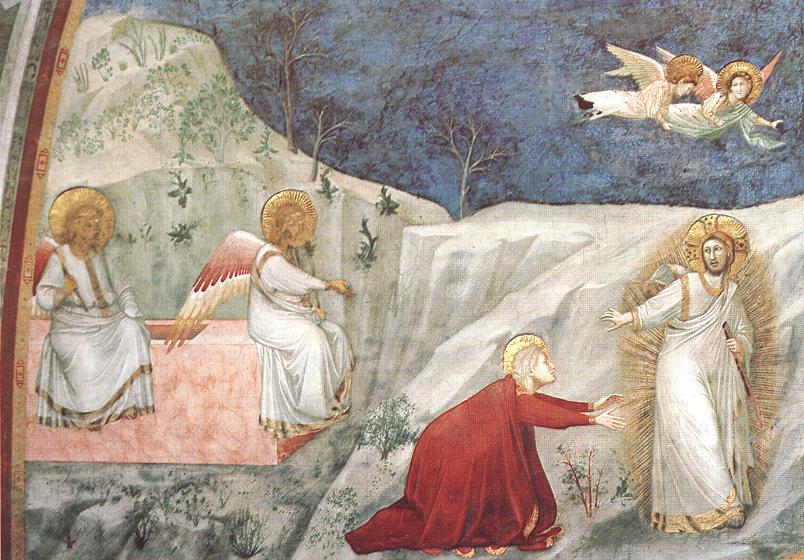
Larawan ng fresco sa Simbahan ni San Francisco sa Assisi, “Noli Me Tangere” na ipininta ni Giotto de Bondone noong ika-13 siglo. Mula sa commons.wikimedia.org.
Ngayong palaging makulimlim
ating panahon, ulan ay bumubuhos
katulad ng unos at kadilimang
bumabalot sa buhay ng karamihan,
kay gandang paglimi-limihan
at dasalan tagpo sa libingan ni Jesus
nang ito'y puntahan ng mga kababaihan
sa pangunguna ni Maria Magdalena
noong Siya ay muling nabuhay.
Madilim-dilim pa nang araw ng Linggo, naparoon na si Maria Magdalena sa libingan. Naratnan niyang naalis na batong panakip sa pinto ng libingan. Si Maria’y nakatayong umiiyak sa labas ng libingan; yumuko siya at tumingin sa loob. May nakita siyang dalawang anghel na nakaupo sa pinaglagyan ng ng bangkay ni Jesus, and isa’y sa gawing ulunan at ang isa nama’y sa paanan. Lumingon siya… at nakita niya si Jesus na nakatayo roon, ngunit hindi niya nakilalang si Jesus iyon.
Juan 20:1, 11-12, 14
Larawan mula sa GettyImages/iStockphoto.com.
Maraming pagkakataon
kapag labis ang aming hapis
Panginoon, ika'y hindi namin
nakikilala gayong katabi ka namin pala!
Katulad ni Santa Maria Magdalena marahil
ay mugto aming mga mata sa pagtangis
at dalamhati sa pagpanaw ng mahal
namin sa buhay o dili kaya habang
nagbabantay sa naghihingalong mahal sa buhay.
Hindi ka rin namin makilala, Panginoon
katulad ni Santa Maria Magdalena
sa tuwina kami'y nagbabata ng hirap
at sakit dahil mahigpit aming kapit,
pilit ibinabalik nagbabaka-sakaling
mapanatili mga nagisnang gawi,
pakikipag-ugnayan sa pumanaw naming
mahal o sa nag-aagaw buhay na tiyak
kami'y iiwanan nang lubusan.
Tinanong siya ni Jesus, “Bakit ka umiiyak? Sino ang hinahanap mo?” Akala ni Maria’y siya ang tagapag-alaga ng halamanan, kaya’t sinabi niya, “Ginoo, kung kayo po ang kumuha sa kanya, ituro ninyo sa akin kung saan ninyo dinala at kukunin ko. “Maria!” ani Jesus. Humarap siya at kanyang sinabi, “Raboni!” – ibig sabihi’y “Guro.” “Huwag mo akong hawakan, sapagkat hindi pa ako nakakapunta sa Ama,” wika ni Jesus. “Sa halip, pumunta ka sa aking mga kapatid at sabihin mong aakyat ako sa aking Diyos at inyong Diyos.” Kaya’t si Maria Magdalena’s pumunta sa mga alagad at sinabi, “Nakita ko ang Panginoon!” At tuloy sinabi sa kanila ang bilin ni Jesus.
Juan 20:15-18
Larawan kuha ng may-akda,pagbubukang-liwayway sa Camp John Hay, Baguio City, Nobyembre 2018.
Panginoon, kami ay tulungan
kung maari tawagin din sa pangalan
upang ikaw aming makilala at
maranasan sa piling namin
kung kami'y nabibigatan at
nadidiliman dahil iyong dahilan
sa pagparito ay upang kami ay samahan
pagaanin mga pasananin at hanguin
tungo sa bagong buhay kaloob mo sa tanan.
Nawa katulad ni Santa Maria Magdalena
ikaw ay lubusan naming makilala
upang sa amin mabanaagan sinag ng
iyong galak at katuwaan, mga palatandaang
tunay ngang ikaw ay aming nakita,
maihayag sa salita at gawa Iyong mga
habilin huwag matakot sa dilim,
krus ay palaging pasanin,
yakapin kamatayan upang ika'y makapiling.
Santa Maria Magdalena
kay Jesus kami ay ipanalangin
kasamaan tuluyan na naming lisanin
kabutihan pawang aming gawin;
mga pumanaw naming mahal sa buhay
ipanalangin mo rin, Diyos ay sapitin
habang mga naghihingalo sa amin
loob ay palakasin, buhay na sasapitin
walang kahulirip at maliw!  Amen.
The Lord Is My Chef Daily Recipe by Fr. Nicanor F. Lalog II
Friday, Feast of St. Mary Magdalene, 22 July 2022
Song of Songs 3:1-4   ><}}}}*> + ><}}}}*> + ><}}}}*>   John 20:1-2. 11-18
Photo from GettyImages/iStockphoto.com
Praise and glory to you,
O Lord Jesus Christ in giving
us today this Feast of St. Mary
Magdalene, the "apostle of the
apostles" who proclaimed to Peter
and company that you have risen
on that Easter morning!
Thank you most especially in
showing us through St. Mary Magdalene
the grace in that state many of us find
ourselves so often especially these days
of the pandemic - that of grieving.
On the first day of the week, Mary of Magdalene came to the tomb early in the morning, while it was still dark, and saw the stone removed from the tomb. Mary stayed outside the tomb weeping. And as she wept, she bent over into the tomb and saw two angels in white sitting there, one at the head and one at the feet where the Body of Jesus had been. And they said to her, “Woman, why are you weeping?” She said to them, “They have taken by Lord, and I don’t know where they laid him.” When she had said this, she turned around and saw Jesus there, but did not know it was Jesus.
John 20:1, 11-14
Dearest Lord Jesus,
I pray for those weeping,
for those grieving for the lost
of a beloved wife or husband,
a son or a daughter, a brother or
a sister, a friend or a colleague;
I also pray, Jesus, for those
who are weeping in silence,
fighting their tears, hiding when
they cry as they attend and care
for a dying loved one at home or
in the hospital.
Like St. Mary Magdalene, death
from its approach and coming
always has that dark presence in
us; mourning and weeping become
more difficult when nights become
longer we could hardly know morning
is coming or has broken.
And many times in those dark moments
we do not recognize you, Jesus,
present among us in our weeping,
right in our grieving for our loved ones.
Open our eyes, open our hearts,
enkindle our faith and hopes in you, Lord
in these long, dark hours of our grieving.
You know very well how difficult it is
to let go of a loved one like St. Mary Magdalene
when you have died; like her, we continue
to "cling" and "hold" to our beloved
in our old ways of relating with them
in the hope of again hugging them,
touching them, and perhaps telling them
how we love them and if given a chance,
to say sorry too for our sins and lapses.
“Noli me tangere” (touch me not) fresco in the Lower Basilica of St. Francis Assisi Church in Italy painted by Giotto de Bondone in the 13th century from commons.wikimedia.org.
Jesus said to her, “Mary!” She turned and said to him in Hebrew, “Rabbouni,” which means Teacher. Jesus said to her, “Stop holding on to me, for I have not yet ascended to the Father. But go to my brothers and tell them, ‘I am going to my Father and your Father, to my God and your God.'” Mary of Magdalene went and announced to the disciples, “I have seen the Lord,” and then reported what he told her.
John 20:16-18
Call us with our name again,
dear Jesus; call us anew with your
reassuring voice of love and kindness,
of mercy and forgiveness no matter
who we really are
for you are the only one sent by the Father
to assure us we are accepted despite and
in spite of our sins and weaknesses.
Let us exclaim again "Rabbouni" like
St. Mary Magdalene, filled with joy in
finding you amidst the darkness
in our lives as we learn to stop "holding"
on to our departed and dying loved ones
as we recall and realize your teaching
that every death is a sharing in your pasch,
a passing over into eternal life,
of leveling up our ties with them
in you, Christ Jesus
to the Father and the Holy Spirit.
Amen.
Photo by author, sunrise at Camp John Hay, Baguio City, November 2018.
Lawiswis ng Salita ni P. Nicanor F. Lalog II, Ika-01 ng Hunyo 2022
Larawan kuha ng may akda sa Bolinao, Pangasinan, ika-19 ng Abril 2022.
Mahigit isang linggo ko nang pinagbubulay-bulay ang pananatili at paglisan hanggang sa aking mapakinggan kahapon sa libing ng kaibigan itong magandang awit ni Bb. Cookie Chua dalawang dekada na siguro ang nakalipas.
"Kung ang buhay ay isang umagang nakangiti
At ikaw ay ang lupang sinusuyo ng bituin
Di mo man silip ang langit
Di mo man silip, ito'y nandirito pa rin

Kung ang lahat ay may katapusan
Itong paglalakbay ay makakarating din sa paroroonan
At sa iyong paglisan, ang tanging pabaon ko
Ay pag-ibig"
Noong nakaraan, ang tanong ko lang naman ay kailan tayo dapat manatili at kailan tayo dapat umalis o lumisan?
Dahil sa awit na aking napakinggan dala ng pagpanaw ng kaibigan, napalawig ang aking pagninilay ng panibagong katanungan: sa bawat paglisan, sino nga ba ang may higit na pag-ibig, ang umaalis o ang naiiwan?
Hayaan ninyo munang aking sagutin unang tanong, kailan ba tayo dapat umalis at kailan dapat manatili?
Larawan kuha ni G. Chester Ocampo sa Japan, 2017.
Napagnilayan ko ito noong nakaraang Martes nang ang mga pagbasa sa Misa ay tungkol sa pagkakulong nina San Pablo at Silas sa Filipos nang biglang mayanig ng malakas na lindol ang naturang lungsod (https://lordmychef.com/2022/05/24/prayer-to-know-when-to-stay-and-when-to-go/). Magpapakamatay na sana ang kanilang bantay sa pag-aakalang tumakas sina San Pablo at Silas nang pigilan siya mismo ni San Pablo na naroon pa rin sa kanilang selda (Gawa 16:22-34).
Hindi ba madalas kapag tayo ay nasa mahirap na sitwasyon, napakadaling pumasok sa isip natin ang basta mawala na lamang at makaalis, gaya ng pagbibitiw sa trabaho o panginibang bansa marahil?
Iyon nga nakapagtataka kina San Pablo at Silas! Bakit hindi pa sila tumakas na lamang pagkaraan ng lindol na sumira sa kanilang kulungan?
Sa kabilang dako naman, doon sa Mabuting Balita ng araw na iyon, si Hesus ay panay ang paalam ng kanyang paglisan sa kanyang mga alagad noong kanilang Huling Hapunan. Sinabi pa niya na ang pag-alis niya ay sa ikabubuti ng mga alagad niya dahil sa pagdating ng Espiritu Santo na susuguin niya (Jn.16:7).
Dalawang magkaibang sitwasyon, kailan nagiging mabuti at tama, ang manatili at umalis?
Mga sagot:
Una, sa manatili man o lumisan, pinakamainam palagi ay sundin banal na kalooban ng Diyos. Parehong mabuti ang manatili at lumisan ngunit nagkakaroon lamang ito ng kabuluhan o katuturan kung makikita batay sa kalooban at plano ng Diyos para sa atin.
Larawan kuha ni G. Chester Ocampo sa Japan, 2017.
Bakit nga ba hindi pa tumakas sina San Pablo at Silas nang mawasak ng lindol kanilang piitan habang nasa Filipos noon? Maliwanag nating makikita dito ang plano at misyon ng Diyos sa kanila upang masagip at mabinyagan bilang Kristiyano ang kanilang bantay sampu ng kanyang pamilya at angkan! Kung tumakas sina San Pablo at Silas, marahil ay nagpakamatay na nga kanilang bantay at hindi naging Kristiyano. Sayang!
Dito ipinakikita sa atin kahalagahan ng pananalangin upang maging maliwanag kung nasaan ang ating misyon sa buhay. Kung ika’y mananatili ngunit ibig ng Diyos ika’y lumayo tulad ni Abraham, kailanaman ay hindi ka mapapanatag sa buhay. Gayun din naman, kung ikaw naman ay magpipilit na umalis at lumipat dahil sa maraming magandang alok at pagkakataon ngunit hindi naman iyon ang layon sa iyo ng Panginoon, baka ikaw ay mabigo lamang sa iyong pupuntahan.
Minsan nais ko na liwanagin paborito nating salawikain na “Nasa Diyos ang awa, nasa tao ang gawa” kasi madalas, nauuna ang gawa ng tao at kapag nagkaproblema na, saka hihingi ng awa sa Diyos. Totoong nasa Diyos ang awa at nasa tao ang gawa kung bago tayo gumawa ay humingi muna tayo sa Diyos ng awa, liwanagin sa kanya ano ba ang dapat nating gawain? Hindi iyong kapag palpak na at marami nang sabit saka lalapit sa Panginoon.
Pangalawa, sa pagpapasya natin sa pananatili o paglisan batay sa pananalangin, isang bagay makikita natin palagi nangingibabaw sa Diyos ay kapakanan ng iba hindi ng sarili dahil tiyak palagi niya tayong pangangalagaan at hindi pababayaan.
Kaya, huwag matakot na manatili o lumisan, pangalawa sa Maykapal na ating batayan ng desisyon ay kapakanan ng iba, hindi ng sarili.
Batid ito ng maraming OFW at mga magulang na nangibang bansa. Mahirap at masakit ang lumisan ng bayan, iwanan mga mahal sa buhay at mahirap din naman ang maiwanan at mahiwalay sa kabiyak at magulang. Ngunit, kanilang tinitiis ang lahat para sa isa’t-isa, para sa minamahal at hindi para sa sarili.
Larawan kuha ni G. Chester Ocampo sa Japan, 2017.
Ganoon ang Diyos parati: hinihiram tayo para sa kapakanan ng iba. Ito yung katotohanan ng sinabi mismo ni Hesus na “Walang pag-ibig na hihigit pa sa pag-ibig ng isang taong nag-aalay ng kanyang buhay para sa kanyang mga kaibigan” (Jn.15:13).
Yung nanatili at lumilisan, kapwa nagmamahal at nagmamalasakit, nagiging mabunga ang buhay at pagkatao kung ang pasya ay batay sa kalooban ng Diyos.
Pangatlo, makikita natin na kapag tumpak ang proseso ng pagpapasya natin kung tayo ba ay mananatili o aalis, naroon din palagi paglago ng ating pagkatao at ng mga maiiwan natin. Sa pananatili at paglisan, higit na mahalaga ang pamumunga o “fruitfulness” at di lamang success.
May mga tao na matagumpay, successful wika nga dahil nanatili at nagtiyaga o kaya’y lumayo at nasapalaran sa ibang lugar ngunit hindi naman ganap sa buhay at tila baga mayroong kulang pa sa kanila. Kasi nga, wala namang naging lalim sa kanilang katauhan kanilang mga ginawa sa pananatili man o sa paglisan. Marahil ay sa kabila ng kayaman at katanyagan, wala silang natagpuan kahulugan sa buhay. Palaging mayroong kulang. Tulad ng Diyos na siya lamang ating kaganapan sa buhay.
Larawan kuha ng may akda sa Bolinao, Pangasinan, ika-20 ng Abril 2022.
Maituturing din ito bilang pagmamature o pagkakaroon ng gulang. May mga pagkakataon lalo na sa mga nakababata na kapag naiwanan at hinayaang mamahala sa kanilang sariling buhay, sila’y nagma-mature; gayun din naman kapag sila ay lumuwas ng lungsod upang mag-aral at manirahan ng sarili sa mga dorm, sila man ay nagma-mature.
Alalaong-baga, sa ating pananatili o paglisan, lagi ding dapat isaalang-alang paglago sa katauhan ng nanatili at lumilisan.
Kapwa puno ng biyaya at pagpapala ang pananatili at paglisan kung ito ay ating mapagpapasyahan ng mahusay at hindi ng padaskol-daskol lamang. Ito higit nating mapagtatanto kung ang usapin ng paglisan ay hindi lamang pansamantala at hindi ibang lunan na maaring marating.
Naiiba at lalong lumalalim ang kahulugan ng pananatili at paglisan kung ito ay sa larangan ng pangmagpakailanman, kapag ang paglisan ay kamatayan.
Iyan ang ating pagninilayang susunod upang sagutin ating pangalawang tanong, sa bawat paglisan, sino nga ba ang may higit na pag-ibig, ang umaalis o naiiwan?
Pansamantala, ay halina at pakinggan, sabayan kung mas mainam, itong awiting Paglisan at baka kayo man ay mayroong ibang mapagnilayan. Hanggang sa muli.
*Wala po kaming hangad na lumabag sa karapatang-pangsipi o copyrights ng may-ari ng awit at video na ito maliban sa namnamin kagandahan ng nitong musika.
Strictly speaking, today’s Feast of the Presentation of the Lord should be the closing of the Christmas season. It is the 40th day since the birth of Jesus when Mary had completed her days of purification to leave Bethlehem and offer her child with Joseph in the temple in accordance with their law that “every male that opens the womb shall be consecrated to the Lord” (Lk.2:23).
And like Christmas, we find in the Lord’s presentation his Cross looming tall, enlightening us how Jesus and his Cross, joy and suffering, life and death cannot be separated. In Simeon’s Canticle, we find that life’s many contradictions make living wonderful and meaningful, too! (See our Sunday homily, https://lordmychef.com/2022/01/29/living-loving-amid-contradictions/).
He (Simeon) came in the Spirit into the temple; and when the parents brought in the child Jesus to perform the custom of the law in regard to him, he took him in his arms and blessed God, saying: “Now, Master you may let your servant go in peace, according to your word, for my eyes have seen your salvation, which you prepared in sight of all the peoples, a light for revelation to the Gentiles, and glory for your people Israel.”
Luke 2:27-32
Photo by Mr. Raffy Tima of GMA-7 News, March 2020.
“Coming to terms with death is coming to terms with life.”
First thing we realize in this beautiful canticle of Simeon is the true meaning of joy in finding Jesus wherein we learn to befriend death as we come to terms with life and living. It is difficult to explain but evidently, it was pure joy that led Simeon bursting into a song.
St. Paul had a similar experience while in prison which he tried to explain to the Philippians when he wrote, “For to me life is Christ, and death is gain. If I go on living in the flesh, that means fruitful labor for me. And I do not know which I shall choose. I am caught between the two. I long to depart this life and be with Christ, for that is far better. Yet that I remain in the flesh is more necessary for your benefit” (Phil.1:21-24).
Those who have cared and lost a loved one to cancer or any terminal illness have experienced Simeon’s canticle. Remember when our loved ones have finally accepted their fate, when they suddenly become more emotionally stable and even joyful in their dispositions? Unlike before when they were first diagnosed with their illness, they were so afraid, always crying but as they came to embrace the reality, they cried less with a strong sense of courage while we are the ones crying more and most stressed out?
That is because the dying must have seen their direction, their final destination in life.
Like Simeon, they have seen God in the light of Jesus Christ while we who are to be left behind cry more not only due of the pain and sadness of separation but because we do not know where we are going, where we are heading to once our loved ones die. Feel the courage and confidence of Simeon boldly telling God to take him at that instance because he had found “the way, the truth and the life”, Jesus Christ!
Too often, we Filipinos take it as a joke, perhaps laughing to dismiss the topic or cope with the reality that to see God means to die like when we say “gusto nang makita si Lord”. But, that is the truth that Simeon is telling us in today’s gospel which is more “felt” in our own language, “Kunin mo na, Panginoon, ang iyong abang alipin, Ayon sa iyong pangako, Yamang nakita na ng aking mga mata ang iyong pagliligtas” (Lk.2:29-30). Imagine Simeon like the teenagers telling God to take him “now na!”?
Here we find at the presentation of the Lord in the temple how Simeon realized that coming to terms with death is coming to terms with life.
Photo by Ms. Nikki A. Vergara, 2020.
“Coming in the Spirit is living in the presence of God.”
Second thing we find in Simeon’s Canticle is the preeminence of the Holy Spirit in his life. We can never experience and find Jesus without being attuned first with the Holy Spirit who animates us and opens us to Christ’s coming.
Imagine the great crowds of people at the temple on that day, of couples trying to fulfill the law of Moses of purification and presentation of their first-born sons to God. How did Simeon know Joseph and Mary were the parents of Jesus? How was he able to accurately spot and find Jesus is the Messiah amid the many male children being offered on that day at the temple?
“To come in the Spirit” like Simeon is more than being faithful to God; it is having a good and pure heart that is ready to believe and act openly with courage, always looking forward at the fulfillment of what we believe. Coming in the Spirit is being at the right place at the right time when we make things happen than wait, exactly how Luke portrayed Simeon and Anna who both lived in the presence of God! Coming in the Spirit in living in the present moment in God.
Thirdly, we cannot see Christ nor live in the Spirit unless we humbly submit ourselves to God, our Lord and Master. Seeing Christ and living in the Spirit presuppose humility before God – we his creatures, he our Lord and Master.
Most of all, God our origin and our end too!
It is the principle and foundation of life as St. Ignatius of Loyola stressed in his Spiritual Exercises, “El hombre es criado para alabar, hacer reverencia y servir a Dios nuestro Señor, y mediante esto, salvar su anima”, that is, “Man is created to praise and serve God his Lord and Master and by doing this save his soul”.
There is something so beautiful and lovely, so touching in the opening verse of Simeon’s canticle that underscores firmly this basic truth we have always forgotten since the fall of Adam and Eve: “Now, Master you may let your servant go in peace, according to your word, for my eyes have seen your salvation, which you have prepared in sight of all the peoples” (Lk.2:29-31). Every time we sin, we act like Adam and Eve, playing gods, desiring to be like God.
Also known as Nunc Dimittis, Simeon’s canticle echoes the fiat of Mary to God during the Annunciation, expressing his fidelity and humility, his total submission to God. Most of all, it summarizes both the Magnificat of the Blessed Mother and the Benedictus of Zechariah, making Simeon’s Nunc Dimittis the finale in Luke’s Christmas “concert” on the birth of the Messiah.
This is the reason why we sing or recite Nunc dimittis at the end of our Night Prayer called Compline from the Latin completorium for “completion of the waking day”. It is the perfect prayer to close each day as we prepare for the coming brand new day to meet Jesus again, hoping we may be enlightened us in our life’s mission.
Or, if ever we do not wake up the following day, we thank God all the more in making us meet Jesus the past day, eager to finally sing to him our praises in eternity. Amen.
Photo by Mr. Raffy Tima of GMA-7 News, 18 January 2022.
Lawiswis Ng Salita ni P. Nicanor F. Lalog II, Ika-02 ng Pebrero 2022
Kapistahan ng Paghahandog kay Jesus sa Templo
Malakias 3:1-4 ><}}}}*> Hebreo 2:14-18 ><}}}}*> Lucas 2:22-40
Larawan mula sa crossroadinitiative.com.
Ngayon ang ika-40 araw mula ng Pasko ng Pagsilang ng Panginoong Hesus sa Bethlehem, Kapistahan ng Paghahandog sa Kanya sa Templo ng kanyang mga magulang na sina Maria at Jose.
Bukod tangi lamang itong salaysay na matatagpuan sa ebanghelyo ni San Lucas sapagkat ibig niyang ipakita noon sa kanyang mga mambabasa at mga taga-sunod na pumarito si Hesus para sa lahat ng tao, hindi lamang sa mga Hudyo.
Una itong pinagdiwang ng mga Kristiyano sa Jerusalem at lumaganap sa Silangan noong taong 500 kung saan ito tinawag sa wikang Griyego na “Ypapante” na ibig sabihi’y ang “Pagtatagpo” nina Hesus at ng dalawang matanda sa templo na sina Simeon at Anna.
Mula Silangan, umabot ang pagdiriwang na ito sa Europa na nakilala bilang kapistahan din ng Paglilinis ni Maria o “Purification of Mary”. Sa France, nagkaroon ng seremonyas ang mga Kristiyano ng pagbabasbas at pagsisindi ng mga kandila bago pumasok ng simbahan bilang pagkilala kay Hesus na tanglaw ng mundo ayon sa pahayag ni Simeon sa templo, “Liwanag itong tatanglaw sa mga Hentil, At magbibigay-karangalan sa iyong bayang Israel” (Luc. 2:32).
Kaya nang makarating sa Roma ang tradisyong ito noong taong 800, ito rin ang ginawang seremonya ni Papa Sergio I kaya tinagurian itong Candelaria (kandila). Makalipas ang mahigit isang libong taon noong 1962 sa Vatican II, ibinalik sa tunay na pangalan ito bilang Kapistahan ng Paghahandog sa Templo ngunit pinanatili ng mga obispo ang tradisyon ng pagbabasbas at pagsisindi ng mga kandila upang ipakita na si Hesus ang tunay na liwanag sa mundo sa aakay sa atin pabalik sa Diyos.
Kuha ni G. Cristian Pasion, Pasko ng Pagkabuhay, 2021.
Mahalaga na ating mapagnilayang muli at makita sa panahong ito na si Hesus ang tanging liwanag sa ating buhay na tumatanglaw sa gitna ng maraming artipisyal na mga ilaw, mga ilaw na ang binibigyang liwanag ay mga tao at kung sinu-sinong ibig na maging sikat o ibig kilalanin.
Ito yaong mga artipisyal na ilaw ng mga kamera at media na ang pinakikita o ang tinatampok bilang “highlight” ay mga karangyaan, kapangyarihan, katanyagan at mga kapalaluan sa mundo.
Inaanyayahan tayo ng kapistahang ito na tularan sina Simeon at Anna na inabangan buong buhay nila si Hesus na siyang tunay na liwanag ng ating buhay na dapat din nating hanapin, lapitan at sundan.
May isang tao noon sa Jerusalem, ang pangala’y Simeon. Matapat at malapit sa Diyos ang lalaking ito at naghihintay sa katubusan ng Israel. Sumasakanya ang Espiritu Santo na nagpahayag sa kanya na hindi siya mamamatay hangga’t hindi niya nakikita ang Mesiyas na ipinangako ng Panginoon.
Lucas 2:25-26
Bukod sa tanging si San Lucas lamang ang may kuwento ng tagpong ito, mayroon din siyang ginamit na kataga na hindi ginamit ng sinumang manunulat ng Bagong Tipan o maging ng alin mang aklat sa buong Bibliya.
Ito yung salitang naglalarawan kay Simeon bilang , “malapit sa Diyos” na sa Inggles ay “devout”.
Alam na natin yung salitang “righteous” o “matapat” na ginamit din ni San Mateo upang ilarawan si San Jose bilang taong matuwid o banal na tumutupad sa mga batas at alituntunin ng kanilang relihiyon.
Ngunit iyong “malapit” o “devout” sa Inggles o “deboto” sa pangkaraniwang pananalita, tanging si San Lucas lamang ang gumamit niyon sa buong Bibliya. Apat na ulit niya itong ginamit: minsan sa ebanghelyo na ating napakinggan at tatlong ulit sa ikalawang aklat niyang sinulat, Gawa ng mga Apostol.
Mas maliwanag ito sa Inggles nang tawagin ni San Lukas ang mga Hudyong pumunta sa Jerusalem noong Pentecostes bilang mga “devout Jews” o “mga taong palasamba sa Diyos” (Gawa 2:5); tinawag din niyang mga “devout men” o “mga taong may takot sa Diyos” yaong mga naglibing sa ating unang Martir na si San Esteban (Gawa 8:2); at sa pagsasalaysay ni San Pablo ng kanyang pagbabalik-loob, ginamit na salita muli ni San Lucas sa kanyang kuwento upang ilarawan si Ananias bilang “a devout observer of the law” o “taong may takot sa Diyos” (Gawa 22:12).
Alalaong-baga, para kay San Lucas, ang isang “devout” na tao, o wika nga natin deboto ay isang taong malapit sa Diyos dahil siya ay mayroong takot sa Diyos kaya tumutupad sa Kanyang mga utos! Hindi lamang sila matapat o faithful kungdi mayroong malinis na puso at laging handang tumupad ng buong tapang sa kalooban ng Diyos.
Kaya nga sa ating mga Pinoy, ang deboto ay taong malapit, yaong mayroong matalik na ugnayan sa Diyos at sa kapwa!
Sila yaong mga kaibigang maaasahan, mayroong sariling kusa at hindi naghihintay na pagsabihan pa kung ano ang gagawain. Mayroong sariling-palo katulad nina Simeon at Anna na kusang naghihintay, lumalapit sa Diyos at Panginoon.
“Presentation at the Temple” painting ng Italian Renaissance artist Andrea Mantegna noong 1455; hawak ni Mari ang Banal na Sanggol habang si San Jose naman sa gitna ay nakatingin kay Simeon na mayroong balbas na puti. Larawan buhat sa wikipedia.org.
Nadadalisay ang ating pagiging malapit sa Diyos sa isang buhay-panalangin na kung saan mayroong disiplina sa pagdarasal na hindi lamang mga salitang inuusal ng bibig kungdi sinasapuso.
Masdan paanong sinabi ni San Lucas sina Simeon at Anna na palaging nasa templo nananalangin. Higit sa lahat, ang pananalangin ay kaisahan sa Diyos kaya nabatid kaagad ng dalawang matanda na dumating na si Hesus sa pag-uudyok sa kanila ng Espiritu Santo.
Katulad din yan ng pagkakaroon ng matalik na kaibigan: palagi kayong nag-uusap, nagbabahaginan at nag-uunawaan kaya mayroong kaisahan.
Ang pagiging malapit sa Diyos o deboto ay hindi lamang pagaalaga at pagkolekta ng mga imahen at aklat dasalan kungdi pumapaloob sa kalooban ng Diyos na siyang sinasabi ni propeta Malakias sa unang pagbasa na biglang darating ang Panginoon sa kanyang templo na siyang ating mga sarili.
Gayun din naman, ang taong malapit sa Diyos palaging malapit sa kapwa, lalo na sa mga maliliit at nahihirapan sa buhay gaya ng mga may-sakit at kapansanan. Pagmasdan paanong kinilala ni Simeon mga magulang ni Hesus sina Maria at Jose. Binigyan niya ng halaga kanyang mga kapwa-tao hindi lamang ang Panginoong Hesus.
Ang tunay na kaibigang matalik ay yaong naglalapit sa atin sa Diyos at kabutihan, hindi kasalanan at kapahamakan. Nakakatagpo natin si Hesus sa ating mga kapwa tao gaya ng sinasabi ng may-akda ng sulat sa mga Hebreo na ating napakinggan.
Higit sa lahat, ang taong malapit sa Diyos o isang deboto ay puno ng tuwa at kagalakan. Damang-dama ang tuwa at galak nina Simeon at Anna nang makatagpo at makalong si Hesus na sa sobrang tuwa nila sila’y handa nang mamatay.
Iyon ang tunay na palatandaan ng malapit at nakatagpo sa Diyos: puno ng tuwa na anuman ang sapitin sa buhay, hindi niya alintana ang mga takot at pangamba, maging kamatayan sapagkat ito ang maghahatid sa tunay na paglapit at pagbuklod sa Ama kay Kristo Hesus. Amen.
Larawan kuha ng may-akda, Santo Niño Exhibit sa katedral ng Malolos, Enero 2022.
The Lord Is My Chef Quiet Storm by Fr. Nicanor F. Lalog II
A Funeral Homily, 29 December 2021
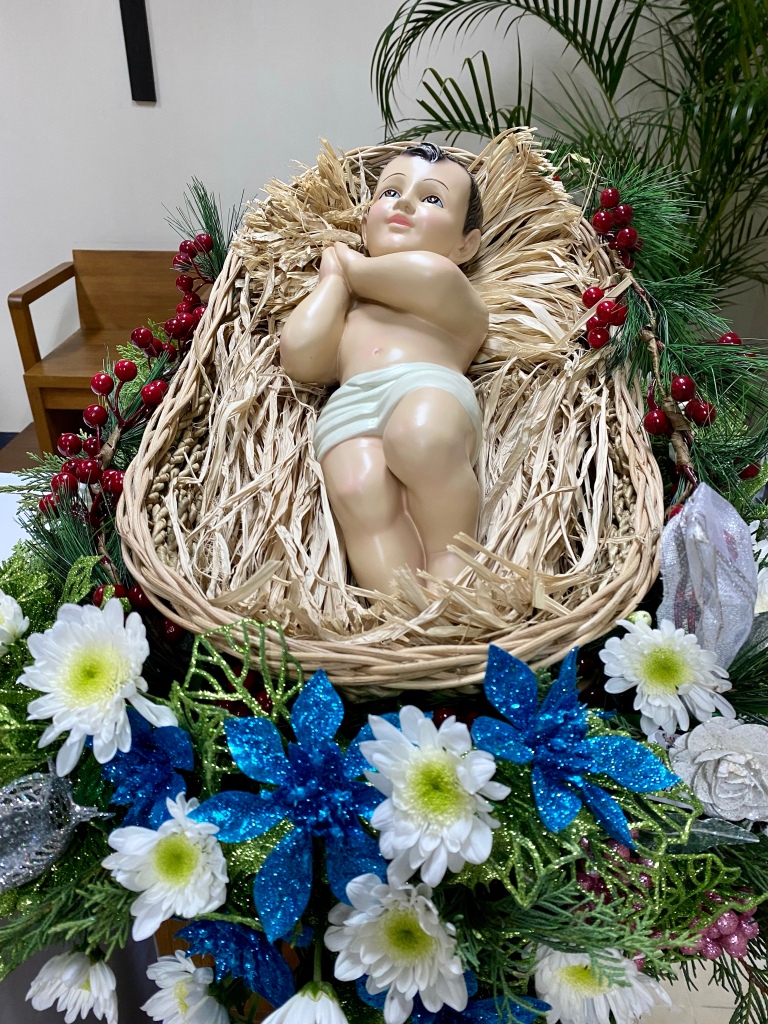
Photo by author, Basic Education Department chapel, Our Lady of Fatima University, Valenzuela City, 24 December 2021.
The Christmas liturgy offers us valuable lessons about life, of essentially the meaning of Christ’s coming into the world: He did not remove death and suffering but instead came to suffer and die with us so we may rise with him to eternal life.
Looming over the Nativity scene at Bethlehem is the Cross of the Calvary as we immediately see (except this year) the following day after Christmas on December 26 when we celebrate the feast of the first martyr of the Church, St. Stephen and again on the 28th when we wear red vestments during the Mass for the feast of the Holy Innocents massacred by Herod after being duped by the Magi.
These lessons of our Christmas liturgy become more real, even surreal for some, when there is death happening during this most joyous season of the year.
On this fifth day in the octave of Christmas, we heard from the gospel of Luke the story of the Presentation of the Child Jesus at the temple met by two elderly people promised by God to see the Christ before dying, Simeon and Anna.
Now there was a man in Jerusalem whose name was Simeon. This man was righteous and devout, awaiting the consolation of Israel, and the Holy Spirit was upon him. It had been revealed to him by the Holy Spirit that he should not see death before he had seen the Christ of the Lord. He came in the Spirit into the temple; and when the parents brought in the child Jesus to perform the custom of the law in regard to him, he took him into his arms and blessed God, saying: “Lord, now you let your servant go in peace; your word has been fulfilled: my own eyes have seen the salvation which you prepared in sight of every people, a light to reveal you to the nations and the glory of your people Israel.”
Luke 2:25-32
What a matter-of-fact story this Christmas of awaiting death, awaiting Christ’s coming!
What a beautiful scene reminding us of the realities of life and of death, coexisting side by side.
“Presentation at the Temple” painting by Italian Renaissance artist Andrea Mantegna done around 1455; Mary holding Baby Jesus while St. Joseph at the middle looks on the bearded Simeon. Photo from wikipedia.org.
Life is like our two hands, the left and the right, always with ironies and paradoxes: life and death, light and darkness, joy and sorrow, triumph and defeat, gains and losses.
That is how life is wonderfully portrayed today by Simeon who held in his arms the Child Jesus, filled with joy, basking in the sacred moment with the Savior, and the words that came from his mouth was about dying: “Lord, now you let your servant go in peace; your word has been fulfilled: my own eyes have seen the salvation which you prepared in the sight of every people.”
That is the “moment of Christmas” we mentioned last Saturday: “Christmas is therefore a blessed event, a most sacred moment of holy communion of man and God in Jesus Christ that continues to this day in the most regular yet miraculous reality of life going on amid many joys and pains, victory and defeats, prosperity and poverty, health and sickness, light and darkness and even in death” (https://lordmychef.com/2021/12/24/rejoicing-christmas-moments-all-year-through/).
Simeon shows us that it is only when we have fully appreciated this life we have in God do we fully accept and welcome death which is eternal union with God. Coming to terms with life is coming to terms with death and the same holds true vice-versa. That is why like Simeon we have to strive to live attuned to the Holy Spirit always to be aware of those sacred moments when Jesus comes to us in our daily living.
Photo by author, 18 November 2021.
I know, these are easier said than done… and, yes, it is doubly painful when our loved ones leave us during this Christmas season but when we try to reflect on it deeply, we find it more meaningful.
Ten years ago I met a family in my previous parish who have come to gather for 41 years every Christmas since their mother passed away on Christmas day. They told me how they were celebrating Mass on a bright sunny Christmas day when they have to immediately leave to rush to the hospital where their mother had died after a lingering illness. It was then I learned that their mother was born on March 24, the eve of the Solemnity of the Annunciation of the Birth of Jesus; that’s when I told them of how blessed they must be: their mother was born on the date we celebrate the Incarnation of the Son of God while she entered eternal life on the date we celebrate Jesus came to earth! They loved the imagery I have shown them and from then on until now, I have been invited to their family reunions….
That is the main blessing of Christ’s coming here on earth: he sanctified death that before was a curse. Recall how we have mentioned that Jesus Christ’s Pasch actually began at Christmas, when he passed over from heaven to earth, from eternal to temporal which reached its highest point in his Passion, Death and Resurrection that led to our salvation.
Photo by author, Basic Education Department chapel, Our Lady of Fatima University, Valenzuela City, 24 December 2021.
When the pandemic came last year, everybody laughed at the year 2020 with all kinds of memes and jokes, describing the year supposed to signify “perfect vision” as the worst and most disastrous. It was labelled so bad and almost cursed that everybody eagerly awaited 2021. Now, the jokes and memes are back, calling 2022 sounds like “2020 too”, insinuating another round of disasters as COVID surges happen in Europe and the States.
But, that is life.
As we have said at the start, it is like our two hands, the left and the right. There is always life and death, light and darkness, joy and sadness. That is why Jesus came and from then on we have reckoned time to his birth because every year is an Anno Domini, the year of the Lord.
Whenever we put our hands together at prayer, life and death becomes one along with joy and sorrow, light and darkness in Jesus Christ who gives meaning and fulfillment in everything.
The Lord Is My Chef Breakfast Recipe for Soul by Fr. Nicanor F. Lalog II
Monday, Week XVIII, Year I in Ordinary Time, 02 August 2021
Numbers 11:4-15  <*(((>< + ><)))*>   Matthew 14:13-21
Photo by author, sunrise at Camp John Hay, Baguio City, 2018.
On this first working day
of August 2021, I pray to
you our loving Father
to watch over the many
others today who feel
the same way as Moses
in the wilderness
being blamed by family
members and relatives,
by friends and others
for all their troubles
and mess in life.
When Moses heard the people,
family after family, crying at the
entrance of their tents, he was grieved.
"Why do you treat your servant
so badly?" Moses asked the Lord.
"Why are you so displeased with me
that you burden me with all this people?
Was it I who conceived all this people?
Or was it I who gave them birth,
that you tell me to carry them
at my bosom, like a foster father
carrying an infant, to the land you have
promised under oath to their fathers?
I cannot carry all this people by myself,
for they are too heavy for me."
(Number11:10, 11-12, 14)
It is so frustrating, Lord
every time there is a hardship or
difficulty being encountered along the way
to every goal and aspiration, we have to resort
to the blaming game with the accusing finger
pointing on somebody else except one's self
for all the woes and miseries,
the chorus lines of wishful thinkings
and litanies of things missed most
that suddenly the higher ideals are
all forgotten for the sake of little comforts
regardless of dignity and freedom recovered.
Teach us, dear Father
to be persevering like your Son:
When Jesus heard of the death
of John the Baptist, withdrew in a boat
to a deserted place by himself.
The crowds heard of this and followed him
on foot from their towns.
When he disembarked and saw
the vast crowd, his heart was moved with
pity for them, and he cured their sick.
He said to his disciples,
"There is no need for them to go away;
give them the food yourselves."
They all ate and were satisfied,
and they picked up the fragments
left over - twelve wicker baskets full.
Those who ate were about five thousand men,
not counting women and children.
(Matthew 14:13-14, 16, 20-21)
Like Jesus our Lord,
open our eyes to see more, not less
of what we have despite the many
burdens we also carry.
Open our hearts to have more room
for those with more difficulties
and hardships going through in life.
Stretch our hands wider to embrace
those burdened and about to give up
on their dreams and aspirations in life.
When we feel so weighed down by
all the blame of everybody else,
may we see more the light of life in Christ
than the darkness of death and surrender
like Moses at the wilderness.
A former classmate and friend from elementary school suddenly died of a heart attack last week. At his wake, everybody was saying of how they wish to die ahead of everybody just like Larry. “Mas gusto ko ako yung mauna” was the trending line of everyone’s conversation that there seemed a surge in courage with everyone bravely claiming readiness to die.
For me, it was like a déjà vu when suddenly it flashed to my mind our school discussions how we would prefer to die first than our parents. As kids, we were so afraid of living without parents that we deemed it better to be the first ones to die.
But, it did not mean we were not afraid of death nor of dying nor of living, too. We were just kids then.
Now that we have passed the half century mark of living, fast approaching the senior age, I think we know better the realities of life.
And of death.
On the surface, it seems that facing death and dying require super graces especially courage as we go into the threshold of the great unknown. But on deeper reflections, we realize that in dying, it could be really true that we have nothing to fear but fear itself because when we die, we don’t feel it anymore and would not even know it at all!
Death and dying can easily come to our minds when we are so hard pressed in life, when sufferings and pains are so unbearable that death wrongly becomes an escape, a cowardice than a courage no matter how hard others would romanticize it.
Yes, it takes a lot of courage to accept and face death
but much more courage is needed to live than to die.
Yes, it takes a lot of courage to accept and face death but much more courage is needed to live than to die.
Living is different because it is filled with paradoxes unlike death that is clearly “the end” and the start of the great unknown, with or without God.
But for us believers, for those with faith in God, living in itself is already a tremendous grace to overcome all fears and difficulties of being alive than being dead.
More than ten years ago, I lost my best friend from high school to cancer. When he was first diagnosed, he cried a lot whenever we would visit him, clearly indicating his fears of dying. Six months after receiving intensive treatment from one of the best hospitals in the country, Gil finally accepted the inevitable after his doctors said his cancer cells were “so aggressive”.
On that final week of his life, I visited him thrice when I noticed a marked change in Gil as he would no longer cry, looking so calm and serene, so composed even in his manner of speaking. This time, I was the one who cried a lot whenever he spoke to me of his “habilin” or reminders upon his death. That is when I realized how God gives the courage needed to face death once the dying accepts it and surrenders one’s self to Him our Maker. That is when death becomes peaceful and a blessing too when the dying is able to make peace with everybody and with God almighty.
Photo by Ms. Ria De Vera, June 2021.
When somebody dies, we cry not only because of the pain of separation. Deep inside us is the fear of living alone without them. That is why we need more courage to live than to die because when you die, you do not feel anymore.
The pain of death is more felt by those living than by those dying, especially those blessed to have prepared for it like my friend Gil as they already knew where they were going while those left behind are still at a loss for directions in life.
Living, facing life’s challenges requires tough courage. Real courage.
Our drive or will to live and survive shows the great amount of courage and strength we muster from deep within we never knew we even have at all! That is why after hurdling every challenge we faced in life, we wonder how we did it, how we made it.
From Facebook, May 2020.
That’s because of courage.
Congratulate yourself! You are good. You are doing well.
Those bruises and scars are badges of courage, medals of valor in fighting, in living this life that prepares us to fullness in heaven with God.
For as long as you feel pains and sufferings, hardships and difficulties… you are alive! Rejoice and celebrate life! Make the most of it. You can surely make it because you are alive.
And there lies the beauty and greatness of life – we are enormously blessed to be alive, blessed with courage to go on living because we are meant for something. We have a mission. Do not lose sight of that immense blessing.
When Jesus faced his death, it was not cowardice but courage because his dying was meant to lead us all to living fully in him. Jesus is life himself when he said “I am the resurrection and life” (John 11:25).
On the Cross, Jesus showed us the realities of life- of joys and pains, of sickness and health, of poverty and wealth, of light and darkness, most of all, of life and death in our daily dying to old self and rising to new life.
On the Cross, Jesus showed us that life is living in courage that comes from him to be like him: standing for what is true and good, for what is just and fair, and most of all, for loving another more than one’s self!
"The real test of courage is in living, not in dying",
according to the the Italian playwright
and poet Vittorio Alfieri (1749-1803).
“The real test of courage is in living, not in dying”, according to the the Italian playwright and poet Vittorio Alfieri (1749-1803).
Stop wishing and praying for death for it will surely come.
At the moment, activate that courage in you and start living life to the fullest.
Coming to terms with death is coming to terms with life and vice-versa. For us to have the courage to face death when that time comes means to have the courage first of all in living. It is a grace always in our heart which is in Latin called “cor”, the root of the word courage itself, meaning “coming from the heart”.
Have the heart – and courage to see and experience the many joys and beauty of life waiting for you! Don’t miss them.
The Lord Is My Chef Sunday Recipe for the Soul by Fr. Nicanor F. Lalog II
Thirteenth Sunday in Ordinary Time, Cycle B, 27 June 2021
Wisdom 1:13-15; 2:23-24 <+> 2 Corinthians 8:7, 9, 13-15 <+> Mark 5:21-24, 35-43
Photo by author, sunrise at the Lake of Galilee, the Holy Land, 2017.
Once again, we find Jesus crossing the Lake of Galilee this week with a crowd following him to listen to his teachings and experience his healing. What a beautiful image of life in Jesus, of constantly crossing the sea, sometimes in the darkness of the night amid storms.
It was something like what we had gone through last Thursday on the Solemnity of the Nativity of John the Baptist when as a nation we crossed history with the inauguration of the new Archbishop of Manila marked with the passing of former President Noynoy Aquino.
We hope and pray that like our gospel this Sunday, our recent crossing will lead us to new awakenings and realizations leading to national healing and yes, a resurrection, a rising from the dead like that young daughter of Jairus brought back to life by Jesus.
When they arrived at the house of the synagogue official, he caught sight of a commotion, people weeping and wailing loudly. So he went in and said to them, “Why this commotion and weeping? The child is not dead but asleep.” And they ridiculed him. Then he put them all out. He took along the child’s father and mother and those who were with him and entered the room where the child was. He took the child by the hand and said to her, Talitha koum, which means, “Little girl, I say to you, arise!” The girl, a child of twelve, arose immediately and walked around. At that they were utterly astounded.
Mark 5:38-42
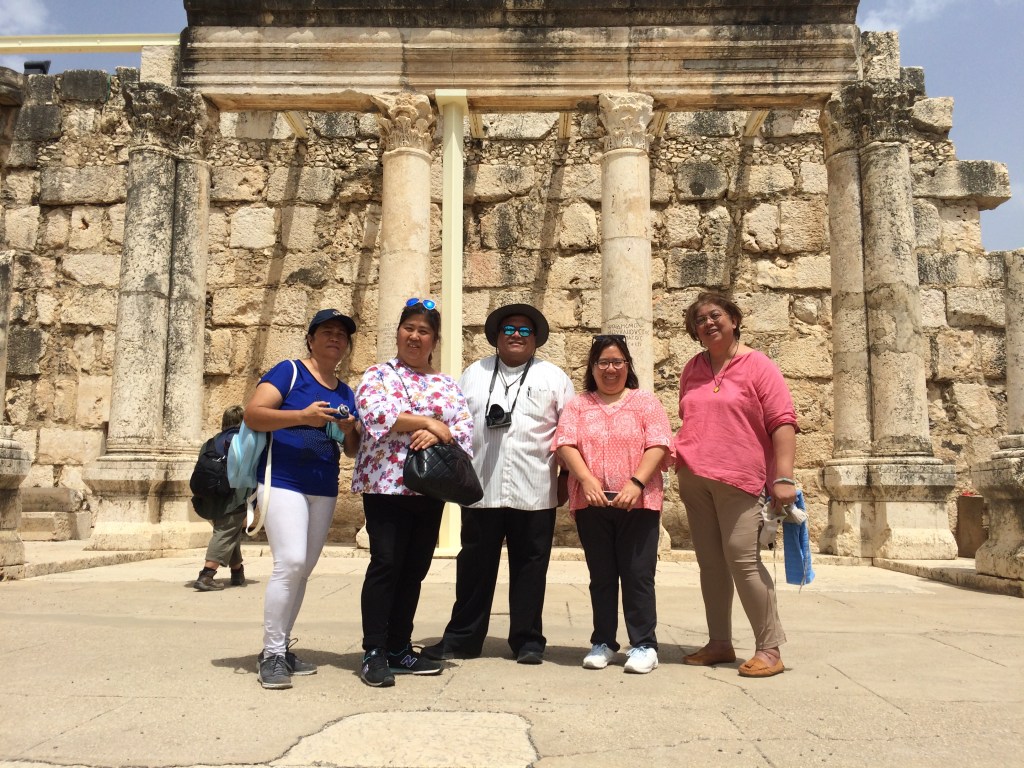
Photo by author with friends at ruins of the synagogue at Capernaum, 2017.
Examining our faith in Jesus
Notice, my dear reader, how similar is our story of Jesus raising to life the dead daughter of Jairus with that of the calming of the storm while crossing the lake last Sunday. In both instances, we find Mark “exaggerating” some details as if Jesus were somewhat oblivious to what was going on around him.
But again, Mark is not entertaining us with his stories narrating the powers and miracles by Jesus for he is telling us something deeper and very important with those surprising details of his stories. Primary of which is the supremacy of Jesus as the Son of God over nature like the sea and death both symbolizing evil and sin.
Mark affirms this truth today in telling us how Jesus brought back to life the dead daughter of Jairus, that Jesus is the Christ who had come launching a new world order where death and sin are overcome in him through his pasch.
Recall last Sunday how Mark ended his story with the disciples asking, “Who then is this whom even wind and sea obey?” (Mk.4:41).
That question is finally answered by our story today that clearly shows Jesus is the Christ, the Son of God who is life himself when he brought back to life the dead little girl.
Unfortunately, like during the time of Mark until now, many still doubt the powers of Jesus. Then and now, there is still that crisis of faith among us expressed by people from the synagogue official’s house who arrived and said, “Your daughter has died; why trouble the teacher any longer?”(Mk.5:35).
If you were in that crowd following Jesus, would you still go with him to enter the house? Would you heed his words like Jairus, “Do not be afraid; just have faith” (Mk.5:36)?
And while inside the house, knowing the little girl was already dead, would you join the rest in ridiculing Jesus who said, “The child is not dead but asleep” (Mk.5:39)?
These are the questions Mark is asking us today like the Christians of his time going through persecution and crisis in the early Church.
It is easy to “believe”, proclaiming with arms raised that Jesus is Lord, that Jesus is the Son of God but it is another thing to be truly convinced, to have faith in him when faced with the stark realities of life persistently attacked by sickness and death, of pains and sufferings that make us wonder why God could allow these to happen!
We have all felt our faith shaken when this pandemic struck us last year that took away those dearest to us so sudden, often without seeing them at all before they were cremated.
Like his story last Sunday, Mark’s narration of the raising to life of the daughter of Jairus is filled with many surprising details we find it so true with our own experiences of struggling to avoid or survive COVID-19, of having a sick child or spouse, of trying to make it to another day, of keeping our jobs to pay for food and rent and other needs of our family.
Do we really have that faith in Jesus, convinced that everything will be “okay” like Nightbirde who can brim with all smiles even if saddled with three kinds of cancer with a 2% chance of survival, claiming it is better than zero?
Today’s gospel is more than the revelation of who Jesus Christ is: the raising to life of the daughter of Jairus dares to invite us in examining our faith in God in the face of unrelenting attacks on life by sickness and death especially in this time of the pandemic.
Death and sickness are realities we face daily, that make us doubt God’s love and concern for us which the first reading clarifies with its declaration that
God did not make death, nor does he rejoice in the destruction of the living. For God formed man to be imperishable; the image of his own nature he made him. But by the envy of the devil, death entered the world, and they who belong to his company experience it.
Wisdom 1:13, 2:23-24
Photo by author, Lake of Galilee, 2019.
Arising and being whole in Jesus
Jesus came not to remove sickness and death, pains and sufferings which did not come from God for God is love. He came to be one with us in sickness and death, in our pains and sufferings so that we may rise with him too in his resurrection and be whole again in him.
Notice the words Jesus used in every healing, “your faith has saved you” to show that healing is not just a cure of the disease but making the person whole again. The words health, healing, wholeness, and holiness are all interrelated if we examine their origins and implications. Hence, we see that whenever Jesus would heal, it is not only an eradication of an illness but restoring harmony and balance in the person – physical, spiritual, mental, and emotional aspects.
It is the same in raising the dead young man in Nain and his friend Lazarus: Jesus or the evangelists used the word “arise” as a foreshadowing of Easter when Jesus himself rose from the dead, an indication of his power over death.
All these people in the gospels Jesus had healed and brought back to life eventually died but the good news is that death and sickness are no longer dark and an ending in itself.
Jesus came to bring salvation to the world, a wholeness in life which disease and physical death can no longer control and hold. That is why we need a firm faith to believe in him in spite of the many sickness and deaths now around us. It is faith that will enable us to grasp the full meaning of this pandemic and other sufferings we are going through in life. It is our deep faith in God that will also enable us to explain and show to others especially our loved ones the true meaning of healings and resurrections performed by Jesus who gives us a share in his victory over sickness and death.
May we dwell on the beautiful exposition of St. Paul today about being poor like Christ “that though he was rich, for your sake he became poor, so that by his poverty you might become rich” (2Cor. 8:9).
We can only be whole when we share whatever we have because that is when we allow Jesus to work in us, to be in us, to complete us. This happens when we wholeheartedly celebrate the Holy Eucharist where we become poor like Jesus, emptying ourselves of our sins, sharing with others our wealth through our contributions not only to the church collections but also to other charities where some of us share also time and talent aside from treasures.
The experience of the community pantry recently had taught us the value of St. Paul’s call for us to share and be poor like Christ when we were encouraged to take only what one needs and to give according to one’s ability – “kumuha ayon sa pangangailangan, magbigay ayon sa kakayahan”.
Yes, the realities of poverty and hunger remain with us but people are fed, sufferings are alleviated and most of all, the whole nation is united in believing again there is hope amidst the pandemic worsened by the systematic evil that has plagued us for so long.
Faith in God is deepened and strengthened when we become poor and weak like Jairus because that is only when we can arise and be whole again in Jesus Christ who is himself our Resurrection and Life. Amen.
The Lord Is My Chef Breakfast Recipe for the Soul by Fr. Nicanor F. Lalog II
Tuesday in the Seventh Week of Easter, 18 May 2021
Acts 20:17-27   ><)))*> + ><)))*> + ><)))*>   John 17:1-11
Photo by Mr. Red Santiago of his son, 2019.
God our loving Father, we thank you in giving us St. Paul and all the other saints who inspire us in dealing with life’s many troubles and challenges especially in this time of the pandemic. How great are his words – and courage – in telling “the presbyters of Ephesus” of the great trials coming his way that he might never see them again.
"You know how I lived among you
the whole time from the day I first came
to the province of Asia.  I served the Lord
with all humility and with tears and trials
that came to me because of the plots of the Jews,
and I did not at all shrink from telling you
what was for your benefit, or from teaching
you in public or in your homes."
(Acts 20:18-20)
Twice St. Paul mentioned to them, “I did not at all shrink”: what an amazing gift and grace of courage! He never chickened out in proclaiming Christ’s gospel of salvation, boldly admitting to everyone his repentance to God in persecuting the Christians before while at the same time proudly declaring his deep faith in Jesus in words and in deeds.
Most of all, St. Paul gallantly faced the realities of life like rejection and other hardships most especially of death, telling the Ephesians they would never meet again (v.25) as he bid them goodbye for Jerusalem that led him to his trial in Rome.
Too often, O Lord, we are afraid to seriously discuss or even entertain thoughts of our death, of our finiteness not only because we are afraid of dying but mostly because we are also afraid of facing the harsh realities of our selves — that we have been wasting our time, we have been remiss with our duties and responsibilities.
And yes, we have shrunk from many instances when we should have stood for what is right and good, for what is fair and just.
Worst, we have left you, dear God and failed to do good, choosing to sin than be loving and kind, and forgiving.
May we hold on always to your High Priestly prayer for us, Lord Jesus that like you, may we realize that the path to glory is always the way of the Cross.
We pray most especially for those who are stuck in situations they know so well as not proper and good; give them the grace and chance to correct their lives, to repent for their sins and return to you and their loved ones.
We pray for those we look up to who do not shrink but deep inside are so hard pressed with the many challenges of remaining upright and holy.
Keep us faithful to you, O Lord, now and forever. Amen.