The Lord Is My Chef Breakfast Recipe for the Soul by Fr. Nicanor F. Lalog II
Thursday, Week XX, Year I in Ordinary Time, 19 August 2021
Judges 11:29-39   ><)))*> + ><)))*> + ><)))*>   Matthew 22:1-14
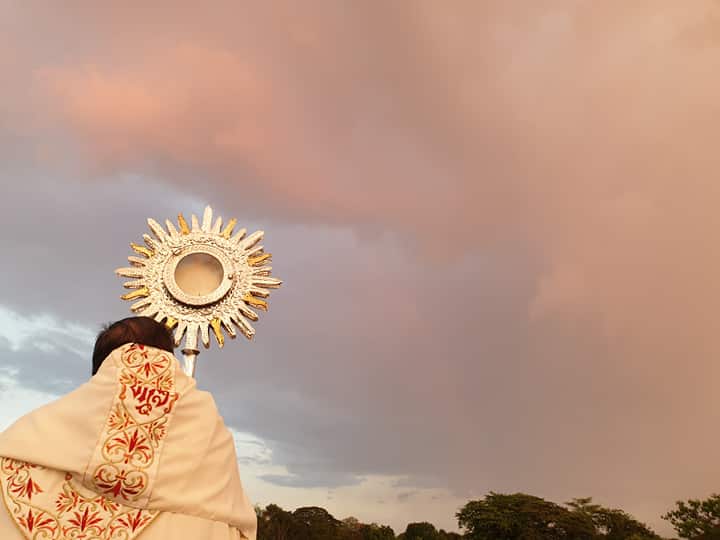
Photo by author, Jerusalem at dawn, May 2017.
God our loving Father,
please make me conscious
beginning today of every word
that I say, of its meaning and
implications; better, teach me
to be silent and still, to speak only
when necessary, avoiding especially
making any oath even before you.
Jephthah made a vow to the Lord. “If you deliver the Ammonites into my power,” he said, “whoever comes ot of the doors of my house to meet me when I return in triumph from the Ammonites shall belong to the Lord. I shall offer him up as a burnt offering. When Jephthah returned to his house in Mizpah (after defeating the Ammonites), it was his daughter who came forth, playing the tambourines and dancing. She was an only child: he had neither son nor daughter besides her. When he saw her, he rent his garments and said, “Alas, daughter, you have struck me down and brought calamity upon me. For I have made a vow to the Lord and I cannot retract.”
Judges 11:30-31, 34-35
"Words, words, words!"
Like Hamlet, we read and say
many words without meaning,
falsely believing words become true
when multiplied and said over and over
not realizing the most powerful words
ever spoken where those borne out of
silence when you created everything.
Give us the grace, dear God,
to be like Jesus your Son,
"the Word who became flesh"
to be a person of credibility
and integrity whose "yes" means "yes"
and "no" means "no" - always dressed
in "wedding garment" for your
banquet in heaven (cf.Mt.22:12-14).
Amen.
The Lord Is My Chef Breakfast Recipe for the Soul by Fr. Nicanor F. Lalog II
Wednesday, Week XX, Year I in Ordinary Time, 18 August 2021
Judges 9:6-15   ><]]]]*> ><)))'> ><]]]]*>   Matthew 20:1-16
Photo by Mr. Jim Marpa, 2019.
Your words today, O God our Father
brought me back to my elementary days
when we read Aesop's fables and
memorized lines from Shakespeare,
"The fault, dear Brutus, is not in our
stars/ But in ourselves that we are
underlings."  And how they both perfectly
jibe together in your words!

So many times we are like the great
trees in the forest, so proud of our giftedness
and abilities that we cannot give our selves
to you and others to serve; we are so in love
with our very selves, so proud or insecured
that most often we uncannily put
undeserving people to power
while we bear all the sarcasm in the end.
“Then all the trees said to the buckthorn, ‘Come; you reign over us!’ But the buckthorn replied to the trees, ‘If you wish to anoint me king over you in good faith, come and take refuge in my shadow. Otherwise, let fire come the buckthorn and devour the cedars of Lebanon.'”
Judges 9:14-15
Most of the time, Lord, we know
the fault is in us - not in the stars
nor among others nor from you
who truly loves each of us perfectly
like the vineyard owner, always
giving the same perfect amount of
love and mercy to everyone;
cleanse our hearts and our minds
of selfish thoughts, of insisting on
what we believe, on what we want;
give us the grace of discernment
to see clearly your will so we may
choose wisely the options we have
to put your divine plan in place.
Loving Father,
make me grateful always to what I have;
most of all, let me focus more on what
you have given me, not on what others
have received for in the end,
it could very well happen that
"the last will be first,
and the first will be last."
(Matthew 20:16)

And that, Lord,
is something completely
our fault.  Amen.
The Lord Is My Chef Breakfast Recipe for the Soul by Fr. Nicanor F. Lalog II
Tuesday, Week XX, Year I in Ordinary Time, 17 August 2021
Judges 6:11-24   ><]]]]'> + ><]]]]'> + ><]]]]'>   Matthew 19:23-30
Photo from Facebook, April 2020.
You know so well the hardships
we are all into these past months,
God our Father.
And you must have heard all our
complaints to you, even those we
have kept in our hearts for you also
know how we feel like Gideon.
Gideon said to him, “My lord, if the Lord is with us, why has all this happened to us? Where are his wondrous deeds of which our fathers told us when they said, ‘Did not the Lord bring us up from Egypt?’ For now the Lord has abandoned us and has delivered us into the power of Midian.”
Judges 6:13
You are so kind, dear God
in allowing us to bring out to you
what we feel which after all, we cannot
hide from you; and here lies your blessing:
after allowing us to recognize before you
the problems and misery we are into,
you send us to work on its solution.
The Lord turned to him and said, “Go with the strength you have and save Israel from the power of Midian. It is I who send you… Be calm, do not fear. You shall not die.” So Gideon built there an altar to the Lord and called it Yahweh-shalom.
Judges 6:14, 23-24
We all want peace,
we all desire a world with less
pains and sufferings like an end
to this pandemic but no one among us
would dare to follow your instructions,
your commands to do our part in finding
solutions to our many problems in life,
in doing our part in alleviating the pains
and sufferings of the sick and dying
for until now we have refused to give up
and surrender our selves to you, Lord.
We are afraid of detaching from whatever
or whomever attachments we have,
so we can be truly free for you and for others.
Most of all, we are afraid to get hurt,
to lose and to get lost in order to have you
and find life and fulfillment.
Give us the grace to realize
and keep in mind always
your Son's words today:
"For men this is impossible,
but for God all things are possible."
(Matthew 19:26)
Keep us calm, Lord, amid
the darkness and uncertainties
around us these days of the pandemic.
Amen.
The Lord Is My Chef Breakfast Recipe for the Soul by Fr. Nicanor F. Lalog II
Monday, Memorial of St. Rock (San Roque), 16 August 2021
Judges 2:11-19   ><]]]]'> ><]]]]'> ><]]]]'>   Matthew 19:16-22
Photo by author, October 2020.
Your words today, O God
our Father are just what we
needed most in this time when
we feel we are good, when we
are so complacent that all is fine.
Thank you for reminding us today
that we are not that "good" at all!
And worst, so many times our
being good are not even good enough!
A young man approached Jesus and said, “Teacher, what good must I do to gain eternal life?” He answered him, “Why do you ask me about the good? There is only One who is good. If you wish to enter into life, keep the commandments.” The young man said to him, “All of these I have observed. What do I still lack?” Jesus said to him, “If you wish to be perfect, go sell what you have and give to the poor, and you will have treasure in heaven. Then come, follow me.” When the young man heard this statement, he went away sad, for he had many possessions.
Matthew 19:16-17, 20-22
So many times, dear Father,
 good is not good where better
is expected, when being good
is not enough because in life,
what matters is not only what
we do but also what we have;
like that young man, there is
something or someone standing
between us and you, or anything
we cannot let go to be totally yours!
Forgive us, merciful God,
when we think more of ourselves
and forget you and others.
Forgive us when our possessions
posses us; give us the strength
to give up and surrender to you
our many attachments and false
securities that prevent us from becoming
truly free and truly your followers
like St. Rock, the patron of pandemics.
Amen.
The Lord Is My Chef Breakfast Recipe for the Soul by Fr. Nicanor F. Lalog II
Friday, Week XIX, Year I in Ordinary Time, 13 August 2021
Joshua 24:1-13   ><]]]]*> + ><]]]]'> + ><]]]]*>   Matthew 19:3-12
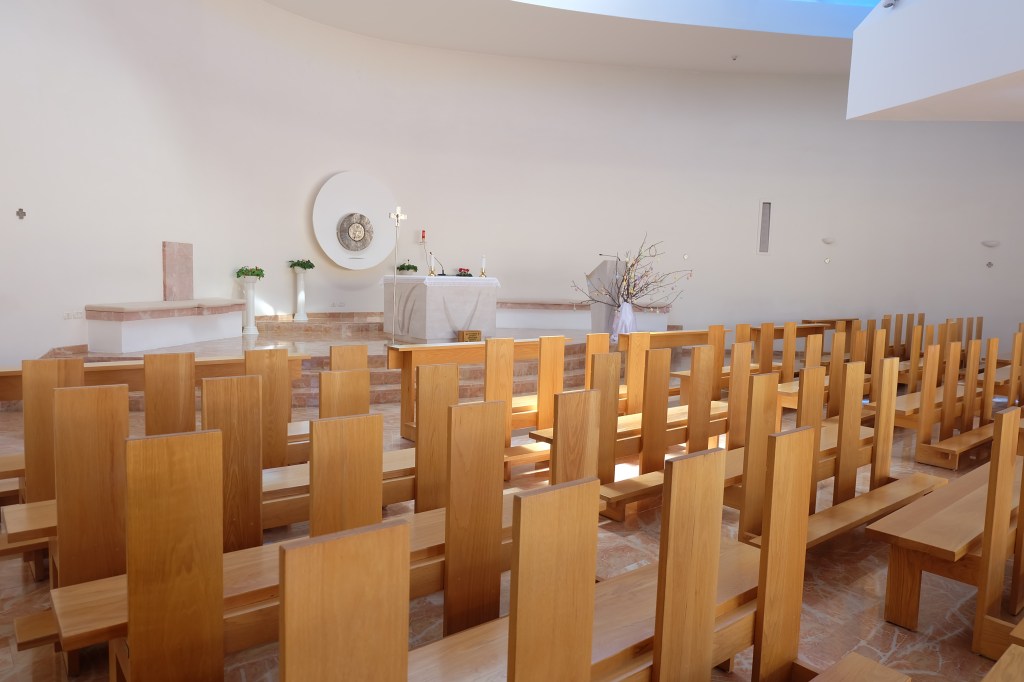
Photo by author, modern chapel at the Milk Grotto in Bethlehem, the Holy Land, 2019.
I know, dear God our Father,
you have no need of our words
nor works in exchange for your
abounding love and grace given us
in Christ Jesus; and there lies
your goodness and holiness when
all you ask of us is our fidelity
to your covenant, that we remain true
to you by dealing with love and justice
to one another which is all for our own good too.
“I gave you a land that you had not tilled and cities which you had not built, to dwell in; you have eaten of vineyards and olive groves which you did not plant.”
Joshua 24:13
You have given us everything, O God:
the earth and everything on it that we have
wasted and destroyed; worst of all, you
have given us family and friends, every person
 and people to love and cherish, respect and
be kind with but whom we have always
hurt with our words and actions when we
see only our very selves, failing to see
others as brothers and sisters in you
as Father from the the very beginning.
“Have you not read that from the beginning the Creator made them male and female, and said, For this reason a man shall leave his father and mother and be joined to his wife, and the two shall become one flesh? So they are no longer two, but one flesh. Therefore, what God has joined together, man must not separate.”
Matthew 19:4-6
Forgive us, merciful Father
for the "hardness of our hearts" (Mt.19:8),
in our building walls among us instead
of bridges to bring us close together
as your children reconciled in Jesus Christ;
help us to find the common grounds that
make us all the same, not different;
make us find and accept our vocation
in life so we may fulfill your calling
by serving you through one another
with love and respect, kindness and mercy
especially in this time of the pandemic.
Amen.
The Lord Is My Chef Breakfast Recipe for the Soul by Fr. Nicanor F. Lalog II
Thursday, Week XIX, Year I in Ordinary Time, 12 August 2021
Joshua 3:7-10, 11, 13-17   ><]]]]'>   Matthew 18:21-19:1
Photo by author, sunrise at Lake of Tiberias (Galilee), the Holy Land, 2019.
Praise and glory to you,
O God our loving Father!
How great indeed are your
works that you do everything for
our own good even long before
we are born, preparing us
for every great moment of
trials long before we have seen
them coming or even happening!
You are always there, Father
ahead of us in every step of
the way in this life like in the
entrance of your chosen people
to your promised land preceded
by the ark of the covenant,
parting the Jordan River so that
your people may cross on dry land
reminiscent of the Exodus at Red Sea.
No sooner had these priestly bearers of the ark waded into the waters at the edge of the Jordan, which overflows all its banks during the entire season of the harvest, than the waters flowing from upstream halted, backing up in a solid mass for a very great distance indeed… While all Israel crossed over on dry ground, the priests carrying the ark of the covenant of the Lord remained motionless on dry ground in the bed of the Jordan until the whole nation had completed the passage.
Joshua 3:15-16, 17
Dear God, whenever I review my life
especially those low moments of
failures and disasters, sins and evil,
sickness or wrong decisions when I thought
everything had collapsed and totally gone,
you were always there, bringing me to safer
grounds; you were always there five steps
or more ahead of me, fixing all the problems
and troubles I have fallen into, even trapped inside.
Like in the history of Israel from Abraham to Joshua,
you never stopped surprising me
with your mighty presence and love.

But the greatest of all
marvelous things you have done
to me and us all, loving Father,
is sending us your Son Jesus Christ
to save us from all our sins with your mercy
 and forgiveness that is without end.
Like in today's parable, teach us to be
merciful and forgiving to those who have
sinned against us for we are all
forgiven sinners you love so much.
You have done so much for us, Father,
but we have done so little for you through others.
Amen.
The Lord Is My Chef Breakfast Recipe for the Soul by Fr. Nicanor F. Lalog II
Wednesday, Memorial of St. Clare, Virgin, 11 August 2021
Deuteronomy 34:1-12   ><)))*> >><)))*> ><)))*>   Matthew 18:15-20
The Golden Gate bridge in San Francisco during the wildfires across California last year. Photo from MediaNews Group/The Mercury News via Getty Images; 10 September 2020.
God our loving Father,
today we pray that we become
bridges among people, bringing
them together, closing their gaps
instead of becoming a wall who
prevent unity and harmony.
As we end our readings from
the Book of Deuteronomy with
the death of Moses by recalling
his greatness in the history of Israel
and of the story of our salvation,
we remember his great role
of reconciling people with you,
O God our merciful Father;
Moses was indeed another prefiguration
of your Son Jesus Christ who came
to unite and reconcile in you mankind
separated by sin and evil.
"Amen, I say to you,
whatever you bind on earth
shall be bound in heaven,
and whatever you loose on earth
shall be loosed in heaven.  Again,
amen, I say to you, if two of you
agree on earth about anything
for which they are to pray, it shall
be granted to them by my heavenly Father."
(Matthew 18:18-19)
As we remember today
St. Clare who was a collaborator
of the great St. Francis of Assisi
and foundress of the Poor Clares,
she is most remembered too
in reconciling warring families and
kingdoms in Italy during her time;
in her life of prayer and austerity,
she had lived bridging people
with one another and with God,
exactly what we need these days
of the pandemic and social distancing.
We pray, dear God
with the intercession of St. Clare,
may we take this time of quarantine
to bridge our gaps with one another
especially with our family and friends
so that at the end of this pandemic,
we may start afresh anew
in Jesus Christ, working together
for a better world where we can live
in peace and harmony,
justice and freedom in the spirit
of humility and reconciliation.  Amen.
The Lord Is My Chef Breakfast Recipe for the Soul by Fr. Nicanor F. Lalog II
Tuesday, Memorial of St. Lawrence, Deacon and Martyr, 10 August 2021
2 Corinthians 9:6-10   ><}}}}'> + ><}}}}'> + ><}}}}'>   John 12:24-26
“Martyrdom of St. Lawrence, Deacon” by Hipolito de Rioja (16th c.) from commons.wikimedia.org
God our loving Father,
give us the grace in this time
of pandemic the zeal and fervor,
kindness and humor of Saint Lawrence,
deacon and martyr of the second century.
You must have loved him so much,
lavishing him with your grace to
witness the gospel of Jesus Christ
for St. Paul said:  "God loves a
cheerful giver" (2 Cor. 9:7).
Saint Lawrence was so cheerful
in his dedication and fidelity to his
office as deacon, serving the Pope
and the people by distributing alms
and other help to the poor and suffering.
In this time of the pandemic
when so many people lack
food and money and other essentials,
give us the courage to trust in you
Lord to share whatever we have.
Most especially, in this time of lockdowns
when so many of us are emotionally drained
with spirits sagging due to quarantine fatigue,
gift us with the wit and humor of Saint Lawrence
who asked his executioners to turn his body
to make his roasting even on all sides!
Above all dear Father,
like Saint Lawrence may we realize
that to see your Son Jesus
is not only with one's eyes but
with one's total self, willing to lose
one's life like a grain of wheat that dies
and produces much fruit in Christ (Jn.12:24).
Amen.
The Lord Is My Chef Breakfast Recipe for the Soul by Fr. Nicanor F. Lalog II
Monday, Memorial of St. Teresa Benedicta of the Cross, 09 August 2021
Deuteronomy 10:12-22   ><]]]]*>  +  <*[[[[><   Matthew 17:22-27
Photo by author, April 2018.
August has always been a difficult
month for us ever since when farmers
wait for their crops to bloom while
parents have spent most of their savings
for enrollment and other expenses
in the family; now, the pandemic has
made August more difficult with the
imposed lockdown due to pandemic.
But you have blessed us, O God our Father
in this month of August with so many great
saints in our midst to inspire us, to pray for us
in our difficulties like St. Teresa Benedicta
of the Cross who rallied her fellow prisoners
at Auschwitz to keep their faith in you, our God
even she had been a Catholic nun having
left Judaism after becoming an atheist for some time.
"Those who seek truth seek God,
whether they realize it or not."
-St. Teresa Benedicta of the Cross
Teach us to be like St. Teresa Benedicta,
Lord, who always sought the truth,
and once finding you, remained in you
like what Moses had asked your people:
  "And now, Israel, what does the Lord
ask you but to fear the Lord, your God
and follow his ways exactly, to love and
serve the Lord your God with all your heart
and all your soul." (Deuteronomy 10:12)
How good it is to know from a survivor
at Auschwitz that “Every time I think of her
sitting in the barracks, the same picture
comes to mind: a Pieta without the Christ.”
Like Jesus her Master, she died with him
and like him for her people and for their
persecutors, paying everything with her life
worth more than any amount of tax money
(cf. Mt.17:27).
St. Teresa Benedicta lived
during the darkest and most troubled
time in modern history, almost eclipsed
today by this COVID-19 pandemic;
we pray, God our Father, for the victims
of violence and exploitation that
their plight be addressed and finally
be stopped, never to happen again
in whatever form in the future.  Amen.
The Lord Is My Chef Sunday Recipe for the Soul by Fr. Nicanor F. Lalog II
Sunday XIX-B in Ordinary Time, 08 August 2021
1 Kings 19:4-8 ><]]]]'> Ephesians 4:30-5:2 ><]]]]'> John 6:41-51
Photo by Mr. Vigie Ongleo, 04 August 2021, Singapore.
Elijah went a day's journey into the desert,
until he came to a broom tree and sat
beneath it.  He prayed for death,
saying:  "This is enough, O Lord!
Take my life, for I am no better
than my fathers." (2 Kings 19:4)
Many of us can probably identify with the Prophet Elijah in the first reading today: so tired and fed up with all the sufferings and trials that seem unending with another round of lockdown due to a surge in COVID-19 infections.
“This is enough, O Lord!”
Elijah was not the only one to cry out to God in that way: there were Moses, Jeremiah, and Jonas who cried in a similar way while bent under the heavy load of responsibilities on their shoulders from God who never failed in coming to their rescue with his comforting and reassuring words of encouragement.
And this time as we have heard from the first reading, God sent Elijah with bread from heaven to sustain his 40 day journey to Mt. Horeb to escape the soldiers of Queen Jezebel out to kill him after a showdown with the priests of baal at Mount Carmel. God nourishes us not only spiritually and emotionally but also physically and materially if we know him, believe him, and love him in Jesus Christ his Son!
This is the context of the continuation of Jesus Christ’s second bread of life discourse at Capernaum, very timely in these two weeks of our fourth Enhanced Community Quarantine (ECQ) as we rely on God’s mercy and protection against COVID-19 and its new Delta variant.
Photo by Ms. Anne Ramos, March 2020.
Knowing Jesus.
When the people finally caught up with Jesus and his disciples last Sunday at Capernaum, the Lord immediately began his bread of life discourse by declaring “I am the bread of life; whoever comes to me will never hunger, and whoever believes in me will never thirst” (Jn. 6:35).
That is the first time in the fourth gospel where Jesus introduced himself with the “I AM” declaration very crucial for John in presenting him as the Christ, the Son of God. This would be followed later by similar statements when Jesus said “I am the good shepherd”, “I am the vine”, and “I am the resurrection”.
Recall how God told Moses to say to his people in Egypt that he was sent by “I am who am”; hence, when Jesus says “I AM”, it was a cue of who he is – the One who had come down from heaven!
The Jews murmured about Jesus because he said, “I am the bread that came down heaven,” and they said, “Is this not Jesus, the son of Joseph? Do we not know his father and mother? Then how can he say, ‘I have come down from heaven?'” Jesus answered and said to them, “Stop murmuring among yourselves.”
John 6:41-43
Reminiscent of the desert experience when the people murmured against God for lack of food and water, John also begins referring to the crowd as “Jews” to indicate their lack of belief in Jesus, like their forefathers who doubted God in the wilderness. Here we find something so common even to our own time of “knowing” God we so easily claim with everybody even if what we know does not square up with the reality.
Knowing is not purely cerebral. In the Jewish culture, to know is to enter into a relationship. Unlike us Filipinos who are so fond of name dropping when we usually tell everyone how we know somebody’s name and address like on Facebook – even if we are not friends or related at all!
To know anyone especially God by entering
into a relationship requires an opening of the mind.
That is why Jesus told the crowd to stop murmuring,
telling them and us today to stop limiting
ourselves to what we know who the Lord really is
because so often, we hardly know him at all!
To know anyone especially God by entering into a relationship requires an opening of one’s mind. That is why Jesus told the crowd to stop murmuring, telling them and us today to stop limiting ourselves to what we know who the Lord really is because we hardly know him at all!
We keep on receiving him in Holy Communion not as the Person but more as the Bread or Sacred Host; we go to Mass but hardly celebrate it with him; and lastly, we know Jesus more as provider and giver, rarely as companion and friend, most of all as Savior.
The Jews have refused to believe in Jesus at the very start because they have always been closed from knowing him, insisting they know better, that he is the “son of Joseph”. We have seen how last Sunday in their asking of “Rabbi, when did you get here?” in Capernaum was cloaked in suspicion at how was he able to cross the lake at night when winds were strong and waves were huge, unmindful of the signs he had shown in feeding them all at a deserted place.
Their knowing of Jesus as well as of God and the Scriptures have remained superficial, stuck in the material level manifested in their being too legalistic and ritualistic in religion without any regard for the people especially the sick and marginalized. Most of all, they did not seem to really believe in God as they saw more of themselves as God himself who knows everything!
Photo by Ms. Ria De Vera, March 2020.
Believing, loving Jesus.
All these words and actions by Jesus during his public ministry at Galilee and Jerusalem later would be used by his enemies against him, wrongly accusing him of blasphemy and disregard for the Laws or Torah. Their minds were all closed to God’s coming in Jesus or at least to his heavenly origin.
Jesus tried to clarify it with them by referring to God his Father, citing the prophet Isaiah:
“No one can come to me unless the Father who sent me draw him, and I will raise him on the last day. It is written by the prophets: They shall all be taught by God. Everyone who listen to my Father and learns from him comes to me. Amen, amen, I say to you, whoever believes has eternal life. I am the bread of life; this is the bread that comes down from heaven so that one may eat it and not die. I am the living bread that came down from heaven; whoever eats this bread will live forever; and the bread that I will give is my flesh for the life of the world.”
John 6:44-45, 47-48, 50-51
Now here we find Jesus taking off to higher level in his discourse, from knowing to believing that is perfected in loving. As we have said, knowing is relating. It is through our relationship with God that we are taught through Jesus Christ in knowing all about him. Yes, God in the Old Testament revealed himself to the Chosen People through the prophets and his Laws. But now, Jesus is telling the people that God is revealing himself through him, the Son who had come from heaven with the gift of faith.
As a gift, it is not like an ordinary present given to just one or several persons privileged to receive it like the Israelites in the Old Testament; faith as a gift from the Father is freely given to everyone for all time. Jesus is now inviting his audience in Capernaum including us today to open one’s mind, to level up in thinking and understanding because it is above the realm of material world but of spirituality that leads to relating, believing, and loving to be expressed later in the Eucharist, the sign of his self-sacrifice on the Cross.
Recall how last Sunday Jesus stressed that it is a work of God, not of men – that is faith! It is a gift from God freely given to everyone which every individual must “turn on” like a switch and make it operate. In that discourse also, Jesus added that the ultimate fulfillment of this faith in God as work of God is faith in himself, the Son sent by the Father.
In this scene alone, Jesus had mentioned the word “bread” five times, repeating it to the crowd like in a crescendo, rising from a sapiential or cerebral and material meaning into something so profound, higher level inviting us to put on our faith in him as he continues to reveal the Father’s plan for all mankind for all time leading to eternity.
And what is it that remains into eternity? LOVE!
"Love is fully sufficient to itself;
when it enters the heart,
it absorbs all other feelings.
The soul who loves,
loves and knows nothing more."
(St. Bernard of Clairvaux)
Photo from Dr. Yangas Colleges Inc., Bocaue, Bulacan in one of their community pantry called “Paraya”, May 2021.
Jesus is now hinting at his discourse the Eucharist as the meaning of the sign he did at the deserted place when he fed and satisfied the more than 5000 people from just five loaves of bread and two fish. Notice the words “eats” and “flesh” – indications of the elevation of knowing into believing, blossoming in love.
To eat his flesh is to accept Jesus, to be one in him and with him through one another. Knowing Jesus, relating with him means believing him, loving him through one another.
Faith is closely linked with love, they always go hand in hand because whoever believes truly always loves!
St. Paul sums up everything that Jesus had taught this Sunday with his call to us to “live in love, as Christ loved us and handed himself over for us as a sacrificial offering to God for a fragrant aroma” (Eph.5:1-2).
It is very difficult to dissect knowing, believing and loving, of finding the very cause of faith and love except in Jesus Christ who had come to us and continues to come in every Eucharistic celebration. There are times we can be aware of the reasons why we believe and love God and our beloved, even explain what we find so lovable in them but still difficult to locate with precision the starting point of everything. That is why at the end of this discourse two weeks from now, we find everybody leaving Jesus except the Twelve who chose to remain with him.
In this life, we may know so many things but we cannot know everything like God.
Let us stop murmuring, stop all talks and sink into silent prayer, opening our minds and our hearts to Jesus to receive him not only in words but in himself as Body and Blood in the Holy Mass so we can start loving him in one another to make life more bearable in these trying times. Amen.