The Lord Is My Chef Breakfast Recipe for the Soul by Fr. Nicanor F. Lalog II
Friday, Feast of the Transfiguration of the Lord, 06 August 2021
Daniel 7:9-10, 13-14  ><}}}'>  2 Peter 1:16-19  ><}}}'>  Mark 9:2-10
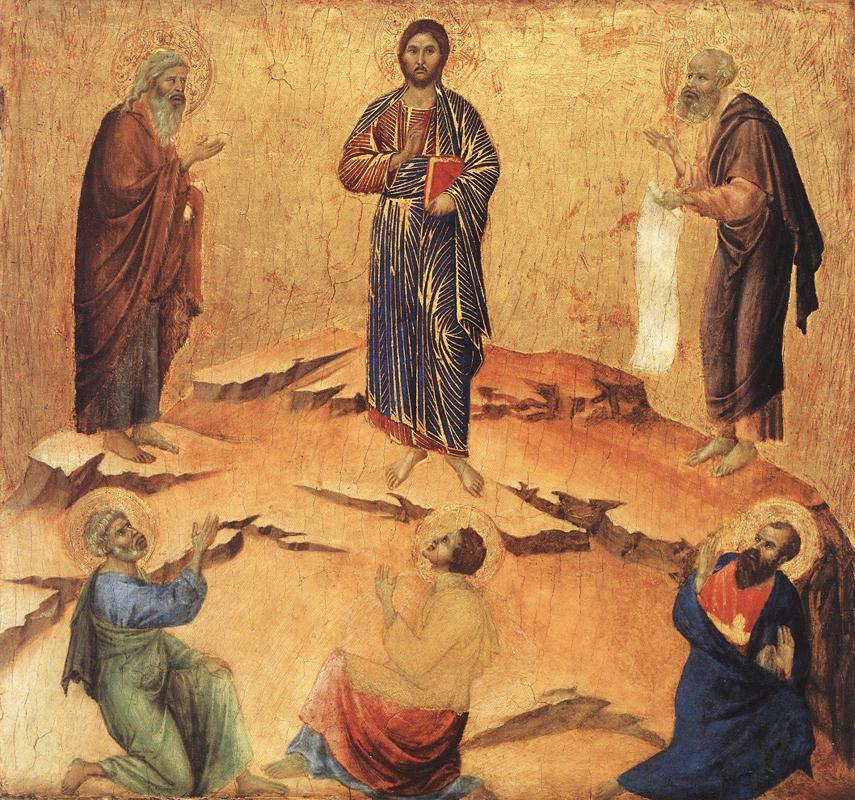
A 1311 painting of the Transfiguration by Italian artist Duccio di Buoninsegna from commons.wikimedia.org.
God our loving Father,
as we celebrate today the Feast
of your Son Jesus Christ's Transfiguration,
we come to you amid the same darkness
that enveloped them that night atop Mount Tabor
as we enter another series of lockdown
in this COVID-19 pandemic that has shaken
faith in you among many of us.
Like the apostles before his Transfiguration,
we too are wondering the meaning of Christ's
Passion and Death when he is your Son, the Messiah.
"How could he suffer and die?", they must have wondered.
In the same manner, we too wonder, could not stop
the questions coming from deep within us why are you
allowing these sufferings and trials, Lord?
Have you been angry with us, Lord, that these happen?
Jesus took Peter, James,
and John and led them up a high
mountain apart by themselves.
And he was transfigured before them,
and his clothes became dazzling white,
such as no fuller on earth could bleach
them... Then a cloud came, casting
a shadow over them; then from the
cloud came a voice, "This is my beloved
Son.  Listen to him." (Mark 9:2-3, 7)
Like Peter during the Transfiguration,
we do not know what we are saying to you, Lord;
whether we are filled with joy or burdened
with sorrow, we speak without thinking much
even if you know what is in our hearts.
Open our hearts, dear God, to always
listen to your Son by remaining with him
in his journey on the path to his Cross.
Moreover, we possess
the prophetic message that is
altogether reliable.  You will do well
to be attentive to it, as to a lamp
 shining in a dark place, until day dawns
and the morning star rises
in your hearts. (2 Peter 1:19)
Bring us back to the path of faith in you, Father;
despite our dismal progress or lack of faith this year due to
the many trials and difficulties by this pandemic,
open our hearts to let us go back to you in Jesus,
listening to him intently when all is dark and even dead
because for as long as we return to you, sin and failures
become means for us to be changed and transformed -
transfigured when we rise in Jesus Christ's Resurrection.
Amen.
The Lord Is My Chef Breakfast Recipe for the Soul by Fr. Nicanor F. Lalog II
Thursday, Memorial of the Dedication of St. Mary Major, 05 August 2021
Numbers 20:1-13   ><)))*> + ><)))*> + ><)))*>   Matthew 16:13-23
Photo by Vigie Ongleo, 03 August 2021, Singapore.
Glory and praise to you,
O God, our loving Father!
You are our rock and foundation,
our life and meaning especially
when dark clouds hover above us.
Bless us on this eve of our lockdown
due to a surge in COVID-19 infections.
May the responsorial psalm be our prayer too:
"If today you hear the voice of the Lord,
harden not your hearts."
Your words today speak a lot
of your goodness and holiness
and of our sinfulness;
so many times we have been like
your people at the wilderness with Moses:
always grumbling and complaining
at the slightest discomforts and difficulties,
easily forgetting your many blessings
like when they were at Meribah
and Massah without water to drink.
Then, raising his hand,
Moses struck the rock twice
with his staff, and water gushed
out in abundance for the peoples
and their livestock to drink.
But the Lord said to Moses
and Aaron, "Because you were not
faithful to me in showing forth my
sanctity before the children of Israel,
you shall not lead this community
into the land I will give them."
(Numbers 20:11-12)
Forgive us, dear God, when even
like Moses whom you trusted so much
we falter in our faith in you, giving in
to our "small" doubts of you that like him
we disobey your "little" instructions -
instead of speaking and just raising his staff
before the rock at Meribah, he struck it twice,
 doubting you and your words
but despite that, you still let waters
gush forth for the peoples and their animals.
The situation is so different at Caesarea
of Philippi, the pagan capital north of Israel
blessed with plenty of water where Jesus
stopped and asked his disciples what people say
 who he is, their answers were so varied
like our answers these days because we rarely
get to know you personally, always focused
on your blessings than your very self!
Forgive us, O Lord, for always forgetting you,
when there is plenty of "water" like at Caesarea Philippi.
He said to them,
"But who do you say that I am?"
Simon Peter said in reply,
"You are the Christ, the Son
of the living God."
Jesus said to him in reply,
"Blessed are you, Simon son of Jonah.
for flesh and blood has not revealed
this to you, but my heavenly Father.
And so I say to you, you are Peter,
and upon this rock I will build
my church, and the gates of the
netherworld shall not prevail against it."
(Matthew 16:15-18)
Open our minds and our hearts,
let Jesus reign in us, revealing to us
your plans and your will, God our Father;
let us be faithful to you in the Church
Christ had founded as vessel of your grace
and salvation to nourish us in this earthly journey;
as we celebrate the memorial of the dedication
of St. Mary Major in Rome, may we remain
united and faithful with the Mother Church
led by the Pope as successor of Peter, the Rock.
Amen.
The Lord Is My Chef Breakfast Recipe for the Soul by Fr. Nicanor F. Lalog II
Wednesday, Feast of St. John Marie Vianney, Patron of Priests, 04 August 2021
Numbers 13:1-2, 25-14:1, 26-29, 34-35   ><]]]]*>   Matthew 15:21-28
Photo by author, sky over Sinai desert in Egypt, 2019.
Dearest God our Father,
on this sacred feast of our
Patron St. John Marie Vianney,
I pray not only for us your priests
but most especially for everyone
going through so many trials and
tests these days as we near
another series of lockdown due to
a surge in COVID-19 infection.
I pray, O God, for more perseverance
in our faith, hope and love in you
so that we may remain committed to you
like that Canaanite woman in the gospel:
a pagan yet believed so much in Jesus,
crying out to him as "Lord" and "Son
of David" to heal her sick daughter (Mt.1521ff);
most of all, like St. John Marie Vianney,
teach us to persevere in life, in serving you
no matter how great are the odds against him
when he lived at a most unfavorable time
for the Church in France after a bloody revolution
that sowed strong anti-clerical, anti-Church
sentiments among the people.
Perseverance.
From the Latin root perseverare
that means to continue with one's
commitment despite the lack of
any success, surviving trials and no
matter what is the result, whether
we succeed or not in our goals,
we still emerge a better person,
a winner.
Perseverance
as perseverare in Latin means doubling
the efforts in keeping up with the doubling
of sufferings and trials we face,
of continuing to work hard even after
you have already worked so hard,
in fact so tired but would not
refuse to surrender and stop
because you are so committed,
truly a winner in the Lord!
Like St. John Marie Vianney:
despite his difficulties learning
and mastering the Church language
of Latin during his time, he persevered
in the seminary until he was ordained priest;
as Cure de Ars or pastor of the insignificant
village of Ars with its 250 inhabitants,
he persevered in preaching and
hearing confessions that were so appreciated
by everyone from all parts of France and Europe
because of his life of simplicity and humility.
And like that Canaanite woman after
being challenged by Jesus, saying
"It is not right to take the food
of the children and throw it to the dogs",
she said, "Please, Lord, for even the
dogs eat the scraps that fall from the
table of their masters" (Mt. 15:26-27).
Let us not imitate the men sent
by Moses to reconnoiter the land
of Canaan that instead of instilling
the virtue of perseverance on the people,
they discouraged them from taking possession
of the land you were giving them,
giving up everything they have worked for
and sacrificed; most of all, rejecting your gift
that eventually, you denied them entrance
into the Promised Land for forty years.
Let me persevere in loving you, Father
even if I am a sinner through
the mercy and salvation in Jesus;
Let me persevere in following your will
 through the Holy Spirit
even if I stumble and fall so often;
Let me persevere in serving you
dear Lord like St. John Marie Vianney
 even if I am self-centered,
always seeking rest and rewards.
AMEN.
The Lord Is My Chef Breakfast Recipe for the Soul by Fr. Nicanor F. Lalog II
Tuesday, Week XVIII, Year I in Ordinary Time, 03 August 2021
Numbers 12:1-13   ><]]]]'> + ><]]]]'> + ><]]]]'>   Matthew 14:22-36
Photo by Mr. Raffy Tima of GMA7-News, Batanes, September 2018.
Dearest God our Father,
you are just, always demanding
us to be fair and just like you,
to never malign and bear false
witness against one another
especially those serving you.
We pray, loving Father
for those among us buffeted
with nasty talks, malicious
stories and gossips especially
fake news that besmirch one's name
just to make them or their masters look good.
Miriam and Aaron spoke against Moses
on the pretext of the marriage he had
contracted with Cushite woman.
Now, Moses himself was by far
 the meekest man on the face of the earth.
So at once the Lord said to Moses and
Aaron and Miriam, "Come out,
you three, to the meeting tent."
Then the Lord came down
in the column of cloud,
and standing at the entrance of the tent,
called Aaron and Miriam.
When both came forward, he said,
"Now listen to the words of the Lord:
Why, then, did you not fear to speak
against my servant Moses?"
So angry was the Lord against them
that when he departed, and the cloud
withdrew from the tent, there was
Miriam, a snow-white leper!
(Numbers 12:1, 3-6, 8-9)
Please, Lord, keep us
 and those being maligned
 to be meek like Moses,
 remaining kind to those
who speak ill about us, especially those
supposed to be closest or dear to us.
Jesus said, "Come."
Peter got out of the boat
and began to walk on the water
toward Jesus.  But when he saw
how strong the wind was
he became frightened; and,
beginning to sink, he cried out,
"Lord, save me!"
(Matthew 14:29-30)
Give us, O God, the courage
and strength to withstand the fierce
winds of criticisms and lies hurled
by our detractors, unlike Peter
let us never doubt the love and mercy
and protection of your Son Jesus we follow.
Amen.
The Lord Is My Chef Breakfast Recipe for Soul by Fr. Nicanor F. Lalog II
Monday, Week XVIII, Year I in Ordinary Time, 02 August 2021
Numbers 11:4-15  <*(((>< + ><)))*>   Matthew 14:13-21
Photo by author, sunrise at Camp John Hay, Baguio City, 2018.
On this first working day
of August 2021, I pray to
you our loving Father
to watch over the many
others today who feel
the same way as Moses
in the wilderness
being blamed by family
members and relatives,
by friends and others
for all their troubles
and mess in life.
When Moses heard the people,
family after family, crying at the
entrance of their tents, he was grieved.
"Why do you treat your servant
so badly?" Moses asked the Lord.
"Why are you so displeased with me
that you burden me with all this people?
Was it I who conceived all this people?
Or was it I who gave them birth,
that you tell me to carry them
at my bosom, like a foster father
carrying an infant, to the land you have
promised under oath to their fathers?
I cannot carry all this people by myself,
for they are too heavy for me."
(Number11:10, 11-12, 14)
It is so frustrating, Lord
every time there is a hardship or
difficulty being encountered along the way
to every goal and aspiration, we have to resort
to the blaming game with the accusing finger
pointing on somebody else except one's self
for all the woes and miseries,
the chorus lines of wishful thinkings
and litanies of things missed most
that suddenly the higher ideals are
all forgotten for the sake of little comforts
regardless of dignity and freedom recovered.
Teach us, dear Father
to be persevering like your Son:
When Jesus heard of the death
of John the Baptist, withdrew in a boat
to a deserted place by himself.
The crowds heard of this and followed him
on foot from their towns.
When he disembarked and saw
the vast crowd, his heart was moved with
pity for them, and he cured their sick.
He said to his disciples,
"There is no need for them to go away;
give them the food yourselves."
They all ate and were satisfied,
and they picked up the fragments
left over - twelve wicker baskets full.
Those who ate were about five thousand men,
not counting women and children.
(Matthew 14:13-14, 16, 20-21)
Like Jesus our Lord,
open our eyes to see more, not less
of what we have despite the many
burdens we also carry.
Open our hearts to have more room
for those with more difficulties
and hardships going through in life.
Stretch our hands wider to embrace
those burdened and about to give up
on their dreams and aspirations in life.
When we feel so weighed down by
all the blame of everybody else,
may we see more the light of life in Christ
than the darkness of death and surrender
like Moses at the wilderness.
It is another rainy, heightened season of quarantine measures here in Metro Manila this Sunday with all religious gatherings being banned again while other business establishments especially like the spa are allowed with limited access by the public.
It is a crazy set up. While we believe there has to be some health protocols needed to control the spread of COVID-19, we find it so baffling since last year when religious gatherings continue to be at the bottom list of essentials in this predominantly Christian country.
And the more crazy is how every time our public Masses are restricted, the more people troop to churches to pray and worship!
That is why we have chosen the British neo soul band Jungle with their 2018 “Casio” for our featured music this Sunday that speaks of heartbreak and dysfunctional relationship. It is aptly called Casio because it speaks of a relationship so utilitarian like a Casio watch wherein the woman is just using the guy for her own advantage like the people who have followed Jesus to Capernaum in today’s gospel in order to have food again like last week (https://lordmychef.com/2021/07/31/beyond-when-and-what/).
Casio, playing on my heart just like a Casio
Breaking it apart so you can let it go
Wait another year that's not original, or cynical
Alright, let's go now

When all your dreams are gone
And you're still holding on
You waited far too long
Don't say
I know, you know it's over
We discovered this electronic band last year at the height of the pandemic and since then have been hooked with their funky sound that is characteristically British – intelligent and no non-sense. You have to see the music video for Casio we find so groovy and savvy, perfect for a quarantine Sunday with family.
In an interview at San Francisco’s KEXP, Jungle members explained how in their latest album For Ever (2018) they explored themes – “to shake off their shallow self-doubt” by making “more vulnerable songs” that gave “new directions where they were going in the soul.”
The band is clean cut like most Brits and hip, they really rock so well with their depth and simplicity – exactly what Jesus is asking in today’s gospel so we would desire things of higher levels that “lead to eternal life than food that perishes”.
*We have intentions of copyright infringements to the following music video except to share its good vibes and wonderful music and message.
The Lord Is My Chef Sunday Recipe for the Soul by Fr. Nicanor F. Lalog II
Sunday XVIII-B in Ordinary Time, 01 August 2021
Exodus 16:2-4, 12-15 ><}}}}'> Ephesians 4:17, 20-24 ><}}}}'> John 6:24-35
Photo by author, Church of Dominus Flevit overlooking Jerusalem, 2017.
Last Sunday we reflected the “where” of Jesus in asking Philip, “Where can we buy enough food” for the crowd who have followed them to a deserted place. We said that “where” of Jesus referred not to any place or location but to himself as the only one who can give “enough food” for everyone.
Today I invite you, my dear readers to join me reflecting on the “when” and “what” of the people who have followed Jesus to the other side of the lake, looking for him to have more food after that miraculous feeding last week. This time, the people are the ones asking Jesus with when and what that reveal their pride before God.
When the crowd saw that neither Jesus nor his disciples were there, they themselves got into boats and came to Capernaum looking for Jesus. And when they found him across the sea they said to him, “Rabbi, when did you get here?” Jesus answered them and said, “Amen, amen, I say to you, you are looking for me not because you saw signs but because you ate the loaves and were filled. Do not work for food that perishes but for the food that endures for eternal life, which the Son of Man will give you. For on him the Father, God, has set his seal.”
John 6:24-35
Photo by author, Capernaum’s shore at Lake Tiberias, 2017.
From a deserted place to Capernaum
To fully appreciate today’s gospel account by John, let us get its whole picture with a little help from Mark who started the story of Jesus and the Twelve crossing the lake to a deserted place to rest the other week. With his usual dash of humor, Mark told us how the people arrived to the place ahead of Jesus who was moved with pity at seeing the crowd “for they were like sheep without a shepherd that he taught them with many things.”
John continued the story last Sunday telling us how Jesus fed the people to their satisfaction with so many leftovers out of just five loaves of bread and two fish. The people were astonished that they tried to get Jesus to make him a king but he “withdrew again to the mountain alone.”
This Sunday, John continued his story telling us how the crowd finally found Jesus at Capernaum with his disciples.
How did he get there?
Photo by author, Lake of Tiberias (aka, Galilee), 2020.
According to Mark 6:45ff., after feeding the people, Jesus told the Twelve to proceed ahead of him to the other side of the lake that evening while he dismissed the crowd. Later that evening while Jesus was praying on the mountain, he saw his disciples’ boat being tossed by big waves due to strong winds. He followed them at the “fourth watch of the night” (about 3AM) by walking on water that terrified the Twelve who thought they have seen a ghost.
Upon identifying himself as the Lord, Peter asked to let him come to him by walking on water too; Peter sank when he doubted due to the strong winds until Jesus saved him and joined them on the boat going to Capernaum.
Mark’s story of Jesus walking on water after the miraculous feeding provides us the context for the people’s question to him today in John’s continuation of the story last week, “Rabbi, when did you get here?” (Jn.6:25): it was very difficult, almost impossible for anyone to have crossed the lake at night due to giant waves caused by strong winds. (Any pilgrim to the Holy Land can attest to this fact even today.)
And that was the main issue here: the people refused to see the deeper meanings behind the two events when Jesus fed them and the almost impossible crossing of the lake that night.
That is why Jesus did not answer their question by bluntly addressing their suspicious motive, “Amen, amen, I say to you, you are looking for me not because you saw signs but because you ate the loaves and were filled. Do not work for food that perishes but for the food that endures for eternal life, which the Son of Man will give you. For on him the Father, God, has set his seal.”
Ironically, while their asking of “when did you get here” implicitly acknowledged the Lord’s miraculous crossing of the lake, they still refused to accept it by downplaying everything like addressing Jesus as “Rabbi” when in fact, they were not interested with him but merely with the food he had given them!
Their question of "when"
was not really about his time of arrival there
but more of an inquiry on the person of Jesus....
Their question of “when“ was not really about his time of arrival there but more of an inquiry on the person of Jesus as they wondered how could he made it across the lake that night. They have failed to recognize the deeper meaning of the sign Jesus did in feeding them with enough food which Jesus explained anew.
And the stage is now set for Jesus to reveal himself, of who he really is which his disciples were also asking and contending among themselves all these weeks and months of being with the Lord.
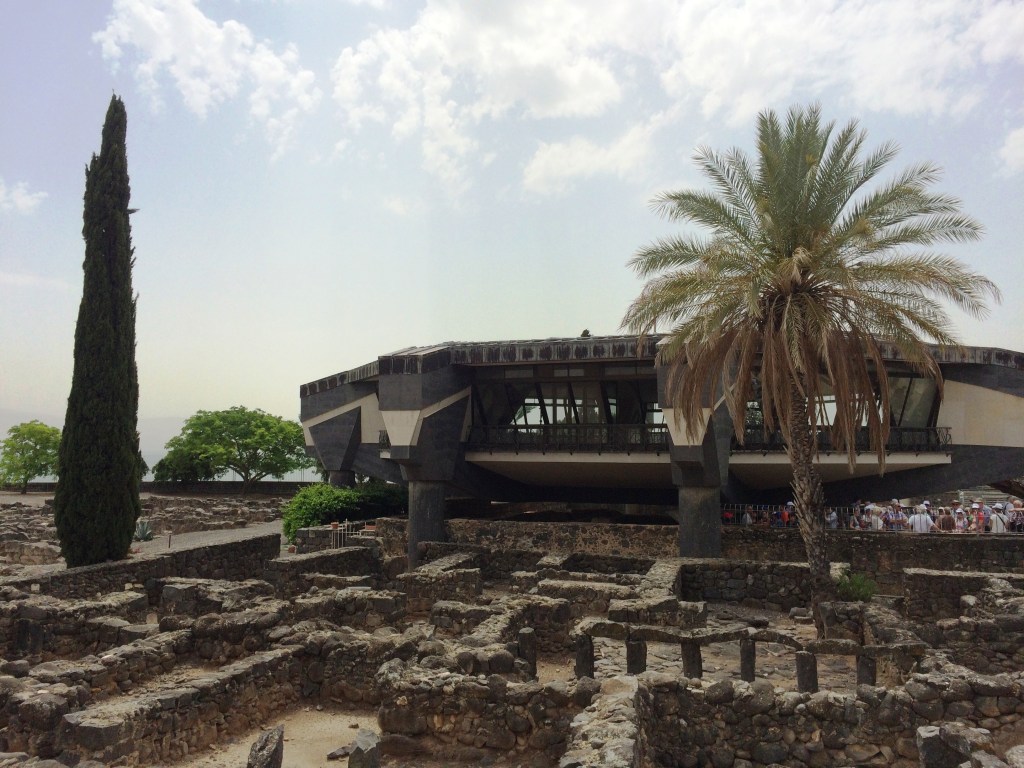
Photo by author(2017), ruins at Capernaum with a church built over the house where Jesus was believed to have stayed.
The need for us to be open to Jesus, our bread of life
Many times in life, our words and attitudes betray us of our inner motives, of our selfish interests to get near some people, to meet and know them not for who they are but for what we can have from them – even with God!
Remember Andrew last Sunday who did not bother to ask the boy’s name who gave the five loaves of bread and two fish from which Jesus performed his miracle? “There is a boy here with five barley loaves and two fish” – no name, just a “there” because the did not matter at all to Andrew except his food.
But there is something deeper being revealed in this attitude of forgetting the other person and being focused on material things: that is our pride, of believing only in ourselves, of playing God!
So they said to him, “What can we do to accomplish the works of God?” Jesus answered and said to them, “This is the work of God, that you believe in the one he sent.” So they said to him, “What sign can you do, that we may see and believe in you? What can you do? Our ancestors ate manna in the desert, as it is written: He gave them bread from heaven to eat.”
John 6:28-31
See how the crowd ignored Christ’s promise of giving food that endures for eternal life by following up their question with “What can we do to accomplish the works of God?” – another veiled question like their when, insisting on their own achievements and abilities, on what they can.
Worst is how in a twist highlighting pride in themselves as they dared to question Jesus again with “What sign can you do, that we may see and believe in you?“!!! Helloooooo….!
Photo by author at the ruins of the synagogue of Capernaum where Jesus preached his bread of life discourse, 2017.
They have gone so blinded with their pride that suddenly the miraculous feeding they have personally witnessed plus the unimaginable crossing of the lake at night remained lacking, not enough for them to believe in the powers of Jesus that they still asked for another sign.
Their “what” had become a demand from them, an insistence on Jesus the Son of God to give them signs from heaven even if they ironically preferred without them knowing how they were stuck at the lowest level of looking at things.
They have closed their eyes to seeing beyond the ordinary things happening to them since Jesus came teaching and healing. And now after feeding them, they demanded Jesus to follow them instead of them following the Lord.
Is it not the same thing happens with us when we keep on demanding God for proofs of his love and mercy, demanding so many other things from him above while we refuse to rise above ourselves, to “level up” in our lives?
This is the call by St. Paul in the second reading, that we must “be renewed in the spirit of your minds, and put on the new self, created in God’s way in righteousness and holiness of truth” (Eph. 4:23-24).
Once again, we are placed on highest level of quarantine due to a surge in COVID-19 cases with threats from the new Delta variant. Unless we learn to see this pandemic on a higher plane or level that calls for spiritual renewal among us, it will persist to disrupt and destroy lives among us.
It is more than a virus infecting us but an attitude deep within us when we have lost respect for one another and with nature. Pope Francis had long ago sounded this alarm in 2015 with his encyclical Laudato Si calling for each of us to change our lifestyle, each of us contributing for the betterment of the world because it is easiest to join advocacies but difficult to change our ways of life by having less.
With all these pandemic and climate changes going on around us, the signs are getting clearer for us to shift our perspectives, to see things on a higher plane like what Jesus had began at Capernaum declaring himself, “I am the bread of life; whoever comes to me will never hunger; and whoever believes in me will never thirst” (Jn.6:35).
Our misunderstandings with others and in life will persist unless we remove the veils and masks that cover so many insincerities of our questions in search of the many answers to the problems we face.
Like the people who have followed Jesus to Capernaum that day who were stuck in the desert experiences of Moses (first reading) that they could not see Jesus himself as the new bread from heaven; in fact, Jesus had to correct them that it was not Moses who gave the manna but God the Father in heaven who now gives Jesus to nourish us in our journey to eternal life.
Let us empty our selves of our pride to let Jesus fill us today with his words and his Body and Blood so we may realize next week the meaning and sweetness of himself as the Bread of life. A blessed week to you. Stay safe and keep praying. Amen.
The Lord Is My Chef Breakfast Recipe for the Soul by Fr. Nicanor F. Lalog II
Friday, Week XVII, Year I in Ordinary Time, 30 July 2021
Leviticus 23:1, 4-11, 15-16, 27, 34-37   ><]]]]*>   Matthew 13:54-58
Photo by author, 2020.
Today we move onto the third book
of your Pentateuche, God our Father,
the Book of Leviticus which tackles the
various celebrations you have stipulated
the children of Israel to celebrate until
they have entered your Promised Land.
It is good to know the major celebrations
you have set before them while still wandering
at the desert have become the roots
of our many liturgical celebrations that
have found fulfillment in your Son Jesus Christ
who is the basis of every sacrament and feast.
Unfortunately, dear Father,
like the children of Israel,
even us until now have forgotten
your saving presence in our midst
when we were wandering in the desert
of darkness and trials, sufferings and sins.
These, therefore, are the festivals
of the Lord on which you shall proclaim
a sacred assembly, and offer as an oblation
to the Lord burnt offerings and cereal offerings,
sacrifices and libations,
as prescribed for each day.
(Leviticus 23:37)
Forgive us, merciful God,
when we forget in our worship
and celebrations that its center
is you alone, not us nor the festivities
nor the rituals prescribed;
let us remember your continuing presence
among us marred by our many sins
when we break away from you; hence,
the need for oblations and offerings
for us to be reconciled in you again.
Jesus came to his native place
and taught the people in their synagogue.
They were astonished and said,
"Where did this man get such
wisdom and mighty deeds?"
And they took offense at him.
And he did not work
many mighty deeds there
because of their lack of faith.
(Matthew 13:54, 57, 58)
Let us be open to you, loving Father
through your Son Jesus Christ
who had come to reconcile us to you
by leading our celebrations
so we can have a perfect offering for you
in the Holy Sacrifice of the Mass;
Do not let us imitate his folks at Nazareth
who refused to accept him that he was
not able to make any miracle
for their lack of faith in him.  Amen.
Lawiswis ng Salita ni P. Nicanor F. Lalog II, Ika-29 ng Hulyo 2021
“Ang Pagbuhay kay Lazaro”, isang painting ni Duccio de Buoninsegna noong 1311. Larawan mula sa commons.wikimedia.org
Sinabi ni Marta kay Jesus,
"Panginoon, kung narito kayo
hindi sana namatay
ang aking kapatid." (Juan 11:21)
Maraming pagkakataon, Panginoon
ganyan din aming sinasabi
kapag kami ay sakbibi ng dalamhati,
tulad ni Santa Marta sa pagpanaw
ng kapatid nilang si San Lazaro:
Kung narito ka, Panginoon.....
...hindi sana nagkaroon ng pandemic,
...hindi sana kami nagipit,
...hindi sana kami nagkasakit,
...hindi sana kami nagkamali,
...hindi sana kami kinakapos,
...hindi sana kami nagugutom,
...hindi sana kami naghikahos,
...hindi sana kami nalinlang,
...hindi sana kami nasaktan,
...hindi sana kami nawalan,
...hindi sana kami nagkahiwalay,
...hindi sana kami napaalis,
...hindi sana kami natalo,
...hindi sana kami napahiya,
...hindi sana kami sumuko,
...hindi sana kami napatigil sa pag-aaral,
...hindi sana kami naulila,
...hindi sana kami naligaw,
...hindi sana kami nabigo,
...hindi sana kami nagkaganito.
Tiyak na marami pa kaming
masasambit na sana ay hindi
nangyari kung narito ka,
Panginoong Jesu-Kristo
katulad ni Santa Marta nang
pumanaw kapatid niya at
kaibigan ninyo na si San Lazaro;
ngunit hayaan din ninyo na aming
mapagtanto kalooban at layon ninyo
kaya kayo naparito upang kami
ang maging kapanatilihan mo
at sumaklolo sa mga nasa peligro.
Itulot po ninyo, Panginoon
aming tularan bunsong kapatid
nina Santa Marta at San Lazaro,
si Santa Maria ng Betanya:
manatili sa iyong paanan,
magnilay at madalisay ang buhay
sa pananalangin upang sa pagdamay
namin sa mga nahihirapan at nabibigatan
ikaw bilang Buhay at Muling Pagkabuhay
ay kanilang panaligan sa aming
pagkakapatiran at pagtutulungan
maramdaman nila, narito ka, Panginoon!
Icon ni Jesus dumalaw sa magkakapatid na San Lazaro, Santa Maria, at Santa Marta sa kanilang tahanan sa Betanya. Larawan mula sa http://www.crossroadsinitiative.com.
The Lord Is My Chef Breakfast Recipe for the Soul by Fr. Nicanor F. Lalog II
Thursday, Memorial of Sts. Martha, Mary and Lazarus, Siblings and Friends of the Lord, 29 July 2021
Exodus 40:16-21, 34-38   ><]]]]'> + ><]]]]'> + ><]]]]'>   John 11:19-27
An icon of Jesus visiting his friends, the siblings Sts. Lazarus, Mary and Martha. Photo from crossroadsinitiative.com.
What a tremendous grace from you,
dearest God our Father through
Pope Francis that we now celebrate
the Memorial not only of St. Martha
but also of her brother St. Lazarus and
sister St. Mary who were all dear friends
of Jesus Christ he frequently visited in
their home at Bethany.
Finally, a beautiful imagery not only
of friendship in the Lord but most of all,
the oft-neglected and taken for granted
relationships of brothers and sisters.
In this time of the pandemic
you know how, O dear God,
we have finally come together
as families free from all excuses
of work and studies, of being far and away;
but sadly, many have ignored and missed
the opportunities to bond together
and mend many gaps long festering
among siblings; instead of fighting and
rivalries, may brothers and sisters
in every family emulate the love and
respect among Saints Martha, Lazarus and Mary.
“The Raising of Lazarus”, 1311 painting by Duccio de Buoninsegna. Photo by commons.wikimedia.org
We pray for all siblings to gather anew
as one family in prayers before you, Lord,
like Saints Martha, Lazarus and Mary;
help them create a space for your Son
Jesus Christ who is the surest bond among us
despite our many differences; like the children of
Israel in the wilderness, may all siblings be
animated and moved by your presence, God our Father:
"Whenever the cloud rose from the dwelling,
the children of Israel would set out on their journey.
But if the cloud did not lift, they would not go forward;
only when it lifted did they go forward." (Exodus 40:36-37)
Most of all, give us the grace
to be the presence of Jesus Christ
when our siblings are sick and burdened
with all kinds of sufferings and miseries
like Martha and Mary present to each other
awaiting Christ’s coming after Lazarus had died:
Martha said to Jesus, "Lord, if you had been here,
my brother would not have died."  Jesus told her,
"I am the resurrection and the life; whoever
believes in me, even if he dies, will live,
and everyone who lives and believes in me
will never die.  Do you believe this?" (John 11:21, 25-26)
Photo by author, Mirador Jesuit Hills, Baguio City, 2018.
Yes, dearest Lord Jesus,
I believe you are the resurrection and life;
whoever believes in you not only lives
but most of all becomes your very presence
especially among those going through
various forms of darkness in this life;
give me the grace to bring your light
and your life, your joys and your hopes
to those heavily burdened
 so they may believe like St. Martha
that "if you, Lord, had been here,
my brother would have not died."
Like St. Martha, and most likely
her siblings, too, St. Lazarus
 and St. Mary who may not have
  understood fully your words and teachings,
keep me open to your coming,
to your visits, sweet Jesus;
make my heart like theirs
filled with warmth and hospitality
to let you stay and reign in me;
most of all, like the three holy siblings
let me share with others the gift of kindness,
of being a kin to everyone in you, with you.  Amen.