The Lord Is My Chef Breakfast Recipe for the Soul by Fr. Nicanor F. Lalog IIMonday, Week XXIII, Year II, 07 September 20201 Corinthians 5:1-8 /// Luke 6:6-11
Photo by Mr. Chester Ocampo, 2019.
Forgive us, loving and merciful Father, for the many times we have chosen to be silent in the face of ongoing evil around us, when we unknowingly conspire in silence against you, against life, against justice.
Both our readings today speak about this deafening silence among us in many situations when we are so afraid to speak for what is good and true.
On a certain sabbath Jesus went into the synagogue and taught, and there was a man there whose right hand was withered. The scribes and the Pharisees watched him closely to see if he would cure on the sabbath so that they might discover a reason to accuse him. But he realized their intentions and said to the man with the withered hand, “Come up and stand before us.” And he rose and stood there. Then Jesus said to them, “I ask you, is it lawful to do good on the sabbath rather than to do evil, to save life rather than to destroy it?”
Luke 6:6-9
Worst than our silence in standing for life and dignity of persons is our “unwitting support” for evil and sin so as not to disturb our family and community.
Brothers and sisters: It is widely reported that there is immorality among you, and immorality of a kind not found even among pagans — a man living with is father’s wife. And you are inflated with pride. Should you not rather have been sorrowful? The one who did this deed should be expelled from your midst.
1 Corinthians 5:1-2
How true is the saying that “the only thing necessary for evil to triumph is for good men and women to do nothing” (attributed to both Edmund Burke and John F. Kennedy).
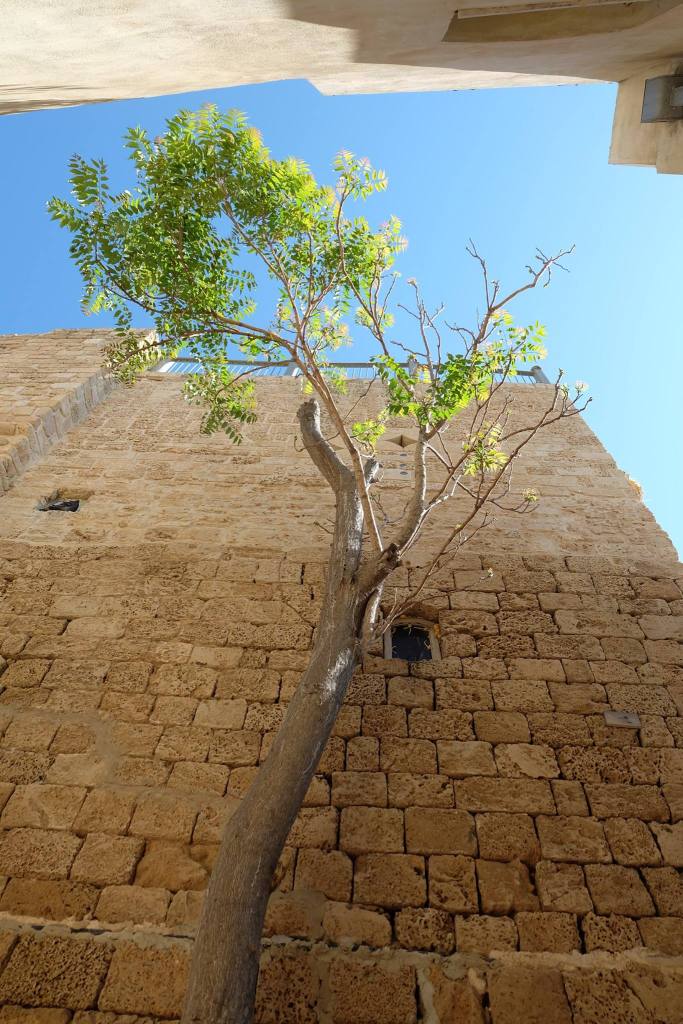
Photo by author, Jaffa, Israel, May 2017.
Forgive us, Lord Jesus.
Strengthen us inside, make our will and our hearts strong to stand for your Gospel specially when friends and families are the ones doing what is wrong and sinful.
Strengthen our firm resolve to be consistent in living our new life in you, Jesus, that is free from what others would say about us and free to be our true selves freed from sin, free to love and be faithful to you and for others.
Enlighten our minds and our hearts with your Holy Spirit on the actions we must take and words we must say to win them back to you.
Most of all, purify our intentions that we do this out of love for you and our beloved going astray. Amen.
The Lord Is My Chef Sunday Recipe for the Soul by Fr. Nicanor F. Lalog II
Week XXIII, Cycle A in Ordinary Time, 06 September 2020
Ezekiel 33:7-9 /// Romans 13:8-10 /// Matthew 18:15-20
Photo by Mr. Gelo N. Carpio, January 2020.
For the next three Sundays beginning today, our liturgy directs our gaze to the nature of the Church as the mystical Body of Jesus Christ. For today we hear from Matthew how we as a church or a community of believers are signs of the presence and love of Jesus Christ.
Recall how two weeks ago at Caesarea Philippi Jesus called Simon as “Peter” (“Rock”) to head his “church”, giving him the keys to the kingdom of heaven that whatever he binds on earth shall be bound in heaven and whatever he looses on earth shall be loosed in heaven (Mt.16:17-19).
Matthew is the only evangelist so particular in using the term “church” that he devoted chapter 18 of his gospel on its nature, collecting and giving some of the Lord’s teachings about community life to his own group of disciples or early church.
And off he went to start with the most important part of community life:
Jesus said to his disciples: “If your brother sins against you, go and tell him his fault between you and him alone. If he listens to you, you have won over your brother. If he does not listen, take one or two others along with you… If he refuses to listen to them, tell the church. If he refuses to listen even to the church, then treat him as you would a Gentile or a tax collector… Again, amen, I say to you, if two of you agree on earth about anything for which they are to pray, it shall be granted them by my heavenly Father. For where two or three are gathered together in my name, there am I in the midst of them.”
Matthew 18:15-16, 17, 19-20
Photo by author, dome of the Malolos Cathedral, 2019.
Presence of Jesus in the love and unity of community
In a very short teaching taking a step by step method, Jesus tells us today how our mutual love shall always take precedence above all in our community life as his disciples and sign of presence.
Though we do not find in our gospel this Sunday the word “love”, it is clearly the Lord’s lesson for today: it is mutual love for one another that must guide everyone specially in the delicate matter of fraternal correction when one is going wayward in his/her path of life.
This explains why Jesus spelled out step by step how we correct others primarily because we love, not because we are better than them or that we have such authority or task and duty. Paul beautifully says it in our second reading:
Brothers and sisters: Owe nothing to anyone, except to love one another; for the one who loves another has fulfilled the law. Love does no evil to the neighbor; hence, love is the fulfillment of the law.
Romans 13:8, 10
But of course, we need to clarify that all these lessons of love from the Lord and Paul are based on the love of Jesus Christ who clearly mandated us during his last supper how we must love:
I give you a new commandment: love one another. As I have loved you, so you should love one another. This is how all will know that you are my disciples, if you have love for one another.
John 13:34-35
What makes this loving one another a “new commandment” is loving like Jesus Christ, unlike the pagans in ancient times that are still imitated to this day even by many among us who are also Christians. So often we find specially in media how love is portrayed as mere feelings like physical attraction that always leads up to sex, devoid of any sanctity and inner beauty at all.
St. Augustine called it “disordered love” when we become self-centered and selfish, directing our love solely to attaining what pleases us that we use persons and love things like money.
Love is not just a feeling but a decision, a choice we make and affirm every day specially when times are very rough and tough for us like when we are not loved in return.
Most of all, love is when we find somebody else we can love more than ourselves (Thomas Merton). This is the kind of love that Jesus and Paul as well as all the other saints speak of: the self-sacrificing love Christ showed us when he offered himself on the cross for the forgiveness of our sins.
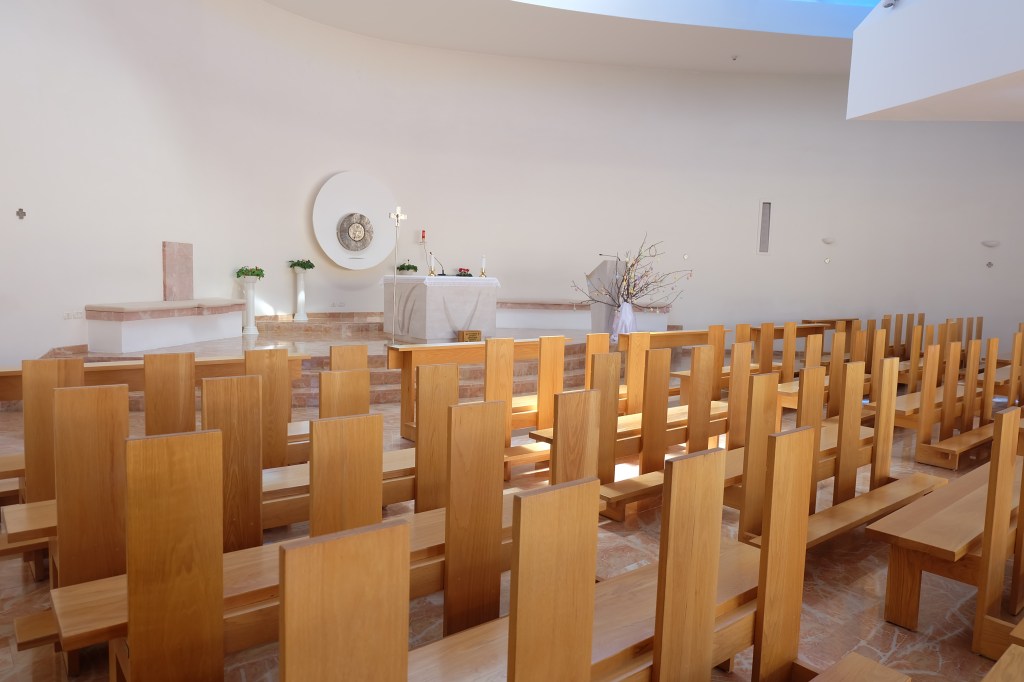
Photo by author, Chapel of the Monastery of the Sisters of Perpetual Adoration of the Blessed Sacrament at the Milk Grotto in Bethlehem where the Holy Family hid before fleeing to Egypt to escape Herod’s order to massacre the Holy Innocents, May 2019.
Love of Jesus builds, not destroys
Applying the law of love to our community is the most severe test of our being disciples of Jesus when we are challenged to be sincere in our love by hating what is evil and holding on to what is good like blessing those who persecute us, foregoing vengeance against those who have wronged us along with other expressions of mutual love in our community that Paul tells us in Romans 12:9-21.
In teaching us mutual love for one another in a step by step manner, it may seem to be a duty that one must follow in the church. It may even sound as contradictory that Jesus seems to be commanding us to strictly follow his law of command because no law can ever impose love.
However, when we try to reflect the ending of his teachings today – “For where two or three are gathered together in my name, there am I in the midst of them” – we find Jesus not ordering us to love but asking us our love because he loves us. He comes to us, grants our prayers because he loves us; therefore, when we love, when we gather as his disciples, we become his presence. And that is when our prayers are most effective because Jesus is in our midst!
Jesus and his love always build people and community; without him and his love, all we have is destruction and divisions. Hence, love is the only debt we owe to anyone. Love as a debt and “duty” is never paid back because the more we love, the more we have love, the more we are indebted to Jesus. It is the only debt that is never burdensome; in fact, the opposite happens when we refuse to love – we are burdened, life becomes heavy and so difficult.
This is what Ezekiel is telling us in the first reading: we are a “watchman”, a brother’s keeper of everyone. St. Pope Gregory the Great wrote a beautiful homily on being a watchman:
Note that a man whom the Lord sends forth as a preacher is called a watchman. A watchman always stands on a height so that he can see from afar what is coming. Anyone appointed to be a watchman for the people must stand on a height for all his life to help them by his foresight.
Office of Readings, Memorial of St. Pope Gregory the Great, 03 September
Photo by author, sunset inside our parish, 25 August 2020.
In the Church, those designated as watchman of the flock of Jesus is the Bishop or episkopos in Greek that means watcher or overseer. It is the bishop’s duty to always be above others in the loving service of the Church that sometimes out of love for Christ, he has to discipline those going astray as instructed in our gospel today, “If he refuses to listen even to the church, then treat him as you would a Gentile or a tax collector”, that is, excommunication or suspensions and other measures not meant to punish but to convert and correct the sinner.
Next Sunday, Matthew deepens our lesson on mutual love when he presents us the teachings of Jesus on how often we must forgive our brother or sister who repeatedly sins against us.
See my dear reader, how after presenting to us who is Jesus Christ last month, in how much he loves us and seeks us, these following Sundays we are challenged by the Lord to be like him – loving and merciful – to truly keep our relationship with him.
It is the first Sunday of September, the -ber months that tell us Christmas is around the corner. But, it seems we are still in a long haul in this pandemic. Having a vaccine will not totally eradicate COVID-19 nor guarantee us this won’t happen again in the future because the disease that is truly plaguing us until now is our refusal to love and live as brothers and sisters in Christ. Let us give it a try. Slowly. Jesus is not rushing us. All he is asking us is be open to his words expressed earlier in our responsorial psalm: “If today you hear his voice, harden not your hearts.”
Have a heart and have a blessed, lovely week, everyone!
The Lord Is My Chef Breakfast Recipe for the Soul by Fr. Nicanor F. Lalog II
First Friday, Week XXII, Year II in Ordinary Time, 04 September 2020
1 Corintians 4:1-5 /// Luke 5:1-11
Photo by author, Lent in our parish 2020.
Dearest Jesus Christ:
Your words today through St. Paul are very edifying but also demanding, even scary and frightening.
But, I would rather have it that way than get them into my head.
Brothers and sisters: Thus should one regard us: as servants of Christ and stewards of the mysteries of God. Now it is of course required of stewards that they be found trustworthy.
1 Corinthians 4:1-2
Yes, it is an honor to be chosen as your servant, Lord, and a steward of the mysteries of God.
It is so pleasant to the ears and so flattering to one’s self to be a steward of the mysteries of God, of his wisdom – of Jesus Christ crucified.
Keep me lowly and humble, Lord. Remind me always that everything is about you and never about me. Keep me faithful to you and your call that whatever others may say about me, let me be concerned solely with your words and with your judgment. At the same time, keep me silent too, never to brag of my mission and most of all, never to judge others for that resides in God alone.
Keep my mind and my heart open to you always, Lord, so I may always be like a fresh wineskin to be poured on with new wine to mature and grow spiritually in you. Amen.
Lawiswis ng Salita ni P. Nicanor F. Lalog II, 04 Setyembre 2020Unang Biyernes ng Setyembre, Ika-XXII Linggo sa Karaniwang Panahon1 Corinto 3:18-23 /// Lukas 5:33-39
Larawan kuha ni G. Angelo N. Carpio, Hunyo 2020.
O Kamahal-Mahalang Puso ni Hesus,
tulungan Mo kami na Ika'y matularan sa pakikinig sa kapwa.
Nawa aming mapalampas ano man ang hindi mabuting sinasabi
laban sa amin at sa halip ay aming pagyamanin aming karanasan
at palalimin aming katauhan.
Katulad ni San Pablo sa kanyang sulat sa mga taga-Corinto,
“Walang anuman sa akin ang ako’y hatulan ninyo
o ng alinmang hukuman ng tao;
ni ako ma’y di humahatol sa aking sarili.
Walang bumabagabag sa aking budhi,
ngunit hindi nangangahulugang ako’y walang kasalanan.
Ang Panginoon ang humahatol sa akin." (1Cor.4:3-4)
Siya namang tunay, Panginoon!
Palaging mayroong masasabi makakating labi
laban sa amin palagi ano mang buti aming mga gawi.
Bakit nga po ba sa gitna nitong pandemya
laganap hindi lamang sakit kungdi galit at pagmamalupit
masasakit na pananalita ng ilan naming kapwa?
Tulungan mo kami, O Hesus
 na dalisayin aming puso at kalooban,
maging bukas sa mga pagkakataon na magbago
gaya ng Iyong turo sa Ebanghelyo:
“Walang pumipiraso sa bagong damit
upang itagpi sa luma.
Kapag ginawa ito, masisira ang bagong damit
at ang tagping bago ay hindi babagay sa damit na luma." (Lk.5:36)
Lagi naming panghawakan
na higit na mahalaga ang Iyong sinasabi Panginoon
kaysa sinasabi ng tao dahil Ikaw pa rin sa kahuli-hulihan
ang sa amin ay hahatol at papataw ng kapasyahan
kaya nawa Ikaw ang aming pakinggan
hindi pinagsasabi sa amin ay kumakalaban.
Amen.
Jesus in the gospel today makes his first prediction of his coming pasch or Passion, Death and Resurrection but it was such a terrible “bad news” for Peter that he
… took Jesus aside and began to rebuke him, “God forbid, Lord! No such thing shall ever happen to you.” He turned and said to Peter, “Get behind me, Satan! You are obstacle to me. You are thinking not as God does, but as human beings do.”
Matthew 16:22-23
With Jesus, there is no such thing as “good news, bad news” because all is good news with him. The good news/bad news question is really a non-question to disciples of Christ because whatever suffering we go through and embrace in him is a sharing in his very life. The key is to think as God does, not as a human beings do as Jesus told Peter (https://lordmychef.com/2020/08/29/when-good-news-bad-news-do-not-matter-at-all/).
And that means avoiding being so vain.
That is why we have Carly Simon singing to us this Sunday her 1972 classic “You’re so Vain” that have left our generation guessing who was she referring to in this superb music and poetry. (Personally, I think there is something “genetic” about this guessing game on whomever Ms. Simon was referring to: it was a non-issue among us males even when I have gone working in a radio station for six years. It has been the women who have kept on raising the issue on who could be that man so vain Ms. Simon was narrating in her number one song. And even if Ms. Simon had already identified him as Warren Beatty 40 years after, I still do not care because the song is so good, filled with gospel values too.)
How many times in our being so vain have we refused to embrace pain and sufferings in life, preferring noise than silence, and popularity than hiddenness that are some of the ways of God taught us by Jesus Christ?
Oh, you had me several years ago When I was still quite naive When you said that we made such a pretty pair And that you would never leave But you gave away the things you loved And one of them was me I had some dreams, they were clouds in my coffee Clouds in my coffee, and
You’re so vain You probably think this song is about you You’re so vain (you’re so vain) I’ll bet you think this song is about you Don’t you? Don’t you? Don’t you?
About ten years ago, Al Pacino played the role of Satan in the movie “The Devil’s Advocate” where at the end after tempting the gullible small-town lawyer Keanu Reeves, he proclaimed “vanity… vanity is my most favorite sin.”
This Sunday, Jesus is telling us all is good news with him, no bad news and you can never lose in him. Just come to him with our true self, no matter how sinful and incomplete we are. A blessed week to everyone and happy listening!
The Lord Is My Chef Breakfast Recipe for the Soul by Fr. Nicanor F. Lalog II
Monday, Feast of St. Bartholomew, Apostle, 24 August 2020
Revelation 21:9-14 >><}}}*> |+| >><}}}*> |+| >><}}}*> John 1:45-51
Photo by author, Subic, 2018.
Glory and praise to you, Lord Jesus, the “Word who became flesh and dwelt among us” to reveal the Father’s immense love for us all. He was not contented in just telling the prophets of Old Testament how he loved us that He came and lived with us in you, Lord Jesus!
And that is why we also rejoice on this Feast of St. Bartholomew, a.k.a. Nathanael, who was introduced to you by another Apostle you have called earlier:
Philip found Nathanael and told him, “We have found the one about whom Moses wrote in the law, and also the prophets, Jesus, son of Joseph, from Nazareth.” But Nathanael said to him, “Can anything good come from Nazareth?” Philip said to him, “Come and see.” Jesus saw Nathanael coming toward him and said of him, “Here is a true child of Israel. There is no duplicity in him.” Nathanael said to him, “How did you know me?” Jesus answered and said to him, “Before Philip called you, I saw you under the fig tree.” Nathanael answered him, “Rabbi, you are the Son of God; you are the King of Israel.”
John 1:45-49
O dear Jesus, like St. Peter in the gospel yesterday and now St. Bartholomew, you are telling us anew to never be contented with mere words, with the “what” of who you really are, that we must always “come and see you” in order to experience your very person and truly know you.
I really wonder O Lord what your words meant that before Philip called Nathanael-Batholomew, you have seen him under the fig tree; however, I am so convinced that in your words, Nathanael-Bartholomew must have felt something deep inside him that he threw himself totally to you as your Apostle.
Most of all, teach me to remain simple and hidden in you, Jesus that like St. Bartholomew, despite the scarcity of stories and information about him except this little anecdote from the fourth Gospel, he remained faithful to you until his death by flaying reportedly in India.
May we imitate St. Bartholomew who had shown us that more than words, what matters is our oneness in you, Jesus, without any need for us doing sensational deeds, earning thousands of “likes” and “followers” in social media because only you, Lord, remains extraordinary above all. Amen.
The Lord Is My Chef Sunday Music by Fr. Nick F. Lalog II, 23 August 2020
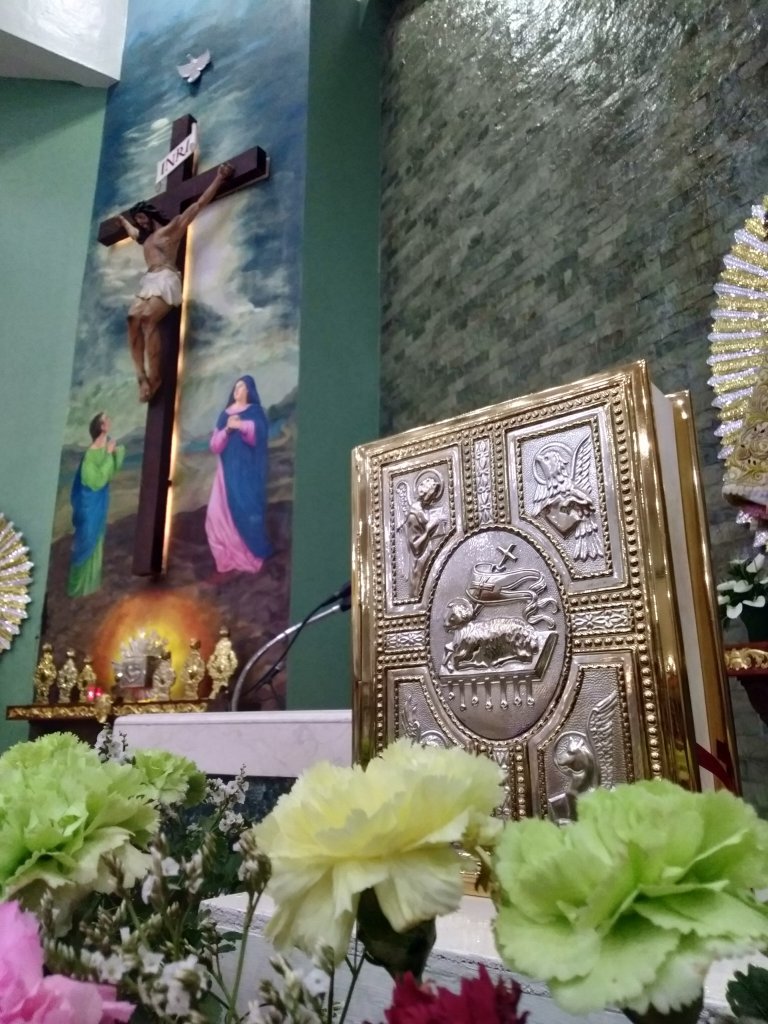
Photo by author, Gospel book (Evangelare), January 2020.
Jesus is asking us today in the gospel like his disciples at Caesarea Philippi, “who do you say that I am?” (Mt.16:15). As we have mentioned in our Sunday reflection, things we say of another person can come from two perspectives, the “what” and the “how”.
“What” we say of a person usually comes from common knowledge, the basics like name and address that sometimes not so reliable as we have not actually and personally known. But, to say of a person based on “how” we have known him/her is deeper because it comes from our personal relationship with some degree of intimacy (https://lordmychef.com/2020/08/22/it-is-not-what-we-say-who-jesus-is-but-how-we-say-who-he-is/).
To know another person is always to enter into a relationship that leads to a deeper friendship.
That is why for this Sunday we offer you this almost surreal, dream-like 1981 music by Gary Wright, “Really Wanna Know You” that spent 17 weeks on Billboard’s Hot 100, reaching highest spot of #16.
Really Wanna Know You speaks of that spiritual thing we experience when we meet someone who seems so special, creating some sparks in us that leads us to something deeper than mere acquaintance. Notice how the sounds of electronic keyboards with the blending voices create that strange, beautiful, and out-of-ordinary feelings like attraction or simply being drawn to the other person.
I don't mind being lonely
But I do mind if not being loved
Maybe you're feeling the same way too
You're ready to hold some one

I really want to know you
I really want to show you the way I feel
I really want to know you
I really want to show you the way I feel

Something about you is telling me
We're coming from the very same place
It's only just a notion I have
(But) I see it written over your face

I really want to know you
I really want to show you the way I feel
I really want to know you
I really want to show you the way I feel
And the good news is that Jesus feels the same way to us, always the first to reach out to us because he feels something so special with each one of us.
Take that chance and meet Jesus in prayers, in the Scriptures, and in others who love and care for us.
After showing us some glimpses of the person of the Lord these past three weeks, St. Matthew now leads us into the middle of his gospel where Jesus takes a U-turn in his ministry by revealing himself to the Twelve as he heads back to Jerusalem to fulfill his mission.
Jesus went into the region of Caesarea Philippi, he asked his disciples, “Who do people say that the Son of Man is?” They replied, “Some say John the Baptist, others Elijah, still others Jeremiah or one of the prophets.” He said to them, “But who do you say that I am?” Simon Peter said in reply, “You are the Christ, the Son of the living God.” Jesus said to him in reply, “Blessed are you, Simon son of Jonah. For flesh and blood has not revealed this to you, but my heavenly Father.” Then he strictly ordered the disciples to tell no one that he was the Christ.
Matthew 16:13-17, 20
St. Matthew told us last Sunday how Jesus withdrew to the region of Tyre and Sidon where he had healed the daughter of a Canaanite woman tormented by a demon. From there, they headed north to Caesarea Philippi, a pagan major city at that time.
It was a perfect setting for our gospel this Sunday – just like our present milieu that challenges us not only to be identified as a Christian but also to make a stand for Jesus as his true disciple at a time when faith and morals are disregarded, economics takes precedence over spirituality.
Who do people say I am: “what” I know of Jesus
The two questions posed by Jesus to his disciples while at Caesarea Phillip – and to us today – may sound very similar and even simple but are actually distinctly different and even worlds apart from each other.
Photo by Mr. Jim Marpa, 2019.
His first question “Who do people say that the Son of Man is?” is straightforward, seems to demand not much critical thinking and introspection. A plain question with a plain answer like the usual news we hear and read called “straight reporting” in journalism that tells us the essential “who, what, where, and when” of the story.
So many times, we face this question without even being asked at all!
Through our words and actions we reveal “who do you say the Son of Man is?” in how we pray, what we pray for, the things we post on social media, especially those electronic chain letters that if you say “Amen” you will get money. And so many other things when we try to show everyone we know Jesus without really thinking and reflecting well. No wonder, people get so many wrong impressions about who Jesus is: “some say he is John the Baptist, others Elijah, still others Jeremiah” or one of those prophets of wealth and health who make life easier!
Telling who Jesus Christ from “what” we know and believe can always be dangerous and misleading because it is all in our heads that could often be wrong. Telling who Jesus Christ from “what” we know and believe cannot be so reliable because it is always mechanical, by the book, not actual and most of all, not real.
It is always easy to speak highly of Jesus from “what” we know and believe like those many preachers with fire and brimstone or modern apostles, a.k.a. vloggers complete with their “shock” preaching and antics and gimmicks who end up more popular with thousands of followers and likes. And wealthy, too! Jesus Christ? Forgotten and stuck in Facebook, the bible, and tabernacle.
But who do you say I am: “how” I know Jesus
On the other hand, the Lord’s second question is direct and personal, probing our heart and soul, asking not just for answer from our lips but from our total self: “But who do you say that I am?”
See the words of the Lord after Simon had answered he is the Christ, the Son of the living God:
Jesus said to him in reply, “Blessed are you, Simon son of Jonah. For flesh and blood has not revealed this to you, but my heavenly Father.”
Matthew 16:17
More than a play of words, here we find a deeper dimension of saying who Jesus Christ is: not just telling the what but most of all, the how that reveals more than what we know in our minds but how we have experienced Jesus, of how we have been living in him!
Photo by author, house at Jaffa (Jopa), Israel where Peter met some gentiles according to Book of Acts, May 2017.
For us to say who is Jesus Christ is always a how because it is a story of our relationship with him, it is a how we have grown deeper, how we have journeyed in him and with him.
It is the ability to see beyond structures and persons, excesses and sins, faults and misgivings because despite shortcomings, it is how we see Jesus as the foundation of our lives and of our Church.
See the ways of other religious sects, their pastors and members who spend so much time bashing us Catholics, insisting on the what of Jesus and the bible, never the how they live.
No wonder, they can raise their hands in prayers and still clap their hands while the President in maligning us Catholic priests and bishops in their gatherings.
To speak of who is Jesus is more than to tell what we know about him but how we have known him, how we have been since knowing him!
Anyone who can say who Jesus is from his how is always blessed like Simon because our answer is always the fruit of our life in Christ. We all become like Simon, another Peter or Rock whose very life and existence rests on Jesus our Lord. Despite our weaknesses and sinfulness, we are still blessed and entrusted with the keys of heaven because we have allowed Jesus to be our foundation of life. There is a process, a history always. Hence, it is a telling of the how.
In the first reading, we find God dismissing the master of the palace named Shebna to be replaced by Eliakim due to his infidelity. That is the meaning of the whole prophecy by Isaiah, of how the Lord will someday entrust his people to a trustworthy steward, someone who does not only know what God is but one who has truly known and experienced God.
Saying who God is, always a revelation from him
It is interesting that in the Jewish thought, to know another person is not knowing the what but of having a relationship or some degree of intimacy. Again, it speaks of the how we have been saying.
St. Paul shows us in the most beautiful manner in his many writings this saying of who Jesus is with his how, his very personal experience of the Lord in his life that has continued and deepened until his death. See the beautiful hymn he had composed for our second reading today:
Oh, the depth of the riches and wisdom and knowledge of God! How inscrutable are his judgments and how unsearchable his ways! For from him and through him and for him are all things. To him be glory forever. Amen.
Romans 11:33, 36
Like St. Peter, we find here St. Paul so blessed despite his sins and sinfulness, of how he had experienced Christ not just a name or a man like any what he had known in his mind.
No one can ever write such great poetry with profound thoughts without any deep relationship with God. Whatever we know of God is always a revelation from him, too. When we speak of who God is, it is always borne out of how we have been relating with him our Lord which is called “spirituality”; it is deeper than religiosity or being religious that is always at the level of the head and more of our ego than of the reality of God.
Sometimes, we do not even have to speak and say who Jesus Christ is.
We simply have to live out that relationship we have in him and people would know who Jesus is. No need for elaborate and spectacular showmanships we have in our many rites and rituals, even in our liturgies now so maligned with our triumphalism.
Lest we forget, Jesus saved the world by suffering and dying on the Cross, not with activities and debates which would be his topic next Sunday. God bless everyone!
Lawiswis ng Salita ni P. Nicanor F. Lalog II, Ika-21 ng Agosto 2020
Larawan kuha ni G. Jim Marpa, 2019.
Ngayong panahon ng COVID-19
sumagi sa akin mga turo ng dalawang pari
na napakalapit at mabuti sa akin:
Una ay si Padre Nanding
malimit sabihin sa akin
"Pinakamasarap makasama
tao na mayroong panlasa";
"iyong iba," aniya,
"pakanin mo ng buong baka,
hindi pa rin masaya!"
Ikalawang paring butihin
ay si Padre Johann
madalas ako paalalahanan
"Biyaya ng Diyos ang ganang kumain
dahil ibig sabihin
wala kang sakit na dapat intindihin
di tulad ng ibang hindi makakain."
Nakatutuwang isipin at malayin
kung paanong noong panahon natin
mga mumunting butil ng pagkain
pinahahalagahan upang huwag sayangin;
ngayon naman ating alalahanin
itong ating panlasa at ganang kumain
mga biyayang hindi napapansin;
magdildil ka man ng asin o
maalat man o maasim ulam na inihain
huwag nang punahin o laitin
sapagkat iyong nalalasap pa rin
ang pagkain at walang COVID-19!
Sa hapag ng pagkain
mga samahan at ugnayan natin
nabubuo, tumatatag at tumitibay
kaya sa ating buhay
masarap kasabay
sa paglalakbay
mayroong panlasa
at maganang kumain,
basta huwag lang sasairin
at uubusin ang sinaing
baka iba hindi na makakain
dahil ikaw pala ay sakim!
Ito naman ang habilin na galing sa akin:
basta nakaka-amoy ng masarap na lutuin
maski hindi sa iyo ang pagkain
matuwa ka na rin, wala ka pang COVID-19;
gayun din naman,
iyo nang kalimutan hindi man kagandahan
 ilong na ngayon ay natatakpan
makaamoy man ng alimuong
makalanghap man ng masansang
at masamang hangin ay mabuti pa rin:
nakakahinga ka ng malalim
wala kang COVID-19!
The Lord Is My Chef Sunday Music by Fr. Nick F. Lalog II, 16 August 2020
Our parish on a lazy afternoon before the pandemic in January 2020. Photo by Mr. Angelo Carpio.
Our Sunday gospel today is so touching at how great is the love of Jesus Christ for us who knows no boundaries when he “withdrew to the region of Tyre and Sidon” to heal the daughter of a Canaanite woman “tormented by a demon” (Mt.15:21, 28).
Two Sundays ago we heard how Jesus fed more than 5000 people who have followed him to a deserted place from just five loaves of bread and two pieces of fish; last week, he walked on water to rescue his disciples in a boat caught in a violent storm at the middle of the lake at night.
Very clear in all his actions is the immense love of Jesus Christ for everyone, doing everything in love and for love.
And that is why we have Rock n’ Roll’s dynamic duo, Daryl Hall and John Oates singing their eighth #1 hit released in 2003 “Do It For Love” from their sixteenth studio album of the same title.
I have always considered Hall and Oates as my topmost favorite musicians standing side by side with the equally great tandem of Walter Becker (+) and Donald Fagen of Steely Dan fame.
Smooth and sophisticated with their characteristic Phillysound, Hall and Oates’ Do It for Love tells of how a man would go to great lengths to express his love for his beloved.
I would fly ten thousand miles In the pouring rain Just to see your face
I’d bare my soul to a total stranger Just to say your name And I’m not ashamed Just to love you into every morning
I would change my name And run away I won’t do it for money I won’t do it for pride
I won’t do it to please somebody else If it don’t feel right But I’ll do it for you And at least I’ll try
I don’t need any other reason Than I feel it deep inside I’ll Do It For Love
I have used it so many times in counseling single and married men having problems with their girlfriend and wife; and so far, it seems to have always worked with most of them still together and happily married!
Try it yourself this Sunday… with a lot of prayers and honest-to-goodness soul searching, miracles may still happen!









 lordmychef.com