Quiet Storm by Fr. Nick F. Lalog II, 09 November 2020
Photo by Dr. Mylene A. Santos, MD, 30 October 2020.
I have always believed
life is more on coming
than on leaving
because
whenever we leave,
we also come.
But,
there is something
about leaving
that makes
it strongly felt
than coming:
from the pain of leaving
follows emptiness -
the angst of still living
when someone is missing.
Most painful part of leaving
is when you are the one left behind;
it is the one who leaves
who actually comes
to somewhere else
while the one left
bears the scars
of leaving,
like grappling
with the unseen
presence
of nothing
but memories
gone
with the one who had left
who might never come again.
But, I think
it is when leaving
is truly hurting
that it turns into a coming -
an arrival
of blessing
of opening
to a new lease on life
and living when we discover
somebody anew
filling what's missing within
not necessarily seen
that together we spin
a new thread in life again.
The other person
gone is never replaced
by a newfound one;
that's the beauty
of every leaving
and coming
when we leave
in order to come
creating a space
for a new one
until it leaves again
to come another one
until finally
we become one in the Only One.
Friendships should depend on nothing like TIME and SPACE. Remove TIME and what we have is NOW; remove SPACE and what we have is HERE. Don’t you think we could meet once or twice between NOW and HERE?
Richard Bach, Jonathan Livingston Seagull (1970)
Photo by Dr. Mylene A. Santos, MD, 07 November 2020.
Lawiswis ng Salita ni P. Nicanor F. Lalog II, Ika-03 ng Nobyembre 2020
Larawan kuha ng may-akda, gayak ng aming parokya, Nob. 1-2, 2020.
Madalas aking ipinapalagay
bilang bahagi ng buhay
itong pagmamahal
ako nama'y nakagaganap,
nakatutugon sa hamon.
Nguni't ano nga ba talaga
ang magmahal at kailan ako
tunay na nagmamahal?
Napakadali na maging mabuti
sa iba, magtimpi ng sarili,
magparaya at magpalampas;
mahabag at maawa na kusang
tutulo ang luha,
umakay at sumabay sa mahihina,
magmalasakit maski sa walang sakit.
Kailan nga ba
ako tunay na nagmamahal,
tanong ko sa sarili noon pa man;
maski mga kaibigan
mga pinapayuhan
sa simbahan
o saan pa man
iyan ang palaging katanungan
na ano mang kasagutan
ay siyang buod at kabuuang
kahulugan ng pagmamahal
di lamang ng mga magkasintahan
o magsing-ibig
kungdi ng sino mang nilalang
ng Diyos na pag-ibig.
Noon ay
palagi kong sinasabi
mula sa limitado kong karanasan
na aking inihahabi,
pinagtatagpi-tagpi
sa mga napag-aralan
at napagnilayan
na tunay ka lamang nagmamahal
kapag ika'y nasasaktan
dahil kung wala ka nang nararamdaman
mas malamang
pusong bato
ang nariyan sa iyong dibdib,
di lamang manhid
kungdi patay at malamig.
Hindi natapos
aking pag-aasam
malaman at maranasan
kung kailan nga ako
tunay nagmamahal;
maraming karanasan
aking pang dinaraanan
dahan-dahan, unti-unti
naliliwanagan na
tunay akong nagmamahal
di lamang kapag ako'y nasasaktan
kungdi dama ko man
aking kawalan
sa kakayahang ibsan maliban samahan
kapatid kong nahihirapan.
Tunay akong nagmamahal
kung aking pipiliing mahalin
ang iba kesa akin;
 hindi na daraing
kungdi sasarilinin
at aangkinin pati tiisin
mga iyak at hinaing
ng ginigiliw
 at kung maari ay pasanin
kanilang mga dalahin.
Sa kahuli-hulihan
batayan pa rin ng pagmamahal
ang masaktan --- kung hanggang saan,
hanggang kailan doon malalaman
yaring lalim at kadalisayan.
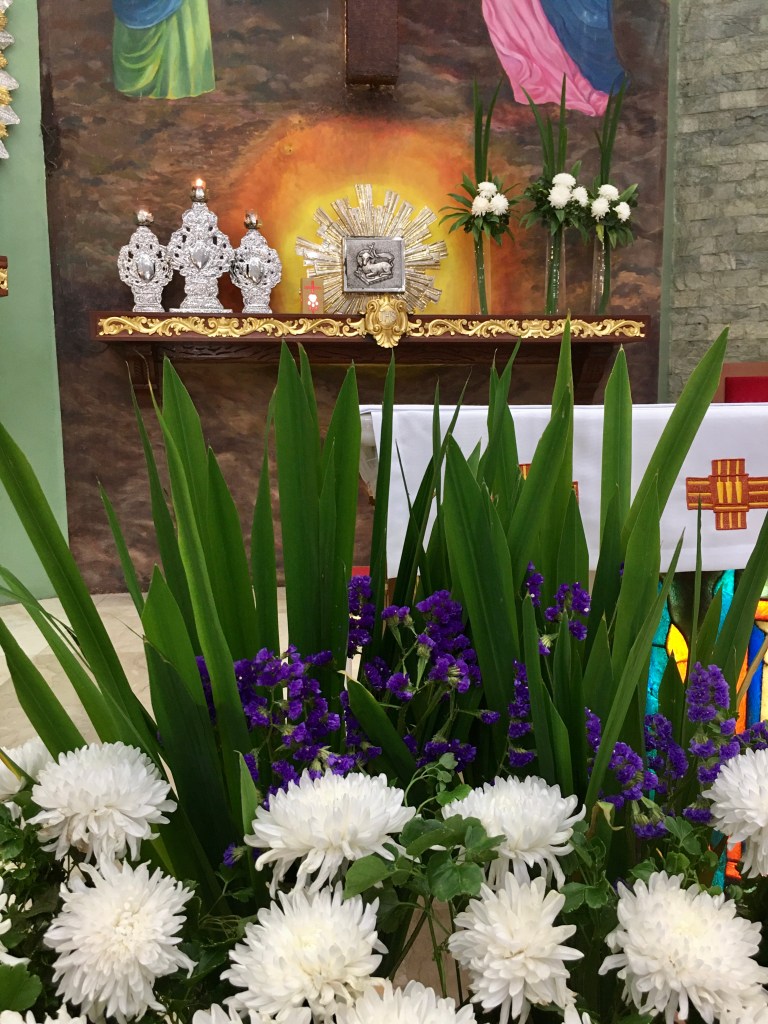
Larawan kuha ng mga may-akda, gayak ng altar ng parokya, Nob.1-2, 2020.
Everyday
I hold your Body
for every-body to see
saying again your words
on the night before you were betrayed:
"Take this,
all of you,
and eat of it,
for this is my Body,
which will be given up for you."
THIS IS MY BODY.
We have studied and learned
theology of your Body
but it was only lately
after I have held
someone's body
with a malady
so sick, so weak, and untidy
have I truly felt your Body.
The nobility and beauty,
the awe and wonder
of holding your Body
dear Jesus came to me
after I have given up my own body
to some-body
in need of my body.
Oh, how I felt your Body
next to me after I have held another body;
it was just the tip of my fingers
touching you but as I looked at you
I felt you in my whole body
filling me with your mystery
unfolding daily in the liturgy;
why did I not see, was it due to apathy,
when some-body comes to me
and treats him a no-body?
Photo from Reuters/Lucas Jackson via The Economist, 2019.
The Lord Is My Chef Breakfast Recipe for the Soul by Fr. Nicanor F. Lalog II
Tuesday, Week XXX, Year II in Ordinary Time, 27 October 2020
Ephesians 5:21-33     +  >><)))*>  +  >><)))*>  +  >><)))*>  +     Luke 13:18-21
Photo by Mr. Jim Marpa, 2018.
Brothers and sisters: Be subordinate to one another out of reverence for Christ.
Ephesians 5:21
What a beautiful admonition to us all this day by St. Paul and a wonderful prayer too to you, O God our Father that we need to pray more often in our world where relationships are getting complicated, very fleeting, and sometimes misleading and hurting.
May Jesus Christ be revered as basis and foundation of our every relationship in life so that the ties that bind us as couples, families, siblings and society may become more human, more loving, and more faithful.
So often, we look down upon your words as too old-fashioned and even outdated for the present situation like the defined codes of relationships St. Paul talks about in his Letter to the Ephesians; but, the sad truth is we have only changed the language nuances to make us sound more just these days without really removing the old obligations of the weaker ones with the stronger ones, like wives to husband, children to parents, and slaves to masters.
Grant us wisdom through the Holy Spirit to base all our relationships only in Jesus Christ who had come to bring us closer to you, God our Father.
May we find the value of many little things we take for granted like respect and being fair so essential in our relationships with everyone beginning in our homes, in our family circles where the kingdom of heaven always begins. Amen.
Photo by Dr. Mylene A. Santos, MD, Katmon Harbor Nature Sanctuary in Quezon, 2020.
Sorry for being away these past four weeks without any secular music inspiration for our Sunday gospels. Hoping to make up with you my dear Reader on this partly cloudy and warm Sunday with a classic song from a 1966 movie that starred Michael Caine, Alfie.
Written by the highly successful duo of Burt Bacharach and Hal David, sang and recorded for the said movie by their favorite interpreter Dionne Warwick, Alfie gives in its opening stanza the questions that create the drama of this 1966 film about a self-centered playboy who cared only for himself, using the people around him for his own gratification and satisfaction.
I have not seen the original 1966 film except its 2004 remake starring Jude Law that I find too “sleazy” that lacked what I suppose as the British “touch of class” and deep drama found in Caine’s starrer.
Nonetheless, we have chosen this song because of our Gospel this Sunday when a scholar of the law challenged Jesus with the question “which commandment in the law is the greatest”. Jesus answered the question so well by taking us all to the very foundation of all laws which is loving God with one’s total self expressed in loving others as we love our selves.
Jesus “passed the test” by the Pharisees and the question now is, how do we fare in the same test of love?
Do we love enough?
And that is why we have chosen the song Alfie that speaks so well of the same question.
There is a very interesting line in the song’s second stanza that relates perfectly well with Jesus Christ’s summary of the laws into love of God expressed in love of others:
And if only fools are kind, Alfie Then I guess it’s wise to be cruel And if life belongs only to the strong, Alfie What will you lend on an old golden rule? As sure as I believe there’s a heaven above, Alfie I know there’s something much more Something even non-believers can believe in
For years, many listeners including artists like Ms. Barbara Streissand have been baffled with the possible meaning of that line “What will you lend on an old golden rule?”; it has always been interpreted in so many ways despite Mr. David’s admission it meant nothing at all but just a line to fill in Mr. Bacharach’s music.
In that case, all the more we find how music is indeed more of the soul, touching our hearts with its deep meanings that transcends our physical world, giving us a glimpse of the Divine, of a personal and relating, loving God.
I believe in love, Alfie Without true love we just exist, Alfie Until you find the love you’ve missed you’re nothing, Alfie When you walk let your heart lead the way And you’ll find love any day, Alfie Alfie …
The problem with love, my dear Reader and Friend, too often our words are not enough to truly express it. Most often, when we love, we just have to love, love, and love!
A lovely and loving week to everyone!
Provided to YouTube by Rhino Alfie (2013 Remaster) · Dionne Warwick Playlist: The Best Of Dionne Warwick ℗ 1967 Scepter Records Producer: Burt Bacharach Producer: Hal David Writer: Burt Bacharach Writer: Hal David Auto-generated by YouTube.
The Lord Is My Chef Breakfast Recipe for the Soul by Fr. Nicanor F. Lalog II
Tuesday, Week XXIX, Year II in Ordinary Time, 20 October 2020
Ephesians 2:12-22     >><)))*> + >><)))*>  +  >><)))*>     Luke 12:35-38
Photo by Dr. Mylene A. Santos, MD in Quezon, 2020.
Glory and thanksgiving to you, God our Father, through your Son our Lord Jesus Christ in the power of the Holy Spirit for reconciling us all in you, making us one despite our many differences.
How lovely to the ears, to our being the words of St. Paul today, Lord Jesus, assuring us of our citizenship in heaven through the salvation you have brought us all, regardless of our color, race, status or even religion!
So then you are no longer strangers and sojourners, but you are fellow citizens with the holy ones and members of the household of God, built upon the foundation of the Apostles and prophets, with Christ Jesus himself as the capstone. Through him the whole structure is held together and grows into a temple sacred in the Lord; in him you also are being built together into a dwelling place of God in the Spirit.
Ephesians 2:19-22
Help us, O Lord, to embody and manifest this unity of peoples in you in the Church, your Mystical Body here on earth.
Heal us of our many divisions and make us truly Catholic by helping everyone enter into communion with you through one another.
Keep us on guard for your return, Jesus, by “girding our loins and lighting our lamps” (Lk.12:35) ready to welcome you with our good works each day, leading others closer to you.
Let us start by going back to you in prayers and silent meditations that many have forgotten or taken for granted in this 24/7 world saturated by media with all the cacophony of sounds and blinding visuals that have blurred our vision of who we really are as citizens of heaven, beloved children of God our Father in heaven.
Help us find our way back home to the Father in heaven here on earth by finding our way back home to our true selves and to our brothers and sisters in you, dear Jesus. Amen.
Quiet Storm by Fr. Nicanor F. Lalog II, 19 October 2020
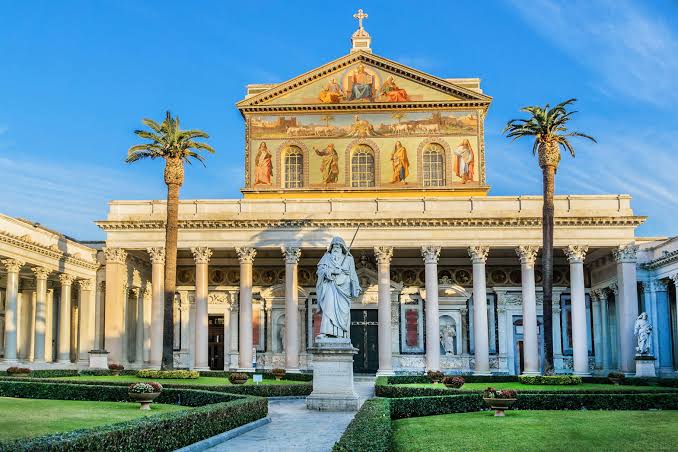
St. Paul’s Basilica in Rome from en.wikipedia.org.
It is really funny these days at how things we grew up with have changed so differently like the postscript we used with initials “P.S.” at the end of letters as an afterthought we sent relatives and friends about 40 years ago.
Today, a postscript is more of a trademark and an application in computers but for my generation, it is from the Latin “post scriptum” that means “written after”.
Consider this piece, my dear Reader, as a postscript or PS to St. Paul’s Letter to the Galatians we heard proclaimed during weekdays from October 5-14, 2020 where he explained and reflected about faith in Jesus Christ whom he loved so much.
Faith is having a relationship with God,
not to obtain things from him.
We always hear people say “have faith” in everything we pray for. Always believe that God will hear us, God will grant us what we need and ask for.
But what happens when we do not get what we are praying for like when a loved one is not healed or recovers from a sickness and eventually dies? Or, flunk an important exam or maybe fail to close a major deal in business? Does it mean we lack faith? Or, is that the main purpose of having faith in God, to obtain things and favors from him?
See how St. Paul called the Galatians “stupid” for being misled by false teachings on the gospel of Jesus Christ: some preachers had come to Galatia at that time telling them of the need to be circumcised like the Jews who converted to Christianity in order to be saved. He wrote the Galatians primarily to rectify those errors they have seemed to believed, where he introduced the doctrine of “justification (salvation) by faith in Christ”, not by rituals and other practices men do. It is not to dismiss our traditions but to stress the primary role of faith in Jesus Christ who died for our sins to save us.
O stupid Galatians! Who has bewitched you, before whose eyes Jesus Christ was publicly portrayed as crucified. I want to learn only this from you: did you receive the Spirit from works of the law, or from faith in what you heard? Are you stupid? After beginning with the Spirit, are now ending with the flesh?
Galatians 3:1-3
Sometimes like the Galatians, we end up with the flesh, believing more in things we do like rituals and other things than truly believing Jesus because we use faith to obtain things from God.
No! We believe because we relate: every relationship like marriage always presupposes faith in the other person. Even Jesus in teaching us how to pray, he taught us the “Our Father” which is an expression of a relationship.
Wedding of my former student, Micah and Lery Magsaysay, February 2020.
Being faithful means being realistic.
Jesus himself assured us that faith can move mountains and do other great things for us if we truly believe. This is perhaps the reason we always equate faith in asking for so many things from God.
Not at all. We also have to be realistic with things we ask from God. He is not a magician who has to please and entertain us with his miracles and powers. When we were in high school seminary, the late Fr. Nick Cruz, SJ gave us a recollection and told us we cannot simply ask anything from God like a rose blooming from your toothpaste to prove he calls you to the priesthood!
Being realistic in our faith by praying first of all to have Jesus, only Jesus and always Jesus!
When Jesus told us to seek and you shall find, to ask and it shall be given to you, and to know and the door shall be opened to you (Lk.11:9-10), he was not telling us to ask for money and gadgets. If we are going to be realistic in our faith, Jesus is telling us to seek God and you shall find him, to ask God and you shall have him, and most of all, God is the only door when we knock would surely open us to new beginnings.
In explaining the unique call we have received from God in Christ, St. Paul gives us the whole reality of our being Christians, of having a faith that is realistic.
For all of you who were baptized into Christ have clothed yourselves with Christ. There is neither Jew nor Greek, there is neither slave nor free person, there is not male and female; for you are all one in Christ Jesus. And if you belong to Christ, then you are Abraham’s descendant, heirs according to the promise.
Galatians 3:27-29
Photo by author, August 2020.
Faith demands conviction and consistency.
God’s gift of faith in us is not everything; we have to cultivate and deepen our faith to experience its wondrous fruits and grace. See the kind of conviction of St. Paul in proclaiming and explaining his faith in Jesus Christ.
Now I want you to know, brothers and sisters, that the Gospel preached by me is not of human origin. For I did not receive it from a human being, nor was I taught it, but it came through a revelation of Jesus Christ.
Galatians 1:11-12
Like the Galatians, many of us are easily swayed by so many other beliefs and teachings that are misleading, claiming to be a part of the faith we have received. Without firmness and conviction in our faith, some among us have gone to accommodating modern thoughts and lifestyles that run contrary to our faith in Christ like abortion, same sex marriage, and in-vitro fertilizations or test tube babies.
A believer without conviction and consistency in faith and actions is not faithful at all. What happens with our “faith is a relationship” when the chips are down, when we are confronted of either being for God or against God?
Sometimes we try “moving the lines”, convincing ourselves that we are not crossing the line of morals and morality like when we are bent on accommodating others and ourselves in some occasions to justify personal preferences.
Sad to say, it happens even among us clergymen like when we tinker with the liturgy and the sacraments in the name of modernism and of arts and worst, with some issues pertaining to acts intrinsically sinful and immoral.
Maybe if we would have the conviction and consistency of faith, we would all be like the good Samaritan in the Lord’s parable – a neighbor to everyone especially those in need, willing to cross the street to faithfully reach out to others in Jesus Christ (Lk. 10:25-37).
Try examining our faith today. Has it bloomed into a relationship we keep with God our Father in Christ Jesus through the Holy Spirit or has it remained as it is, a given, a safety net just in case we need?
Have faith, have God and we’ll journey far, together! Amen.
From americamagazine.org.
On Wednesday, we reflect on being faithful and free, and how faith works through love. Have blessed Monday and see you again!
You may also check our prayers from October 05-14, 2020 based on St. Paul’s Letter to the Galatians at the archives of http://lordmychef.com.
Quiet Storm by Fr. Nicanor F. Lalog II, 14 October 2020
Photo by author, sunrise at the Lake of Tiberias, the Holy Land, May 2019.
HOPE. A favorite word among us, used as an expression for things to get better, especially when we express our “hope” God grants what we pray for, or, in ending our letters of request with “hoping for your kind consideration”.
Even Hollywood is fond of this virtue, portraying it as a reserved power to overcome evil when Neo in the 2003 The Matrix Revolutions was summoned into action to defend their city because he was the only one with “hope”.
Or, something like a turbo charger that will boost every leap of faith when Toretto in Fast and Furious 6 handed to his rival Owen Shaw the computer chip they were tasked to retrieve in the “hope” of getting it back even if they have to chase a giant Antonov An-124 plane taking off.
Of course, Neo and Toretto succeeded in their efforts filled with hope, defeating evil.
But, that is not what hope is all about.
To hope is different from optimism, of believing things can get better;
in fact, we hope because things can get worst.
The late Fr. Henri Nouwen wrote in one of his books that to hope means having that firm conviction within that even if things get worst like death, we are certain God will never forsake us for he loves us very much.
Jesus Christ showed us this true meaning of hope when he decided to go to Jerusalem to accomplish his mission by dying on the Cross for our salvation. I love the way Luke narrated in his gospel this attitude of Jesus in showing us the path of hope amid his knowledge things would get worst than before leading to his Passion and Death (and Resurrection):
When the days for his being taken up were fulfilled, he (Jesus) resolutely determined to journey to Jerusalem…
Luke 9:51
Imagine Jesus “resolutely determined” going to Jerusalem, the very same attitude of saints witnessing the Gospel by facing martyrdom. It is also very true with us when we say our only hope is the Lord when we know of sure death while facing a serious illness.
To hope is to be “resolutely determined” like Jesus and the saints along with our loved ones to follow the arduous path of life, of putting up the good fight against sickness or injustice and evil even if they knew things will lead unto death. At first we wonder, what victory can we claim if in the end we die like the saints and martyrs?
That’s the mystery and paradox of hope: to hope is to completely trust in God that death is not the end of life or any struggle but the highest point of our transformation as we dive to life’s lowest level like defeat, loss, and death when we pray like Jesus on the Cross, “Father, into your hands I commend my spirit” (Lk.23:46).
Hope is faith severely tested, believing and abandoning everything to God, come what may.
Photo by Arch. Philip Santiago, Fatima, Portugal, 2016.
Hope is clearly not positive thinking nor optimism; hope is “faith in God” as Pope Emeritus Benedict XVI tells us in his second encyclical, Spe Salvi (2007). According to Pope Benedict, hope gives us the direction towards the future by enabling us to face the challenges of this life leading to salvation and eternal life.
In this sense it is true that anyone who does not know God, even though he may entertain all kinds of hope, is ultimately without the great hope that sustains the whole of life (Eph.2:12). Man’s great, true hope which holds firm in spite of all disappointments can only be God — God who has loved us and who continues to love us “to the end,” until all “is accomplished” (Jn.13:1 and 19:30)… If we are in a relation with him who does not die, who is Life itself and Love itself, then we are in life. Then we “live”.
Spe Salvi, #27
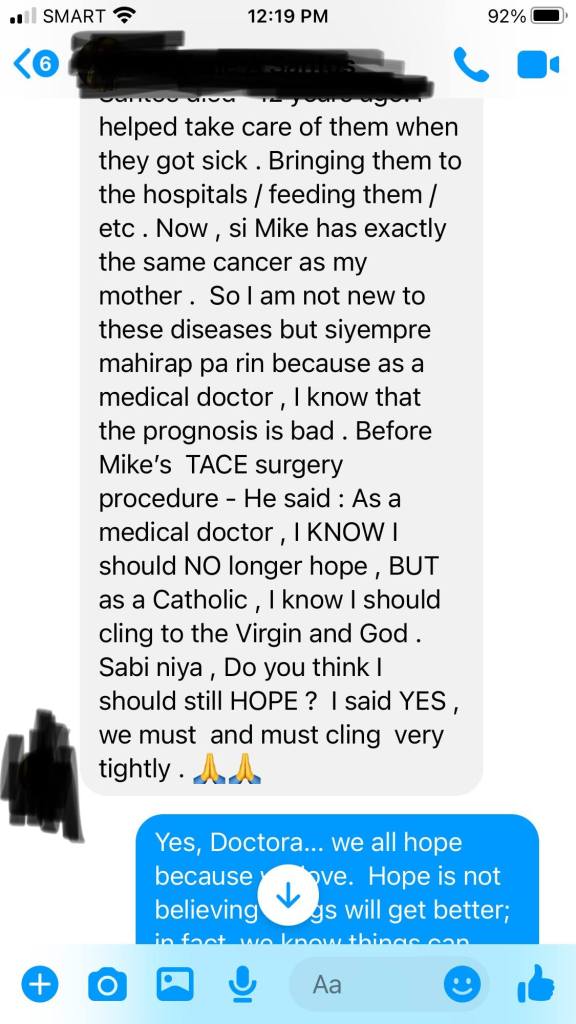
Four weeks ago, a former parishioner had asked me for prayers for her husband with liver cancer. Both are medical doctors; in fact, it was her husband who had actually diagnosed himself while going through radiological lab exam.
It was at that time they “resolutely determined” to go home and face the inevitable by praying together, hoping together in God.
Here lies the mystery and paradox of hope we were talking earlier: why and what do we really hope when we know it is going to end in death?
God. Nothing else and nobody else. God is the reason we hope and what we hope for.
It is only when we have been stripped of everything else when we truly “see” and experience God is all we have in life after all.
Then we become confident God will never abandon us until the end.
That is what my friend and her husband have realized, especially when Dr. Mike died two weeks later after going home.
When I celebrated Mass at his wake, I could not resist telling my friend how the smile of her husband is the sweetest, even most infectious one I have ever seen on the lips of a dead person in my 22 years as a priest!
Truly, the Lord loved Dr. Mike until the end that he died with a smile as the fruit of his hoping in God with his wife.
Indeed, friends have told me that God will give us the grace to face our death when that time comes; and I believe them because I have seen them transformed after accepting their terminal condition that they no longer cry of their situation getting worst while those to be left behind in turn become the ones crying knowing their beloved is passing (https://lordmychef.com/2020/09/22/the-gift-of-tears/).
Hope surprises.
Even God.
Photo by author, 2019.
When I was on my second year of seminary formation in theology, I experienced the most severe test of my vocation to the priesthood that I almost left and abandoned all plans of becoming a priest at all.
What sustained me in the seminary were prayers — and some lines from T.S. Eliot’s very long poem “Four Quartets” published in 1941:
I said to my soul, be still, and wait without hope For hope would be hope for the wrong thing; wait without love, For love would be love of the wrong thing; there is yet faith But the faith and the love and the hope are all in the waiting. Wait without thought, for you are not ready for thought: So the darkness shall be the light, and the stillness the dancing.
Too bad I have lost the index card on which I wrote this stanza which I posted on my study lamp, reading it daily even until I have become a priest.
To truly hope, one has to get totally lost and empty, stripped naked of our very selves when darkness is our only light and hopelessness is our only hope.
It is when we have totally lost everything except God when we truly hope.
And that is when all the surprises happen, not only with ourselves but with others.
Not only here but definitely even in eternity, the biggest surprise we are all hoping for.
Photo by author at Silang, Cavite, 22 September 2020.
In 1912, the French poet Charles Pierre Péguy (1873-1914) wrote a very long poem ahead of T.S. Eliot about the virtue of hope, claiming it is God’s favorite because it is full of surprises.
Péguy portrayed Hope as a “little girl” who enlivens her older sisters Faith and Love.
I do not want to dilute its magic and power so I leave it that way for you to savor its sweetness, its truth and beauty in Péguy’s poetry:
The faith that I love best, says God, is hope. Faith doesn’t surprise me. It’s not surprising. I am so resplendent in my creation…. That in order not to see me these poor people would have to be blind. Charity, says God, that doesn’t surprise me. It’s not surprising. These poor creatures are so miserable that unless they had a heart of stone, how could they not have love for each other…. But hope, says God, that is something that surprises me. Even me. That is surprising.
Charles Péguy, The Portal of the Mystery of the Second Virtue
Sometimes in life, we have to hit rock bottom in order to truly hope. Keep hoping and you will surely be surprised by God, by others, and by our very selves that we are always blessed! Amen.
The Lord Is My Chef Breakfast Recipe for the Soul by Fr. Nicanor F. Lalog II
Tuesday, Week XXVIII, Year II in Ordinary Time, 13 October 2020
Galatians 5:1-6     >><)))*>  +  >><)))*>  +  >><)))*>     Luke 11:37-41
Photo by author, Lovers’ Bridge, Tamsui in Taiwan, January 2019.
Thank you again, God our Father, for the gift of faith that enables us to do good, to do your works of charity and love. You have gifted us with freewill primarily because of faith itself when you believed in us and trusted us.
Yes, dear Father: like love, we are able to believe and trust you because you were the first to believe and trust us. Forgive us for those times we wrongly chose sin, when pride and selfishness, doubts and mistrust clouded our decision making. When despite our faith, we refused to love.
For in Christ Jesus, neither circumcision nor uncircumcision counts for anything, but only faith working through love.
Galatians 5:6
Indeed, it is because of faith that we are able to choose and do what is good. And the more faithful we become to you, O God, we become more loving like you!
Without faith, it is difficult for us to love because of the pains that come always in loving
Without faith, it is impossible to forgive and be merciful, to let go of others’ infidelity and lack of love and concern because these are virtues and values that come only from within, from a loving heart where faith dwells.
Photo by author, February 2020.
Sometimes, like the Pharisees, we become so focused with what is outside to cover what is missing inside us — faith!
And despite our confessions of our faith, we believe more on outside appearances and forget the more essential inside that is faith leading to love.
The Lord said to him, “Oh you Pharisees! Although you cleanse the outside of the cup and the dish, inside you are filled with plunder and evil. You fools! Did not the maker of the outside also make the inside? But as to what is within, give alms, and behold, everything will be clean for you.”
Luke 11:39-41
Teach us, Jesus, to trust in you, to grow in faith in you so we may be more loving like you! Amen.
Quiet Storm by Fr. Nicanor F. Lalog II, 08 October 2020
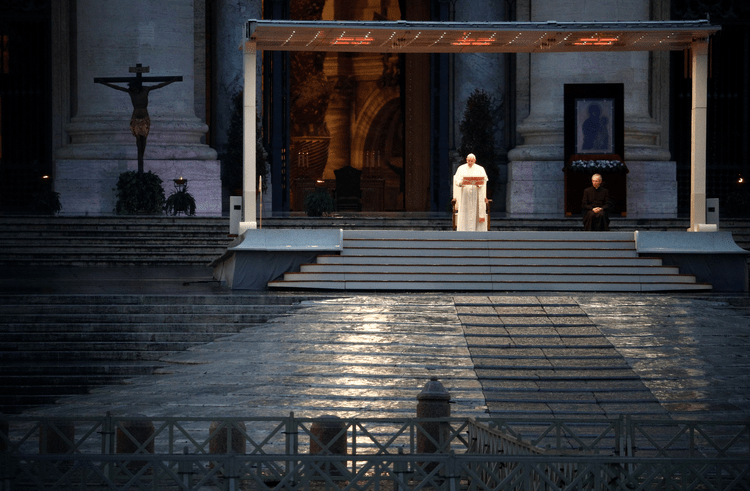
Pope Francis delivering his “Urbi et Orbi” before an empty St. Peter’s Square in Rome, 27 March 2020 at the height of COVID-19 pandemic. Photo from Vatican Media/AFP via Getty Images.
In the beginning
we were counting
the days of quarantine
but when COVID-19
spread with so many dying
then we realized this is not just passing
but could be staying
leaving the world in a standstill
shaking our very core and being
bringing us back to God
praying, surrendering everything
to him as our sole grounding.
Finding God
during this quarantine
is indeed a blessing
directing us to look within
to examine our being
where every healing must begin;
Any sickness is a dis-ease
a lack of order
when things are not pleasing
because of sin and wrong-doing
exactly what we are now seeing
with COVID-19.
Photo by Mr. Jay Javier, May 2020.
Consider the following:
Long before social distancing
we have always been so far away
even from those with whom we stay
foregoing all the loving,
replaced with twitting or texting;
When we were growing
we were taught to keep our hands clean
but we have pushed it to the extreme
refusing to dirty our hands
forgetting to work with honor and dignity
keeping them free from stains of dishonesty;
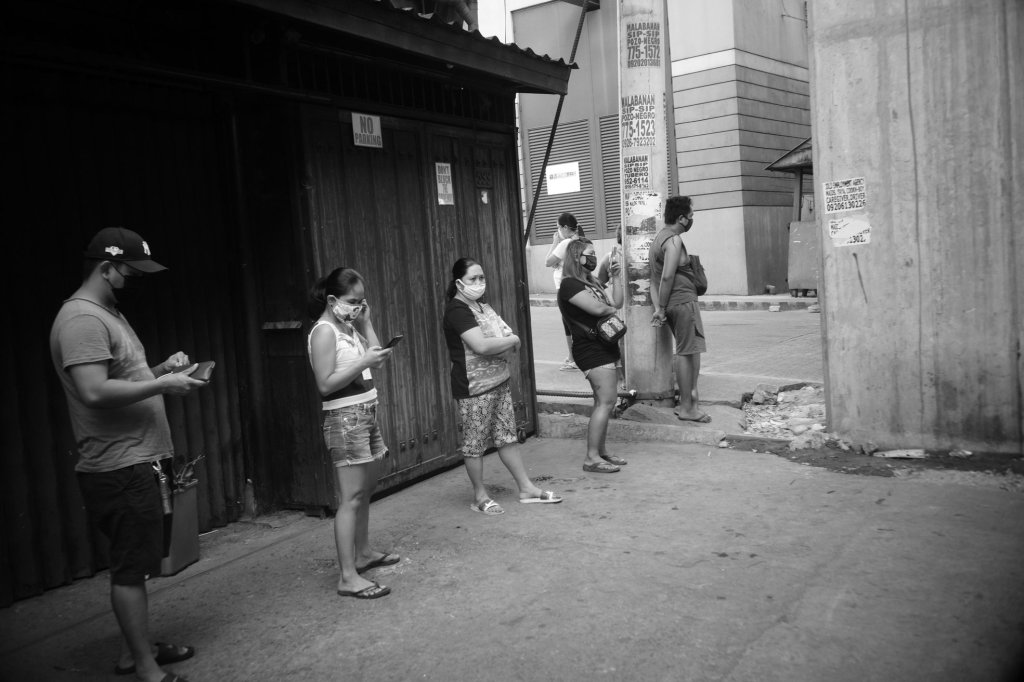
Of all the most disturbing
during this quarantine
is the mask that cover our face;
but, why be fazed, objections raised
when we have long erased
to see in every face
that tremendous grace
of God's trace?
In the midst of this calamity
when air became pollution-free
we rejoiced at Nature's beauty;
the remedy for every malady
is not found only in the pharmacy
but right in our hearts when we see
everything and everyone in harmony.
Oh how I long when that day shall be
when everyone is free with nothing to worry;
at ease shall we carry within the peace and serenity
of one big family living cleanly in God's mercy.











 lordmychef.com