Lawiswis ng Salita ni P. Nicanor F. Lalog II
Martes, Kapistahan ng Mater Dolorosa, 15 Setyembre 2020
1 Corinto 12:12-14, 27-31  || + ||  Juan 19:25-27
Larawan kuha ng may-akda, Abril 2020.
O Birheng Maria, aming Ina!
Ngayong aming ipinagdiriwang
iyong kapistahan bilang Mater Dolorosa
kinabukasan pagkaraan ng kapistahan
ng Pagtatampok ng Banal na Krus ni Hesus,
nabubuo ang napakagandang larawan
ng malalim at matalik ninyong ugnayan,
 kaisahan bilang mag-ina sa liwanag ng Banal na Krus;
tunay nga ikaw Birheng Maria ang una at dakilang alagad Niya
sinamahan Siya hanggang pagdurusa at kamatayan
kaya naman ikaw ay naging Ina nitong Santa Iglesya
nang kami ay naging katawan Niya.
Aming dalangin sa gitna nitong COVID-19
paratingin aming mga daing at hinaing
masintahing Ina sa Panginoon natin:
patatagin aming pananampalataya
paalabin aming pagmamahal at paglilingkod
iwaksi kami sa sakit at iba pang kapahamakan
upang balang araw sa pagbubukang liwayway
mapawi rin aming mga dalamhati
katulad mo'y magningning ang ngiti sa aming mga labi
mula kay Kristong muling nabuhay
sa pandemya kami'y pinagtagumpay.
Amen.
Larawan ng “Mater Dolorosa” ng pintor na si Carlo Dolci mula sa Wikimedia Commons.
The Lord Is My Chef Breakfast Recipe for the Soul by Fr. Nicanor F. Lalog II
Friday, Week XXIII, Year II in Ordinary Time, 11 September 2020
1 Corinthians 9:16-19, 22-27   <*(((><<   |+|   >><)))*>   Luke 6:39-42
NEW YORK – SEPTEMBER 11, 2001. Photo by Robert Giroux/Getty Images.
Today, we remember, O Lord, 9/11 – more than the date but the people who have perished, those injured, those who risked their lives for others, and countless others whose lives were forever changed by the terror attacks of that day.
Your servant St. Pope John Paul II lamented at that time how year 2001 – the start of the new century – was marked by that unimaginable attack on human life and freedom.
Nineteen years after, we still remember those vivid moments caught on television that stunned us in disbelief. Most of all, we can still feel the pain and fear 9/11 had stirred in us even if we were thousands of miles away from ground zero.
May this occasion remind us too, Lord Jesus, of our task of great efforts that lie ahead to proclaim your gospel of salvation amidst these troubled times.
All the more that we feel the importance of proclaiming the gospel in this time of the pandemic, 19 years after 9/11 as we go through many crises and calamities of biblical proportions. How sad that until now, we have refused to examine our true selves so we can see clearly the path we are taking.
Jesus told his disciples a parable: “Can a blind person guide a blind person? Will not both fall into a pit? Why do you notice the splinter in your brother’s eye, but do not perceive the wooden beam in your own?”
Luke 6:39, 41
Until now, wars and attacks on life continue everywhere around the world because right inside our hearts, Lord, we have refused to forget ourselves, think more of others so that we can be like St. Paul to “become all things to all” (omnia omnibus) like a slave foregoing our own good and comforts for the sake of more people.
Teach us to discipline ourselves, Lord, for all these crises we are facing today begin inside us.
thus I do not run aimlessly; I do not fight as if I were shadowboxing. No, I drive my body and train it, for fear that, after having preached to others, I myself should be disqualified.
1 Corinthians 9:26-27
To remember anyone and anything in the past, Lord, is to always change to make them better. Let it begin in me by first remembering your dying on the Cross for me. Amen.
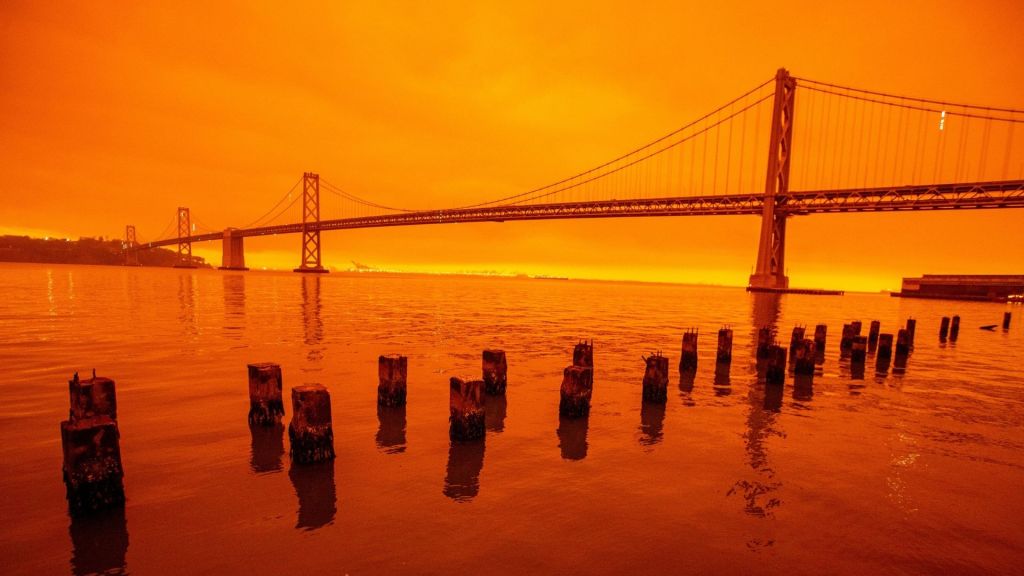
The wildfires created a natural Instagram filter across California. Photo: MediaNews Group/The Mercury News via Getty Images; 10 September 2020.
Quiet Storm by Fr. Nicanor F. Lalog II, 10 September 2020
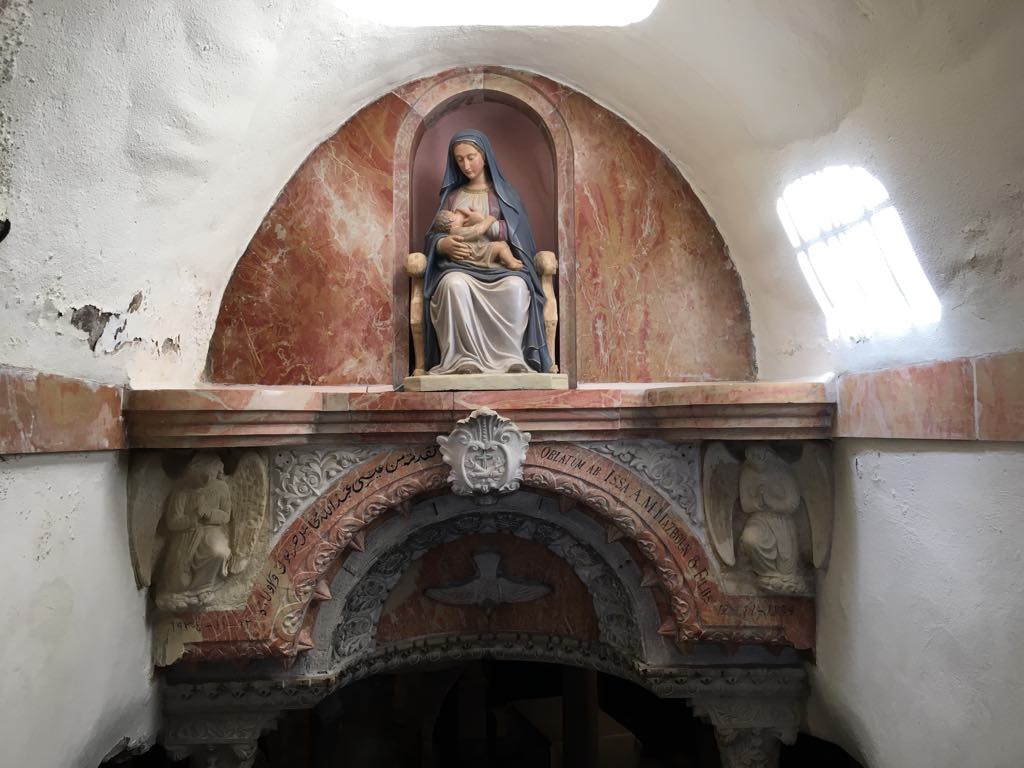
Chapel of the Milk Grotto in Bethlehem where the Holy Family hid before fleeing to Egypt to escape Herod’s murder of innocent babies. According to tradition, a drop of milk from the Virgin Mary fell on the floor of the cave that turned color of the stones to white.
We have just celebrated the Feast of the Birth of the Blessed Virgin Mary, the most perfect example of one who had experienced God’s hiddenness in her life, teaching us with some important lessons in rediscovering and keeping God’s hiddenness specially in this age of social media when everything is shown and has to be seen.
We have mentioned in our previous blog that hiddenness is different from being invisible that simply means “not visible”; hiddenness is more than not being seen per se but that feeling with certainty that God is present though hiding because he wants to surprise us. If God were not hidden, we would have not found him at all. And the more God is hidden, the more we are able to see him and experience him too as seen in the life of Mary (https://lordmychef.com/2020/09/04/the-hiddenness-of-god/).
The hiddenness of Mary.
Simplicity and humility of Mary as venue for the perfect setting of God’s coming in Jesus Christ. Consider her origins: her town of Nazareth in the province of Galilee was definitely outside the more popular city of Jerusalem that was the place to be at that time. Most of all, it is the only town in the New Testament never mentioned in the Old Testament nor by the prophets for lack of any significance in the coming of the Messiah.
Nazareth was largely unknown with some hint of notoriety as expressed by Nathanael (aka, Apostle Bartholomew) when he expressed disbelief to Philip who told him they have found the Christ, Jesus of Nazareth, by saying “Can anything good come from Nazareth?” (John 1:46)
Photo by author of chapel at the grotto believed where Mary received the good news of bearing Jesus Christ in her womb underneath the Basilica of the Annunciation at Nazareth, Israel (2019).
But that is how God works in his hiddenness, coming to us in the most ordinary places and circumstances, even least expected like Mary who was definitely not “in” if we go by today’s popular standard of “who’s in and who’s out?”
In fact, she was so “outside” the circle of influence of their time with her being promdi as we say these days, without any illustrious lineage to be proud of like her spouse Joseph who was from the royal Davidic line or her cousin Elizabeth from the priestly branch of Aaron, the brother of Moses whose husband, Zechariah belonged to another priestly clan in Israel.
Yet, God chose Mary to be the Mother of Jesus Christ because of her hiddenness expressed in her simplicity and humility. It is a far cry from our extreme “Marianism” when we almost worship Mary forgetting Jesus Christ her Son and our Savior! Worst still is the growing trend of “triumphalism” in many parishes racing for the so-called “episcopal” and “canonical” coronation of their various images of the Virgin Mary that come in all kinds of names and titles that has come to look more of a fad than authentic Marian devotion.
Without any intentions of denigrating the role and stature of the Blessed Virgin Mary in our faith as well as her proper place in the life of the Church defined by Vatican II’s Lumen Gentium, I dare ask the following questions:
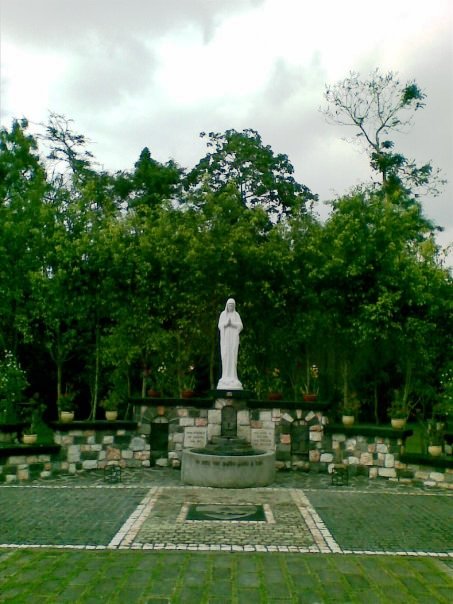
Photo by author, a replica of Our Lady of the Poor of Banneux, Belgium at Girlstown, Cavite (2009).
Is her coronation in heaven as Queen of heaven and earth not enough?
Why the need for these lavish spectacles for the coronation of the most simplest and humblest woman to have lived on earth?
It is a clear case of triumphalism – that exaggeration or overdoing our worship and rituals – especially if the Marian image is less than 200 years old without widespread devotions like the ones at Sto. Domingo (Quezon City) and Manaoag (Pangasinan).
I do not think the Blessed Mother would favor this considering her simplicity and solidarity with the poor and marginalized peoples seen in her many apparitions.
See the quaint and charming simplicity of Mary at Fatima in Portugal (1917) and lately at Banneux in Liege, Belgium (1933) where she identified herself as “Lady of the Poor”.
Note how the Virgin Mary reads “the signs of the times” in her apparitions and appearances when during the 1500’s at the height of European royalties and expeditions, she was always portrayed as victorious in regal clothes; but since Fatima in the 20th century as the world sank into the excesses of Industrial Revolution and affluence, Mary appeared simple, always in solidarity with the poor and suffering.
It is a cue we are sorely missing and sad to say, instead of renewing the world as St. Paul had asked us, we have allowed ourselves with the Mother of God to be transformed into the ways of the world by immersing in its showbiz frenzies, focusing on the material aspects like expensive clothes and jewelries.
Second example of Mary’s hiddenness is her oneness with Jesus Christ. She was never on her own, always seen in Jesus, with Jesus her Son and Lord. She believed in him so much, making him the focus at the wedding feast at Cana as well as at the foot of the Cross where she expressed in the most strongest terms her solidarity with the Savior of the world.
This has always been insisted by the Church since Vatican II regarding our devotions to Mary that must always be in relation with Jesus and his mission — never on her own.
Photo by author, 2019.
In all her apparitions, the Blessed Mother has always been consistent with her messages of conversion and return to God through her Son Jesus Christ, the frequent reception of the Sacraments of the Eucharist and Confession or Reconciliation.
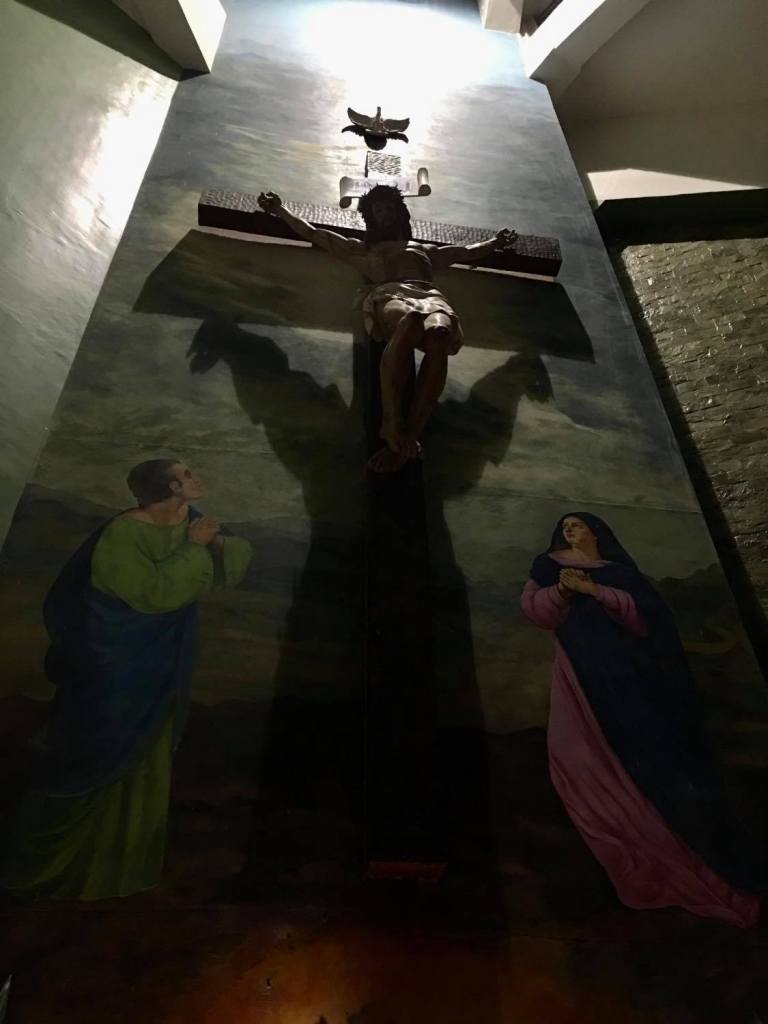
Mary’s Christocentricity is best seen in her oneness with him in pains and sufferings like in the Pieta and the Mater Dolorosa where Jesus is the one standing out, not her. Nor anybody else.
When Mary, or anybody else for that matter goes on one’s own, Jesus is no longer hidden but removed from the scene. Then his Cross disappears and all that is seen is Mary in all her “beauty and glory” that are empty, very secular because these attributes come precisely from her communion in Jesus!
Perhaps, this pandemic is teaching us today to review our Marian devotions and processions that have become more of a show and a spectacle for Instagram than for deepening of our faith.
I pray that the Cofradia that holds the annual December 8 processions at Intramuros would take a rest this year until 2022 to discern their noble efforts before that have degenerated to pomp and pageantry among “devotees” specially camareros and camareras trying to outshine and outclass each other with some participation at the sidelights of their pastors and sacristans.
Keeping the hiddenness of God while we remain hidden in contemplation.
Of all the qualities of Mary we all must imitate to help people rediscover God’s hiddenness is her being hidden in prayer and contemplation.
St. John Paul II noted in Rosarium Virginis Mariae when he launched the Luminous Mysteries in 2002 that although the scriptures are silent about where was Mary during the other significant moments of the life of Jesus, especially at the institution of the Holy Eucharist, it was most likely that Mary was also present deep in prayer.
This we find clearly at the Pentecost when the Holy Spirit descended upon the apostles and the Blessed Virgin Mary while they were praying at the Upper Room in Jerusalem (Acts 1:13-14).
Modern rendition of the Pentecost with Mary among the other disciples of Jesus. From Google.
Pope emeritus Benedict XVI shares with us his profound insight in his second Jesus of Nazareth book series (Birth of Jesus) how after the annunciation of the the birth of Christ to Mary, the angel left her totally without ever coming back to warn or instruct her unlike with Joseph. After saying “Yes” to the plan of God to be the Mother of Jesus, Mary immersed herself deep in prayers and contemplation, becoming hidden herself in God.
Since then, she never doubted Jesus her Son as the Christ, nurturing her faith with prayers beautifully expressed by St. Luke in saying how “Mary treasured things in her heart” when facing difficult situations like during his birth and his finding at the temple. It is not surprising that in the contemplation by St. Ignatius of Loyola, the Risen Lord must have first appeared to his Mother upon rising from the dead because she was the first to believe totally in him (which became the basis of our tradition of the Salubong).
Mary has always been present in the hiddenness of Christ from his coming in the darkness of the night on a manger in Bethlehem, to his hidden years in Nazareth, to his ministry when he would always retreat to a deserted place to pray, to his Crucifixion and death and burial on Good Friday and finally, in the darkness of Easter.
In this age of social media where everyone and everything has to be seen and shown with nothing hidden anymore even without qualms and shame at all, part of our mission and ministry as priests and religious is to lead people back to God’s hiddenness like the Virgin Mary so they may realize anew that the best things in this life are not always seen.
To fulfill this is for us first of all to imitate God like Mary — be hidden!
How unfortunate that instead of leading the people back to God’s hiddenness, we priests and religious have in fact joined the secular world, imitating the “influencers” like bloggers and vloggers that instead of focusing on God who is hidden, we are concerned with our selves and all the “porma” for the sake of number of “likes” and “followers” we have in our posts.
The more we try so hard to make God visible in our ministry by imitating the styles and gimicks of some media personalities that make our liturgy look like a variety show complete with song and dance numbers with our altars heavily decorated like a studio set with giant tarpaulins like in EDSA, that is when we remove God totally – not only his hiddenness – from the scene and inverse proportionately, the more we priests and pastors become more popular than the Lord himself.
“The Assumption of the Virgin” by Italian Renaissance painter Titian completed in 1518 for the main altar of Frari church in Venice. Photo from wikidata.org.
And that is how cults begin, with or without Jesus. It is very sad, even tragic and ironic because we have removed God himself – even Mary! – by unconsciously making ourselves the center of attention like pop icons and idols.
Mary had shown us the most perfect example of discipleship which is more of Jesus, less of self.
Can we not post without using our own pictures – no matter how profound our thoughts are – so the people may see the hiddenness of God in a photo of a lovely flower or a magnificent sunset? Unless you are a bishop or the Pope himself, having your photo published specially in the news is part of the information process about the person in focus. It is totally different in Church communications which is all about God and his message of love, not us.
The quarantine period invites us in the Church to appreciate and share this wonderful hiddenness of God by first becoming incognito, unknown and hidden from others, preferring to be at the background or “behind the camera” as we follow God in his hiddenness until we go to that great beyond of totally hidden from everybody except God.
Do not worry. We have Mary in every step along the way. Amen.
One of the best ads during the lockdown last summer from Smart.
What a wonderful lesson we have today from St. Paul about your wisdom, O God our Father that is found in the scandal of the Cross of your Son Jesus Christ!
Brothers and sisters: Let no one deceive himself. If anyone among you considers himself wise in this stage, let him become a fool so as to become wise. For the wisdom of this world is foolishness in the eyes of God, for it is written: God catches the wise in their own ruses, and again: The Lord knows the thoughts of the wise, that they are vain.
1 Corinthians 3:18-20
This we have realized at the start of this pandemic when everything in the world stopped and forever changed because of microscopic COVID-19 virus, affecting even the most advanced countries of the world.
Most of all, everybody – rich and poor alike – suffered greatly from this virus, teaching us to value persons more when people we took for granted for so long have become our “saviors” during this prolonged quarantine periods like vendors and delivery personnel, our househelpers, and others we used to look down upon who continued to serve us with food and other needs.
Not to be forgotten too are the members of neglected sectors of our society, specially those in the medical and healthcare system and the agriculture who showed us the importance of human and natural resources over imports and technology as well as entertainment.
What a great lesson about wisdom of God and foolishness of man in this modern time!
One thing very clear, O Lord, that to be a fool for you is first of all to let go of our foolish pride and be humble before you and others.
It is the only way we can let you do your work of changing us and the world when we learn to let go of our foolish pride like St. Peter in today’s gospel when he as an experienced fisherman heeded your command to cast his nets into the deep even though you are the carpenter’s son.
When we review the lives of all saints, they are all men and women of exceptional humility before you, Lord; like St. Gregory the Great who focused more on you that he was able to reform our liturgy, set up schools and monasteries, sent missionaries to England, and instill holiness among the clergy in his “Pastoral Instructions.”
Help us to believe more in you than in ourselves so that you may do your work in us and through us. May we value your Cross, Lord Jesus, considered as foolish in this sophisticated age yet has continued to prove that it is the only path to our transformation as persons and nations. Amen.
Photo by author, XVth Station of the Cross, the Resurrection, Mount St. Paul, La Trinidad, Benguet, February 2020.
“The Beheading of St. John the Baptist” by Pierre Puvis de Chavannes (1869) from WikiArt.org.
Immediately after our Mass for the Passion of John the Baptist this morning, Lord, I am leaving for the celebration of funeral Mass for a very kind woman I have known since high school seminary, Dra. Nenita San Diego who succumbed to COVID-19 three weeks ago.
Yesterday after praying the Holy Rosary, another parishioner passed away, more than a month after I have visited her on her birthday to anoint her with oil for the sick and receive the Holy Viaticum. I was told it was a peaceful death, so true to her name which is “Puring”, from “Purita” for “pure”.
I am not complaining, Lord, but, what is with death – with “Christian death” – that we “celebrate” it, be it for the martyrdom of saints or the demise of ordinary mortals like us?
Thank you for the experience, Lord.
In this time of pandemic when death comes easily almost daily, we are not only reminded of our mortality but most of all, our eternity and victory in Jesus Christ, making every death an image of hope in you.
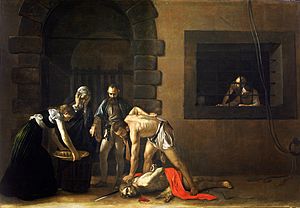
John the Baptist stood and died speaking for what is true because he had hope in Jesus Christ, the truth, the way and the life.
Caravaggio’s painting of the beheading of John the Baptist. From wikimedia.org.
So many people like him are suffering today, refusing to give in to the pressures and whims of modern Herods among us because they believe in you that they stand for what is true.
O good Jesus, we pray for those suffering for truth and for life like John the Baptist in this time of pandemic; bless them and keep them always for they remind us like your precursor that you have come, that you are among us.
Keep our hopes vibrant and alive in you and to a more just tomorrow, Lord, so that we may persevere in speaking your words of truth no matter what others would say. Amen.
Lawiswis ng Salita ni P. Nicanor F. Lalog IIPaggunita sa Pagpapakasakit ni San Juan Bautista, Ika-29 ng Agosto 2020
Ama naming mahabagin,
ngayong ginugunita namin
pagpapakasakit ni San Juan Bautista,
Inyo sanang dinggin aming panalangin
para sa maraming kapatid namin na ginigipit, iniipit;
ang iba sa kanila ay nakapiit
marami ang lugmok sa pait at sakit na sinapit
mula sa mga makabagong Herodes at Herodias
na prinsipyo at pagkatao, ipinagpalit sa ginto.
Inyong patatagin paninindigan sa katotohanan
katulad ni San Juan Bautista
upang ipagpatuloy pakikipaglaban
nasaid man ang kabuhayan
at tanging pinanghahawakan
dangal ng katauhan.
Ikaw lamang Panginoon
ang nakaaalam ng higit na mainam
kami ay Iyong turuan at tulungan
katulad ni San Juan loob mo ay masundan
kami ma'y maging palatandaan
ng Iyong kapanatilihan sa gitna ng mga
pag-uusig at kahirapan.
Amen.
*Mga larawan sa itaas: una ang painting ni Caravaggio ng pagpupugot sa ulo ni Juan Bautista mula sa wikimedia.org; biktima ng tokhang mula sa Philippine Daily Inquirer; umiiyak na empleyado ng ABS-CBN mula sa Reuters.org; at mga locally stranded individuals sa ilalim ng flyover malapit sa NAIA kuha ni G. Raffy Tima ng GMA-7 News.
The Lord Is My Chef Breakfast Recipe for the Soul by Fr. Nicanor F. Lalog II
Monday, Feast of St. Bartholomew, Apostle, 24 August 2020
Revelation 21:9-14 >><}}}*> |+| >><}}}*> |+| >><}}}*> John 1:45-51
Photo by author, Subic, 2018.
Glory and praise to you, Lord Jesus, the “Word who became flesh and dwelt among us” to reveal the Father’s immense love for us all. He was not contented in just telling the prophets of Old Testament how he loved us that He came and lived with us in you, Lord Jesus!
And that is why we also rejoice on this Feast of St. Bartholomew, a.k.a. Nathanael, who was introduced to you by another Apostle you have called earlier:
Philip found Nathanael and told him, “We have found the one about whom Moses wrote in the law, and also the prophets, Jesus, son of Joseph, from Nazareth.” But Nathanael said to him, “Can anything good come from Nazareth?” Philip said to him, “Come and see.” Jesus saw Nathanael coming toward him and said of him, “Here is a true child of Israel. There is no duplicity in him.” Nathanael said to him, “How did you know me?” Jesus answered and said to him, “Before Philip called you, I saw you under the fig tree.” Nathanael answered him, “Rabbi, you are the Son of God; you are the King of Israel.”
John 1:45-49
O dear Jesus, like St. Peter in the gospel yesterday and now St. Bartholomew, you are telling us anew to never be contented with mere words, with the “what” of who you really are, that we must always “come and see you” in order to experience your very person and truly know you.
I really wonder O Lord what your words meant that before Philip called Nathanael-Batholomew, you have seen him under the fig tree; however, I am so convinced that in your words, Nathanael-Bartholomew must have felt something deep inside him that he threw himself totally to you as your Apostle.
Most of all, teach me to remain simple and hidden in you, Jesus that like St. Bartholomew, despite the scarcity of stories and information about him except this little anecdote from the fourth Gospel, he remained faithful to you until his death by flaying reportedly in India.
May we imitate St. Bartholomew who had shown us that more than words, what matters is our oneness in you, Jesus, without any need for us doing sensational deeds, earning thousands of “likes” and “followers” in social media because only you, Lord, remains extraordinary above all. Amen.
Almighty God and Father, on this Memorial of the Queenship of Mary our Blessed Mother, we join her in that most beautiful song of praise to you, “My soul proclaims the greatness of the Lord, my spirit rejoices in God my savior” (Lk.1:47).
Remind us always, O Lord, specially in this time when we exaggerate everything that unlike the royalties of the world, Mary is our Queen not because of power and wealth nor of fame and popularity but precisely due to her humility and weakness before you.
In this time when we are so fond of “triumphalism”, when we overdo even our devotions and prayers to praise and glorify you, remind us O Lord it is not your way as shown to us by the Blessed Mother Mary.
Let us keep in our minds and hearts that Mary, along with all the saints, are venerated because of their obedience to you, fulfilling your will at all times, making you present among us in our weaknesses and helplessness.
We pray for more simplicity and humility, above all, sincerity in our devotions to Mary and the saints that lead to more authentic faith in you alone who is our God Most Holy.
Like Mary our Queen, may we always say “yes” to you O God our “King of kings”. Amen.
The Lord Is My Chef Breakfast Recipe for the Soul by Fr. Nicanor F. Lalog II
Wednesday, Memorials of St. John Eudes & St. Ezechiel Moreno, Priests, 19 August 2020
Ezekiel 34:1-11 >><)))*> ||| >><)))*> ||| >><)))*> Matthew 20:1-16
Photo by author, Pulilan, Bulacan, February 2020.
As we go through more difficulties and sufferings during this time of pandemic, your words today dear God speak so well of what we need most – a true shepherd who will care for the lost and injured sheep.
Yes, you have fulfilled, O God, your promise a long time ago to Ezekiel that you yourself will come by sending us your Son Jesus Christ to look after and tend your sheep after the shepherds of Israel have miserably failed in their duties and responsibilities.
Unfortunately, there are still so many shepherds today in government even in Church who continue to pasture themselves!
Woe to the shepherds of Israel who has been pasturing themselves! Should not shepherds, rather, pasture sheep? You have fed off their milk, worn their wool, and slaughtered the fatlings, but the sheep you have not pastured. You did not strengthen the weak nor heal the sick nor bind up the injured. You did not bring back the strayed nor seek the lost, but you lorded it over them harshly and brutally. As I live, says the Lord God, because my sheep have been given over to pillage, and because my sheep have become food for every wild beast, for lack of a shepherd; I swear I am coming against these shepherds.
Ezekiel 34:2-4, 8, 10
Teach us, O Lord, through the examples of two great shepherds of souls whose feast we celebrate today: St. John Eudes who was one of the early pioneers in propagating devotion to your most Sacred Heart and St. Ezechiel Moreno who served for 15 years in the Philippines and later in South America where innumerable cancer cures were attributed to him.
St. John Eudes and St. Ezechiel Moreno showed in their lives of faithful and loving apostolate for the poor that shepherding is always a gift, never to be counted or equated nor even be seen in terms of wages and pay like in the gospel.
Remind us sweet Jesus in the midst of this pandemic when we are called to be good shepherds like you, may we always see your call and mission to us as gifts freely given not as tasks or work to be compensated by material things because you believe in us.
May we always go the extra mile in answering your call, O Lord, which is in itself a tremendous gift we must cherish for we are not even worthy at all to receive. Amen.
The Lord Is My Chef Breakfast Recipe for the Soul by Fr. Nicanor F. Lalog II
Tuesday, Week XX, Year II in Ordinary Time, 18 August 2020
Ezekiel 28:1-10 <*(((><< || + || >><)))*> Matthew 19:23-30
Photo by author, Petra in Jordan, May 2019.
Then Peter said to Jesus in reply, “We have given up everything and followed you. What will there be for us?” Jesus said to them, “Amen, I say to you that you who have followed me… And everyone who has given up houses or brothers or sisters or father or mother or children or lands for the sake of my name will receive a hundred times more, and will inherit eternal life.”
Matthew 19:27-28, 29
“We have given up everything and followed you, Lord. What will there be for us?”
Oh! how often we tell this to you, Lord Jesus, as if we have given so much for the sake of your kingdom.
Sometimes, it is not really a question we ask but a reminder to you of our “goodness” and “benevolence” with others, of how good we have been when in fact whatever we give and share are all from you.
Forgive us, O Lord, when most specially in the midst of pains and sufferings, we ask you “What will there be for us?” in order to remind you of our rewards, or entitlement as if you forget them or that there is such a thing at all with you.
Photo by author, 2019.
We are sorry Lord in counting the costs and most of all, in demanding so many in return.
“What will there be for us?” is often the question we ask when we doubt your generosity and fidelity to your promises to us.
Like Ezekiel in the first reading, remind us O Lord to keep in mind not to be “haughty of heart”, that “we are not god despite our many achievements brought about by our intelligence or beauty” (Ezekiel 28:1-7).
Dearest Jesus, you have given us with so much and we have given so little; teach us to give more of ourselves, more of our time, more of our treasures, and most of all, more of you to others. Amen.









 lordmychef.com