We are the Lord’s “harvest”. And “laborers” too.

Lord My Chef Sunday Recipe for the Soul by Fr. Nicanor F. Lalog II
Eleventh Sunday in Ordinary Time, Cycle A, 14 June 2023
Exodus 19:2-6 ><}}}}*> Romans 5:6-11 ><}}}}*> Matthew 9:36-10:8

Photo by Giuseppe Russo on Pexels.com

A very good friend in the States texted me the other night, requesting for prayers as she was about to go through an MRI; the following day, she texted me anew asking for more prayers because it seemed her cancer had recurred, this time attacking her liver.

I felt her fears and worries. And pain.

She told me how she wanted to call her parents that evening but had to wait until this weekend so that her younger brother would be home to be present especially by her mom’s side when she breaks to them that her cancer had metastasized. Despite her condition, she was thinking of her parents in their “empty nest”, thinking how they might react in receiving the bad news.
Photo by author, Sacred Heart Novitiate, Novlaiches, QC, March 2026.

This crucial factor is what is most missing in the agony of Ms. Rovelyn Baterbonia when her son Rene died Monday after drowning in the treacherous beach of Aurora during their varsity training.

We all felt her pain not only of losing a son but most of all the agony of being alone, perhaps even left out in the dark so far from her dead son with no one from the university nor basketball team immediately informing her of the circumstances of the accident.

It was so heartwrenching – nakakadurog ng puso – watching her grieved upon arrival at the airport, lamenting at how somebody texted her that Monday if they can call her: “Hindi naman siya tumawag. Ako na lang nag-tawag… tapos, nang tumawag na ako sabi niya, mam naaksidente po si Rene. Nalunod po…”. After that, she said she heard nothing from the people supposed to be with Rene. “Wala maski pictures sila send sa akin”, she complained.

This is the most crucial part of every misery and tragedy: is there someone present with those grieving, with those suffering?

At the sight of the crowds, Jesus’ heart was moved with pity for them because they were troubled and abandoned, like sheep without a shepherd. Then he said to his disciples, “The harvest is abundant but the laborers are few; so ask the master of the harvest to send our laborers for his harvest” (Matthew 9:36-38).

Our Lady of Fatima University, February 2025.

We are the Lord’s “harvest” and his “laborers” too. Jesus reminds us today that the answer to all our problems and pains in the world is never found in material things, in money and gadgets, nor well-crafted statements and other publicities. We are the harvest and the harvesters too!

What we need are more people who care, who journey, who are present with majority of the population so lost like sheep without a shepherd. And that is where I felt the pain most when Ms. Baterbonia repeatedly said that “kahit mahirap kami, hindi ko papayagan anak ko mag-training ng ganun.”

Photo by Oscar Millu00e1n on Pexels.com

She said it all – the harsh reality in our country, the most Christian nation in this part of Asia, where the poor remain neglected, forgotten, and taken for granted especially by those in the Church.

See how the poor have shied away from the church primarily due to so many collections in every Mass every Sunday while in the parish office, almost everything comes with a fee. They could not even get a free smile from some staff members often masusungit.

If Matthew were with us today, he would surely repeat with intensity his report that day of how “At the sight of the crowds, Jesus’ heart was moved with pity for them because they were troubled and abandoned, like sheep without a shepherd” because that is how our Church is today – sheep without a shepherd.

And where are the shepherds? Check their social media accounts and you find them most frequently in malls and hotels, traveling abroad via business class, unwinding on a yacht, communing with nature riding big bikes or their expensive mountain bikes. Go to any buffet and ribbon-cutting ceremonies of the newest Jollibee store or even gas station and you find more than two priests and a bishop present while the poor could not even have a decent funeral rite nor blessing for the burial of their dead because the priest is out, could not come to the slum area.

But of course, there are still more blessed and dedicated priests and bishops like Bishop Pabillo of Palawan who brave the seas and mountains just to celebrate the Mass and other Sacraments to the great number of their harvests in far-flung areas.

For Jesus, it is always the person who matters that is why his proposal has always been to send us another person, another companion, a fellow to accompany us in our brokenness and darkness. There is his move of gathering us, calling us, and sending us forth to a mission.

Jesus never taught us to ask for more money nor food nor gadgets to solve the problems of the world. Recall his temptation in the desert when he rejected the devil’s challenge to change stones into bread because man does not live by bread alone but with every word from God.

For the world, everything is a problem to be solved, including mysteries of God and of the human person. As we have reflected the past two Sundays, mysteries are not problems to be solved but non-logical realities we must embrace or even allow ourselves to be wrapped to discover the richness and meaning of this life like God and persons.

When people are down and lost in life, feeling troubled and abandoned, where do we focus more, to their woes and problems or their very persons?

Try thinking of the people you consider as “heaven sent” and helped you in your darkest moments. Are they not the ones who brought out our giftedness as a person, as a beloved child of God with Christ’s gospel?

A few months after his election as Pope in 2005, Benedict XVI heard of a bishop in Austria dying of cancer. He reportedly wrote that bishop, assuring him of his prayers as a brother priest, reminding him that “Jesus saved the world by suffering and dying on the cross, not with activities.” I remembered that news so well because what is mostly happening in our parishes and dioceses are activities. We have become program oriented than people oriented.

Worst is when some of us priests and bishops see the “abundant harvest” as business ventures of all sorts including churches and fiestas as tourist attractions. When economics become our major consideration in the church, how can “we also boast of God through our Lord Jesus Christ, through whom we have now received reconciliation” as St. Paul reflected in the second reading?

Let us return to our “desert of Sinai” spoken of in the first reading, a reminder of our turning point in life and history when God called and sent us to be a “kingdom of priests, a holy nation” – his abundant harvest at the same time his laborers too. We are the new apostles called and sent by Jesus to others like us who are weak and tired, confused and lost, hurting and crying but also blessed and joyful! As God’s abundant harvest, each one of us is a gift to be cherished and valued always; but, at the same time, a brother and a sister entrusted to each one for God’s greater glory, not ours. Amen. Have a blessed week ahead.

Be gentle to be in the banquet

Lord My Chef Sunday Recipe for the Soul, 28 September 2025
Twenty-Sixth Sunday in Ordinary Time, Cycle C
Amos 6:1, 4-7 ><}}}}*> 1 Timothy 6:11-16 ><}}}}*> Luke 16:19-31
Photo by author, Carmel of the Holy Family Monastery, Guiguinto, Bulacan, 25 September 2025.

But you, man of God, pursue righteousness, devotion, faith, love, patience, and gentleness (1Timothy 6:11).

How lovely and so apt these days are the qualities Paul required through Timothy every man and woman of God must have. Of the six qualities Paul had cited, I like most “gentleness” which Jesus also asked us to have, “learn from me, for I am meek and gentle ( or humble) of heart” (Mt. 11:29).

From the Greek word prauteis, gentleness implies consideration, meekness, humility, calmness and strength amid adversities and difficulties. True power is expressed kindly and gently, not with harshness. Parents and teachers know this so well as children learn discipline better when authority and power are expressed gently than harshly.

Photo by author, Carmel of the Holy Family Monastery, Guiguinto, Bulacan, 25 September 2025.

Lately we have been sliding towards this kind of arrogance in our anger and frustrations following the wholesale corruption in Congress. Everybody feels the weight and pains of the ghost flood control projects but cursing and wishing death upon the corrupt officials are off bounds because that make us just like Duterte and his followers whose mouths spew expletives and death to their detractors.

Our readings are so timely this Sunday again, calling us to be gentle with one another because eternal life begins in the here and now of our earthly existence. How we live today determines our entrance or not into the eternal banquet of the Lord.

Jesus said to the Pharisees: “There was a rich man who dressed in purple garments and fine linen and dined sumptuosly each day. And lying at his door was a poor man named Lazarus, covered with sores, who would gladly have eaten his fill of the scraps that fell from the rich man’s table. dogs even used to come and lick his sores. When the poor man died, he was carried away by angels to the bosom of Abraham. The rich man also died and was buried, and from the netherworld, where he was in torment, he raised his eyes and saw Abraham far off and Lazarus at his side” (Luke 16:19-23).

Photo by author, Carmel of the Holy Family Monastery, Guiguinto, Bulacan, 25 September 2025.

Our readings continue to pursue that thorny issue of money, of how we use and manage it for God’s greater glory in the service of others not for our shameful selfish interests.

That is why we find Paul’s admonition to Timothy and to us today as men and women of God to be gentle in the midst of too much materialism. In the preceding verses Paul warned Timothy of the dangers of false teachings and the love of riches which he concluded with an exhortation to rely more on God than in wealth in verse 17. It is a timely reminder from over 2000 years ago against this growing trend among us spawned by social media of people flaunting their wealth as if finding their own value as a person in possessions than in their very selves.


Gentleness like Jesus is first of all finding our being’s sacredness. It is an expression of our being loving and charitable because we are children of one loving God we relate with as a Father.

How tragic we no longer see each other’s worth as a person, as an image and likeness of God as we seek more the face of money than the face of God in every person. Pera pera na lang lahat – even in the church, sad to say. Every consideration boils down to money like leadership in church activities or hermanidad in fiestas being reserved for the rich and famous who are always the politicians to whom many priests and bishops have become beholden, consciously or unconsciously. We have too much collections and envelopes that further drive away the poor from celebrating our Sunday Eucharist which is essentially a foretaste of the Lord’s banquet in heaven.

Photo by author, Carmel of the Holy Family Monastery, Guiguinto, Bulacan, 25 September 2025.

Amos continues his tirades against the priests of the temple of his time with their hypocrisies of hiding selfish motives in religious celebrations and practices that sadly continue to this day among us in the church.

Thus says the Lord the God of hosts: “Woe to the complacent of Zion! Lying upon beds of ivory, stretched comfortably on their couches, they eat lambs taken from the flock, and calves from the stall! They drink wine from bowls and anoint themselves with the best oils; yet they are not made ill by the collapse of Joseph!” (Amos 6:1, 4, 6).

That “eating lambs from the flock” and “calves from the stall” are the animals reserved for offering in the temple their priests have taken for themselves while “drinking from bowls” and “anointing with the best oils” harp on our rituals we have taken as our own like commercialization of Masses and sacraments. It is the color of money perfectly described by the purple clothing of the rich man in the parable that pervades us in the church that people no longer see and experience God as they have become so cautious asking about the price or the fees that come with every service we give.

Photo by author, Carmel of the Holy Family Monastery, Guiguinto, Bulacan, 25 September 2025.

Gentleness like Christ is using our power and authority at the service of the poor and disadvantaged, ensuring our Eucharistic banquet is a reflection of the eternal banquet in heaven where everyone is welcomed.

How sad this parable is repeated daily in the church that is why Jesus directed it to the Pharisees, one of the ruling class in the Jewish society at that time associated with temple worship and religion. Though Jesus did not say at all if the rich man is a good person or not, it is very clear that he lacked gentleness in his flamboyance, wearing purple clothes as if screaming to be noticed by everyone as a somebody while everybody is a nobody.

Maybe we should add “nepo Fathers” to the list of nepo babies and nepo wives who flaunt their wealth, looking more like showbiz kids than priests, feeling superstars who are more like entertainers than preachers who relish the tag “influencer” than remain hidden doing the work of Christ. They refuse wearing the proper liturgical vestments due to our tropical climate but would not mind at all wearing signature clothes with their perfumes leaving traces in their favorite stomping grounds like malls and cafes during offs.

Where is our gentleness or concern and consideration for the majority of our people who are poor further pushed out of our churches literally and figuratively speaking simply because we do not smell and look like them our flock of sheep as Pope Francis reminded us early in his pontificate?

Photo by author, Carmel of the Holy Family Monastery, Guiguinto, Bulacan, 25 September 2025.

Gentleness of Jesus is solidarity with the people, especially the poor and suffering who experience being uplifted or empowered in his mere presence so filled with warmth and love.

People understand us priests for being strict even stern-looking but what they find so difficult is when pastors are detached from them, always out of the parish for so many reasons, when priests are selective in their company even having cliques. How sad when priests are unapproachable and indifferent like the rich man who was oblivious to the presence of Lazarus at his door, who never gave him any attention at all while still on earth when in fact, they knew each other as mentioned in the parable after they have both died. Kakilala naman pala niya si Lazaro pero doon na lang sa kabilang buhay siya kinausap at pinansin kung kailan huli na ang lahat.

Pope Francis used to describe the church as a hospital where the sick in body and soul come to find solace and comfort in the presence of God. But, instead of hospitality, many times it is hostility that people experience in our parish when they are held hostage by our many rules and regulations that they never feel welcomed at all. Some get scolded that instead of their burdens being eased, they are traumatized by the priests or the office staff and volunteers.

Photo by author, Carmel of the Holy Family Monastery, Guiguinto, Bulacan, 25 September 2025.

If we could be a little more gentle with every Lazarus, perhaps we could be truly rich as we find God in everyone in our doors that lead to our banquet table, whether here on earth or in the afterlife.

Let me end with this parable within me these past five years as a chaplain in the hospital.

Have you ever noticed how the rich with all their wealth and resources are often afflicted with rare diseases without any cure and medication at all while so many poor people without money at all could not avail of the many procedures and medications available for their illness?

It is a parable in this life that begs us to be gentle, even extra gentle many times to ease each other’s sufferings with the rich sharing their material wealth and the poor sharing their gift of self in the face of death. Amen. Have a gentle week ahead everyone. Fr. Nicanor F. Lalog II, Our Lady of Fatima University, Valenzuela City (lordmychef@gmail.com).

Remaining in Jesus

The Lord Is My Chef Daily Recipe for the Soul by Fr. Nicanor F. Lalog II
First Friday, Fourth Week in Ordinary Time, 07 February 2025
Hebrews 13:1-8 ><}}}}*> + ><}}}}*> + ><}}}}*> Mark 6:14-29
Photo by Mr. Gelo Carpio Nicolas, January 2020.
Keep me faithful and true
to you,
Jesus
because
you are
"the same yesterday,
today,
and forever"
(Hebrews 13:8);
it is I who forgets
all the time,
who chooses to turn away
from you and be unloving,
unkind,
unforgiving.
Forgive me, Jesus
when you tell me
"Let brotherly love continue"
(Hebrews 13:1)....
...but many times
I can't look or even consider
each one a brother or a sister
because of our many differences.
"Do not neglect hospitality,
for through it some have unknowingly
entertained angels"
(Hebrews 13:2)...
...I think,
more than the angels
but on many occasions it was
you whom I have turned away,
Jesus because I am
so suspicious of others
who come to me for whatever
needs.
"Be mindful of prisoners
as if sharing their imprisonment,
and of the ill-treated as of yourselves,
for you are also in the body"
(Hebrews 13:3)...
I'm sorry,
Jesus for the many times
I have imprisoned others
in my narrow mind
of many biases
and prejudices.
"Let marriage be honored
among all and the marriage bed
be kept undefiled"
(Hebrews (13:4)...
what a shame,
Jesus in our age when
marriage is no longer honored
and just taken for granted
with many couples
defiling their bed.
"Let your life be free
from love of money but
be content with what you have"
(Hebrews 13:5)...
alas!
my dearest Jesus,
save us your priests
our diocese so in love
with money,
with the rich
and powerful with whom
we are so close
and identified with,
totally neglecting
the poor and the suffering
among us with our
many excuses and alibis,
always at their beck and calls.
Yes, Jesus,
many times we feel like
Herod: bothered
only by the gospel,
bothered only of your
presence among the poor
and suffering
but so much like Herod,
we never bothered ourselves
to truly find you
and follow you.
Amen.
Photo from Wikipedia, mosaic of Jesus with Mary and John the Baptist at the Hagia Sophia in Turkey.

Advent is freedom from enemies

The Lord Is My Chef Daily Recipe for the Soul by Fr. Nicanor F. Lalog II
Simbang Gabi-9 Homily, 24 December 2024
2 Samuel 7:1-5, 8-12, 14, 16 <*((((>< + ><))))*> Luke 1:67-79
Photo by author, Advent 2022.

Finally! This may be the word and expression today, the 24th of December. Finally, a lot of you would be bragging about having completed the nine-day novena to Christmas. Finally, it would be Christmas day. And finally, we could sleep longer.

But then, finally what?

When Zechariah’s tongue was loosened after naming his son John in fulfillment of the angel’s instruction to him, it was not the word “finally” that came from his mouth but “Blessed be the Lord, the God of Israel!”(Lk.1:68). After being mute for nine months, Zechariah’s silence became praise with gratitude and wonder giving him the voice to speak again.

Zechariah his father, filled with the Holy Spirit, prophesied, saying: “Blessed be the Lord, the God of Israel, for he has come to his people and set them free. He has raised up for us a mighty Savior, born of the house of his servant David. Through his prophets he promised of old that he would save us from our enemies, from the hand of all who hate us, He promised to show mercy to our fathers and to remember his holy covenant. This was the oath he swore to our father Abraham: to set us free from the hand of enemies, free to worship him without fear (Luke 1:67-74).

Photo by author, birthplace of St. John the Baptist underneath the church dedicated to him in Judah.

We have reflected last Thursday that Advent and Christmas is a journey that begin in the church, in the celebration of the Mass as Luke opened his Christmas story with the annunciation of John’s birth to Zechariah during their Yom Kippur at the Jerusalem Temple.

Luke’s artistry and mastery in weaving stories brought us right into every scene leading into Christmas – from Jerusalem to Nazareth then to the hill country of Judah in the home of Zechariah until John’s birth where our scene remains today. Tonight and tomorrow, he will be leading us along with Matthew and John to Bethlehem for the birth of the Lord.

But this journeys Luke recounted to us were not only about places but most of all an inner journey into our hearts. As we all know, the destination does not really matter but the journey, the trip. It is most true with our Simbang Gabi too – it is not about completing the nine-day novena that matters most but what have we become!

After tonight and tomorrow’s Masses, our churches would be empty again, only to be filled up on Ash Wednesday, and then Palm Sunday and Holy Thursday. How tragic that on Easter which is “the Mother of all feasts in the Church”, people are miserably absent because they are out in the beach and resort enjoying summer. In fact, more people come to Christmas (Pasko ng Pagsilang) than with Easter (Pasko ng Pagkabuhay) when it is actually the very foundation of our faith.

With our students after Simbang Tanghali last year at the Medicine Lobby of Our Lady of Fatima University, Valenzuela City.

So, what have we become after these nine days of waking up early or staying up late at night, praying, listening and reflecting on the word of God, sharing our material blessings in the collections and gift-giving if we stop going to Mass the whole coming new year?

American Trappist monk Thomas Merton wrote that seeking God is not like searching for a “thing” or a lost object because God is more than an intellectual pursuit or a contemplative illumination of the mind. Merton explained that God reveals Himself to us in our hearts through our communion and fellowships in the Church. 

We come to church to celebrate the Mass and pray with the whole community to express our communion with one another in Jesus Christ. It is in this communal aspect of prayer we become holy, when we are transformed and as Zechariah prophesied, we are “set free” by Jesus Christ who is the main focus of his Benedictus.

Who are those enemies Zechariah mentioned twice in his Benedictus? Who are those enemies we have to be set free for God and free to love?

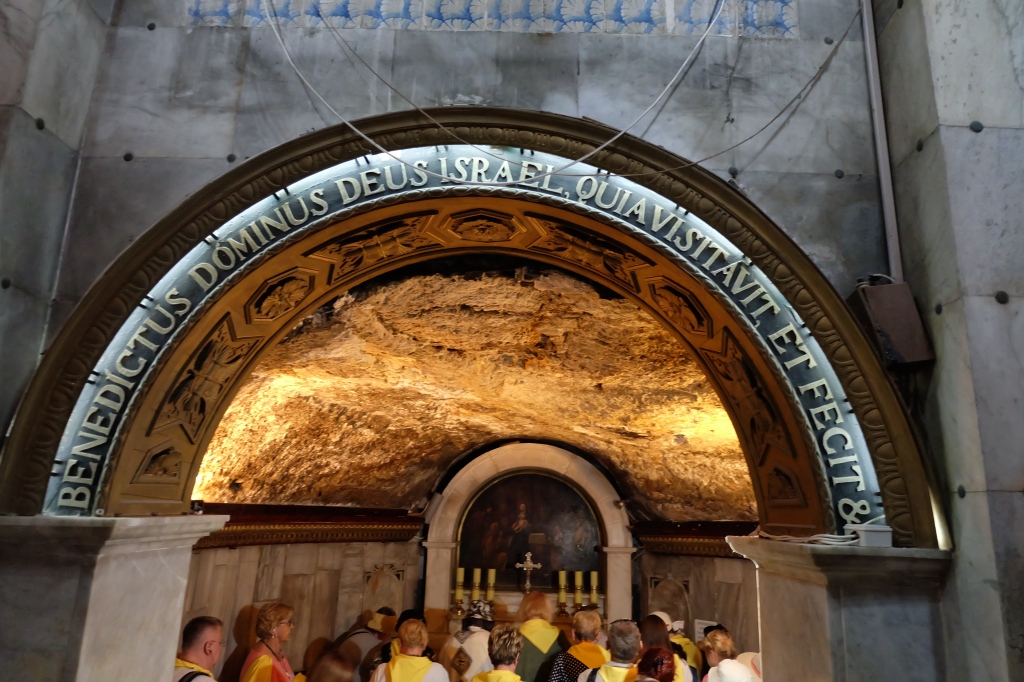
Photo by author, Church of St. John the Baptist, Israel, May 2019.

Again, look at this minute detail Luke used in composing Zechariah’s Benedictus when he spoke twice of the word “enemies”: first of “saving us from our enemies, from the hand of all who hate us” (Lk.1:71) and then, the fulfillment of God’s promise to Abraham “to set us free from the hand of enemies, free to worship him without fear” (Lk.1:74).

Surely, those “enemies” were not just the Romans and other pagans around Israel at that time nor the Pharisees and scribes, the priests and Sadducees of the temple who had hands in Christ’s death for they are now gone. The gospel accounts were written in the past but remain true and relevant at all time in history, especially now more than ever in our own time.

Are we the “enemies” within who think only of our selves even in our religious and spirituality, manipulating God, controlling God?

A friend asked me last week if their priest was right in saying that the Simbang Gabi is the most effective means to obtain special favors from God. I emphatically told her “no”, adding that their priest’s claim is misleading. We cannot dictate God. God blesses everyone, including sinners who do not even go to Mass. We do not need to multiply our prayers as Jesus warned us because God know’s very well our needs before we pray. Then, why pray at all?

We pray and most especially celebrate the Mass especially on Sundays to know what God wants from us because we love God. Period. And that love for God must flow in our loving service and kindness with others. If gaining favors is the main reason we go to Mass or even pray, then, we are the “enemies” who prevent ourselves to freely worship God!

Mr. Paterno Esmaquel of Rappler rightly said it in his Sunday column:

“We are a society obsessed with achievement and success, command and control… Even we who try to complete the Simbang Gabi can plead guilty. During the Simbang Gabi, for example, we are tempted to focus on achieving all the nine days and succeeding for another year. By fulfilling this tradition, we can then ask God (or “command” God, like a genie) to grant our wishes. We can therefore wield greater control over life that is otherwise unpredictable (https://www.rappler.com/voices/thought-leaders/the-wide-shot-missed-simbang-gabi-found-christmas-grace/).

And who are feeding all these misleading and erroneous thoughts on the people? We your priests and bishops!

How sad as we have mentioned last week when many priests have totally lost any sense at all of the sacred in the celebration of the Mass. Some of them not only come unprepared for the celebration without any homily, even so untidy and shabbily dressed and worst of all, make fun of almost everything and everyone that the Mass has become a cheap variety show. Online Masses continue not for evangelization for “shameful profits” in the Sacrament through “likes” and “followers” that some priests are now more concerned in finding ways to be trending and viral instead of how to effectively evangelize the people with our good liturgical celebrations flowing into our witnessing of life.

Yes, we priests and bishops are the enemies right here in the church when we align more with the rich and powerful, when we have no qualms asking/receiving gifts and favors from politicians and still, would want to collect more money and donations from people with our endless envelops that have totally alienated the poor from the church. The poor are the ones who suffer most, paying for the corruption of the politicians who help the clergy in their projects for the poor. Poor Jesus Christ!

Perhaps, on this last day of our novena to Christmas, let us all force ourselves – especially us priests and bishops – to go into silence to identify, to weed out those enemies within and outside us that prevent us from welcoming Jesus Christ in our hearts.

Let us pray to God that He may set us free from these enemies within us, around us so we can be like John the Baptist who will “go before the Lord to prepare his ways, to give his people knowledge of salvation.” Amen. See you tonight or tomorrow, Christmas in the Holy Mass!

Photo by author, Dumaguete City Cathedral, November 2024.

Love sincerely

The Lord Is My Chef Daily Recipe for the Soul by Fr. Nicanor F. Lalog II
Tuesday in the Thirty-first Week of Ordinary Time, Year I, 07 November 2023
Romans 12:5-16   ><]]]]'> + ><]]]]'> + ><]]]]'>   Luke 14:15-24
Photo by Mr. Jim Marpa, 2019.
God our merciful Father:
let us love sincerely
like your Son Jesus Christ
as St. Paul beautifully tells us
in today's first reading:

Let love be sincere; hate what is evil, hold on to what is good; love one another with mutual affection; anticipate one another in showing honor. Do not grow slack in zeal, be fervent in spirit, and serve the Lord. Rejoice in hope, endure in affliction, and persevere in prayer.

Romans 12:9-12
Our loving Father,
let us love sincerely by loving in Jesus,
with Jesus and through Jesus,
not according to one's self nor 
with what the world knows that is
superficial, emotional, and temporary;
let us love sincerely without
pretensions but solely because
we find you in one another;
make us love sincerely
without thinking of our own
good and benefit but more of
the needs of others, especially
the poor and the needy;
let us love sincerely by making you
visible to others, making them
experience your love by bringing out
the giftedness of everyone around us, 
making them realize they are blessed, 
they are good in themselves,
that we need them in as much as we need
one another to grow and mature as persons;
let us love sincerely by avoiding instances
for hatred and envy and jealousy
to take shape within us and in our
relationships;
let us love sincerely by holding on
to what is good and true, 
never to what is false and evil
even if they may seem to be convenient
especially when one is untrue, unfaithful;
let us love sincerely by serving others
without expecting anything in return;
let us love sincerely by remaining
enthusiastic in life despite the sufferings
we go through, rejoicing in hope in you,
enduring afflictions and trials as we
handle life in prayer, together.
O Father, like Jesus Christ,
may we love sincerely by always
finding our place in your banquet table
(Luke 14:15-24)
among our brothers and sisters as
our equal, saying yes to your
every call to serve
in every here and now.
Amen.
Photo by author, National Shrine of Our Lady of Fatima, 06 November 2023.

True blessedness

The Lord Is My Chef Sunday Recipe for the Soul by Fr. Nicanor F. Lalog II
Sunday in the Fourth Week of Ordinary Time, Year A, 29 January 2023
Zephaniah 2:3, 3:12-13 ><}}}*> 1 Corinthians 1:26-31 ><}}}*> Matthew 5:1-12
Photo by author, 2020.

Blessedness is a very contentious term for us Filipinos. Very often, we equate blessedness with being rich and wealthy like having a lot of money, a beautiful house, and the latest car model as well as clothes and gadgets. Being blessed sometimes means being lucky or fortunate like winning the lotto or having a child graduating in college or getting promoted in one’s job.

In the Visitation, Elizabeth defined for us the true meaning of being blessed like Mary as someone who believed that what the Lord had promised her would be fulfilled (Lk.1:45). Blessedness is essentially a spiritual reality than a material one; however, it implies that being blessed results from doing something good like being faithful to God.

Today in our gospel from Matthew, Jesus shows us that blessedness is still a spiritual reality than a material one but, it is more of a being – like a status in Facebook – than of doing.

Most of all, being blessed is not being in a good situation or condition when all is well and everything proceeding smoothly in life; blessedness according to Jesus at his sermon on the mount is when we are on the distaff side of life like being poor, being hungry, being persecuted and insulted – being like him!

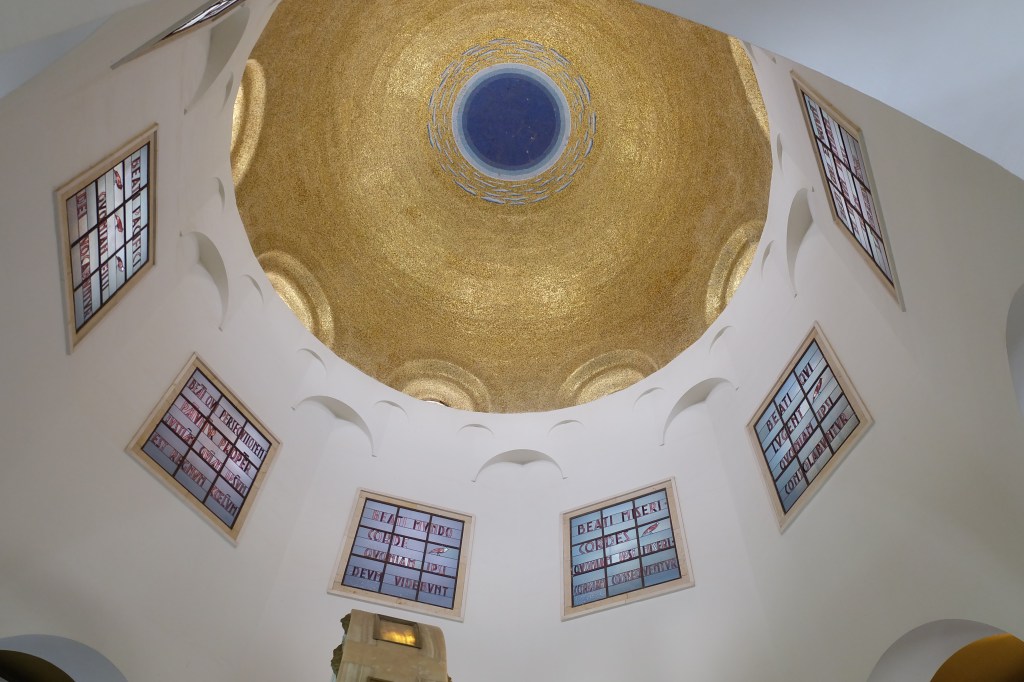
Photo by author, Church of the Beatitudes, Israel, 2019.

“Blessed are the poor in spirit, for theirs is the kingdom of heaven. Blessed are they who mourn, for they will be comforted. Blessed are the meek, for they will inherit the land. Blessed are they who hunger and thirst for righteousness, for they will be satisfied. Blessed are the merciful, for they will be shown mercy. Blessed are the clean of heart, for they will see God. Blessed are the peacemakers, for they will be called children of God. Blessed are they who are persecuted for the sake of righteousness, for theirs is the kingdom of heaven. Blessed are you when they insult and persecute you and utter every kind of evil against you falsely because of me. Rejoice and be glad, for your reward will be great in heaven.”

Matthew 5:3-12

After going around the shores of Galilee, preaching and healing the people, Jesus went up a mountain upon seeing crowds were following him. They were mostly poor people with deep faith in God, hoping and trusting only in him for their deliverance called the anawims.

They were in painful and difficult situations, maybe like many of us, fed up with the traffic and rising costs of everything, fed up with the corruption among public officials and most of all, disillusioned with our priests and bishops!

Then, Jesus called them blessed.

Now, please consider that it is more understandable and normal to say that after being persecuted or after losing a loved one, after all these sufferings that people would be blessed, that the kingdom of God would be theirs.

But, that is not the case with the beatitudes whereby Jesus called them already blessed now, right in their state of being poor, being persecuted, being maligned!

Keep in mind that Matthew’s audience were his fellow Jewish converts to Christianity. By situating Jesus on the mountain preaching his first major discourse, Matthew was reminding his fellow Jewish converts of their great lawgiver, Moses who stood on Mount Sinai to give them the Ten Commandments from God.

However, in the sermon on the mount, Matthew was presenting Jesus not just as the new Moses but in fact more than Moses because Jesus himself is the Law. His very person is what we follow that is why we are called Christians and our faith is properly called Christianity so unlike other religions that are like philosophies or any other -ism.

To understand the beatitudes, one has to turn and enter into Jesus Christ for he is the one truly poor in spirit, meek, hungry and thirsty, merciful, clean of heart, who was persecuted, died but rose again and now seated at the righthand of the Father in heaven. Essentially, the Beatitudes personify Jesus Christ himself. Those who share what he had gone through while here on earth, those who identify with him in his poverty and meekness, mercy and peace efforts, and suffering and death now share in his blessedness.

Therefore, the Beatitudes are paths to keeping our relationship with Jesus Christ who calls us to be like him – poor, hungry and thirsty, meek, clean of heart and persecuted. The Beatitudes are not on the moral plane like the Decalogue that tells us what to do and not to do. Have you ever used the Beatitudes as a guide in examining your conscience when going to Confessions? Never, because the Beatitudes are goals in life to be continuously pursued daily by Christ’s disciples.

Photo by author, Church of the Beatitudes, Israel, 2017.

The Beatitudes are more on the spiritual and mystical plane of our lives that when we try imitating Jesus in his being poor and merciful, meek and clean of heart, then we realize and experience blessedness as we learn the distinctions between joy and happiness, being fruitful and successful.

That is when we find fulfillment while still here on earth amid all the sufferings and trials we go through because in the beatitudes we have Jesus, a relationship we begin to keep and nurture who is also the Kingdom of God. Of course, we experience its fullness in the afterlife but nonetheless, we reap its rewards while here in this life.

As we have noted at the start, we must not take the beatitudes in their material aspect but always in the spiritual meaning. This we find in the first beatitude, Blessed are the poor in spirit, for theirs is the kingdom of heaven.

Actually, this first beatitude is the very essence of all eight other blessedness. Everything springs forth from being poor in spirit, of having that inner attitude and disposition of humility before God. We cannot be merciful and meek, nor pure of heart nor peacemakers unless we become first of all poor in spirit like Jesus, who, “though he was in the form of God, did not regard equality with God something to be grasped. Rather he emptied himself, taking the form of a slave, coming in human likeness and humbled himself” (Phil. 2:6-7, 8).

The prophet Zephaniah showed us in the first reading that poverty in the Old Testament does not only define a social status but more of one’s availability and openness to God with his gifts and calls to us to experience him and make him known. Experience had taught us so well that material poverty is one of life’s best teacher as it leads us to maturity and redemption best expressed in the Cross of Jesus Christ.

In this sense, the beatitude is also the “be-attitude” of every disciple who carries his cross in following Christ. See that each beatitude does not refer to a different person; every disciple of Jesus goes through each beatitude if he/she immerses himself/herself in Christ. That is why last week Jesus preached repentance which leads to conversion. Notice that the beatitudes of Christ are clearly opposite and contrary to the ways of the world as St. Paul tells us in the second reading with God calling the weak and lowly to manifest his power and glory.

Many times in life, we fail to recognize our blessedness when we are so focused with what we are going through, with our work and duties and obligations. This Sunday, Jesus takes us up on the mountain, in the celebration of the Holy Eucharist for us to see ourselves blessed and loved right in the midst of our simplicity and bareness, sufferings and pains. Stop for a while. Find Christ in all your troubles or darkness in life. If you do not find Jesus in your labors and burdens, you are just punishing yourself. If you find Christ because you see more the face of other persons that you become merciful, you work for peace, you mourn and bear all insults and persecution… then, you must be loving a lot. Therefore, you are blessed! Amen.

Have a blessed week ahead!

Photo by author, Church of the Beatitudes, Israel, 2017.

When you say nothing at all

The Lord Is My Chef Sunday Recipe for the Soul by Fr. Nicanor F. Lalog II
Twenty-Sixth Sunday in Ordinary Time, Cycle C, 25 September 2022
Amos 6:1, 4-7 ><000'> 1 Timothy 6:11-16 ><000'> Luke 16:19-31
Photo by author, Pangasinan, 19 April 2022.
It's amazing how you can speak right to my heart
Without saying a word you can light up the dark
Try as I may I could never explain what I hear when you don't say a thing

The smile on your face lets me know that you need me
There's a truth in your eyes saying you'll never leave me
The touch of your hand says you'll catch me if ever I fall
You say it best when you say nothing at all

Yes, my dear friends, I am so in love these days; the Lord is doing a lot of things in my heart and soul in my ministry that songs automatically play within me like a jukebox every time I pray and meditate. The other day was Five for Fighting’s 100 Years; this Sunday it is When You Say Nothing At All by Paul Overstreet and Don Schlitz first recorded by Keith Whitley in 1988 but became popular with Alison Krauss in 1995 that finally became a worldwide hit with Roan Keating’s version used as soundtrack of the 1999 Julia Robert-starrer Notting Hill.

The lyrics are so lovely, so true while the melody is so cool that is so uplifting and even spiritual as the song tells us a lot of the love of God for us expressed in his Son Jesus Christ who does everything, saying nothing at all, just loving us, understanding us, forgiving us. Most of the time, with us saying nothing at all too because he knows everything.

The more I listen to this song, the more I feel it speaking also of the parable of the Rich Man and Lazarus, of how we truly regard each other as a person, as a brother and sister, as disciples of Jesus when we say nothing at all, when our actions speak loudly or, silently of our love for each other.

Jesus said to the Pharisees: “There was a rich man who dressed in purple garments and fine linen and dined sumptuously each day. And lying at his door was a poor man named Lazarus, covered with sores, who would gladly have eaten his fill of the scraps that fell from the rich man’s table. Dogs even used to come and lick his sores.”

Luke 16:19-21
Photo from bloomberg.com of a homeless man in New York City during a fashion week in summer 2019.

Rich Man, Poor Man

Today’s parable is uniquely found only in Luke’s gospel like last Sunday that stresses Christ’s lesson on the wise use of money in the service of God through one another; but, the parable adds an important dimension in how this wise use of money will have a bearing in our judgment before God upon death. Hence, the gravity of the message expressed in great simplicity with beautiful layers of meaning.

First of all, the rich man has no name while the beggar was named Lazarus that means “God has rescued” or El ‘azar in Hebrew. The scene is still from the previous Sundays when the Pharisees and scribes complained why Jesus welcomed tax collectors and sinners. Jesus took it as an occasion to teach through parables the value of everyone before God, including the lost, the sick, the poor, and the sinful. They are the Lazarus who are given with a name because they are special in the eyes of God who rescues them all.


Then follows the juxtaposition of Lazarus
 lying at the door of the rich man's home
 - a very powerful image that punches us hard
 right in our face, of how numb we have become
 with each other!  

On the other hand, the rich man had no name not because he was less important but because he stands for each one of us blessed and loved by God. Notice that Jesus did not say whether the rich man and Lazarus were good or bad because their character would be revealed later as the parable unfolds.

See how Jesus presented the outer appearances of the two: the rich man was dressed in colorful and fine clothes, eating sumptuous food while Lazarus was somewhat naked, covered with sores in his whole body that dogs would lick as he filled himself with scraps falling from the rich man’s table.

Then follows the juxtaposition of Lazarus lying at the door of the rich man’s home – a very powerful image that punches us hard right in our face, of how numb we have become with each other!

Photo by Mr. Raffy Tima of GMA-7 News, stranded local residents at the airport, June 2020.

Here we find a valuable lesson from this pandemic courtesy of the face mask that finally opened our eyes, including our minds and hearts to look again onto each one’s face, to recognize each person. Before the virus came, we just did not care with everyone we met as we were so cold that we would not even look at each others face, snubbing even those close to us.

There are still other Lazarus around us, living among us, not begging at all from us like this one in the parable who would not say anything at all but silently suffer in pain, hungry and thirsty for recognition and love like parents forgotten and neglected by their grownup children, wives cheated by their spouse, children left alone and misunderstood by their parents, our classmates and colleagues so maligned in the nasty talks going around us and in the social media, the poor and lowly workers exploited by their employers, or just anyone often criticized and judged but never appreciated.

Try thinking of the other Lazarus around us we never bothered to talk to nor even smiled at because we have been preoccupied with our many other worldly pursuits in life. Let us examine ourselves while amid the comforts and luxuries of life may have rightly earned with decent hard work that but may have caused us to have forgotten the “feel” of being human, of being sick and weak that we have forgotten or been totally unaware of those around us.

Death and the urgent call to conversion

See how the parable gets interesting when both characters died and a reversal of situation in the afterlife occurred. The rich man was buried, immediately going down to hell to suffer while Lazarus was carried – not buried – by angels to Abraham in heaven to be comforted. In the two conversations that followed between the rich man and Abraham, we find at the core the primary importance of daily conversion of everyone.

When Abraham told the rich man of the great chasm dividing them that Lazarus could do nothing to alleviate his torment, Jesus is warning us of the exact situation when we die which is eternity, without end. Therefore, while we are still alive, let us be aware and conscious of others too, not just of ourselves. That is essentially conversion, defocusing from our selves to see those around us more.

Remember how the dishonest steward in the parable last week who made friends with the debtors of his master to ensure his good fate after being fired? That finds its application in this Sunday’s parable wherein the rich man should have been like that dishonest steward in befriending Lazarus so he could have made it too in heaven! That is why I love so much that part of the parable of the juxtaposition of Lazarus at the gate of the rich man.

How did the rich man miss and did not see Lazarus right there at his face, hungry and with sores?

From Facebook, 2020.

Let us not be “complacent” as the Prophet Amos warned in the first reading of not being aware of the excesses and sacrilege going on during that time (Am.6:1). It could be happening right now with us when we choose to be silent and uninvolved, even blind and deaf to the suffering people around us because we are like the fool rich man who grew rich for himself instead of “growing rich in what matters to God” (Lk.12:13-21, August 1, 18th Sunday)!

In the second conversation with Abraham by the rich man, we find the pressing need for conversion more urgent, of heeding the calls of the scriptures, of the prophets and of Jesus Christ himself we hear in the gospel proclaimed daily. See also how the rich man had not really changed amid his torments, requesting that Lazarus be sent to warn his brothers living the same way he had lived in order to avoid hell. Imagine while in the afterlife, the rich man was still thinking of those he had left behind on earth!

So ridiculous was his request and yet, we too must be careful because so often, we have such illusion that a clear and irrefutable sign from heaven like what the Pharisees and scribes insisted from Jesus could lead everyone to conversion. It is an illusion because as Jesus had been telling since then, we need to have faith first to see and acknowledge him for us to be converted. It is the same faith that we need to heed St. Paul’s call in the second reading to “Lay hold of eternal life” (1 Tim. 6:12). It is faith that is vibrant and so alive that enables us to recognize our true wealth is God found among one another with us.

When we have faith, whether we are rich or poor, we always see everyone as a brother and sister in Christ. When we have faith, whether we are rich or poor, we are able to love truly because we also believe. And that is when we do not say anything at all because we just keep on doing what is good to everyone, especially the Lazarus among us.

This Sunday, Jesus reminds us of God’s immense love for each one of us, a love we have to share with everyone especially if we have so much unlike others.

Let us reflect our lives these past days and weeks when we felt like Lazarus unrecognized at all, even forgotten amid our being right in the middle of life and everyone. It must be painful and sad. Jesus knows it so well; hold on to him our Savior who is always doing something for us always, especially when he says nothing at all. Amen.

Have a blessed week ahead! God bless you more!

Photo from inquirer.net, Ms. Patricia Non of the Maginhawa Community Pantry, 2021.

The world is passing away

The Lord Is My Chef Daily Recipe for the Soul by Fr. Nicanor F. Lalog II
Wednesday in the Twenty-third Week in Ordinary Time, Year II, 07 September 2022
1 Corinthians 7:25-31   ><]]]]'> + ><]]]]'> + ><]]]]'>   Luke 6:20-26
Photo by author, Makati skyline from Antipolo, 12 August 2022.
Thank you, 
God our loving Father,
for this brand-new day;
in a few days, the week will
be over again as we move 
closer to another week,
to another month,
and on to another year!
There is no denying that the world
indeed is passing away as St. Paul
reminds us today in the first reading:

I tell you, brothers, the time is running out. From now on, let those having wives act as not having them, those weeping as not weeping, those rejoicing as not rejoicing, those buying as not owning, those using the world as not using it. For the world in its present form is passing away.

1 Corinthians 7:29-31
Like what the psalmist
says today, let me listen to you,
dear God, let me see and bend 
my ear to experience and realize
that far more better than this life is
heaven awaiting us where we shall
enjoy your presence eternally!
Let us be on guard against that
great temptation that there is still time,
that we have plenty of time to spare,
not realizing that it is not really time that
passes by but us who are passing by
when we live in lavish wealth and luxury,
when we eat and drink without satiety,
when we laugh unmindful of the miseries 
around us, and when we relish and enjoy
the accolades and praises of others.

Grant us the grace and courage 
to choose you always in Jesus Christ 
who had come to us as poor and hungry, 
weeping and hated by everyone,
insulted and denounced for standing for 
what is true and good.
Lord, let us see in every
beginning the end of our lives
in you. Amen.

Lest we forget or miss others…

The Lord Is My Chef Daily Recipe for the Soul by Fr. Nicanor F. Lalog II
First Friday, Week XXXI, Year I in Ordinary Time, 05 November 2021
Romans 15:14-21   ><]]]]'> + ><]]]]'> + ><]]]]'>   Luke 16:1-8
Photo by author at Silang, Cavite, 2020.
On this First Friday of November,
I thank you dear God our Father
for the enriching and comforting words
of St. Paul these recent weeks as we
come to the penultimate installment of his
beautiful Letter to the Romans:

I myself am convinced about you, my brothers and sisters, that you yourselves are full of goodness, filled with all knowledge, and able to admonish one another. But I have written to you rather boldly in some respects to remind you, because of the grace given me by God to be a minister of Christ Jesus to the Gentiles in performing the priestly service of the Gospel of God, so that the offering up of the Gentiles may be acceptable, sanctified by the Holy Spirit.

Romans 15:14-16
You have reminded us these past weeks
through St. Paul not only of the need to
have sound doctrine on what we believe
but most of all to have much love in our
faith and hope in you.
As he begins to close his letter to the
Romans, may we imitate his great love
and concern for the Gentiles and those 
others to whom the Gospel has not been
proclaimed yet; many times in our lives,
we only remember those with us, those like
us, forgetting and missing out those not
with us, those living in the margins, those in
the fringes of the society and Church.
Give us, dear Father, such attention 
of St. Paul in seeking those not yet in our fold,
those neglected and taken for granted; how sad
that we only remember others when we are already
in dire need and extreme situations like that wise
steward in the gospel today:  at the height of his
power and influence, he never thought of the
creditors of his master, milking them dry of their
resources; but when he was in danger of being
terminated, he suddenly remembered them.
Most of all, he dealt with them with charity and
leniency to win their favors and sympathies.
Before any calamity or storm befall us,
when unfavorable circumstances happen 
to us or anyone, remind us, loving Father, 
to think of others,
to search for the lost 
and little ones
lest we miss them totally 
as if they do not exist.
Amen.

Strengthen our hearts, Lord

The Lord Is My Chef Breakfast Recipe for the Soul by Fr. Nicanor F. Lalog II
Thursday, Week XXI, Year I in Ordinary Time, 26 August 2021
1 Thessalonians 3:7-13   ><]]]]'> ><)))*> ><]]]]'>   Matthew 24:42-51
From inquirer.net, 20 August 2021.
Strengthen us, O God
in this trying time of the pandemic;
keep our body healthy and strong
to fight the virus and most especially
to take care of the sick among us.
Strengthen our hearts, loving Father
by cleansing it of our sins, taking away
our pride and filling it with your Son
Jesus Christ's humility, justice and love
that always have a space for those 
with less in life, to those most in need
like the sick, the children and elderly.
Strengthen our hearts, O God,
so that as St. Paul had reminded the
Thessalonians, we may "be blameless 
in holiness before you our God and Father
at the coming of our Lord Jesus Christ"
(1Thess.3:13) by being "faithful and prudent"
like the wise servant in the parable today.
Strengthen our hearts in Christ Jesus
so we may consistently seek and serve him
among one another at every moment
of our lives.  Amen.