The Lord Is My Chef Breakfast Recipe for the Soul by Fr. Nicanor F. Lalog II
Tuesday within the Octave of Easter, 06 April 2021
Acts 2:36-41  ><)))*>  +++  <*(((><  John 20:11-18
Painting by Giotto of the Risen Lord Jesus Christ appearing to St. Mary Magdalene from commons.wikimedia.org.
Recent events of sufferings due to a surge in COVID-19 infections and the difficulties this lockdown had put on our people have somehow “cut us to the heart” like the listeners of Peter in Jerusalem after the Pentecost, God our loving Father.
Yes, we feel being cut to the heart, so moved by your presence in Christ despite this crisis in the pandemic.
Help us, Lord, answer the two questions posed by your words this Tuesday within the Easter Octave that can help us experience you more amid this unholy events happening in our history.
"What are we to do, my brothers?"
(Acts 2:37)
First of all, Lord, we pray for our government officials who are until now clueless on what really to do during this pandemic. We pray for their conversion, to get down from their ivory towers and admit their mistakes rather than cover up with so many lies and inanities.
Give us the courage to examine too what we are really doing to overcome this crisis. So many times, we have been hiding and running away from our responsibilities in our home, in the school, in the office and even in the church! Let us confront our many fears to start trusting you and take the big leap forward learning and working on how to help others.
Teach us to be grateful for the many blessings you have given us even in this time of crisis and therefore find purpose in our lives to share the good news of Easter with others especially the less fortunate.
 "Woman, why are you weeping?"
(John 20:13, 15)
Secondly, Lord, let us live in the present moment so we may recognize and find you amid all the darkness that surround us these days. Twice your friend Mary Magdalene was asked with the same question, first by the angels and then by you, dear Jesus: “Woman, why are you weeping?”
Why did she not recognize you, Lord, considering you are the best of friends?
Sometimes, Lord, we are not like her your friend: we do not live in the present moment, always in the past that is why we cannot find you. We cannot find nor recognize you because we are stuck in your old ways and looks, in our old ways of relating with you, forgetting you have passed over from the past into the new present.
If we shall be able to live in the present moment, we shall stop weeping and start rejoicing finding you amid all the darkness and uncertainties of this pandemic. Give us the grace, dear Jesus to level up in our relating with you and with others by first meeting you in your words, in prayer, and in the Eucharist. Amen.
Photo by Bro. Cristian Pasion, National Shrine of Our Lady of Fatima in Valenzuela, 03 April 2021.
40 Shades of Lent by Fr. Nicanor F. Lalog II
Thursday, Third Week in Lent, 11 March 2021
Jeremiah 7:23-28   ><}}}*> + <*{{{><   Luke 11:14-23
Photo by author, Mt. St. Paul Spirituality Center, La Trinidad, Benguet, March 2020.
O God our loving Father in heaven, how great indeed is your love and patience with us your children. Despite our sinfulness that hardened our hearts, you never stopped sending us prophets even your Son Jesus Christ to call us and return to you.
Why still be bothered with us so afflicted with a hardness of the heart and stiffened necks?
But they obeyed not, nor did they pay heed. They walked in the hardness of their evil hearts and turned their backs, not their faces, to me… Yet they have not obeyed me nor paid heed; they have stiffened their necks and done worse than their fathers… Say to them: This is the nation that does not listen to the voice of the Lord, its God, or take correction. Faithfulness has disappeared; the word itself is banished from their speech.
Jeremiah 7:24, 26, 28
Thank you, dear God, for never getting tired with us that we join the psalmist in praying, “If today you hear his voice, harden not your hearts.”
Please do not allow our hearts to remain hardened because that is when it leaves no room nor space to listen nor repent and turn back to you again.
Soften our hearts or better, take away our stony hearts as you have promised your other prophet Ezekiel, so we may open ourselves to Jesus and listen to his good news of salvation instead of always seeing evil and Satan in everything, even in Christ like in the gospel today!
In this season of Lent, let us be persevering like you in exhausting all means to listen and discern every voice we hear. Soften our hearts, Lord, so we may choose you always no matter how difficult it may be for truly, “Whoever is not with me is against me, and whoever does not gather with me scatters” (Lk.11:23).
Amen.
Photo by author, Mt.St. Paul Spirituality Center, La Trinidad, Benguet, February 2020.
40 Shades of Lent by Fr. Nicanor F. Lalog II
Wednesday, Week I, 24 February 2021
Jonah 3:1-10     <*(((><   +   ><)))*>     Luke 11:29-32
Photo by author, 26 February 2020.
Praise and glory to you, O God our Father, in making Lent a season of surprises just like in our readings today. Continue to surprise us with your love and mercy, with your movements in our lives and in our time. Open our hearts and minds at the many possibilities of good things happening even in the midst of great evil and sufferings.
Forgive us when we lose hope, when we refuse to be surprised with our pessimism and cynicism like Jonah who refused to obey you in going to Nineveh to warn the pagans and sinners there of your coming wrath lest they repent and change their ways.
Jonah began his journey through the city, and had gone but a single day’s walk announcing, “Forty days more and Nineveh shall be destroyed,” when the people of Nineveh believed God; they proclaimed a fast and all of them, great and small, put on sackcloth. When God saw by their actions how they turned from their evil way, he repented of the evil that he had threatened to do to them; he did not carry it out.
Jonah 3:4, 10
It is about time that we reflect and examine also this Lent our attitudes with other people, especially those different from us not only in ways and looks but also in beliefs, that there is always hope in everyone to change and become a better person.
Even your Son Jesus Christ had told us how we would be surprised someday with the kinds of people entering your kingdom in heaven. Let us not be surprised in the end in the wrong sense like that warning by Jesus:
While still more people gathered in the crowd, Jesus said to them, “This generation is an evil generation; it seeks a sign, but no sign will be given except the sign of Jonah. Just as Jonah became a sign to the Ninevites, so will the Son of Man be to this generation. At the judgment the queen of the south will rise with the men of this generation and she will condemn them, because she came from the ends of the earth to hear the wisdom of Solomon, and there is something greater than Solomon here. At the judgment the men of Nineveh will arise with this generation and condemn it, because at the preaching of Jonah they repented, and there is something greater that Jonah here.”
Luke 11:29-32
Cleanse us of our prejudices and biases, Lord, and open our sense of wonder and awe to continue to be surprised of your presence and coming, of your love and mercy in us and among others. Amen.
The Lord Is My Chef Sunday Music by Fr. Nick F. Lalog II, 14 February 2021
Photo by author, 2019.
A blessed happy Valentine’s to everyone! Strictly speaking, every Sunday celebration of the Holy Mass is a celebration of God’s great love for each of us. This Sunday is so special not only because it falls on the day of the hearts but most of all because of that lovely and touching story of the healing of a leper by Jesus.
A leper came to Jesus and kneeling down begged him and said, “If you wish, you can make me clean.” Moved with pity, he stretched out his hand, touched him, and said to him, “I do will it. Be made clean.” The leprosy left him immediately, and he was made clean.
Mark 1:40-42
This is a very unique story because lepers were forbidden at that time to get near people not only for fear of contagion but because of the terrible meaning of their disease that evoked sins of the Egyptians before the Exodus of the Hebrew people (https://lordmychef.com/2021/02/13/to-be-loved-is-to-be-touched-by-god/).
It is so touching because Jesus welcomed the leper, touched him and healed him, making him a totally “brand new” person, exactly like the one mentioned in the 1974 hit by the Stylistics You Make Me Feel Brand New. It was the first love song I had learned to memorize its lyrics after finally saving enough money to buy a song hits while in grade five.
The song elegantly speaks in simple beauty and sincerity the great relationship of true love experienced by a man with a wonderful woman who loved him so much, who must have touched him so much that made him feel brand new.
My love I’ll never find the words, my love To tell you how I feel, my love Mere words could not explain
Precious love You held my life within your hands Created everything I am Taught me how to live again
Only you Cared when I needed a friend Believed in me through thick and thin This song is for you, filled with gratitude and love
And what I like most with this song is how it thanked God for this wonderful gift of love who is after all, love himself!
God bless you You make me feel brand new For God blessed me with you You make me feel brand new I sing this song ’cause you Make me feel brand new
It is now a classic covered by so many great artists through the years. We have chosen Simply Red’s version recorded at the Sydney Opera House in 2010 with Mick Hucknall’s moving interpretation, full of emotion and passion. They first released You Make Me Feel Brand New in 2003 as part of their album Home, reaching the #7 spot in the UK hit list.
You Make Me Feel Brand New is one song that had really touched so many of us, reminding us of the power of love to transform us, to change us, to make us better persons like that leper in the gospel. An anonymous writer had said that “If you have love in your heart, you have been blessed by God; if you have been loved, you have been touched by God.”
As you relive your most touching and loving moments while listening to this classic covered by Hucknall, think also of concrete ways to touch somebody with God’s love this Valentine’s — not just with flowers or chocolates.
The Lord Is My Chef Breakfast Recipe for the Soul
Monday, Feast of the Conversion of St. Paul the Apostle, 25 January 2021
Acts 22:3-16    <*(((><<   +++   >><)))*>     Mark 16:15-18
A sculpture of St. Paul near the entrance to the Malolos Cathedral by artist Willie Layug.
Praise and glory to you, O Lord Jesus Christ in coming to us always in the most personal manner in calling and inviting us to follow you to become fishers of men like in this Sunday’s gospel. You always come in the ordinariness of our lives, challenging us to face our responsibilities and most of all, asking for our commitment to you.
It is very funny but so true when you called St. Paul, he was out on his “ordinary” task of arresting followers of your Way while en route to Damascus. In that brief moment of encounter with him that eventually led to more days of prayers and teachings, you have shown us Lord the true meaning of conversion: it is not really a change in person in us but more of a change in focus.
St. Paul remained zealous in his ways but this time no longer to defend the old Mosaic Law he had defended at all costs before but this time for your gospel, Lord Jesus. He remained a committed person but no longer to the old ways but now in your person, dear Jesus, that he can claim in that “it is no longer I who live but Christ lives in me” (Gal.2:20) .
That is essentially what conversion is all about: remaining the same person but no longer living in himself alone but in Jesus Christ alone.
Teach us, dear Jesus, that conversion in you is a daily happening, that needs to be cultivated in prayer and witnessing like St. Paul; that what really matter is to place you, O Lord Jesus at the center of our lives so that our identity is essentially marked by our encounter in you, by our communion with you and with your Word. More than seeing you in a vision, illumine us with your light, Jesus so we may recover and purify everything in us that has become dull due to sin.
We pray also for those people like Ananias who have been instrumental in bringing us close you, Jesus, people who set aside their biases against us and listened to your instruction so we may be converted and be your witness. Amen.
The Lord Is My Chef Breakfast Recipe for the Soul
Thursday, Seventh Day in the Christmas Octave, 31 December 2020
1 John 2:18-21     >><)))*>   +   <*(((><<     John 1:1-18
Photo by Ms. Ria De Vera, sunrise in our Parish amid the summer lockdown of 2020.
O God our Father, on this last day of 2020, we thank you so much for all the blessings you have given us these past 365 days. Yes, we shall always remember this year as the most difficult and most life-changing we ever had but we are grateful to you.
No matter how much people would ridicule and play jokes on 2020, despite its being so heavy for many of us who have lost loved ones, lost jobs and livelihood, and forced us to change plans and directions in life, we still thank you Lord for letting us make it through.
The problem, Lord, is not the year 2020 which means “perfect vision”; the problem is us who have lost all our vision for moral and upright living, decency, and good governance. We have lost vision, of the ability to see beyond the surface of things we have gone through this year.
How sad when many of us have seen only the year, the days and the months without realizing the deeper meaning of the events that resulted from our poor and wrong decisions, inactions and indifference to the calumnies and lies dished out daily by those in power.
Open our minds and our hearts that the presence of so many antichrists in our midst who lie and speak without thinking so well what they say signal the final hour of Christ’s coming and judgment as well as the final hour for us to do something concrete to end the reign of evil.
Children, it is the last hour; and just as you heard that the antichrist was coming, so now many antichrists have appeared. Thus we know this is the last hour.
1 John 2:18
Let us claim, dear Jesus, on this last day of 2020 and into the coming new year the two great gifts you have given us in your coming — light and life (Jn.1:4).
Your light has always been there present among us. Give us the courage to bring out your light, sweet Jesus so there may be more truth, goodness, justice, love, beauty, compassion, kindness, freedom, and peace in this world that have ironically reached great new heights in science and technology but has remained inside the caves of evil and malice.
May we rediscover anew the value of every life, that one life being lost is too many, whether due to the pandemic or the war on drugs.
On this last day of the year, may we do something so good, so kind, so true as if today were also our last day on earth. Amen.
Photo by author, Gaudete Sunday (13 December 2020).
The Lord Is My Chef Simbang Gabi Recipe-2 for the Soul
by Fr. Nicanor F. Lalog II
Thursday, Advent Week III, 17 December 2020
Genesis 49:2, 8-10     >><)))*> + >><)))*> + >><)))*>     Matthew 1:1-17
Photo by author of sun beginning to shine over the mountain ranges Sinai Desert in Egypt, May 2019.
Yesterday we started our reflection with an old Christmas song, Do You Hear What I Hear? by Bing Crosby; today, it is Andy Williams turn to serenade us with the opening lines to the theme of the 1970 film Love Story:
Where do I begin
To tell the story of how great a love can be
The sweet love story that is older than the sea
The simple truth about the love she brings to me
Where do I start
No. I did not see that movie now a classic but I was old enough to remember its theme that became popular even for some more years during the 70’s that made Andy Williams so well-known when we were in elementary school. His song came to my mind as I grappled – which usually happened – on how to begin this reflection.
Where do I begin or how shall I begin? is one of our most common question in almost anything we start doing or telling because beginning any undertaking is always difficult. Experts have tackled it like Stephen Covey telling us to “begin with the end in sight” while Simon Sinek insists we always “start with why”.
Every beginning – like a homily or a speech, a business venture, or even an exercise program – means so much as it gives us a gist of where it is leading to, of what is going to happen.
The evangelists also wrestled with the same issue and they all have their own style in starting their gospel account but nothing beats Matthew in his most unique manner by beginning with a series of names in the genealogy of Jesus Christ. According to the late American biblical scholar Fr. Raymond Brown, he was willing to bet that if anyone is asked to tell the story of Jesus to a non-believer, no one will ever imitate Matthew by starting with Abraham begetting Isaac, Isaac is the father of…
The book of the genealogy of Jesus Christ, the son of David, the son of Abraham. Abraham became the father of Isaac, Isaac the father of Jacob, Jacob the father of Judah and his brothers. Judah became the father of Perez and Zerah, whose mother was Tamar…
Matthew 1:1-3
Photo by author of an oasis in the Dead Sea region of Israel, May 2017.
God the Prime Mover, the Beginning of everything
Today we shift our focus in our Advent preparations to the first coming of Jesus Christ when he was born in Bethlehem more than 2000 years ago. Strictly speaking, the Church’s official countdown to Christmas begins only today when all our weekday readings from December 17-24 are focused on how the birth of Jesus happened.
And what a way to start this series with the gospel by Matthew that begins with “The book of the genealogy of Jesus Christ, the son of David, the son of Abraham”! The Greek is more literal in stating it as “The book of the genesis of Jesus Christ, the son of David, the son of Abraham.”
That makes Matthew’s gospel so unique by starting it with names that all sound so weird to us today. So, what’s with the names? Of course, a name is everything!
Companies and organizations pay huge amounts of money for their trademarks and logos like Coca-Cola, IBM, and Apple. Some corporate or product names have in fact entered our vocabulary like Xerox for copiers, Colgate for toothpaste and Frigidaire for refrigerators.
Every name carries a story, a meaning, a mission, even a destiny. How sad that we Filipinos rarely take this seriously especially in giving names to children that often becomes a joke or a disaster, or both. But to foreigners especially the Jewish people, a name is more than an identification but also one’s mission.
When we examine each name in Matthew’s genealogy of Jesus, we discover it is just like our own family trees with some men and women not really that exceptional, even a shame and an embarrassment to the family. Behind each name we have heard is an imperfect person -except for Joseph and Mary – with so many sins and mistakes.
And that is the good news of today: God does not call the qualified but qualifies His call.
Everything begins with God – our lives and coming into being. In all eternity, God perfectly knows everything that will happen to us and yet He chose to believe in us, despite our imperfections and being prone to sin that He sent us to this world with a mission to make His Son our Lord Jesus come into the world through us, just like his ancestors.
Photo by author, Mt. St. Paul Spirituality Center, La Trinidad, Benguet, January 2020.
From the imperfect “house of King David” to Jesus Christ’s eternal kingdom
Let us take the first name mentioned by Matthew in starting his gospel, David who makes this genealogy so interesting. In fact, it was on him the whole genealogy is structured by Matthew. And we all know how imperfect was David, of how he had sinned when he took Bathsheba the wife of army officer Uriah whom he ordered placed in a position that got him killed in a battle.
But that is how God works – so unlike us! God is a God of surprises who works so unpredictably unlike us humans. Imagine after all the sex scandals with Bathsheba, God still promised an eternal kingdom coming from the house of David, that of Jesus Christ: “Your house and your kingdom shall endure forever before me; your throne shall stand firm forever” (2 Sam.7:16, first reading on Sunday and morning of Thursday).
At the end of his genealogy of Jesus, Matthew added this interesting note:
Thus the total number of of generations from Abraham to David is fourteen generations; from David to the Babylonian exile, fourteen generations; from the Babylonian exile to the Christ, fourteen generations.
Matthew 1:17
Matthew is up to something here! Why build around the history of Israel and genealogy of Jesus Christ around a person who had gravely sinned against God and others?
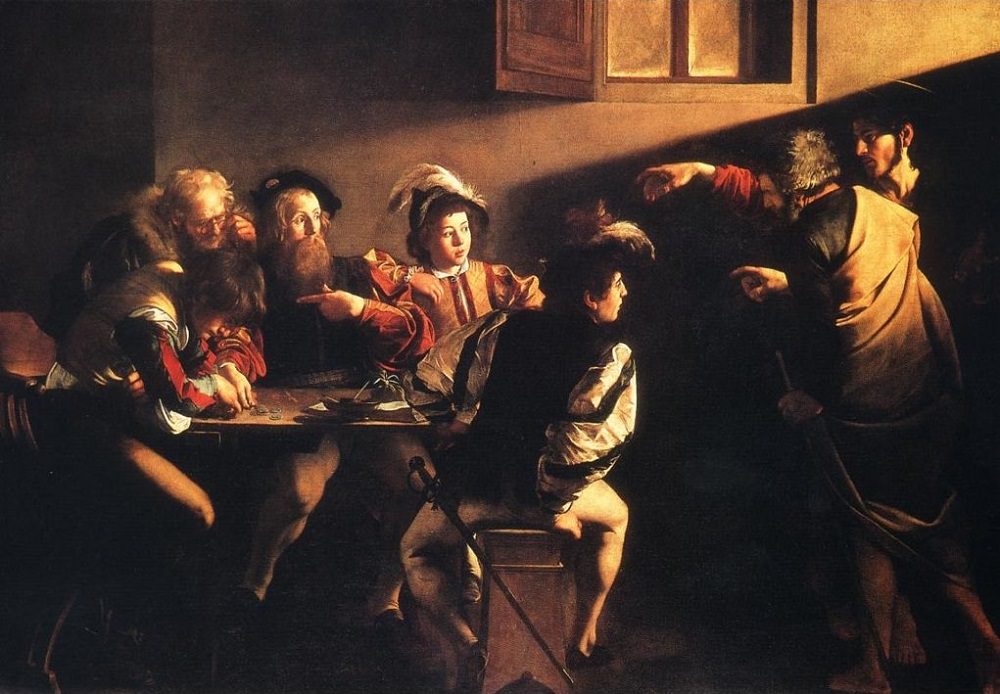
Most likely. Remember how Matthew experienced God’s mercy and forgiveness when Jesus came to call him while at his tax collection booth and he immediately stood and left everything behind to follow the Lord. Matthew knew well that God is not like humans who box people and label them like things.
Caravaggio’s famous painting of the call of Matthew by Jesus from wikicommons.org.
In assembling to us three sets of fourteen generations that traced the coming of Jesus Christ from Abraham structured around David, Matthew shows us how God worked through this sinful man a series of new “beginnings” in life, both in grace and in sin. See the genealogy rising from Abraham to David, then its decline and descent from Solomon to the Babylonian Exile, and then rising again to the advent of Jesus.
Now try to imagine how great and loving is our God and Father who chose to believe in David, a person just like us with many imperfections and prone to sins! See His power and holiness in setting any sinful situation for new beginnings of grace and blessings.
Sometimes,
God uses our occasions of sins
as new beginnings
of His grace and blessings.
One thing I have realized in life is that our most unforgettable moments happen either when we are nearest, or farthest away from God.
This is very amazing. Consider when are we closest to God? Most often that is when we were high and good, feeling blessed and loved, when healthy and successful that were ironically the times we rarely thought of God. We only remember those moments as our closest with God after being away in fact from Him!
And when are we farthest from God? Quickly we say when we were deep in sin, when lost, or when unloved and misunderstood.
Between these two moments, it is most often when we are farthest from God that is always most unforgettable, the ones we remember always, the ones that have left the deepest cut in us because those times in turn have become occasions for us to begin anew in God!
Like David. Or Matthew known before as Levi the tax collector.
Photo by author of the Lake of Galilee shortly after sunrise, May 2019.
That is how God sometimes would make it for us to begin anew in Him! See how at the first set of fourteen generations from Abraham to David, we find the whole history of Israel so close with God punctuated by Egypt and Exodus when their sins “turned” into their favor. In the second set of fourteen generations from Solomon to the Babylonian exile, the Israelites sank into their lowest point in history when led by their kings they turned away from God, worshipping idols. But, God did not abandon them as we see in the third set of fourteen generations when things got better as the Israelites returned to God and to their Promised Land reaching its high point in Jesus Christ’s birth.
God is the beginning of everything and even if we try to “end” with our many sins what He had began, He always finds ways to begin anew even when we are so far away from Him.
This is also the meaning of the Jacob’s choice for Judah over his other sons in being the tribe to continue his family line leading to the fulfillment of the Davidic lineage in Jesus Christ. It was from Judah came the name of their religion “Judaism” even if Judah was not the best and holiest of Jacob’s sons. Joseph the Dreamer must have been the wisest choice as more suitable to have been blessed by their father or by God himself but, that is not the way of God.
By starting his gospel with the line “The book of the genealogy of Jesus Christ, the son of David, the son of Abraham”, Matthew shows us God’s total power and goodness as source and beginning of all good things who also has the last and final say in everything.
In the genealogy of Jesus, we are reminded that every day is a new beginning in God, right in our darkness and sin, in our sickness and pandemic. David like Judah may have sinned so great before God but His mercy and love proved greater than their sins that they were able to rise again to become better and holier in His grace.
That’s one great beginning we can start right here, right now in our Simbang Gabi! A blessed Thursday to you! Amen.
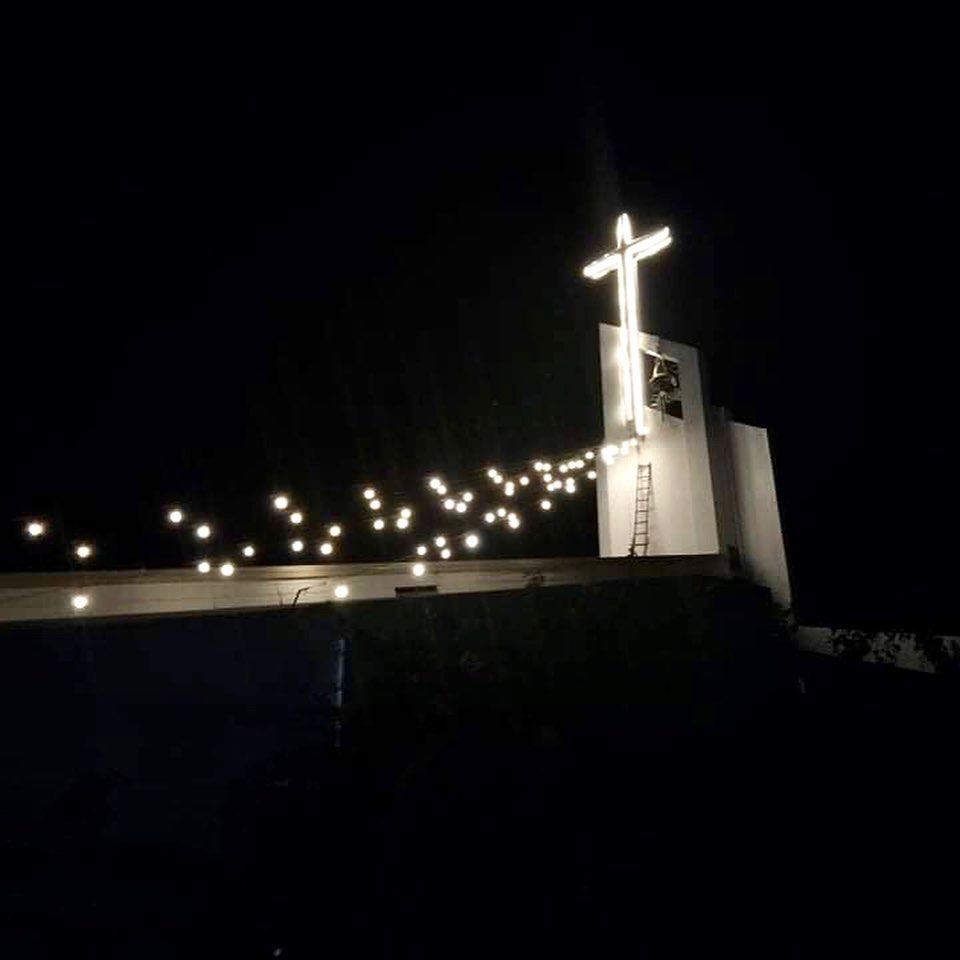
Photo by Marc Angelo Nicolas Carpio, our Parish at night, 29 November 2020.
The Lord Is My Chef Breakfast Recipe for the Soul by Fr. Nicanor F. Lalog II
Monday, Advent Week-II, 07 December 2020
Isaiah 35:1-10     >><)))*>  >><)))*>  >><)))*>     Luke 5:17-26
Photo by author, sacristy altar, 05 December 2020.
Your words today, O God are so uplifting, evoking in us springtime when everything is bursting into new life making this Season of Advent a prelude to Easter. And rightly so!
The desert and the parched land will exult; the steppe will rejoice and bloom. They will bloom with abundant flowers, and rejoice with joyful song. Then will the eyes of the blind be opened, ears of the deaf be cleared; then will the lame leap like a stag, the tongue of the dumb will sing. Streams will burst forth in the desert, and rivers in the steppe. The burning sands will become pools, and the thirsty ground, springs of water.
Isaiah 35:1-2, 5-7
But for us to see life bursting forth around us, let us in our selves first desire life, persevere our healing, and keep your gifts of mercy and forgiveness like the men who lowered through the roof a paralyzed man on a stretcher before Jesus while preaching inside a packed house.
Strengthen us to go out and find ways in meeting you, Jesus, like those men.
Forgive us for the many occasions of cynicisms and indifference, as well as arrogance and pride like the scribes and Pharisees who questioned your authority to forgive sins.
As we have reflected yesterday, Advent is a two-way street: you always come, Lord Jesus but we must also come to meet you. So many times you have come to our lives but we never met you, never experienced you nor even felt you because we have always been full of ourselves, of our sins, and of so many other people and things.
Keep us one with you always, Jesus – in your cross, in your humility, in your love.
Like St. Ambrose your great Bishop of Milan, may we lead more souls discover you, Jesus, and experience life anew like St. Augustine, his famous convert. Amen.
Quiet Storm by Fr. Nicanor F. Lalog II, 22 November 2020
Photo by author, Petra at Jordan, May 2019.
"As Jesus approached Jericho
a blind man was sitting by the roadside begging"
So many times I see myself in him
blinded by sins
and false securities
preferring to remain
at the safe side
at home with my comfort zone;
but soon
I get tired of begging
of being blind
deciding to leave the roadside
to finally meet Jesus,
asking him to restore my sight.
O what a scene to behold
of the beautiful journey
that unfolds
only if I go
to the middle of the road
to be with the Lord!
Photo by author, a sycamore tree in Jericho, May 2019.
"At that time Jesus came to Jericho;
but Zacchaeus was short in stature"
So often in life
Jesus truly intends to pass
through wherever we are
only to test
if we would dare
to rise above our selves
to see and meet him there;
the key is to admit reality
that we are always short
in moral standing
but never in humility
if we can truly
forgo everything
then we see its beauty
when from the middle of the road
the Lord looks up to us
calling us to come down
for he had come to be with us!
Photo by Mr. Roland Atienza, 12 June 2019.
This is the most lovely
thing I have heard
the Lord said:
"Those whom I love,
I reprove and chastise.
Be earnest, therefore, and repent.
Behold, I stand at the door
and knock.  If anyone hears my voice
and opens the door, then I will
enter his house and dine with him,
and he be with me."
The Lord always comes,
bidden and unbidden,
but, are we open to meet him,
willing to leave
the roadside, climb a tree
if needed or turn the knob
to see and meet him?
Yes, Jesus is always passing by,
do not let yourself be left behind.
The Lord Is My Chef Breakfast Recipe for the Soul by Fr. Nicanor F. Lalog II
Tuesday, Week XXXIII, Year II in Ordinary Time, 17 November 2020
Revelation 3:1-6, 14-22     >><)))*>  +  <*(((><<     Luke 19:1-10
Photo by author, May 2019 Holy Land Pilgrimage.
Your words today, O Lord, are so comforting — after some reprimanding for our sins and misgivings!
And that is how you display your love and mercy and forgiveness that sometimes we fail to see and even recognize.
Despite our being “alive but dead” like the church in Sardis (Rev. 3:1) when we backslide to our old ways of sinfulness as well as our being “neither cold nor hot” like those in Laodicea when we refuse to make a stand for what is true and just, you still come to us, seeking us, trying to bring us back to your fold.
Behold, I stand at the door and knock. If anyone hears my voice and opens the door, then I will enter his house and dine with him, and he with me.
Revelation 3:20
Keep us humble, Lord Jesus, like Zacchaeus who openly admitted his “being short in stature” (Lk.19:3-4) that he had to climb a sycamore tree to see you passing by. And when you finally met him and told him of your coming into his home, he welcomed you right into his heart by being sorry for his sins, promising to repay or recompense those he had extorted money from.
A sycamore tree at the world’s oldest city of Jericho in Israel, 2019.
Like the blind man you have healed yesterday and now Zacchaeus, keep us following you Jesus on the middle of the road, leaving our comfort zones, to dirty our hands and garments in doing your works among the poor and needy specially in this time of calamity.
Open our ears to listen to your voice, to be on guard waiting for your coming, to your knocking at our door to welcome you back into our lives.
May we grab every opportunity to welcome you into our lives, Lord Jesus, by turning away from sins and heeding your voice of love and compassion among the poor and suffering. Amen.