Lawiswis Ng Salita ni P. Nicanor F. Lalog II, Ika-14 ng Abril 2020
Nakapanlulumo kung iisipin
itong sinapit natin sa COVID-19
sa isang iglap, kaagad-agad
takbo ng ating buhay tila nasagad
tayo ay sumadsad sa kaabahan
na dati ni hindi sumagi sa ating isipan
na tayo ay walang puwedeng panghawakang
kapangyarihan na maaring ipagyabang.
Aanhin ang pera at kayamanan
wala ka namang mabili o mapuntahan
sarado ang lahat pati ang simbahan
lansangan walang laman
lahat natigilan, natauhan
sa katotohanan tayo ay tao lamang
sa mahabang panahon ay nahibang
sarili ay nalinlang sa maling katotohanan.
Kay gandang pagmasdan
nakakakilabot hanggang kaibuturan
pananabik ng mga tao masilayan
Panginoong Jesu-Kristo
sa Santisimo Sakramento at Santo Entierro
hanggang sa Señor Resuscitado
ng Pasko ng Pagkabuhay nang lahat kumaway
maging sundalo tinaas mga kamay sa pagpugay.
Suko kami sa inyo, Panginoon
tinalikuran ka namin noon:
ang pagkamakasarili sa amin ay lumamon
at sa nakakalasong ilusyon, kami naluom
kaya kami ay iyong hanguin sa pagkakabaon
ibangon upang muling makatugon
sa iyong tawag at hamon limutin ang sarili
pasanin ang Krus upang kasama mo kami makaahon.
Lawiswis ng Salita ni P. Nicanor F. Lalog II, Biyernes Santo, Ika-10 ng Abril 2020
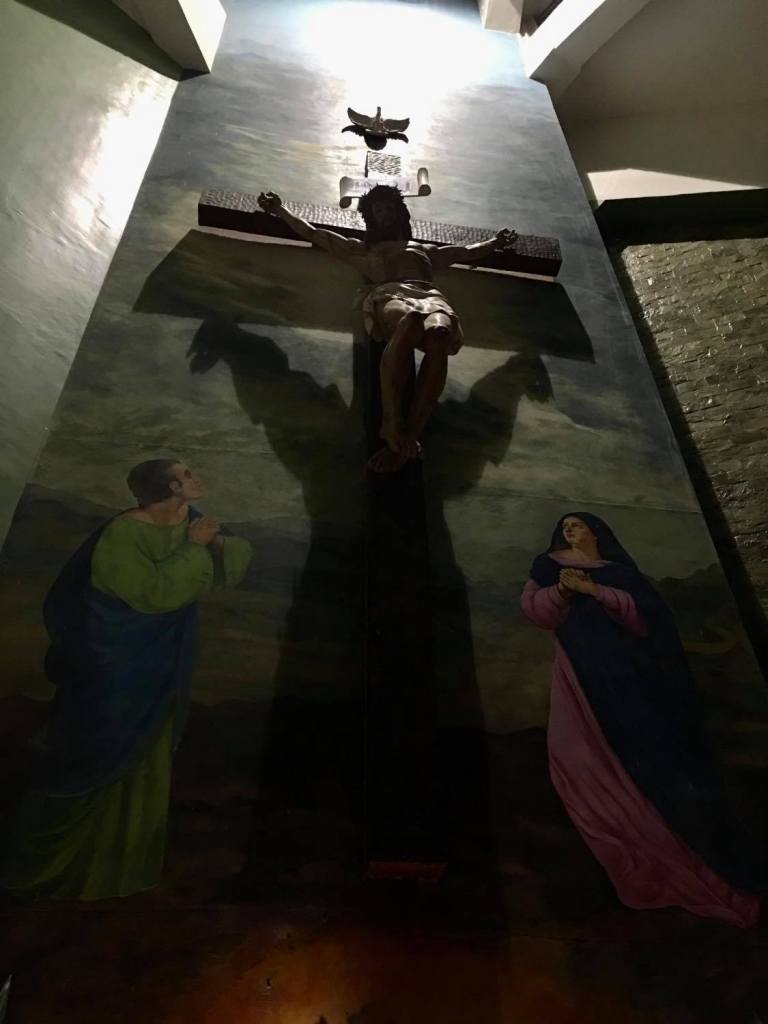
Larawan kuha ng may akda, Parokya ni San Juan Apostol at Ebanghelista, Bagbaguin, Santa Maria, Bulacan, ika-02 ng Abril 2020.
Katulad ng Huwebes Santo
ito na ang pinakamalungkot
at hindi malilimutang
Biyernes Santo dahil binago
ng corona virus ang kalbaryo ng krus
ni Kristo Hesus.
Dama sa buong kapaligiran
pighati at sakit na pinagdaanan
noon sa nakaraan:  mapanglaw ang kalangitan
sarado pa rin mga simbahan
pagdiriwang mapapanood lamang
dahil sa umiiral na lockdown.
Kaya ang katanungang tiyak
na pag-uusapan sa kinabukasan
nasaan ka nang mangyari ang lockdown
nang manalasa itong COVID-19
na kumitil sa libu-libong buhay
nagpasakit sa buong sangkatauhan?
Larawan kuha ni G. Ryan Cajanding, 09 Abril 2020.
Nasaan ka nang ipako sa krus si Hesus
nitong corona virus nagpasakit sa mga maliliit?
Ikaw ba yaong nakipagsiksikan, nag-panic buying
lahat ng pagkain inangkin
hinakot mga alcohol at face masks
dahil takot magutom at madapuan ng sakit?
Nasaan ka nang ipako sa krus si Hesus
nitong corona virus na habang lahat ay aligaga
sa pag-iisip ng mga paraan maibsan kahirapan
ikaw naman ang siyang pinapasan
sa iyong walang katapusang pamumuna
at reklamo, ibig mo ikaw ang inaamo at inaalo?
Nasaan ka nang ipako sa krus si Hesus
nitong corona virus kaya naglockdown
upang maiwasan paglaganap ng sakit?
Nasa chismisan at daldalan
inuman at sugalan tulad ng mga kawal
damit ni Hesus pinagsapalaran?
Larawan kuha ng may-akda, Kuwaresma sa Parokya noong 2019.
Kay ganda at butihing larawan
sa panahon nitong Covid-19
ang dalawang alagad na pinili manatili
sa paanan ng krus ni Kristo Hesus:
si Maria kanyang ina unang nanalig sa kanya
at si Juan Ebanghelista na tunay na nagmahal sa kanya.
Silang dalawa ang kailangan ng panahon ngayon
upang samahan si Hesus sa bagong kalbaryo
ng pandemiya ng corona virus
tulad ng mga duktor at nurse
lahat ng nasa larangan ng kalusugan
at medisina upang lunasan sakit at karamdaman.
Hindi naman kailangan gumawa malalaking hakbang
mga munting kabutihan na maaring magpagaan
sa labis na kahirapang pinagdaraanan
sapat na at makahulugan pamamaraan
upang samahan sa paanan ng krus si Hesus
na siyang nasa bawat isa nating pinaglilingkuran.
Tonight is “Spy Wednesday” – the night traitors and betrayers are put on the spotlight because it was on this night after Palm Sunday when Judas Iscariot struck a deal with the chief priests to hand them over Jesus for 30 pieces of silver (Mt. 26:14-16).
The “Tenebrae” is celebrated in some churches when candles are gradually extinguished with the beating of drums and sounding of matraca to evoke silence and some fear among people as they leave in total darkness to signal the temporary victory of evil in the world for tomorrow we enter the Paschal Triduum of Holy Thursday, Good Friday and Easter Vigil of the Lord.
From Google.
Darkness generally evokes evil and sin, uncertainties and sufferings. But, at the same time, darkness preludes light!
That is why Jesus Christ was born during the darkest night of the year to bring us light of salvation.
Beginning tonight, especially tomorrow at his agony in the garden, we shall see Christ entering through darkness reaching its climax on Friday when he dies on the cross with the whole earth covered in darkness, rising on Easter in all his glory and majesty.
Our present situation in an extended Luzon-wide lockdown offers us this unique experience of darkness within and without where we can learn some important lessons from the Lord’s dark hours beginning tomorrow evening of his Last Supper.
St. John gives us a glimpse into how we must deal with life’s darkness that plagues us almost daily with his unique story of the Lord’s washing of his disciples’ feet on the night he was betrayed.
Before the feast of Passover, Jesus knew that his hour had come to pass from this world to the Father. He loved his own in the world and he loved them to the end. The devil had already induced Judas, son of Simon the Iscariot, to hand him over. So, during supper… he rose from supper and took off his outer garments. He took a towel and tied it around his waist. Then he poured water into a basin and began to wash the disciples’ feet and dry them with the towel around his waist. He came to Simon Peter…
John 13:1-2, 4-6
Photo from aleteia.org.
It is very interesting to reflect how Judas Iscariot and Simon Peter dealt with their own inner darkness on that night of Holy Thursday when Jesus was arrested.
Though Judas Iscariot and Simon Peter are poles apart in their personalities, they both give us some traits that are so characteristic also of our very selves when we are in darkness. In the end, we shall see how Jesus turned the darkness of Holy Thursday into becoming the very light of Easter.
Getting lost in darkness like Judas Iscariot
Right after explaining the meaning of his washing of their feet and exhorting them to do the same to one another, Jesus begins to speak of Judas Iscariot as his betrayer.
When he had said this, Jesus was deeply troubled and testified, “Amen, amen, I say to you, one of you will betray me …It is the one to whom I hand the morsel after I had dipped it.” So he dipped the morsel and handed it to Judas, son of Simon the Iscariot. After he took the morsel, Satan entered him… and left at once. And it was night.
John 13:21, 26-27, 30
Photo from desiringgod.org
The scene is very dramatic.
Imagine the darkness outside the streets of Jerusalem in the stillness of the night and the darkness inside the Upper Room where they were staying.
More darker than that was the darkness among the Apostles not understanding what Jesus was saying about his betrayer because they thought when Judas left, he was being told to buy more wine or give money to the poor!
Most of all, imagine the darkness within Judas.
To betray means to hand over to suffering someone dear to you.
That’s one darkness we always have within, of betraying Jesus, betraying our loved ones because we have found somebody else to love more than them. Satan had taken over Judas. The same thing happens to us when we sin, when we love someone more than those who truly love us or those we have vowed to love always.
And the darkest darkness of all is after handing over our loved ones, after dumping them for something or somebody else, we realize deep within the beautiful light of truth and love imprinted in our hearts by our betrayed loved ones – then doubt it too!
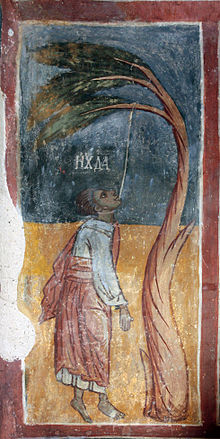
The flickering light of truth and love within is short lived that we immediately extinguish it, plunging us into total darkness of destruction like Judas when he hanged himself.
See how Judas went back to the chief priests because “he had sinned”, giving them back the 30 pieces of silver to regain Jesus.
Here we find the glow of Jesus, of his teachings and friendship within Judas still etched in his heart — the light of truth and love flickering within.
Any person along with their kindness and goodness like Jesus, our family and true friends can never be removed from one’s heart and person. They will always be there, sometimes spurting out in our unguarded moments because they are very true.
That is the darkest darkness of Judas – and of some of us – who think we can never be forgiven by God, that we are doomed, that there is no more hope and any chance at all.
See how the evangelist said it: “Judas left at once. And it was night.”
And that is getting lost in darkness permanently, eaten up by darkness within us because we refuse to believe in the reality of a loving and forgiving God who had come to plunge into the darkness of death to be one with us so we can be one in him. What a loss.
Groping in the dark into the light like Peter
Photo by author, Church of Gallicantu, Jerusalem where the cock crowed after Peter denied Jesus the third time, May 2017.
Of the Twelve, it is perhaps with Simon Peter we always find ourselves identified with: the eager beaver, almost a “bolero” type who is so good in speaking but many times cannot walk his talk.
“Master, are you going to wash my feet?” Jesus answered and said to him, “What I am doing, you do not understand now, but you will understand later.” Peter said to him, “You will never wash my feet.”
John 13:6-8
Here is Peter so typical of us: always assuming of knowing what is right, which is best, as if we have a monopoly of the light when in fact we are in darkness.
See how during the trial of Jesus before the priests, Peter denied him thrice, declaring he never knew Jesus while outside in the dark, completely in contrast with Jesus brilliantly answering every question and false accusation against him inside among his accusers!
Many times in our lives, it is so easy for us to speak on everything when we are in our comfort zones, safe and secured in our lives and career. But when left or thrown out into the harsh realities of life, we grope in the darkness of ignorance and incompetence, trials and difficulties.
How often we are like Peter refusing Jesus to wash our feet because we could not accept the Lord being so humble to do that simply because he is the Lord and Master who must never bow low before anyone.
And that is one darkness we refuse to let go now shaken and shattered by the pandemic lockdown! The people we used to look down upon are mostly now in the frontlines providing us with all the comforts we enjoy in this crisis like electricity, internet, security, food, and other basic services.
Bronze statue of the call of Peter by Jesus. Photo by author, May 2017.
We have always thought of the world, of peoples in hierarchy, in certain status where there are clear delineations and levels of importance, totally forgetting the lessons of Jesus of being like a child, of service and humility: “whoever wants to be great must be the least and servant of all.”
According to Matthew and Luke, Peter realized his sins – the darkness within him – of denying Jesus thrice after the cock crowed that he left the scene weeping bitterly, feeling so sorry. Eventually after Easter, Peter would meet Jesus again on the shores of the Lake of Tiberias, asking him thrice, “do you love me?”
Peter realized how dark his world has always been but in that instance when he declared his love that is so limited and weak did he finally see the light of Christ in his love and mercy!
Unlike Judas, Peter moved out of darkness and finally saw the light in the Risen Lord right in the very place where everything started when he was called to be a fisher of men, in his humanity as he was called by his original name, “Simon, son of Jonah, do you love me?”.
Human love is always imperfect and Jesus knows this perfectly well!
The best way to step out of darkness within us is to be like Simon — simply be your imperfect self, accepting one’s sins and weakness for that is when we can truly love Jesus who is the only one who can love us perfectly.
Overcoming darkness in, Jesus, with Jesus, through Jesus
Though the fourth gospel and the synoptic gospels of Matthew, Mark, and Luke differ in providing us with the transition from the Upper Room of the Last Supper into the agony in the garden, the four evangelists provide us with one clear message at how Jesus faced darkness: with prayer, of being one in the Father.
Even on the cross of widespread darkness, Jesus spoke only to pray to the Father.
Then Jesus came with them to a place called Gethsemane, and he said to his disciples, “Sit here while I go over there and pray.” He took along Peter and the two sons of Zebedee, and began to feel sorrow and distress.
Matthew 26:36-37
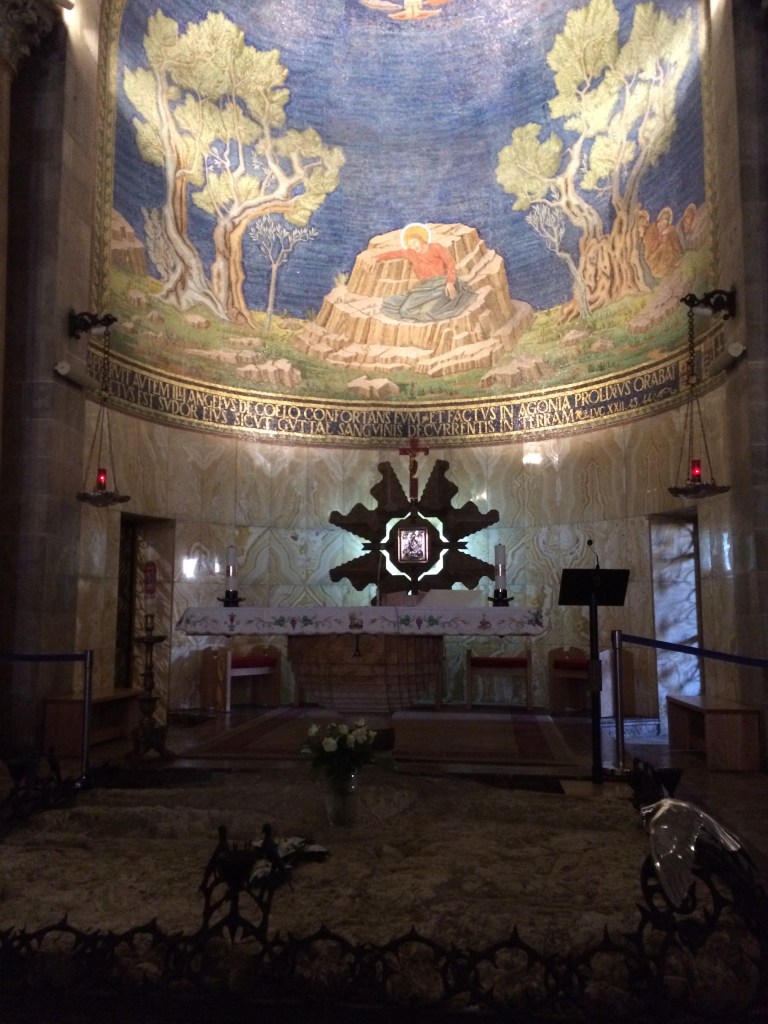
Photo by author, altar of the Church of All Nations beside the Garden of Gethsemane, May 2017. The church is always dimly lit to keep the sense of darkness during the Agony in the Garden of Jesus.
Before, darkness for man was seen more as a curse falling under the realm of evil and sin; but, with the coming of Jesus, darkness became a blessing, a prelude to the coming of light.
We have mentioned at the start of our reflection that Jesus was born during the darkest night of the year to show us he that is the light of the world, who had come to enlighten us in this widespread darkness, within us and outside us.
As the light of the world, Jesus was no stranger to darkness which he conquered and tamed in many instances like when they were caught in a storm at sea and in fact, when walked on water to join his disciples caught in another storm.
But most of all, Jesus had befriended darkness and made it a prelude to light.
How? By always praying during darkness. By prayer, it is more than reciting some prayers common during his time as a Jew but as a form of submission to the will of the Father. Jesus befriended darkness by setting aside, forgetting his very self to let the Father’s will be done.
Bass relief of agony in the garden on the wall of the Church of All Nations at Gethsemane. Photo by author, May 2019.
This he showed so well in two instances, first on Mount Tabor where he transfigured and second in Gethsemane before his arrest.
In both events, Jesus showed us the path to overcoming darkness is always through prayers, of being one in the Father.
It is in darkness when God is most closest to us because it is then when we get a glimpse of himself, of his love and mercy, of his own sufferings and pains, and of his glory.
This is something the three privileged disciples – Simon Peter, James and his brother John – did not realize while being with Jesus at both instances until after Easter. We are those three who always fall asleep, who could not keep with praying in Jesus, with Jesus, and through Jesus.
It was in the darkness of the night when Jesus spent most of his prayer periods, communing with the Father up in a mountain or a deserted place.
On Mount Tabor, Jesus showed his coming glory while in Gethsemane he showed his coming suffering and death. But whether in Gethsemane or on Mount Tabor, it is always Jesus we meet inviting us to share in his oneness with the Father, in his power in the Holy Spirit to overcome every darkness in life.
And the good news is he had already won for us!
Photo by Mr. Raffy Tima of GMA-7 News of Mt. Samat with the Memorial Cross across the Manila Bay following clear skies resulting from the lockdown imposed since March 17, 2020.
In these extended darker days of quarantine period, let us come to the Lord closer in prayer to. experience more of his Passion and Death, more of his darkness so we may see his coming glory when everything is finally cleared in this corona pandemic.
Prayer does not necessarily change things but primarily changes the person first. And that is when prayer changes everything when we become like Jesus in praying.
Jesus is asking us to leave everything behind, to forget one’s self anew to rediscover him in this darkness when we get out of our comfort zones to see the many sufferings he continues to endure with our brothers and sisters with lesser things in this life, with those in total darkness, with those groping in the dark.
Now more than ever, we have realized the beauty of poverty and simplicity, of persons than things.
And most especially of darkness itself becoming light for us in this tunnel.
May Jesus enlighten us and vanish all darkness in us so that soon, we shall celebrate together the joy of his coming again in this world darkened by sin. Amen.
40 Shades of Lent, Sunday Week II-A, 08 March 2020
Genesis 12:1-4 +++ 2 Timothy 1:8-10 +++ Matthew 17:1-9
“Creation of Adam” by Michaelangelo at Sistine Chapel, the Vatican. From Wikipedia.
Touch is a very powerful word – literally and figuratively speaking. We say “we are touched” when we are deeply moved by words or music, gestures, acts, and scenes that need not be so spectacular because to touch is about making a connection, a communion of persons.
A touch can be so powerful that when filled with love and sincerity, it can transform the person being touched. Experts say that a touch of about five seconds is worth more than 300 words of encouragement and praise!
And that is why our Lord Jesus Christ, the Son of God is a certified “touch person” who always reached out to people by physically touching them, embracing them to make them feel his loving presence, his mercy, and most of all, his healing.
Almost all his healings were done by touching the sick when he would lay his hands on them like with the blind Bartimaeus on the street of Jericho.
There were times Jesus held up the hand of the sick to raise them up from their bed like Peter’s mother-in-law and the daughter of Jairus. Sometimes in rare occasions, Jesus healed in the most bizarre ways with his sense of touch like with that deaf in Decapolis.
He (Jesus) put his finger into the man’s ears and, spitting, touched his tongue; then he looked up to heaven and groaned, and said to him, “Ephphatha!” (that is, “Be opened!”).
Mark 7:33-34
In Nain, Jesus raised to life the son of a widow by touching the coffin – not the dead – by saying, “Young man, I tell you, arise!” that everyone was amazed, saying “the Lord has visited his people”.
Jesus never missed an occasion without personally touching another person, especially the children like when he caught his disciples driving them away.
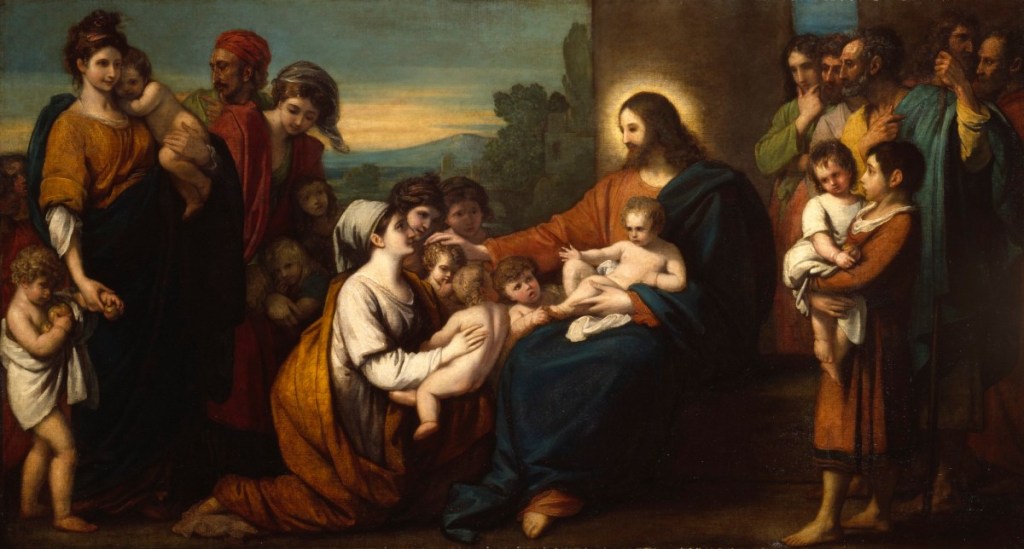
“Jesus blessing Little Children”, painting by British North American Benjamin West PRA (1781). Photo from wikipedia.
It is perhaps one of the most touching story of Jesus touching others when he told his disciples to “let the children come to me for theirs is the kingdom of heaven”, after which he embraced them, laid his hands on them and blessed them.
How blessed were those children must be to be embraced and laid with hands on by Jesus! According to tradition, one of those kids embraced and blessed by Jesus was St. Ignatius of Antioch who became a bishop and martyr in the early Church.
That is the transforming power of the touch by Jesus that children are blessed, the sick are healed by restoring their sight or cleansing their skin of leprosy, forgiving the sinners, giving hope to the poor. His touch is always a part of his proclamation of the good news to the people.
Jesus continues to touch us today in every Mass we celebrate when he first speaks to us in the scriptures, trying to make us feel our “hearts burn inside” like the disciples going home to Emmaus on Easter Sunday; and secondly, when he gives us his Body and Blood to partake in the Holy Eucharist.
Most of all, Jesus continues to literally touch us today through one another in our loving service to one another as a community of his disciples.
But, in this age of social media when every communication is mediated by gadgets and other instruments, this kind of personal communication is something we have all been missing because we have stopped touching Jesus, touching others too.
And this is what the second Sunday of Lent is trying to remind us today in the Transfiguration of Jesus.
Transfiguration of Jesus, communion of God with us
Jesus took Peter, James, and John his brother, and led them up a high mountain by themselves. And he was transfigured before them… a bright cloud cast a shadow over them, then from the cloud came a voice that said, “This is my beloved Son, with whom I am well pleased; listen to him.” When the disciples heard this, they fell prostrate and were very much afraid. But Jesus came and touched them, saying, “Rise, and do not be afraid.” And when the disciples raised their eyes, they saw no one else but Jesus alone.
Matthew 17:1-2, 5-7
“Transfiguration of Jesus” by Raphael from wikipedia.
We hear this story of the Transfiguration of Jesus twice every year: the Second Sunday of Lent and the sixth of August for the Feast of the Transfiguration. At this time of the year, the Transfiguration story is heard in relation with the Lord’s coming Passion, Death, and Resurrection.
At his Transfiguration, Jesus made it very clear that his glory and divinity must always be seen in the light of his Cross for it is only with his Cross that he can be correctly recognized as the Christ. It is on the Cross where Jesus truly touches us too in our personhood, in our humanity.
See how the three disciples were seized with fear upon hearing the voice of the Father while a bright cloud cast a vast shadow over them; but, it was right in that “tremendum fascinans” that we also find the intimacy, the closeness of God to us through Jesus Christ when he touched the three disciples.
Jesus came and touched them, saying, “Rise, and do not be afraid.” And when the disciples raised their eyes, they saw no one else but Jesus alone.
Matthew 17:7
And that is the good news for us all!
God had chosen to be so close to us in his Son Jesus Christ who touches us most not only in glory but most especially in moments of trials and tribulations! It is on the Cross where humanity and the divine truly become one in Jesus, when that personal and loving touch of Jesus becomes transformative and even performative.
This is the reason St. Paul exhorted Timothy to “bear your share of hardship for the gospel with the strength that comes from God” (2Tim.1:8) because oneness with Jesus always starts at the cross!
This is very true with us too when we only come to realize who are our true friends, our BFF’s when they are personally one with us in our trials and tribulations, not only in times we are well and good.
True transformation in Jesus can only happen when we are willing to be one with him, to be in touch with him in his passion and death for it is the only path to his Easter glory of transfiguration.
Touch communication vs. mediated communication
From Forbes.com
How sad that in this age of modern communications that have shrunk the world into a “global village” with instant communications that instead of growing together we have grown more apart than ever from each other.
We have lost real communications that lead to communion of persons or unity of people because we have become more concerned with the techniques of communication, more of skills and gadgets than of persons.
That is the meaning of media or “mediated communication” where there is always a medium between or among persons like cellphones and gadgets.
No more interpersonal relationships, making us more isolated and alienated, leading to growing problems of loneliness, depression, and suicides.
How frustrating sometimes to attend social functions like dinners and weddings where everyone is more busy and interested with their cellphones than with persons beside them!
Aside from isolation from persons, we have also grown “out of touch” with reality itself when more and more people are retreating into their own small worlds like cocoons with wires attached into their ears while their eyes fixated on screens oblivious to the world around them.
We have become so out of touch with ourselves and with others that more and more we are becoming like porcupines – we have not only stopped getting in touch with others but even hurt others if ever we touch them!
From Google.
Parents, lovers, couples, even people we trust like priests and religious sometimes hurt us with their touch instead of healing us, comforting us. Nobody would want to go through the Passion of the Cross anymore that we would rather stay on top of the mountain, of everything to be delighted with our perceived power and glory.
So unlike in our first reading where we get the feel and touch of real encounter in persons between God and Abraham. Note how in just four verses the word “bless” used five times by God to Abraham, promising to bless him more if he leaves his kin to follow him to the land he would give him.
In their conversation, we find a very personal and engaging communication, as if God and Abraham were literally in touch with each other, where there is personal contact and communication.
We know this for a fact at how effective and more reliable are personal interactions in communication than mediated ones through phones and email – personal communications always have that feel and touch that enable us to negotiate further and be more fruitful.
This Season of Lent, the Father is asking us to be in touch with him again by listening to the words of his Son Jesus who asks us only one thing: deny yourself, take up your cross and follow him. Let us heed him, touch him, and allow him to touch us again to be healed and transformed.
May you be touched as you touch also others in the most loving way this Sunday throughout the whole week! Amen.
40 Shades of Lent, Saturday after Ash Wednesday, 29 February 2020
Isaiah 58:9-14 +++ 0 +++ Luke 5:27-32
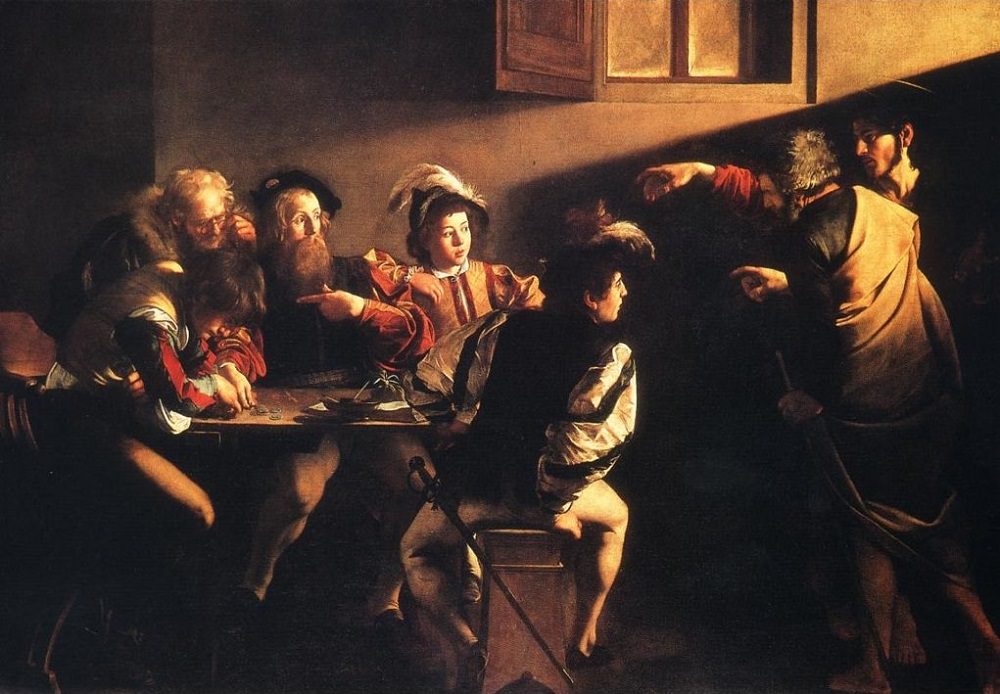
“The Calling of St. Matthew” by Caravaggio. From Google.
Dearest Jesus: I have been imagining in prayer of myself being Levi the tax collector sitting at his post.
It must be so lonely being like him, rich but deep inside longing for something deeper and meaningful than money and wealth. He had been thinking of making a “lifestyle shift” but he felt hopeless with nobody to help him.
Like in the first reading, your invitation Lord through the Prophet Isaiah seem to be too good to be true that anyone like Levi – or me – could make a big difference in life by “giving food to someone hungrier, abandoning my own comfort to care for someone afflicted, substituting a kind word for a malicious gossip, and worshipping you than pursuing my own interests”(Is.58:10,13).
I felt like Levi – there in his little customs post – that is impossible because everything is hopeless and there is no chance to change. Everything is doomed, especially for me, a sinner, Lord.
Then, suddenly you came, saying, “Follow me” (Lk.5:27).
How I love looking back, Lord, to those dark days when you suddenly came calling me to follow you!
It was so simple.
Like Levi, I just stood and followed you and everything changed in my life!
That was so nice of you, Lord Jesus, to take such a bold step of coming to Levi’s post to call him and, me. It was – and still is – a gamble on your part to call us sinners to follow you. And since then, you have never stopped calling us sinners Lord Jesus to follow you, even on our darkest and lowest days and hours, Lord, when everything seemed to be so doomed.
As we prepare for the first Sunday of Lent, remind me, O Lord, that this holy season is not all that drab and dry. After all, Lent originally means “springtime”, the coming joy of Easter which happens every time we turn our hearts to you like Levi. Amen.
Saturday, Feast of the Chair of St. Peter, 22 February 2020
1 Peter 5:1-4 ><)))*> 0 <*(((>< Matthew 16:13-19
Chair of St. Peter at the altar of St. Peter’s in Rome. From Google.
Many of us today are wondering, O Lord, about our unusual celebration, the Feast of the Chair of St. Peter. Because deep inside to most of us, chairs and seating mean a lot, whether at the dining table, conference room, the church, or even the bus and other modes of transportation.
Chairs and seats connote position and power. You have noticed it so well when you were invited to a banquet when people scrambled for the best seating positions.
How funny, O Lord, that we try to fool ourselves many times choosing to take the last seats at the back to make it appear we are humble and simple, choosing to be away from the limelight when in fact, the more we insist on having some seats, regardless where it may be, the more we insist on our ego and self, on who we really are!
A sculpture of St. Peter by Edwin Layug near the main door of the Malolos Cathedral. Photo by Lorenzo Atienza.
Remove our masks, Lord. Stop our hypocrisies! Let us heed the words of your humble servant, your first Pope.
Beloved: I exhort the presbyters among you, as a fellow presbyter and witness to the sufferings of Christ and one who has a share in the glory to be revealed. Tend the flock of God in your midst, overseeing not by constraint but willingly, as God would have it, not for shameful profit but eagerly. Do not lord it over those assigned to you, but be examples to the flock.
1 Peter 5:1-3
Pray for us, dearest St. Peter, to see that chairs and seats are signs indeed of primacy – not of prestige or honor but of charity and service in our family and community.
Help us to keep in mind that what really matters for the Lord, in this life, in the church we belong, is not where we are seated but where we stand in him, “the Christ and the Son of the living God” (Mt.16:16). Amen.
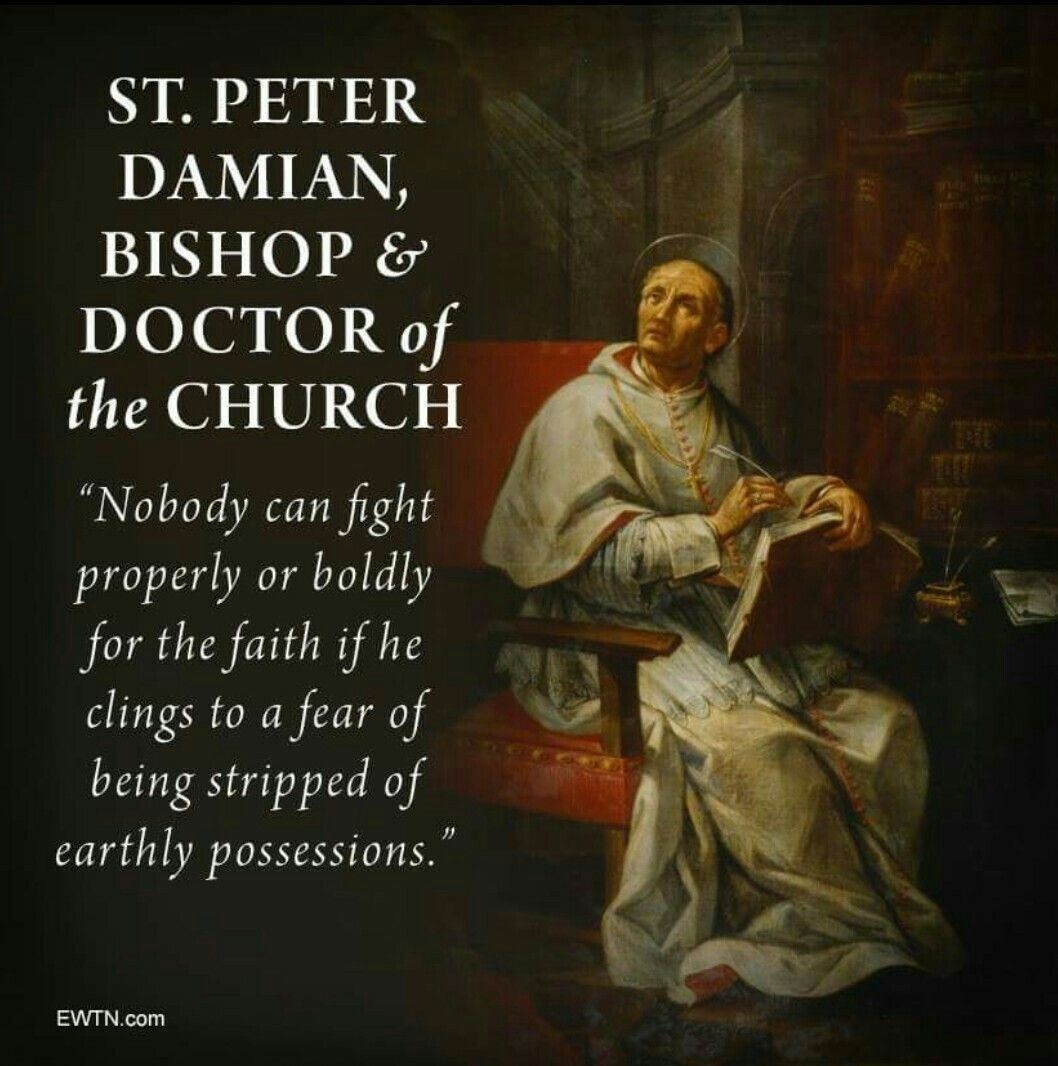
Friday, Memorial of St. Peter Damian, 21 February 2020
James 2:14-24.26 ><)))*> ><)))*> ><)))*> Mark 8:34-9:1
Photo by Mr. Jay Javier, Traslacion 2020, Quiapo, Manila.
Praise and glory to you, O Lord Jesus Christ, for standing by our side through all the trials that have poured upon us this early 2020. In fact, since December you have been keeping us, blessing us, protecting us from all the problems we have been going through in the family and in the world.
You have never left us, Lord, with many of us now moving on with our lives since losing our beloved earlier this year while war between Iran and the US was averted. Thank you, Jesus, the alert level of Taal Volcano had gone down and despite the continuing threats from the new corona virus, things seem to be improving.
Except us, your people who are supposed to be “faithful”.
The words of St. James since Monday have been shaking us down into our very core, reminding us to get real and do away with all the pomp and pageantries of being your faithful disciples.
What good is it, my brothers and sisters, if someone says he has faith but does not have works? Can that faith save him? So also faith of itself, if it does not have works, is dead. You believe that God is one. You do well. Even the demons believe that and tremble. See how a person is justified by works and not by faith alone. For just as a body without a spirit is dead, so also faith without works is dead.
James 2:14, 17, 19, 24-26
Continue to purify us, teach us how to truly “deny one’s self, take up one’s cross, and follow you, O Lord” (Mk.8:34).
How sad, O Lord, that as we approach your holy season of Lent, we are more preoccupied with how ashes should be distributed on Ash Wednesday.
What an “overkill” Lord in dealing with this disease when we have forgotten the more essential cleansing of our hearts, of our minds and conscience that flow into maintaining cleanliness and hygiene inside our churches.
Faith in this time of the new corona virus is proving to be a very crucial test of our being Christ-ians indeed through our genuine works of love and mercy for others.
Give us the same courage of St. Peter Damian in reforming not only your church but most especially our very selves. Amen.
Photo by Mr. Jay Javier, Traslacion 2020, Quiapo, Manila.
Lord Jesus Christ, today I beg you, please do not ask me the same question you have asked your apostles at Caesarea Philippi: “Who do people say that I am?”
I am not yet ready to report these to you, Lord, because I would be telling you also so many varied answers on what people say who you are just like the Twelve at that time.
But so unlike your apostles, the people’s many different answers on who you are – that are mostly wrong – are because of my own faults and shortcomings.
Yes, dear Jesus: when your apostles told you what people said about you, they merely reported what they have heard.
But, today Lord, people say different things about you largely because we your priests and modern followers have not fulfilled our mission from you. We have misrepresented you, Jesus, most of the time.
People get so many wrong ideas on who you are because we do not reflect your true self as a humble and loving servant living with the poor and marginalized.
People get so many wrong ideas on who you are because we do not reflect your true self as a suffering servant, sacrificing everything, bearing all pains for justice and truth.
Forgive us, Jesus, when most of the time, we are what your apostle St. James refer to as those showing partiality with the rich and powerful, forgetting the less fortunate among us.
I am sorry, Lord Jesus in misrepresenting you that until now, people still say so many things on who you are.
Please continue to purify me, to empty me of my pride, to fill me with your humility, justice and love so people may realize who you really are — through me. Amen.
The Lord Is My Chef Sunday Recipe for the Soul, Week VI-A, 16 February 2020
Sirach 15:15-20 ><)))*> 1 Corinthians 2:6-10 ><)))*> Matthew 5:17-37
Photo by author of pilgrims entering the Church of the Beatitudes with a painting of the Sermon on the Mount above the door, May 2019.
Jesus continues his Sermon on the Mount this Sunday, expounding the meaning of his teachings called the Beatitudes. As we have reflected last week, the Beatitudes tell us the person of Jesus Christ as being “poor, merciful, clean of heart” whom we must all imitate to become the salt and the light of the world.
Most important of all, Matthew presents to us at the Sermon on the Mount that Jesus is more than the new Moses as giver of laws like at Mt. Sinai in the Old Testament: Jesus himself is the Law, who is both our Teacher and Redeemer.
This we see in his teachings today when he claims to be the fulfillment of the Laws and the Prophets from God in the Old Testament.
Jesus said to his disciples: “Do not think that I have come to abolish the law or the prophets. I have come not to abolish but to fulfill it. Amen, I say to you, until heaven and earth pass away, not the smallest letter or the smallest part of a letter will pass from the law, until all things have taken place.”
Matthew 5:17-18
Essence of the Laws: reflection of God, the good of man
Today, Jesus is teaching us to see the laws in the right perspectives, in the light of the will of God for the good of every person. Throughout his ministry, Jesus has always been consistent in reminding everyone that the laws were made for man, not the other way around.
During Christ’s time, people have lost the real meaning of the Commandments of God as priests and religious leaders focused more on its letters than in its essence and spirit that in the process, the laws have become burdensome. It has continued in our own generation with laws taking precedence over God and persons.
Photo by author of the Church of the Beatitudes at the Holy Land, May 2019.
At the Sermon on the Mount, we find Jesus restoring and recalibrating the laws so that these become more relevant and powerful as reflections of God in the service of man.
Jesus “relectures” us the laws in this part of his Sermon on the Mount by adding more righteousness (holiness), declaring that,
“I tell you, unless your righteousness surpasses that of the scribes and Pharisees, you will not enter the kingdom of heaven.”
Matthew 5:20
By using a pattern where he would cite Laws, saying, “You have heard that it was said”– Jesus shows us his fidelity and obedience to Judaism, contrary to his enemies’ accusations that he had abolished their laws. Moreover, in fulfilling the laws, Jesus put himself in the midst of every law and precept by declaring, “Amen, I say to you” or “but I say to you”.
In following that formula, Jesus gave the laws with a human face and a human heart in himself as its fulfillment so that from then on at his Sermon on the Mount, Christ made every law, every tradition, everything else to be seen always in his person.
Black and white photo by Mr. Jay Javier in Quiapo, 09 January 2020.
Performative powers of the laws in Jesus Christ
With Jesus in the midst of every law and precept as its fulfillment, God’s laws then become not only informative but most of all, performative to borrow one of Pope Emeritus Benedict XVI’s favorite expression. This we find Jesus teaching us in three stages in our long gospel this Sunday.
Education of the heart.
The first two laws cited by Jesus in this long list of commandments are “You shall not kill” and “you shall not commit adultery”. Both laws bring us to the very core of our personhood, of what is in our hearts and in our minds. The Lord explains that being angry as well as saying bad words against another person is like murder while looking lustfully at a woman is a form of adultery because in both cases, we have ceased to regard the other individuals as persons to be loved and respected, created in the image and likeness of God.
From Google.
It is an invitation for us to purify our hearts and minds for what defiles man is not what enters him but what comes out from him (Mt.15:11). Whatever is within us will always have an effect in all of our actions, for better or for worse.
What a tragedy that right here in the middle of our wired world of social media and instant communications, we have actually grown apart than together in the last 35 year with so much animosities fed on by lies and misinformation.
How ironic also that despite the information explosion from the Net, we have more benighted souls today than ever before who have actually gone to schools who know nothing of our history and geography?!
Education of the heart is formation of the whole person, not just a training of skills. One problem we have these days is when information is geared on data and facts without integration that we forget our relationships as well as the values we keep like respect, kindness, and dedication. Unless we have an education of the heart, a wholistic and integral formation, we can never be transformed into like Jesus Christ.
2. Get into the roots of our sins.
In telling us to pluck out our right eye or cut off our right hand if these cause us to sin, Jesus is inviting us again to probe deep into our hearts and being to understand what causes us to sin.
Photo by author, water plants in my room at the Fatima Parish and National Shrine, Valenzuela City, 2010.
The key here is to be totally free. In the first reading, Ben Sirach counsels us to “choose” rightly what is good and avoid what is evil.
We can only exercise our true freedom when we have clearer knowledge and understanding of ourselves and of things within us. We fall into vices and sins because we do not know what is going on inside us; hence, we are enslaved by our desires and sins to be not free at all.
Once we understand our sins, we commit them less often. Most of all, when we understand our sins, our struggles against committing these become more persevering, resulting to more triumphs than defeats.
The Season of Lent is near. Once again, we shall be busy with fasting and abstinence, contrition and confession of sins, almsgiving and other spiritual works that make us holy. But too often, these acts become mechanical that sooner, we sometimes reach that point when we cannot find meaning in doing them anymore that we sink deeper into sins and evil.
This happens when we get focused with letters of the laws and we forget its spirit that we become mechanical because we have failed to understand our very selves as well as our sins.
3. Be true.
Jesus said it perfectly well at the end of his teachings today,
“Let your ‘Yes’ mean ‘Yes’ and your ‘No’ mean ‘No.’ Anything more is from the evil one.”
Matthew 5:37
In this last installment of reviewing the laws, Jesus underscored the problems with divorce as well as with lies that continue to this day because we always choose not to be true at all with ourselves, with God, and with others.
Photo by author of the last two Stations of the Cross at the chapel of my niece Ms. Babs Sison in Los Baños, Laguna 13 February 2020.
See the wisdom of Jesus in putting together divorce and oaths, the two great lies that until now continue to mislead so many among us who refuse to accept and carry the cross of Christ, preferring only the Easter Sunday minus the Good Friday.
Being true is embracing the Cross of Jesus Christ like St. Paul in the second reading. It is something we cannot deny in this life. There will always be pain and sufferings. As Dr. Scott Peck put it in his book The Road Less Travelled, “life is difficult.”
At his Sermon on the Mount, Jesus clearly showed in his Beatitudes that he and his values are in sharp contrast to the wisdom of the world. And this wisdom is only accessible to those willing to embrace the crucified Christ and the scandal of the cross.
It is there on the Cross with Jesus Christ we truly find the fulfillment of the laws as well as our fullness as persons. Amen.
The Lord Is My Chef Recipe for the Soul, Sunday Week V-A, 09 February 2020
Isaiah 58:7-10 ><)))*> 1 Corinthians 2:1-5 ><)))*> Matthew 5:13-16
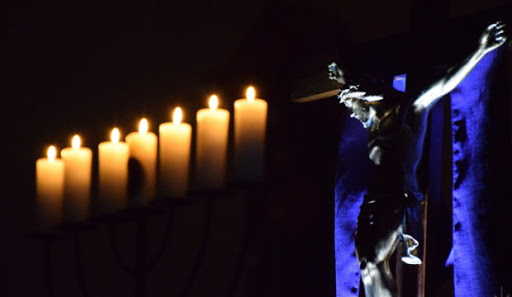
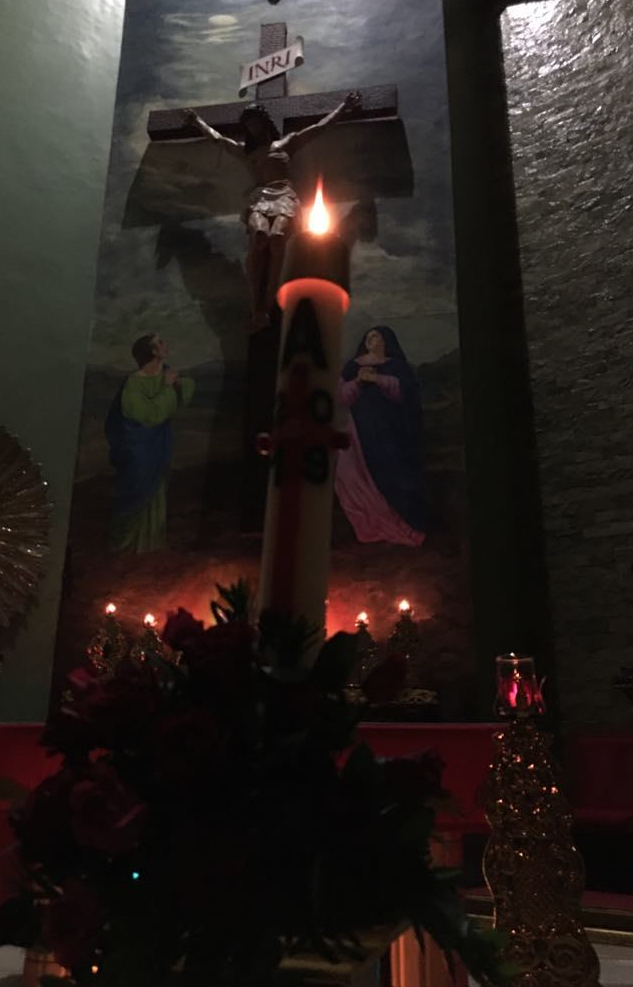
Our parish cross at night, taken with my camera phone, 02 February 2020.
For most of us, 2020 is a very tough year with all the dark clouds that have come to hover above us in January remain in this month of February.
Threats from the corona virus are growing especially in our country. And while the alert level at Taal Volcano had gone down, dangers of its major eruption remain while volcanologists observed last week a “crater glow” on Mayon Volcano, indicating a possible rising of magma in the world’s most perfect cone.
Elsewhere, more bad news are happening like the sudden deaths this week of healing priest Fr. Fernando Suarez and of our very own and beloved Fr. Danny Bermudo, just 24 hours apart due to heart attacks.
In our own circles of family and relatives, friends and colleagues are also dark clouds covering us while we go through our many trials and tests in life that seem to eclipse this early the many gains we have achieved in the whole of 2019.
Indeed, year 2020 shows us in “perfect vision” the sad realities of dark spots in life that behoove us more to heed Christ’s call to be the light of the world.
Jesus said to his disciples: “You are the light of the world. Just so, your light must shine before others, that they may see your good deeds and glorify your Heavenly Father.”
Matthew 5:14, 16
Photo by author, frost on petals, Baguio City, 04 February 2020.
Jesus is the light of the world, not us
Our gospel this Sunday follows immediately the inaugural preaching of Jesus called “the Sermon on the Mount” with the Beatitudes at its centerpiece. We have skipped that part of the gospel last Sunday due to the celebration of the Feast of the Presentation of the Lord.
For us to better appreciate this Sunday’s gospel, let us keep in mind that for Matthew, the Sermon on the Mount is the great discourse of Jesus Christ that depicts his image not only as the new Moses but as the Law himself, being both our Teacher and Savior as well.
Jesus shows us a picture of his person in the Beatitudes as someone we must imitate in being “poor in spirit, meek, and merciful” so we can follow his path to the Father. After all, as the Son of God, Jesus is “the way, the truth, and the life” (Jn. 14:6).
Hence, after enumerating the nine Beatitudes, Jesus followed up his Sermon on Mount with a call for us to be the salt and the light of the world: as salt, we merely bring out the Christ or the taste in every person and as light, it is the light of Christ that we share.
Focus remains in being like Jesus, not in replacing him who is our Savior. That is why he tells us clearly before shifting to another lesson in his Sermon that “your light must shine before others, that they may see your good deeds and glorify your Heavenly Father” (Mt.5:16).
Sharing Christ’s light with our good deeds as a community
So, how do we share the light of Jesus Christ in this age when so many others are claiming to be the light that will dispel all darkness in our lives?
As early as during the darkest period in the history of Israel in the Old Testament called the “Babylonian Captivity (or Exile)”, God had taught his people how to become light for one another during trials and sufferings.
Christ Light of the World, Red Wednesday, 27 November 2019. Photo by author.
Thus says the Lord: Share your bread with the hungry, shelter the oppressed and the homeless; clothe the naked when you see them, and do not turn your back on your own. Then your light shall break forth like the dawn… if you bestow your bread on the hungry and satisfy the afflicted; then light shall rise for you in the darkness, and the gloom shall become for you like midday.
Isaiah 58:7-8, 10
To share one’s bread with the hungry, to welcome the homeless, to clothe the hungry are some of the most concrete demands placed by God to his people since he had freed them from slavery in Egypt and later in Babylonia (Iraq today) when the third part of the Book of Isaiah was written.
Eventually, this prophecy was fulfilled in Jesus Christ who also preached exactly the same things shortly before fulfilling his mission in Jerusalem when he stressed the need to do good to one another because “whatsoever we do to one another, especially to the least among us, we also do unto him” (Mt.25:31-40).
We shall hear this part of Matthew’s gospel at the end of our current liturgical year on November 22, 2020 in the celebration of the Solemnity of Christ the King.
These instructions became the basis of our catechism’s “spiritual and corporal works of mercy” that Pope Francis stressed in 2016 during the Extraordinary Jubilee of Mercy.
From fathersofmercy.com
By saying “you are the light of the world”, Jesus is telling us that to fulfill this mission, we have to do it together as a community, as his Body, the Church!
No matter how good and holy we are, none of us is the “light of the world” on our own.
One candle or lamp, or even a light bulb today cannot produce enough light to brighten a whole town or community. But, if one Christian will be lighting just one little candle in the dark, he or she can encourage others especially those who are timid, hesitant, and indifferent until they finally set the world ablaze with Christ’s light.
Christ’s call to be the light of the world is also a call for us to be united as one community, one family, one faithful couple with all our imperfections and sinfulness. What matters is our striving to be good disciples, always charitable to one another as brothers and sisters in Christ.
Here we find the direct relationship of mission and community: every mission given by Jesus is also a call to become a community because without it, it soon becomes a cult centered on the disciple than the Lord.
Photo by Mr. Jim Marpa, 2018.
The example of St. Paul in sharing Christ’s light
St. Paul shows us the best example of being a light of Jesus is to always have it done and fulfilled in the context of a community, of the Church as the Body of Christ, avoiding chances of grabbing the light from him for personal gains.
“I came to you in weakness and fear and much trembling, and my message and my proclamation were not with persuasive words of wisdom, but with a demonstration of Spirit and power, so that your faith might rest not on human wisdom but on the power of God.”
1 Corinthians 2:3-5
It has always happened especially for us serving in the Church that in sharing the light of Christ, we get carried by our ministry and apostolate that we forget him until we claim being the light ourselves.
Sometimes, we consciously or unconsciously create clouts and personality cults for ourselves for being the best, the brightest, even the holiest and most humble of all!
We foolishly brag the great buildings and edifices we have built or the countless malnourished kids we have fed or sent to school for free through college, et cetera, et cetera, et cetera without being bothered at all where is Jesus Christ in all our efforts and projects!
How sad when we forget that what matters most in life is not what we have done or what we have achieved but what have we become as bearers of the light of Christ like St. Paul.
My dear friend, if you are going through many darkness in life today, simply be good, think only of Jesus Christ in everybody you meet and deal with. That is actually when you shine brightest as the light of Christ because people will be surprised at how calmly and gracefully you carry your cross.
In that way, you encourage others living in darkness to let their little sparks of light come out too without realizing how in their own darkness and limitations they have made Christ’s light seen. Amen.
Have a bright and blessed Sunday with your loved ones!
























 lordmychef.com