Standing for Christ

The Lord Is My Chef Breakfast Recipe for the Soul

Saturday, Feast of the Chair of St. Peter, 22 February 2020

1 Peter 5:1-4 ><)))*> 0 <*(((>< Matthew 16:13-19

Chair of St. Peter at the altar of St. Peter’s in Rome. From Google.

Many of us today are wondering, O Lord, about our unusual celebration, the Feast of the Chair of St. Peter. Because deep inside to most of us, chairs and seating mean a lot, whether at the dining table, conference room, the church, or even the bus and other modes of transportation.

Chairs and seats connote position and power. You have noticed it so well when you were invited to a banquet when people scrambled for the best seating positions.

How funny, O Lord, that we try to fool ourselves many times choosing to take the last seats at the back to make it appear we are humble and simple, choosing to be away from the limelight when in fact, the more we insist on having some seats, regardless where it may be, the more we insist on our ego and self, on who we really are!

A sculpture of St. Peter by Edwin Layug near the main door of the Malolos Cathedral. Photo by Lorenzo Atienza.

Remove our masks, Lord. Stop our hypocrisies! Let us heed the words of your humble servant, your first Pope.

Beloved: I exhort the presbyters among you, as a fellow presbyter and witness to the sufferings of Christ and one who has a share in the glory to be revealed. Tend the flock of God in your midst, overseeing not by constraint but willingly, as God would have it, not for shameful profit but eagerly. Do not lord it over those assigned to you, but be examples to the flock.

1 Peter 5:1-3

Pray for us, dearest St. Peter, to see that chairs and seats are signs indeed of primacy – not of prestige or honor but of charity and service in our family and community.

Help us to keep in mind that what really matters for the Lord, in this life, in the church we belong, is not where we are seated but where we stand in him, “the Christ and the Son of the living God” (Mt.16:16). Amen.

Faith in the time of COVID-19

The Lord Is My Chef Breakfast Recipe for the Soul

Friday, Memorial of St. Peter Damian, 21 February 2020

James 2:14-24.26 ><)))*> ><)))*> ><)))*> Mark 8:34-9:1

Photo by Mr. Jay Javier, Traslacion 2020, Quiapo, Manila.

Praise and glory to you, O Lord Jesus Christ, for standing by our side through all the trials that have poured upon us this early 2020. In fact, since December you have been keeping us, blessing us, protecting us from all the problems we have been going through in the family and in the world.

You have never left us, Lord, with many of us now moving on with our lives since losing our beloved earlier this year while war between Iran and the US was averted. Thank you, Jesus, the alert level of Taal Volcano had gone down and despite the continuing threats from the new corona virus, things seem to be improving.

Except us, your people who are supposed to be “faithful”.

The words of St. James since Monday have been shaking us down into our very core, reminding us to get real and do away with all the pomp and pageantries of being your faithful disciples.

What good is it, my brothers and sisters, if someone says he has faith but does not have works? Can that faith save him? So also faith of itself, if it does not have works, is dead. You believe that God is one. You do well. Even the demons believe that and tremble. See how a person is justified by works and not by faith alone. For just as a body without a spirit is dead, so also faith without works is dead.

James 2:14, 17, 19, 24-26

Continue to purify us, teach us how to truly “deny one’s self, take up one’s cross, and follow you, O Lord” (Mk.8:34).

How sad, O Lord, that as we approach your holy season of Lent, we are more preoccupied with how ashes should be distributed on Ash Wednesday.

What an “overkill” Lord in dealing with this disease when we have forgotten the more essential cleansing of our hearts, of our minds and conscience that flow into maintaining cleanliness and hygiene inside our churches.

Faith in this time of the new corona virus is proving to be a very crucial test of our being Christ-ians indeed through our genuine works of love and mercy for others.

Give us the same courage of St. Peter Damian in reforming not only your church but most especially our very selves. Amen.

Misrepresenting Jesus Christ

The Lord Is My Chef Breakfast Recipe for the Soul

Thursday, Week VI, Year II, 20 February 2020

James 2:1-9 ><)))*> 0 <*(((>< Mark 8:27-33

Photo by Mr. Jay Javier, Traslacion 2020, Quiapo, Manila.

Lord Jesus Christ, today I beg you, please do not ask me the same question you have asked your apostles at Caesarea Philippi: “Who do people say that I am?”

I am not yet ready to report these to you, Lord, because I would be telling you also so many varied answers on what people say who you are just like the Twelve at that time.

But so unlike your apostles, the people’s many different answers on who you are – that are mostly wrong – are because of my own faults and shortcomings.

Yes, dear Jesus: when your apostles told you what people said about you, they merely reported what they have heard.

But, today Lord, people say different things about you largely because we your priests and modern followers have not fulfilled our mission from you. We have misrepresented you, Jesus, most of the time.

People get so many wrong ideas on who you are because we do not reflect your true self as a humble and loving servant living with the poor and marginalized.

People get so many wrong ideas on who you are because we do not reflect your true self as a suffering servant, sacrificing everything, bearing all pains for justice and truth.

Forgive us, Jesus, when most of the time, we are what your apostle St. James refer to as those showing partiality with the rich and powerful, forgetting the less fortunate among us.

I am sorry, Lord Jesus in misrepresenting you that until now, people still say so many things on who you are.

Please continue to purify me, to empty me of my pride, to fill me with your humility, justice and love so people may realize who you really are — through me. Amen.

From Interaksyon.com 2019.

Fullness of person, fulfillment of law

The Lord Is My Chef Sunday Recipe for the Soul, Week VI-A, 16 February 2020

Sirach 15:15-20 ><)))*> 1 Corinthians 2:6-10 ><)))*> Matthew 5:17-37

Photo by author of pilgrims entering the Church of the Beatitudes with a painting of the Sermon on the Mount above the door, May 2019.

Jesus continues his Sermon on the Mount this Sunday, expounding the meaning of his teachings called the Beatitudes. As we have reflected last week, the Beatitudes tell us the person of Jesus Christ as being “poor, merciful, clean of heart” whom we must all imitate to become the salt and the light of the world.

Most important of all, Matthew presents to us at the Sermon on the Mount that Jesus is more than the new Moses as giver of laws like at Mt. Sinai in the Old Testament: Jesus himself is the Law, who is both our Teacher and Redeemer.

This we see in his teachings today when he claims to be the fulfillment of the Laws and the Prophets from God in the Old Testament.

Jesus said to his disciples: “Do not think that I have come to abolish the law or the prophets. I have come not to abolish but to fulfill it. Amen, I say to you, until heaven and earth pass away, not the smallest letter or the smallest part of a letter will pass from the law, until all things have taken place.”

Matthew 5:17-18

Essence of the Laws: reflection of God, the good of man

Today, Jesus is teaching us to see the laws in the right perspectives, in the light of the will of God for the good of every person. Throughout his ministry, Jesus has always been consistent in reminding everyone that the laws were made for man, not the other way around.

During Christ’s time, people have lost the real meaning of the Commandments of God as priests and religious leaders focused more on its letters than in its essence and spirit that in the process, the laws have become burdensome. It has continued in our own generation with laws taking precedence over God and persons.

Photo by author of the Church of the Beatitudes at the Holy Land, May 2019.

At the Sermon on the Mount, we find Jesus restoring and recalibrating the laws so that these become more relevant and powerful as reflections of God in the service of man.

Jesus “relectures” us the laws in this part of his Sermon on the Mount by adding more righteousness (holiness), declaring that,

“I tell you, unless your righteousness surpasses that of the scribes and Pharisees, you will not enter the kingdom of heaven.”

Matthew 5:20

By using a pattern where he would cite Laws, saying, “You have heard that it was said”– Jesus shows us his fidelity and obedience to Judaism, contrary to his enemies’ accusations that he had abolished their laws. Moreover, in fulfilling the laws, Jesus put himself in the midst of every law and precept by declaring, “Amen, I say to you” or “but I say to you”.

In following that formula, Jesus gave the laws with a human face and a human heart in himself as its fulfillment so that from then on at his Sermon on the Mount, Christ made every law, every tradition, everything else to be seen always in his person.

Black and white photo by Mr. Jay Javier in Quiapo, 09 January 2020.

Performative powers of the laws in Jesus Christ

With Jesus in the midst of every law and precept as its fulfillment, God’s laws then become not only informative but most of all, performative to borrow one of Pope Emeritus Benedict XVI’s favorite expression. This we find Jesus teaching us in three stages in our long gospel this Sunday.

  1. Education of the heart.

The first two laws cited by Jesus in this long list of commandments are “You shall not kill” and “you shall not commit adultery”. Both laws bring us to the very core of our personhood, of what is in our hearts and in our minds. The Lord explains that being angry as well as saying bad words against another person is like murder while looking lustfully at a woman is a form of adultery because in both cases, we have ceased to regard the other individuals as persons to be loved and respected, created in the image and likeness of God.

From Google.

It is an invitation for us to purify our hearts and minds for what defiles man is not what enters him but what comes out from him (Mt.15:11). Whatever is within us will always have an effect in all of our actions, for better or for worse.

What a tragedy that right here in the middle of our wired world of social media and instant communications, we have actually grown apart than together in the last 35 year with so much animosities fed on by lies and misinformation.

How ironic also that despite the information explosion from the Net, we have more benighted souls today than ever before who have actually gone to schools who know nothing of our history and geography?!

Education of the heart is formation of the whole person, not just a training of skills. One problem we have these days is when information is geared on data and facts without integration that we forget our relationships as well as the values we keep like respect, kindness, and dedication. Unless we have an education of the heart, a wholistic and integral formation, we can never be transformed into like Jesus Christ.

2. Get into the roots of our sins.

In telling us to pluck out our right eye or cut off our right hand if these cause us to sin, Jesus is inviting us again to probe deep into our hearts and being to understand what causes us to sin.

Photo by author, water plants in my room at the Fatima Parish and National Shrine, Valenzuela City, 2010.

The key here is to be totally free. In the first reading, Ben Sirach counsels us to “choose” rightly what is good and avoid what is evil.

We can only exercise our true freedom when we have clearer knowledge and understanding of ourselves and of things within us. We fall into vices and sins because we do not know what is going on inside us; hence, we are enslaved by our desires and sins to be not free at all.

Once we understand our sins, we commit them less often. Most of all, when we understand our sins, our struggles against committing these become more persevering, resulting to more triumphs than defeats.

The Season of Lent is near. Once again, we shall be busy with fasting and abstinence, contrition and confession of sins, almsgiving and other spiritual works that make us holy. But too often, these acts become mechanical that sooner, we sometimes reach that point when we cannot find meaning in doing them anymore that we sink deeper into sins and evil.

This happens when we get focused with letters of the laws and we forget its spirit that we become mechanical because we have failed to understand our very selves as well as our sins.

3. Be true.

Jesus said it perfectly well at the end of his teachings today,

“Let your ‘Yes’ mean ‘Yes’ and your ‘No’ mean ‘No.’ Anything more is from the evil one.”

Matthew 5:37

In this last installment of reviewing the laws, Jesus underscored the problems with divorce as well as with lies that continue to this day because we always choose not to be true at all with ourselves, with God, and with others.

Photo by author of the last two Stations of the Cross at the chapel of my niece Ms. Babs Sison in Los Baños, Laguna 13 February 2020.

See the wisdom of Jesus in putting together divorce and oaths, the two great lies that until now continue to mislead so many among us who refuse to accept and carry the cross of Christ, preferring only the Easter Sunday minus the Good Friday.

Being true is embracing the Cross of Jesus Christ like St. Paul in the second reading. It is something we cannot deny in this life. There will always be pain and sufferings. As Dr. Scott Peck put it in his book The Road Less Travelled, “life is difficult.”

At his Sermon on the Mount, Jesus clearly showed in his Beatitudes that he and his values are in sharp contrast to the wisdom of the world. And this wisdom is only accessible to those willing to embrace the crucified Christ and the scandal of the cross.

It is there on the Cross with Jesus Christ we truly find the fulfillment of the laws as well as our fullness as persons. Amen.

Have a blessed Sunday, everyone!

Sharing the light of Christ

The Lord Is My Chef Recipe for the Soul, Sunday Week V-A, 09 February 2020

Isaiah 58:7-10 ><)))*> 1 Corinthians 2:1-5 ><)))*> Matthew 5:13-16

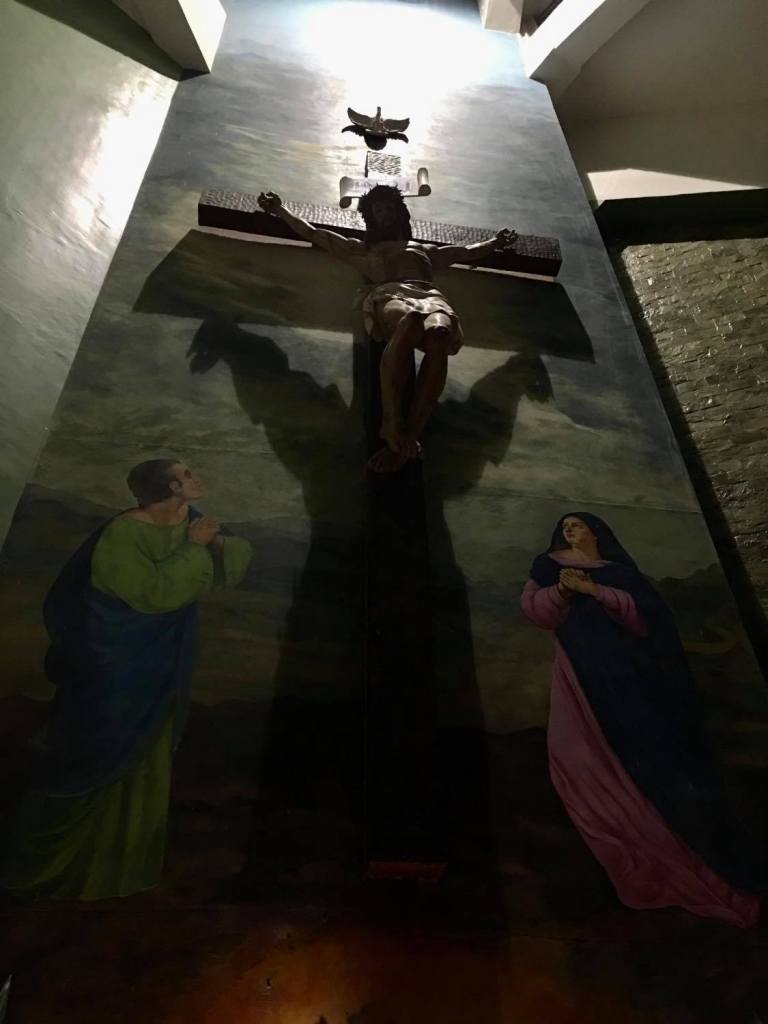
Our parish cross at night, taken with my camera phone, 02 February 2020.

For most of us, 2020 is a very tough year with all the dark clouds that have come to hover above us in January remain in this month of February.

Threats from the corona virus are growing especially in our country. And while the alert level at Taal Volcano had gone down, dangers of its major eruption remain while volcanologists observed last week a “crater glow” on Mayon Volcano, indicating a possible rising of magma in the world’s most perfect cone.

Elsewhere, more bad news are happening like the sudden deaths this week of healing priest Fr. Fernando Suarez and of our very own and beloved Fr. Danny Bermudo, just 24 hours apart due to heart attacks.

In our own circles of family and relatives, friends and colleagues are also dark clouds covering us while we go through our many trials and tests in life that seem to eclipse this early the many gains we have achieved in the whole of 2019.

Indeed, year 2020 shows us in “perfect vision” the sad realities of dark spots in life that behoove us more to heed Christ’s call to be the light of the world.

Jesus said to his disciples: “You are the light of the world. Just so, your light must shine before others, that they may see your good deeds and glorify your Heavenly Father.”

Matthew 5:14, 16
Photo by author, frost on petals, Baguio City, 04 February 2020.

Jesus is the light of the world, not us

Our gospel this Sunday follows immediately the inaugural preaching of Jesus called “the Sermon on the Mount” with the Beatitudes at its centerpiece. We have skipped that part of the gospel last Sunday due to the celebration of the Feast of the Presentation of the Lord.

For us to better appreciate this Sunday’s gospel, let us keep in mind that for Matthew, the Sermon on the Mount is the great discourse of Jesus Christ that depicts his image not only as the new Moses but as the Law himself, being both our Teacher and Savior as well.

Jesus shows us a picture of his person in the Beatitudes as someone we must imitate in being “poor in spirit, meek, and merciful” so we can follow his path to the Father. After all, as the Son of God, Jesus is “the way, the truth, and the life” (Jn. 14:6).

Hence, after enumerating the nine Beatitudes, Jesus followed up his Sermon on Mount with a call for us to be the salt and the light of the world: as salt, we merely bring out the Christ or the taste in every person and as light, it is the light of Christ that we share.

Focus remains in being like Jesus, not in replacing him who is our Savior. That is why he tells us clearly before shifting to another lesson in his Sermon that “your light must shine before others, that they may see your good deeds and glorify your Heavenly Father” (Mt.5:16).

Sharing Christ’s light with our good deeds as a community

So, how do we share the light of Jesus Christ in this age when so many others are claiming to be the light that will dispel all darkness in our lives?

As early as during the darkest period in the history of Israel in the Old Testament called the “Babylonian Captivity (or Exile)”, God had taught his people how to become light for one another during trials and sufferings.

Christ Light of the World, Red Wednesday, 27 November 2019. Photo by author.

Thus says the Lord: Share your bread with the hungry, shelter the oppressed and the homeless; clothe the naked when you see them, and do not turn your back on your own. Then your light shall break forth like the dawn… if you bestow your bread on the hungry and satisfy the afflicted; then light shall rise for you in the darkness, and the gloom shall become for you like midday.

Isaiah 58:7-8, 10

To share one’s bread with the hungry, to welcome the homeless, to clothe the hungry are some of the most concrete demands placed by God to his people since he had freed them from slavery in Egypt and later in Babylonia (Iraq today) when the third part of the Book of Isaiah was written.

Eventually, this prophecy was fulfilled in Jesus Christ who also preached exactly the same things shortly before fulfilling his mission in Jerusalem when he stressed the need to do good to one another because “whatsoever we do to one another, especially to the least among us, we also do unto him” (Mt.25:31-40).

We shall hear this part of Matthew’s gospel at the end of our current liturgical year on November 22, 2020 in the celebration of the Solemnity of Christ the King.

These instructions became the basis of our catechism’s “spiritual and corporal works of mercy” that Pope Francis stressed in 2016 during the Extraordinary Jubilee of Mercy.

From fathersofmercy.com

By saying “you are the light of the world”, Jesus is telling us that to fulfill this mission, we have to do it together as a community, as his Body, the Church!

No matter how good and holy we are, none of us is the “light of the world” on our own.

One candle or lamp, or even a light bulb today cannot produce enough light to brighten a whole town or community. But, if one Christian will be lighting just one little candle in the dark, he or she can encourage others especially those who are timid, hesitant, and indifferent until they finally set the world ablaze with Christ’s light.

Christ’s call to be the light of the world is also a call for us to be united as one community, one family, one faithful couple with all our imperfections and sinfulness. What matters is our striving to be good disciples, always charitable to one another as brothers and sisters in Christ.

Here we find the direct relationship of mission and community: every mission given by Jesus is also a call to become a community because without it, it soon becomes a cult centered on the disciple than the Lord.
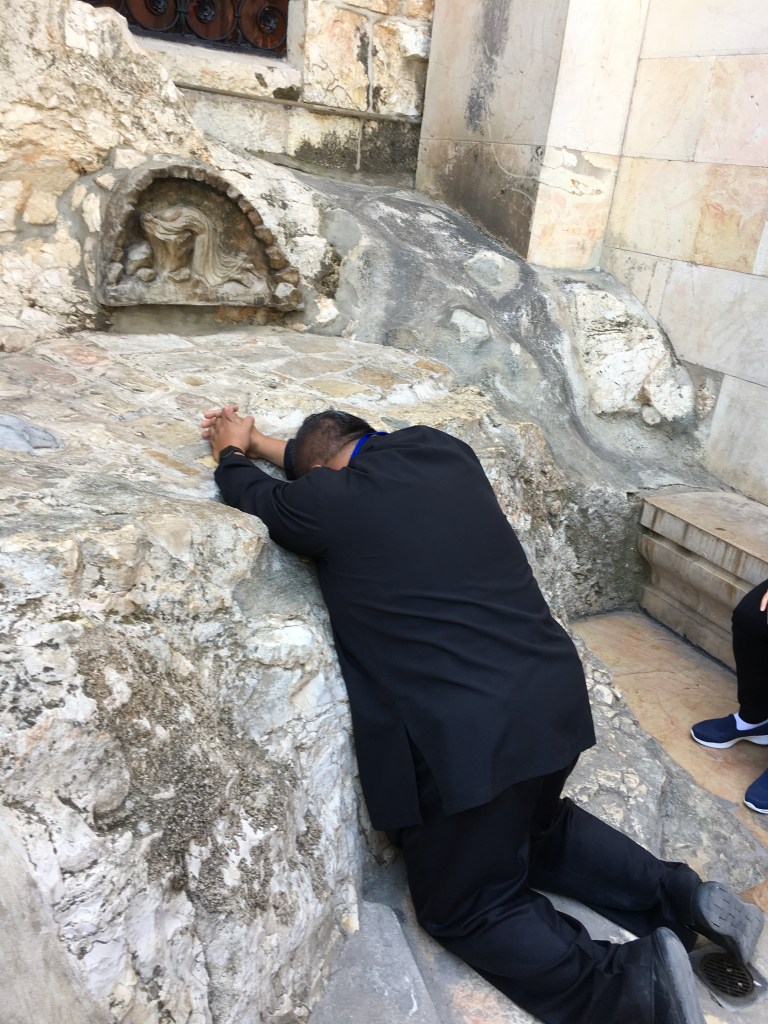
Photo by Mr. Jim Marpa, 2018.

The example of St. Paul in sharing Christ’s light

St. Paul shows us the best example of being a light of Jesus is to always have it done and fulfilled in the context of a community, of the Church as the Body of Christ, avoiding chances of grabbing the light from him for personal gains.

“I came to you in weakness and fear and much trembling, and my message and my proclamation were not with persuasive words of wisdom, but with a demonstration of Spirit and power, so that your faith might rest not on human wisdom but on the power of God.”

1 Corinthians 2:3-5

It has always happened especially for us serving in the Church that in sharing the light of Christ, we get carried by our ministry and apostolate that we forget him until we claim being the light ourselves.

Sometimes, we consciously or unconsciously create clouts and personality cults for ourselves for being the best, the brightest, even the holiest and most humble of all!

We foolishly brag the great buildings and edifices we have built or the countless malnourished kids we have fed or sent to school for free through college, et cetera, et cetera, et cetera without being bothered at all where is Jesus Christ in all our efforts and projects!

How sad when we forget that what matters most in life is not what we have done or what we have achieved but what have we become as bearers of the light of Christ like St. Paul.

My dear friend, if you are going through many darkness in life today, simply be good, think only of Jesus Christ in everybody you meet and deal with. That is actually when you shine brightest as the light of Christ because people will be surprised at how calmly and gracefully you carry your cross.

In that way, you encourage others living in darkness to let their little sparks of light come out too without realizing how in their own darkness and limitations they have made Christ’s light seen. Amen.

Have a bright and blessed Sunday with your loved ones!

Our prophetic mission in Christ

The Lord Is My Chef Breakfast Recipe for the Soul

First Friday, Week IV, Year II, 07 February 2020

Sirach 47:2-11 ><)))*> 0 <*(((>< Mark 6:14-29

Photo from catholicworldreport.com, “The Beheading of St. John the Baptist” (1869) by Pierre Puvis de Chevannes.

Your gospel today, O Lord, is so appropriate and timely: while we were busy, albeit foolishly discussing the novel coronavirus in every fora, a technical committee in the House of Representatives has approved three measures seeking to legalize divorce in the country.

We do not know what have really happened but it is so sad that no one among the Catholic and Christian lawmakers there made a solid stand against these measures like St. John the Baptist who was imprisoned on account of his objection to Herod’s taking of his brother’s wife Herodias.

So many times, Lord, we are so afraid and worried of what others might say against us when we make a stand for what is right and just, for what is proper and decent, for what is right and good, for what is your will.

Worst, O Lord, many of us are like Herodias who have prostituted our very selves in the service of the worldly allures of sex, fame, and wealth, choosing to be silent with all the many immoralities going on in government, in the society, and even in the church!

Give us the same courage, Lord, you have given your precursor St. John the Baptist to be prophets in this modern age, to be a voice in the wilderness, making a stand for what is holy, true, and just.

Like David, may we always seek your ways, ask for your grace to do your will against the giants and monsters of this world who ram into us every modern thought and idea that disregard the sanctity of life, the value of every person, as well as the sanctity of marriage.

Let us not be silent anymore with the growing impunity of many in their arrogant display of authority, throwing their weight around us with their cuss words and fallacious arguments that dignify their truncated egos and pride for the sake of progress and modernity. Amen.

In life and in death, one commission

The Lord Is My Chef Breakfast Recipe for the Soul

Thursday, Memorial of St. Pedro Bautista and companion priest-martyrs, Week 4, Year 2, 06 February 2020

1 Kings 2:1-4, 10-12 ><)))*> 0 <*(((>< Mark 6:7-13

Our merciful God and Father, on this memorial of your great priest-missionaries and martyrs – St. Pedro Bautista, St. Paul Miki and companions who have also worked in the Philippines – we pray today in a very special way for our dearly beloved mentor and brother priest, the Rev. Fr. Danny Bermudo.

We are not complaining, Lord, but year 2020 is a very tough year for many of us, right into January that continues to this month of February with many deaths and sickness, problems and trials not only in our own circles of family and friends but also in our country and the whole world in general.

We trust in you, O God, and can clearly see now in your readings especially that essentially, in life and in death, we are commissioned only to one thing — be faithful to you and your instructions, Lord.

While nearing his death, King David perfectly said it to his son and heir to the throne, Solomon:

“I am going the way of all flesh. Take courage and be a man. Keep the mandate of the Lord, your God, following his ways and observing his statutes, commands, ordinances, and decrees as they are written in the law of Moses, that you may succeed in whatever you do, wherever you turn…”

1 Kings 2:2-3

In a similar manner, at the start of his ministry, Jesus said the same thing while sending the Twelve two by two with authority over unclean spirits: leave everything behind in life and solely be focused on you, Lord, so we may fulfill your work and mission.

Photo by author, 2019.

Thank you, O God, for the gift of Fr. Danny who taught us in his classes and most especially in his personal way of being our seminary formator to always be faithful to you and your laws; to always be good and holy like you, our Heavenly Father.

In words and in deeds, in life and in death, Fr. Danny lived out his life totally for you, Lord, dying after fulfilling his mission and ministry of celebrating the Eucharist.

Bless Fr. Danny, O Lord, and may we carry on his lessons until our death like him. Amen.

Darkness in every beginning

The Lord Is My Chef Sunday Recipe for the Soul, Week IV-A, 26 January 2020

Isaiah 8:23-9:3 ><)))*> 1 Corinthians 1:10-13, 17 ><)))*> Matthew 4:12-23

Photo by author, July 2019, Tagaytay City.

In the beginning, when God created the heavens and the earth, the earth was a formless wasteland, and darkness covered the abyss, while a mighty wind swept over the waters.

Genesis 1:1-2

The Bible clearly tells us everything in the beginning was dark. And since then, almost everything has always begun in darkness, like human life itself, or every new day, even new year!

Some relatives and friends have been complaining to me how 2020 started off with a lot of darkness.

And I totally agree with them!

Since the Christmas Season until last Friday, I have been officiating funeral Masses for parishioners and friends as well as praying for some relatives and friends who have passed away this January abroad. Also included in this vast swathe of darkness are some relatives and friends diagnosed with serious illnesses like Alzheimer’s and cancer.

In the news we find so many darkness at the start of 2020 like fears of World War III when an Iranian military officer was killed in an American drone attack in Baghdad on January 03; the January 12 phreatic eruption of Taal Volcano now threatening a catastrophic eruption anytime; and, this fast-spreading new corona virus from China that is reportedly so deadly.

Everything is so dark at the start of 2020 and January is not even over yet!

Photo by Mr. Raffy Tima, GMA-7 News, 15 January 2020.

Darkness leads us into light

Even our readings today speak about darkness, especially the beginning of the public ministry of our Lord Jesus Christ after John the Baptizer was arrested.

When Jesus heard John had been arrested, he withdrew to Galilee. He left Nazareth and went to live in Capernaum by the sea, in the region of Zebulun and Napthali, that what had been said through Isaiah the prophet might be fulfilled.

Matthew 4:12-14

However, these same readings assure us that not all darkness are gloomy after all. In fact, it is in darkness where we see the light of the gospel shining brightly.

Sunrise at Lake Tiberias (aka, Galilee), May 2017. Photo by author.

Despite that dark note on the arrest of John the Baptizer, we actually have here the beginning of the good news of salvation with the start of the preaching and public ministry of Jesus Christ.

Darkness is always a prelude to light, like chaos is to order.

Sometimes, we need to experience some darkness for us to realize the need to be enlightened, to see more the beauty of light, to seek light – most especially of the love and mercy of God in Jesus Christ who had come to us on the darkest day of the year, December 25.

See how in our lives when bad things have to happen first before we can learn our lessons so well or find particular values we now treasure in life.

Sometimes, God allows us to be plunged into darkness to find him, to see him, to desire him and eventually have him.

First the Lord degraded the land of Zebulun and the land of Naphtali; but in the end he has glorified the seaward road, the land west of the Jordan, the District of the Gentiles. Anguish has taken wing, dispelled is darkness: for there is no gloom where but now there was distress. The people who walked in darkness have seen a great light; upon those who dwelt in the land of gloom a light has shone.

Isaiah 8:23-9:1

Jesus comes to us in darkness

Photo by Mr. Jim Marpa, Bohol Island, 2019.

Darkness in the bible signifies sin and evil, failures and disappointments, struggles and sufferings, and finally, sickness and death. No one is immuned from darkness.

But with the coming of Jesus Christ who conquered evil and sin, darkness has become a blessing, an invitation for us to find him, to listen to him, and to follow him.

Fram that time on, Jesus began to preach and say, “Repent, for the kingdom of heaven is at hand.” As he was walking by the Sea of Galilee, he saw two brothers, Simon who is called Peter, and his brother Andrew, casting a net into the sea; they were fishermen. He said to them, “Come after me, and I will make yo fishers of men.” At once they left their nets and followed him. He walked along from there and saw two other brothers, James, the son of Zebedee, and his brother John. They were in a boat, with their father Zebedee, mending their nets. He called them, and immediately they left their boat and their father and followed him.

Matthew 4:17-22

Jesus opted to start his public ministry and preaching in the “darkest region” of Israel at that time, among the peoples living in darkness of sins and lack of meaning and directions in life. He comes to us most of the time during our moments of darkness to enlighten us and give us direction.

That makes every darkness a blessing in itself for that is when Jesus – the Gospel himself – shines brightly.

Lake Tiberias at the back of the ruins of the Capernaum synagogue where Jesus preached. Photo by author, May 2019.

Let everything begin in the words of Jesus

Right away at the start of his preaching and ministry, people began following to listen to Jesus in Galilee, particularly at Capernaum where he used to preach in their synagogue near the shores of the Lake of Galilee (a.ka., Tiberias).

Everything began with the words of Jesus Christ: the sick were healed, those possessed by evil spirits were cleansed, sinners were forgiven, and those troubled found comfort in him.

Most of all, people found meaning in life as experienced by the first four disciples of Jesus, Simon and his brother Andrew, and the sons of Zebedee, James and John.

They were all rich and money was not a problem because they owned fishing boats that was very expensive at that time. Simon Peter is believed to be a very successful fisherman with many hired workers while the brothers James and John were beginning to learn the trade from their rich dad.

All four grew up together, worked together, most of all shared the same darkness in life, searching for meaning and direction in life that they have finally found in Jesus Christ while listening to his preaching. And that is why they immediately left everything and everyone behind after being called by Christ!

Very surprising was the attitude of Zebedee also who did not even bother to call or drag his sons back to their boat to help him because he must have felt and seen the bright sparks within his sons who have finally found meaning and direction in life through the preaching of Jesus Christ – “the Word who became flesh” – according to John who later wrote the fourth gospel account.

The Gospel Book (Evangelare) enthroned at our altar for the Bible Sunday celebration, 26 Jan. 2020. Photo by Angelo Nicolas Carpio.

Such is the power of the word of God who cleanses us of our sins, empties us of our pride and foolish self to be filled with the wisdom and light of Jesus Christ.

In a decree issued last week, Pope Francis has declared every third Sunday of Ordinary Time as “Bible Sunday” to emphasize the importance of praying the Sacred Scriptures, listening to God himself present in his words found in the Bible.

Even today, everything begins with the words of Jesus Christ: that is why it is the very first part of the Mass, equally important with the Eucharist.

We can never experience Jesus Christ in his Body and Blood at the Holy Eucharist or even among our brothers and sisters gathered in the celebration of the Holy Mass unless we first meet and experience him in his words.

Most of all, we can never experience him in person without praying the Sacred Scriptures because according to St. Jerome, “Ignorance of the scriptures is ignorance of Jesus Christ.”

Is there ay darkness in your life these days?

Try dusting off that bible you have kept in a little corner of your shelf — read it, study it, and pray it.

Be surprised in its powers for,

“Indeed, the word of God is living and effective, sharper than any two-edged sword, penetrating even between soul and spirit, joints and marrow, and able to discern reflections and thoughts of the heart”

Hebrews 4:12

A blessed Sunday to you!

Praying with St. Paul

The Lord Is My Chef Breakfast Recipe for the Soul

Saturday, Feast of the Conversion of St. Paul, Apostle, 25 January 2020

Acts 22:3-16 ><)))*> ><)))*> ><)))*> Mark 16:15-18

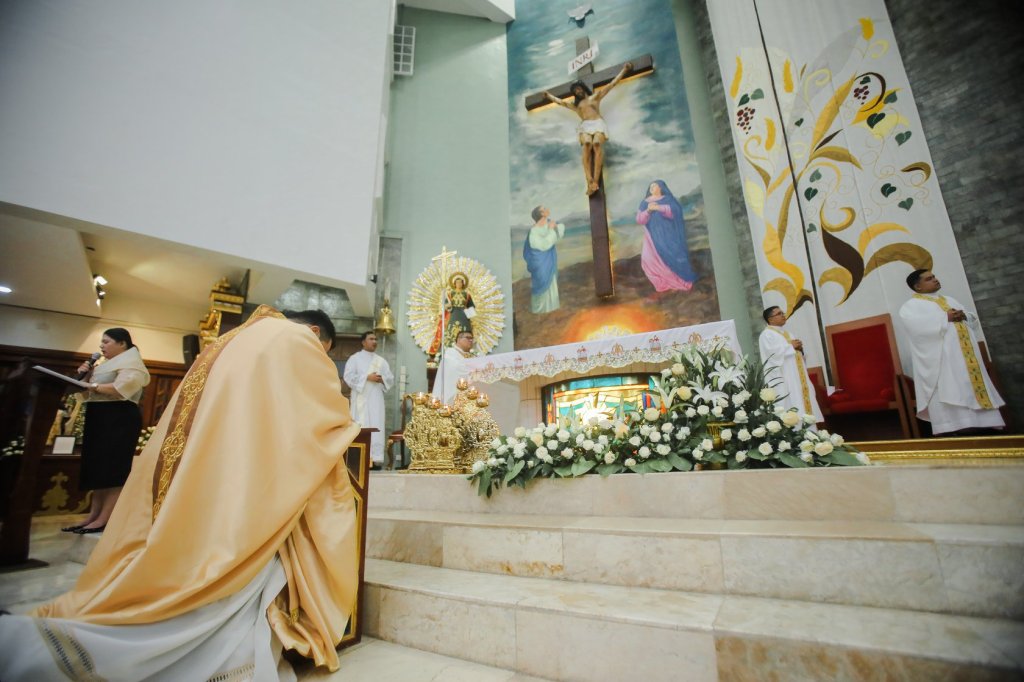
Photo by Lorenzo Atienza, Malolos Cathedral, 29 June 2019.

Glory and praise to you, O Lord Jesus Christ!

Thank you Lord for not leaving us alone, for continuing to live with us, calling us and sending us to your mission in the Church, your blessed Body!

As we celebrate today the Feast of the Conversion of your great Apostle St. Paul, we do not merely recall this personal event of his in the past but most of all, we try to listen to you with him anew in our own time and situation.

Nothing much had changed, O Lord Jesus since that day in Damascus when St. Paul was on his way to persecute your early followers.

Many of us continue to persecute you because of lack of faith in you, of pride, and yes, because of wrong beliefs all premised in that great lie we have the truth, just like St. Paul who was called Saul then.

I fell to the ground and heard a voice saying to me, ‘Saul, Saul, why are you persecuting me?’ I replied, ‘Who are you, sir?’ And he said to me, ‘I am Jesus the Nazorean whom you are persecuting.'”

Acts 22:7-8

It was the single event that converted St. Paul to become your most dynamic Apostle, Lord.

In that short instance, Lord, you remind us of how you personally call each one of us in our own name, no ifs nor buts, everything that is good and bad, even the worst in us.

Like St. Paul, we always hear your personal call but unlike him, we rarely have the courage to answer you, even enter into a dialogue with you just for a brief moment. We would rather stay on top of our horse, only to heed you when we have fallen and blinded by the world.

Likewise, Lord Jesus, in that brief encounter, you taught St. Paul and us today that basic reality of you identifying with the Church, your Body!

Every day, Lord, you continue to call us like St. Paul, asking us the same question, “why do you persecute me?”

O great St. Paul the Apostle, thank you for reminding us always in your letters how Jesus ceaselessly draws us into his Body the Church through the Holy Eucharist that for him is the center of Christian life where we experience Christ’s love in the most personal manner by giving himself for me.

Dearest St. Paul, pray for me that the love of Christ may always be my law and guide in life even to point of offering myself to him who had called me to a life of holiness. Amen.

St. Paul Basilica in Rome. Photo from Google.

Prayer to subdue one’s self

The Lord Is My Chef Breakfast Recipe for the Soul

Friday, Memorial of St. Francis de Sales, Doctor of the Church, 24 January 2020

1 Samuel 24:3-21 ><)))*> ><)))*> ><)))*> Mark 3:13-19

Photo by author, Malolos Cathedral, December 2019.

Blessed are you, O God our loving Father! Thank you for the gift of self, the gift of everything especially our temperament.

Many times it is our temperament that lead us to a lot of troubles as well as to holiness like in the story of David today, the appointment of 12 Apostles by Jesus in the gospel, and the life of St. Francis de Sales whose memorial we celebrate today.

Thank you, Lord, for making us all too complex that despite the four types of temperament – sanguine, phlegmatic, melancholy, and choleric – there is really no clear cut category for each one of us.

Thank you for making us that way to have enough room for you to work on us, to help us subdue ourselves to your will and be holy.

How wonderful was the attitude of David not to harm Saul while they were hiding inside the cave: he chose to be kind and even magnanimous by “cutting off an end of Saul’s mantle” to show his goodwill (1 Sm.24:5).

In doing so, he earned the respect of his enemy, Saul who declared, “And now, I know that you shall surely be king and that sovereignty over Israel shall come into your possession” (1Sm.24:21).

Our newly ordained priest kneeling at prayer on his first Mass, 11 December 2019.

In the gospel, your Son’s choice of the 12 Apostles are very revealing of your love and mercy to us: a mix of different people of different even extreme backgrounds and temperament but all given with the chance to be a part of Jesus Christ’s mission.

Last but not least, O God, the choleric and fiery temperament of St. Francis de Sales was a lifelong struggle for himself even in is old age but he never stopped subduing himself to serve you best by effecting the return of about 70,000 Protestants into Catholicism in Switzerland, not to mention the millions of souls touched until today by his 21,000 letters and writings as well as the 4,000 sermons he had left that still inspire people today.

Indeed, he who conquers and masters himself for you, O God, is the victorious of all! Amen.

St. Francis de Sales, pray for us!