Lord My Chef Daily Recipe for Soul by Fr. Nicanor F. Lalog II
Tuesday, Twenty-Fifth Week in Ordinary Time, Year II, 22 September 2026
Proverbs 21:1-6, 10-13     ><))))*> + ><))))*> + ><))))*>     Luke 8:19-21
I pray for all
those suffering today,
Lord Jesus;
for those hoping to see
you, to talk to you even for a while
like your mother and brothers
in the gospel;
why did you not go out to see
them right away?
I felt sad.
And disappointed.
The mother of Jesus and his brothers came to him but were unable to join him because of the crowd. He was told, “Your mother and your brothers are standing outside annd they wish to see you.” He said to them in reply, “My mother and my brothers are those who hear the word of G0d and act on it” (Luke 8:19-21).
Luke never bothered
to tell us what they wanted
from you, Lord;
but your reply got me praying
more deeply and these
I realized:
you love us so much
Jesus,
your words always in us,
in our hearts
but many times we do not listen;
Mary and your brothers know
that so well
and they never protested;
in fact,
they affirmed your words
by remaining silent,
trusting you as always;
most of all,
your reply teaches us
your disciples
to widen,
to enlarge
the bounds of our family:
if we choose to listen
and act on the Word of God,
we must at the same time
become a member of the
family of Jesus.
Teach us to be like
that king in the first reading
willing to bow
his will and desires to
God despite his power
and authority;
give me a listening heart,
a will so pliant to your ways
so that I may welcome those
trying to get close to you
Jesus because they hurt;
many times our pains
are so pronounced because
we have no room
for those seeking you,
Jesus.
Amen.
Lord My Chef Daily Recipe for Soul by Fr. Nicanor F. Lalog II
Wednesday in the Seventeenth Week of Ordinary Time, Year II
Memorial of Sts. Mary, Martha, and Lazarus, 29 July 2026
1 John 4:7-16     <*{{{{><  +  ><}}}}*>     John 11:19-27
“The Raising of Lazarus”, 1311 painting by Duccio de Buoninsegna. Photo from commons.wikimedia.org
Glory and praise
to you, God our Father
for sending us your Son
Jesus Christ who continues
to come to us in various ways:
in nature,
in the events that happen to us
in our lives, both good and bad,
most especially
in persons like our siblings
that this Memorial of
Saints Mary,
Martha
and Lazarus reminds us;
how lovely to remember
how our Lord Jesus
was described as very close
with the blessed sisters and brother
he frequently visited in their
home at Bethany.
We pray for all brothers and
sisters now living apart from
each other due to work
and marriage, raising a
family of their own;
may they never forget each other
as siblings, "magkakapatid"
with invisible bonds that transcend
their physical separations;
keep them mindful of one
another, checking on each others
needs and well-being,
becoming your very presence
in each other especially when
there is sickness and death:
Martha said to Jesus,
"Lord, if you had been here,
my brother would not have died"
(John 11:21).
Like the blessed siblings
of Sts. Mary, Martha and Lazarus,
keep every brother and sister
open to your coming
and visits, Lord Jesus,
that are always in disguise;
make our hearts like theirs
filled with warmth and hospitality,
understanding and forgiveness
for each other so that you may stay
and reign in our hearts,
revealing the face of God
with one another;
most of all, Lord Jesus,
like the three holy sisters
and brother,
may we share
your gift of kindness
of being a kin
to everyone in you,
with you,
through you.
Amen.
An icon of Jesus visiting his friends, the siblings Sts. Lazarus, Mary and Martha from crossroadsinitiative.com.
Lord My Chef Sunday Recipe for the Soul by Fr. Nicanor F. Lalog II
Feast of the Holy Family of Jesus, Mary & Joseph, Cycle A, 28 December 2025
Sirach 3:2-6, 12-14 ><}}}}*> Colossians 3:12-21 ><}}}}*> Matthew 2:13-15, 19-23
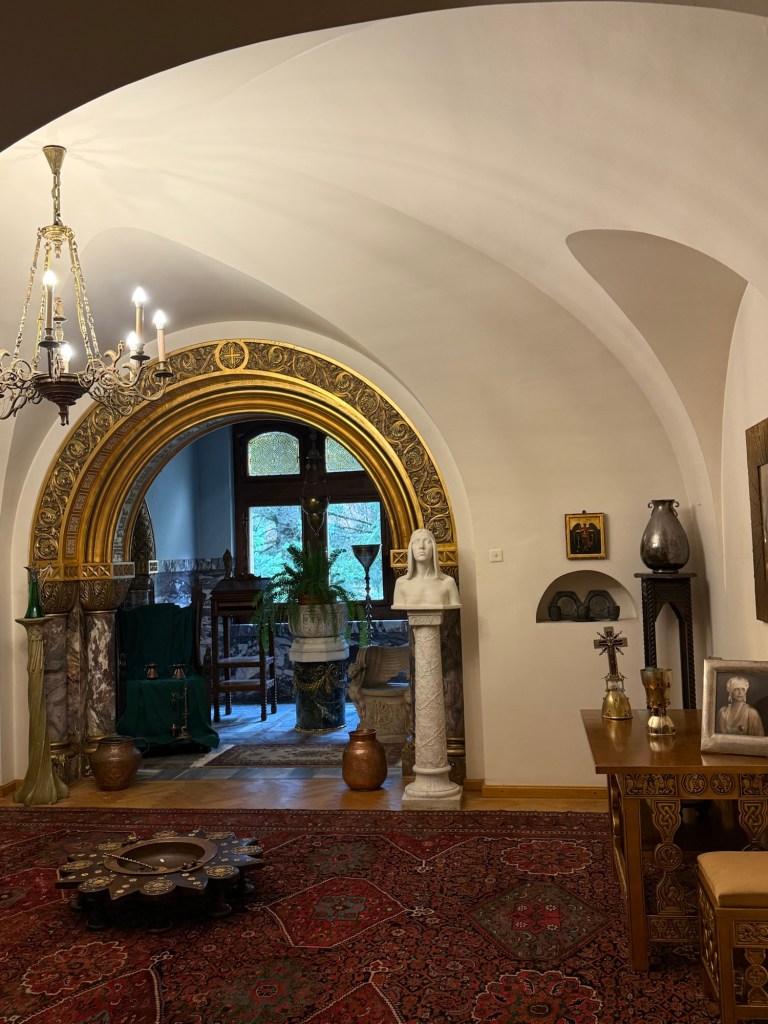
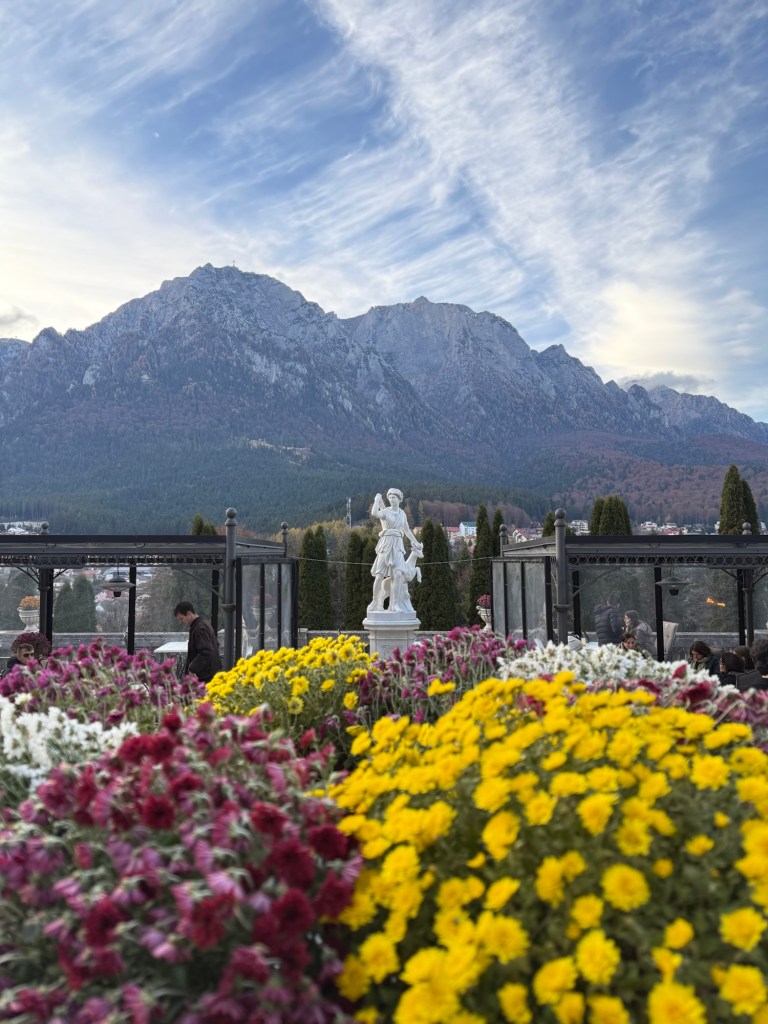
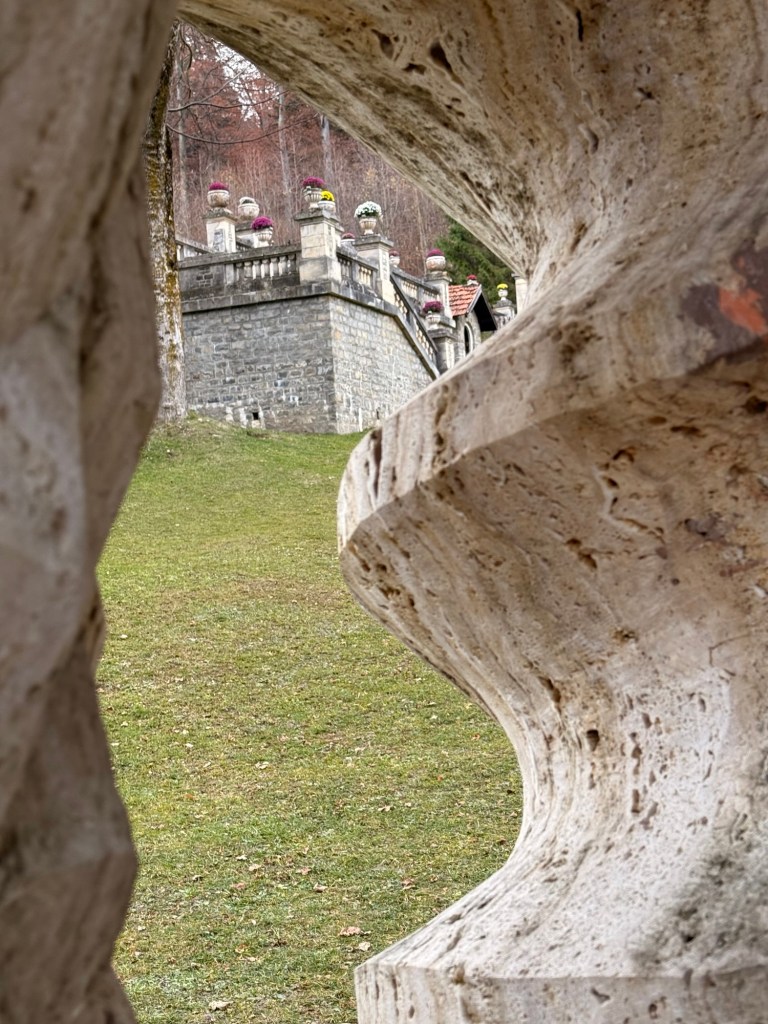
Last November we were blessed to have visited Romania’s three famed castles at Transylvania region: the Bran Castle considered as the home of Count Dracula in Bram Stoker’s stories; the Cantacuzino Castle owned by one of Romania’s wealthiest family which is the setting of Netflix’s Wednesday series; and the Pelisor Castle which is the smallest but loveliest for me due to its romantic story behind.
I remembered these Romanian castles because of our gospel today about two kings: one is a ruthless, old king named Herod so “greatly troubled” upon hearing the news of the “newborn king of the Jews”, our Lord Jesus Christ (Mt.2:2, 3).
Very often when we hear of kings and royalties living in castles, so many images of affluence and power come into our minds. And indeed they are so true when we went inside those castles with its wonderful interiors and amazing artworks; however, as we learned more of its history especially of the lives of its occupants, our wonder and excitement dissipated. It was really more like a fairy-tale, or a horror story in the case of Bran Castle.
Photo by author, Cantacuzino Castle, Romania, 06 November 2025.
It must have been so lonely and sad living in those palaces; however, let us admit how often the presence and reality of Jesus whom we take for granted like when he was born in Bethlehem more than 2000 years ago invite us into those parts of our lives where we like to rule like kings or queens.
I find this important and even essential before reflecting about the Feast of the Holy Family because it is right in our homes – ironically or tragically – where we are first exposed to evil and sins. It is inside our homes when the father or mother or siblings take on their “power trips”, insisting on their rules, even flexing their powers over each other that in the process we hurt each other. Sometimes, the trauma that comes after may last a lifetime.
Would we rather choose a kingdom or a home? Be a Herod or a Baby Jesus?
Of course, our answers are so obvious as we would generally choose a home than a kingdom and be a Baby Jesus than a Herod. This we can do by imitating St. Joseph.
When the magi had departed, behold, the angel of the Lord appeared to Joseph in a dream and said, “Rise, take the child and his mother, flee to Egypt, and stay there until I tell yo. Herod is going to search for the child and destory him.” Joseph rose and took the child and his mother by night and departed to Egypt… When Herod had died, behold, the angel of the Lord appeared in a dream to Joseph in Egypt and said, “Rise, take the child and his mother and go to the land of Israel, for those who sought the child’s life are dead.” He rose, took the child and his mother, and went to the land of Israel. But when he heard that Archelaus was ruling over Judea in place of his father Herod, he was afraid to go back there… He went and dwelt in a town called Nazareth, so that what had been spoken through the prophets might be fulfilled, He shall be called a Nazorean (Matthew 2:1314, 19-22, 23).
Photo by author, site of the Nazareth home of the Holy Family underneath the Church of St. Joseph in Nazareth, Israel, 2017.
Remember how Matthew described St. Joseph as a righteous man? Here after the birth of Jesus Christ, we find Joseph’s holiness most shining. See how before this scene, Matthew described to us the attitudes of Herod and the experts in Jerusalem vis-a-vis the Magis from the East: Herod and company were all disturbed while the Magis were all sincere and so open in their search for the Christ.
That’s what we were saying earlier: of how we play so much on our turf and power, on how we want to make our “rule” as sovereignty felt always right in our home, in Jerusalem that was then the seat of power and of worship. Very clear at that time, the temple was already so untidy that needed Christ’s cleansing thirty years later.
When sin especially pride fills us, it is difficult to recognize Jesus. Moreover, even the smallest and harmless or weakest person like a child or a woman would always disturb anyone filled with one’s self, feel threatened like Herod that one’s rule is being taken away. How sad when a father or a husband, a mother or a wife including the eldest children would dare challenge everyone at home, asking who is the father or who is the one supposed to be in command? Sino ba and tatay (o nanay) dito na dapat masunod? It is the most scariest tactic of all not because of what the power trippers can do but actually it was a proof enough they are immatured and lacking of proper understanding about power and authority.
Photo by author, March 2024.
Joseph was clearly not of the same kind. He readily left his home and moved the Infant Jesus and Mary to Egypt. Remember that Bethlehem as the town of David is Joseph’s turf so to speak being from royal Davidic lineage himself. It must have been so difficult for him to leave Bethlehem and be a refugee in Egypt!
But Joseph had none of those airs of rule and superiority. For him, the only rule was God and that meant always the good of Jesus and Mary. That is why Joseph twice “rose” to obey the angel’s instructions to him to take the Infant Jesus and Mother Mary to Egypt and then back to Israel after some time.
Joseph’s rising was actually an act of bowing low to the power and authority of God, most of all to the Son of God he had named as “Jesus”.
Can we imitate Joseph’s “rising” from our selfishness and ordinariness of petty quarrels and assertions of power or “rule” especially in our homes? To imitate the Holy Family, we need to be like Joseph who rose not just literally from his sleep and comfort but rose above his very self. Jesus is inviting us this Sunday to rise too above our pride and self-centeredness to give way to his love and mercy, kindness and understanding for each other so that everyone remains safe and unharmed like the Infant Jesus and Mary following Joseph’s selflessness.
Photo by author, St. Joseph Parish Church, Pacdal, Baguio City, 28 December 2024.
Home is where the heart is. This is most true when we get into the origin of the Filipino equivalent of home which is tahanan which is from the root word tahan that means to stop crying. When children cry, we tell them to tahan na, tahan na… or stop crying.
Home is where we stop crying because that is where we are most safe, that is where we find the people who love us, believe in us, the one who would still accept us and forgive us when we have sinned. Home is our safest place because that is where there are people willing rise above their selfishness, to rise above their painful memories, and rise to let go of their comforts for others in distress and more difficult plight and situation in life.
Jesus, Mary and Joseph all rose from their very selves for each other to be safe. Most of all, they rose above themselves because they love so much for each other, a reflection of their great love for God the Father. Amen. May your family be blessed!
Lord My Chef Daily Recipe for the Soul, 29 July 2025
Tuesday, Memorial of Sts. Martha, Mary and Lazarus, Siblings
1 John 4:7-16     <'[[[[><  +  ><]]]]'>     John 11:19-27
“The Raising of Lazarus”, 1311 painting by Duccio de Buoninsegna from commons.wikimedia.org
What a beautiful reminder to us,
dear Jesus on this day as we celebrate
the Memorial of the Holy Siblings
Saints Martha, Mary and Lazarus:
the only time they are presented as one
and complete was during the raising of
Lazarus; you were there in their most
sorrowful moment in life as brother and
sisters because you have always been there
with them in good times when they were
all alive and well.
I pray,
dear Jesus,
for all siblings like
Saints Martha, Mary and Lazarus
to remain one as a family after
their parents have been gone;
so many times in such deep sorrow,
we are like Martha telling you Lord,
"if you had been here my brother -
or sister or parents -would not have
died" (John 11:21); but, your response
to her and to us was so rich in meaning
we can only summarize in love,
"your brother will rise... I am the resurrection
and the life; whoever believes in me,
even if he dies, will live, and anyone
who lives and believes in me will never die.
Do you believe this?"
(John 11:23, 25-26)
Help me believe
like Martha,
Jesus;
help me believe by being
more loving and caring
with my family while still alive
and well;
help me believe by being
more understanding
and forgiving,
more kind and sensitive
with my brother or sister
while still alive;
please help, Jesus
 the siblings
at odds with each other,
not talking with each other,
grouping together against each other
because of betrayals
and dishonesty in their share
of inheritance;
help them seek your face
to be more just and loving
because "love is of God"
(1 John 4:7);
let siblings be like
Saints Martha, Mary and Lazarus
be one in you, Jesus
in faith,
hope
and love
while still alive
so that in their death
they remain one in you.
Amen.

Fr. Nicanor F. Lalog II
Our Lady of Fatima University
Valenzuela City
(lordmychef@gmail.com)
An icon of Jesus visiting his friends, the siblings Sts. Lazarus, Mary and Martha. Photo from crossroadsinitiative.com.
Quiet Storm by Fr. Nicanor F. Lalog II, 07 July 2025
Photo by author.
For the first time in 25 years since daddy’s passing, I did not deliver any homily during his death anniversary Mass in our home last June 17, 2025. My sisters readily agreed when I told them after the gospel proclamation “hindi na ako mag-homily at baka maiyak lang tayo.”
It was the second time we celebrated daddy’s death anniversary after mommy’s passing last May 7, 2024 but, it was only at that time when I truly felt the deeper realities of both parents being gone, of being “ulilang lubos”.
Perhaps that’s because we have been preoccupied for over two decades with mommy’s grief when dad passed away right on her 61st birthday before dawn of June 17, 2000. We were at a loss how to pacify her with such a surreal date for the two most loving couple we have known first hand. During my dad’s wake, we have to warn everybody not to mention anything about mom’s birthday.
From then on, mommy practically stopped celebrating her birthday even when she turned 70, 75, and 80 as we threw small gatherings at home for her siblings and friends but she would always remind us all not to forget it was also daddy’s death anniversary.
That is why I have always dreaded the days approaching June 17 because I felt sad for her. I thought after her death last year, it would be different because we would no longer see mommy sad on her birthday mourning dad’s death. I told myself, “hindi na malulungkot si mommy… hindi na rin kami malulungkot.”
But I was wrong.
Hindi na nga malungkot ang mommy ko ngayon pero ako naman ang malungkot – malungkot na malungkot. Noon ngang araw ng Linggo bago mag-June 17, naalala ko ang mommy at daddy bigla kaya naluha ako sa bahagi ng Ama Namin noong aming Misa sa Dambana.Wala na sila dito. Iyon una ko nadama, ulila na nga kami at saka pa lamang naisip ko magkasama na sila sa buhay na walang hanggan.
Indeed, the pains of losing our loved ones never decrease through time but actually increase. Those pains will remain until we are reunited with them in death and eternity.
There are pains in life meant to remain, that cannot be removed like a hole or a scar in our hearts not to burden nor hurt us but to uplift us actually. These wounds keep us in persevering in love to keep our relationships alive with those left behind after the deaths of our loved ones like parents or children. These wounds enable our hearts to sing of faith, hope and love in God all merciful who would one day unite us all together as one family after our days on this earth. These pains make us see the very thin line separating us from eternity, telling us that life goes on among us even after death. They open our eyes to see beyond, to have visions of the future.
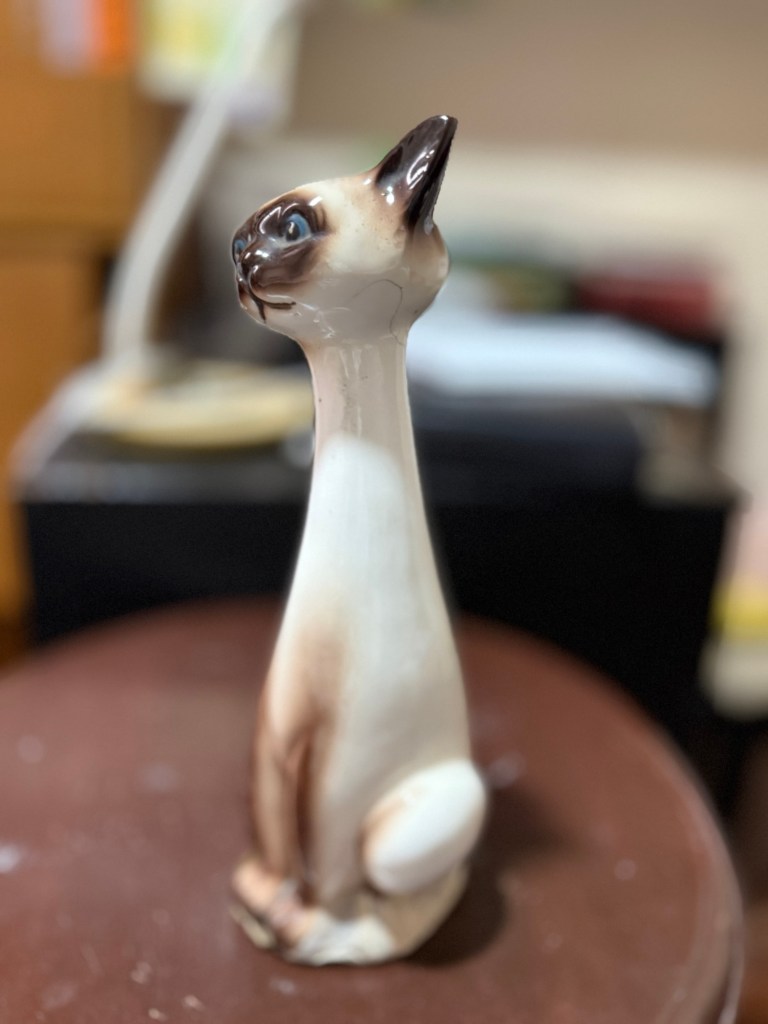
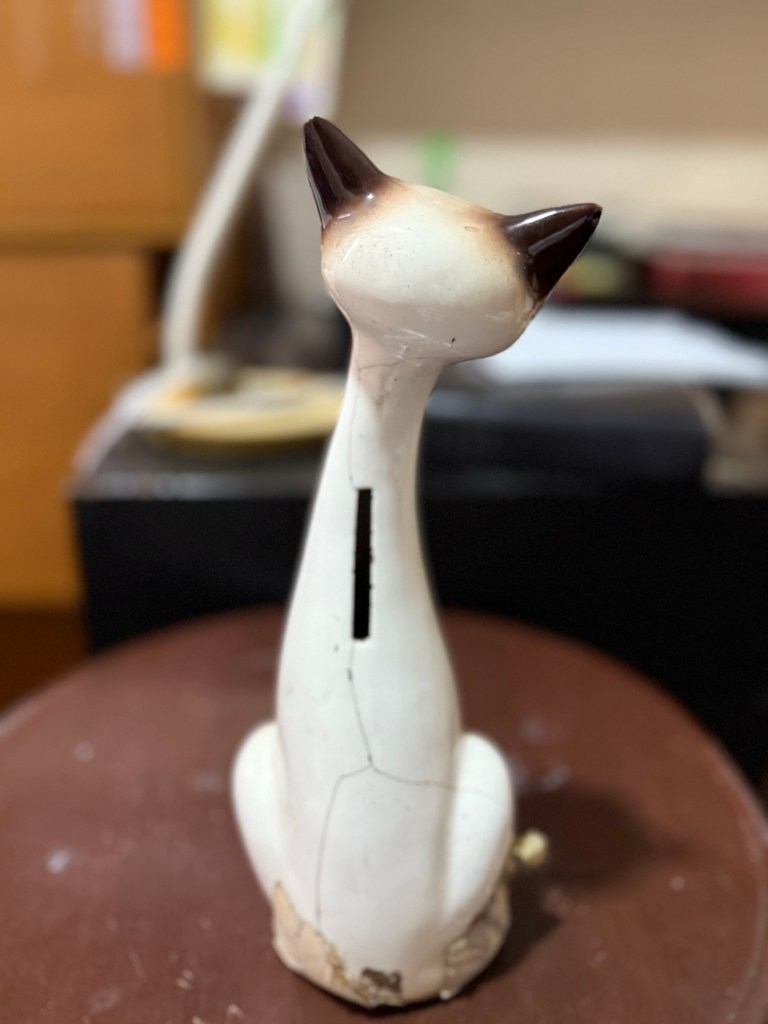
Photo by author, my mom’s kitty bank, 10.5 inches to the tip of ears.
While these things were running through me during our family dinner that night, my brother presented to me mommy’s “kitty bank” which is older than I am, 61 years old. It is one of her most cherished possessions she truly took great care as far as I can remember.
I have been thinking about it recently if it were still around though I never had any interest with it when growing up as a child except that I enjoyed counting the rare coins inside mostly dating back to the American occupation with the usual designs of the US flag and an eagle.
That evening on dad’s 25th death anniversary that could have been mom’s 86th birthday if she were still alive today, I felt a very strong attraction with that “kitty bank” whose face seemed to be speaking to me.
Photo by author, my mom’s kitty bank, circa 1964.
As I held it closer to see its many fissures and tapes following the wear and tear of over 60 years, I saw mommy again, of how she loved us and life so much, especially cats, dogs and fish, and most of all, plants- being a certified tita herself. Our house may be small but mommy lovingly took care of her pets and plants, always talking with them even after having a stroke.
Like the cat with its nine lives, death is never the end but the prelude to new life or, more lives hereafter.
And that is the nobility and giftedness of every mother – even after they are gone, they continue to bring forth and nurture life. God bless everyone… and the cats.
The Lord Is My Chef Sunday Recipe for the Soul by Fr. Nicanor F. Lalog II
Feast of the Holy Family, Cycle C, 29 December 2024
1 Samuel 1:20-22, 24-28 ><)))*> 1 John 3:1-2, 21-24 ><)))*> Luke 2:41-52
Photo by author of a depiction of the Holy Family near the main door of St. Joseph the Worker Parish in Pacdal, Baguio City, 28 December 2024.
You must have heard of the classic song “A House Is Not A Home” composed by the great tandem of Burt Bacharach and Hal David recorded by Dionne Warwick in 1964 for a movie of the same title. It went back to charts in 1981 when the late Luther Vandross covered it in his first album.
It is a very lovely ballad of a love lost, teaching us that indeed, “a house is made of walls and beams while a home is made of love and dreams”.
A chair is still a chair
Even when there's no one sitting there
But a chair is not a house
And a house is not a home
When there's no one there to hold you tight
And no one there you can kiss good night

A room is still a room
Even when there's nothing there but gloom
But a room is not a house
And a house is not a home
When the two of us are far apart
And one of us has a broken heart
But, in the Hebrew language and Jewish thought, the word “house” in itself connotes relationships. There are no distinctions between a house and a home for them that is why we find Jesus claiming the temple as His Father’s house.
Pope Francis opening the Jubiliee Door at St. Peter’s in Rome to launch the start of the Jubilee Year of 2025. Photo by Maurix/Gamma-Rapho via Getty Images.
In fact, the first letter of the Hebrew word for God (Yahweh) is actually shaped as a door or a house. That is why there is the blessing of church doors in dioceses today worldwide following the blessing and opening of the Jubilee Door at St. Peter’s in the Vatican by Pope Francis last Christmas Eve to launch the Jubilee Year. The Jubilee Door signifies our passing through, an entering into a relationship with God.
In John’s gospel we find Jesus as an adult using the word “house” twice when He cleansed the temple, telling everyone to “stop making my Father’s house a marketplace” (Jn.2:16) and at their last supper when He assured the disciples, “In my Father’s house there are many dwelling places or rooms” (Jn.14:2).
The only other occasion Jesus used the word “house” to mean the same thing as John was when He was found by His parents in the temple as we heard today on this Feast of the Holy Family.
Each year Jesus’ parents went to Jerusalem for the feast of Passover, and when he was twelve years old, they went up according to festival custom. After they had completed its days, as they were returning, the boy Jesus remained behind in Jerusalem, but his parents did not know it. After three days they found him in the temple… When his parents saw him, they were astonished, and his mother said to him, “Son, why have you done this to us? Your father and I have been looking for you with great anxiety?” And he said to them, “Why were you looking for me? Did you not know that I must be in my Father’s house?” But they did not understand what he said to them (Luke 2:41-43, 46, 48-50).
“The Finding of the Savior at the Temple” painting by William Holman Hunt (1860) from en.wikipedia.org.
We find in the story of the finding of Child Jesus in the temple that even at a very young age, Jesus had always been clear with His oneness in God by always referring to the temple as His “Father’s house”.
As we have reflected in December 19 in Luke’s first Christmas story, the annunciation of John’s birth to his father Zechariah while incensing at the temple in Jerusalem during a major Jewish feast that Christmas begins in the church where we gather to praise and worship God as a community. See how this Sunday after Christmas our many empty pews in the church. How sad that many Catholics after Christmas have totally disregarded the Sunday Mass, going to all the vacation spots here and abroad with many of them having no qualms at all that this is the “day of the Lord”, a Sunday obligation.
Again, here is Luke in his artistic narration of Christmas into Christ’s adolescence insisting on us the importance of communal worship and prayer. Not surprising that of the four evangelists, Luke is the one who presented Jesus always at prayer as an expression of His oneness or communion in the Father and he wants us hearers of his gospel account to cultivate that same communion with God in Jesus, with Jesus, and through Jesus.
Christmas is essentially Jesus Christ becoming human so that God may be “at home” with us humans as John beautifully wrote in his prologue we heard last Christmas Day, “And the Word became flesh and made his dwelling among us” (Jn.1:14).
But, are we at home with God in Jesus?
Photo by author, the small entrance door leading to the Church of the Nativity in Bethlehem where one needs to bow low literally and figuratively to enter Christ’s birthplace.
On this Feast of the Holy Family, our gospel reminds us this Sunday of how even Mary and Joseph had trouble with their adolescent son Jesus like most parents these days, a kind of family conflict so familiar with many people everywhere.
What a lovely scene today this Christmas season amid widespread reports of child kidnappings and so many children caught in the middle of many conflicts among adults like wars in many parts of the world and worst, right inside every family, right in their house, or homes where there are no relationships at all.
Luke was a physician who understood very well the anguish and sufferings of many people, especially parents during his time that continue to these days. In narrating to us this sad episode of his Christmas stories when Jesus was lost but eventually found in the temple, Luke is assuring us that despite all the darkness and troubles that engulf many families today, we have a very loving, personal God in Christ always with us.
Photo by author, picture taken from the inside of the Church of the Nativity in Bethlehem of its small entrance door.
Mary and Joseph did not understand what Jesus meant that He must be at His Father’s house but it did not deter them from exploring its meaning so that only Mary with John and two other women remained with Christ at the foot of the Cross on that Good Friday.
How lovely that Mary and those others at the foot of the Cross were the ones truly “at home” with the Lord, in the Lord! The same thing speaks so true with Joseph who in his silence was so “at home” with God in Jesus, whether awake or asleep. He kept that relationship with God alive through Mary and those others around him especially Jesus.
As an adult approaching His pasch, Jesus assured His disciples including us today of having a dwelling place or room in His Father’s house in heaven – that, despite our many sins, God would never cut off His ties with us in Jesus, with Jesus! That is how God loved us so much as the author of the Letter to the Hebrews reminds us “God is greater than our hearts and knows everything” (1Jn.3:20).
Like Hanna the mother of the child Samuel, let us start cultivating this relationship with God even while still very young. It does not really matter if we destroy and cut it so often; what matters is we keep on trying to let it grow anew for it is and would never ever get lost again. Thanks to Christmas!
That is why I personally insist in my homilies and writings that we keep greeting everyone with a Merry Christmas until January 12, the Feast of the Baptism of the Lord that closes the Christmas season. It is still Christmas after all!
Photo by author, Chapel of the Angel of Peace, RISE Tower, Our Lady of Fatma University, Valenzuela City, Christmas 2024.
Like Mary and Joseph, let us keep coming back to God symbolized by Jerusalem and its temple now replaced with our churches. Let us go back to prayer and to Sunday Masses to find Jesus again present in the signs and symbols of the liturgy and most of all, in everyone present celebrating His coming.
Let us continue the story of Christmas with our relationships with God through others, of our being at home with the Father in Jesus Christ who “advanced in wisdom and age and favor before God and man” (Lk.2:52) after this episode which closed Luke’s Christmas account.
Let us be at home with God and with one another in Jesus, with Jesus, and through Jesus. May you continue to have blessed Christmas Season. Amen.
I had published my Sunday homily that Saturday morning when I decided to unwind by watching any movie on Netflix which I do only on weekends. So glad it was the first movie I saw, very related with the story of Prophet Elijah and Jesus Christ’s “Bread of Life Discourse” that Sunday.
First think I liked with Lolo and the Kid is its fast-paced story that revolved around the two characters played by veteran Joel Torre and GMA7’s famed Firefly star Euwenn Mikael Aleta.
Second thing so interesting with me is how Lolo and Kid have no proper names at all (I just learned Lolo’s name was Mario after reading the various write ups) maybe because they stand for all of us who are caught in this great race for money and material things but deep inside longing for the more essential and truly lasting in life like love. And people who love us too, who care for us, and would stand by us.
We are Lolo and Kid who many times have traded our principles for momentary satisfaction but despite our seemingly strong facades of pragmatism and “resourcefulness” or madiskarte as Lolo taught Kid in the movie, deep inside us is still our conscience where God dwells, telling us to pursue good and shun evil. Joel Torre perfectly portrayed this beautiful side in each one of us (with his Ilonggo accent) of keeping a conscience despite our sinfulness, like a soft shell we delicately keep whole and intact inside lest we lose everything in life.
Photo from de.flixable.com
Recall our first reading last Sunday about Elijah fleeing to the mountain from an army pursuing to kill him. Elijah felt a total failure like Lolo and us many times in life when after all our goodwill and love, we are dumped by the very people we care for.
Elijah went a day’s journey into the desert, until he came to a broom tree and sat beneath it. He prayed for death, saying: “This is enough, O Lord! Take my life, for I am no better than my fathers” (1 Kings 19:4).
In one of the scenes of Lolo and the Kid, we find Lolo crying, cursing everyone and murmuring just like in last Sunday’s gospel. As he tried to end his life with a knife, Lolo suddenly heard the cry of an infant from the heap of garbage around him. What a beautiful portrayal of that infant left in the trash like Jesus Christ born on a manger becoming the savior of Lolo, a definitive message of mercy and love from God after his apparent cry of “This is enough, Lord!”
How many times have we found ourselves in the same situation, often in less momentous ones than Elijah or any prophet and saint, crying out to God in the heavens “this is enough”?
But, what is also most true behind every cry of “this is enough” that we make, we continue to believe and to hope in God that there is still a way out of our plight. And very often like in the story of Elijah last Sunday and in that scene in Lolo and the Kid, God comes at the nick of time like that infant crying in the garbage heap, a reminder of life and beauty found within us despite all the dirt we may have around us.
From netflixlovers.it
Here we find the Kid, perfectly played by Euwenn like in Firefly, as the saving grace, the Christ-figure in the movie bringing salvation to Lolo. Kid was “the bread of life from heaven” who “fed” Lolo with life with its meaning and direction. And joy found in Kid, the image of Christ Jesus.
Now, joy according to Jesus at the Last Supper is like a woman at the pangs of childbirth (Jn.16:21-22); it is deeper than happiness. True joy is borne out of self-sacrifice, a fruit of self-denial, of loving somebody more than one’s self. This we find at the end of this moving film.
Now all grown up, Kid finally met again Lolo in the hospital a day after his college graduation. Kid brought Lolo while seated on a wheelchair to visit Taba (another character without a name), their suki in fencing. From there, they went to their usual stop, a videoke bar to eat and drink, singing repeatedly Kenny Roger’s Through the Years.
Then, Lolo died, singing the only tune he knew that summed their beautiful relationship.
Photo from list23.com.
After Lolo’s body was taken out of the videoke bar, Kid opened Lolo’s bag that had a tin can of biscuit filled with old photographs taken with their stolen Polaroid camera. The photos did not merely remind Kid of their happy times together but most especially when they were already apart!
Unknown to Kid, Lolo hid to take photos when he moved to his adoptive parents, from his first ever birthday party to his college graduation! Through the years, Lolo, like God, was always there, present in all of Kid’s milestones in life because he is truly loved.
I have never liked that song Through the Years even when it was a hit during our high school days in 1981 but since Saturday, I have been humming it silently, hearing it inside me as an LSS until now. We hear the song playing throughout the end of the movie with scenes of how Lolo secretly took Kid’s photos filled with love and joy amid the strong current of pain within he had to endure to be far and away yet so near to his beloved apo.
If the Kid is the Christ figure in this film, Lolo is the God-the-Father figure, the One who seems so far from us as if He does not care at all. In Lolo and the Kid, there is that message of God never leaving us wherever we may be, whether we are in the squalor of poverty and sin or in the purity and cleanliness of affluence and grace maybe. God like Lolo to Kid is always with us but never interferes, silently doing many things to ensure that despite our many faults and failures in life, we end up in Him and His love.
We go back to Elijah’s cry of “This is enough, Lord!”, our very same cry like Lolo in the movie.
It is a cry that is also a prayer coming from our innermost being when we feel so saddled with no one to unload our woes except to God – who after all is the very reason why we cry! Watch for Lolo’s soliloquy on this reality we often do.
Photo by author, James Alberione Center, QC, 08 August 2024.
It is a cry of faith so akin with love because to believe and to love go hand in hand. It is during that moment when we feel like giving up to God, crying “this is enough” when in reality we surrender everything to God because we have been caught up by Him that we cannot resist His attraction.
It is that moment when we feel so “fed up with life” but deep inside, we hear God telling us like Lolo with the cries of an infant or like Elijah with an angel instructing him, “Get up and eat, else the journey will be too long for you!” (1 Kings 19:7).
Yes, our life journey is still long but we have a companion in Jesus, our bread of life from heaven, nourishing us, strengthening us, teaching us that essential beauty of love found only in sharing one’s life for the other. As we have said in last Sunday’s homily, it is when we cry “it is enough, Lord” when God gives us more than enough to sustain us sometimes in the form of a good movie like this one. May we have more “bread” like Lolo and the Kid that feeds our soul and gladdens our heart.
*BTW, we are not paid to endorse this movie; simply sharing with you its good news.
The Lord Is My Chef Daily Recipe for the Soul by Fr. Nicanor F. Lalog II
Monday, Memorial of Sts. Martha, Mary & Lazarus, 29 July 2024
1 John 4:7-16     <*{{{{><  +  ><}}}}*>     John 11:19-27
“The Raising of Lazarus”, 1311 painting by Duccio de Buoninsegna from commons.wikimedia.org
If you have love in your heart, you have been blessed by God; if you have been loved, you have been touched by God (Anonymous author).
What a lovely Monday
You have given us today,
O God our Father
as we celebrate the Memorial
of the friends of Jesus Christ,
the sisters St. Mary and St. Martha
with their brother St. Lazarus -
a beautiful
and most powerful
reminder to us all
that Jesus comes
first in our family
most especially
among our siblings.
How sad, dear Father
are the growing number of couples
having only one child
or two the most
with kids denied of this
most wonderful experience
of kinship;
on the other hand,
there is the growing trend
of family disintegration
due to divorce and separation
of many couples
with children as main casualties;
likewise, of the growing trend
among young people to selfishly
pursue many things in life
in total disregard of others
beginning in their own family circle.
No one has ever seen God. Yet, if we love one another, God remains in us, and his love is brought to perfection in us (1 John 4:12).
Help us, dear Father,
to rekindle this love
we first experienced
in our homes,
among our siblings
like Saints Mary,
Martha and Lazarus;
let us discover anew
the wonderful
and amazing gifts of
brothers and sisters
in the family
who remind us
of your blessing us
with so much love in our hearts;
let us feel and
experience again
your gift of love in our hearts
in the mere mention of
names of our own brother
and/or sister
who made us first experience
love next from our parents;
refresh our memories
of those times You touched us
with the selfless love,
the unconditional love
freely shared with us
by our brother
and/or sister.
We pray,
most merciful Father,
for all brothers
and sisters separated
from each other
due to misunderstandings,
jealousy,
betrayals and mistrust;
like St. Martha,
let us never lose faith
and hope for estranged
brothers and sisters
to rise anew from their
deaths into sin,
to find again that love
You have given them in their hearts
and most of all,
touch them
so they may remember
and miss anew
those experiences
of being loved by their
siblings in their childhood
to rebuild their ties again
in Jesus Christ our Lord.
Amen.
An icon of Jesus visiting his friends, the siblings Sts. Lazarus, Mary and Martha. Photo from crossroadsinitiative.com.
Quiet Storm by Fr. Nicanor F. Lalog II, 19 June 2024
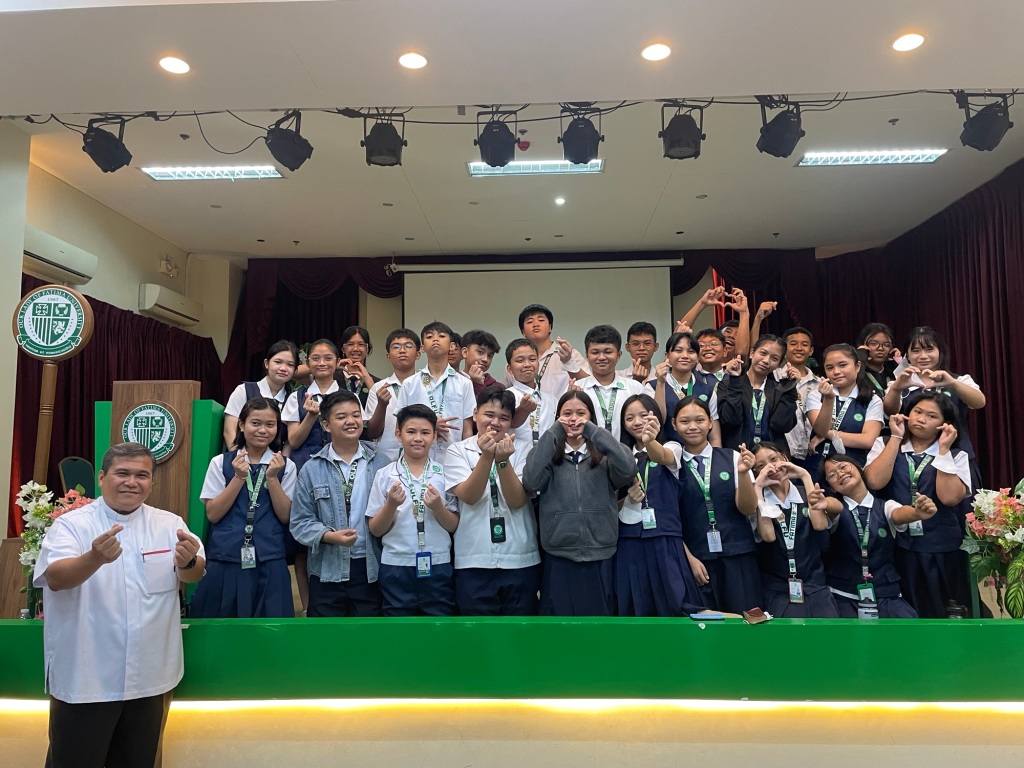
With our Grade 7 Students in our San Fernando, Pampanga campus last March.
In my 26 years in the priesthood, the primary reason I have always objected to divorce aside from its being against the teaching of the Lord are the children. When couples separate, their children suffer the most.
Whenever I would speak to couples getting married, I always insist on this important aspect of marriage, of having children, of how this life calls for much maturity and responsibilities from husband and wife to ensure a bright future not only for them but for humanity. From them will come children and future generations. The kind of life they surely affects their children for better or for worst. And there is our future.
Marriage is not a question or a thing based on luck – the Sacrament and grace of God are not everything. Couples need to work harder and pray hardest to keep their union strong in faith, hope and love so that they would have good children who shall be matured and responsible Christians and citizens.
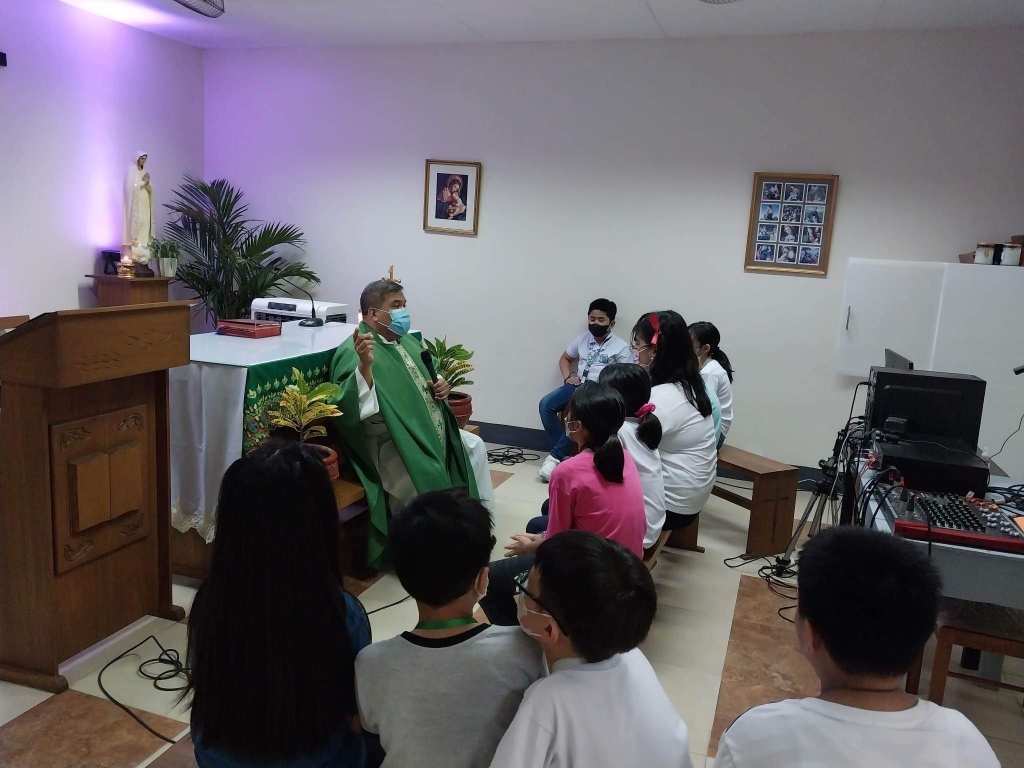
Praying with our students in our main campus in Valenzuela City.
Allowing divorce is opening the floodgates of so many abuses and excuses that will surely destroy the basic unit of the society, the family. Very often in my interaction with students from separated parents, they always have two wishes: that their parents would not separate or if still possible be reunited; and the second, how they wished they were not born to experience all pains and difficulties of having parents on the verge or already separated.
Very sad. Even tragic.
That is why the more I find meaning in my priesthood assigned in the school. Actually, it is more difficult than being in a parish but most fulfilling as I get to see my students mature and bloom, though there were times some of them got lost or went wayward in their lives.
My first assignment after ordination was as administrator-teacher of our diocesan school in Malolos for 11 years, the Immaculate Conception School for Boys (ICSB) and Immaculate Conception School of Malolos (ICSM). In 2011, I literally begged our bishop to assign me to a parish as I have never experienced being a pastor. During our grand reshuffle in 2021, our new bishop assigned me anew as chaplain here at my present assignment at the Our Lady of Fatima University (OLFU) in Valenzuela and its five other campuses.
Every day in my encounters and engagements with students in the sacraments and casual talks, the more I feel my “fatherhood” – here are thousands of kids longing for a dad, a father. Many times I tease God, asking Him if this is the reason why we priests do not get married so that we could take care of somebody else’s children?!
What a joy that even for a brief moment I become a dad for many of them in my stories and teachings. And presence.
Speaking to our elementary students after their weekly Mass in our Valenzuela campus.
That is why I feel so glad and proud of many of my students especially from ICSB who have turned out so well as responsible dads and faithful husbands to their wives. One of them was Micah who asked me to officiate his wedding to Lery shortly before the pandemic in 2020.
The homily I prepared for their wedding was actually a review of the five important things I used to tell Lery and all my students in ICSB to have in their pocket as a man: handkerchief, money, pen, comb, and Rosary.
Lery at my back in another wedding of his classmate in January 2020.
Micah and Lery are happily married with two kids and a third coming in eight months. They all live abroad where Micah is working.
Most of his barkada are also happily married, many abroad too like him.
I send them my prayers and reflections once in a while as I remember them all in prayers, hoping their marriage will remain strong, that they – and their kids – would truly be icons of the love of God in Jesus Christ. Amen.
Quiet Storm by Fr. Nicanor F. Lalog II, 10 May 2024
Photo by Veejay Villafranca/Bloomberg via Getty Images
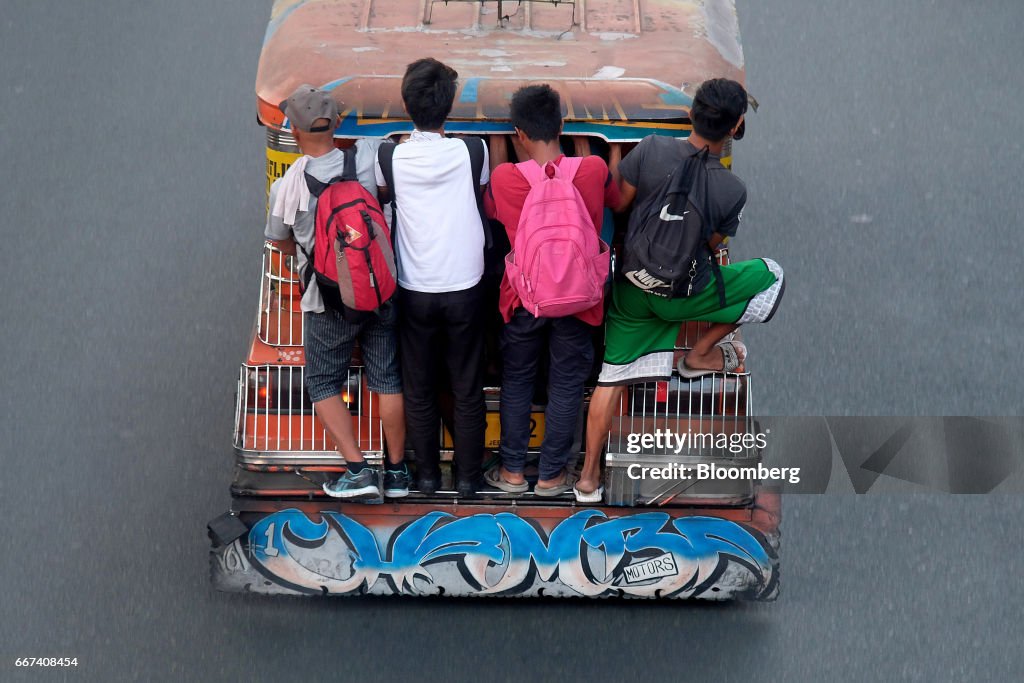
My most vivid image of mommy’s love for me is from June 1979 when I bid her goodbye in her sari-sari store on my way to the high school seminary. That was the last time I felt I was a kid, her child, when she hugged me tightly, then held my head and kissed me as she fixed by combed hair, telling me “magpapakabait ka doon, anak.”
She had always been against my entering the seminary, saying I was too young to know about the priesthood. She did all the scare tactics to me: “hindi ka mag-aasawa, isda at tuyo araw-araw ang ulam ninyo, hindi masarap pagkain doon…” She finally allowed me to enter the seminary on second year high school I believe after my dad had silently persuaded her.
It was funny because on my fourth year before graduation, I felt I was not ready yet for the major seminary that was eventually confirmed by the results of my entrance exam (psychological tests actually) to San Carlos Seminary that it was suggested I better leave the seminary.
My mother Corazon before their wedding in 1964.
Tama nga si mommy.
It was from then on when we had that kind of not so smooth mother-son relationship. I felt far from her as she would always say something to my plans and decisions. She was not really a contravida but more of an oppositionist. That is why when I felt my vocation anew later in 1988, I never told her about it until I was about to go back to the seminary. That time, there was no more hugging and kissing maybe because I was already an adult, a man bigger and stronger than her.
But what was most memorable for me now that she is gone was the scene every time I would go back the seminary and later to my assignments as a priest.
Whenever I would tell her “mommy, uuwi na po ako”, she would say while smiling, “e nasa bahay ka, paano ka pa uuwi?”
That happened so often that she sounded so corny but still, thank God, I never tired explaining to her, “uuwi sa seminaryo” later to Malolos then to Bagbaguin and now to Fatima. She never failed to banter with me with her dry humor and stroke during those moments of my leaving home. I think she was telling me in those every good bye of ours that my home would always be her, my family. That is why after her body was taken from her room last Tuesday morning, the scene that struck me most on her death was her empty room, vacant big bed.
As I left home pauwi sa Fatima, the morning sunshine were so lovely as it softly brightened mommy’s empty room as she is now “home” in heaven with daddy.
Overall, I feel so joyful and grateful in my mother’s demise. She left so peacefully in her sleep as I have prayed to God daily. The outpouring of love and sympathies and friends are beyond our expectations or imaginations. But, there is that fear, a dread in me about coming home, finding her room empty, telling me she is gone.
Mommy’s room is now empty but our hearts are so full of her love, of her memories, of her gift of self.
During the pandemic, I begged God not to take my mom yet. I told God I was not ready because she was primarily the reason I “go home”. As I reflect on the meaning of that image of her empty room, I realized that it is not about going home but coming home. We go home to the house and place but we come home to persons, to family and friends.
Pag-uwi in Tagalog which is literally coming home. Not going home. Because when we leave, we say uuwi also as we come home to our new home.
We Filipinos express both our kinship and Christian faith in our goodbyes.
Our professor in liturgy Msgr. Andy Valera used to tell us we never say aalis na ako or “I am leaving” because that means we are angry. It is very rude and should never be said when saying goodbye in any Filipino gathering. Instead, we say next to uuwi na ako either tutuloy na ako or mauna na ako. But, how can we make tuloy which is to enter when we are in fact leaving? And why say mauna na ako which means I’ll go ahead when nobody is going with you?
Photo by author.
According to Msgr. Andy, our coming home indicates our theology of heaven: we all come home, uwi to heaven our true home that is why when we leave our gatherings we say tutuloy na ako because in the end, we enter heaven. Most of all, we say mauna na ako because nobody knows who is next to die.
What a beautiful lesson I just realized now after mommy had died; even if she’s gone and her empty is room, I will still come home to my sisters and brother, nieces and nephew, relatives and neighbors.
How lovely that despite the pain and emptiness death creates in us here on earth is also the grace of God to fill each others heart with His loving presence and joy as we await our final coming home to Him with our departed loved ones in heaven.
Jesus told his disciples: “Do not let your hearts be troubled. You have faith in God; have faith also in me. In my Father’s house there are many dwelling places. If there were not, would I have told you that I am going to prepare a place for you? And if I go and prepare a place for you, I will come back again and take you to myself, so that where I am you also may be.”
John 14:1-3
The best way to come home to heaven is to come home often to our family and friends not only to dine and celebrate but most of all, to praise and thank God in prayers, especially the Sunday Mass. God bless everyone!