The Lord Is My Chef Breakfast Recipe for the Soul by Fr. Nicanor F. Lalog II
Monday, Week XXVIII, Year II in Ordinary Time, 12 October 2020
Galatians 4:22-24, 26-27, 31-5:1     ||| +++ |||     Luke 11:29-32
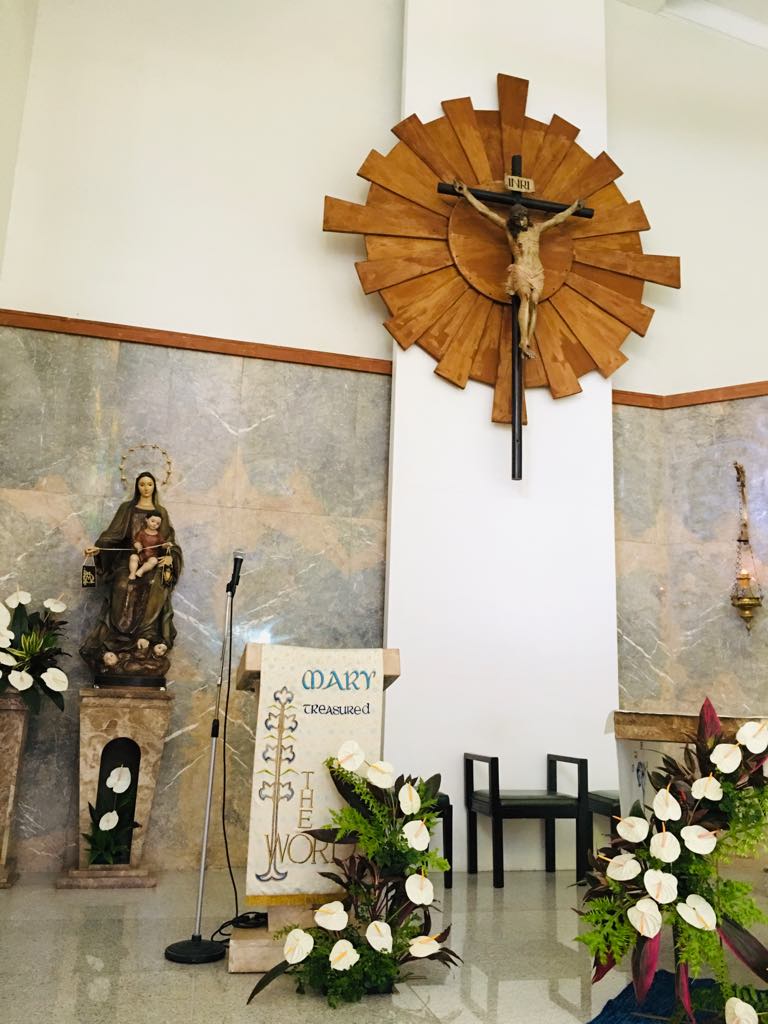
Cross of Christ atop the church of our Lady of Lourdes in France. Photo by Arch. Philip Santiago, September 2018.
Today O God our Father I thank you for the gift of faith we have always taken for granted. Faith is not just for believing in you, God; faith is for believing what is true! Without faith, life would be a drab and even senseless for there is nothing we can ever hold as reliable and true.
Without faith is like living without friction with everything sliding, slipping, escaping our grasps. There is nothing we would ever believe in. Most of all, without faith we can never read and understand any kind of signs, especially your saving work in Jesus Christ.
While still more people gathered in the crowd, Jesus said to them, “This generation is an evil generation; it seeks a sign, but no sign will be given it, except the sign of Jonah. Just as Jonah became a sign to the Ninevites, so will the Son of Man be to this generation.
Luke 11:29-30
We live in a world of so many signs and symbols but it is only through your gift of faith that they all become meaningful and useful.
Teach us, Lord, to deepen our faith so we can read your signs better like St. Paul in the first reading whose deep faith in you enabled him to interpret the meaning of the signs of Abraham’s two sons, Ishmael by Hagar and Isaac by Sarah.
May we love and care more for your gift of faith to us, Lord, because it is through our faith that we know and discover, follow and hold on to your plans for us. Amen.
The Lord Is My Chef Breakfast Recipe for the Soul by Fr. Nicanor F. Lalog II
Saturday, Week XXVII, Year II in Ordinary Time, 10 October 2020
Galatians 3:22-29     ||+||   >><)))*>   ||+||     Luke 11:27-28
Photo by author, 2019.
Glory and praise, O God, our Father for another week that had passed and another new one to start! Thank you so much for everything we have received this week: the beautiful things that have blessed us wondrously and the sad things that have also blessed us with lessons in life.
Thank you for the gifts of faith and conviction, faith and being realistic, faith and consistency.
And so, I pray today for the gifts of faith and freedom for a truly faithful person is always one who is also truly free!
Brothers and sisters: Scripture confined all things under the power of sin, that through faith in Jesus Christ the promise might be given to those who believe. Before faith came, we were held in custody under law, confined for the faith that was to be revealed. Consequently, the law was our disciplinarian for Christ, that we might be justified by faith. But now that faith has come, we are no longer under a disciplinarian.
Galatians 3:22-25
You know how so many times, Lord, when we feel imprisoned and chained by our broken and toxic relationships, sickness and handicaps, painful memories, failures and other past sins.
Let us realize and be convinced that you have come to set us free from all of these, that we are now free to love, free to be ourselves, free to grow, free and faithful in you.
Show us the path how we can break the many barriers that continue to imprison us and prevent us from maturing in faith and freedom in you like gender, color, language, social status and even religion.
Help us imitate you, Jesus, who boldly claimed before everyone that true blessedness is not found in affinities or blood ties but in freely receiving and observing the word of God. Amen.
The Lord Is My Chef Breakfast Recipe for the Soul by Fr. Nicanor F. Lalog II
Friday, Week XXVII, Year II in Ordinary Time, 09 October 2020
Galatians 3:7-14     <*(((><<   +   >><)))*>     Luke 11:15-26
Photo by author, 2019.
Glory and praise to you, O God our Father through your Son Jesus Christ! Today we are celebrating the Memorial of some great men who faithfully and consistently served you and your people with their lives of witnessing to your gospel as members of the clergy: St. John Leonardi who founded in 1570’s the forerunner of Propaganda Fide now headed by Cardinal Luis Antonio Tagle; St. Denis, first bishop of Paris who suffered martyrdom with his priest and deacon in 258; St. Louis Bertrand who came to be known as the “Apostle to the Americas” during the 16th century; and beatified recently by Pope emeritus Benedict XVI, Blessed John Henry Cardinal Newman considered as one of the great Christian intellectuals of the 19th century.
They were all great men of deep faith. And most of all, consistent in heeding your call, doing your work.
And that is why, today O Lord I pray for the gift of being consistent in my faith.
A believer without consistency in his faith and actions is not faithful at all. A truly faithful servant is always consistent especially when the chips are down, we are confronted of either for you, Lord, or against you.
Sometimes we try “moving the lines”, convincing ourselves that we are not crossing the line of morals and morality like when we are bent on accommodating others and ourselves in some occasions to justify personal preferences like tinkering with the formula of the Sacraments as well as those pertaining to intrinsically sinful and immoral.
Like St. Paul in his letter to the Galatians today, clear our minds and our hearts of all kinds of inconsistencies in our faith, set us straight onto your paths, Lord and let us see your own consistency, your works in the past that are fulfilled in the present.
Unlike those people accusing you of driving evil spirits in the name of Beelzebul, may we be consistent in relying only in you and your powers despite our many setbacks and failures in life when you never failed to bless us and work things out for our own good. Amen.
The Lord Is My Chef Breakfast Recipe for the Soul by Fr. Nicanor F. Lalog II
Monday, Week XXVII, Year II in Ordinary Time, 05 October 2020
Galatians 1:6-12     >><)))*>   |+|   <*(((><<     Luke 10:25-37
From America Magazine via Google.
God our loving Father, I praise and thank you for the gift of faith in you that have greatly helped me finding fulfillment in you. As I grow and continue in this journey in faith, I have realized too that it is not enough to just believe in you but also be convinced in this faith in you.
Like during the time of St. Paul especially among the Galatians, until now many of us are easily swayed by so many other beliefs that are misleading. claiming to be a part of the faith we received from you through Jesus Christ.
Teach us to be like St. Paul in his firmness and conviction in his faith no matter what modern thoughts claim to be a part of the gospel of Jesus Christ that try to accommodate certain thoughts and lifestyles, like masquerading as being “politically correct”.
Now I want you to know, brothers and sisters, that the Gospel preached by me is not of human origin. For I did not receive it from a human being, nor was I taught it, but it came through a revelation of Jesus Christ.
Galatians 1:11-12
If we can have St. Paul’s kind of conviction in faith, maybe we can be more authentic Christians or believers of God like the good Samaritan unlike the priest and Levite who just passed by the victim to robbers on the road to Jericho.
Forgive us Lord when our faith and lives do not match because so often our faith have no roots within us, we are not personally convinced in believing and following you. Amen.
The Lord Is My Chef Breakfast Recipe for the Soul by Fr. Nicanor F. Lalog II
Tuesday, Week XX, Year II in Ordinary Time, 18 August 2020
Ezekiel 28:1-10 <*(((><< || + || >><)))*> Matthew 19:23-30
Photo by author, Petra in Jordan, May 2019.
Then Peter said to Jesus in reply, “We have given up everything and followed you. What will there be for us?” Jesus said to them, “Amen, I say to you that you who have followed me… And everyone who has given up houses or brothers or sisters or father or mother or children or lands for the sake of my name will receive a hundred times more, and will inherit eternal life.”
Matthew 19:27-28, 29
“We have given up everything and followed you, Lord. What will there be for us?”
Oh! how often we tell this to you, Lord Jesus, as if we have given so much for the sake of your kingdom.
Sometimes, it is not really a question we ask but a reminder to you of our “goodness” and “benevolence” with others, of how good we have been when in fact whatever we give and share are all from you.
Forgive us, O Lord, when most specially in the midst of pains and sufferings, we ask you “What will there be for us?” in order to remind you of our rewards, or entitlement as if you forget them or that there is such a thing at all with you.
Photo by author, 2019.
We are sorry Lord in counting the costs and most of all, in demanding so many in return.
“What will there be for us?” is often the question we ask when we doubt your generosity and fidelity to your promises to us.
Like Ezekiel in the first reading, remind us O Lord to keep in mind not to be “haughty of heart”, that “we are not god despite our many achievements brought about by our intelligence or beauty” (Ezekiel 28:1-7).
Dearest Jesus, you have given us with so much and we have given so little; teach us to give more of ourselves, more of our time, more of our treasures, and most of all, more of you to others. Amen.
The Lord Is My Chef Sunday Recipe for the Soul by Fr. Nicanor F. Lalog II
Week XX, Cycle A in Ordinary Time, 16 August 2020
Isaiah 56:1, 6-7 >><}}}*> Romans 11:13-15, 29-32 >><}}}*> Matthew 15:21-28
Twilight at our parish by Ms. Ria De Vera, 12 August 2020.
For the third Sunday in a row, Jesus reveals a very wonderful side of him who goes out of his way to meet us and comfort us in the most difficult situations and places we are into. It is something we need so much in these days of Moderate Enhanced Community Quarantine (MECQ) seen right away in the opening of today’s gospel.
At that time, Jesus withdrew to the region of Tyre and Sidon. And behold, a Canaanite woman of that district came and called out, “Have pity on me, Lord, Son of David! My daughter is tormented by a demon.” But Jesus did not say a word in answer to her.
Matthew 15:21-23
Jesus goes out of his way to meet everyone
Israel is a very small country but always leaves a big impact on everyone who goes on a pilgrimage there. There is that sense of awe in every sacred site that until now continues to “speak” and evoke among pilgrims the presence and holiness of God and his saints.
Like what we have mentioned last Sunday, the proxemics or the non verbal communication of the places Jesus have visited convey to us deeper meanings than just mere sites. And that is more true during the time of Christ like the setting of this Sunday’s gospel, the region of Tyre and Sidon.
Now part of Lebanon found south of its capital city Beirut that was devastated by powerful explosions two weeks ago, Tyre and Sidon were gentile or pagan cities during the time of Jesus with a considerable Jewish population.
His going there shows us his fidelity to his mission of “searching for the lost sheep of the house of Israel” that partly explains to us why he never bothered to give the slightest hint of recognition to the Canaanite woman who had sought his help for her daughter “tormented by a demon”.
Photo by author, the Holy Land, May 2019.
And despite the lack of any explanation again by St. Matthew on the attitude by Jesus “snubbing” the pagan woman, we can safely assume that Christ surely knew that by going to Tyre and Sidon, gentiles would seek his healing as news of his fame had spread beyond Galilee at that time.
Here we find the great love and concern of Jesus for everyone, specially the rejected and marginalized in the society.
His “withdrawing to the region of Tyre and Sidon” was in itself a revelation of his universal love, a love without borders reaching out to those lost and feeling alone in life, those rejected, those discriminated for their color and beliefs, status and gender, sickness and diseases like AIDS and lately, COVID-19!
Inclusive Jesus, exclusive human
At the beginning of chapter 11 of St. Paul’s Letter to the Romans from which our second reading is taken today, the great Apostle starts by asking “has God rejected his people?” St. Paul emphatically said “no”, explaining at length the plan of God in Jesus Christ to save all peoples not just the Jews, beautifully telling us,
For the gifts and the call of God are (permanent and) irrevocable.
Romans 11:29
St. Paul’s reflections on God being “inclusive” as against our being so “exclusive” in sending us Jesus Christ to bring us all together as one sheds us some light on that extraordinary incident in the region of Tyre and Sidon involving the Canaanite woman.
Again, I invite you my dear reader to reflect on the many layers of meaning found in this episode so special like the feeding of more than five thousand people the other Sunday and Jesus walking on water last week.
First, notice the silence of Jesus. Keep in mind when the Lord is silent, it does not mean he is out or does not care at all to our needs and pleas. When there is silence – specially a deafening one – the problem is never with God but with us people.
And, true enough! See how the disciples asked Jesus to “Send her away, for she keeps calling out after us” (Mt.15:23) — exactly the way we deal sometimes with those begging our help and attention, seeing them as a nuisance to be sent away? What a shame!
From Google.
Now, we go to the climax of this episode with the woman coming to Jesus, “paying him homage” for the healing of her daughter tormented by a demon. It was a scene similar with St. John’s wedding at Cana where the Blessed Mother also approached Jesus with a request when wine ran out during the feast.
In both episodes we find Jesus being a snub – suplado, as we say.
Most of all, in both scenes we find the remarkable faith in Jesus by his Mother at Cana believing he can do something to spare the newly wed couple of embarrassment from running out of wine while this Canaanite woman felt so sure only Jesus can cure her daughter.
See how she addressed Jesus like his disciples with not just “Lord” but also with the title “Son of David” to indicate her faith in him as the Messiah.
And it did not stop there as she engaged Jesus into a dialogue — indicating intimacy and trust, depth and communion that we refer in Filipino as “matalik na ugnayan” or “matalik na usapan”.
Sometimes in life, Jesus seems to have that longing for some “lambing” from us that he tries to be “pakipot” or hard to get in order to be intimate with us. Please take these Filipino traits positively to get what I mean from this unique scene of Jesus and the Canaanite woman in Tyre and Sidon.
Jesus said in reply, “It is not right to take the food of the children and throw it to the dogs.” She said, “Please, Lord, for even the dogs eat the scraps that fall from the table of their masters.” Then Jesus said to her in reply, “O woman, great is your faith! Let it be done for you as you wish.” And the woman’s daughter was healed from that hour.
Matthew 15:26-28
Photo by author, Church of All Nations beside the Garden of Gethsemane in the Holy Land, May 2019.
Brothers and sisters all in one God as Father
St. Matthew recorded this episode not to scandalize and shock us with those words coming from the Lord, referring to the Canaanite woman as one of the “dogs” that was the term used to designate pagans at that time.
For St. Matthew who was writing for Christians of Jewish origins, the episode was a reminder that the people of Israel were indeed the “children” of God to whom the coming Messiah and salvation – like bread or food – were first promised. St. Paul spent a great deal of explaining of this in his letter specially to the Romans .
Rigthly then, theirs was the “food” not right to be thrown to the “dogs” but, that fact does not exclude the “dogs” from partaking later from the leftover food of the children, as if telling Jesus, today we satisfy ourselves with crumbs, tomorrow we shall have bread!
The Canaanite woman clearly knew where to place herself before the Lord, proving to him her deep faith and amazing knowledge of God’s goodness and plans for everyone. For that, she was highly praised by Jesus for her faith. The only other person also praised by Jesus in having a tremendous faith in him was the centurion – another pagan – who begged the Lord for the remote healing of his servant.
Last Sunday afternoon I read the story of how a nurse was driven out of her boarding house after she tested positive for COVID-19 virus. The poor lady had nowhere to go to spend the night after being denied of any assistance by barangay officials, even by her own family in Batangas! Good enough, somebody reported her to the Philippine National Red Cross that sent an ambulance to take care of the nurse who was found crying by herself at the gutter of a street in Pasay City.
What a very sad and tragic reality happening among us these days of the pandemic.
Where is our love and concern for everyone, especially the weak and the sick, those in our own versions of Tyre and Sidon where no one would dare to go except Jesus, perhaps like the dorms and residences of our medical frontliners who are so tired and sick physically, emotionally, and spiritually during this pandemic?
In these past three weeks we have reflected how Jesus lovingly joined us, staying with us in the wilderness, in the storms of the dark sea, even at the pagan territories where nobody would ever want to go.
This Sunday, Jesus is inviting us to break all barriers and borders between us that separate us from each other. Let us animate our community with Christ’s love and mercy for us all amid our many differences so that slowly we fulfill Isaiah’s prophecy in the first reading that someday the house of the Lord shall be called “a house of prayer for all peoples” (Is.56:7). Amen.
A blessed and safe new week to you! And please do not forget to pray ten Hail Mary’s every 12-noon for national healing and end of the pandemic until September 15, 2020.
The Lord Is My Chef Sunday Music by Fr. Nick F. Lalog II, 02 August 2020
Photo from iStock/StudioAnnika
Our Sunday music for today is specially for all the doctors, nurses, and everyone serving in hospitals since this pandemic began. You are exactly like Jesus Christ in the gospel today who went to a deserted place to rest but upon seeing the crowds who have followed him, “his heart was moved with pity for them, and he cured their sick” (Mt.14:14).
Thank you, dearest doctors and nurses and everyone serving in our hospitals for keeping the love alive, forgetting your selves and loved ones just to answer the call of duty like our Lord who was also so tired preaching with a heart aching for the death of John the Baptist (https://lordmychef.com/2020/08/01/human-situation-divine-response-multiplying-our-blessings/).
And this is the reason we have jazz artist Tom Scott’s 1991 hit “Keeping This Love Alive” as our featured music this Sunday: with the excellent vocals by David Pack, the song tells us how amid so many trials and tests, a man keeps on coming back to the woman he loves so much.
I don't know why my faith gets so low
I'm helpless to control my fears
I turn to you and somehow I know
No matter how far I fall
You will answer my call,
becauseI keep coming back to you

Heal me one more time
I keep coming back to you
You're the reason why (the reason why)
The reason I (the reason I)
I've got to keep this love alive (alive, alive, alive)
Oh, gotta keep this love alive (alive)
Ultimately, it is the love of Jesus Christ that we have experienced that we keep this love alive – in our family and circle of friends, in our community and nation. It is his love that sustains us, enabling us to believe more and hope more.
Thank you dearest doctors, nurses and everyone serving in our hospitals around the world to care for the sick.
The Lord Is My Chef Sunday Recipe for the Soul by Fr. Nicanor F. Lalog II
Week XVIII, Cycle A in Ordinary Time, 02 August 2020
Isaiah 55:1-3 >><}}}*> Romans 8:35, 37-39 >><}}}*> Matthew 14:13-21
Remember our reflection last Sunday? Of how parables teach us that “less is always more” because to have the kingdom of God – Jesus Christ himself – we have to learn to appreciate the little things in life?
Beginning this Sunday until August 16, our gospels will start telling us who is Jesus Christ by showing us his powers and abilities that are exactly opposite the way we see and understand them. This new series of stories are so relevant to us in this time of pandemic, giving us wonderful insights into God’s ways of responding to our human situations.
St. Matthew now leads us with Jesus to the wilderness after teaching us in parables to experience his power in transforming us like the five loaves and two fish to feed more than five thousand people.
Multi-layered story of the multiplication of bread
All four evangelists have recorded this story of Jesus Christ’s multiplication of the loaves of bread with their particular focus and stress, showing us that it truly happened and was a major event in the Lord’s ministry.
Very unique with St. Matthew’s version of this miracle story – which has not one but two! – is his economy of words in narrating it like a straight news as if it were a developing story or a “breaking news” unfolding before us, calling us to follow its updates and details due to its multi-layered meanings.
When Jesus heard of John the Baptist, he withdrew in a boat to a deserted place by himself. The crowds heard of this and followed him on foot from their towns. When he disembarked and saw the vast crowd, his heart was moved with pity for them, and he cured their sick. When it was evening, the disciples approached him and said, “This is a deserted place and it is already late; dismiss the crowds so they can go to the villages and buy food for themselves.” Jesus said to them, “There is no need for them to go away; give them some food yourselves.” But they said to him, “Five loaves and two fish are all we have here.” Then he said, “Bring them here to me,” and he ordered the crowds to sit down on the grass. Taking the five loaves and the two fish, and looking up to heaven, he said the blessing, broke the loaves, and gave them to the disciples, who in turn gave them to the crowds. They all ate and were satisfied, and they picked up the fragments left over — twelve wicker baskets full. Those who ate were about five thousand men, not counting women and children.
Matthew 14:13-21
Photo from iStock/Studio-Annika.
The consolation of Jesus.
Our situation in this time of the corona pandemic is so similar with that of Jesus. With the increasing number of COVID-19 cases, it has finally hit us hard, so close to home with news of those we know getting infected and worst, dying from this disease.
Like Jesus upon hearing the death of John the Baptist, we are all saddened that we wish to withdraw away from everyone.
We want to mourn but there are more people in need of our presence and help in this time of pandemic like the countless medical frontliners and health workers who must be so tired – even sick, physically and emotionally – by now with the growing number of COVID-19 patients and yet have chosen to remain in their posts.
And there are still the other casualties of this pandemic like those who have lost their jobs, those evicted from their rented apartments, those stranded and separated from their loved ones, those begging for food, and those afflicted with other sickness going through dialysis and physical therapy.
Jesus knows so well the “wilderness” we are all going through and he is right here with us, one with us in our sufferings, in our fears and anxieties, and in our exhaustion.
To be one with us is consolation, from the Latin “con” or with + “solare” or alone, to be one with somebody feeling alone.
Jesus did not remove our pains and sufferings, even our death; he joined us to be one with us in these that he can call us to “Come to me, all you who labor and are burdened, and I will give your rest. Take my yoke upon you… For my yoke is easy and my burden light” (Mt.11:28-30, 14th Sunday, 05 Jul 2020).
Compassion of Jesus.
Still with Christ’s reaction of being “moved with pity” at the sight of the crowds who have followed him to the wilderness, we find something more deeper with his being one with us, in consoling us that he had forgotten all about himself, his tired body that he went on to heal the sick among them.
To be moved with pity is more than a feeling of the senses but a response of his total person.
You respond for help, you reply to a call.
Ever wondered why we have the “responsorial psalm” after the first reading in the Mass? Because those words from the Psalms express our total assent and commitment to God, involving our total self like body, mind, heart and soul.
Photo by Dra. Mai B. Dela Peña, Carmel Monastery, Israel, 2016.
God cannot suffer because he is perfect.
That is why he became human like us in Jesus Christ to be one with our suffering and death so that we would one with him in his glorious Resurrection.
In the wilderness, Jesus stayed with the people, not allowing them to leave as suggested by the Twelve because he was moved with pity with the crowd because he wanted to suffer with them.
That is compassion, literally means to “suffer with” from cum + patior. Here in the wilderness, Jesus showed his compassion for the people which will reach its highest point in giving himself on the Cross on Good Friday.
Have we “responded” to God’s call to serve, to a call of duty, and to a plea for help from the poor? Have we truly given ourselves to somebody without ever thinking our own comfort or rewards? Or, are we running away from his Cross?
What a shame in this time of pandemic there are some among us who rejoice at the losses of others like the Twelve who wanted the crowd to be sent home because they were afraid of responsibilities, of taking care of the suffering people.
Consolation and compassion are the two most needed from each of us in this time of crisis.
Our scarcity mentality, the God of plenty.
We now come to the miracle of the feeding of five thousand. According to the late Fr. Henri Nouwen, this story is an example of our “scarcity mentality” when we think of not having enough, of finding what we have as too little, always looking for more; hence, our tendency to hoard everything.
The Twelve were thinking more of themselves, afraid they could go hungry with the five loaves of bread and two fish they have. They were so afraid of difficulties ahead of them in their situation where to find and how to feed those great number of people.
They were focused on what was lacking than on what they have, and who was with them, Jesus Christ! They were hungry for food in the stomach than for food to the soul unlike the crowds who have followed Jesus.
Worst of all, the Twelve got “mad” upon seeing the crowds who have followed them to the wilderness when in fact, it was Jesus who needed most to rest to mourn John’s death!
But through all these, Jesus patiently bore the people’s woes and the Twelve’s selfishness to teach them all in a very nice way something so essential in our response to every human suffering and extreme situation: opening and entrusting our selves totally to God.
And that was actually the greatest miracle that happened that day.
In doing it, Jesus simply asked the Twelve what they have, never asking how much they have or its condition. Just whatever they have to give everything to Jesus like those five loaves and two fish that he took, and while looking up to heaven, blessed and broke the loaves, and gave them to the Twelve to distribute to the crowd.
And everyone was satisfied with a lot of left overs too!
Matthew nor any of the other Evangelists ever explained how it happened because it does not really matter at all. What is most important is what are we willing to give up to Jesus so he can transform us into better persons.
That is what we continue to do this day in every celebration of the Holy Eucharist- whatever we have, even not the best or the worst and littlest we have, when given to Jesus becomes holy and multiplied!
The power of God is immense, without doubt. But, in this miracle of the feeding of five thousand, Jesus is showing us that his power is not meant to satisfy our material or bodily needs but our deepest desires that lead to our fulfillment in him as prophesied by Isaiah in the first reading.
Why spend your money for what is not bread; your wages for what fails to satisfy? Heed me, and you shall eat well, you shall delight in rich fare. Come to me heedfully, listen, that you may have life.
Isaiah 55:2-3
Amid the pandemic worsened by our government officials’ inanities, irresponsibilities, and sheer lack of compassion with us in this wilderness, the Lord assures us today that he is with us for “nothing can separate us from the love of Christ” (Second Reading) if we are willing to give him all that we have.
It is our spiritual transformation first that leads us to our material blessings. We can all have it if we are willing to give everything to Jesus and believe in him always. What do you have for miracles to happen?
A blessed August ahead for you!Amen.
Photo by Dra. Mai B. Dela Peña, Carmel, Israel, 2016.
The Lord Is My Chef Breakfast Recipe for the Soul by Fr. Nicanor F. Lalog II
Thursday, Memorial of Our Lady of Mount Carmel, 16 July 2020
Isaiah 26:7-9, 11, 16-19 >><)))*> + <*(((><< Matthew 11:28-30
Photo by author, Our Lady of Mt. Carmel of the Holy Family, Guiguinto, Bulacan, 08 December 2019.
Your words today, O God our Father, are very comforting and consoling, so reassuring of your love and mercy for us sinners, giving us new life in you as we celebrate the memorial of Our Lady of Mount Carmel.
Like the Israelites living in exile because of their own making when they turned away from you in sins worshiping false gods, we also admit our sinfulness and failures in standing up for what is true and just, in being faithful to you.
Help us to rise again, heavenly Father, breathe into us your life-giving Spirit specially at this time we feel so down and crushed not only by COVID-19 pandemic but by public officials concerned only with their well-being and whims forgetting the people they are supposed to serve.
We conceived and writhed in pain, giving birth to wind. Salvation we have not achieved for the earth, the inhabitants of the world cannot bring it forth. But your dead shall live, their corpses shall rise; awake and sing, you who lie in the dust. For your dew is a dew of light, and the land of shades gives birth.
Isaiah 26:18-19
If there is anything we would want to have these days, it is rest, O Lord.
A lightening of our load and burdens.
But why another yoke, Jesus?
Forgive us Jesus when we feel negative with yoke because they always portray to us images of slavery and oppression. Open our eyes, Lord, as we come closer to you to take your yoke because you not only help us carry our burdens but most of all, your yoke gives us direction in our path back to the Father.
May your Blessed Mother of Mount Carmel help us to hold on to God in this hour of darkness in our lives as individuals and as a nation. Amen.
Photo by author, Our Lady of Mount Carmel of the Holy Family, Guiguinto, Bulacan, November 2019.
The Lord Is My Chef Breakfast Recipe for the Soul by Fr. Nicanor F. Lalog II
Tuesday, Memorial of St. Camillus de Lellis, Priest, 14 July 2020
Isaiah 7:1-9 <*(((><< ] + [ >><)))*> Matthew 11:20-24
Fire at the Pandacan Church, 10 July 2020.
O God our Father, we are in a war.
A war between good and evil, between light and darkness, sanity and insanity.
It is a war long been raging within us that I fear must have reached a stalemate because of our indecision, of our indifference. Some battles may have been won but the war rages on because we have refused to make a gallant stand for you.
Banish our fears, assure us with your same words to King Ahaz of Judah when threatened with simultaneous attacks by his neighboring kingdoms:
Take care you remain tranquil and do not fear; let not your courage fail before these two stumps of smoldering brands… Unless your faith is firm you shall not be firm!
Isaiah 7:4, 9
Sometimes, our faith waver especially at how things are now going on among us like divisions and confusions due to lack of clear leadership in government while many of us in the church are in disarray.
Make us realize that there is a day of reckoning for all our sins, for taking side with the enemies, for refusing to stand for what is true and just when Jesus Christ reproached Chorazin, Bethsaida, and Capernaum who refused to recognize his works of salvation when he came.
May we learn from the experience and lessons of St. Camillus de Lellis who was a soldier addicted to gambling but later converted to follow Jesus as a priest taking care of the sick, realizing the need for us to grow in holy charity. Amen.







 lordmychef.com