The Black Nazarene in COVID-19

The Lord Is My Chef Breakfast Recipe for the Soul
Saturday, Feast of the Black Nazarene of Quiapo, 09 January 2021
1 John 5:14-21     >><)))*>   +   <*(((><<     John 3:22-30
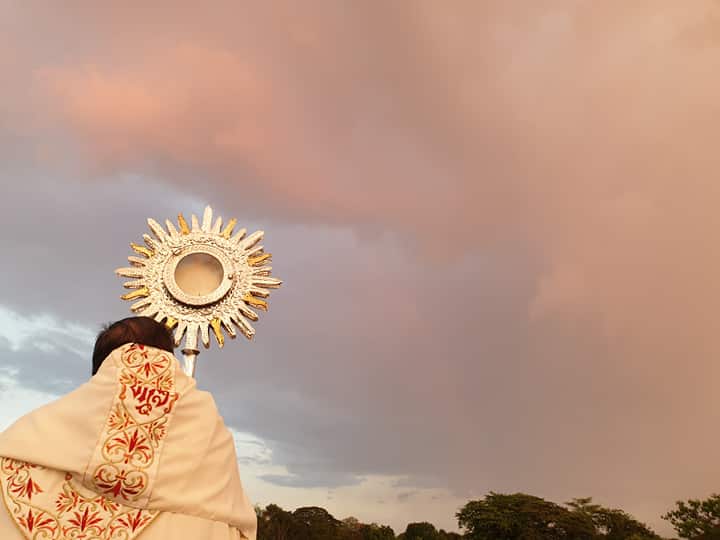
Photo by Mr. Jay Javier, Quiapo, 09 January 2020.

For the first time in so many years, there will be no Traslacion today of the Black Nazarene of Quiapo due to the COVID-19 pandemic but devotees are still celebrating its feast via online Masses and by visiting other churches with revered images of Nuestro Padre Señor Jesus de Nazareno first brought in the country by Augustinian Recollects in the early 1600’s.

Like in our celebrations last year of Lent and Easter and recently of Christmas, COVID-19 pandemic has given us much needed time to reflect, meditate, and review our faith in general that has been shaped for better and, for worst, by our many rites and rituals that have turned us blind to its deeper realities of finding Jesus among the poor and suffering.

It is a great marvel for our eyes to see this unique and intense expression of faith of great crowds gathering every year to fulfill their panata or vow to the Black Nazarene. People from all walks of life, children, men and women, young and old flock to Quiapo on this day as part of their panata for a prayer and wish granted them by the Señor Nazareno.

Photo by Mr. Jay Javier, Quiapo, 09 January 2020.

Beloved: We have this confidence in him that if we ask anything according to his will, he hears us. And if we know that he hears us in regard to whatever we ask, we know that what we have asked him for is ours. Children, be on your guard against idols.

1 John 5:14-15, 21

So often people wonder do we really have to go through all these because of a prayer granted like healing or having a child or getting a job or passing a board exam?

The beloved disciple reminds us today during this time of the pandemic that somehow we have to restore some sense of order especially in the Traslacion.

There is no doubt about the faith of everyone — but it is not everything. Faith is directed to God, a Person, not to a ritual or rite nor to an image. In this time of COVID-19, Jesus reiterates to us His love for us, of how like yesterday in the gospel He always wishes the best for us.

Let it be clear we are not passing judgment on the devotees of the Black Nazarene and of other popular devotions anywhere else in the world. In the letter of St. John we heard today, we find that we do not need to go through so much hardships like some people would do in their panata because prayer is not primarily for having things but for deepening relationship with God. We pray because we relate, we want to be one with God. Asking for things or blessings is secondary. Prayers and sacrifices do not necessarily change situations in one’s life; prayers and sacrifices change the person. In fact, when we pray for something, deep within us we already knew if it is meant for us or not; that is why, I always tell people to “claim” from Jesus whatever he/she may be praying for because if it is for you, the Lord will surely give it to you.

It will almost be a year since we have this pandemic but until now, see in most churches how people continue to disregard our health protocols not to touch and kiss images. In less than a month, we shall start the Season of Lent when images are covered so we go deeper into the person of God and not merely to His images and other visuals that unfortunately for some have become their gods. And that is why despite our deep religiosity, we cannot experience real change in our society because we are still individualistic than communal. Values are misplaced or even disregarded when we think more of the favors to be had than the relationships to be kept, the person to be respected and life to be valued. No wonder, so many Catholics ironically and sadly support corrupt politicians and leaders who lie and disregard life despite their being “prayerful”.

From Google.

John said: “He (Jesus) must increase, I must decrease.”

John 3:30

Señor Nazareno reminds us how in this life we imitate John the Baptist remaining humble before Jesus, entrusting everything to Him. Most especially, working hard to ensure that Jesus and His gospel of salvation is made known to everyone.

See how in our gospel today when the disciples of John the Baptist reported to him Christ’s ministries in Judea, seeking clarifications on how to deal with the situation as more and more people were coming to Jesus. The scene reveals to us the deep spirituality of John, telling his disciples how Jesus must increase and he must decrease which is essentially Christ’s teaching on discipleship, that who ever wants to follow Him must first deny himself and take up his cross with Him.

That is the central message of the Black Nazarene: of how we are also willing to forget our very selves, take up our cross and follow Jesus in the path of self-sacrifice. It is finding Jesus among the poor and suffering that made the Quiapo devotion so appealing to every generation, but — we also wonder why our nation remains poor with so many sufferings! There must be something wrong.

This is something that only the pandemic can offer us: to search our souls, sincerely asking our selves if we still find Jesus in the center of all these devotions. How sad that every year, we hear reports of how some devotees getting unruly, insisting on what they believe, on what they want, including the route of the Traslacion.

Amid all these celebrations, do we hear John’s declaration “Jesus must increase and I must decrease”?

That is spirituality which is more about relationship with God than just fulfillment and celebration of rites and rituals that we call religiosity.

The Black Nazarene statue sits at the stage of the Quirino Grandstand in Manila on January 8, 2013, one day before its feast day when it will be paraded around the streets of Manila to the greeting of thousands of devotees. (Photo by LJ Pasion)

Usually, when you ask anyone for the meaning of “Jesus Nazareno”, easily they would say it refers to the Lord’s origins, the town of Nazareth where He grew up after returning from Egypt to escape Herod’s murderous plot against all infants when He was born.

It is true but on deeper reflection, we have to remember that Nazareth is the only place in the New Testament never mentioned in the Old Testament. Besides, Jesus Christ is actually from Bethlehem, the town of David and Joseph His father where He was born in fulfillment of the prophecies.

According to Pope Emeritus Benedict XVI, the words Nazoraios and Nazarenos used to designate Jesus in the gospels came from the Hebrew root “nezer” for root. Remember in the Simbang Gabi the prophecy by Isaiah that “There shall comne forth a shoot (nezer) from the stump of Jesse” (Is.11:1)?

Pope Benedict explains that Matthew must have detected in the name Nazareth a prophetic reference to the “shoot” as a sign of fulfillment of God’s promise to draw new life from the dead stump of Jesse:

If we add that in the inscription above the Cross, Jesus is called ho Nazoraios (cf. Jn.19:19), then the title acquires its full resonance: what is at first sight refers simply to his origin, actually points to his essence: he is the “shoot,” he is the one completely consecrated to God, from his mother’s womb to the day of his death.

Benedict XVI, Jesus of Nazareth: The Infancy Narratives (pp.117-118)

What a beautiful reminder to us all today in this time of COVID-19 in celebration of the feast of the Black Nazarene, reminding us that in this time when everything seems to be “dead” like a “stump” of the tree, God is working something marvelous, something great among us through His Son Jesus Christ.

Jesus is coming, Jesus has come and remains with us despite this pandemic.

But, are we willing to die to ourselves to see Him, to experience Him, and most of all, share Him?

Viva Nuestro Padre Señor Jesus de Nazareno!

Advent is being consistent

The Lord Is My Chef Sunday Recipe for the Soul by Fr. Nicanor F. Lalog II
Fourth Sunday of Advent, Year B, 20 December 2020
2 Samuel 7:1-5, 8-12, 14, 16  >><)))*>  Romans 16:25-27  >><)))*>  Luke 1:26-38
Photo by author, Christmas 2019.

We are now on the final week of our four Sundays of preparations for Christmas. We have been saying Christmas 2020 is surely the most different and difficult in our lives due to the pandemic. However, it may also be the most meaningful when we have more of spiritual values, less of material things; more of the other persons, less of ourselves; and, more of Jesus, less of the Christmas trimmings.

Today we heard the beautiful story of the annunciation of the birth of Jesus Christ found only in the gospel of Luke, the source of many inspirations in arts for many centuries even today. The scene reveals to us the artistry and spirituality of Luke believed to be a medical doctor who was a disciple of St. Paul. He is the only evangelist who admitted he had “investigated everything accurately anew, to write it down in an orderly sequence (the events about Jesus Christ) so that you may realize the certainty of the teachings you have received” (Lk.1:3-4).

And what is that certainty Luke looked into? That Jesus Christ is the Son of God, the fulfillment of the Old Testament promises to the patriarchs and prophets, who is the very presence of God among us. That is why Luke wrote a second volume to his gospel, the Acts of the Apostles to show us Jesus still present in the Church in the power of the Holy Spirit. In this beautiful canvass painted to us by Luke on Jesus the Christ in his Gospel and Acts we also find in a supporting role the Blessed Virgin Mary, His own Mother and model disciple.

The angel Gabriel was sent from God to a town of Galilee called Nazareth, to a virgin betrothed to a man named Joseph, of the house of David, and the virgin’s name was Mary. And coming to her, he said, “Hail, full of grace! The Lord is with you.” But she was greatly troubled at what was said and pondered what sort of greeting this might be. then the angel said to her, “do not be afraid, Mary, for you have found favor with God. Behold you will conceive in your womb and bear a son, and you shall name him Jesus. He will be great and will be called Son of the Most High, and Lord God will give him the throne of David his father, and he will rule over the house of jacob forever, and of his kingdom there will be no end”

Luke 1:26-33

The discipleship of Mary

As a former journalist, I have always considered the four evangelists as the premiere reporters of Jesus Christ. Mark is the old school type of straight news reporting, writing the basic who, what, where, when and why, making his gospel the first to be written and shortest as he was in a hurry, a true journalist. Matthew is more of a feature writer or interpretative reporter while John was a news analyst, an op-ed columnist.

Luke is the modern journalist using the “digital platform” who goes on “live as it happens” with all the colors and actions without losing depth and focus like the BBC and Al Jazeera. He brings us where the news is happening as you must have noticed yesterday in the story of the annunciation of the birth of John the Baptist to Zechariah which also served as introduction to his lead story of Christmas, the annunciation of the birth of Jesus Christ.

Here we see the unique position of Mary as a disciple of Jesus Christ. Unlike Mark and Matthew, Luke tells us how Mary is the only one to have believed in a “situation of contemporaneity” as Fr. Cantalamessa would love to say, meaning, she believed while the event was taking place and prior to any confirmation by the event or history.

See how Matthew presented some facts already known to him in narrating the annunciation to Joseph where the angel clarified Mary’s pregnancy was due to the Holy Spirit. Luke, on the other hand, is like reporting live in real time, so realistic with Mary and the angel conversing to each other!

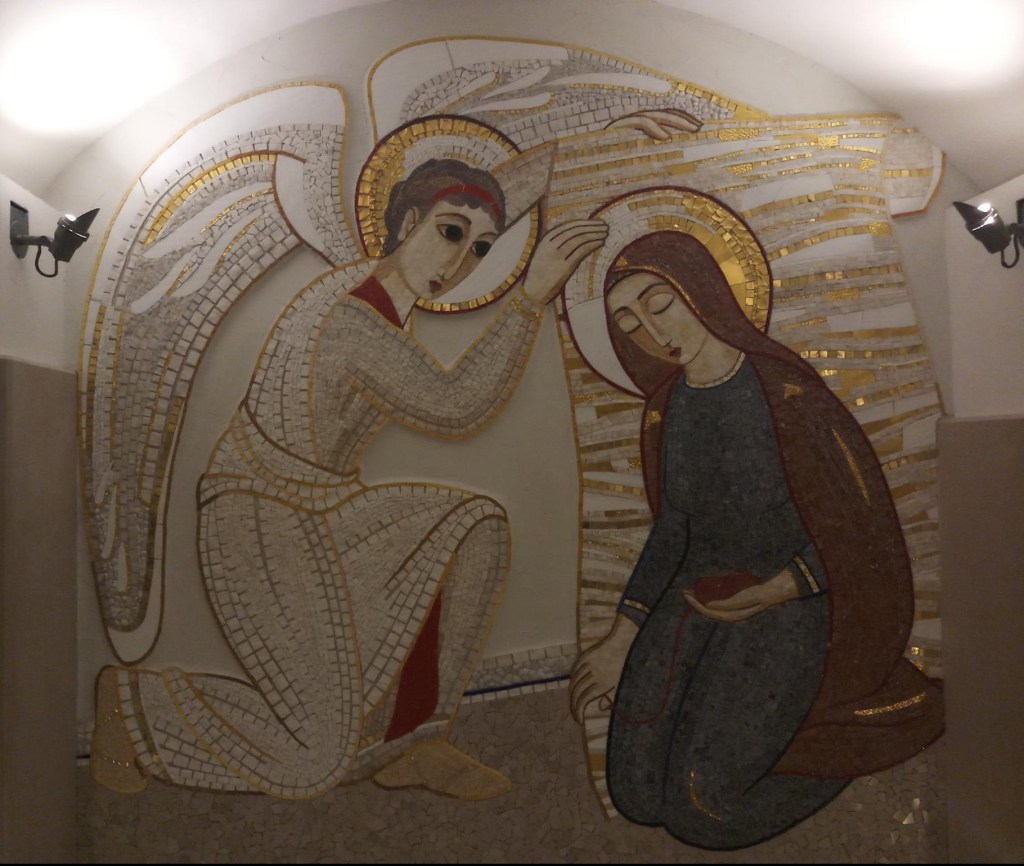
Photo by Arch. Philip Santiago, mosaic of the Annunciation at the San Padre Pio Church in San Giovanni Rotondo, Italy, 2016.

Writing in Greek like the rest of the authors in the New Testament, Luke did not use the usual Hebrew greeting of “Shalom” when Gabriel appeared to Mary, addressing her instead with chaire or “Rejoice favored one” that means especially graced from which came our translation from the Latin “Hail, full of grace!” in 1:28.

The favor or grace of Mary has found with God in 1:30 is explained in 1:31 in the future tense, “you will conceive in your womb and bear a son“. What is amazing here is that there is the sense of certitude on the part of the angel that the future will definitely take place because Mary has already been highly favored one by God before this event. How?

Though Mary will finally become a disciple at the end by saying “Behold, I am the handmaid of the Lord. May it be done to me according to your word” in 1:38, we find in 1:29 how she had always been disposed to the will and grace of God when Luke described how “she was greatly troubled at what was said and pondered what sort of greeting this might be“.

Mary “pondered – meaning, she prayed, she meditated right away the greetings to her, indicating her openness and disposition to listen and follow the will of God. That shows how even before the annunciation happened, Mary had always been obedient to God that is why she could say yes to Him when asked to be the Mother of the Savior.

Here we find Mary’s consistency as a disciple of the Lord, her Son Jesus still to be born but already existing in eternity!

When we were growing up, our mother would always tell us that once our names are called either by her or by our father, we only say one thing, “Opo… ano po iyon?” (Yes, what is it?). That is old school discipline where we literally obeyed first even without any instruction yet because we have always been assured parents would never tell kids to do something bad or wrong. And we believed that. Unlike today’s generations where the usual reply to parents’ call is “wait” that no wonder, we now ask God wait before he can speak to us. Thank God I did not get married….

Going back to Mary, we now find the contrast with yesterday’s annunciation to Zechariah: Mary pondered and felt everything in her heart and soul while Zechariah reasoned out, used more his head than his heart – something we must ponder this Christmas. Mary right away had her heart, her very self onto the Christmas Nativity while Zechariah was stuck in his negativity.

Mary believed while the event, the annunciation, was taking place, prior to any confir­mation by the event itself or by history. Later we shall see that expression “pondering in her heart” repeated often by Luke and also by John in presenting Mary: after listening to the words of the shepherds who came to see baby Jesus at His birth in Bethlehem, at finding Jesus at the temple aged 12, and during the wedding feast at Cana where He did His first miracle.

Photo by author of the site where the annunciation to Mary took place found below the Basilica of the Annunciation in Nazareth (2019).

The faith of Mary

From the annunciation of the birth of Jesus to His crucifixion, Easter and Pentecost, Mary always believed. During the Visitation, Elizabeth praised her, becoming the first to call Mary as “blessed” because “you believed what was spoken to you by the Lord would be fulfilled” (Lk.1:45).

Eight days after Easter, Jesus said to Thomas, “Have you believed because you have seen me? Blessed are those who have not seen and yet believe! ” (Jn 20:29). Early at the annunciation, Mary was the first to have believed without having seen Jesus Christ!

Mary teaches us the importance of subjective faith or the act of simply believing and trusting God, a person-to-person relationship with Him.

But it is not enough because it could lead to isolationism when we become individualistic and begin to have our own concept of God like what is happening these days especially with many Catholics with their own interpretations of God, heaven, evil and sin among other things.

Like Mary, we need to cultivate also objective faith, believe in the content of faith of the community. Mary believed God relating with the ancient prophets and patriarchs of Israel which the angel mentioned to her during the annunciation. See that after the annunciation, Mary hastily went to visit Elizabeth to share her good news and her faith. In her we learn that faith leads to a mission that is seen in the context of a community, the Church where Mary was portrayed to us praying with the disciples of Jesus during the Pentecost at the Upper Room in Jerusalem.

So here we find the consistency of Mary even before the annunciation that continued on in the life of the Church we still experience today in her many apparitions and messages always centered on Jesus not herself.

That is the call of Advent to us all: to be consistently clear with our faith with the one to be born at Christmas, Jesus Christ who is the Son of the Father, our Savior promised in Old Testament, now the very presence of God among us.

People kneeling on the streets during our Christ the King celebrations, 22 November 2020.

It is not enough that we just pray and believe; like Mary, we need to get out of ourselves and give ourselves to God and the Church. This is especially true with us priests who seem to believe more to himself and to media than with God! We must constantly examine ourselves if we truly believe in what we preach, in the kind of lives we lead. Is Jesus still center of our lives or us that we are so concerned always with our “image”, always seeking “likes” and “followers” than anything else?

If there is anyone who should be the first to be consistent in faith in God in any community, that must be the priest or pastor.

A few weeks ago while striving through the many challenges of my personal life and my ministry since this pandemic began, a parishioner told me how they draw strength and inspiration from me. I asked her why and how? What does my personal life has anything to do with them?

She explained that whenever they see me still going through with my ministry, holding on in my prayers and daily Masses, still smiling and can still laugh and crack jokes — they just feel they too can overcome their trials and difficulties.

I have realized in that short conversation more than preaching and explaining faith and its content, people look more at how faithful are we truly are as men of faith. That aside from dispensing the sacraments and doing all the ministries in my parish, there is also the task so unknown to me before of enkindling the faith of my flock, of guiding and leading them to God based on how do I live that faith in God with joy and patience.

People believe in God and the Church when they experience their pastor believing first in God and the Church. Like the COVID-19 virus, faith is contagious that spreads by coming into contact with. We priests must be the first to be “infected” with faith in the parish so that everyone would be “positive” with it, creating a “pandemic” in faith!

That is the consistency of Mary as a disciple — she is a “carrier” of a deep, joyful and active faith in Jesus, “infecting” everyone so positively that despite the difficult and trying situations we are into, we celebrate Christ’s coming amid the pandemic.

A blessed Sunday as we prepare for Christmas!

When feeling helpless

The Lord Is My Chef Breakfast Recipe for the Soul by Fr. Nicanor F. Lalog II
Saturday, Week XXX, Year II in Ordinary Time, 31 October 2020
Philippians 1:18-26     >><)))*>  +  >><)))*>  +  >><)))*>     Luke 14:1, 7-11
Photo by Mr. Jim Marpa, 2019.

It is the end of another month, of another week as we brace ourselves for a super typhoon directly hitting our region. And yes, God our loving Father, we are scared, we are worried, we feel helpless most specially for our little brothers and sisters, those who have always been suffering in life like the poor, the elderly, the sick, the marginalized.

But if there is one thing we have learned from COVID-19 these past eight months is to wholly entrust everything to you, O God, to completely surrender and rely on you alone.

Let us grow deeper in faith, more fervent in hope and be unceasing in our charity and love for others so that the Gospel of Jesus your Son may always be proclaimed.

Help us imitate St. Paul, though imprisoned and almost certain of facing death, no trace of helplessness is found in him; on the contrary, he was so full of power coming from his deep, personal relationship with Jesus Christ.

My eager expectation and hope is that I shall not be put to shame in any way, but that with all boldness, now as always, Christ will be magnified in my body, whether by life or by death. For to me life is Christ, and death is gain.

Philippians 1:20-21

Enable us in the power of the Holy Spirit to humbly submit ourselves to you, dear God, confident that you always have a specific place and seat, a role to play for us — if we can learn to first stand up for you like in today’s parable by Jesus.

May the coming typhoon be an opportunity for us to let our faith be expressed in words and in deeds. Amen.

We are all in a struggle

The Lord Is My Chef Breakfast Recipe for the Soul by Fr. Nicanor F. Lalog II
Thursday, Week XXX, Year II in Ordinary Time, 29 October 2020
Ephesians 6:10-20     >><)))*> + + + >><)))*>     Luke 13:31-35
Photo by author, 09 October 2020.

There is no doubt, O God, we are in a war with evil as St. Paul tells us in today’s first reading; but, as I prayed more, I dwelled on that one word he had said — “struggle”.

For our struggle is not with flesh and blood but with principalities, with the powers, with the world rulers of this present darkness, with the evil spirits in the heavens. Therefore, put on the armor of God, that you may be able to resist on the evil day and, having done everything, to hold your ground.

Ephesians 6:12-13

Almighty and loving Father in heaven, today I pray for each one of us struggling in life — struggling to survive, struggling to be afloat amid the economic crisis, struggling to keep our family and friends together, struggling against an addiction, struggling against sins, struggling in almost everything or anything, maybe even struggling to believe and have faith in you, dear God.

To struggle is an effort to get out of something not meant to be like an imprisonment. To struggle is to exert efforts to resist attacks or be free from any constraints. Like when a fish is out in the sand, it struggles to get onto water which is its natural habitat.

There are many conditions in our lives today we are into but not really meant to be for us like the effects of evil and sin sometimes perpetrated by some among us. We are sure you never wanted us to be put into this situation. And that is why, you have sent us your Son Jesus to help us in our struggles.

Sometimes, life for others has simply been entirely a struggle since childhood.

Have mercy on us, please help us, Lord, in our struggles. Be our armor of truth and righteousness, our shield of faith, our helmet of salvation, and our sword of the Holy Spirit to slay the evil and sins enslaving us.

Thank you, dear Jesus, for standing by our side in our many struggles despite efforts of some like the Pharisees in the gospel today who told you to leave Jerusalem because “Herod wanted to kill you” (Lk.13:31).

Make us realize that in the midst of life’s many struggles, “you are our Rock, O Lord, who trains our hands for battle, our fingers for war” (Ps.144:1) and someday, as you have promised, we shall win in all our struggles to experience your glory and majesty, love and mercy. Amen.

Photo by Ms. Jo Villafuerte, September 2019 in Atok, Benguet.

How I found my vocation in life through a simple prayer for faith

Quiet Storm by Fr. Nicanor F. Lalog II, 27 October 2020
Photo by Ms. Anne Ramos, March 2020.

Whenever people ask me about the story how I became a priest, I always begin by telling them that I am more of a “delayed vocation” than a “late vocation” because after graduating from high school seminary in 1982, I was refused admission to the major seminary to pursue the priesthood.

It was the first serious blow I have had in my life as I felt so deeply hurt because I thought God wanted me to become a priest only to be rejected. It was then I realized his saying “many are called but few are chosen” could be so bad as I had to leave the seminary.

Feeling rejected, I decided to go to the University of Sto. Tomas to pursue my “first love” – journalism to totally forget the priesthood specially when I got into the staff of the Varsitarian (1984-86). It was at the Varsitarian where I learned everything about newspaper journalism that on my senior year in college, I opted to have my training at GMA-7 News to try broadcast journalism.

And I was so amazed at how TV and radio can quickly report the news as it happened, specially whenever I would hear those alarms ringing from the telex machines of United Press International (UPI) and Philippine News Agency (PNA). (By the way, the first thing I learned in broadcast news was changing the newsprints for those telex machines.)

After graduation in college, I got hired as news writer for GMA radios DZBB-AM and 97.1 DWLS-FM. Two years later, I was assigned to cover the police beat at the graveyard shift for our television newscasts.

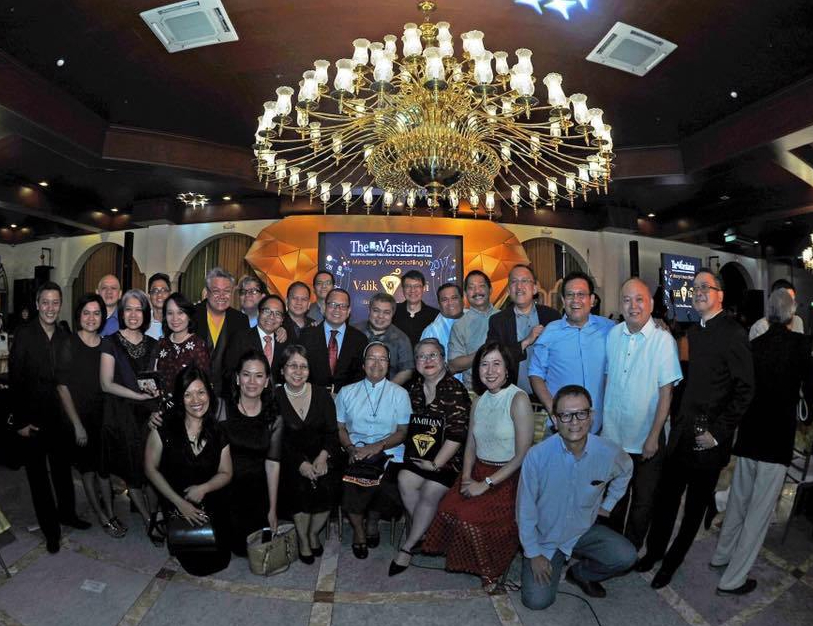
With former co-staffers and fellow alumni of UST’s The Varsitarian during our 2017 homecoming.

One morning before “going to bed”, I read a copy of the Columbia, the magazine of Knights of Columbus my father had insisted me joining while in college. At the last page was a vocation campaign written by a Carmelite priest who claimed something like “faith is a very important gift of God we must keep because if we lose it, we could also get lost in life”.

I cannot remember the priest’s explanations but those words got stuck in me that very morning when I just felt praying again after a very long time of being a nominal Catholic in college and GMA-7. The words simply flowed from my lips to become my only prayer in the next four years:


"Lord,
let me grow in faith 
in you."

Everything happened so fast for me at GMA-7 with all the breaks and opportunities given me which I never asked nor even dreamed of. I have never wanted to be “on camera” and have always preferred working behind the scenes (even now as a priest).

As I look back and count my blessings, I always consider it as a grace, a gift from God when Ms. Jessica Soho recommended me to take her place covering the military/defense beat when she was promoted to hosting her own morning show and doing special reports that have established her now as the best in the field.

Despite the recognition that came along with a career in broadcast news, deep inside me I started feeling empty as early as 1988. Most strange of all, I felt God calling me back to the priesthood that I vehemently dismissed, knowing personally how sinful and evil I have been!

When the emptiness and priestly call persisted, I slowly returned to our parish thinking that maybe, I was just missing my old ways of going to Mass and singing with the choir. But, the more I thirsted and yearned for God!

It was so funny and even ridiculous for me at that time seeing myself praying more often, choosing to be alone inside the church like when we were in the minor seminary. I even did not know if I were praying at all except that I felt complete in silence until one day, I found myself begging God:


"Lord, 
let me know
my vocation 
in life."

I thought of leaving broadcast journalism in 1989 to teach English language to Vietnamese refugees in Morong, Bataan after reading its ads in the Manila Bulletin. It seemed to me that was what I was searching for, something I can enjoy with a deeper purpose and meaning like serving others.

For several weeks I would read the ads in the newspaper until my interest died down as I got into a lot of action doing police stories in the dead of the night. It was also the time when I got so busy covering the 1989 December coup attempt and the destructive Luzon earthquake of July 1990.

Though I felt good reporting the news from the fields, one thing I noticed every time I went home was how I still felt empty inside when alone. Life had no meaning that I tried seeking it in bottles of beer, then in shots of brandy and whiskey until I thought I have found it in glasses of Tanqueray gin tonic. Mr. Marlboro in blue seal bought along Timog Ave. became my constant companion too.

Finally I sought spiritual direction from some priests I have known in the seminary like our former rector Fr. Memeng Salonga and our Sunday Mass presider in our barrio chapel, Fr. Boie Agustin. They have greatly helped me in discerning my vocation that I decided to take the entrance exams to the seminary in February 1991.

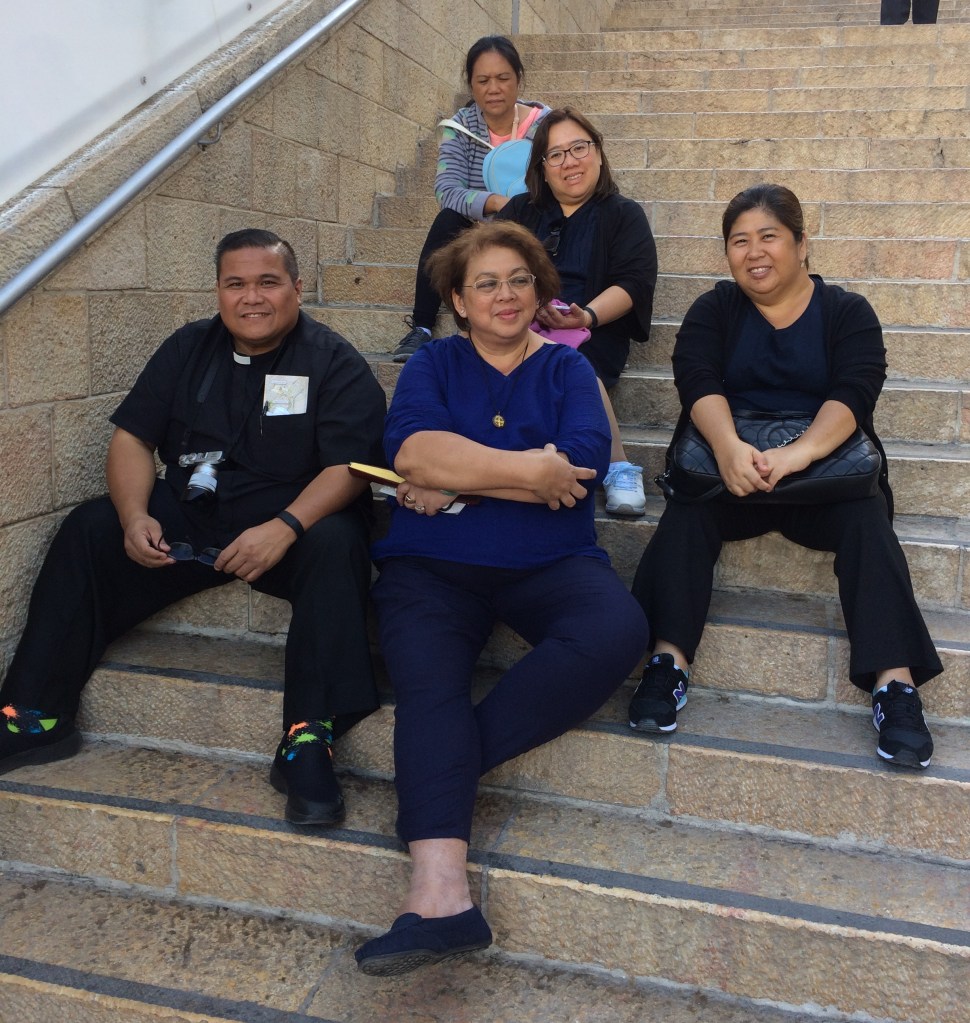
With my former colleagues at GMA-7 News as we rest on the steps near the Wailing Wall of Jerusalem during our Holy Land pilgrimage in 2017; from top is Ms. Marissa Flores, SVP of GMA-News with her nurse, Ms. Jessica Soho of “State of the Nation” and KMJS, and Ms. Kelly Vergel de Dios, the former VP for Personnel of GMA News.

It was the last exam date for the coming academic year and frankly, I was still hesitant to give my vocation a second try because I felt unworthy of the call and most of all, afraid of failing again like in high school seminary.

For a while I felt a strong basis for my doubts with my vocation: just when I was about to take the entrance exam, our boss, Ms. Tina Monzon-Palma asked me to cancel my day off that Saturday to search for the lone survivor of the 1911 Taal eruption in Talisay town when that “small but terrible” volcano showed signs of activity.

In my mind, God must be using Ms. Palma to inform me I got it all wrong, that he wasn’t calling me at all to the priesthood that is why I was given a job that Saturday, the last exam date to the seminary.

Of course I was so glad missing the entrance exam with a valid reason that I immediately went back to “happy hours” after coverages until late March when I had a severe attack of gout one weekend. It was so painful that I could not go to work the following Monday and Tuesday.

While in total bed rest for my gout, I felt my vocation coming back again, more persistent than before that I had the stupid idea of asking God for one last sign that would clearly convince me he wanted me to become a priest.

And God heard my prayer!

By Thursday I was back to work covering the newly-assigned AFP Chief Gen. Lisandro Abadia inspecting the troops in Abra and Kalinga. Everything went well until we flew to Laoag City for the final leg of Gen. Abadia’s troop inspection when one of our plane’s tires blew on landing!

Boom! Everything was so fast as I remembered the loud explosion of the tire on my side of the plane, followed by thick smoke seen from my window and tilting of plane as I ducked my head down on my lap, repeatedly praying in silence, over and over again, “Yes, Lord! Magpapari na po ako!”

It was the big news that evening: a tire of the plane with the new AFP Chief blew upon landing at Laoag City airport.

And the bigger news among newsmen was me —- everybody was teasing I was the next Jessica Soho who used to figure out in accidents while covering soldiers and military officials.

More teasings and laughters welcomed us when we got back to Manila but all throughout our trip until I got home that night, I felt deep inside like the prophet Jonas so relieved and convinced of God’s call after being spitted out from the belly of a giant whale like that PAF’s Fokker plane. From that day also, I have never dared to ask God for signs anymore.


Faith is a relationship with God;
we pray with faith not to obtain favors 
but to grow deeper 
in love and unity
in Him. 
 

It was not very easy for me when I finally returned to the seminary in 1991 until our ordination to the priesthood in 1998. There were more trials and hardships, more tests that required from me more prayers, more faith…. to which I got in return from God more love, more mercy, more calls.

From that simple prayer to grow in faith, God has blessed me more abundantly not materially but spiritually and emotionally, of being fulfilled in him. Since becoming a priest in 1998, I have stopped asking God for any specific things in prayers. All I ask him is to give me with more firm faith, fervent hope and unceasing charity and love so that in every here and now, I may say yes to his calls.

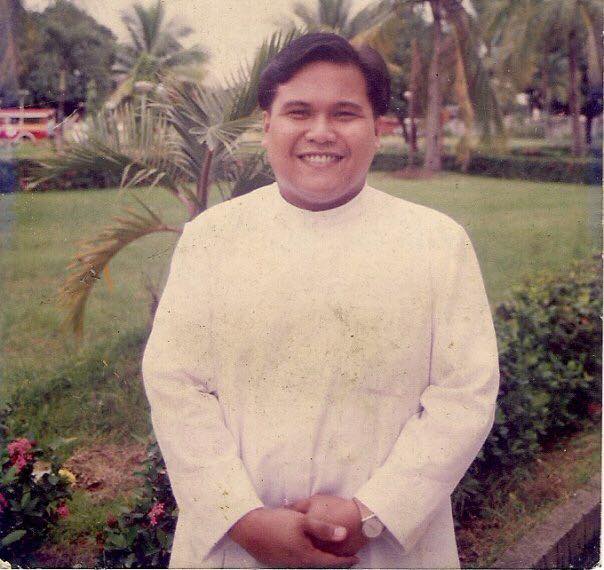
My first months in the seminary in 1991.

In his book reflecting his 50 years of being a priest published in 1999, St. John Paul II described the priesthood as both a gift and a mystery. Indeed, every vocation from God – priesthood, religious life, married life, and single-blessedness – is always a gift and a mystery, something so personal and so deep between me and God, or you and God.

This I realized more when public Masses were suspended during the lockdown in March. It was in that being alone and sad when I existentially experienced the Mass as truly a union, an intimacy of the priest with the Eternal Priest, Jesus Christ. With or without the people.


Let me close this with another prayer I have made during our annual retreat in the seminary in 1994 facilitated by a Cenacle sister. It is one of my core prayers next to that about growing in faith:

Lord Jesus Christ,
you have given me with so much
and I have given you with so little;
teach me to give more of myself,
and most of all, 
more of your love,
more of your kindness,
more of your mercy and forgiveness
and most of all,
more of YOU to others.
Amen.

Enjoy and grow in your faith journey in the Lord until you find your vocation in life in him!

Photo by author, 22 September 2020.

Postscript-2 to St. Paul’s Letter to the Galatians

Quiet Storm by Fr. Nicanor F. Lalog II, 21 October 2020
Statue of St. Paul at the Malolos Cathedral by the famed ecclesiastical artist Willy Layug.

Today we conclude our reflections – or “postscript” – to St. Paul’s Letter to the Galatians about faith we heard proclaimed in the weekday readings two weeks ago from October 05-14, 2020.

A truly faithful person 
is one who is also free.

We have said that faith is a relationship with God and with others like in marriage and friendship. When our faith with God and with persons is strong with conviction and realistic, then the more we become free because there is no room for doubts that we are not loved.

Brothers and sisters: Scripture confined all things under the power of sin, that through faith in Jesus Christ the promise might be given to those who believe. Before faith came, we were held in custody under law, confined for the faith that was to be revealed. Consequently, the law was our disciplinarian for Christ, that we might be justified by faith. But now that faith has come, we are no longer under a disciplinarian.

Galatians 3:22-25

Recall those times we have felt imprisoned and chained by the past with all of our broken and toxic relationships, sickness and handicaps, failures and sins, and other painful memories: that was when we wavered in our faith, when we lacked conviction in our faith.

We have to be convinced that Jesus came to set us free from all forms of slavery that prevent us from growing and maturing in faith and freedom in him. When our faith is strong, then we are able to break the many barriers that imprison us like gender, color, language, social status and even religion.

Nourish our faith to be free to become our true selves!

Photo by author, 2019.

Faith works through love.

It is God’s gift of faith that enables us to do good, to do our works of charity and love. And because we are faithful and free, then we also love!

Incidentally, being faithful and free are always tied up with being able to love because love is a choice, a decision we make, not just feelings or emotions.

Every choice is made out of freewill and here is the most interesting part of being faithful and free and loving: like love, man is able to believe and trust because it is God who first believed and trusted us!

A faithful person is always a loving person because he is free to choose what is good, what is right. And the more faithful we become to God, to your spouse, to your family and friends, the more loving you become like them!

For in Christ Jesus, neither circumcision nor uncircumcision counts for anything, but only faith working through love.

Galatians 5:6

Without faith, it is difficult for us to love because of the pains that come always in loving.

Without faith, it is impossible to forgive and be merciful, to let go of others’ infidelity and lack of love and concern because these are virtues and values that come only from within, from a loving heart that is also faithful where Jesus Christ dwells and reigns.


A few years ago, GMA-7 launched its talent search called Starstruck inviting young people to… Dream. Believe. Survive.

For us Christians, it is… Dream. Believe. Live.

The moment we believe, then we are able to see, even God hidden among each one of us. Amen.

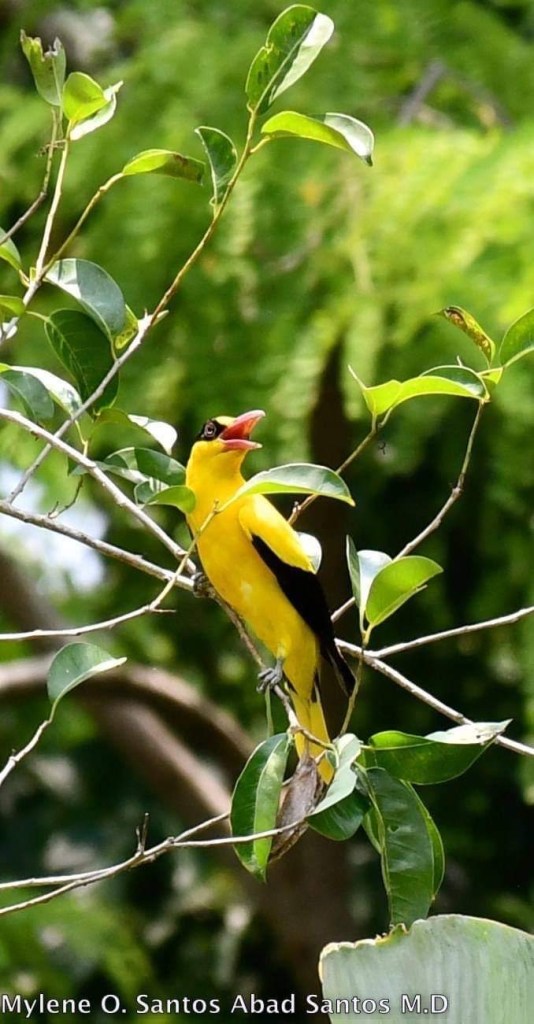
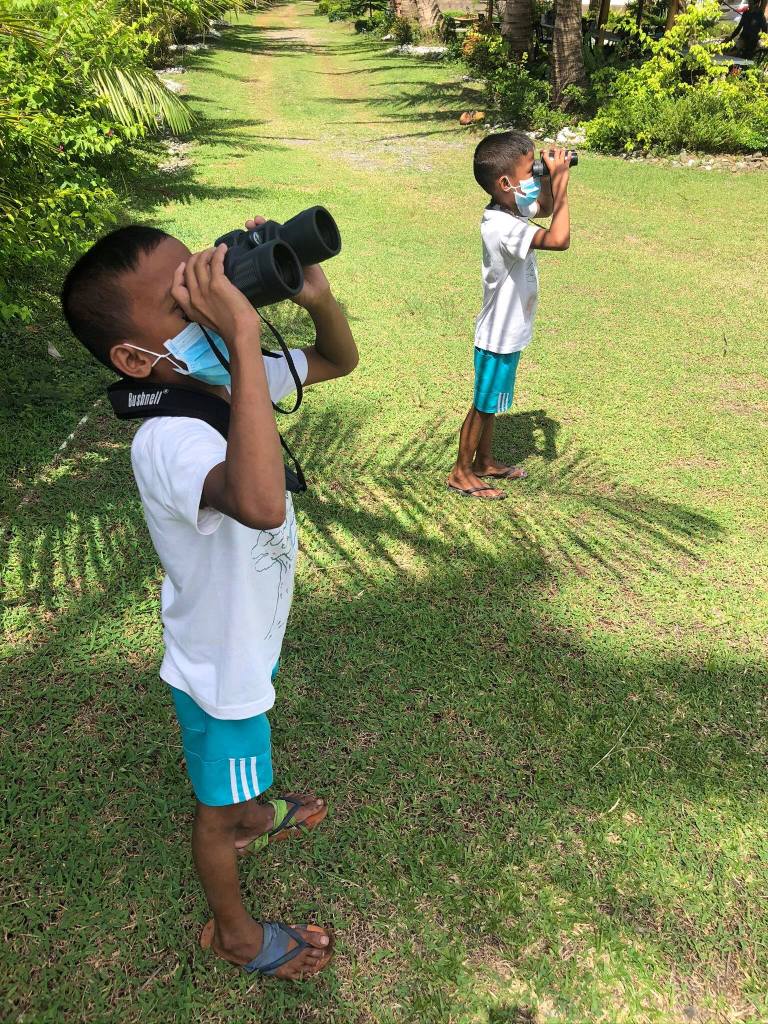
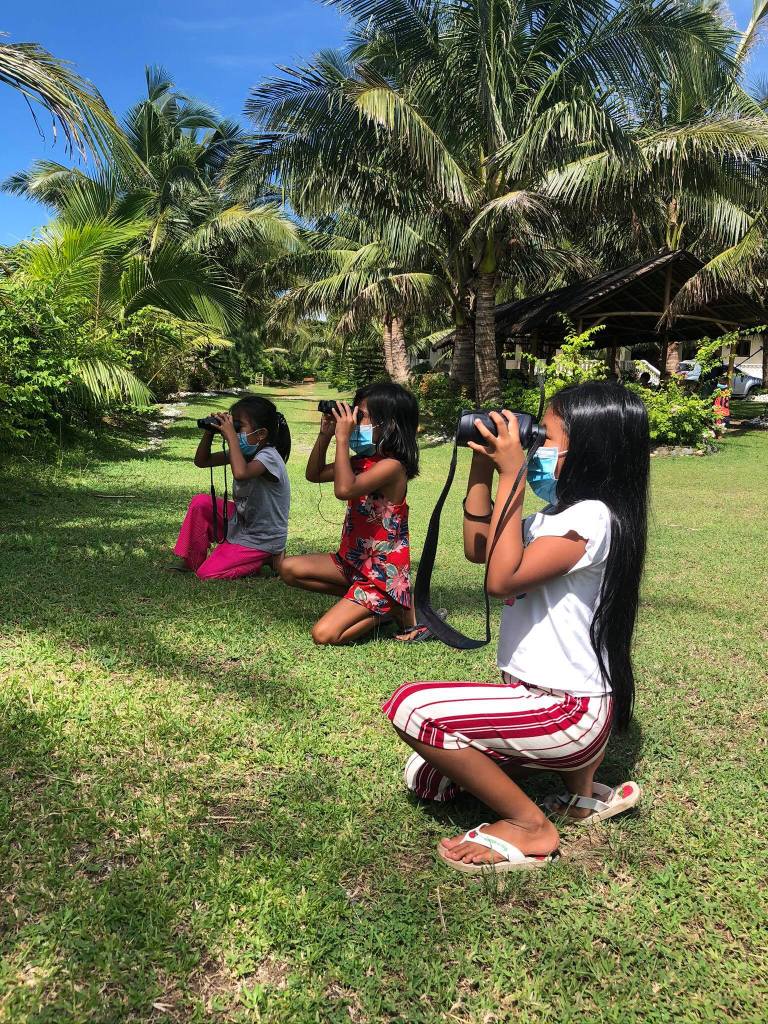
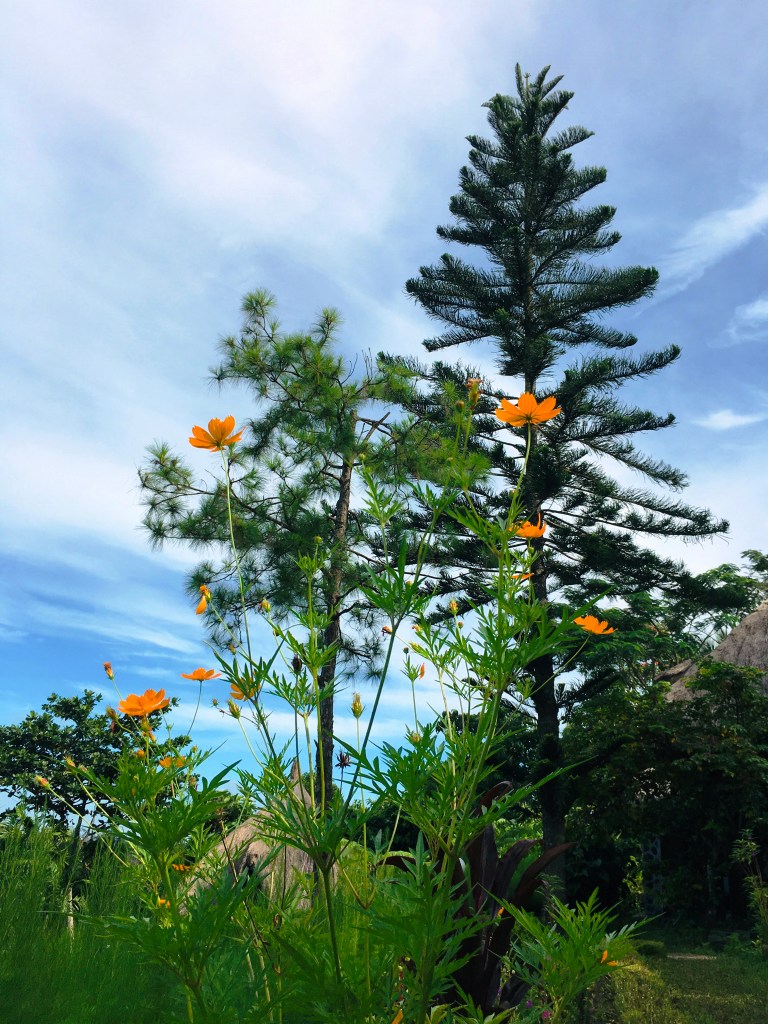
*All photos by Dr. Mylene A. Santos, MD at Katmon Harbor Nature Sanctuary, Quezon, 2020.

Praying for humility and gratitude

The Lord Is My Chef Breakfast Recipe for the Soul by Fr. Nicanor F. Lalog II
Wednesday, Week XXIX, Year II in Ordinary Time, 21 October 2020
Ephesians 3:2-12     >><)))*>  +  >><)))*>  +  >><)))*>     Luke 12:39-48     
Photo by author, Baguio City, 2018.

God our loving Father in heaven, teach us to accept that you love us, that you trust us, and that you believe in us so that we can finally be grateful and humble before you.

Yes, dear God – one reason we find it so hard to be grateful and humble before you is because we have hardly accepted nor appreciated your love and trust in us. Teach us to see ourselves as you see us, like St. Paul despite our sinfulness.

To me the very least of all the holy ones, this grace was given, to preach to the Gentiles the inscrutable riches of Christ, and to bring to light for all what is the plan of the mystery hidden from ages past in God who created all things.

Ephesians 3:8-9

What a wonderful attitude by St. Paul, expressing such gratitude to you God in calling him and entrusting him the “stewardship of your grace” (Eph.3:2) for others to experience you and your love!

Remind us, dear God, that everything we have is not simply a grace and blessing from you but a sign of your trust in us – whether as a husband or wife, mother or father, brother or sister, or, whatever profession and vocation we follow – they all mean you believe us, that we are responsible enough and most of all, we can all accomplish our mission in Jesus through the Holy Spirit.

May we heed your Son’s warning in today’s parable that

“Much will be required of the person entrusted with much, and still more will be demanded of the person entrusted with more.”

Luke 12:48

And to do so, let us humbly and gratefully accept your gifts always. Amen.

Photo by Dr. Mylene A. Santos, MD, Quezon, 2020.

A “postscript” to St. Paul’s Letter to the Galatians

Quiet Storm by Fr. Nicanor F. Lalog II, 19 October 2020
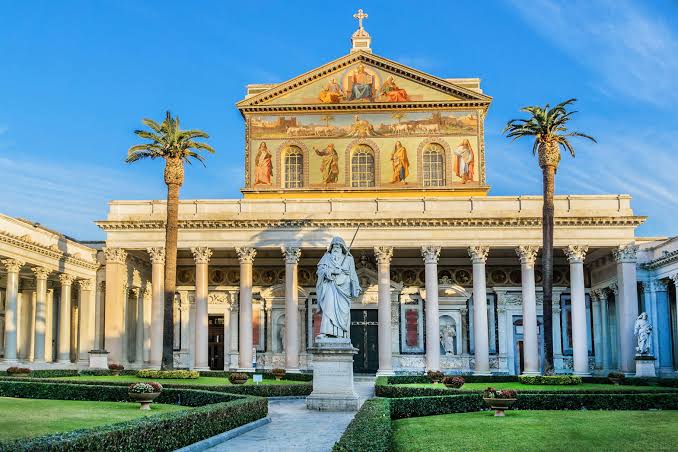
St. Paul’s Basilica in Rome from en.wikipedia.org.

It is really funny these days at how things we grew up with have changed so differently like the postscript we used with initials “P.S.” at the end of letters as an afterthought we sent relatives and friends about 40 years ago.

Today, a postscript is more of a trademark and an application in computers but for my generation, it is from the Latin “post scriptum” that means “written after”.

Consider this piece, my dear Reader, as a postscript or PS to St. Paul’s Letter to the Galatians we heard proclaimed during weekdays from October 5-14, 2020 where he explained and reflected about faith in Jesus Christ whom he loved so much.


Faith is having a relationship with God, 
not to obtain things from him.

We always hear people say “have faith” in everything we pray for. Always believe that God will hear us, God will grant us what we need and ask for.

But what happens when we do not get what we are praying for like when a loved one is not healed or recovers from a sickness and eventually dies? Or, flunk an important exam or maybe fail to close a major deal in business? Does it mean we lack faith? Or, is that the main purpose of having faith in God, to obtain things and favors from him?

See how St. Paul called the Galatians “stupid” for being misled by false teachings on the gospel of Jesus Christ: some preachers had come to Galatia at that time telling them of the need to be circumcised like the Jews who converted to Christianity in order to be saved. He wrote the Galatians primarily to rectify those errors they have seemed to believed, where he introduced the doctrine of “justification (salvation) by faith in Christ”, not by rituals and other practices men do. It is not to dismiss our traditions but to stress the primary role of faith in Jesus Christ who died for our sins to save us.

O stupid Galatians! Who has bewitched you, before whose eyes Jesus Christ was publicly portrayed as crucified. I want to learn only this from you: did you receive the Spirit from works of the law, or from faith in what you heard? Are you stupid? After beginning with the Spirit, are now ending with the flesh?

Galatians 3:1-3

Sometimes like the Galatians, we end up with the flesh, believing more in things we do like rituals and other things than truly believing Jesus because we use faith to obtain things from God.

No! We believe because we relate: every relationship like marriage always presupposes faith in the other person. Even Jesus in teaching us how to pray, he taught us the “Our Father” which is an expression of a relationship.

Wedding of my former student, Micah and Lery Magsaysay, February 2020.

Being faithful means being realistic.

Jesus himself assured us that faith can move mountains and do other great things for us if we truly believe. This is perhaps the reason we always equate faith in asking for so many things from God.

Not at all. We also have to be realistic with things we ask from God. He is not a magician who has to please and entertain us with his miracles and powers. When we were in high school seminary, the late Fr. Nick Cruz, SJ gave us a recollection and told us we cannot simply ask anything from God like a rose blooming from your toothpaste to prove he calls you to the priesthood!

Being realistic in our faith by praying first of all to have Jesus, only Jesus and always Jesus!

When Jesus told us to seek and you shall find, to ask and it shall be given to you, and to know and the door shall be opened to you (Lk.11:9-10), he was not telling us to ask for money and gadgets. If we are going to be realistic in our faith, Jesus is telling us to seek God and you shall find him, to ask God and you shall have him, and most of all, God is the only door when we knock would surely open us to new beginnings.

In explaining the unique call we have received from God in Christ, St. Paul gives us the whole reality of our being Christians, of having a faith that is realistic.

For all of you who were baptized into Christ have clothed yourselves with Christ. There is neither Jew nor Greek, there is neither slave nor free person, there is not male and female; for you are all one in Christ Jesus. And if you belong to Christ, then you are Abraham’s descendant, heirs according to the promise.

Galatians 3:27-29
Photo by author, August 2020.
Faith demands conviction and consistency.

God’s gift of faith in us is not everything; we have to cultivate and deepen our faith to experience its wondrous fruits and grace. See the kind of conviction of St. Paul in proclaiming and explaining his faith in Jesus Christ.

Now I want you to know, brothers and sisters, that the Gospel preached by me is not of human origin. For I did not receive it from a human being, nor was I taught it, but it came through a revelation of Jesus Christ.

Galatians 1:11-12

Like the Galatians, many of us are easily swayed by so many other beliefs and teachings that are misleading, claiming to be a part of the faith we have received. Without firmness and conviction in our faith, some among us have gone to accommodating modern thoughts and lifestyles that run contrary to our faith in Christ like abortion, same sex marriage, and in-vitro fertilizations or test tube babies.

A believer without conviction and consistency in faith and actions is not faithful at all. What happens with our “faith is a relationship” when the chips are down, when we are confronted of either being for God or against God?

Sometimes we try “moving the lines”, convincing ourselves that we are not crossing the line of morals and morality like when we are bent on accommodating others and ourselves in some occasions to justify personal preferences.

Sad to say, it happens even among us clergymen like when we tinker with the liturgy and the sacraments in the name of modernism and of arts and worst, with some issues pertaining to acts intrinsically sinful and immoral.

Maybe if we would have the conviction and consistency of faith, we would all be like the good Samaritan in the Lord’s parable – a neighbor to everyone especially those in need, willing to cross the street to faithfully reach out to others in Jesus Christ (Lk. 10:25-37).

Try examining our faith today. Has it bloomed into a relationship we keep with God our Father in Christ Jesus through the Holy Spirit or has it remained as it is, a given, a safety net just in case we need?

Have faith, have God and we’ll journey far, together! Amen.

From americamagazine.org.

On Wednesday, we reflect on being faithful and free, and how faith works through love. Have blessed Monday and see you again!

You may also check our prayers from October 05-14, 2020 based on St. Paul’s Letter to the Galatians at the archives of http://lordmychef.com.

Hope. And be surprised!

Quiet Storm by Fr. Nicanor F. Lalog II, 14 October 2020
Photo by author, sunrise at the Lake of Tiberias, the Holy Land, May 2019.

HOPE. A favorite word among us, used as an expression for things to get better, especially when we express our “hope” God grants what we pray for, or, in ending our letters of request with “hoping for your kind consideration”.

Even Hollywood is fond of this virtue, portraying it as a reserved power to overcome evil when Neo in the 2003 The Matrix Revolutions was summoned into action to defend their city because he was the only one with “hope”.

Or, something like a turbo charger that will boost every leap of faith when Toretto in Fast and Furious 6 handed to his rival Owen Shaw the computer chip they were tasked to retrieve in the “hope” of getting it back even if they have to chase a giant Antonov An-124 plane taking off.

Of course, Neo and Toretto succeeded in their efforts filled with hope, defeating evil.

But, that is not what hope is all about.


To hope is different from optimism, of believing things can get better;
in fact, we hope because things can get worst.

The late Fr. Henri Nouwen wrote in one of his books that to hope means having that firm conviction within that even if things get worst like death, we are certain God will never forsake us for he loves us very much.

Jesus Christ showed us this true meaning of hope when he decided to go to Jerusalem to accomplish his mission by dying on the Cross for our salvation. I love the way Luke narrated in his gospel this attitude of Jesus in showing us the path of hope amid his knowledge things would get worst than before leading to his Passion and Death (and Resurrection):

When the days for his being taken up were fulfilled, he (Jesus) resolutely determined to journey to Jerusalem…

Luke 9:51

Imagine Jesus “resolutely determined” going to Jerusalem, the very same attitude of saints witnessing the Gospel by facing martyrdom. It is also very true with us when we say our only hope is the Lord when we know of sure death while facing a serious illness.

To hope is to be “resolutely determined” like Jesus and the saints along with our loved ones to follow the arduous path of life, of putting up the good fight against sickness or injustice and evil even if they knew things will lead unto death. At first we wonder, what victory can we claim if in the end we die like the saints and martyrs?

That’s the mystery and paradox of hope: to hope is to completely trust in God that death is not the end of life or any struggle but the highest point of our transformation as we dive to life’s lowest level like defeat, loss, and death when we pray like Jesus on the Cross, “Father, into your hands I commend my spirit” (Lk.23:46).

Hope is faith severely tested, believing and abandoning everything to God, come what may.

Photo by Arch. Philip Santiago, Fatima, Portugal, 2016.

Hope is clearly not positive thinking nor optimism; hope is “faith in God” as Pope Emeritus Benedict XVI tells us in his second encyclical, Spe Salvi (2007). According to Pope Benedict, hope gives us the direction towards the future by enabling us to face the challenges of this life leading to salvation and eternal life.

In this sense it is true that anyone who does not know God, even though he may entertain all kinds of hope, is ultimately without the great hope that sustains the whole of life (Eph.2:12). Man’s great, true hope which holds firm in spite of all disappointments can only be God — God who has loved us and who continues to love us “to the end,” until all “is accomplished” (Jn.13:1 and 19:30)… If we are in a relation with him who does not die, who is Life itself and Love itself, then we are in life. Then we “live”.

Spe Salvi, #27

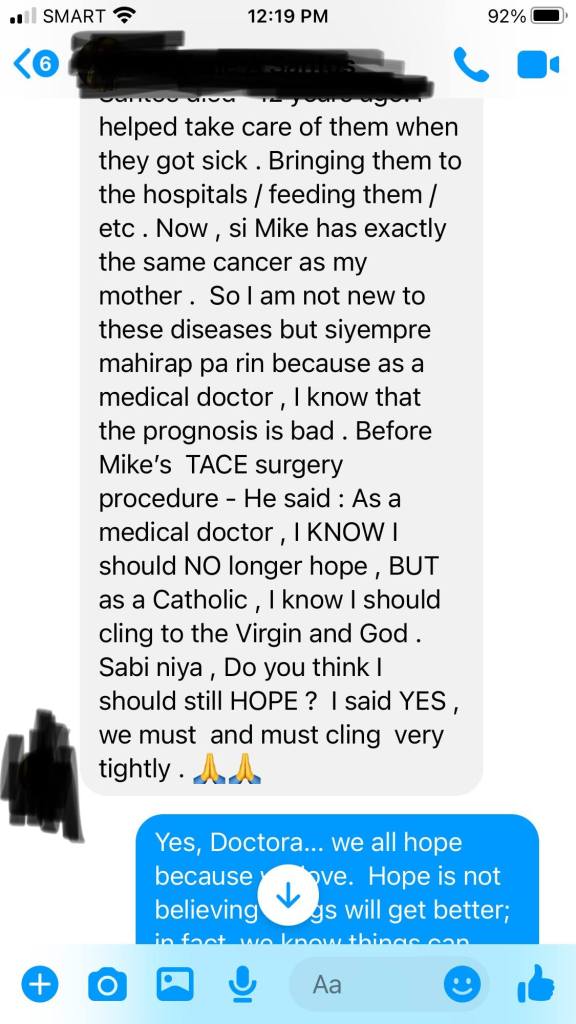
Four weeks ago, a former parishioner had asked me for prayers for her husband with liver cancer. Both are medical doctors; in fact, it was her husband who had actually diagnosed himself while going through radiological lab exam.

It was at that time they “resolutely determined” to go home and face the inevitable by praying together, hoping together in God.

Here lies the mystery and paradox of hope we were talking earlier: why and what do we really hope when we know it is going to end in death?

God. Nothing else and nobody else. God is the reason we hope and what we hope for.

It is only when we have been stripped of everything else when we truly “see” and experience God is all we have in life after all.

Then we become confident God will never abandon us until the end.

That is what my friend and her husband have realized, especially when Dr. Mike died two weeks later after going home.

When I celebrated Mass at his wake, I could not resist telling my friend how the smile of her husband is the sweetest, even most infectious one I have ever seen on the lips of a dead person in my 22 years as a priest!

Truly, the Lord loved Dr. Mike until the end that he died with a smile as the fruit of his hoping in God with his wife.

Indeed, friends have told me that God will give us the grace to face our death when that time comes; and I believe them because I have seen them transformed after accepting their terminal condition that they no longer cry of their situation getting worst while those to be left behind in turn become the ones crying knowing their beloved is passing (https://lordmychef.com/2020/09/22/the-gift-of-tears/).


Hope surprises.
Even God.

Photo by author, 2019.

When I was on my second year of seminary formation in theology, I experienced the most severe test of my vocation to the priesthood that I almost left and abandoned all plans of becoming a priest at all.

What sustained me in the seminary were prayers — and some lines from T.S. Eliot’s very long poem “Four Quartets” published in 1941:

I said to my soul, be still, and wait without hope
For hope would be hope for the wrong thing; wait without love,
For love would be love of the wrong thing; there is yet faith
But the faith and the love and the hope are all in the waiting.
Wait without thought, for you are not ready for thought:
So the darkness shall be the light, and the stillness the dancing.

Too bad I have lost the index card on which I wrote this stanza which I posted on my study lamp, reading it daily even until I have become a priest.

To truly hope, one has to get totally lost and empty, stripped naked of our very selves when darkness is our only light and hopelessness is our only hope.

It is when we have totally lost everything except God when we truly hope.

And that is when all the surprises happen, not only with ourselves but with others.

Not only here but definitely even in eternity, the biggest surprise we are all hoping for.

Photo by author at Silang, Cavite, 22 September 2020.

In 1912, the French poet Charles Pierre Péguy (1873-1914) wrote a very long poem ahead of T.S. Eliot about the virtue of hope, claiming it is God’s favorite because it is full of surprises.

Péguy portrayed Hope as a “little girl” who enlivens her older sisters Faith and Love.

I do not want to dilute its magic and power so I leave it that way for you to savor its sweetness, its truth and beauty in Péguy’s poetry:

The faith that I love best, says God, is hope. Faith doesn’t surprise me. It’s not surprising. I am so resplendent in my creation…. That in order not to see me these poor people would have to be blind. Charity, says God, that doesn’t surprise me. It’s not surprising. These poor creatures are so miserable that unless they had a heart of stone, how could they not have love for each other…. But hope, says God, that is something that surprises me. Even me. That is surprising.

Charles Péguy, The Portal of the Mystery of the Second Virtue

Sometimes in life, we have to hit rock bottom in order to truly hope. Keep hoping and you will surely be surprised by God, by others, and by our very selves that we are always blessed! Amen.

Faith works through love

The Lord Is My Chef Breakfast Recipe for the Soul by Fr. Nicanor F. Lalog II
Tuesday, Week XXVIII, Year II in Ordinary Time, 13 October 2020
Galatians 5:1-6     >><)))*>  +  >><)))*>  +  >><)))*>     Luke 11:37-41 
Photo by author, Lovers’ Bridge, Tamsui in Taiwan, January 2019.

Thank you again, God our Father, for the gift of faith that enables us to do good, to do your works of charity and love. You have gifted us with freewill primarily because of faith itself when you believed in us and trusted us.

Yes, dear Father: like love, we are able to believe and trust you because you were the first to believe and trust us. Forgive us for those times we wrongly chose sin, when pride and selfishness, doubts and mistrust clouded our decision making. When despite our faith, we refused to love.

For in Christ Jesus, neither circumcision nor uncircumcision counts for anything, but only faith working through love.

Galatians 5:6

Indeed, it is because of faith that we are able to choose and do what is good. And the more faithful we become to you, O God, we become more loving like you!

Without faith, it is difficult for us to love because of the pains that come always in loving

Without faith, it is impossible to forgive and be merciful, to let go of others’ infidelity and lack of love and concern because these are virtues and values that come only from within, from a loving heart where faith dwells.

Photo by author, February 2020.

Sometimes, like the Pharisees, we become so focused with what is outside to cover what is missing inside us — faith!

And despite our confessions of our faith, we believe more on outside appearances and forget the more essential inside that is faith leading to love.

The Lord said to him, “Oh you Pharisees! Although you cleanse the outside of the cup and the dish, inside you are filled with plunder and evil. You fools! Did not the maker of the outside also make the inside? But as to what is within, give alms, and behold, everything will be clean for you.”

Luke 11:39-41

Teach us, Jesus, to trust in you, to grow in faith in you so we may be more loving like you! Amen.