Lord My Chef Daily Recipe for the Soul, 19 November 2025
Wednesday in the Thirty-Third Week of Ordinary Time, Year I
2 Maccabees 7:1, 20-31     ><))))*> + ><))))*> + ><))))*>     Luke 19:11-28
Lady of Sorrows from a triptych by the Master of the Stauffenberg Altarpiece, Alsace c. 1455; photo from fraangelicoinstitute.com.
What a lovely phrase,
dear Jesus for today
for us all
especially mothers
and all women:
"womanly heart,
manly courage."
At this time when
a wayward daughter
and sister viciously attacks
her own brother in total
disregard of our family values
and tradition, not to mention
the need for decency and respect
as well as a little sanity too,
here comes out in the open
the nobility of many women and
mothers as well as men still intact;
in this time like during the
Maccabean Revolt when many
sold their souls to evil for the price
of comfort and ease, there are
still more like that mother who dare
to go against the tide of insanity
and folly, indecency and disrespect,
most of all, of idolatrous worship
through religious leaders of the many
sects and cults who use God's name
in vain and shameful profit too.
Keep us strong inside,
Jesus, to be not afraid in
venturing into finding ways of
serving you most than being idle
in keeping your gifts and talents;
teach us anew the virtue of
obedience, of docility
to authority
whether at home and family or
in the society in general
and in other civil institutions.
Lastly,
we pray dear Jesus
for all mothers crying in silence
these days for the many pains
they bear inside their hearts
especially those who have lost a child,
those betrayed by their own husband
or children,
those separated from their families
due to work and employment,
those nursing a sick loved one,
those forgotten even by families
and societies; grant them
a "womanly heart" filled with faith
in God and a "manly courage"
trusting in you alone.
Amen.
Now more than ever, we are proven right: the past administration is the most decadent in our history with its utter lack of respect for life and for women; that its war on drugs was totally a lie. May they “who have contrived every kind of affliction not escape the hands of God” (2 Maccabees 7:31).
Lord My Chef Daily Recipe for the Soul, 17 November 2025
Monday in the Thirty-Third Week of Ordinary Time, Year I
Memorial of St. Elizabeth of Hungary, Religious
1 Maccabees 1:10-15, 41-43, 54-57, 62-63   <*(((>< + ><)))*>   Luke 16:35-43
Jesus asked him,
"What do you want me
to do for you?"
He replied,
"Lord, please let me see."
Jesus told him,
"Have sight;
your faith has saved you"
(Luke 18:40-42).
What a touching story
for this Monday
as we quickly approach
the end of our liturgical
calendar,
when Jesus likewise
in the gospel is on his final
journey before his Passion
to Jerusalem.
"What do you want me
to do for you?"
Honestly,
Lord Jesus,
I do not know
 what I really want
in life;
as I get older,
it seems the
more I get confused
and afraid of many things
as I start to feel my body
ageing, getting weaker,
forgetting a lot of things,
feeling desperate at times
like that blind man at the roadside.
And so,
I cry out to you too
like him with
"Jesus, Son of David,
have pity on me!"
This time I know what I want
from you:
like him,
let me have sight;
clear my mind
and my heart
and my soul
of all doubts and fears,
hesitations
and mistrust
that I too may leave
the "roadside"
to follow you closer on
the road to Jerusalem
like St. Elizabeth of Hungary,
praying more,
believing more,
giving up more,
and giving more
of myself to you
through others.
Amen.
Today we also pray
in a special way to all
those having problems
with their in-laws,
those grieving the lost
of a child,
and widows:
O St. Elizabeth of Hungary,
you went all through
these pains and sufferings,
please pray for the many
wives and mothers
and widows going thrugh
these. Amen.
Fr. Nicanor F. Lalog II
Our Lady of Fatima University
Valenzuela City
The Lord Is My Chef Daily Recipe for the Soul by Fr. Nicanor F. Lalog II
Simbang Gabi-8 Homily, 23 December 2024
Malachi 3:1-4, 23-24     <'[[[[><  +  ><]]]]'>     Luke 1:57-66
Photo by author, Church of St. John the Baptist, the Holy Land, May 2019.
We are now in our penultimate day of our Simbang Gabi. I love that word “penultimate” so often found in the sports page that means second to the last of the series.
From the Latin prefix pen- meaning “almost” + ultimatum for “last”, penultimate literally means “almost last” which gives a sense of fulfillment and of completion – exactly how we feel this eighth day of Simbang Gabi that is almost over with everything already fulfilled in our readings and prayers for Christmas.
When the time arrived for Elizabeth to have her child she gave birth to a son. Her neighbors and relatives heard that the Lord had shown his great mercy toward her, and they rejoiced with her. When they came on the eighth day to circumcise the child, they were going to call him Zechariah after his father, but his mother said in reply, “No. He will be called John.” But they answered her, “There is no one among your relatives who has this name.” So they made signs, asking his father… He asked for a tablet and wrote, “John is his name.” Immediately, his mouth was opened, his tongue freed, and he spoke blessing God. All who heard these things took them to heart, saying, “What, then, will this child be?” For surely the hand of the Lord was with him (Luke 1:57-62, 63-64, 66).
Painting of “Saint Luke Drawing the Virgin” by Flemish painter Roger van der Weyden (1400-1464); photo from en.wikipedia.org.
See again the artistry and advocacy of Luke as an evangelist and a journalist. We can imagine the scene, experience the joy and excitement of the event in the tight-knit community with all the wonderful elements of a drama in real life.
Leading the scene is Elizabeth, the priest’s wife barren for years and beyond hope now gives birth to a son, creating excitement and gossip among the many Marites. Then Zechariah the priest who was silenced for nine months due to his doubts with the good news announced to him by the angel finally spoke praising God, filled with gratitude and wonder. And of course, the uzis (usiseros), the neighbors who shared in the joy and for a good reason and intentions wanted the baby named after his father.
That’s when Luke showed his skillful mastery of weaving together a wonderful piece of tapestry clearly designed by God that surprised everyone, including us today. “When they came on the eighth day to circumcise the child, they were going to call him Zechariah after his father, but his mother said in reply, “No. He will be called John.” But they answered her, “There is no one among your relatives who has this name.” So they made signs, asking his father… He asked for a tablet and wrote, “John is his name.” Immediately, his mouth was opened, his tongue freed, and he spoke blessing God.“
Again, notice another minute detail mentioned by Luke when he called Elizabeth “his mother”.
Photo by author, Church of St. John the Baptist, the Holy Land, May 2019.
Of the four evangelists, Luke is the one who gave a lot of emphasis on the role of women in the society, especially the ancient Jewish one that was strongly patriarchal.
In the Visitation story yesterday, it was only Luke who had written a scene in the whole Bible with two women together conversing and in very positive mood. Women were so rarely put together in one scene especially in the Old Testament, a sort of what we may call as “gender bias” because women were always at odds with each other, even quarreling. Except for the Book of Ruth where we find two women not only in a single scene but a whole book and yet very pronounced there how it was Naomi the mother-in-law always portrayed in control or leading, always speaking while Ruth was silent, giving an impression of being so lovely yet very soft even submissive to elders and men.
Luke wrote the Visitation scene to clarify all these gender bias of their world then that persists even to our own time. Luke made a loud and clear statement in putting together Elizabeth and Mary in this one scene, an old, barren woman and a virgin, unmarried maiden both so blessed by God with infants in their wombs. Not only men are called by God to a special mission but most especially women who give birth. Elizabeth and Mary represent all the women of the world to remind everyone for all time that they are created in the image and likeness of God, with same dignity as men who must be respected at all times as indwelling of the Holy Spirit.
Notice how throughout the scene from the annunciation to Zechariah and the Visitation, the wife of Zechariah was referred to by her name Elizabeth but, when controversy arose about the name to give her son, Luke emphatically wrote “his mother” to show that she has every right over her son, reaching its climax when Zechariah affirmed the mother as he wrote “John is his name.”
Think of those moments in your life when there are reversal of roles and suddenly God threw you – catapulted you – to a major role in life you only entertained in your wishful thinking and daydreaming because you have given them up, you have surrendered it due to a very long time of being disappointed like Elizabeth or Zechariah?
Think of those times when you realized, when you felt being at the center of attention for a good reason because you are good, you are so blessed, you did the right thing? How do you feel of the grace of God?
Think of those times when you did something so good that prompted others to “prepare the way of the Lord” like John the Baptist, when people around you were wondering what else you would achieve because clearly, God is with you?
On this penultimate day to Christmas, take time to speak God from your heart as you prepare for the fulfillment of His promise to you. I tell you, claim it now whatever you are asking God for Christmas. Remember what the angel told Mary at the annunciation, “nothing will be impossible for God.” Dare to open yourself to God, create a space within you for Him alone and let Him lead you like Zechariah whose name means “God remembers”, Elizabeth which means “God has promised” and John, “God is gracious.”
On this penultimate day to Christmas, we are assured God is gracious because God remembers His promise always. Amen. Have a blessed week ahead.
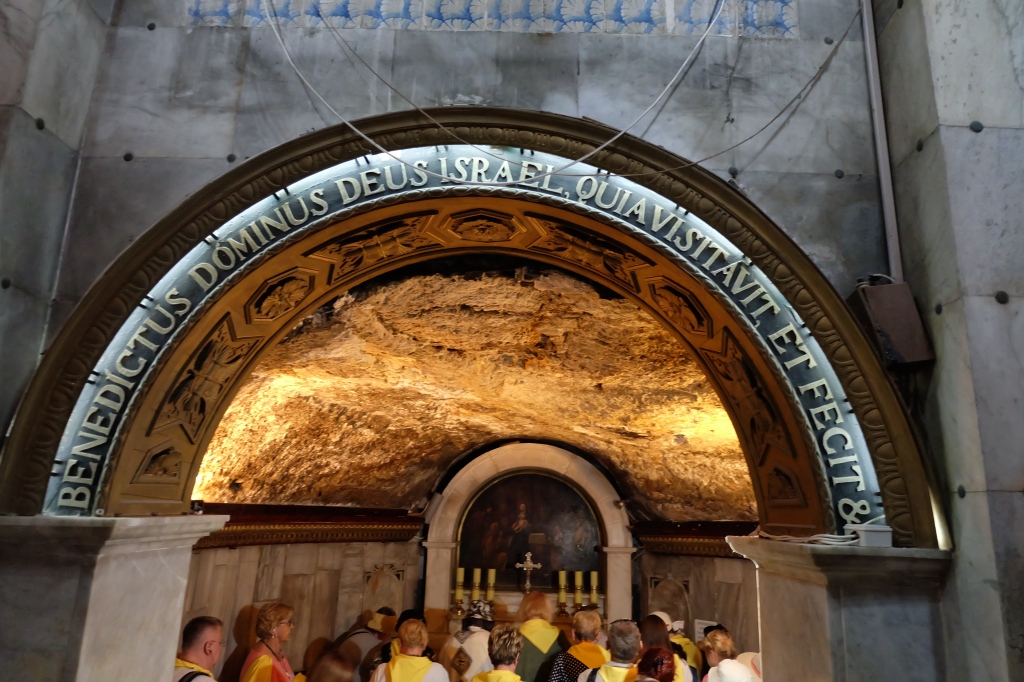
Photo by author, birthplace of St. John the Baptist underneath the Church of St. John the Baptist, the Holy Land, May 2019.
I have been searching the internet since last night of images of the widow of Nain whose only son was raised to life by Jesus in today’s gospel. After reading and praying over this scene found only in Luke’s gospel, it struck me differently last night, touching something so deep within me unlike before that I wanted to see how artists portrayed her.
Unfortunately despite the many paintings based on this story by Luke, only a few artists took time to paint with focus and emphasis on the widow of Nain. Despite Luke’s detail in saying that Jesus was moved with pity with her than with the young dead son, artists seemed to have looked more into the whole scene than the persons involved.
Jesus journeyed to a city called Nain, and his disciples and a large crowd accompanied him. As he drew near to the gate of the city, a man who had died was being carried out, the only son of his mother, and she was a widow. A large crowd from the city was with her. When the Lord saw her, he was moved with pity for her and said to her, “Do not weep” (Luke 7:11-13).
What a sorrowful sight it must have been with the widow of Nain burying her only child and son after losing her husband because she had practically lost everything in life!
The widow of Nain could have been a most wonderful subject for any painter or artist as she had melted the heart of Jesus who was prompted to raise to life her dead young son. In fact, this was the only third time Jesus had raised the dead to life in all four gospel accounts as He felt the enormous loss of the widow of Nain which remains so true to every widow these days.
In this brief and lovely story, Jesus reminds us of the special care we must have for widows and widowers who have lost everything in life while at the same time bares to us too the more disheartening aspect about death, of losing a beloved. Especially when it concerns a mother.
Photo by Mr. Jim Marpa, 2018.
The most striking truth I have realized until now since my mother died in May is how she meant everything to me and my siblings that I always say, “iisa lang siyang nawala sa amin pero lahat nawala.”
That’s the pain I feel most hurting inside me. I really could not picture our house without her every morning sweeping its front or watering her orchids or combing her dog. More painful was looking inside our home now so empty without her as I imagined those days she used to feed her aquarium fish named “pitimini” and “fetunia” and other flowers I did not know at all or simply bantering with her myna bird. Whenever I would come home, I still could not look long into her room now occupied by my brother because she’s all I see and feel inside.
The story of Jesus being moved with pity at the widow of Nain proclaims how every woman is a gospel herself, especially mothers who from the very start a part of us. See how the author of Genesis rightly narrated when God decided to create the woman, He said “Let us create a suitable partner for him” (2:18).
Photo by Mr. Jim Marpa, 2018.
Every woman is apart-ner of every man, especially mothers. Our umbilical cords are never cut off from our mom even after birth for our link with her continues even long after she – or us – is gone.
That’s because every woman is everything for each one of us as the Bee Gees sang it so well in one of the scenes in Saturday Night Fever, “more than a woman to me” because
Here in your arms I found my paradise
My only chance for happiness
And if I lose you now, I think I would die
Oh, say you'll always be my baby, we can make it shine
We can take forever, just a minute at a time

More than a woman
More than a woman to me...
During our Mass this morning, I chose to celebrate the Memorial of St. Hildegard von Bingen, a German Benedictine nun who lived over 1000 years ago. She was a mystic and a prolific writer, thinker and spiritual master who was beatified in 1326 but was only canonized in 2012 by Pope Benedict XVI who declared her a Doctor of the Church.
Like the other German woman saint, Teresa Benedicta of the Cross or Edith Stein, St. Hildegard’s writings are so deeply true but tenderly expressed that one could feel the woman touch of God. One of her quotes I used in reflecting on the widow of Nain says, “The mystery of God hugs you in its all-encompassing mystery.”
That’s what mothers do best, they hug us with God’s mystery as they themselves are a mystery to us that John Lennon rightly called woman as “the other half of the sky”.
Make a widow, a mother smile today for that would surely go a long, long way to heaven. God bless all the women of the world!
The Lord Is My Chef Daily Recipe for the Soul by Fr. Nicanor F. Lalog II
Monday in the Sixth Week of Easter Season, 06 May 2024
Acts 16:11-15     ><]]]]'> + ><]]]]'> + ><]]]]'>     John 15:26-16:4
Photo by author, Our Lady of the Poor (also of Banneaux), Sacred Heart Novitiate, 20 March 2024.
Today Lord Jesus
I pray in the most special way
all the women of the world,
especially the women most
dearest to me like my mother
who brought me forth in this world,
who taught me about You and
how to pray, my sisters and
girl friends who have guided me
and opened my mind,
heart and soul to the many
wonderful things about life
and living!
On the sabbath we went outside the city gate along the river where we thought there would be a place of prayer. We sat and spoke with the women who had gathered there. One of them, a woman named Lydia… a worshiper of God, listened and the Lord opened her heart to pay attention to what Paul was saying.h
Acts 16:13-14
How lovely to be reminded
today in our first reading that
like during Your time, Lord,
when women were some of the
first to help You in Your ministry,
it was also the women
who made the great impact in the
growth of the early Church
which continues to this day with
majority of the church-goers
are women, most of our volunteer
catechists and servants in the
parish are also women
while the mothers remain
as primary evangelizers
in this modern age
that tries so hard
to remove God from
life's picture.
How sad,
dear Jesus,
that until now,
it is still the women
who are on the distaff
side of life, whether at home
or school or office,
even in the Church!
Bless the women
of the world, Lord Jesus,
especially those neglected
and taken for granted
especially by their own
family; bless and set free
those women held captive
by the systematic crimes
and oppression
still going on against them
like human trafficking;
heal those women
suffering not only in body
but also in heart, mind and
soul; touch the hearts
and lighten the load
of women crying in silence
for the many pains they
endure.
Thank You, dear Jesus
for the gift of women
who so often disguise
as our Holy Spirit,
the Advocate
pointing us to the right
directions and decisions
in life; keep them safe
always in Your loving arms,
assure them of Your
presence.
Amen.
The Lord Is My Chef Daily Recipe for the Soul by Fr. Nicanor F. Lalog II
Thursday, Misa de Gallo VI, 21 December 2023
Zephaniah 3:14-18 <*{{{{>< + ><}}}}*> Luke 1:39-35
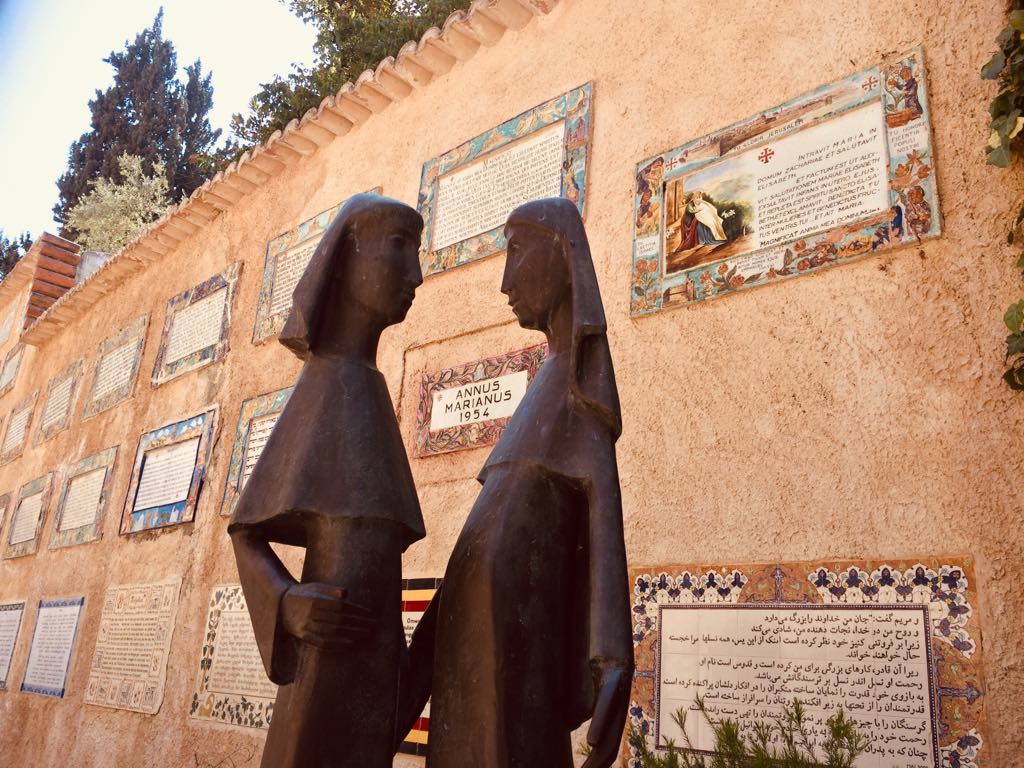
Photo by author, bronze statues of the Blessed Virgin Mary and St. Elizabeth, Church of the Visitation at Ein-Karem, Israel, April 2017.
For the third straight day since Tuesday until Saturday morning at the end of our Christmas novena, all our gospel readings will be from St. Luke, the only evangelist with the most “comprehensive coverage” of the first Christmas following his extensive research on Jesus Christ’s life and teachings (cf. Lk.1:1-4).
Hence, his gospel has the most stories and parables than the gospel accounts of Mark and Matthew. Most of all, St. Luke’s gospel account has two distinctive characteristics that showed Jesus always at prayer while at the same time gave special emphasis on women like the Blessed Virgin Mary. You must have noticed this by this time since Tuesday when we began listening to his infancy narrative.
Mary set out in those days and travelled to the hill country in haste to a town in Judah, where she entered the house of Zechariah and greeted Elizabeth. When Elizabeth heard Mary’s greeting, the infant leaped in her womb, and Elizabeth, filled with the Holy Spirit, cried out in a loud voice and said, “Most blessed are you among women, and blessed is the fruit of your womb.”
Luke 1:39-42
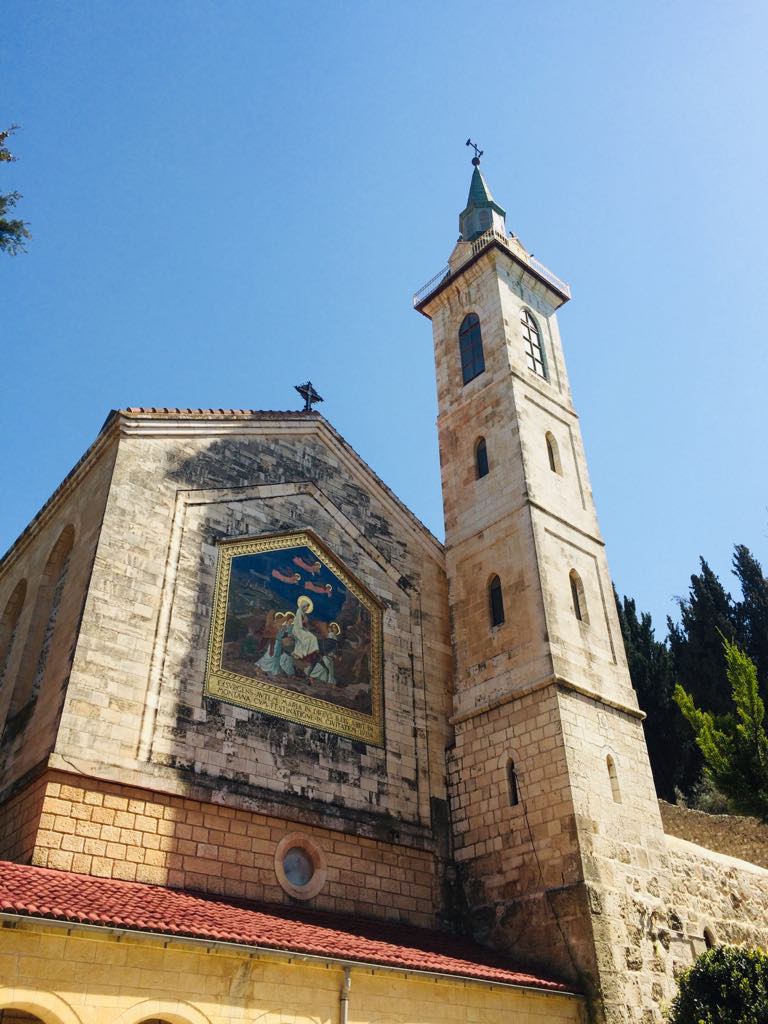
Photo by author, mural on the apse of the Church of the Visitation at Ein-Karem illustrating the Visitation (left panel) and how the angel helped St. Elizabeth hid the infant St. John the Baptist after King Herod ordered the murder of all children aged two and below.
It is rare in the Bible to find two women presented positively together in a single scene. Very often especially in the Old Testament, there is always a sort of animosity among them due to the prevailing patriarchal points of view of the time.
The only instance two women were presented together in good terms in the Old Testament is in the Book of Ruth that still hinted some sense of superiority of Naomi over her daughter-in-law Ruth who was like her a widow but childless.
Therefore, this scene of the Visitation only St. Luke has is a gem in itself as it speaks eloquently of the important place of women in God’s plan of salvation. It beautifully portrays to us the joy of two great women filled with God and humble before him, affirming and acknowledging the two great men in their wombs about to change the course of human history: Elizabeth with John the Baptist who would prepare the way of the Savior, Jesus Christ in the womb of Mary.
Photo by Mr. Boy Cabrido, Our Lady of Mt. Carmel, QC, Misa de Gallo, 18 December 2023.
The story of the Visitation reminds us how God works mysteriously in everyone without exceptions by linking or interconnecting us with each other in Jesus Christ our great Mediator and Savior. How lovely to see in this instance how John and Jesus already performing their mission even while in the womb of their mothers, of bringing together people. What a wonderful illustration of women as God’s vessels and carriers!
In both Mary and Elizabeth, we now “shout for joy” as Zephaniah prophesied in the first reading at how God saved us when he “removed the judgment against you, he has turned away your enemies; the Lord, your God, is in your midst, a mighty savior, who will rejoice over you with gladness, and renew you in his love… so that no one may recount your disgrace” (Zep. 3:14,15,17, 18).
Do we truly share in this shout for joy for the women of the world, for the women among us? How sad that until now women continue to suffer from all kinds of abuses not only from men but even from their fellow women.
Some spiritual writers say God is more like a woman because whatever was lacking in man, God put it in her. Perhaps that is why it is the woman who completes every man – including with us priests! But sadly, as we speak a lot about synodality in the Church these days, it is often among us priests with whom women are often taken for granted, and worst, abused.
One problem directly related today with how we regard women is the great number of people especially the youth trapped in the insidious effects of pornography due to prevalence of social media. At its core, the problem and evil with pornography is the failure of so many to recognize the lack of respect for women who are created equal with men in the image and likeness of God.
St. Joseph showed us the other day that true holiness is expressed in the way we respect women. According to an article by Papal Preacher Cardinal Cantallamessa I have read two decades ago where he cited a Dominican biblical scholar who’s name I could not recall, “the way we treat and regard women is a reflection of our relationship with God”.
That is very true.
When I review my life, I have found God making so many ways to lead me into the priesthood through the many women I have met and known, and many of them have remained my “bestest” friends like the three former executives of GMA-7 News Department who asked me to guide them in their Holy Land pilgrimage in Easter 2017.
Photo by author, Church of the Visitation, Ein Karem, Israel, April 2017.
It was my second Holy Land pilgrimage but my first time to visit the beautiful Church of the Visitation in Ein Karem.
Outside that lovely church are two bronze statues of Elizabeth and Mary conversing on how God had blessed them with sons under unique circumstances: Elizabeth was too old and barren while Mary was too young, a virgin, not yet married with Joseph.
What a beautiful reminder of God coming to us through women!
While there at Ein Karem, I prayed for all the women I have loved and have loved me before, all the women who have blessed me and have taken care so well of my vocation to the priesthood. I thanked God for the women like Elizabeth who have blessed me in believing that what was spoken to me by the Lord would be fulfilled in the priesthood. Blessed are the women who like Mary have helped me see the women’s perspectives that made my priesthood more complete especially in dealing with feminine issues. The women who taught me how to respect differences, to feel the society’s bias against them, and most especially feel their deep pains when they shared with me their ordeals of abuse and rape.
Let me end this reflection with an unforgettable anecdote at the funeral Mass for the mother of our late Bishop Jose F. Oliveros in Quezon province about ten years ago when he recalled how his mother held his right hand while still a child, and taught to make the sign of the Cross. On her deathbed, it became his turn, as a priest and a bishop, to hold his dying mother’s hands to make the sign of the Cross.
Hail to all women and mothers in the world who bring life into this dying world with their joy and perseverance, artistry and simplicity, warmth and presence of God almighty. May this story of the Blessed Virgin Mary’s Visitation of St. Elizabeth teach us to always respect women for they are the carriers of God to us. Amen.
Hi everyone! So glad to be back this Sunday for our music related with our Mass celebration. We hope you have gone to your local church or wherever for the Sunday Mass where the first reading was taken from the Book of Proverbs that spoke of a “worthy wife”, a perfect wife.
When one finds a worthy wife, her value is far beyond pearls. Her husband, untrusting his heart to her, has an unfailing prize. She brings him good, and not evil, all the days of her life. She obtains wool and flax and works with loving hands. She puts her hands to the distaff, and her fingers ply the spindle. She reaches out her hands to the poor, and extends her arms to the needy.
Proverbs 31:10-13, 19-20
You must be wondering if there is a perfect wife – or a perfect husband – who really exist.
Of course, none. Nobody is perfect. You have to understand human words are so limited to express God’s thoughts and words. What the author of Proverbs mean today is an “ideal wife” – someone who keeps all the little things at home we (especially men and children) often take for granted that are actually the most important things that keep our homes nice and clean, cozy and orderly (https://lordmychef.com/2023/11/18/little-things-are-the-big-things/).
The reading from the Book of Proverbs this Sunday invites us to imitate the attitudes of the “worthy wife” like her diligence and fidelity to her tasks at home in actively waiting for the Second Coming of Christ at the end of the world. It supports the teaching of Jesus in today’s parable of the talents that God is not asking us great things in life but simply to be faithful to the tasks and responsibilities he entrusted to us. Exactly like the perfect wife who got everything covered not only at home but even outside! When we die, the only thing Jesus will ask us is how we have cared for those persons and things he entrusted us in this life – not what we have done nor achieved nor amassed like wealth.
And that is why as I prayed while preparing this Sunday’s homily, I kept hearing at the back of my head Sting and the Police singing their 1981 hit Every Little Thing She Does Is Magic.
Though I’ve tried before to tell her Of the feelings I have for her in my heart Every time that I come near her I just lose my nerve as I’ve done from the start
Every little thing she does is magic Everything she do just turns me on Even though my life before was tragic Now I know my love for her goes on
Do I have to tell the story Of a thousand rainy days since we first met? It’s a big enough umbrella But it’s always me that ends up getting wet
Every little thing she does is magic Everything she do just turns me on Even though my life before was tragic Now I know my love for her goes on
Written by Sting, the song is about a man who could not express his love for a woman he finds so beautiful and amazing. The song is actually about unrequited love and she never became his wife!
I resolved to call her up A thousand times a day And ask her if she’ll marry me Some old-fashioned way
But my silent fears have gripped me Long before I reach the phone Long before my tongue has tripped me Must I always be alone
And so you ask how do I find this song related with that reading from the Book of Proverbs about a perfect wife? We find that in the repetitive chorus line “Every little thing she does is magic” as well as in the superb instrumentation, especially its opening tune. This piece of music in itself is magic.
Let’s face it, man… women are so good in this life that without them, our world would stop, including the Church. For me, that “battle of sexes” had long been won by women because they are better than us in many accounts. That is why God gave them to us as our part-ners in life. Women, especially mothers and wives, have that attention to details we could not see (ask any husband how his wife could still see even even nothing can be seen?). Most of all, they have that flair and elan so built in within them that everything they do is magic – effortless, easy, so natural and personal.
Jesus is not asking us to do something so great or monumental in life. He simply wants us to be faithful and consistent with our calling as his disciples, as Christians who lovingly serve God through one another. Something that women, especially wives and mothers, could teach us a lot with in this life. Here’s the Police to all the great women out there with their loving and faithful men.
Quiet Storm by Fr. Nicanor F. Lalog II, 15 September 2023
“Mater Dolorosa” also known as “Blue Madonna” (1616) by Carlo Dolci. Photo from Wikimedia Commons.
I started praying about this blog last month after the Feast of the Nativity of the Blessed Virgin Mary. It just occurred to me on that day to greet some of my “girlfriends” – yes, God has blessed me with so many of them who are mostly women and ladies who have taught me and shared with me so many lessons and thoughts about life only women can see.
One of them is my former colleague at GMA-7 News, Kelly, widowed for six years since the passing of her husband Larry whom I have visited and anointed many times during his long battle with cancer. When I asked her how she has been doing since our last meeting before the pandemic, she was her usual self – candid yet a bit sardonic in her reply, “I’m good. I have health issues but I’m handling them, living a simple but contented life… alam mo naman ako, I’m so Alannis Morissette.”
I thought she was again speaking “gay” as in chorva when she described herself as Alannis Morisette. And before I could ask her the meaning of “Alanis Morissette”, she turned out to be speaking English – referring to the singer Alanis Morissette as she sent me lyrics of her 1995 song Handin My Pocket. Immediately I checked it on Youtube and found it perfect too for today’s celebration of the Memorial of Our Lady of Sorrows or Mater Dolorosa as it speaks of every woman’s sacrifice and sufferings in this world that is sadly still dominated by male chauvinists.
Mary as Our Lady of Sorrows reminds us of every woman’s fidelity to God through her husband and children, family and loved ones as well as vocation. Her remaining at the foot of the Cross was her lowest and painful point in life to be with her crucified Son, Jesus Christ. She was so absorbed with his pain and sufferings that at Easter, she was in turn absorbed by the glory of our Risen Lord which culminated at her Assumption into heaven.
How was Mary able to keep her composure? Oneness in Christ her Son from whom all good things come even in the most trying times. When I look at her face as portrayed in the arts, it is not pity that I feel but her dignity, nobility and simplicity. Notice her praying hands, totally surrendering herself to God which began at the Annunciation when she told the angel, “Behold, I am the handmaid of the Lord. May it be done to me according to your word” (Lk.1:38). There at the foot of the Cross of Jesus, her hands remained in praying position, entrusting everything to God, filled with faith, hope and love.
Alanis Morissette express almost the same faith, hope and love in the modern sense today with her 1995 Hand in My Pocket. A Canadian-American, Morissette grew up in a devout Roman Catholic family. Although she is now a practicing Buddhist, Morissette claimed repeatedly in some interviews that she owes her singing career to her Catholic faith. Her personal life is marked with so many pains and sufferings too, going through depressions and eating disorders as well as having been raped while 15 years old. It was from these experiences that she got all her inspirations in her many songs that strike chords in the hearts of many modern people, not just women, who strive to find meaning by hoping to brighter tomorrows amid the many hardships modern life has brought us.
I’m broke, but I’m happy I’m poor, but I’m kind I’m short, but I’m healthy, yeah I’m high, but I’m grounded I’m sane, but I’m overwhelmed I’m lost, but I’m hopeful, baby
And what it all comes down to Is that everything’s gonna be fine, fine, fine ‘Cause I’ve got one hand in my pocket And the other one is giving a high five
We just have to remember our own mothers to realize and appreciate how our Lady of Sorrows and Alanis Morissette were able to bear all of life’s sufferings. It is in their hands. The praying hands. The hand in the pocket holding on to the present realities and the other hand up in the air hoping everything will be fine.
How ironic – pun intended as it is the title too of my favorite Morissette song – that despite all the great love women have offered and given us through our own mothers and sisters, aunts and grandmothers, teachers and nurses, not to forget the multitude of women who make our economy grow by laboring here and abroad plus the nuns who pray and run so many orphanages, women are still neglected and forgotten, even unloved, maltreated, and abused. Sadly, their fellow women are the ones who inflict those pains in this cruel and ungrateful world.
Starting today, be kind to women, especially those closest to you, those who have remained loving and kind despite your excesses and other idiosyncrasies.
Here is Ms. Alanis Morissette. Her music video is very interesting too, showing the many contrasts every disciple of Christ like Mary our Lady of Sorrows goes through in this life. Set in black and white, it evokes rawness yet at the same time brings out that eternal spring of hope within each one of us. Have a blessed rest day ahead!
Quiet Storm by Fr. Nicanor F. Lalog II, 21 April 2023
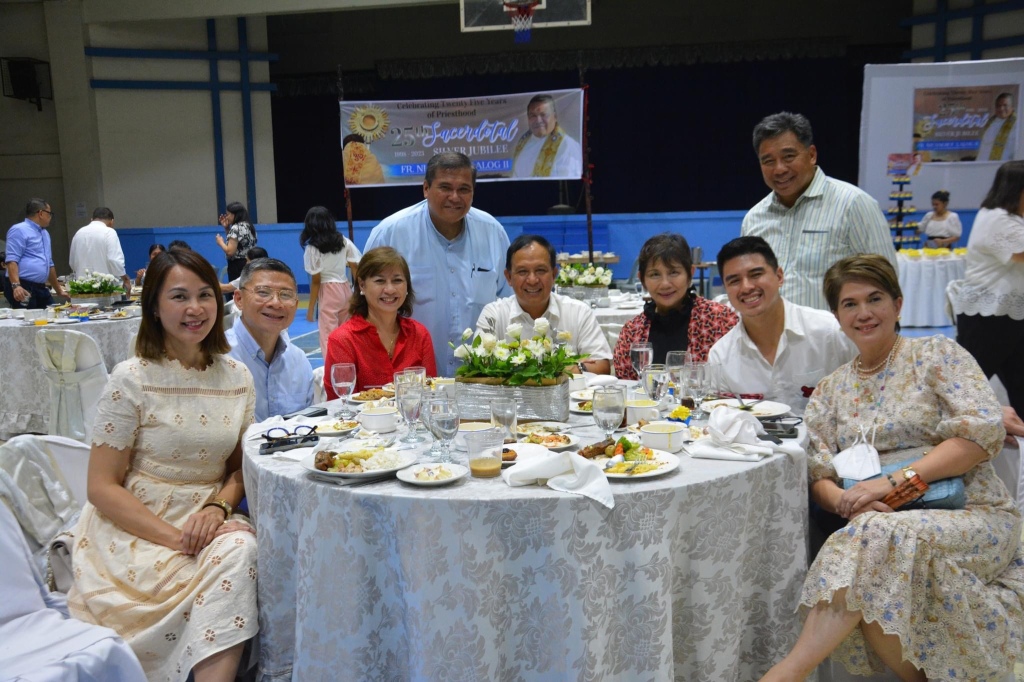
Reflections on the occasion of my 25th year in the Priesthood
Photo by Mr. Jong Arcano before the Mass with Ms. Marissa Flores (former SVP-GMA7 News), the Ms. Tina Monzon-Palma, of course, Ms. Jessica Soho, Ms. Jaileen Jimeno of GMA News with Mr. Ben Cal of Phil. News Agency at the back.
As I have promised you yesterday, today we reflect about the women the Lord had sent me to meet him, to follow him.
My first assignment from 1998 to 2010 after ordination was teacher-administrator of the Immaculate Conception School for Boys (ICSB) and Immaculate Conception School of Malolos (ICSM). My students would always ask me why I left the news to become a priest. My usual answer given in a jest, especially to the boys, was that I wanted to “love” more women than just one. It was a “birong totoo” because that was how I felt when I began examining my life and heard anew my vocation following that conversation with Atty. Dan.
During my retreat last March while praying over the many graces and blessings I have not been aware of, I realized how God prepared me for the priesthood and its call of celibacy. As I looked back in my life, he has blessed me with great women, so beautiful inside and outside. They were gifts that even if I did not get married because I chose priesthood and celibacy, I feel so blessed with that unique relationships with these wonderful women who continue to enrich my life as a person, as a priest.
First, my Bosses in work have all been women.
Photo by Ms. Karen Galarpe as shared during our 2017 Homecoming at the Varsitarian; Ms. Gina has long been away and I could not find our old photos. Nonetheless, in this photo are Sr. Gina who proclaimed the first reading at my anniversary who was then assistant of our Asst. Publications Director Ms. Jesselyn dela Cruz to her right.
My first boss was Ms. Gina Bautista-Navarette. She was the editor-in-chief of the UST’s Varsitarian when I applied as a news reporter in 1984. Even at that time, she has always been the epitome of “beauty and brains” – so lovely and so kind, but really tough inside, especially with her knowledge and beliefs. She finished Industrial Engineering and went to work first at PRC as one of its young executives, then to Johnson & Johnson and then to Jollibee as VP for Marketing. When Jollibee bought Greenwich Pizza, she became its GM and a few years later, became the President of Red Ribbon when Jollibee acquired the famous cake company. While still the VP for Marketing at Jollibee, I invited her to our school for a career talk to our students. She in turn would call me sometimes for comments for their products which I enjoyed because I had valid reasons to eat burgers and palabok!
Later on, Gina emailed me of their moving to Canada for a “lifestyle shift” but even then, she had never forgotten to greet me during my ordination anniversaries as deacon and priest! That is why, whenever I remember and pray for Gina, “it is the Lord” whom I see.
She came about two hours early last Tuesday because she said, “gusto ko lang makausap ka muna Father ng konti.”
My second boss was Ms. Tina Monzon-Palma. Yes. The Ms. Tina Monzon-Palma of television news. Late have I realized the super blessing given to me by God to have worked under Ms. TMP as we called her.
So tall and lovely, surely better than that girl from Ipanema! But, in her I found really a WOMAN in the truest sense. Astig. But with a lot of sense of humor. So kalog. And yes, so kind and thoughtful. What I could not forget is her sense of humility. Imagine, the goddess of TV News for so long that you would surely believe if she tells you World War III has begun, is in fact a humble person because she says sorry. I have personally experienced her saying sorry once or twice but on other occasions, she has that tender way of letting you know she is sorry like saying “kumusta na kid?” or just being extra nice on certain days. Whenever I feel in a dilemma of saying sorry or not, when I feel so proud, I remember Ms. Tina who despite her stature and every right and privilege would always be that humble to say sorry.
Another thing I learned from Ms. TMP was when she told me why she would always reprimand me with my scripts and reports: she insisted She would insisted excellence in our work. Later in the seminary and as a priest, I would speak of excellence as holiness, of giving your best always. It is the very heart of St. Therese’s “little way”, of doing small things excellently.
I will always be proud of Ms. Tina. Monzon-Palma. Even she had moved to other networks, she remained our kapuso, seeing us, conversing with us her former colleagues at GMA-7. She came to my 50th birthday and again in my anniversary. In fact, she came so early because she told me, she just wanted to talk to me. Truly, I could say that afternoon, “It is the Lord” when I was with her.
Our President, Dra. Caroline Enriquez in red, to her right is Mr. Rico Santos, VP for Finance of FUMC and wife Dra. Carol; at the middle is my predecessor Fr. Lito Caliwag, Dra. Mylene A. Santos, MD our VP for Student Affairs, standing next to her is Dr. Vic Santos, President of FUMC with his son Angelo and wife, Dra. Mary Anne.
My third and current Boss is again a woman, also beauty and brains, but most holy and truly a Wonder Woman. The President of the Our Lady of Fatima University (OLFU) and Board Member of Fatima University Medical Center (FUMC) of which I am both the chaplain: Dr. Caroline Santos-Enriquez, MD.
I first met Dra. Caroline in 2010-2011 when I was first assigned as attached priest here at the National Shrine of Our Lady of Fatima in Valenzuela. Twice the chaplain was indisposed and I had to celebrate Masses for him. After I was given a parish of my own to shepherd, Doctora would always invite me for talks in OLFU and twice to address their graduates at the PICC.
During my retreat last month, she came to my prayers. Yes, “It is the Lord” experience again and I felt so ashamed before God not realizing this immense grace and blessing of how a great woman of faith who has hurdled so many trials in life, a very wise manager and steward who has steered OLFU to what it is today with six campuses would believe in me? Our Bishop told me during our clergy reshuffle in December 2020 that he had asked Dra. Enriquez to recommend to him three names he would assign as chaplain. I was her first choice, and again, “It is the Lord!”
Of the other women and friends God gave me to lead me back to his Son Jesus, will share them Monday in our next blog. For now, I too believe that nothing happens by accident. God knew everything beforehand that I would be sent out of the seminary in 1982 only to go back after nine years and become a priest 25 years ago. In all those years, he blessed me with so many friends, especially friends who are girls, some are ladies, and many are women like my three Bosses in the professional life. They are among the best of his blessings I was not aware until I went back to those 25 years of my priesthood. It is the Lord I have seen in them. And like James Taylor in his 1971 song Places in My Past, I could sing…
There are ladies in my life
Lovely ladies in these lazy days
And though I never took a wife
May I say that I have loved me one or two
Lawiswis ng Salita ni P. Nicanor F. Lalog II, Ika-13 ng Abril 2023
Larawan ng painting ni American painter Henry Osawa Tanner, “The Three Marys” (1910) mula sa biblicalarchaeology.org.
Magkakatulad
ang mga ebanghelista
sa paglalahad
ng mga kababaihang naiwan,
sinamahan si Jesus sa Krus
hanggang sa kanyang kamatayan;
tatlo sa kanila ating nakikilala
na sina Maria na Ina ni Jesus,
Maria Magdalena at
Maria asawa ni Clopas.

Subalit, sino
iyong "isa pang Maria"
na binabanggit sa ebanghelyo
ni San Mateo na kasama
ni Maria Magdalena
"nakaupo sa tapat ng
libingan" ni Jesus (Mateo 27:61)
na hindi naman niya kinilala
nakatayo rin sa paanan
ng Krus?

Kataka-taka sino nga ba
itong kasama ni Maria Magdalena
"Makaraan ang Araw ng Pamamahinga,
pagbubukang-liwayway
ng unang araw ng sanlinggo,
pumunta sa libingan ni Jesus
si Maria Magdalena
at isa pang Maria" (Mateo 28:1)
na unang pinagpakitaan
ng Panginoong muling nabuhay?
Hindi na natin malalaman
tunay niyang pangalan
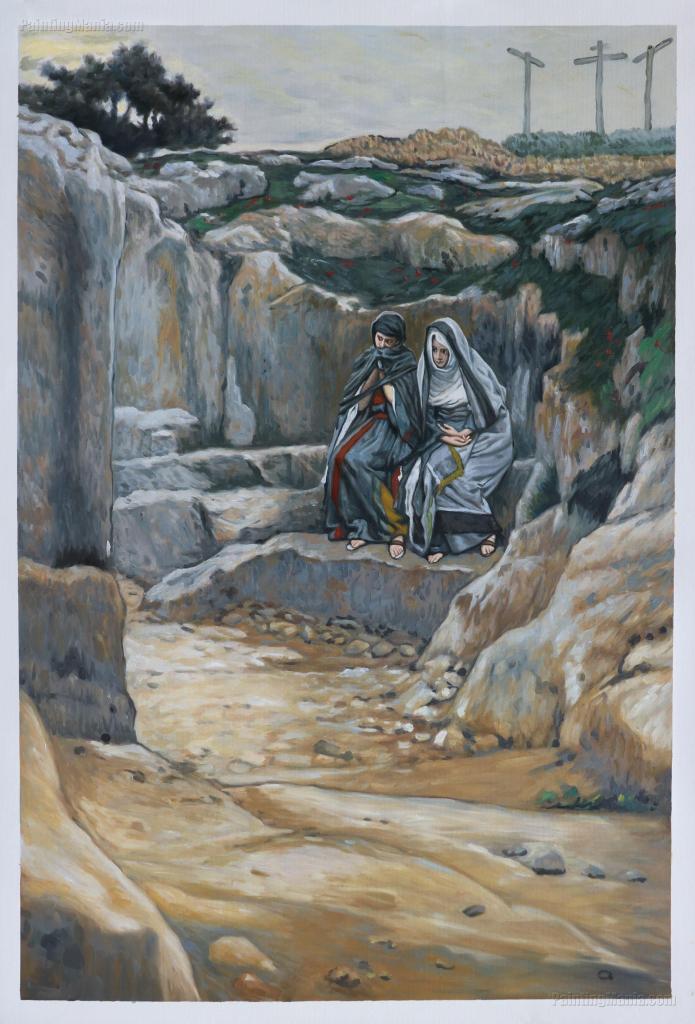
maliban sa "isa pang Maria"
na hindi kasing tanyag
 ni Magdalena,
 ni walang nakakakilala
ni pumapansin
bagama't matitiyak natin
hindi siya mahuhuli
 pagbibigay ng kanyang sarili
bilang tapat na alagad
ng ating Panginoon din!
Bawat isa sa atin
katulad ni Maria Magdalena,
dapat ipagpasalamat
 kasama at kaibigan
maituturing din na
  "isa pang Maria" -
tahimik at walang kibo
subalit buo ang loob
tayong sinasamahan
saanmang kadiliman
basta patungo kay Kristo
na kapwa nating sinusundan!
Larawan ng painting ni French painter James Tissot ng “The Two Marys Watch the Tomb” (1894) mula sa paintingmania.com.











 lordmychef.com