Good grief

Lord My Chef Daily Recipe by Fr. Nicanor F. Lalog II
Tuesday, Memorial of Our Lady of Sorrows, 15 September 2026
Hebrews 5:7-9 <*{{{{>< + ><}}}}*> John 19:25-27
Photo by the late Mr. Noli Yamsuan, Manila Cathedral, 15 July 2012.

A day after the Feast of the Exaltation of the Cross, we celebrate the Memorial of our Lady of Sorrows or Mater Dolorosa, the grieving Mother Mary at the foot of the Cross of Jesus Christ.

For a better appreciation of the scene, I recalled the one particular detail provided by Matthew, Mark, and Luke at how the area was enveloped in darkness from noon to three in the afternoon situating it in John’s most unique element of the Crucifixion:

Standing by the cross of Jesus were his mother and his mother’s sister, Mary the wife of Clopas, and Mary Magdalene. When Jesus saw his mother and the disciple there whom he loved, he said to his mother, “Woman, behold your son.” Then he said to the disciple, “Behold, your mother.” And from that hour the disciple took her into his home (John 19:25-27).
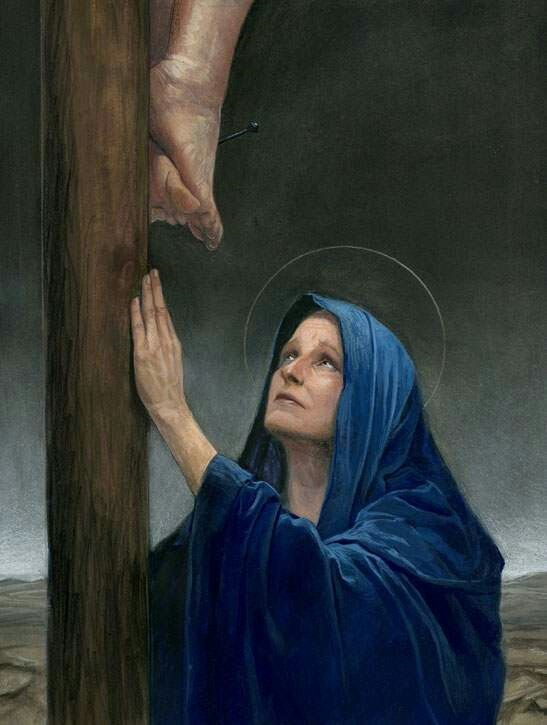
Photo of painting from stswithuns.org.uk.

As I prayed over this scene, the expression “good grief” came to my mind.

Good grief is an expression so similar with the second Beatitude of Christ taught at his sermon on the mount, “Blessed are those who mourn (grieve), for they will be comforted” (Mt.5:4).

What is blessed with mourning or good with grief when you have lost a loved one or in pain and suffering? Or, when things are not going well with one’s self and life?

As we reel from the recent monsoon rains or habagat, grieving cleanses out eyes and whole body system like the rains that wash away all dirt and trash in the surroundings. Though grief and storms inconvenience, even immobilize us for some time, overall crying and rains enable us to reassess our priorities and directions in life like the painful lessons the floods have taught us, if we have indeed learned.

There at the Cross, John noticed and presented us this most moving scene before the death of Jesus to show us the new reorientation also in our lives as disciples led by the first and model disciple of all, Mary with the beloved disciple. Clearly here we find a new direction in their lives and eventually in the life of the Church Jesus had founded.

Grief is good and blessed because it leads us to God, to self, and to others as both Mother Mary and the beloved disciple exemplified in their lives.

Grief is the default browser of faith, enabling us to hold on to God when everything and everyone slip from our grasps, when we realize God looming over us despite the darkness that envelops us like during the Crucifixion. Imagine the tremendous faith the Blessed Virgin Mary and the beloved disciple both have during that most crucial moment when they were the only ones who have remained with Jesus while all the other disciples have gone hiding in fear.

In the many artistic depictions of the Crucifixion, we can find that like Mary and the beloved disciple, we are are most human when in the face of grief because that is when we accept and affirm our weakness as a person – whether we are the one grieving or comforting someone grieving. Grief is good because that is when God calls us most to be his very presence in the darkest hours of sufferings and pain.

Lady of Sorrows from a triptych by the Master of the Stauffenberg Altarpiece, Alsace c. 1455; photo from fraangelicoinstitute.com.

In my 28 years as a priest, I have comforted and grieved with so many people, family and friends, even strangers. And it seems that of all the things I have said and done as a priest and an individual, it was those moments of grieving with those who have lost a loved one or going through difficulties are what people most remembered of me because I have realized too with the deaths of my dad and mom, grieving is the pathway to home – to ourselves, to our beloved and to God. John tells us how since that day on the beloved disciple took Mary into “his home.”

Our Filipino word for home literally came from crying and grieving – tahanan which is from “tahan na” or stop crying. We stop crying or tahan in our own home, tahanan because that is where we feel loved and cared, safe and accepted no matter what.

During funerals, I tell people to simply grieve and please, do not ask anybody to stop crying or tahan. When we allow those in pain to cry and grieve, eventually in the process they stop when they finally find a reason to moving on and start living.
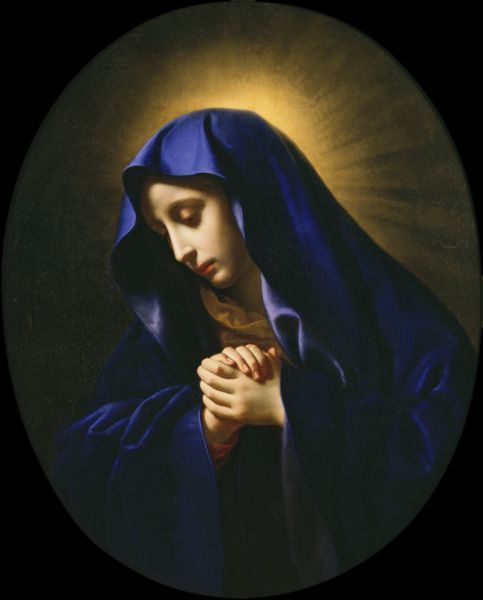
“Mater Dolorosa” also known as “Blue Madonna” (1616) by Carlo Dolci. Photo from Wikimedia Commons.

It is here where we find too the goodness in the good grief of the Blessed Virgin Mary, our Lady of Sorrows: she was deeply in pain minus the theatrics of some during funerals. It was purely good grief for Mary because at that most crucial moment, she must be lovingly praying.

That is the beautiful reminder to us of this memorial of Mater Dolorosa: the more we must handle life with prayer in order to believe more and love more when everything is dark and even dead. At the Crucifixion, we find the words of the author of the Letter to the Hebrews so fulfilled and true not only in Jesus but also with those who stood with him like his Mother Mary and beloved disciple:

In the days when he was in the flesh, he offered prayers and supplications with loud cries and tears to the one who was able to save him from death, and he was heard because of his reverence. Son though he was, he learned obedience from what he suffered; and when he was made perfect, he became the source of eternal salvation for all who obey him (Hebrews 5:7-9).

Amid all the hardships and difficulties many of us are facing these days of rains and floods, of corruption among our officials and leaders as if we are again standing at the foot of the Cross of Jesus Christ, it is a most opportune time of “good grief” for us to stand for what is true and good, fair and just, honorable and honest. Like our Lady of Sorrows the Blessed Virgin Mary, let us draw out faith and strength and courage from Jesus Christ who had won over death and sin on the Cross. Amen.

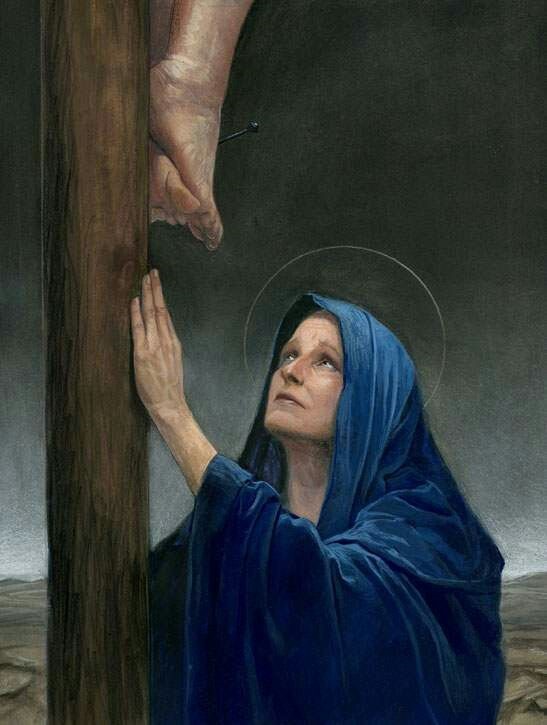
Amazed. And sorrowful.

Lord My Chef Daily Recipe for the Soul, 15 September 2025
Monday, Memorial of Our Lady of Sorrows
Hebrews 5:7-9 <*{{{{>< + ><}}}}*> Luke 2:33-35
Image from churchofjesuschrist.org.
A blessed Monday indeed,
Lord Jesus Christ as we
celebrate your Blessed Mother
as Our Lady of Sorrows.

The alternative gospel
for today's celebration is
so striking with the account
of Luke of your Presentation at
the Temple:

The child’s father and mother were amazed at was said about him; and Simeon blessed them and said to Mary his mother, “Behold, this child is destined for the fall and rise of many in Israel, and to be a sign that will be contradicted” (Luke 2:33-34).

Why were your parents,
Joseph, especially Mary your Mother
were amazed at the words
of the Prophet Simeon?

I really wonder
how they looked like, Jesus:
to be amazed
is more than being
surprised with the enormity
of reality before one;
to be amazed is to be awed,
to be seized by that reverential
fear Joseph and Mary felt when
your coming was announced to them;
to be amazed is more of the
heart than of the mind,
a feeling that overwhelms one's
whole being with something
so profound,
so wonderful,
most of all,
so real.
Yes, Jesus:
being amazed is
beyond incredible,
simply breathtaking
because of your very presence,
of your reality.
Amaze me,
Lord Jesus.
Keep amazing me,
Jesus so that like
your parents Joseph
and especially Mary
the more I shall know you,
love you,
and follow you
even to the Cross.

“and you yourself a sword will pierce so that the thoughts of many hearts may be revealed” (Luke 2:35).

O dearest Jesus,
being sorrowful
is also of the heart
like being amazed
and both are related:
the more we are amazed
with the reality of your love
for us,
the more we are sorrowful
not only with your passion and death
but most of all of our sinfulness
because to sin is a refusal to love,
a refusal to recognize the truth
and reality of your immense love
for us, Jesus;
when people no longer
feel sorrow with all
the sins and senseless
killings happening today,
when people glorify
sin and evil,
when the young feel proud
more with wealth and fame
than the human person,
when people are so consumed
with things of the world
than be amazed
with the wonder of human life,
the warmth of each person,
and the joy of being loved
and being loving...
that is when we are
no longer amazed with
you, Jesus,
our way,
our truth and
our life.

Immerse us in your words,
Jesus like Mary your Mother;
like her,
let us act on your words
to keep us amazed
with your love and mercy,
Lord Jesus
so we may be
sorrowful with our sins
and most of all,
be resolved in
returning to you,
remaining in you
like Mary your Mother
and our Mother too.
Amen.
Lady of Sorrows from a triptych by the Master of the Stauffenberg Altarpiece, Alsace c. 1455; photo from fraangelicoinstitute.com.

Understanding sin

The Lord Is My Chef Daily Recipe for the Soul by Fr. Nicanor F. Lalog II
Tuesday in the Eleventh Week in Ordinary Time, Year II, 18 June 2024
1 Kings 21:17-29 <'[[[[><< + ><]]]]'> Matthew 5:43-48
Photo by author, Sacred Heart Novitiate, Novaliches, QC, 20 March 2024.
God our merciful Father,
grant me the grace today
to understand my sins more
clearly so that I may come to
sorrow for them,
sorrow that leads to love
of your Son Jesus Christ
and not despair;
let me keep in mind
that sin is not just a breaking
of your laws and rules but
simply a refusal to love
You and others around me;
and the worst part of sin
we are not aware of is how
it seriously affects our personality,
our personhood
because whenever we sin
we become a less-loving
person.

So be perfect, just as your heavenly Father is perfect.

Matthew 5:48
Being perfect,
being holy like You,
dear Father,
means being filled
by You
which is a process
of daily conversion
when we ask
your forgiveness Father,
to gain a better self-knowledge
of ourselves
to identify our weaknesses
and sinfulness
so that in your grace,
we become a better person
than before.
Let us have within us
that sense of sinfulness
and sense of sin,
Father
so that we
we may grow in your love.
Amen.

Mater Dolorosa & Alanis Morisette

Quiet Storm by Fr. Nicanor F. Lalog II, 15 September 2023
“Mater Dolorosa” also known as “Blue Madonna” (1616) by Carlo Dolci. Photo from Wikimedia Commons.

I started praying about this blog last month after the Feast of the Nativity of the Blessed Virgin Mary. It just occurred to me on that day to greet some of my “girlfriends” – yes, God has blessed me with so many of them who are mostly women and ladies who have taught me and shared with me so many lessons and thoughts about life only women can see.

One of them is my former colleague at GMA-7 News, Kelly, widowed for six years since the passing of her husband Larry whom I have visited and anointed many times during his long battle with cancer. When I asked her how she has been doing since our last meeting before the pandemic, she was her usual self – candid yet a bit sardonic in her reply, “I’m good. I have health issues but I’m handling them, living a simple but contented life… alam mo naman ako, I’m so Alannis Morissette.”

I thought she was again speaking “gay” as in chorva when she described herself as Alannis Morisette. And before I could ask her the meaning of “Alanis Morissette”, she turned out to be speaking English – referring to the singer Alanis Morissette as she sent me lyrics of her 1995 song Hand in My Pocket. Immediately I checked it on Youtube and found it perfect too for today’s celebration of the Memorial of Our Lady of Sorrows or Mater Dolorosa as it speaks of every woman’s sacrifice and sufferings in this world that is sadly still dominated by male chauvinists.

Mary as Our Lady of Sorrows reminds us of every woman’s fidelity to God through her husband and children, family and loved ones as well as vocation. Her remaining at the foot of the Cross was her lowest and painful point in life to be with her crucified Son, Jesus Christ. She was so absorbed with his pain and sufferings that at Easter, she was in turn absorbed by the glory of our Risen Lord which culminated at her Assumption into heaven.

How was Mary able to keep her composure? Oneness in Christ her Son from whom all good things come even in the most trying times. When I look at her face as portrayed in the arts, it is not pity that I feel but her dignity, nobility and simplicity. Notice her praying hands, totally surrendering herself to God which began at the Annunciation when she told the angel, “Behold, I am the handmaid of the Lord. May it be done to me according to your word” (Lk.1:38). There at the foot of the Cross of Jesus, her hands remained in praying position, entrusting everything to God, filled with faith, hope and love.

Alanis Morissette express almost the same faith, hope and love in the modern sense today with her 1995 Hand in My Pocket. A Canadian-American, Morissette grew up in a devout Roman Catholic family. Although she is now a practicing Buddhist, Morissette claimed repeatedly in some interviews that she owes her singing career to her Catholic faith. Her personal life is marked with so many pains and sufferings too, going through depressions and eating disorders as well as having been raped while 15 years old. It was from these experiences that she got all her inspirations in her many songs that strike chords in the hearts of many modern people, not just women, who strive to find meaning by hoping to brighter tomorrows amid the many hardships modern life has brought us.

I’m broke, but I’m happy
I’m poor, but I’m kind
I’m short, but I’m healthy, yeah
I’m high, but I’m grounded
I’m sane, but I’m overwhelmed
I’m lost, but I’m hopeful, baby
And what it all comes down to
Is that everything’s gonna be fine, fine, fine
‘Cause I’ve got one hand in my pocket
And the other one is giving a high five

We just have to remember our own mothers to realize and appreciate how our Lady of Sorrows and Alanis Morissette were able to bear all of life’s sufferings. It is in their hands. The praying hands. The hand in the pocket holding on to the present realities and the other hand up in the air hoping everything will be fine.

How ironic – pun intended as it is the title too of my favorite Morissette song – that despite all the great love women have offered and given us through our own mothers and sisters, aunts and grandmothers, teachers and nurses, not to forget the multitude of women who make our economy grow by laboring here and abroad plus the nuns who pray and run so many orphanages, women are still neglected and forgotten, even unloved, maltreated, and abused. Sadly, their fellow women are the ones who inflict those pains in this cruel and ungrateful world.

Starting today, be kind to women, especially those closest to you, those who have remained loving and kind despite your excesses and other idiosyncrasies.

Here is Ms. Alanis Morissette. Her music video is very interesting too, showing the many contrasts every disciple of Christ like Mary our Lady of Sorrows goes through in this life. Set in black and white, it evokes rawness yet at the same time brings out that eternal spring of hope within each one of us. Have a blessed rest day ahead!

From YouTube.com.

Our Lady of Sorrows: absorbed in sorrow, absorbed by glory

The Lord Is My Chef Daily Recipe for the Soul by Fr. Nicanor F. Lalog II
Friday, Memorial of Our Lady of Sorrows, 15 September 2023
1 Timothy 1:1-2, 12-14   ><}}}*> + ><}}}*> + ><}}}*>   John 19:25-27
Lady of Sorrows from a triptych by the Master of the Stauffenberg Altarpiece, Alsace c. 1455; photo from fraangelicoinstitute.com.
What a joy for us,
sinful children of the Father
to be your children too,
O Blessed Virgin Mary
through your Son
our Lord Jesus Christ!

Standing by the cross of Jesus were his mother and his mother’s sister, Mary the wife of Clopas, and Mary of Magdala. When Jesus saw his mother and the disciple there whom he loved, he said to his mother, “Woman, behold, your son.” Then he said to the disciple, “Behold, your mother.” And from that hour the disciple took her into his home.

John 19:25-27
More than the tears and sorrow
 on your face portrayed in arts,
O Sorrowful Mother, 
all I see and experience
in you is a disciple
 so absorbed in prayer,
so united and close
 with our Lord Jesus;
yours is a different kind
of sadness
that I feel when I look
at your images
as our Lady of Sorrows:
no pity but dignity,
no dramatics nor theatrics
but purely
noble simplicity.
How sad,
dear Mother and Lady of Sorrows
 that many of us disciples
 of your Son Jesus
have forgotten this very
important aspect of discipleship
you have shown us,
a life centered on prayer
that is more than reciting prayers
but residing in Christ,
of being absorbed in his
Passion and Death
so that like you,
we may be absorbed by
his glorious Resurrection!
Indeed,
 dear Lady of Sorrows,
as St. Paul tells us today,
"the grace of our Lord has been
abundant, along with the faith
and love that are
in Christ" (1 Tim.1:14);
pray for us your children
and fellow disciples
to be first absorbed in prayers
because before everything
else came,
there was Jesus
who first came
calling us
to be one in him,
with him,
and through him
like you
absorbed by his glory
in heaven.
Amen.