40 Shades of Lent by Fr. Nicanor F. Lalog II
Holy Tuesday, 04 April 2023
Isaiah 49:1-6   >>> + <<<   John 13:21-33, 36-38
Photo by Ms. April Oliveros, Mt. Pulag, 25 March 2023.
Dear Jesus,
let me be sensitive of other people,
of their feelings and beliefs,
of their roots and situations,
most especially of their needs,
their fears,
their pains,
their losses
and their longings.

How sad, dear Lord,
when you expressed to the Twelve
on your Last Supper how you were
"deeply troubled" that one of them would
betray him, "they looked at one another
and were at a loss as to whom you meant";
more sad was after you have identified
Judas Iscariot as the one to betray you,
they still did not get it!
(cf. John 13:21-30).
Many times, dear Jesus,
we are like them, so self-centered,
always looking at others,
at a loss at what you mean
because we lack sensitivity:
we rarely think about you really
nor of others as we are preoccupied
with our own ideas and perceptions
about you and others, refusing to suspend
or let go of them even for a while
to feel exactly how others felt;
we have lost that sensitivity to have the eyes
to see what others see when they are lost,
who stop to notice others are missing
or crying or been left behind as their
pace slowed down due to heavy burdens.
My sweet Lord,
knock me off my senses,
from my self-centeredness
and self-righteousness
giving reasons even justifications
to whatever I do,
when I have become results-oriented
than person-oriented
that as a result, I could not take failures
and disappointments in life.
May I have your sensitivity
and humility as God's Suffering Servant.
Though I thought I had toiled in vain, and for nothing, uselessly, spent my strength, yet my reward is with the Lord, my recompense is with my God.
Isaiah 49:4
Let me sing of your salvation,
Lord Jesus Christ
in unison with my suffering
brothers and sisters,
trusting in you alone.
Amen.
Photo by Ms. April Oliveros, Mt. Pulag, 25 March 2023.
40 Shades of Lent by Fr. Nicanor F. Lalog II
Tuesday in the Second Week of Lent, 07 March 2023
Isaiah 1:10, 16-20   >>> +++ <<<   Matthew 23:1-12
Photo by author, sunrise at the Pacific from the coast of Infanta, Quezon, 04 March 2023.
In this blessed
Season of Lent,
I pray to you,
dear God our Father,
to help me set things
right in my self,
in my life;
help me set things right
by "washing myself clean,
putting away my misdeeds,
ceasing from doing evil
and learning to do good
by making justice my aim,
redressing those I have wronged,
hearing the plea of the orphans,
and defending the powerless
among us" (Isaiah 1:16-17).
Let me set things right,
O Lord, by walking my talk,
by practicing what I preach,
by being humble without any
desires to be known nor admired,
nor be served by putting too much
burdens on others without my
lifting of my finger, seeking
places of honor and being
greeted by everyone (Mt. 23:1-7);
forgive me for those times
I thought that you are like me
when I recite your statutes and
profess your covenant with mouth
yet hate discipline (Ps. 50:16-17).
Let me set things right,
O Lord, in my life
my keeping in mind
YOU alone is our Master
and Teacher, that there
is no other Father but
God alone in heaven
(Mt. 12:7-10).
Let me set things right,
O Lord, in my life
by letting go of my
bitterness and unforgiveness,
of my painful and dark past;
help me set things right
in finally fulfilling that
promise I made to change
in myself, in finally making
peace with that person I detest,
in going back to you in
Christ Jesus.
Amen.
40 Shades of Lent by Fr. Nicanor F. Lalog II
Thursday after Ash Wednesday, 23 February 2023
Deuteronomy 30:15-20   ><000'> + ><000'> + ><000'>   Luke 9:22-25
Everyday you bless us,
O God, with that great power
to choose freely what we desire
best for us; but, many times, we make
the wrong choices that often lead us
to more pains and emptiness,
sadness and that feeling of being
lost.
Most of all,
we choose sin,
we choose evil,
than choosing good,
than choosing you, O God.
Moses said to the people: “I call heaven and earth today to witness against you: I have set before you life and death, the blessing and the curse. Choose life, then, that you and your descendants may live, by loving the Lord, your God, heeding his voice, and holding fast to him. For that will mean life for you, a long life for you to live on the land that the Lord swore he would give to your fathers Abraham, Isaac and Jacob.”
Deuteronomy 30:19-20
So many times
we make the wrong choices
when we insist on what we like
without really knowing what it is;
we make wrong choices
when we choose to disregard
you and your ways, Lord;
worst, we make the wrong choices
because we reject our very selves!
What a tragedy
when we ourselves refuse
to believe in ourselves,
in our worth,
in our possibilities
because we have lost all hope
in life, in you, and in others
due to failures or disappointments
or frustrations in life;
we choose wrongly when we
avoid pains and sufferings,
when we refuse to choose
the Cross not realizing
it is the one that truly leads
to life and prosperity
because every suffering,
every pain
leads to maturity
that make us better
and more open to
life and prosperity.
These 40 days of Lent,
let us choose you, Jesus
including your Cross;
let us choose people and
things outside of ourselves
because you have chosen to
care us and all our needs;
let us trust you
so we may always choose you
because the times we choose
wrongly in life,
when we choose people
and things that are seemingly
favorable to us,
that is when
we do doubt you,
when we do not
trust you.
Amen.

Jesus,
King of Mercy,
we trust in you!
The Lord Is My Chef Daily Recipe for the Soul by Fr. Nicanor F. Lalog II
Friday in the Sixth Week of Ordinary Time, Year I, 17 February 2023
Genesis 11:1-9   ><]]]]'> + ><]]]]'> + ><]]]]'>   Mark 8:34-9:1
Thank you, O God our loving Father
for this wonderful Friday;
after a week of stories of our Creation
and Fall, your words today invite us
anew to look deeper into our hearts
to find you and see your plans for us.
The story of the tower of Babel reveals
many things about our hearts,
of how we would always start seeming
to be good, like being one and united
as a people which you have always desired;
but, like the people at that time, our seemingly
good and innocent plans reveal sinister
evil within our hearts:  "Come,
let us build ourselves a city
and a tower with its top in the sky,
and so make a name for ourselves;
otherwise we shall be scattered
all over the earth" (Genesis 11:4).
Forgive us, O God,
the many times we have tried
manipulating you, fooling our selves
with our supposed to be good intentions
when in fact full of evil and selfish motives;
how funny we have never learned that in
our efforts to preserve ourselves through
our many selfish schemes, the more we fall,
the more we ended up divided like at Babel.
The Lord brings to nought the plans of nations; he foils the designs of peoples. But the plan of the Lord stands forever, the design of his heart through all generations.
Psalm 33:10-11
Let us not confuse unity
with oneness right away;
yes we have to be one in you
through others, but never one
in ourselves or with others for a
vested interest for it shall surely collapse
and crash like Babel;
take away our arrogance that pretend
to be sincere and true in always having
the best intentions, the most beautiful plans
when in fact are all self-serving,
trying to impose our very selves on others;
make us realize that life is fragile,
that anything can always happen
with us and with our plans,
that we have no total control of everything
and hence, simply be open to your
new directions and instructions.

Help us forget our selves,
to take up our cross and follow
your Son Jesus Christ
in humility and simplicity,
in hiddenness and silence,
in kindness and love
for others which is your
original plan for us as a people.
Make us one in you, dear Father,
regardless of our language and color,
or any other differences like at Pentecost.
Amen.
The Lord Is My Chef Daily Recipe for the Soul by Fr. Nicanor F. Lalog II
Tuesday, Memorial of Sts. Cyril, Monk & Methodius, Bishop, 14 February 2023
Genesis 6:5-8; 7:1-5, 10   ><]]]'> + ><]]]'> + ><]]]'>   Mark 8:14-21
On this most joyous day of hearts,
dear God our Father,
I pray for us all with a heart
to have a natural heart
not hardened by sin and bitterness,
not a heart lacking in understanding
nor a heart so caught up with selfish
and personal agenda.
When the Lord saw how great was man’s wickedness on earth, and how no desire that his heart conceived was ever anything but evil, he regretted that he had made man on the earth, and his heart was grieved.
Genesis 6:5-6
Give us a heart
inclined to you, O Lord,
a heart that listens in silence,
a heart that rejoices in truth,
a heart that celebrates what is good,
a heart that sings amid the many scars
and pains of infidelity and betrayal,
unkindness and unfriendliness,
a heart that is whole and undivided
in courage and freedom to do what
is most loving, most self-sacrificing
and self-giving like that of Jesus Christ.

Let us not be carried away
and worst, give rise to the commercialization
of Valentine's Day that we forget the
true meaning of loving which is
forgetting one's self and thinking more of
the other person; how lovely it is to read how
you, O God, directed Noah to build an ark
to save his family from the great flood:
Everyone inside the ark was in pair -
Noah and his wife,
his three sons and each one's wife
as well as the animals with one male
and one female each to show us that
love is never alone,
always with another person
with a community of believers!
Many times, O Lord,
we miss your point because we are so
caught up with our own thoughts and ideas
that our eyes cannot see,
and ears cannot hear.
Teach like our brother saints today,
St. Cyril and St. Methodius
to seek your holy will
so we may love truly
like Jesus Christ who
died on the Cross
for us.
Amen.
The Lord Is My Chef Sunday Recipe for the Soul by Fr. Nicanor F. Lalog II
Sunday in the Fourth Week of Ordinary Time, Year A, 29 January 2023
Zephaniah 2:3, 3:12-13 ><}}}*> 1 Corinthians 1:26-31 ><}}}*> Matthew 5:1-12
Photo by author, 2020.
Blessedness is a very contentious term for us Filipinos. Very often, we equate blessedness with being rich and wealthy like having a lot of money, a beautiful house, and the latest car model as well as clothes and gadgets. Being blessed sometimes means being lucky or fortunate like winning the lotto or having a child graduating in college or getting promoted in one’s job.
In the Visitation, Elizabeth defined for us the true meaning of being blessed like Mary as someone who believed that what the Lord had promised her would be fulfilled (Lk.1:45). Blessedness is essentially a spiritual reality than a material one; however, it implies that being blessed results from doing something good like being faithful to God.
Today in our gospel from Matthew, Jesus shows us that blessedness is still a spiritual reality than a material one but, it is more of a being – like a status in Facebook – than of doing.
Most of all, being blessed is not being in a good situation or condition when all is well and everything proceeding smoothly in life; blessedness according to Jesus at his sermon on the mount is when we are on the distaff side of life like being poor, being hungry, being persecuted and insulted – being like him!
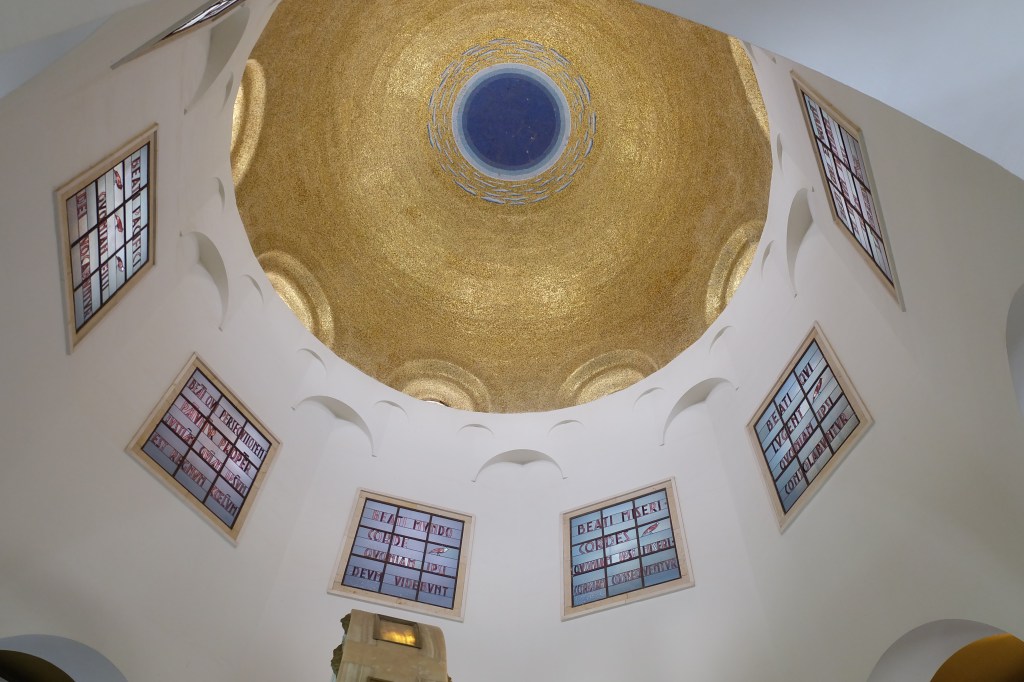
Photo by author, Church of the Beatitudes, Israel, 2019.
“Blessed are the poor in spirit, for theirs is the kingdom of heaven. Blessed are they who mourn, for they will be comforted. Blessed are the meek, for they will inherit the land. Blessed are they who hunger and thirst for righteousness, for they will be satisfied. Blessed are the merciful, for they will be shown mercy. Blessed are the clean of heart, for they will see God. Blessed are the peacemakers, for they will be called children of God. Blessed are they who are persecuted for the sake of righteousness, for theirs is the kingdom of heaven. Blessed are you when they insult and persecute you and utter every kind of evil against you falsely because of me. Rejoice and be glad, for your reward will be great in heaven.”
Matthew 5:3-12
After going around the shores of Galilee, preaching and healing the people, Jesus went up a mountain upon seeing crowds were following him. They were mostly poor people with deep faith in God, hoping and trusting only in him for their deliverance called the anawims.
They were in painful and difficult situations, maybe like many of us, fed up with the traffic and rising costs of everything, fed up with the corruption among public officials and most of all, disillusioned with our priests and bishops!
Then, Jesus called them blessed.
Now, please consider that it is more understandable and normal to say that after being persecuted or after losing a loved one, after all these sufferings that people would be blessed, that the kingdom of God would be theirs.
But, that is not the case with the beatitudes whereby Jesus called them already blessed now, right in their state of being poor, being persecuted, being maligned!
Keep in mind that Matthew’s audience were his fellow Jewish converts to Christianity. By situating Jesus on the mountain preaching his first major discourse, Matthew was reminding his fellow Jewish converts of their great lawgiver, Moses who stood on Mount Sinai to give them the Ten Commandments from God.
However, in the sermon on the mount, Matthew was presenting Jesus not just as the new Moses but in fact more than Moses because Jesus himself is the Law. His very person is what we follow that is why we are called Christians and our faith is properly called Christianity so unlike other religions that are like philosophies or any other -ism.
To understand the beatitudes, one has to turn and enter into Jesus Christ for he is the one truly poor in spirit, meek, hungry and thirsty, merciful, clean of heart, who was persecuted, died but rose again and now seated at the righthand of the Father in heaven. Essentially, the Beatitudes personify Jesus Christ himself. Those who share what he had gone through while here on earth, those who identify with him in his poverty and meekness, mercy and peace efforts, and suffering and death now share in his blessedness.
Therefore, the Beatitudes are paths to keeping our relationship with Jesus Christ who calls us to be like him – poor, hungry and thirsty, meek, clean of heart and persecuted. The Beatitudes are not on the moral plane like the Decalogue that tells us what to do and not to do. Have you ever used the Beatitudes as a guide in examining your conscience when going to Confessions? Never, because the Beatitudes are goals in life to be continuously pursued daily by Christ’s disciples.
Photo by author, Church of the Beatitudes, Israel, 2017.
The Beatitudes are more on the spiritual and mystical plane of our lives that when we try imitating Jesus in his being poor and merciful, meek and clean of heart, then we realize and experience blessedness as we learn the distinctions between joy and happiness, being fruitful and successful.
That is when we find fulfillment while still here on earth amid all the sufferings and trials we go through because in the beatitudes we have Jesus, a relationship we begin to keep and nurture who is also the Kingdom of God. Of course, we experience its fullness in the afterlife but nonetheless, we reap its rewards while here in this life.
As we have noted at the start, we must not take the beatitudes in their material aspect but always in the spiritual meaning. This we find in the first beatitude, Blessed are the poor in spirit, for theirs is the kingdom of heaven.
Actually, this first beatitude is the very essence of all eight other blessedness. Everything springs forth from being poor in spirit, of having that inner attitude and disposition of humility before God. We cannot be merciful and meek, nor pure of heart nor peacemakers unless we become first of all poor in spirit like Jesus, who, “though he was in the form of God, did not regard equality with God something to be grasped. Rather he emptied himself, taking the form of a slave, coming in human likeness and humbled himself” (Phil. 2:6-7, 8).
The prophet Zephaniah showed us in the first reading that poverty in the Old Testament does not only define a social status but more of one’s availability and openness to God with his gifts and calls to us to experience him and make him known. Experience had taught us so well that material poverty is one of life’s best teacher as it leads us to maturity and redemption best expressed in the Cross of Jesus Christ.
In this sense, the beatitude is also the “be-attitude” of every disciple who carries his cross in following Christ. See that each beatitude does not refer to a different person; every disciple of Jesus goes through each beatitude if he/she immerses himself/herself in Christ. That is why last week Jesus preached repentance which leads to conversion. Notice that the beatitudes of Christ are clearly opposite and contrary to the ways of the world as St. Paul tells us in the second reading with God calling the weak and lowly to manifest his power and glory.
Many times in life, we fail to recognize our blessedness when we are so focused with what we are going through, with our work and duties and obligations. This Sunday, Jesus takes us up on the mountain, in the celebration of the Holy Eucharist for us to see ourselves blessed and loved right in the midst of our simplicity and bareness, sufferings and pains. Stop for a while. Find Christ in all your troubles or darkness in life. If you do not find Jesus in your labors and burdens, you are just punishing yourself. If you find Christ because you see more the face of other persons that you become merciful, you work for peace, you mourn and bear all insults and persecution… then, you must be loving a lot. Therefore, you are blessed! Amen.
Have a blessed week ahead!
Photo by author, Church of the Beatitudes, Israel, 2017.
The Lord Is My Chef Christmas Recipe by Fr. Nicanor F. Lalog II
Monday, Memorial of Sts. Basil the Great & Gregory Nazianzen, Bishops/Doctors of the Church
02 January 2022
1 John 2:22-28     ><))))*> + ><))))*> + ><))))*>     John 1:19-28
Photo by Mr. John Ryan Jacob, 31 December 2022, Paco, Obando, Bulacan.
What a great Monday morning
in this new year of 2023,
God our loving Father!
Thank you for your words
that invite us to examine
our true selves,
of who we are,
and what are we?
This is the testimony of John. When the Jews from Jerusalem sent priests and Levites to him to ask him, “Who are you?” He admitted and did not deny it, but admitted, “I am not the Christ.” So they asked him, “What are you then? Are you Elijah?” And he said “I am not.” “Are you the Prophet?” He answered, “No.”
John 1:19-21
Many times we are at a loss
for answers for these basic
questions we refuse to face
and answer, always evading
because deep inside we are lost;
empty our hearts of our pride
and sin to let your Son Jesus Christ
come within;
may we let him dwell in our hearts
and fill us with his humility,
justice,
and love.
Like John,
may we be firm in telling
and showing everyone who we are;
let us not be liars who deny
Jesus is the Christ not only in
words but most especially in deeds;
many times, we just remain silent
amid all the evil and indecencies
that abound us these days especially
in social media.
Like the two great friends
Sts. Basil the Great and
Gregory Nazianzen who were both
Bishops and Doctors of the Church,
they never buckled down in their faith
defending and fighting the truth of Jesus Christ;
help us cultivate such kind of friendships
and relationships that flourish
in great faith and love of Jesus.
Amen.
Lawiswis ng Salita ni P. Nicanor F. Lalog II, Ika-29 ng Disyembre 2022
*Isang tula bunsod ng nakatutuwa na awitin ng Mayonnaise.
Sino ka nga ba, Jopay?
Ako ay nakikisabay,
nakikibagay sa sayaw at ingay
pero pramis,
ang sarap sumakay
sa awit sa iyo ay alay!
Jopay,
gusto ko rin umuwi sa bahay
simpleng buhay
hawak lang pamaypay
sabay kaway kaway
maski kaaway!
Kung sino ka man, Jopay,
totoo sabi nila sa iyo:
minsan masarap umalis
sa tunay na mundo,
walang gulo -
pero wala ding tao!
Kaya kung ako sa iyo,
Jopay, kakanta na lang ako
sabay sayaw:
spaghetti pababa
spaghetti pataas
ganyan ang buhay, Jopay,
isang magandang sayaw
lalo na kung iyong kasabay
mahal sa buhay
mga kaibigan
hindi ka iiwan
maski kelan.
Mayroon tayong
isang kasabay
 sa sayaw ng buhay, Jopay:
tunay ka kaibigan
huwag lang siya ang mawawala
tiyak ika'y matutuwa
sa hapis at lungkot
hirap at dusa
hindi mo alintana
mga ito'y nalampasan mo na
siya palagi mong kasama
hanggang sa bahay ng Ama!
Pasensiya ka na, Jopay
ako ma'y walang kasama
at kausap dito sa bahay
sa mundong magulo;
naisip ko lang tumula para sa iyo
at sa mga kagaya mo
palaging masaya sa paningin
pero maraming kinikimkim
saloobin at pasanin
kaya isang taus-pusong panalangin
aking alay sa inyo,
para lumigaya kayo!
*We have no intentions of infringing into the copyrights of this music and its uploader except to share its beauty and listening pleasure.
The Lord Is My Chef Simbang Gabi Recipe for the Soul by Fr. Nicanor F. Lalog II
Fourth Sunday in Advent, Third Simbang Gabi, 18 December 2022
Isaiah 7:10-14 ><]]]]'> Romans 1:1-7 ><]]]]'> Matthew 1:18-24
Photo from vaticannews.va, 14 December 2020.
We are now at the final stretch of our Advent Season, getting closer to Christmas Day with our gospel today directly telling us how it all happened. And it was not very easy – in fact so difficult – just like with most of us in our many experiences in life when everything did not go so well as planned.
It would not be surprising at all that so many times, many of us would have also thought of giving up, of letting go everything like St. Joseph!
Now this is how the birth of Jesus Christ came about. When his mother Mary was betrothed to Joseph, but before they lived together, she was found with child through the holy Spirit. Joseph her husband, since he was a righteous man, yet unwilling to expose her to shame, decided to divorce her quietly.
Matthew 1:18-19
Christmas is a story of accepting difficulties in life especially persons dearest to us suddenly thrown into challenging situations. Exactly what happened to St. Joseph and Mama Mary.
Many times in life, we advise people going through problems to just simply accept how things are –“tanggapin na lang” – with some sense of resignation as if there is nothing we can do.
Sometimes it is true but many times, not at all true like with St. Joseph’s predicament. He accepted first Mary and then Jesus on a totally different manner worthy of our emulation. It was not out of resignation to the situation but was first of all focused in accepting and valuing persons.
St. Joseph decided to silently leave Mary because of his great love for her. He did not want to expose her to shame and public humiliation that would surely result in being pregnant with a child not his. He did not merely accept the situation as if it were his lot to be “scooped” out by somebody else faster than him with Mary. Keep in mind how the evangelist described St. Joseph as a righteous man, a holy man that despite Mary’s pregnancy, he loved and valued her so much, totally as a person. His leaving her silently was a testimony to his great love and respect for her!
We demand "understanding" in order to "accept"
without realizing that it is different
with persons and with life in general
when we must first "accept" in order to "understand"!
Unlike with us these days when everything has to be explained and spelled out in details before anything or anyone may be accepted. In this age of instants, we want instant explanations too on everything before making any decision, demanding many information to understand anything.
And everyone.
We demand “understanding” in order to “accept” without realizing that it is different with persons and with life in general when we must first “accept” in order to “understand”!
That was exactly the accepting attitude of St. Joseph. He might have not totally understood everything when explained to him by the angel in a dream. Imagine how very difficult it must have been to listen to instructions and explanations in a dream that are already difficult to grasp when done in normal circumstances while awake. But that shows the great maturity and deep spirituality of St. Joseph, of how he accepted everything told to him by the angel in a dream that upon waking up, he absolutely obeyed God’s instruction by taking Mary as his wife.
Photo by Arch. Philip Santiago, Basilica of San Padre Pio, Italy, 2017.
One of my favorite singers is the late Marvin Gaye whose 1971 hit What’s Going On I have used extensively in lessons and recollections to young people. Its lyrics are so poetic yet so deep, with its first two stanzas calling for “loving” before it could lead to “understanding” at the third stanza after the chorus. It calls for acceptance first of everyone, of respect so we could love and understand more.
Picket lines and picket signs Don’t punish me with brutality Talk to me So you can see Oh, what’s going on (What’s going on) What’s going on (What’s going on) What’s going on (What’s going on) What’s going on (What’s going on)
People can never be understood really. There are some people who are truly difficult to understand or as we say, “mahirap ispellengin”. Many times in life I have learned that we simply just have to accept everyone as unique, that God comes through everyone in each one’s uniqueness and peculiarities.
Situations become more difficult to accept unless we accept first the persons involved.
That begins with our very selves when we have to set aside our pride, our own good, even our own plans and agendas like St. Joseph in order to let God lead us truly to fulfillment.
Very often this is the problem with us when we insist on ourselves, on our own ideas and own plans. We get blinded with what we know and even with what we believe in like King Ahaz in the first reading.
Photo from Aleteia.org, “Let Mum Rest”, 2019
St. Joseph as an accepting person was also a very welcoming man like St. Paul in the second reading who took pride in being called and sent by God to proclaim the good news of Jesus Christ. A truly accepting person is always a welcoming one, full of warmth and joy because he/she has Jesus!
See the beauty of St. Joseph’s acceptance of God’s plan: when he accepted Mary, that is when Jesus came.
Thus, we must first accept God.
If we truly accept God, we must accept others as his gifts to us. No matter what.
It is in accepting others with all their differences when Jesus Christ truly comes.
When we learn to accept and welcome people, that is when Christmas truly happens. Not only in December but all year through! Let us pray:
Lord Jesus Christ,
thank you for coming to us daily
not only in our very selves and the many
events that happen to us but most especially
among people you send us;
there are times they are good and so faithful
like St. Joseph who are easy to accept;
but there are also times, they are very
difficult to accept or even understand
especially when they happen to be those
closes to us whom we also love.
Teach us to appreciate the value of silence
like St. Joseph so we may be accepting like him
because it is in our accepting of people and difficult
situations in life when you often come.
Amen.
The Lord Is My Chef Simbang Gabi Recipe by Fr. Nicanor F. Lalog II
Saturday in the Third Week of Advent, Day 2 of Christmas Novena, 17 December 2022
Genesis 49:2, 8-10     ><}}}}*> + ><}}}}*> + ><}}}}*>     Matthew 1:1-17
Photo by author, 2021.
Beginning today, we shift our focus in our Christmas preparations into the second phase of Advent, of looking back to the first coming of Jesus Christ when he was born in Bethlehem more than 2000 years ago.
The birth and origin of Jesus has always been an issue to many people then and now. It was the main reason he was put to death for the case of “blasphemy” because his enemies at that time refused to accept he is the Son of God, the fulfillment of the promises in the Old Testament, of him coming from the lineage of King David.
Until now, people continue to question his origin with so many others insisting Jesus is not God, that he is only human.
That is why all four evangelists began their gospel accounts by first establishing his identity and roots with Matthew doing a very superb job by starting right away with the genealogy of Jesus Christ.
The book of the genealogy of Jesus Christ, the son of David, the son of Abraham. Abraham became the father of Isaac, Isaac the father of Jacob, Jacob the father of Judah and his brothers. Judah became the father of Perez and Zerah, whose mother was Tamar. Perez became the father of Hezron, Hezron the father of Ram….
Matthew 1:1-3
Photo by author, November 2022.
For the early Christians, it was very important to first establish the origin of our Lord because his roots reveal his very being and mission – that indeed, he is the Christ, the promised one of God since the beginning sent to save us from sin and bring us back into one with the Father.
The same is very true with us. Unless we know our roots, our origins, we will always have those confusions in life like identity crisis and meaning of existence. All these problems about gender identity, drug addictions, teenage pregnancies, depressions and so many others are basically due to lack of our knowing of ourselves, of our being. How can we go on with our life journey and mission if we are not even sure of ourselves, of who we are, of our grounding, of where we came from?
When I was a newly ordained priest assigned to a school in Malolos, at first I felt so mad at seeing how our young people behaved, their lack of discipline and sense of responsibilities. But after three months in school, I realized that the question we should be asking even until now is not why are the young acting that way today but, “where are their parents”?
Now that I am assigned as a university chaplain, the more I see this reality so true, even at its worst and ugly faces of the many burdens and sufferings our young people have to bear and contend with right in their homes – incest and physical abuses, absentee parents and separated parents or single parents made more difficult by poverty that many of them even go without breakfast or decent meal on many occasions every week.
Now more than ever, the school has become truly the home of every student because they have no home, no parents and no love to come home to! They prefer hanging out anywhere including school and get into drugs and other vices at a young age because nobody cares for them except their equally lost peers. Many practically live in the internet and social media because nobody is around to interact with them at home.
Many young people are lost simply because their parents are lost too. They have all kinds of issues because they do not know who they are and where they are going to. They have low self-confidence and low self-esteem, depressive and yes, almost everyone contemplates committing suicide even once because they could not find meaning in their lives anymore.
... human love is imperfect,
only God can love us perfectly.
So sad, so disheartening.
This past week, I have been hearing confessions of our students who poured out everything to the point of crying. What is so moving for me was how they still professed their love for their parents and siblings despite their pains and sufferings.
After listening to them – sometimes crying with them – I tell them that human love is imperfect, only God can love us perfectly. For sure, I tell them that their parents must have also come from so many pains and hurts in their lives, even broken homes too like theirs. Widen your perspectives, I tell them. And keep your hearts wide open to God, to welcome Jesus who comes daily in our lives especially in the most trying time.
This is the meaning of all those names in Jesus Christ’s genealogy – he is so like us with many imperfect relatives and family like quarrelsome siblings, single-parents, prostitutes, unfaithful kings and husbands, illegitimate children, and probably all those things we describe or label as “dysfunctional family”.
Deep within every name is a real person, broken and sinful, hurting and lost just like us yet, loved and saved by God in Jesus Christ. All of them remind us we all came from God like Jesus and with him, in him and through him, we shall all come home to God our true Father.
Every time I administer Baptism, I remind parents to shower their children with love especially in their formative years from infancy to early teens while singing to them a few lines from James Taylor’s “Shower the People with Love” to make my point.
Recently I found in my Facebook feeds from one of the sites I follow a beautiful story and shared it on my wall, saying, “Ito ang tunay na pag-ibig” (this is true love):
From Facebook, The Language Nerds, 13 December 2022.
Our being is from God who is love. Therefore, our mission too is love. Just like Jesus Christ. That is the meaning of all those names in the genealogy of Jesus Christ. The very same meaning we shall find when we trace our own roots, when we do our family tree to find our being and mission.
This is the grace of Christmas 2022 – after two years in the pandemic with so many restrictions, we are celebrating face-to-face to personally experience one another again. Most of all, to personally experience of being loved and loving again.
Christmas is essentially a story of our first love – God – who comes to us face-to-face. Even its preparation as we have seen in the Lord’s genealogy, of God coming to us in our imperfections and weaknesses happened face-to-face in the context and spirit of love, a love that covers a multitude of sins, welcomes everyone, ready to forgive and celebrate life.
Let us see and welcome God in our hearts by rekindling that love we have always have. And upon finding him there, may we also find him in the face of everyone we meet, especially those closest to us, our family and relatives. Let us pray:
Lord Jesus Christ,
thank you for coming to us;
thank you for showing us that
like us, you came from very
dysfunctional family too!
Thank you for assuring us
that despite our many imperfections,
sins and weaknesses,
you still come and even more present
in our hurts and wounds.
Let us find you where we are,
right here in our brokenness
and darkness so that in the process,
we may also show you to others
lost in their many sufferings and pains.
You have given us yourself, Jesus,
let me give you to others
in love and kindness,
in my mere presence.
Amen.











 lordmychef.com