The Lord Is My Chef Breakfast Recipe for the Soul by Fr. Nicanor F. Lalog II
Tuesday, Memorial of St. Martin de Porres, Religious, 03 November 2020
Philippians 2:5-11  +++ ||| +++   Luke 14:15-24
Photo by author, Chapel of the Holy Family, Sacred Heart Center for Spirituality, Novaliches, 2018.
Brothers and sisters: Have among yourselves the same attitude that is also yours in Christ Jesus. Who, though he was in the form of God, did not regard equality with God something to be grasped.
Philippians 2:5-6
God our Father, I feel too small, even ashamed before you today as I prayed on your words through St. Paul; it is not just a very tall order but the sad part is the fact that we have all known it all along since our catechism days in school or the parish but rarely put into practice.
We admit it is the fundamental rule of Christian life, to be like Jesus Christ your Son who had come to show us the way back to you is by emptying one’s self for others, to be one with others especially in their pains and sufferings, of being the last, being the servant of all, being like a child.
Unfortunately, we always find it so difficult to learn.
Partly because we lack the very attitude of Jesus Christ we must first imitate according to St. Paul.
And that is the attitude of being small, being the least.
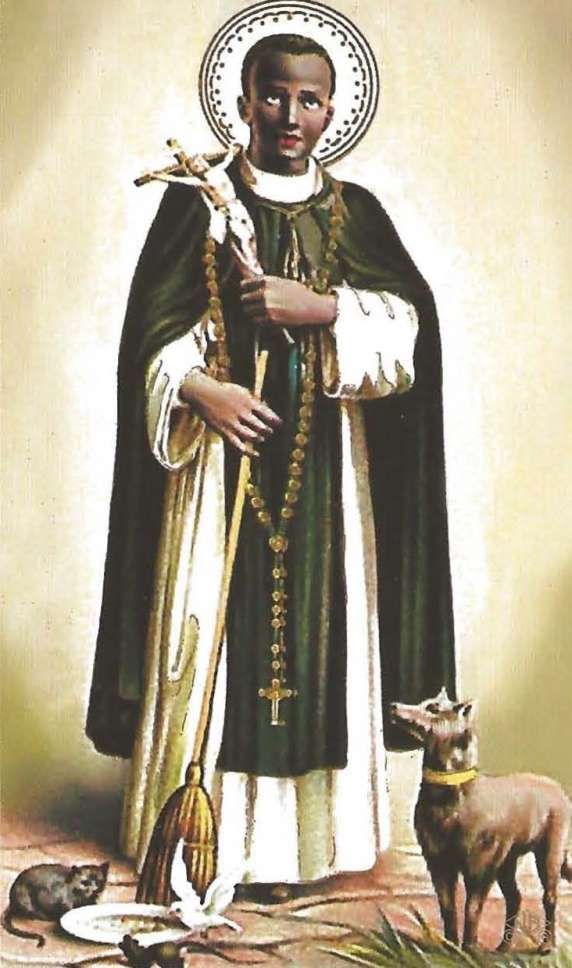
Exactly like St. Martin de Porres:
From Pinterest.com
Such was his humility that he loved them even more than himself and considered them to be better and more righteous that he was. He did not blame others for their shortcomings. Certain that he deserved more severe punishment for his sins than others did, he would overlook their worst offenses. He was tireless in his efforts to reform the criminal, and he would sit up with the sick to bring them comfort. for the poor he would provide food, clothing and medicine.
Homily by St. Pope John XXIII at the Canonization of Saint Martin de Porres in 1962
So often, our attitude is like with those invited by the king to his great dinner: feeling great, feeling so important with themselves that they find no need to be with others that they all turned down the invitation.
Sometimes our arrogance and high regard for ourselves miserably fail us in being like Jesus; hence, we continue to be divided into factions because no one would give way for others that lead to peace and harmony.
Teach us Lord to change that attitude of greatness in us with an attitude of smallness, of leaving a space for others in our lives so we can all work together as one community of believers in you like St. Martin de Porres and all the other saints. Amen.
The Lord Is My Chef Breakfast Recipe for the Soul by Fr. Nicanor F. Lalog II
Saturday, Week XXX, Year II in Ordinary Time, 31 October 2020
Philippians 1:18-26     >><)))*>  +  >><)))*>  +  >><)))*>     Luke 14:1, 7-11
Photo by Mr. Jim Marpa, 2019.
It is the end of another month, of another week as we brace ourselves for a super typhoon directly hitting our region. And yes, God our loving Father, we are scared, we are worried, we feel helpless most specially for our little brothers and sisters, those who have always been suffering in life like the poor, the elderly, the sick, the marginalized.
But if there is one thing we have learned from COVID-19 these past eight months is to wholly entrust everything to you, O God, to completely surrender and rely on you alone.
Let us grow deeper in faith, more fervent in hope and be unceasing in our charity and love for others so that the Gospel of Jesus your Son may always be proclaimed.
Help us imitate St. Paul, though imprisoned and almost certain of facing death, no trace of helplessness is found in him; on the contrary, he was so full of power coming from his deep, personal relationship with Jesus Christ.
My eager expectation and hope is that I shall not be put to shame in any way, but that with all boldness, now as always, Christ will be magnified in my body, whether by life or by death. For to me life is Christ, and death is gain.
Philippians 1:20-21
Enable us in the power of the Holy Spirit to humbly submit ourselves to you, dear God, confident that you always have a specific place and seat, a role to play for us — if we can learn to first stand up for you like in today’s parable by Jesus.
May the coming typhoon be an opportunity for us to let our faith be expressed in words and in deeds. Amen.
Lawiswis ng Salita ni P. Nicanor F. Lalog II, Ika-29 ng Oktubre 2020
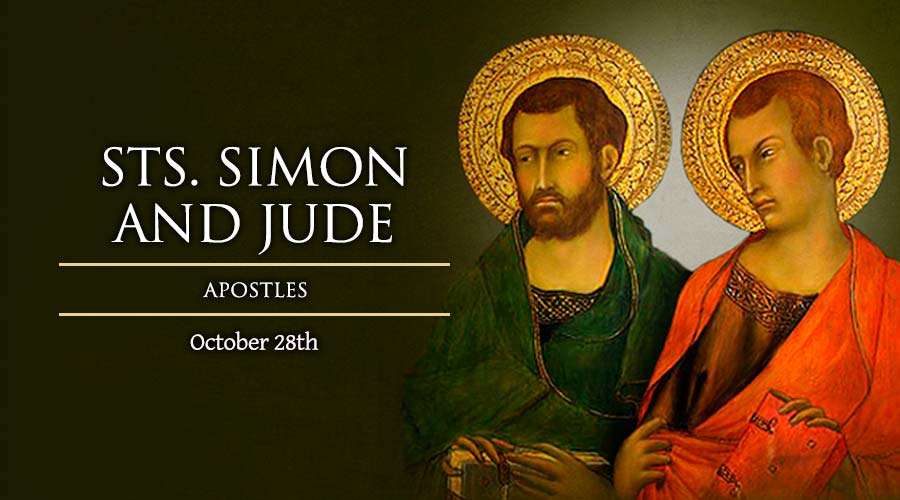
Larawan mula sa catholicnewsagency.com.
Sa pagdiriwang ng kapistahan
ni San Judas Tadeo kahapon
may isang magandang tagpo
na kay inam nating balikan
upang pagnilayan
kanyang tanong kay Jesus
noong Huling Hapunan:
"Panginoon,
bakit po sa amin lamang kayo
magpapakilala nang lubusan
at hindi sa sanlibutan?" (Jn.14:22)
Mahiwaga at matalinhaga
ang tugon ng Panginoon:
"Ang umiibig sa akin ay tutupad
ng aking salita;
iibigin siya ng aking Ama,
at kami'y sasakanya at
mananahan sa kanya." (Jn.14:23)
Bakit nga ba hindi na lamang
magpakita si Jesus sa lahat upang
mawala na pagaaalinlangan,
at iba pang mga katanungan?
Maski naman magpakita si Jesus
marahil wala pa ring maniniwala
hangga't hindi natin siya nakikilala
sa mukha ng bawat kapwa:
hindi bagay o gamit si Jesus
na basta-basta lamang nakikita
ng ating mga mata ---
Siya ay Persona:
makikilala lamang
ng isang pusong bukas
handang tumanggap
at tularan Kanyang pagmamahal
upang Kanyang panahanan
tungo sa personal na ugnayan.
Hanggang ngayon ito pa rin
ang ating tanong sa ating panahon
at bakit nga kaya nagkagayon?
Tuwing magkokomunyon
"Amen" ang ating tinutugon
bago tanggapin
Katawan ng Panginoon
na marahil atin ngang nakikita
nguni't hindi nakikilala
dahil puso ay ipininid
naging manhid
sa daing ng bawat kapatid?
Ang Diyos ay pag-ibig
na siyang Kanyang larawan
at wangis sa atin Kanyang ipinaris;
kung pag-ibig ay ating inalis,
ang lahat sa atin ay malilihis
makita man natin si Jesus di natin Siya makikilala!
Larawan ay kuha ni Lucas Jackson ng Reuters ginamit sa The Economist, 2019.
The Lord Is My Chef Breakfast Recipe for the Soul by Fr. Nicanor F. Lalog II
Thursday, Week XXX, Year II in Ordinary Time, 29 October 2020
Ephesians 6:10-20     >><)))*> + + + >><)))*>     Luke 13:31-35
Photo by author, 09 October 2020.
There is no doubt, O God, we are in a war with evil as St. Paul tells us in today’s first reading; but, as I prayed more, I dwelled on that one word he had said — “struggle”.
For our struggle is not with flesh and blood but with principalities, with the powers, with the world rulers of this present darkness, with the evil spirits in the heavens. Therefore, put on the armor of God, that you may be able to resist on the evil day and, having done everything, to hold your ground.
Ephesians 6:12-13
Almighty and loving Father in heaven, today I pray for each one of us struggling in life — struggling to survive, struggling to be afloat amid the economic crisis, struggling to keep our family and friends together, struggling against an addiction, struggling against sins, struggling in almost everything or anything, maybe even struggling to believe and have faith in you, dear God.
To struggle is an effort to get out of something not meant to be like an imprisonment. To struggle is to exert efforts to resist attacks or be free from any constraints. Like when a fish is out in the sand, it struggles to get onto water which is its natural habitat.
There are many conditions in our lives today we are into but not really meant to be for us like the effects of evil and sin sometimes perpetrated by some among us. We are sure you never wanted us to be put into this situation. And that is why, you have sent us your Son Jesus to help us in our struggles.
Sometimes, life for others has simply been entirely a struggle since childhood.
Have mercy on us, please help us, Lord, in our struggles. Be our armor of truth and righteousness, our shield of faith, our helmet of salvation, and our sword of the Holy Spirit to slay the evil and sins enslaving us.
Thank you, dear Jesus, for standing by our side in our many struggles despite efforts of some like the Pharisees in the gospel today who told you to leave Jerusalem because “Herod wanted to kill you” (Lk.13:31).
Make us realize that in the midst of life’s many struggles, “you are our Rock, O Lord, who trains our hands for battle, our fingers for war” (Ps.144:1) and someday, as you have promised, we shall win in all our struggles to experience your glory and majesty, love and mercy. Amen.
Photo by Ms. Jo Villafuerte, September 2019 in Atok, Benguet.
The Lord Is My Chef Breakfast Recipe for the Soul by Fr. Nicanor F. Lalog II
Tuesday, Week XXX, Year II in Ordinary Time, 27 October 2020
Ephesians 5:21-33     +  >><)))*>  +  >><)))*>  +  >><)))*>  +     Luke 13:18-21
Photo by Mr. Jim Marpa, 2018.
Brothers and sisters: Be subordinate to one another out of reverence for Christ.
Ephesians 5:21
What a beautiful admonition to us all this day by St. Paul and a wonderful prayer too to you, O God our Father that we need to pray more often in our world where relationships are getting complicated, very fleeting, and sometimes misleading and hurting.
May Jesus Christ be revered as basis and foundation of our every relationship in life so that the ties that bind us as couples, families, siblings and society may become more human, more loving, and more faithful.
So often, we look down upon your words as too old-fashioned and even outdated for the present situation like the defined codes of relationships St. Paul talks about in his Letter to the Ephesians; but, the sad truth is we have only changed the language nuances to make us sound more just these days without really removing the old obligations of the weaker ones with the stronger ones, like wives to husband, children to parents, and slaves to masters.
Grant us wisdom through the Holy Spirit to base all our relationships only in Jesus Christ who had come to bring us closer to you, God our Father.
May we find the value of many little things we take for granted like respect and being fair so essential in our relationships with everyone beginning in our homes, in our family circles where the kingdom of heaven always begins. Amen.
The Lord Is My Chef Sunday Recipe for the Soul by Fr. Nicanor F. Lalog II
Week XXX-A in Ordinary Time, 25 October 2020
Exodus 22:20-26  |+++|   1 Thessalonians 1:5-10   |+++|   Matthew 22:34-40
Nuns bringing relief goods during the lockdown due to COVID-19 last summer. Photo from Facebook.
Our gospel this Sunday is a very usual scene happening daily in our modern world when we keep on testing Jesus Christ like the Pharisees for so many things about life we feel we know better than even God.
We keep on “pushing the lines” to avoid crossing them lest we break the laws and commandments when our hearts are clearly bent more on the legalisms than their spirit and sense.
How unfortunate that until now, when we would rather see the small parts than the whole that we keep on breaking down everything specially laws as if they are entities unto themselves, forgetting that each part leads to greater good.
Such is the essence of the one law of love, love of God is always love of neighbor and vice versa. They cannot be separated, like a face with two cheeks.
But more important than understanding the nature of the law of love which is the inseparability of love of God and love of others is passing its final test of loving.
I have always loved this actual photo of a banana vendor during the lockdown who kept his prices low as part of his effort in alleviating the sufferings due to COVID-19 pandemic. Photo from Smart, March 2020.
We keep on testing Jesus
who has passed every test we have
subjected him into...
Can we pass his test of love, too?
As we come to close our liturgical calendar in the coming weeks, our Sunday gospel today challenges us to examine our very selves too if like Jesus, can we pass the test of love?
When the Pharisees heard that Jesus had silenced the Sadducees, they gathered together, and one of them, a scholar of the law, tested him by asking, “Teacher, which commandment in the law is the greatest?”
Matthew 22:34-36
The scholar’s question to Jesus was partly a result of the confusion among people of his time when their experts and scholars of the Laws broke down into minute details and parts the Decalogue that eventually ended having over 600 precepts including those rituals of cleansing of things Jesus and his disciples were often accused of disregarding whenever they came to gatherings.
The sad thing is that instead of simplifying them so the people may find more the spirit of the Laws than its legalisms, the Jewish leaders “did not lift a finger” about it for selfish motives.
And now they were using it to test Jesus which we sadly continue in our present time.
While it is true that evil exists in lawlessness or when we live lawlessly, God’s law is directly opposed to a legalistic understanding that must be seen always in the light of faith.
This is perhaps the main point of Pope Francis in his recent statement proposing for “civil coexistence law” (convivencia civil) that will protect homosexual people from mistreatment and social rejection even from among their own family circles. The Pope is not calling for same sex civil union nor same sex marriage. We have to go beyond the legalese and legalisms of laws to see the Holy Father’s genuine concern and love for people with homosexual tendencies he had longed to bring back to the fold.
We cannot separate law and love if either is to bring deepened relationships and unity among peoples that are in fact the goals of both law and love. Law and love always take into consideration the other person often forgotten when we have an excess of our very selves.
In the first reading, we are reminded how the laws themselves are manifestations of God’s love for his people, of laws coming directly from him without any hint whatsoever of the distant lawgiver we have always seen and experienced among men.
See how he admonished everyone to be kind with everybody specially aliens for after all, we are all immigrants and travelers of this earth whom he takes care of. In declaring “I am compassionate” (Ex.22:26), God assures everyone of his oneness with us, that to love him is to love others, to hurt others is hurting him too! The very same thing Jesus is telling us today!
He said to him, “You shall love the Lord, your God, with all your heart, with all your soul, and with all your mind. This is the greatest and the first commandment. The second is like it: You shall love your neighbor as yourself. The whole law and the prophets depend on these two commandments.”
Matthew 22:37-40
Jesus easily passed the “test” by the Pharisees at that instant and would prove it more decisively and concretely on the Cross when he gives himself up to the Father for our salvation as the supreme sign of love that is true.
His answer takes us all to the very foundation of all the laws we have which is loving God with one’s total self expressed in loving others as we love our selves. Here we find Jesus doing away with our legalisms that focus on the letters and individual laws and commandments, summing them all in love.
Again, following the background and personality of Pope Francis, here we find his love in action being bogged down by legalisms and limitations of the language.
What does he really mean with convivencia civil or civil coexistence law minus any romantic meanings in adherence to our moral laws?
I do not know but in my heart, I could feel the love and compassion of this Pope for homosexuals we have long ostracized from the Church and even society, making fun of them, forgetting their feelings and well-being and persons. It might still take some time before the Pope’s idea is realized even in the Church. What we need at the moment is openness to the leading of the Holy Spirit to finally find those words and terms to encapsulate the love and compassion Pope Francis has for them.
That is the problem with love — always beyond words. One has just to do it, to just “love, love, and love” as Leo Buscaglia would always say.
In the second reading, St. Paul reminds us how the world continues to frown upon us Christians striving to live the life Christ had called us to. We can see the continuing biases in the society even in social media against us Christians standing for what is just, moral and true. It is in this context where we are challenged to be true witnesses of the love of Jesus Christ that the credibility of his gospel is proven daily as the only path towards peace and harmony.
Jesus passed the tests of his enemies about his love for God and love for us; all the past Popes have proven too their complete love for God and for others in their lives of holiness. Pope Francis has striven while still in Argentina to witness this immense love of Jesus for the marginalized. Instead of wasting our energies debating about his recent statements despite his being passed the same test of love, let us now examine ourselves how are we faring in this test of love too?
And loving and lovely week ahead of everyone in Jesus!
The Lord Is My Chef Breakfast Recipe for the Soul by Fr. Nicanor F. Lalog II
Saturday, Week XXIX, Year II in Ordinary Time, 24 October 2020
Ephesians 4:7-16     >><)))*>   +   <*(((><<     Luke 13:1-9
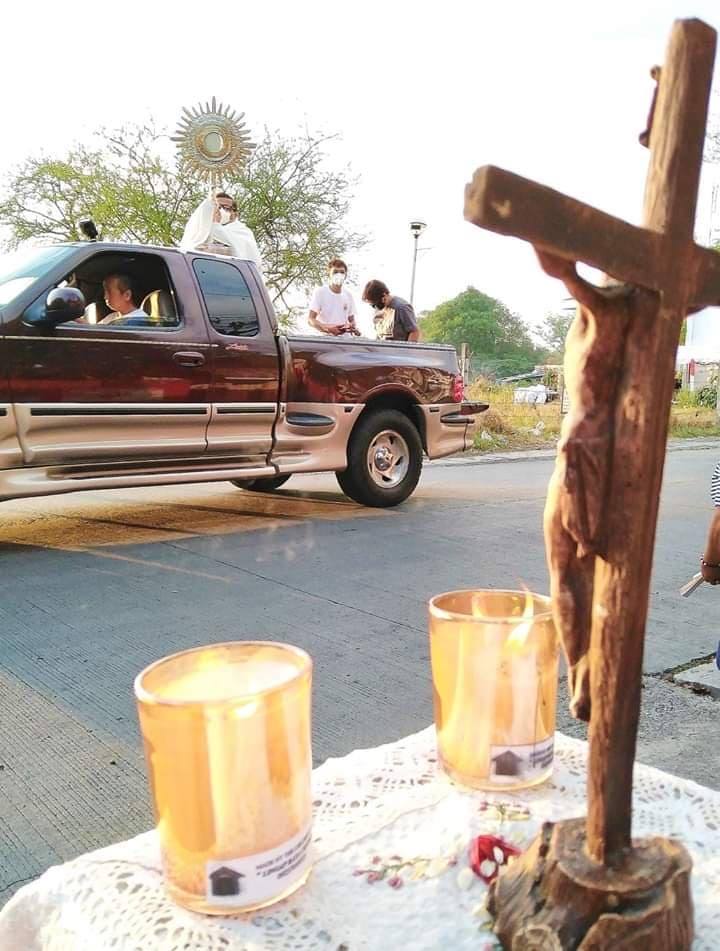
Motorized procession or “Paglilibot” of the Blessed Sacrament around our Parish last summer at the height of COVID-19.
Praise and thanksgiving to you, God our merciful Father for the grace of some bit of good news these past few days with the declining number of COVID-19 infections specially in the National Capital Region. We are still far from controlling the spread of corona virus but that is enough for us to rejoice! Thank you, dear God!
As we come to close this week and inch closer to the penultimate month of 2020, we pray like St. Paul that we may live holy and righteous lives worthy of our dignity in Jesus Christ your Son.
Rather, living the truth in love, we should grow in every way into him who is the head, Christ, from whom the whole Body, joined and held together by every supporting ligament, with the proper functioning of each part, brings about the Body’s growth and builds itself up in love.
Ephesians 4:15-16
Make us grow in you, dear Jesus: let us see and find you in things and events in our lives.
Make us see ourselves first of all in need of seeking your forgiveness and mercy for our many sins to cleanse ourselves of any claims to self-entitlement as you have warned the people in today’s gospel.
Most of all, may our lives bear fruits like in the parable of the fig tree wherein we keep in mind, always aware of our identity in you, dear Jesus so that we may live accordingly in the grace of the Father through the Holy Spirit. Amen.
The Lord Is My Chef Breakfast Recipe for the Soul by Fr. Nicanor F. Lalog II
Tuesday, Week XXIX, Year II in Ordinary Time, 20 October 2020
Ephesians 2:12-22     >><)))*> + >><)))*>  +  >><)))*>     Luke 12:35-38
Photo by Dr. Mylene A. Santos, MD in Quezon, 2020.
Glory and thanksgiving to you, God our Father, through your Son our Lord Jesus Christ in the power of the Holy Spirit for reconciling us all in you, making us one despite our many differences.
How lovely to the ears, to our being the words of St. Paul today, Lord Jesus, assuring us of our citizenship in heaven through the salvation you have brought us all, regardless of our color, race, status or even religion!
So then you are no longer strangers and sojourners, but you are fellow citizens with the holy ones and members of the household of God, built upon the foundation of the Apostles and prophets, with Christ Jesus himself as the capstone. Through him the whole structure is held together and grows into a temple sacred in the Lord; in him you also are being built together into a dwelling place of God in the Spirit.
Ephesians 2:19-22
Help us, O Lord, to embody and manifest this unity of peoples in you in the Church, your Mystical Body here on earth.
Heal us of our many divisions and make us truly Catholic by helping everyone enter into communion with you through one another.
Keep us on guard for your return, Jesus, by “girding our loins and lighting our lamps” (Lk.12:35) ready to welcome you with our good works each day, leading others closer to you.
Let us start by going back to you in prayers and silent meditations that many have forgotten or taken for granted in this 24/7 world saturated by media with all the cacophony of sounds and blinding visuals that have blurred our vision of who we really are as citizens of heaven, beloved children of God our Father in heaven.
Help us find our way back home to the Father in heaven here on earth by finding our way back home to our true selves and to our brothers and sisters in you, dear Jesus. Amen.
The Lord Is My Chef Breakfast Recipe for the Soul by Fr. Nicanor F. Lalog II
Friday, Week XXVIII, Year II in Ordinary Time, 16 October 2020
Ephesians 1:11-14     >><)))*> + >><)))*> + >><)))*>     Luke 12:1-7
Photo by the author, September 2020.
What a great apostle you have, O Lord God, in St. Paul indeed! Today he tells us something so unique, so understandable and relatable with us regarding our being blessed in Jesus Christ: being sealed in the Holy Spirit.
In him (Christ) you also, who have heard the word of truth, the Gospel of your salvation, and have believed in him, were sealed with the promised Holy Spirit, which is the first installment of our inheritance toward redemption as God’s possession, to the praise of his glory.
Ephesians 1:13-14
I love those two catchphrases by St. Paul: “sealed with the promised Holy Spirit” and “first installment of your inheritance”. It is both a stroke of his genius and mastery of language while at the same time, his openness to the inspiration of the Holy Spirit.
In him we find that blessedness in Christ through the Holy Spirit like having peace, kindness, generosity, forgiveness, understanding and things that bind us together in working together for the Lord’s mission.
But at the same time in speaking of the Holy Spirit as the first installment of our redemption, St. Paul had a foretaste of what we shall all experience in its fullness in eternity, an assurance of the fulfillment of Christ’s promise of salvation.
Like St. Teresa of Avila whose memorial we celebrated yesterday, St. Paul restored all things in you, Jesus Christ. And so, we pray for the grace of enthusiasm and perseverance of working for the coming of God’s Kingdom like him.
Give us the wisdom to proclaim loud and clear not only in words but also in deeds the Gospel so the world may know Jesus is here to restore everything and everyone back to you, God our Father.
We are not going to say anything new, Lord; we merely have to echo in this modern time your Good News of salvation, of love and mercy and forgiveness for everyone specially in this difficult time of the pandemic.
Likewise, give us the courage to witness the power of the Holy Spirit in this world living in front of all kinds of cameras without solid grounding on the realities of life, living in a make-believe world filled with hypocrisy. Seal us with your Holy Spirit, Lord! Amen.
The Lord Is My Chef Breakfast Recipe for the Soul by Fr. Nicanor F. Lalog II
Thursday, Memorial of St. Teresa of Avila, Virgin and Doctor of the Church, 15 October 2020
Ephesians 1:1-10     <*(((><<  || + + + ||   >><)))*>     Luke 11:47-54
Photo by Dr. Mai B. Dela Peña at a Carmelite Monastery in Israel, 2016.
You know so well, O God, how we must pray to you that you have taught St. Paul one of the most beautiful prayer – and greetings – we can all recite individually or communally when gathered in your name.
Blessed be the God and Father of our Lord Jesus Christ, who has blessed us in Christ with every spiritual blessing in the heavens, as he chose us in him, before the foundation of the world to be holy and without blemish before him.
Ephesians 1:3-4
So beautiful are these words showing to us our blessedness in Jesus Christ! If we could all be aware of our blessedness in you that springs from your infinite love for us poured by Jesus Christ at the Cross, maybe there would be less chaos in the world today.
Forgive us in wasting your blessings, exchanging them for fleeting pleasures of fame and wealth that set us apart from one another. Worst, in misleading others away from you with our sinful ways of life like the enemies of Jesus in today’s gospel.
Help us restore all things in your Son, dear Father, like St. Teresa of Avila who taught us to be mindful always of Jesus Christ’s love for us.
Whenever we think of Christ we should recall the love that led him to bestow on us so many graces and favors, and also the great love God showed in giving us in Christ a pledge of his love; for love call for love in return.
St. Teresa of Avila, Office of Readings, October xv