40 Shades of Lent, Wednesday, Solemnity of the Annunciation, 25 March 2020
Isaiah 7:10-14; 8:10 +++ Hebrews 10:4-10 +++ Luke 1:26-38
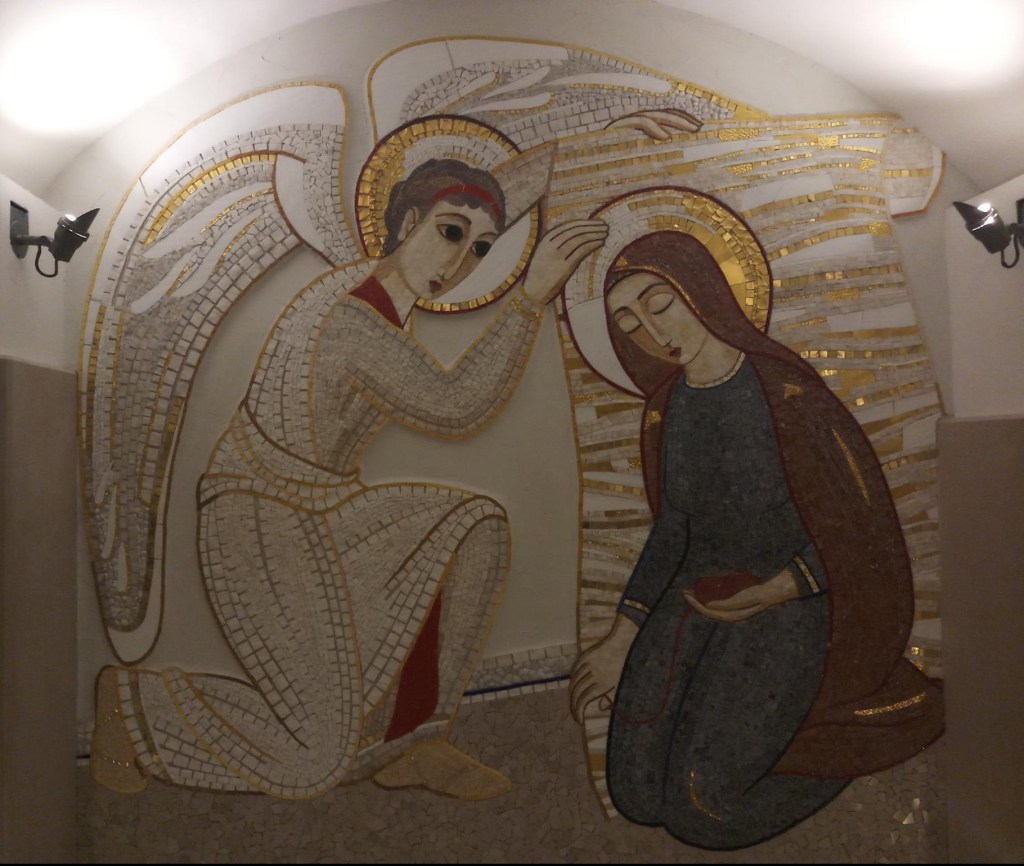
Mosaic of the Annunciation to Mary at San Giovanni Rotondo Church, Italy. Photo by Arch. Philip Santiago, 2019.
Glory and praise to you, O God our Father as we celebrate today the Solemnity of the Annunciation of the Birth of Jesus Christ to Mary. What a celebration so appropriate in this time of COVID-19 amid the ongoing lockdown not only in our country but in many parts of the world.
You know how I am not into any countdown whatsoever, Lord; in fact, I do not even keep tabs of how many days we have been locked down except that I really miss my parishioners, the normal grind of each day.
But as I prayed on this Solemnity, the first thing that I realized is that we are nine months from Christmas!
Jesus is coming, Jesus has come, Jesus is never gone — especially in this lockdown!
Photo by Ms. Ria De Vera during our procession of the Blessed Sacrament in our Parish, 22 March 2020.
What an honor and grace, O Lord, that despite our sinfulness and failures, you continue to offer us salvation, of starting all over again, of picking up the pieces of our lives, of hoping for that great day when all these lockdown and pandemic are gone.
We pray for all the health workers who sacrifice their very lives in saving the sick and all the other unsung heroes who do their share in helping us unburden the heavy crosses we are carrying following COVID-19’s wrath.
Thank you for the many among us who have opened like Mary to receive Jesus and share Jesus in these trying times.
But we also pray, O Lord, for those many of us who remain closed and cold to you and to others.
The people who continue to ignore “social distancing” and those who have remained spiritually and emotionally distant from family members, friends, and neighbors.
We pray most especially for our officials in the government who continue to bring more shame and dishonor to themselves to the detriment of the people.
The leaders who think more of themselves, who regard themselves as more important than others. The modern “King Ahaz” of our time who rely more on their own power, on their alliances with their foreign and local lords and masters.
Have mercy on them, Lord.
Come quickly and save us.
Open our hearts, teach us humility to be able to say to you like Mary, “Be it done unto me according to your word.” Amen.
Photo by author of the site where Mary received the Good News of Christ’s coming from Archangel Gabriel beneath the Basilica of the Annunciation, Nazareth, 2019.
40 Shades of Lent, Saturday, Week III, 21 March 2020
Hosea 6:1-6 <*(((>< +++ ><)))*> Luke 18:9-14
Photo by author, Mount St. Paul, Trinidad, Benguet (04 February 2020).
Your words today, O Lord, are so true.
And so painful, too.
What can I do with you, Ephraim? What can I do with you, Judah? Your piety is like a morning cloud, like the dew that early passes. For this reason I smote them through the prophets, I slew them by the words of my mouth. For it is love that I desire, not sacrifice, and knowledge of God rather burnt offering.
Hosea 6:4-6
We could feel your sadness, O Lord, speaking to us who have become like your people Israel. Slay us with your words as we close the first week of our heightened community quarantine deep in confusion and loss when our leaders fail – or refuse – to rise to maturity and statesmanship when concern for ego and turfs have become their main preoccupation while others are nowhere to be found.
Where is the love, O Lord, they have promised us, our country?
But the more painful question we all have to answer really is where is our love? Where is our love for our country expressed in electing all these officials we now have? Where is the love we have promised to one another, of husband and wife, of parents and children, of siblings, of friends?
We have sinned, O God our Father, because we have failed or refused to love and share your immense love for each one of us.
Forgive us, for we have lost the essence of love, of forgetting one’s self in favor of the beloved. We have loved our selves too much, thinking we are always just and right, truly the ones for whom today’s gospel is meant for without exceptions.
Jesus addressed this parable to those who were convinced of their own righteousness and despised everyone else. Two people went up to the temple area to pray; one was a Pharisee and the other was a tax collector.
Luke 18:9-14
We have thought that love is when the good times roll, when there is laughter and pleasure, when there is affluence. Worst of all, we have thought that love is a material expressed in things or mere feelings we always show in sweet nothings.
Teach us again to remember that love is a person … because you are love, O God!
Deus caritas est (1 John 4:8).
Let us love, love, and love truly like Jesus your Son who gave himself for us on the cross. Amen.
Parokya ni San Juan Apostol at Ebanghelista, 2019.
40 Shades of Lent, Friday, Week III, 20 March 2020
Hosea 14:2-10 ><)))*> +++ <*(((>< Mark 12:28-34
Photo by author, Mt. St. Paul, Trinidad, Benguet, 04 February 2020.
Unbelievable.
That’s the only word you spoke to me Lord in my prayers last night and this morning.
Unbelievable.
As the days move on, God our Father, the more I could not believe all these things going on. What have happened with us, Lord?
Bakit kami nagkaganito at paano kami humantong dito, Panginoon?
Your words today, O Lord, are so true. It is you indeed who speaks to us especially in the first reading through the Prophet Hosea. You have spoken so well — we have all sinned.
We have disregarded you and others. We have relied so much in our own powers and abilities. We have insisted on doing things our own ways totally discarding your teachings.
But more unbelievable in this unbelievable situation is your immense love and mercy for us, O God our Father.
Thus says the Lord: Return, O Israel, to the Lord, your God; you have collapsed through your guilt. Take with you words, and return to the Lord… I will heal their defection, says the Lord, I will love them freely; for my wrath is turned away from them. I will be like the dew for Israel: he shall blossom like the lily.
Hosea 14:2-3, 5-6
Lent Week-III 2020 in our Parish.
Help us, Father through your Son Jesus Christ that we may look more inside ourselves these trying times, that we may see you more and as we see you as the most essential, the most important of all, we also see our value as persons.
Let us experience that love you have for us that we ought to share with one another, beginning in our family, in our neighborhood.
How unbelievable that some of us, like that scribe who asked Jesus “which is the first of all commandments”, we keep on categorizing, ranking things and even persons to determine who or what is the most important — the first.
Unbelievable but true, this pandemic is happening because we have forgotten you and we have forgotten others too. We have forgotten YOU are always first, always great. Semper Primus, semper Major!
Teach us to see more of you so that we also see you among one another. Amen.
40 Shades of Lent, Solemnity of St. Joseph, Husband of Mary, 19 March 2020
2 Samuel 7:4-5, 12-14, 16 +++ Romans 4:13, 16-18, 22 +++ Matthew 1:16, 18-21, 24
Photo from zenit.org, “Let Mom Rest” figurine
Praise and thanksgiving to you, O God our loving Father in giving us your Son, Jesus Christ our Savior. In sending him to us, you have asked St. Joseph to be not afraid to be the husband of the Blessed Mother of Jesus, Mary Most Holy.
…the angel of the Lord appeared to him in a dream and said, “Joseph, son of David, do not be afraid to take Mary your wife into your home. For it is through the Holy Spirit that this child has been conceived in her.” When Joseph awoke, he did as the angel of the Lord had commanded him and took his wife into his home.
Matthew 1:20-21, 24
We pray today on this Solemnity of St. Joseph that we may also not be afraid in fighting this pandemic COVID-19.
Let us be not afraid to stay home to be with our family again, together and longer.
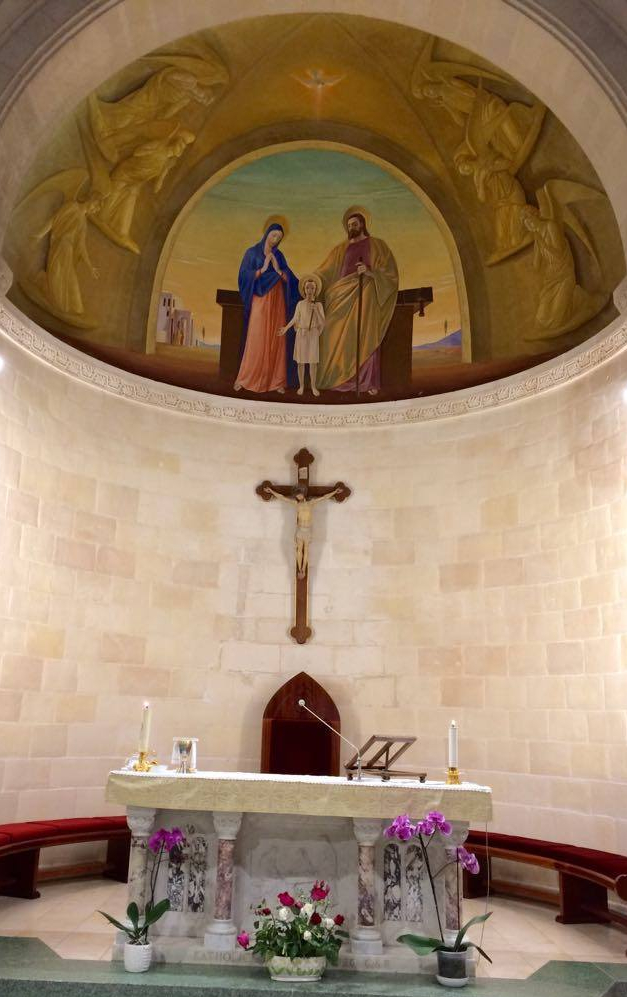
Photo by author, Chapel of St. Joseph, Nazareth, Israel, May 2017.
Let us be not afraid to talk and converse really as husband and wife, parents and children, brothers and sisters. Help us to be more open and more silent like St. Joseph to hear our family members’ innermost thoughts and feelings again with love and understanding.
Let us be not afraid, O Lord, to seek and work for real peace in our family now disintegrating as we disregard each other, choosing fame and wealth than persons.
Let us be not afraid to reach out also to those living alone like the sick, the elderly, the separated, those abandoned by family and friends or society, those widowed.
Let us be not afraid to share food and money to the needy, time and talent, joy and hope to those living in the margins.
Let us be not afraid to ask for forgiveness, to say again those beautiful words “I am sorry” to those we have hurt in words and in deeds; likewise, let us be not afraid to say also those comforting words “I forgive you” to those who have hurt us in words and in deeds.
Let us not be afraid to show respect anew to our elders. Forgive us, O God, in making disrespect a way of life in our time, in our society, in our government and right in our homes and family as we disregard the dignity of one another.
Let us not be afraid to pray again, to kneel before you, and humbly come to you as repentant sinners, merciful Father.
Let us be not afraid to bring Jesus your Son into this world with your love and kindness, sympathy and empathy so we may be healed of so many brokenness and pains deep within.
Let us not be afraid to be humans again and realize we are not gods, that we cannot control everyone and everything in this world.
Let us be not afraid to be open to you and to others, especially the weak and needy because the truth is, we need you O God and one another.
Please, like St. Joseph, let us not be afraid to wake up to the realities of this life to follow you always in your Son Jesus Christ. Amen.
O blessed St. Joseph, Husband of Mary, pray for us!
Photo by author, site of St. Joseph’s shop in Nazareth beneath a chapel in his honor, May 2017.
40 Shades of Lent, Monday, Week III, 16 March 2020
2 Kings 5:1-15 ><)))*> + <*(((>< Luke 4:24-30
Photo by author, Baguio Cathedral, January 2019.
Praise and glory to you, O God our Father for this Monday, our first working day and most of all, when all plans for community quarantine are put to severe tests. Please give us the grace to be simple and faithful to you.
In the eerie silence of this past weekend while many have finally stayed home and hopefully reconnected with you and family, we still need your tremendous grace to change our ways to become better persons and disciples of Jesus your son.
We pray most especially for our leaders in the government today to be sincere and simple but also professional, efficient and exceptional in serving the people.
Please, we pray O God, enough with our callous and grandstanding politicians who act like the king of Israel in the time of the Prophet Elisha who tore his garment and exclaimed against the friendly request of the king of Aram for Naaman’s healing, always seeking attention:
“Am I a god with power over life and death, that this man should send someone to me to be cured of leprosy? Take note! You can see he is only looking for a quarrel with me!” When Elisha, the man of God, heard that the king of Israel had torn his garments, he sent word to the king: “Why have you torn your garments? Let him come to me and find out that there is a prophet in Israel.”
2 Kings 5:7-8
Come to us, O God, send us a prophet who can stand up against these people playing gods and cast them down from their thrones. They have long been a burden to your people like those enemies of Jesus at the synagogue of Capernaum.
Likewise, keep us simple and faithful too, O God, that we learn to be obedient and cooperative in this time of serious emergencies. Like Naaman, help us to set aside our biases and other inclinations, thinking only of the good of the country.
Let our prayers and pieties bear fruit in more authentic service especially to the poor and those with less in life. Amen.
40 Shades of Lent, Sunday Week II-A, 08 March 2020
Genesis 12:1-4 +++ 2 Timothy 1:8-10 +++ Matthew 17:1-9
“Creation of Adam” by Michaelangelo at Sistine Chapel, the Vatican. From Wikipedia.
Touch is a very powerful word – literally and figuratively speaking. We say “we are touched” when we are deeply moved by words or music, gestures, acts, and scenes that need not be so spectacular because to touch is about making a connection, a communion of persons.
A touch can be so powerful that when filled with love and sincerity, it can transform the person being touched. Experts say that a touch of about five seconds is worth more than 300 words of encouragement and praise!
And that is why our Lord Jesus Christ, the Son of God is a certified “touch person” who always reached out to people by physically touching them, embracing them to make them feel his loving presence, his mercy, and most of all, his healing.
Almost all his healings were done by touching the sick when he would lay his hands on them like with the blind Bartimaeus on the street of Jericho.
There were times Jesus held up the hand of the sick to raise them up from their bed like Peter’s mother-in-law and the daughter of Jairus. Sometimes in rare occasions, Jesus healed in the most bizarre ways with his sense of touch like with that deaf in Decapolis.
He (Jesus) put his finger into the man’s ears and, spitting, touched his tongue; then he looked up to heaven and groaned, and said to him, “Ephphatha!” (that is, “Be opened!”).
Mark 7:33-34
In Nain, Jesus raised to life the son of a widow by touching the coffin – not the dead – by saying, “Young man, I tell you, arise!” that everyone was amazed, saying “the Lord has visited his people”.
Jesus never missed an occasion without personally touching another person, especially the children like when he caught his disciples driving them away.
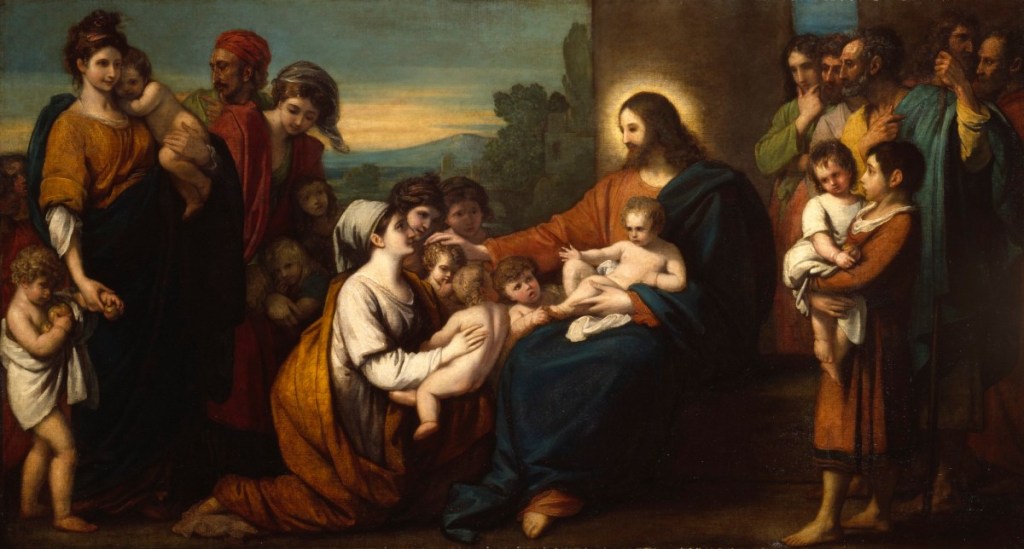
“Jesus blessing Little Children”, painting by British North American Benjamin West PRA (1781). Photo from wikipedia.
It is perhaps one of the most touching story of Jesus touching others when he told his disciples to “let the children come to me for theirs is the kingdom of heaven”, after which he embraced them, laid his hands on them and blessed them.
How blessed were those children must be to be embraced and laid with hands on by Jesus! According to tradition, one of those kids embraced and blessed by Jesus was St. Ignatius of Antioch who became a bishop and martyr in the early Church.
That is the transforming power of the touch by Jesus that children are blessed, the sick are healed by restoring their sight or cleansing their skin of leprosy, forgiving the sinners, giving hope to the poor. His touch is always a part of his proclamation of the good news to the people.
Jesus continues to touch us today in every Mass we celebrate when he first speaks to us in the scriptures, trying to make us feel our “hearts burn inside” like the disciples going home to Emmaus on Easter Sunday; and secondly, when he gives us his Body and Blood to partake in the Holy Eucharist.
Most of all, Jesus continues to literally touch us today through one another in our loving service to one another as a community of his disciples.
But, in this age of social media when every communication is mediated by gadgets and other instruments, this kind of personal communication is something we have all been missing because we have stopped touching Jesus, touching others too.
And this is what the second Sunday of Lent is trying to remind us today in the Transfiguration of Jesus.
Transfiguration of Jesus, communion of God with us
Jesus took Peter, James, and John his brother, and led them up a high mountain by themselves. And he was transfigured before them… a bright cloud cast a shadow over them, then from the cloud came a voice that said, “This is my beloved Son, with whom I am well pleased; listen to him.” When the disciples heard this, they fell prostrate and were very much afraid. But Jesus came and touched them, saying, “Rise, and do not be afraid.” And when the disciples raised their eyes, they saw no one else but Jesus alone.
Matthew 17:1-2, 5-7
“Transfiguration of Jesus” by Raphael from wikipedia.
We hear this story of the Transfiguration of Jesus twice every year: the Second Sunday of Lent and the sixth of August for the Feast of the Transfiguration. At this time of the year, the Transfiguration story is heard in relation with the Lord’s coming Passion, Death, and Resurrection.
At his Transfiguration, Jesus made it very clear that his glory and divinity must always be seen in the light of his Cross for it is only with his Cross that he can be correctly recognized as the Christ. It is on the Cross where Jesus truly touches us too in our personhood, in our humanity.
See how the three disciples were seized with fear upon hearing the voice of the Father while a bright cloud cast a vast shadow over them; but, it was right in that “tremendum fascinans” that we also find the intimacy, the closeness of God to us through Jesus Christ when he touched the three disciples.
Jesus came and touched them, saying, “Rise, and do not be afraid.” And when the disciples raised their eyes, they saw no one else but Jesus alone.
Matthew 17:7
And that is the good news for us all!
God had chosen to be so close to us in his Son Jesus Christ who touches us most not only in glory but most especially in moments of trials and tribulations! It is on the Cross where humanity and the divine truly become one in Jesus, when that personal and loving touch of Jesus becomes transformative and even performative.
This is the reason St. Paul exhorted Timothy to “bear your share of hardship for the gospel with the strength that comes from God” (2Tim.1:8) because oneness with Jesus always starts at the cross!
This is very true with us too when we only come to realize who are our true friends, our BFF’s when they are personally one with us in our trials and tribulations, not only in times we are well and good.
True transformation in Jesus can only happen when we are willing to be one with him, to be in touch with him in his passion and death for it is the only path to his Easter glory of transfiguration.
Touch communication vs. mediated communication
From Forbes.com
How sad that in this age of modern communications that have shrunk the world into a “global village” with instant communications that instead of growing together we have grown more apart than ever from each other.
We have lost real communications that lead to communion of persons or unity of people because we have become more concerned with the techniques of communication, more of skills and gadgets than of persons.
That is the meaning of media or “mediated communication” where there is always a medium between or among persons like cellphones and gadgets.
No more interpersonal relationships, making us more isolated and alienated, leading to growing problems of loneliness, depression, and suicides.
How frustrating sometimes to attend social functions like dinners and weddings where everyone is more busy and interested with their cellphones than with persons beside them!
Aside from isolation from persons, we have also grown “out of touch” with reality itself when more and more people are retreating into their own small worlds like cocoons with wires attached into their ears while their eyes fixated on screens oblivious to the world around them.
We have become so out of touch with ourselves and with others that more and more we are becoming like porcupines – we have not only stopped getting in touch with others but even hurt others if ever we touch them!
From Google.
Parents, lovers, couples, even people we trust like priests and religious sometimes hurt us with their touch instead of healing us, comforting us. Nobody would want to go through the Passion of the Cross anymore that we would rather stay on top of the mountain, of everything to be delighted with our perceived power and glory.
So unlike in our first reading where we get the feel and touch of real encounter in persons between God and Abraham. Note how in just four verses the word “bless” used five times by God to Abraham, promising to bless him more if he leaves his kin to follow him to the land he would give him.
In their conversation, we find a very personal and engaging communication, as if God and Abraham were literally in touch with each other, where there is personal contact and communication.
We know this for a fact at how effective and more reliable are personal interactions in communication than mediated ones through phones and email – personal communications always have that feel and touch that enable us to negotiate further and be more fruitful.
This Season of Lent, the Father is asking us to be in touch with him again by listening to the words of his Son Jesus who asks us only one thing: deny yourself, take up your cross and follow him. Let us heed him, touch him, and allow him to touch us again to be healed and transformed.
May you be touched as you touch also others in the most loving way this Sunday throughout the whole week! Amen.
Photo by author, Parokya ni San Juan Apostol at Ebanghelista, Bagbaguin, Santa Maria, Bulacan, Lent 2020.
Once again, our loving Father, I take the computer as my point of comparison for my prayer reflection on this second Friday of Lent.
Thank you in giving us this blessed season of Lent when we are able to “debug” our “internal hard drive” – the heart – to be cleansed of bugs and virus as well as unnecessary materials that slow us down to be holy and perfect like you.
Your words are very reassuring of how you want us to be “fixed” always, to be in good condition, filled with life and holiness.
Thus says the Lord God: “Do I indeed derive any pleasure from the death of a wicked?” says the Lord God. “Do I not rather rejoice when he turns from his evil way that he may live? Hear now, house of Israel: Is it my way that is unfair, or rather, are not your ways unfair? When someone virtuous man turns away from virtue to commit iniquity, and dies, it is because of the iniqity he committed that he must die. But if the wicked, trning from the wickedness he has committed, does what is right and just, he shall preserve his life; since he has turned away from all the sins that he committed, he shall surely live, he shall not die.”
Ezekiel 18:23, 25-28
Educate our hearts, O Lord.
Help us “surpass the righteousness of the scribes and the Pharisees” in Jesus Christ who have come to perfect the laws in himself, in love.
May your purifying love, sweet Jesus, cleanse us of our sins, delete our painful memories that continue to hold us back, preventing us to move forward and forgive others and especially our very selves.
Make us rejoice, O Lord, in your immense love and share it with others so that we may grow more in holiness in you. Amen.
Genesis 2:7-9, 3:1-7 +++ Romans 5:12-19 +++ Matthew 4:1-11
From Google.
Lent has always been associated with the Sacrament of Baptism since the beginning of the Church. In fact our Sunday readings this 2020 (Cycle A) are among the oldest in our liturgy used in the preparation of candidates or catechumens to Baptism on Easter Vigil.
This intimate link between Lent and Baptism is very evident in our synoptic gospels as Matthew, Mark, and Luke present to us how after Jesus was baptized by John in Jordan River, his temptations by the devil in the desert immediately comes next.
At that time Jesus was led by the Spirit into the desert to be tempted by the devil. He fasted for forty days and forty nights, and afterwards he was hungry. The tempter approached and said to him, “If you are the Son of God, command that these stones become loaves of bread.”
Matthew 4:1-3
The Season of Lent and the Sacrament of Baptism
From Google.
Let us go back a little to that Baptism scene of Jesus at Jordan so we can understand this link between Lent and Baptism as well as to appreciate the meaning of our celebration this first Sunday of Lent.
It was during his Baptism at Jordan when the Father formally launched and made known the mission of Jesus as the Christ or the “Anointed One” of God, that is, the Messiah in Hebrew or Christo in Greek from which we derived the word Christ in English.
As a prefiguration of his coming Pasch – Passion, Death, and Resurrection – Jesus Christ’s Baptism became his “investiture” or “commissioning” when the Father declared, “This is my beloved Son, with whom I am well pleased” (Mt. 3:17).
In his Baptism, Jesus entered into solidarity with us sinners when he plunged into Jordan River to be one with us in everything except sin. It is here we find very clear the intimate link of Baptism with Lent when we are called to be faithful children of God like Jesus Christ
An anatomy of temptation and sin
Detail of the mosaic of the “Temptations of Christ” at the St. Mark Basilica in Venice. Photo from psephizo.com.
Every temptation by the devil, every sin is always a turning away from God, a deviation from our identity as children of the Father in Jesus Christ.
Whenever we would wake up, the Father reminds us like at the Baptism of Jesus at Jordan that we are his beloved son or daughter with whom he is well pleased despite our many sins, failures, and weaknesses.
And like Jesus Christ right after his Baptism at Jordan, the devil also comes every day to tempt us to turn away from the Father, echoing to us his same words in the desert with the Lord, “If you are the Son of God” to lure us into becoming someone we are not.
The tempter approached and said to him, “If you are the Son of God, command that these stones become loaves of bread.” He said in reply, “It is written: One does not live by bread alone, but by every word that comes forth from the mouth of God. Then the devil took him to the holy city, and made him stand on the parapet of the temple, and said to him, “If you are the Son of God, throw yourself down. For it is written…”
Matthew 4:3-6
See this pattern of the devil in his first two temptations, “If you are the Son of God” – very enticing to be somebody else, to prove one’s worth and being.
This pattern will significantly change at the third temptation when the devil took Jesus to a high mountain to show him all the kingdoms of the world in their magnificence. No more “If you are the Son of God” but a more direct temptation that is affront and “garapal” as we say in Filipino:
“All these I shall give to you, if you will prostrate yourself and worship me.”
Matthew 4:9
Observe how cunning was the devil in his temptations of Jesus until finally, he brings out his sinister plot: worship him, turn away from God!
The same is true with us: the devil will lure and deceive us in so many ways with just one objective which is for us to turn away from God. In every temptation, in every sin, the issue has always been the primacy of God which Jesus Christ firmly affirmed in his triumph over the devil’s temptations at the desert.
And this issue on the primacy of God is always attacked by the devil in every temptation when he confuses us on who we really are like the woman in the first reading after the serpent had told her that she would be like God:
The woman saw that the tree was good for food, pleasing to the eyes, and desirable for gaining wisdom. So she took some of its frit and ate it; and she also gave some to her husband. Then the eyes of both of them were opened, and they realized that they were naked; so they sewed fig leaves together and made loincloths for themselves.
Genesis 3:6-7
Do we not feel the same way after every sin? We feel naked – ugly, dirty, and alienated from our very selves precisely because we have not become our true selves!
These temptations of Jesus by the devil would persist up to his crucifixion where some people jeered and taunted him, telling him “if you are the Son of God” or “if you are the Messiah” so that he would turn away from the Father and forget all about his mission and Divine plan of salvation.
Notice that the last temptation of Jesus is exactly our last temptation too: abandon God the Father and simply be like the devil, with no dignity, with nothing at all because he is separated from God, our only grounding of being.
Hubris, our greatest temptation and sin
Photo by Mr. Raffy Tima of GMA-7 News, Batanes, 2018.
Last Sunday we have mentioned how the Greeks have always held that man’s first and greatest temptation and sin is hubris – that is, the arrogant presumption of man that he is god, or that he can defy the divine to do everything and have anything.
We call it pride which is at the very core of every temptation and sin. The director of the classic film “Ten Commandments”, Mr. Cecil de Mille was once asked which of the Lord’s commandments is most often violated by man?
According to Mr. De Mille, it is the first commandment of God that we always violate because whenever we sin, that is when we also have another false god or idol aside from the true God.
Very true!
Our problem in the world is not really hunger or war or poverty but our refusal to be faithful to God, to be who we really are as his blessed sons and daughters. In some instances, there are some who have totally rejected and denied God, believing more in themselves, in the sciences and technologies.
Jesus is not indifferent to hunger or wars still going on in many parts of the world today; he had come to show us the path to our problems is to reclaim our being children of the Father, listening and living his words, worshiping and trusting him alone.
In going through his Pasch, in fighting all temptations, Jesus shows us the path to see and experience the God we can meet when we come to our desert where we rely only in him alone. It involves hard work, without any shortcut and quick fixes or instants that have become our norm these days.
It is not a simplistic approach to the many problems we are facing, but if you read the newspapers or watch the news, we see how humanity is still in solidarity with Adam, with sin, with the material world as St. Paul explained in the second reading.
On this first Sunday of Lent, we are reminded anew of our identity as beloved children of the Father in Jesus Christ who showers us with every grace and blessing that we need. Let us live in him, trust in him, hold on to him to experience life anew.
Let us give Jesus a chance to work in us, rise with him to our being beloved children of the Father! Amen.
Photo by author at the ancient city of Jericho, Israel, May 2019.
40 Shades of Lent, Saturday after Ash Wednesday, 29 February 2020
Isaiah 58:9-14 +++ 0 +++ Luke 5:27-32
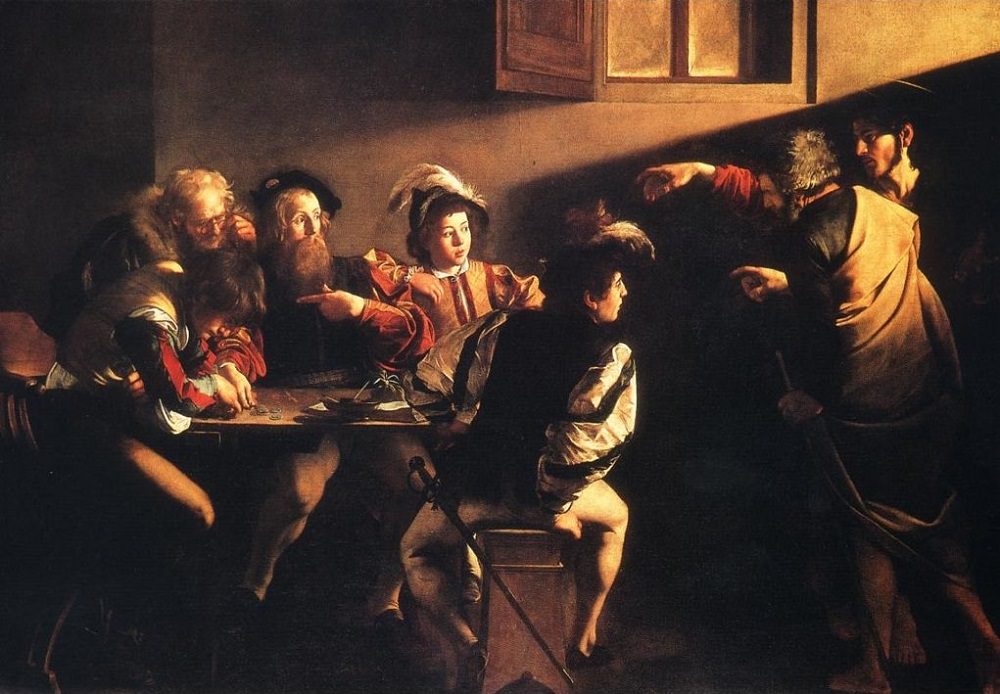
“The Calling of St. Matthew” by Caravaggio. From Google.
Dearest Jesus: I have been imagining in prayer of myself being Levi the tax collector sitting at his post.
It must be so lonely being like him, rich but deep inside longing for something deeper and meaningful than money and wealth. He had been thinking of making a “lifestyle shift” but he felt hopeless with nobody to help him.
Like in the first reading, your invitation Lord through the Prophet Isaiah seem to be too good to be true that anyone like Levi – or me – could make a big difference in life by “giving food to someone hungrier, abandoning my own comfort to care for someone afflicted, substituting a kind word for a malicious gossip, and worshipping you than pursuing my own interests”(Is.58:10,13).
I felt like Levi – there in his little customs post – that is impossible because everything is hopeless and there is no chance to change. Everything is doomed, especially for me, a sinner, Lord.
Then, suddenly you came, saying, “Follow me” (Lk.5:27).
How I love looking back, Lord, to those dark days when you suddenly came calling me to follow you!
It was so simple.
Like Levi, I just stood and followed you and everything changed in my life!
That was so nice of you, Lord Jesus, to take such a bold step of coming to Levi’s post to call him and, me. It was – and still is – a gamble on your part to call us sinners to follow you. And since then, you have never stopped calling us sinners Lord Jesus to follow you, even on our darkest and lowest days and hours, Lord, when everything seemed to be so doomed.
As we prepare for the first Sunday of Lent, remind me, O Lord, that this holy season is not all that drab and dry. After all, Lent originally means “springtime”, the coming joy of Easter which happens every time we turn our hearts to you like Levi. Amen.