The Lord Is My Chef Daily Recipe for the Soul by Fr. Nicanor F. Lalog II
Tuesday, Memorial of St. Barnabas, Apostle, 11 June 2024
Acts 11:21-26, 13:1-3     ><]]]]'>  +  <'[[[[><     Matthew 10:7-13
Photo by author, Mt. St. Paul, La Trinidad, Benguet, 2016.
Praise and glory
to You, God our loving Father
for this memorial of St. Barnabas,
one of the first to embrace Christianity
after the Resurrection of your Son
Jesus Christ.

A Levite Jew born in Cyprus,
his original name was Joseph but
upon joining the Apostles in Jerusalem,
he was nicknamed Barnabas
which means "son of encouragement"
or "son of consolation" whom
St. Luke described as "a good man,
filled with the Holy Spirit and faith"
(Acts 11:24).
Fill us, dear Jesus
with the same goodness and faith
of St. Barnabas, truly children of
encouragement and consolation,
believing in our brothers and
sisters especially those have withdrawn
from the ministry and apostolate
for various reasons
including shame and embarrassment
for past mistakes and sins like St. Paul.
Then he (Barnabas) went to Tarsus to look for Saul, and when he had found him he brought him to Antioch. For a whole year they met with the church and taught a large number of people, and it was in Antioch that the disciples were first called Christians.
Fill us with your gift
of peace, Lord Jesus,
to imitate St. Barnabas
who vouched for St. Paul's sincerity
of conversion
as well as in encouraging
and consoling the early Christians
who were persecuted for their
faith in You.
Help us imitate St. Barnabas
in his beautiful disposition of
focusing more on You, Jesus
than in the problems and personalities
we encounter in fulfilling your mission;
most of all,
grant us the humility of St. Barnabas
to reconcile later with St. Paul
 after a serious disagreement
that led to their parting of ways
as companions in their mission.
Make us realize, Jesus, that saints like St. Barnabas do not fall from Heaven but are people like us who have many and complicated problems in life; let us arise from our sins and mistakes like St. Barnabas who showed in his life that holiness is not being sinless but being humble to admit one's sins and faults, going through conversion daily with a willingness to forgive others to be reconciled anew in You, Jesus. Amen.
The Lord Is My Chef Sunday Recipe for the Soul by Fr. Nicanor F. Lalog II
Fourth Sunday in Ordinary Time, Cycle B, 28 January 2024
Deuteronomy 18:15-20 ><}}}}*> 1 Corinthians 7:32-35 ><}}}}*> Mark 1:21-28
Photo by Dra. Mylene A. Santos, MD, an orange-bellied flowerpecker (Dicaeum trigonostigma) somewhere in the Visayas, December 2023.
The gospel makes us wonder anew this Sunday on the mystery of Jesus, on what was with his person and speech. Remember how we wondered the other Sunday on what he had told Andrew and his companion who “went and see” Jesus at his dwelling at “four in the afternoon” (Jn. 1:39) that they realized he was indeed the Messiah, the Christ.
Reading further in that portion of the fourth gospel, we find how Andrew and companion brought two others to Jesus, Simon Peter and Nathanael to become disciples too. This Sunday as we return to Mark’s gospel, the evangelist tells us the start of Jesus Christ’s public ministry on a sabbath in the synagogue of Capernaum with his first four “fishers of men”:
Then they came to Capernaum, and on the sabbath Jesus entered the synagogue and taught. The people were astonished at his teaching, for he taught them as one having authority and not as the scribes.
Mark 1:21-22
Photo by author of ruins of parts of the synagogue at Capernaum where Jesus taught, May 2017.
Every time we hear the word “authority” especially among us Filipinos, it often evokes the sense of power, of superiority over persons and things. In Tagalog, we translate it as “power” or kapangyarihan, kakayanan mapangyari ano mang bagay.
But, Jesus is now telling us something deeper about true authority. People compared his kind of authority with their scribes, men of power and authority in their time along with the priests and Pharisees who were considered experts in scriptures being learned men, highly regarded and feared. Their authority flowed only from their position and name, from the outside and not from within.
Jesus shows us today that real authority flows from within, from a person’s inner self, from one’s heart, not from designations nor positions. True authority is felt even without the titles nor any forms of externalities. True authority comes from people who “walk their talk” so to speak.
Photo by author, tourists and pilgrims at the ruins of the synagogue at Capernaum where Jesus taught, May 2017.
People of true authority “actualize” their words and their thoughts, making them a “reality” that everyone not just notices but even feels their authority. True authority creates a certain sense of aura, of positive vibes (arrive or “dating”) and a lot of mysteries that even in just reading Mark’s account of Jesus in the synagogue, we too could feel it and be astonished with the people there 2000 years ago!
What is most amazing here is that Mark did not tell us what Jesus spoke of nor what he taught nor even described how he spoke. What was so unheard of from Jesus that people and even us today are astonished with his words?
Keep in mind how Mark narrated this scene in the context of the synagogue on a sabbath – a beautiful reminder to us of Jesus continuing the Jewish tradition that had come into fulfillment in him. Recall also that at the start of Mark’s gospel After John had been arrested, Jesus came to Galilee proclaiming the gospel of God: ”This is the time of fulfillment. The kingdom of God is at hand. Repent, and believe in the gospel” (Mk.1:14-15).
Photo by author in May 2019 of a signage at the entrance of the ruins of the synagogue in Capernaum where Jesus taught more than 2000 years ago.
In the synagogue, Jesus continued this preaching. He claimed what he proclaimed for he is in fact – his very person – is the kingdom of God who had come as we reflected last Sunday.
People felt God in him as he spoke, very similar with the experience of the chosen people in the wilderness with Moses in the first reading. There in the synagogue on that sabbath day, Mark presents to us how Jesus is indeed the “Word who became flesh” that people felt God in him because he claimed what he proclaimed. As the first reading from Deuteronomy reminds today, the surest criterion for recognizing a prophet is being a spokesperson of God like Moses now fulfilled in Jesus Christ.
We all share in this prophetic ministry of Christ when we were baptized but, are we rooted in God’s words that we speak only God’s words like Jesus?
Can we claim what we proclaim that after celebrating the Sunday Mass, people experience Christ’s authority within us when we go home and go back to work and school because we actualize, we make God real in ourselves in our words and deeds?
How sad that we – especially us your priests – speak more of our selves and of the world, making the Mass a videoke and a variety show rolled into one that God is hardly felt by the people except be entertained.
The second time Mark mentioned the people being amazed with Jesus in his speaking with authority in the synagogue on that sabbath day was when he exorcised a man with an unclean spirit.
In their synagogue was a man with an unclean spirit… Jesus rebuked him and… And the unclean spirit convulsed him and with a loud voice came out of him. All were amazed and asked one another, “What is this? A new teaching with authority. He commands even the unclean spirits and they obey him.” His fame spread everywhere throughout the whole region of Galilee.
Mark 1:23, 25, 26-28
The surest sign of God speaking through us or anyone is when healing and repentance happen just like in the synagogue on that sabbath day. Notice how Mark recorded the words of the people about Jesus, “A new teaching with authority.”
In John’s gospel during the Last Supper we heard Jesus telling his disciples about his new command or teaching too which is to “love one another as I have loved you” (13:34).
True authority is about love and healing, kindness and compassion, mercy and forgiveness. Definitely not about subjugation nor manipulation nor use of force as we always experience from those with authority who display their powers and literally throw their weight around even amid heavy traffic with their security escorts blaring with sirens.
People were amazed at Jesus in healing the man with unclean spirit and called it a new teaching with authority because they felt God present among them because there was healing and exorcism which only God can do.
Most of all, the people in the synagogue felt God with them because Jesus was one of them unlike the scribes and other people of authority who were above them, detached from them.
The same thing is most true with us these days. Whatever authority we have is to help and comfort people, not to scare them nor burden them. We are most moved by people in authority – whether at home or in school, at work or in the community and in the church – when they are kind and approachable, caring and understanding.
Photo by author at the shore of the Lake of Galilee in Capernaum, Israel, May 2017.
Jesus teaches us today that true authority is making God present in us by offering comfort and consolation to those suffering like the poor and the weak who merely survive as they try to make ends meet daily.
True authority is being prophetic, making God and his words our very own, becoming ourselves his presence and his healing hands with our loving service to everyone, offering hope and inspiration to those down in sins and miseries.
True authority leads to salvation and liberation from sins. This begins with our communion in God through Jesus Christ in our personal and communal prayers, especially the Sunday Mass.
We are all blessed with the same kind of authority of Jesus Christ. Let us claim it by being free from all anxieties in this life (second reading) by joining Jesus in his journeys like the four disciples with him in the synagogue in Capernaum. Amen. Have a blessed week ahead.
Quiet Storm by Fr. Nicanor F. Lalog II
The Seven Last Words, 04 April 2023
Photo by author, Chapel of the Holy Family, Sacred Heart Novitiate, Novaliches, Quezon City, 2014.
From noon onward, darkness came over the whole land until three in the afternoon. And about three o’clock Jesus cried out in a loud voice, “Eli, Eli, lema sabachtani?” which means, “My God, my God, why have you forsaken me?”
Matthew 27:45-46
God is perfect. So perfect in fact He is all beauty and majesty. Perfectly whole and holy. But He chose to be like us human in everything except sin in Jesus Christ to experience pain and suffering. Even death. And right there on the Cross, Jesus felt the most painful pain of any suffering – that of being abandoned.
Any suffering becomes most unbearable, most painful when we are alone, when family and friends abandon us. Worst is when even the society would not care at all! That is why St. Mother Teresa thought of serving the “poorest of the poor” when she saw the sick of Calcutta dying alone.
It is the most miserable situation anyone could be. To suffer alone, abandoned with no one to even look at, no one to listen to one’s cries of pain, no one to even comfort and ease one’s physical, emotional and spiritual sufferings.
And sadly, it is in fact a reality happening daily in our lives, not only in the slum areas but even in the most sophisticated facilities where the sick and the elderly literally await death alone.
Jesus went through the same experience too, abandoned by almost everyone. Of the twelve Apostles, one betrayed Him, the leader denied Him thrice, going into hiding along with the other ten except for the youngest of them, John the Beloved who stood with Mother Mary there at the foot of the Cross along with two other women. Not one of those He had healed nor fed came.
But Jesus never felt alone on the Cross. Like any good and pious Jew, He prayed Psalm 22, a psalm of lament, of suffering and total trust in God.
And that is the good news of Jesus dying on the Cross. From then on, humans have never been alone in life’s pains and sufferings, even death because God has consoled us in Christ through the Cross. From the Latin words con solare that literally mean to be with one who is alone (solo), God has become most closest and truly one with us in our sufferings and death in Jesus Christ so that we too may be one in Him and with Him in His Resurrection.
Because he himself was tested through what he suffered, he is able to help those who are being tested.
Hebrews 2:18
In my two years as chaplain of Our Lady of Fatima University and Fatima University Medical Center, I have seen and experienced first hand how real some people – young and old alike, sick and those with strong and robust bodies, rich and poor alike many times feel alone in their sufferings and miseries. Many are crying in pain alone, by themselves because the wife or husband or children or parents and friends are so busy or away for various reasons.
Is anybody still home?
Let us pray for one another, especially those suffering alone.
God of all consolation,
You gave us Your Son Jesus Christ
in order to experience Your love and mercy,
Your healing and comfort,
Your presence and peace
so that we may never be alone;
may we always remember when we are
in our most trying moments in life,
when we feel alone and abandoned
because that is when Jesus is most closest
with us, us present right in our sufferings,
right where we are on the Cross.
Amen.
Never say, “walang-wala ako” because we always have God – “laging mayroon tayo, ang Diyos.” When there are storms, that is when rainbows appear, like the outstretched arms of Jesus on the Cross, consoling us, assuring us He is with us, ever-present. Photo by author, 04 March 2023, Katmon Nature Sanctuary & Beach Resort, Bgy. Binulusan, Infanta, Quezon.
The Lord Is My Chef Daily Recipe for the Soul by Fr. Nicanor F. Lalog II
Wednesday in the First Week of Ordinary Time, Year I, 11 January 2023
Hebrews 2:14-18     ><]]]]'> + ><]]]]'> + ><]]]]'>     Mark 1:29-39
Photo by Dr. Mylene A. Santos, MD, 2022 in France.
Lord Jesus,
allow me to imitate today
your Apostles Simon and Andrew,
James and John in "immediately
telling you" (Mk. 1:30)
of how sick and down with all kinds
of problems our own family members
and relatives, friends and everyone
going through trials in life;
come, Lord Jesus, "grasp their hands"
like Simon's mother-in-law
and "help them up" (Mk.1:31).
Because he himself was tested through what he suffered, he is able to help those who are being tested.
Hebrews 2:18
At this very moment,
Lord Jesus, I pray for those
going through their medical
exams - please calm them,
assure them of your presence;
accompany too, dear Jesus,
those going through dialysis,
chemotherapy,
surgery, and other medical procedures
for their ailments;
comfort and console those
living separately who have to endure
the pains and troubles of worrying
their loved ones going through
difficulties in far and distant lands;
touch and ease the pains of those
who have experienced failures
and disappointments, even frustrations
to assure them that it is better to be
fruitful than successful in life;
uplift, O Lord, those with sagging
spirits in being good,
in being holy,
in being honest and true,
in being faithful and just;
touch them, Jesus,
pat their shoulders
that they may forge on
with you in being good.
Amen.
The Lord Is My Chef Daily Recipe for the Soul by Fr. Nicanor F. Lalog II
Wednesday in the Second Week of Advent, Memorial of St. Ambrose, 07 December 2022
Isaiah 40:25-31   ><]]]]'> +><]]]]'> + ><]]]]'>   Matthew 11:28-30
Photo by author, 02 December 2022.
How wonderful are your words
this second week of Advent,
God our loving Father:
Monday you reminded us to
strengthen each other,
Tuesday you asked us to comfort
one another,
today, you console us
with this part of Isaiah's
"Book of Consolation":
Why, O Jacob, do you say, and declare, O Israel, “My way is hidden from the Lord, and my right is disregarded by my God?” Do you not know or have you not heard? The Lord is the eternal God, creator of the ends of the earth. He does not faint nor grow weary, and his knowledge is beyond scrutiny. He gives strength to the fainting; for the weak he makes vigor abound.
Isaiah 40:27-29
Forgive me, loving Father,
in those times I doubted you,
when I complained to you as if
I am entitled; looking back to those
trying times when I felt alone and
abandoned, struggling and fighting
by myself, silently crying unknown to
anyone, there was YOU always with me,
standing by my side, defending me,
fighting my battles,
even carrying me when I am lost
and defeated.
Indeed, you never left me,
I was never alone for you have
always been with me - con solare -
one with me in my pains and sorrows,
trials and sickness; in Christ Jesus,
you chose to suffer and die to be one with me
- con solare - by helping us carry our yoke,
giving us rest in you you,
making it lighter and
easier to carry.
Like St. Ambrose,
teach us to speak your words
of wisdom to those in darkness,
to appreciate also your silence
so we may be instruments of your
consolation to those feeling alone
to assure them you are one with us
when darkness surrounds us.
Amen.
40 Shades of Lent by Fr. Nicanor F. Lalog II
Palm Sunday of the Passion of the Lord, 28 March 2021
Isaiah 50:4-7  +  Philippians 2:6-11  +  Mark 14:1-15:47
Photo by Mr. John Karol Limjuco, Parish of the National Shrine of Our Lady of Fatima, Valenzuela City, 26 March 2021.
For the second straight year, we are again celebrating our holiest week in the most unholy time of our lives in this COVID-19 pandemic. The timing could not escape everybody’s suspicion of something so sinister, if not diabolic, that religious gatherings are again limited.
But on a closer look and deeper reflection, we find what is happening right now is something similar with what Jesus went through that made these days so holy.
Notice that the official designation of our celebration today is “Palm Sunday of the Lord’s Passion” when Vatican II fused the two earliest preparations by the Church for Easter: the palm procession by Christians at Jerusalem in the fourth century and the proclamation of the long gospel of the Passion of the Lord in Rome by the Pope in the fifth century.
Both ancient celebrations set our sights to the Paschal Mystery of Jesus beginning this Sunday stretching it through this whole week to remind us of the triumph and tragedy, of darkness and light, of death and life. These contrasts shall be most pronounced when we enter the Triduum of the Lord’s Passion, Death, and Resurrection on Holy Thursday evening, Good Friday, and Easter Vigil.
Then everything becomes light and pure joy in Easter!
And the key to understanding, appreciating, and deeply imbibing the meaning of all these confluences of mixed emotions and feelings, colors and hues like our situation while under this time of the corona is to have the same attitude of Jesus Christ expressed so beautifully by St. Paul in our second reading:
Have among yourselves the same attitude (mind) that is also yours in Christ Jesus, though he was in the form of God, he did not regard equality with God something to be grasped. Rather, he emptied himself, taking the form of a slave, coming in human likeness; and found human in appearance, he humbled himself, becoming obedient to death, even death on a cross.
Having the mind and heart of Jesus Christ is opening ourselves to the Father by trying to see everything in his light as we go through life especially during this pandemic. It is what Jesus has always reminded us of “reading the signs of the times”.
God is telling us something in this pandemic but we are not listening to him as we continue to see it as a medical and social issue, refusing to recognize its spiritual and moral implications. In a lot of senses, this pandemic and quarantine we are undergoing is similar with situation when Jesus entered Jerusalem more than 2000 years ago when Israel under Roman rule and life was so difficult but nobody recognized him as the Christ and Savior!
In his entire life here on earth, Jesus always saw everything in the light of his Father in heaven. He never got involved into politics and other temporal concerns or subject but throughout the course of history since then until now, his teachings remain relevant in addressing our social issues and problems.
Seeing things and events in our lives and history in the light of God demands that we have the same attitude of Jesus of opening ourselves to be empty of our pride, of our plans and agenda, of our self-interests as well as of our illusions and insecurities in life.
We will never see God nor find him when we are filled with our selves, especially with our bloated egos when we think we know everything, when we presume we are always right, when we play gods.
Like the people who welcomed Jesus entered Jerusalem holding palms, singing “Hosanna in the highest!”, soon we would also be shouting “Crucify him!” unless we get emptied of ourselves and be filled with God.
St. Paul could eloquently present the mind and heart of Jesus in this beautiful hymn because he himself went through a process of kenosis, of self emptying. He had experienced in himself how when Jesus emptied himself and went down to his lowest point obediently accepting death on the cross, that is also when he was at his closest union with the Father who raised him to his highest glory at Easter.
That is why St. Paul called it the “scandal of the cross” for when we empty ourselves and offered everything to God out of love for him and for others that we are willing to go down to our lowest point in life, that is when God raises us up to “meet” him, to be one in him that miracles begin to happen, when things change for the best not only for us but also for others and those around us.
Hence, while we are in the most unholy period of our history, the Lord is giving us every chance to have the holiest Holy Week of our lives by examining our very selves in this time of quarantine to cleanse and empty ourselves of sins and evil to be filled with God of his holiness and grace through Christ’s cross.
Photo by author, St. Joseph Parish, Baras, Rizal, 15 January 2021.
The logic of the Cross
As we go to another Enhanced Community Quarantine (ECQ) or lockdown like last year, I am convinced that while we are sad at how things are going on, it is actually God who is most “sad” of all as we go through all these pains and difficulties due to the COVID-19 pandemic.
God cannot suffer because he is perfect; but, he can suffer with us that is why he sent his Son Jesus to become human like us to join us in all our sufferings including death and thus, “console” us in Christ.
“To console” is from the Latin terms “con” (with) + “solatio” (solace/comfort) that means not only to comfort or delight those in suffering but to also “strengthen” or make strong those weakened by trials and difficulties which is the literal meaning of cum fortis, with strength.
And here lies the “logic” of Christ’s Cross: Jesus died by the hatred of others so that we may live again by his love. Only God can give us the evidences of his love to render us capable through Jesus Christ to forge on amid our pains and sufferings, hoping against all hope that love is always stronger than suffering, death, and sin.
When we persevere in our sufferings, especially in silence for the sake of others out of love, imitating the self-emptying of Jesus, that is when God showers us with more of his love and mercy, strength and vigor to overcome everything in Christ.
This he had promised and fulfilled in Christ who is the “Suffering Servant” we heard in the first reading from the Prophet Isaiah:
The Lord God has given me a well-trained tongue, that I might know how to speak to the weary a word that will rouse them. Morning after morning he opens my ear that I may hear; and I have not rebelled, have not turned back. I gave my back to those who beat me, my cheeks to those who plucked my beard; my face I did not shield from buffets and spitting. The Lord God is my help therefore I am not disgraced; I have set my face like flint, knowing that I shall not be put to shame.
Isaiah 50:4-7
See how everything Isaiah had written was fulfilled in Jesus as we heard in the gospel today when at the praetorium “They clothed him in purple and, weaving a crown of thorns, placed it on him. They began to salute him with, ‘Hail, King of the Jews!’ and kept striking his head with a reed and spitting upon him. They knelt before him in homage” (Mk.15:17-19). It went on up to the calvary when “They gave him wine drugged with myrrh, but he did not take it. Then they crucified him…” (Mk.15:23-24).
In my reflections this Lent, I have been dwelling lately on tenderness and compassion as mercy of God in action, as mercy of his hands. To be tender and compassionate is to be one with the suffering even if you are suffering too – just like our medical frontliners who risk not only their very lives but even their families.
Last Friday I was asked to give a talk via webinar about development of compassionate teachers and staff at Our Lady of Fatima University where I serve as chaplain. A doctor asked if there is such a thing as “over compassion” wherein she can already feel chest pains in seeing and hearing all the sufferings of their patients in this time of the pandemic.
I was so touched by her question because I felt it too; I told her she is not alone feeling that way when I also feel overwhelmed with the sufferings of the people but cannot do so much. I told her it is a grace to feel that way, that she had to find ways how her mercy in the heart can flow to mercy of the hands while ensuring safety protocols as a doctor.
But that is where the grace of God works fullest, when we believe and trust more in Jesus Christ when the chips are already down, when we feel defeat is inevitable that we just surrender everything to Divine grace and intervention.
“Ecce Homo” by Murillo from wikipediacommons.org.
That is the meaning of Palm Sunday of the Lord’s Passion when we see life in its total weakness and even wreak, whether in our selves or among others, and yet we continue to persevere, to hope against hope because deep in us we know God is with us, God is working in us, and God will save us.
French poet Charles Péguy wrote in one of his great poems at the turn of the century that hope is God’s favorite virtue because “hope surprises him”.
Péguy described hope like the end of a play or a movie in our time; we know the show had ended but we stay on refusing to leave the theater because we believe that something is still coming up like a preview or a surprise scene!
See how St. Mark tells us at the end of his Passion Story when everything was so dark after Jesus had died when “he breathed his last” that the centurion standing there believed that “Truly this man is the Son of God!” (Mk.15:39)
Sometimes in life, God becomes clearest and most truest when we have lost everything, including what is most precious and dearest to us.
Have a heart with a lot of faith, hope and love that this may be the holiest Holy Week in our lives because it is the most unholy period in our history like when Jesus entered Jerusalem more than 2000 years ago. Amen.
Keep safe, be blessed, and be a blessing to others!
The Lord Is My Chef Breakfast Recipe for the Soul
Tuesday, Second Week in Ordinary Time, 19 January 2021
Hebrews 6:10-20     <*(((><<   +++   >><)))*>     Mark 2:23-28
Photo by Mr. Chester Ocampo, October 2019.
Dear God our Father:
Today I pray for those feeling low, for those having the blues lately when everything seems to be going wrong in their lives, feeling they have been forgotten, not cared for and not loved.
Please touch their hearts, enkindle the flames within them in continuing to serve you because You do love them.
Teach me Lord how I can let them know or feel and experience your encouraging words in today’s first reading:
Brothers and sisters: God is not unjust so as to overlook your work and the love you have demonstrated for his name by having served and continuing to serve the holy ones. We earnestly desire each of you to demonstrate the same eagerness for the fulfillment of hope until the end, so that you may not become sluggish, but imitators of those who, through faith and patience, are inheriting the promises.
Hebrews 6:10-12
Increase, O God, the inspiration and zeal of those serving you by continuing to be open to Your Son Jesus Christ our eternal High Priest who had gone to your presence to bring us closer to You more than ever, especially when our skies are dark and gloomy.
I pray, dear Father, in the most special way for all of our medical frontliners in the fight against COVID-19 to never lose hope despite the dismal way how things are going on in our country in this time of the pandemic; touch the hearts of those losing hope in fighting for what is true and just, for those striving to contribute to make this world a better place to live in with their contributions in the sciences and to the society.
Assure them, O Lord, that all your promises of salvation and healing will be fulfilled soon by experiencing your loving presence in the celebrations of the Holy Eucharist.
Like the apostles in the gospel today, may those working for improving human life in various sectors of the society experience Jesus Christ’s love and defense for them against those trying to discredit them. May their love for others, for the country, for the Church, and for You, Lord, mature according to Your will. Amen.
The Lord Is My Chef Sunday Recipe for the Soul by Fr. Nicanor F. Lalog II
Week XVIII, Cycle A in Ordinary Time, 02 August 2020
Isaiah 55:1-3 >><}}}*> Romans 8:35, 37-39 >><}}}*> Matthew 14:13-21
Remember our reflection last Sunday? Of how parables teach us that “less is always more” because to have the kingdom of God – Jesus Christ himself – we have to learn to appreciate the little things in life?
Beginning this Sunday until August 16, our gospels will start telling us who is Jesus Christ by showing us his powers and abilities that are exactly opposite the way we see and understand them. This new series of stories are so relevant to us in this time of pandemic, giving us wonderful insights into God’s ways of responding to our human situations.
St. Matthew now leads us with Jesus to the wilderness after teaching us in parables to experience his power in transforming us like the five loaves and two fish to feed more than five thousand people.
Multi-layered story of the multiplication of bread
All four evangelists have recorded this story of Jesus Christ’s multiplication of the loaves of bread with their particular focus and stress, showing us that it truly happened and was a major event in the Lord’s ministry.
Very unique with St. Matthew’s version of this miracle story – which has not one but two! – is his economy of words in narrating it like a straight news as if it were a developing story or a “breaking news” unfolding before us, calling us to follow its updates and details due to its multi-layered meanings.
When Jesus heard of John the Baptist, he withdrew in a boat to a deserted place by himself. The crowds heard of this and followed him on foot from their towns. When he disembarked and saw the vast crowd, his heart was moved with pity for them, and he cured their sick. When it was evening, the disciples approached him and said, “This is a deserted place and it is already late; dismiss the crowds so they can go to the villages and buy food for themselves.” Jesus said to them, “There is no need for them to go away; give them some food yourselves.” But they said to him, “Five loaves and two fish are all we have here.” Then he said, “Bring them here to me,” and he ordered the crowds to sit down on the grass. Taking the five loaves and the two fish, and looking up to heaven, he said the blessing, broke the loaves, and gave them to the disciples, who in turn gave them to the crowds. They all ate and were satisfied, and they picked up the fragments left over — twelve wicker baskets full. Those who ate were about five thousand men, not counting women and children.
Matthew 14:13-21
Photo from iStock/Studio-Annika.
The consolation of Jesus.
Our situation in this time of the corona pandemic is so similar with that of Jesus. With the increasing number of COVID-19 cases, it has finally hit us hard, so close to home with news of those we know getting infected and worst, dying from this disease.
Like Jesus upon hearing the death of John the Baptist, we are all saddened that we wish to withdraw away from everyone.
We want to mourn but there are more people in need of our presence and help in this time of pandemic like the countless medical frontliners and health workers who must be so tired – even sick, physically and emotionally – by now with the growing number of COVID-19 patients and yet have chosen to remain in their posts.
And there are still the other casualties of this pandemic like those who have lost their jobs, those evicted from their rented apartments, those stranded and separated from their loved ones, those begging for food, and those afflicted with other sickness going through dialysis and physical therapy.
Jesus knows so well the “wilderness” we are all going through and he is right here with us, one with us in our sufferings, in our fears and anxieties, and in our exhaustion.
To be one with us is consolation, from the Latin “con” or with + “solare” or alone, to be one with somebody feeling alone.
Jesus did not remove our pains and sufferings, even our death; he joined us to be one with us in these that he can call us to “Come to me, all you who labor and are burdened, and I will give your rest. Take my yoke upon you… For my yoke is easy and my burden light” (Mt.11:28-30, 14th Sunday, 05 Jul 2020).
Compassion of Jesus.
Still with Christ’s reaction of being “moved with pity” at the sight of the crowds who have followed him to the wilderness, we find something more deeper with his being one with us, in consoling us that he had forgotten all about himself, his tired body that he went on to heal the sick among them.
To be moved with pity is more than a feeling of the senses but a response of his total person.
You respond for help, you reply to a call.
Ever wondered why we have the “responsorial psalm” after the first reading in the Mass? Because those words from the Psalms express our total assent and commitment to God, involving our total self like body, mind, heart and soul.
Photo by Dra. Mai B. Dela Peña, Carmel Monastery, Israel, 2016.
God cannot suffer because he is perfect.
That is why he became human like us in Jesus Christ to be one with our suffering and death so that we would one with him in his glorious Resurrection.
In the wilderness, Jesus stayed with the people, not allowing them to leave as suggested by the Twelve because he was moved with pity with the crowd because he wanted to suffer with them.
That is compassion, literally means to “suffer with” from cum + patior. Here in the wilderness, Jesus showed his compassion for the people which will reach its highest point in giving himself on the Cross on Good Friday.
Have we “responded” to God’s call to serve, to a call of duty, and to a plea for help from the poor? Have we truly given ourselves to somebody without ever thinking our own comfort or rewards? Or, are we running away from his Cross?
What a shame in this time of pandemic there are some among us who rejoice at the losses of others like the Twelve who wanted the crowd to be sent home because they were afraid of responsibilities, of taking care of the suffering people.
Consolation and compassion are the two most needed from each of us in this time of crisis.
Our scarcity mentality, the God of plenty.
We now come to the miracle of the feeding of five thousand. According to the late Fr. Henri Nouwen, this story is an example of our “scarcity mentality” when we think of not having enough, of finding what we have as too little, always looking for more; hence, our tendency to hoard everything.
The Twelve were thinking more of themselves, afraid they could go hungry with the five loaves of bread and two fish they have. They were so afraid of difficulties ahead of them in their situation where to find and how to feed those great number of people.
They were focused on what was lacking than on what they have, and who was with them, Jesus Christ! They were hungry for food in the stomach than for food to the soul unlike the crowds who have followed Jesus.
Worst of all, the Twelve got “mad” upon seeing the crowds who have followed them to the wilderness when in fact, it was Jesus who needed most to rest to mourn John’s death!
But through all these, Jesus patiently bore the people’s woes and the Twelve’s selfishness to teach them all in a very nice way something so essential in our response to every human suffering and extreme situation: opening and entrusting our selves totally to God.
And that was actually the greatest miracle that happened that day.
In doing it, Jesus simply asked the Twelve what they have, never asking how much they have or its condition. Just whatever they have to give everything to Jesus like those five loaves and two fish that he took, and while looking up to heaven, blessed and broke the loaves, and gave them to the Twelve to distribute to the crowd.
And everyone was satisfied with a lot of left overs too!
Matthew nor any of the other Evangelists ever explained how it happened because it does not really matter at all. What is most important is what are we willing to give up to Jesus so he can transform us into better persons.
That is what we continue to do this day in every celebration of the Holy Eucharist- whatever we have, even not the best or the worst and littlest we have, when given to Jesus becomes holy and multiplied!
The power of God is immense, without doubt. But, in this miracle of the feeding of five thousand, Jesus is showing us that his power is not meant to satisfy our material or bodily needs but our deepest desires that lead to our fulfillment in him as prophesied by Isaiah in the first reading.
Why spend your money for what is not bread; your wages for what fails to satisfy? Heed me, and you shall eat well, you shall delight in rich fare. Come to me heedfully, listen, that you may have life.
Isaiah 55:2-3
Amid the pandemic worsened by our government officials’ inanities, irresponsibilities, and sheer lack of compassion with us in this wilderness, the Lord assures us today that he is with us for “nothing can separate us from the love of Christ” (Second Reading) if we are willing to give him all that we have.
It is our spiritual transformation first that leads us to our material blessings. We can all have it if we are willing to give everything to Jesus and believe in him always. What do you have for miracles to happen?
A blessed August ahead for you!Amen.
Photo by Dra. Mai B. Dela Peña, Carmel, Israel, 2016.
The Lord Is My Chef Breakfast Recipe for the Soul by Fr. Nicanor F. Lalog II
Thursday, Memorial of Our Lady of Mount Carmel, 16 July 2020
Isaiah 26:7-9, 11, 16-19 >><)))*> + <*(((><< Matthew 11:28-30
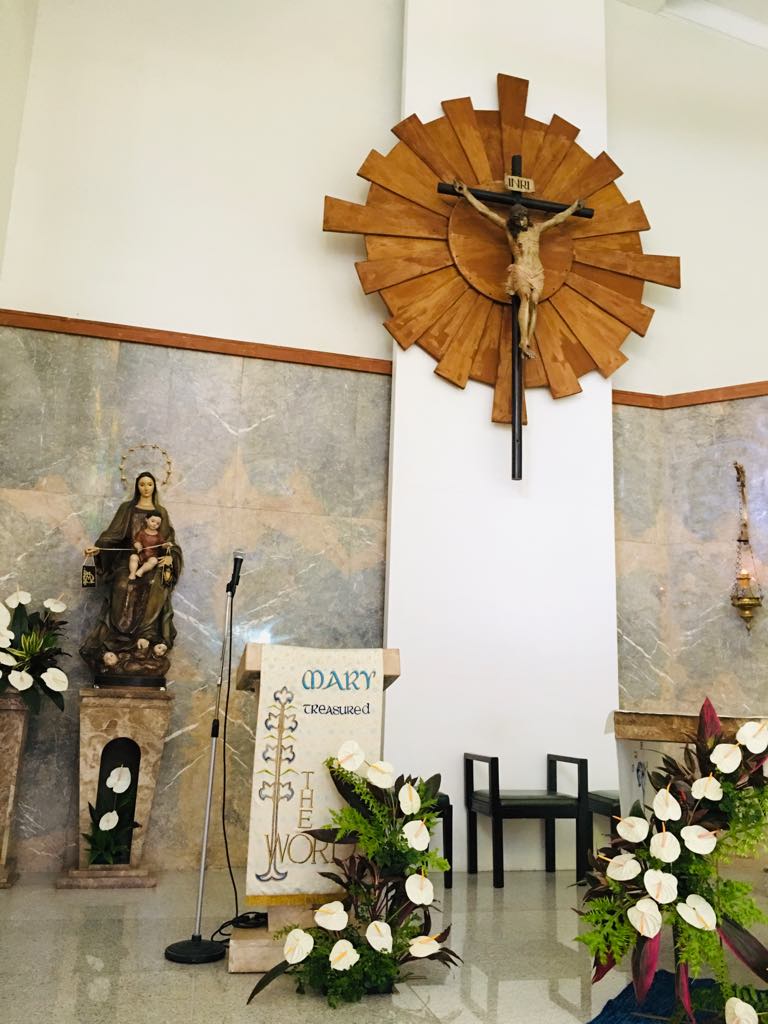
Photo by author, Our Lady of Mt. Carmel of the Holy Family, Guiguinto, Bulacan, 08 December 2019.
Your words today, O God our Father, are very comforting and consoling, so reassuring of your love and mercy for us sinners, giving us new life in you as we celebrate the memorial of Our Lady of Mount Carmel.
Like the Israelites living in exile because of their own making when they turned away from you in sins worshiping false gods, we also admit our sinfulness and failures in standing up for what is true and just, in being faithful to you.
Help us to rise again, heavenly Father, breathe into us your life-giving Spirit specially at this time we feel so down and crushed not only by COVID-19 pandemic but by public officials concerned only with their well-being and whims forgetting the people they are supposed to serve.
We conceived and writhed in pain, giving birth to wind. Salvation we have not achieved for the earth, the inhabitants of the world cannot bring it forth. But your dead shall live, their corpses shall rise; awake and sing, you who lie in the dust. For your dew is a dew of light, and the land of shades gives birth.
Isaiah 26:18-19
If there is anything we would want to have these days, it is rest, O Lord.
A lightening of our load and burdens.
But why another yoke, Jesus?
Forgive us Jesus when we feel negative with yoke because they always portray to us images of slavery and oppression. Open our eyes, Lord, as we come closer to you to take your yoke because you not only help us carry our burdens but most of all, your yoke gives us direction in our path back to the Father.
May your Blessed Mother of Mount Carmel help us to hold on to God in this hour of darkness in our lives as individuals and as a nation. Amen.
Photo by author, Our Lady of Mount Carmel of the Holy Family, Guiguinto, Bulacan, November 2019.
Thank you very much, O dear Jesus, for the gift of your Apostles who became the foundations of your Church here on earth like St. Barnabas whose Memorial we celebrate today.
Despite his being a “Johnny come lately” replacing your betrayer Judas Iscariot, St. Barnabas proved to be a true apostle with his life of loving service to the early Church.
A Levite Jew from Cyprus who settled in Jerusalem, he was one of the first to embrace your new way of life, Lord, described by St. Luke as “a good man, filled with the Holy Spirit and faith” (Acts 11:24).
What is so wonderful, Lord, is how he lived out the meaning of his name “Barnabas” which is “son of encouragement” or “son of consolation”, exactly the kind of people we need at this time of corona pandemic and of so many social unrests and issues happening.
Send us, Jesus, more “Barnabas” – good men and women filled with your Holy Spirit and faith who would encourage people to do what is good, direct others into reason and understanding through cooperation and collaboration to hurdle all these troubles, not divisions.
Like St. Barnabas who searched and encouraged St. Paul in Tarsus to join the Christians at Antioch in proclaiming your gospel of salvation to those outside Israel including the Gentiles, may we gather and inspire other people into working together in this troubled time instead of fighting each other.
May our words also bring more encouragement to people to rise above each one’s differences in color and language and beliefs to seek what is common so we can collaborate more for peace and common good like what St. Barnabas did in convincing the Christians in Antioch to welcome their former persecutor, St. Paul.
Help us imitate the generosity of St. Barnabas in selling his piece of property so that the Apostles may have the means to provide for the needs of the early Church and thus, consoled the poor and widows.
Most of all, like St. Barnabas who participated at the Council of Jerusalem, may we seek ways in resolving issues among us that may lighten the burdens of people saddled with so many concerns in life without diluting the essence of being your follower, sweet Jesus.
Lastly, like St. Barnabas, may we always have an open heart for reconciling with others, in setting aside past misunderstandings like his falling out with St. Paul to be one again in your most holy name, O Lord Jesus Christ. Amen.

















 lordmychef.com