The Lord Is My Chef Daily Recipe for the Soul by Fr. Nicanor F. Lalog II
Monday in the Thirteenth Week of Ordinary Time, Year II, 01 July 2024
Amos 2:6-10, 13-16     <*((((><<  + >><))))*>     Matthew 8:18-22
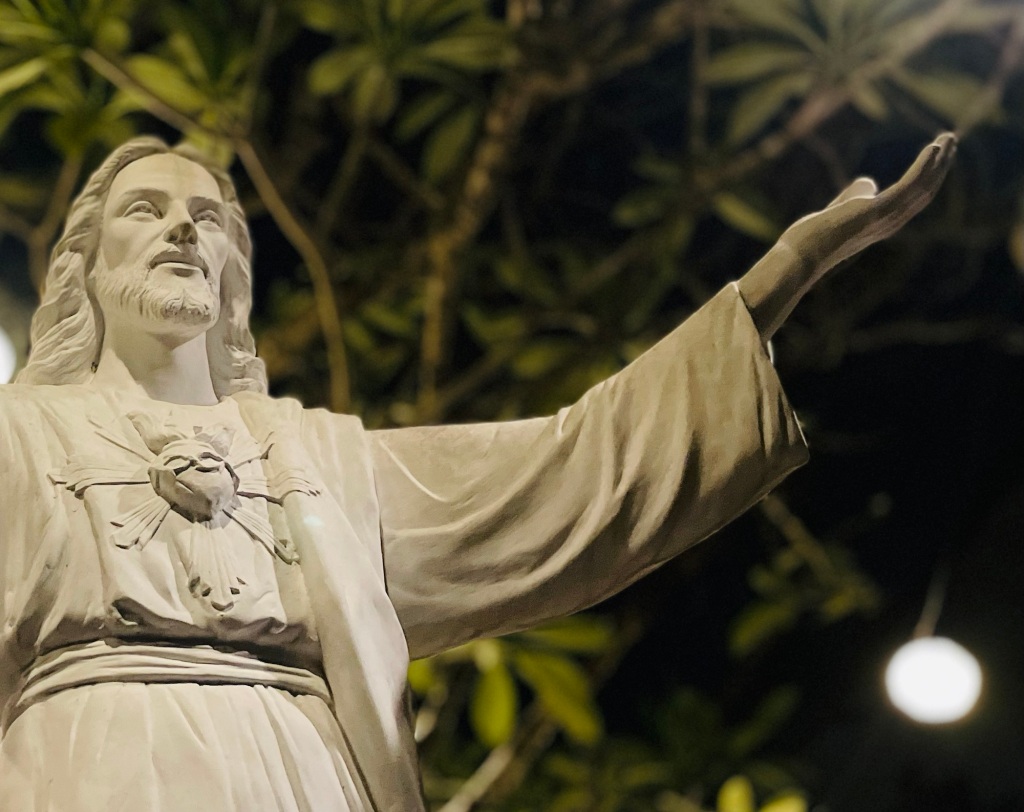
Photo by author, Anvaya Cove, 15 April 2024.
Glory and praise to You,
God our loving Father for this
brand new month of July;
we have passed the first half of
2024, help us to make good of its
remaining six months, most especially
in finding ways to address and mitigate
if not eradicate the social injustices
that continue to happen among us
since 3000 years ago your Prophet Amos
had denounced.
Thus says the Lord: For three crimes of Israel, and for four, I will not revoke my word; because they sell the just man for silver, and the poor man for a pair of sandals. They trample the heads of the weak into the dust of the earth, and force the lowly out of the way. Son and father go to the same prostitute, profaning my holy name (Amos 2:6-7).
What a shame, O God,
how this passage written
in 750 BC remains still the same
these days; give us the sincerity
to confront our selves,
to look into our own lives
to see how these accusations
can be thrown against us too;
let us realize there can be no
real love of God nor even true religion
without the practice of justice
and loving concern for the
weak and marginalized.
Give us the will
to have Jesus our priority in life
in order to build a more humane
and just society in this imperfect world,
instead of relying on our abilities
and expertise as well as comfort
and ease; both Amos and Jesus
have showed that doing the work
of God is always other-centered,
entails a lot of sacrifices and
suffering so that we decrease
and lose our very selves for
God through others.
Amen.
The Lord Is My Chef Sunday Recipe for the Soul by Fr. Nicanor F. Lalog II
Thirteenth Sunday in Ordinary Time, Cycle B, 30 June 2024
Wisdom 1:13-15, 2:23-24 ><}}}}*> 2 Corinthians 8:7, 9, 13-15 ><}}}}*> Mark 5:21-43
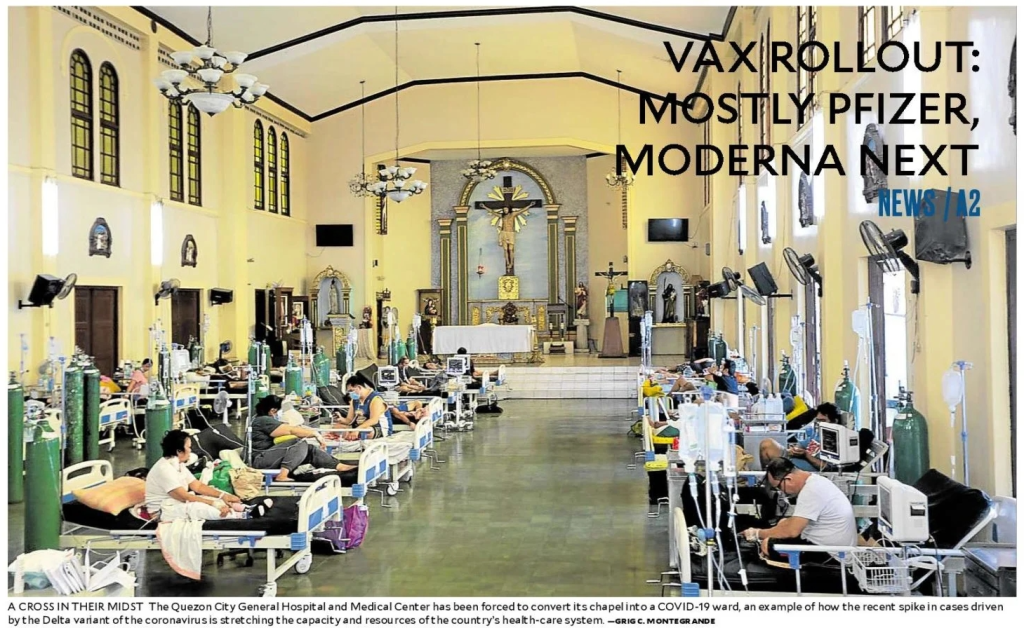
August 20, 2021 frontpage photo of the Philippine Daily Inquirer at the height of COVID-19 pandemic.
A young brother-priest recently interviewed me about my ministry as chaplain in a university and a hospital, inquiring about its similarities and differences with a parish assignment, difficulties and challenges. I told him first, it is the priesthood, an answer to the call of Jesus Christ to serve. How? By reminding the people I serve that we are still humans – that it is good and normal to fail and get disappointed, to get sick and be not well in life.
As a chaplain, my ministry involves the hospitality of Jesus Christ like in our gospel today, that is, to welcome everyone especially those who are sick and troubled to experience God’s love and mercy, healing and salvation. It is a ministry of accompanying, of journeying with those who have to “cross” so often the turbulent sea of life, of opening their eyes and hearts to faith in God.
When Jesus had crossed again in the boat to the other side, a large crowd gathered around him, and he stayed close to the sea. One of the synagogue officials, named Jairus, came forward. Seeing him he fell at his feet and pleaded earnestly with him, saying, “My daughter is at the point of death. Please, come lay your hands on her that she may get well and live.” He went off with him, nd a large crowd followed him and pressed upon him (Mark 5:21-24).
Photo by author, Lake of Galilee, Israel, May 2019.
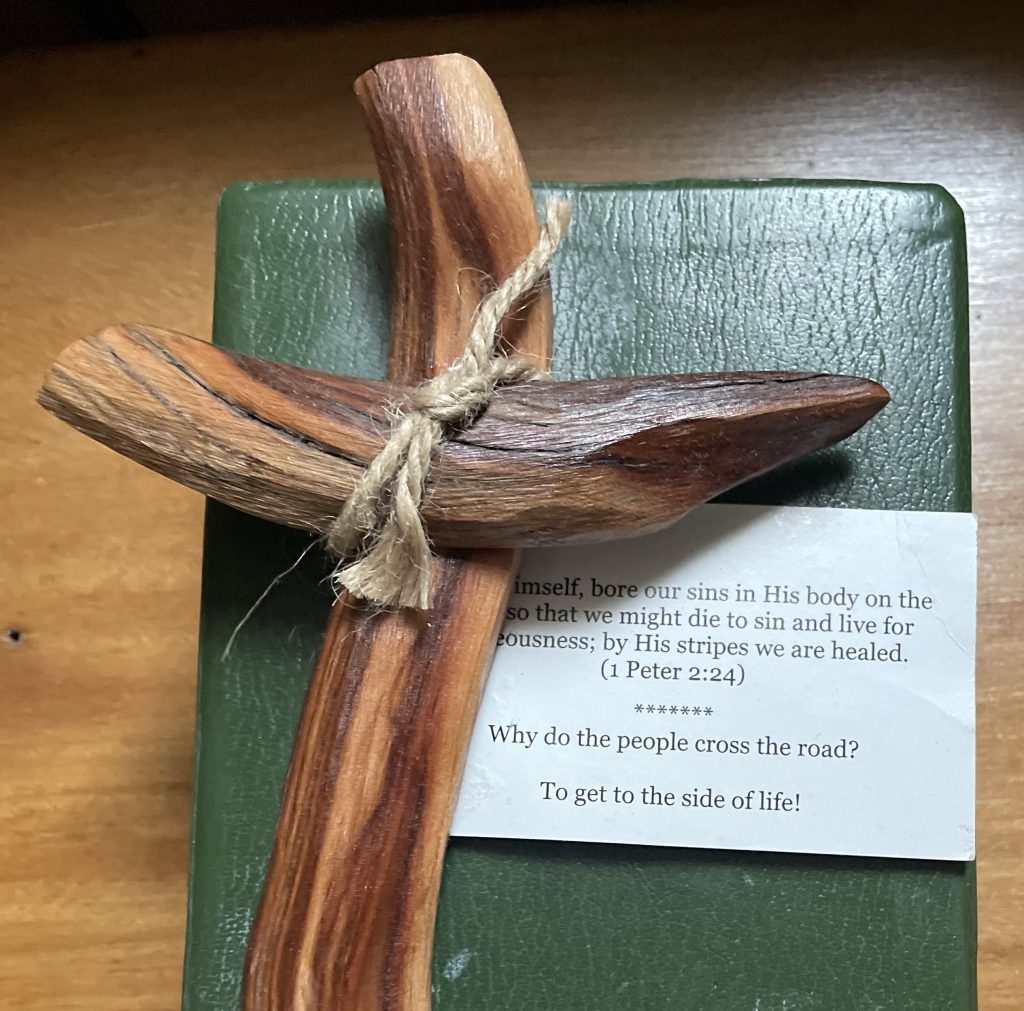
I love that little detail Mark mentioned in today’s gospel, of how Jesus “had crossed again” the Lake of Galilee. That’s what Jesus had done when He crossed from heaven to earth to lead us cross from here to eternity. And Jesus keeps on crossing the sea and the streets with us to get to the side of life with its fullness in heaven.
In this long gospel, we see how Jesus crossed again and again for the worried father, the sickly widow along the way, and the dead daughter. Here we find Jesus welcoming us, our humanity with all its weaknesses and imperfections. That first act of Jesus of coming with Jairus to his home in itself was the start of the healing process. That is the hospitality of Jesus.
From the Latin word hospis which means to welcome, it is the origin of the English terms hospitality and hospital. Both terms are so trending today as the most in demand careers are those in the hospitality business of hotels and travels and in the hospital care system following the pandemic.
Medical professionals during the time of Jesus were very rare that most people have no other recourse but to muster all their faith for healing and well-being. Sickness and death were so negative for them, seen at its worst as a punishment from God for sins committed. That context makes our gospel scene this Sunday so uplifting because Mark shows us Jesus came to bring healing and life to us humans who are frail and weak, even dead to sin!
We know this story of double healing by Jesus, of the hemorrhaging woman who touched His clothes that right away stopped her bleeding and of Jairus’ daughter raised from the dead after taking her hand, telling her to arise, “Talitha koum”.
In both instances, we first experience Christ’s hospitality, of how Jesus right away made those afflicted welcomed. Blessed are those with family and friends, even total strangers hospitable enough to encourage the sock and troubled among us to hold on to their faith when life’s too difficult and rough, to keep on hoping for the best and to believe in love when all is dark. The sad truth is, many were lost not really in their battles with diseases and trials but with no one on their side to support and encourage them during their trying moments.
Today, Jesus is inviting us to keep on crossing the seas and streets of life, to bring Him with those finding difficult or terrifying to cross to the side of life of grace, of acceptance, and of forgiveness as the world has become so perfectionist and unrealistic.
Of course, the woman and the daughter as well as all the others healed and brought back to life by Jesus eventually died later in life; our whole life is an unceasing struggle against the relentless assaults of diseases and death that have become more violent and insidious. Surely, we shall all die one day.
What makes the difference is the faith we have in Jesus who had come to bring salvation, healing and life to the world, more than our physical well-being. See how in every healing Jesus would engage us first into a personal encounter with Him with His eyes full of mercy and tenderness, touching and raising up those sick and dead before saying the words “arise” or “be opened” finished off with the most unique of all, “your faith has saved you”.
Photo by author, 2023.
Only faith will enable us to understand these cures and resurrections worked by Jesus. It was the same thing He had asked us with the disciples during the storm in the middle of the sea (or lake).
Let us have that welcoming spirit or hospitality of Jesus with others too! We may not have His actual powers of healing but we can be the extensions of Him by first being hospitable, welcoming those in distress especially. Since Friday, I have felt the Lord telling me to speak more about encouragement. In telling us these story of Jesus bringing back to life the daughter of Jairus sandwiched with the healing of the hemorrhaging woman along the way, Mark was encouraging the persecuted Christians of his time and us today to be hospitable with one another going through many trials in life. People actually come to us not really for help nor solutions to their problems but simply to be welcomed and encouraged in what they were going through.
The first reading clearly tells us that death and sickness were not from God but from the devil. Only good things come from God – including us! Though sin had thwarted the beautiful plan of God in the beginning, right away after the fall He promised salvation in Christ who became poor to make us rich in life with love and mercy in Him.
your abundance at the present time should supply their needs, so that their abundance may also supply your needs, that there may be equality. As it is written: “Whoever had much did not have more, and whoever had little did not have less” (2 Corinthians 8:14-15).
Photo by author, Anvaya in Morong, Bataan 17 June 2024.
St. Paul was in prison, thanking the Corinthians for their hospitality and generosity in providing for his needs. He was reminding them and us too that every hospitality and generosity we do must be rooted in Christ.
We in the church are always accused of so many collections, and rightly so. These collections get to their nerves not because of the money they have to give but the sheer lack of Jesus! They could hardly feel nor find Jesus as the reason and essence not only for their generosity but most especially in the Mass celebration. How sad when priests are demanding of the people’s generosity when they lack the hospitality of Jesus. People are most generous, both the rich and the poor alike, when their pastor are hospitable like Christ, when they feel the parish as a community with Jesus always leading them to cross every street, every sea of trials and challenges.
Last Sunday, the gospel reminded us how Jesus silently journeys with us even in turbulent seas, asking us to have faith and trust in His powers. This Sunday, the gospel reminds us that we become the presence of Christ in helping people cross the seas and the streets of sickness even of death. Can we? Let us pray:
Lord Jesus,
teach us to have
your courage to believe and trust
You in crossing stormy seas;
teach us too to be warm and
hospitable with the many people
we meet while crossing busy
streets, those who are sick
and "dead" to life and living;
let us be your silent presence,
encouraging, consoling, uplifting
those with sagging spirits
to experience your healing and life
in our loving service in You.
Amen.
The Lord Is My Chef Daily Recipe for the Soul by Fr. Nicanor F. Lalog II
Friday, Memorial of St. Irenaeus, Bishop & Martyr, 28 June 2024
2 Kings 25:1-12     <'[[[[><  +  ><]]]]'>     Matthew 8:1-4
It is the end of another week
of work and studies for most of us,
God our loving Father,
but for some,
it is like the end of everything
for them like your people
at Judah and Jerusalem:
In the tenth month of the ninth year of Zedekiah’s reign, on the tenth day of the month, Nebuchadnezzar, king od Babylon, and his whole army advanced against Jerusalem, encamped around it and built siege walls on every side. On the ninth day of the fourth month, when famine had gripped the city, and the people had no more bread, the city walls were breached. The king was therefore arrested and brought to Riblah to the king of Babylon, who pronounced sentence on him. He had Zedekiah’;s sons slain before his eyes. He then blinded Zedekiah, bound him with fetters, and had him brought to Babylon (2 Kings 25:1, 3, 6-7).
Many times,
when life becomes so difficult
even so terrible for us,
all we ask, O God, are
simple words and acts of
encouragement;
send us someone who
is like Jesus your Son,
our Lord and Savior who,
upon meeting a leper,
told him,
"I will do it. Be made clean"
(Matthew 8:3).
Like Jesus,
may we stay and remain
even for a few minutes
with those so burdened in life;
when the leper approached him,
Jesus did not hide nor run
but stayed to let the leper
feel He was with him;
many times, we forget
our mere presence
can be so encouraging;
forgive us for abandoning
and turning away from those
who come to us
even for company
and warmth.
Like Jesus,
even if we do not have
the power to heal
and cleanse anyone of sickness,
grant us the gift of
words that encourage
others to hold on in faith,
to keep hoping,
and most of all,
to believe in love
when all is dark
because like Jesus,
we may tell them how much
we desire their well-being.
Amen.
The Lord Is My Chef Daily Recipe for the Soul by Fr. Nicanor F. Lalog II
Thursday, Memorial of St. Cyril, Bishop & Doctor of the Church, 27 June 2024
2 Kings 24:8-17     <*((((><<  +  >><))))*>     Matthew 7:21-29
Photo by Ms. Analyn Dela Torre, March 2024.
God our loving Father,
help us find You
where we are now -
especially those feeling
so down at the bottom
of the pits, those who are
burdened with so much in life -
help us find You O Lord in
our darkness and sadness
not where we would like
to be.
It is a very beautiful day
but your words in the first reading
are very distressing like what many of
us today are feeling;
we have failed,
we have sinned
like the people of Judah and Jerusalem
who were conquered and exiled
by the Babylonians; it is the
final week June, closing the first
half of 2024 when life slows down,
when tasks seem too difficult,
when our spirits are also sagging;
uplift our weary souls,
inspire us and fill us with
the warmth and zeal of the Holy Spirit
to find You, dear God,
where we are and let us stop
our usual blaming game
and wishful thinking of worlds
and situations we imagined
where You are not present.
Give us the courage
like Jesus to speak with
authority like St. Cyril of Alexandria
who defended the truth of Christ
as true God and true Man
that paved the way to recognize
Mary as the Mother of God;
like St. Cyril of Alexandria,
let us mean mean what we say,
most of all,
to be one with Jesus
always among the poor
and rejected
and neglected for Jesus
is always found
among them.
Amen.
The Lord Is My Chef Daily Recipe for the Soul by Fr. Nicanor F. Lalog II
Wednesday in the Twelfth Week of Ordinary Time, Year II, 26 June 2024
2 Kings 22:8-1`3, 23:1-3     <*((((><< + >><))))*>     Matthew 7:15-20
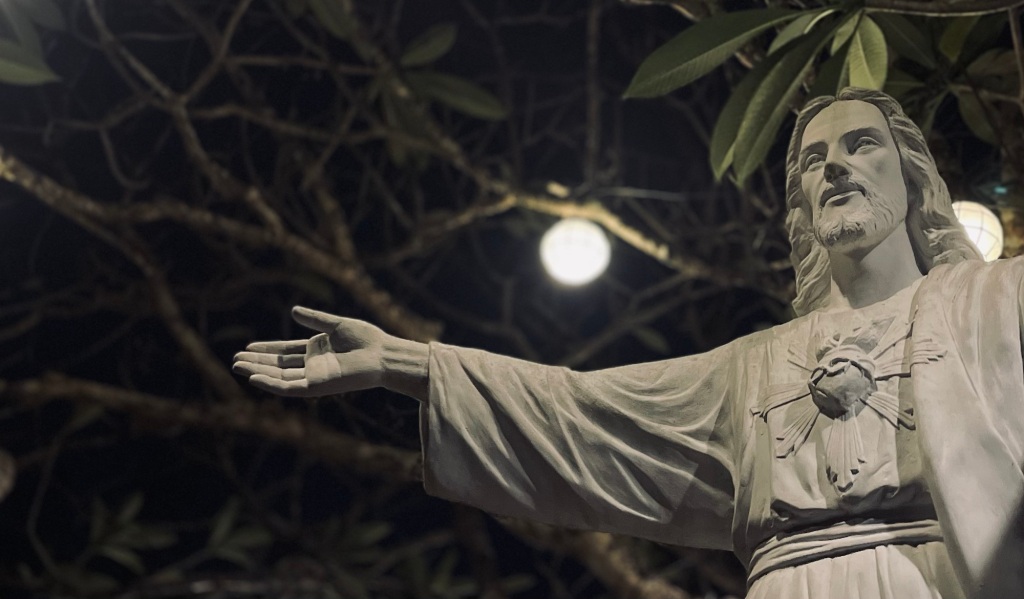
Photo by author, Sacred Heart Novitiate, Novaliches, QC, 20 March 2024.
Keep us faithful to You,
God our Father;
keep us searching for You
especially in the Sacred Scriptures
to learn and listen to your words
that are ever-present and true
and relevant.
The high priest Hilkiah informed the scribe Shaphan, “I have found the book of the law in the temple of the Lord.” Hilkiah gave the book to Shaphan, who read it. The scribe Shaphan also informed the king that the priest Hilkiah had given him a book, and then read it aloud to the king. When the king had heard the contents of the book of the law, he tore his garments and issued this command… “Go, consult the Lord for me, for the people, for all Judah, about the stipulation of this book that has been found, for the anger of the Lord has been set furiously ablaze against us, because our fathers did not obey the stipulations of this book, nor fulfill our written obligations” (2 Kings 22:8, 10-12, 13).
Your words,
Your will,
Your laws are
always among us
especially in Jesus Christ,
the Word who became flesh
and dwelt among us;
but, how sad especially
in this decadent period
and age despite our many
advances in science and technology,
we have morally retrogressed
as many people who are also believers
in You choose to believe the
false prophets in our midst -
influencers in the social media
who peddle lies, massaging the minds
of many people too lazy to think
and pray, preferring to follow the
many vogues and trends that
lead nowhere but destruction;
there are also the modern gnostics
claiming to be progressive
and liberal in their thinking
espousing themselves as more
fair and inclusive but actually
followers of dictatorship of
relativism who allow everything
in the name of inclusivity
without responsibility.
Teach us, O Lord Jesus,
in the way of your decrees;
most of all,
let us look hard on
the fruits of every prophet
who promise to lead us
to fulfillment and truth.
Amen.
It’s been more than four years since the breakout of the COVID-19 pandemic that threw many of us out of sync in life, especially those planning to get married during those critical years of 2020-2022.
I had four weddings affected by the COVID-19 lockdowns in that period; three were postponed but I was able to officiate at the two weddings when reset to another dates except the first one that did not fit my schedule. The fourth wedding I was not able to officiate because I got the virus and had to be isolated.
This is the homily I delivered at one of those three weddings postponed I officiated, between Cris my former student at the Immaculate Conception School for Boys (ICSB) in Malolos City and Tim whom I met when they were going steady while we were all taking MA courses at UST.
More funny than that was the fact Cris and Tim have planned of getting married in 2020 but have to move it to 2021 due to the pandemic; but, when COVID still persisted that year, they finally fixed their altar date to early 2022. Alas! Just as they were all set in January 2022, the church was closed on the week of their wedding after its priests got the virus!
Cris and Tim were at a loss when their wedding would finally take place until they were offered by the parish the date February 22, 2022 after the weddings of those others postponed like them. I told them to go for it than wait further for other dates lest they in turn get the virus too!
Looking back to their wedding day, I have realized how God always finds ways in helping married couples in all their problems for as long as they are willing to cooperate. This is why we cannot allow divorce to be legalized in the country for God never fails in His grace and blessings. We just have to work on them.
From stillromancatholicafteralltheseyears.com, January 2022.
You must have heard the saying that “God writes straight crooked lines”. And today that proves so true not only with how God wrote so crooked His straight lines in your life, Cris and Tim, but even wrote in circles to make this date your wedding day – 22 February 2022!
Cris and Tim, God has always been so sure in calling you before His altar on this date, which will similarly happen again in 200 years – 22 February 2222! God writes straight crooked lines because everything in him is perfect, like numbers. Precise and exact. Like this date you never chose, 02-22-2022.
When you consulted me last month when priests here offered you this date due to their recent lockdown, right away I told you it is the most wonderful date for your wedding being the Feast of St. Peter’s Chair… St. Peter as in San Pedro like Cristopher Tabafunda San Pedro and later, Mrs. Fatima Macam San Pedro!
It was God who willed in all eternity that you, Cris and Tim, be married today — not last year, not the other week nor next week because today is the day that the Lord has made!
Cris and Tim are both very prayerful and good, practicing Catholics.
You are both good with numbers like God, a mathematician who is very precise and exact like an economist and stock trader (Cris) and a marketing and sales executive (Tim) who used to do a lot of chemical research before.
But God has better and deeper plans for you that numbers cannot count nor quantify.
God wants you to always go back to basic numbers, not to those found in equations only you two can understand or multiple digits only you can count.
Jesus said it so well in the gospel today: two is equal to one. So mathematical ba?
Photo by author, 2021.
“For this reason a man shall leave his father and mother and be joined to his wife, and the two shall become one flesh? So they are no longer two, but one flesh. Therefore, what God has joined together, no human being must separate.”Matthew 19:5-6
Life is not about having the most but the least. That is where faith grows and deepens.
When we have so much in life, when we feel so sufficient, when we are so filled with things, we forget God. We stop believing in him, we believe more in ourselves.
And when we stop believing in God, we lose our faith and then, we stop loving, too. Sooner or later, we become empty and miserable.
So, be simple, Cris and Tim.
Reduce everything to the barest and simplest. Simplify, simplify, simplify as Henry David Thoreau said: “let your affairs be two or three, and not a hundred or a thousand.”
When we get complicated like our Facebook, life becomes difficult as we can’t find right away who and what matters most to us.
Kaya nga isa lang ang asawa, Cris at Tim, kasi hindi puwede marami.Hindi lang magulo. Magastos pa. Imagine kung dalawa o tatlo wedding rings? Pag isa lang, kita agad at alam na this – married na ang mamang ito na may cute na dimple o itong girl na ito na naka glasses at dalawa pa ang dimples! Hayaan ninyo sabihin ng mga makakita singsing ninyo na sayang at taken na pala siya!
You see, the lower the number, the simpler, the better. Madaling tumaya at manampalataya.
That’s faith! Parang PBA game kung saan kayo nagkakilala. And you have both experienced, walang tatalo sa faith in God ninyong dalawa!
God is greater and more than the numbers the wiz kids and supercomputers of the world can calculate and predict. His thoughts are not our thoughts, nor His ways. He first created just one man and one woman – just two – to be one with each other in Him, and to be faithful to Him and each other.
Because the more we become faithful, the more we become loving.
That is the message of this Feast of the Chair of St. Peter which is the “Primacy of Rome” or of the Pope: it is the primacy of faith and the primacy of love together which cannot be separated.
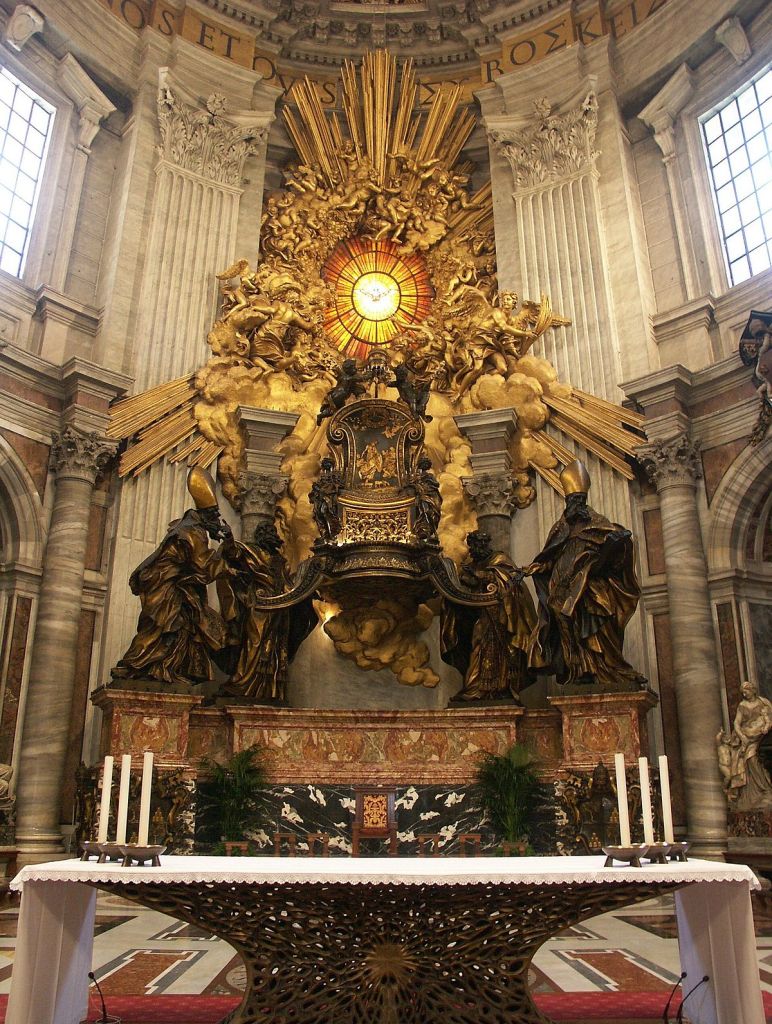
Chair of St. Peter in Rome, from Wikipedia.
Forget all those numbers Cris and Tim, focus only in the One – God in Jesus Christ. Just focus on Jesus, always Jesus.
Love is not about counting or keeping tabs and tallies, like how many “likes” and “followers” we get in our posts.
The true measure of love is when we love without measure, when we simply love, love, love. And love.
That is why we only have one heart so we can love with all our heart. Forget Sana Dalawa ang Puso Ko. It is just a song.
When you have LQ (lover’s quarrel), who should blink first, or smile? Who should take the first move to reconcile, the first to offer the hand of peace?
Whenever lovers and couples or even friends quarrel, I always say, whoever has more love to give must be the first one to initiate reconciliation, the first to blink, or smile, the first to offer the hand of peace.
To have the most love to give and share does not mean to be better or superior than the other; to have the most love to give and share is to have more faith, to have a deeper faith the he/she is ready and willing to lose everything for the sake of the loved one.
Like Jesus Christ who gave everything for us on that Cross because of love.
The Lord Is My Chef Daily Recipe for the Soul by Fr. Nicanor F. Lalog II
Monday, Solemnity of the Birth of John the Baptist, 24 June 2024
Isaiah 49:1-6 ><}}}}*> Acts 13:22-26 ><}}}}*> Luke 1:57-66.80
Photo from Wikipedia, mosaic of Jesus with Mary and John the Baptist at the Hagia Sophia in Turkey.
Praise and glory to You,
God our loving Father
in sending us John the Baptist
as Precursor of your Son
Jesus Christ our Savior;
on this Solemnity of his birth
six months before Christmas
during the summer solstice to
remind us of John's vocation,
"a burning and shining lamp"
(John 5:35) set to decrease
when the Light that illuminates
the world appeared in December,
the winter solstice.
Everything about John pointed
to the unexpected - his conception
in the womb of his old, barren mother
Elizabeth, his being named not after
his father Zechariah, and his life being
spent in the wilderness, not in the
temple to follow the footsteps of
his father; most of all, his "manifestation
to Israel"  (Lk.1:80) was not about himself
but pointed to the Christ, Jesus our Lord
and Savior.
What is not unexpected, dear Father,
is the connection between John and
Jesus and the salvific events that have
everyone filled with joy and fear at the
same time for "surely your hand hand
was with him" (Lk.1:66).
Photo by author, Binuangan Is., Meycauayan, Bulacan, 31 December 2021.
Open our eyes and our hearts,
merciful Father, to always expect
the unexpected in this life and mission,
to learn to withdraw in the wilderness
of our lives like John
to realize that our whole being
like his is directed to our relationship
with Jesus the Christ.
Let us decrease
so that Jesus may increase!
Let us strive to go to the wilderness
to empty ourselves to be filled
by the Holy Spirit;
most of all,
let your words comfort us
when life becomes so difficult
in being a herald of Jesus by proclaiming
repentance and conversion (Acts 13:24):
“You are my servant, he said to me, Israel, through whom I show my glory. Though I thought I had toiled in vain, and for nothing, uselessly, spent my strength, yet my reward is with the Lord, my recompense is with my God” (Isaiah 49:3,4).
How wonderful
that when I learn to expect
the unexpected from You,
O God,
that is when I am less,
Jesus becomes more in me,
then truly,
You are most gracious,
 Father through me,
like John.
Amen.
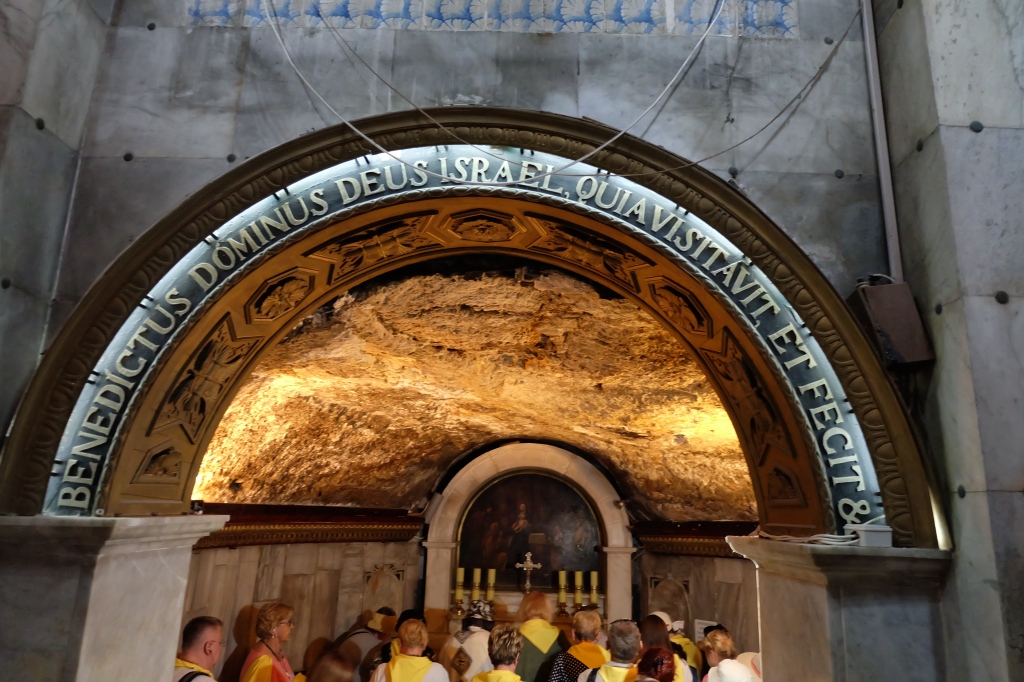
Photo by author, birthplace of St. John the Baptist beneath the church in his honor in Ein Karem, Israel, May 2019
The Lord Is My Chef Sunday Music for the Soul by Fr. Nicanor F. Lalog II, 23 June 2024
Photo by Fr. Pop Dela Cruz, Binuangan Is., Obando, Bulacan, June 2021.
We go OPM this Sunday, digging through the great decade of Pinoy rock bands of the 90’s with The Dawn’s Iisang Bangka Tayo released in 1992.
I was still outside the seminary working at GMA7-News when The Dawn rocked the local scene with their Enveloped Ideas in 1987. Unfortunately, their founder and more famous member Teddy Diaz was stabbed to death the following year on his way to visit his girlfriend in Quezon City that abruptly ended the career of a very promising musician who have unknowingly sowed the seeds for the blossoming anew of OPM with the advent of many alternative bands in the 90’s.
After leaving GMA-7 News to give my vocation a second try in the seminary, radio and music remained my two “worldly” pursuits without any plans at all of ever turning away from. And I was so glad The Dawn had continued to play music all those years while in the seminary days until I became a priest.
This is my second favorite song from them: rough and raw as they have always been with deep thoughts running through but this time in the vernacular language. What I like most with this song is its theological undertones: its calls for togetherness and unity as friends and a nation, and most of all, of communion as a church considering that is what the boat symbolizes.
The boat carrying Jesus and the disciples crossing the Lake of Galilee during a violent squall actually symbolized the Church under persecution. The Dawn’s Iisang Bangka Tayo struck the gospel chords perfectly, especially at this part midway through the song:
Dahon ng damo tangay ng hangin At di mo matanaw kung saan ka dadalhin Ngunit kasama mo ako nakabigkis sa puso mo Daluyong ng dagat ang tatawirin natin
Saan ang tungo mo mahal kong kaibigan Saan sadsadyain hanap mong katahimikan Basta’t tayo’y magkasama laging sasabayan Pinagsamaha’y nasa puso kaibigan kabarkada
Iangat natin ang layag sa umaawit na hangin Kapit-bisig tayong ang gabi ay hahawiin
Ating liliparin may harang may sibat Ating tatawirin daluyong ng dagat Pagkat kasama mo ako iisang bangka tayo Anuman ang mithiin ay makakamtan natin
It is the same message of oneness and trust that Jesus conveys in our gospel this Sunday who silently joins us in the boat to help us cross this sea of life amid storms and giant waves that can be overwhelming most of the time (https://lordmychef.com/2024/06/22/into-the-sea-of-life-love/). Most of all, Jesus and The Dawn’s Iisang Bangka Tayo remind us of the need for more love and trust with each other to overcome life’s many trials and sufferings. Here now are The Dawn… rak en roll!
The Lord Is My Chef Sunday Recipe for the Soul by Fr. Nicanor F. Lalog II
Twelfth Sunday in the Ordinary Time, Cycle B, 23 June 2024
Job 38:1, 8-11 ><}}}}*> 2 Corinthians 5:14-17 ><}}}}*> Mark 4:35-41
Photo by author, San Juan, La Union, 25 July 2023.
From examples of trees in the forest and sowing of seeds in the fields last week, our readings this Sunday situate us at the middle of the sea with a raging storm to remind us of God’s immense power and most of all, love and care for us in Jesus Christ. Right away we get that hint from our short first reading:
The Lord addressed Job out of the storm and said: Who shut within doors the sea, when it burst forth from the womb; when I made the clouds its garments and thick darkness its swaddling hands? When I set limits for it and fastened the bar of its door, and said: Thus far shall you come but no farther, and here shall your proud waves be stilled!” (Job 38:1, 8-11).
Photo by author, San Juan, La Union, 25 July 2023.
Nothing so struck humans since time immemorial as the sea that is so immense, seemingly without limits. It has been so loved yet dreaded with many literatures around the world teeming with all kinds of stories about the sea’s many mysteries that still baffle us in this age of computers and satellites. Experts say that big ships and jumbo jets are so minuscule compared with any area of the sea where they could still get lost like the missing Malaysian Airlines not too long ago.
That is the imagery of the sea, similar with life itself that is lovely to behold yet frightening with many mysteries and dangers. Life like the sea must be crossed and lived out to experience its boundless beauty, joys, and gifts waiting to be discovered by those willing to have faith in Jesus who assures us today that He had come to accompany us in crossing this great sea of life with His love and power.
A violent squall came up and waves were breaking over the boat, so that it was already filling up. Jesus was in the stern, asleep on a cushion. They woke him and said to him, “Teacher, do you not care that we are perishing?” He woke up, rebuked the wind, and said to the sea, “Quiet! Be still!” The wind ceased and there was great calm (Mk.4:37-39).
Photo by author, Anvaya Cove in Morong, Bataan, 15 April 2024.
“Teacher, do you not care that we are perishing?”
Most likely we have also asked God the same question especially when everything seems to be so wrong in our lives with God seemed to be so far from us, not caring at all. That was the situation of the fictional character Job we have in the first reading. Towards the end of the book, God assured Job that as the Creator of this universe, He is in control of everything in this life. This became more real in the coming of Jesus, the Son of God, our Emmanuel or “God-is-with-us” that Mark showed in his story of Christ’s calming of the sea.
See Mark’s details as so weird and exaggerated to show us that even in the worst scenarios in life, God is present in Jesus Christ. Remember that Mark wrote his gospel account to inspire and strengthen the faith of early Christians persecuted and felt exactly like the disciples in the boat caught in a violent squall with nowhere to go except to Jesus soundly asleep in the stern on a cushion.
Both the incident at the sea and the persecution of early Christians must be so terrifying, reminding us of the times we felt the same way too in many instances in our lives like when the whole world stood still during the start of the COVID-19 pandemic.
Photo by author, Lake of Galilee, the Holy Land, May 2017.
This was the same gospel scene Pope Francis used in his reflections at the special Urbi et Orbi benediction in March 2020 at the start of COVID-19. That surreal scene of an empty St. Peter Square with the Pope alone limping his way to the altar was so much like this scene in the gospel. How sad that four years after crossing modern history’s stormiest sea, many have forgotten while others refuse to recognize that it was Jesus who pacified the virus that caused the pandemic.
Jesus reminds us today that He is always in the boat, silently sailing with us in this stormy sea of life. Do not expect Him to be like most stage mothers or protective parents who keep on interfering in the lives of their children especially when there are difficulties.
During a vacation in Canada more than a decade ago, I noticed the big difference between Filipino and Canadian parents when relatives brought me to experience “apple picking”. While waiting at the entrance, I observed how Canadian parents simply looked at their children playing, never intervening except when kids were hurt and started to cry. So amazing at how the parents would just smile and carry their children to comfort them, so unlike Filipino parents who acted like Secret Service agents watching, reprimanding every move of their children. Worst was when children got hurt and cried as parents scolded them! – which continues even after their children have all grown up with families of their own. Maybe we never progressed as a nation because so many of us have never really matured as individuals partly due to our “stage parents”.
Photo by author, Lake of Galilee, May 2019.
Going back to the boat caught in a violent squall in the middle of the Lake of Galillee, see the dramatic contrast of Jesus soundly asleep in the stern while His disciples were deep in anguish and fears. Like those Canadian parents I have observed, Jesus prefers to be silent during storms in life than to interfere so that we would grow and mature in our faith and prayers, becoming stronger inside and out.
Instead of frantically shouting and scrambling on what to do like the disciples in the boat when trials come our way, let us go inside to Jesus in the stern, no need to wake Him up nor speak. Simply stay, be still and be one with Him in prayers, trusting Him more than anyone.
That’s how we are transformed into better persons by letting Jesus live inside our hearts, the stern of our boat.
To let Jesus live in our hearts is to live in love of Christ despite the many storms and darkness we encounter like St. Paul who implored us in the second reading, “Brothers and sisters: The love of Christ impels us, once we have come to the conviction that one died for all; therefore, all have died (2Cor.5;14).
Photo by Dra. Mylene A. Santos, MD in Infanta, Quezon, 2023.
St. Paul’s second letter to the Corinthians is his most personal letter where he poured his heart out in response to the nasty talks hurled against him. Throughout this letter, we find St. Paul narrating all the trials and sufferings he endured in following Jesus that led him to experience Christ’s love in the most personal way that gave him the conviction to live in Christ, to love Christ. Hence, his call every Paulinian knows by heart, Caritas Christi urget nos.
Last Sunday, Mark portrayed God’s presence in Jesus Christ among us like the seed sown in the field that grows without us knowing how, always present among us. Today, Mark portrayed Jesus present among us in exaggerated manner like sleeping in the stern while the boat filled with many leaks crosses this sea of life in a violent storm. How interesting that in crossing the sea – on the Cross itself – Jesus reconciled us with God, with others and with our very selves so that we may pass over and cross to the other side of life and love in Christ. Let us pray:
Lord Jesus Christ,
cast away our fears
in this sea of life we cross
filled with darkness and storms;
many times, our boat is filled with
many leaks of our sins
but You chose to stay with us,
sleeping soundly in the stern;
teach us to be silent,
to trust You more
when the going gets rough
and tough like during an exam:
You are our Teacher,
You know all the answers,
You are silent because
You want us to learn,
You want us to pass.
Amen.
The Lord Is My Chef Daily Recipe for the Soul by Fr. Nicanor F. Lalog II
Friday, Memorial of St. Aloysius Gonzaga, Religious, 21 June 2024
2 Kings 11:1-4, 9-18, 20     ><]]]]'>  +  <'[[[[><     Matthew 6:19-23
Photo by author, Sacred Heart Novitiate, Novaliches, QC, 20 March 2024.
On this Friday,
Lord Jesus Christ,
there are two things I pray:
give me a pure heart
and eyes like a lamp.
Jesus said to his disciples: “Do not store up for yourselves treasures on earth, where moth and decay destroy, and thieves break in and steal. But store up treasures in heaven, where neither moth nor decay destroys, nor thieves break in and steal. For where your treasure is, there also will your heart be (Mt. 6:19-21).”
Help me realize, Jesus,
that to "store up treasures
in heaven" is not just to pile up
a lot of good works in heaven
that will be to our credit in the
next life for they too can be lost
when we slide down into sin and evil;
rather, like in your beatitudes,
give me a clean or pure heart
that is like yours, that is inclined
to You always; a clean heart, O Lord,
is not of "doing" but of "being" and
"becoming" that truly becomes a
treasure, something we value most.

How sad in this world so materialistic
that many believe there is
nothing money cannot buy,
nothing money cannot solve
even though this belief is proven
false all the time!

Cleanse our hearts of
pride and sins,
fill it with your humility,
justice and love, Lord Jesus!
Dwell in our hearts,
reign over us!
“The lamp of the body is the eye. If your eye is bad, your whole body will be in darkness. And if the light in you is darkness, how great will the darkness be” (Mt.6:22-23).
Give us that light
and vision, Jesus
to see the most essential,
the most valuable in life
that are beyond
wealth, fame, and power;
free us from the darkness
and blindness
of not seeing beyond material things
so we may discern
the real treasures,
what is most valuable
in this life
like You and others,
love and peace
and joy.
Amen.
Photo by author, Sacred Heart Novitiate, Novaliches, QC, 20 March 2024.