The Lord Is My Chef Daily Recipe for the Soul by Fr. Nicanor F. Lalog II
Wednesday, Memorial of St. Rita de Cascia, Religious, 22 May 2024
James 4:13-17     ><]]]]'> + ><]]]]'> + ><]]]]'>     Mark 9:38-40
"you have no idea
what your life will be like
tomorrow.
You are a puff of smoke
that appears briefly
and then disappears"
(James 4:14).
St. James' imagery
of our lives
and of our very selves
are so light as the
puff of a smoke
but so heavy in meaning
for it is true indeed
we are nothing in this world
without God;
it is only in God
we have worth
and meaning.

Forgive us,
dear Jesus
when we are arrogant,
proud and boastful,
when we live so far from You,
detached from You,
living on our "own"
as if we have control
of everything;
forgive us,
dear Jesus
when we are like John
who tried to prevent
someone driving out demons
in Your name simply because
he was not one of us;
forgive us,
dear Jesus
whenever we think we
have an edge over others
simply because they are
not with us in the Church
or just because they are
different in their approach
and style.
Like St. Rita of Cascia
to whom You did so many
wondrous things,
help us to rely solely in
You, Jesus;
that nothing is too late
nor too early
with Your grace
for as long as we rely
on You.
Not in us.
Amen.
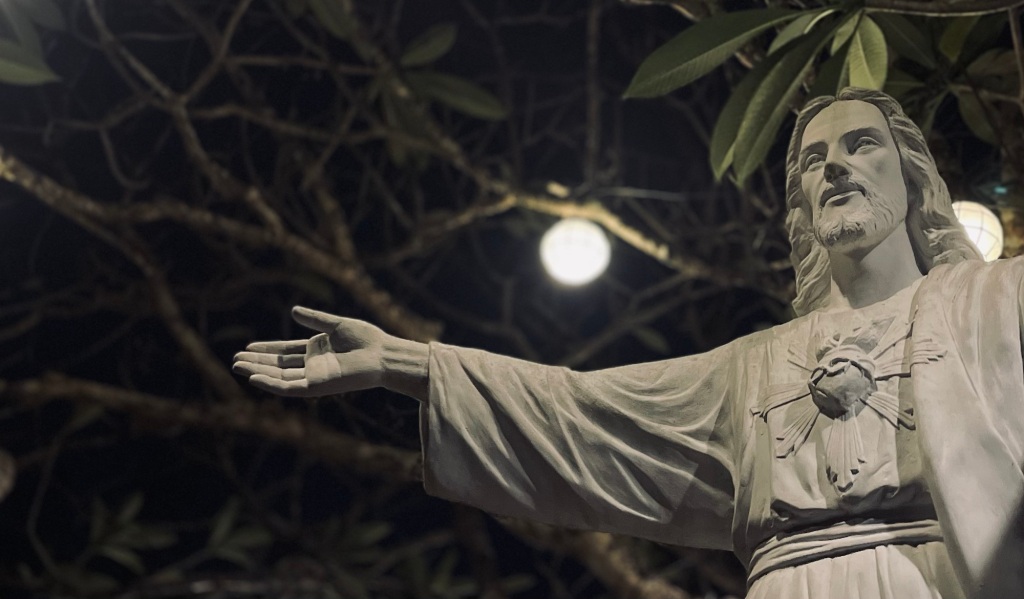
Photo by author, San Juan, La Union, 25 July 2023.
Lawiswis ng Salita ni P. Nicanor F. Lalog II, Ika-16 ng Hunyo, 2024
Larawan kuha ng may-akda, Our Lady of Fatima University-Sta. Rosa, Laguna, 2023.
Mula pa man noong una
pinuna ko na pagdiriwang
ng araw ng mga ina
at araw ng mga ama
dahil sa katawa-tawang
pagbati nila:
"Happy Mother's Day" sa lahat ng Ina!
"Happy Father's Day" sa lahat ng Ama!
Kanino pa nga ba
araw ng mga Ina kungdi
sa mga nanay at ang araw
ng mga Ama kungdi sa mga tatay?
Kaya hindi ko mapigilang matawa
sa tila dispalenghagang turing nila
na mother's day sa mga Ina
at father's day sa mga Ama:
e para kanino pa nga ba mga
araw na iyon?
Nguni't sadyang mapagbiro
itong tadhana
nang aming ihatid si ina
sa kanyang himlayan noong
Sabado, kinabukasa'y
ikatlong Linggo ng Mayo,
Araw ng mga Ina;
hindi na ako natawa
bagkus naiyak nang makita
sa social media napakaraming
pagbati sa kani-kanilang ina
ng Happy Mother's Day;
noon ko higit nadama
sakit ng pagiging ulila sa ina,
kalungkutan ng pangungulila
sa nanay na hindi na makikita,
mahahagkan at mayayakap
palaging tanong kung ako'y kumain na?
Larawan kuha ng may-akda sa Benguet, 2023.
Tinakda ang Araw ng mga Ina
tuwing ikatlong Linggo ng Mayo
upang parangalan
kadakilaan nila
ngunit kung tutuusin
araw-araw
 ay Araw ng mga Ina
dahil wala nang hihigit pa
sa pag-ibig nila sa atin
katulad ni Jesus
sarili'y sinaid at binuhos
matiyak ating kaligtasan,
kapayapaan
at katiwasayan;
hindi sasapat
 isang araw ng Linggo
taun-taon
 upang mga ina ay pagpugayan,
parangalan at pasalamatan
dahil sa bawat araw ng kanilang
buhay, sarili kanilang iniaalay;
batid ng mga nanay
lilipas kanilang buhay
maigsi lamang kanilang panahon
kapos buong maghapon
walang sinasayang na pagkakataon
pipilitin pamilya ay makaahon
sa lahat ng  paghamon.
May kasabihan mga Hudyo
nilikha daw ng Diyos ang mga ina
upang makapanatili Siya sa lahat
ng lunan at pagkakataon;
hindi ba gayon nga kung saan
naroon ang nanay, mayroong buhay
at pagmamahal, kaayusan at kagandahan
kaya naman sa Matandang Tipan
matatagpuan paglalarawan
sa Diyos katulad ng isang ina:
"malilimutan ba ng ina
ang anak na galing sa kanya,
sanngol sa kanyang sinapupunan
kailanma'y di niya pababayaan;
nguni't kahit na malimutan
ng ina ang anak niyang tangan,
hindi kita malilimutan"; iyan ang
katotohanan ng Diyos at mga ina
mapanghahawakan
hanggang kamatayan.
The Lord Is My Chef Easter Recipe for the Soul by Fr. Nicanor F. Lalog II
Monday, Memorial of Our Lady of Fatima, 13 May 2024
Isaiah 61:9-11 ><}}}*> Galatians 4:4-7 ><}}}*> Luke 11:27-28
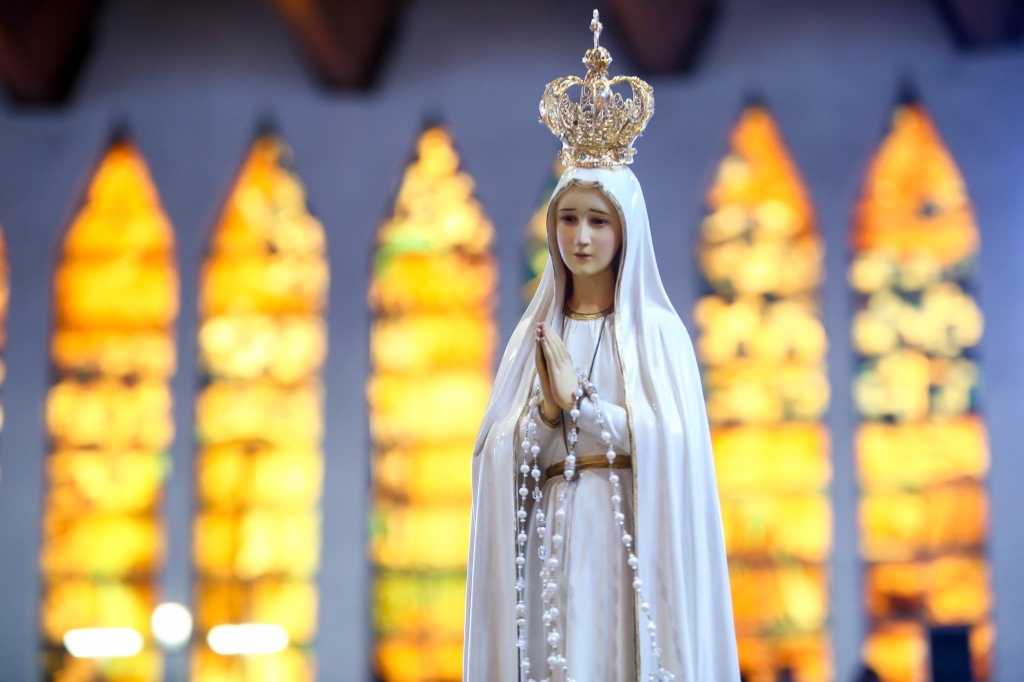
From cbcpnews.net, 13 May 2022, at the Parish of the National Shrine of Our Lady of Fatima, Valenzuela City.
We celebrate today the Memorial of Our Lady of Fatima when she first appeared there in Portugal on May 13, 1917. What a wonderful coincidence the eve of her Memorial was the Solemnity of the Lord’s Ascension that fell on the third Sunday of May, Mother’s Day.
What a wondrous alignment of celebrations this May – the Lord’s Ascension, Mother’s Day and Memorial of Fatima – as they all speak of love and belongingness despite the painful reality of separations we experience while in this life filled with sufferings and darkness due to evil and sin.
When Jesus ascended into heaven, it was not about His going up to a certain place or location in the universe but actually a leveling up of His relationships with the Father and with us. Though He had physically left earth, He is still very much present in the world. In fact, Jesus had to leave us physically to be with us at all time here in this life.
True to His promise of not totally leaving us, Jesus not only sent us the Holy Spirit to dwell in each of us to make us strong and holy but also gave us His Mother the Blessed Virgin Mary to be our Mother too in this world still filled with sufferings and darkness due to the seeming prevalence of sin and evil.
When Jesus saw his mother and the disciple there whom he loved, he said to his mother, “Woman, behold your son.” Then he said to the disciple, “Behold, your mother.” And from that hour the disciple took her into his home.
John 19:26-27
The Blessed Mother’s apparition in Fatima, Portugal more than 100 years ago was a resounding proof of the reality of God and His abiding love for mankind in this modern time when the world is more bent in denying His very existence.
How lovely that in reminding modern man of Himself to us, God used the most unique yet so common experience of everyone in every race – the mother. Everyone of us, including the most hardened criminals, always have two softest spots in our hearts, for children and our own mother. The umbilical cord with our mothers remain forever with us, even after they have died. This I realized yesterday on Mother’s Day.
While rehearsing my homily for the Mass, I had a hearty cry in my room when I came to the part of inserting the celebration of Mother’s Day. How can I speak of Mother’s Day when I am now “motherless”?
But hey…!!!
As I prayed and reviewed my prepared homily yesterday, I realized we are never “motherless” in this world!
Mothers are like Jesus Christ who ascended into heaven: when a mother dies, she remains a mother to us. Still so loving and caring.
Like Jesus who ascended into heaven, our mothers have to die and depart too to be with us more than ever. Those memories of our mother’s selfless love, from her singing of lullabies to make us fall into sleep to all her sacrifices we never saw and knew but so evident in her wrinkles and gray hair remain fresh until the end of our lives, assuring us of her and God’s love, that we shall get by in this life even when we do not see her like Jesus.
The Jews have a saying that God created mothers so that He can be everywhere. So true! That is why mothers are always lovely, “I rejoice heartily in the Lord, in my God is the joy of my soul; for he has clothed me with a robe of salvation, and wrapped me in a mantle of justice, like a bridegroom bedecked with her jewels” (Is.61:10).
Photo by author, December 2023.
Mary’s apparition in Fatima is motherhood at its finest, non pareil in history and the world. She appeared at the most crucial moment when the world was in great transition in all aspects of life that tempted us to go on our own, bragging on our achievements and knowledge.
Just like what happens in most families when many leave their families behind, especially their mother, blinded by success and the limelight. Despite all the hurts, mothers are life’s most enduring proof of God’s mercy and love. Like most mothers appealing to their children to return to their father, to come home, Mary called us in Fatima to go back to the Father in Jesus through the three children of Fatima. Her calls were very similar with every mother’s appeal to her children – pray always and repent.
Mary at Fatima reminds us of our own mothers who would never sleep – and die – until she’s assured her children are safe back home. See how the recent turn of events in history in the last 50 years were still shaped or affected by the Fatima apparition that further bolstered it to be one of the most popular devotion and pilgrimage sites in the world today.
Fatima and Mother’s Day cannot be separated from each other primarily because of all the mothers, the Blessed Virgin Mary is the foremost of all mothers in all time, the model disciple of her Son Jesus Christ not because of her just giving birth to Him but most of all, being the first to believe in Him!
While he was speaking, a woman from the crowd called out and said to him, “Blessed is the womb that carried you and the breasts at which you nursed.” He replied, “Rather, blessed are those who hear the word of God and observe it.
Luke 11:27-28
May we heed the calls of the Blessed Mother in Fatima. Most of all, let us be like her, a model disciple of Jesus Christ, be a “mother” to everyone, nurturing and inspiring others with our faithful witnessing of the gospel especially in this time when people in many parts of the world are at edge or actually in war already, forgetting we are all brothers and sisters in one Father in heaven.
Our dear Mother Mary of Fatima, thank you for coming to us to remind us of God's love, to assure us we are never motherless in this world; help us to share God's loving tenderness and fidelity to promise to never forsake us; may our lives nurture and inspire others to hope and be open to God in the midst of the seeming meaningless world, striving to do what is true and good, making Jesus present in a humanity so often absent to God. Amen.
Quiet Storm by Fr. Nicanor F. Lalog II, 10 May 2024
Photo by Veejay Villafranca/Bloomberg via Getty Images
My most vivid image of mommy’s love for me is from June 1979 when I bid her goodbye in her sari-sari store on my way to the high school seminary. That was the last time I felt I was a kid, her child, when she hugged me tightly, then held my head and kissed me as she fixed by combed hair, telling me “magpapakabait ka doon, anak.”
She had always been against my entering the seminary, saying I was too young to know about the priesthood. She did all the scare tactics to me: “hindi ka mag-aasawa, isda at tuyo araw-araw ang ulam ninyo, hindi masarap pagkain doon…” She finally allowed me to enter the seminary on second year high school I believe after my dad had silently persuaded her.
It was funny because on my fourth year before graduation, I felt I was not ready yet for the major seminary that was eventually confirmed by the results of my entrance exam (psychological tests actually) to San Carlos Seminary that it was suggested I better leave the seminary.
My mother Corazon before their wedding in 1964.
Tama nga si mommy.
It was from then on when we had that kind of not so smooth mother-son relationship. I felt far from her as she would always say something to my plans and decisions. She was not really a contravida but more of an oppositionist. That is why when I felt my vocation anew later in 1988, I never told her about it until I was about to go back to the seminary. That time, there was no more hugging and kissing maybe because I was already an adult, a man bigger and stronger than her.
But what was most memorable for me now that she is gone was the scene every time I would go back the seminary and later to my assignments as a priest.
Whenever I would tell her “mommy, uuwi na po ako”, she would say while smiling, “e nasa bahay ka, paano ka pa uuwi?”
That happened so often that she sounded so corny but still, thank God, I never tired explaining to her, “uuwi sa seminaryo” later to Malolos then to Bagbaguin and now to Fatima. She never failed to banter with me with her dry humor and stroke during those moments of my leaving home. I think she was telling me in those every good bye of ours that my home would always be her, my family. That is why after her body was taken from her room last Tuesday morning, the scene that struck me most on her death was her empty room, vacant big bed.
As I left home pauwi sa Fatima, the morning sunshine were so lovely as it softly brightened mommy’s empty room as she is now “home” in heaven with daddy.
Overall, I feel so joyful and grateful in my mother’s demise. She left so peacefully in her sleep as I have prayed to God daily. The outpouring of love and sympathies and friends are beyond our expectations or imaginations. But, there is that fear, a dread in me about coming home, finding her room empty, telling me she is gone.
Mommy’s room is now empty but our hearts are so full of her love, of her memories, of her gift of self.
During the pandemic, I begged God not to take my mom yet. I told God I was not ready because she was primarily the reason I “go home”. As I reflect on the meaning of that image of her empty room, I realized that it is not about going home but coming home. We go home to the house and place but we come home to persons, to family and friends.
Pag-uwi in Tagalog which is literally coming home. Not going home. Because when we leave, we say uuwi also as we come home to our new home.
We Filipinos express both our kinship and Christian faith in our goodbyes.
Our professor in liturgy Msgr. Andy Valera used to tell us we never say aalis na ako or “I am leaving” because that means we are angry. It is very rude and should never be said when saying goodbye in any Filipino gathering. Instead, we say next to uuwi na ako either tutuloy na ako or mauna na ako. But, how can we make tuloy which is to enter when we are in fact leaving? And why say mauna na ako which means I’ll go ahead when nobody is going with you?
Photo by author.
According to Msgr. Andy, our coming home indicates our theology of heaven: we all come home, uwi to heaven our true home that is why when we leave our gatherings we say tutuloy na ako because in the end, we enter heaven. Most of all, we say mauna na ako because nobody knows who is next to die.
What a beautiful lesson I just realized now after mommy had died; even if she’s gone and her empty is room, I will still come home to my sisters and brother, nieces and nephew, relatives and neighbors.
How lovely that despite the pain and emptiness death creates in us here on earth is also the grace of God to fill each others heart with His loving presence and joy as we await our final coming home to Him with our departed loved ones in heaven.
Jesus told his disciples: “Do not let your hearts be troubled. You have faith in God; have faith also in me. In my Father’s house there are many dwelling places. If there were not, would I have told you that I am going to prepare a place for you? And if I go and prepare a place for you, I will come back again and take you to myself, so that where I am you also may be.”
John 14:1-3
The best way to come home to heaven is to come home often to our family and friends not only to dine and celebrate but most of all, to praise and thank God in prayers, especially the Sunday Mass. God bless everyone!
Quiet Storm by Fr. Nicanor F. Lalog II, 09 May 2024
Our mother had always loved flowers and shades of pink, especially pink carnation her favorite.
It has been said death is the greatest equalizer. But with my mom’s recent passing, I realized too that death is the best explainer of life. Death is life’s final joke on us that answers, clarifies the many questions we have been asking in our lifetime.
Consider these:
Dad died on June 17, 2000, my mom’s 61st birthday; we celebrated his 40th day of death on his birthday, July 26, 2000. He died on a Saturday, the eve of Father’s Day.
Mommy died May 07, 2024 with her 40th day coming on June 15, two days before her 85th birthday and dad’s 24th death anniversary. This Sunday after her burial is Mother’s Day.
Ever since my father died, I have realized that death weaves a certain pattern in our lives, telling us a lot of things about us and our loved ones. And about life itself if we would have faith in God by setting aside our fears and superstitions.
Photo by author, somewhere in Bgy. Kaysuyo, Alfonso, Cavite, 27 April 2024.
See how Jesus spoke to His disciples about His coming death during their Last Supper:
“Now I am going to the one who sent me, and not one of you asks me, ‘Where are you going?’ But because I told you this, grief has filled your hearts. But I tell you the truth, it is better for you that I go. For if I do not go, the Advocate will not come to you. But if I go, I will send him to you… But when he comes, the Spirit of truth, he will guide you to all truth. He will not speak on his own, but he will speak what he hears, and will declare to you the things that are coming.”
John 16:5-7, 13
It is always after someone had died when things and life itself become clearer for us. In every death comes an unfolding of truth in time, in persons. It is after a beloved had died when we realize how much we do not know of their goodness or kindness that often we are surprised at the outpouring of love by those who come to their wake. Many times, strangers know more of the brighter side of a person when he/she dies. Along this line of mystery of the person we find too how death happens on days that at first seem to mean nothing at all but at closer look, or later as we moved on in life after the demise of a loved one, we see how every death points to something about us and our family and friends!
Hence, we say death is not the end but the beginning of eternity. Actually, with the deaths of my father and now of my mom, I have found death is life. No wonder St. Francis referred to death as a person, calling him “cousin Death.”
This became more clear to me when I became a chaplain at the Fatima University Medical Center (FUMC) in Valenzuela City.
Last year I took care of an elderly priest, Msgr. Teng Manlapig when he was confined in our hospital for almost a month. Two days before he died on February 26, 2023, he asked me to hear his confession. It was a Friday and February 26 last year was the first Sunday in Lent when the gospel was the temptation of Christ in the wilderness.
It was on that Sunday evening after seeing Msgr. Teng for the last time before he was taken to the funeral parlor when I remembered another priest I had cared during his dying days, Msgr. Macario Manahan who died in front of me in his retirement home on March 16, 2014 – the second Sunday in Lent when the gospel was the Transfiguration.
What a tremendous gift from God for me to care until their deaths of two monsignori in the Season of Lent. From them I have realized that our final altar as priests are our deathbeds where even to the end, we celebrate Mass and the Sacraments. From that day on too, I have prayed to God to allow me to go home to Him not during Lent but on Easter. Or, preferably on Ascension Sunday when my time comes.
Have a blessed day celebrating life, finding its meaning and beauty in the prism of cousin Death in Jesus Christ. Amen.
Quiet Storm by Fr. Nicanor F. Lalog II, 07 May 2024
My favorite photo of my mom and dad, so candid, “silang-sila talaga”; now, they are together in heaven.
Yes. It is true. I just realized today that we never get used to any death because every death is different as the person who dies. And most especially, now I have realized, every death is always a blessing from God.
I was preparing for our 630AM Mass today when my youngest niece called me, crying, and the only word I understood she was saying was “Mamu”, referring to my mother. I then asked my brother priest to take over my Mass as I headed home. In less than half an hour, I was anointing my mom for the final moment, said prayers and blessed her body with Holy Water with my sisters and only brother.
I knew this day was coming, even approaching.
In 2020 during the COVID pandemic, I begged God to keep us all safe, not to take any one from my family, especially Mommy who had a stroke in 2005. June last year she had another stroke but refused to stay in the hospital, begged me not to have her confined, “Father, huwag mo ako ipa-ospital…tama na… ayoko na.” What can I do but obey my mother. Last January, she had permanently been bed-ridden, been sleeping for days, and had refused to eat on several days. But one thing we noticed she had always been bubbling with joy, cracking jokes whenever she would wake up.
Mommy would always say the day she married my dad was the happiest day of her life.
Every week, I would visit her, anoint her with Holy Oil and bring her Holy Communion. Since January this year, I have been praying to God to give my mother a peaceful death. I did not ask for her happy death because I felt how happy she has been this past year. Lord, just make it peaceful. No more pain because she had gone through many pain in her life since her childhood as she used to tell me. That is why she insisted on us to all finish our studies because she never had the chance to even reach high school because of that dictum in those years “mag-aasawa lang ang babae…”
And she died peacefully. Definitely, happily early today. My sister said she was supposed to give her medications before 6AM when mommy did not move or even twitch a little. She was still warm, my sister said but unusually still unlike before. That was when they called me.
Like when my dad suddenly died on mommy’s birthday, June 17, 2000, I could not cry hard enough. I feel very sad. But there is that inner joy and peace within me. Especially with my mom’s passing. I thought I would be used to her dying, having prepared for this day, having through dad’s sudden death 24 years ago.
By the way, my homilies since Sunday have always revolved around mommy:
I never knew mommy would “join” daddy today in heaven.
Iba pa rin pala. God is so good. That’s all I feel at the moment. God is so good. He listens and grants our deepest prayers. All praise to Him. Kindly pray for my mother, Corazon. God bless you too and thank you.
The Lord Is My Chef Easter Recipe for the Soul by Fr. Nicanor F. Lalog II
Tuesday in the Fifth Week of Easter, 30 April 2024
Acts 14:19-28     <*((((>< + ><))))*>     John 14:27-31
Photo by Fr. Pop Dela Cruz, Binuangan Island, Obanda, Bulacan, 2021.
Your words today,
O Lord Jesus,
are very comforting
and soothing on these
extremely hot days of summer;
and how amazing your words
were set in the most distressing
situations:
in the first reading, Paul was stoned
and dragged out of Lystra,
"supposing he was dead"
(Acts 14:19);
in the gospel, as You spoke
of Your impending betrayal
and arrest leading to Your
Passion and Death, You spoke
about peace, telling Your disciples
"Do not let your hearts be troubled
or afraid" (Jn.14:27).
How amazing, dear Jesus,
are Your strength and courage
to assure others even in the midst
of great turmoil Yourself;
where did Paul get those
grace and power to strengthen
the spirits of others, exhorting them
to persevere in faith (Acts 14:22)
after he almost got killed?
Photo by Fr. Pop Dela Cruz, Binuangan Island, Obanda, Bulacan, 2021.
Many times, my Lord,
I cave into myself,
worst, sulk in isolation
from the rest when disappointed
and hurt;
keep me strong, dear Jesus,
let me persevere in face of trials
and difficulties like Paul,
keeping in mind that difficulties
are temporary,
are meant to purify
and strengthen me
because the enemy has no power
over me for You have already
conquered the world in love;
let me rejoice in the face of
my adversaries so that the world
may know and experience Your great
love poured upon me in Your
passion and death.
Amen.
The Lord Is My Chef Easter Recipe for the Soul by Fr. Nicanor F. Lalog II
Monday in the Fifth Week of Easter, 29 April 2024
Acts 14:5-18     ><))))*> + ><))))*> + ><))))*>     John 14:21-26
Photo by author, San Juan, La Union, July 2023.
Like the Apostle Jude,
I have always wanted to ask You
dear Jesus, "Master, then what
happened that you will reveal yourself to us
and not to the world?" (John 14:22);
why, O Lord, You not simply appear
to everyone so that people will
not have to create other gods
like the people at Lystra who mistook
Paul and Barnabas as Hermes and Zeus?
Jesus answered and said to him, “Whoever loves me will keep my word, and my Father will love him, and we will come to him and make our dwelling with him.”
John 14:23
It is a very timely question
many of us are still asking
and Your answer, O Lord,
was mysterious and so profound;
but, thank You, dear Jesus,
for being so near with us,
for being with us always
to enable us to slowly grasp
and understand Your words:
forgive us, Lord, when we take
You as a thing, as an object
to be possessed and held
like those idols and gods
not only of the Greeks and Romans
of old but by many of us today
in various forms and ways;
You, O Jesus, are a Person,
Someone who must be seen
and perceived by our hearts
so that You may take Your dwelling
within us; how lovely that despite
our sins and weaknesses,
You desire to enter our lives;
grant us, therefore, Lord,
an open heart willing to welcome You
inside, to dwell in our hearts
so that we may manifest You to others
in our life of witnessing You peace
and joy, mercy and love, kindness
and reconciliation so that like the
psalmist, we may always sing,
"Not to us, O Lord, not to us
but to your name give glory
because of your mercy,
because of your truth"
(Psalm 115:1).
Amen.
The Lord Is My Chef Easter Recipe for the Soul by Fr. Nicanor F. Lalog II
Monday in the Fourth Week of Easter, 22 April 2024
Acts 11:1-18     ><))))*> + ><))))*> + ><))))*>     John 10:1-10
Photo by author in Silang, Cavite, September 2020.
Lord Jesus Christ,
as we go back to school and to work
this Monday, I pray
that we "object" less
to one another,
that we hold our "objections"
to ourselves first until
we have found the merits
of an endeavor or proposal
and most especially,
until we have found Your Holy Will.
The Apostles and the brothers who were in Judea heard that the Gentiles too had accepted the word of God. So when Peter went up to Jerusalem the circumcised believers confronted him, saying, “You entered the house of uncircumcised people and ate with them.” Peter began and explained it to them step by step… When they heard this, they stopped objecting and glorified God, saying, “God has then granted life-giving repentance to the Gentiles too.” (Acts 11:1-4, 18)
Teach us, dear Jesus,
to widen our perspectives
and to always be alert for
the movements of the Holy Spirit
so that we do not waste
time and energies with our
endless "objections"
that often paralyze
missions and operations
and worst of all, destroy
people.
How lovely is Your claim,
"I am the gate for the sheep"
(John 10:7) for we all belong
to You alone; when we object
a lot, we close the gate,
we hinder the flow of people
to the gate, and most of all,
we steal Your sheep!
Do not let our many and endless
objections claimed as for the
greater good but totally empty of You
hinder our flock in finding You
"so that they might have life
and have it more abundantly"
(John 10:10).
Amen.
Photo by author in Silang, Cavite, September 2020.
The Lord Is My Chef Easter Recipe for the Soul by Fr. Nicanor F. Lalog II
Third Sunday in Easter-B, 14 April 2024
Acts 3:13-15, 17-19 ><}}}}*> 1 John 2:1-5 ><}}}}*> Luke 24:35-48
Photo by Dra. Mylene A. Santos, MD, 27 March 2024 at Katmon Nature Sanctuary & Beach Resort, Infanta, Quezon.
More than ten years ago, there used to be a billboard at the C3-Banaue area in Quezon City that said, “True love is like ghosts, which everybody talks about and only a few have seen.”
I googled the saying and found it was from French moralist Francoise de la Rochefoucauld (1613-1680). Nonetheless, we remembered that billboard because in our gospel today, we have heard how the Apostles thought upon seeing the Risen Lord that He was a ghost!
While they were still speaking about this, he stood in their midst and said to them, “Peace be with you.” But they were startled and terrified and thought that they were seeing a ghost. Then he said to them, “Why are you troubled? And why do questions arise in your hearts? Look at my hands and my feet, that it is I myself. Touch me and see, because a ghost does not have flesh and bones and you can see I have.”
Luke 24:36-39
“The Road to Emmaus” painting by American Daniel Bonnell from fineartamerica.com.
This is the last Sunday we shall hear a story of the Risen Lord’s appearance to His disciples; beginning next Sunday, our gospels will be the accounts of Jesus Christ’s discourses at their Last Supper.
It is not really important to count how many times the Risen Lord had appeared to His disciples who in the first place never bothered themselves with it. John explained it last Sunday why only a few of these were written so that we may believe and have life in Him (Jn.20:31). There are two things we find always in these few Resurrection stories that convince us the Lord is risen.
First, there is always the intensity we feel in the Resurrection stories we have. Even though there is no account of how it happened, we could feel in the whole New Testament that it actually happened. It is historical but beyond the physical and ordinary. So real yet surreal. That is why initially, there is the incredulity not only among the disciples but even among us at this time. As we say in Filipino, “hindi makapaniwala” as opposed to “hindi maniwala” because Jesus Christ’s Resurrection opened new possibilities in our human existence that only faith in Him can explain though not fully. It is when all we can say in Filipino is “a…basta!”
From this intensity of His Resurrection, there is always that movement to gather together as a community of the risen Lord’s disciples. Easter is always in the context and setting of a community. See how Jesus would always tell or lead His disciples to gather together as a community, always appearing to them when there are at least two of them gathered like Clopas and companion on the way to Emmaus on the evening of Easter. And we see its effect – once they recognized Jesus at His breaking of bread, they both hurried back to Jerusalem to join the other disciples to share the good news!
That’s the beauty and mystery of Easter. It is so intense, so true we can feel and experience, always leading us to gather together as a community, as a family. It is never selfish nor personal. Do we have the same intensity today as individuals and as a community especially in our Sunday Masses?
From Facebook, 04 April 2021: “There is an urgency to announce the Joy, the joy of the Risen Lord.”
Today’s gospel scene is the continuation of that Emmaus story. While Clopas and companion were telling the disciples their experience, Jesus suddenly came into their room and again, they were startled and terrified.
But Luke added that one word “ghost” that was used twice in this scene: first in v.37, “But they were starteld and terrified and thought that they were seeing a ghost” and in v. 39 when Jesus read His disciples’ minds, telling them to “Look at my hands and my feet, that it is I myself. Touch me and see, because a ghost does not have flesh and bones as you can see I have.”
Sorry for the long introduction as I wish to direct our attention to that word ghost.
When we were growing up, there was a cartoon show on TV called “Casper the friendly ghost.” In Filipino, we always refer to ghost as multo, something scary because like the aswang, they look terrible and would always harm people. That is why the Church later on changed the name Holy Ghost to Holy Spirit because of the very negative connotation of the word ghost.
These days, the young people are using again the word ghost, turning it into a verb form that means so negative: ghosting as in “iniwan sa ere”. At first, I thought to be ghosted is the equivalent of what we used to say “na-Indian” when a date or someone stood you up in a meeting or coming together.
But ghosting is more than just not appearing nor coming to a meeting or get together. It is almost like betrayal or infidelity. Precisely what the youth say, to be left hanging on air not knowing at all what is next. Very disappointing. Most of all, painful as it hurts us deeply when ghosted. The Filipino expression says it all completely, iniwan sa ere which is worst than the English expression “dropped like a hot potato”. To be ghosted is to be betrayed, to be taken for granted, to be discarded like a thing. It is utter lack of respect to another person. Worst, it is lack of life fulln of pessimism and indifference to life itself.
Photo by author, Sacred Heart Novitiate, 18 March 2024.
Jesus Christ is not a ghost. Had never and would never ever ghost us because He is faithful, truly alive and truly present with us especially in our darkest and emptiest moments in life. Many times, we do not see nor recognize Him because we are so focused at how we were ghosted especially by loved ones.
In the first reading, we heard Peter’s second discourse on Pentecost Sunday about the Resurrection of Jesus as the summit of everything that was written in the Old Testament, the fulfillment of salvation history. But at the same time, he was telling the people of how they have ghosted the Lord “whom you handed over and denied in Pilate’s presence, when he decided to release him” (Acts 3:13).
Peter was not accusing the people then or anyone today for being accomplices in Jesus Christ’s death because he himself denied the Lord thrice, remember? Peter ghosted Jesus too but repented. And that was his point to everyone including us today of how may times we too have ghosted Jesus when we sin against each other, when we betray our loved ones, when we are remiss in our duties and responsibilities, when we are unfaithful that people fail to experience the Risen Lord coming to them.
Peter is asking us this Sunday to look into ourselves at how we continue to ghost each other that we contribute to the vicious circle of violence happening in the world that often starts right in our family and community, even in the Church.
That is why the beloved disciple asks us in the second reading “to keep his commandments so that we may not commit sin” by rejecting the lusts of the flesh not only in the sexual sense but in all of our selfish interests. Most of all, to imitate Jesus Christ by living like Him full of love and kindness, always understanding and forgiving and caring especially of the weak and marginalized.
Photo by author, 09 April 2024.
The Resurrection remains a mystery. It is a call for us to be real with flesh and bones not like a ghost. Easter is an invitation to live our lives as Easter people, full of joy and hope in Christ even when the chips are down.
Being real as opposed to ghosting means proclaiming Jesus Christ with our very own witnessing of His loving presence and service to others with our very lives.
Being real as opposed to ghosting is avoiding “back burning” those dearest to us.
Being real as opposed to ghosting is not “bread crumbing”, of being mediocre that we do only the bare minimum.
Easter is Jesus faithfully present with us especially in the most trying and difficult moments of our lives because He assures us nothing can keep us nor hostage us in whatever darkness or emptiness we are in.
Not being able to see someone does not mean that someone does not exist. Many times in life, it is after our loved ones are gone – permanently or temporarily – when we actually experience them closest. That’s because of the Resurrection of Jesus!
Let’s get real by praying:
Lord Jesus Christ,
open my mind and my heart
to Your words;
let me develop that prayer life
You have always been inviting me
to get into a relationship with You;
let me find You in my wounds
so I may find Your glory too;
let me find You in my many hurts
and scars in my heart so I may
find and share Your healing and
comfort with those still in the
darkness of Good Friday
or silence of Holy Saturday;
dearest Jesus,
fill me with life and joy
so that people may see You
in me alive
and not like a ghost.
Amen.