The Lord Is My Chef Breakfast Recipe for the Soul
Monday, Feast of the Conversion of St. Paul the Apostle, 25 January 2021
Acts 22:3-16    <*(((><<   +++   >><)))*>     Mark 16:15-18
A sculpture of St. Paul near the entrance to the Malolos Cathedral by artist Willie Layug.
Praise and glory to you, O Lord Jesus Christ in coming to us always in the most personal manner in calling and inviting us to follow you to become fishers of men like in this Sunday’s gospel. You always come in the ordinariness of our lives, challenging us to face our responsibilities and most of all, asking for our commitment to you.
It is very funny but so true when you called St. Paul, he was out on his “ordinary” task of arresting followers of your Way while en route to Damascus. In that brief moment of encounter with him that eventually led to more days of prayers and teachings, you have shown us Lord the true meaning of conversion: it is not really a change in person in us but more of a change in focus.
St. Paul remained zealous in his ways but this time no longer to defend the old Mosaic Law he had defended at all costs before but this time for your gospel, Lord Jesus. He remained a committed person but no longer to the old ways but now in your person, dear Jesus, that he can claim in that “it is no longer I who live but Christ lives in me” (Gal.2:20) .
That is essentially what conversion is all about: remaining the same person but no longer living in himself alone but in Jesus Christ alone.
Teach us, dear Jesus, that conversion in you is a daily happening, that needs to be cultivated in prayer and witnessing like St. Paul; that what really matter is to place you, O Lord Jesus at the center of our lives so that our identity is essentially marked by our encounter in you, by our communion with you and with your Word. More than seeing you in a vision, illumine us with your light, Jesus so we may recover and purify everything in us that has become dull due to sin.
We pray also for those people like Ananias who have been instrumental in bringing us close you, Jesus, people who set aside their biases against us and listened to your instruction so we may be converted and be your witness. Amen.
The Lord Is My Chef Sunday Recipe for the Soul
Third Sunday in Ordinary Time, Cycle-B, 24 January 2021
Jonah 3:1-5, 10  >><)))*>  1 Corinthians 7:29-31  >><)))*>  Mark 1:14-20
Photo by Mr. Jim Marpa, 2018.
The sea evokes mixed feelings of both joy and fear at the same time. It symbolizes life itself that may be nice and lovely but difficult and dangerous too. For many people, the sea is the sign of abundant life, a source of livelihood while for some, a reminder of death and misery.
Such is the mystery of life too that at the start of the ministry of Jesus Christ, we find Mark locating its setting by the sea as we embark fully into the Ordinary Time of the liturgy.
After John had been arrested, Jesus came to Galilee proclaiming the gospel of God: “This is the time of fulfillment. The kingdom of God is at hand. Repent, and believe in the gospel.” As he passed by the Sea of Galilee, he saw Simon and his brother Andrew casting their nets into the sea; they were fishermen.
Mark 1:14-16
Mark wrote the first gospel account that became the framework for Matthew and Luke in writing their own versions. He was in a hurry in writing his gospel because he felt the urgency in making known the good news of Jesus Christ; thus, his gospel is also the shortest, doing away with so many other details without losing the essentials.
This we find in his brief presentation today of the beginning of Christ’s ministry set by the Sea of Galilee.
Our sea of discontent.
First thing we notice is the very nature of the coming of Jesus Christ that happens when we are in rough waters, perhaps even with a violent storm at the middle of the sea called life: After John had been arrested, Jesus came to Galilee proclaiming the gospel of God: “This is the time of fulfillment. The kingdom of God is at hand. Repent, and believe in the gospel.”
Photo by author, sunrise at the Sea (Lake) of Galilee, 2017.
The setting was not totally good. John had been arrested. People must have been disappointed. But, that is always the cue in God’s coming called “kairos” or fullness of time, the day of judgment.
It is when we are going through difficult situations in life when we must examine ourselves too, of the need to set aside our own plans and agenda to let go and let God.
Every here and now is the time of fulfillment, a time of God’s coming to us.
Do we have the room, the space in us to welcome him to bring us into fulfillment? Hence, the need to empty ourselves, to repent and believe in Jesus Christ, the gospel himself.
Secondly, it is when we are sailing through rough seas when we also experience within that feeling of discontentment, of emptiness when there seems to be something missing in our lives even if everything is going fine like with our career or business, relationships, or family where nobody is sick or maybe the kids have all grown up and now on their own.
There comes a time in our lives when our problem is not having any problems at all — when we are no longer contented with being happy and satisfied but longing for fulfillment.
Rejoice and be glad when feeling this way! Emptiness leads to fullness as discontentment in life is always a sign of spiritual growth if we heed the calls of Jesus when desolation is a prelude to consolation.
Like in the story of creation, out of chaos comes order, exactly the experience of the first four disciples of Jesus.
As he passed by the Sea of Galilee, he saw Simon and his brother Andrew casting their nets into the sea; they were fishermen. Jesus said to them, “Come after me, and I will make you fishers of men.” Then they abandoned their nets and followed him. He walked along a little farther and saw James, the son of Zebedee, and his brother John. They too were in a boat mending their nets. Then he called them. So they left their father Zebedee in the boat along with the hired men and followed him.
Mark 1:16-20
Photo by Mr. Jim Marpa, Carigara, 2019.
When we are sailing through rough seas in life, that is when we have to trust God more so he can do and move in our lives to achieve the great plans he had created us for. “Be still and confess that I am God!” (Ps. 46:10), so the psalmist tells us.
Money and material things were not a problem for Simon and company. They must be well to-do as they have their own fishing boats at the time, even with men hired to work for them. Opening their hearts to listen to Jesus, they must have felt deep inside them that finally, they have found direction in life, something they have been searching for a long time.
Did they understand the meaning of “fishers of men”? We have no way of knowing it but Mark tells us how upon listening to Jesus, Simon and Andrew left everything behind and followed the Lord! Imagine the great fortune they have left behind.
Even Zebedee, the father of James and John, did not complain nor run after them to at least ask them to stay behind so they would help him run their family business because he too must have been praying for his sons to grow up and mature! Recall how the mother of James and John requested Jesus the favor to have them seated beside him when reigning in his kingdom they thought to be like the kings of their time living in a palace. Or, their attitude in asking Jesus to burn down a Samaritan village that refused them passage. These instances indicate how the brothers James and John may have been like today’s typical happy-go-lucky rich kids of their time but searching for meaning in life amid the many troubles and misadventures in life.
Jesus comes to us in a similar manner, in the ordinariness and problems and struggles of our lives like when Simon and Andrew, James, and John were busy working near the Sea of Galilee. The Lord speaks to them about what they were doing as fishermen to express to them his plans to make them fishers of men.
We do not find God;
it is God who finds us.
Every day, Jesus Christ is passing by, calling us, inviting us to repent and believe in his gospel, challenging us to face our responsibilities and most of all, asking us for our commitment. He never imposes but would always patiently wait for us.
We all search for meaning in life; for some, it may come early in life while for others, it might come later. But surely, our search for meaning, for God always come for sure because we were created that way by God.
In my personal experience, I have realized that we do not really find God; it is God who actually finds us! Moreover, nobody escapes God as attested by so many saints and even ordinary people we have known who have experienced conversion.
Photo by Dr. Mylene A. Santos, MD, December 2020.
One beautiful story of God coming to us, searching for us, and saving us from storms at the middle of the sea of life is that of Jonah and the city of Nineveh in the first reading. Jonah himself tried to escape God when his ship encountered a severe storm in the middle of the sea that he was thrown out to be swallowed by a whale. Of course, it is symbolic but it tells us in a nutshell the urgency of proclaiming God’s message of conversion, of not escaping God. This we find when Jonah was surprised at how a pagan nation like Niniveh listened to his preaching that they were spared of God’s wrath and punishment.
Jonah and Niniveh both give us beautiful lessons in resolutely turning back to God and his ways without wasting any instant as well as God’s immense love and concern for everyone, offering his mercy and forgiveness no matter how serious our sins are.
The characters of Jonah and of the inhabitants of Niniveh may be exaggerated but they are very true even among us in our own days! Recently we have seen how things have gone worst in this life in almost every aspect especially since last year with the coming of COVID-19 pandemic.
That is why St. Paul’s call in the second reading is so timely: “I tell you, brothers and sisters, the time is running out. For the world in its present form is passing away” (1Cor.7:29,31).
When St. Paul wrote the Corinthians telling them to act as not having wives or weep as not weeping means we have to detach ourselves from all that perish like material things as well as jobs and careers, and even this life we have. We have to focus more on things that last who is ultimately God in Jesus Christ.
Last week, I was so saddened with the news of the closing of the Makati Shangri-la Hotel next month. One of our parishioners is a young man working there as a chef since 2004. He is a very good man, always dropping by the parish after work, never missing a Sunday with his father who died last summer. When COVID-19 started, he would always attend our online Mass wherever he may be.
I texted him the night the news came out of the closure of their hotel next month. Beside is a screenshot of our chat that turned my sorrow into joy upon realizing Carlo’s deep faith in God.
That night, I thanked God in my final prayer, for letting Jesus passed by my room while chatting with Carlo, in taking care of Carlo.
Yesterday after Mass I talked to him again and he was already very upbeat, looking forward to celebrating the Mass with us more often while looking for a new job.
Let us pray this Sunday for everyone going through many hardships these days so they may remain open in their hearts, listening to Jesus who is passing by, calling them to be his fishers of men in this troubled seas. Amen.
The Lord Is My Chef Breakfast Recipe for the Soul
Friday, Memorial of St. Vincent, Deacon and Martyr, 22 January 2021
Hebrews 8:6-13     >><)))*>  = + =  <*(((><<     Mark 3:13-19
Photo by author, Dominus Flevit Church, the Holy Land, 2017.
Jesus went up the mountain and summoned those whom he wanted and they came to him. He appointed Twelve, whom he also named Apostles that they might be with him and he might send them forth to preach and have authority to drive out demons. He appointed the Twelve: Simon, whom he named Peter; and Judas Iscariot who betrayed him.
Mark 3:13-16, 19
How great indeed is your love for us, O Lord Jesus Christ! I just wonder how or what are your criteria in calling those you wanted to follow you? You do not seem to reject anyone at all! You want all because you love us all!
Thank you very much, dear Jesus! Despite our many flaws and weaknesses, you still want us, you still call us, and most of all, even send us despite our imperfections.
And amid your great love for us is your “poor memory”, of always forgetting or disregarding our sins against you. Like when you called Simon and named him Peter to lead the Twelve as attested in all accounts as being the first among the list of the Apostles; but, at the same time, always mentioned last in every list of your inner circle is Judas Iscariot who betrayed you. Why called him at all?
So often, I find that so strange with you who knows everything and reads our hearts; but, the more I pray over your calls and our response, the more I find it more strange on our part when despite your mediating a new and perfect covenant in God (first reading from Hebrews), we still choose to turn away from you in sin.
Forgive me, Lord Jesus, when I cannot resist the temptation to slide back to the past, to seek something already obsolete and imperfect simply because they are easier.
Teach me to have the inner strength like of St. Peter, your prince of the Apostles and of St. Vincent, your Martyr and Deacon whose feast we celebrate today. May we remain faithful and vigilant in our commitment in responding to your call, Lord Jesus so we may always be one in the Father. Amen.
Photo by author, St. Joseph Parish in Baras, Rizal (07 January 2021).
The Lord Is My Chef Sunday Recipe for the Soul
Feast of the Sto. Niño, 17 January 2021
Isaiah 9:1-6  >><)))*>  Ephesians 1:3-6.15-18  >><)))*>  Mark 10:13-16
Photo by author, 16 January 2021.
Today we spend an extra Sunday for the Christmas Season’s Feast of Sto. Niño granted by Rome to the local Church in recognition of the important role played by that image of the Holy Child gifted by Magellan to Queen Juana of Cebu in 1521.
Its role in the Christianization of the country cannot be denied, considering the historical fact that when Miguel Lopez de Legazpi arrived in Cebu 44 years later after Magellan to claim the country for Spain, they were surprised to discover how the natives venerated the Sto. Niño inside a special hut for worship along with their other anitos.
Legazpi’s chaplain Fray Luis Andres de Urdaneta attested to how that devotion to the Sto. Niño in Cebu enabled them to Christianize other natives without difficulties as the Holy Child image at that time has become the favorite among the people in asking favors like children and bountiful harvests as well as protection from calamities and wars.
The late National Artist Nick Joaquin was absolutely right to claim in his many writings and talks that it was really the Sto. Niño who truly conquered the Philippines that continues to be the most popular Christ-devotion in the country along with the Nuestro Padre Jesus de Nazareno of Quiapo.
More powerful than the swords and cannons or any force in the world indeed is the Child Jesus who has continued to be a paradox in world history: the Son of God born in a lowly stable in a small town called Bethlehem because there was no room for them in the inn during the time of the powerful Caesar claiming to be the king of the whole world by ordering a census of all his subjects in the vast Roman Empire now totally forgotten, his kingdom long gone.
What an irony the God who came so weak like all of us, without any title to His name nor an army at His command still influencing the world in His weakness and silence, in His childlikeness. A reality in life until now we have refused to accept even in the Church.
People were bringing children to Jesus that he might touch them, but the disciples rebuked them. When Jesus saw this, he became indignant and said to them, “Let the children come to me; do not prevent them, for the kingdom of God belongs to such as these. Amen, I say to you, whoever does not accept the kingdom of God like a child will not enter it.” Then Jesus embraced them and blessed them, placing his hands on them.
Mark 10:13-16
A child praying in our Parish, 07 November 2019; photo by Mr. Red Santiago.
Christ’s path of weakness vs. the world’s path of power
It is so timely that during this Ordinary Time we have this Feast of the Sto. Niño to remind us of the central teaching of Jesus Christ to be childlike that gets lost in the novelty and sentimentality of our Christmas celebrations.
See how this call for us to be childlike becomes more difficult even almost impossible to achieve in our world that has become so technical and “sophisticated” as we seek to shape and manipulate everything according to our own design.
The world of men, of macho men we love to relish with delight in the secular and religious world in all of its trappings of fads and fashion and “hard talks”, of external showmanships that we try so hard to project cannot hide the hypocrisies within, of keeping grips and control on everyone and everything like the disciples of Jesus. The tragedy of that scene continuing to happen in our time is how some few people who live in darkness pretend to be seeing the light that in the process are actually misleading people towards darkness and destruction.
Every time we refuse to allow others to come forward with their new thoughts and new ideas, fresh perspectives in governance and management, in the ministry, in theology, when we close our minds to hear others ideas and opinions in doing things, then we are into serious power plays that can be pernicious at the same time.
When this happens, we are all the more challenged to be child-like before God in taking all the risks in exposing what is true, what is real like those kids shouting “the emperor has no clothes”!
To be a child means to owe one’s existence to another which we never outgrow even in our adult life. It is an attitude of being open, that Jesus can be talking to us through people not necessarily like us, even different from us. It is an attitude of trusting others, unlike those hungry for power who only believe in themselves, so afraid they might be proven wrong because their minds are either narrow or closed.
Are we not surprised at all that these control freaks around us who try so hard to project images of power and strength are often the perverts and deviants hiding their childishness and immaturities and other skeletons in the closet?
Photo by author, “Sleeping Sto. Niño”, January 2020.
Becoming and living as God’s children
Jesus shows us today in this feast of the Sto. Niño that it is in the path of being weak like children when we are truly free like Him – free to be a child of God indeed! This He accomplished by dying on the Cross not only to forgive us for our sins but made us a “new man/woman” in God as His children.
Brothers and sisters: Blessed be the God and Father of our Lord Jesus Christ, who has blessed us us in Christ with every spiritual blessing in then heavens, as he chose us in him, before the foundations of the world, to be holy and without blemish before him. In love he destined us for adoption to himself through Jesus Christ, in accord with the favor of his will, for the praise of the glory of his grace that he granted us in the beloved.
Ephesians 1:3-6
How sad that in our efforts to be in the man’s world of power and dominance, we try so hard becoming somebody else whom we are not only to end up alone, lost and unfulfilled.
Our being children of God is something innate in us, already within us that was accomplished by Christ for us at the Cross.
The key is to always go back to Jesus at the Cross.
We have said earlier that to be a child is to owe one’s existence to another that is, ultimately speaking, to God alone.
Hence, one sure sign of being like a child is having the sense of gratitude, of thanksgiving.
Incidentally, the Greek word for thanksgiving is eucharistia or eucharist! In the gospel accounts, we find so many instances of Jesus thanking the Father for everything that beautifully reminds us of His childlikeness.
The moment we feel strong enough without need for others, then we stop being grateful, then we lose that childlikeness in us as we start tinkering with power and influence, assuming to ourselves that everybody owes us, the world needs us.
That is when we stop growing and sooner or later, we collapse and eventually fall so hard on our faces.
How amazing that the Sto. Niño image given by Magellan to Queen Juana holds an orb or a globe. It is very interesting where did the maker of that image got that idea that the world is round when in fact it was the theory that Magellan had in mind in setting out to his ambitious expedition by sailing westward and returning from the east?
Records show that the first images of the Child Jesus or Sto. Niño as we know came from Flanders, a region in the Netherlands. The Flemish people have been making those images as early as the late 1400’s. That is why there is also that popular image of the the Child Jesus in Prague in the Czech Republic.
The mystery remains where did they get that idea of the Child Jesus holding an orb?
Could it be that the Flemish people who were devoutly Catholics at that time must have found the “light” from Jesus Christ in their devotions and prayers as prophesied by Isaiah in the first reading?
Nobody knows for sure but the next time you look at a Sto. Niño, be reminded always that it is the Child Jesus who holds the world in His hands. If you want to have the world in your hand too, be child-like! Be always grateful for who you are and what you have. Jesus promised it anyway.
The Lord Is My Chef Breakfast Recipe for the Soul
Monday, Week-I, Year-I in Ordinary Time, 11 January 2021
Hebrews 1:1-6     >><)))*> + >><)))*> + >><)))*>     Mark 1:24-20
Photo by author, Pulilan by-pass road, 25 February 2020.
Please clear our minds, O God our Father, to stop taking for granted anything called or labeled as “ordinary” like our Ordinary Time in the liturgy that begins today. So often, when we hear the word “ordinary”, we dismiss it as something not so important, of lesser value.
May we realize that the word “ordinary” implies orderliness, regularity as its Latin root means “rule”. The ordinary days, the ordinary people, the ordinary fares – whatever ordinary always makes up the bulk of our lives.
And who is the supreme ordinary of our lives but You, O God?!
So let us stop taking granted whatever or whoever we deem as ordinary because they are the rule of the day. The author of the Letter to the Hebrews said it so well for us today:
Photo by author, November 2019.
Brothers and sisters: In times past, God spoke in partial and various ways to our ancestors through the prophets; in these last days, he spoke to us through the Son, whom he made heir to all things and through whom he created the universe.
Hebrews 1:1-2
Today begins the rule of my life, the rule of each day – Jesus Christ who had come to make You known to us, dear God our Father. He is the rule, the order of each day because everything was created in Him and through Him.
Today begins the rule and order of grace and peace, of kindness and charity, of love and mercy because “this is the time of fulfillment, the coming of Your Kingdom” (Mk.1:15).
Teach me, dear Jesus, to have this regularity of life, of having order in my life that begins and ends in You because you have come to make me and everyone truly special by being closer to the Father through one another. Amen.
The Lord Is My Chef Breakfast Recipe for the Soul
Saturday, Feast of the Black Nazarene of Quiapo, 09 January 2021
1 John 5:14-21     >><)))*>   +   <*(((><<     John 3:22-30
Photo by Mr. Jay Javier, Quiapo, 09 January 2020.
For the first time in so many years, there will be no Traslacion today of the Black Nazarene of Quiapo due to the COVID-19 pandemic but devotees are still celebrating its feast via online Masses and by visiting other churches with revered images of Nuestro Padre Señor Jesus de Nazareno first brought in the country by Augustinian Recollects in the early 1600’s.
Like in our celebrations last year of Lent and Easter and recently of Christmas, COVID-19 pandemic has given us much needed time to reflect, meditate, and review our faith in general that has been shaped for better and, for worst, by our many rites and rituals that have turned us blind to its deeper realities of finding Jesus among the poor and suffering.
It is a great marvel for our eyes to see this unique and intense expression of faith of great crowds gathering every year to fulfill their panata or vow to the Black Nazarene. People from all walks of life, children, men and women, young and old flock to Quiapo on this day as part of their panata for a prayer and wish granted them by the Señor Nazareno.
Photo by Mr. Jay Javier, Quiapo, 09 January 2020.
Beloved: We have this confidence in him that if we ask anything according to his will, he hears us. And if we know that he hears us in regard to whatever we ask, we know that what we have asked him for is ours. Children, be on your guard against idols.
1 John 5:14-15, 21
So often people wonder do we really have to go through all these because of a prayer granted like healing or having a child or getting a job or passing a board exam?
The beloved disciple reminds us today during this time of the pandemic that somehow we have to restore some sense of order especially in the Traslacion.
There is no doubt about the faith of everyone — but it is not everything. Faith is directed to God, a Person, not to a ritual or rite nor to an image. In this time of COVID-19, Jesus reiterates to us His love for us, of how like yesterday in the gospel He always wishes the best for us.
Let it be clear we are not passing judgment on the devotees of the Black Nazarene and of other popular devotions anywhere else in the world. In the letter of St. John we heard today, we find that we do not need to go through so much hardships like some people would do in their panata because prayer is not primarily for having things but for deepening relationship with God. We pray because we relate, we want to be one with God. Asking for things or blessings is secondary. Prayers and sacrifices do not necessarily change situations in one’s life; prayers and sacrifices change the person. In fact, when we pray for something, deep within us we already knew if it is meant for us or not; that is why, I always tell people to “claim” from Jesus whatever he/she may be praying for because if it is for you, the Lord will surely give it to you.
It will almost be a year since we have this pandemic but until now, see in most churches how people continue to disregard our health protocols not to touch and kiss images. In less than a month, we shall start the Season of Lent when images are covered so we go deeper into the person of God and not merely to His images and other visuals that unfortunately for some have become their gods. And that is why despite our deep religiosity, we cannot experience real change in our society because we are still individualistic than communal. Values are misplaced or even disregarded when we think more of the favors to be had than the relationships to be kept, the person to be respected and life to be valued. No wonder, so many Catholics ironically and sadly support corrupt politicians and leaders who lie and disregard life despite their being “prayerful”.
From Google.
John said: “He (Jesus) must increase, I must decrease.”
John 3:30
Señor Nazareno reminds us how in this life we imitate John the Baptist remaining humble before Jesus, entrusting everything to Him. Most especially, working hard to ensure that Jesus and His gospel of salvation is made known to everyone.
See how in our gospel today when the disciples of John the Baptist reported to him Christ’s ministries in Judea, seeking clarifications on how to deal with the situation as more and more people were coming to Jesus. The scene reveals to us the deep spirituality of John, telling his disciples how Jesus must increase and he must decrease which is essentially Christ’s teaching on discipleship, that who ever wants to follow Him must first deny himself and take up his cross with Him.
That is the central message of the Black Nazarene: of how we are also willing to forget our very selves, take up our cross and follow Jesus in the path of self-sacrifice. It is finding Jesus among the poor and suffering that made the Quiapo devotion so appealing to every generation, but — we also wonder why our nation remains poor with so many sufferings! There must be something wrong.
This is something that only the pandemic can offer us: to search our souls, sincerely asking our selves if we still find Jesus in the center of all these devotions. How sad that every year, we hear reports of how some devotees getting unruly, insisting on what they believe, on what they want, including the route of the Traslacion.
Amid all these celebrations, do we hear John’s declaration “Jesus must increase and I must decrease”?
That is spirituality which is more about relationship with God than just fulfillment and celebration of rites and rituals that we call religiosity.
The Black Nazarene statue sits at the stage of the Quirino Grandstand in Manila on January 8, 2013, one day before its feast day when it will be paraded around the streets of Manila to the greeting of thousands of devotees. (Photo by LJ Pasion)
Usually, when you ask anyone for the meaning of “Jesus Nazareno”, easily they would say it refers to the Lord’s origins, the town of Nazareth where He grew up after returning from Egypt to escape Herod’s murderous plot against all infants when He was born.
It is true but on deeper reflection, we have to remember that Nazareth is the only place in the New Testament never mentioned in the Old Testament. Besides, Jesus Christ is actually from Bethlehem, the town of David and Joseph His father where He was born in fulfillment of the prophecies.
According to Pope Emeritus Benedict XVI, the words Nazoraios and Nazarenos used to designate Jesus in the gospels came from the Hebrew root “nezer” for root. Remember in the Simbang Gabi the prophecy by Isaiah that “There shall comne forth a shoot (nezer) from the stump of Jesse” (Is.11:1)?
Pope Benedict explains that Matthew must have detected in the name Nazareth a prophetic reference to the “shoot” as a sign of fulfillment of God’s promise to draw new life from the dead stump of Jesse:
If we add that in the inscription above the Cross, Jesus is called ho Nazoraios (cf. Jn.19:19), then the title acquires its full resonance: what is at first sight refers simply to his origin, actually points to his essence: he is the “shoot,” he is the one completely consecrated to God, from his mother’s womb to the day of his death.
Benedict XVI, Jesus of Nazareth: The Infancy Narratives (pp.117-118)
What a beautiful reminder to us all today in this time of COVID-19 in celebration of the feast of the Black Nazarene, reminding us that in this time when everything seems to be “dead” like a “stump” of the tree, God is working something marvelous, something great among us through His Son Jesus Christ.
Jesus is coming, Jesus has come and remains with us despite this pandemic.
But, are we willing to die to ourselves to see Him, to experience Him, and most of all, share Him?
The Lord Is My Chef Breakfast Recipe for the Soul
Friday after the Epiphany, 08 January 2021
1 John 5:5-13     <*(((><<   +   >><)))*>     Luke 5:12-16
Photo by author, December 2020.
Beloved: Who indeed is the victor over the world but the one who believes that Jesus is the Son of God? This is the one who came through water and blood, Jesus Christ, not by water alone, but by water and blood. The Spirit is the one who testifies, and the Spirit is truth.
1 John 5:5-6
If we could all be aware of this wonderful declaration by your Son’s beloved disciple, O God our Father, surely there would be fewer disappointments and frustrations among us in this life, especially from that “rat race” where there are no victors but only losers.
As we advance in science and technology supposedly making life better and easier for us, making us more affluent to some degree, what a tragedy that we still do not feel contented as life has become more competitive in quantitative terms than qualitative aspects like love and understanding, closer ties and cooperation.
Life may be easier but, unfortunately we cannot see its great value that even on the personal level, there is still so much self-hate and self-rejection going on among us.
Help us, dear Jesus, to keep in our minds and our hearts how you wish only the best for us, our healing and our fulfillment in life like that leper you have healed in the gospel today.
It happened that there was a man full of leprosy in one of the towns where Jesus was; and when he saw Jesus, he fell prostrate, pleaded with him, and said, “Lord, if you wish, you can make me clean.” Jesus stretched out his hand, touched him, and said, “I do will it. Be made clean.” And the leprosy left him immediately.
Luke 5:12-13
Lord Jesus, let us believe in you wholeheartedly by embracing your Cross where you won the world for us with “the Spirit, the water, and the blood” that all testify to you as the Christ, the Anointed One of God who saved and redeemed us. Amen.
Photo by author, Chapel of Theology Dept., ICMAS, 12 November 2020.
The Lord Is My Chef Breakfast Recipe for the Soul
Wednesday after the Epiphany of the Lord, 06 January 2021
1 John 4:11-18     <*(((><<   +   >><)))*>     Mark 6:45-52
Photo by author, St. Anne’s Catholic Church inside the old Jerusalem, May 2017.
He got into the boat with them and the wind died down. They were completely astounded. They had not understood the incident of the loaves. On the contrary, their hearts were hardened.
Mark 6:51-52
So many times, Lord, our hearts are hardened like your Apostles’: hardened by so many fears and anxieties due to our lack or weak faith in you; hardened by anger and disappointments and failures in the past we cannot let go, festering our hearts and everything we have inside our very selves.
Our hearts are hardened too by our disbelief and doubts, even mistrust in you, dear Lord Jesus. Most of the time, our hearts are hardened when like the Apostles we see only the surface of things that happened, failing to see their deeper meaning, of your immense love and care for us.
Beloved, if God so loved us, we also must love one another. No one has ever seen God. Yet, if we love one another, God remains in us and his love is brought to perfection in us. This is how we know that we remain in him and he in us, that he has given us of his Spirit.
1 John 4:11-13
Our hearts are hardened, dear Jesus, because we have refused to love, love truly from within without the need to always hug and kiss one another or give gifts that eventually add up to the clatter inside our house, office or school.
Sometimes all we need is just a break from the daily grind so we may see and appreciate our loved ones too by opening our hearts to them, caring for those lost, for those having difficulties in life these days.
How wonderful was the beloved disciple to have constructed his sentence in such a holy arrangement, “Beloved, if God so loved us, we also must love one another.”
Instead of loving You, O God who so loved us, he beautifully declared, we also must love one another. To love You, dear God, is to love the person next to me. And the more we love, the more we see Your coming to us, dispelling all our fears in the darkness and storm.
Let our hearts be softened today with your love, Lord, a love that is free and not afraid to reach out to others. Amen.
The Lord Is My Chef Sunday Recipe for the Soul
Solemnity of the Epiphany of the Lord, 03 January 2021
Isaiah 60:1-6  >><)))*>  Ephesians 3:2-3, 5-6  >><)))*>  Matthew 2:1-12
Christmas is the greatest exchange gift of all when God became human like us so that we in turn can become holy like Him. For some, it is something so unthinkable even impossible but history proves Jesus Christ did come while our faith continues to affirm this reality daily when we continue to tell and relive the story of Christmas through every new year.
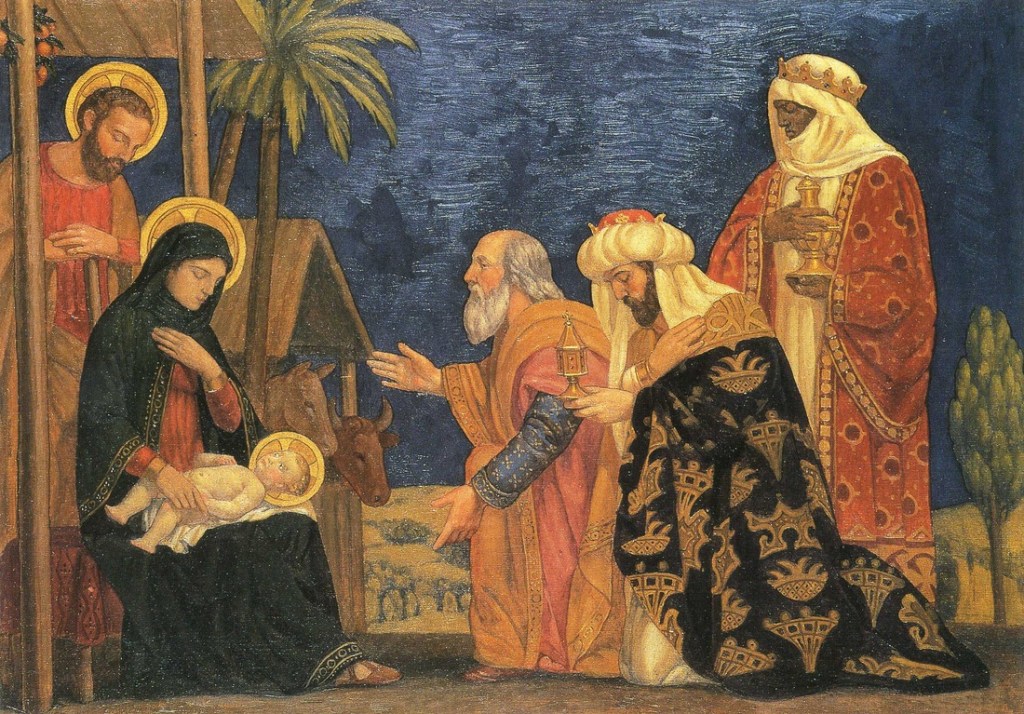
And this we can only do if we become open and sincere to God who revealed Himself to us in His Son Jesus Christ. No need to hide things from Him. He knows everything but He does not force us to come to Him. He merely invites us. Just like the three wise men from the East or Magi who came to pay homage to Him in Bethlehem.
When Jesus was born in Bethlehem in Judea, in the days of King Herod, behold, magi from the east arrived in Jerusalem, saying, “Where is the newborn king of the Jews? We saw his star at its rising and have come to do him homage.”
Matthew 2:1-2
The meaning of magi and star.
After the Nativity of the Lord and the solemnity of Mary, Mother of God we celebrate this Sunday the third major feast of the Christmas Season called the Epiphany from the Greek term that means manifestation or appearance of Jesus to pagan wise men symbolizing the peoples of the world.
So much attention has always been given on the magi and the star that we sometimes forget that the stories in the Bible are not pure accounts in history that are factual to satisfy our curiosities; it is not that they did not happen at all but the most important thing is the meaning they impart to those reading the Sacred Scriptures.
As we have noted during our Simbang Gabi, Matthew has the most unique in beginning his gospel account with “the genealogy of Jesus Christ, the son of David, the son of Abraham” (Mt.1:1) to show right away to his readers that Jesus is the fulfillment of the promise of God in the Old Testament. Recall how behind every name in the genealogy of Jesus is a story and history full of meaning and significance.
Matthew continues this in his story of the epiphany to show us again that Jesus is the fulfillment of God’s promises since Abraham by using the story of Moses as his framework.
See how the story of Jesus resembled that of Moses, the greatest figure of the Old Testament: the flight to Egypt, the threat of murdering all infants in the time of the Pharaoh and then of King Herod, and the saving act of God in the exodus which is fulfilled in Jesus Christ’s Passion, Death and Resurrection.
See my dear Reader that in the story of the epiphany of Jesus is also found glimpses of His crucifixion and death: at His birth, the magi were the first to recognize Jesus as the new King of the Jews while at His death, there hung above Him the sign “Jesus of Nazareth, king of the Jews” with a Roman centurion, another pagan like the magi who would declare to himself, “Truly, this was the Son of God” (Mt.27:54).
Here we find Matthew’s infancy narratives of Jesus are not only appealing to our sentiments and emotion but on a deeper level, these stories reflect how we Christians have always believed based in our experiences and faith that indeed Jesus is the Emmanuel of God, His presence among us who truly walked this planet and continues to guide us in the power of the Holy Spirit after His Ascencion into heaven, making Him truly a star above us guiding us in this life’s journey.
Unfortunately, for some people, it is something unthinkable and even impossible, choosing to live in their own follies and blindness like King Herod and yes, some Christians who claim to believe and know God.
When King Herod heard this, he was greatly troubled, and all Jerusalem with him. Assembling all the chief priests and scribes of the people, he inquired of them where the Christ was to be born. They said to him, “In Bethlehem of Judea, for thus it has been written through the prophet… Then Herod called the magi secretly and ascertained from the time of the star’s appearance. He sent them to Bethlehem and said, “Go and search diligently for the child. When you have found him, bring me word, that I too may go and do him homage.”
Matthew 2:3-5, 7-8
Jesus calling us to our "epiphany".
I like that part when Matthew tells us how “Herod called the magi secretly” to inquire further to them about their knowledge about Jesus and the star. How ironic and tragic that they in Jerusalem were the ones who did not even notice the unusual star above them and worst of all, with the information and knowledge they have, not to have known the birth of Jesus Christ!
How sad that so many times, we keep on looking so far without even noticing those nearest to us!
Most of all, of our blindness and refusal to accept what is obvious, what is so clear like the love and mercy Jesus pours on upon us despite our sinfulness.
See at how some government officials are making a mockery of our laws and of their very selves, trying to cover up their wrongdoings, trying to defend their mistakes and sins not knowing the more they sink in their follies with all their lies and secrecies.
Keeping secrets can sometimes be needed for a good reason; but most often, to act in secret is often indicative of something sinister like in our story today, of Herod calling the magi secretly to snoop around and eventually launch his evil plot.
What a shame that Jesus, Mary and Joseph were never in hiding yet here were people secretly plotting something against them — just like inn our own lives, in ur own time when we try to deceive even those dearest to us, hiding in our so many secrets and lies that eventually come out in the open.
How sad that while Jesus keeps on revealing Himself to us but we still hide many secrets from Him as if he would not know!
This Epiphany Sunday while Jesus appears to us in His words and in the Eucharist, He invites us to open up to Him, to be sincere and have our own epiphany too. May this prayer help you in discarding your many secrets that are after all, very known to Jesus who merely waits for us to come to Him in our openness and sincerity.
Lord Jesus Christ,
in so many instances this past year 2020
You have continued to reveal Your presence among us,
in my own life, in keeping me safe from so many harm,
in healing my sickness, in providing for my needs,
in obviously being my Lord and my God;
You know everything in me, my many secrets
that I continue to hide from You.
Forgive me Jesus in hiding from you
even if I know you know better than I am.
I have no gold, frankincense nor myrrh
but this Christmas help me offer to you
my many "secrets" I hide  from you and others
so I may fully experience your love and mercy poured out
since that first Christmas when you first came to us.
AMEN.
The Lord Is My Chef Recipe for the Soul
Friday, Solemnity of Mary, Mother of God, 01 January 2021
Number 6:22-27  >><)))*>  Galatians  >><)))*>  Luke 2:16-21
Photo by Mr. Marc Angelo Nicolas Carpio, Christmas 2020.
A blessed Merry Christmas to you all!
Please, continue greeting one another with a “Merry Christmas” than with “Happy New Year” because Christmas is not over yet; besides, we Catholics celebrated our new year last November 29, the first Sunday of Advent. Most of all, it is so unfair to Jesus that we easily forget Him and think more of the new year! What happened to those Christmas countdowns that began in September only to stop greeting “Merry Christmas” after eight days?
Most of all, contrary to what most priests are erroneously saying today, our Mass is not for the new year but for the Solemnity of Mary, Mother of God. Although the sacramentary (our book for the celebration of Mass) has prayers for the Mass on new year, it also says – written in red ink to stress this point – that one cannot celebrate the Mass for new year on January first because the proper celebration on this date is the Motherhood of Mary.
The “Solemnity of Mary, Mother of God” used to be celebrated on October 11 but during the Second Vatican Council, the Fathers deemed it more right and proper to celebrate every January first which is the eighth day called octave of Christmas. This solemnity also abolished the feasts of the Circumcision of Our Lord (January 1) and the Holy Name of Jesus (Sunday between January 1 and 8, or January 2).
Nonetheless, as a further background to our liturgy, today’s celebration is also the oldest feast in honor of Mary, dating back to year 431 after the Council of Ephesus when the Church declared Mary as the Mother of God following heresies claiming Jesus was not born divine but only human, that he assumed his divinity later in life as he matured. It was during that Council of Ephesus when the Church Fathers insisted that when Mary conceived Jesus in her womb, His divinity was not diminished nor lost. Hence, Mary shall be called the Mother of God Jesus Christ who is true God and true human, the Second Person of the Holy Trinity.
While the whole world is celebrating in revelry with all the pagan practices of fireworks and noise that sadly include many Christians, we Catholics on this first day of the new year celebrate Mary the Mother of God as our model disciple in journeying through life this 2021 in Jesus Christ.
Photo by author, Mary in our Nativity scene, 25 December 2020.
Beginning anew in Jesus like Mary
It has been more than 24 hours since my iPhone “crashed” that I now merely rely on Messenger for communications. But, it is a wonderful feeling too! Nothing bothering me so I can rest fully today.
Yes, I am a “dinosaur” when it comes to these tech things and gadgets. When I got this phone in 2018, I never bothered to check its “storage capacity”, thinking since it is a high-end phone, it must be very, very good.
Then came the pandemic last year when I had to use it for our daily online Mass until it showed signs of problems two weeks ago when I found out we have used all its 32 GB capacity.
But, as I learned all those things about storage capacity of cellphones and computers, I remembered the Blessed Virgin Mary in our gospel today.
The shepherds went in haste to Bethlehem and found Mary and Joseph, and the infant lying in the manger. When they saw this, they made known the message that had been told them about this child. All who heard it were amazed by what had been told them by the shepherds. And Mary kept all these things, reflecting on them in her heart.
Luke 2:16-19
How beautiful to hear those words of the evangelist, “Mary kept all these things, reflecting on them in her heart.”
Yes, better than any cellphone and computer is the human heart with unlimited storage capacities for all memories, data and images of life! How sad we have been keeping all those wonderful events in our lives inside this tiny gadgets that eventually would be corrupted by bugs or even hacked.
But we have this heart – the core of our very being where we process all those memories and images of everything we are going through and have gone through.
We celebrate today this Solemnity of Mary, Mother of God to remind us in keeping the Christmas story alive through the new year by imitating the Blessed Mother in treasuring and reflecting all our experiences – good and bad – in 2020!
Imagine that image of Jesus born in a manger: it must be so dark, even filthy and smelly – maybe like how our lives have been last year. But, do not forget, there was Jesus present with us in the darkness and dirt and foul smell of 2020.
If life has been so good and kind to you last year, reflect on those memories, find Jesus in those joy like the shepherds and share the good news and blessings you have received!
I love that part Mary “treasured” – as something precious – all those things said by the shepherds, reflecting them in her heart. Luke would always present Mary keeping everything in her heart to reflect them especially when things and events were beyond her understanding.
Photo by author, Mary at the foot of the Cross.
The same is true with life. Sometimes, we just cannot comprehend the many things that have happened in 2020.
Instead of blaming the year 2020 for all the negative things that have have happened, Mary shows us the way by looking into our selves, into our hearts to “process” all those experiences, find their meaning, and most of all, what God is trying to tell us. That is Christmas – Jesus became human like us to be with us specially in our sufferings and trials in life. Problem is, we are so filled with ourselves as our cellphones and other gadgets would show – selfies and so many posts most often done for the sake of “likes” and “followers”.
Do we still have memories? Do we still remember? Or, should the question be, do we still feel at all?
Whenever I see people with arms stretched looking through their cellphones in so many events, I pity them because they fail to feel and savor the moment, living in a “mediated” world, not grounded and detached from the realities of life. This is perhaps the reason why despite the affluence of life today, more people are lost, alone, alienated, and empty.
There are two local commercials that I have always loved and they both featured grandparents having Alzheimer’s.
First is McDonald’s about ten or 15 years ago of a lolo slicing into half his cheeseburger, saying, “ito para sa paborito kong apo, si Karen” (this is for my favorite grandchild, Karen).
Second is the Ayala Malls’ “Wishing Tree” in 2019 where the grandmother, so sad and haggard looking suddenly smiled again with her face lighting up in joy when she saw the old CCTV footages of her trips to the Mall with her apo in the past.
Both commercials show how big is the storage capacity of our hearts to keep our beautiful memories with loved ones even if the memories in our brain “crash”.
How amazing that the heart remains intact with its stored memories of events and persons who have loved us – and even hurt us. That is how big is our heart as a storage of memories that must be treasured, processed, and reflected upon like what Mary did to deepen our faith, widen our perspectives and most of all, find Jesus Christ.
See my dear Reader how at the end of the gospel on the eighth day Mary’s child was given with the name “Jesus” – the only thing she and Joseph were certain of about their child. The same is so true with us on this day as we begin 2021: we do not know what will happen to us. Nothing is really so certain, not even having that COVID-19 vaccine, legally speaking.
Like Mary and Joseph, all we have for sure is Jesus, the only One we must trust and follow, the only One we must nurture and share so that His face may shine upon us (Num.6:25) and lead us to eternal life as heirs to the kingdom of heaven as children of the Father (Gal.4:7).
Have a blessed Merry Christmas this new year, and may the Lord bless you and keep you! Amen.
Photo by Mr. Marc Angelo Nicolas Carpio, 25 December 2020.