Lawiswis ng Salita ni P. Nicanor F. Lalog II, Ika-29 ng Oktubre 2020
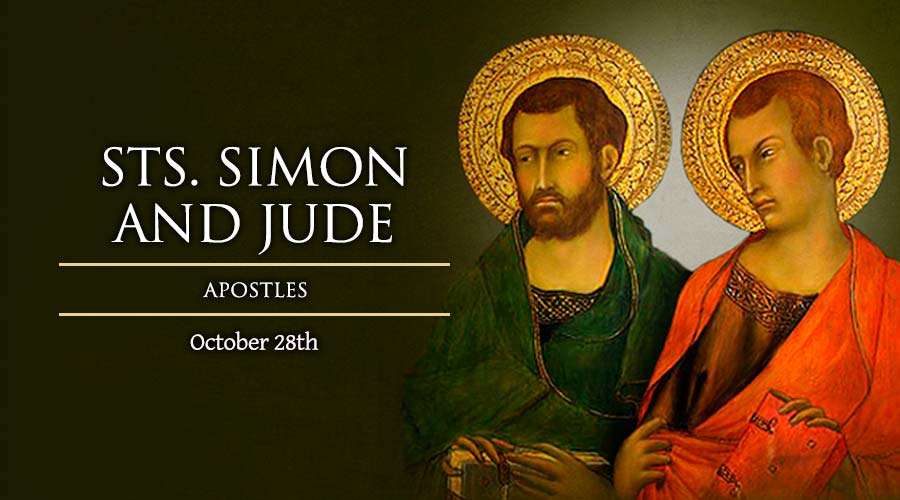
Larawan mula sa catholicnewsagency.com.
Sa pagdiriwang ng kapistahan
ni San Judas Tadeo kahapon
may isang magandang tagpo
na kay inam nating balikan
upang pagnilayan
kanyang tanong kay Jesus
noong Huling Hapunan:
"Panginoon,
bakit po sa amin lamang kayo
magpapakilala nang lubusan
at hindi sa sanlibutan?" (Jn.14:22)
Mahiwaga at matalinhaga
ang tugon ng Panginoon:
"Ang umiibig sa akin ay tutupad
ng aking salita;
iibigin siya ng aking Ama,
at kami'y sasakanya at
mananahan sa kanya." (Jn.14:23)
Bakit nga ba hindi na lamang
magpakita si Jesus sa lahat upang
mawala na pagaaalinlangan,
at iba pang mga katanungan?
Maski naman magpakita si Jesus
marahil wala pa ring maniniwala
hangga't hindi natin siya nakikilala
sa mukha ng bawat kapwa:
hindi bagay o gamit si Jesus
na basta-basta lamang nakikita
ng ating mga mata ---
Siya ay Persona:
makikilala lamang
ng isang pusong bukas
handang tumanggap
at tularan Kanyang pagmamahal
upang Kanyang panahanan
tungo sa personal na ugnayan.
Hanggang ngayon ito pa rin
ang ating tanong sa ating panahon
at bakit nga kaya nagkagayon?
Tuwing magkokomunyon
"Amen" ang ating tinutugon
bago tanggapin
Katawan ng Panginoon
na marahil atin ngang nakikita
nguni't hindi nakikilala
dahil puso ay ipininid
naging manhid
sa daing ng bawat kapatid?
Ang Diyos ay pag-ibig
na siyang Kanyang larawan
at wangis sa atin Kanyang ipinaris;
kung pag-ibig ay ating inalis,
ang lahat sa atin ay malilihis
makita man natin si Jesus di natin Siya makikilala!
Larawan ay kuha ni Lucas Jackson ng Reuters ginamit sa The Economist, 2019.
The Lord Is My Chef Breakfast Recipe for the Soul by Fr. Nicanor F. Lalog II
Wednesday, Feasts of Saints Simon and Jude, Apostles, 28 October 2020
Ephesians 2:19-22   >><)))*> + <*(((><<  ||  >><)))*> + <*(((><<   Luke 6:12-16
Photo by author, Malolos Cathedral, August 2020.
Dearest Lord Jesus:
What did you pray for on the night before you named your Twelve Apostles?
Jesus went up the mountain to pray, and he spent the night in prayer to God. When day came, he called his disciples to himself, and from them he chose Twelve, whom he also named Apostles:
Luke 6:12-13
What an amazing sight, a scene to behold you, Jesus who is true God and true man, praying to the Father, spending the night just to name the Twelve Apostles! Most likely, you prayed for them individually so they may be strong in their commitment to you. What an honor!
And the most beautiful part in every call you make specially with the Twelve Apostles is how you have chosen them from their so diverse backgrounds and temperaments to prove that what interests you most Lord Jesus are people or persons, not labels or backgrounds.
Remind us always, dear Jesus of this reality, of how you value each of us that you have called us to be your followers as Christians.
Open our eyes and our hearts to always have the zeal and passion of St. Simon.
His two nicknames given by Luke as a “Zealot” belonging to Zealots Party demanding the ouster from Israel of the occupying Romans and that by Mark as “Cananean” from the Hebrew verb qana for “to be jealous, ardent” both mean being filled with passion for his Jewish identity for God, his People Israel and Torah or the Laws.
In choosing Simon as an Apostle, may we be reminded of always having room in the Church for all charisms and human qualities of all peoples who find their communion in our Lord Jesus Christ.
Likewise, we pray to be like Jude Thaddeus who stood firmly by his faith in you, Lord Jesus in writing a short letter to remind the early Church of keeping their Christian identity, of not being deceived by some preachers who sowed confusion and division with their thoughts and ideas.
Pray for us, dear Jesus in this modern time when we who are in the Church who are lacking in passion and drive to make you known not only in words but also in deeds.
Pray for us, still Lord Jesus in this modern age that we may have the strength, clarity, and courage in defending and upholding our Christian identity amidst the many contradictions of the world in which we live in.
May St. Simon and St. Jude help us rediscover the beauty of our Christian faith and live it faithfully, witnessing to its beauty and truth. Amen.
The Lord Is My Chef Breakfast Recipe for the Soul by Fr. Nicanor F. Lalog II
Monday, Feast of St. Matthew, Apostle and Evangelist, 21 September 2020
Ephesians 4:1-7, 11-13   >><)))*>   +   <*(((><<   Matthew 9:9-13
Photo by author, Lake of Galilee at the side of Capernaum where Jesus called Matthew the tax collector, May 2019.
Glory and praise to you, O God our loving Father! Your Son Jesus Christ never fails to surprise us with your wondrous plans for us, with your ways of calling us, and of coming to us!
As we celebrate today on this first working day of the week the feast of St. Matthew, you fill us with hope and inspiration to work harder and pray hardest in life to find fulfillment in you our God.
Thank you for being so kind to come and call us like St. Matthew, Lord Jesus. It was a very extraordinary call not because we are so special but actually unimportant with Matthew also known as Levi belonged to the most despised group of people at that time in Israel, the tax collectors who were always mentioned along with sinners and prostitutes. And so were Matthews’s contemporaries at Capernaum, the brothers Simon and Andrew, James and John who were all fishermen, the most ordinary folks doing the most ordinary jobs of that time.
We were all just like them – nothing special and unimportant! If not for your call, we would be nobody at all even in our family circles.
What a joy that even if some people reject us for various reasons, you O Lord never exclude anyone of us from your friendship. Most of all, you even defend us.
While he was at table in his (Matthew’s) house, many tax collectors and sinners came and sat with Jesus and his disciples. The Pharisees saw this and said to his disciples, “Why does your teacher eat with tax collectors and sinners?” He heard this and said, “Those who are well do not need a physician, but the sick do. Go and learn the meaning of the words, I desire mercy, not sacrifice. I did not come to call the righteous but sinners.”
Matthew 9:10-13
Give us the readiness and firmness of St. Matthew in leaving everything behind to follow you, Lord.
Like St. Matthew who “got up (rose in some translations) and followed you” (Mt.9:9) right after you have called him, help us realize that following you requires our detachment from our sinful situations, from things and people who prevent us from totally loving you and serving you.
Help us Lord to arise from our dark, sinful past so we can radiate your light in our version of your gospel like St. Matthew. Amen.
“The Calling of St. Matthew”, painting by Caravaggio (1599-1600) said to be one of the favorite pieces of art Pope Francis used to frequent while still a student in Rome. Photo from Wikipedia.org.
The Lord Is My Chef Breakfast Recipe for the Soul by Fr. Nicanor F. Lalog II
Monday, Feast of St. Bartholomew, Apostle, 24 August 2020
Revelation 21:9-14 >><}}}*> |+| >><}}}*> |+| >><}}}*> John 1:45-51
Photo by author, Subic, 2018.
Glory and praise to you, Lord Jesus, the “Word who became flesh and dwelt among us” to reveal the Father’s immense love for us all. He was not contented in just telling the prophets of Old Testament how he loved us that He came and lived with us in you, Lord Jesus!
And that is why we also rejoice on this Feast of St. Bartholomew, a.k.a. Nathanael, who was introduced to you by another Apostle you have called earlier:
Philip found Nathanael and told him, “We have found the one about whom Moses wrote in the law, and also the prophets, Jesus, son of Joseph, from Nazareth.” But Nathanael said to him, “Can anything good come from Nazareth?” Philip said to him, “Come and see.” Jesus saw Nathanael coming toward him and said of him, “Here is a true child of Israel. There is no duplicity in him.” Nathanael said to him, “How did you know me?” Jesus answered and said to him, “Before Philip called you, I saw you under the fig tree.” Nathanael answered him, “Rabbi, you are the Son of God; you are the King of Israel.”
John 1:45-49
O dear Jesus, like St. Peter in the gospel yesterday and now St. Bartholomew, you are telling us anew to never be contented with mere words, with the “what” of who you really are, that we must always “come and see you” in order to experience your very person and truly know you.
I really wonder O Lord what your words meant that before Philip called Nathanael-Batholomew, you have seen him under the fig tree; however, I am so convinced that in your words, Nathanael-Bartholomew must have felt something deep inside him that he threw himself totally to you as your Apostle.
Most of all, teach me to remain simple and hidden in you, Jesus that like St. Bartholomew, despite the scarcity of stories and information about him except this little anecdote from the fourth Gospel, he remained faithful to you until his death by flaying reportedly in India.
May we imitate St. Bartholomew who had shown us that more than words, what matters is our oneness in you, Jesus, without any need for us doing sensational deeds, earning thousands of “likes” and “followers” in social media because only you, Lord, remains extraordinary above all. Amen.
Quiet Storm by Fr. Nicanor F. Lalog II, 25 July 2020
Santiago de Compostela in Spain is one of the world’s oldest and most popular pilgrim sites where the body of the Apostle St. James the Greater whose feast we are celebrating today is believed to be buried in its beautiful cathedral.
I have not been there yet and despite COVID-19’s disruption of air travel expected to last until 2022, my hope remains that someday in God’s time I may finally do the “el camino de Santiago de Compostela” (the way of Saint James of Compostela), too.
But, with or without the el camino de Santiago de Compostela, this great Apostle from the very beginning had always been in a journey in himself into the kingdom of God – Jesus Christ – by showing us the way of transformation into a true disciple of the Lord.
He is called the Greater not because he is holier than the other St. James called “the Lesser”, son of Alpheus, but to simply indicate the different importance they received in the writings of the New Testament. In the gospel of Mark, he comes in second in the list after Peter while in the gospels of Matthew and Luke, he is ranked third after the brothers Peter and Andrew; he again comes in third in the Acts of the Apostles after St. Peter and his brother St. John.
It is from this book where we also learn St. James the Greater as the first bishop of the original Christian community in Jerusalem that during the persecution by King Herod Agrippa in 40 AD, he also became the first Apostle to be martyred (Acts 12:1-2).
His martyr’s death thus fulfilled Christ’s words to him that he would indeed “drink from his chalice” to be with him in his Kingdom, a journey that essentially began within this great apostle after leaving everything behind to follow Jesus.
The journey within self to Jesus Christ
St. James the Greater and his brother St. John the Evangelist and believed to be the same beloved disciple came from a middle class family with both parents still alive and most likely, very supportive of them as attested by some little anecdotes in the gospel accounts.
Money was never an issue for them because their father Zebedee could hire workers to work in their fishing business. He must have sighed with a great relief when James and John immediately left him after being called by Jesus to be his disciples.
Marker along the “el camino de Santiago de Compostela”.
Finally, his sons have found some directions in life following Jesus who was getting known then in Galilee as a powerful and credible Teacher unlike the Pharisees and scribes.
Jesus nicknamed James and John as Boanerges for “Sons of thunder” (Mk.3:17) due to their temperament like when they proposed that they send fire to burn a Samaritan town that have refused them passage during their journey to Jerusalem (Lk.9:54).
They have seen and experienced the tremendous powers of Jesus not only in preaching but most especially in calming the storms, walking on sea, exorcising evil spirits, healing all kinds of sickness, and even raising to life some who have died.
Most of all, St. James the Greater was privileged to witness along with his brother and St. Peter the Transfiguration of Jesus Christ on Mount Tabor, seeing all the glory of Christ conversing with Moses and Elijah. It was after this major event that their most controversial episode would occur when their mother came to ask Jesus that James and John be seated “one at your right and the other at your left, in your Kingdom” (Mt.20:21).
The other ten Apostles “grew indignant” of the brothers James and John for being so ambitious but Jesus summoned them and explained things which all of them would heed except for one:
“You know that the rulers of the Gentiles lord it over them, and the great ones make their authority over them felt. But it shall not be also among you. Rather, whoever wishes to be great among you shall be your servant; whoever wishes to be first among you shall be your slave. Just so, the Son of Man did not come to be served but to serve and to give is life as a ransom for many.”
Matthew 20:25-28
This took place shortly before Palm Sunday when Jesus entered Jerusalem.
A few days later on the evening of Holy Thursday, Jesus again brought St. James the Greater with his brother St. John and St. Peter to accompany him pray at Gethsemane where Judas Iscariot eventually betrayed him to his enemies.
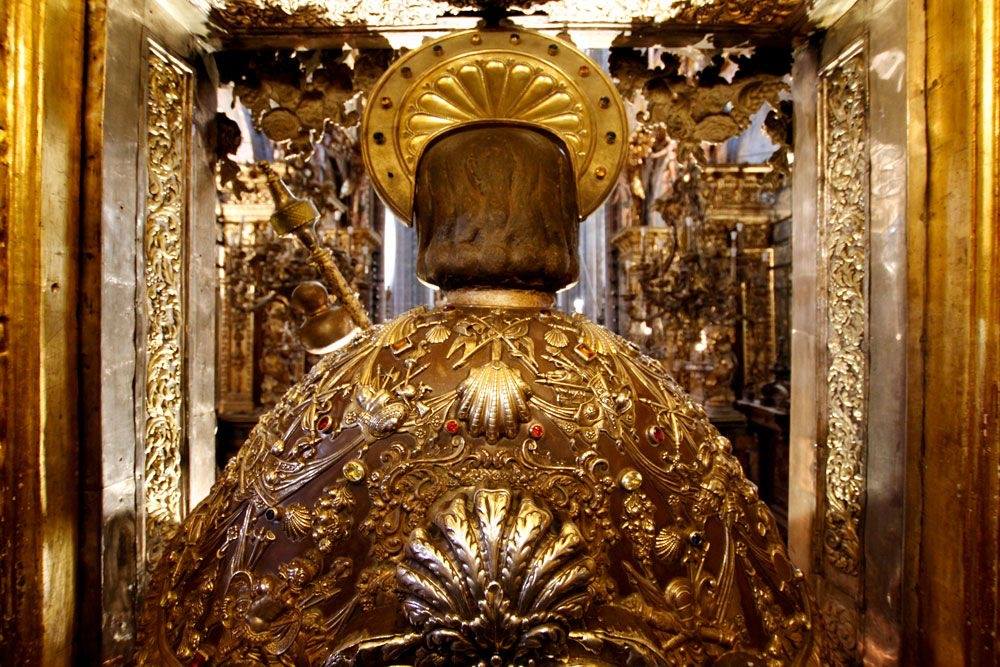
A pilgrim hugging from the back the statue of Santiago de Compostela after completing his el camino.
Here we find St. James the Greater being present to two major stops in Jesus Christ’s journey to the Calvary: first, on Mount Tabor for his Transfiguration and second, at Gethsemane for his agony in the garden. In both events in the life of our Lord, St. James the Greater was a privileged witness, first of his coming glory and then of his passion and death.
It would only be after Easter and the Pentecost when all these major stops in his personal journey with Christ when everything would become clear to him and the other Apostles.
All along their journey from the shores of Galilee to Jerusalem, St. James the Greater remained by the side of Jesus Christ, probably unaware of another journey with the Lord taking place right inside his heart to truly be a part of his Kingdom by sharing in his Passion, Death, and Resurrection.
For his faithful adherence to Jesus from Galilee to Jerusalem, St. James the Greater again had the rare privilege like at Mount Tabor and Gethsemane in being the first to die as a martyr proclaiming the Gospel of Christ which is the meaning of the expression of “drinking from the chalice” of the Lord.
Sometimes in life, we just have to make “sakay” as my generation used to say, “sakay lang ng sakay” or “ride on, man, ride on” without really knowing where our trip would lead us. St. James just made “sakay” without knowing Jesus was already fulfilling his wish of “drinking from his chalice”.
Photo by Fr. Gener Garcia, sculpture of a pilgrim’s feet at Santiago de Compostela museum, 2019.
St. James the Greater was truly great not because of the distances in miles or kilometers he had covered with Jesus from Galilee to Jerusalem and all the way to Compostela in Spain; we honor him today because of that great journey he had undertaken within him, in his heart to remain always at the side of Christ even if had to smoothen his many rough edges as a person, and cleanse his heart as a sinner like us.
That is the most important journey we are all taking in this life, the journey within us.
The longest journey in life is the distance between the heart and the mind.
Former UN Sec.Gen Dag Hammarskjold in “Markings”
My friend Fr. Gener Garcia last year went to Santiago de Compostela to follow the el camino with our kababayan Bishop Bart Santos of Iba, Zambales and Fr. Jaypee Avila assigned as a chaplain for OFW’s in Milan, Italy.
He is so generous to share with us his photos of their pilgrimage as well as his experiences and realizations in life. According to him, on the four sides of the sculpture of the pilgrim’s feet in front of the museum of Santiago de Compostela is the following quotation:
Marker along the el camino de Santiago de Compostela.
Camino recto, camino erguido, camino buscando un sentido. Camino porque tengo un objetivo, y no parare hasta alcanzar mi destino.
(I walk straight, I walk upright, I walk looking for meaning. I walk with a purpose and I won’t stop until I meet my destiny.)
The pilgrim’s journey is the same one you and I are on. Know your goals and understand your challenges. Face them head-on, tackle them with intention, and never give up.
Do you know what your purpose in life is? What would you say if someone ask you what your destiny was?
The Lord Is My Chef Breakfast Recipe for the Soul by Fr. Nicanor F. Lalog II
Saturday, Feast of St. James the Greater, Apostle, 25 July 2020
2 Corinthians 4:7-15 ><}}}*> >><}}}*> >>><}}}*> Matthew 20:20-28
Facade of “Santiago de Compostela” in Spain in honor of St. James the Greater. Photo courtesy of Fr. Gener Garcia during their “El Camino de Santiago de Compostela”, May 09 to June 05, 2019.
Glory and praise to you, Lord Jesus Christ who had called and given us the Apostles as foundations of your Holy Church as we celebrate today the feast of St. James the Greater, the first bishop of Jerusalem and the first among the Twelve to die a martyr.
In him, O Lord, you gave us an image of hope in you, of how we can grow in holiness in you.
Through St. James the Greater, you have shown us your kindness in joining us in our earthly pilgrimage, slowly making us realize how we must adhere to you more closely to finally make it to our final destination in your kingdom in heaven.
Jesus said in reply, “You do not know what you are asking. Can you drink the chalice that I am going to drink?” They said to him, “We can.” He replied, “My chalice you will indeed drink, but to sit at my right and at my left, this is not mine to give but is for those for whom it has been prepared by my Father.”
Matthew 20:22-23
Your kindness is very evident, sweet Jesus.
I really wonder how you felt when the mother of James and John asked you that her sons be seated “one at your right and the other at your left in your kingdom” (Mt.20:21).
You were so kind to simply tell her and her sons, “You do not know what you are asking.”
Photo by Fr. Gener Garcia, image of Santiago de Compostela in Spain, 2019.
So many times, Lord, like St. James, we ask so many things from you, even demanding from you in exchange of what we believe as too great we have given you. You perfectly know so well that we do not know what we are asking at all. You know how we are blinded by fame and honor, power and wealth – things that do not matter at all in your kingdom.
You are so gentle in reminding us about the deeper realities of life, of discipleship by simplifying your demands, “Can you drink the chalice that I am going to drink?” to which we are often so naive, even oblivious for good reasons. Primarily because, we really do not know what we are asking.
And that’s when you are kindest of all, sweet Jesus: like with St. James and his brother St. John, you invite us “to drink the chalice you are drinking” by assuring us it can be done, that it is very possible, that in fact, that is the greatest honor of being with you, to drink from your chalice – without letting us know right away what it meant! St. John eventually realized and wholly accepted what you meant of drinking in your chalice when he became the first to share in your passion and death during the persecution by King Herod Agrippa (Acts 12:1-1).
Slowly, you make us realize too what is to drink in your chalice as we continue life’s journey with you, most especially into our inner self where we eventually find and rest in you when the goings get tough and rough.
It is total kindness on your part Lord to show us the beauty of sharing a meal with you, of sharing in your mission, of sharing in your life and most especially of sharing in your death that we make it with you to your kingdom.
Like St. James the Greater, continue to be kind with us, Lord, accompanying us in this journey.
In the same manner, make us kind to one another too like St. James the Greater who offered his life for the early church, for being the first to drink from your chalice. Amen.
Photo by Fr. Gener Garcia, marker along the “El Camino de Santiago de Compostela”, 2019.
The Lord Is My Chef Breakfast Recipe for the Soul by Fr. Nicanor F. Lalog II
Wednesday, Week XIV, Year II in Ordinary Time, 08 July 2020
Hosea 10:1-3, 7-8, 12 <*(((><< >><)))*> Matthew 10:1-7
Photo by Dr. Mai B. Dela Peña, statues of the Twelve Apostles on the facade of the Church of our Lady of Montserrat in Spain, 2019.
How beautiful are your words today, dearest God our Father. You never fail to surprise me with your deep personal involvement with us all that you can capture exactly what is inside us without any doubt at all.
After praising Israel’s great achievements that have brought them material prosperity, you remain impartial and fair in pronouncing your judgement:
Israel is a luxuriant vine whose fruit matches its growth. The more abundant his fruit, the more altars he built. The more productive his land, the more sacred pillars he set up. Their heart is false, and now they pay for their guilt. God shall break down their altars and destroy destroy their sacred pillars.
Hosea 10:1-2
Indeed, only you can read our hearts, our inmost beings.
How many times have we been deceived by outward appearances like material prosperity in life, thinking these are the crowing glory of one’s great efforts in balancing prayer and work only to be rejected by God for their hard headedness and pride?
A heart that is false is also a heart that has turned away from you, O God; sometimes, these are not evident right away because a heart can always fake outside what is inside.
A heart that takes pride in its grand designs and visions is a heart that is false. Most of all, a heart that refuses to look into the pains and hurts of others, their shortcomings and sins, is a heart that is false because it denies humanity, its being a human flesh tormented by love amidst pains and sufferings. A heart that is false is a heart that refuses to see other hearts with many hurts because it believes more with its self than with God’s love and mercy.
A heart that is false is a heart that has refused to grow and outgrow its previously held convictions and beliefs, more intent in looking at its own heart than into Christ’s meek and humble heart, eventually betraying Jesus and loved ones.
Incline our hearts into the Father’s loving heart, dear Jesus, and give us a heart that is both true and humble, accepting our many limitations, full of hope in becoming a better person in you like your Apostles who started out like us all with imperfect hearts. Amen.
The Lord Is My Chef Breakfast Recipe for the Soul by Fr. Nicanor F. Lalog II
Friday, Feast of St. Thomas, Apostle, 03 July 2020
Ephesians 2:19-22 >><)))*> <*(((><< >><)))*> <*(((><< John 20:24-29
Thank you very much, dearest Jesus, in founding your church upon your Apostles who were all like us: full of flaws and weaknesses, faults and failures, sins and imperfections.
Every time we celebrate their feasts, you remind us of your call to be near you like the Apostles despite our sins and inadequacies, to be sorry and make amends to return to you to be built into a dwelling of the Holy Spirit.
Brothers and sisters: You are no longer strangers and sojourners, but you are fellow citizens with the holy ones and members of the household of God, built upon the foundation of the Apostles and prophets, with Christ Jesus himself as the capstone. Through him the whole structure is held together and grows into a temple sacred in the Lord; in him you are also being built together into a dwelling place of God in the Spirit.
Ephesians 2:19-22
Help us, Lord Jesus, to be like St. Thomas your Apostle who came but doubted, returned and saw you a week later and believed, declaring “My Lord and my God” upon seeing you.
But what did St. Thomas really see that he believed?
Then he said to Thomas, “Put your finger here and see my hands, and bring your hand and out it into my side, and do not be unbelieving, but believe.” Thomas answered and said to him, “My Lord and my God!”
John 20:27
Through St. Thomas, you have blessed us and helped us, dear Jesus to believe in you not in seeing your face but more in seeing and feeling your wounds.
How wonderful, O Lord!
It is not your face but your wounds that enable us to recognize you and believe in you.
We will never see your face in this lifetime, Lord, but every day in our trials and sufferings, in our pains and hurts, in our wounds and woundedness, in our brokenness — there you are most present in us and among us.
Heighten our awareness of your presence, to accept pains and sufferings for your love and mercy so we may deepen our faith in you, following you always in your path of the Cross.
Like St. Thomas, may we follow you closely at your Cross, offering ourselves like you to be broken and shared so that in our wounds and woundedness, others may find healing, most especially you, sweet Jesus. Amen.
The Lord Is My Chef Breakfast Recipe for the Soul by Fr. Nicanor F. Lalog II
Monday, Solemnity of St. Peter and St. Paul, Apostles, 29 June 2020
Acts of the Apostles 12:1-11 >><)))*> 2 Timothy 4:6-8, 17-18 <*(((><< Matthew 16:13-19
Photo from americamagazine.org.
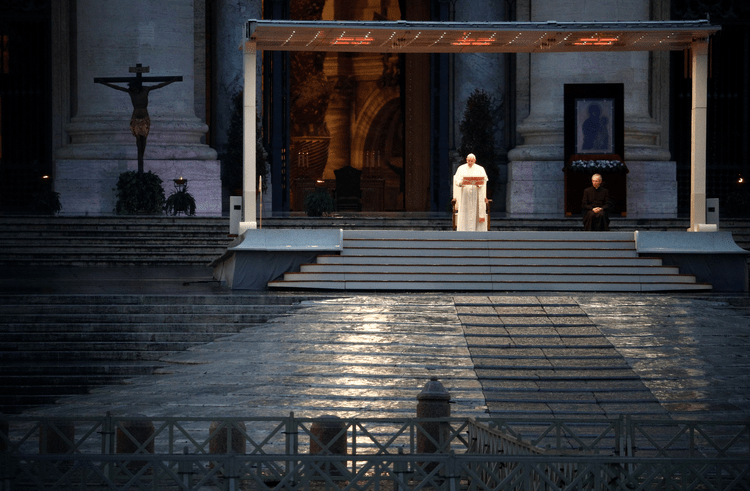
As I prepared to celebrate today’s Solemnity of the two pillars of the Church you have established, Lord Jesus Christ, that image of your Vicar and St. Peter’s successor, Pope Francis delivering his extraordinary Urbi et Orbi message last March 27, 2020 before an empty St. Peter’s Square flashed into my mind, something like a deja vu.
It is a holy deja vu, Lord, of St. Peter’s experience in prison on a Sunday night…
In those days, King Herod laid hands upon some members of the Church to harm them… he proceeded to arrest Peter also – it was the feast of the Unleavened Bread – he had him taken into custody and put in prison under the guard of four squads of four soldiers each. He intended to bring him before the people after the Passover. Peter thus was being kept in prison, but prayer by the Church was fervently being made to God on his behalf. Suddenly the angel of the Lord stood by him and light shone in the cell. He tapped Peter on the side and awakened him, saying, “Get up quickly.” The chains fell from his wrists. The angel said to him, “Put hi on your cloak and follow me.” So he followed him out, not realizing what was happening through the angel was real; he thought he was seeing a vision.
Acts of the Apostles 12:1, 3-5, 7-9
It is happening again, Lord, when we are all in great darkness due to this COVID-19 pandemic.
How blessed are we, O Lord, here with us in the midst of this pandemic is Pope Francis, St. Peter’s successor and St. Paul’s reminder to continue in proclaiming your Gospel in season, out of season.
Keep him strong and inspired always in order to lead us through this dark 2020.
We pray, O dear Jesus, for our Church especially here in the Philippines.
Our churches remain closed, some of our leaders are under attack while some of them along with our fellow workers are so afraid, so timid, abandoning their flock in this crucial moments of tests. Others are so concerned with trivial things, pursuing positions, fame, and wealth.
Have mercy on us, Jesus in veering away from your person and your Cross.
Strengthen us your Church, Lord, especially Pope Francis and all the bishops and priests, to always be aware of the angels you are sending us to deliver us from so many dangers in this time of crisis.
May we avoid “over thinking” that results into “analysis paralysis” that we forget to focus and do the more important things at this time which is to accompany, to be one with your flock now under various attacks not only by the corona virus but the diseases of indifference and convenience.
May we your body, the Church continue to pray with confidence, remembering your own pasch that brought us to salvation as we thank you too in keeping us safe and alive since March.
Give us the courage of St. Paul to take this period of pandemic and crisis as a form of pasch for each one of us, that we may willingly die in our selves and offer ourselves to you through others as an offering through worship with our loving service to one another.
May we keep our sights focused on you alone, Lord Jesus, the Christ of the living God sent to make us one.
Like St. Peter and St. Paul, though they were poles apart in their personalities and backgrounds, they were united in serving you, working for you by seeking only your face, your voice, your will and your presence.
May we keep in mind that when we fail to know you, Lord, that is when people fail to know and meet you too like the people of your time who claimed you were one of the prophets
Yes, the situations today may be like a holy deja vu from the past but you are definitely and truly present among us in this time of crisis.
St. Peter and St. Paul, pray for us!
Amen.
St. Peter by ecclesiastical artist Willy Layug at the Malolos Cathedral.
St. Paul by ecclesiastical artist Will Layug at the Malolos Cathedral.
Quiet Storm by Fr. Nicanor F. Lalog II, 11 June 2020
Painting by Raphael (1515) of St. Paul preaching at Areopagus in Athens, Greece. From wikipedia.
With houses of worship still closed despite the opening of most business establishments, here is the final installment of reflection in our series on how the life and teachings of St. Paul may help us in our ministry during this time of COVID-19 amid a perceived government “persecution” of the Catholic Church.
There is no doubt that like during his time, St. Paul would be using modern means of communication to preach the Gospel of Jesus Christ especially in this most trying time of our history, using the internet as the new “Areopagus” with social media in particular.
Then Paul stood up at the Areopagus and said: “You Athenians, I see that in every respect you are very religious. For as I walked around looking carefully at your shrines, I even discovered an altar inscribed, ‘To An Unknown God.’ What therefore you unknowingly worship, I proclaim to you. The God who made the world and all that is in it…”
Acts of the Apostles 17:22-24
Social Communication
Perhaps before we go into our reflection, it is imperative especially for bishops and priests to be reminded anew of some important terms in communications; this is more than about names or nomenclature because for as long these terms of communications are not clear with us, all our evangelization efforts would be askewed as it is now showing with an explosion of online Masses and other religious celebrations.
First priority is to stop using the words “mass media” and even “social media” in our church communications because these are very limited in scope and context.
It is important to note that in the 2000-year history of the Church, it was only in Vatican II that we have issued a conciliar document on communication wherein the Fathers also introduced the term social communication as a new name for communications in the Church.
How sad that there are still bishops and priests using the terms “mass media” or “media” and lately “social media” when more than 50 years ago the Church through the inspiration of the Holy Spirit coined social communication to refer to “the communication of and in human society including all the ways and means used in this process” (Fr. Franz-Josef Eilers, svd, 2009 BISCOM-FABC, Bangkok).
Social communication is a very prophetic term because it is theological and rooted in God who is communication himself, sharing with us his power to communicate so we may also communicate with him and with others. Most of all, God continues to communicate with us and from that lies our task as a Church to communicate him to the world.
This is the reason why we have to keep on using this term “social communication” in our Church communications to keep us Christocentric, meaning, every communication in the Church and by the Church has Jesus as Message.
And that is essentially the kind of communication process followed by St. Paul the Apostle. In fact, reviewing his letters and the various accounts about him would show us that early, this great apostle has been into social communication, specifically “pastoral communication” that is an emerging field in Church communications whose realities have long been espoused by St. Paul himself.
Pastoral Communication
Pastoral communication is anchored on Jesus Christ, the “Good Shepherd” who sets himself as the norm and standard of our Church communications.
Jesus said, “I am the good shepherd. A good shepherd lays down his life for the sheep… I am the good shepherd, and I know mine and mine know me, just as the Father knows me and I know the Father; and I will lay down my life for the sheep.”
St. Paul has always been very clear with this in all his communications that towards the end of his life, he had beautifully written his disciple this wonderful piece:
Beloved: I charge you in the presence of God and of Christ Jesus, who will judge the living and the dead, and by his appearing and his kingly power: proclaim the word; per persistent whether it is convenient or inconvenient… For I am already being poured out like a libation, and the time of my departure is at hand. I have competed well; I have finished the race; I have kept the faith.”
2 Timothy 4:1-2, 6-7
Communicating Jesus Christ is always about self-sacrifice, about giving of one’s self like our Lord and Master. In whatever form of communication we use, it is always a call to “enflesh” the Word. In short, communication is spirituality that indicates the kind of relationship we have with God. How we reflect that relationship with God in words and in deeds, in our clothings and everything is communication.
Like St. Paul, he was able to offer himself wholly to God as reflected in his writings and preaching because he was more concerned with the needs of the flock and not with his own needs.
And this is where I sadly feel our bishops sorely absent and silent except for just two, Lingayen-Dagupan’s Archbishop Soc Villegas and Manila’s Apostolic Administrator Bishop Broderick Pabillo.
Where are the other bishops?
Business establishments are almost all opening, even dine-in restaurants and yet, until now for no valid reason, the government continues to ban religious mass gatherings except for maximum of ten persons in areas under GCQ.
When are the bishops and priests going to speak out against this and open the churches so people may be spiritually nourished?
What an auspicious time for the clergy and hierarchy to speak against this continued closure of churches as we are on the eve of our 500th year of Christianization when under serious persecution. Has the Church grown timid in the face of an unfriendly government?
Worst are some priests who seem to follow more the secular world in their digital presence but empty of Jesus Christ, concerned only with popularity measured in number of likes and shares as well as followers.
Many of us have become more of personalities than as priests and ministers, unconsciously trying to be more popular than the Lord himself that we no longer have sacrifice of the Mass but a variety show, complete with sound effects and digital characters, some wit dance numbers and raffles!
When God is displaced, then our love is misplaced, then, we lose all communications too.
Communication is more than the expression of ideas and the indication of emotion. At its most profound level it is the giving of self in love. Christ’s communication was, in fact, spirit and life. In the institution of the Holy Eucharist, Christ gave us the most perfect and most intimate form of communion between God and man possible in this life, and, out of this, the deepest possible unity between men. Further, Christ communicated to us His life-giving Spirit, who brings all men together in unity. The Church is Christ’s Mystical Body, the hidden completion of Christ Glorified who “fills the whole creation”. As a result we move, within the Church and with the help of the word and the sacraments, towards the hope of that last unity where “God will be all in all”.
Communio et Progressio # 11
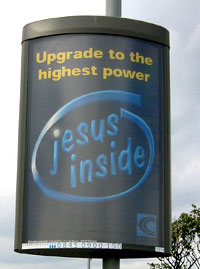
From Google.
Problem with online Masses and religion
Every communication presupposes presence. That is essentially the meaning of God’s “I AM” in the burning bush to Moses and the “I AM” declarations by Jesus in the New Testament, especially in the fourth gospel where we find him saying “I am the good shepherd”.
Even St. Paul in his letters always began with his standard salutations like “I, Paul…” to indicate his very presence among his “parishioners”.
However, in the digital media, presence is not so essential and can even be faked both ways, either by being “taped” or “replayed” by viewers.
And there lies the great danger of online Masses and other celebrations: whether we like or not, online religious celebrations give the impressions on people that God is a “consummable”, a product or a show that can be had when most convenient to us like video on demand or the streamed shows of Netflix.
That is why we have to open churches soon to stop these online Masses except for those in the Cathedrals and in existence long before COVID-19 that cater to the needs of the sick and elderly in their homes.
Pope Francis has always been clear with this, stressing that these online Masses and religious celebrations are very temporary due to the extraordinary situation brought about by the pandemic.
From Pinterest/Aleteia.
Imagine the problem at Corinth that reached St. Paul’s attention, prompting him to write them another letter to reprimand them but at the same time to encourage them to mend their ways. It was a problem of abusing the Eucharist when St. Paul was no longer with them.
It is the same thing happening in many of our online Masses that have become variety shows to impress viewers. Long before we got into this lockdown, many priests have crossed the boundaries without knowing they have made fools of themselves as they rely more on “likes”, on being viral or trending, dishing out shallow reflections covered with cute song numbers, litany of greetings on air, and so many other inanities that Jesus is lost in the process.
Unfortunately, many laypeople are now also having their own digital preaching or evangelization with their own “productions” taking their cue from their showbiz pastors.
If St. Paul were with us today, he would surely write again to express his dismay at the people seeking more of entertainment than having Jesus Christ.
“But I am afraid that, as the serpent deceived Eve by his cunning, your thoughts may be corrupted from a sincere and pure commitment to Christ. For I think that I am not in any way inferior to these “superapostles”. Even if I am untrained in speaking, I am not so in knowledge; in every way we have made this plain to you in all things.
2 Corinthians 11:3, 5-6
Church communication is Jesus Christ and his Cross as St. Paul reminds us in his writings (1Cor.15:1-3); it is never about techniques or gadgets.
Though we need to be present online, the cutting edge of real communication remains in pastoral communication that means being present with others who need us most including those without internet access, witnessing to the values of Jesus in relating with people, bringing people together into a communion and helping them find answers in their search for meaning and directions in life, in making the right choices and in living their convictions and faith.
What we are speaking of are real people, persons and lives that matter so much, more precious than goods and commodities.
Let us not fall into the trappings of this “media revolution” that made one futurologist describe our contemporary society as
Technologically Intoxicated Zone defined by the complicated and often paradoxical relationship between technology and our search for meaning.
John Naisbitt
According to Naisbitt and other experts, while people prefer quick fixes online of everything, from religion to nutrition, while at the same time fearing and worshipping technology that had blurred the distinction of what is real and fake, the more they live their lives distanced and distracted — something we are already seeing even before the coming of social distancing!
To communicate in the Church at this time is to imitate St. Paul: be present for and with the people wherein we help them find their way to God by being their companions and “co-journeyers” in life, witnessing to them the Cross of Jesus Christ with our very lives as an offering and sacrifice, not as a commodity or a show to be “liked” on Facebook and Instagram.
And, lest we forget, it is God whom people must follow and worship, not us.
So be imitators of God, as beloved children, and live in love, as Christ loved us and handed himself over for us as a sacrificial offering to God for a fragrant aroma.
Ephesians 5:1-2
Pope Francis praying before an empty St. Peter’s Square last March 27, 2020 at the height of COVID-19 in Italy.








 lordmychef.com