Quiet Storm by Fr. Nicanor F. Lalog II, 10 March 2025
When the devil
first tempted Jesus
"If you are
the Son of God,
command this stone
to become bread"
the devil tempts us too
to forget our being
beloved children of God
by doing everything
and anything
for us to be reduced to
human doing
forgetting we are
human being.
And so, Jesus told
the devil, "One does not live
by bread alone",
he tells us too today
even if we cannot do anything
because we are weak and sick,
even if we fail to do something
because we have forgotten or
was so afraid,
we are still loved
for God is greater than
our hearts who cannot be seen
yet so true and so real,
fulfilling not just satisfying
than any bread.
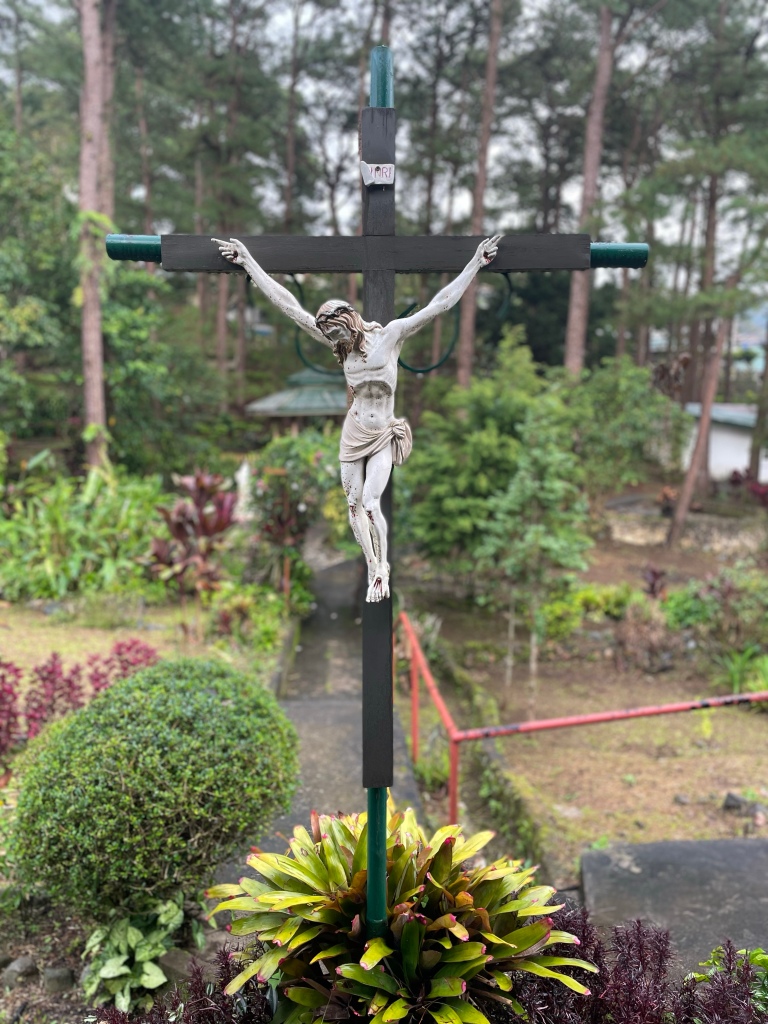
Photo by author, Timberland Highlands Resort, San Mateo, Rizal, 08 March 2025.
When the devil tempted
Jesus the third time,
"If you are the Son of God,
throw yourself down
from here",
the devil tempts us too
to totally forget God
because, after all,
whatever we do,
God still loves us;
of course,
that is true: we are humans
loved and cared
in our being
not in our doing.
And so, Jesus told
the devil "You should not
put the Lord, your God
to the test",
he tells us too today
for us to stop pushing
the limits of morality
and decency,
and simply let
the mysteries of God
and of life wrap us because
they are greater than us,
not problems to be
solved nor principles
to be understood.
Photo by author, 10 March 2025.
Life is a daily Lent,
a journey towards Easter,
a return to our first love,
 - God
in Jesus Christ his Son
in whom we have been baptized
and adopted
as his beloved children
as our being and identity:
so let us simply be
our true selves -
his beloved
since the beginning -
loving him totally
in our loving service to others.
This Lent
let us journey in Jesus
in prayer to be one in him;
in fasting to create space for him within;
in alms-giving to be one with
fellow human beings
for we are not
human doings
who cannot do everything
who cannot know
and explain everything
except to wonder more,
to love more,
to appreciate more,
to believe and trust God more.
*Collage are photos of our students last February 09, 2025 spending a Sunday afternoon of love with children with cerebral palsy and family.

**Special thanks to our sister in faith, Nicola who gave us the idea for this poem, the beautiful terms "human being, human doing" from her blog https://eaglesight.blog/2025/03/02/rest-and-replenish/.
40 Shades of Lent by Fr. Nicanor F. Lalog II
Friday after Ash Wednesday, 07 March 2025
Isaiah 58:1-9     + + +     Matthew 9:14-15
Photo by author, Hidden Springs Valley Resort, Calauan, Laguna, 20 February 2025.
I love your words today,
Lord God our Father
through the Prophet Isaiah:
Thus says the Lord God: Cry out full-throatedand unsparingly, lift up your voice like a trumpet blast; tell my people their wickedness, and the house of Jacob their sins (Isaiah 58:1-9).
So strong was the word
your great prophet had used,
"full-throated" which is
to express confidently,
with strong feeling
and without limit;
to shout our loudly
in no uncertain terms;
to mince no words,
to emphatically declare
what it really is.
Photo by author, Hidden Springs Valley Resort, Calauan, Laguna, 20 February 2025.
O God forgive us,
as a nation and as a church,
as a community of your disciples
for being so soft,
so disturbingly quiet
and selectively silent
in denouncing
injustice and abuses
happening not only around us
but even by those among us;
we have been so lax,
overly lenient,
always trying to please
everyone
that we have forgotten to stand
for you in Christ Jesus
that so many among us your
priests have abused your
worship,
your prayers,
your liturgy.
Teach us to be like your
tall trees,
so magnificently imposing
minus the pride and airs
many of us exude;
simply rooted and grounded
in you, O Lord,
 firm and unshakeable,
truly a presence in
Christ.
Photo by author, Atok, Benguet, 27 December 2024.
Let us take the challenges
of the Prophet Isaiah
to see fasting not just
as refraining from food
and drink but about how
our behavior affect others;
let us empty ourselves first
of the bonds of wickedness
that bind us so that in our fasting
we set the oppressed free
by breaking every yoke (Is.58:6);
let us be one with the hungry
and homeless by realizing our
nakedness in you, that more
essential than food and things
are those of the Spirit to
experience you among the poor
like the hungry and the homeless (Is.58:7);
let us be your presence in this world
by shouting full-throated
not just with our voice
but most especially with our
actions and witnessing of your
justice and love.
Loving Father,
you have given us with so
much and we have given
so little
if not nothing at all;
teach us the essence
of fasting which is to give more
of ourselves with others
and to give more of you
and your love,
and kindness,
and mercy,
and joy and life.
Amen.
40 Shades of Lent by Fr. Nicanor F. Lalog II
Ash Wednesday, 05 March 2025
Joel 2:12-18 + 2 Corinthians 5:20-6:2 + Matthew 6:1-6, 16-18
As we begin our
40-day journey to Easter
this Season of Lent
with Ash Wednesday,
I pray only for one thing,
dear Lord Jesus:
let me find my way,
my direction
to you.
Rend my heart, Jesus:
take away my pride
and fill me with your
humility,
justice,
and love;
let me enter my heart
more often these days
to commune in you
to be one with you
as you dwell here
in my heart.
Help me create
a space for you, Jesus
and for others
I have taken for granted
especially those who
truly care for me,
those at the margins
those I avoid;
let me be reconciled
with you, Jesus
beginning today
a very acceptable time,
a day of salvation in you.
May this ash on my
forehead direct me
to my origin
and destination in the Father
in heaven
through you, Jesus,
who suffered,
died and rose again
for me.
Amen.
40 Shades of Lent by Fr. Nicanor F. Lalog II
Ash Wednesday, 05 March 2025
Joel 2:12-18 ><}}}*> 2 Corinthians 5:20-6:2 ><}}}*> Matthew 6:1-6, 16-18
Life is a daily Lent, a journey towards Easter.
We go through a pasch everyday like Jesus Christ’s Passion, Death and Resurrection when we “pass over” from sin into grace, from darkness into light, from death into life.
Life is a daily Lent because everyday, we go through an “exodus” from another day to the next new day, from sunset to sunrise. However, Lent as a journey is about direction, not destination. This we find clearly at the start of our 40-day journey of Lent with Ash Wednesday.
“Even now, says the Lord, return to me with your whole heart, with fasting, and weeping, and mourning; Rend your hearts, not your garments, and return to the Lord, your God” (Joel 2:12-13).
It is strange that while Jesus Christ asked us in the gospel to “Take care not to perform righteous deeds in order that people may see them; otherwise, you will have no recompense from your heavenly Father” (Mt.6:1), what we are doing this Ash Wednesday is exactly the opposite!
Alam na this… that if you meet anyone with ashes on his/her forehead, definitely he/she is a Catholic who had gone to Mass or at least had observed Ash Wednesday.
There are some who would surely be teased by friends as being too serious as they practice abstinence by avoiding meat today and on Fridays this Lent. Most likely too, many would be giving alms today in the collections for the poor in the parishes all because for the reason it is Ash Wednesday.
These three pillars of Lent – prayer, fasting and alms-giving are not only meant for this Season that lasts only for 40 days but something we are hoped to practice the whole year through until we are slowly transformed into the likeness of Jesus Christ.
The purpose of Jesus in asking us in the gospel to do these all in secret is to avoid falling into the trap of the people of His time who flaunted to everyone their prayer, fasting and alms-giving, forgetting God in the process because focus had been on them. And yes, it continues among us that we have religiosity without spirituality, devotion without evangelization.
Moreover, to practice these in secret is actually to enter into our very selves, into our hearts where God dwells, where we meet Him personally.
Our Lenten journey becomes a direction when we take it into our hearts, when we open and rend our hearts to let Jesus come and dwell within by letting Him empty us of our pride to be filled with His humility, justice and love.
Lent then becomes a direction leading us not only to daily Easter but ultimately to our eternal salvation not just in heaven or any “place” but to be one with the Person of God Himself and the persons along the way we shall meet with whom we are called by Christ to be one with in Him.
Therefore, Lent as a direction is an inner transformation as companions in Christ.
In this age of WAZE and GPS, we can easily seek directions to a particular destination. Problem with being focused more on destination is we miss the fun and adventure of every journey. When we reach our destination, what do we do?
We cross out from our list of travel goals every destination that we make and start looking for new places to visit until we have been to every place on earth that we plan to visit the Moon and Mars next! Eventually we get tired with travels and after covering so many distances and destination, we still feel lacking and incomplete. There is no more destination to go to that we confront ourselves with the existential question, is this really what I need most in life? Is this all?
To see life more as a direction means to find its meaning in God that we keep on maturing, we keep on sustaining our journey in Him and with Him. It does not matter wherever He leads me or where I go or stay because what matters most is I am in and with God.
Lent is entering God in and through Jesus Christ. It is going back to Him, staying in Him and with Him in love. This is the reason why we fast, we empty ourselves even our sights and other senses so that we become more sensitive to God’s presence. There are no flowers, no decors, no Alleluia, no Gloria in the church and liturgy. Everything is bare essential so we are not distracted in finding and following God right in our hearts.
Recall the first time you truly fell in love, when truly loved that you literally see and hear even smell your beloved everywhere and in everyone. You always thought it is your beloved whom you saw walking or speaking somewhere but it wasn’t really she! Akala mo lang…
When we truly love, the time and place are not important because all we have are the here and the now together.
Oh how easy to say we love God or somebody! But if we try to probe deeper into ourselves, we find that we have not truly loved God or anyone that much because in many instances, we always prevail over them. We choose our own will than God’s or our beloved’s.
That is when we sin as we turn away from God and our beloved. To sin is not just to break laws and turn away from God and our beloved but ultimately a refusal to love which is actually losing one’s direction in life.
Lent is the wonderful season of finding again our direction in life, our true love, God. Love needs no justifications. And we can only love persons, not things. Hence the need for oneness, for reconciliation as St. Paul asked us in the second reading to be “reconciled with God” (2 Cor.5:20).
Working together, then, we appeal to you not to receive the grace of God in vain. For he says: In an acceptable time I heard you, and on the day of salvation I helped you. Behold, now is a very acceptable time; behold, now is the day of salvation (2 Corinthians 6:1-2).
Now is the best time to find our life direction in God in our personal and communal worship and practices this Lent. When you find your direction, you find God, yourself and others. And that is when you find joy and peace which is Easter, the direction of every Lent and life. Amen.
The Lord Is My Chef Wedding Recipe by Fr. Nicanor F. Lalog II
Homily, Wedding of Dra. Arianna Julia Enriquez & Dr. Dexter Falcon
Santuario de San Jose Parish, Greenhills, Mandaluyong
28 February 2025
Congratulations, Dra. Arianna and Doc Dexter in choosing to get married in the Church. Many people these days disregard the Sacrament of Marriage, sadly seeing it more in human terms and most sad of all, many would rather follow superstitions than faith in getting married.
When I was still in a parish in Bulacan, a couple met with me due to a problem with the date they wanted to get married that fell on a Saturday. I offered to them a Friday but the mother of the bride said “araw po ng mga mangkukulam ang Biyernes!” Whoa! Did you know that?
Trying to hide my laughter, I told the couple how about on a Thursday which is my day off and would just cancel it to officiate their wedding. The mother again interjected, “nakupo Father… lalo na po ang Huwebes! Araw ng kasal ng mga tikbalang!” I could not contain myself anymore and I told the mother, “Katoliko pala mga tikbalang dito sa inyo!”
I mentioned this experience because in the provinces, very few couples get married in the month of February like you. Your Tita, Dra Mylene knows this very well… happy birthday po! When people find out you were born in February, they say “kaya ka pala ganyan, kulang-kulang.” And that’s how most people see February – kulang or incomplete – that is why even couples avoid it as a date for their wedding.
Of course that is not true. Every day is a perfect day for wedding for each day is blessed by God – most especially the days of February, the most perfect month in number of days. February was added to our calendar to complete the 365 days of revolution of Earth around the Sun to make it a year. It is February that completes the year as it fills the missing days following the miscalculations by the early Romans.
And that’s marriage. A man and a woman get married to complete each other.
Remember God’s declaration in the first reading, “It is not good for man to be alone.”
See how in creating the woman, God cast a deep sleep on man and took his rib to form it into a woman. The man was totally unaware of what was going on when God created and gave him the woman as his “suitable partner.”
This is most true with you, Dra. Arianna and Doc Dexter: you were both totally unaware in the beginning of how God worked silently in the background that you would eventually complete each other as friends, as lovers and now as husband and wife.
You have realized after your long relationship from pre-med to med proper and now as full-pledged doctors that you both cannot be complete without each other that even if you were separated by time and distance, you still made efforts to be together because that is love. You have realized that you can only be complete and whole with each other. Ikaw lang, sapat na!
Nothing is so toxic and difficult, nothing is most joyous when you think of each other, when you love each other. And so, simply love, love, and love! Huwag kayong magbibilangan! No need to have the numbers “224” tattooed on your arms like Philmar and Andi Eigenman.
When you have an LQ, who must make the first move to reach out and make peace?
Some couples say the man should make the first move but what happened to the rule “ladies first”? Others say the first to reconcile and say sorry is the one who started the lover’s quarrel but, would anyone really admit that?
The answer is this: when couples have an LQ, the one who has the most love to give must be the first to make the move for peace and reconciliation. Yung higit na nagmamahal ang unang kikibo.
Love is not a competition and love cannot be really measured. The true measure of love is when you love without measure. Nobody is perfect; hence, human love is also imperfect. Only God can love us perfectly. That is why, just keep on loving each other, letting your love flow to each other by taking care of each other.
That is the beautiful imagery of the ribs – inside the rib cage, the most vital organs of the body are protected and kept safe like the heart, the lungs, the liver. Lalo na ikaw, Doc Dexter: you are lacking in one rib and that is Dra. Arianna. Alagaan mo siyang mabuti. Boss namin siya…
God willed in all eternity that the two of you get married today not tomorrow nor next year nor last year. It was God who set February 28 as your wedding date because on this day God completes you.
However, though the husband and the wife complete each other, it is Jesus Christ who cements their union in the Sacrament of Holy Matrimony. Jesus is the “gold paint” in the Japanese kintsugi art of repairing broken pottery.
Kintsugi is the Japanese art of joining together the broken pieces of a jar or a vase with a glue and then pain with gold its cracks to make the broken piece more beautiful. Along this line of thought is St. Paul the Apostle who described us as “earthen vessels” – palayok in Tagalog: so delicate and easily broken yet God still fills us with Himself and His grace because He loves us so much.
And that is my second final reflection for you dear Dra. Arianna and Doc Dexter: love is not natural but supernatural – it is divine because it is rooted in God! Love is more than a feeling which is natural. Love is a decision, requiring your cooperation with God who pours out His blessings to you since you met despite your imperfections and flaws. That is the meaning of Marriage as a Sacrament – it is more than a human and natural bond but a supernatural, divine union of man and woman who become the signs of Christ’s saving presence in the world.
Heed the call of Jesus in our gospel today, “remain in me and make my joy complete.”
How lovely is your love story! Clearly of divine origin that you met in a theology class during your senior year in college. You did not meet in a party nor in any of those rows of restaurants across Ateneo or at the parking lot. You met in a theology class where you learned about God.
And the more you discovered God, the more you discovered each other, realizing in the process that the more you need God to make you both complete which is the principle and foundation of St. Ignatius of Loyola’s Spiritual Exercises.
We are able to love because God loved us first as the beloved disciple wrote in his first letter. That is the mystery of love, of married love specifically that Ben & Ben said so well in their song, “Mahiwaga… Pipiliin ka sa araw-araw… Mahiwaga… and nadarama sa iyo ay malinaw.”
When I think of this mystery of divine love in married couples, the image that comes to my mind are the “praying hands”. Each hand represents the husband and the wife. They retain their individuality as they freely pursue growth and maturity and fulfillment in life and career. Both hands are flexible and can move freely.
But, look at these two praying hands: as you get closer with each other, you also create a sacred space between you for Jesus Christ. Like that glue painted gold in the Japanese art of kintsugi, it is Jesus who makes you one and complete, it is Jesus who joins you together in his love.
Hence, whatever you do to each other, you do it first to Jesus. When you are faithful and true to Dra . Arianna, you are first faithful and true Doc Dexter to Jesus. The same with you Dra. Arianna: when you bake pastries and cakes for Doc Dexter, it is Jesus whom you first make happy and delighted.
But the moment you Doc Dexter cheat and lie to Dra. Arianna, you first fool Jesus. When you make taray to Doc Dexter, you first make taray to Jesus, Dra. Arianna.
Handle your life always with prayer. Every day, invite Jesus into your married life, Dra. Arianna and Doc Dexter in the same manner you have both invited Him today on your wedding day. God bless you always, Dra. Arianna and Doc Dexter! May today be your least happiest day in your life as couple! Amen.
The Lord Is My Chef Sunday Recipe for the Soul by Fr. Nicanor F. Lalog II
Eighth Sunday in Ordinary Time, Cycle C, 02 March 2025
Sirach 27:4-7 ><}}}}*> 1 Corinthians 15:54-58 ><}}}}*> Luke 6:39-45
The last time we have celebrated the eighth Sunday in Ordinary Time Cycle C was in 2001 when just like this year, the Season of Lent started late in March. In fact, the other last two Sundays of sixth and eighth in Cycle C were last celebrated in 2010 and 2007, respectively.
It is worth noting this because as Jesus delivered his Sermon on the Plain, we find that contrary to claims by many in this modern time, the teachings of Christ are actually taken directly from life as he reveals to us the truth in our hearts. Two Sundays ago, Jesus taught us the paradoxical happiness of our lives, of being poor, hungry, weeping, and maligned than rich, filled, laughing and well-spoken of; last Sunday, he taught us of the need to love truly that is rooted in God by loving without measure, loving even our enemies.
This Sunday, Jesus tells us something we often debate about as it usually puts us into a bind even a quandary on what to say and do.
Jesus told his disciples a parable, “Can a blind person guide a blind person? Will not both fall into a pit? Why do you notice the splinter in your brother’s eye, but do not perceive the wooden beam in your own eye? How can you say to your brother, ‘Brother, let me remove that splinter in your eye,’ when you do not even notice the wooden beam in your own eye? You hypocrite! Remove the wooden beam from your eye first; then you will see clearly to remove the splinter in your brother’s eye” (Luke 6:39, 41-42).
Photo by author, Hidden Valley Springs Resort, Calauan, Laguna, 20 February 2025.
Very often in many instances, most of us choose to be quiet than speak out against evil and other irregularities among us and in our society because of this teaching of the Lord. Many are afraid to notice the splinter in the brother’s eye lest they too might have a wooden beam blocking their views of themselves.
And that is why, evil persists everywhere that eventually, many of us become silent partners in the many sins happening around us which is very far from the demands of Jesus for us to choose what is right and good, to always make a stand for him even on the Cross.
See the flow of the Sermon on the Plain, of how Jesus is first of all never condemning nor judgmental of anyone. We have reflected his four “woes” were actually invitations for the rich et alii to change their ways in life, to think more of things that do not pass like wealth and other material things.
Secondly, last Sunday, Jesus directed our intentions into our hearts, to probe our hearts and find his grace of supernatural or divine love poured in there so that we can love selflessly without measure like him.
This Sunday, Jesus still directs us into our hearts, to examine whether we are truly his disciple or a hypocrite as someone who says something yet does the opposite. It is not opposite his exhortation last week for us to be merciful like God our Father rather a challenge to examine what we practice, our Christian praxis.
“A good tree does not bear rotten fruit, nor does a rotten tree bear a good fruit. For every tree is known by its own fruit. For people do not pick figs from thornbushes, nor do they gather grapes from brambles. A good person out of the store of goodness in his heart produces good, but an evil person out of a store of evil produces evil; for from the fullness of the heart the mouth speaks” (Luke 6:43-45).
Photo by Mr. Lorenzo Atienza, leftmost section of the stained glass at the National Shrine of Our lady of Fatima in Valenzuela City, 25 February 2025.
It is clearly a lesson in holiness, in integrity of every disciple! Do we walk our talk? The most basic norm of morality is that what we know in our mind and what we feel in our heart is what we say and therefore what we do.
Where are we now? Everybody is speaking about corruption while the devils celebrate everywhere as we are all entangled in all forms of corruption not only in the streets and government offices but even in our homes, in schools and offices and yes, right inside the church in many parishes.
Now we come full circle with Christ’s opening to his parable, Can a blind person guide a blind person? And this is what is now happening in the world, in our lives, in our country and in our parishes. Nobody would want to speak because nobody would want to examine one’s heart and follow the path of Jesus.
It is in our deeds that one is recognized as a true disciple. Let us not forget that. And let us not be afraid to examine constantly the value of our many ways and practices.
Photo by author, St. Paul Spirtuality Center, Pico, La Trinidad, Benguet, 05 January 2025.
One of the famous bishops and saint both recognized by the Eastern and Western Churches is St. John Chrysostom who served as Archbishop of Constantinople until the early 400’s. He is called the “golden mouthed” because of his gift in eloquence most true in his witnessing Christ, always meaning what he said like in this homily that sounds so 2025:
The Church is in an extremely critical state, and you think that all is going well. The fact is that we are plunged into countless sins, and we do not even know it!
You wonder why. We hav e churches, money, and everything else. There are places for assembly, people come there everyday; surely this is not nothing?
But it is not thus that we judge the state of the Church. Then how?, you ask.
Whether we lead a truly Christian life. Whether everyday we make ourselves spiritually more rich, bearing fruit, whether great or small; if we are not content simply with flfilling the law and expediting our religious duties.
Who is a better person, after having frequented the church all month?
This is what we must look for! After all, even what appears to be a good action is only a bad action, when one does not follow it up… If we bring nothing to fruition through it, it would be better to stay home (from Days of the Lord, vol. 6, page 62).
Photo by Mr. Lorenzo Atienza, 25 February 2025.
The kind of life we lead is the final test of our discipleship, the proof of what is in our hearts. St. Francis of Assisi used to tell his followers whenever they would preach to use only their mouth if necessary. Our actions speak louder than our words.
This is the biggest problem in the Church today: our lack of credibility as bishops and priests when our lives are far from what we say and teach.
God shared with us his power of the words. In the Bible, we find how his words and his being are always one since the story of creation into the coming of Jesus Christ who could heal with just mere words being the word who became flesh.
This is the whole point of Ben Sirach in our first reading this Sunday, reminding us that inasmuch as the potter knows the quality of his work after it has passed through fire, the same thing is most true with our words. We have to harness and master our speech, our words so that we walk what we talk.
We master our power of the words in our prayer life as St. Paul assured us in today’s second reading how in the Lord our labor is not in vain (1 Cor. 15:58). Let us pray to the Holy Spirit especially this Sunday as we approach the Season of Lent with Ash Wednesday. Let us keep our zeal for Christ not nonly for his words and teachings but most especially in his life and witnessing. Amen.See you at Ash Wednesday.
Campus Ministry, Our Lady of Fatima University, Valenzuela City.
Quiet Storm by Fr. Nicanor F. Lalog II, 23 February 2025
Photo by author, Hidden Valley Springs Resort, Calauan, Laguna, 20 February 2025.
Jesus said to his disciples: “To you who hear I say, love your enemies, do good to those who hate you, bless those who curse, pray for those who mistreat you… But rather, love your enemies and do good to them, and lend expecting nothing back; then your reward will be great and you will be children of the Most High, for he himself is kind to the ungrateful and wicked. Be merciful, just as your Father is merciful” (Luke 6:27-28, 35-36).
yes, i hear you Lord.
love my enemies.
i have tried
and continue to strive
at loving my enemies;
but, who are my enemies?
yes, it is easier said than done,
loving my enemies
who are most easy to identify
as those i hate and do not agree with,
those who have hurt me,
those who do not believe in me,
those who simply differ with me
both outside
and inside.
as i rested in you, Jesus
i have realized
something deeper,
and pernicious:
my worst enemies
are those within me
like a sin i refuse to admit,
a sin i continue to justify,
a darkness i'm afraid to look into.
yes, Jesus!
my worst enemy
is actually myself
when i deny your love
and presence in me;
let me look deep inside me
where in my life
is God asking me to love
more like you, Jesus?
yes, it is terrifying,
disturbing and difficult
but it is only when i love more
like you Jesus
that i experience your love more
and begin loving my enemies within!
Photo by author, Hidden Valley Springs Resort, Calauan, Laguna, 20 February 2025.
The Lord Is My Chef Sunday Recipe by Fr. Nicanor F. Lalog II
Seventh Sunday in Ordinary Time, Cycle C, 23 February 2025
1 Samuel 26:2, 7-9, 12-13, 22-23 ><)))*> 1 Corinthians 15:45-49 ><)))*> Luke 6:27-38
Photo by author Santisima Trinidad Parish, Malolos City, 18 March 2023.
We continue this Sunday Jesus Christ’s Sermon on the Plain with his teachings getting more disturbing, twice telling us to love our enemies. Yes, you heard it right…
Jesus said to his disciples: “To you who hear I say, love your enemies, do good to those who hate you, bless those who curse, pray for those who mistreat you… But rather, love your enemies and do good to them, and lend expecting nothing back; then your reward will be great and you will be children of the Most High, for he himself is kind to the ungrateful and wicked. Be merciful, just as your Father is merciful” (Luke 6:27-28, 35-36).
See that after selecting Twelve from among his many disciples, Jesus will be asking more from his followers that includes us today. As we have reflected last Sunday with the four woes of Christ, there is no middle ground in being a Christian. We have to make a decision, to choose Jesus always.
This Sunday, Jesus shows us it is no simple choice we have to make because loving our enemies is easier said than done.
In this age of social media when everything is blown out of proportion with everyone dragged even into the quarrels and infidelities among celebrities, the more it is difficult to avoid making enemies with many of us easily taking sides in the petty issues that are trending.
It is the same thing with our way of loving these days with how easy it is to love people who love us too. Anyone can be so nice to people nice also to them as it comes naturally.
But real love is not really that natural.
True love as Jesus had shown us on the Cross is more than the natural flow of things. It is always supernatural, beyond the natural flow of emotions. Jesus is asking us that we go beyond what comes naturally especially with love because love is a decision, a fruit of the meeting of mind and of heart, a oneness within every person that is also a sure sign of one’s maturity, spirituality.
Loving our enemies, doing good on those who do bad against us is love of the highest order. It is not weakness but actually a strength for no weakling can muster the courage and clarity to be loving with one’s enemies.
Loving our enemies is knowing better than the rest on the repercussions, the intricacies and complexities of being adamant and insistent.
This is the beautiful example shown by David in the first reading: instead of delivering into his hands King Saul he had found sleeping unguarded inside a cave while pursuing him and his men, David spared his life out of respect for God who anointed Saul as King of Israel.
See also the practicality of Jesus in teaching us to love our enemies and those who do us bad: if you only love or care or be kind with those who love and care and are kind to us, then it is not real love and caring and kindness at all you are giving. Jesus pointed out that even criminals and bad people do it. If that is the case, then, we are no different from them if we love only those who love us!
Fatima University students spent a Sunday afternoon of prayers and fun with kids with cerebral palsy and their families, 09 February 2025.
True love, real love is never transactional, never a deal nor an agreement in this age of many marriages punctuated with pre-nuptials. True love is freely given without any reservations, no ifs nor buts. As St. Mother Teresa used to say, the true measure of love is to love without measure.
Love is something we fully give away, never kept. You never scrimp on love. It is always given in full. Scrimp on your love, you lose because the love you keep and withdraw is never kept nor save. In fact, a love not shared and given becomes stale. Or expired. Napapanis.
Like the things we love eating or using, love comes without any expiration date that says “best consumed before February 23, 2025.”
Love is best when freely given and shared. Once “opened” or given, no need to keep and refrigerate it. Consume it right away! Everything. No love is ever wasted. Walang sayang na pagmamahal, lahat may pinatutunguhan at binubungang mabuti.
Photo by author, Hidden Springs Resort, Calauan, Laguna, 20 February 2025.
Love is like a natural spring water, or the waterfalls that keep flowing, watering and refreshing countless tributaries, people, plants and animals. Just keep loving! Love, love, love!
At his Sermon on the Plain, Jesus clarifies that true love like his love is first of all not of natural level and flow but of supernatural nature, divine like him. Jesus emphasized this at his Last Supper, describing it as a “new commandment of love” because it is a love rooted in God not just in man.
The following Good Friday on the Cross, Jesus proved his love as true and real. Most of all, free.
We today experience that true love of Jesus even to this day because of his rising three days after his crucifixion at Easter. This is what Paul meant in the second reading that in Jesus Christ, we have become heavenly and spiritual. The love of Christ have made us like him, divine and heavenly. What a great honor we now have! For being so loved by God in Jesus Christ, we too must love truly and freely like him!
Photo from vaticannews.va.
Last month, I strongly reacted to a statement by Rappler’s Ms. Maria Ressa in her interview before a speech at the Vatican Jubilee of Journalists.
That night in my prayer, I felt God “disturbed” me for being so harsh and judgmental of a journalist presumably totally unaware of the meaning of “dogma” in the Church.
The following day, I got a message from the reporter who posted that story and naturally, did not like what I wrote. As days went on, I felt “disturbed” and “uneasy” with my calling her “heretic”. After three days, I edited my blog and removed the harsh word as I realized calling others with names or labels would not help at all in clarifying things especially about our faith.
Most of all, it is not the Christian way of loving others, of putting others down just to uphold our faith and beliefs. It is not love. And I felt so afraid Jesus might personally get down from his Cross to take away that harsh word I have written.
Next month, I will be turning 60 years old, a senior sixty-cent so excited with my discount card. As I reflected these days on the immense love of Jesus for me in these 60 years, 27 as his priest, I have been praying, where in my life is God asking me to love more like Christ?
Loving our enemies is not merely the people we hate, or those who have hurt us or different from us, not like us. Loving our enemies includes those darkness within us, those weaknesses we hide and cover, sins we refuse to admit or continue to justify. Many times our worst enemies are those within us, our very selves.
It is difficult. And terrifying. Loving our enemies is easier said than done. It is also disturbing but at the same time, so liberating because the more we love, the more we feel free for Christ and for others. Amen.Have a blessed, loving week ahead.
Sharing with you a video I have taken last Thursday at the Hidden Springs Resort in Laguna; the sight and scene of a waterfalls reminded me so much of God’s love that never runs out.
The Lord Is My Chef Daily Recipe for the Soul by Fr. Nicanor F. Lalog II
Thursday, Sixth Week in Ordinary Time, Year I, 20 February 2025
Genesis 9:1-13     <*{{{{><  +  ><}}}}*>     Mark 8:27-33
Jesus and his disciples set out for the villages of Caesarea Philippi. Along the way he asked his disciples, “Who do people say that I am?” They said in reply, “John the Baptist, others Elijah, still others one of the prophets.” And he asked them, “But who do you say that I am?” Peter said to him in reply, “You are the Christ.” (Mark 8:27-29)
You are always on the move,
Lord Jesus:
you are always moving,
crossing the lake,
hiking in the mountains
and most often,
walking the streets.

What a lovely imagery
of you, Jesus,
always on the road
with me following you,
watching you,
observing you,
sometimes stopping
because of being tired
but you are always there
waiting for me.
And now,
what a lovely scene
of you back on the road again
but this time asking those closest
to you - including me! -
with that most personal question
of all: "But who do you say
that I am?"
Who are you for me, Jesus?
So many, actually.
I may not be as eloquent
like Peter, but no doubt about
who are you for me, Jesus:
my life,
my meaning,
my love,
my hopes,
my fullness.

But,
very often along this
road,
on these streets we walk
and cross,
dear Jesus
when that who are you for me
is shaken,
is tested,
even doubted
like Peter:
how could you allow
yourself and us your followers
suffer and cry,
and die?
He began to teach them that the Son of Man must suffer greatly and be rejected by the elders, the chief priests, and the scribes, and be killed, and rise after three days. He spoke this openly. Then Peter took him aside and began to rebuke him (Mark 8:31-32).
Let us think always
as God does, Jesus,
not as human beings do
seeking fame and prestige,
comfort and wealth,
self and ego;
let me walk closer with you
Jesus on the streets,
on whatever road
you take
upholding that covenant
of God with Noah to
uphold and respect
human life by
"accounting for human
life" (Genesis 9:5);
more than the colorful
rainbows of the skies,
may we always see in your
outstretched arms on the Cross
the true and new covenant
of God with us sealed in
your blood.
Amen.
Photo by author, St. Scholastica Spirituality Center, Baguio City, August 2023.
The Lord Is My Chef Daily Recipe for the Soul by Fr. Nicanor F. Lalog II
Monday, Sixth Week in Ordinary Time, Year I, 17 February 2025
Genesis 4:1-15, 25     <*((((><  +  ><))))*>     Mark 8:11-13
Photo by author, DRT, Bulacan, November 2024.
How interesting are your words
today, O God our loving Father,
of how Cain like the Pharisees
came to Abel to "discuss" about
something as a pretext before
killing him; the Pharisees went to
Jesus to argue with him
and asked him for a sign
from heaven to test him.
How funny and insane,
dear Father,
how much time we spend
just to discuss
and argue things
about you
and your ways,
asking for many signs
just for us to believe
you; how unfortunate,
our quest for signs
has often led us to sin,
to more divisions
and separations,
more lies
and more hate
because
we have too much self.
Forgive us, Father.
Teach us to offer
you a sacrifice of praise
as the psalmist
sings today
by "doing well,
holding up our heads"
(Genesis 4:7)
giving our best to
listen to you,
to seek you,
and follow you.
Amen.