40 Shades of Lent by Fr. Nicanor F. Lalog II
Friday, Fourth Week in Lent, 04 April 2025
Wisdom 2:1, 12-22     + + + + +     John 7:2, 10, 25-30
Photo by author, Sacred Heart Novitiate, Novaliches, QC, 17 March 2025.
Life indeed is a daily Lent,
Lord Jesus: as we come to close
this fourth week in Lent while entering
its penultimate week, our readings
today show us the reality of life
that can be confusing sometimes.
Jesus moved about within Galilee; but he did not wish to travel in Judea, because the Jews were trying to kill him. But when his brothers had gone up to the feast (of the Tabernacle), he himself also went up, not openly but as it were in secret. Some of the inhabitants of Jerusalem said, “Is he not the one they are trying to kill? And look, he is speaking openly and they say nothing to him” (John 7:1, 10, 25, 26).
Of course,
you were never confused
Lord Jesus
but we your disciples
and almost everyone
including bystanders
are the ones confused:
you moved in secret but
everybody recognized you;
most of all,
threats never deterred you
from speaking what is true,
that the one who sent you
whom many do not know
is true (John 7:28).
The first reading
also gives us an impression
of confusion among peoples,
but never from God;
like what the author of the
Book of Wisdom had written,
the wicked are most confused
though pretending to know all,
plotting against the just
and the believers.
Confusions happen
in Lent
in life
when we refuse to
believe and trust in you,
Jesus;
confusions happen
in Lent
in life
when we disregard
you who is truth himself,
when we choose
not to love.
Teach us Jesus
that truth is not just
an object
an objective reality
of concurrence what is in our
mind and what is outside but
most of all
truth is a person,
when we accept you
wholly among those around
us especially the needy
and disadvantaged.
Amen.
Photo by author, Sacred Heart Novitiate, Novaliches, QC, 17 March 2025.
Lord My Chef Sunday Music by Fr. Nicanor F. Lalog II, 30 March 2025
Photo by author, ceiling lights, Canyon Woods Resort, Batangas, 16 March 2025
Glad to be back dear friends with our Sunday music featuring secular music that echoes the good news of Jesus Christ. So excited with today’s feature because it is by one of our favorite musicians, Michael McDonald.
McDonald is that most unique voice in many of Steely Dan’s hits in the early 70’s where he got recognized, thus becoming the most sought partner of other great artists like Christopher Cross before settling with the Doobie Brothers with their signature song What A Fool Believes.
After leaving the Doobies in the early 80’s, McDonald came up with his first solo album called If That’s What It Takes from which came out our featured song I Keep Forgettin’ in 1982.
I keep forgettin' we're not in love anymore
I keep forgettin' things will never be the same again
I keep forgettin' how you made that so clear
I keep forgettin'

Everytime you're near
Everytime I see you smile
Hear your "hello"
Saying you can only stay a while

And I know that it's hard for you
To say the things that we both know are true
But tell me how come
While praying over our beautiful gospel this fourth Sunday in Lent (Laetare or Rejoice Sunday), I could hear McDonald singing this lovely song at the back of my mind that became the inspiration for our Sunday homily:
We do not tell God and our family and friends that we don’t love them but our walking away from them tells that so clearly. However, as we refuse to love when we sin, that is also when we deny the love right in our hearts, that we cannot stop loving because whatever we take after we have left are actually the very love of God and of our family and friends!
There is nothing truly ours in this world and because of God’s Mystery, we never lose His gift of love within us that when things get worst in our lives, it is the same love that gives us the spark to hope and believe again. It was that love that the youngest son missed and realized despite all his dramas as he went home to his loving father just like us too (https://lordmychef.com/2025/03/29/mystery-of-god-mystery-of-sin/).
Can we really forget or delete permanently a love that is especially so true, so great? In the parable of the prodigal son heard in churches this Sunday, Jesus reminds us that every time we sin – that is, when we refuse to love – we deny His very love in our hearts that remains there, only to be recognized or rediscovered by us when we are down like the prodigal son. That love of God we keep denying eventually is the very same love that gives us the spark to hope and believe again when we realized the foolishness we have done with our sins.
In this song by McDonald, we are reminded too of the same truth: we cannot forget nor deny the love we have especially to a beloved sweetheart even if things do not turn out well, when we part ways because our relationship wouldn’t work. The love remains there, is it not? Most often, we simply mature in our perceptions and relationships and yes, love because that love remains there.
How much more with God’s love?
Now, imagine Jesus Chris singing this McDonald hit?
And yes, that’s how He feels for us: God “keeps forgettin’ we’re not in love anymore” when we sin and yet, He keeps blessing us. Because, God simply loves us so much that even if we refuse to love Him, He still loves us, waiting for us to return to him like the loving father in the parable of the prodigal son.
That is why – rightly – the Doobies got another hit called Jesus Is Alright With Me but that’s for another piece perhaps this Holy Week.
Here now is Michael McDonald in his first solo hit, I Keep Forgettin’…. have a blessed, rockin’ week ahead, everyone.
40 Shades of Lent by Fr. Nicanor F. Lalog II
Friday, Third Week in Lent, 28 March 2025
Hosea 14:2-10     + + +     Mark 12:28-34
And when Jesus saw that he answered with understanding, he said to him, “You are not far from the Kingdom of God.” And no one dared to ask him any more questions (Mark 12:34).
Lord Jesus,
bring us close
to the Kingdom of God;
let us return home
to you
to ourselves
to one another
in love.
We have “collapsed“
due to sin which is
a refusal to love;
many times we are so concerned
counting our ways to love
when we just have to love,
love, and love
the way you love us.
Make us realize,
be aware
and most of all,
be convinced of your immense love
for each of us,
a love so unbelievable yet
so real
so true!
In this season of Lent,
bring us close,
not far from the Kingdom
of God by being more
loving to you in others;
let us get rid of our many
small choices in life
though not really a vice
but has a tinge of selfishness
that eventually make us
a less loving person
and far from God's Kingdom.
Amen.
40 Shades of Lent by Fr. Nicanor F. Lalog II
Third Week in Lent, Cycle C, 23 March 2025
Exodus 3:1-8, 13-15 + 1 Corinthians 10:1-6, 10-12 + Luke 13:1-9
Photo by author, Sacred Heart Novitiate, Novaliches, QC, 17 March 2025.
Thank you very much for all your birthday greetings yesterday, my 60th. Until now my heart overflows in joy from your expressions of love to me that confirmed God loves me so much in the most personal manner. Hence, my firm resolve in these senior years of my life to be able to love like God, to desire always the Cross for the love of our Crucified Lord Jesus Christ.
Yes, it is very ambitious, too idealistic but, that is God’s love for each one of us! Jesus became human like us so we may finally experience God’s immense love for each of us. And that is the invitation of Lent to us – that we go back to God, our very first love. Very often, we experience that very personal love of God for us in the desert of our lives when we are in darkness and emptiness like Moses in today’s first reading.
Moses was tending the flock of his father-in-law Jethro, the priest of Midian. Leading the flock across the desert, he came to Horeb, the mountain of God. There an angel of the Lord appeared to Moses in fire flaming out of a bush. As he looked on, he was surprised to see that the bush, though on fire, was not consumed (Exodus 13:1-2).
Fire is a very powerful sign not only in the Holy Bible but in every culture for the warmth it generates and the light it illuminates the surrounding. Fire signifies power because of its unique abilities to cleanse, purify and transform materials into something better. It is history’s most significant discovery of all time, facilitating our growth and development as peoples and nations with the advent of cooking that gave us food that delights and nourishes us.
That is the fiery love God has for each one of us we often find when we least expected like Moses in the first reading. Moses ended up in the wilderness tending sheep after fleeing from Egypt when he learned it was widely known that he had murdered an Egyptian maltreating a Hebrew slave.
What a beautiful image here of God’s love so fiery yet not burning us! In the burning bush, God revealed Himself as the omnipresent One always with us we are rarely aware of. There in the burning bush, God also reminded Moses and us today how this whole planet Earth is a sacred ground, His dwelling-place that we keep on desecrating with our sins.
And there lies the great paradox of our lives where God lighting us, straightening our crooked path to help us find our way back to Him, to life and to meaning. God is the fire burning the impurities in us without us knowing in many instances while He prevents us from being consumed like the burning bush. In fact, many times unknown to us, the fires of our failures and disappointments, pains and trials have actually brought out the best in us. Unconsciously to us, we are like the burning bush aflame with God’s fiery love that transforms us into better persons and more committed disciples of Christ.
Some people told Jesus about the Galileans whose blood Pilate had mingled with the blood of their sacrifices. Jesus said to them in reply, “Do you think that because those Galileans suffered in this way they were greater sinners than all the other Galileans? by no means! But I tell, if you do not repent, you will perish as they did! Or those eighteen people who were killed when the tower of Siloam fell on them – do you think they were more guilty than everyone else who lived in Jerusalem? By no means! But I tell you, if you do not repent, you will perish as they did!” (Luke 13:1-5)
How timely is our gospel today, reminding us to go deeper into our very selves, into those dark places in our hearts to realize too God’s message to us in the light of recent turn of events in the country.
What a mess we are now into that we easily blame on others except us. We have become so divided as a nation that we have refused to find the face of God, choosing to remain in the level of personalism and worst, of politics.
Sin is not just a turning away from God nor a breaking of any law but a complete refusal to love. When there is no love, there is no trust, there is no other person, there is no God. Just one’s self. Sin, therefore, is selfishness, the thinking more of one’s self, not of others.
That was the very sin of the people after the exodus when they refused to love one another, grumbling against Moses and even God most of the time. St. Paul has a grim reminder to each of us this Sunday as he recalled that desert experience of the Israelites when he wrote:
I do no want you to be unaware, brothers and sisters, that our ancestors were all under the cloud and all passed through the sea… Yet God was not pleased with most of them, for they were struck down in the desert. These things happened as examples for us, so that we might not desire evil things, as they did. Therefore, whoever thinks he is standing secure should take not to fall (1 Corinthians 10:1, 5-6, 12).
Five years ago I celebrated my birthday on a Sunday, the fifth in Lent just before Palm Sunday. That was very memorable to me because it was the first Sunday during the COVID lockdown when public Masses were prohibited.
That afternoon, I decided to go on a motorized procession of the Blessed Sacrament around my parish with a handful of our parish volunteers using a borrowed F-150 truck of a generous parishioner. Oh how the people knelt while lining up the main highway and inner streets as we passed by with the Blessed Sacrament.
Halfway through our libot, it started to rain but I instructed my companions to still go on even if it there would be a downpour. As we approached the last purok of our parish, I saw a rainbow. And cried as I felt God telling me at that moment like Noah after the floods that He would not forsake us in that time of COVID.
God kept that promise until I left Parokya ni San Juan Ebanghelista in Bagbaguin, Sta. Maria, Bulacan that was the least affected barangay by COVID in the whole town during my term.
Reflecting on that scene of Moses before the burning bush, I remembered that rainbow during my 55th birthday at the start of the COVID pandemic and lockdown. God often comes to us in many disguises, enlightening us to see the present situation we are into especially when it is all dark. It is the time we look inside our hearts to find God and experience His love; if we can’t find God or feel His love, let us be converted. Let us do penance as Jesus told the people in the gospel. Only with a contrite heart that one can truly find love again because being sorry for one’s sin is the beginning of loving.
That is the surest sign of God’s love for us – when everything especially us and our relationships become visibly clear , no matter how slowly it may be, one step at a time. The more we experience the love of God, the more we resolve to love; that is when this life and world become brighter. Let us love like God by returning to Him in His love. Amen. Have a blessed week ahead.
Quiet Storm by Fr. Nicanor F. Lalog II, 20 March 2025
Photo by author, Canyon Woods Resort Club, Laurel, Batangas, 15 March 2025.
“And, when you want something, all the universe conspires in helping you to achieve it.” – Paulo Coelho, “The Alchemist”
It is exactly what I am experiencing these days since we had our university management team-building seminar in Batangas last weekend when my realizations there were reinforced in my ongoing annual personal retreat here in Novaliches that started Monday evening.
It is a moment of consolation when suddenly, the whole universe conspires not only to get whatever you want but simply to affirm you being on the right track, giving you the proverbial pat on the shoulder that everything is going fine, everything falling into its right places.
Photo by author with flash, Canyon Woods Resort Club, Laurel, Batangas, 15 March 2025.
Pardon me for writing for the third time about perspectives and point-of-view (POV) as I could not contain the joy of the fruits of my prayers.
Another thing is the fact that when I took these photos randomly, there was no plan at all in writing about the subject of perspective. Never thought how these photos would turn out to be pieces of a jigsaw puzzle on perspective and POV.
We have reflected the other day how our perspectives of things and people as well as events contribute to the understanding or breakdown in communication as they reveal our inner thoughts and dispositions. It is not only important at how we narrate a story from whatever POV but most of all, at how open are we in refining our perspectives so that we achieve unity.
(More photos from our team-building in Batangas.)
Lights at the lobby of Canyon Woods taken from below.
Sunset from my room…
sunrise from same room.
Delighful scene of window and moon at night.
During our Holy Hour Tuesday night to cap our first day of prayers, I realized something very close to our subject of perspective while praying over the following gospel passage regarding the Mystery of God:
Jesus told his disciples, “The lamp of the body is the eye. If your eye is sound, your whole body will be filled with light; but if your eye is bad, your whole body will be in darkness. And if the light in you is darkness, how great will the darkness be” (Matthew 6:22-23).
Photo by author, Sacred Heart Novitiate, Novaliches, QC, 17 March 2025.
When we have the right perspective in life, we get a clear vision of life too.
That is why in our previous blog we have said we need to refine our perspective like an artist who has to spend and invest time not only in his/her studies but most especially in his/her dealing and interactions with people to come up with an obra maestra.
Living, after all, is an art, of our participation in the grace of God to bring out the best in each of us. St. Paul was very clear about this perspective regarding leadership and community life that both aim to show the giftedness of every member.
Photo by author, Sacred Heart Novitiate, Novaliches, QC, 17 March 2025.
Our perspectives are put to the test in moments of darkness like when we are in trials and tribulations, difficulties and crises. It is during darkness in life when people are distinguished from merely having sight or with a vision. According to the American writer Helen Keller, the worst thing that can happen in life is for anyone with sight not to have any vision at all.
Of course, we all know Helen was blind who wrote some of the loveliest poetry of her time.
Photo by author, Sacred Heart Novitiate, Novaliches, QC, 17 March 2025.
Many people just have sight that can be easily blurred that eventually affect their perspective. It is more than looking from the inside or from the outside (POV) but of how we see or look at everything and everyone from within us.
Photo by author, Sacred Heart Novitiate, Novaliches, QC, 17 March 2025.
A person of vision always sees beyond and therefore achieves more, always more fulfilled and fruitful than those who merely sees things, people and events as they are.
Photo by author, Sacred Heart Novitiate, Novaliches, QC, 17 March 2025.
People with the right perspective will always have vision in seeing everything despite many obstacles in life. They remain focused on what they “see” that others could not see at all. With a right perspective and proper vision, that person still sees when “darkness is his only light and hopelessness is his only hope” (T. S. Eliot in Four Quartets).
Photo by author, Sacred Heart Novitiate, Novaliches, QC, 17 March 2025.
My spiritual director since 2016, Jesuit Father Danny Gozar asked me during outside prayer periods that I “deliberately appreciate” God’s creation like feeling the gentle breeze, walking barefooted to be caressed by the green grass soaked in morning dew, feel the burning heat of the sun and if it rains – which it did briefly – try to get wet to feel the raindrops.
Photo by author, Sacred Heart Novitiate, Novaliches, QC, 17 March 2025.
What struck me most were the many sounds of nature here in Sacred Heart Novitiate due to its mini-forest.
Crows caw the whole day along with the crickets while the ugly gecko fills the whole place with its cries of tu…ko! tu…ko!
Their sounds were so musical to my ears, sounds I have last heard decades ago while growing up in the province but almost totally gone in the city.
What is amusing is how with merely the sounds they make, we can form images of how these creatures look like!
The same thing with God himself.
When we are formed in Jesus Christ’s perspectives in life, everything around us becomes a reminder of God’s presence, of himself with us. We cannot see him but with his gift of vision, we see him. And follow him.
That is why, with proper perspective comes vision. Then, mission!
Photo by author, Sacred Heart Novitiate, Novaliches, QC, 17 March 2025.
40 Shades of Lent by Fr. Nicanor F. Lalog II, 19 March 2025
Solemnity of St. Joseph, Husband of the Blessed Virgin Mary
2 Samuel 7:4-5, 12-14, 16 + Romans 4:13, 16-18, 22 + Matthew 1:16, 18-21, 24
Photo by author, Sacred Heart Novitiate, Novaliches, QC, 17 March 2025.
God our most loving Father,
thank you for this Solemnity of St. Joseph,
the most chaste husband of the Blessed Virgin Mary
who witnessed to us with his life of faith
the important aspects of Lent
that have become a rarity these days -
silence and stillness in you.
In this world of 24-7
when everything is "instant",
we have lost the sense and beauty
of silence and stillness in you,
O Lord, making us to drift farther
away from you,
not believing you,
not obeying you
relying more in our powers
and control of everything.

But life is not about doing
and things as your Son Jesus
have shown us:
life is about being and loving,
of persons in whom we find you
and meaning of our lives.
Joseph her husband, since he was a righteous man, yet unwilling to expose her to shame, decided to divorce her quietly. Such was his intention when, behold, the angel of the Lord appeared to him in a dream and said, “Joseph, son of David, do not be afraid to take Mary your wife into your home…She will bear a son and you are to name him Jesus, because he will save his people from their sins.” When Joseph awoke, he did as the angel of the Lord had commanded him and took his wife into his home (Matthew 1:19-20, 21, 24).
Photo by author, Sacred Heart Novitiate, Novaliches, QC, 17 March 2025.
Teach us, Jesus
to be like St. Joseph
your foster father
to be holy and righteous:
obedient to your laws
but most of all,
faithful and loving to God
through one another.
Teach us, Jesus
to be like St. Joseph
your foster father
to be silent because
silence is the domain of trust:
let us trust you more
than our selves,
than our gadgets,
than our modern thoughts
and beliefs;
teach us Jesus
to be like St. Joseph
to be still in this time
when everyone is easily
agitated foolishly
by the cacophony of
various shouts and cries
in social media that are mostly
not true.
Photo by author, Sacred Heart Novitiate, Novaliches, QC, 20 March 2024.
Teach us, Jesus,
that life is a daily Lent,
of being silent and still
in your presence,
in your voice,
in your plans
so that like St. Joseph
your foster father
we may take care of you
found in each one of us
especially the weak
and the poor.
Amen.
Quiet Storm by Fr. Nicanor F. Lalog II, 18 March 2025
While I was processing my many realizations and lessons about perspectives and point of view (POV) following our team-building activities over the weekend, the venue’s architecture fascinated me, particularly its solid design of the staircase. I felt they all conveyed to me the very thoughts percolating in me that day of how our perspectives affect our communications, for better or for worst (https://lordmychef.com/2025/03/17/on-the-road-to-my-60th-perspectives-and-pov/).
Where we stand on the staircase is our POV – above on top, at the middle stop or at the bottom part. But how we look at the staircase reveals our perspectives, either we are looking up from or looking down to the floor that can have different impact with others.
The perspectives and views from that experience in Canyon Woods Resort Club in Batangas remained with me until Monday when I arrived at the Sacred Heart Novitiate in Novaliches where I have been going on my personal retreat since 2016.
Stairs at the new Blessed Peter Faber Hall.
It was another lesson in perspectives. They were the same stairs that have been there for almost 75 years with some younger at 30 years which I have seen and walked on the past nine years but it was only now that I have recognized their unique beauty.
And lessons.
Stairs at the main and oldest building at the Sacred Heart Novitiate leading to its chapel at the second floor.
Things change greatly when we see them from the top and from below. The same sights can evoke fear and dangers, or joy of being challenged to climb the flight of stairs.
View from top upon exit from the chapel, same stairs, different perspective.
Perspectives also change especially when we use the modern apps in cameras and phone cameras today like the iPhone 16 I am using lately.
Access ramp at the Faber Hall directly leading to the modern Chapel of the Holy Family.
One can change perspectives by simply editing a photo to change its “mood” to soften or strengthen its impact. Or, change its color to the traditional Black & White I have always loved.
B&W photos evoke simplicity and mystery at the same time. They converse with viewers as if inviting you to provide the “colors”. See the “ironing board” or plantsahan under the stairs that remind us of home.
Our focus and point-of-view convey different perspectives of the same objects as seen from different angles. In this shot below of the side stairs to the dorms at the second and third floors of the Blessed Faber Building are very inviting as if leading you to light or enlightenment that is primarily the reason of most people going on recollections and retreats here.
There is the sense of openness, of opening to God too not only with emphasis on the light that falls on each step but also in revealing the back or bottom part of the stairs, there is the perspective of courage to bare what’s inside. Or underneath. A sense of sincerity.
What’s in a stairway? There were the stairs that caught my attention in Batangas because it was my first time to be there at Canyon Woods Resort Club.
But, here again in my “happy place”, my “Bethel” where like Jacob I “wrestle” with God in prayers every year? Why my attention?
Blame it partly to my anticipation for the coming Netflix documentary on Led Zeppelin whose masterpiece Stairway to Heaven had made a tremendous impact on me as a child growing up in the 1970’s.
During that time, I have heard older people saying rock music was of the devil but I wondered why, if Led Zeppelin was diabolic, were they singing something about the heaven like Stairway to Heaven?
Stairs to the second floor dorm of the Sacred Heart Novitiate, 17 March 2025.
Later on in Grade 5 and 6 in the late 70’s, I heard our religion teachers that included nuns at St. Paul College-Bocaue spoke about Jacob’s dream of a “stairway to heaven”.
Immediately, I realized rock music isn’t bad at all!
And so, after classes I would come home early enough ahead of my father so that I could listen to DZRJ-AM that played all the classic and modern rock music of that time along with Juan Dela Cruz Band and other Pinoy rakistas.
A cozy resting place for souls trying to reach heaven at the mezzanine room of a spiritual director, Sacred Heart Novitiate, Novaliches, QC, 17 March 2025.
Good that I did not listen to some aunts who insisted that I could not become a priest if I followed rock music which did not hinder at all my listening to God about my priestly calling. In 1998, I was ordained priest while still rockin and rollin’ with Led Zep, Steely Dan and other rock bands.
As a priest turning sigisty (60) soon and 27 years in the ministry, my perspective on stairs have evolved: as a priest, my job is to lead others to heaven – whatever song they may be singing. God bless everyone!
Exactly a week before a I turn 60 this Saturday, I was told to join our management committee in their team-building seminar in Batangas. As chaplain of the University, I had to lead the prayers and of course celebrate the Mass the following Sunday.
For the second time since I came to our University, our university officials and administrators had me included in the games that capped the talks in the morning. What a big surprise when finally I was able to decode an experience I have always had with students since my ordination in 1998 whenever I would prepare kids for their First Communion. There has always been this one recurring problem whether in a Catholic school, public school or non-sectarian school – the usual confusion of many children on how to make the Sign of the Cross properly.
Kids are first confused with their left and right hands, on which to make the Sign of the Cross; and their second confusion is where to place the finger(s) for each Person of the Trinity. Even if I have explained we use our right hand with the index and middle fingers together in making the Sign of the Cross, the children are confused at the actual execution because when I face them, they always tried imitating me by instinctively raising their left hand to imitate my movement; everything breaks loose when we make the Sign of the Cross, saying “In the name of the Father” with the fingers on the forehead, and “of the Son” with fingers on their navel and the most confusing part, when they say “and of the Holy” placing their fingers on right instead of left shoulder as they saw me … “Spirit” on the left instead of the right shoulder.
But when I stand beside them, when I am with them as we all face the same direction to the front, children easily learn and follow the Sign of the Cross: no problem raising the right hand because we are all side by side with each other. Most of all, easier to follow the “In the name of the Father and of the Son and of the Holy Spirit” because we are all on the same side. They can easily follow and imitate me.
More than the point of view (POV) in praying, kids realize my perspective better on how I see the Blessed Trinity with the Father up in heaven (forehead), the Son born by the Blessed Mother (navel) and the Holy Spirit as our guide (shoulders).
Very often, POV and perspective are used interchangeably but they are actually worlds apart. And that’s where most confusions arise.
A point of view refers to who is telling the story as a first person, second person, or third person. Perspective is deeper than a POV – it is how the speaker sees the world, it is the interplay of the speaker’s inner dynamics based on one’s beliefs and experiences as well as background. Many times, our perspective colors our POV so much that we presume everything is understood like what the youth would claim as, alam na this! when in fact, hindi nga pala!!!
Our perspectives lead us to what we call “curse of knowledge” when we presume everybody knew what we knew or everybody understood what we have understood. I should have known this long ago while working in radio and television when we were taught to never assume the listener or the viewer knows anything. That is why the TV is called an “idiot box” – because viewers are deemed idiots, a perspective not seen by many viewers because those writers are so good in influencing our perspectives!
Back to our games last weekend in Batangas…
In the second to the last activity we had, ten members of each group were blindfolded, with each holding a string attached to a garter band as its center that would be used to “catch” or “hold” a tennis ball from the ground. One member acts as a leader – in our group it was I! – who gave the instructions and commands to either pull or release one’s string to open or close the garter to hold the tennis ball that had to be brought around a cone without dropping it until the group returns to their starting point. Everything depended entirely on the instructions of the leader and we lost the game miserably because my instructions were not clear enough because it was affected by my perspectives: if I told them to move to my right, it was actually the left of others and vice versa!
That’s when I realized that not everyone sees what we see at the same time. Our perspectives, the way we see things are different that when people tell us something from a different perspective like me in that game, I felt so easy to turn to either left or right because I could see everything but not those blindfolded.
It was very much like in teaching grade three students preparing for their First Communion: when I stood beside them, there was no confusion in using the right hand in making the Sign of the Cross unlike when I just merely faced them, instructing them something that looked so different when executed.
Many times I have been complaining why young people these days have to be “spoon-fed” with everything because we older ones presume they know and understand everything like us! They don’t even know what Cortal is!
Our problem these days is not the generation gap which is actually not a problem but a situation we can easily grasp if we widen our perspectives in life and about other people by being one with them, by being open to them like a friend.
“Don’t walk in front of me, I may not follow; Don’t walk behind me, I may not lead; Walk beside me, just be my friend” (Albert Camus).
When we are fixated with our own perspectives, we tend to assume a lot, then fail to consider others’ perspectives even points of view that lead to breakdown in communication, confusions and misunderstanding then failures.
Many times, we may have the same POV with the same situation but widely different in perspectives. It is impossible to explain or even grasp and feel our hugot for our perspective but by being open, being a friend to others can greatly improve our relationships and productivity. By being more focused with a goal, with an ideal, despite our diverse perspectives, we can still move forward and work together. Best examples were the Twelve Apostles of Jesus who were all of different perspectives in life due to their contradicting backgrounds but were able to achieve the impossible in the grace of God.
Perspectives have to be formed and refined. Like architects and other artists in drawing their “perspectives” of a building or any project, they undergo years of intensive studies and practice to produce things of great beauty. But more than what they know, it is mostly what and how they feel being with other people in trying to see their perspectives which they blend with theirs to create their masterpiece like office buildings and homes, a fashion clothes and jewelries, sculptures and poetry.
Beautiful things happen when there is a blending of peoples’ different perspectives. That is why God became human to finally show us in Jesus Christ his perspective of holiness and goodness, of love and mercy that make us truly a human person, his image and likeness. Jesus did that when he suffered and died on the Cross to be one with us in our sins and mortality so that we may be one with him in his holiness and eternity, blending and uniting our perspectives.
Hope you find this perspective enlightening. Have a blessed day.
40 Shades of Lent by Fr. Nicanor F. Lalog II
Second Sunday in Lent, Cycle C, 16 March 2025
Genesis 15:5-12, 17-18 + Philippians 3:17-4:1 + Luke 9:28-36
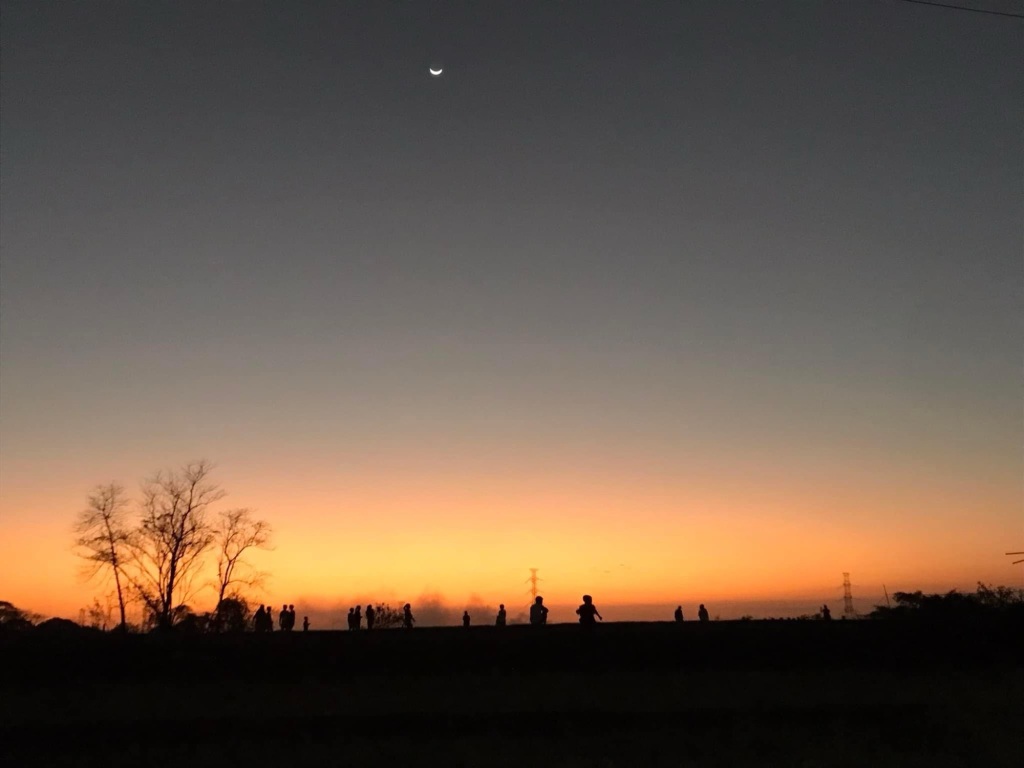
Photo by author, the metropolis at night from Timberland Highlands Resort, San Mateo, Rizal, 08 March 2025.
Both our first reading and gospel this Second Sunday in Lent are set in the darkness of the night. Despite being the favorite setting to portray evil and horror not only in movies but even in the Bible, the darkness of the night has a unique charm of its own.
It is in this darkness of the night when the moon and the stars shine brightest. It is in this darkness of the night when we are delighted with the most wonderful ensemble of sights and sound no stage could duplicate when a sparkle of fireflies outline a treetop while crickets and geckos – tuko – with all the other insects and animals sound like a live symphony orchestra.
So many things in this world and in this life are best seen and experienced in the darkness of the night to be truly appreciated. And that is the call to us this second Sunday in Lent – that we enter the darkness in our hearts with the light of Jesus Christ for us to be transformed and transfigured in his image as his disciples.
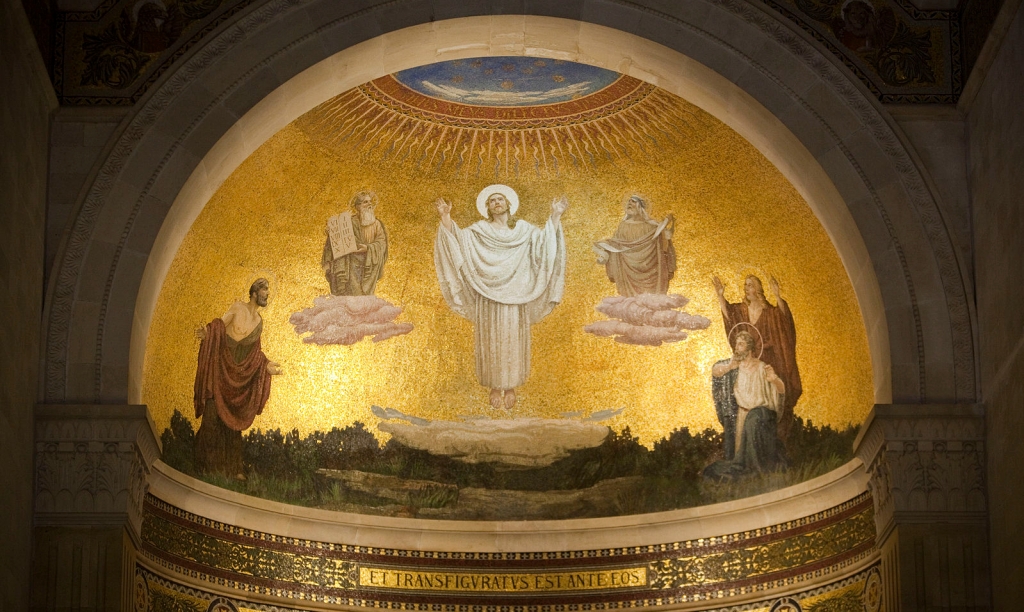
Jesus took Peter, John, and James and went up the mountain to pray. While he was praying his face changed in appearance and his clothing became dazzling white. And behold, two men were conversing with him, Moses and Elijah, who appeared in glory and spoke of his exodus he was going to accomplish in Jerusalem (Luke 9:28-31).
Mosaic inside the Basilica of the Transfiguration on Mt. Tabor, Israel from commons.wikimedia.org.
We have been saying since Ash Wednesday that life is a daily Lent, a daily exodus from darkness into light, from sin into forgiveness, from slavery into freedom.
Every day we “pass over” to many darkness in life like sickness, loss of a loved one, failures and other trials and sufferings that come our way. Sometimes so dark, sometimes not so dark. But most dark of all darkness we go through are those darkness of sin and evil along with its many scars left right in our hearts following the constant temptations by the devil for us to turn away from God, for us to refuse to love others and even our very selves.
Photo by author, St. Paul Spirituality Center, Mt. Pico, La Trinidad, Benguet, 06 January 2025.
Our readings this Sunday assure us that in that it is in those darkness we find God who had come nearest to us in Jesus Christ. It is during those darkness like an exodus that we pass from passion and death to resurrection where Christ is calling us; hence, the need for us to listen to him and follow him. It is from this passing over the darkness of sins and trials when we are purified and transformed, transfigured into better persons and disciples of Jesus because that is where his light is most visible too.
To enter into these dark places in our hearts is the beginning of our conversion, of our daily Lent when we return to God, to his covenant we keep on breaking in sin.
Photo by Ms. Analyn Dela Torre, 12 February 2024 in Bgy. Caypombo, Santa Maria, Bulacan.
Lent as a preparation to Easter is also a renewal this covenant we have in our baptism which we renew every year at the Masses of Easter. That is why we have the story of the covenant of God with Abraham in the first reading that was set at night with the darkness signifying the trials we go through in life.
As the sun was about to set, a trance fell upon Abram, and a deep, terrifying darkness enveloped him. When the sun had set and it was dark, there appeared a smoking brazier and a flaming torch, which passed between those pieces. It was on that occasion that the Lord made a covenant with Abram, saying: “To your descendants I give this land, from the Wadi of Egypt to the Great River, the Euphrates” (Genesis 15:17-18).
Feel the terrifying character of the event as narrated by the author of Genesis; but, remember also how God remained with Abraham that night. It was after this episode that God first promised Abraham to become the father of all nations with children as many as the stars above.
But it was not all light with Abraham after this episode as he went through a lot of darkness in life like when he wondered when God would finally give him his own son as he grew older. When Isaac was finally born and had grown, God tested Abraham, asking him to sacrifice to him Isaac. Abraham willingly obeyed God that as he was about to kill Isaac, an angel stopped him and told him how God was so pleased with him that he was doubly blessed anew! Abraham passed over that very dark night in his life by completely trusting God who never abandoned him in life! Most of all, because Abraham never backed out from darkness.
Photo by author, St. Paul Spirituality Center, Mt. Pico, La Trinidad, Benguet, 06 January 2025.
That is the charm of darkness: it can bring us fears and anxieties but as one poet said, only the brave who dare to walk the darkness of the night shall see the beauty of the moon and stars above. In a little while after all the uncertainties and difficulties of the night, we arrive at a new day. Darkness is the prelude to light and day.
Entering into those dark places in our hearts can be terrifying but it is the only path towards true freedom with Jesus as our companion in our exodus. Refusal to go into those dark places in our hearts will keep us only deeper in darkness – anxious and afraid, always wondering when we shall see light which will never come unless we come out and pass over the night.
Recent turn of events in our country are so Lenten in nature, our own passover and exodus – hopefully – from darkness into light.
After those long six years of darkness in the deadly war on drugs of the past administration, we finally saw the light of God’s mercy and justice coming with the arrest of the former president.
It must have been so tortuously painful to the families left behind by the thousands of victims of tokhang.
Though I feel so glad with the turn of events, I still refuse to celebrate nor even join the heated discussions. I feel more the need for us to pray and reflect, to find God and where he is leading us — maybe into those dark places in our hearts to see how we too have contributed to that dark period in our history.
A reporter-friend who volunteered in the care for orphans of the tokhang victims recently shared her reflections in these turn of events where she claimed “we are Duterte”.
Huh? It is chockful. And shocking.
As I prayed and reflected on it, I agreed with her. Prior to Duterte’s coming to power, we as a nation have allowed the forces of darkness to come upon us with the RH bill later followed by bills and proposals for divorce, same sex marriage, and return of capital punishment. There was already this great darkness hovering above us even before Duterte came to power.
Sad to say, that darkness started in our hearts which St. John Paul II referred in his encyclical Evangelium Vitae as “culture of death”.
Let us heed the calls by St. Paul in today’s second reading to “stand firm” in Jesus (Phil. 4:1) because to conduct ourselves as “enemies of the cross” of Christ will surely lead only to “destruction” (Phil. 3:18-19). Let us avert our total destruction as a nation by finally confronting the many darkness within us in Jesus Christ. Amen.Have a blessed week ahead.
*Photos in the collage are not mine but from various sources like TIME magazine and Mr. Howie Severino of GMA7 News.
God our loving Father,
as we end this first week
in Lent, teach us more on the
need to be empty of ourselves,
empty of our pride
for us to be consistent
and most especially,
kind.
We have been so filled
with the world that our
hearts burn with anger
and hate, totally disregarding
reason and morals
with so many parents
still in grief, crying for
their children mercilessly
killed on mere suspicions
while friends and neighbors
even family are caught
in a huge web of lies
everyone believes;
worst, everyone sees
one's self being so right
while others so wrong,
even accusing you, O God,
of being "unfair" like during
the time of Ezekiel.
How sad in this age of
boundless and instant
communications,
our world had shrunk
into little worlds and galaxies
of "me and mine and I";
teach us your way of kindness
in Jesus so we may see
everyone as a "kin" -
a kindred,
a one of us
filled with goodwill
for one another;
remind us always, Jesus,
that it is not enough that
we do not just kill anyone
but most of all has goodwill
with everyone right in our hearts
as a sign of true worship
for it is only when we see
each one as a kin
that loving can begin
consistently.
Amen.
Photo by author, Northern Blossoms Farm, Atok, Benguet, 27 December 2024.