Lent is believing to see Jesus

40 Shades of Lent by Fr. Nicanor F. Lalog II
Fifth Sunday in Lent-B, 17 March 2024
Jeremiah 31:31-34 + Hebrews 5:7-9 + John 12:20-33
From Google.com.

We now come to the penultimate Sunday of Lent before entering the Holy Week on Palm Sunday as we listened to the final installment of John’s narration of Jesus Christ’s final six days in Jerusalem before his Passion, Death, and Resurrection.

Our gospel today is actually set on Palm Sunday when Jesus triumphantly entered Jerusalem.

Some Greeks who had come up to worship at the Passover Feast came to Philip, who was from Bethsaida in Galilee, and asked him, “Sir, we would like to see Jesus.” Philip went and told Andrew; then Andrew and Philip went and told Jesus. Jesus answered them, “The hour has come for the Son of Man to be glorified. Amen, amen, I say to you, unless a grain of wheat falls to the ground and dies, it remains just a grain of wheat; but if it dies, it produces much fruit. Whoever loves his life loses it, and whoever hates his life in this world will preserve it for eternal life. Whoever serves me must follow me, and where I am, there also will my servant be. The Father will honor whoever serves me.

John 12:20-26
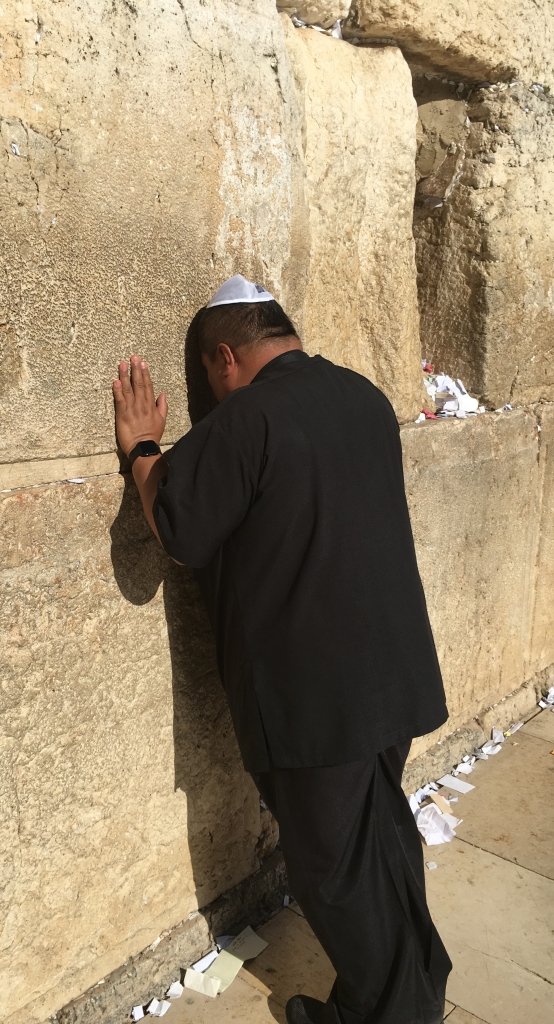
Praying at the wailing wall of Jerusalem, May 2019.

As we have been telling you, John’s gospel teems with many symbolisms and hidden meanings in the way he narrated events and scenes like when those Greeks asked Philip and Andrew to see Jesus.

If they simply wanted to catch a glimpse of Jesus, they could have easily satisfied themselves because Jesus never hid at that time. He had just entered Jerusalem, so warmly welcomed by the people, even by those Greeks perhaps. Most likely, they must have heard many things about Jesus that they wanted to go farther in requesting to see him. Hence, it was more than a request to have an audience with Jesus but something about their faith in him as they were pagans converted to Judaism.

We have to remember here that John used the verb “to see” to also mean “to believe” in his gospel account like when he narrated on Easter morning how Peter and the “other disciple” ran to the empty tomb “and he saw and believed” (Jn.20:8).

Keeping that detail on Easter morning at the empty tomb, we now understand why John never told us if Jesus met at all the Greeks requesting to see him because to see and believe Jesus is to accept and embrace wholly his Passion and Death on the Cross. This is why John jumped into Christ’s monologue upon being told by Philip and Andrew on the Greeks’ request.
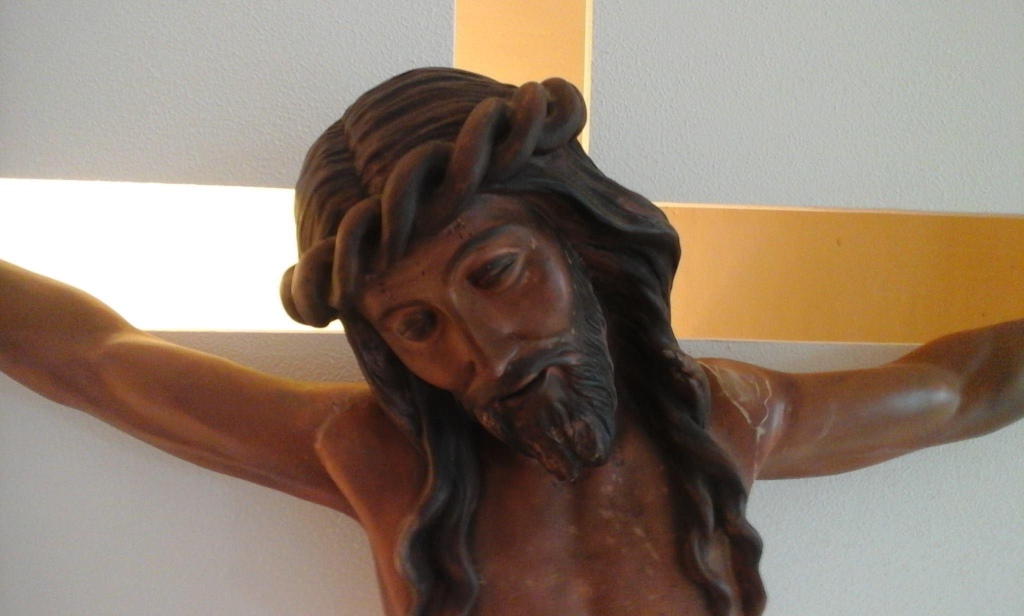
Photo by author, 2018.

What a beauty we have here because we are those Greek converts too, constantly searching, seeking to go farther in our faith in Jesus despite our sins. As we get older and mature, we realize how our days are numbered, that we will definitely die someday and meet God.

Lately I have been thinking why do we really have to be happy on our birthday – much less why greet celebrators a happy birthday when in fact every birthday is a step closer to death, is it not? I am not being morbid but it is the truest matter of fact in life. Life is a lifelong process of preparation for death. What comes next when we age? Death.

However, our faith in Jesus tells us it is not simply death as an end but a blessed death that leads to fullness in life, literally and figuratively speaking.

That is where the beauty of Christ’s parable of the grain of wheat lies, “Amen, amen, I say to you, unless a grain of wheat falls to the ground and dies, it remains just a grain of wheat; but if it dies, it produces much fruit.”

We do not simply die in the end or even in the in-betweens of life through those failures and losses, defeats and wrong moves. We get better in life as we forge on.

It is the undeniable truth written in our hearts as God told Jeremiah in the first reading, that we are God’s, we solely belong to him no matter how hard we try to flee from him and disobey him in our sins, he would always find us even if we get lost. St. Augustine said it so well, “You have made us for yourself, O Lord, and our heart is restless until it rests in you.”

There is always that inner longing for God our Creator and End. That is why God sent us Jesus his Son as the author of the Letter to the Hebrews explained in the second reading so that through all our darkness and confusions, sufferings and trials, especially in those daily deaths that weaken us in our desire to search and follow him we may still find to have the strength and courage to forge on in wanting to see him by being with him where he is always – at the Cross.

Photo by author, 2018.

This is the grace of this fifth Sunday in Lent: we believe so we may see, we die in order to live. Both believing and dying in order to see and to live are grace from God freely given to us even if we are not worthy at all.

The world tells us always that to see is to believe but Christ tells us that first we must believe so that we would see; it is the same thing with living – die to one’s self in order to live fully because “whoever loves his life loses it.”

When we read or watch the news, many times we feel so exasperated and hopeless with the world. Imagine a resort right in a natural wonder there in the Chocolate Hills of Bohol? Or, land developers covering swamps without any considerations for others and the environment? Or, the mess and wastage happening in our offices, schools and homes? Do not forget us your priests living far from witnessing Christ in charity and service?

It’s a crazy world! And in all these abuses, the more we have become empty and lost that is why in the process, more and more of us never stop to believe and see, to hope and pray like those Greek converts seeking Jesus, for only in him we find rest and peace. Let us pray:

Lord Jesus Christ,
many times I really do not know
where I am going;
I cannot see
the road ahead of me
while many times
I wonder if I am really
following you and doing your will;
but at least, Jesus,
I am sure it is still you
whom I wish to see,
it is you I always desire
even if many times
it does not show
because this time
I am sure
you alone
is my God,
my life,
my fulfillment.
Therefore, like the psalmist,
"Create a clean heart for me,
O God, and a steadfast spirit
renew within me.
Cast me not out
from your presence,
and your Holy Spirit
take not from me"
(Psalm 51:12-13).
Amen.

Have a blessed week ahead, everyone!

From Google.com.

Cross my heart?

The Lord Is My Chef Daily Recipe for the Soul by Fr. Nicanor F. Lalog II
Thursday, Feast of the Exaltation of the Cross, 14 September 2023
Numbers 21:4-9 ><]]]]'> Philippians 2:6-11 ><]]]]'> John 3:13-17
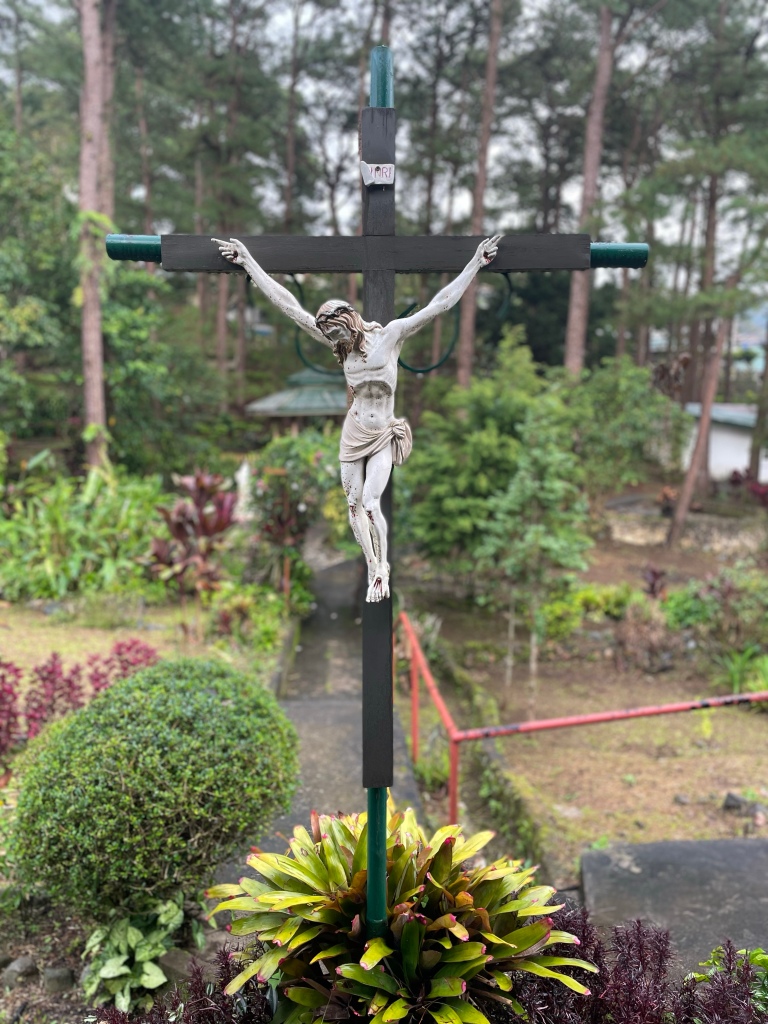
Photo by author, Sacred Heart Novitiate, Novaliches, QC, 2017.

The cross is perhaps one of the most widely used but also abused and misunderstood sign in almost every generation. In fact, we are so accustomed to the cross of Jesus Christ found everywhere like in churches and cemeteries, offices and classrooms, hospitals, inside every kind of vehicle and, of course, houses. Almost everybody carry it on our persons for various reasons: as an object of veneration, as a badge, or as a jewel.

On the cross we find Jesus shown in glory, peacefully sleeping in death, sometimes with his body broken by suffering. Hence, many times we use the word “cross” like in “cross my heart” to indicate our sincerity and truthfulness. But, are we truly aware of its meaning and significance in our faith, of its centrality as the symbol of God’s love for us expressed by the self-sacrificing death of Jesus Christ his Son?

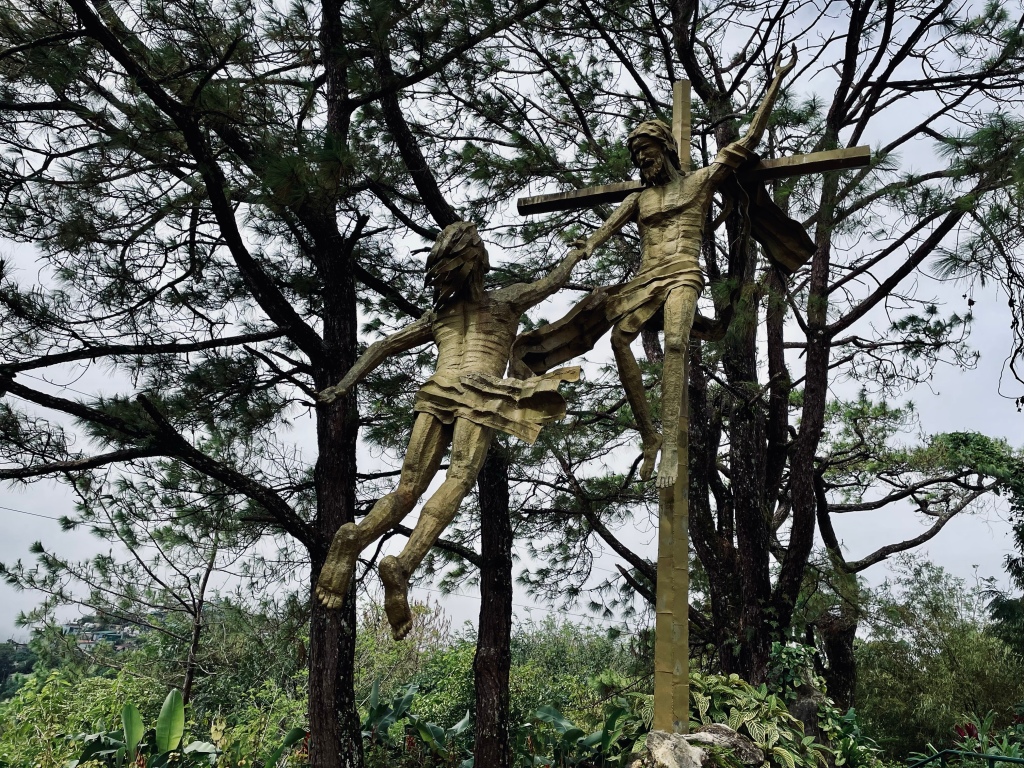
Photo by author, St. Scholastica Convent, Baguio City, 23 August 2023.

Today we celebrate the Exaltation of the Cross which started in the fourth century. According to legend it began with the miraculous discovery of the True Cross by Helena, mother of the Emperor Constantine, on 14 September 326, while she was on a pilgrimage to Jerusalem. She then ordered through her son the emperor the building of the Church of the Holy Sepulchre that was dedicated nine years later with a portion of the True Cross placed inside it in September 13, 335. The following day, the Cross was brought outside of the church to be venerated by the clergy and the faithful.

In the year 627, during the reign of the Emperor Heraclius I of Constantinople, the Persians conquered the city of Jerusalem and removed a major part of the Cross from its sanctuary. The emperor then launched a campaign to recover the True Cross which he regarded as the new Ark of the Covenant for the new People of God. Before embarking into war, Emperor Heraclius went to church wearing black as a sign of penance, then prostrated himself before the altar and begged God for courage. His prayer was granted as he won the war and recovered the Cross from the Persians. He brought the Cross back to Jerusalem in 641 amid great celebrations by carrying it on his shoulders. Upon reaching the gate leading to Calvary, the emperor could not go forward! Heraclius and his retinue were astonished and could not understand what had happened until the Patriarch Zachary of Jerusalem told him, “Take care, O Emperor! In truth, the imperial clothing you are wearing does not sufficiently resemble the poor and humiliated condition of Jesus carrying His cross.”

Upon hearing those words, the emperor removed his shoes and bejewelled robes, put on a poor man’s clothing and was eventually able to proceed to Calvary and replaced the Cross inside the Church of the Holy Sepulchre where a number of miracles happened during the occasion: a dead man returned to life, four paralytics were cured, ten lepers were healed, 15 blind men were given their sight, with several possessed people exorcised and many sick people totally healed!

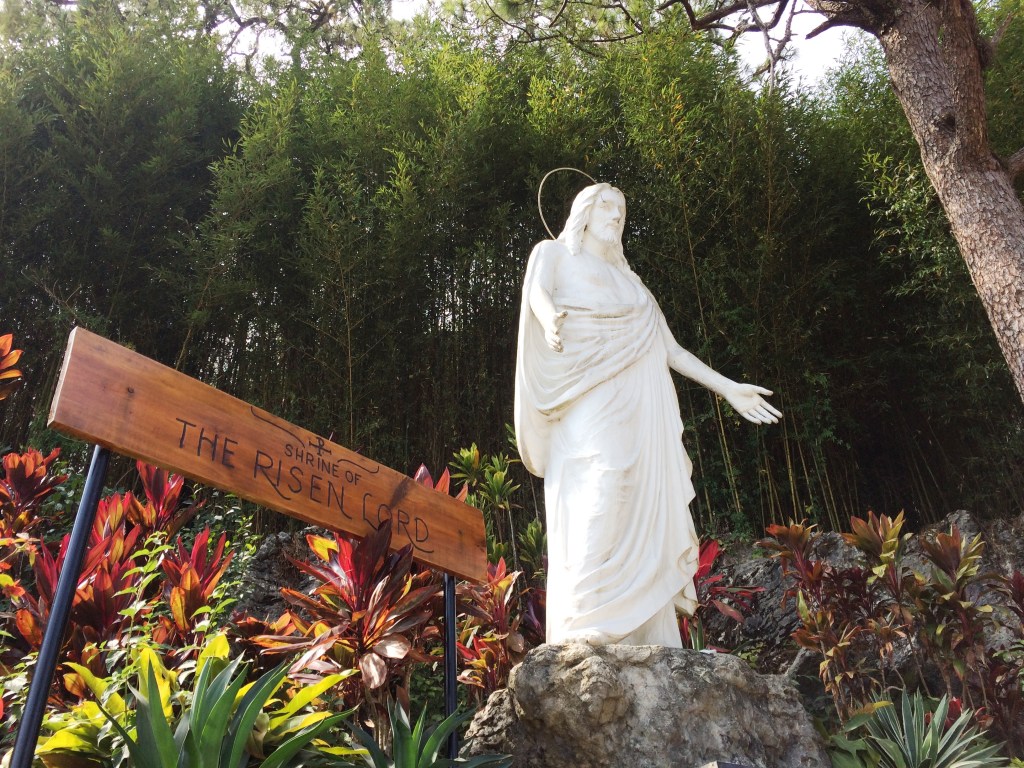
Photo by author, Mirador Jesuit Villa & Retreat House, Baguio City, 24 August 2023.

Very notable in this story were the words of the Patriarch of Jerusalem. It was only after the emperor had taken off his royal clothings and put on those of the poor was he able to carry the Cross.

It is the same thing that is asked of us today: it is so easy to display the cross inside our homes and cars, or wear it as a jewelry or even as a tattoo on our skin. But that would amount to nothing unless we have the cross inside our hearts, our very being. More than the many signs of the cross and imaginary drawing of its lines we draw on our chest is the need for us to empty ourselves of our pride and sins so that we can be filled by Jesus Christ.

Brothers and sisters: Christ Jesus, though he was in the form of God, did not regard equality with God something to be grasped. Rather, he emptied himself, taking the form of a slave, coming in human likeness; and found human in appearance, he humbled himself, becoming obedient to death, even death on a cross.

Philippians 2:6-8

Called kenosis in Greek, self-emptying is the way of the Cross of Christ. It is choosing love and mercy than self-centeredness and self-righteousness; sacrifice than satisfaction; fairness and justice than greed and possession; bearing all the pains and perseverance than complaining and whining about difficulties and trials in life like the Israelites in the wilderness (first reading); and, thinking more of others than of one’s self.

Photo by author, 02 September 2023.

The recent COVID-19 pandemic had taught something very amusing about the positivity of being negative, when negative was actually positive – healthy and COVID free! Remember how during those days when we would always wish we would yield negative results in our swab tests for COVID?

When we look at the sign of the cross (+), it is a positive sign, a plus sign. Though the cross calls us to let go, to be detached and dispossessed, it is actually an invitation to have more of God, of life and fulfillment! In this time of affluence when everything is practically easily available for as long as you have the means and the resources, the sign of the Cross reminds us that life is more of letting go and of giving than of having like God who “so loved the world that he gave his only Son, so that he who believes in him might not perish but might have eternal life” (Jn.3:16). St. Francis of Assisi said it perfectly why the Cross is an exaltation, a triumph:

For it is in giving that we receive,
it is in pardoning that we are pardoned,
and it is in dying that we are born to eternal life.  

Amen.  Have a blessed Thursday!

Awesome

The Lord Is My Chef Daily Recipe for the Soul by Fr. Nicanor F. Lalog II
Friday, Memorial of St. Clare, Virgin, 11 August 2023
Deuteronomy 4:32-40   ><}}}*> + ><}}}*> + ><}}}*>   Matthew 16:24-28
Photo by author, Camp John Hay, 12 July 2023.
"Did a people ever hear the voice of God
speaking from the midst of fire,
as you did, and live?

Or did any god venture to go and take
a nation for himself from the midst of another nation,
by testings, by signs and wonders, by war, 
with his strong hand and outstretched arm,
and by great terrors, all of which the Lord, your God,
did for you in Egypt before your very eyes?"
(Deuteronomy 4:33-34)
I heard your questions,
God our Father,
like a whisper so near
yet so loud and clear from
deep within;
and you know my answer,
so well, Lord
and yet despite my deep yes,
here I am still wandering
in the desert,
looking somewhere else,
running away from you,
doubting you
when deep within me,
I know,
I am so sure,
I have experienced
"there is no other" God
but YOU.
Of course my life is not marked
with such dramatic events as you did
to your people in the desert
but still, I could feel them,
I have felt them
and merely reading the questions by Moses
put me into silence
for deep inside me,
you have never stopped in
creating wonders
in my life that make me realize
what a gift and a privilege
to be alive!
And indeed,
as your Son Jesus Christ
had taught us, to have you
is the only valuable,
the only worthy
response of gratitude
to you, O God;
like St. Clare,
let me come after Jesus
by denying myself, 
taking my cross
and following him
in love and mercy,
kindness and fidelity,
service and intimacy.
Amen.
Photo by author, La Mesa Dam Watershed Park, Quezon City, January 2023.

Praying to be generous

The Lord Is My Chef Daily Recipe for the Soul by Fr. Nicanor F. Lalog II
Tuesday, Memorial of St. Cyril of Alexandria, Bishop & Doctor of Church, 27 June 2023
Genesis 13:2, 5-18   ><]]]]'> + ><]]]]'> ><]]]]'>   Matthew 7:6, 12-14
Photo by author, the narrow door into the Church of the Nativity, Bethlehem, the Holy Land, 2019.
Lord Jesus Christ,
teach us to be generous
by choosing to enter 
through the narrow gate
that leads to life (Mt. 7:13);
let us realize that generosity
is choosing which is more
difficult, which is less,
forgetting one's self
in order to give others better
chances,
better choices,
better portions.
Like Abraham
in today's first reading,
generosity is being able
to give the best freely
when we completely trust
God's generosity;
God promised to bless
Abraham more abundantly
not only with wealth but 
most of all of being the father
of all nations with descendants 
more than the dust of earth
after Lot had chosen 
the plains of Jordan with
its abundant water
not realizing the wicked
inhabitants of Sodom. 
Above all,
generosity is thinking more 
of persons than objects
like when Abraham felt the
need for him and Lot to part
ways lest their slaves
quarrel.
Remind us, dear Jesus,
to be always generous
not only with our goods
but most of all with 
persons because 
we can only find you
and fulfillment
in others we 
consider as 
brothers and sisters
in you.
Amen.

Jesus the Good Shepherd, our Gate

The Lord Is My Chef Sunday Recipe for the Soul by Fr. Nicanor F. Lalog II
Fourth Sunday in Easter-A, Good Shepherd Sunday, 30 April 2023
Acts 2:14, 36-41 ><}}}*> 1 Peter 2:20-25 ><}}}*> John 10:1-10
Photo by author, Baguio City, January 2018.

Beginning this Sunday, all our gospel readings will be about the major teachings of Jesus before his arrest that led to his Passion, Death, and Resurrection. Like the Apostles, we are reviewing the Lord’s final teachings in the light of Easter to fully appreciates its meaning and significance.

First of these teachings is the Lord’s declaration, “I am the good shepherd” (Jn. 10:11).

This is very significant in the fourth gospel where we find Jesus using the phrase I AM. It was not just reminiscent of God identifying himself as I AM WHO AM to Moses in the Old Testament but most of all, for Jesus it is his self-identification as the Christ, the Son of God whom his enemies refused to accept nor recognize.

More interesting in our gospel this Sunday is how the Good Shepherd discourse of Jesus actually began with his claim as being the gate or door through whom the sheep enter and pass through.

Jesus said: “Amen, amen, I say to you, whoever does not enter a sheepfold through the gate but climbs over elsewhere is a thief and a robber. But whoever enters enters through the gate is the shepherd of the sheep. I am the gate. Whoever enters through me will be saved, and will come in and go our and find pasture. A thief comes only to steal and slaughter and destroy; I came that they might have life and have it more abundantly.”

John 10:1-2, 9-10
Photo from https://aleteia.org/2019/05/12/three-of-the-oldest-images-of-jesus-portrays-him-as-the-good-shepherd/.

Jesus spoke twice “I am the gate” in vv. 7 and 9 to emphasize and clarify that flock belongs to him, never to us. That is why Jesus is the gate, the only way through whom the sheep pass through. Hence, the true mark of a good shepherd is one who passes in Jesus as the gate, the owner of the sheep. Whoever does not pass through Jesus is a thief, a robber. A fake shepherd.

Nobody else could ever replace Jesus as Shepherd of the flock but he wants us all to be shepherds like him, passing in him our gate. This we can understand when we fast-forward to his third and final appearance to the seven disciples at Lake Tiberias after Easter. After their breakfast at the lakeshore, Jesus asked Simon Peter thrice, “Do you love me?” In every question, Peter professed his love for Jesus who asked him only for one thing, “feed my sheep” until finally adding at the end, “follow me” (cf. Jn. 21: 15-19). His call to follow him came after describing to Peter how he would suffer and die for him.

To pass in Jesus as the door to the sheep is first of all to love Jesus.

We all have experienced that loving calls for nearness which Nat King Cole described perfectly in his hit “The Nearness of You”. Whenever we love somebody, we want to be always near our beloved. The same desire we must possess if we truly love God. Furthermore, being near demands that we share feelings with the one we love – his/her joy is our joy, his/her pain is our pain. No wonder when we love somebody, we are willing to suffer. That is the first true mark of our love for Christ – we are willing to suffer for him and with him on the Cross!

That is the first meaning of Jesus is the gate of the sheep as the Good Shepherd: his Cross is our path to fulfillment, to true joy in this life and to eternal life eventually. We can only have a true relationship with him through others when we are willing to share in others’ sufferings like Jesus. Because of his Passion, Death and Resurrection, Jesus has turned suffering into a grace itself and a source of grace too because to suffer with somebody else is love. Anyone who avoids suffering does not love at all and can never be a shepherd like Jesus.

The second meaning of Jesus is the gate flows from that nearness with him – it is not enough to be close but most of all, to be obedient, submitting our total self to him in the same manner he obeyed the Father as expressed in St. Paul’s beautiful hymn found in Philippians 2:6-11.

How close can we come to Jesus is the sum of our obedience to him. Or to anyone we love. It is only in being obedient can we truly follow Christ and those we love. When we love, we are not presented right away with everything that could happen in our relationship and journey in life. Love is a wholesale, a package deal always without ifs nor buts. Nobody knows to where our lives would lead to as most couples could attest. That is why, more than being close and near to Jesus or our beloved, we need to be obedient too because that is the mark of true love when we humbly submit ourselves to the one we love.

Obedience calls us to go down to our lowest level because that is the highest mark of our love too. Recall how Jesus at their last supper “loved his own in the world and he loved them to the end” (Jn.13:1) by washing their feet. See how the Son of God went so low, lower than what slaves were not supposed to do, that is, wash feet of others. Jesus showed this in no uncertain terms the following Good Friday by dying on the Cross, of literally going under earth at his burial that led to his highest glory, his Resurrection.

That is why Jesus is the Good Shepherd by first being the gate because in him, we have shared in his pasch to share in his glory. As the gate or door, we enter in Jesus by sharing in his paschal mystery of loving, suffering, and following.

Photo by Dr. Mylene A. Santos, MD, 2020.

Today we are reminded that our being the flock of Jesus, a sheep of the Good Shepherd is not our choice but a gift of God himself.

Our coming together in the church, in our celebrations and sacraments is not a mere social function out of our own volition. It is a gift and a call from Jesus. That is why it is very important to celebrate the Sunday Mass.

It is Christ himself we refuse and turn down when we skip Sunday Masses because when we love somebody, we show it by being present, being near, ready to suffer and obey to show our love.

Jesus is not asking us too much except an hour each week to immerse ourselves in his life giving words, to find him with others we meet and live with.

Peter said something still very true especially in our time, “Save yourselves from this corrupt generation” (Acts 2:41) where God is totally disregarded as if we can live without him, without loving like him. Let us return to Jesus, pass in him our door to life and fulfillment by loving, suffering and following him our Good Shepherd. Amen. Have a blessed week and month of May ahead!

Lent is arising, not being afraid

40 Shades of Lent by Fr. Nicanor F. Lalog II
Second Sunday in Lent-A, 05 March 2023
Genesis 12:1-4 >+< 2 Timothy 1:8-10 >+< Matthew 17:1-9
Photo by author, sunrise at Taal Lake, 08 February 2023.

Something so personal has happened with me this past week. It is something that is still unfolding, making me realize so many things in my life and ministry that as I continue to reflect on the death last Sunday of our elderly priest, Msgr. Vicente Manlapig, at the Fatima University Medical Center where I serve as its chaplain.

I was out when told about Msgr. Manlapig’s passing shortly before 3PM. It was the First Sunday of Lent. After saying a prayer for him, it suddenly dawned upon me that he was the second elderly priest I had taken cared of who also died in this blessed Season of Lent. The first was Msgr. Macario Manahan who died 16 March 2014, the Second Sunday of Lent at that time. I was with him when he died that afternoon as he lived very near my former parish assignment.

What a tremendous blessing God has given me to have attended to their spiritual needs preparing them for their deaths, of how life indeed is a daily Lent preparing for Easter when we have to go through many difficult series of temptations and sufferings that lead us to our transfiguration (https://lordmychef.com/2023/02/27/deaths-in-lent/).

It is the very path of life and death of every disciple of Jesus, from temptations in the wilderness to transfiguration on the high mountain. It is something we all have to go through in Christ, with Christ and through Christ.

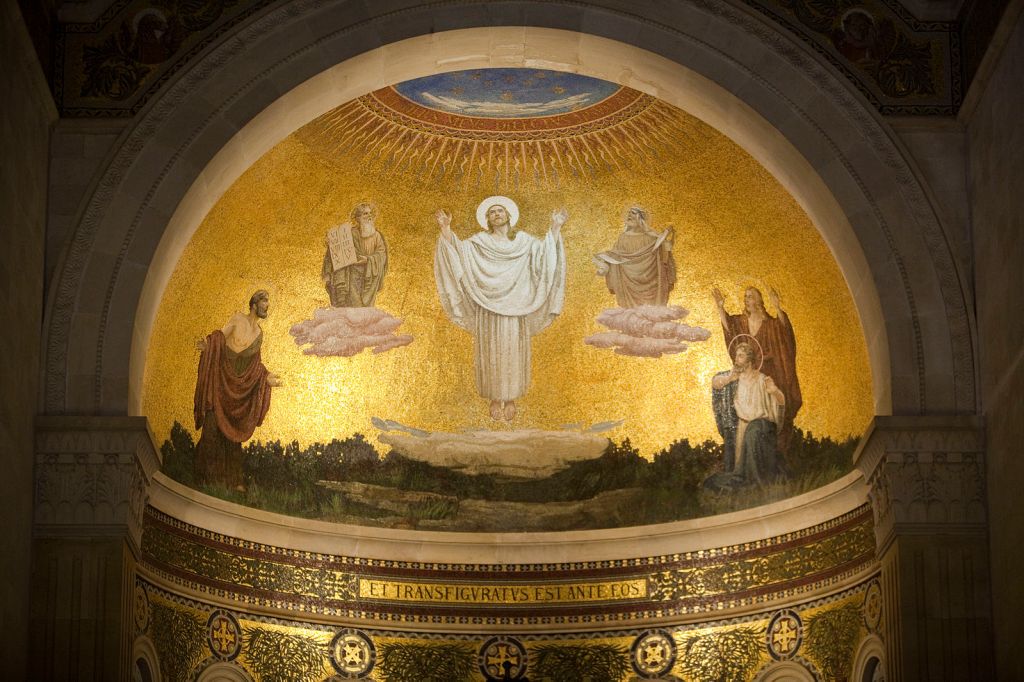
Jesus took Peter, James and John his brother, and led them up a high mountain by themselves. And he was transfigured before them; his face shone like the sun and his clothes became white as light. And behold, Moses and Elijah appeared to them, conversing with him. Then Peter said to Jesus in reply, “Lord, it is good that we are here…” While he was still speaking, behold, a bright cloud cast a shadow over them, then from the cloud came a voice that said, “This is my beloved Son, with whom I am well pleased; listen to him.” When the disciples heard this, they fell prostrate and were very much afraid. But Jesus came and touched them, saying, “Rise, and do not be afraid.” And when the disciples raised their eyes, they saw no one else but Jesus alone. As they were coming down from the mountain, Jesus charged them, “Do not tell the vision to anyone until the Son of Man has been raised from the dead.”

Matthew 17:1-4, 5-9
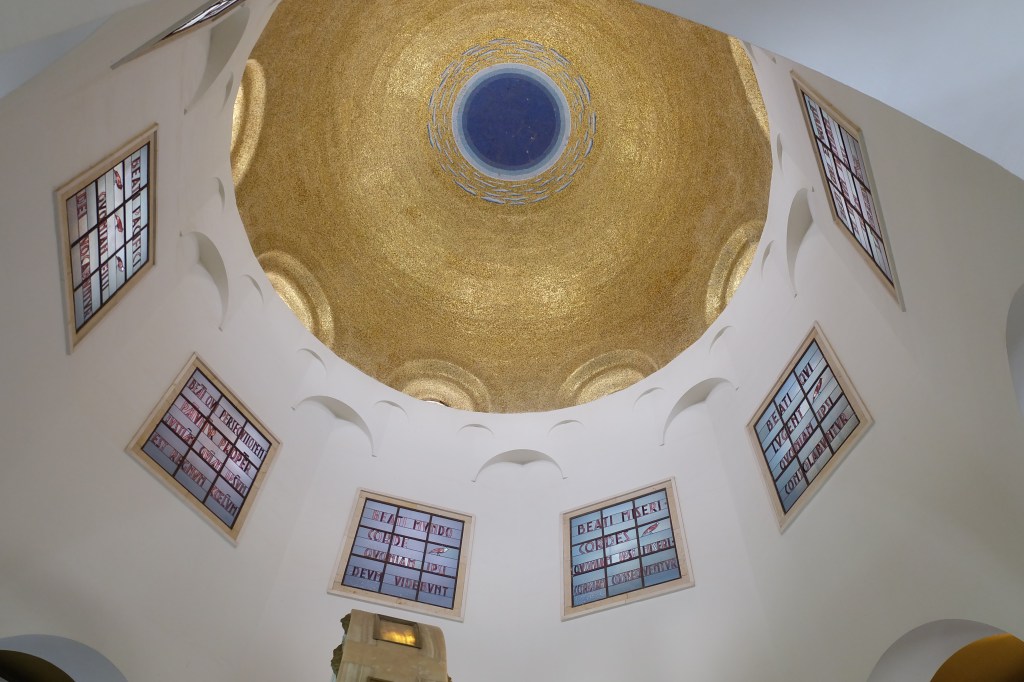
Photo from commons.wikimedia.org of mosaic inside the Basilica of the Transfiguration on Mt. Tabor, Israel.

Unlike Luke’s account that was set in the context of a prayer, Matthew’s version of the transfiguration of Jesus Christ illuminates the Lenten pilgrimage of the Church that is the tragedy of the Cross being seen always in the perspective of the Easter radiance. It is the oneness and inseparability of Christ’s divinity and glory with the Cross through which we get to know Jesus correctly.

Recall that the transfiguration happened after Peter’s confession of Jesus as “the Messiah, the Son of the living God” at Caesarea Philippi (Mt.16:16) where Jesus also made the first prediction of his passion, death and resurrection. From that day on, Jesus began instilling into the Twelve his conditions of discipleship, “Whoever wishes to come after me must deny himself, take up his cross and follow me” (Mt. 16:24). It was a very difficult lesson for them to learn and accept that triggered Judas to betray Jesus. The remaining disciples would only fully appreciate it after the Easter event with the help of the Holy Spirit on Pentecost.

That is why the transfiguration was actually some sort of a “teaching aid” for this most difficult lesson of his disciples when Jesus gave Peter, James and John a glimpse of his coming glory after his pasch. See that very clearly, Matthew recorded Christ’s instruction not to tell the “vision” to anyone until Easter; the transfiguration did happen and was seen by everyone there as Matthew used the word vision to describe it.

Like the three disciples, many of us are given with this unique privilege by Jesus to have a glimpse and vision of Easter, of glory when we join him on the Cross with our own sufferings and trials and when we accompany those in severe tests in life like the sick and dying.

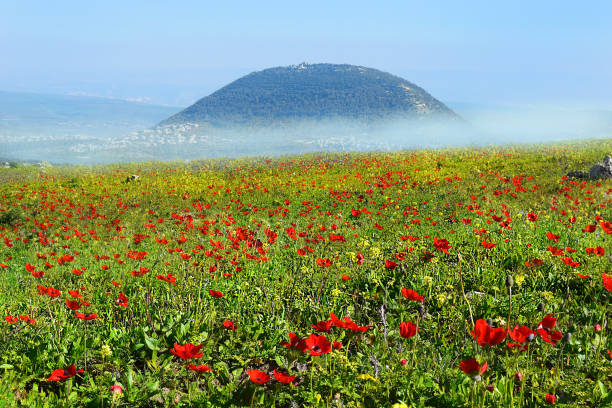
Photo from iStockphoto.com of Mount Tabor in Israel where Jesus is believed to have transfigured.

Amid the pain and hurts we go through or see in others, we “see” Jesus, we feel Jesus, we experience Jesus.

Many times like Peter we speak and do things without really thinking well about them because we are overwhelmed by the experience as well as the vision and sight.

And most of the time, the sight and experiences are very frightening when God speaks to us, telling us to listen to Jesus his Son, to simply obey him and trust him.

Here we have a deepening of our reflection last Sunday of the need to fix our eyes on Jesus son that we may not fall into temptations and sin. Many times we do not see everything clearly but if we close our eyes and have faith in Christ, things get clearer until it is him alone do we see with us especially after passing over a turmoil or a test in life. Like the first man and woman, our eyes are misled by so many things that look so good but not good at all. In fact, there are things that look bad that could really be good after all like pains and sufferings in life!

In the second reading, St. Paul tells us through St. Timothy to “bear your share of hardship for the gospel with the strength that comes from God” (2 Tim. 1:8) which matches directly the instruction in the voice heard during the transfiguration, “This is my beloved Son, with whom I am well pleased; listen to him” (Mt. 17:5). After the transfiguration, everything that Jesus would tell his disciples and everyone that include us today is his coming passion, death and resurrection as well as the conditions of discipleship we mentioned earlier. God wants us to listen and follow his Son Jesus Christ to the Cross in order to join him in the glory of Easter.

We are transfigured and transformed into better persons by our pains and sufferings. That is the irony and tragedy of this age: we have everything like gadgets and money and other resources to make lives easier and comfortable but we have become more lost and alienated, empty and no direction in life. There cannot be all glory without sorrow; no Easter Sunday without Good Friday.

Lent is a journey back home to God who wants us all to share in his glory through Jesus Christ’s passion, death and resurrection. It is a blessed season we are reminded to always arise in Christ, to have courage and be not fearful of failures because right now, we are already assured of victory and glory in Jesus. Let us ascend with him the high mountain of sacrifices and hard work, of prayers and patience, mercy and forgiveness to be transfigured and glorified like him. Let us imitate Abraham in the first reading to respond to this call by God with faith and hope, obedience and perseverance. Amen. Have blessed and transformative week ahead.

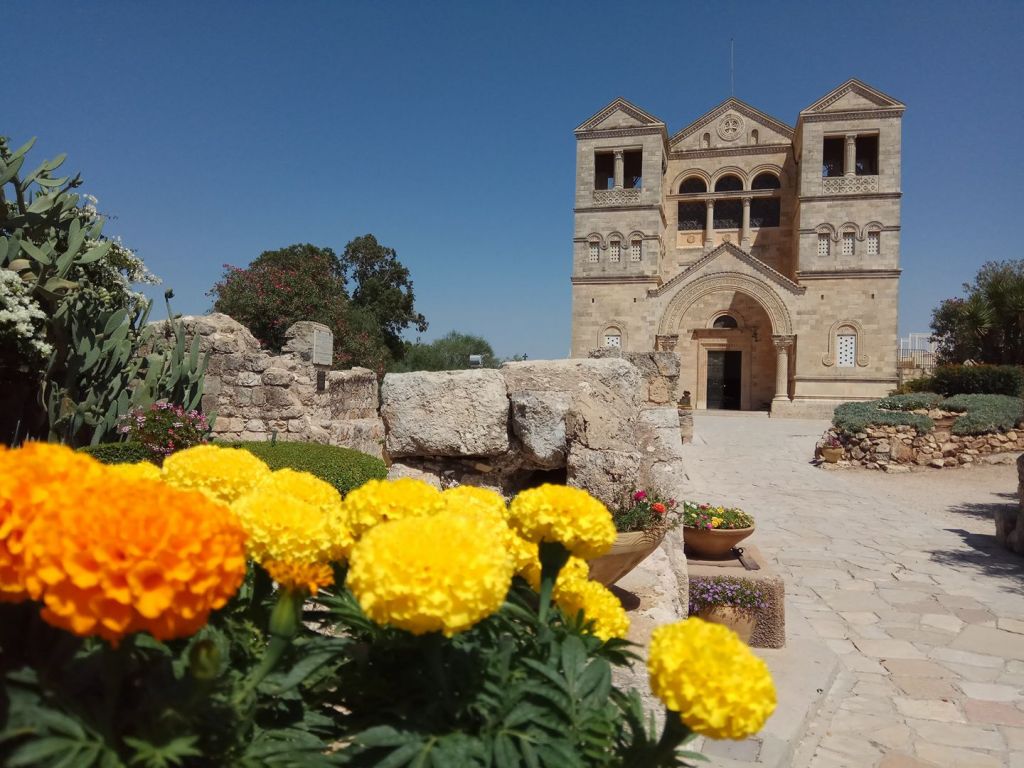
Photo from custodia.org of Basilica of the Transfiguration on Mt. Tabor, Israel.

Life’s many crossovers

The Lord Is My Chef Daily Recipe for the Soul by Fr. Nicanor F. Lalog II
Monday in the Fourth Week of Ordinary Time, Year I, 30 January 2023
Hebrews 11:32-40     ><0000'> + ><0000'> + ><0000'>     Mark 5:1-20
Photo by author, sunrise at Bgy. Igulot, Bocaue, Bulacan, 29 January 2023.
Thank you dear Jesus
for this Monday;
another "crossing over"
from Sunday rest yesterday
to working days beginning
today.
Today's gospel speaks
so beautifully of life's many
crossovers with you leading us,
joining us, coming to us to heal us,
to cleanse us, to forgive us:

Jesus and his disciples came to the other side of the sea, to the territory of the Gerasenes. When he got out of the boat, at once a man from the tombs who had an unclean spirit met him. The man had been dwelling among the tombs, and no one could restrain him any longer, even with a chain.

Mark 5:1-3
Many times, O Lord,
we have been bound by chains
of sins and shackles of vices
we have found comfort with;
like that man, some of us have
been living in tombs among
the dead and zombies;
but worst, dear Jesus,
were the people who drove you
away after you have cleansed
that man of his evil spirits,
giving more importance to the herd of
swine that perished than to the one
possessed person freed from evil.
Lord Jesus,
life is a series of crossing overs
from darkness to light,
from ignorance to wisdom,
from slavery to freedom,
from sin to grace;
let us not be afraid to cross
over to the other side to follow you,
to cross with you in faith;
let us lead others into crossing
over through the nights of life into
the day filled with your grace and
challenges; most of all, let us cross 
over life with firm faith in you,
persevering even if we do not receive
"what had been promised" because
"God had foreseen 
something better for us" (Heb.11:39-40).
Amen.

True blessedness

The Lord Is My Chef Sunday Recipe for the Soul by Fr. Nicanor F. Lalog II
Sunday in the Fourth Week of Ordinary Time, Year A, 29 January 2023
Zephaniah 2:3, 3:12-13 ><}}}*> 1 Corinthians 1:26-31 ><}}}*> Matthew 5:1-12
Photo by author, 2020.

Blessedness is a very contentious term for us Filipinos. Very often, we equate blessedness with being rich and wealthy like having a lot of money, a beautiful house, and the latest car model as well as clothes and gadgets. Being blessed sometimes means being lucky or fortunate like winning the lotto or having a child graduating in college or getting promoted in one’s job.

In the Visitation, Elizabeth defined for us the true meaning of being blessed like Mary as someone who believed that what the Lord had promised her would be fulfilled (Lk.1:45). Blessedness is essentially a spiritual reality than a material one; however, it implies that being blessed results from doing something good like being faithful to God.

Today in our gospel from Matthew, Jesus shows us that blessedness is still a spiritual reality than a material one but, it is more of a being – like a status in Facebook – than of doing.

Most of all, being blessed is not being in a good situation or condition when all is well and everything proceeding smoothly in life; blessedness according to Jesus at his sermon on the mount is when we are on the distaff side of life like being poor, being hungry, being persecuted and insulted – being like him!

Photo by author, Church of the Beatitudes, Israel, 2019.

“Blessed are the poor in spirit, for theirs is the kingdom of heaven. Blessed are they who mourn, for they will be comforted. Blessed are the meek, for they will inherit the land. Blessed are they who hunger and thirst for righteousness, for they will be satisfied. Blessed are the merciful, for they will be shown mercy. Blessed are the clean of heart, for they will see God. Blessed are the peacemakers, for they will be called children of God. Blessed are they who are persecuted for the sake of righteousness, for theirs is the kingdom of heaven. Blessed are you when they insult and persecute you and utter every kind of evil against you falsely because of me. Rejoice and be glad, for your reward will be great in heaven.”

Matthew 5:3-12

After going around the shores of Galilee, preaching and healing the people, Jesus went up a mountain upon seeing crowds were following him. They were mostly poor people with deep faith in God, hoping and trusting only in him for their deliverance called the anawims.

They were in painful and difficult situations, maybe like many of us, fed up with the traffic and rising costs of everything, fed up with the corruption among public officials and most of all, disillusioned with our priests and bishops!

Then, Jesus called them blessed.

Now, please consider that it is more understandable and normal to say that after being persecuted or after losing a loved one, after all these sufferings that people would be blessed, that the kingdom of God would be theirs.

But, that is not the case with the beatitudes whereby Jesus called them already blessed now, right in their state of being poor, being persecuted, being maligned!

Keep in mind that Matthew’s audience were his fellow Jewish converts to Christianity. By situating Jesus on the mountain preaching his first major discourse, Matthew was reminding his fellow Jewish converts of their great lawgiver, Moses who stood on Mount Sinai to give them the Ten Commandments from God.

However, in the sermon on the mount, Matthew was presenting Jesus not just as the new Moses but in fact more than Moses because Jesus himself is the Law. His very person is what we follow that is why we are called Christians and our faith is properly called Christianity so unlike other religions that are like philosophies or any other -ism.

To understand the beatitudes, one has to turn and enter into Jesus Christ for he is the one truly poor in spirit, meek, hungry and thirsty, merciful, clean of heart, who was persecuted, died but rose again and now seated at the righthand of the Father in heaven. Essentially, the Beatitudes personify Jesus Christ himself. Those who share what he had gone through while here on earth, those who identify with him in his poverty and meekness, mercy and peace efforts, and suffering and death now share in his blessedness.

Therefore, the Beatitudes are paths to keeping our relationship with Jesus Christ who calls us to be like him – poor, hungry and thirsty, meek, clean of heart and persecuted. The Beatitudes are not on the moral plane like the Decalogue that tells us what to do and not to do. Have you ever used the Beatitudes as a guide in examining your conscience when going to Confessions? Never, because the Beatitudes are goals in life to be continuously pursued daily by Christ’s disciples.

Photo by author, Church of the Beatitudes, Israel, 2017.

The Beatitudes are more on the spiritual and mystical plane of our lives that when we try imitating Jesus in his being poor and merciful, meek and clean of heart, then we realize and experience blessedness as we learn the distinctions between joy and happiness, being fruitful and successful.

That is when we find fulfillment while still here on earth amid all the sufferings and trials we go through because in the beatitudes we have Jesus, a relationship we begin to keep and nurture who is also the Kingdom of God. Of course, we experience its fullness in the afterlife but nonetheless, we reap its rewards while here in this life.

As we have noted at the start, we must not take the beatitudes in their material aspect but always in the spiritual meaning. This we find in the first beatitude, Blessed are the poor in spirit, for theirs is the kingdom of heaven.

Actually, this first beatitude is the very essence of all eight other blessedness. Everything springs forth from being poor in spirit, of having that inner attitude and disposition of humility before God. We cannot be merciful and meek, nor pure of heart nor peacemakers unless we become first of all poor in spirit like Jesus, who, “though he was in the form of God, did not regard equality with God something to be grasped. Rather he emptied himself, taking the form of a slave, coming in human likeness and humbled himself” (Phil. 2:6-7, 8).

The prophet Zephaniah showed us in the first reading that poverty in the Old Testament does not only define a social status but more of one’s availability and openness to God with his gifts and calls to us to experience him and make him known. Experience had taught us so well that material poverty is one of life’s best teacher as it leads us to maturity and redemption best expressed in the Cross of Jesus Christ.

In this sense, the beatitude is also the “be-attitude” of every disciple who carries his cross in following Christ. See that each beatitude does not refer to a different person; every disciple of Jesus goes through each beatitude if he/she immerses himself/herself in Christ. That is why last week Jesus preached repentance which leads to conversion. Notice that the beatitudes of Christ are clearly opposite and contrary to the ways of the world as St. Paul tells us in the second reading with God calling the weak and lowly to manifest his power and glory.

Many times in life, we fail to recognize our blessedness when we are so focused with what we are going through, with our work and duties and obligations. This Sunday, Jesus takes us up on the mountain, in the celebration of the Holy Eucharist for us to see ourselves blessed and loved right in the midst of our simplicity and bareness, sufferings and pains. Stop for a while. Find Christ in all your troubles or darkness in life. If you do not find Jesus in your labors and burdens, you are just punishing yourself. If you find Christ because you see more the face of other persons that you become merciful, you work for peace, you mourn and bear all insults and persecution… then, you must be loving a lot. Therefore, you are blessed! Amen.

Have a blessed week ahead!

Photo by author, Church of the Beatitudes, Israel, 2017.

Advent is also the coming of the Cross

The Lord Is My Chef Daily Recipe for the Soul by Fr. Nicanor F. Lalog II
Wednesday in the First Week of Advent, Feast of St. Andrew the Apostle, 30 November 2022
Romans 10:9-18   ><}}}}*> + ><}}}}*> + ><}}}}*>   Matthew 4:18-22

Brothers and sisters: If you confess with your mouth that Jesus is Lord and believe in your heart that God raised him from the dead, you will be saved.

Romans 10:9
If Advent is the preparation 
for your coming, Lord Jesus Christ,
then Advent is also the preparation
for the coming of your Cross!
As St. Paul had taught us in all his
writings, there can be no proclamation of
of your salvation for us without preaching
your Cross, O Lord Jesus Christ!
Without your Cross, O Lord,
all your words and deeds
would be empty;
that is why, there is no saint
without a love for your Cross!
Teach us to love the cross 
you have assigned each of us
because it is on the Cross 
where you are found, Lord Jesus;
like St. Andrew, make us realize
that our own crosses can only have value
if we consider and accept them
as part of your own Cross;
though our crosses may be
of different shapes or colors,
each one is always a reflection of 
your eternal light, dear Jesus,
that ennobles our sufferings and pains.
Amen.

Making things happen in Christ

The Lord Is My Chef Daily Recipe for the Soul by Fr. Nicanor F. Lalog II
Friday, Memorial of St. Charles Borromeo, Bishop, 04 November 2022
Philippians 3:17-4:1   ><}}}*> + ><}}}*> + ><}}}*>   Luke 16:1-8
Praise and thanksgiving,
God our loving Father
for the grace of your Son
Jesus Christ 
who had come 
to make us closer to you
more than ever, 
making us "citizens of heaven"
(Philippinas 3:20).
Teach us, dear Jesus,
to be imitators of St. Paul
witnessing your Cross, 
the only path to salvation
because it is our liberation from sin;
do not allow us to be
"enemies of the cross"
whose "God is their stomach;
their glory is in their shame.  
Their minds occupied with earthly
things" (Philippians 3:18-19);
keep us faithful to your teachings 
and example, Lord Jesus Christ
by living your paschal mystery.
Like St. Charles Borromeo
whose memorial we celebrate today,
give us the grace of determination
and perseverance in keeping us
true and faithful to you
by making things happen 
like making Christ present
no matter how difficult and 
unpopular it may be especially 
when others especially our pastors 
have forgotten to live in your footsteps,
when too much time and emphasis
are spent with outward appearances
forgetting internal reformation;
let us stop wishful thinking that
things may get better by being just idle,
simply awaiting for events to happen.
Like that shrewd steward in the gospel,
let us find ways, O Lord, in making
justice and mercy,
love and kindness
become realities
by making them happen
by standing firm in you
Jesus Christ.
Amen.