Quiet Storm by Fr. Nicanor F. Lalog II, 11 October 2020
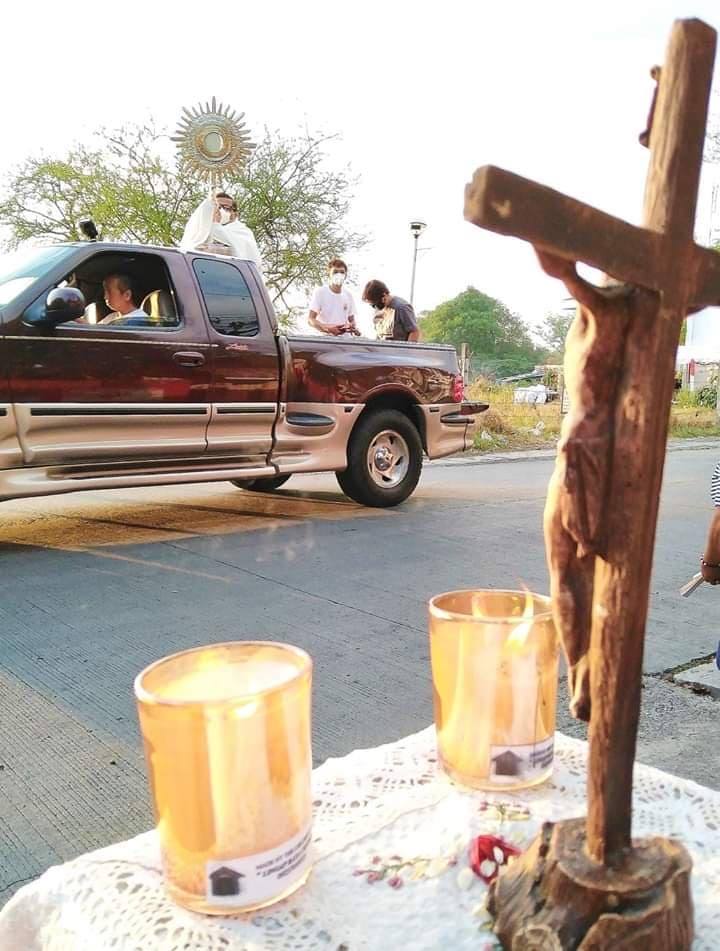
Photo by Ms. Anne Ramos, Good Friday “motororized procession” of Santo Entierro in our Parish during COVID-19, 10 April 2020.
Lately I have noticed
since month of August
when we have a spike of the virus
I have felt heavy and serious
as Sundays have become
more like a Good Friday
with the streets and church seats
both empty;  nobody seems to be happy
or Sundays have become more lazy?
How I miss the people I always see
wondering if they are safe and healthy
or maybe so wary just like me.
Sometimes I still feel
how everything is surreal
will I make it to next year
enjoying life without fear?
I have been wondering
if the Lord is still hanging
or have they crucified him again?
Life in the midst of COVID-19
has become more challenging
listening to silence so deafening
when God does not seem to be caring;
but, deep within
there is that calming
during Good Friday
that Easter Sunday
 is surely coming:
keep on believing, keep on praying
if Sundays look like a Good Friday
this may only mean one thing, that
Jesus is with us suffering COVID-19!
Quiet Storm by Fr. Nicanor F. Lalog II, 08 October 2020
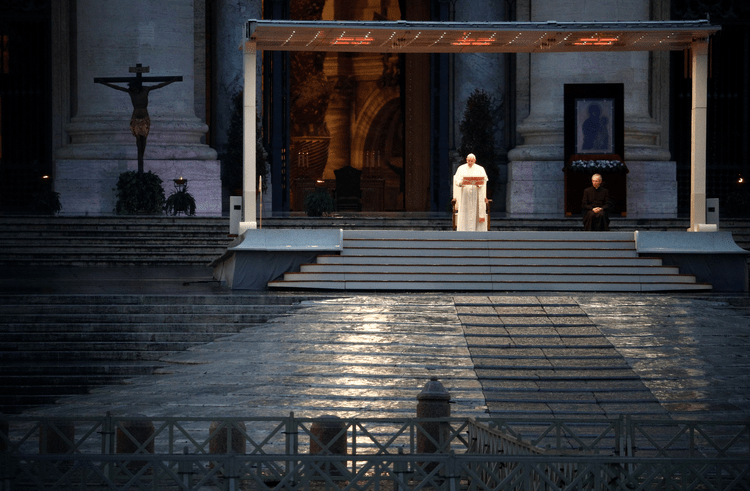
Pope Francis delivering his “Urbi et Orbi” before an empty St. Peter’s Square in Rome, 27 March 2020 at the height of COVID-19 pandemic. Photo from Vatican Media/AFP via Getty Images.
In the beginning
we were counting
the days of quarantine
but when COVID-19
spread with so many dying
then we realized this is not just passing
but could be staying
leaving the world in a standstill
shaking our very core and being
bringing us back to God
praying, surrendering everything
to him as our sole grounding.
Finding God
during this quarantine
is indeed a blessing
directing us to look within
to examine our being
where every healing must begin;
Any sickness is a dis-ease
a lack of order
when things are not pleasing
because of sin and wrong-doing
exactly what we are now seeing
with COVID-19.
Photo by Mr. Jay Javier, May 2020.
Consider the following:
Long before social distancing
we have always been so far away
even from those with whom we stay
foregoing all the loving,
replaced with twitting or texting;
When we were growing
we were taught to keep our hands clean
but we have pushed it to the extreme
refusing to dirty our hands
forgetting to work with honor and dignity
keeping them free from stains of dishonesty;
Of all the most disturbing
during this quarantine
is the mask that cover our face;
but, why be fazed, objections raised
when we have long erased
to see in every face
that tremendous grace
of God's trace?
In the midst of this calamity
when air became pollution-free
we rejoiced at Nature's beauty;
the remedy for every malady
is not found only in the pharmacy
but right in our hearts when we see
everything and everyone in harmony.
Oh how I long when that day shall be
when everyone is free with nothing to worry;
at ease shall we carry within the peace and serenity
of one big family living cleanly in God's mercy.
The Lord Is My Chef Sunday Recipe for the Soul by Fr. Nicanor F. Lalog II
Week XVIII, Cycle A in Ordinary Time, 02 August 2020
Isaiah 55:1-3 >><}}}*> Romans 8:35, 37-39 >><}}}*> Matthew 14:13-21
Remember our reflection last Sunday? Of how parables teach us that “less is always more” because to have the kingdom of God – Jesus Christ himself – we have to learn to appreciate the little things in life?
Beginning this Sunday until August 16, our gospels will start telling us who is Jesus Christ by showing us his powers and abilities that are exactly opposite the way we see and understand them. This new series of stories are so relevant to us in this time of pandemic, giving us wonderful insights into God’s ways of responding to our human situations.
St. Matthew now leads us with Jesus to the wilderness after teaching us in parables to experience his power in transforming us like the five loaves and two fish to feed more than five thousand people.
Multi-layered story of the multiplication of bread
All four evangelists have recorded this story of Jesus Christ’s multiplication of the loaves of bread with their particular focus and stress, showing us that it truly happened and was a major event in the Lord’s ministry.
Very unique with St. Matthew’s version of this miracle story – which has not one but two! – is his economy of words in narrating it like a straight news as if it were a developing story or a “breaking news” unfolding before us, calling us to follow its updates and details due to its multi-layered meanings.
When Jesus heard of John the Baptist, he withdrew in a boat to a deserted place by himself. The crowds heard of this and followed him on foot from their towns. When he disembarked and saw the vast crowd, his heart was moved with pity for them, and he cured their sick. When it was evening, the disciples approached him and said, “This is a deserted place and it is already late; dismiss the crowds so they can go to the villages and buy food for themselves.” Jesus said to them, “There is no need for them to go away; give them some food yourselves.” But they said to him, “Five loaves and two fish are all we have here.” Then he said, “Bring them here to me,” and he ordered the crowds to sit down on the grass. Taking the five loaves and the two fish, and looking up to heaven, he said the blessing, broke the loaves, and gave them to the disciples, who in turn gave them to the crowds. They all ate and were satisfied, and they picked up the fragments left over — twelve wicker baskets full. Those who ate were about five thousand men, not counting women and children.
Matthew 14:13-21
Photo from iStock/Studio-Annika.
The consolation of Jesus.
Our situation in this time of the corona pandemic is so similar with that of Jesus. With the increasing number of COVID-19 cases, it has finally hit us hard, so close to home with news of those we know getting infected and worst, dying from this disease.
Like Jesus upon hearing the death of John the Baptist, we are all saddened that we wish to withdraw away from everyone.
We want to mourn but there are more people in need of our presence and help in this time of pandemic like the countless medical frontliners and health workers who must be so tired – even sick, physically and emotionally – by now with the growing number of COVID-19 patients and yet have chosen to remain in their posts.
And there are still the other casualties of this pandemic like those who have lost their jobs, those evicted from their rented apartments, those stranded and separated from their loved ones, those begging for food, and those afflicted with other sickness going through dialysis and physical therapy.
Jesus knows so well the “wilderness” we are all going through and he is right here with us, one with us in our sufferings, in our fears and anxieties, and in our exhaustion.
To be one with us is consolation, from the Latin “con” or with + “solare” or alone, to be one with somebody feeling alone.
Jesus did not remove our pains and sufferings, even our death; he joined us to be one with us in these that he can call us to “Come to me, all you who labor and are burdened, and I will give your rest. Take my yoke upon you… For my yoke is easy and my burden light” (Mt.11:28-30, 14th Sunday, 05 Jul 2020).
Compassion of Jesus.
Still with Christ’s reaction of being “moved with pity” at the sight of the crowds who have followed him to the wilderness, we find something more deeper with his being one with us, in consoling us that he had forgotten all about himself, his tired body that he went on to heal the sick among them.
To be moved with pity is more than a feeling of the senses but a response of his total person.
You respond for help, you reply to a call.
Ever wondered why we have the “responsorial psalm” after the first reading in the Mass? Because those words from the Psalms express our total assent and commitment to God, involving our total self like body, mind, heart and soul.
Photo by Dra. Mai B. Dela Peña, Carmel Monastery, Israel, 2016.
God cannot suffer because he is perfect.
That is why he became human like us in Jesus Christ to be one with our suffering and death so that we would one with him in his glorious Resurrection.
In the wilderness, Jesus stayed with the people, not allowing them to leave as suggested by the Twelve because he was moved with pity with the crowd because he wanted to suffer with them.
That is compassion, literally means to “suffer with” from cum + patior. Here in the wilderness, Jesus showed his compassion for the people which will reach its highest point in giving himself on the Cross on Good Friday.
Have we “responded” to God’s call to serve, to a call of duty, and to a plea for help from the poor? Have we truly given ourselves to somebody without ever thinking our own comfort or rewards? Or, are we running away from his Cross?
What a shame in this time of pandemic there are some among us who rejoice at the losses of others like the Twelve who wanted the crowd to be sent home because they were afraid of responsibilities, of taking care of the suffering people.
Consolation and compassion are the two most needed from each of us in this time of crisis.
Our scarcity mentality, the God of plenty.
We now come to the miracle of the feeding of five thousand. According to the late Fr. Henri Nouwen, this story is an example of our “scarcity mentality” when we think of not having enough, of finding what we have as too little, always looking for more; hence, our tendency to hoard everything.
The Twelve were thinking more of themselves, afraid they could go hungry with the five loaves of bread and two fish they have. They were so afraid of difficulties ahead of them in their situation where to find and how to feed those great number of people.
They were focused on what was lacking than on what they have, and who was with them, Jesus Christ! They were hungry for food in the stomach than for food to the soul unlike the crowds who have followed Jesus.
Worst of all, the Twelve got “mad” upon seeing the crowds who have followed them to the wilderness when in fact, it was Jesus who needed most to rest to mourn John’s death!
But through all these, Jesus patiently bore the people’s woes and the Twelve’s selfishness to teach them all in a very nice way something so essential in our response to every human suffering and extreme situation: opening and entrusting our selves totally to God.
And that was actually the greatest miracle that happened that day.
In doing it, Jesus simply asked the Twelve what they have, never asking how much they have or its condition. Just whatever they have to give everything to Jesus like those five loaves and two fish that he took, and while looking up to heaven, blessed and broke the loaves, and gave them to the Twelve to distribute to the crowd.
And everyone was satisfied with a lot of left overs too!
Matthew nor any of the other Evangelists ever explained how it happened because it does not really matter at all. What is most important is what are we willing to give up to Jesus so he can transform us into better persons.
That is what we continue to do this day in every celebration of the Holy Eucharist- whatever we have, even not the best or the worst and littlest we have, when given to Jesus becomes holy and multiplied!
The power of God is immense, without doubt. But, in this miracle of the feeding of five thousand, Jesus is showing us that his power is not meant to satisfy our material or bodily needs but our deepest desires that lead to our fulfillment in him as prophesied by Isaiah in the first reading.
Why spend your money for what is not bread; your wages for what fails to satisfy? Heed me, and you shall eat well, you shall delight in rich fare. Come to me heedfully, listen, that you may have life.
Isaiah 55:2-3
Amid the pandemic worsened by our government officials’ inanities, irresponsibilities, and sheer lack of compassion with us in this wilderness, the Lord assures us today that he is with us for “nothing can separate us from the love of Christ” (Second Reading) if we are willing to give him all that we have.
It is our spiritual transformation first that leads us to our material blessings. We can all have it if we are willing to give everything to Jesus and believe in him always. What do you have for miracles to happen?
A blessed August ahead for you!Amen.
Photo by Dra. Mai B. Dela Peña, Carmel, Israel, 2016.
The Lord Is My Chef Breakfast Recipe for the Soul by Fr. Nicanor F. Lalog II
Wednesday, Feast of St. Mary Magdalene, 22 July 2020
2 Corinthians 5:14-17 >><}}}*> >><}}}*> >><}}}*> John 20:1-2, 11-18
Painting by Giotto of the Risen Lord Jesus Christ appearing to St. Mary Magdalene from commons.wikimedia.org.
Dearest Lord Jesus Christ:
Today as I prayed on the feast of your beloved Saint Mary Magdalene, my sights were focused on your beautiful exchange of names on that Easter morning at your tomb.
It is so lovely and so deep, and very personal for all of us whom you love so much despite our many sins like St. Mary Magdalene.
When she had said this, she turned around and saw Jesus there, but did not know it was Jesus. Jesus said to her, “Woman, why are you weeping? Whom are you looking for?” She thought it was the gardener and said to him, “Sir, if you carried him away, tell me where you laid him, and I will take him.” Jesus said to her, “Mary!” She turned and said to him in Hebrew, “Rabbouni,” which means Teacher.
John 20:14-16
You called her by her name, “Mary” and she called you by your title “Rabbouni” – what a beautiful scene of two people loving each other so deeply, so truly! You – humbly and lovingly accepting the sinner, and she – submitting herself to you as disciple.
You have expelled seven demons from her, you have known her so well even her darkest secrets and sins, and despite all these knowledge, Lord Jesus, the more you have loved her that you called her by the sweetest word she could ever hear in her life, “Mary”.
The same with us, sweet Jesus: every day you call us by our names, each one of us as a person, an individual, a somebody not just a someone. You love us so much in spite and despite of everything. We are not just a number or a statistic to you but a person with whom you relate personally.
From Google.
Help us to realize this specially when darkness surrounds us, when self-doubts and mistrust abound in us without realizing your deep trust in us, in our ability to rise again in you and follow you.
Teach me to trust you more and love you more like St. Mary Magdalene, to give and offer my self to you totally as yours, calling you “Rabbouni” or Teacher and Master.
Let me give up whatever I still keep to myself, whatever I refuse to surrender so that I may enjoy the intimacy you offer me as a friend, a beloved, and a family in the Father.
What a joy indeed to be like St. Mary Magdalene, fully known and fully loved by you, dear Jesus.
May I learn to know and love others too like you so I may proclaim you to them. Amen.
The Lord Is My Chef Sunday Recipe, Solemnity of the Pentecost-A, 31 May 2020
Acts of the Apostles 2:1-11 <*(((>< 1 Corinthians 12:3-7, 12-13 ><)))*> John 20:19-23
Pope Francis praying at an empty St. Peter’s Square 27 March 2020. Photo from cruxnow.com.
As I prayed over the readings this coming Pentecost Sunday, my thoughts kept going back to those powerful images when Pope Francis prayed at an empty St. Peter’s Square at the Vatican last March 27 when COVID-19 was ravaging the whole Italy with so many deaths.
Now more than ever, the Church badly needs the Pentecost – a new Pentecost that will heal and rebirth the world so wounded and altered by the corona pandemic this year 2020.
On the evening of that first day of the week, when the doors were locked, where the disciples were, for fear of the Jews, Jesus came and stood in their midst and said to them, “Peace be with you.” When he had said this, he showed them his hands and his side. The disciples rejoiced when they saw the Lord.
John 20:19-20
Modern rendition of the Pentecost. From Google.
Holy Spirit, breath of life and cause of unity
The Pentecost is not just an event remembered in the past but a reality that happens daily when the Holy Spirit comes and is received by those attuned with its life and mission which is to bring peace through unity and healing.
Promised by Jesus Christ to his followers as their Advocate and Counsellor, the Holy Spirit descended on them during the feast of Pentecost in Jerusalem when Jews from all parts of the world gathered to remember the 50 days after their Passover in Egypt at the time of Moses.
It was the perfect setting for the Christian Pentecost – this time 50 days after Easter – to celebrate the new unity of mankind in Jesus he established on Holy Thursday evening at his Last Supper. Inasmuch as the Jews went home at that time to be one with their fellow believers in Jerusalem, on that day from the holy city comes forth the new solidarity of peoples in Jesus led by his followers gathered that day in the Upper Room.
Hence, the tradition of considering Pentecost Sunday as the birthday of the Church, too.
Though we have heard two different versions of its coming, what matters most is the Person of the Holy Spirit as the breath of life and the cause of unity among the followers of Christ.
In the first reading, Luke gives us an artistic presentation of the coming of the Holy Spirit showing the unity of the peoples: first of the followers of Jesus and later with the Jews gathered in Jerusalem on that day for their feast of Pentecost. Whereas the apostles were at first presented as timid and lacking in understanding, the Holy Spirit emboldened them on that day to go out and proclaim the gospel of Jesus Christ. Led by Peter, they were filled with life and wisdom and courage, converting thousands of people on Pentecost day despite their speaking in different languages, exactly the opposite at the Tower of Babel in the Old Testament.
In the gospel, John gives us the theological grounding of Pentecost when we find Jesus appearing to his disciples hiding from the Jews on the evening of Easter at the Upper Room where he breathed on them the Holy Spirit that filled them with joy upon seeing him risen and alive.
The scene was reminiscent of the many stories in the Old Testament of the “breath of God” giving life to the first human beings in the story of creation, the “breathing on” by Elijah on the nostrils of the widow’s dead son back to life (1Kgs.17:21), and the promise of God to Ezekiel to restore to life the many dry bones in their graves in the time to come (Ezek. 37:1-14).
These stories now take on deeper meanings in Jesus Christ its fulfillment. And not only were the disciples breathed on with new life in Christ but also the whole creation was renewed in the coming of the Holy Spirit that we pray, “Come Holy Spirit, fill the hearts of your faithful and you shall renew the face of the earth”.
Perennial Pentecost for peace and healing
Pentecost is an event that continues to happen daily especially when we are gathered as the body of believers of Jesus Christ tasked to realize its fulfillment. This coming of the Holy Spirit is not a one-shot deal that happened only in the past in Jerusalem more than 2000 years ago — it is something we as followers of the Risen Lord must always wait and make happen every day so as to continually bring life and renewal to this world especially at this time of the corona pandemic.
In giving us the Holy Spirit, Jesus not only renewed our lives as his disciples united in him but also conferred his own power without restrictions to accomplish our mission.
Jesus said to them again, “Peace be with you. As the Father has sent me, so I send you.” And when he had said this, he breathed on them and said to them, “Receive the Holy Spirit. Whose sins you forgive are forgiven them, and whose sins you retain are retained.”
John 20:21-23
The Chair of St. Peter at St. Peter’s Basilica in Rome with the stained glass of the Holy Spirit above. Photo from dreamstime.com.
At the Vatican inside the great St. Peter’s Basilica is a beautiful stained glass of the Holy Spirit in the form of a dove rising above as background to the Chair of St. Peter ( Feast is February 22) at the sanctuary area.
Pope Emeritus Benedict XVI described this beautiful work of art:
“It seems to me that a deep analysis of the essence of the Church lies hidden here, is contained here… It unites the Church with creation as a whole. It signifies through the dove of the Holy Spirit that God is the actual source of all light. But it tells us something else: the Church herself is in essence, so to speak, a window, a place of contact between the other-worldly mystery of God and our world, the place where the world is permeable to the radiance of his light… The Church is the place of encounter where God meets us and we find God. It is her task to open up the world closing in on itself, to give it the light without which it would be unlivable.”
Images of Hope, pp.29-31
Here we find part of our mission in collaboration with the Holy Spirit is the the healing of the world that can be achieved only through peace. See how Jesus had to repeat twice his gift of peace to his disciples because it is his greatest gift to us following his Resurrection.
Life thrives and blooms most where there is peace, where there are disciples of the Lord willing to work for it with love and patience.
But the peace from Jesus Christ always has a price that we must be willing to pay to achieve it.
See that after his first greeting of peace, Jesus showed his wounds — he was the first to pay the price for peace with his own life.
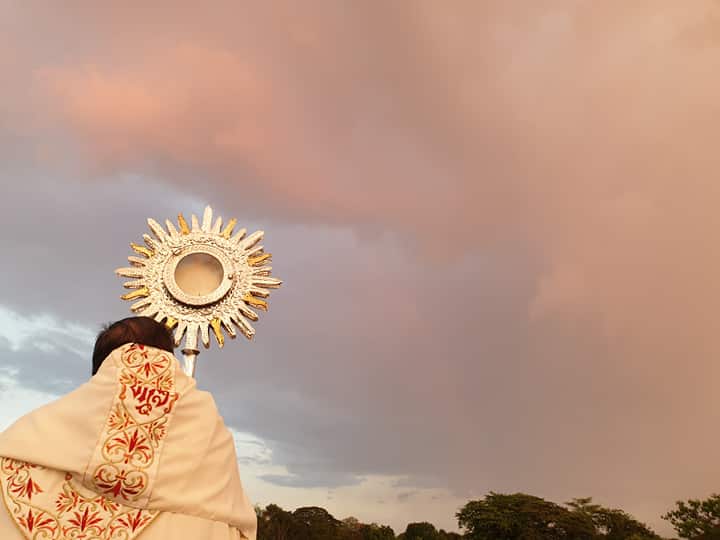
Bringing around our Parish the Blessed Sacrament during the lockdown, March-May 2020.
This is the meaning of the many sacrifices and sufferings we all have to go through in this quarantine period expected to continue until 2021: if we want to get out of this pandemic, aside from the need for a vaccine and medication, we all need to change our ways to make sure this will not happen again.
It is always easy to join so many advocacies and rallies calling for every kind of change in the society and the world but nothing had ever happened because whenever we come home, we do not change our own ways of living! Sayang (what a waste) were all the inspiration and energies of the Holy Spirit for our many causes that have not taken roots right in our hearts.
All the apostles of the Lord paid the price of peace with their own lives that led to the healing not only of individuals and families but even of nations and the world.
The second time Jesus offered his gift of peace, he breathed the Holy Spirit on his apostles and commissioned them to forgive all sins.
Peace is the fruit of love according to Vatican II.
As such, peace from the Holy Spirit leads to healing when there is dialogue, prayer and repentance, that lead to justice, love, and forgiveness. Peace and healing need hard work that is why they are fruits. They never come on a silver platter.
On Monday, most of the quarantine levels in the country are downgraded because it is hoped we have somehow controlled the spread of COVID-19.
As we eagerly await more freedom and mobility in this time of pandemic, what have we achieved during these three months of quarantine, said to be the longest in the world?
Have we resolved our family differences? Have we rediscovered our family members, getting more close than ever, more kind, more understanding?
How sad that all we can share as our quarantine stories are all about food and other pursuits we have undertaken forgetting the unity and life of our family and community.
How sad when we in the Church have all been preoccupied with the new communication media but failed at all to make any impact or dent in the lives of our faithful because we have not shared Jesus Christ at all, when all our “live streaming” and vlogs are powered by likes and followers, not by the Holy Spirit.
Pope Francis blessing the people last March 27 in an empty St. Peter’s Square during the height of COVID-19 in Italy that became the new epicenter of pandemic next to China. Photo from Vatican Media Office.
Jesus never takes back his gift of peace, his gift of healing, his gift of the Holy Spirit. He promised to never leave us orphans. Let us not leave the Holy Spirit behind and stop believing in our selves.
That’s the way we have been in the world and even in the Church.
That is why – to a large extent – we have this corona pandemic.
40 Shades of Lent, Friday, Week III, 20 March 2020
Hosea 14:2-10 ><)))*> +++ <*(((>< Mark 12:28-34
Photo by author, Mt. St. Paul, Trinidad, Benguet, 04 February 2020.
Unbelievable.
That’s the only word you spoke to me Lord in my prayers last night and this morning.
Unbelievable.
As the days move on, God our Father, the more I could not believe all these things going on. What have happened with us, Lord?
Bakit kami nagkaganito at paano kami humantong dito, Panginoon?
Your words today, O Lord, are so true. It is you indeed who speaks to us especially in the first reading through the Prophet Hosea. You have spoken so well — we have all sinned.
We have disregarded you and others. We have relied so much in our own powers and abilities. We have insisted on doing things our own ways totally discarding your teachings.
But more unbelievable in this unbelievable situation is your immense love and mercy for us, O God our Father.
Thus says the Lord: Return, O Israel, to the Lord, your God; you have collapsed through your guilt. Take with you words, and return to the Lord… I will heal their defection, says the Lord, I will love them freely; for my wrath is turned away from them. I will be like the dew for Israel: he shall blossom like the lily.
Hosea 14:2-3, 5-6
Lent Week-III 2020 in our Parish.
Help us, Father through your Son Jesus Christ that we may look more inside ourselves these trying times, that we may see you more and as we see you as the most essential, the most important of all, we also see our value as persons.
Let us experience that love you have for us that we ought to share with one another, beginning in our family, in our neighborhood.
How unbelievable that some of us, like that scribe who asked Jesus “which is the first of all commandments”, we keep on categorizing, ranking things and even persons to determine who or what is the most important — the first.
Unbelievable but true, this pandemic is happening because we have forgotten you and we have forgotten others too. We have forgotten YOU are always first, always great. Semper Primus, semper Major!
Teach us to see more of you so that we also see you among one another. Amen.
40 Shades of Lent, Solemnity of St. Joseph, Husband of Mary, 19 March 2020
2 Samuel 7:4-5, 12-14, 16 +++ Romans 4:13, 16-18, 22 +++ Matthew 1:16, 18-21, 24
Photo from zenit.org, “Let Mom Rest” figurine
Praise and thanksgiving to you, O God our loving Father in giving us your Son, Jesus Christ our Savior. In sending him to us, you have asked St. Joseph to be not afraid to be the husband of the Blessed Mother of Jesus, Mary Most Holy.
…the angel of the Lord appeared to him in a dream and said, “Joseph, son of David, do not be afraid to take Mary your wife into your home. For it is through the Holy Spirit that this child has been conceived in her.” When Joseph awoke, he did as the angel of the Lord had commanded him and took his wife into his home.
Matthew 1:20-21, 24
We pray today on this Solemnity of St. Joseph that we may also not be afraid in fighting this pandemic COVID-19.
Let us be not afraid to stay home to be with our family again, together and longer.
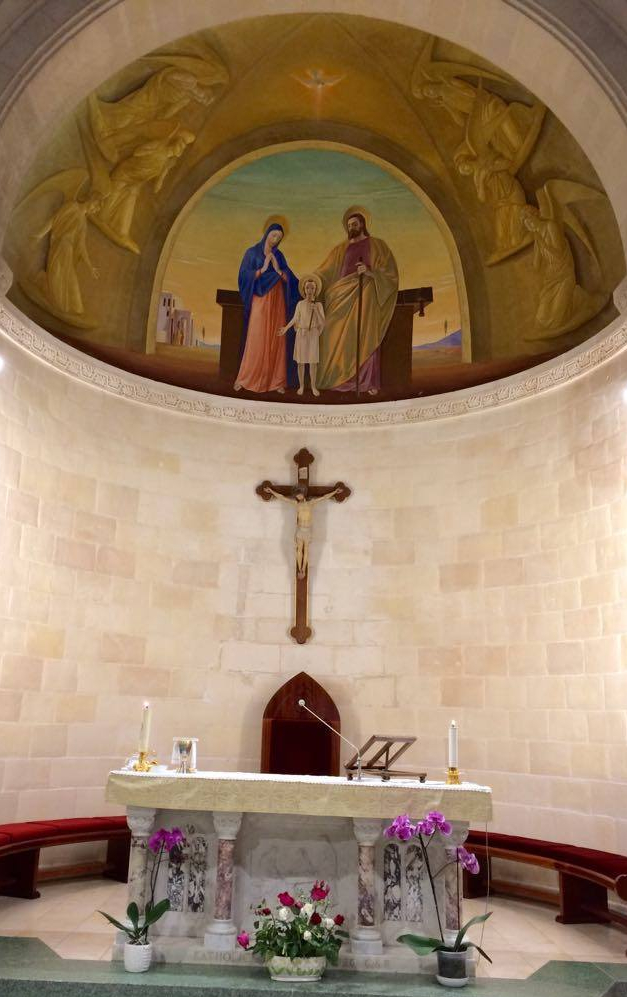
Photo by author, Chapel of St. Joseph, Nazareth, Israel, May 2017.
Let us be not afraid to talk and converse really as husband and wife, parents and children, brothers and sisters. Help us to be more open and more silent like St. Joseph to hear our family members’ innermost thoughts and feelings again with love and understanding.
Let us be not afraid, O Lord, to seek and work for real peace in our family now disintegrating as we disregard each other, choosing fame and wealth than persons.
Let us be not afraid to reach out also to those living alone like the sick, the elderly, the separated, those abandoned by family and friends or society, those widowed.
Let us be not afraid to share food and money to the needy, time and talent, joy and hope to those living in the margins.
Let us be not afraid to ask for forgiveness, to say again those beautiful words “I am sorry” to those we have hurt in words and in deeds; likewise, let us be not afraid to say also those comforting words “I forgive you” to those who have hurt us in words and in deeds.
Let us not be afraid to show respect anew to our elders. Forgive us, O God, in making disrespect a way of life in our time, in our society, in our government and right in our homes and family as we disregard the dignity of one another.
Let us not be afraid to pray again, to kneel before you, and humbly come to you as repentant sinners, merciful Father.
Let us be not afraid to bring Jesus your Son into this world with your love and kindness, sympathy and empathy so we may be healed of so many brokenness and pains deep within.
Let us not be afraid to be humans again and realize we are not gods, that we cannot control everyone and everything in this world.
Let us be not afraid to be open to you and to others, especially the weak and needy because the truth is, we need you O God and one another.
Please, like St. Joseph, let us not be afraid to wake up to the realities of this life to follow you always in your Son Jesus Christ. Amen.
O blessed St. Joseph, Husband of Mary, pray for us!
Photo by author, site of St. Joseph’s shop in Nazareth beneath a chapel in his honor, May 2017.
Tuesday, Memorial of Our Lady of Lourdes, World Day of the Sick, 11 February 2020
Isaiah 66:10-14 ><)))*> 0 <*(((>< John 2:1-11
Photo of Our Lady of Lourdes in France by Arch. Philip Santiago, September 2018.
Praise and glory to you O God, our loving and merciful Father who has given us a wonderful and most kind mother in the Blessed Virgin Mary through Jesus Christ your Son.
Through Mary, your abundant blessings, O God, have flowed and continue to overflow upon us even with the completion of her mission here on earth as Mother of Jesus.
How true were your words to the Prophet Isaiah that you shall send Israel a mother who shall comfort us, a mother in whom you shall spread prosperity and blessings upon us (Isaiah 66:10-14).
When Mary came into the scene when she was conceived without original sin, through her came our Savior Jesus Christ. From the very start, she worked to be the vessel of your blessings, God.
On the third day there was a wedding in Cana in Galilee, and the mother of Jesus and his disciples were also invited to the wedding. When the wine ran short, the mother of Jesus said to him, “They have no wine.” His mother said to the servers, “Do whatever he tells you.” Jesus told them, “Fill the jars wit water.”
John 2:1-3, 5, 7
How wonderful to recall and meditate on this first miracle of Jesus of turning water into wine at the wedding feast at Cana through the intercession of his Mother, the Blessed Virgin Mary.
How lovely it is that more than 1800 years, another miracle would happen again from you, O God, at a grotto in Lourdes, France involving water through the Blessed Virgin Mary again!
Thank you dearest Jesus for the gift of water, the gift of life in you. Water is the primordial element of life, and water is also one of the primordial symbols of humanity. How amazing that since the miracle at Cana, your life continues to overflow upon us, Lord Jesus Christ, through Mary especially at Lourdes, France.
There are at Lourdes, Mary told the young St. Bernadette to dig on earth where water burst forth a spring, like life coming out of the womb of the earth. Until now, that spring is the origin and beginning of many healings and other miracles among generations of different peoples from all walks of life and nation, including to those who have not been there in Lourdes, France!
The waters of Lourdes remain a symbol of fruitfulness and of healing, of maternity in Mary who cares most to us and the sick next to Jesus our Lord and Savior..
Give us the grace, O God, the gift of purity, of cleanliness in our hearts so that we may become like Mary at Lourdes as a vessel of your healing and compassion especially for the sick of the world. Amen.
Photo of a cross of atop the church of Our Lady of Lourdes in France by Arch. Philip Santiago during his pilgrimage, September 2018.
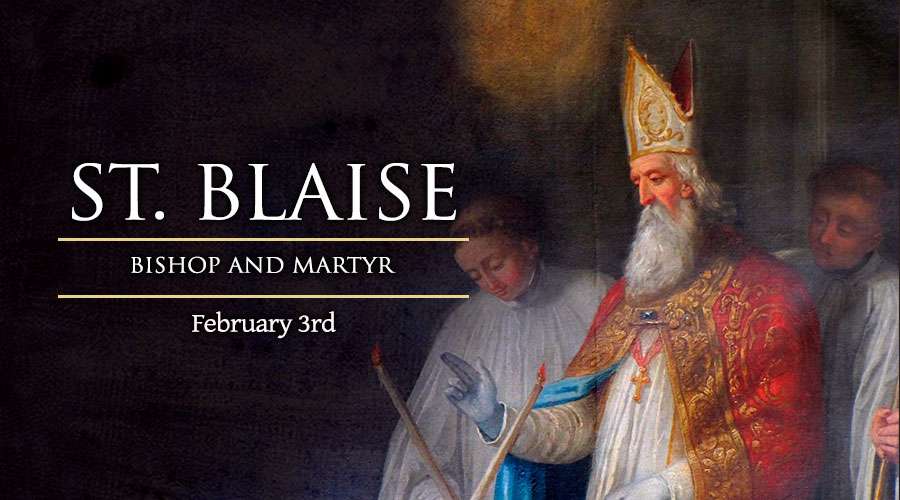
Monday, Memorial of St. Blaise, Week 4, Year 2, 03 February 2020
2 Samuel 15:13-14, 30; 16:5-13 ><)))*> 0 <*(((>< Mark 5:1-20
From catholicnewsagency.com
Praise and glory to you, O God, our loving Father, for this beautiful first Monday of the cold and breezy month of February.
Today we pray for your mercy and healing, O Lord, as the dangers posed by the novel corona virus in the country become more real with the death yesterday of a patient afflicted with the dreaded virus.
As we celebrate the memorial of your great servant, St. Blaise, we pray most of all for a healing of our minds and hearts infected with so much sins for our lack of charity and concern for one another, especially our leaders in government.
We pray for the cleansing of our hearts that we may think more of others, especially those most weak and vulnerable among us like the poor and elderly.
Drive away the evil spirits within us especially of those who take advantage of the situation.
Most of all, stay with us, Lord Jesus Christ to guide us in proclaiming your good news of salvation like St. Blaise who immersed himself in prayers and charity. Amen.
The Lord Is My Chef Breakfast Recipe, Wednesday, Easter Octave, 24 April 2019
Acts 3:1-10///Luke 24:13-35
Road to Emmaus. From Google.
How interesting is Easter becoming, O Lord! Yesterday, Peter’s listeners were “cut to the heart” upon hearing your good news of salvation. Today, as you walked along with two disciples going to Emmaus feeling so sad with your death and news of missing body, you expressed great surprise at their being “slow of heart to believe”.
And he said to them, “Oh, how foolish you are! How slow of heart to believe all that the prophets spoke! Was it not necessary that the Christ should suffer these things and enter into his glory?” Then beginning with Moses and all the prophets, he interpreted to them what referred to him in all the Scriptures.
Luke 24:25-27
So many times Lord, we are slow of heart to believe because we refuse to see the bigger picture in life when setbacks and failures can be staging points for greater growth and maturity. We choose to be mediocre and be contented with whatever is before us, refusing to strive and rise.
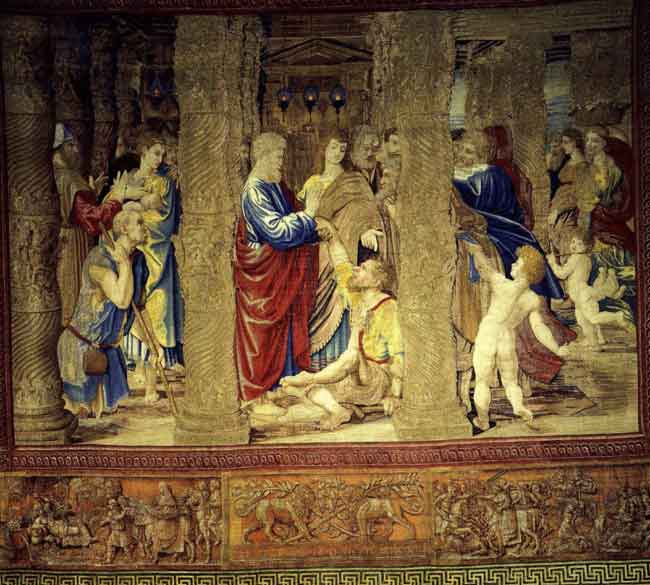
So many times Lord, we feel like that man crippled from birth at the Beautiful Gate of the temple contented in begging alms without realizing that negative things in our lives can enable us to receive the gift of life.
Like that crippled man from birth at the Beautiful Gate, let us seize every moment of meeting you, having you in our lives. Amen.
Healing of a Lame by Peter and John on a tapestry by Raphael at the Sistine Chapel in the Vatican. Photo from Google.

















 lordmychef.com