The Lord Is My Chef Breakfast Recipe for the Soul by Fr. Nicanor F. Lalog II
Thursday, Memorial of Sts. Pontian and Hippolytus, Martyrs, 13 August 2020
Ezekiel 12:1-12 >><)))*> |+| >><)))*> |+| >><)))*> Matthew 18:21-19:1
Photo by author, Mt. St. Paul Spirituality Center, La Trinidad, Benguet, 2018.
Praise and glory to you, our merciful Father always waiting for us to come home to you. Thank you for being patient with us who always rebel against you, turning away from you to be on our own.
Sadly, whenever we rebel, it is not you whom we hurt and inflict pain with but those dearest to us like our family and friends who truly love us. We are like the people of Jerusalem who have become callous and indifferent, cold and distant from you, O God, who truly cared for them.
The word of the Lord came to me: Son of man, you live in the midst of a rebellious house; they have eyes to see but do not see, and ears to hear but do not hear, for they are a rebellious house.
Ezekiel 12:1-12
So many times, loving Father, we have become like that debtor in Christ’s parable whose debts were written off by his master and yet could not do the same to a fellow debtor who owed him with a lesser amount.
Both that debtor in the gospel and the rebellious house of Israel in the first reading share the same sin and evil attitude of refusing to recognize your goodness and mercy you have given them that we are equally guilty of today.
So many times in our lives, Lord, this same attitude of being rebellious and unmerciful are the main reasons that destroy our many relationships because we have separated ourselves from others.
Teach us through Jesus Christ to always live grateful to your abounding love and kindness, mercy and forgiveness to us, Father, so we may always share these same blessings with others.
Touch our hearts like you have moved the first anti-pope, St. Hippolytus who sought forgiveness from the Pope he had earlier rebelled against, St. Pontian after they were both sent to hard labor on the island of Sardinia during the persecution by Maximus Thrax.
What a beautiful twist of fate that you still brought them together, Lord to share in witnessing to your truth and mercy.
We pray today for those who have rebelled against you, O God, uttering all kinds of blasphemies against your most Holy Name not realizing that the more they rebel against you, the more they have become distant from us the people they are supposed to serve.
Open their eyes and their ears so they may see and hear the sufferings of the people in this time of pandemic. Amen.
Photo by Ms. Ria De Vera, sunrise at lockdown in our Parish, March 2020.
Almost daily in my prayers I give you praise, O God, without really bothering myself to dwell on what is the meaning of your glory, of that scene from the first reading that says:
Then the glory of the Lord left the threshold of the temple and rested upon the cherubim… They stood at the entrance of the eastern gate of the Lord’s house, and the glory of the God of Israel was up above them. Then the cherubim lifted up their wings, and the wheels went along with them, while up above them was the glory of the God of Israel.
Ezekiel 10:18, 19b-20
It is so difficult to imagine of your glory, O God, when I am in dirt and sin.
Your glory is your purity.
Cleanse us, merciful Father of our many sins and iniquities that have darkened the world and our very lives with evil and sin.
At the same time, teach us to be like you in Christ Jesus, full of mercy and forgiveness for those who sin because every time we are able to bring back a sinner to you, the more we see and experience your glory.
Most of all, keep on purifying us so that our gathering together becomes your indwelling, fulfilling Christ’s words
Photo by author, sunset in our parish church, April 2020.
“For where two or three are gathered together in my name, there I am in the midst of them.”
Matthew 18:20
Lord Jesus, more sinister than all the dirt of sin and evil in us and around us today is our refusal to stand against the immoralities going on.
Worst, O Lord, is our attitude of always “moving the lines” when some people cross the boundary between what is right and wrong, good and evil, decent and indecent.
Forgive us and bring us back to your path, Lord, when truth and morality have suddenly become relative for us without realizing how these have muddled our relationships with you and with others, hiding your glory among us. Amen.
The Lord Is My Chef Breakfast Recipe for the Soul by fr. Nicanor F. Lalog II
Monday, Week XVII, Year II in Ordinary Time, 27 July 2020
Jeremiah 13:1-11 >><)))*> >>><)))*> >><)))*> Matthew 13:31-35
Photo from Google.
What a great way to start our last week of work and studies in July with your sense of humor, O God! Your words are so witty and funny but with a strong punch. Hard-hitting, so biting. And so revealing.
For, as close as the loincloth clings to a man’s loins, so I had made the whole house of Israel and the whole house of Judah cling to me, says the Lord; to be my people, my renown, my praise, my beauty. But they did not listen.
Jeremiah 13:11
You really got me, Lord.
What can I say?
Our underwear, that is, the loincloth of Jeremiah’s time, is our most intimate clothing, always in contact with our very selves, in that part of our body that we always guard and keep to ourselves.
But, what happens when we “dirty” ourselves with sins, when we put on all those filth in ourselves, we also feel the same way inside, no matter how clean and crisp our clothes are but when deep down our loincloth – underwear – is rotted and good for nothing?
We can always hide it from others and they will never know the kind of underwear we have but we cannot deceive ourselves of how dirty we are with sins and evil.
And so far from you, O God.
Forgive us when you are supposed to be the closest to us, the one we are always in contact with but we have totally disregarded because of our many sins, when we thought we can always have our own ways without you, denying the fact it simply cannot be for indeed, you have made us to be that closest to you.
Forgive us in your Son and our Lord Jesus Christ. Renew us inside, cleanse us and refresh us to be in close contact with you again, O God.
Help us to remain good and clean inside like the little mustard seed so we may grow to have leafy branches for birds to come and dwell in us.
In your mercy, cleanse us of our sins and be our yeast to mix with us again to leaven into a dough to make your kingdom come here on earth. Amen.
The Lord Is My Chef Breakfast Recipe for the Soul by Fr. Nicanor F. Lalog II
Wednesday, Feast of St. Mary Magdalene, 22 July 2020
2 Corinthians 5:14-17 >><}}}*> >><}}}*> >><}}}*> John 20:1-2, 11-18
Painting by Giotto of the Risen Lord Jesus Christ appearing to St. Mary Magdalene from commons.wikimedia.org.
Dearest Lord Jesus Christ:
Today as I prayed on the feast of your beloved Saint Mary Magdalene, my sights were focused on your beautiful exchange of names on that Easter morning at your tomb.
It is so lovely and so deep, and very personal for all of us whom you love so much despite our many sins like St. Mary Magdalene.
When she had said this, she turned around and saw Jesus there, but did not know it was Jesus. Jesus said to her, “Woman, why are you weeping? Whom are you looking for?” She thought it was the gardener and said to him, “Sir, if you carried him away, tell me where you laid him, and I will take him.” Jesus said to her, “Mary!” She turned and said to him in Hebrew, “Rabbouni,” which means Teacher.
John 20:14-16
You called her by her name, “Mary” and she called you by your title “Rabbouni” – what a beautiful scene of two people loving each other so deeply, so truly! You – humbly and lovingly accepting the sinner, and she – submitting herself to you as disciple.
You have expelled seven demons from her, you have known her so well even her darkest secrets and sins, and despite all these knowledge, Lord Jesus, the more you have loved her that you called her by the sweetest word she could ever hear in her life, “Mary”.
The same with us, sweet Jesus: every day you call us by our names, each one of us as a person, an individual, a somebody not just a someone. You love us so much in spite and despite of everything. We are not just a number or a statistic to you but a person with whom you relate personally.
From Google.
Help us to realize this specially when darkness surrounds us, when self-doubts and mistrust abound in us without realizing your deep trust in us, in our ability to rise again in you and follow you.
Teach me to trust you more and love you more like St. Mary Magdalene, to give and offer my self to you totally as yours, calling you “Rabbouni” or Teacher and Master.
Let me give up whatever I still keep to myself, whatever I refuse to surrender so that I may enjoy the intimacy you offer me as a friend, a beloved, and a family in the Father.
What a joy indeed to be like St. Mary Magdalene, fully known and fully loved by you, dear Jesus.
May I learn to know and love others too like you so I may proclaim you to them. Amen.
Tonight is “Spy Wednesday” – the night traitors and betrayers are put on the spotlight because it was on this night after Palm Sunday when Judas Iscariot struck a deal with the chief priests to hand them over Jesus for 30 pieces of silver (Mt. 26:14-16).
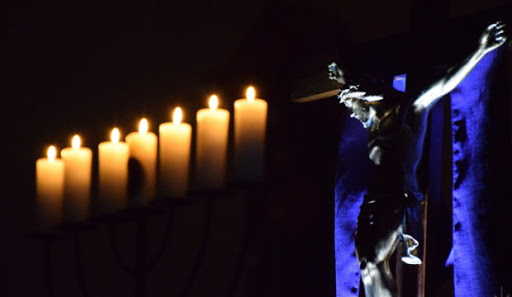
The “Tenebrae” is celebrated in some churches when candles are gradually extinguished with the beating of drums and sounding of matraca to evoke silence and some fear among people as they leave in total darkness to signal the temporary victory of evil in the world for tomorrow we enter the Paschal Triduum of Holy Thursday, Good Friday and Easter Vigil of the Lord.
From Google.
Darkness generally evokes evil and sin, uncertainties and sufferings. But, at the same time, darkness preludes light!
That is why Jesus Christ was born during the darkest night of the year to bring us light of salvation.
Beginning tonight, especially tomorrow at his agony in the garden, we shall see Christ entering through darkness reaching its climax on Friday when he dies on the cross with the whole earth covered in darkness, rising on Easter in all his glory and majesty.
Our present situation in an extended Luzon-wide lockdown offers us this unique experience of darkness within and without where we can learn some important lessons from the Lord’s dark hours beginning tomorrow evening of his Last Supper.
St. John gives us a glimpse into how we must deal with life’s darkness that plagues us almost daily with his unique story of the Lord’s washing of his disciples’ feet on the night he was betrayed.
Before the feast of Passover, Jesus knew that his hour had come to pass from this world to the Father. He loved his own in the world and he loved them to the end. The devil had already induced Judas, son of Simon the Iscariot, to hand him over. So, during supper… he rose from supper and took off his outer garments. He took a towel and tied it around his waist. Then he poured water into a basin and began to wash the disciples’ feet and dry them with the towel around his waist. He came to Simon Peter…
John 13:1-2, 4-6
Photo from aleteia.org.
It is very interesting to reflect how Judas Iscariot and Simon Peter dealt with their own inner darkness on that night of Holy Thursday when Jesus was arrested.
Though Judas Iscariot and Simon Peter are poles apart in their personalities, they both give us some traits that are so characteristic also of our very selves when we are in darkness. In the end, we shall see how Jesus turned the darkness of Holy Thursday into becoming the very light of Easter.
Getting lost in darkness like Judas Iscariot
Right after explaining the meaning of his washing of their feet and exhorting them to do the same to one another, Jesus begins to speak of Judas Iscariot as his betrayer.
When he had said this, Jesus was deeply troubled and testified, “Amen, amen, I say to you, one of you will betray me …It is the one to whom I hand the morsel after I had dipped it.” So he dipped the morsel and handed it to Judas, son of Simon the Iscariot. After he took the morsel, Satan entered him… and left at once. And it was night.
John 13:21, 26-27, 30
Photo from desiringgod.org
The scene is very dramatic.
Imagine the darkness outside the streets of Jerusalem in the stillness of the night and the darkness inside the Upper Room where they were staying.
More darker than that was the darkness among the Apostles not understanding what Jesus was saying about his betrayer because they thought when Judas left, he was being told to buy more wine or give money to the poor!
Most of all, imagine the darkness within Judas.
To betray means to hand over to suffering someone dear to you.
That’s one darkness we always have within, of betraying Jesus, betraying our loved ones because we have found somebody else to love more than them. Satan had taken over Judas. The same thing happens to us when we sin, when we love someone more than those who truly love us or those we have vowed to love always.
And the darkest darkness of all is after handing over our loved ones, after dumping them for something or somebody else, we realize deep within the beautiful light of truth and love imprinted in our hearts by our betrayed loved ones – then doubt it too!
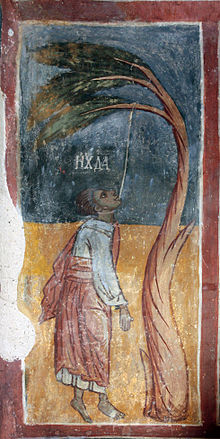
The flickering light of truth and love within is short lived that we immediately extinguish it, plunging us into total darkness of destruction like Judas when he hanged himself.
See how Judas went back to the chief priests because “he had sinned”, giving them back the 30 pieces of silver to regain Jesus.
Here we find the glow of Jesus, of his teachings and friendship within Judas still etched in his heart — the light of truth and love flickering within.
Any person along with their kindness and goodness like Jesus, our family and true friends can never be removed from one’s heart and person. They will always be there, sometimes spurting out in our unguarded moments because they are very true.
That is the darkest darkness of Judas – and of some of us – who think we can never be forgiven by God, that we are doomed, that there is no more hope and any chance at all.
See how the evangelist said it: “Judas left at once. And it was night.”
And that is getting lost in darkness permanently, eaten up by darkness within us because we refuse to believe in the reality of a loving and forgiving God who had come to plunge into the darkness of death to be one with us so we can be one in him. What a loss.
Groping in the dark into the light like Peter
Photo by author, Church of Gallicantu, Jerusalem where the cock crowed after Peter denied Jesus the third time, May 2017.
Of the Twelve, it is perhaps with Simon Peter we always find ourselves identified with: the eager beaver, almost a “bolero” type who is so good in speaking but many times cannot walk his talk.
“Master, are you going to wash my feet?” Jesus answered and said to him, “What I am doing, you do not understand now, but you will understand later.” Peter said to him, “You will never wash my feet.”
John 13:6-8
Here is Peter so typical of us: always assuming of knowing what is right, which is best, as if we have a monopoly of the light when in fact we are in darkness.
See how during the trial of Jesus before the priests, Peter denied him thrice, declaring he never knew Jesus while outside in the dark, completely in contrast with Jesus brilliantly answering every question and false accusation against him inside among his accusers!
Many times in our lives, it is so easy for us to speak on everything when we are in our comfort zones, safe and secured in our lives and career. But when left or thrown out into the harsh realities of life, we grope in the darkness of ignorance and incompetence, trials and difficulties.
How often we are like Peter refusing Jesus to wash our feet because we could not accept the Lord being so humble to do that simply because he is the Lord and Master who must never bow low before anyone.
And that is one darkness we refuse to let go now shaken and shattered by the pandemic lockdown! The people we used to look down upon are mostly now in the frontlines providing us with all the comforts we enjoy in this crisis like electricity, internet, security, food, and other basic services.
Bronze statue of the call of Peter by Jesus. Photo by author, May 2017.
We have always thought of the world, of peoples in hierarchy, in certain status where there are clear delineations and levels of importance, totally forgetting the lessons of Jesus of being like a child, of service and humility: “whoever wants to be great must be the least and servant of all.”
According to Matthew and Luke, Peter realized his sins – the darkness within him – of denying Jesus thrice after the cock crowed that he left the scene weeping bitterly, feeling so sorry. Eventually after Easter, Peter would meet Jesus again on the shores of the Lake of Tiberias, asking him thrice, “do you love me?”
Peter realized how dark his world has always been but in that instance when he declared his love that is so limited and weak did he finally see the light of Christ in his love and mercy!
Unlike Judas, Peter moved out of darkness and finally saw the light in the Risen Lord right in the very place where everything started when he was called to be a fisher of men, in his humanity as he was called by his original name, “Simon, son of Jonah, do you love me?”.
Human love is always imperfect and Jesus knows this perfectly well!
The best way to step out of darkness within us is to be like Simon — simply be your imperfect self, accepting one’s sins and weakness for that is when we can truly love Jesus who is the only one who can love us perfectly.
Overcoming darkness in, Jesus, with Jesus, through Jesus
Though the fourth gospel and the synoptic gospels of Matthew, Mark, and Luke differ in providing us with the transition from the Upper Room of the Last Supper into the agony in the garden, the four evangelists provide us with one clear message at how Jesus faced darkness: with prayer, of being one in the Father.
Even on the cross of widespread darkness, Jesus spoke only to pray to the Father.
Then Jesus came with them to a place called Gethsemane, and he said to his disciples, “Sit here while I go over there and pray.” He took along Peter and the two sons of Zebedee, and began to feel sorrow and distress.
Matthew 26:36-37
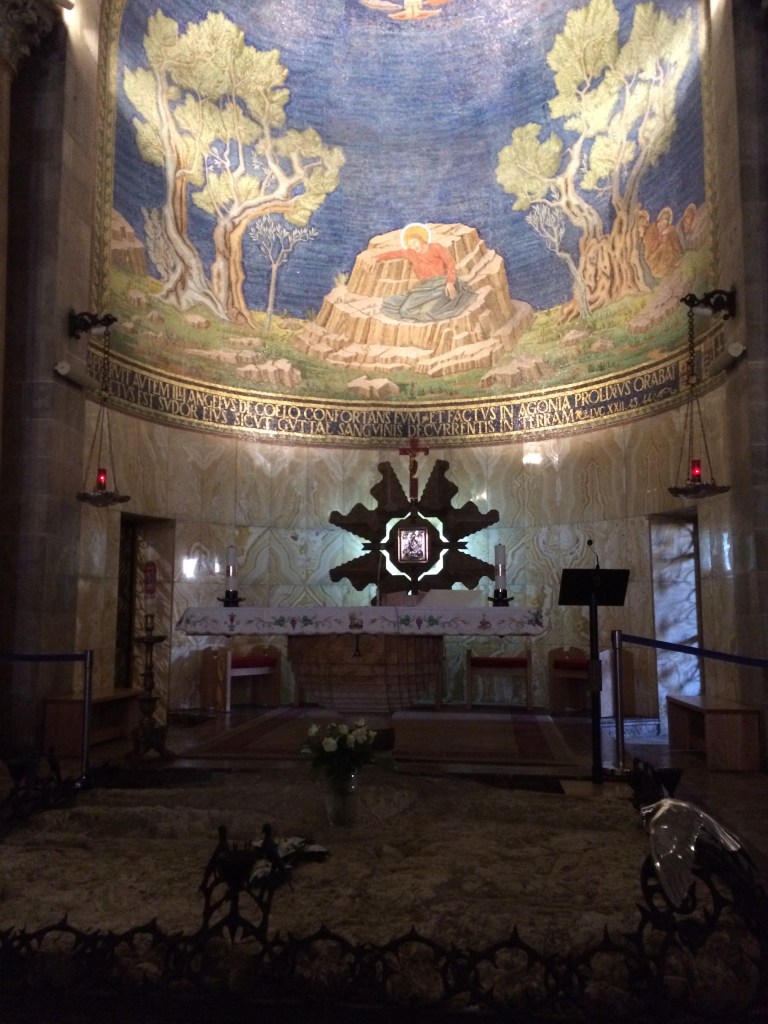
Photo by author, altar of the Church of All Nations beside the Garden of Gethsemane, May 2017. The church is always dimly lit to keep the sense of darkness during the Agony in the Garden of Jesus.
Before, darkness for man was seen more as a curse falling under the realm of evil and sin; but, with the coming of Jesus, darkness became a blessing, a prelude to the coming of light.
We have mentioned at the start of our reflection that Jesus was born during the darkest night of the year to show us he that is the light of the world, who had come to enlighten us in this widespread darkness, within us and outside us.
As the light of the world, Jesus was no stranger to darkness which he conquered and tamed in many instances like when they were caught in a storm at sea and in fact, when walked on water to join his disciples caught in another storm.
But most of all, Jesus had befriended darkness and made it a prelude to light.
How? By always praying during darkness. By prayer, it is more than reciting some prayers common during his time as a Jew but as a form of submission to the will of the Father. Jesus befriended darkness by setting aside, forgetting his very self to let the Father’s will be done.
Bass relief of agony in the garden on the wall of the Church of All Nations at Gethsemane. Photo by author, May 2019.
This he showed so well in two instances, first on Mount Tabor where he transfigured and second in Gethsemane before his arrest.
In both events, Jesus showed us the path to overcoming darkness is always through prayers, of being one in the Father.
It is in darkness when God is most closest to us because it is then when we get a glimpse of himself, of his love and mercy, of his own sufferings and pains, and of his glory.
This is something the three privileged disciples – Simon Peter, James and his brother John – did not realize while being with Jesus at both instances until after Easter. We are those three who always fall asleep, who could not keep with praying in Jesus, with Jesus, and through Jesus.
It was in the darkness of the night when Jesus spent most of his prayer periods, communing with the Father up in a mountain or a deserted place.
On Mount Tabor, Jesus showed his coming glory while in Gethsemane he showed his coming suffering and death. But whether in Gethsemane or on Mount Tabor, it is always Jesus we meet inviting us to share in his oneness with the Father, in his power in the Holy Spirit to overcome every darkness in life.
And the good news is he had already won for us!
Photo by Mr. Raffy Tima of GMA-7 News of Mt. Samat with the Memorial Cross across the Manila Bay following clear skies resulting from the lockdown imposed since March 17, 2020.
In these extended darker days of quarantine period, let us come to the Lord closer in prayer to. experience more of his Passion and Death, more of his darkness so we may see his coming glory when everything is finally cleared in this corona pandemic.
Prayer does not necessarily change things but primarily changes the person first. And that is when prayer changes everything when we become like Jesus in praying.
Jesus is asking us to leave everything behind, to forget one’s self anew to rediscover him in this darkness when we get out of our comfort zones to see the many sufferings he continues to endure with our brothers and sisters with lesser things in this life, with those in total darkness, with those groping in the dark.
Now more than ever, we have realized the beauty of poverty and simplicity, of persons than things.
And most especially of darkness itself becoming light for us in this tunnel.
May Jesus enlighten us and vanish all darkness in us so that soon, we shall celebrate together the joy of his coming again in this world darkened by sin. Amen.
40 Shades of Lent, Solemnity of St. Joseph, Husband of Mary, 19 March 2020
2 Samuel 7:4-5, 12-14, 16 +++ Romans 4:13, 16-18, 22 +++ Matthew 1:16, 18-21, 24
Photo from zenit.org, “Let Mom Rest” figurine
Praise and thanksgiving to you, O God our loving Father in giving us your Son, Jesus Christ our Savior. In sending him to us, you have asked St. Joseph to be not afraid to be the husband of the Blessed Mother of Jesus, Mary Most Holy.
…the angel of the Lord appeared to him in a dream and said, “Joseph, son of David, do not be afraid to take Mary your wife into your home. For it is through the Holy Spirit that this child has been conceived in her.” When Joseph awoke, he did as the angel of the Lord had commanded him and took his wife into his home.
Matthew 1:20-21, 24
We pray today on this Solemnity of St. Joseph that we may also not be afraid in fighting this pandemic COVID-19.
Let us be not afraid to stay home to be with our family again, together and longer.
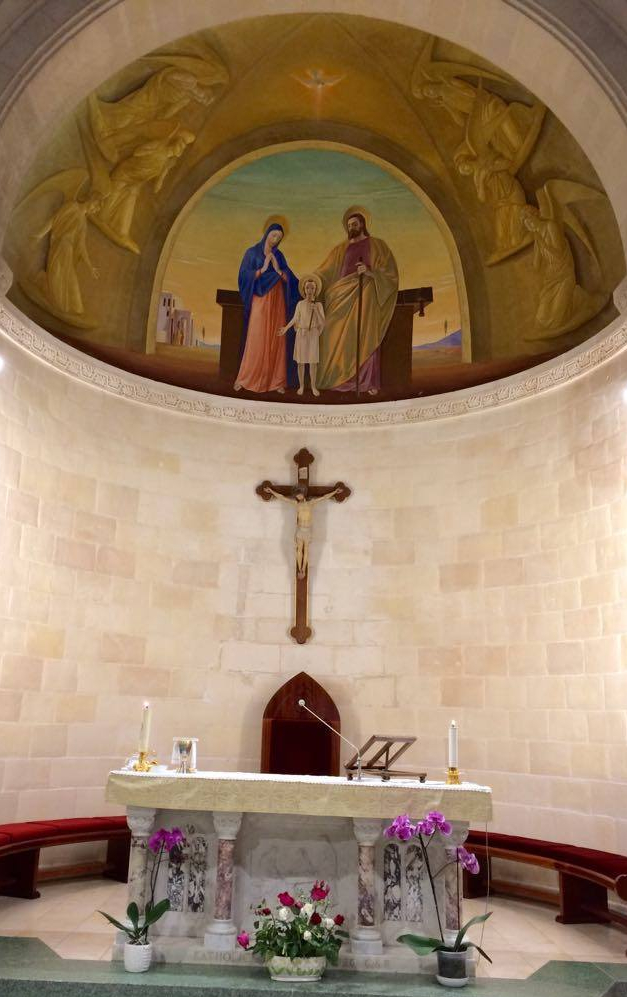
Photo by author, Chapel of St. Joseph, Nazareth, Israel, May 2017.
Let us be not afraid to talk and converse really as husband and wife, parents and children, brothers and sisters. Help us to be more open and more silent like St. Joseph to hear our family members’ innermost thoughts and feelings again with love and understanding.
Let us be not afraid, O Lord, to seek and work for real peace in our family now disintegrating as we disregard each other, choosing fame and wealth than persons.
Let us be not afraid to reach out also to those living alone like the sick, the elderly, the separated, those abandoned by family and friends or society, those widowed.
Let us be not afraid to share food and money to the needy, time and talent, joy and hope to those living in the margins.
Let us be not afraid to ask for forgiveness, to say again those beautiful words “I am sorry” to those we have hurt in words and in deeds; likewise, let us be not afraid to say also those comforting words “I forgive you” to those who have hurt us in words and in deeds.
Let us not be afraid to show respect anew to our elders. Forgive us, O God, in making disrespect a way of life in our time, in our society, in our government and right in our homes and family as we disregard the dignity of one another.
Let us not be afraid to pray again, to kneel before you, and humbly come to you as repentant sinners, merciful Father.
Let us be not afraid to bring Jesus your Son into this world with your love and kindness, sympathy and empathy so we may be healed of so many brokenness and pains deep within.
Let us not be afraid to be humans again and realize we are not gods, that we cannot control everyone and everything in this world.
Let us be not afraid to be open to you and to others, especially the weak and needy because the truth is, we need you O God and one another.
Please, like St. Joseph, let us not be afraid to wake up to the realities of this life to follow you always in your Son Jesus Christ. Amen.
O blessed St. Joseph, Husband of Mary, pray for us!
Photo by author, site of St. Joseph’s shop in Nazareth beneath a chapel in his honor, May 2017.
Saturday, Feast of the Exaltation of the Cross, 14 September 2019
Numbers 21:4-9 ><)))*> Philippians 2:6-11 ><)))*> John 3:13-17
The Brazen Serpent Monument on Mt. Nebo inside the Franciscan Monastery in Jordan, May 2019.
“We adore you, O Christ, and we praise you. Because by your holy cross you have redeemed the world.”
As we celebrate today the Feast of the Exaltation of the Cross, we widen our gaze on your holy cross, Lord Jesus, that remains standing to remind us of your love and mercy, of your abiding presence and light amidst the many darkness enveloping us today.
When we look around us, when we read the newspapers, watch the TV and listen to the radio, we cannot help but cry, even complain deep within like the Israelites in the wilderness why all the miseries still happening around us with all the killings and injustices going on.
Sometimes, Lord, the powers of evil and sin seem to prevail over the world cast in widespread darkness with all the chaos and confusions going on.
But here lies the beauty of your Cross, Jesus Christ: it does not deny the sufferings and pains caused by our sins that led to your death that still continue to this day and cause our grave sufferings; however, despite this gravity of our sins, your Cross reminds us too of your unending love and mercy.
More powerful than evil and darkness are your love and light, O sweet Jesus made manifest on your Cross.
Grant us that gaze of faith, the look of faith needed by so many of us travelling in this wilderness to always see you Lord who was sent by the Father because he so loved the world that whoever believes in you might not perish but gain eternal life. Amen.
1 Timothy 1: 1-2, 12-14 ><}}}*> ><}}}*> ><}}}*> Luke 6:39-42
From Google.
Thanks be to you, O God our loving Father for this merciful day of Friday. Today, the whole Church praises you with that beautiful Psalm 51, “The Miserere Nobis”.
Have mercy on me, God, in your kindness. In your compassion blot out my offense. O wash me more and more from my guilt and cleanse me from my sin.
My offenses truly I know them; my sin in always before me. Against you, you alone, have I sinned; what is evil in your sight I have done… O see, in guilt I was born, a sinner was I conceived.
From the Breviary
Like St. Paul in today’s first reading, give us the grace of having that “sense of sinfulness” within us, Lord.
So many times, we deny the presence of sin in our lives as we keep on justifying our actions, always having that feeling of uprightness, of never erring. Worst, we have become blind guides you have mentioned, O Lord, in the gospel today.
Give us the grace of a deep sense of sinfulness within us, Jesus, so that like St. Paul and all the other saints who were all sinners before, including Dimas the thief who died with you on the Cross on that Good Friday, we may also have that sense of the Father’s rich mercy.
Garden of Gethsemane, May 2019.
Let us not be blinded by our self-righteousness that make us deny the presence of sin in us that ultimately deny ourselves of your mercy. May we realise that only those who have been forgiven can understand what it means to receive the Father’s mercy. Amen.
Quiet Storm by Fr. Nicanor F. Lalog II, 07 May 2019
We are now traveling to the Mt. Sinai area to cross into Egypt. As I have been telling you, this is my third time in the Holy Land and Yad Vashem, the Holocaust Memorial of Israel. I shall write later of my reflections but below is my email written the first time I came here:
23 June 2005
Shalom everyone!
Until now, I could still feel the impact Yad Vashem had on me.
I would just like to add here a story shared with us by Ronnie before our tour….
Accdg to Ronnie, he acted as a guide to a group of young Americans at the Yad Vashem last summer. They met a Jewish woman who survived the holocaust after their tour and told them firsthand her own experience from the Auschwitz camp.
The young tourists were so touched with her story, of how she had lost her parents, siblings and friends. As she wiped her tears, a young man asked the survivor: have you forgiven the people who killed your family?
And Ronnie said, the woman replied this way:I could only forgive if you would always remember.
We were also so touched with the story and the woman’s declaration: I could only forgive if you would always remember.
One of my favorite philosopher is Martin Heidegger, a German existentialist who, unfortunately, was blinded by Hitler’s rhetorics in the beginning but later denounced Nazism.
According to Heidegger, we are all “beings of forgetfullness”; he explained that this is the main reason why we always lead “inauthentic living.”
And that is true. We always have to remember the past not to take tally of how we were hurt or maltreated by others; we remember the painful past so that we would not repeat it and do them again onto others.
It is so sad that in our lives, we keep on remembering how we got inflicted with wounds so that we could wound others; hence, what we have is a vicious circle of violence and retributions.
That I think is the essence of “learning from history”—-of not repeating the same mistakes over and over again.
This is often at the root of many of our problems in our dealings with other people: parents, priests, teachers, supervisors or almost anyone who always remember the difficulties they have gone through when they were younger; we are sometimes guilty of harking at our painful past and get even with those presently under us. And the pains and the hurts increase, forgetting the lessons that could have been learned.
Our country is in deep, deep, deep crises because we are mostly “beings of forgetfullness”—we have a poor sense of history, we can’t remember the lessons of the past because we did not learn at all or just maybe, preoccupied with getting even or vengeance.
Forgiving does not mean forgetting because that is impossible; God programmed us to always remember so that we could become more loving, more forgiving, more understanding, and more like Him in seeing what’s good in everyone.
At the back of Yad Vashem is a breathtaking view of Jerusalem below. After seeing and somehow experiencing the horrors of the Holocaust, I can’t help thinking how come God could accept and allow the Jews, Moslems, and Christians live together in His old city when we can’t even stand the sight or the smell of the person next to us because he is not of same color or creed with us?
God bless!
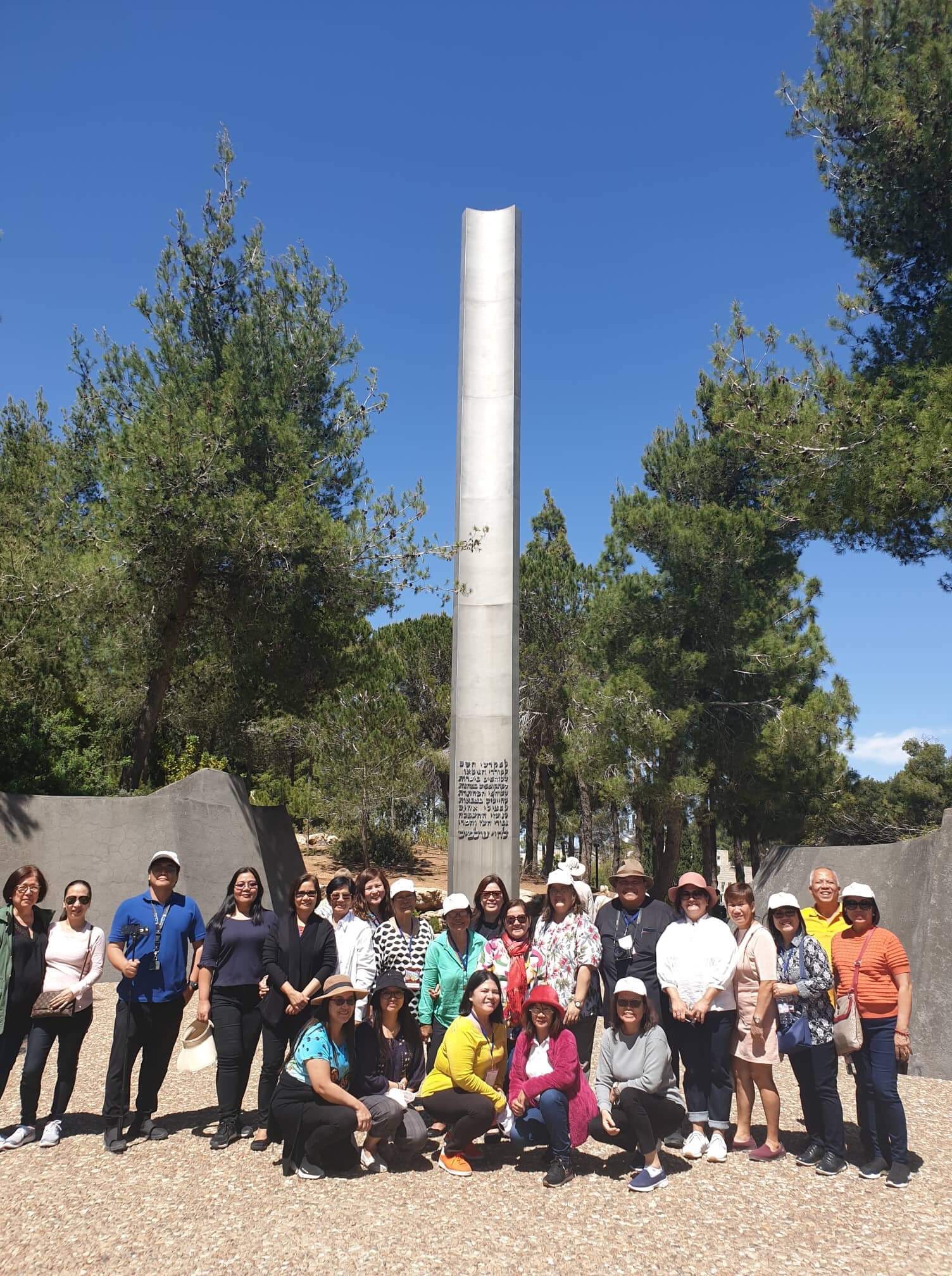
With my parishioners the other day at Yad Vashem. Many cried at the sights in the museum but we were all touched with the personal story and reflections of our guide, a 70 year old man we fondly call Lolo Mendy. Will write his stories later.
40 Shades of Lent, Tuesday, Week III, 26 March 2019
Daniel 3:25, 34-43///Matthew 18:21-35
Praise and glory to you, O Lord Jesus Christ!
Here we are now O Lord being confronted by this topic of sin and forgiveness. Every day we pray the “Our Father” and you know very well how mechanical it had become for us asking God “to forgive us our sins as we forgive those who sinned against us.”
Like Peter, we often feel at a loss at how to forgive those who have hurt us. No… not just hurt or wronged us but, hurt or wronged us so deeply.
The pain is so deep in our hearts, Jesus. And that is why you want us all to forgive from our hearts, not from our lips or from our minds but from our hearts where the pains hurt us most.
We really do not know how. Your parable seems inadequate though you make an absolutely valid point of forgiving others because we have been forgiven too.
Like Daniel your prophet in the Old Testament, we beg you to “Deliver us by your wonders” – surprise us O Lord with your gentle mercy, with your kindness that like you we may be moved to forgiving those who have terribly wronged us. Amen.
















 lordmychef.com